Piazza Mattei
In short. Piazza Mattei is in the Sant'Angelo rione, in Rome's historic center, between Via dei Funari, Via della Reginella and Via Paganica, a few minutes' walk from Largo di Torre Argentina.
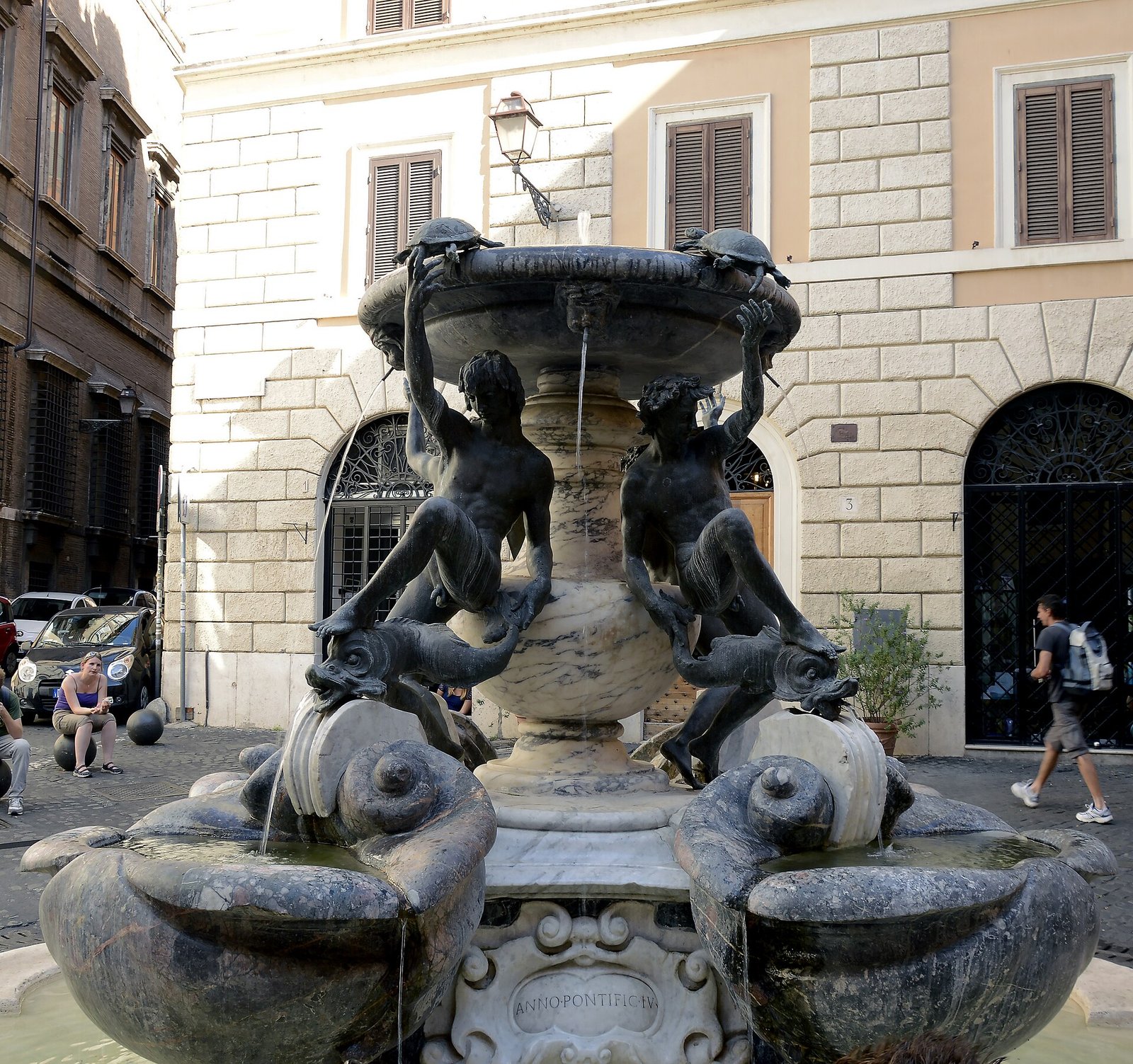
Piazza Mattei is in the Sant'Angelo rione, in Rome's historic center, between Via dei Funari, Via della Reginella and Via Paganica, a few minutes' walk from Largo di Torre Argentina. It's public land of Roma Capitale: you cross it for free, at any hour, without a ticket and without a reservation. At the center is the Turtle Fountain. Around it close in the palaces of the Mattei family and Palazzo Costaguti, which are seats of institutes or private residences and are seen from the outside.
The piazza is small and irregular, a trapezoid of paving squeezed between tall façades, on the northern edge of what was once the Ghetto enclosure. Whoever arrives for the fountain usually takes a photo and leaves. It's a mistake, because the piazza is the entry point to the Mattei "island," an entire block of 16th- and 17th-century palaces built by a single family, with inside one of the richest antiquarian courtyards in the city.
Data verified on September 29, 2026 on the Ministry of Culture libraries portal, for the Biblioteca di storia moderna e contemporanea, on the website of the Centro Studi Americani, on the pages of the Soprintendenza Speciale di Roma for the restorations of Palazzo Mattei di Giove and on the Roma Capitale tourist portal, for Palazzo Costaguti. The piazza has no opening hours. The institutes overlooking the block, on the other hand, have their own hours, listed later in the text.
At a Glance: Address, Hours, Ticket
- Address: Piazza Mattei, Sant'Angelo rione, Rome, between Via dei Funari, Via della Reginella and Via Paganica.
- Operator: public land of Roma Capitale. Palazzo Mattei di Giove is state-owned, Palazzo Costaguti (no. 10) is private.
- How to get in: the piazza is open, reached on foot from the alleys around it.
- Price: free, no ticket and no reservation.
- Hours: always accessible. Biblioteca di storia moderna e contemporanea at Via Michelangelo Caetani 32 open Monday and Friday 8:30-16:30, Tuesday through Thursday 8:30-19:30, only for registered adults.
- Getting there: on foot from Largo di Torre Argentina or from Portico d'Ottavia, bus and tram lines per the ATAC route planner.
- Accessibility: the data is not published by Roma Capitale, the piazza is flat and paved with sampietrini.
Where It Is and What You Actually See
The piazza occupies a widening in the Sant'Angelo rione, between Via delle Botteghe Oscure to the north and the Portico d'Ottavia to the south. From Largo Argentina you get there in a few minutes. Via della Reginella connects it in a straight line with Via del Portico d'Ottavia, that is with the main street of the old Jewish Ghetto. The rest of the alleys lead toward Campitelli and toward the Tiber.
At the center is the Turtle Fountain, with the four bronze ephebes and the turtles on the rim of the basin. It's the only element almost everyone photographs. The history, restorations and legend of the fountain are told on its dedicated page, and we don't repeat them here. What's worth doing instead is looking up at the palaces, because they're what give the piazza its name and explain why such a refined fountain ended up in such a tight corner.
On the side facing the fountain stretches the palace of Giacomo Mattei, with two doorways at nos. 17 and 19. The one on the right, at no. 19, has a white marble portal from the late 15th century with the Mattei coat of arms. The one on the left, at no. 17, attributed to Nanni di Baccio Bigio, has gray marble columns. It's the oldest core of the block: a document from 1495 records it as "House of Domenico Mattei."
At the corner with Via della Reginella, at no. 10, rises Palazzo Costaguti, recognizable by its rusticated arched portal. The Roma Capitale tourism portal states that the palace is closed to the public and can be seen only from the outside. Inside are rooms frescoed by Guercino, Domenichino, the Cavalier d'Arpino and the Zuccari, which no ordinary visitor can see. From the piazza what remains is the plain façade, with the door almost always closed.
Behind Giacomo Mattei's palace, toward the north and east, the other buildings of the island stretch out: Palazzo Mattei di Paganica, Palazzo Caetani on Via delle Botteghe Oscure and Palazzo Mattei di Giove between Via dei Funari and Via Michelangelo Caetani. From the piazza you can't see them together, because the alleys break up the view. You understand them by walking around the block, which takes a quarter of an hour and pays off more than stopping in front of the fountain.
The piazza has the life of an inhabited corner of the historic center. There are doorways of private homes, a few ground-floor businesses, outdoor tables in the warm season. In the evening it's frequented by residents and by people heading out to dinner in the neighborhood. In the middle hours of the day visitors arrive in waves, often all together, and the space around the fountain fills up quickly. The rest of the time the piazza goes quiet again.
A Curiosity About Piazza Mattei
The façade of Giacomo Mattei's palace, the bare one you see today from the fountain, was painted in the mid-1500s. Taddeo Zuccari decorated it with stories of Furius Camillus, the Roman commander, in monochrome, that is with figures in a single color imitating stone relief. Nothing of those paintings remains. The façade you see is light plaster, and you have to imagine it covered in battle scenes like the painted houses that were once common in Rome.
On that same façade there's a walled-up window. The best-known legend of the piazza is tied to it, that of the duke who had the fountain built in one night to convince his future father-in-law. The full story is on the page about the Turtle Fountain. Here it's enough to know where to look: the closed window is a detail almost nobody notices, because those who arrive look down at the water and not up at the windows.
The second curiosity concerns the name of the block. The Mattei didn't have one palace but five, built one next to the other by different branches of the same family, between the end of the 15th century and the early 17th century. The result is a building block enclosed between four streets, which historiography calls the Mattei "island." Piazza Mattei is the only true open space of this block, and for that reason it has become its recognized gateway.
There's also a paradox in the place names. The most famous piazza of the island bears the family's name, but the open space behind Palazzo Mattei di Paganica is called Piazza della Enciclopedia Italiana, because the institute that publishes the encyclopedia is based there. In a few meters you thus go from a 15th-century family name to a 20th-century institution name, without the façades really changing. The neighborhood changed function, not appearance.
Something Nobody Tells You About Piazza Mattei
The piazza was not always outside the Ghetto. In the early 19th century Pope Leo XII enlarged the enclosure of the Roman Jews and included the stretch between Via della Reginella and Via di Sant'Ambrogio up to Piazza Mattei. To close off the new area, more gates were added, among them the Reginella gate. For a few decades, therefore, the Ghetto boundary ran right on the edge of this piazza, and the residents of the houses on Via della Reginella lived inside the enclosure.
The sign of that boundary can still be seen on Palazzo Costaguti. Its original entrance faced Via della Reginella, between nos. 29 and 30, where a marble frame remains that now frames a barred window. When the enclosure was enlarged, the palace moved its main entrance to Piazza Mattei, so as to remain outside the rules of the Ghetto. The arched portal you see on the piazza is the direct consequence of that choice.
The third thing almost nobody says concerns Palazzo Mattei di Giove. The big courtyard full of ancient reliefs is not on Piazza Mattei but around the corner, with entrances on Via dei Funari and on Via Michelangelo Caetani at no. 32. Whoever stops at the fountain and doesn't turn the corner misses the richest part of the block, which is also the least photographed in the rione, because it can't be seen from the street.
What Is the Mattei "Island" and How Do You Read It?
The island is made up of several palaces that the Mattei family built or rebuilt over about a century. The oldest is Giacomo Mattei's on Piazza Mattei, documented as early as 1495 and renovated in the mid-1500s, when Giacomo unified the two buildings that composed it. It's also the most modest in appearance, and for that very reason goes unnoticed. The name of the piazza comes from him, not from the larger palaces built later.
On the western side is Palazzo Mattei di Paganica, built starting in 1540 under the direction of Nanni di Baccio Bigio, perhaps to a design by Vignola. Today it houses the Istituto della Enciclopedia Italiana, and faces the piazza that bears the Encyclopedia's name. It's the palace you meet arriving from Via delle Botteghe Oscure, and its façade is the most regular of the block, with aligned windows and little decoration.
Along Via delle Botteghe Oscure stretches the palace of Alessandro Mattei, built between 1545 and 1564, with an attribution still debated. In 1776 it was bought by Francesco Caetani, Duke of Sermoneta, for 39,500 scudi, and since then it has been called Palazzo Caetani. Today it houses the Embassy of Brazil to the Holy See, the Fondazione Camillo Caetani, the Fondazione Roffredo Caetani and the Rome delegation of the FAI. You can't visit it with a ticket.
The last and largest is Palazzo Mattei di Giove, between Via dei Funari and Via Michelangelo Caetani. Carlo Maderno designed it for Asdrubale Mattei, Duke of Giove, starting in 1598. In 1613 work began on the wing linking it to Alessandro's palace, and the works were completed in 1618. It's the palace that contains the antiquarian courtyard, the staircase decorated with sculptures and the rooms frescoed by the most sought-after painters of early 17th-century Rome.
Read together, the palaces tell of a family that expands without ever leaving the neighborhood. Instead of buying land elsewhere, the Mattei built next to home, branch after branch, until they occupied an entire block. To understand the sequence, start from the piazza, go up Via Paganica toward Botteghe Oscure, turn onto Via Caetani and come back along Via dei Funari. In 15 minutes you do the complete loop.
What Can You See of Palazzo Mattei di Giove?
The main courtyard has a two-tier loggia. The side walls are covered with ancient bas-reliefs set in stucco frames, with male Roman statues along the sides. The four-flight staircase is decorated with ancient sculptures and stuccoes by Donato Mazzi, executed between 1606 and 1611, and holds some of the most beautiful Roman sarcophagi of the Mattei collection, including the one with Mars and Rhea Silvia. In the upper loggia are large busts of emperors.
A second courtyard, smaller and treated as a garden, has a fountain with a grotesque mask. On the first floor the rooms are frescoed by Francesco Albani, Domenichino, il Pomarancio, Giovanni Lanfranco, Pietro da Cortona, Paul Bril and other early 17th-century painters. These rooms are offices and spaces of the institutes, and they do not appear to be open to ordinary visits. What an ordinary visitor can hope to see is the courtyard, and only when the entrance is open.
The palace has been state-owned since 1938. At the start of the 19th century the male line of the Mattei di Giove had died out, and the building had passed to Marianna Mattei, who brought it as a dowry to her husband Carlo Teodoro Antici of Recanati. For this reason in the sources it also appears as Palazzo Antici Mattei. The Ministry of Culture states that the Biblioteca di storia moderna e contemporanea moved here in 1937, and the sources do not agree on the exact year of the state purchase.
Today the palace houses several institutes. The Soprintendenza Speciale di Roma lists the Istituto centrale per il catalogo e la documentazione, the Istituto centrale per i beni sonori ed audiovisivi, the Biblioteca di storia moderna e contemporanea, the Centro Studi Americani and the Istituto storico italiano per l'età moderna e contemporanea. They are places of work and study. The reference address for libraries and institutes is Via Michelangelo Caetani 32.
The palace's main library has a history as long as unified Italy. The Ministry of Culture traces its origins to 1880, when the Chamber of Deputies approved the creation of a collection devoted to the Risorgimento. Between 1921 and 1923 the Biblioteca Museo Archivio del Risorgimento was born, housed for a time in the Palazzetto Venezia. After the reorganization of 1934 the bibliographic section took its current name and arrived at Palazzo Mattei di Giove.
Between 2019 and 2023 the Soprintendenza restored a large part of the palace: the roofs and the façade on Via dei Funari with the entrance in 2019, the entrance corridor from Via Caetani and the loggia façade in 2020, the chapel of Costanza Gonzaga in 2021, the monumental staircase and the Pietro da Cortona gallery in 2023. Work remains underway, according to the same source, on the exterior façade on Via Caetani and on the Lanfranco and Pomarancio rooms.
The Advice I Give You for Visiting Piazza Mattei
My advice is to arrive from the wrong side. Instead of entering from the Reginella with the flow coming from the Ghetto, arrive from Via delle Botteghe Oscure, walk past Palazzo Caetani and go down Via Paganica. That way you see the block first and then the fountain, in the order in which the family built its presence in the neighborhood. The fountain becomes the last piece of a story, and not an isolated monument to photograph in a hurry.
Before arriving it's worth fixing three things to look for on the façades, because there's no panel on the piazza pointing them out. The first is the Mattei coat of arms on the portal at no. 19. The second is the walled-up window of Giacomo Mattei's palace. The third is the rusticated portal of Palazzo Costaguti, to compare afterward with the old entrance frame on Via della Reginella. With these three points the piazza can be read in 10 minutes.
Choose the morning, before 10:00, or the late afternoon. In the middle hours the piazza fills with visitors all concentrated on the fountain, and photographing the façades becomes difficult. If you want to try to see the courtyard of Palazzo Mattei di Giove, go on a weekday during library hours, when the palace is open for work. Ask politely at the front desk and accept a refusal: it's a seat of institutes, not a museum.
One last note. The piazza is in an inhabited neighborhood and the windows are low. In the evening the residents ask for quiet, and the fountain is a 16th-century monument, not a bench: avoid sitting on the rim or resting backpacks on the basin. The best way to enjoy the place is to stand for a few minutes, look up, then continue toward the Portico d'Ottavia or toward Botteghe Oscure.
Do You Need a Ticket or a Reservation?
For the piazza, no. It's a public space open day and night, with no ticket office and no reservation. The Turtle Fountain can be looked at freely, like the façades of the palaces. None of the palaces on the island sells entrance tickets. Palazzo Costaguti is private and closed to the public. Palazzo Caetani houses an embassy and some foundations. Palazzo Mattei di Giove is a seat of state institutes, and the Soprintendenza does not publish a calendar of openings with dates and hours.
The only regular way into Palazzo Mattei di Giove is to use the libraries. The Biblioteca di storia moderna e contemporanea is open to anyone who needs to consult the collections, provided they are an adult and registered according to the library's procedures. The official contact is the phone number 06 6828171 or the email b-stmo@cultura.gov.it. The Centro Studi Americani has its own library, with contact library@centrostudiamericani.org and phone number 06 68801613. The published hours are these:
| Day | Biblioteca di storia moderna e contemporanea | Centro Studi Americani Library |
|---|---|---|
| Monday | 8:30-16:30 | 10:00-17:30 |
| Tuesday | 8:30-19:30 | 10:00-17:30 |
| Wednesday | 8:30-19:30 | 10:00-17:30 |
| Thursday | 8:30-19:30 | 10:00-17:30 |
| Friday | 8:30-16:30 | 10:00-14:30 |
The Biblioteca di storia moderna e contemporanea notes reduced hours from late July through the end of August, without giving exact dates on the ministry portal. The Centro Studi Americani does not publish summer closures on its contacts page. There are no tickets to buy and no tourist product dedicated to the piazza: be wary of anyone selling an "entrance" to Piazza Mattei. Whoever wants a tour of the Ghetto with a licensed guide will find the offering on the pages of the nearby museums.
Another Well-Known Fact, Yet Rarely Mentioned
It's known that Caravaggio worked for the Mattei. Less often mentioned is where. Between 1601 and 1602 the painter was a guest in the palace of Alessandro Mattei, that is the present Palazzo Caetani, a few meters from the piazza. For the family he painted the Supper at Emmaus, a St. John the Baptist and the Taking of Christ. None of these canvases stayed in the Mattei collection, and today they are kept elsewhere.
The detail changes how you look at the block. The canvases that made the Mattei collection famous were painted here, in a palace that today houses an embassy and that is seen only from the street. Whoever follows an itinerary on the painter finds the Roman works in the churches and museums listed on our page about Caravaggio in Rome. The Mattei palace remains an address without paintings, but it's the place where those paintings were born.
The Mattei collection was not made only of painting. The ancient sculptures seen in the courtyard of Palazzo Mattei di Giove were part of a broader patrimony, distributed among the city palaces and the villa the family owned on the Caelian Hill, today a public park with the name of Villa Celimontana. Part of the antiquities was sold and dispersed in the 18th century. What remains in the courtyard is a fragment, but it has stayed in its place.
The Right Photo to Take at Piazza Mattei
The classic shot is the fountain from three-quarters, with one of the ephebes in the foreground and the turtles on the rim of the basin. The more interesting one is another: stand at the mouth of Via della Reginella and frame the fountain with the façade of Giacomo Mattei's palace behind it. That way the photograph holds together the water, the family that wanted it and the alley that for decades marked the Ghetto boundary.
For the portal of Palazzo Costaguti you need morning light, when the façade isn't in shadow. The rustication of the arch looks good in raking light. For Giacomo Mattei's palace it's best to frame the two doorways at nos. 17 and 19 together, so you see the difference between the 15th-century white marble and the gray columns of the 16th century. They are two different eras of the same house, a few meters from each other.
If the main door of Palazzo Mattei di Giove is open and the front desk allows it, the photo of the entrance hall toward the courtyard, with the ancient reliefs on the walls, is worth more than any shot of the fountain. Don't enter the institutes' spaces and don't photograph people at work. If the door is closed, the façade on Via dei Funari, restored in 2019, photographs well in the afternoon, when the light runs down the street.
In the evening the piazza changes. The fountain is lit from below and the façades stay in half-light, so the bronze of the ephebes stands out against the dark background. It's the best moment for a photo without crowds, as long as you give up the flash and respect those who live on the lower floors. A small tripod helps, but in the narrow alleys it should be used without blocking the way and without occupying the entrances of the homes.
How Do You Get There from the Center of Rome?
On foot is the simplest way. From Largo di Torre Argentina you cross Via delle Botteghe Oscure and enter the Sant'Angelo rione, reaching the piazza in a few minutes. From the Portico d'Ottavia you go up Via della Reginella. From Piazza Venezia the route goes along Via delle Botteghe Oscure and takes about 10 minutes at an easy pace, all flat.
Largo Argentina is one of the main public transport hubs of the center, served by many public transport lines. The lines change often because of works, detours and events, so the advice is to use the route planner on the website of ATAC, Rome's public transport company, entering Piazza Mattei as the destination. From Largo Argentina on you proceed on foot, because the streets of the rione are narrow and inside the limited traffic zone.
Driving is not worth it. The piazza is in the limited traffic zone of the historic center, and parking nearby is scarce and almost all reserved for residents. If you arrive by taxi you can be dropped on Via delle Botteghe Oscure or on Via Arenula and do the last stretch on foot. Shared bikes and scooters can be found in the area, but the sampietrini of the alleys make them uncomfortable.
For those in a wheelchair or with a stroller, Roma Capitale does not publish accessibility data for the piazza. The route from Largo Argentina is flat, but the paving is almost everywhere sampietrini, the sidewalks of the alleys are narrow or absent and the curbs change height often from one stretch to the next. Arriving from the wider Via delle Botteghe Oscure is the most comfortable. The institutes on Via Caetani give their own contacts for access information.
Some Important Events That Happened Here in History
The first useful date is 1495, when a document records the "House of Domenico Mattei" where Giacomo Mattei's palace now stands. Between 1540 and 1618 the family built or rebuilt the other palaces of the island. In between, from 1581 to 1588, the fountain at the center of the piazza was built. In less than a century, a corner of the rione became one of the most compact noble quarters of Rome.
In 1555 Pope Paul IV established the Ghetto, confining the Roman Jews within an enclosure along the Tiber, south of Piazza Mattei. In the early 19th century Leo XII enlarged it up to the edge of the piazza, with new gates among them that of the Reginella. The enclosure survived until the end of the popes' temporal power. The full history of the neighborhood and of the community is on the page about the Jewish Ghetto of Rome.
In 1776 Alessandro Mattei's palace passed to the Caetani. At the start of the 19th century the male line of the Mattei di Giove died out, and Maderno's palace passed to the Antici of Recanati. In the 20th century the State acquired it and moved libraries and research institutes there. That is how a family palace, built to show off the owners' antiquities, became a workplace for historians, librarians and archivists.
The last chapter is recent. Since 2019 the Soprintendenza Speciale di Roma has launched a restoration campaign at Palazzo Mattei di Giove, starting with securing the building and the roofs. In four years the entrance on Via dei Funari, the loggia façade, the chapel of Costanza Gonzaga, the staircase and the Pietro da Cortona gallery have become legible again. At the same time the Mattei collection remaining in the palace has been digitized and cataloged.
On May 9, 1978, on Via Michelangelo Caetani, the street running alongside Palazzo Mattei di Giove, the body of Aldo Moro, kidnapped and killed by the Red Brigades, was found. A plaque marks the spot, and every year on May 9 the institutions lay a wreath there. The Quirinale website documents the 2025 ceremony with the President of the Republic. It's a stop of civic memory, to be experienced in silence, a few steps from the piazza.
Who Has Passed Through Piazza Mattei
Giacomo Leopardi lived in Palazzo Mattei di Giove between November 1822 and April 1823. It was his first stay in Rome, and he was a guest of his uncle Carlo Teodoro Antici, husband of the Mattei heiress and brother of Adelaide, the poet's mother. The young poet from Recanati was thus living in one of the richest palaces of the neighborhood, with the courtyard full of antiquities under his windows, among stuccoes, sarcophagi and busts of emperors.
Caravaggio, as mentioned, was a guest of Alessandro Mattei's palace between 1601 and 1602. Before him, in the mid-1500s, Taddeo Zuccari had painted the façade of Giacomo Mattei's palace. In the early 17th century Francesco Albani, Domenichino, Giovanni Lanfranco, Pietro da Cortona and the Flemish painter Paul Bril worked in the rooms of Palazzo Mattei di Giove. Few piazzas in Rome have seen so many leading painters pass through in so few meters.
Among the patrons, the name to remember is Asdrubale Mattei, Duke of Giove, third son of Alessandro. It was he who called Maderno and had the largest palace of the island built. His wife was Costanza Gonzaga, and the chapel that bears her name, inside the palace, was restored by the Soprintendenza in 2021. Behind the Mattei collections and building sites there are therefore specific people, with documented names and dates.
Among the architects, Nanni di Baccio Bigio worked on the Paganica palace and perhaps on Alessandro's. Carlo Maderno, the same who signed the façade of St. Peter's Basilica, designed Palazzo Mattei di Giove. Carlo Lombardi reworked Palazzo Costaguti for its new owners. Giacomo della Porta and the Florentine Taddeo Landini worked on the fountain, and the rest of the story is told on its dedicated page.
Cinema and television have also passed through here. In 1971 Palazzo Mattei di Giove was one of the filming locations of the TV serial Il segno del comando, and later Costa-Gavras used the palace and the surrounding alleys for the Rome scenes of the film Amen. Other sets of the city are on our page about Rome in the Movies. Filming still happens in the neighborhood, and you may find the alleys occupied by crews.
What Is the Relationship Between the Square and the Ghetto?
Piazza Mattei is not a piazza of the Ghetto, even though many tourist sites present it that way. For almost three centuries the enclosure lay farther south, along the river. Only with the enlargement ordered by Leo XII in the early 19th century did the boundary reach this far. The piazza was therefore for a long time a frontier place: on one side the Mattei palaces, on the other the alleys closed by gates that were barred at night.
The relationship can still be read today by walking. From Via della Reginella you go down toward Via del Portico d'Ottavia, where the life of the Jewish community, the shops and the places of worship are concentrated. In a few minutes you reach the Synagogue of Rome and the Jewish Museum of Rome, which have their own hours, tickets and guided tours. It's the most natural route for those starting from the piazza.
The neighborhood also preserves the memory of the 20th century. On October 16, 1943 the Nazis rounded up the Roman Jews in the neighborhood around the Portico d'Ottavia. Whoever wants to understand that history finds the information on the page about the Shoah Museum of Rome and on our page about the places of memory in Rome. Walking through the rione's alleys, one simple rule applies: the signs of memory are looked at with respect, without turning them into a backdrop for a photo.
Our opinion is that the piazza should be read as a hinge, neither as an appendix of the Ghetto nor as an isolated noble salon. On one side the Mattei island, with the collections and palaces of a family that built to be seen. On the other the Jewish community's neighborhood, closed for centuries by gates and rules. The fountain sits exactly in the middle, and that is why it tells the story of the city better than many larger piazzas.
What Do the Documents Say and What Is Told?
The documents say that the Mattei house on this piazza existed in 1495, that Giacomo's palace was renovated in the mid-1500s, that the façade was painted by Taddeo Zuccari and that the fountain was built between 1581 and 1588 to a design by Giacomo della Porta, with bronzes by Taddeo Landini. They also say that the Ghetto boundary reached the piazza only in the early 19th century, under Leo XII.
For Palazzo Costaguti the documents are just as clear. It was built in the mid-1500s for Costanzo Patrizi, treasurer to Pope Paul III Farnese, and in 1578 passed to the Costaguti, a family of Ligurian bankers. The sources do not agree on the details of the origin: one speaks of descendants of Genoese bankers, another of a family from Rapallo settled in Rome in the 16th century. For the new owners the architect Carlo Lombardi redesigned the building.
Local tradition, on the other hand, ties the fountain and the walled-up window of Giacomo Mattei's palace to a gambling duke who supposedly wanted to impress his future father-in-law. It's the story told most often on the piazza, and it's the one found on almost all tourist sites. The full version, with what the dates say, is on the page about the Turtle Fountain.
The name of Via della Reginella also has two explanations, both without documentary proof. The first links it to an ancient temple of Juno Regina that supposedly stood in the area. The second speaks of the most beautiful girl in the neighborhood, called, precisely, Reginella. Neither is confirmed by an archival source, and the story of the girl has the typical flavor of rione tales. It counts as color, not as history.
What's Around, Between Botteghe Oscure and the Tiber?
To the north, on Via delle Botteghe Oscure, is the Crypta Balbi, the seat of the Museo Nazionale Romano that tells the stratification of a block from antiquity to the Middle Ages. It's the ideal complement to Piazza Mattei, because it shows what was under the palaces before the great families. A little farther west opens Largo Argentina with the Republican sacred area and the Teatro Argentina.
To the south, beyond the Portico d'Ottavia, you reach the Theater of Marcellus and then the Tiber, with the Tiber Island reachable on foot in a few minutes. Continuing along the river you enter the area of the Forum Boarium, with the Mouth of Truth and the church of San Nicola in Carcere halfway.
To the west, once across Via Arenula, the Regola rione begins. In a quarter of an hour on foot you reach Campo de' Fiori, Piazza Farnese, the Galleria Spada and Via Giulia, with the Fontana del Mascherone at the end of the street. It's a route of fountains and noble palaces that naturally continues that of the Mattei island.
To the east, going up toward Campitelli, you reach in a few minutes Piazza Venezia and the Capitoline Hill, with the Capitoline Museums. Whoever has time can combine the piazza with Palazzo Venezia and its museum. The whole Sant'Angelo rione is also told on our page about the 22 rioni of Rome, useful for understanding how the historic center is organized.
When Is It Closed and What Not to Expect?
The piazza never closes. It can be fenced off for a few hours during work on the fountain, film shoots or paving maintenance, but Roma Capitale doesn't publish a calendar of closures. The fountain may be without water during cleaning or restoration work. In those cases it remains visible, but loses a large part of its effect. If you care about seeing it running, come by again another day.
Allow for construction sites too. The Soprintendenza lists as still underway the work on the exterior façade of Palazzo Mattei di Giove along Via Caetani and on the rooms frescoed by Lanfranco and Pomarancio, in addition to projects funded by PNRR funds. Scaffolding and fencing may cover part of the façades for months. They don't change access to the piazza, but they can ruin the photo you had in mind.
Don't expect to get into the palaces. Palazzo Costaguti is private, Palazzo Caetani houses an embassy and some foundations, Giacomo Mattei's palace has no visitor entrance. Palazzo Mattei di Giove is open for work on weekdays, but mere visitors' access to the courtyard is not regulated by a published schedule. The published library hours do not include Saturday and Sunday, and on weekends the palace's doors are normally closed.
Don't expect explanatory panels or a marked route either. On the piazza there are no signs telling about the Mattei island or the Ghetto boundary. Everything there is to understand has to be read on the façades: the portals, the walled-up window, the Mattei coat of arms at no. 19, the marble frame on Via della Reginella. A small piazza with no signs asks for a minimum of preparation before arriving, otherwise it remains just a pretty fountain.
Eating in the Area
The Sant'Angelo rione and the nearby Ghetto are full of restaurants, and some of them live off tourist traffic. The traps are the typical ones of the center: the barker who stops you on the sidewalk, menus with photographs of the dishes in four languages, items with no price or with the price marked as quoted verbally, different menus between the outside board and the card at the table. With these rules you avoid the worst.
Then there's the case of places in front of monuments, which adapt the price to the customer, and of those open continuously from morning to night without a kitchen break. Romans don't go to them for a simple reason: they know that a kitchen that's always working, without a closing between lunch and dinner, rarely prepares dishes to order. It's not snobbery. It's the same distrust toward fresh pasta laid out in the window as a lure for passersby.
My advice is to move a few streets away from the most photographed spots and look for places frequented by residents on weekdays, with a short menu and prices written out. For those who want to start from already selected addresses, between the Ghetto, Regola and Trastevere, there's the list of addresses on Google Maps, to be consulted before sitting down and always compared with what you see on the spot, starting with the posted prices.
What to Combine in the Same Day
The most logical pairing is the Ghetto. From the piazza you go down Via della Reginella to the Portico d'Ottavia, visit the Jewish Museum with the Synagogue and end at the Theater of Marcellus. They are all a few minutes from one another, and in one morning you see the neighborhood at leisure. For the afternoon you can continue toward the Tiber Island and Trastevere, crossing Ponte Sisto or Ponte Fabricio.
A second pairing follows the thread of fountains. From the Turtle Fountain you walk toward Piazza Navona, with the Fountain of the Four Rivers, and then toward the Pantheon. It's a way to see how Roman Baroque used water in its piazzas. The stops on this route are also gathered on our page about Baroque Rome and on the one about Bernini in Rome.
A third route follows the Mattei. From the piazza you go up the Caelian Hill to Villa Celimontana, the family's villa, now a public park, and end the day in the green. The trip is long and it's best to do part of it by public transport. Whoever prefers to stay in the center can instead aim for the Crypta Balbi and then the Capitoline Hill, an all-on-foot itinerary that combines archaeology, noble palaces and museums.
Those traveling on a small budget will find in the piazza a perfect free stop. It pairs well with the other no-ticket stops gathered on our page about Free Rome, from fountains to piazzas, to churches open for worship. On hot days it's also worth knowing the nasoni of Rome and the neighborhood drinking fountains, for drinking cool water during the walk.
Frequently Asked Questions
Do You Pay to Visit Piazza Mattei?
No. It's a public piazza of Roma Capitale, open day and night, with no ticket and no reservation. The Turtle Fountain can be looked at freely. The palaces overlooking the piazza don't sell tickets: Palazzo Costaguti is private and closed to the public, the others are seats of institutes, foundations, residences or an embassy. Nobody can ask you for payment to stand on the piazza or photograph the fountain.
Can You Enter the Courtyard of Palazzo Mattei di Giove?
The palace is a seat of state institutes and the Soprintendenza does not publish a visiting schedule for the courtyard. Regular access is that of the libraries, at Via Michelangelo Caetani 32, on weekdays and for registered adult users. On weekdays, with the door open, you can ask politely at the front desk. For official information the contact is the Biblioteca di storia moderna e contemporanea, phone number 06 6828171, email b-stmo@cultura.gov.it.
Can You Visit Palazzo Costaguti?
No. The Roma Capitale tourism portal states that the palace, at no. 10 on Piazza Mattei, is closed to the public and can be seen only from the outside. The rooms frescoed by Guercino, Domenichino, the Cavalier d'Arpino and the Zuccari therefore remain invisible to the ordinary public. From the piazza you see the rusticated arched portal, and from Via della Reginella the old entrance frame turned into a barred window.
Is Piazza Mattei Part of the Ghetto?
Not originally. The Ghetto established in 1555 was farther south, along the Tiber. In the early 19th century Pope Leo XII enlarged the enclosure up to Piazza Mattei, including the stretch between Via della Reginella and Via di Sant'Ambrogio and adding new gates. For this reason today the piazza is often presented as part of the Ghetto. It's more correct to consider it its northern boundary, between the Jewish neighborhood and the Mattei island.
What Is the Mattei Island?
It's the block formed by the palaces that the Mattei family built between the late 15th century and the early 17th century: Giacomo Mattei's palace on Piazza Mattei, Palazzo Mattei di Paganica, Alessandro Mattei's palace now Palazzo Caetani and Palazzo Mattei di Giove. It's in the Sant'Angelo rione, between Via delle Botteghe Oscure, Via dei Funari and Via Michelangelo Caetani. The walk around the block takes about a quarter of an hour.
Where Is Via Caetani and What Does It Commemorate?
Via Michelangelo Caetani is the street running alongside Palazzo Mattei di Giove, a few steps from the piazza. On May 9, 1978 the body of Aldo Moro, kidnapped and killed by the Red Brigades, was found there. A plaque marks the spot, and every year on the anniversary the institutions lay a wreath. At no. 32 is the entrance to the libraries and institutes of Palazzo Mattei di Giove.
How Long Does It Take to See the Square?
For the fountain alone, 10 minutes are enough. For the piazza with its palaces and the loop around the Mattei island, about half an hour at an easy pace. If you add the walk down Via della Reginella to the Portico d'Ottavia and a visit to the Jewish Museum or the Crypta Balbi, you get a full morning. The piazza works better as the starting point of an itinerary than as an isolated destination.
When Is the Best Time to Go?
Early in the morning on weekdays, before the piazza fills with visitors and before the outdoor tables open. At that hour the light comes in from the side on the façades, the fountain is free and there's also a chance of finding the institutes' doors open. On Saturday and Sunday the piazza is more crowded in the middle hours and the palaces stay closed. Late in the evening it's quiet, but the residents ask for silence.
Who Wrote This and On What Sources
The text comes from the editorial team of Tour Leader Pro, the Rome-based organization that designs itineraries, visits and cultural events across Rome and Lazio. Rates, hours and booking arrangements reported here come from the official sources cited in the text as of the date given at the opening: the Ministry of Culture libraries portal, the Centro Studi Americani website, the pages of the Soprintendenza Speciale di Roma, the Roma Capitale tourist portal and the Quirinale website. Let us know what you find changed.
The piazza fits easily into a day on foot between the Ghetto, Largo Argentina and the Capitoline Hill, but it has practical limits: the space is small, the palaces are residences or office seats and the doors must be left clear. Whoever organizes a visit, for themselves or for others, does well to choose the morning hours and prepare the reading of the façades beforehand. For those organizing group trips, a useful resource is Tour Leader Pro.
Piazza Mattei is one stop on a broader trip to Rome and Lazio, among the rioni of the center, the villas of the Castelli Romani and the villages of Sabina and Tuscia. A couple of days in the historic center are enough for the main piazzas, churches and museums, but the rest of the region asks for time and an orderly plan. A useful resource for putting together a multi-day itinerary is Italy Planner.