Museo della Shoah in Rome
In short. Today the Museo della Shoah in Rome is the exhibition site of the Fondazione Museo della Shoah at the Casina dei Vallati, Via del Portico d'Ottavia 29, in the Ghetto.
Today the Museo della Shoah in Rome is the exhibition site of the Fondazione Museo della Shoah at the Casina dei Vallati, Via del Portico d'Ottavia 29, in the Ghetto. Admission is free, with no ticket. You enter from Sunday to Thursday from 10:00 to 18:00 and on Friday from 10:00 to 13:00, Jewish holidays excluded. On Saturday it's closed. Groups and schools must reserve. The definitive museum, planned at Villa Torlonia, is not open and has no published inauguration date.
At the Casina dei Vallati you don't find a permanent collection in the classic sense, but a sequence of exhibitions curated by the Foundation on the persecution and extermination of the Jews of Europe, with particular attention to Italy and Rome. The exhibition that the Foundation's website lists as current is The End of the Nazi Camps, open since January 24, 2025, curated by Marcello Pezzetti. Alongside the exhibitions the Foundation organizes activities for schools, training courses and memory trips.
Data checked on September 29, 2026 on the website of the Fondazione Museo della Shoah, on the page of the current exhibition, on the entry for the Casina dei Vallati published by the Ministry of Culture and in the press that followed the construction site of the definitive museum. The Foundation does not publish an opening date for the new site. For changes of hours, especially on Jewish holidays, the reference remains the museum's phone, 06 68139598, or the address info@museodellashoah.it given on the website.
At a glance: address, hours, ticket
- Address: Casina dei Vallati, Via del Portico d'Ottavia 29, 00186 Roma, in the Jewish Ghetto.
- Operator: Fondazione Museo della Shoah, which organizes the exhibitions, the activities for schools and the training courses.
- Price: free admission, as the page of the current exhibition published by the Foundation indicates.
- Hours: Sunday to Thursday from 10:00 to 18:00, Friday from 10:00 to 13:00, Jewish holidays excluded. Closed Saturday.
- Reservation: not required for individual visitors, mandatory for groups and schools through the school reservation section of the Foundation's website.
- Contacts: museum 06 68139598, office 06 68805806, info@museodellashoah.it.
- Accessibility: according to the Ministry of Culture the building has three floors, with restrooms and a freight elevator to the first floor.
Where it is and what you actually see
The Casina dei Vallati is at the end of Via del Portico d'Ottavia, the main street of the Jewish Ghetto of Rome, on the side toward the Theater of Marcellus. From the entrance you see the columns of the Portico d'Ottavia and the small square named for October 16, 1943. It's a masonry building of modest size, isolated from the houses of the rione, recognized more by its position than by its facade.
Inside there are no monumental halls. The Ministry of Culture's entry describes three floors with restrooms and a freight elevator serving the first floor. The Foundation's exhibitions fill these rooms with panels, photographs, period films, maps, official documents and direct testimony from survivors. The material is read standing, panel after panel, and requires attention more than space. Anyone who enters expecting objects in display cases, as in an archaeological museum, finds a display made mostly of images and words.
The context matters as much as the display. A few minutes on foot away, on the lungotevere, are the Synagogue of Rome and the Jewish Museum of Rome, which are another institution, with another operator and a paid ticket. The Casina dei Vallati instead tells the 20th century, the persecution and the deportation. Visiting the two sites on the same morning gives a complete picture, from the oldest Jewish community in Western Europe to the Nazi camps.
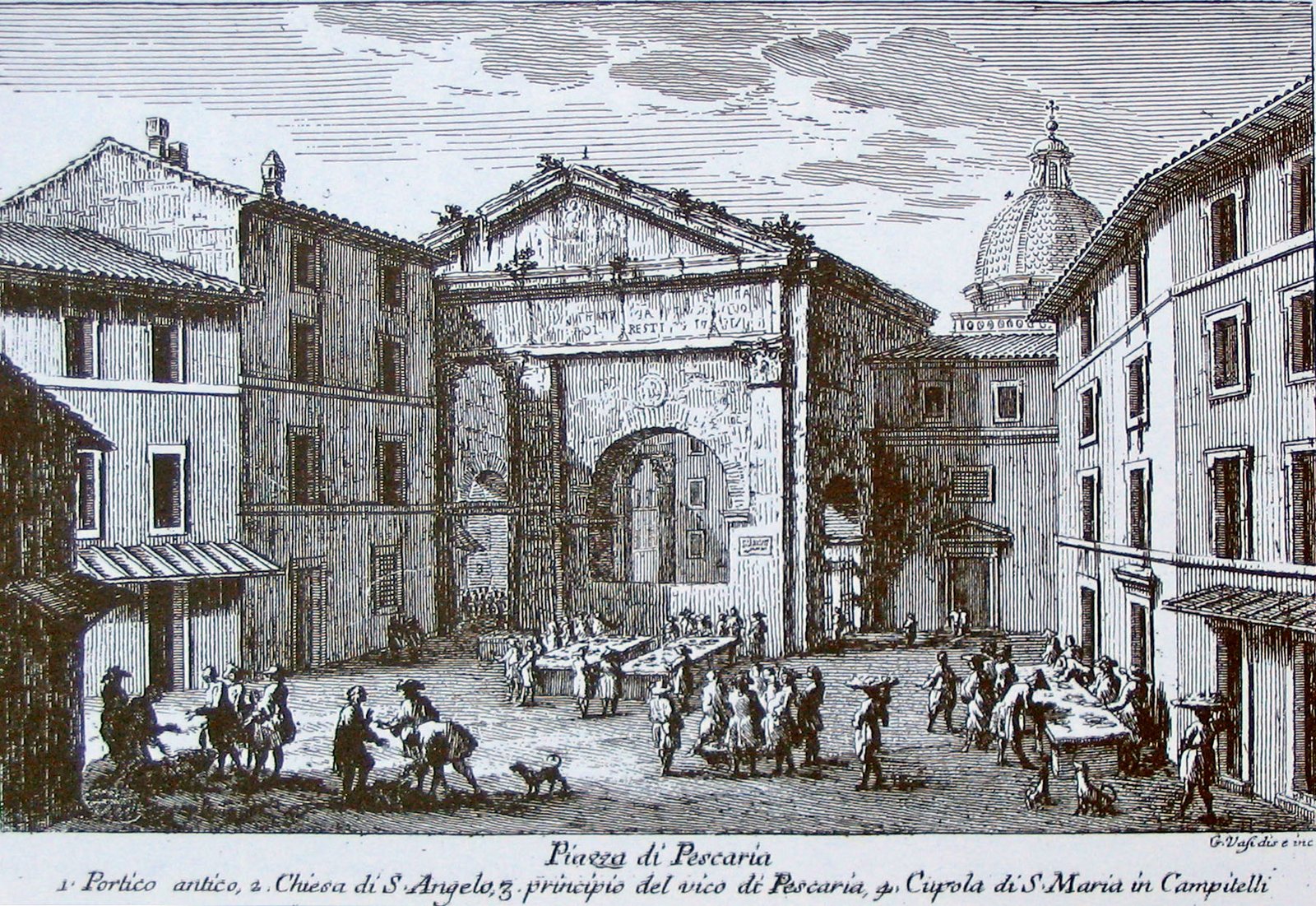
The Ghetto is in the Sant'Angelo rione, one of the 22 historic rioni of Rome, between the Tiber, Via Arenula and the Campitelli rione. The rione's name comes from the church of Sant'Angelo in Pescheria, built among the columns of the Portico d'Ottavia, where the fish market was held for centuries. The Casina dei Vallati occupies the end of the rione toward the Theater of Marcellus, where the houses give way to ancient ruins and to the gaps left by 20th-century demolitions.
A curiosity about the Museo della Shoah in Rome
The building that houses the Foundation exists as you see it because of a destruction. The Ministry of Culture's page explains that the Casina dei Vallati dates to the medieval period and that it was brought back to light during the demolitions begun in the 1920s in the Theater of Marcellus area. The houses that squeezed it were torn down, and the medieval construction was left isolated, just as it appears today at the end of the street.
Those demolitions belong to the season in which the Fascist regime redrew the center of Rome around the ancient monuments, freeing them from the dwellings that surrounded them. A little more than a decade later the same regime passed the racial laws of 1938. That the memory of the persecution is today told in a building that survived the demolitions of those years is not a symbol built on paper, it is a coincidence of place that's worth knowing before you enter.
The name also misleads anyone who arrives without information. People say Museo della Shoah in Rome, but the body that opens the doors is the Fondazione Museo della Shoah, and the Casina dei Vallati is its exhibition site while waiting for the construction of the museum proper. For this reason maps and guides carry different names for the same address: Casina dei Vallati, Fondazione Museo della Shoah, Museo della Shoah. The place is one, at Via del Portico d'Ottavia 29.
One thing nobody tells you about the Museo della Shoah in Rome
It's closed on Saturday, and on Friday it closes at 13:00. It seems like a detail, but it's the most common reason people find the door shut. The calendar follows the Jewish week, with Shabbat beginning on Friday at sunset, and the operator indicates that Jewish holidays are excluded from opening. Anyone who plans the day in the Ghetto on a Saturday, when many Romans go to the center, finds both the Casina dei Vallati and a good part of the life of the Jewish quarter closed.
Then there's a frequent confusion between the two institutions of the neighborhood. The Jewish Museum of Rome, under the Tempio Maggiore, belongs to the Jewish Community, has a ticket office and a visit to the Synagogue included in the route. The Fondazione Museo della Shoah is a distinct body, based at the Casina dei Vallati with free admission. Anyone who buys a ticket for the Jewish Museum thinking they'll also see the exhibitions on the Shoah, or the reverse, has the wrong address. They are two different visits, both useful.
Finally, the exhibitions are not all the same in duration. The Foundation's website lists exhibitions open for years next to temporary ones, with start and end dates. An exhibition seen two years ago may no longer be there, and an outdated travel page may describe a closed display. Before going it's best to open the Exhibitions on site section of the official website and check what is marked as current.
Another practical aspect concerns security. As with the other Jewish sites in the city, in the neighborhood it's normal to see law enforcement posts, and checks may be required at the entrance of community sites. It is not a sign of imminent danger, it is a measure that has been stable for years. It's best to arrive without suitcases or bulky backpacks, carry an ID and allow for a few minutes of waiting, especially on commemoration days and when several classes arrive together.
Which exhibitions can you see at the Casina dei Vallati?
The exhibition that the Foundation's website presents as the main one is The End of the Nazi Camps, opened on January 24, 2025 and curated by Marcello Pezzetti. It tells the liberation of the camps between 1944 and 1945 with photographs, period films, geographic maps, official documents and direct testimony. The sections cover Majdanek, Auschwitz-Birkenau, the death marches, the arrival of the Allies and the camps in Italy, including Bolzano-Gries and the Risiera di San Sabba.
The exhibition page lists a long group of institutional promoters: the Presidency of the Council of Ministers, the Ministry of Foreign Affairs, the Ministry of Culture, Regione Lazio, Roma Capitale, the Metropolitan City of Roma Capitale, the Union of Italian Jewish Communities, the Jewish Community of Rome, the Associazione Figli della Shoah, CDEC and ANED. The page gives no closing date, and as of September 29, 2026 the exhibition is still among those current on the Foundation's website.
In the same section the website marks two other exhibitions as current: From Italy to Auschwitz, opened on January 27, 2021, and October 16, 1943. Geography of a Deportation, opened on October 16, 2021. Among the concluded exhibitions are The Longest Journey, on the deportation to Auschwitz of the Jews of Rhodes and Kos, from September 20, 2024 to January 7, 2025, and The Nazi Hell, on the camps of Belzec, Sobibor and Treblinka, from January 27, 2023 to January 6, 2025.
The choice of themes says a lot about the Foundation's approach. It starts from Italian and Roman history, from the racial laws and the roundup of the Ghetto, and widens the view to the extermination centers of Eastern Europe. The language is that of historical documentation, with no theatrical reconstructions. Anyone looking for an immersive experience is disappointed, anyone who wants to understand dates, places and responsibilities finds dense material, to be read calmly and without hurry.
The exhibition on the deportation of the Jews of Rhodes and Kos, closed in January 2025, dealt with a little-known chapter. The two islands of the Dodecanese were then Italian possessions, and their Jewish communities were deported to Auschwitz in the summer of 1944, with a journey by sea and then by train among the longest of the whole deportation. The title, The Longest Journey, refers to exactly this. That the exhibition is no longer open confirms how much it pays to check the website before going.
A documentary exhibition is read differently from an art collection. It's best to follow the chronological order proposed by the display, without skipping the introductory panels, which give the dates and names needed to understand the photographs. The maps are often the most neglected part and the most useful: they show the distances between Rome, the Italian transit camps and the extermination centers. If time is short, it's better to see one section well than to rush through all the others.
The advice I give you for visiting the Museo della Shoah in Rome
My advice is to go on a weekday, in the morning, between Sunday and Thursday, and to allow a good hour for the main exhibition. Before leaving, open the Exhibitions on site section of the Foundation's website, to know what you'll find, and call the museum if the date falls near a Jewish holiday. Friday remains the worst day: the 13:00 closing leaves little margin if you arrive late.
Then go out and walk. The visit makes sense above all if the story told by the panels connects to the street. In front of the Casina opens the small square of October 16, 1943, and along Via del Portico d'Ottavia and in the nearby streets you meet in the paving the stumbling stones (pietre d'inciampo), small brass plaques set in front of the homes of those who were deported. Reading them after seeing the exhibition changes the way you cross the neighborhood.
If you also plan to visit the Jewish Museum, the order matters. It's best to begin with the Jewish Museum and the Synagogue, which tell centuries of life of the Roman community, and end at the Casina dei Vallati, where that history is broken by persecution. The reverse route works worse, because you arrive at the long history after its hardest chapter. Check the hours of both sites, though, which don't match, and remember that on Friday the Casina closes at 13:00.
In our judgment the most widespread mistake is to put off the visit while waiting for the big museum at Villa Torlonia. The site is provisional, but the exhibitions are curated with rigor and admission is free. Waiting for a new building, with no published opening date, means giving up a visit you can make now, in the neighborhood where the persecution took place. The new museum, when it opens, will tell the same story in a place farther from those streets.
How much does it cost and how do you reserve?
It costs nothing. The page of the exhibition The End of the Nazi Camps reports free admission, and the Foundation's website publishes no fares for individual visitors. The Ministry of Culture's entry adds that for the general public reservation is not required, while for schools it is mandatory through the Foundation's website. Groups, according to the Foundation, must always reserve, even when they are not school classes.
There is therefore no ticket to buy, neither online nor on site, and for this reason you won't find sales links. The only official channel is the website of the Fondazione Museo della Shoah, with the school reservation section for classes and groups. Be wary of anyone offering skip-the-line tickets or paid entry for the Casina dei Vallati: you enter freely during opening hours, with no intermediaries.
| Day | Hours published by the Foundation |
|---|---|
| Sunday | 10:00 - 18:00 |
| Monday | 10:00 - 18:00 |
| Tuesday | 10:00 - 18:00 |
| Wednesday | 10:00 - 18:00 |
| Thursday | 10:00 - 18:00 |
| Friday | 10:00 - 13:00 |
| Saturday | Closed |
The hours in the table are those of the Foundation's website, valid with the exclusion of Jewish holidays. The Ministry of Culture's entry reports different hours for some days, and the sources therefore don't agree. The operator, that is the Foundation, is the authority. For the dates of the Jewish holidays, which change every year according to the lunar calendar, it's best to call the museum at 06 68139598 or the office at 06 68805806 before setting out.
Another well-known fact, yet rarely cited
Almost everyone knows that on October 16, 1943 the Nazis rounded up the Ghetto of Rome. It is less often remembered that the persecution of Jews in Italy had begun five years earlier, by Italian decision, with the racial laws of 1938. Expulsions from schools and universities, dismissals, professional bans, censuses: all this happened before the German occupation, and the lists compiled in those years then weighed on the arrests.
The title of one of the exhibitions listed by the Foundation, From Italy to Auschwitz, goes in this direction: the path of the deportation begins in Italy. The section of the current exhibition devoted to the Italian camps, with Bolzano-Gries and the Risiera di San Sabba, also recalls that the transit and detention camps existed inside the national borders too. It's a part of the story that accounts centered only on the German occupation tend to leave in shadow.
There is a second known fact that is rarely put in line with the others. At the end of September 1943, a few weeks before the roundup, the German command in Rome imposed on the Jewish community the delivery of a large quantity of gold, with the promise of sparing the families. Many Romans, including non-Jews, contributed to the collection, and the gold was delivered within the required time. The promise was not kept: at dawn on October 16 the roundup began anyway, street by street.
The right photo to take at the Museo della Shoah in Rome
The right photo is taken outside, from the street. From the small square of October 16, 1943 you frame the Casina dei Vallati with the profile of the Theater of Marcellus behind it, and turning around you get the columns of the Portico d'Ottavia. It's an image that tells the place without needing explanations: an isolated medieval building, the remains of ancient Rome, the houses of the Ghetto. The best light on the street comes in the morning, when the neighborhood is still quiet.
A second sensible shot is the street seen from the other end, with the perspective of Via del Portico d'Ottavia closing on the ancient columns. It's the street of the neighborhood's daily life, with its shops, schools and benches, and it shows the Ghetto as an inhabited place, not an open-air museum. In these images avoid shooting residents' faces or children coming out of school in the foreground without asking permission.
Inside the exhibition site the operator publishes no rules on photographs, and it's best to ask the staff before shooting. Many displayed images come from archives with their own rights, and the testimony concerns real people and families who still live in the neighborhood. No smiling poses in front of the panels, no selfies on the stumbling stones. The most respectful photograph of a stumbling stone is the one from above, with the name legible, with no feet or shadows over it.
How do you get there from central Rome?
Via del Portico d'Ottavia can be reached on foot from many directions. From Piazza Venezia you go down along Via del Teatro di Marcello and enter the Ghetto from the theater side. From Largo Argentina you cross the streets of Sant'Angelo passing by the Turtle Fountain. From Trastevere you cross the Tiber Island and come out on the lungotevere in front of the Synagogue.
The Foundation's website does not publish bus or tram lines or recommended stops. The right way to choose the vehicle is the Atac route planner or the Roma Capitale information number 060608. The Ghetto is in a limited traffic zone, with narrow streets and sampietrini paving. Arriving by car isn't worth it, and even with a stroller or wheelchair the road surface requires attention in the last few meters.
Anyone arriving from Termini station has an urban trip of a few kilometers ahead, which can be done by public transport to Piazza Venezia or Largo Argentina and then on foot. Here too the lines should be chosen with the Atac planner, which takes into account detours and current construction sites. From Piazza Venezia the walk takes a few minutes and is the simplest way to enter the neighborhood from the Theater of Marcellus side.
For interior accessibility the only published information comes from the Ministry of Culture, which reports a freight elevator to the first floor and restrooms on three floors. The operator does not indicate in detail which exhibition rooms can be reached without stairs. Anyone with reduced mobility needs does well to call 06 68139598 before the visit, to know which spaces of the current exhibition are accessible and if assistance is needed at the entrance.
Some important events that happened here in history
In 1555 Pope Paul IV, with the bull Cum nimis absurdum, established the enclosure of the Ghetto, where the Jews of Rome were obliged to live for more than three centuries. The enclosure fell after the capture of Rome in 1870. Between the end of the 19th century and the early 20th a part of the old houses was demolished, and in 1904 the Tempio Maggiore was inaugurated on the lungotevere. From the 1920s the demolitions around the Theater of Marcellus isolated the Casina dei Vallati.
The current form of the neighborhood depends in large part on those works of the late 19th century. After the flood of December 1870 Rome built the Tiber embankment walls and the new lungotevere, and the capital's urban plan led to the demolition of most of the houses closest to the river. On the cleared areas new blocks rose, and the Tempio Maggiore. Today's Ghetto is therefore what remains of the historic enclosure, smaller and tidier than the one in which the community lived until 1870.
In 1938 the racial laws struck Italian Jews, including Roman ones. At dawn on October 16, 1943 German troops rounded up the Ghetto and other areas of the city: hundreds of people were arrested and deported to Auschwitz, and very few returned. The date today gives its name to the small square in front of the Casina dei Vallati. Every year, on that day, the neighborhood hosts public commemorations, and the Foundation joins them with its own initiatives.
In 2021 the Foundation opens two of the exhibitions still listed as current, on January 27 and October 16, the two dates of memory. On October 18, 2023 the Chamber of Deputies approves the law on the museum to be built at Villa Torlonia, a few days after the 80th anniversary of the roundup. On January 24, 2025 The End of the Nazi Camps opens. On March 14, 2025 the Lazio regional administrative court (TAR) suspends the preparatory works of the construction site on Via Alessandro Torlonia.
January 27, the date the gates of Auschwitz were opened in 1945, is in Italy the Giorno della Memoria, established by law in 2000. It is no accident that the Foundation chose that date, or nearby days, to inaugurate several exhibitions, from From Italy to Auschwitz to The Nazi Hell, up to The End of the Nazi Camps. October 16 is instead the Roman date. Between these two anniversaries a large part of the public calendar of remembrance in the city is concentrated, and the turnout at the Casina dei Vallati too.
Who has passed through the Museo della Shoah in Rome
First of all, the families of the Ghetto. The streets around the Casina dei Vallati are the ones from which the trucks of October 16, 1943 departed, and the names engraved on the stumbling stones belong to people who lived a few meters from the exhibition site. The museum tells a story that took place in exactly those houses. It's a different relationship from that of a museum built far from the events, and anyone who enters senses it right away.
Then the scholars who built the exhibitions. The current exhibition is curated by Marcello Pezzetti, historian of the Shoah named as early as 2013 as future director of the museum and head of the committee for exhibitions and research. Working with him are research bodies and memory associations, including CDEC, ANED and the Associazione Figli della Shoah, cited among the promoters. Finally the schools, which are the largest audience: classes that arrive by reservation and students who take part in the educational programs offered by the Foundation.
The voices of those who returned from the camps also pass through the rooms. The page of the current exhibition cites direct testimony alongside photographs and archive documents. As the years go by the survivors are fewer and fewer, and their words reach visitors through recordings and texts. It's one of the reasons a place like the Casina dei Vallati is needed: it preserves and makes legible a memory that soon can no longer be told by those who lived it.
Where does the Villa Torlonia museum stand?
The definitive museum is not open. The idea of a Shoah museum in Rome dates to the mid-2000s, and the City Council approved the project in 2012. In March 2023 the government announced an allocation of 10 million euros, and on October 18, 2023 the Chamber of Deputies definitively approved the law establishing the museum. The area chosen is that of Villa Torlonia, with the construction site on Via Alessandro Torlonia, in the Nomentano neighborhood.
On March 14, 2025, according to the Adnkronos agency, the Lazio regional administrative court (TAR) suspended the work under way at the construction site, which at that stage concerned clearing unexploded wartime ordnance. Excavation for the building had not yet begun. The appeal had been filed by the owner of two properties in the neighboring building, worried about the risk of landslides linked to a complex system of cavities in the subsoil. The City had to file a technical report by March 19.
A few days earlier, at the beginning of March 2025, the press had reported an antisemitic act against the same construction site, which the Digos investigated. In the following months the Roman press reported the possibility of resuming work after checks on the ground. As of September 29, 2026 neither the Foundation nor other official sources consulted publish a completion date or an opening date for the new museum. Any forecast, until then, remains a journalistic estimate.
Villa Torlonia, moreover, is a place with many layers. Under the park extend the Jewish catacombs of Villa Torlonia, today closed to visitors, and in the Casino Nobile Mussolini lived until 1943. The future museum and the underground cemetery are two distinct projects, with different bodies. Anyone going to Villa Torlonia for the Shoah museum today finds a public park, the villa's museums and a fenced-off construction site.
To follow the progress of the construction site it's best to rely on institutional channels: the website of the Fondazione Museo della Shoah, the Roma Capitale portal and the number 060608. Over the years the Roman press has published many forecasts of start and end of works, later overtaken by events. In our judgment the choice to build the museum far from the Ghetto has reasons of space and visibility, but it separates the account from the place where the events happened. For this reason Via del Portico d'Ottavia site should keep a role even after the opening.
What does the Foundation offer to schools and teachers?
The largest part of the Foundation's activity concerns schools. The website presents a school reservation section for visits to the exhibitions, mandatory for classes, a teaching desk (Sportello didattico), pathways for transversal skills and orientation, the so-called PCTO, training courses for teachers and memory trips. The precise terms, from the maximum number of students per slot to response times, should be read in the website's forms or asked of the Foundation's office.
For a teacher preparing the visit it's best to work in class first. The exhibitions at the Casina dei Vallati use documents, maps and testimony, and work best with students who already know the framework of the racial laws and of the German occupation of Rome. An introductory lesson, a shared reading of the names on the stumbling stones in front of the school or in your own neighborhood, and a specific question to bring to the exhibition make the morning much more useful.
Visits with guides are listed among the services in the Ministry of Culture's entry, but the operator does not publish a price list or a calendar open to the public. For a group of adults, an association or a cultural club, the route is the same as for schools: write to info@museodellashoah.it or call the office, giving the number of people, the date and your interest, and wait for confirmation before organizing transport and meals.
Among the activities listed on the website there are also the memory trips, that is organized visits to the sites of the deportation in Europe, and training courses devoted to the history of the Shoah. Destinations, costs, dates and participation requirements change from year to year and are published each time by the Foundation. For a school that wants to fit the visit to the Casina dei Vallati into a longer project, it is the most concrete place to start for information.
The museum among Rome's places of memory
The Casina dei Vallati is one stop on a longer route. Among our pages you'll find the places of memory in Rome, with the sites to put together in one or more days. The closest in theme is the Casa della Memoria e della Storia, home to archives and associations of the Resistance and the deportation, where meetings and presentations take place.
On Via Ardeatina the Ardeatine Caves Mausoleum commemorates the massacre of March 1944, in which Roman Jews arrested in the previous months were also killed. At Porta San Paolo the resistance of September 1943 against the German occupation is remembered. On the Gianicolo the Janiculum Ossuary Mausoleum and the Museo della Repubblica Romana take civic memory further back, to the Risorgimento.
For the Jewish history of Rome over the long term you need other stops. Besides the Jewish Museum, the Jewish catacombs of Vigna Randanini and those of Villa Torlonia document the community of ancient Rome. The Verano keeps a Jewish section of the monumental cemetery. Putting these places in line helps you understand that the Shoah struck a community rooted in the city for more than two millennia, and not a group that had arrived recently.
Places of memory call for a different behavior from that of an ordinary attraction. Low voice, no posed photographs, attention to ceremonies and commemorations under way. The same goes for the stumbling stones: they are not a decorative element of the paving, they are the remembrance of specific people with a name, a date of birth and a date of deportation. Stopping to read them is the simplest way to respect them, and it requires no tickets or reservations.
To understand the city of 1943 and 1944 the street names and the stones in the paving also help. The small square of October 16, 1943 in front of the Casina, the plaques of the Ghetto and the stumbling stones laid in many neighborhoods draw a map of the deportation wider than the old enclosure. After 1870 many Roman Jews were by then living outside those streets, and they were arrested in their homes in other areas of the city, from Monti to Trastevere.
When is it closed and what not to expect?
The Casina dei Vallati is closed on Saturday and on Jewish holidays, and on Friday it opens only in the morning, from 10:00 to 13:00. In the autumn months several holidays of the Jewish calendar fall, and the dates change every year. The safe way not to find it closed is to phone the museum before setting out. The Foundation does not publish summer closures, but extraordinary changes are indicated on the website and on its channels.
Don't expect a big national museum. The rooms are few, the displays are temporary and the material is documentary. Don't expect to find the new museum at Villa Torlonia either: as of September 29, 2026 it has no published opening date. And don't expect the Jewish Museum ticket to cover this visit, or the reverse. They are two different bodies, with their own hours and rules, and the visit to the Casina dei Vallati remains free.
Finally, don't expect a silent neighborhood. Via del Portico d'Ottavia is a lived-in street, with shops, schools and constant foot traffic. The commemorations of October 16 and January 27 draw many people, and on those days the visit can be more crowded or subject to limitations. If you want to read the panels calmly, choose any day of the week, away from the anniversaries, and arrive at opening.
Don't expect either that the staff can answer questions about the Villa Torlonia construction site or the timing of the new museum. The decisions depend on several bodies, and the exhibition site deals with the exhibitions and the educational activities. For institutional information on the project the channels are the Foundation's website and that of Roma Capitale. You go to the Casina dei Vallati for the exhibitions, and on those the staff can give precise directions on route, sections and visiting times.
Eating in the area
The Ghetto is one of the most frequented areas of Rome for eating, and for that very reason it requires care. Be wary of places with a photo menu in four languages, of anyone who stops you at the door to invite you to sit, of items with no written price and of kitchens open non-stop from morning to night. They are signs of a restaurant trade designed for people passing through once, with prices adjusted to the customer and typical dishes emptied of their meaning.
A note on timing helps avoid disappointment. Roman kitchens serve lunch more or less between 12:30 and 14:30 and dinner from 19:30 on. If you visit the Casina dei Vallati in the morning, come out around lunchtime and choose calmly, instead of sitting down in the first place with tables on the street. In the Ghetto the outdoor tables along the main street are convenient and in great demand, but they are not in themselves an index of the quality of the cooking.
The Roman artichoke has a season, roughly from autumn to spring, and Romans order it when it's there. Places that follow Jewish dietary rules close for Shabbat, from Friday evening to Saturday evening, another reason not to concentrate the visit on the weekend. No snobbery: what counts is the ratio between price and dish. For precise addresses there is the list of addresses on Google Maps maintained by the editorial team.
What to combine in a day
The most natural pairing is the Jewish Museum with the visit to the Synagogue, on the lungotevere, paid and with its own hours. Then the Portico d'Ottavia, with the church of Sant'Angelo in Pescheria built among the columns, and the Theater of Marcellus, which you look at from the pedestrian path along Via del Teatro di Marcello. A few minutes away is Piazza Mattei with the Fontana delle Tartarughe, one of the most elegant fountains of the Roman Renaissance.
Toward the Campo Marzio you reach the Crypta Balbi, site of the Museo Nazionale Romano, and the sacred area of Largo Argentina. Toward the river are the Tiber Island and, beyond the bridge, Trastevere. Toward the south, along the Tiber, you arrive at San Nicola in Carcere, the Forum Boarium with the Temple of Hercules Victor and the Mouth of Truth in Santa Maria in Cosmedin.
If you'd rather stay in the Renaissance of the neighboring rioni, you can go up toward Campo de' Fiori and Piazza Farnese, passing by San Paolo alla Regola and Santa Maria in Monticelli, and finish on Via Giulia and Ponte Sisto. Toward the Campidoglio the Capitoline Museums complete the day with ancient Rome, a few minutes on foot from the Ghetto.
If the day continues across the river, in Trastevere you reach in a few minutes the basilica of Santa Cecilia, Santa Maria in Trastevere and the Museo di Roma in Trastevere. The most convenient crossing is through the Tiber Island, leaving the Ghetto on the lungotevere in front of the Synagogue. It's a way to end the day in a different neighborhood, after a morning that asks for concentration and silence.
For those building the visit around free places, the Casina dei Vallati fits well in the page on free Rome and in the list of free museums in Rome. A second day, on the theme of memory, can lead to Villa Torlonia for the park, the villa's museums and the obelisks, with a walk in the nearby Coppedè neighborhood, to also see the place where the new museum will rise.
Frequently asked questions
Is admission to the Museo della Shoah in Rome free?
Yes. The page of the exhibition The End of the Nazi Camps, published by the Fondazione Museo della Shoah, reports free admission, and the website indicates no fares for individual visitors. There is no ticket to buy, neither online nor on site. For individuals reservation is not required, while for groups and schools it is mandatory through the school reservation section of the Foundation's official website.
What are the opening hours?
According to the Foundation's website, the Casina dei Vallati is open from Sunday to Thursday from 10:00 to 18:00 and on Friday from 10:00 to 13:00, with the exclusion of Jewish holidays. On Saturday it's closed. The Ministry of Culture's entry reports partly different hours, and the operator is the authority. During Jewish holiday periods it's best to phone the museum at 06 68139598 before leaving, to avoid finding it closed.
Where is the exhibition site?
At Via del Portico d'Ottavia 29, 00186 Roma, in the Casina dei Vallati, a medieval building at the end of the Ghetto's main street, toward the Theater of Marcellus. In front opens the small square named for October 16, 1943, a few meters from the columns of the Portico d'Ottavia. The Synagogue and the Jewish Museum can be reached in a few minutes on foot, on the lungotevere side.
Are the Museo della Shoah and the Jewish Museum the same thing?
No. The Jewish Museum of Rome, under the Tempio Maggiore, tells the history of the Roman Jewish community, has a ticket office and includes the visit to the Synagogue. The Fondazione Museo della Shoah is a distinct body, based at the Casina dei Vallati, with free admission and exhibitions devoted to the persecution and the deportation. They are in the same neighborhood, a few minutes from each other, and it's best to visit both in the same morning.
When will the museum at Villa Torlonia open?
As of September 29, 2026 there is no published opening date. The law on the museum was approved on October 18, 2023, and the construction site is on Via Alessandro Torlonia. On March 14, 2025 the Lazio regional administrative court (TAR) suspended the preparatory clearance work, after an appeal tied to the risk of landslides. Until an official communication from the Foundation or Roma Capitale, any inauguration date remains a journalistic forecast.
Can you visit on Saturday?
No. The exhibition site is closed on Saturday, the day of Shabbat, and on Friday it opens only in the morning, from 10:00 to 13:00. If you have only the weekend available, you can plan for Sunday, when the Casina dei Vallati is open from 10:00 to 18:00. Part of the life of the Jewish quarter also stops on Saturday, so Sunday is generally the best day to visit the Ghetto.
How much time does the visit take?
The operator gives no duration. For the main exhibition, allow a good hour, more if you read all the panels carefully and watch the films. If you pair the Casina dei Vallati with the Jewish Museum with the Synagogue and a walk in the Ghetto, the visit easily fills a whole morning. On Friday, with the 13:00 closing, it's best to arrive at opening so as not to squeeze the time too much.
Is the visit suitable for young people?
The operator gives no minimum age. The exhibitions use period photographs and films about the concentration and extermination camps, and some images are harsh. For classes the Foundation organizes specific pathways by reservation, with activities prepared for schools. For younger children the choice is up to the parents, who can phone the museum to find out which sections of the current exhibition are more suitable and which are better skipped.
Is the site accessible to people with mobility difficulties?
The Ministry of Culture's entry reports a freight elevator to the first floor and restrooms on three floors. The Foundation does not publish detailed information on the individual exhibition rooms. The streets of the Ghetto have sampietrini paving that requires attention with strollers and wheelchairs. It's best to phone 06 68139598 beforehand to find out which rooms of the current exhibition can be reached without stairs and if assistance is needed on arrival.
Who wrote this and from what sources
The text comes from the editorial team of Tour Leader Pro, the Rome-based company that designs itineraries, visits and cultural events in Rome and Lazio. Fares, hours and reservation methods given here come from the official sources cited in the text as of the date indicated at the start: the website of the Fondazione Museo della Shoah, the page of the current exhibition, the Ministry of Culture's entry and the press on the Villa Torlonia construction site. Tell us what you find changed.
Organizing a morning at the Casina dei Vallati, for yourself or for a group, means dealing with a particular calendar: closed Saturday, Friday only in the morning, Jewish holidays excluded, reservation mandatory for classes and tour groups. For those who organize group trips, a useful resource for setting up visits and reservations sensibly, including on places of memory, is Tour Leader Pro, with materials designed for those who plan cultural itineraries in Rome.
The Ghetto lends itself to half a day, but anyone staying in Rome more days can build a broader itinerary, among the historic center, the 20th-century neighborhoods like the Nomentano of Villa Torlonia and the places of memory scattered across the city. Putting together hours, transport and closures takes a minimum of planning. For those who want a broader picture of the trip, a useful resource for putting together a multi-day itinerary is Italy Planner.