Fontana delle Api
In short. The Fontana delle Api is at the corner of Piazza Barberini and Via Vittorio Veneto, in the Ludovisi rione, on the sidewalk at the mouth of the street.
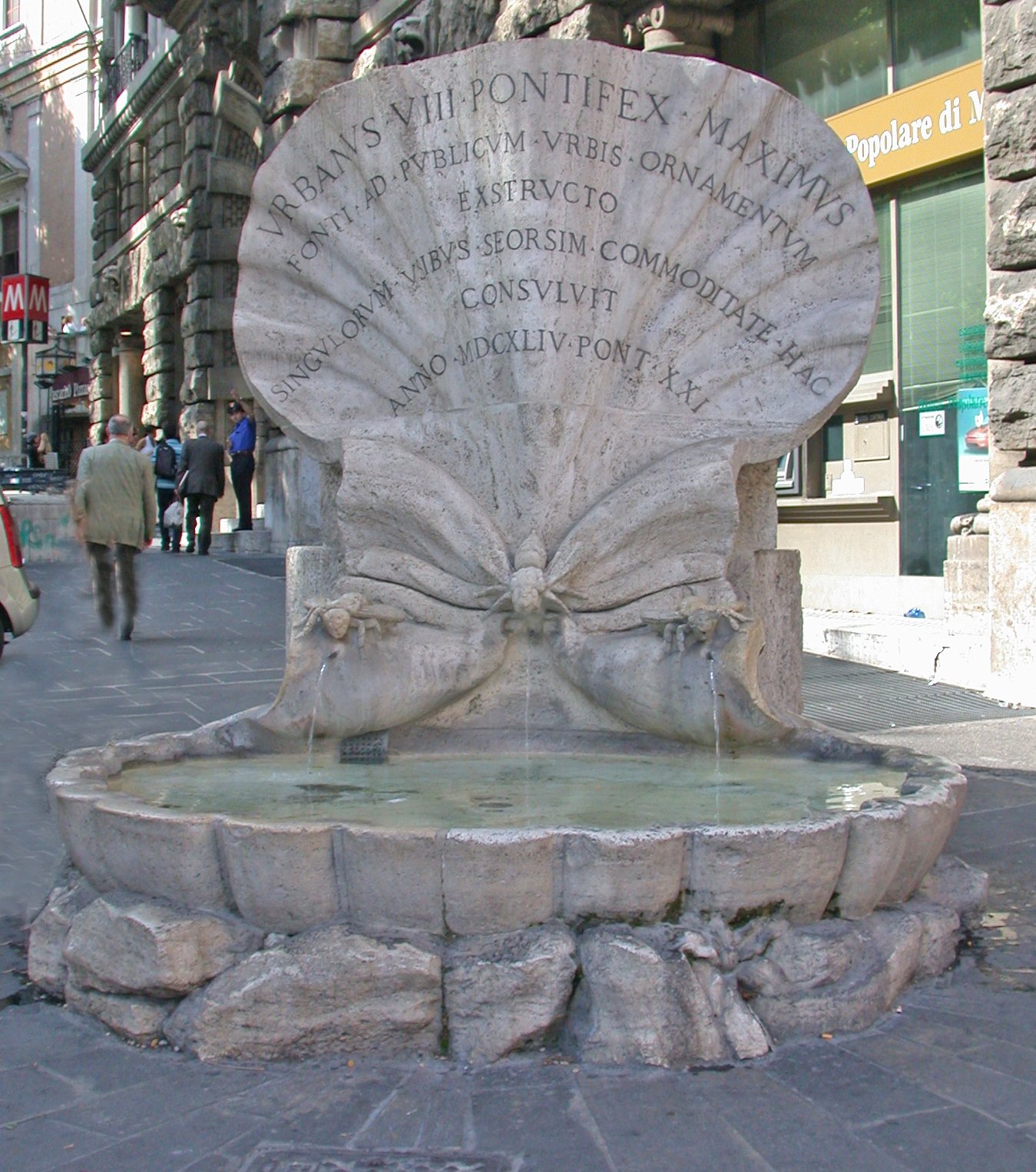
The Fontana delle Api is at the corner of Piazza Barberini and Via Vittorio Veneto, in the Ludovisi rione, on the sidewalk at the mouth of the street. You can see it for free, at any hour, with no ticket and no reservation. Its protection is the responsibility of the Capitoline Superintendency for Cultural Heritage of Roma Capitale, which attributes it to Gian Lorenzo Bernini and dates it to 1644, with a second date, 1915-1916, for the reconstruction you see now.
That second date matters more than the first. The fountain was dismantled in 1865 and reassembled 50 years later in another spot of the square, and according to the Superintendency the only original parts are fragments of the central bee and of the portion of the valve it rests on. The rest is a 20th-century reconstruction in travertine. Those who arrive expecting an intact Baroque sculpture find a low shell, flush with the traffic, with three bees and a lot of history on it.
Data checked on September 29, 2026 on the Superintendency's page dedicated to the fountain, on the Turismo Roma portal of Roma Capitale, on the communications of Roma Servizi per la Mobilità about the works on Via Veneto and in the national press for recent episodes. The City indicates sidewalk redevelopment works between Largo Federico Fellini and Piazza Barberini until October 17, 2026. During these weeks the corner of the fountain may be fenced off or cluttered with vehicles.
At a glance: address, hours, ticket
- Address: Via Vittorio Veneto, corner of Piazza Barberini, 00187 Rome, Ludovisi rione. There is no street number.
- Operator: Capitoline Superintendency for Cultural Heritage, Roma Capitale.
- How to get in: you don't. The fountain is viewed from the sidewalk, with no permanent fencing.
- Price: free. No official source provides for tickets or paid visits.
- Hours: always visible, day and night. The operator does not publish a maintenance calendar.
- How to get there: subway line A, Barberini stop, or on foot from Via del Tritone, Via Sistina or Via Veneto.
- Accessibility: it is at sidewalk level. The operator does not publish specific accessibility data.
Where it is and what you actually see
Coming out of the subway onto Piazza Barberini, the big fountain in the center is the Triton. The Fontana delle Api is to be looked for on the upper side of the square, where Via Veneto begins. The Superintendency places it at the corner of the square toward Via Vittorio Veneto, in an isolated position. That means that today the fountain is not set against a building, as it was originally, but stands alone on the sidewalk, with the street climbing behind it.
The shape is that of an open bivalve shell. The lower valve serves as a basin and collects the water, while the upper one rises like a backrest. At the base of the upper valve are three bees, the heraldic symbol of the Barberini, the family of Pope Urban VIII. The Turismo Roma portal says that originally the bees poured the water in thin jets. The whole piece is small, closer to the size of a wash basin than to that of a monumental fountain.
Turismo Roma adds a detail that you only notice if you know it: in the reconstruction the lower valve was raised on a base of boulders, while the upper one no longer rests against a building. That is the difference between the 17th-century design and the 20th-century arrangement. Bernini had designed a shell that opened from the corner of a palazzo, almost as if emerging from the wall. Today you see an isolated object, surrounded by poles, signs and passersby.
Around it is one of the busiest areas of the center. Behind it rise the sidewalks of Via Veneto, in front opens the square with the Triton, and on the other side Via del Tritone descends toward the Corso. A few minutes' walk away are Palazzo Barberini, the Trevi Fountain and the climb toward Porta Pinciana. The fountain is a stop of a few minutes within a longer walk, not a destination in itself.
The rione is Ludovisi, as the Superintendency indicates, even though the fountain is almost always seen as a piece of Piazza Barberini. It is a useful boundary to keep in mind. Behind the shell begins the Rome built after 1870 on the grounds of the great noble villas, with its Umbertine buildings, hotels and ministries. In front, toward the Triton and the Quirinale, the city of the popes remains. The fountain sits exactly on the line that separates the two eras.
A curiosity about the Fontana delle Api
The fountain was born as a utility installation. The Superintendency explains that Bernini conceived it as a public watering trough and that in a ground-floor room of the neighboring building he had designed a bottino, that is, a system for collecting the return water of the Triton Fountain. In practice, the water that had already put on a show in the big fountain was recovered and made available again to the people in the small fountain.
This was a common way of working in 17th-century Rome, where the water of the papal aqueducts passed from a monumental display to minor fountains, drinking troughs and wash basins. Bernini, however, turned a utility basin into a shell with the family's bees. The Superintendency puts it in a precise formula: the artist's imagination gave a utility structure the unusual form of an open bivalve shell. That is the whole point.
The two fountains of the square, then, were a single hydraulic system, conceived together within a few months and for the same patron. The Triton represented the pope, while the Fontana delle Api served the citizens with the same water. Separating them, as happened in the 19th century, erased that link. Those who look at them today as two distinct monuments, one large and one small, see half of the original project.
The link can still be read in the form. The Triton too rests on a large shell, held up by dolphins, and blows water from a smaller shell. The Fontana delle Api takes up the same motif on a reduced scale, without figures, with bees in place of the sea god. Those who look at the two works one after the other, from the center of the square to the corner of Via Veneto, recognize the common theme: the shell as a container of water and as the signature of the same building site.
Something nobody tells you about the Fontana delle Api
The fountain you see at the corner of Via Veneto is not where Bernini put it. The Superintendency gives as its original location the corner of Palazzo Soderini, between Piazza Barberini and Via Sistina, that is, on the opposite side of the square from today. Turismo Roma specifies that the upper valve adhered to the corner of a building on Via Felice, the present Via Sistina, which leads to Trinità dei Monti and the staircase of Piazza di Spagna, near the property of Nicolò Soderini.
To understand it, just stand in the middle of the square and look toward the mouth of Via Sistina. There, in 1644, those climbing toward Trinità dei Monti found the shell resting against the corner of a palazzo. In 1915-1916, when the fountain returned to the square, it was set on the opposite corner, at the start of the new Via Veneto. Neither spot is random: the first was on the papal street of the 17th century, the second on the street that symbolized Umbertine Rome.
Those who come across it by chance, coming out of the subway, assume it was born in that spot, and on site nothing suggests otherwise. The move is not a detail for scholars. It helps explain why the fountain, isolated on the sidewalk, looks a bit out of scale and out of place: it is a piece designed for a wall, reassembled without its wall.
Even the name of the starting street tells something. Turismo Roma calls the street the fountain faced Via Felice, and identifies it with the present Via Sistina. The name came from Felice Peretti, that is, Sixtus V, the pope who at the end of the 16th century opened that straight road and brought to the hills the aqueduct that still carries his name. The Fontana delle Api was originally, then, a small water terminal on a papal street built for water.
Original or copy: what remains of Bernini?
The official answer is short. The Superintendency writes that fragments of the central bee and of the portion of the valve it rests on are the only original parts of the work. Everything else, that is, the greater part of the shell, the other two bees and the base, belongs to the reconstruction of 1915-1916. The material the operator gives for the present fountain is travertine.
Turismo Roma adds two elements. The first: when the fountain was rebuilt, in 1915, most of the pieces dismantled 50 years earlier had been lost. The second: the copy was entrusted to the sculptor Adolfo Apolloni, who made it in travertine and not in marble. The change of material explains the color and porous surface of the shell, far from the polished stone you imagine when you think of Bernini.
On the date of the dismantling the sources do not agree. The Superintendency and Turismo Roma give 1865 and traffic reasons. Other historical accounts circulating online speak of 1880. Here we follow the date of the official sources. On the basic point, instead, all versions coincide: the pieces were taken to the municipal warehouses and there, in part, were lost, as happened to many items of street furniture removed in Rome at the end of the 19th century.
The reconstruction has since had a history of restorations of its own. The Superintendency records one in 2000 and an intervention in 2004, when the head of a bee, lost to an act of vandalism, was replaced with a copy. In June 2017 ANSA reported the inauguration of a new restoration, of about 60 days, funded by Dutch patrons. Each intervention has added something to a whole already made of original, copy and additions.
In our judgment the Fontana delle Api is overrated as a work of Bernini and underrated as a document of the city. Those who present it as a Baroque masterpiece load it with a weight that the present stone cannot bear. Those who look at it knowing that it is a 20th-century copy with a few ancient fragments, instead, see a concrete case of how Rome treated its own heritage between Unification and the Great War.
My advice for visiting the Fontana delle Api
Don't make the fountain the goal of an outing. It is a five-minute stop, to be slotted into a wider walk among Piazza del Tritone, Via Veneto and the Quirinale. My advice is to get there on foot from above, coming down from Porta Pinciana along Via Veneto: the fountain appears at the end of the descent, before the Triton, and the relationship between the two works is better understood in this order.
Once in front of it, crouch down. The fountain is low and the bees are under the upper valve, at the height of the basin. Standing, a meter away, you mostly see the shell. Bending down, the three bees appear, and with a little attention you can recognize the central one, the only one that keeps 17th-century fragments according to the Superintendency. Compare it with the two side ones: the difference in surface helps you read the history of the piece.
Look at the base too. Turismo Roma explains that in the reconstruction the lower valve was raised on a frame of boulders, an element that was not in the 17th-century design. It is the most 20th-century part of the whole fountain, and also the one that changes how it reads the most: the shell, lifted off the ground, becomes an object to look at more than a basin to use. Those who know the neighborhood fountains of the 1920s will recognize the same taste.
Then try an experiment: cross the square and stand at the mouth of Via Sistina, where it originally was. From there look at the Triton and imagine the shell resting against the corner behind you. You understand why Bernini had put it there, on the road that led from the family palace toward Trinità dei Monti. It is a two-minute exercise, but it changes the way you see the square.
Finally, check the state of the works before you go. Until October 17, 2026, Roma Servizi per la Mobilità reports the sidewalk site between Largo Federico Fellini and Piazza Barberini. With vehicles at work, the corner may be fenced off, and the fountain is viewed from a few meters farther away. On Sunday mornings the traffic is lighter and the corner quieter, even in periods without works.
Do you pay for anything, and do you need to book?
No. The fountain is on public land, outdoors, and is viewed from the sidewalk with no ticket, no reservation and no set hours. Neither the Superintendency's page nor the Turismo Roma portal, which lists it as freely accessible, provides for a payment or a booking. There is no ticket for the Fontana delle Api, and anyone offering one on the street is selling something else.
For information on its protection and restoration work, the reference is the page of the Capitoline Superintendency on the Fontana delle Api, while the official tourist description can be read on the Turismo Roma portal. There are no online tickets and none are needed. Third-party guided tours that pass through Piazza Barberini may include the fountain as a stop, with no additional cost for access.
If you want a story on site, you can choose a third-party walking tour of Baroque Rome, led by licensed tour guides, which usually links Bernini's fountains among Barberini, Trevi and Piazza Navona. In that case you pay for the guide's service, not for access to the fountain. For a self-guided walk a map is enough, and on the site you will also find the page dedicated to Bernini in Rome, with his works in route order.
Another well-known fact, yet rarely cited
In February 2015 a group of Feyenoord fans, in Rome for a soccer match, damaged the Barcaccia Fountain in Piazza di Spagna. The episode had wide coverage in the Italian and Dutch press. Less remembered is what followed: according to ANSA, in June 2017 the restoration of the Fontana delle Api was inaugurated, funded by a group of Dutch patrons as a symbolic gesture toward the city.
The choice had its own logic. The Barcaccia, below the staircase, is tied to the same pope, Urban VIII, and to the same Bernini workshop. Restoring the little Fontana delle Api was a way of answering damage done to a Barberini work with the care of another Barberini work. ANSA reports that the works lasted about 60 days and that the Capitoline administration took part in the ceremony.
Today, walking past the shell, nothing seems to recall this episode: there is no plaque on site that tells it. It is a piece of recent history that adds to the ancient one: a fountain born of a pope's generosity, reassembled by the City a century ago and restored with the money of foreign citizens after an act of vandalism committed elsewhere. Few fountains in Rome have such a long biography in so little space.
There is also a practical lesson. Low fountains, at sidewalk level, are the most exposed: to vandals, to construction vehicles, to cars maneuvering. The Barcaccia, below the staircase of Piazza di Spagna, was damaged precisely because it is accessible to everyone. The Fontana delle Api lost the head of a bee in 2004 and risked worse in May 2026. Looking at it up close is a right, touching it or sitting on the edge is not.
The right photo to take at the Fontana delle Api
The photo that works is a three-quarter view, from below, with the lens at the height of the basin. From that position the upper valve stands out against the background and the three bees appear together, instead of staying hidden under the rim. With a smartphone, just crouch half a meter from the basin. Avoid the flash: on wet stone it reflects the light and flattens the reliefs.
In light rain the fountain changes color. The wet travertine gets darker and the bees stand out on the surface of the valve, while the square empties of passersby. In the evening the result depends on the street lamps, because the operator does not report any lighting dedicated to the monument. Via Veneto project announces new public lighting, but the City's communication does not say if it will also concern the fountain.
The detail not to overlook is the central bee, the most interesting for the history of the piece. A close-up photo, tight on the bees and on the water of the basin, when the fountain is running, tells the story of the fountain better than a wide shot. Overall shots from the opposite sidewalk, instead, pick up cars, signs and passersby, and the shell becomes a detail amid the traffic of Via Veneto.
The best light is early morning, when the sun is still low and the sidewalk is empty. In the middle hours the light from above flattens the volumes and the corner fills with passersby. If you want a photo that relates the two fountains, climb a few meters along Via Veneto and frame the shell in the foreground with the Triton in the background, in the center of the square.
How do you get there from central Rome?
The nearest stop is Barberini, on line A of the subway run by ATAC. You exit directly onto Piazza Barberini and the fountain is on the side that climbs toward Via Veneto. From Termini it is a few stops, from Spagna just one. The buses that pass through Via del Tritone and Via Veneto often change route because of the works under way: it's best to check them on the ATAC website the same day.
On foot there are many routes. From the Trevi area you climb Via del Tritone in about 10 minutes. From Piazza di Spagna you go by Trinità dei Monti and Via Sistina, the street that corresponds to the fountain's original location. From the Quirinale you descend by Via delle Quattro Fontane, passing in front of Palazzo Barberini.
From Villa Borghese the road is downhill. You leave the villa at Porta Pinciana and go down Via Veneto all the way: the fountain is the last thing you meet before the square. Until October 17, 2026, part of the sidewalks is affected by the redevelopment works, and pedestrian routes may be diverted to one side of the street only.
For those moving in a wheelchair or with a stroller, the fountain is reached at sidewalk level, without steps, but the operator does not publish specific accessibility information. Via Veneto redevelopment project, according to Roma Servizi per la Mobilità, includes routes for people with visual disabilities and reduced mobility. During the works, however, barriers and temporary passages can make the corner less comfortable than usual.
Driving is not advisable. Piazza Barberini is a hub of heavy traffic at every hour and parking spots in the surrounding streets are very few. During Via Veneto works, Roma Servizi per la Mobilità has set up no-parking zones with towing on both sides of the affected stretch and suspended the bus and taxi lanes. Those coming from outside Rome do better to leave the car near a subway station.
Some important events that happened here in history
In 1644, the last year of Urban VIII's pontificate, Bernini designs the fountain as a public watering trough, a few months after the Triton. The Superintendency gives the pope's pontificate as 1623 to 1644 and Bernini as 1598 to 1680. The fountain is placed at the corner of Palazzo Soderini, on the street leading toward Trinità dei Monti, and fed with the return water of the big fountain through a bottino on the ground floor.
In the same year, 1644, according to Turismo Roma's account, controversy breaks out over the inscription, which gave the 22nd year of the pontificate when that year had not yet begun. The number is erased. On July 29 Urban VIII dies, eight days before the anniversary. With him ends the season of the great Barberini building projects, and within a few years the family loses a large part of its power in Rome.
In 1865, with Rome still under papal government, the fountain is dismantled for traffic reasons and the pieces end up in the municipal warehouses. A few years later, with Rome as capital of the Kingdom, the area changes face: the Ludovisi villa is divided into lots, the neighborhood that now bears its name is born and Via Veneto opens, the street that climbs from the square toward the walls and the gate of the Pincio.
In 1915-1916, as Italy enters the First World War, the fountain returns to the square. According to Turismo Roma, most of the pieces were lost and the sculptor Adolfo Apolloni makes a copy in travertine. The Superintendency records it at the corner toward Via Vittorio Veneto, in an isolated position. It is the arrangement you still see, with the lower valve raised on a base of boulders.
In the following decades the fountain becomes a fixture of one of the best-known corners of modern Rome. Via Veneto grows with hotels, cafés and representative offices, and the little shell stays at the mouth, between the traffic going up and the traffic going down. No official source records major interventions between the reconstruction and the restoration of 2000: for almost a century the fountain stayed where it was, with its travertine exposed to the smog of the square.
The last decades are a sequence of restorations and incidents. In 2000 a general restoration, in 2004 the replacement with a copy of the head of a bee destroyed by a vandal, in 2017 the restoration funded by Dutch patrons. On May 11 and 12, 2026, ANSA and Il Fatto Quotidiano circulated images of a bulldozer at work a few centimeters from the fountain, during the resurfacing of Via Veneto, with no visible protection on the work.
Who has passed by the Fontana delle Api
The first name is that of the patron, Maffeo Barberini, pope as Urban VIII from 1623 to 1644. The bees are his coat of arms, and the fountain is one of his last public works. Then there is Bernini, who for the same pope had already worked on the baldacchino of St. Peter's and on the family palace on the hill, and who left two fountains in this square within a few months.
In 17th-century Rome the people who passed by the fountain were mostly ordinary folk. The watering trough was meant for daily use, and the street it faced led toward Trinità dei Monti and the upper neighborhoods. Turismo Roma reports that the inscription spoke of a small fountain made for the use of the citizens, next to the large fountain made for the public ornament. Those who filled buckets and jugs were the true recipients of the piece.
In the 20th century the name to remember is that of Adolfo Apolloni, the sculptor who according to Turismo Roma signed the 1915 copy. Behind him was the municipal administration that decided to bring the fountain back to the square, at the mouth of a new street that was becoming the drawing room of the capital. After World War II, Via Veneto lived through the season of cinema and photographers, and the fountain found itself at the entrance of that scene.
In recent years the best-documented passages are those of construction sites. In 2000 and 2004 the fountain went through the hands of restorers overseen by the Superintendency, in 2017 through those of the site funded by the Dutch patrons. In 2026 the workers of Via Veneto site passed by, with the bulldozer caught on video. Every day, then, thousands of people pass by on their way to the subway, most of them without looking at the shell.
The inscription and the missing year: what is documented and what is legend?
The level of the documents is sober. The Superintendency writes that an inscription recalled the pope's intervention for the construction of the fountain and the watering trough as a public ornament of the city. Turismo Roma gives its full sense: the pontiff Urban VIII, after having built a fountain for the public ornament of the city, had this little fountain made for the use of the citizens, in the year 1644, the 22nd of his pontificate.
The level of tradition concerns precisely that number. According to Turismo Roma, the 22nd year of the pontificate had not yet begun when the inscription was carved, and the Romans saw in it an excess of zeal. The pope's nephew had the number erased, and people spitefully said he did not want to see his uncle reach that anniversary. Urban VIII died on July 29, 1644, eight days before the anniversary.
The level of legend is that of the pasquinades. Turismo Roma reports that the talking statue of Pasquino commented on the inscription, accusing the Barberini, after having drained the world dry, of wanting to drain time too. Another popular joke compared the bees, which received a lot of water from the Triton and gave back little, to the government that collected a lot of taxes and provided few services. On the talking statues of Rome the site has a dedicated page.
The sources do not agree on the exact number. Turismo Roma speaks of the 22nd year, some online accounts of the 21st, probably because they report the text after the erasure. The tale of the bad omen remains tradition, not document. What is certain, instead, is that the pope died in 1644 and that his family, right afterward, had to face difficult years under his successor.
The practical advice is to read the story of the inscription as a portrait of relations between the Romans and the Barberini more than as a fact about the fountain. Urban VIII's pontificate was long, costly and full of building sites, and the city remembered it also for the taxes. The shell with the bees, small and full of coats of arms, lent itself well to satire. Where the joke was really born, there or attached to the fountain later, remains an open question.
Why such a small fountain next to the Triton?
The answer lies in how water was used in Rome before the 19th century. The great water displays, like the Triton or the Moses Fountain of the Acqua Felice, served to celebrate the pope and the aqueduct. The water coming out of them, however, was often not wasted: it was collected and sent to minor fountains, drinking troughs, wash basins, where people and animals really used it. The Fontana delle Api was one of these terminals.
The operator's page gives the Acqua Felice as the original supply, the aqueduct commissioned by Sixtus V at the end of the 16th century to bring water to the Quirinale and Viminale hills. Those who want to follow that water backward, to the arches outside the city, will find in the Aqueducts Park the stretch where the Felice runs next to the ancient aqueducts. It is the best way to understand where the water of Piazza Barberini came from.
Today the function of the watering trough has been taken over by other objects. Since 1874 the city has had the nasoni, the cast-iron drinking fountains from which you drink for free in every neighborhood. In the 1920s came the travertine fontanelle rionali, each with the symbol of its rione. The Fontana delle Api is in some way their ancestor: a piece of daily use with a precise identity.
The comparison with the fontanelle rionali is instructive. Those of the 1920s were born as neighborhood street furniture, with books, barrels, rudders and palettes. The Fontana delle Api was born as a pope's street furniture, with the family coat of arms in place of the rione's symbol. In both cases the water is public, but whoever pays for the fountain wants it known. In the 17th century this was done with bees, in the 20th with civic symbols.
To see how the scale changes, just compare the Fontana delle Api with the city's great water displays. On the Janiculum the Acqua Paola Fountain celebrates Paul V's aqueduct with an entire facade, in Piazza della Repubblica the Fountain of the Naiads marks the arrival of the Acqua Marcia in Rome as capital. The shell on Via Veneto sits at the other end of the hierarchy: water already used, made available again to passersby.
Where do you find the Barberini bees in Rome?
Once you have learned to recognize them, the Barberini bees appear everywhere. They are the family's heraldic symbol, and Urban VIII put them on a good part of the building sites of his pontificate. In the same square they are carved in the papal coats of arms of the Triton Fountain, among the dolphins' tails. Going up Via delle Quattro Fontane you find them on the family palace, today home to the Gallerie Nazionali di Arte Antica.
Inside St. Peter's Basilica the bronze bees are on the baldacchino of the main altar, a work by the same Bernini for the same pope. In Piazza di Spagna the Barcaccia carries the Barberini symbols on the bow and the stern. Those who go around the city with this eye find bees also on lesser-known portals, ceilings and altars, often in churches restored during that pontificate.
On the fountain of Via Veneto the bees are three, as in the family coat of arms, and are placed at the base of the upper valve, as if about to drink. Bernini's choice was to use the coat of arms as the subject and not as an added decoration: without bees the fountain would just be a shell. It is the same procedure as the Triton, where the papal coat of arms is set among the dolphins' tails and is part of the structure, not of the frame.
A simple game, with kids, is to count bees along a route. From Piazza Barberini to St. Peter's, passing through Trevi, the Pantheon and Piazza Navona, there are many chances. The site collects more ideas for those visiting the city with children on the page about Rome with kids, and the Fontana delle Api, low and close to the subway, is a good starting point.
When is it hard to see, and what shouldn't you expect?
The fountain never closes, but it may be turned off, fenced in or surrounded by vehicles. The operator does not publish a maintenance calendar. In 2026 the situation depends on Via Veneto site: Roma Servizi per la Mobilità indicates works from April 13 until October 17, with a first phase between Piazza Barberini and Via Boncompagni and a second, from July, between Porta Pinciana and Via Boncompagni.
The project, funded by Roma Capitale with 4.5 million euros according to Roma Servizi per la Mobilità, provides for the complete rebuilding of the sidewalks, new granite curbs, routes for people with visual and motor disabilities, new public lighting, bollards against parking and new plants. For the fountain it means that the corner might change appearance when the works are done. The City's communication does not mention the fountain among the planned interventions.
The May 2026 precedent should be kept in mind. Il Fatto Quotidiano, on May 12, reported the video of a bulldozer a few centimeters from the fountain left without protection, during the resurfacing of the road, with only the workers on site. If you pass by during the works and find the fountain exposed to vehicles, the report goes to the Capitoline Superintendency through the channels indicated on its website.
Don't expect a fountain isolated from traffic, or a secluded little square. Cars pass a few meters away and the corner is one of the busiest in the area. Don't expect a big fountain either: those who see it for the first time almost always find it smaller than they imagined. And don't expect Bernini's original: the shell you see is a 20th-century reconstruction.
Finally, don't expect information panels. On site there are no signs that tell about the move, the copy or the restorations. That is why it's best to arrive already knowing what you are looking at: the history of the fountain is understood only with the whole square before your eyes, from the Triton to the mouth of Via Sistina, and with the operator's dates in mind, 1644 and 1915-1916.
Eating between Piazza Barberini and Via Veneto
The area around the fountain lives off passing trade: tourists headed to Trevi, offices, hotels on Via Veneto. Prices reflect it. The signs of a place that works the passing tourist are quickly recognized: photo menus in four languages, touts on the sidewalk, items without prices, a kitchen open from morning to night without a break, a different menu inside and outside. Put together, they say the place counts on the fact that you won't come back.
Other signs hold here as in front of every famous monument: the window with the lady rolling out fresh pasta in front of passersby, which is a scene more than cooking, the small tables with a view of the fountain where the price adapts to the customer, bills without a detailed receipt. The Romans who work in the area eat elsewhere, in the side streets toward upper Via Veneto or toward the Quirinale, where places count on everyday customers.
The rule is simple: the farther you get from the square and the streets with the big crowds, the better the ratio between price and quality becomes. For water, the nasoni in the area are enough and are free. To choose a lunch or dinner without surprises, a starting point is the list of addresses on Google Maps, with places selected across Rome and Lazio.
What to combine in the same day
The natural pairing is with the rest of the square and with the family palace. You begin at the Triton and the Fontana delle Api, climb Via delle Quattro Fontane to Palazzo Barberini, where under the garden you also find the Barberini Mithraeum, and arrive at the crossing of the Quattro Fontane, with Borromini's San Carlo alle Quattro Fontane on the corner.
A second route follows Bernini's fountains. From the Fontana delle Api you go down to Trevi, which is not by Bernini but carries his legacy, pass by Sant'Andrea delle Fratte, which holds two Berninian angels, and arrive at the Barcaccia. From there you continue toward Piazza Navona and the Fountain of the Four Rivers, and, for those who still have legs, the Moro Fountain in the same square.
If you are short on time you can do a short, compact loop. From the Fontana delle Api you go down Via del Tritone to Trevi, climb back toward Piazza del Quirinale for the view over the rooftops and return to Piazza Barberini by Via delle Quattro Fontane. In a couple of hours you see three monumental fountains, two palaces tied to the popes and the little shell where it all started, without ever taking a vehicle.
A third route instead heads north. You climb Via Veneto to Porta Pinciana, along the Aurelian Walls, and enter Villa Borghese, with the Galleria Borghese for those who have booked Bernini's early masterpieces. Not far from Via Veneto, in the Ludovisi rione, is the Christuskirche, the Lutheran evangelical church on Via Sicilia, one of the least-known buildings in the area.
If you like small fountains, you can make a theme of it. Besides the nasoni and the fontanelle rionali, the center holds the Turtle Fountain in Piazza Mattei, the Fontana del Mascherone on Via Giulia, and the Fontanella degli innamorati at Trevi. For those who want to spend little, the page on free Rome collects the stops without a ticket, and the one on Baroque Rome gives the wider picture.
Walking a few steps up Via Veneto you reach the church of Santa Maria della Concezione and its crypt. The admission to the Capuchin Crypt, with tour or audio guide, is booked online, and on the other side of the square there is the ticket for Palazzo Barberini and Galleria Corsini. These are Tiqets affiliate links: if you buy from there, Estate Romana receives a small commission, while the price for you stays the seller's price.
Frequently asked questions
Where exactly is the Fontana delle Api?
At the corner of Piazza Barberini and Via Vittorio Veneto, on the sidewalk at the mouth of the street, in the Ludovisi rione. It has no street number. Coming out of the Barberini subway, the big fountain in the middle of the square is the Triton, and the Fontana delle Api is on the upper side, where Via Veneto begins. It is low and easy to overlook, so it's best to look for it deliberately instead of waiting to see it from afar.
How much does it cost to see the Fontana delle Api?
Nothing. It is an outdoor public monument, protected by the Capitoline Superintendency, and is viewed from the sidewalk with no ticket, no reservation and no set hours. None of the official sources provides for paid access. If someone offers you a ticket or an admission for the fountain, it doesn't exist. Third-party guided tours may include it in a paid route, but you pay for the service, not the fountain.
Is the Fontana delle Api really by Bernini?
The design yes, the stone mostly no. The Superintendency attributes it to Gian Lorenzo Bernini and dates it to 1644, but specifies that the only original parts are fragments of the central bee and of the portion of the valve it rests on. The rest is the reconstruction of 1915-1916, which Turismo Roma attributes to the sculptor Adolfo Apolloni, in travertine instead of marble. It is a copy faithful to the idea, not to the object.
Why does the fountain have bees?
Because bees are the heraldic symbol of the Barberini, the family of Pope Urban VIII, who commissioned the fountain. There are three, at the base of the upper valve, and according to Turismo Roma they originally poured the water in thin jets. The same bees are found in the coats of arms of the Triton Fountain, in the middle of the square, and on many other monuments commissioned by that pope, from the family palace to St. Peter's Basilica.
Has the fountain always been in that spot?
No. According to the Superintendency, the original location was at the corner of Palazzo Soderini, between Piazza Barberini and Via Sistina, on the opposite side of the square. In 1865 it was dismantled for traffic reasons and the pieces ended up in the municipal warehouses. Between 1915 and 1916 it was rebuilt at the corner toward Via Vittorio Veneto, in an isolated position, that is, no longer set against a building as in the 17th-century design.
Can you drink the water of the Fontana delle Api?
The operator does not list the fountain's water as drinkable, and the fountain is not meant for drinking. Originally it was a public watering trough fed with the return water of the Triton, but today it is a monument. To drink, it's best to use the nasoni, the public cast-iron drinking fountains the city is full of, also shown on the free app of the water utility operator. The utility's map shows the ones nearest to the square.
Are there works under way near the fountain?
Yes, until mid-October 2026. Roma Servizi per la Mobilità reports sidewalk redevelopment works on Via Vittorio Veneto from April 13 to October 17, 2026, with a first stretch between Largo Federico Fellini and Piazza Barberini. In May 2026 the press reported images of a bulldozer a few centimeters from the fountain. During the works the corner may be fenced off, but the fountain remains visible from the sidewalk.
What is the difference between the Fontana delle Api and the Triton Fountain?
They are two Bernini fountains for the same pope, made a few months apart, but with different roles. The Triton, in the middle of the square, is the monumental display, with the sea god blowing into the shell. The Fontana delle Api was the utility trough that collected its return water through a bottino. Today the biggest difference is another one: of the Fontana delle Api only fragments of the central bee and of the valve remain original.
How much time do you need to see it?
Five minutes for the fountain, a quarter of an hour if you want to take in the whole square, with the Triton in the middle and the corner of Via Sistina where it originally stood. On its own it doesn't justify an outing. It's best to fit it into a wider walk, with Palazzo Barberini, the Quattro Fontane, Trevi or Via Veneto up to Porta Pinciana. In the light of early morning the photos come out better and the sidewalk is clear.
Who wrote this and on what sources
The text comes from the editorial team of Tour Leader Pro, the Roman outfit that designs itineraries, visits and cultural events across Rome and Lazio. Fees, hours and booking methods reported here come from the official sources cited in the text as of the date given at the opening: the Superintendency's page on the fountain, the Turismo Roma portal and the communications of Roma Servizi per la Mobilità on Via Veneto site. Let us know what you find changed.
Planning a stop at the Fontana delle Api, for yourself or for a group, mostly means choosing the right hour for the traffic, taking Via Veneto site into account and linking it to Bernini's other fountains or to the route between Palazzo Barberini and Villa Borghese. For those organizing group trips to Rome, with themed itineraries on the Baroque city and its waters, a useful resource is Tour Leader Pro.
The fountains of Rome are only one chapter in the history of water in Lazio, which continues with the aqueducts of the Roman countryside, the villas of the Castelli with their water features and the springs of the Monti Simbruini from which the ancient aqueducts started. Those who want to look beyond the city will find much more to see in the region. To put together a trip of several days, a useful resource for building an itinerary is Italy Planner.