Museum of Illusions in Rome
In short. Address: Via Merulana 17, 00185 Rome, Esquilino district, on the side that climbs toward Santa Maria Maggiore.
Address: Via Merulana 17, 00185 Rome, Esquilino district, on the side that climbs toward Santa Maria Maggiore. Phone +39 06 4542 9340, email inforoma@museoillusioni.it, official website museoillusioni.it. You get there by metro line A, Vittorio Emanuele stop, or by metro line B, Cavour stop. From Termini it's about 12 minutes on foot along Via Gioberti, Piazza di Santa Maria Maggiore and Via Merulana. Hours given by the museum: Monday to Friday 10.00-19.00 with last entry at 18.00, Saturday and Sunday 10.00-20.00 with last entry at 19.00. Extraordinary closures at Easter and Christmas are announced on the home page. Tickets: full price €21, reduced €18 for students aged 16 to 30, over 60s and visitors with disabilities (companion free), children aged 6 to 15 €15, free under 6, family (two adults and two children aged 6 to 15) €54. Online sales are currently suspended and tickets are bought at the museum's ticket office. It's best to check the official website before setting out. For groups of more than 20 people the museum provides one free admission for every nine visitors and a guided tour included. Length of the route: about an hour, on a single floor, over 70 installations.
If you're building a wider Roman itinerary, the map of Rome's tourist attractions helps you fit this stop in with the rest of the day.

What the Museum of Illusions in Rome really is
Let's say it right away, because it's the question everyone asks at the start: it's not an art exhibition and it's not a playground disguised as a museum. It's a visual perception laboratory open to the public, with over 70 stations that stage phenomena studied by physicists, opticians and experimental psychologists over the last 150 years. The format was born in 2015 in Zagreb, Croatia, from an idea of Tomislav Pamuković and Roko Živković, and from there it became an international network: in May 2023 the brand counted 43 locations in 25 countries. The Rome location opened on November 12, 2022 and is the second in Italy after the one in Milan, at Via Luigi Settembrini 11.
The difference from a traditional museum lies in the pact with the visitor. Here you don't look from behind a yellow line: you step inside the experiment, you touch, you slide, you strike a pose, and above all you get it wrong. Every installation is built to bring you to a false perceptual conclusion quickly and surely, and then to make you understand why you fell for it. It's an interesting didactic reversal: instead of explaining how vision works, they make you fail first and then hand you the explanation. It works, because the perceptual error stays in memory much longer than a panel.
Our firm opinion: the Museum of Illusions in Rome is an excellent second-tier science museum, and it belongs in an itinerary the way an intermezzo does, not as the main course. If you have three days in Rome and haven't seen the Forums yet, don't come here. If instead you're on day five, your feet are wrecked and the children's attention threshold is at zero, this is the stop that saves the afternoon, and it saves it with real content.
Before going in: perception is not a photograph
The misunderstanding the Museum of Illusions in Rome takes apart, room after room, is an old one: we believe the eye records the world like a camera and that the brain just looks at the film. It doesn't work that way. The retina receives a two-dimensional, upside-down image, full of holes and noise. The rest is built by the nervous system, which completes, corrects, chooses the most probable hypothesis and passes it off as reality. Hermann von Helmholtz, in the nineteenth century, called this work unconscious inference: we don't decide to interpret, the interpretation arrives already packaged.
On the same question, in the early twentieth century in Germany, an entire school was built. Gestalt psychology, founded by Max Wertheimer with his students Kurt Koffka and Wolfgang Köhler and developed between the 1910s and the 1930s, put in black and white that the visual field organizes itself according to rules: good form, proximity, similarity, good continuation, common fate, figure and ground, induced motion, pregnance. These are principles you see at work here with the naked eye. In Italy that tradition had leading scholars, from Fabio Metelli to Gaetano Kanizsa, born in Trieste on August 18, 1913 and died in Monfalcone on March 13, 1993, professor at the University of Trieste from 1953 and founder there of the Institute of Psychology, who reached international fame with an article on subjective contours published in Scientific American in 1976.
Keep this frame in mind as you go around: it completely changes the tone of the visit. Without it, the museum is a sequence of funny photographs. With it, it's an hour inside a century and a half of research on the mind.
Perspective before illusions: from Alberti to Borromini
Rome is the wrong city in which to be amazed by optical illusions, because here they've been building them in masonry for 500 years. Before laughing in front of the Ames room, it's worth remembering where that trick comes from.
The Quattrocento and the visual pyramid
Linear perspective was born in Florence in the first decades of the Quattrocento. Filippo Brunelleschi demonstrated it with two painted panels, now lost, that depicted the baptistery seen from the door of Santa Maria del Fiore and Piazza della Signoria with Palazzo Vecchio. Leon Battista Alberti put it into theoretical form in De pictura, written between 1434 and 1436, where he defines painting as the intersection of the visual pyramid: the picture is the section of the cone of rays that goes from the eye to the scene. Masaccio, with the Trinity of Santa Maria Novella, had already achieved the result before the treatise explained it. From that moment depth becomes a teachable technique, and therefore also a manipulable one.
Borromini's gallery at Palazzo Spada
The Roman masterpiece of the genre is found in Piazza Capo di Ferro. Cardinal Bernardino Spada bought the palace in 1632 and entrusted Francesco Borromini with the transformations. What came out of it was a gallery that looks 37 meters long and measures 8. The colonnade has decreasing heights, the floor rises, the ceiling descends, and the statue at the end, which seems life-size, is 60 centimeters tall. Borromini was assisted in the calculations by the mathematician Father Giovanni Maria da Bitonto. Anyone who wants to truly understand what happens in the Ames room should spend half an hour at the Galleria Spada: it's exactly the same principle, applied four centuries earlier and with much more style.
Andrea Pozzo and the dome that doesn't exist
The second Roman precedent is even more shameless. In the church of Sant'Ignazio di Loyola, the Jesuit Andrea Pozzo frescoed the vault of the nave around 1685, dissolving the real surface into an open sky full of ascending figures, and above the crossing he painted on canvas a coffered dome that was never built. The original canvas of 1685 was destroyed by a fire and was faithfully reproduced in 1823 by Francesco Manno on the basis of the drawings left by Pozzo. A marble disk set into the floor of the nave marks the point from which the deception works: move three meters and the dome collapses. It's exactly the rule that governs half of the installations on Via Merulana: the illusion has only one legitimate viewpoint, and that point is marked on the ground.
Escher, the impossible cube and the Roman season
Between Renaissance perspective and the Museum of Illusions in Rome there's an obligatory passage, and he's Dutch by birth but Roman by residence. Maurits Cornelis Escher, born in Leeuwarden on June 17, 1898 and died in Laren on March 27, 1972, arrived in Italy in the spring of 1922, returned in the autumn via Cadiz and Genoa, moved to the Amalfi Coast in the spring of 1923 and married Jetta Umiker in Viareggio on June 12, 1924. He then set up house in Rome, at Via Poerio 122, in the Gianicolense district, with the home on the third floor and the studio on the fourth. He left Italy in 1935 for Switzerland, for reasons tied to the political climate of Fascism.
The works everyone knows come later, but they grow out of that eye trained on Italian architecture: Relativity from 1953, with three different gravities coexisting on the same staircase. Belvedere from 1958, built on a Necker cube that cannot exist in three dimensions. Ascending and Descending from 1960, with the monks who climb forever without gaining a centimeter. Waterfall from 1961, where the water returns to its starting point thanks to a Penrose tribar set into the building. Escher didn't invent impossible figures: he made them inhabitable.
Here's a point to clarify. The installations on Via Merulana are the walk-in version of those prints. Where Escher forced you to stay outside the sheet, the museum puts you inside it, with your body. The price of this convenience is that the experience lasts an instant and has to be photographed. The gain is that you understand it with your muscles, not just with your eyes.

The visit to the Museum of Illusions in Rome, room by room
The route is on a single floor and takes about an hour, at a free pace. There's no rigid obligatory direction, but the sequence I describe is the one in which most visitors meet the installations. The rooms have no long panels: the explanation comes in a few lines next to each station, which makes it useful to arrive prepared.
Trilussa's face that follows you with its gaze
The opening is a tribute to Rome, and for once it's not rhetorical: a gigantic face of the dialect poet Trilussa that follows the visitor with its gaze as you move around the room. The mechanism is that of the hollow mask: the brain refuses to interpret a face as concave, because in all our experience faces are convex, and so it straightens it. The geometric consequence of that forced straightening is an apparent rotation that follows your movements. It's the most probable hypothesis winning over the evidence, live.
Trilussa, whose birth name was Carlo Alberto Camillo Salustri, was born in Rome on October 26, 1871 and died there on December 21, 1950. He lived between Via del Babuino, Via Ripetta and Piazza di Pietra, published Stelle de Roma in 1889, the Quaranta sonetti romaneschi in 1894, the Favole romanesche in 1901, Cento favole in 1934 and Duecento sonetti in 1936, and was appointed senator for life by Luigi Einaudi on December 1, 1950, 20 days before dying. Putting him at the entrance of a museum of perception is a subtler choice than it seems: the fable in dialect works exactly like an optical illusion, it shows one thing and makes you understand another.
The mirror room and the infinity room
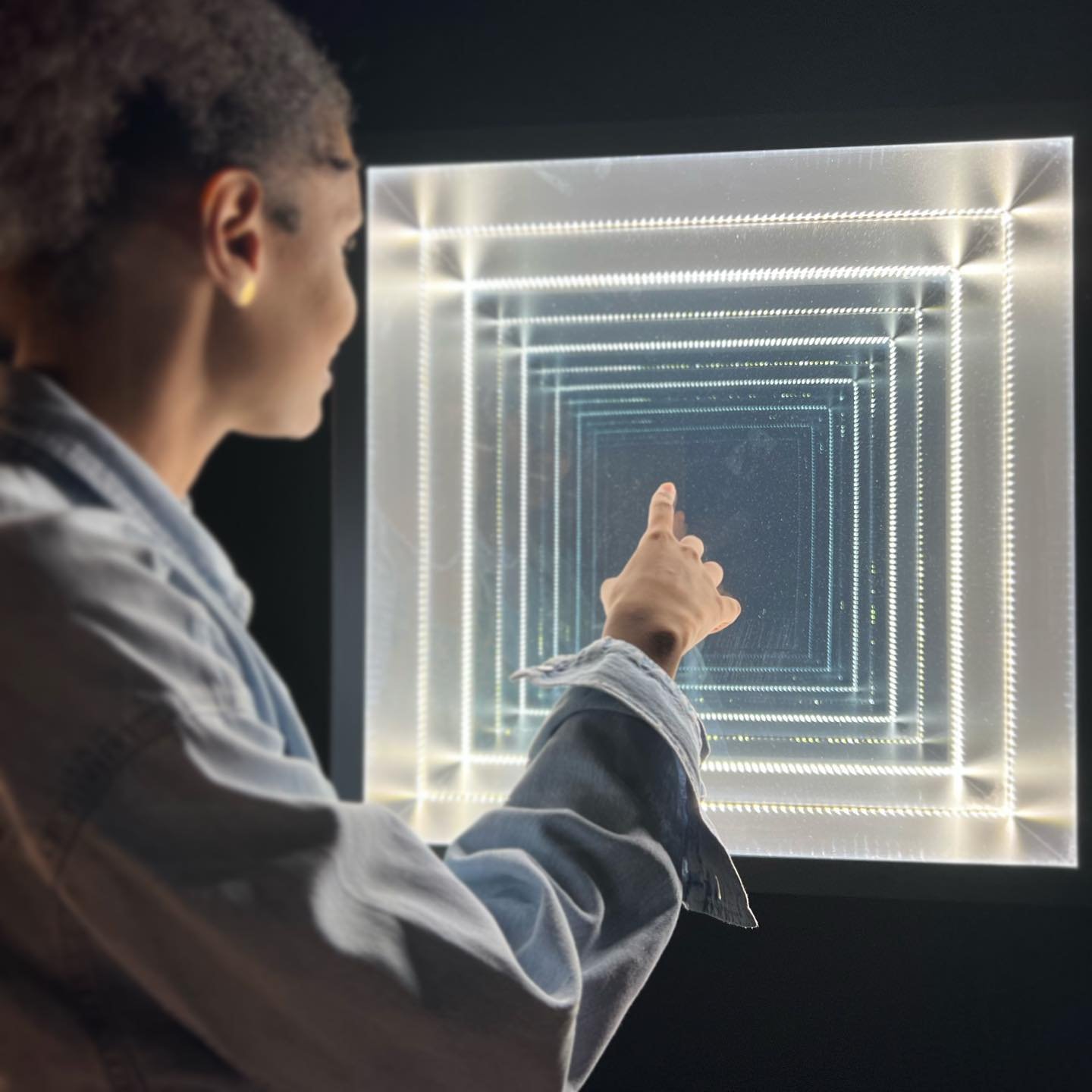
The mirror room plays on the multiplication of the image and the loss of depth cues. The infinity room is the most radical variant: two reflective surfaces facing each other, with one of the two semi-reflective, generate a series of reflections that slowly decays and that the eye reads as an endless corridor. Light is lost at every bounce, and that's why the apparent tunnel darkens toward the back instead of continuing uniform: that drop in brightness is the physical signature of the illusion. Practical advice: go in alone or at most two at a time, because with six people inside you only see reflected elbows.
The vortex tunnel of the Museum of Illusions in Rome
This is the station that puts the most visitors in crisis, and it's no accident. You walk on a strictly still walkway, inside a cylinder that rotates around you covered in luminous patterns. The vestibular system of the inner ear correctly signals that you are balanced. The visual system, invaded by a coherent peripheral motion, concludes that you are the one rotating. The conflict between the two channels produces real staggering, and hands rush to the handrail. It's vection, the same phenomenon that makes you believe you're leaving when it's the train next to yours that is moving.
Anyone who suffers from vertigo, labyrinthitis or strong motion sickness struggles here. You can cross it anyway, holding the handrail and looking at your own feet instead of the walls. Whoever accompanies elderly people should keep it in mind beforehand and not afterward.
The rotated room, or upside-down room
A furnished environment built with a strong tilt relative to the real walking surface, which with a straight camera gives bodies hanging from the ceiling, objects that defy gravity, people sitting on the walls. The brain, lacking a reliable horizon, takes the edges of the architecture as the vertical reference. Since those edges lie, the conclusion lies too. It's the same principle as the crooked houses at amusement parks, taken to greater precision. Here the photograph has to be taken with the phone perfectly parallel to the walls of the room, not to the real floor.
The Ames room at the Museum of Illusions in Rome
The most important room from the scientific point of view. The Ames room was devised in 1946 by the American ophthalmologist Adelbert Ames, developing an intuition of Hermann von Helmholtz. The floor plan is trapezoidal, the walls diverge, floor and ceiling are tilted. Seen head-on from the intended peephole, it looks like a perfectly normal parallelepiped-shaped room. The result is that a person in one corner looks like a giant and the same person in the opposite corner looks tiny, and whoever walks between the two corners seems to swell and shrink. The reason is that the eye judges size in relation to an apparent horizon which, in that room, is not horizontal at all.
It's worth observing something almost nobody notices: the illusion doesn't break even when you know how it works. You can have read everything, measured everything, and you'll keep seeing the giant and the dwarf. It's the most elegant demonstration that perception is impermeable to knowledge, and no panel explains it better than your own repeated failure.
The head on the plate and the hidden body
Two related stations, both based on mirrors set at an angle and on a geometry that makes the visitor's body invisible. In the first, the head appears served on a tray. In the second, the torso disappears, leaving only the limbs on stage. The trick is old, descending from the nineteenth-century optical theaters and from the so-called Pepper's ghost: a mirror that reflects a surface identical to the backdrop is, to all effects, invisible. It works only from the intended spot, and that's why every station has a mark on the floor.
The table of clones
A mirror structure that multiplies the same person seated around the same table. It's the installation with the highest ratio between simplicity of mechanism and effect on the public, and it's also the one where the longest queue builds up on Saturday afternoons, because it requires coordination among visitors and several shots to work.
The chair illusion
A piece of furniture broken apart and spread over planes at different distances, which comes together into a normal chair only from one precise observation point, where a distant visitor appears seated in miniature on the seat. It's pure anamorphosis, the same technique as Baroque painted floors and figures that straighten only when seen at a slant: from any other position the furniture is a heap of suspended pieces. Look at it from the wrong sides too, because the comparison between the two ways of seeing is the instructive part.
The symmetry room, a Roman exclusive
Among the installations of the Rome location there are two that the museum presents as exclusives, and the first is the symmetry room: an environment of which only one half really exists, while the other is returned by a reflective surface placed on the axis. Perception reads it as a whole, coherent room because bilateral symmetry is one of the strongest signals the visual system uses to recognize objects, and it's a signal for which it asks no confirmation. The detail that gives it all away remains: if you move an arm and watch the edge of the axis, the seam shows. Try to find it.
The RGB room of the Museum of Illusions in Rome
The second Roman exclusive, and the most photographed. Three light sources of different colors, red, green and blue, illuminate the same subject from different directions: each source casts a shadow where its light is blocked, and in that shadow the sum of the other two remains. Hence the three colored shadows, cyan, magenta and yellow, that you see on the wall. It's additive synthesis of light in its pure state, the one that governs the screen of the phone you're about to photograph it with: red plus green gives yellow, green plus blue gives cyan, red plus blue gives magenta. Move slowly and the shadows overlap, recreating black.
The light room and the other stations
The route is completed by a room played on light beams and reflective surfaces, a series of holograms, and an area dedicated to mechanical puzzles and logic games, where you move from perceptual deception to cognitive deception: the public stops there longer than it imagines, and it works very well with middle schoolers. At the end of the route there's a shop with reproductions of puzzles and themed material.

How to get to the Museum of Illusions in Rome
Number 17 on Via Merulana is in the first stretch of the street, the one that climbs from the Santa Maria Maggiore side. With metro line A you get off at Vittorio Emanuele and climb back up toward Piazza dell'Esquilino. With metro line B you get off at Cavour and go around the side of the basilica. From Termini the most direct walk goes through Via Gioberti and Piazza di Santa Maria Maggiore, and it's a matter of 12 minutes at a normal pace. The area is served by many surface lines converging on Piazza di Santa Maria Maggiore and on Piazza Vittorio Emanuele II. Routes change often, so it's best to check the line number the same day.
By car: paid parking on the blue lines along the climb that leads to the museum, with the caveat that in the Esquilino quadrant finding a spot on a Saturday afternoon is an exercise in optimism. The professional advice is banal and it works: leave the car elsewhere and arrive by metro.
How much the Museum of Illusions in Rome costs and how to save
€21 for an adult is, in absolute terms, the most debatable part of the offer: it's the price of a top-tier state museum for an hour of route. The reductions, however, are generous and cover a good part of the real public. €18 for students aged 16 to 30, over 60s and visitors with disabilities, with a free companion. €15 for children aged 6 to 15, free under six. The family ticket, €54 for two adults and two children in the 6-15 bracket, saves money compared with the four single tickets and is the option I recommend almost every time.
For groups of more than 20 people the museum applies one free admission for every nine visitors and includes the guided tour: for a class or a corporate group the bill changes quite a lot. Online ticket sales are currently suspended and the purchase takes place at the on-site ticket office. Conditions of this kind change over time, so a phone call or a check on the official website before leaving avoids surprises. No free first Sunday of the month and no state museum card are valid here: it's a private venue and stays outside those circuits.
The Museum of Illusions in Rome with children
The age group that has the most fun runs from six to 14. Under five, admission is free but the cultural return is modest: the youngest enjoy the mirrors and ignore everything else. The advantage over a classic museum is that here the ban on touching falls away, and with it falls the main source of tension between parents and children on a visit.
Whoever has middle schoolers or first- and second-year high schoolers should use the route the way you use a laboratory: stop in front of the Ames room and ask why, instead of snapping a photo and moving on. If an afternoon with the kids is the theme of your day, in the same spirit the Museum of Mathematics, Explora, the children's museum of Rome and the Museo Civico di Zoologia work well. With the youngest, the Bioparco di Roma (Rome Zoo) remains unbeatable.
Accessibility, services and visit rules
The route is on a single floor, a condition that makes life much simpler for anyone with mobility difficulties, and the museum provides a reduced ticket for visitors with disabilities with a free companion. Some installations, by their nature, require climbing onto a walkway or taking particular positions: these are experiences you can also observe without going through them, and the staff in the rooms gladly point out the alternatives. For specific needs, a phone call beforehand to the museum's number is the quickest way to get a certain answer.
Photographs are allowed and in fact encouraged: in a museum where the installations are built to be seen from a precise point, the camera is a reading tool, not a nuisance. It's best to have the photo holder charged: here the phone works a lot. Bulky backpacks and strollers are better handled by leaving them at the entrance, asking the staff.
When to go to the Museum of Illusions in Rome and when to avoid it
The best window is early weekday morning, from 10.00 to 11.30: half-empty rooms, time to understand the installations, photographs with no strangers in the frame. The worst window is Saturday afternoon between 15.00 and 18.00, when the crowding turns some stations into queues, and the mirror stations become unusable because everyone ends up inside them.
Rainy days dump half the city here, so in case of bad weather move your time earlier. On long weekends and holidays the flow grows, and the extraordinary closures at Easter and Christmas are announced on the official website. Last entry at 18.00 on weekdays and at 19.00 on weekends: showing up 10 minutes before the ticket office closes means doing the route at a run, which is the worst way to spend €21.
What to see around the Museum of Illusions in Rome
The quadrant is among the densest in the city and within a 10-minute walk you go from an early Christian masterpiece to a multiethnic market. A few steps away is the basilica of Santa Maria Maggiore, with the fifth-century mosaics of the nave. Going down the street you meet Palazzo Merulana with its collection of twentieth-century Italian art, and a little further the Teatro Brancaccio together with the nearby Palazzo Brancaccio.
Toward Piazza Vittorio you reach the remains of the Auditorium of Maecenas, the frescoed Augustan nymphaeum, and the Alchemical Gate, the threshold covered in hermetic symbols that survives from Villa Palombara. Under the porticoes works the Nuovo Mercato Esquilino, which for shopping and a quick lunch is a real resource. At the end of the street, about 20 minutes away, the Basilica of San Giovanni in Laterano. Whoever wants to stay on the theme of perception and architectural wonder can climb back up toward the Oppian Hill and book the Domus Aurea, where the vault of the octagonal hall is another experiment in light.
A curiosity about the Museum of Illusions in Rome
The most solid curiosity concerns a coincidence almost nobody connects: the man who gave his name to one of the most cited geometric illusions in the world taught a few metro stops from Via Merulana. Mario Ponzo, born in Milan on June 23, 1882 and died in Rome on January 9, 1960, after his first research at the University of Turin held the chair of experimental psychology at the Faculty of Medicine of the University of Rome from 1931 to 1952. The illusion that bears his name is the one in which two horizontal segments of identical length, placed between two converging lines, appear unequal: the one closer to the vanishing point seems longer, because the brain interprets it as farther away and compensates for its size. Anyone who has looked at two rails narrowing toward the horizon has already done that experiment without knowing it.
The coincidence is instructive, because it overturns a common prejudice. The museum on Via Merulana is perceived as an imported product, a Croatian format that landed in the Esquilino in 2022, and in part it is. But the subject it displays has deep Roman roots: Italian experimental psychology had in this city one of its main seats for 20 years, and one of the most reproduced phenomena in textbooks around the world bears the surname of the man who held the chair here. When you walk through the installations that play with depth and apparent size, what you're seeing is not a theme park invention: it's the touchable version of a chapter also written in Roman lecture halls. Knowing it changes the way you look at the following rooms.
Something nobody tells you about the Museum of Illusions in Rome
That the museum, right now, is visited by buying the ticket at the desk. Online sales appear to be suspended and tickets are bought on site: it means the habit of booking everything from the couch doesn't work here the way it does elsewhere, and that at peak hours the waiting time is spent in front of the ticket office and not in front of a code reader. It's the practical information that really changes the day of someone who arrives in Rome with a tight schedule, and almost no guide reports it because it's a moving condition, which the museum updates on its own website. Before setting out from another neighborhood, a phone call to the location's number is worth more than 20 minutes of reading.
The second thing nobody tells you concerns the way the route should be approached. The installations don't work from any point: almost all have a single correct observation point, often marked on the floor or indicated by the position of the suggested camera. Whoever walks in and strolls the way you stroll in a picture gallery, looking at things at a slant while advancing, sees half the effects and concludes the museum is overrated. Whoever stops, looks for the mark, stands exactly there and then moves a meter to see how the illusion falls apart, leaves with an hour of excellent visual education. The difference between the two visits isn't the ticket: it's the discipline of the viewpoint. I'll add a third detail, unromantic but useful: the phone's memory. On a route built to be photographed, arriving with your storage full is the stupidest way to waste an admission.

The advice I give you for visiting the Museum of Illusions in Rome
Go early in the morning on a weekday, and go with a precise mental order. First Trilussa's face, which is the conceptual front door to everything else: there you understand in 10 seconds that the brain prefers the probable hypothesis to the evidence. Then the Ames room, which is the big piece, and should be tackled with a fresh head and no line behind you, because it deserves two or three passes and not one. Leave the vortex tunnel for when you've already gained confidence, and tackle it looking at your feet if you tend to get vertigo. The two Roman exclusives, the symmetry room and the RGB room, save for the second half: they're the most photogenic and they'll steal your time.
The advice that matters most of all, though, concerns company. This is a museum to be visited in twos or threes, never alone and never in a group of 10. Alone, half of the installations don't even activate: the table of clones, the head on the plate, the Ames room live on the comparison between two bodies in the same space, and without someone stepping into the frame they remain mute objects. In 10, on the other hand, they turn into queues and confusion, and the effect vanishes because in the mirror rooms you only see yourselves on top of each other. The right number is two or three people, with one photographing and the others posing in turn.
One last recommendation, and it counts as an itinerary rule: don't come here as the first thing of your Roman day and don't come as the last. As the first thing it burns energy you need elsewhere. As the last you arrive tired and just snap pictures. The right place in the program is the middle afternoon, after a lunch in the Esquilino and before climbing back up toward Santa Maria Maggiore in the low light. An hour inside, an hour outside, and the day holds up.
Another well-known fact, yet rarely cited
That the optical illusion is not an entertainment born with tourism, but a serious research tool and also a rhetorical weapon of religious architecture. Everybody knows it in the abstract. Almost nobody says it when entering a museum like this one, and the result is that the public leaves believing they've seen fairground tricks. They are instead experimental devices. The Ames room of 1946 was born as an instrument to test how much the perception of size depends on context rather than retinal data, developing an intuition of Helmholtz on unconscious inference. The subjective contours studied by Kanizsa serve to show that the visual system produces edges where there are no luminance differences. The vestibular-visual conflict of the rotating tunnel is the same one engineers have to tame in flight simulators.
On the Roman side, the matter is even more explicit. The gallery of Palazzo Spada, 8 real meters sold as 37, was born to give a cardinal the monumental perspective that his courtyard could not contain: it's propaganda to scale, built with geometry. The fake dome of Sant'Ignazio, painted on canvas around 1685 and redone in 1823 by Francesco Manno, exists because the real dome was never built, and the Society of Jesus needed there to be one anyway. In both cases perception is engineered to achieve an effect on the public. The museum on Via Merulana does the same operation with a declared purpose and an admission ticket, which, if you think about it, is the most honest version of the matter. Plainly: anyone who dismisses these rooms as a social network gimmick hasn't looked at enough Roman ceilings.
The right photo to take at the Museum of Illusions in Rome
The right photo is the one of the RGB room, and it has to be done well, because almost everyone gets it wrong. The subject stands a couple of meters from the light wall, facing the three sources. The photographer positions to the side, never between the lights and the wall, otherwise their shadow enters the scene and spoils the result. Arms wide and body still for a couple of seconds, because every movement frays the edges of the three colored shadows. If your phone has a manual exposure mode, lower the exposure slightly: the white wall fools the sensor and burns the cyan, which is the most delicate of the three colors. The successful photo shows three crisp profiles, cyan, magenta and yellow, overlapping only where the shadows cross.
The second must-have photo is the one in the rotated room, and it has a single rule: the camera must be aligned to the walls of the room, not to the real floor. Whoever holds the phone level gets a photo of a crooked room, that is, exactly the opposite of the effect. Whoever tilts it until the edges of the environment are orthogonal gets the person stuck to the ceiling. It's worth taking both versions one after the other and looking at them side by side: it's the quickest way to understand how much our sense of the vertical depends on what surrounds us.
One last note from someone who has dozens of people photographed every year. The Ames room gives the most effective image when the two subjects have similar height in reality: the contrast is more violent and nobody can object that it's a matter of height. And the mirror room, honestly, I'd skip as a subject: it turns out well for anyone and it's the most predictable image in the museum.
Some important events that happened here in history
The history of this address begins long before the museum, and coincides with the history of the street. Via Merulana follows the route of the sixteenth-century Via Gregoriana, opened by Pope Gregory XIII and then extended by Pope Sixtus V in the great design linking the basilicas: it joins Santa Maria Maggiore to San Giovanni in Laterano, crossing the Monti and Esquilino districts. Until 1871 it was called Via Coroncina. The current name comes with proposal number 16 to the City Council of November 30, 1871, that is, in the months immediately following Rome's entry into the Kingdom of Italy. It's the date that marks the street's passage from papal pilgrimage axis to street of the new city, the one that shortly afterward would fill with the Umbertine buildings of the Esquilino.
On the same street stand places of weight: the basilica of Sant'Antonio da Padova all'Esquilino, the church of Santi Marcellino e Pietro al Laterano, Palazzo Merulana with the Cerasi collection, the Teatro Brancaccio, the Auditorium of Maecenas with the nymphaeum of the Augustan age, the church of Sant'Alfonso all'Esquilino and Villa Wolkonsky, from 1830. And then there's the literary event, which on this street weighs as much as a monument: Quer pasticciaccio brutto de via Merulana by Carlo Emilio Gadda, from 1946, made this name a synonym of an investigation that doesn't close and of a Rome observed from inside, with its tangle of languages and apartment buildings. Anyone who has read that book walks here with a shadow on them.
As for the museum's events, the calendar is short but clear. The Rome location opened on November 12, 2022, bringing to the Esquilino a format born in 2015 in Zagreb that became in a few years an international network which in May 2023 counted 43 museums in 25 countries. The previous Italian location was the one in Milan, at Via Luigi Settembrini 11. Since then the organization of the visit has known at least one substantial change, with the move from online booking, once mandatory on weekends, to purchase at the ticket office now in force. In the life of a young museum, these are the chronicles that really matter to those who visit it.
Who has passed through the Museum of Illusions in Rome
The museum is young and its rooms have not yet accumulated the register of illustrious visitors that an ancient basilica can point to. But whoever walks in these rooms walks through the ideas of specific people, and it's worth calling them by name, because each of them left on Via Merulana an installation that carries their theoretical signature.
Hermann von Helmholtz, with the idea that seeing is an act of unconscious inference, is the premise of the whole route. Adelbert Ames, American ophthalmologist, translates that intuition in 1946 into a trapezoidal room that is today the most important piece of the collection. Max Wertheimer, Kurt Koffka and Wolfgang Köhler, between the 1910s and the 1930s in Germany, formulate the rules of organization of the visual field that govern the symmetry room and the mirror rooms. Gaetano Kanizsa, from Trieste, shows that the visual system draws contours that aren't there in the world, and in 1976 tells the international public in Scientific American. Mario Ponzo, Roman by adoption and holder of the chair of experimental psychology at the University of Rome from 1931 to 1952, gives his name to the perspective illusion met at half a dozen stations.
Then there are the Romans proper. Trilussa, whose gigantic face welcomes visitors at the entrance, born in this city in 1871 and died here in 1950, senator for life for 20 days. Maurits Cornelis Escher, who lived in Rome from 1924 to 1935, at Via Poerio 122, and who from frequenting Italian architecture drew the obsession with impossible spaces that he would put into Belvedere in 1958, Ascending and Descending in 1960, Waterfall in 1961. Francesco Borromini and the mathematician Father Giovanni Maria da Bitonto, who in the palace of Cardinal Bernardino Spada built the most refined perspective illusion in the city. Andrea Pozzo, who at Sant'Ignazio painted a dome that isn't there. And finally Tomislav Pamuković and Roko Živković, the two Croatians who in 2015 had the idea of putting all this into an admission ticket. None of them appears in the attendance register. All of them, in a very concrete way, have passed through here.

Quick questions about the Museum of Illusions in Rome
Where exactly is the Museum of Illusions in Rome
At Via Merulana 17, 00185 Rome, Esquilino district, in the first stretch of the street that descends from Santa Maria Maggiore toward San Giovanni.
How much does the Museum of Illusions in Rome ticket cost
Full price €21. Reduced €18 for students aged 16 to 30, over 60s and visitors with disabilities. €15 for children aged 6 to 15. Free under 6. Family ticket €54 for two adults and two children aged 6 to 15.
What are the opening hours of the Museum of Illusions in Rome
Monday to Friday from 10.00 to 19.00, with last entry at 18.00. Saturday and Sunday from 10.00 to 20.00, with last entry at 19.00.
Do I need to book for the Museum of Illusions in Rome
Online sales are currently suspended and tickets are bought at the ticket office. Since this is a condition that can change, a check on the official website or a phone call before leaving settles the doubt.
How long does the visit to the Museum of Illusions in Rome last
About an hour for a complete route at a normal pace. With children who want to repeat the installations it easily reaches an hour and a half.
How many attractions are there in the Museum of Illusions in Rome
Over 70, spread over a single floor among walk-in rooms, photo stations, holograms and logic games.
Can you take photographs at the Museum of Illusions in Rome
Yes, and they are an integral part of the visit: many installations work best precisely through the lens, which fixes the correct viewpoint.
Is the Museum of Illusions in Rome suitable for children
Very much, especially in the age range from six to 14. Under five admission is free, but understanding of the phenomena is obviously limited.
Is the Museum of Illusions in Rome wheelchair accessible
The route is on a single floor and a reduced ticket is provided for visitors with disabilities with a free companion. Some installations require climbing onto walkways. For specific needs, it's best to phone the museum in advance.
How do I get to the Museum of Illusions in Rome by metro
With metro line A, Vittorio Emanuele stop, or with metro line B, Cavour stop. From Termini it's about 12 minutes on foot along Via Gioberti and Piazza di Santa Maria Maggiore.
Can you park near the Museum of Illusions in Rome
There are paid spaces on the blue lines along the climb that leads to the museum, but finding a spot at peak hours is difficult. The metro remains the best choice.
Is the Museum of Illusions in Rome part of the free first Sunday of the month
No. It's a private venue and stays outside the free-admission initiatives of state and city museums.
Are there discounts for groups and schools at the Museum of Illusions in Rome
For groups of more than 20 people the museum provides one free admission for every nine visitors, with the guided tour included. For classes it's best to write to the address dedicated to groups indicated on the official website.
What is the most famous installation at the Museum of Illusions in Rome
The Ames room, for scientific importance. The RGB room, for number of photographs. They are two different records and shouldn't be confused.
Which rooms are exclusive to the Rome location
The symmetry room, where half the environment is returned by a reflective surface, and the RGB room with the three colored shadows.
Does the vortex tunnel really cause dizziness
For many people yes, because the conflict between the visual signal and the vestibular signal produces real disorientation. You cross it holding the handrail and looking at your own feet. Anyone who suffers from labyrinthitis can avoid it.
What's the difference between the Museum of Illusions in Rome and a science museum
Here the theme is single and circumscribed, perception, and the relationship is bodily: you step into the installations instead of observing them. A classic science museum covers more disciplines and asks for more time.
Is the Museum of Illusions in Rome or the wax museum the better choice
They are different experiences: here you experience a phenomenon, at the Museo delle Cere you look at portraits. With kids curious about science, Via Merulana wins hands down.
How long is the wait in line at the Museum of Illusions in Rome
On weekday mornings you get in practically right away. On Saturday afternoon and on rainy days the wait at the ticket office can grow longer, and some stations inside have queues of their own.
Is there a shop inside the Museum of Illusions in Rome
Yes, at the end of the route, with puzzles, logic games and material on the theme of perception.
Is the Museum of Illusions in Rome open at Christmas and Easter
The museum has extraordinary closures at Easter and Christmas, announced on the home page of the official website. On holidays a check beforehand is a must.
What to see near the Museum of Illusions in Rome
Santa Maria Maggiore, Palazzo Merulana, the Auditorium of Maecenas, the Alchemical Gate in Piazza Vittorio, the Nuovo Mercato Esquilino and, 20 minutes on foot away, San Giovanni in Laterano.
Is the Museum of Illusions in Rome worth visiting on a first visit to the city
No, if you have two or three days: the Roman priorities are others. Yes, if you've been in Rome for more days, are traveling with kids or are looking for an hour of intelligent indoor museum.
Let's close with our opinion. The Museum of Illusions in Rome is worth the ticket if you go in with the right mindset, that is, treating it as a small perception laboratory and not as a gallery of pranks. The difference between the two visits is enormous and you decide it in the first five minutes, in front of Trilussa's face. If you just snap and move on, you'll leave with 20 photographs and no new idea. If you stop to ask yourself why that face follows you, the rest of the hour becomes a lesson on the way your brain builds the world, and in a city that has been making fake domes and lengthened galleries for 500 years it's a lesson that's useful. Do me a favor: after you come out, go to Palazzo Spada and look at Borromini's gallery. You'll realize you paid €21 for the preview of something that already existed in Rome, free, in the form of a masterpiece.
Article written by the editorial team of TourLeaderPro, contact them for Private/Corporate/V.I.P. Tours and Experiences.
Planning a trip to Rome? The English guides to visiting the city are on ItalyPlanner.com.