Easter in Rome: Holy Week, Via Crucis and Urbi et Orbi
In short. Easter is the week in which Rome works at the peak of its capacity: four papal celebrations in six days, a Way of the Cross at the Colosseum that blocks half the historic center, tens of thousands of pilgrims alongside spring tourists…
Easter is the week in which Rome works at the peak of its capacity: four papal celebrations in six days, a Way of the Cross at the Colosseum that blocks half the historic center, tens of thousands of pilgrims alongside spring tourists and a city that closes a good part of its shops for two days. It isn't a difficult week, but it doesn't forgive improvisation: tickets for the celebrations are requested weeks in advance and are free, the Way of the Cross needs no ticket but you have to be on the spot much earlier, and on Easter Monday half of Rome heads out of town, leaving the center strangely breathable. The lines that follow set out the real mechanism, day by day, with the official ticket procedure of the Prefecture of the Papal Household and the practical pointers to be in the right place at the right time.
A premise: you won't find dates here, because Easter is a movable feast and the program of the papal celebrations is published each year by the Holy See a few weeks beforehand. What remains stable is the mechanism, and that's what we tell. The times cited as recurring are indications drawn from past calendars, not commitments: the time that counts is the one in the Vatican Press Office bulletin of the year you travel.
When Easter Falls and Where to Find the Year's Calendar
Catholic Easter always falls on a Sunday between March 22 and April 25, because the rule set by the Council of Nicaea places it on the first Sunday after the first full moon of spring. Everything else follows from this single rule: Holy Week occupies the six days before, Easter Monday is the day after, and the chain of feasts that depend on Easter (Ascension, Pentecost, Corpus Christi) shifts along with it. Anyone planning a trip to Rome in spring therefore needs only one piece of information to understand which scenario they'll find: on which Sunday Easter falls that year.
The Nicaea Rule, Explained Without Formulas
The Council of Nicaea in 325 established that Christian Easter be celebrated on the Sunday following the first full moon after the spring equinox, and conventionally fixed the equinox at March 21. The practical consequence is that the possible range runs from March 22, when the full moon falls right on the equinox on a Saturday, to April 25, when the full moon arrives just before the equinox and you have to wait for the next one. The calculation doesn't use the real Moon observed in the sky, but a conventional Moon called ecclesiastical, derived from tables: for this reason it happens that the liturgical date and the astronomical full moon don't coincide to the day.
Where to Read the Official Calendar for the Current Year
The program of the celebrations presided over by the Pope in Holy Week is published by the Office for the Liturgical Celebrations of the Supreme Pontiff and spread by the Bulletin of the Holy See Press Office and by L'Osservatore Romano, as a rule in the weeks before Palm Sunday. It is the only source that counts: it gives day, time and place of each celebration, and it should be reread even close to departure, because last-minute changes exist. The same information then ends up in the calendar of activities published on vatican.va and in the pages of Vatican News.
Tickets for the Papal Celebrations: How You Really Request Them
Tickets for the liturgical celebrations presided over by the Pope and for the general audiences are always free and are requested from the Prefecture of the Papal Household: the Holy See states it explicitly on its official pages. Anyone offering to sell them, to guarantee them for a fee or to include them in a package is selling something else, usually an escort or a convenience booking. This is the first thing to know, because around Holy Week the market in fake papal tickets is lively and hits above all those who book at the last minute.
The Portal of the Prefecture of the Papal Household
The request for free tickets now goes through the portal of the Prefecture of the Papal Household, reachable from the Holy See's website: you create an account, choose the celebration from the available calendar and enter the number of people. The channel is single for the Wednesday general audiences and for the liturgical celebrations, and remains free at every stage. There is a separate channel, managed by the Office for the Liturgical Celebrations, reserved for bishops, priests and deacons who intend to concelebrate: it is not the route for a lay believer. For groups, the simplest way often remains the parish or diocese of origin, which forwards the request as an organized pilgrimage.
For Which Celebrations a Ticket Is Needed and for Which Not
A ticket is needed for the celebrations with regulated seating: the Palm Sunday Mass, the Chrism Mass, the Celebration of the Lord's Passion, the Easter Vigil and the Easter Day Mass. No ticket is needed, instead, for the Way of the Cross at the Colosseum, which has free entry, nor to follow the Urbi et Orbi blessing from the areas of St. Peter's Square and Via della Conciliazione open to the public. It's a distinction that confuses many: the Way of the Cross is the most sought-after event of the week and it is also the only major papal event for which there is nothing to book.
Pickup, Checks, Arrival Time
Historically the tickets are picked up at the Bronze Door, at the right end of the colonnade as you face the basilica, on the afternoon before the celebration or the same morning. With the move to the online portal, the issuing and pickup arrangements may change, so they should be read on the Prefecture's confirmation and not taken for granted. The ticket, in any case, is not a numbered seat: it indicates a sector, and within the sector arrival order counts. For a celebration in the square in Holy Week, showing up at the gates two or three hours early is not excess zeal, it's the norm.
The Mistakes That Lose You Your Spot
There are three recurring mistakes. Arriving with large backpacks or luggage: the checks are airport-style, there are no storage facilities nearby, and anyone who shows up with a trolley stays outside. Underestimating the line at the metal detectors, which in Holy Week easily exceeds an hour. Dressing for the midday weather: spring evening celebrations end with quite a few degrees less, and the square is stone. For those who then enter St. Peter's Basilica the ordinary dress rules apply anyway: shoulders and knees covered, with no exceptions for big occasions.
Palm Sunday in St. Peter's Square
Palm Sunday opens Holy Week and in Rome it is celebrated in St. Peter's Square, with the blessing of palm and olive branches, the procession and then the Mass with the reading of the Passion, followed by the Angelus. It is one of the celebrations for which the free ticket from the Prefecture is needed, and it is also the longest of the cycle: between the procession, the full reading of the Passion and the homily you easily pass two hours standing or seated on the square's chairs. In exceptional cases, because of bad weather or for particular reasons, the celebration can be moved inside the basilica, as happened in the years of the health restrictions.
Where to Position Yourself in the Square
Those with a ticket enter through the gates of Via della Conciliazione and Piazza Pio XII and are directed to the sectors. Those without can still stand in the free areas at the mouth of the square and along the Conciliazione, where giant screens make the celebration followable. Bernini's colonnade offers shade in the morning on the left side as you face the basilica, a detail that matters more than it seems on a cloudless April Sunday. The Vatican obelisk in the center of the square is the reference everyone uses to arrange a meeting, and it is the only truly recognizable point once the sectors fill up.
Holy Thursday: the Coena Domini and the Sepulchers
Holy Thursday in Rome has two distinct papal celebrations and an evening popular tradition that is perhaps the most authentically Roman thing of the week. In the morning the Chrism Mass is celebrated in St. Peter's Basilica, with the blessing of the holy oils and the renewal of the priestly promises, and the basilica stays closed to visits. In the late afternoon the evening Mass in Coena Domini opens the Triduum. The third thing, the visit to the sepulchers, is not in anyone's official calendar: it happens after dinner, in the streets of the center.
The Mass in Coena Domini and the Washing of the Feet
The evening Mass in Coena Domini commemorates the Last Supper and includes the rite of the washing of the feet. The place where the Pope celebrates it has changed over time, and here it is worth being precise: for years it was celebrated outside the Vatican, in prisons, reception centers and institutions, with restricted access and no outside public. In other periods it returned to the Lateran basilica, the cathedral of Rome, where the rite has a historical setting. Whoever wants to attend must therefore look at the year's calendar before organizing: if the celebration is in a closed facility, it isn't accessible to the public and is followed only live. If it is at St. John Lateran, the ordinary mechanism of free tickets applies.
The Sepulchers, the Roman Evening Not to Miss
After the Mass in Coena Domini the Blessed Sacrament is placed on the altar of repose, which popular devotion calls sepolcro. The churches stay open until late in the evening, and tradition has it that you visit seven, or in any case an odd number, going from one to the other on foot. It's a popular tradition, not a liturgical obligation: a devotional walk that works in Rome because the churches are close together. A classic tour in the center takes in the Gesù, Santa Maria sopra Minerva, Santa Maria in Aracoeli and the churches around Piazza Navona. A more intimate neighborhood tour is done in Trastevere, going from Santa Maria in Trastevere to Santa Cecilia. The displays with wheat germinated in the dark, white because it grew without light, are the most characteristic part.
Good Friday: the Passion and the Way of the Cross at the Colosseum
Good Friday in Rome is the day with the greatest practical impact on the city: in the afternoon the Passion of the Lord is celebrated in St. Peter's, and in the evening the Way of the Cross at the Colosseum entails the closing of the Colosseum and the Forum in the early afternoon, the stopping of part of the metro and the rerouting of about 10 bus lines. It is also the day on which fasting and abstinence are prescribed for Catholics, and on which many Roman churches stay bare, without flowers and with silent bells. Whoever arrives in Rome knowing nothing of all this finds half a day of the program scrapped.
The Afternoon: the Celebration of the Lord's Passion
The Celebration of the Lord's Passion is held in the afternoon in St. Peter's Basilica: it is not a Mass, because the Eucharist is not celebrated on Good Friday, but a liturgy in three parts with the reading of the Passion, the universal prayer, the adoration of the Cross and communion. It is one of the celebrations with a free ticket from the Prefecture and takes place inside the basilica, therefore with much smaller capacity than the celebrations in the square: requests far exceed the seats. The Preacher of the Papal Household gives the homily, and the celebration closes in silence, with no final blessing and no dismissal.
Way of the Cross at the Colosseum: What It Is and Since When It Has Existed
The Good Friday Way of the Cross at the Colosseum is a procession of 14 stations with meditations read between one station and the next, in the Flavian amphitheater and along the route that climbs toward the Palatine. The first Way of the Cross at the Colosseum dates to 1750, desired by Benedict XIV for the jubilee year. The practice continued for over a century and stopped after 1870. John XXIII brought it back to the amphitheater in 1959 and with Paul VI, from 1965, it became an annual event, as well as one of the first big religious live television broadcasts on Eurovision. The meditations are entrusted each year to a different author, chosen by the Pope: over the years they have been cardinals and theologians, but also families, prisoners, doctors and students.
Here a Widespread Belief Needs Correcting: the Venue Doesn't Change
You often hear that the Pope's Way of the Cross changes place all the time. That is not so: in all recent history the rite has been held elsewhere only on two occasions, when it was moved to St. Peter's Square during the health restrictions, and in both cases for extraordinary reasons. What has changed several times, and this is true, is the physical presence of the Pope: in several years the Pontiff followed the celebration from his residence for reasons of health or cold, while at the Colosseum the Way of the Cross took place regularly, presided over in his place. In the most recent edition, instead, the Pope presided in person and carried the cross at all 14 stations. Translated into practical terms: the Way of the Cross at the Colosseum takes place anyway, and the Pope's presence is known with certainty only in the days immediately before.
Do You Need a Ticket? No, but You Need to Arrive Early
Way of the Cross at the Colosseum is accessed freely and free of charge, with no ticket and no booking: it is the only major papal event of the week for which there is nothing to request. Access is through gates with security checks that are activated in the afternoon, and the areas for the public fill up well before the start. The usual time is early evening, around 21:00, but the exact time is set each year by the Holy See's calendar and should be verified: in recent years the start has also been placed a quarter of an hour after the hour. Anyone who wants a front-row spot must arrive in the late afternoon and stand for several hours.
Where You Really Position Yourself
The public doesn't enter the amphitheater: the first stations take place in the arena, where only the participants in the rite have access, the later ones outside along the route toward the hill. The areas for the faithful are therefore the outer ones, on Piazza del Colosseo and along the stretch facing the Arch of Constantine and the mouth of Via di San Gregorio. The best spots, in terms of real visibility, are those in front of the giant screens and not those closest to the barriers: up close you see little and hear worse, while from the screen area you follow the whole celebration. Whoever comes for the first time should reckon with this: locate the giant screens and choose accordingly.
How You Get There and What Closes
The Good Friday traffic plan repeats with few variations: from early afternoon Via dei Fori Imperiali, Piazza del Colosseo, Via Nicola Salvi, Via Celio Vibenna, Via di San Gregorio and Via degli Annibaldi close to traffic, with parking bans from the night before. The metro stations serving the Colosseum close in the early afternoon and about 10 bus lines are rerouted, with dozens of stops suspended. Bike and scooter rentals in the area are also suspended. The operational consequence is simple: you reach the Colosseum on foot that evening, coming down from the Monti district or coming up from the Circus Maximus, and you plan to walk back to a distant stop. The exact measure is published each year by the city and by Roma Mobilità a few days beforehand.
The Colosseum by Day: Reduced Hours and Closed Monuments
On Good Friday the Colosseum Archaeological Park works reduced hours: in recent years the Colosseum has opened only in the morning, with last entry around noon, the public leaving by early afternoon and the route limited to the first two rings. The same holds for the Roman Forum and the Palatine, with the special routes suspended. In the preceding days the Temple of Venus and Roma and the Baths of Elagabalus stay closed, for the setups. Anyone holding an afternoon ticket for that day must change it: the park publishes the notice on its website a few weeks in advance.
What It's Really Like, Said Without Rhetoric
Those who go find themselves in a very large square, in the dark, with tens of thousands of people, a sound system broadcasting meditations and chant, and a long wait before the start. It's cold: it is a March or April evening, the rite lasts over an hour and a half and you stand still. It isn't suitable for small children or for those who can't bear standing for long, and the restrooms are not sufficient. Whoever seeks recollection finds it more easily in the parish Way of the Cross of the same evening.
The Other Roman Way of the Cross
On the evening of Good Friday dozens of Roman parishes organize their own Way of the Cross through neighborhood streets, and some have routes of strong impact: on the Appia Antica near the church of Domine Quo Vadis, along the walls of the Janiculum, in the alleys of Trastevere or around the Orange Garden on the Aventine. The times are published by the individual parishes and by the Vicariate of Rome in the preceding days. For those who want to understand what the Roman Good Friday really is, these neighborhood processions are worth as much as the Colosseum, and don't ask for four hours of waiting.
Holy Saturday and the Easter Vigil
On Holy Saturday in Rome nothing is celebrated until evening: the Church stays silent, the altars are bare and the Blessed Sacrament is not exposed. On the practical side it is the most ordinary day of the Triduum, with museums and shops open, and it is the best moment to see the basilicas with no celebrations going on. In the evening the Easter Vigil begins, the most important celebration of the liturgical year, which at the Vatican is held in St. Peter's Basilica: it opens in the dark in the atrium with the blessing of the fire and the lighting of the candle, continues with the readings and the baptismal liturgy, often lasts over two and a half hours and requires the free ticket from the Prefecture.
The Vigils in the Roman Basilicas
All Roman parishes and all Roman basilicas celebrate their own Easter Vigil the same evening, as a rule without tickets and without booking. Those left out of St. Peter's therefore have very serious alternatives a short distance away: the Vigil at St. Paul Outside the Walls, under the apse mosaic and the quadriporticus, the one at Santa Maria Maggiore, or the one in an ancient church like Santa Sabina, where the outdoor fire rite, with the Orange Garden next door, has a force that the small size doesn't take away. The times are published by each basilica: almost all begin between sunset and the hours after.
The Easter Mass and the Urbi et Orbi Blessing
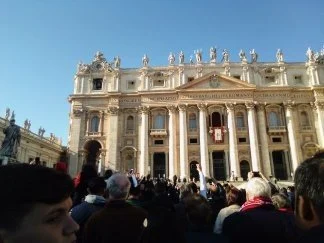
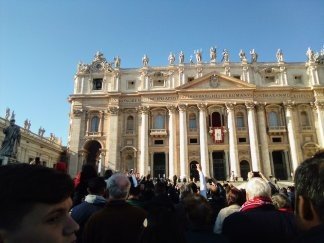
On Easter Sunday the Mass of the day is celebrated in the morning in St. Peter's Square and afterward, from the central loggia of the basilica, the Pope delivers the Easter message and gives the Urbi et Orbi blessing, traditionally around noon. They are two distinct moments in the same place: for the Mass the free ticket from the Prefecture is needed, while for the blessing the free areas of the square and of Via della Conciliazione remain open to the public. The parvis is covered by the floral display donated every year by Dutch flower growers, a tradition repeated since 1986 with tens of thousands of tulips, daffodils and hyacinths transported to Rome in refrigerated trucks. It is, with Christmas, the day of greatest turnout of the year at the Vatican.
What Exactly the Urbi et Orbi Is
The Urbi et Orbi blessing, that is, to the city and to the world, is a solemn blessing that the Pope gives from the central loggia of St. Peter's Basilica on few occasions a year, among them Easter, Christmas and the day the pontificate begins. It is preceded by the Easter message, which as a rule touches on the international crises of the moment, and by the greetings in different languages. Tied to the blessing is the granting of the plenary indulgence under the ordinary conditions set by the Church, extended also to those who follow it on radio, on television or through online media.
Following It Without a Ticket
Whoever has no ticket for the Mass can show up in the square in the late morning and settle in the free areas: you don't get near the loggia, but the giant screens cover the square and the Conciliazione well, where the outflow at the end of the celebration is easier than at the gates of Piazza Pio XII. For the return the area empties slowly: Castel Sant'Angelo and the bridge of the same name are the bottleneck of Easter Sunday, while going up toward Borgo Pio pedestrian traffic is lighter.
The Seven Churches Pilgrimage
The Seven Churches pilgrimage is the Roman devotional walk par excellence: about 20 kilometers on foot, in one or two days, touching the four major papal basilicas and three minor basilicas. Saint Philip Neri gave it shape from 1552, taking up an older practice and proposing it as a devout alternative to the days of Carnival. It is not a rite of Holy Week in the strict sense, but in the days before Easter it is especially popular.
Which Are the Seven Churches
The seven classic stops are St. Peter in the Vatican, St. Paul Outside the Walls, St. Sebastian Outside the Walls, St. John Lateran, Holy Cross in Jerusalem, St. Lawrence Outside the Walls and Santa Maria Maggiore. Since the Jubilee of 2000 the stop at San Sebastiano has been replaced, in the jubilee list, by the Sanctuary of the Madonna del Divino Amore: the two versions coexist, and whoever walks today chooses which to follow. San Sebastiano stands above the catacombs of the same name, and the stretch between Porta San Sebastiano and the basilica is among the most beautiful of the route.
The Route, the Kilometers, the Real Time
The full circuit measures about 20 kilometers and originally was done in a single day, starting at dawn. It was later divided into two days, the first dedicated to St. Peter's alone. Today walking all of it takes between six and eight actual hours, plus stops in the basilicas. The most demanding stretches are those between San Paolo and San Sebastiano and between San Sebastiano and the Lateran, on through roads. The Congregation of the Oratory organizes the walk in collective and nighttime form a couple of times a year.
A Shorter Variant That Works
Those who don't have a whole day can keep the eastern block of the route, which is also the densest and the least tiring: Santa Maria Maggiore, San Lorenzo Outside the Walls with the adjacent Verano cemetery, Holy Cross in Jerusalem and St. John Lateran with the Holy Stairs. That's four stops in a little over five kilometers, all served by public transport, and they cover the relics of the Passion kept at Santa Croce and the cathedral of Rome. For help getting around between one stop and the next, the overview of transport is in how to get around Rome.
The Rites in the Roman Basilicas, Outside the Vatican
Concentrating only on the Vatican is the most common mistake of those who spend Easter in Rome: the four papal basilicas and dozens of minor churches celebrate the Triduum in solemn form, without tickets, without lines and with a liturgical and musical quality that is often very high. For those who haven't obtained the Prefecture's tickets, or prefer a celebration in which you can see the altar, they are the obvious answer. The times are published by the individual basilicas and by the Vicariate of Rome.
St. John Lateran and the Scala Santa
The basilica of St. John Lateran is the cathedral of Rome and the first in dignity among the papal basilicas: in the Triduum it hosts solemn celebrations and, when the Pope celebrates the Mass in Coena Domini there, it becomes the center of Holy Thursday evening. Opposite, across the square, is the Holy Stairs, 28 steps that tradition identifies with those of Pilate's praetorium, covered with walnut wood in 1724 to protect the marble beneath and which are climbed only on your knees. It is the most frequented Roman place of Lent and of Good Friday. The sanctuary is entrusted to the Passionists, the climb is free, and the visit to the Sancta Sanctorum, the medieval papal chapel at the top, is instead paid. Hours vary between summer and winter, so it's best to check them before showing up.
St. Paul Outside the Walls and the Peripheral Basilicas
The basilica of St. Paul Outside the Walls is the largest after St. Peter's and the easiest to reach by metro, with the advantage that even on peak days no lines comparable to the Vatican ones form. Its Triduum celebrations are solemn and the quadriporticus allows flows to be managed without a crush. On the opposite side of the city, San Lorenzo Outside the Walls offers a more intimate dimension, and the Abbey of the Tre Fontane, in the place that tradition names as the site of Paul's martyrdom, has Trappist celebrations with Gregorian chant that are among the most beautiful to hear in Rome.
Easter Monday and the Roman Pasquetta
Easter Monday, which everyone calls Pasquetta, is a public holiday in Italy for all purposes and in Rome it means one thing only: a day trip out of town. The liturgical name recalls the angel's announcement to the women before the empty tomb, but the civil holiday is a postwar institution, designed to lengthen the Easter weekend. In the city the effect is paradoxical and worth exploiting: the historic center empties of Romans while parks, villas and consular roads fill with families carrying their baskets.
The Appia Antica, the Classic Outing
The Appia Antica Park is the Roman destination par excellence for Easter Monday, and on the holiday the historic stretch of the road is closed to cars, which makes it walkable and bikeable without problems. You generally start from the church of Domine Quo Vadis, pass the catacombs of San Callisto and those of San Sebastiano, reach the Mausoleum of Cecilia Metella and, if you have the legs, continue to the Villa of the Quintilii. The catacombs follow their own calendars and each closes one day a week, so the underground visit should be checked beforehand. The natural starting point is Porta San Sebastiano, along the Aurelian Walls.
The Parco degli Acquedotti
The Aqueducts Park is the most photographed lawn in Rome on holidays: a green area crossed by the arches of the Claudian aqueduct and of the Acqua Felice, reachable by metro and suited to a day outdoors with no organization. On Pasquetta it is very busy, with soccer games, blankets spread out and large families, and this must be factored in: it isn't the place to look for solitude. There aren't enough kiosks, so water and food are brought from home, and there are no real shaded areas except under the arches.
The Caffarella and the Historic Villas
The Caffarella Park is the more rural version of the same idea, wedged between the Appia Antica and the Tuscolana, with grazing sheep, ruins and packed-earth paths. Those who prefer to stay inside the walls have Villa Doria Pamphilj, the largest public park in Rome and perhaps the most convenient choice for a Pasquetta in the city, Villa Ada with its woods and Villa Borghese, which on the holiday, however, is the most crowded of the three. In the municipal villas a picnic on the lawn is allowed, while the use of stoves and barbecues is not: it is a rule that is enforced on Pasquetta.
The Castelli Romani
The historic day trip of Romans aims at the Castelli Romani, the towns on the Alban Hills southeast of the city. Frascati is the most immediate, with the Tusculan villas and the wine cellars. Ariccia is the capital of porchetta and hosts the Palazzo Chigi. Castel Gandolfo overlooks Lake Albano and keeps the Papal Palace, now open to visitors. Nemi looks down from above on the lake of the same name and is known for its strawberries. Completing the picture are Grottaferrata with the Greek abbey of San Nilo, where the Easter liturgy follows the Byzantine rite, Marino, Genzano, Albano Laziale and Rocca di Papa. On Pasquetta, however, Via Appia Nuova and the Tuscolana get clogged, regional trains to Frascati and Albano run on a reduced holiday schedule and the restaurants of the Castelli work only by reservation.
Destinations Beyond the Castelli
Those who want to go farther have Ostia Antica, which opens as usual on the holiday and is one of the largest archaeological areas in Europe, Tivoli with Hadrian's Villa, Palestrina with the sanctuary of Fortuna Primigenia and Subiaco with its Benedictine monasteries. All of them, however, require a car or a longer travel time, and on Pasquetta the return toward Rome in the late afternoon is the worst moment of the day for traffic. Those arriving by car should also keep in mind the picture of city restrictions, explained in Rome's ZTL and Cars in the City.
What Is Open and What Is Closed
The general rule in Rome is that state and civic museums stay open both on Easter Sunday and on Easter Monday, while commerce and most services close. The exceptions mainly concern the Vatican and Good Friday. The updated picture is published every year by the tourist portal of Roma Capitale and by the individual museums.
State Museums and Civic Museums
The Colosseum, the Roman Forum, the Palatine and the other areas of the Archaeological Park open as usual both on Easter and on Pasquetta, with the sole exception of the reduced hours on Good Friday. The same goes for the civic museums of Roma Capitale, from the Capitoline Museums on top of the Capitoline Hill to the Markets of Trajan, which open on Pasquetta with regular hours. Booking, on the two holidays, is not a suggestion but a necessity: the Colosseum's timed tickets sell out weeks in advance.
The Vatican Museums
The Vatican Museums and the Sistine Chapel follow a calendar of their own, published every year: they are closed on Sundays, with the exception of the last Sunday of the month with free entry, and they also close on a series of holiday dates that the annual calendar lists explicitly. Easter Day is among the closures, and even the last free Sunday of the month is skipped when it coincides with Easter. Before planning the visit to the Museums in Easter week, therefore, there is only one thing to do: download the year's calendar from the Vatican Museums website and check day by day.
Shops, Markets, Restaurants
On Easter Sunday the great majority of Roman shops are closed, including neighborhood supermarkets, and on Easter Monday the situation is similar even though some chains in the center open. Neighborhood markets, including the Nuovo Mercato Testaccio, are closed on both holidays. Restaurants, instead, work at full capacity on Easter, almost always with a fixed menu and by reservation only, while on Pasquetta many venues in the center close because the clientele has moved out of town. Anyone counting on dining out on Easter Sunday without a reservation is almost always headed for a fallback.
Transport
On the two holidays Roman public transport runs on a holiday schedule, that is, with reduced frequencies compared with weekdays, and Lazio regional trains adopt the same scheme: on Pasquetta morning the runs toward the Castelli and the coast are fewer than you'd expect, with a concrete effect on waiting times. On Good Friday the question is different and concerns the afternoon and evening, when the closure of the Colosseum area changes a considerable part of the surface network. The general picture of transit and travel passes is in how to get around Rome, while for arrivals what is said in from the airports to central Rome applies.
The Roman Easter Table
In Rome the identity meal of Easter is not lunch but breakfast: hard-boiled eggs, corallina (the Easter salami, often sliced), pizza sbattuta or savory Easter pizza, fava beans and pecorino, all eaten on Sunday morning and able to keep a good part of the day occupied. Lunch then brings the abbacchio, that is, milk-fed lamb, usually roasted with potatoes or a scottadito, and the lamb coratella with artichokes, an offal dish typical of exactly this season, when Roman artichokes are at their best. The dessert is the colomba, which however is an industrial invention of the 20th century and not an ancient Roman tradition.
A Clarification on a Tradition That Belongs to Another Feast
You often read that at Easter rose petals rain down from the oculus of the Pantheon. The rain of petals at the Pantheon does exist, but it belongs to the solemnity of Pentecost, which falls 50 days after Easter, not to Easter Sunday: whoever organizes the trip counting on that image has the wrong feast by almost two months.
How to Survive a Packed Rome
Easter week is, with Christmas, the moment of greatest tourist pressure on Rome. The rules that work are always the same: book well in advance everything that can be booked, visit in the time slots that others don't use and accept that in the days of the Triduum some things can't be done.
Book, and Book Earlier
Timed tickets for the Colosseum and the Vatican Museums, a restaurant for Easter Sunday, regional trains to the Castelli and lodging: everything sells out weeks in advance, and hotel prices in Easter week line up with those of the high summer season. Those looking for guidance on which area to choose will find the picture in where to sleep in Rome. The first three days of the week are still weekdays and remain the best for visiting the city, perhaps set up along the lines of Rome in One Day: from Holy Thursday afternoon on, the center stiffens with closures and barriers. The operational advice is to avoid the area immediately around the Vatican if you're not interested in the celebrations: on peak days, leaving the hotel and crossing Borgo can take much longer than expected.
An Alternative If the Crowd Is the Problem
If the reason for the trip is not religious, Easter week is not the right week to see Rome, and no strategy changes that. In that case it's best to shift the center of gravity outside the historic center: Ostia Antica, the Villa of the Quintilii, the catacombs of Priscilla on the Salaria, San Saba or the Janiculum remain workable even on peak days. The view from the Janiculum and the one from the Orange Garden are, in those days, the two least tiring ways to look at the city.
Frequently Asked Questions About Easter in Rome
Do you need tickets for the Way of the Cross at the Colosseum?
No: the Good Friday Way of the Cross at the Colosseum has free entry at no charge, with no ticket and no booking. The public areas are accessed through gates with security checks activated in the afternoon, and spots are taken in order of arrival. Anyone who wants to be at the front must show up several hours early. The public stays outside the amphitheater: the first stations take place in the arena, reserved for the participants in the rite.
How do you get tickets for the Easter papal celebrations?
Tickets for the papal celebrations in Rome are always free and are requested from the Prefecture of the Papal Household, now through its online portal reachable from the Holy See's website. They are needed for Palm Sunday, the Chrism Mass, the Passion of the Lord, the Easter Vigil and the Easter Mass. Nobody can legitimately sell them: whoever offers them for a fee is selling an escort service, not access.
What time does the Way of the Cross at the Colosseum start?
The Way of the Cross at the Colosseum is held in the early evening, in recent years around 21:00, but the exact time is set from year to year by the calendar of celebrations published by the Holy See and should be checked there. The rite lasts about an hour and a half and takes place in the dark, on an evening that in Rome between March and April can be cold. It's best to arrive in the late afternoon, before the road closures kick in.
Is the Pope always present at the Way of the Cross at the Colosseum?
The Way of the Cross at the Colosseum takes place every year, but the Pope's physical presence is not guaranteed: on several recent occasions the Pontiff followed it from his residence for reasons of health, while the celebration went on as usual, presided over in his place. The venue, instead, changes very rarely: the rite was held in St. Peter's Square only in the years of the health restrictions. Confirmation comes a few days beforehand from the Vatican Press Office.
When does Easter fall and how is it calculated?
Catholic Easter falls on the first Sunday after the first full moon following the spring equinox, according to the rule of the Council of Nicaea, and can therefore land on any Sunday between March 22 and April 25. The equinox is conventionally fixed at March 21 and the full moon used in the calculation is the one of the ecclesiastical tables, not the astronomical one. Orthodox Easter, calculated on the Julian calendar, almost always falls on a different Sunday.
Is the Colosseum open on Good Friday?
On Good Friday the Colosseum opens only in the morning and closes in the early afternoon for the setup of the Way of the Cross, with the route limited to the first two rings. The same applies to the Roman Forum and the Palatine, with the special routes suspended and some monuments in the area closed in the preceding days. Anyone with an afternoon timed ticket for that day must change it. The Archaeological Park publishes the notice on its website a few weeks in advance.
What is open in Rome at Easter and Pasquetta?
In Rome on Easter and Pasquetta the state and civic museums stay open, Colosseum and Capitoline Museums included, while the Vatican Museums close on Easter Day and follow a calendar of their own to be checked every year. Shops and neighborhood markets are mostly closed on both days, restaurants work by reservation on Sunday and many close on Monday. Public transport runs on a holiday schedule.
Where do Romans go on Pasquetta?
On Pasquetta Romans leave the city: the classic destinations are the Appia Antica Park, closed to cars on holidays, the Parco degli Acquedotti, the Parco della Caffarella and the Castelli Romani, from Frascati to Ariccia as far as Castel Gandolfo and Nemi. Those who stay in the city fall back on Villa Doria Pamphilj or Villa Ada. A picnic on the lawn is allowed in the municipal villas, barbecues are not, and the late-afternoon return is the worst moment for traffic.
Who Wrote This Page
This page is edited by the editorial team of Tour Leader Pro, the Rome-based project office that designs and coordinates visits, itineraries and cultural events in Rome and Lazio. Hours, fares and access conditions given here were verified at the publication date against the official sources indicated in the text: it's best to check them again before you go, because they change often. If you find out-of-date information, let us know.
Anyone putting together a Roman stay in Easter week, with celebrations at fixed times, road closures and visits to fit between the Colosseum, the papal basilicas and a day in the Castelli Romani, finds planning tools and operational support at Tour Leader Pro, which works on exactly this: making real times, openings and transfers fit together in a week when the city doesn't forgive scheduling mistakes.
For a broader picture of Italian transport and of the destinations in Lazio reachable from Rome in a day, from the villas of Tivoli to the excavations of Ostia Antica to the villages of the Alban Hills, a good resource is Italy Planner.