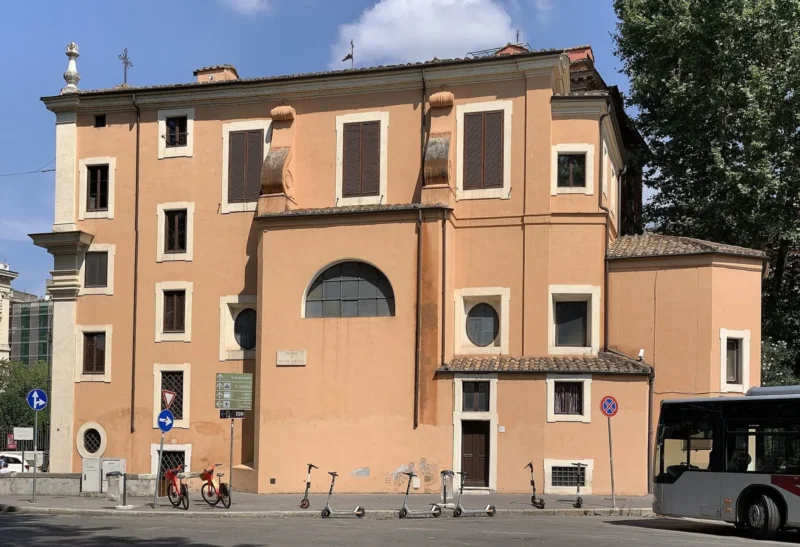
Santa Maria in Publicolis
In short. Santa Maria in Publicolis is a small, Baroque and almost always closed church, wedged between Via in Publicolis, Via dei Falegnami and Piazza Costaguti, in the Sant'Angelo district.
Santa Maria in Publicolis is a small, Baroque and almost always closed church, wedged between Via in Publicolis, Via dei Falegnami and Piazza Costaguti, in the Sant'Angelo district. It stands a few steps from the Jewish Ghetto of Rome and the Turtle Fountain, in one of the most photographed and least read blocks of the city. Almost everyone walks past it without raising their eyes: the facade is narrow, the color is dull, and above the pediment there are two stone birds that nobody looks at. They are pelicans, and they explain whose church this was. This page lines up what the sources actually document about the title, the family that appropriated it, the 1642 building project, the paintings it contains and the access regime. It also explains two things that circulate and don't hold up: the location inside the ghetto and the supposed role in the sermons imposed on the Roman Jews.
Where Santa Maria in Publicolis Is and How to Get There
The address of Santa Maria in Publicolis is not just one, and this is the first practical difficulty. The institutional records of the Municipality and the diocesan lists register it at Via dei Falegnami 23, other sources give Via in Publicolis 46, and the facade looks onto Piazza Costaguti. There is no contradiction: the building occupies a corner and has entrances and numbering on different fronts. Anyone who sets the navigator to only one of the three risks circling the block.
The Visual Landmark That Works
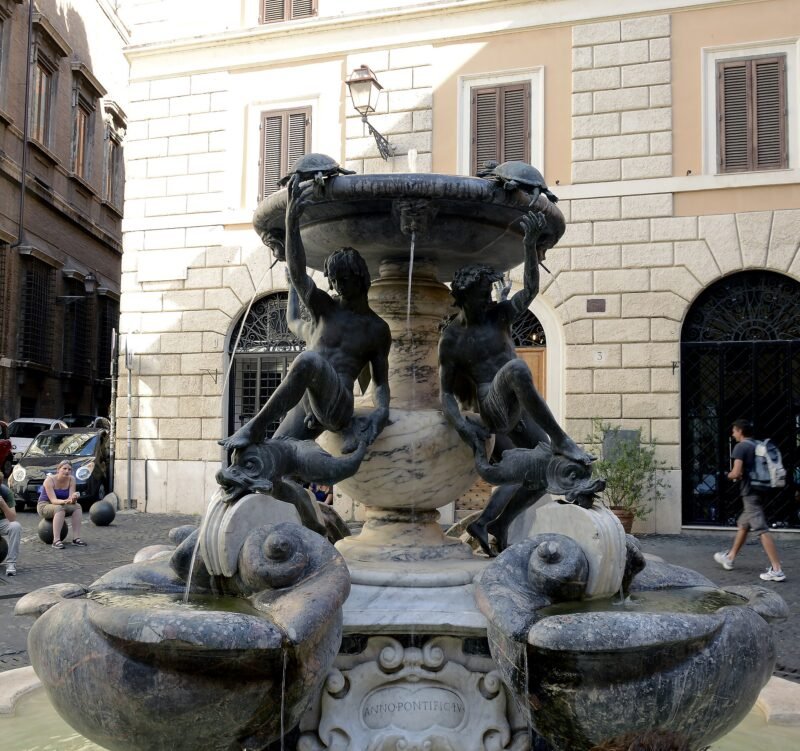
The quickest way to get there is to aim for the Turtle Fountain in Piazza Mattei, which everyone knows how to find, and then take Via dei Falegnami westward for about 50 meters. The church appears on the left, with the facade turned onto a tiny widening. Anyone arriving instead from Via del Portico d'Ottavia has to go back up north crossing Piazza Costaguti.
By Public Transport
The useful stop is Largo di Torre Argentina, a surface hub served by many bus lines and by tram 8, which comes from Trastevere. From there you walk five or six minutes south, passing the dark bulk of San Carlo ai Catinari. Roman line routes change often because of roadworks: check on the same day on the transport company's app. The general picture of transport is on our page on how to get around Rome.
The Subway Doesn't Help
No subway station is really convenient for this corner of the city, and it is good to know before getting off at Colosseo with the idea of taking a short walk. From Line B it takes a good 20 minutes on foot passing by Piazza Venezia or the Theater of Marcellus. The Roman subway network avoids the historic center for archaeological reasons, and the Ghetto remains one of the zones best reached on foot and worst reached underground.
By Car and by Bike
Arriving by car is a terrible idea: the area is inside the limited traffic zone of the historic center, the streets are very narrow and parking is practically nonexistent. By bike the quadrant works better, because distances are short and traffic is slow, but the sampietrini surface tests wheels and wrists. Anyone who wants to understand which Roman cycling routes really hold up will find an assessment on our page on Rome by bike.
What You See, and When You See Nothing
The operational truth has to be said right away: Santa Maria in Publicolis is closed for most of the day. It is not a tourist church, it has no custodian, no ticket office and does not appear in the visiting circuits. Whoever passes at 11:00 in the morning on a weekday finds a barred door, and the visit ends there, on the sidewalk, looking at the facade.
The Opening Regime
The available information indicates opening concentrated in the late afternoon on weekdays and in the late morning on Sunday, tied to the times of the services. Sunday Mass appears to be set at 11:00. Some data in circulation dates back more than 15 years and should be taken for what it is, that is rough indications. The phone number published in the municipal records is the most reliable way to find out if the church opens on a given day.
The Administrative Status
Santa Maria in Publicolis is not a parish and is not even a rectory. The lists of the Diocese of Rome classify it as an annexed church, linked to the parish of Santa Maria in Campitelli, that is Santa Maria in Portico in Campitelli. This explains why it has no articulated liturgical calendar of its own and why its internal life depends on the religious community that officiates there, not on an autonomous territorial organization.
The Facade, Which You Can Always See
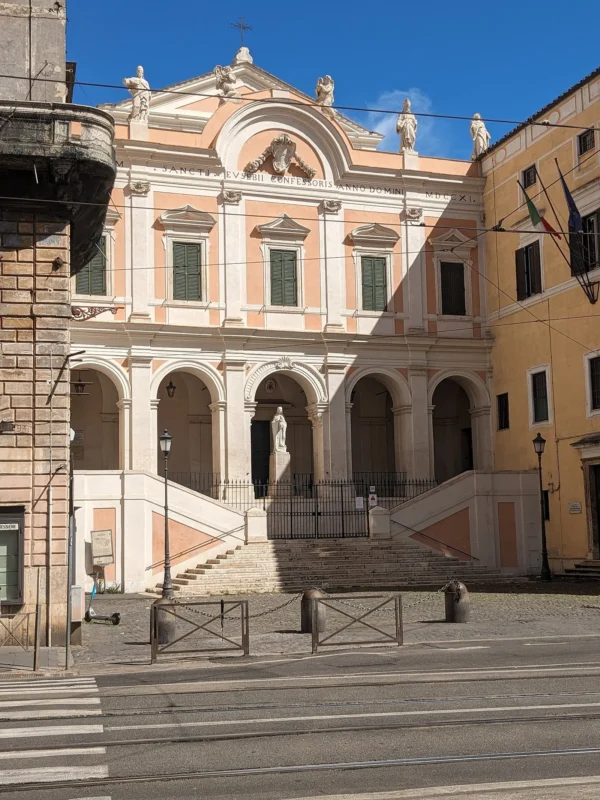
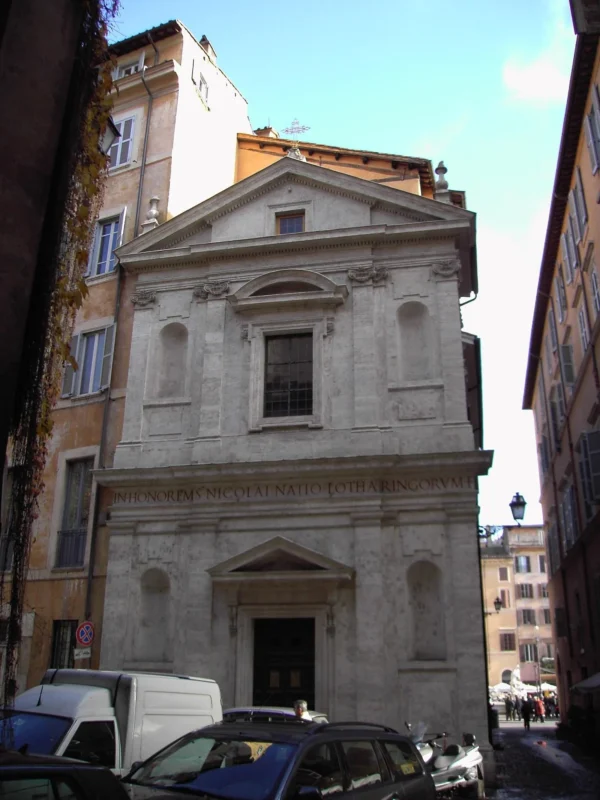
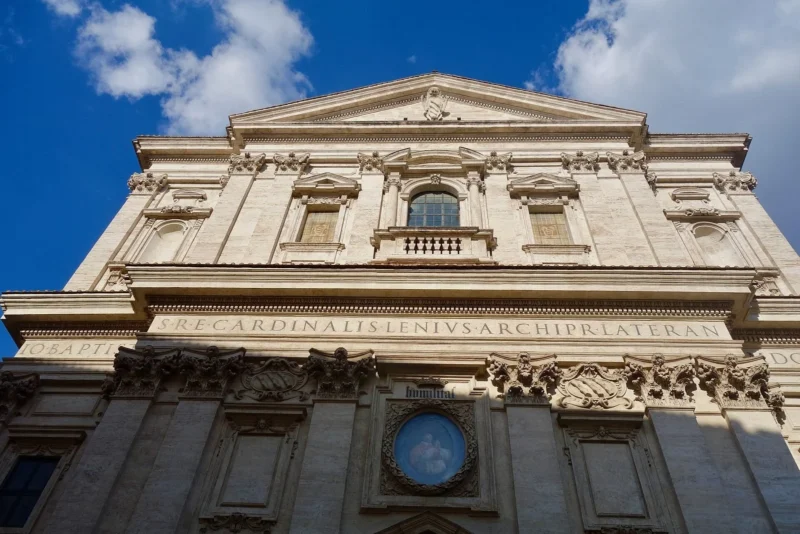
The facade remains legible from outside at any hour, and is worth the five minutes it asks. It is divided into two orders by a sturdy cornice and is divided vertically into three bands. Below, at the center, the portal with a fresco of the Madonna enthroned among angels, framed by two Ionic half-columns, and at the sides two semicircular niches left empty. Above, Tuscan pilasters and a large window.
The Two Pelicans
The detail to look for is at the top, at the sides of the arched pediment that closes the facade. They are two sculptures depicting a pelican in the act of wounding its breast, an ancient image of the sacrifice of Christ feeding his own with his blood. The same figure recurs in the heraldry of the family that held the church for centuries, and this makes it a double signature, devotional and dynastic at once.
The Name: From Santa Maria de Publico to in Publicolis
The story of this church's name is more interesting than the church itself, because it documents a successful genealogical rewriting that was never dismantled. Originally the building was called Santa Maria de Publico, with no reference to noble families. The passage to in Publicolis takes place in the 1500s and is the work of a Roman house that wanted to attach itself to republican Rome.
The First Attestation
The church appears in a bull of Pope Urban III of 1186, where it is listed among the dependencies of San Lorenzo in Damaso under the name Santa Maria de Publico. At the end of the same century the catalog of Cencio Camerario, the great census of Roman churches compiled by the chamberlain who would become Honorius III, registers it as number 208 as sancte Marie in Publico. They are two independent documents that place the building in the full Middle Ages.
What de Publico Meant
The current hypothesis on the origin of the place name ties the name to the Porticus Minucia frumentaria, the great imperial-era complex where the distributions of the frumentum publicum took place, the public grain distributed to the citizens entitled to it. The area between today's Via delle Botteghe Oscure and the Crypta Balbi preserves precisely the traces of that food-supply apparatus. The hypothesis is solid but remains a hypothesis, and the sources present it as such.
The Invention of the 1500s
In the 1500s the Santacroce family, which had obtained the patronage of the church, claimed to descend from the Valerii Publicola, the clan that tradition connects to Publius Valerius Publicola, consul of the very first Roman republic and protagonist of the war against Porsenna. From that claim came the change of name: de Publico became in Publicolis, and the food-supply place name was turned into an aristocratic surname. No modern source gives credit to the descent.
Why the Forgery Worked
The name has held for four and a half centuries, and has reached the municipal street naming: Via in Publicolis is called that because of the church, not the other way around. The baronial families of Renaissance Rome habitually built ancient genealogies to legitimize themselves against older houses, and this is one of the best-succeeded operations, because it has crystallized in a street sign that nobody has any reason to change anymore.
The Santacroce: A Turbulent Family and Its Burial Place
Understanding the Santacroce serves to understand the church, because Santa Maria in Publicolis is essentially their mausoleum. The family had been present in Rome for a long time and lived in the Sant'Angelo district since at least the 1200s, with a palace and a tower a few meters from the church. The sources describe it as quarrelsome and involved in the baronial feuds that bloodied the late medieval city.
Expelled and Readmitted
The hardest clash was with the Margani, and it ended badly: Pope Sixtus IV expelled them from Rome and had their houses torn down. The return came under Innocent VIII, and from that moment the family rebuilt its position with method, placing senators, conservators and four cardinals. The palace on Via in Publicolis, with the corner tower in diamond-point rustication, bears the inscription that attributes the construction to Antonio Santacroce around 1501.
Prospero and Tobacco
The most curious member of the house is Prospero Santacroce, born in Rome in 1514 and died in 1589, jurist and diplomat, nuncio in France, Portugal and Spain, created cardinal by Pius IV in 1565. On his return to Rome he was credited with having been the first to help introduce tobacco into the city, bringing it from Portugal. The plant was nicknamed holy herb or Santacroce herb, and the biographical reference work records the attribution with caution.
Antonio, the Cardinal Who Did Not See the Building Site
Antonio Santacroce was born in Rome in 1599 and died of tuberculosis in November 1641. He was apostolic protonotary, governor, nuncio in Poland, archbishop of Chieti and then of Urbino, papal legate in Bologna, and received the red hat at 30 in 1629. He died a few months before the old church was demolished, and his burial is among those that the new building took in.
The End of the House
The Publicola branch of the Santacroce died out in the 1800s, without male heirs. This is one of the pieces of information we found in a single line of sources, specialist but not academic, and we report it pointing out the limit. What is certain is that the church, in the mid-1800s, passes to a religious congregation, which presupposes that the family patronage had by then lost strength.
The 1642 Building Project and Giovanni Antonio De Rossi
The building you see today has a precise date and a signature. The medieval church was restored by the Santacroce in 1465, then fell into ruin during the 1500s and early 1600s. In 1642 it was demolished and rebuilt from scratch to a design by Giovanni Antonio De Rossi, at the wish of Marcello Santacroce. The work closed the following year.
The Date on the Facade
The confirmation is not in an archive but on the stone: between the two orders of the facade runs the inscription DEIPARAE VIRGINI IN PUBLICOLIS MDCXLIII, to the Virgin Mother of God in Publicolis, 1643. It is a self-referential but unequivocal document, and it is the kind of proof worth more than 10 nineteenth-century guidebooks copied from one another. Anyone who wants to verify the date of the church only has to look up.
The Problem of the Cardinal's Title
Here is a knot that almost nobody points out. The sources agree in calling the patron Cardinal Marcello Santacroce, but the episcopal reference works place his creation as cardinal in February 1652, nine years after the end of the work. Marcello was born in June 1619 and in 1642 he was 23. The current formula is therefore a convenient anticipation: the person who commissioned the church was a young patrician destined for the red hat, not yet a cardinal.
Who De Rossi Was
Giovanni Antonio De Rossi is one of the Roman architects of the full 1600s, active on churches, palaces and noble chapels in a city where the work was shared out by far bulkier names. Anyone who wants to measure the distance between his restraint and the grand Baroque scene can compare this facade with the itineraries devoted to Bernini in Rome and Borromini in Rome. Publicolis is an exercise in control, not in invention.
What Was Lost
Of the medieval church practically nothing remains standing. The 1642 project was a complete demolition, not a modernization, and the only earlier testimonies that survive are the gravestones reused in the floor. This is the usual cost of the Roman rebuildings of the 1600s: a more coherent and more modern building, paid for with the erasure of seven centuries of layering. The same thing happened in dozens of churches in the center.
Inside the Church: One Nave, Two Chapels, Many Dead
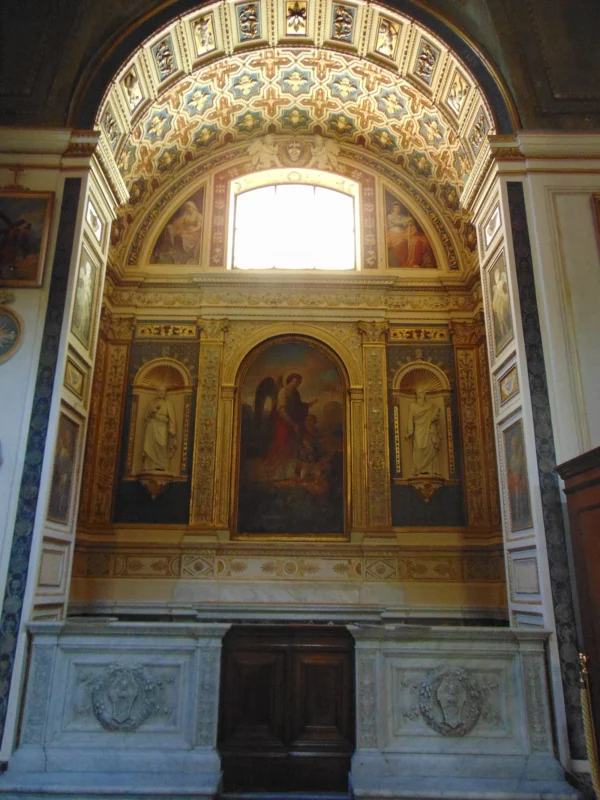
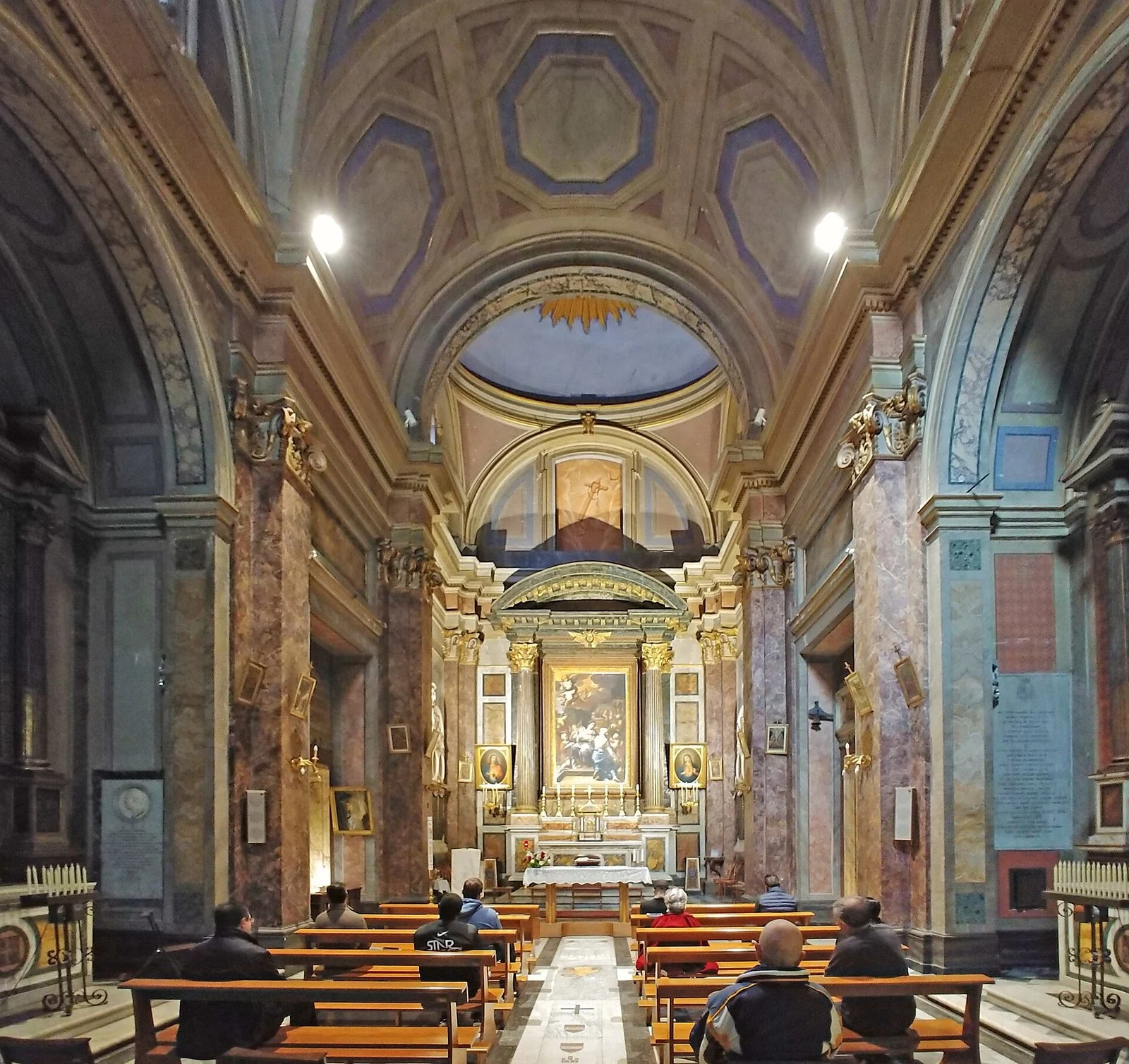
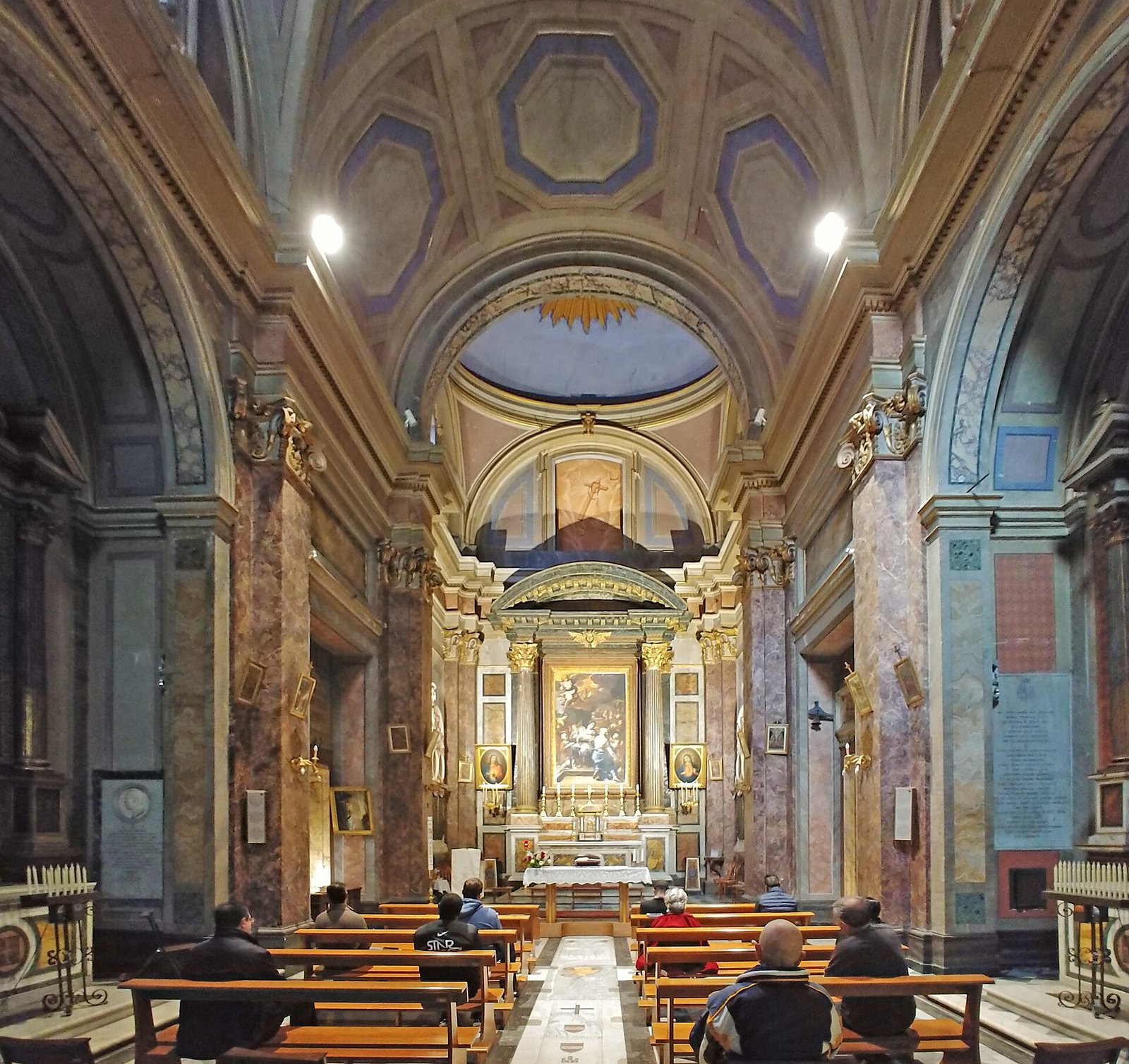
The interior is simple and can be read in a few minutes. A single nave covered by a barrel vault, two side chapels, at the end a rectangular apse covered by a dome and entirely occupied by the presbytery. There is no transept, no radiating chapels, none of the staging of light you expect from Roman Baroque. It is a family church, sized for a family.
The High Altar
The high altar is in polychrome marbles and holds a Nativity of the Virgin by Raffaello Vanni. The painter, from Siena, was baptized in September 1595 and died in 1673, trained in Rome with Guido Reni and Antonio Carracci and spent some years in Venice copying Titian and Veronese. In 1658 he became head of Accademia di San Luca and at the end of the 1650s prepared cartoons for the mosaics of St. Peter's.
The Right Chapel
In the right side chapel is a painting by the same Vanni with Saint Helena before the Cross. The pairing is not accidental: the finder of the true Cross is the obvious reference saint for a family called Santacroce, and the commission of these canvases is documented to 1644, that is right after the end of the building project. There was also a third painting, a Saint Andrew Corsini, now lost.
The Left Chapel and an Unstable Attribution
In the left chapel is a Saint Francis of Assisi, and here the sources quarrel. Some assign it to an Alessandro Grimaldi, a painter active between 1630 and 1663, others to Giovanni Francesco Grimaldi and describe it as a copy of an original by Annibale Carracci. The two readings are not reconcilable and neither is supported by documentation we have been able to check: we report it as an open divergence.
The Organ
On the choir loft over the entrance wall is a pipe organ by the firm Mascioni, opus 307, built in 1912. It is a 1900s instrument in a 1600s church, and this layering is the norm in Roman churches, where the old organs were replaced almost everywhere between the 1800s and 1900s. The opus numbering of Italian organ-building firms makes it possible to date the instruments with notarial precision.
The Floor
The floor is the most interesting part and the least looked at. Set into it are gravestones of the 1400s and 1500s, reused from the previous church, and among them the slab of a canon of St. Peter's who died in 1435 and that of an Alfonso Santacroce who died in 1472, with the effigy in very low relief by now worn by footsteps. There is also a polychrome marble inlay for a Clemenzia Santacroce, who died aged 24 in 1571.
The Funerary Monuments
On the walls are the monuments of the full Baroque age and of the 1700s. The most cited is that of Antonio Publicola Santacroce and his wife Girolama, with busts attributed to Lorenzo Ottoni: the sources however diverge on the date, between the first decade and the third decade of the 1700s, and on who signed the design. A second monument, for a Scipione Publicola Santacroce who died in 1747, is attributed to Giovanni Battista Maini and Tommaso Righi.
A Curiosity About Santa Maria in Publicolis
The best curiosity is that this church is the surviving monument of a genealogical lie. A Roman family of middling power decided in the 1500s to descend from a consul of the first republic, changed the name of its church accordingly, and that name is today the reason a street in the Sant'Angelo district is called Via in Publicolis. The forgery has outlived the family that invented it.
How to Take It Apart, in Practice
It is enough to look at the documentary sequence. In 1186 the church is Santa Maria de Publico, at the end of the 1200s it is sancte Marie in Publico: the name refers to the public, that is to the food-supply distributions of the imperial age that took place in this sector of the Campo Marzio. Publicolis appears only in the 1500s, when the Santacroce hold the patronage. The chronology alone is enough to show that the surname was stuck on afterward.
Why It Is a Roman Story
Rome is full of operations of this kind, because for centuries antiquity was the currency with which authority was bought. The baronial families that arrived late needed ancestors and got them, with the help of obliging scholars. Anyone who walks between Palazzo della Cancelleria and Campo de' Fiori crosses the neighborhood where this genealogy industry worked at full capacity.
Something Nobody Tells You About Santa Maria in Publicolis
The thing that is almost never said is that this church is not in the ghetto. The confusion is understandable, because the ghetto in everyday language today means the whole quadrant around Via del Portico d'Ottavia, but the closed enclosure established in 1555 had precise boundaries and Santa Maria in Publicolis stayed outside, on the free side of the Christian city.
Where the Wall Really Ran
The bull Cum nimis absurdum of Pope Paul IV, of 1555, shut the Roman Jews into a very narrow area lying roughly between today's Via del Portico d'Ottavia, Piazza delle Cinque Scole and the Tiber. The gates were initially two, closed at sunset and reopened at dawn, and were then raised to three, to five and finally to eight. The enclosure was enlarged by Sixtus V in 1586 and again under Leo XII in 1825.
A Distance of a Few Meters That Meant Everything
Between the facade of Santa Maria in Publicolis and the perimeter of the enclosure there are a few dozen meters, and that is exactly the point. For three centuries those few meters separated those who could leave their homes after sunset from those who could not. Walking today from this church to the Synagogue of Rome takes five minutes and meets no obstacle: it is a recent freedom.
How to Read the Neighborhood Now
The 1800s block around the synagogue was born after the demolition of the ghetto, decided in 1888, and preserves almost nothing of the original layout. Anyone who wants to understand the layering has two serious tools on the spot: the Jewish Museum of Rome, under the Tempio Maggiore, and a close reading of the surviving houses of Via della Reginella. We put the overall picture on the page about the Jewish Ghetto of Rome.
The Sermons Imposed on the Jews: What the Sources Say and What They Don't
There is an idea circulating about this church that it was one of the venues of the compulsory sermons imposed on the Jews of the ghetto. We checked, and it doesn't hold up. None of the sources we consulted, from the institutional records to the reference works on Roman churches to the popular literature on the ghetto, associates Santa Maria in Publicolis with that practice. It has to be said clearly, because this is a subject where approximation does harm.
What the Forced Sermons Were
For centuries the Roman Jews were obliged to attend conversion sermons, usually on Saturday, given almost always by Dominican preachers. The obligation came with an apparatus of control and attendance counting. Anyone who didn't show up risked a fine. Roman popular memory has kept the gesture of those who plugged their ears with wax or cotton, and it is a minimal and documented form of resistance.
Where They Were Really Held
The sources agree on three places, all different from this one: the church of Sant'Angelo in Pescheria, under the ancient portico. The little church of San Gregorio della Divina Pietà, the one in front of Ponte Quattro Capi with the bilingual inscription still on the facade. And the small oratory of the Carmelo. Anyone who wants to see the material places of that history has to go there, not here.
The Dates, Where They Diverge
On the chronology the sources do not agree. Some place the introduction of the obligation in 1572, others tie it to the bull Sancta Mater Ecclesia of Gregory XIII and date it to 1584. The difference is not minor and we are unable to resolve it with the sources available, so we point it out. They agree instead on the end: the obligation was revoked by Pius IX in 1848, the same year in which the demolition of the wall was ordered.
Why Precision Matters More Here Than Elsewhere
Attributing to a building a role in a story of religious coercion without having documents is a mistake that doesn't correct itself, because it gets repeated and ends up in the guidebooks. The history of the Jews of Rome is already harsh enough in the established facts and doesn't need approximate additions. Anyone looking for the places of persecution will find a serious route on the page about the places of memory in Rome.
My Advice for Visiting Santa Maria in Publicolis
The advice is just one and goes against the habit of people visiting Rome: don't come here in the morning. Roman churches run by religious communities and of no tourist importance open in the late afternoon, around the time of the weekday Mass, and stay closed during the hours when the city walks. Showing up at 10:00 means photographing a door.
The Right Window
The slot that works is between 17:00 and 19:00 on weekdays, and late Sunday morning. The general rule of the minor churches of the center applies: you go in when the faithful go in, not when the groups come out. Anyone who wants peace of mind phones the day before the number published in the municipal records and asks for confirmation of the time, which changes with the liturgical seasons.
How to Behave Once Inside
Santa Maria in Publicolis is the seat of a congregation's generalate, so it is an inhabited place and not a monument open to the public. You enter in silence, avoid photographing during services, stay away from the presbytery if someone is praying. The floor with the gravestones is observed by walking slowly, which is also the way not to wear it down further.
How Much Time You Need
For the church itself 20 minutes is enough, and they are 20 honest minutes: two canvases by Vanni, a burial floor, two funerary monuments, an organ. It is not a half-day place and whoever treats it as one ends up disappointed. It works very well instead as a stop inside a walking tour of the quadrant, which has many more things to see than the fame of the Ghetto suggests.
Plan B When It's Closed
Finding it closed is the most likely scenario, and it is best to arrive with an alternative already ready. Within 300 meters are San Carlo ai Catinari, Santa Maria in Campitelli and Santissima Trinità dei Pellegrini, all with more generous hours. A short distance away the Crypta Balbi and the Galleria Spada are also open.
Another Well-Known Fact, Yet Rarely Mentioned
It is known to insiders, and almost never written in the guidebooks, that since 1858 this church has been entrusted to the Missionaries of the Sacred Hearts of Jesus and Mary, a congregation born in the South and not in Rome. The generalate of the institute appears here from 1835, that is from before the church was entrusted to them: the two dates appear in the same record and live in tension, without the source explaining the relationship.
Who the Missionaries of the Sacred Hearts Are
The congregation was founded in 1833 in Secondigliano, on the outskirts of Naples, by Gaetano Errico, a priest born in 1791 and died in 1860. It obtained the decree of praise in June 1838 and the definitive approval of the Holy See in August 1846. The official abbreviation is M.SS.CC. The founder was canonized by Benedict XVI on October 12, 2008, together with three other figures.
What It Means for Visitors
A generalate is the governing center of an order or a congregation, not a parish: religious live and work there who look after the institute across the world. This explains the restricted hours, the absence of tourist reception and the fact that the church remains substantially private in everyday perception. It isn't hostility, it is a use different from the one the visitor imagines.
A Family Church Turned Congregation Church
The change of hands is the most eloquent thing in the recent history of the building. A church built in the 1600s as a burial place and patronage chapel of a baronial house ends up in the 1800s in the hands of a southern missionary institute of very recent foundation. Between the two owners there is no continuity of any kind, and the second simply inherits the funerary marbles of the first.
The Right Photo to Take at Santa Maria in Publicolis
The right photo is not the frontal facade, which is narrow, squeezed by the neighboring buildings and practically impossible to frame without distorting it. The photo worth taking is the detail up high: one of the two stone pelicans wounding their breast, isolated against the sky, with the profile of the pediment cutting the frame diagonally. You need a modest telephoto lens or the zoom of a recent phone.
The Light
The facade gets direct light for a few hours and the alley stays in shadow almost all day. The useful moment for the pelicans is the mid-afternoon band, when the raking sun reaches the upper part of the building while the lower part is already in shadow: the contrast sets the sculptures off from the background. On overcast days the white sky works well as a neutral backdrop.
The Shooting Point
The best shooting point is on the opposite side of the widening, against the wall, to gain the few meters of distance you need. From there you also keep in the frame the inscription with the date, which completes the image without needing captions. Anyone who wants the whole facade has to accept the converging verticals or straighten them in post-production, and the result will be mediocre anyway.
The Alternative Photo
The second image to take home is from the inside, if you manage to get in: the floor with the worn gravestones, shot almost vertically, with side light revealing the very low relief of the effigies. It is a photograph that requires a steady hand and no flash. Anyone looking for other photographic subjects in the quadrant will find them around the Turtle Fountain and on Tiber Island.
Some Important Events That Happened Here in History
The history of this building is not made of great events but of changes of ownership, and for that very reason it reads well. There are five or six dates, all documented, that tell how a small neighborhood oratory becomes first a dynastic chapel and then the seat of an international religious institute.
1186: The First Mention
The bull of Urban III lists Santa Maria de Publico among the churches dependent on San Lorenzo in Damaso. It is the first moment at which the building exists in writing. Scholars hypothesize an earlier foundation, between the 10th and 11th centuries, when Rome filled up with small neighborhood churches, but this is a deduction from context and not a documented fact.
1465: The Santacroce Restoration
In the 1400s the family intervenes on the building and restores it. The sources agree on the year but not on the name: some indicate Alfonso Santacroce, others an Andrea Santacroce described as a jurist. The uncertainty about the patron does not dent the main fact, that is that by the mid-1400s the house had already established a stable relationship with this church, 50 years before building the palace next to it.
1501: The Palace Next Door
Antonio Santacroce builds the family palace a few meters from the church, after obtaining papal permission to rebuild on the houses that had been torn down. The inscription on the portal still records it. From that moment church and palace function as a unit: residence and burial, power and memory, in the same block of the Sant'Angelo district.
1642 and 1643: Demolition and Reconstruction
The old church is torn down and rebuilt in a little over a year to a design by De Rossi. It is the moment when the building takes its current form and when the title in Publicolis is definitively consolidated. The speed of the work, barely a year, indicates a simple plan and resources available without hitches, which is rare in the Roman building sites of the 1600s.
1644: Vanni's Canvases
The year after the end of the work, the two canvases that can still be seen are commissioned from Raffaello Vanni, plus a third now lost. It is a logical and well-documented sequence: first the architecture, then the painted apparatus. The fact is recorded in the painter's biography and is one of the few documentary fixed points on the furnishing of the church.
1835 and 1858: The Arrival of the Missionaries
In the 1800s the complex passes to the Missionaries of the Sacred Hearts of Jesus and Mary, who establish their generalate there and receive the church in trust. It is the moment when Santa Maria in Publicolis stops being a family matter and becomes an institutional one. Since then its daily life follows the rhythms of a religious community and no longer those of a noble house.
1912: The Organ
The firm Mascioni delivers instrument number 307 of its production. It is the last significant intervention that the sources record on the furnishing of the church, and it marks the definitive passage of the building from the aristocratic dimension to that of a normal officiated church. For more than a century, substantially, nothing has changed here.
Who Has Passed by Santa Maria in Publicolis
The people tied to this church are not celebrities but second-rank figures of papal Rome, and that is what makes it a good sample. Curial cardinals, papal diplomats, Sienese painters, workshop sculptors: the ordinary personnel with whom the Roman machine worked, far more representative than the few names everybody knows.
The Cardinals of the House
The church holds burials of several members of the family, among them Prospero, the tobacco nuncio, Antonio, the nuncio in Poland who died of tuberculosis on the eve of the demolition, and Marcello, the patron of the building project, who would become cardinal in 1652 and bishop of Tivoli in the same year. Beside them rest Alfonso, Andrea and Valerio Santacroce, as well as an Ottavia Corsini.
Raffaello Vanni
The painter who signs the two surviving canvases is the most solid artistic presence in the place. Trained between Rome and Venice, Vanni worked for the Santacroce also in the family palace at the Giubbonari before 1640, painting figures in the vault of the gallery. His Roman career reaches the cartoons for the mosaics of the Vatican basilica, which is the summit a painter could aspire to in those years.
Lorenzo Ottoni and the Sculptors
Among the sculptors cited by the sources are Lorenzo Ottoni, author of the busts of the 1700s monument, Giovanni Battista Maini and Tommaso Righi. They are names that recur in the Roman building sites of the 1700s and that are also met in far more visited churches like Sant'Andrea della Valle or the Church of the Gesù. Here they work on a reduced scale and for a private patron.
Gaetano Errico
The founder of the congregation that officiates the church today is the only saint tied to this address, albeit indirectly and through the institution. A Neapolitan priest of very modest origins, Errico built his work in Secondigliano and died in 1860, with no personal presence in Rome tied to this building on record. The connection is one of institute, not biographical, and it has to be said.
Who Did Not Pass This Way
It is worth also saying the names that have nothing to do with it, because they appear in the guidebooks through neighborhood association. No source links this church to Caravaggio, who did work a few hundred meters away, or to the great names of the scenographic Baroque. Santa Maria in Publicolis remains a work of private commission entrusted to competent, not stellar, professionals.
What to See Around, Within Half an Hour's Walk
The real reason to come all the way here is that the block sits at the center of one of the densest concentrations of monuments in Rome, and almost all of them stay outside the mass routes. In 30 minutes on foot, without ever taking transport, you cross 2000 years of urban layering.
Toward the River
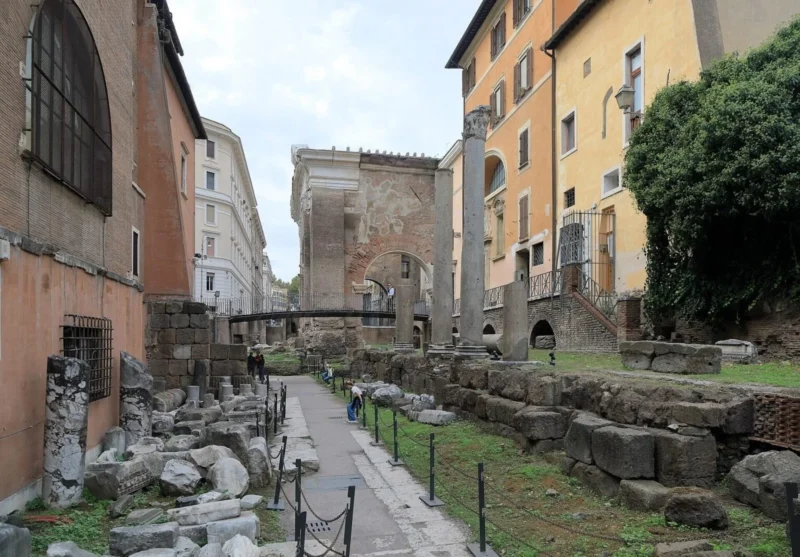
Going down south you meet the Portico d'Octavia, the Theater of Marcellus with its superimposed arches, and then the Tiber embankment. From there you cross onto Tiber Island over the Ponte Fabricio, which is the oldest Roman bridge still in use, and come out on the other side on the Ponte Cestio toward Trastevere.
Toward the North
Going back up toward Via delle Botteghe Oscure you reach the Crypta Balbi, which is the most underrated museum in Rome and the only place where the layering between the ancient world and the Middle Ages is truly visible to the naked eye. A little farther on is Largo di Torre Argentina with the sacred area now visitable from the ancient level and the cat sanctuary.
The Churches of the Quadrant
Within a few minutes are some first-rank churches that the tourist flow ignores: Santa Maria in Campitelli with its altar machine, San Carlo ai Catinari, Santa Maria sopra Minerva with the Bernini obelisk in front, and the Pantheon. To the west are San Pantaleo and Santa Maria in Monserrato.
The Walk We Recommend
The walk that works starts from Campo de' Fiori early in the morning, goes down to the Galleria Spada, crosses the Ghetto unhurriedly, touches this church in the late afternoon when it opens, and ends at Ponte Sisto or at Ponte Garibaldi to cross to Trastevere. It is six or seven hours with stops, and fills a day of a weekend in Rome.
Eating in the Area: The Ghetto, the Portico d'Ottavia and Largo Argentina
This is the chapter on which it is worth being hard, because few Roman quadrants are worse off. The triangle between Via del Portico d'Ottavia, Piazza Costaguti and Largo Argentina concentrates enormous tourist pressure on a few hundred meters of street, and the result is that the percentage of venues built on passing trade rather than on the craft is very high. Not everything is bad, but the ratio between signs and real cooking is unfavorable.
The Specific Trap of the Ghetto
Here there is one more trap compared with the rest of the center, and it concerns Roman-Jewish cooking. It is a real, documented tradition, with precise dishes and centuries of history behind it, and for that very reason it has become a label to display. Many venues on the street put it in the window as a commercial category, serving a simplified and expensive version to people passing through once. A sign declaring the tradition says nothing about who is at the stove.
The Signs That Should Make You Turn On Your Heels
The menu with photographs of the dishes is the first, and it is almost infallible: whoever cooks well describes, whoever sells to people who don't understand the language photographs. The second is the person at the entrance who intercepts passersby and invites them to sit, often in three languages. A place that has to stop you in the street has a customer problem, and it solves that problem on price or on raw materials, never on the cooking.
Pasta Rolled in the Window
The lady who rolls out the sheet of pasta behind the glass or at a table on the sidewalk is a scenic lure, not a sign of quality. It is a gimmick that works because it evokes home cooking and because it photographs well, and indeed it has multiplied across the whole historic center in recent years. In kitchens that really work, pasta is made early in the morning, away from the street, and nobody puts it on display.
Non-Stop Hours
The venue that serves without interruption from morning to late night has given up on service and runs continuous feeding. A kitchen that does lunch and dinner takes a break in the afternoon, because it has to clean, prep and change shift. Whoever never closes works with semi-finished products and regeneration, which is an elegant way of saying that the dish was already ready long before you came in. The difference is felt at the first bite.
Prices in Front of Monuments
At the tables facing the ancient ruins and the portico, a rule as old as tourism applies: the price adapts to the customer. The signs are always the same, and they are almost always all present together. Menu items without a price, or with the per-kilo formula written small for fish and shellfish. Different price lists between the indoor room and the outdoor tables. Cover charge and service multiplied together. Bills that arrive without an itemized breakdown.
Chains with Repeated Signs
In the center of Rome there are groups that open the same venue, with the same furnishings and the same menu, in 10 different spots a few hundred meters from one another. They work as tourist attractions: they are part of the itinerary exactly like a fountain, they are recognizable from afar, they give reassurance to those who don't know the city. There is nothing shameful in it and you don't need snobbery to say so: Romans simply don't go there, because they eat elsewhere and spend less.
The Criterion That Doesn't Fail
The method for choosing is one and is applied from the threshold, in 10 seconds, without reading anything. Look at who is sitting at the tables and listen to what language they order in. If the room speaks mostly Italian, and better still Roman, if there are office workers, craftsmen, people from the neighborhood who come in and say hello, the place has a stable clientele that comes back. If the room speaks only foreign languages and nobody knows the waiter, you have in front of you a venue that lives off passing trade.
Where to Look Instead
The geographic rule is simple: just move three or four blocks away from the main thoroughfare and prices go down while quality goes up. Toward Via dei Giubbonari, toward the alleys behind Largo Argentina, across the river toward the neighborhood markets. We have collected the complete method, with the checks to make before sitting down, on the page about where to eat in Rome and in the entry on the markets of Rome.
For Coffee and Breakfast
For coffee the same criteria apply, with one variant: see if there are people standing at the counter who drink in 30 seconds and leave. A Roman bar that works has fast turnover at the counter and a counter price much lower than the table price, displayed as the law requires. The survey of the city's historic venues, with judgments on which ones still hold up, is on the page about historic cafes and shops of Rome.
Daniele's List
The places we really go to, with their declared limits, we keep updated in a public list on Google Maps: Daniele's list of venues. It is not a ranking and it is not sponsored: it is the list of where we go when we pay out of our own pockets. It should be used as a starting point and checked on the spot, because managements change and a good venue can get worse in six months.
Frequently Asked Questions About Santa Maria in Publicolis
Can You Visit Santa Maria in Publicolis?
You can visit Santa Maria in Publicolis, but only in the opening windows tied to services, usually in the late afternoon on weekdays and late morning on Sunday. There is no ticket office, no reception staff and it is not included in tourist circuits. It is best to phone first the number indicated in the records of the Municipality of Rome.
Is Santa Maria in Publicolis Inside the Jewish Ghetto?
Santa Maria in Publicolis is not inside the perimeter of the ghetto established in 1555, which lay roughly between today's Via del Portico d'Ottavia, Piazza delle Cinque Scole and the Tiber. The church stands a few dozen meters outside that enclosure, in the Sant'Angelo district. Today the distinction is invisible on the ground, but for three centuries it was the difference between two legal conditions.
Were the Compulsory Sermons for the Jews Held in This Church?
The sermons imposed on the Roman Jews were not held at Santa Maria in Publicolis. The sources consulted agree on three different places, all inside or backed against the ghetto enclosure: Sant'Angelo in Pescheria, San Gregorio della Divina Pietà in front of Ponte Quattro Capi, and the small oratory of the Carmelo. No document we found links this church to that practice.
Who Built Santa Maria in Publicolis?
Santa Maria in Publicolis in its current form was designed by Giovanni Antonio De Rossi, who rebuilt it between 1642 and 1643 after the demolition of the medieval building. The patron was Marcello Santacroce, indicated by the sources as a cardinal, a title he however obtained only in 1652. The inscription with the date 1643 is still legible on the facade between the two orders.
Why Is the Church Called in Publicolis?
The name in Publicolis derives from the Santacroce family's claim to descend from the Valerii Publicola of ancient Rome, a claim asserted in the 1500s when the family held the patronage of the church. Originally the building was called Santa Maria de Publico, a name that the sources link to the distributions of public grain that took place in the area in the imperial age.
What Can You See Inside Santa Maria in Publicolis?
Inside Santa Maria in Publicolis you see a single nave with a barrel vault, two side chapels and a rectangular apse with a dome. The main works are two canvases by Raffaello Vanni, the Nativity of the Virgin on the high altar and Saint Helena with the Cross in the right chapel. The floor preserves gravestones of the 1400s and 1500s.
How Much Time Do You Need to Visit Santa Maria in Publicolis?
To visit Santa Maria in Publicolis 20 minutes is enough, which is the honest time required by a single-nave church with two chapels. Fitting it into a walking tour of the Ghetto, the Portico d'Ottavia and Tiber Island takes half a day. Anyone arriving with the expectations of a great Baroque monument ends up disappointed, and it is best to know it beforehand.
Is Santa Maria in Publicolis Accessible for People with Mobility Difficulties?
The accessibility of Santa Maria in Publicolis is not declared by any official source we consulted. The entrance has a step up from the sidewalk and the streets around are in narrow, uneven sampietrini. Anyone using a wheelchair should ask during the phone contact what the real entry conditions are. The general picture is on the page about accessible Rome.
Is Admission to Santa Maria in Publicolis Free?
Admission to Santa Maria in Publicolis is free, as in all officiated churches in Rome that don't have separate museum routes. There are no tickets, mandatory offerings or reservations. The only limit is the hours, which are restricted. Other zero-cost visits in the historic center are collected on the page about free Rome.
Who Wrote This Page
The editorial team that edits this page is that of Tour Leader Pro, a Roman organization that designs itineraries, visits and cultural events in Rome and Lazio. Hours, contact details and access conditions given here are checked against the cited sources as of the publication date, but they change often and without notice: a check before leaving remains necessary. Reports of out-of-date information are welcome.
Anyone who has to build a Roman program holding together churches with a few hours of opening a day, religious communities that don't answer to tourist logic, quadrants where walking distances are short but real times stretch, and groups with different needs, will find materials and planning tools at Tour Leader Pro, designed both for those who guide and for those who organize on their own.
For the wider scale, that is trains, rentals, airports and destinations in Lazio outside the center of Rome, from the Castelli to the volcanic lakes to the coast and the Tuscia, the reference we use is Italy Planner.
Nearby
 Piazza Mattei100 m
- San Carlo ai Catinari100 m
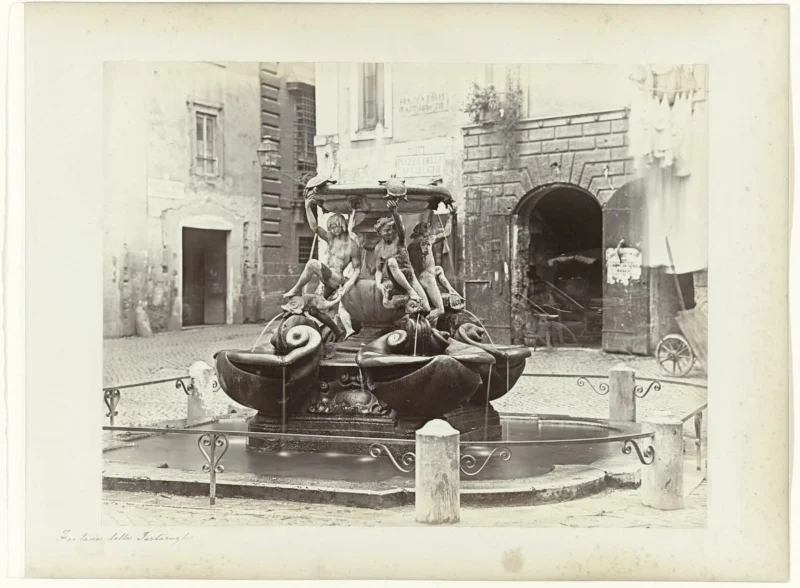
- Turtle Fountain100 m
- The Jewish Ghetto of Rome: What to See and What to Know100 m
- Cat Sanctuary at Largo Argentina100 m
- Teatro Centrale200 m
Upcoming events nearby
- Antonio Marras, Vorrei riempire la tua stanza di rose at Galleria Valentina Bonomo, from October 20, 2026 to February 10, 2027200 m
- Othello at Teatro Argentina, November 4 to 29, 2026200 m
- The Madness of King George with Massimo Popolizio at Teatro Argentina in Rome, January 9 to 31, 2027200 m
- Una delle ultime sere di Carnovale at Teatro Argentina, February 2 to 14, 2027200 m