San Pantaleo
In short. San Pantaleo is the church that faces Corso Vittorio Emanuele II right across from Palazzo Braschi, in the Parione district, about a hundred meters from Piazza Navona and a little more from Campo de’ Fiori.
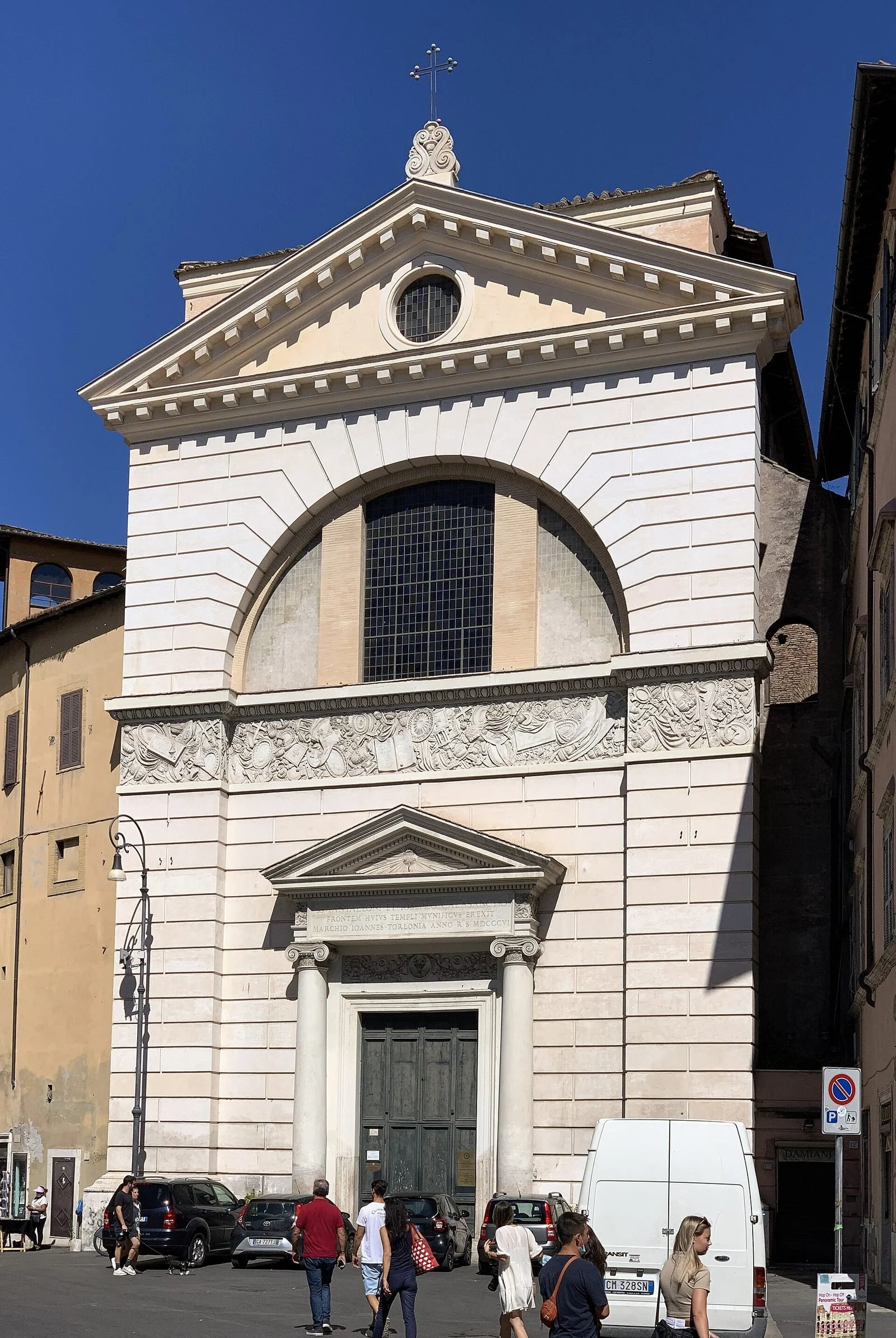
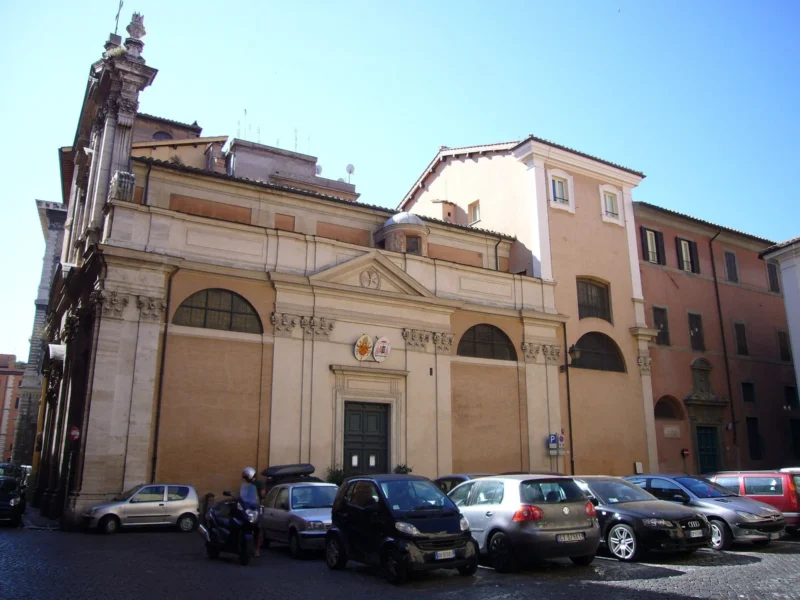
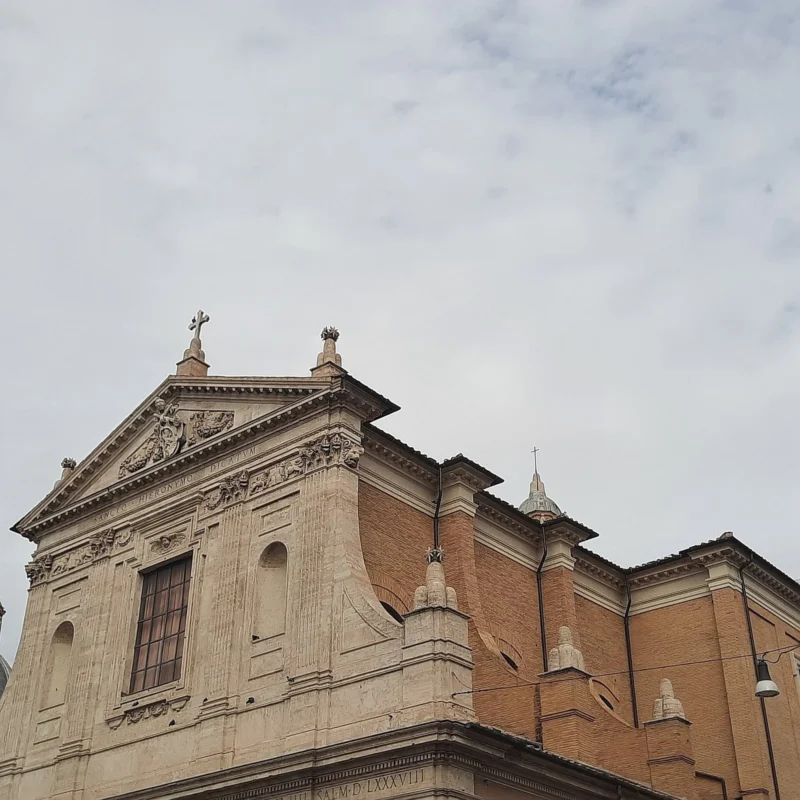
San Pantaleo is the church that faces Corso Vittorio Emanuele II right across from Palazzo Braschi, in the Parione district, about a hundred meters from Piazza Navona and a little more from Campo de’ Fiori. Thousands of people walk past it every day without going in, convinced it’s one of the many pass-through churches of the historic center. Inside, though, lies the body of a Spanish saint who in Rome, in 1597, opened what the order he founded and a good part of school historiography consider the first free public school in Europe: Joseph Calasanz. The church is the seat of the order that grew out of it, the Piarists, and keeps his remains under the altar of the chapel dedicated to him. The neoclassical facade you see from the street is by Giuseppe Valadier and dates from 1806, added to a building that had already been there for centuries. The corso in front, on the other hand, didn’t exist. It was opened between the 1870s and 1880s, and it completely overturned the relationship between this church and the city. The lines that follow tell what you can see today at San Pantaleo, what happened here inside, which facts we were able to verify and which we weren’t, and how to organize a visit that doesn’t shrink to two minutes in the half-light.

Where San Pantaleo is and how to get there
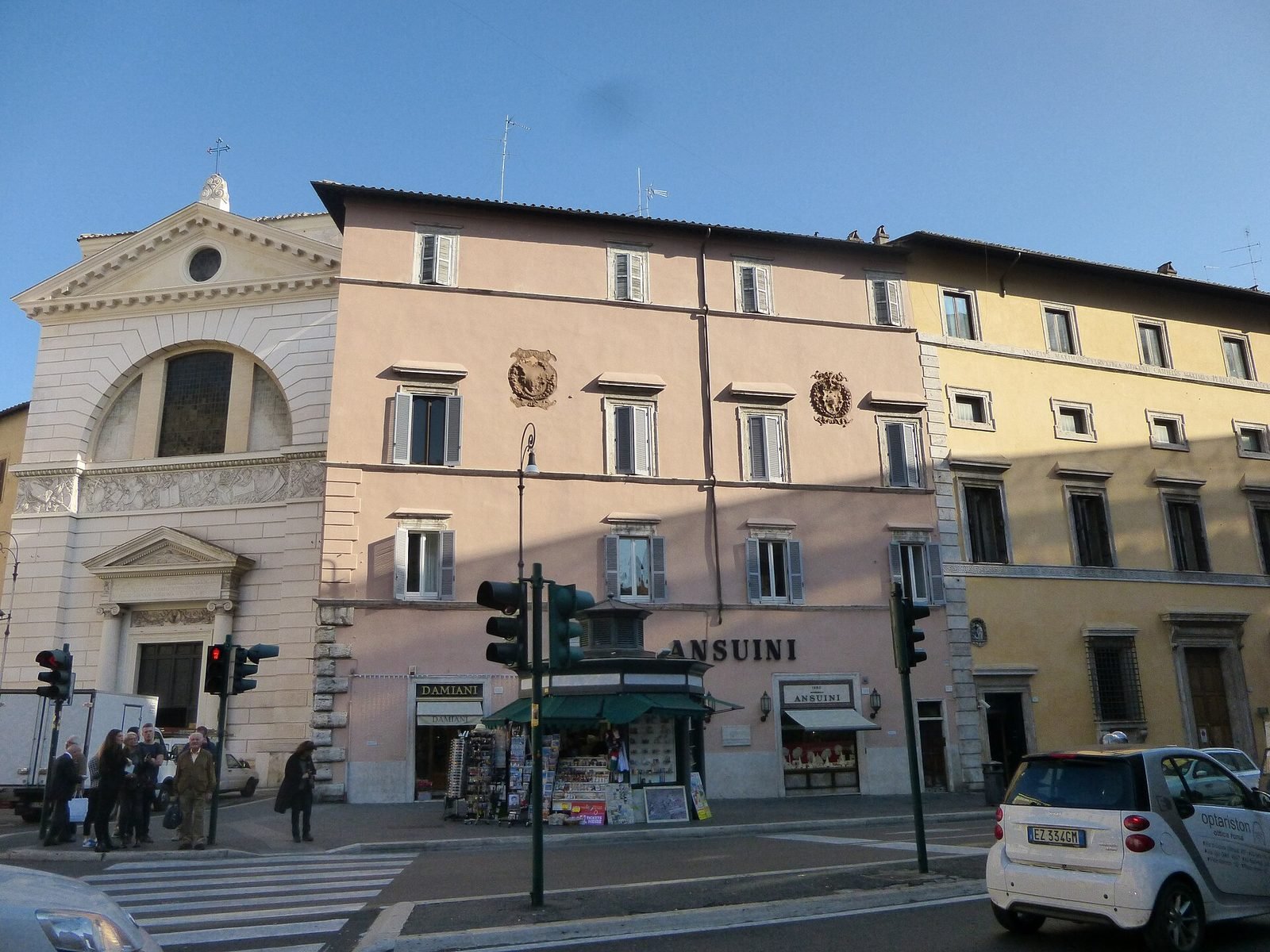
San Pantaleo is in Piazza San Pantaleo, on the south side of Corso Vittorio Emanuele II, in the stretch between Largo di Torre Argentina and Palazzo della Cancelleria. The easiest landmark to avoid getting it wrong is Palazzo Braschi, the big late 18th-century mass that houses Museo di Roma. The church is almost opposite, on the other side of the roadway, with its light travertine facade set between two buildings and a small widening in front that traffic has reduced to a wide sidewalk.
By bus
Corso Vittorio Emanuele II is one of the best-served surface routes of the historic center of Rome. The lines that run along it connect Termini, Piazza Venezia, the Vatican and Trastevere, and the useful stop for the church is the one named after the corso at the height of Navona or of the Cancelleria, depending on the direction of travel. We recommend checking the active lines on the Roman transport company’s website before you leave, because on this route detours for demonstrations, marches and roadworks are frequent and buses are often diverted onto the Lungotevere. Anyone arriving from outside Rome who isn’t familiar with the surface network will find a general overview on our page on how to get around Rome.
By metro and tram
The metro doesn’t serve this part of the historic center. There’s no stop nearby, and anyone arriving by metro has to walk anyway: from line A you get off at Barberini or Spagna and walk a good 20 minutes, from line B the best stop is Colosseo and then you head up toward Piazza Venezia. The most convenient solution remains tram 8, which runs from Trastevere to Largo di Torre Argentina. From there to San Pantaleo it’s barely 600 meters along the corso, 8 minutes at a normal pace. Anyone getting off at the sacred area of Largo Argentina can therefore fit in both stops with no extra travel.
On foot, which is how almost everyone gets there
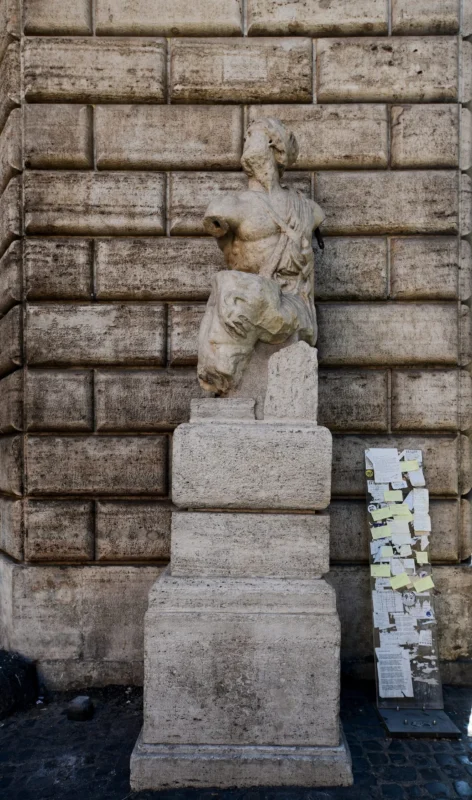
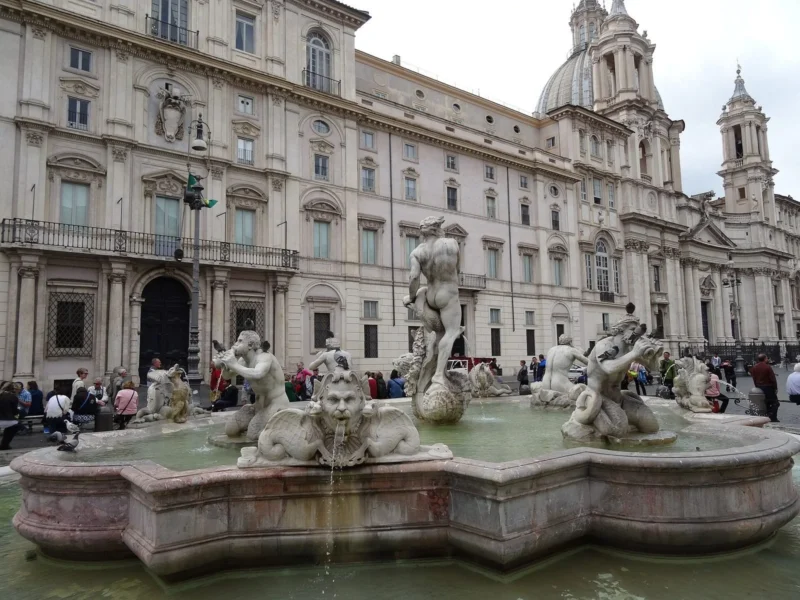
From the Fountain of the Four Rivers to the doorway of San Pantaleo it’s a walk of about three minutes. You leave Piazza Navona from the south side, pass by the statue of Pasquino, follow the side of Palazzo Braschi and find yourself on the corso. From Campo de’ Fiori the time is the same, taking Via dei Baullari northward. From the Pantheon you need a good 10 minutes, going by Sant’Eustachio and Corso del Rinascimento. This is an area where finding your way by eye works badly, because the medieval fabric has no regular axes. The corso is the only long straight line, and once you’ve found that, the church is easy to spot from its triangular pediment.
What you see in 10 minutes: the first impression
San Pantaleo is a single-nave church with side chapels, covered by a fully frescoed barrel vault, and modest in size compared with the basilicas of the neighborhood. The immediate comparison helps. Sant’Andrea della Valle, on the same corso 300 meters farther east, has the second tallest dome in Rome and a nave that crushes anyone who walks in. Here the scale is different. You go in, you look up, and the vault does all the work.
Anyone short on time can organize the stop like this: three minutes for the vault, two for the chapel with the remains of Joseph Calasanz, three for the side chapels and the high altar, two to go out and look at the facade from the opposite sidewalk, which is the only point from which Valadier’s design really reads. 10 honest minutes, which is more than 99 percent of the people passing by give it.
Joseph Calasanz and the first free public school in Europe
In 1597, in the rooms attached to the church of Santa Dorotea in Trastevere, Joseph Calasanz opened a school that was free and open to all the children who showed up, and this is the experience that his order and a large part of the studies on the history of schooling point to as the first free public school in Europe. The church of San Pantaleo is the place where that story then took root and where it ended, because Calasanz lived his last decades here and died here, and he is buried here.
Who he was, before Rome
He was Spanish, from Aragon, born in Peralta de la Sal in 1557 to a well-off family. He studied at Lérida and Alcalá, was ordained a priest and made an administrative career in the diocese of Urgell, where he reached positions of responsibility. In 1592 he left everything and came to Rome with the idea, entirely ordinary for a Spanish churchman of the time, of getting a benefice at the Curia. He stayed 56 years and never got the benefice.
In Rome he spent time with the charitable confraternities, went around the working-class districts with the Confraternity of Christian Doctrine and saw up close something that wasn’t news at the time: the children of the poor neighborhoods didn’t go to school because school had to be paid for. Private teachers asked for a monthly fee, the district schools were reserved for those who could afford them, and anyone who didn’t pay stayed illiterate. The hagiographic sources insist on the sudden nature of his decision. The most recent studies read it as the result of a few years of fieldwork in the districts of Trastevere and Parione.
1597 and the school of Santa Dorotea
The commonly accepted date is 1597, and the place is Trastevere, in the rooms attached to the church of Santa Dorotea. The formula was simple and radical at the same time: no fees, no social selection on entry, teaching of reading, writing and arithmetic together with Christian doctrine. The number of enrolled pupils grew quickly, and this is the point that makes the story historically interesting more than any devotional consideration: the demand for free education already existed, what was missing was the supply.
On one thing it’s worth being precise, because it’s the kind of claim that gets repeated without checking. Free schools for the poor had existed before, run by confraternities, cathedral chapters or individual benefactors, in Italy and elsewhere. What didn’t exist in 1597 was a free public school conceived as a stable institution, open to everyone without distinction, with a dedicated teaching staff and a structure meant to last beyond its founder. It’s in this sense that the formula of the first free public school in Europe is used by historians of schooling, and in this sense we report it here.
From Trastevere to Parione: the stages of a move
The school didn’t stay at Santa Dorotea. As it grew, it looked for bigger and more central spaces, and moved toward the Campo Marzio. The sources indicate a first move near Sant’Andrea della Valle at the beginning of the 17th century, to a rented palazzo, and a second move to San Pantaleo around 1612, with the acquisition of the palazzo next to the church. The exact chronology of these steps varies slightly from source to source, by a year or two, and on this point we flag the uncertainty instead of choosing a date and passing it off as certain.
The move to San Pantaleo was not a logistical detail. It brought the school into a densely populated district right next to the seats of papal power, between Palazzo Madama and the Cancelleria, and made it visible. From that moment anyone crossing Parione knew where the Pious Schools were.
The Piarists: how a school becomes a religious order
The order based at San Pantaleo is called in full the Order of the Poor Clerics Regular of the Mother of God of the Pious Schools, and its members are called Piarists, from the Latin Scholae Piae. It is the only major order of the Catholic Church born with free teaching as its primary purpose, not as a side activity.
The legal stages, in order
The passage from a group of volunteer teachers to a true religious order was slow and went through two successive recognitions. In 1617 Pope Paul V established the Pauline Congregation of the Poor of the Mother of God of the Pious Schools, giving Calasanz’s collaborators a legal status and a habit. In 1621 Pope Gregory XV raised the congregation to the rank of religious order with solemn vows, and Calasanz became its first superior general. The constitutions were approved the following year.
Anyone who knows the history of religious orders knows that 24 years between the de facto foundation and full recognition is a lot. Of those, 20 passed between 1597 and 1617. The slowness was no accident: an order that taught for free the children of artisans and porters took business away from private teachers and fed a suspicion that sounds unbelievable today and was widespread then, even in high places, namely that educating the poor made them unfit for manual work and dangerous to the social order.
The suppression of 1646, which is the part of the story nobody tells
In 1646 Pope Innocent X reduced the order to a simple congregation without vows, in effect dismantling it. Calasanz, who was 89 by then, had first been removed from the leadership of the order and had also been brought before the Holy Office, in an internal affair made of power conflicts, mutual accusations and maneuvering by some religious against him. He died two years later, on August 25, 1648, in the rooms attached to San Pantaleo, watching his own work formally undone.
The order was partially reconstituted by Alexander VII in the 1650s as a congregation of simple vows, and brought back to the rank of order with solemn vows by Clement IX in 1669, 21 years after the founder’s death. This is the fact we recommend keeping in mind when you enter the chapel where he is buried: the man who rests there didn’t see the happy ending.
What the order does today, at San Pantaleo
The complex next to the church houses the general curia of the Pious Schools, that is, the central government of the order, together with the general archive and a historic library. The archive holds the order’s documentation from its origins and is consulted by researchers working on the history of education. It is not a facility open to the general public: access for study is requested formally, with a stated reason and in advance. We weren’t able to verify the exact address, hours and current access procedures of the archive, and so we don’t report them. Anyone who needs to consult it has to write to the general curia.
The chapel with the remains of Calasanz
The remains of Saint Joseph Calasanz are kept at San Pantaleo, in the chapel dedicated to him, under the altar table, in an urn visible to the faithful. It is the main reason people from all over the world enter this church: not passing tourists, but teachers, students and groups tied to the Piarist schools, who come to Rome above all between the end of August and the first days of September.
The relics and the rooms
Next to the church are preserved the camerette, that is, the rooms where Calasanz lived and died, turned into a place of remembrance. The order’s tradition also links to them the preservation of relics of the saint, including the heart and the tongue, objects of specific devotion. The camerette are not freely accessible during the church’s ordinary hours. Opening depends on a prior request or on special occasions, and anyone who wants to see them has to contact the religious community before showing up. We weren’t able to verify a stable opening calendar and so we don’t give one.
A curiosity about San Pantaleo
The church of San Pantaleo is dedicated to a physician martyred at Nicomedia at the beginning of the 4th century, and this means that the building where the free school of Europe was born bears the name of a saint who has nothing to do with the school. The coincidence is purely a matter of place names: the Piarists arrived in a building that had had that title for centuries and didn’t change it.
Who Pantaleon was
Pantaleon, or Pantaleimon in the Greek form, was according to tradition a physician at the court of Emperor Galerius and suffered martyrdom during the persecution of Diocletian, around 305. His figure spread enormously in the East and then across Europe. He is one of the 14 Holy Helpers, the group of intercessors invoked against specific illnesses, and is the patron saint of physicians and midwives. His feast day falls on July 27.
Very little is known about the historical figure. The acts of the martyrdom are late and belong to the legendary genre, with episodes of miraculous healings and instruments of torture that break. We report them as hagiographic tradition, which is what they are, and not as chronicle.
One thing nobody tells you about San Pantaleo
The facade you see from the corso dates from 1806, and at the time it was built it looked onto no corso at all. It looked onto a narrow, closed little square, inside a fabric of medieval alleys. Corso Vittorio Emanuele II was opened 70 years later, cutting through the district. This means that the relationship between this church and the street that runs in front of it, which seems obvious today, is an accident of urban history: Valadier designed a front to be seen up close and at an angle, and today we look at it from far away and head-on, across four lanes of traffic.
What changes, concretely, in how you read the facade
A facade conceived for a narrow little square is read in glimpses: first you see the portal, then you step back a few paces and take in the order, and the relationships between the parts are calibrated for a short viewing distance. On Corso Vittorio the viewing distance is long, the whole front comes into the field of view at once, and its modest size makes it look more modest than it is. Anyone who wants to understand the design has to get close to the church’s sidewalk and look at it at an angle, from the right or from the left. That’s how it was meant to be seen.
The churches that got the same treatment
San Pantaleo is not alone. The demolition for the corso exposed onto a through road a series of fronts built for different settings: San Carlo ai Catinari, Sant’Andrea della Valle itself, the side facade of San Lorenzo in Damaso inside the Cancelleria. In all these cases the original staging was calibrated for enclosed spaces. The corso lined them up as in a shop window, and that line-up is what we now perceive as a natural feature of the Roman historic center.
The neoclassical facade by Giuseppe Valadier, 1806
The facade of San Pantaleo is the work of Giuseppe Valadier and dates from 1806, and it is one of the few openly neoclassical church fronts in the historic center of Rome. Valadier was then 46, was the papal chamber architect and was working on the project that would bring him his greatest fame, the layout of Piazza del Popolo with the ramps of the Pincio.
What you see
The front is in travertine, with one main order of pilasters, with entablature and triangular pediment. No projecting columns, no side scrolls, no statues on the facade. After two centuries of Baroque fronts built to move, to advance and recede, to play with shadow, here the wall goes flat again and the decoration is reduced almost to zero. Anyone arriving from Sant’Andrea della Valle, which has the facade by Carlo Rainaldi with the whole Baroque repertoire on display, feels the break immediately.
Who paid
Learned tradition attributes the financing of the facade to the Torlonia family, and in particular to Giovanni Torlonia, the banker who in those years was building his position in Rome also through patronage of religious buildings. The claim is reported by several reference works. We weren’t able to trace a primary document that confirms it and so we report it as a current attribution, not as a certain fact.
Why a facade arrives two centuries after the church
It’s a perfectly normal situation in Rome under the old regime, and it’s worth explaining because it helps read half the city. The rebuilding of a church started from the inside, where services were held, and proceeded in lots financed by different benefactors. The facade was the last lot, the most expensive in relation to its liturgical return and the most exposed. It required a patron willing to pay for a piece of architecture that didn’t serve worship. Many Roman churches stayed with the rough wall in view for decades. San Pantaleo waited longer than average, and when the financier came, taste had changed completely. That’s why a front from 1806 is mounted on a 17th-century body.
A judgment, since the page exists to give one
The facade of San Pantaleo is underrated, and for a trivial reason: it’s gray, it’s flat, and it sits next to much louder competitors on the same axis. But anyone trying to understand how building was done in Rome in the early 19th century finds here a clean specimen, dated with precision, which is not common. We recommend looking at it in late morning, when the sun hits the travertine at a slant and the pilasters regain a minimum of relief. In the late afternoon, in shadow, the front flattens out completely and you can’t read anything anymore.
Corso Vittorio Emanuele II: the street that wasn’t there
Corso Vittorio Emanuele II was opened starting in the second half of the 1870s, after Rome had become the capital of the Kingdom of Italy in 1870, to connect the bridge over the Tiber toward the Vatican with Piazza Venezia. Before that it didn’t exist. In its place was a fabric of alleys, courtyards and medieval blocks that the new axis cut through in an almost straight line.
What was demolished
The demolition meant the tearing down of whole blocks, the mutilation of palazzi, the moving of fountains and the disappearance of squares. Palazzo Braschi itself, finished a few decades earlier, lost part of the context it had been designed for. The fountain known as the Zuppiera di Corso Vittorio, that is, the Fontana della Terrina, was removed from its original location and placed elsewhere in the 20th century. It’s one of the clearest examples of how the opening of the corso reshuffled the district’s street furniture.
What it meant for San Pantaleo
The church suddenly found itself on a through road that hadn’t been conceived for it and that it hadn’t been conceived to face. The little square in front shrank, the relationship with the surrounding buildings changed, the street level and the flows were reorganized around traffic that within a few decades would become vehicular and heavy. Today the background noise inside the church, at rush hour, is that of buses braking in front of the doorway.
There is, however, an opposite effect that has to be mentioned. Without the corso, San Pantaleo would be an invisible church at the end of an alley, and probably today it would be closed a good part of the time like so many other minor churches of the center. The street that attacked it also gave it 40,000 passersby a day. The balance is ambiguous, and we leave it ambiguous.
A reading that helps anyone walking the corso
Anyone walking Corso Vittorio from Piazza Venezia to the Tiber crosses, in a kilometer and a half, four centuries of Roman architecture lined up by a street none of those architects had foreseen. In order, you meet the Gesù and its idea of a Counter-Reformation church, Sant’Andrea della Valle and full Baroque, San Pantaleo and the neoclassical, the Cancelleria with its Renaissance front, the Chiesa Nuova of the Filippini with Borromini’s oratory next to it. For anyone with half a day who wants to understand Baroque Rome and what came after, this is the cheapest route in terms of steps.
Inside the church: the frescoed vault
The vault of the nave of San Pantaleo is frescoed with the Triumph of the Name of Mary, the work of the Lucca painter Filippo Gherardi, done in the last quarter of the 17th century as part of the rebuilding of the church. It is the artwork that justifies going in, and it is the only attribution for the interior that we can give without reservations.
What an illusionistic vault is
Gherardi works in the tradition of 17th-century Roman quadratura, the one that, between the Gesù and Sant’Ignazio, had taken to its extreme consequences the idea of breaking through the ceiling and showing the sky. The method is to paint on the curved surface a fake architecture that continues the real one, and to place the figures beyond that limit, in a space that appears open. It works from one precise point on the floor, where the vanishing lines come back together. As you move, the fake architecture distorts and the trick shows.
We recommend looking for that point. It’s usually toward the center of the nave, and you find it by eye by taking a few steps forward and back until the painted cornices line up with the real ones. Two minutes of work, and what you see changes completely.
The other works, and why we don’t list them
The church keeps 17th- and 18th-century altars and paintings in the side chapels. The attributions circulating in guides and online listings are partly contradictory, partly not accompanied by verifiable references, and in some cases concern works that may have been moved or replaced during restorations. We chose not to publish a list of names we can’t stand behind. Anyone visiting with a specific interest in Roman 17th-century painting should consult the catalog entries of the heritage protection institutes, or ask directly in the sacristy.
It’s a choice that costs something in terms of apparent completeness. We prefer it to a list that looks authoritative and isn’t.
The 17th-century rebuilding of the building
The present layout of the interior comes from a rebuilding begun in the last quarter of the 17th century, which replaced the earlier plan with the single barrel-vaulted nave we see today. The direction of the works is attributed in the literature to Giovanni Antonio de Rossi, an architect very active in Rome in those years. On this point the sources are not unanimous and we flag the uncertainty: the attribution is plausible and recurring, but we weren’t able to confirm it from primary documentation.
The advice I give you for visiting San Pantaleo
The practical advice on San Pantaleo is just one, and it counts for more than any other: don’t come here as your only stop, because the church has variable opening hours tied to the life of a religious community, and the real risk is finding the door closed. Fit it into a route through the district, so that a gap doesn’t ruin the day.
The hours, and why we don’t write one
The hours of San Pantaleo are not stable and we won’t invent them. It’s a church run by a religious community, with openings tied to services, and the time slots change between ordinary periods, summer, major liturgical seasons and special days. The information circulating online is often years old. Anyone who wants a reliable answer should phone the church or the general curia of the Piarists the day before, or check the official channels of the order and of the diocese of Rome. Without confirmation, the rule of thumb that works best in Roman churches of this kind is early morning or the time slot just before the evening Mass.
Entry costs nothing
Entry to San Pantaleo is open and free, as in all the active churches of Rome. There is no ticket office, no online booking, no paid circuit that includes it. Anyone offering a ticket to enter this church is selling something else, usually a guided tour, and it’s good to know that. Anyone building a zero-cost itinerary will find other free stops on our page on free Rome and on the one about free museums in Rome.
The time of day
The frescoed vault needs light. Roman single-nave churches with high windows are well lit in the middle hours, and on a clear day between 11:00 and 14:00 the fresco reads clearly better than at 18:00. If the church has artificial lighting on a coin or by donation, it’s worth the money: two euros radically change how a vault of that size looks. If you arrive on an overcast day, come back another time, because without natural light the fresco stays unreadable.
How to fit it into a route
The pairing we recommend is with Palazzo Braschi, across the street. You visit the Museo di Roma, which charges admission and takes an hour and a half, cross the corso and go into San Pantaleo for 10 minutes. The museum tells, with prints, paintings and photographs, exactly the Rome that the corso erased, and the church is one of the survivors of that cut. The two places explain each other, and that’s why we put them together.
The second combination is by district: Pasquino, San Pantaleo, Santa Maria dell’Anima, Santa Maria della Pace with Bramante’s cloister, and a finish at Sant’Agnese in Agone on Piazza Navona. That’s five stops in 700 meters, all with free entry except the exhibitions at the Chiostro del Bramante, and they cover the early afternoon.
Accessibility, families and rainy days
San Pantaleo has its main entrance on Corso Vittorio Emanuele II with a few steps, and this is the fact that anyone who gets around in a wheelchair needs to know before arriving. We weren’t able to verify if there is an alternative level entrance or a mobile ramp, and so we recommend phoning first. A general overview of access conditions for places in the historic center is on our page on accessible Rome.
Families and bad weather
A single-nave church with a painted vault works well with children between 6 and 12, on one condition: that someone explains the perspective trick and has them look on the floor for the point from which the fake cornices line up with the real ones. The story of Calasanz, then, a child gets right away, because it’s about school. More ideas on the page about Rome with kids. For bad weather there’s a district-level point: between Campo de’ Fiori and Piazza Navona you go in and out of six or seven churches in 500 meters without really getting wet, and more suggestions are on the page about Rome when it rains.
Another well-known fact, yet rarely cited
In 1630, while Calasanz was still alive, the Piarists founded in Rome the Collegio Nazareno, which is the oldest Roman school institution still active born from that experience, and which has a history distinct from that of the free school of Parione. It is a fact known to historians of schooling and rarely cited by those who visit San Pantaleo, yet it explains a tension inside the order that has lasted four centuries.
Two schools, two models
The Collegio Nazareno was born from a bequest of Cardinal Michelangelo Tonti and was a boarding school, meant for a limited number of pupils, with its own endowment. The school of San Pantaleo was open, free, crowded and without income. Two very different models, inside the same order, from the same decade.
The tension between the two is the historical crux of the Pious Schools: an order that lives on alms and teaches for free needs revenue, and fee-paying schools for well-off families are the most obvious way to get it. The risk, recognized inside the order since the 17th century, is that the profitable activity ends up absorbing the best energies at the expense of the original mission. The debate runs through the whole Piarist history and has never been closed.
The right photo to take at San Pantaleo
The photo that works at San Pantaleo is taken from the north sidewalk of Corso Vittorio Emanuele II, below Palazzo Braschi, in late morning, with the facade lit at a slant and traffic moving in the foreground. It’s the only framing that tells the story of the church and the street that landed on top of it together, and that is the real subject.
Why from there
From the church’s sidewalk the front doesn’t fit in the lens without a very wide angle, and a very wide angle on a flat facade produces ugly converging lines. From the opposite side the distance is enough to frame everything with a normal focal length, and the result holds the vertical. The traffic, which looks like a nuisance, is the context: a neoclassical facade behind a bus lane says the whole urban history of this corner in one image. Anyone who wants to eliminate it should wait for early Sunday morning, when the corso is almost empty.
Inside
Inside, the subject is the vault. You need a camera that handles high ISO or a support, because tripods aren’t used in active churches: they’re in the way, they’re seen as intrusive and in many Roman churches they need a permit. The flash should always be kept off, both out of respect and because on a vault 15 meters up it does nothing. Bracing against a pillar or on the back of a pew solves it. Before photographing in an active church you check if a ban is posted and, if in doubt, you ask in the sacristy. It’s a courtesy that costs 10 seconds.
Some important events that happened here in history
The most important date in the history of San Pantaleo is August 25, 1648, the day Joseph Calasanz died here at the age of 91, two years after his order had been dismantled by papal decision. The other steps that made the church as we see it are arranged around that date.
The Middle Ages
A church dedicated to San Pantaleo in Parione is attested in medieval documentation, and the reference works cite it among the Roman places of worship listed in papal bulls of the second half of the 12th century. The precise dating of the first attestation varies among the sources and we weren’t able to fix it on a document consulted directly. We therefore flag the century, not the year. Throughout the late Middle Ages it was a district parish church, with a catchment of a few hundred souls.
The 17th century: arrival of the Piarists and rebuilding
Around 1612 Calasanz’s community settled in the complex next to the church, which became the mother house of the work. In 1617 Paul V established the congregation, in 1621 Gregory XV raised it to a religious order. In 1646 Innocent X reduced it to a congregation without vows. In 1648 Calasanz died. In 1669 Clement IX restored solemn vows to the order, and from there began the period of revival that led to the rebuilding of the building and to the vault frescoed by Filippo Gherardi.
The 18th century: beatification and canonization
In 1748 Benedict XIV beatified Calasanz, in 1767 Clement XIII canonized him. For a church the step is anything but formal: the canonization of the founder buried on the spot turns the building into a pilgrimage destination and attracts funding. A few years later, on the other side of the future street, Luigi Braschi Onesti, nephew of Pius VI, began construction of the palazzo that now houses Museo di Roma.
The 19th century: the facade and the demolition
In 1806 Valadier signed the facade. 70 years later, with Rome as capital, the opening of Corso Vittorio Emanuele II redesigned the whole block. Between these two interventions lies the sharpest break in the recent history of the church: before, a district building with a new front, after, a front on a city through road.
Who has passed through San Pantaleo
Through San Pantaleo, over four centuries, have passed the founder of an order, some of the popes who first approved it and then dismantled it, a neoclassical architect and at least one figure directly tied to the affair of Galileo Galilei. It’s a short and rather dense list.
Joseph Calasanz
He lived here his last decades, died here on August 25, 1648 and is buried here. The rooms where he lived are preserved next to the church. He is the only figure whose presence here requires no caution: it is documented by the whole tradition of the order and by the records of the canonization trials.
Clemente Settimi and the closeness to Galileo
Among the Piarists of the 17th century there is a figure who links this house to one of the central episodes of modern science: Clemente Settimi, a Piarist religious who in the last years of Galileo’s life, when he was already blind, stayed by his side at Arcetri as assistant and amanuensis. It cost the order dearly, because the relationship with Galileo after the trial was a very delicate matter and contributed to the climate of suspicion that surrounded the Pious Schools in the following years. Settimi’s presence at San Pantaleo in certain periods is reported by Piarist sources. We weren’t able to verify exactly how much time he spent here, and we flag it.
Tommaso Campanella
Tommaso Campanella, during his Roman years after his release from Neapolitan imprisonment, was close to Calasanz and wrote in favor of the Pious Schools in an apologetic text that defended the free education of the poor against the objections of the day. A philosopher who had imagined an ideal city governed by knowledge found it natural to support those who handed that knowledge out for free. The association is documented. The extent to which Campanella physically entered this house is not documented with precision, and we say so.
Giuseppe Valadier and Filippo Gherardi
Valadier worked here in 1806 on the facade, Gherardi in the last quarter of the 17th century on the vault. They are the two artists who gave the church its two recognizable images, more than a century apart. Anyone following the traces of the great names of Roman Baroque will find dedicated routes on the pages about Bernini in Rome and Borromini in Rome.
Eating between Navona and Campo de’ Fiori: how to choose
San Pantaleo is in the stretch of the historic center between Piazza Navona and Campo de’ Fiori, which is one of the most exposed areas of Rome in terms of tourist dining. Here we don’t name restaurants and never will, because a list of signs goes out of date in a few months and because teaching how to choose is worth more than recommending an address.
The signs that point to a trap
There are five and you can recognize them from the street, without going in. The lady rolling out fresh pasta in the window or on the sidewalk is an advertising lure, not a sign of the kitchen. The menu with photographs of the dishes is for people who don’t need to understand what they’re ordering. The tout at the door inviting you to sit works on commission on the cover charge. The place open from morning to late at night with no kitchen break doesn’t have a crew that cooks, it has a counter that reheats. And the seats placed in front of famous monuments, or at the mouth of the busiest squares, often set the price by the customer in front of them: items without prices on the menu, different price lists between the indoor room and the outside tables, service and cover charge that appear only on the bill.
The chains
In the historic center, places with repeated signs have multiplied, with the same menu at several points of the city and a line with a number ticket in front of the door. We don’t name them and we don’t recommend them. The useful observation is just one: Romans don’t go there. Their public is made up almost entirely of visitors, and that is enough to explain the level of the ratio between price and plate.
The criterion that always works
Look at who is sitting at the tables and in what language they order. If at 13:30 on a Tuesday the room is full of people speaking Italian and ordering without looking at the menu, the place holds up. If it’s full of suitcases and conversations in five different languages, the kitchen is not the reason those people are there. Moving three or four alleys away from the front of the square changes the picture more than any online review.
Anyone who prefers to start from a selection already made can consult Daniele Dezi’s personal list on Google Maps, curated and not sponsored, and the general overview on our page on where to eat in Rome.
What to see nearby
Within 500 meters of San Pantaleo there are more than 10 places you can visit for free, which makes this corner of Parione one of the stretches of the city with the highest cultural density per square meter. Besides Museo di Roma across the street and the churches of Piazza Navona, worth a detour are San Luigi dei Francesi for the Contarelli Chapel, Santa Maria sopra Minerva, San Salvatore in Lauro, Sant’Antonio dei Portoghesi and, on the Campo de’ Fiori side, Santa Maria dell’Orazione e Morte and Santa Maria in Monserrato. Visits with admission and by reservation are available for the Stadium of Domitian under Piazza Navona and the Galleria Spada with Borromini’s perspective.
Frequently asked questions about San Pantaleo
How much does it cost to enter San Pantaleo?
Entry to the church of San Pantaleo in Rome is open and free, as in all the active churches of the city. There is no ticket office, no need to book, and no museum circuit includes it. Any offerings are voluntary, and in some Roman churches the artificial lighting of the artworks is switched on with a coin. Anyone who finds a ticket for sale for this church is buying a guided visit, which is a different service from access.
What are the opening hours of San Pantaleo?
The hours of San Pantaleo are variable and tied to the services of the religious community that runs it, so it’s not possible to give stable time slots valid all year. The information circulating online is often outdated. We recommend phoning the church or the general curia of the Piarists the day before the visit, or checking the official channels of the order of the Pious Schools and of the diocese of Rome.
Where exactly is San Pantaleo and how do you get there?
San Pantaleo is in Piazza San Pantaleo, on Corso Vittorio Emanuele II, across from Palazzo Braschi, in the Parione district. There is no metro stop nearby. You get there by the buses that run along the corso, or by tram 8 to Largo di Torre Argentina and then 8 minutes on foot. From Piazza Navona it’s a three-minute walk, passing by Pasquino.
Who is buried in the church of San Pantaleo?
The church of San Pantaleo keeps the remains of Saint Joseph Calasanz, founder of the order of the Piarists, who died here on August 25, 1648 at the age of 91. The body rests under the altar of the chapel dedicated to him, in an urn visible to the faithful. Calasanz was canonized in 1767 and proclaimed universal patron of Christian public schools by Pius XII in 1948.
Why is San Pantaleo tied to the first free school in Europe?
San Pantaleo is the mother house of the order founded by Joseph Calasanz, who in 1597 opened in Trastevere, at Santa Dorotea, what is considered the first free public school in Europe understood as a stable institution open to all. The school moved to the San Pantaleo complex around 1612, and since then this has been the center of the order of the Pious Schools.
Who made the facade of San Pantaleo?
The facade of San Pantaleo is the work of Giuseppe Valadier and dates from 1806, and it is one of the rare openly neoclassical church fronts in the historic center of Rome. It was added to a building already rebuilt in the 17th century, at a time when Corso Vittorio Emanuele II did not yet exist. The financing is attributed by the reference works to the Torlonia family, without our having been able to confirm it from primary documentation.
Can you take photographs inside San Pantaleo?
Inside San Pantaleo, photography without flash is normally tolerated as in the other active churches of Rome, but a tripod requires a permit and during services it’s best to refrain altogether. Before shooting you check if a ban is posted at the entrance and, if in doubt, you ask in the sacristy. For the frescoed vault you need high ISO or a stable support, because the interior light is scarce.
How much time do you need to visit San Pantaleo?
10 minutes are enough to visit San Pantaleo: three for the vault frescoed by Filippo Gherardi, two for the chapel with the remains of Calasanz, three for the side chapels and the high altar, two for the facade seen from the opposite sidewalk. Anyone who pairs it with Museo di Roma at Palazzo Braschi, which is across the street and takes about an hour and a half, spends a full morning.
Is San Pantaleo accessible to people with mobility disabilities?
The main entrance of San Pantaleo on Corso Vittorio Emanuele II has a few steps, and we weren’t able to verify if there is an alternative level access. Anyone who gets around in a wheelchair should phone the church or the general curia of the Piarists beforehand to make arrangements. The interior, once you’re past the threshold, is a single nave and level, so it can be walked without further changes in elevation.
Who wrote this page
This page is edited by the editorial team of Tour Leader Pro, the Rome project office that designs and coordinates visits, itineraries and cultural events in Rome and Lazio. The hours, fares and access conditions given here were verified at the date of publication against the official sources named in the text. Check them again before you leave, because they change often. If you find a piece of information that is out of date, let us know.
Anyone building an itinerary in the historic center of Rome will do well to treat San Pantaleo as a stop to fit between two longer ones, bearing in mind that opening is not guaranteed. Pairing it with Museo di Roma across the street, with Piazza Navona and with the churches of Parione holds up well for half a day. For building tailor-made routes, managing the time between one stop and the next and coordinating group visits in the historic center, planning tools and services are available at Tour Leader Pro.
Anyone instead organizing a broader trip, with travel between Rome and the rest of Italy, trains, travel times and the choice of bases, will find a general overview and planning tools at Italy Planner, which approaches the trip on a national scale while these pages stay focused on Rome and Lazio.
Nearby
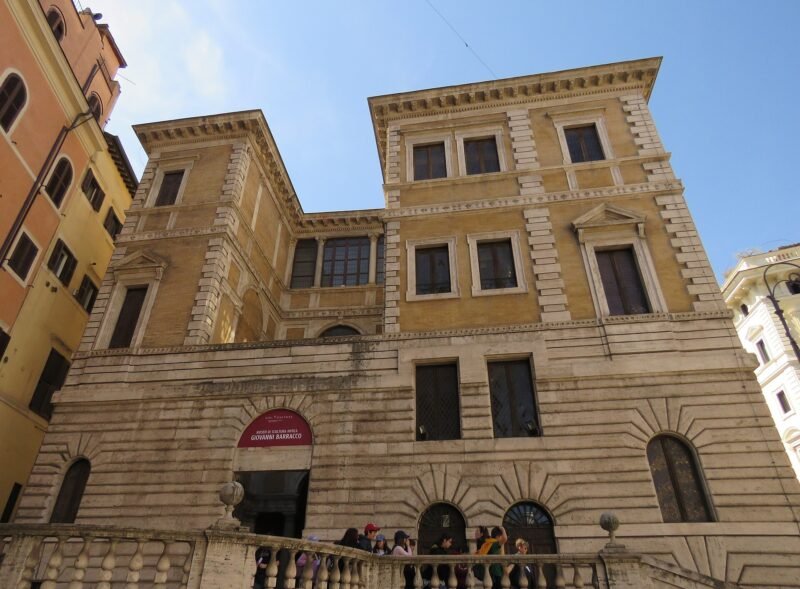
 Museo Barracco – Giovanni Barracco Museum of Ancient Sculpture100 m
- Museum of Rome – Palazzo Braschi100 m
- Pasquino100 m
- Moro Fountain100 m
- The Talking Statues of Rome100 m
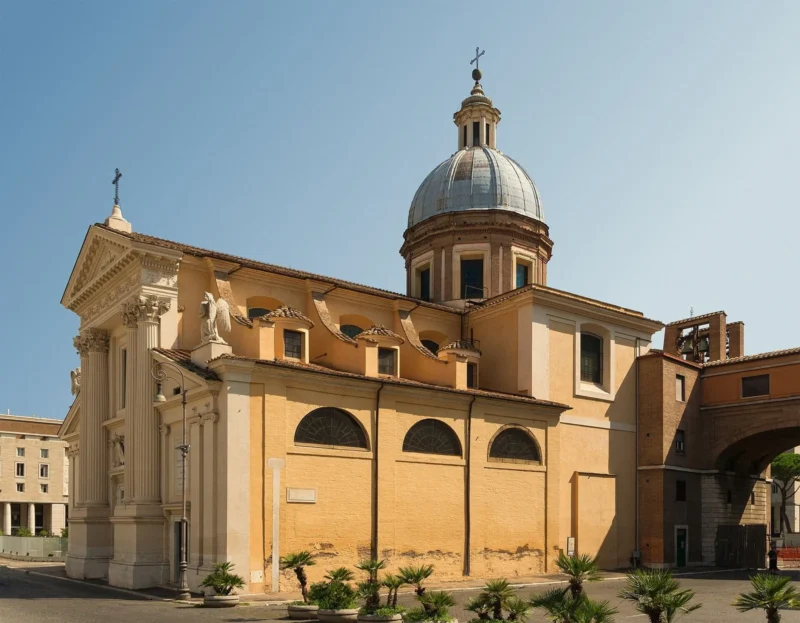
- San Lorenzo in Damaso100 m
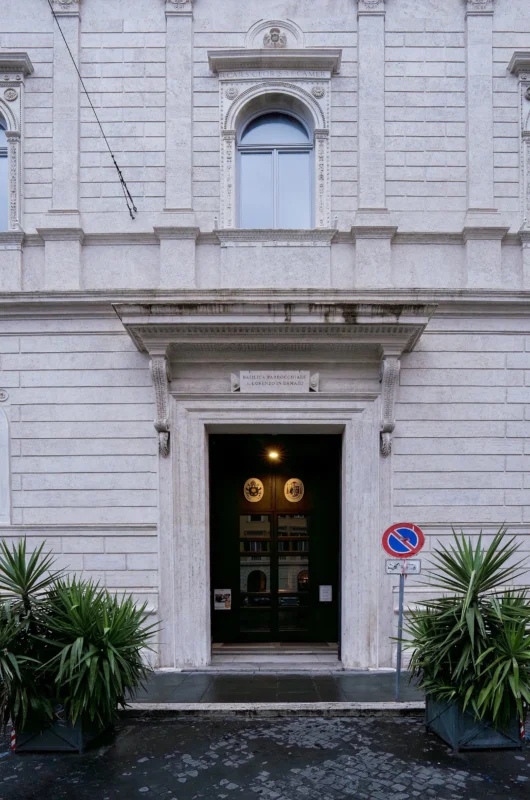
Upcoming events nearby
- Keith Haring at Museo di Roma in Palazzo Braschi, from October 6, 2026 to April 11, 2027100 m
- Divina d’Acciaio, the portrait statue of Maria Callas at the Barracco Museum, September 24 to November 15, 2026100 m
- Primarosa Cesarini Sforza, Ines Fontenla, Thorsten Kirchhoff, Daniela Monaci, Luana Perilli at Galleria Emmeotto, from October 3 to November 27, 2026100 m
- Memoria di ragazza at Teatro Valle, November 10 to 22, 2026100 m