Una delle ultime sere di Carnovale at Teatro Argentina, February 2 to 14, 2027
In short. Una delle ultime sere di Carnovale (One of the Last Evenings of Carnival) by Carlo Goldoni, directed by Valerio Binasco, plays at Teatro Argentina in Rome from February 2 to 14, 2027, at Largo di Torre Argentina 52, for 12 performances:…
Una delle ultime sere di Carnovale (One of the Last Evenings of Carnival) by Carlo Goldoni, directed by Valerio Binasco, plays at Teatro Argentina in Rome from February 2 to 14, 2027, at Largo di Torre Argentina 52, for 12 performances: from Tuesday, February 2 to Sunday, February 7 and from Tuesday, February 9 to Sunday, February 14, with Monday the 8th off. The theater is reached by tram 8, Torre Argentina stop, or on foot from Piazza Venezia in a few minutes. The most convenient Metro Line B stations are Colosseo and Circo Massimo. On stage are 14 actors, including Natalino Balasso, Milvia Marigliano and Michele Di Mauro. Prices and start times of the individual performances are published on the official Teatro di Roma website. Tickets are bought at the theater box office or online on the authorized presale network named by the Teatro di Roma.
Language: performed in Italian. No English version or English surtitles are announced.
Una delle ultime sere di Carnovale at the Argentina: dates, company and production
Una delle ultime sere di Carnovale stays on the Teatro Argentina program for two weeks, from Tuesday, February 2 to Sunday, February 14, 2027, with 12 performances. It is one of the richest productions of the Teatro di Roma's 2026/2027 season, which it signs together with three other public theaters: the Teatro Stabile di Torino, the Teatro Stabile del Veneto and the Teatro Stabile di Bolzano.
The dates of the 12 performances
The official calendar lists these evenings: Tuesday the 2nd, Wednesday the 3rd, Thursday the 4th, Friday the 5th, Saturday the 6th and Sunday, February 7. Then Tuesday the 9th, Wednesday the 10th, Thursday the 11th, Friday the 12th, Saturday the 13th and Sunday, February 14. On Monday the 8th the theater rests. Two Saturdays and two Sundays are few for a show with such a well-known cast. Those who want the weekend should move early, and those with a free choice should go for Tuesday or Wednesday.
A production by four national theaters
The production is by the Teatro Stabile di Torino, Teatro Nazionale, the Teatro di Roma, Teatro Nazionale, the TSV, Teatro Nazionale, and the Teatro Stabile di Bolzano. Four public bodies joining forces for a Goldoni with 14 actors on stage: today it is the only way to see an ensemble comedy of this kind with the full company, without cutting characters.
The creative team
Sets are by Guido Fiorato, costumes by Alessio Rosati, lighting by Alessandro Verazzi, sound by Filippo Conti, video by Simone Rosset. It is the team Binasco has worked with for years, and one that knows well his way of handling the classics: few frills, attention to bodies and voices.
The play: Goldoni's farewell to Venice
Una delle ultime sere di carnovale is a comedy in three acts by Carlo Goldoni, written in 1761 and first performed on February 16, 1762 at the Teatro San Luca in Venice. It was the last comedy Goldoni wrote in Venice before leaving for Paris, where he had been called as author for the Comédie Italienne.
The plot
We are in Venice, in the workshop-home of sior Zamaria, a cloth manufacturer. His daughter Domenica is in love with Anzoletto, a fabric designer. It is the last evening of Carnival and the house is celebrating: they chat, play cards, dance, dine. Then Anzoletto announces that he will leave for Muscovy, together with madame Gatteau, an elderly French embroiderer who has fallen for him. Domenica's jealousy erupts, tension builds, and the evening finds its balance only with a double wedding: Domenica with Anzoletto, Zamaria with madame Gatteau. They will all leave for Muscovy, and in Venice the shop will be left to Momolo.
A world of trades
The beauty of the comedy is its gallery of characters. Besides Zamaria and Anzoletto there are sior Bastian, a silk merchant, with his wife Marta, sior Lazaro and sior Agustin, cloth manufacturers, with their wives Alba and Elenetta, siora Polonia, who spins gold thread, sior Momolo, a calenderer, and the shop's three apprentices, Cosmo, Baldissera and Martin. It is the productive Venice of the 18th century, that of the textile arts, told from inside a house where work and festivity mix. Those looking for Goldoni of the masks find something else here: the artisan middle class, with its jealousies and small ambitions.
Meneghella, a Venetian card game
In the comedy they play meneghella, a card game that Goldoni himself, in the preface, describes as particular to Venice, suited to large companies, with up to 16 players at the same table. It is one of those details that make this text a portrait of customs: the Carnival party in an artisan household, with the game holding everyone together.
An allegorical comedy
Goldoni described it, in the preface to the printed edition, as an allegorical comedy that needs an explanation. Anzoletto, the designer who leaves for Muscovy, is Goldoni himself, leaving for Paris. Domenica represents the reformed comedy, the one Goldoni had built in Venice. Madame Gatteau, who speaks a playful Italian-French, represents the Comédie Italienne that claims him. The weavers are the actors, and the audience at the party is the Venetian public. A comedy about the melancholy of things that end, written by an author who knew he was closing a chapter.
The opening night
The 1762 premiere was a success, and Goldoni left a memory of it in his Mémoires: the house resounded with applause, and among the applause you could hear shouts of safe travels, happy return. The author confessed he was moved to tears. It came at the end of a season that had seen the triumph of Le baruffe chiozzotte and I rusteghi.
Valerio Binasco's reading
After Il bugiardo and Arlecchino servitore di due padroni, Valerio Binasco returns to Goldoni with Una delle ultime sere di Carnovale, which the official presentation calls Goldoni's melancholy farewell to Venice. It is the third stop on a Goldoni path the director has pursued for more than 10 years.
Goldoni, observer of the human soul
In the director's vision, Goldoni is a careful observer of the human soul, able to reveal behind the smile the truth of relationships, the hypocrisies, the small daily deceptions. Binasco reads in him a surprising modernity: comedy always arises from a fragility, from a pathology of living, and for that reason it still speaks to today's audience. It is a reading I share: the great Goldonis of recent years are those that stopped looking for Venetian color and looked for people.
Masks and men
The show's presentation sets Arlecchino, Lelio and Anzoletto side by side: masks and men together, living figures of a humanity that never really changes. Arlecchino and Lelio are the leads of Binasco's two previous Goldonis, and Anzoletto is the newcomer. Those who saw the other two shows will find a continuity of outlook, and of actors too.
An act of love for the theater
In the director's reading the show becomes an act of love toward the theater itself, a vital space that stops looking to the past and keeps questioning the present through the direct force of the stage. Put more simply: a text in which an author says goodbye to his actors and his audience, staged by a director who has run a national theater for years, inevitably becomes a reflection on the craft. And this, I believe, is why Binasco chose it.
Who Valerio Binasco is
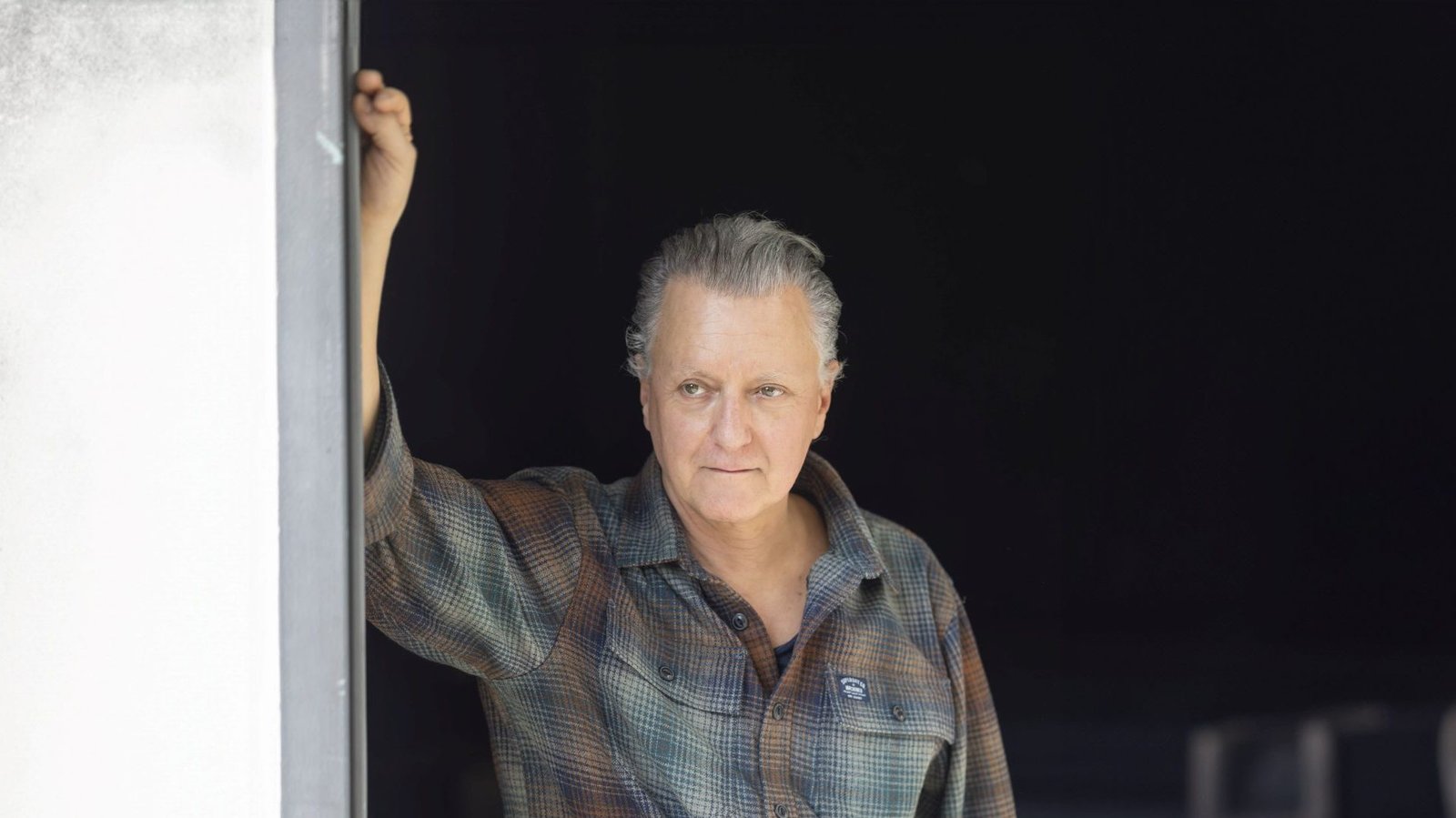
Valerio Binasco, born in Paderna in 1964, is a stage actor and director. Trained at the school of the Teatro Stabile di Genova, where he graduated in 1988, he has been artistic director of the Teatro Stabile di Torino since 2018. The appointment had come in May 2017, for the 2018-2021 three-year term.
The years as an actor
Binasco debuted in Genoa in productions directed by Marco Sciaccaluga, including two Goldonis: La putta onorata in 1987 and La buona moglie in 1988. Carlo Cecchi chose him for his Hamlet, produced by the Festival dei Due Mondi in Spoleto. With Cecchi he also acted in Beckett's Endgame and Pinter's The Hothouse. He worked at length with Franco Branciaroli, in Antigone, King Lear and The Government Inspector. With Gianfranco De Bosio he was in Goldoni's I due gemelli veneziani. With Mario Martone he played Oedipus at Colonus by Sophocles.
Awards
He won three Ubu prizes: in 1997/98 as new actor, in 2003/04 as best supporting actor for Oedipus at Colonus, and in 2010/11 for best direction with Romeo and Juliet, staged at Teatro Eliseo in Rome with Riccardo Scamarcio. He received two awards from the National Association of Theater Critics, an Olimpico del Teatro prize and the Flaiano prize for direction in 2020.
Film
In film Binasco worked with Guido Chiesa in Lavorare con lentezza, which earned him a Nastri d'argento nomination in 2005, and with Claudio Cupellini in Alaska, which in 2016 brought him a David di Donatello nomination as best supporting actor. He has been seen in Ferzan Özpetek's Un giorno perfetto, in Mario Martone's Noi credevamo and Il giovane favoloso, in Marco Tullio Giordana's Nome di donna and in Gianni Amelio's Il signore delle formiche.
The director and Rome
As a director Binasco has worked in Italy's main stabile theaters. His tie with Rome is long: for the Teatro di Roma he directed Chekhov's The Seagull in 2001 and in 2008 Jon Fosse's And Night Sings, an author he has staged more than anyone else in Italy. For Teatro Eliseo he directed Fausto Paravidino's Noccioline, Fosse's Un giorno d'estate, Natalia Ginzburg's L'intervista and the Romeo and Juliet that won the Ubu. In 2012 he founded the Popular Shakespeare Kompany, an independent company with which he staged The Tempest, The Merchant of Venice with Silvio Orlando and, in 2014, Goldoni's Il bugiardo.
Binasco's Goldoni
In October 2018 Binasco directed Il servitore di due padroni for the first time, produced by the Teatro Stabile di Torino, with Natalino Balasso as Arlecchino. Eight years later Balasso is in the company again for this Goldoni. In his Turin years Binasco also took on Pirandello, Molière, Shakespeare, Ionesco, Euripides and Fosse. At the Maggio Musicale Fiorentino he signed two opera productions, Hindemith's Cardillac and Verdi's Otello.
Who is on stage
The cast of Una delle ultime sere di Carnovale has 14 actors: Andreapietro Anselmi, Natalino Balasso, Mauro Bernardi, Marta Cortellazzo Wiel, Matteo Cremon, Michele Di Mauro, Giordana Faggiano, Milvia Marigliano, Daniele Marmi, Elisabetta Mazzullo, Orietta Notari, Nicola Pannelli, Aron Tewelde and Ivan Zerbinati. The theater has not yet published the role assignments.
An ensemble comedy
Goldoni's text calls for 15 characters, and Binasco's company fields 14: an almost one-to-one casting, rare in Italian theater today. The advantage for the audience is clear. The comedy lives on the buzz of the party, on crossed dialogues, on collective play. With few actors it becomes a duet, with 14 it is a full house again.
Natalino Balasso
The name best known to the general public is Natalino Balasso, who in 2018 was Arlecchino in Binasco's Servitore di due padroni. He is an actor who knows Goldoni's Veneto from the inside, and this counts in a comedy written largely in Venetian dialect.
Milvia Marigliano and Michele Di Mauro
Milvia Marigliano and Michele Di Mauro are, with Balasso, the most recognizable names in the company. In a comedy where the mature roles, Zamaria, madame Gatteau and the merchant couples, hold up the structure, their presence gives the company weight.
The language
A practical warning: the comedy is in Venetian, and madame Gatteau speaks a deliberately comic Italian-French. The discussion between her and Anzoletto about which language to use is one of the funniest passages in the text. For a Roman audience it is not an obstacle, but reading the plot before going in helps you enjoy the nuances.
A curiosity about the play Una delle ultime sere di Carnovale at Teatro Argentina, from February 2 to 14, 2027
The world premiere of Una delle ultime sere di carnovale took place on February 16, 1762. Binasco's last Roman performance is Sunday, February 14, 2027, two days before the anniversary. And in 2027 Mardi Gras falls right in those days, so the show coincides with the last evenings of Carnival on the real calendar.
It is no minor coincidence. Goldoni had written the comedy to close the San Luca season, which in Venice ended with Carnival. The audience at the premiere left the theater and found the city in festivity, masks in the streets, the last night before Lent. The text tells exactly that atmosphere, a party about to end. Seeing the show in Rome in mid-February means finding again, more than two and a half centuries later, the same fit between stage and calendar.
The second curiosity concerns Teatro Argentina. In February 1816, again in the middle of Carnival, the Argentina hosted the premiere of Rossini's Barber of Seville: whistles the first night, triumph from the second. Roman Carnival was then the great season of the theaters, the one when novelties were concentrated. The 1762 premiere in Venice too belonged to that tradition. Bringing a Carnival Goldoni to the Argentina in the same weeks in which Rome celebrated its 18th-century Carnival has the flavor of a homecoming: the hall was inaugurated in 1732, 30 years before the comedy.
Teatro Argentina: the hall that hosts Goldoni
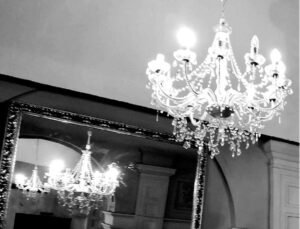
Teatro Argentina has 720 seats, 354 in the orchestra and 366 spread over six tiers of boxes, according to Teatro di Roma figures. It is a horseshoe-shaped Italian-style hall, red and gold, with a decorated green ceiling and a large candelabra chandelier with 16 arms. The Teatro di Roma calls it the golden theater of the city.
A name that comes from Strasbourg
Argentina has nothing to do with the South American country. The name comes from the tower of the late Gothic palace of Johannes Burckardt, known as Burcardo, a papal master of ceremonies originally from Strasbourg, built between 1491 and 1500. Strasbourg in Latin was Argentoratum, and Burcardo signed himself episcopus argentinensis. The tower became the Argentina, and with it the square, the street and the theater. The Burcardo palace is still on Via del Sudario, next to the theater.
The Sforza Cesarini and Theodoli
The theater was commissioned by the Sforza Cesarini family, which began construction in 1730. The hall was designed by marquis and architect Gerolamo Theodoli, with the horseshoe shape chosen for acoustics and visibility. It was originally almost entirely wooden. The orchestra had 40 rows of benches and there were 186 boxes. It was inaugurated in January 1732 with Berenice by Domenico Sarro.
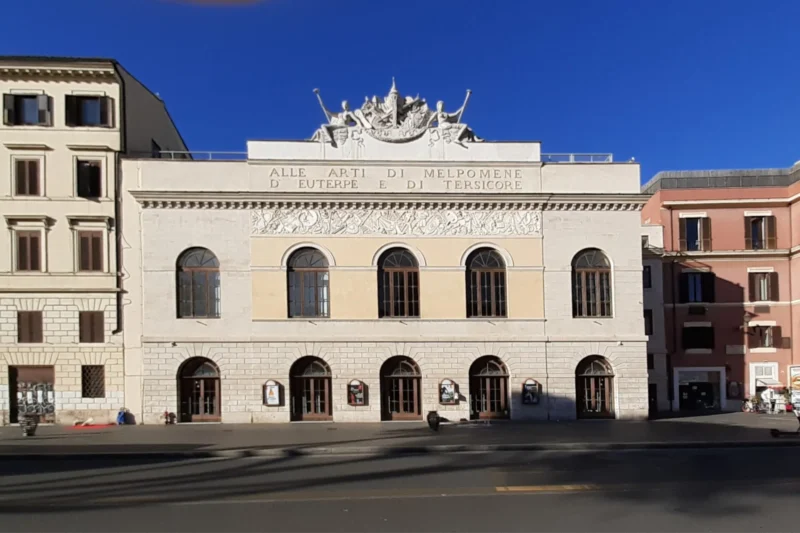
The facade
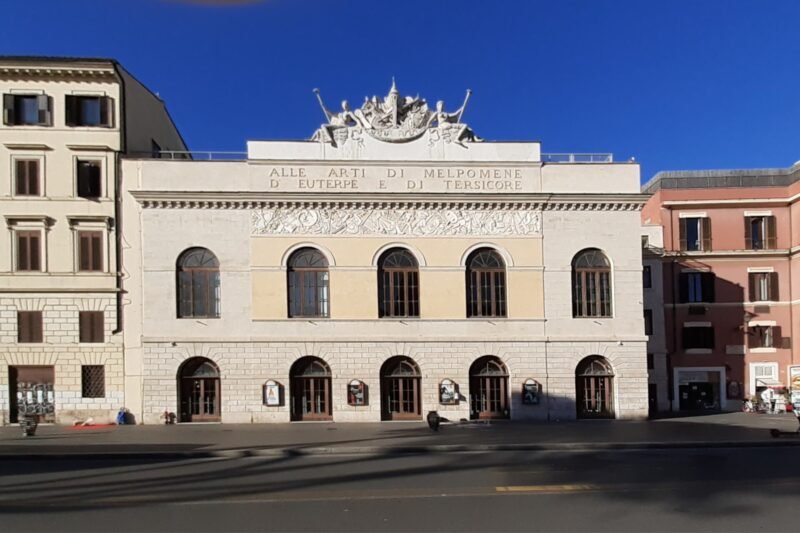
The neoclassical facade came only in 1826, to a design by Pietro Holl. Above the arched windows runs the dedication to the arts of Melpomene, Euterpe and Terpsichore: tragedy, lyric poetry and dance. For a comedy the dedication does not include Thalia, the comic muse, a detail that makes those who notice it smile.
Portoghesi's restoration
In 1993 Paolo Portoghesi restored the theater while respecting its structure. He brought back the red of the upholstery in place of the gold yellow introduced in 1970 and restored the festoon outline of the box valances. It is thanks to that work that the hall again has its 18th-century look, the one that makes it perfect for a comedy from the same century.
One thing nobody tells you about the play Una delle ultime sere di Carnovale at Teatro Argentina, from February 2 to 14, 2027
Teatro Argentina stands over part of the great complex of the Theater of Pompey, which included the Curia where Julius Caesar was killed in 44 BC. The Teatro di Roma tells it openly: the story of this place begins with a political assassination.
What almost no one knows is that the Teatro di Roma's guided performance visits end in the refectory of the old Benedictine convent of the Abbey of Farfa, in the archaeological area between the theater and the Curia of Pompey. Inside the theater's perimeter there is therefore an access to that layer of the city. During performances those rooms cannot be visited, but knowing they exist changes the way you look at the hall while, on stage, a group of Venetian weavers celebrates Carnival.
The second thing nobody says concerns the car. Teatro Argentina is the only one of the Foundation's theaters bound by the historic center ZTL hours. Teatro India and Teatro Torlonia do not have this problem. Many spectators who arrive by car from the outskirts find out with a fine. The theater has no private parking. The right solution is to leave the car outside the limited traffic zone and take tram 8, which stops in front of the sacred area.
Third, for those who know the text: the Argentina was inaugurated in 1732, 30 years before Goldoni wrote this comedy. Seeing a Goldoni in an Italian-style hall contemporary with its writing, with the boxes and the chandelier, is a less frequent chance than you might think.
How to get to Teatro Argentina
Teatro Argentina is at Largo di Torre Argentina 52, opposite the sacred area, and the simplest way to get there is tram 8, which stops right at Torre Argentina. In February, with cold evenings, it is best to choose the transport that leaves you closest to the entrance.
By tram
Tram 8 stops at Torre Argentina, a few steps from the theater. For those coming from Trastevere or Monteverde it is the most comfortable solution on the way out too, at the end of the show.
By Metro
No Metro station is right next to the theater. The most convenient are Colosseo and Circo Massimo on Line B, from which you continue on foot or by surface transport. From Piazza Venezia to Largo Argentina the walk along Via delle Botteghe Oscure takes a few minutes.
By bus
Largo di Torre Argentina and Corso Vittorio Emanuele II are crossed by many surface lines linking Termini station, Piazza Venezia, the Vatican and Trastevere. Lines and evening schedules should be checked on the Rome public transport information service before leaving.
By car and taxi
The theater has no parking and is bound by ZTL hours. Those arriving by car must park outside the limited traffic zone and complete the trip by transit or on foot. A taxi remains the simplest alternative for those with mobility difficulties.
On foot
From the Pantheon, Piazza Navona, Campo de' Fiori and the Ghetto the theater is reached in a few minutes. It is one of the rare theaters in Rome where arriving on foot is the best choice.
The advice I give you for visiting Una delle ultime sere di Carnovale at Teatro Argentina, February 2 to 14, 2027
The advice is firm: for this Goldoni choose the orchestra or a low box, and read the plot before going in. An ensemble comedy with 14 actors, written in Venetian, is enjoyed when you recognize the characters and their relationships right away. From the high boxes you follow the party but lose the glances, and in Goldoni glances say half the text.
Second piece of advice: spend five minutes on the list of characters. Zamaria the shop owner, Domenica his daughter, Anzoletto the designer, madame Gatteau the French embroiderer, the three couples of merchants and manufacturers, siora Polonia who spins gold thread, Momolo the calenderer, the three apprentices. Those who enter the hall knowing who is who follow the party like a guest, and those who don't spend the first act figuring it out. The full text of the comedy is freely available online, and it is short. It is worth reading the preface, where Goldoni explains the allegory.
Third: arrive at least 40 minutes early. The theater box office cancels reservations not picked up within an hour of the start, and the empty Argentina with its six tiers of boxes lighting up one after another is a show that comes before the show. Fourth: if you can choose, pick an evening of the second week, February 9 to 14. A company of 14 actors, after six performances, has found its rhythm, and in a comedy of crossed dialogues rhythm is everything.
Tickets and box office at Teatro Argentina
The Teatro Argentina box office, at Largo di Torre Argentina 52, is open Monday to Saturday from 11:00 to 19:00 and on Sunday three hours before the start of the show. When there is a performance it stays open until the start. The numbers given by the theater are 06 684000311 and 06 684000314.
Where to buy
The Teatro di Roma sells tickets at the Argentina box office and online, on the presale network the theater links from its pages. At the Argentina box office you can also buy tickets for Teatro India and Teatro Torlonia. From one hour before the show the box office sells only for that evening's performance.
Prices and discounts
The hall's price list, divided among the Poltrona and the boxes of the different tiers, is published on the Teatro di Roma website along with the discounts. The Teatro di Roma offers reduced rates for young people, over-65s, teachers and people with disabilities, and rates for university students and students of partner theater schools, which normally do not apply to the last performances of each show. Check the current conditions before buying.
Pickup and changes
Reserved tickets must be picked up within one hour of the start of the show. After that time the reservation is canceled. Once issued, tickets are neither replaced nor canceled. The box office accepts card payments.
Subscriptions
The Teatro di Roma offers subscriptions and cards for the 2026/2027 season. For those planning to see several titles of the season, it is worth comparing the options before buying single tickets.
Another well-known fact, yet rarely mentioned
Everyone knows that in Rome "fare il portoghese" (literally, to be a Portuguese) means getting into a show without paying. Less well known is that one of the most popular explanations of this saying leads straight to Teatro Argentina. According to this version, in the 18th century the Portuguese ambassador to the Papal States invited the Portuguese living in Rome to attend a show at the Argentina for free, and declaring your nationality was enough to get in.
Many Romans took advantage by passing themselves off as Portuguese, and the expression was born from there. It must be said honestly that this is a hypothesis, not a documented fact. There is another, older explanation, dating to 1514 and Pope Leo X, who is said to have granted the Portuguese ambassador and his retinue free access to theaters and taverns to thank the King of Portugal for the gift of the elephant Hanno. There are still others, tied to customs duty exemptions. The Argentina version, though, is the one dictionaries report most often.
For a Goldoni spectator the story has a special flavor. The ambassador's 18th century is the same century as the comedy, and the crowd that passed itself off as foreign to get into the theater resembles Goldoni's characters: shop people, sly enough, ready to seize the chance of a party. Una delle ultime sere di carnovale tells of a Venetian house where everyone knows each other and everyone watches each other, and the Portuguese legend tells of a Roman audience in which someone pretended not to know each other. Today, of course, at the Argentina the ticket must be bought and picked up on time.
Accessibility at Teatro Argentina
Teatro Argentina is accessible to audiences with disabilities: the historic building does not allow all architectural barriers to be removed, but the facility has elevators and services that ease access. For people with disabilities the theater reserves some orchestra seats, in line with safety regulations, with the companion in a nearby seat.
To check availability the theater asks you to write to the box office or phone during opening hours. For holders of an attendance allowance certified by INPS, a free ticket for the companion is provided. House staff are available for any need.
The right photo to take at Una delle ultime sere di Carnovale at Teatro Argentina, February 2 to 14, 2027
The right photo is taken from the orchestra, before the lights go down, with the lens pointed up: the six tiers of red and gold boxes, the green ceiling and the 16-arm chandelier. It is the shot that tells the Argentina better than any description, and for a Goldoni it is also the right one: an 18th-century hall for an 18th-century comedy.
The best moment is when the audience is still coming in and the house lights are full. Keep the whole hall in the frame, without looking for detail. As soon as the show starts the phone goes off. In an ensemble comedy made of quick lines and pauses, a lit screen in the orchestra can be seen from every box and disturbs the actors.
The second photo is taken outside, in the evening, from the other side of the square. From there you see together the neoclassical facade with its dedication to the muses and, in the foreground, the lit columns of the sacred area. In February darkness comes early, and those with an evening performance find the square already lit.
Third, for those who arrive early: the Burcardo palace on Via del Sudario, behind the theater, with its late Gothic facade. It is the tower that gave the Argentina its name, and almost nobody photographs it. Those who want a themed image can photograph the show's poster at the entrance, with the hall behind it. For a title about Carnival, in February, it is the most fitting keepsake.
Around Teatro Argentina: what to see before and after
Teatro Argentina is in the historic center, a few minutes on foot from the Pantheon, Piazza Navona, Campo de' Fiori and the Ghetto. A theater evening can be combined here, with no transport, with a walk among the most important places in the city.
The sacred area
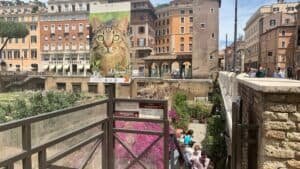
In front of the theater opens the sacred area of Largo Argentina, with the republican temples and the structures linked to the Theater of Pompey complex. Among the ruins lives a cat colony looked after by volunteers. The entry on the cat sanctuary at Largo Argentina explains how it works.
Pantheon and Piazza Navona
In five minutes to the north you reach the Pantheon. To the west, beyond Corso Vittorio Emanuele II, are Piazza Navona and Campo de' Fiori.
The Gesù, the Ghetto and the Theater of Marcellus
To the east is the Church of the Gesù. Going down toward the Tiber you enter the Jewish Ghetto and reach the Theater of Marcellus: an ancient theater a short distance from an 18th-century one.
Some important events that took place here in history
Teatro Argentina was inaugurated in January 1732 with Berenice by Domenico Sarro, and since then its history has been intertwined with that of Italian music and with the politics of Rome. In the 18th century, according to foreign travelers, it was considered the most important of the Roman theaters.
On February 20, 1816 the premiere of Gioachino Rossini's Barber of Seville was staged there, with Manuel García. It was a fiasco: in the orchestra sat many admirers of Giovanni Paisiello's Barber, who whistled in protest. From the second night the opera triumphed. On January 28, 1822 the Argentina hosted the world premiere of Gaetano Donizetti's Zoraida di Granata. In 1827 Niccolò Paganini played there.
Giuseppe Verdi brought two premieres there: I due Foscari in 1844 and La battaglia di Legnano in 1849. According to the Teatro di Roma's account, it was on the occasion of that performance that the Romans began the demonstrations against the papal government that led to the Roman Republic.
After 1870 the opening of Corso Vittorio Emanuele II put the theater at the center of the new city. The building passed to the city and became a representative theater. In the 20th century, with the birth of the Teatro di Roma, the Argentina became the home of public drama in the capital. In 1993 Paolo Portoghesi's restoration gave it back its 18th-century look, and in 2022 management passed to a foundation. For a Goldoni audience, the fact that counts is the first: the hall was born 30 years before the comedy, in the same world of boxes, candles and Carnival seasons.
Who has played Una delle ultime sere di Carnovale at Teatro Argentina, February 2 to 14, 2027
Through the stage of Teatro Argentina have passed Gioachino Rossini, with the Barber of Seville in 1816, Gaetano Donizetti, with Zoraida di Granata in 1822, Giuseppe Verdi, with I due Foscari and La battaglia di Legnano, and Niccolò Paganini, in concert in 1827. It is a list no other Roman drama theater can claim.
The Teatro di Roma recalls that the works of Gabriele D'Annunzio and Luigi Pirandello passed across the Argentina stage. Then there are the directors who have led the house: Vito Pandolfi from 1964, Franco Enriquez, Luigi Squarzina, Maurizio Scaparro, Pietro Carriglio, Luca Ronconi from 1994 to 1999, Mario Martone, Giorgio Albertazzi, Gabriele Lavia, Antonio Calbi, Giorgio Barberio Corsetti and today Luca De Fusco.
In the list there is a thread that ties this show to the hall's history. Mario Martone, director of the Teatro di Roma, is the director who directed Binasco in Edipo a Colono, the performance that won him the Ubu as best supporting actor. And it is the same Martone who wanted him in film in Noi credevamo and Il giovane favoloso. Binasco himself has passed through Rome several times as a director for the Teatro di Roma, with The Seagull in 2001 and And Night Sings in 2008.
In the 2026/2027 season the list grows. Before Goldoni the Argentina hosts De Fusco's Otello in November, covered in its own entry, and Massimo Popolizio in January. After Binasco, still in February, comes Roberto Andò with Lino Musella.
How to plan the evening
A Goldoni evening at the Argentina is easily organized on foot: dinner before or after in the historic center, the show, then home by tram 8 or by taxi from Piazza Venezia. February in Rome is a month of cold and often damp evenings, and this must be factored in.
Where to eat
The historic center around the Argentina offers every kind of place: Roman trattorias on the streets toward Campo de' Fiori, Roman-Jewish cooking in the Ghetto, pizza-by-the-slice shops and bakeries along Corso Vittorio Emanuele II for a quick meal, wine bars and bistros around the Pantheon for after the theater. On weekends it is best to book, especially after 22:00.
With teenagers
Goldoni is studied in school, and this comedy is a good first theater Goldoni for a teenager: a party, a thwarted love, a departure, a happy ending. The Venetian can throw the youngest off. For them the Teatro di Roma has a Teatro Ragazzi (youth theater) program with dedicated rates.
Carnival in Rome
The weeks of the show coincide with Carnival. In the streets of the center you see children in costume and pastry shops turn out frappe and castagnole, the fried Carnival sweets. A frappa before going in to see Goldoni's last evening of Carnival is the kind of pairing a group remembers.
The 2026/2027 season at Teatro Argentina
Una delle ultime sere di Carnovale arrives in the middle of the Teatro di Roma's 2026/2027 season, titled Il teatro è vita (Theater Is Life). The Teatro Argentina season includes, among others, Luca De Fusco's Otello in November, John Ford's 'Tis Pity She's a Whore in December, La pazzia di Re Giorgio with Massimo Popolizio in January, Roberto Andò's Non posso narrare la mia vita with Lino Musella in February and Leonardo Lidi's Hamlet in March. The season also marks the reopening of Teatro Valle, which returns to the Foundation.
Frequently asked questions about the play Una delle ultime sere di Carnovale at the Argentina
When does the play Una delle ultime sere di Carnovale run at the Teatro Argentina?
Una delle ultime sere di Carnovale plays at Teatro Argentina from February 2 to 14, 2027, for 12 performances: from Tuesday the 2nd to Sunday the 7th and from Tuesday the 9th to Sunday, February 14. On Monday, February 8 the theater rests. Start times are published on the Teatro di Roma website.
Who is the director of the play Una delle ultime sere di Carnovale?
Una delle ultime sere di Carnovale is directed by Valerio Binasco, an actor and director who has won three Ubu prizes and was artistic director of the Teatro Stabile di Torino. It is his third Goldoni after Il bugiardo, in 2014, and Arlecchino servitore di due padroni, in 2018.
Who is in the cast of the play Una delle ultime sere di Carnovale?
The cast of Una delle ultime sere di Carnovale has 14 actors: Andreapietro Anselmi, Natalino Balasso, Mauro Bernardi, Marta Cortellazzo Wiel, Matteo Cremon, Michele Di Mauro, Giordana Faggiano, Milvia Marigliano, Daniele Marmi, Elisabetta Mazzullo, Orietta Notari, Nicola Pannelli, Aron Tewelde and Ivan Zerbinati.
What is the play Una delle ultime sere di carnovale by Goldoni about?
Una delle ultime sere di carnovale tells of an end-of-Carnival party in the home of cloth manufacturer Zamaria in Venice. The designer Anzoletto announces his departure for Muscovy, an allegory of Goldoni's departure for Paris, where he was called by the Comédie Italienne in 1762.
When was Goldoni's comedy written?
Goldoni wrote Una delle ultime sere di carnovale in 1761. The first performance was on February 16, 1762 at the Teatro San Luca in Venice, closing the season of Le baruffe chiozzotte and I rusteghi. It was the last comedy the author wrote in Venice.
How do I get to Teatro Argentina by public transport?
Teatro Argentina, at Largo di Torre Argentina 52, can be reached on tram 8, Torre Argentina stop, and on the many bus lines crossing the square. The nearest metro B stations are Colosseo and Circo Massimo. The theater has no parking and is subject to the ZTL hours.
How many seats does Teatro Argentina have?
Teatro Argentina has 720 seats: 354 in the orchestra and 366 spread over six tiers of boxes. It is a horseshoe-shaped Italian-style hall inaugurated in 1732, with red upholstery, gilded decorations and a 16-arm chandelier, restored by Paolo Portoghesi in 1993.
When is the Teatro Argentina box office open?
The Teatro Argentina box office is open Monday to Saturday from 11:00 to 19:00 and on Sunday three hours before the show. Reserved tickets must be picked up within one hour of the start. The numbers given by the theater are 06 684000311 and 06 684000314.
One last piece of advice: this Goldoni should be seen knowing it is a farewell. Read the author's preface, take a seat from which you can see faces, and watch how Binasco moves 14 actors in a single room. In a hall from 1732, in mid-February, with Carnival outside the door, it is hard to imagine a better occasion to meet the most melancholy Goldoni.
Article written by the editorial team of Tour Leader Pro, contact them for Private/Corporate/V.I.P. Tours and Experiences.
Planning a trip to Rome? The English guides to visiting the city are on ItalyPlanner.com.
Contact Information
Nearby
 Teatro Argentina100 m
- Teatro Centrale100 m
- Largo Torre Argentina – Sacred Area of Campo Marzio100 m
- Cat Sanctuary at Largo Argentina100 m
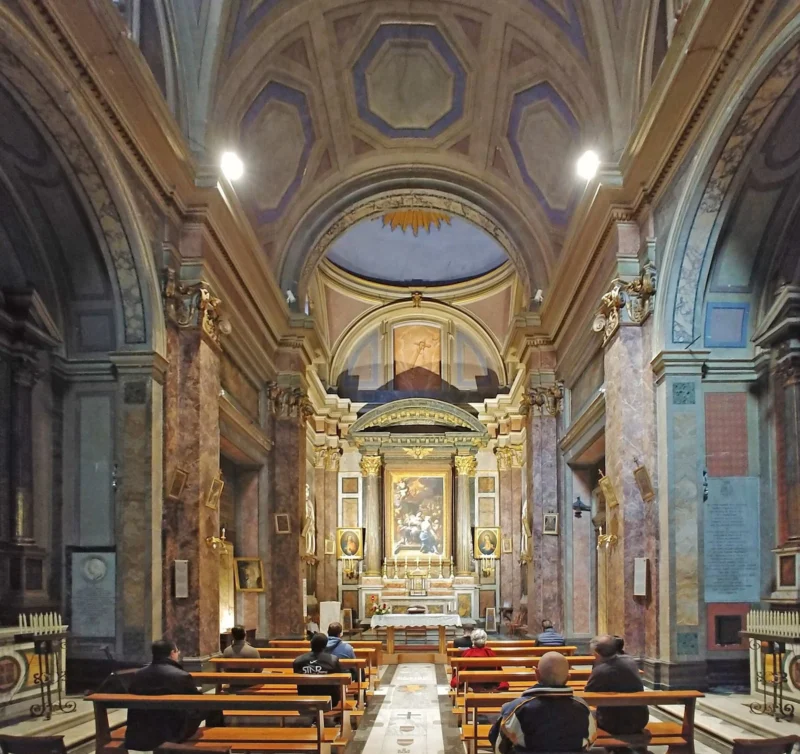
- San Carlo ai Catinari200 m
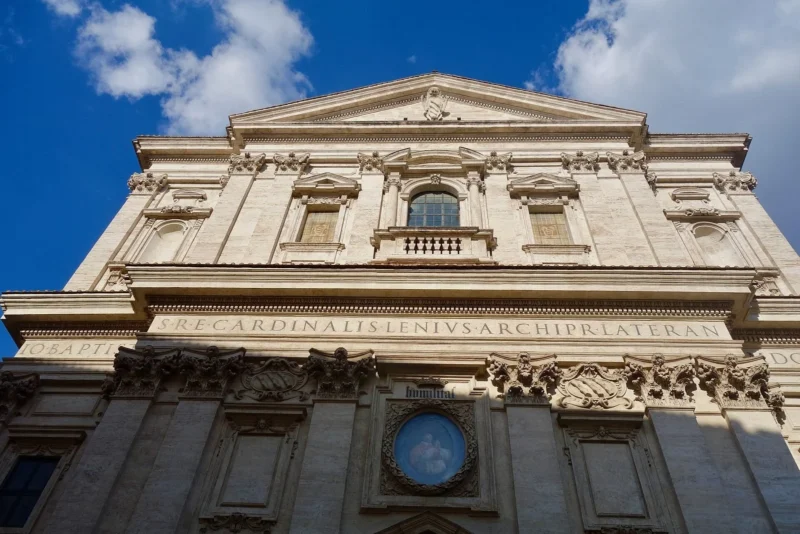
- Santa Maria in Publicolis200 m
Upcoming events nearby
- Othello at Teatro Argentina, November 4 to 29, 2026100 m
- The Madness of King George with Massimo Popolizio at Teatro Argentina in Rome, January 9 to 31, 2027100 m
- Lo zar by and with Stefano Massini at Teatro Argentina in Rome, March 16 to 25, 2027100 m
- I Solisti della Filarmonica: Mahler, Symphony No. 4 at Teatro Argentina, November 5, 2026100 m
You might also like
- L’inconveniente with Milena Vukotic at Teatro Quirino, January 19 to 31, 2027
- Se devi dire una bugia è meglio dirla grossa by Ray Cooney at Teatro de’ Servi, from February 23 to March 7, 2027
- Figli maschi by Centouno at Teatro Sala Umberto, February 16 to 28, 2027
- Don Giovanni with Simone Toni and Enzo Paci at Teatro Sala Umberto, February 2 to 14, 2027
- Totalmente incompatibili, Nuzzo and Di Biase at Teatro Sistina, January 22-24, 2027
- From Broadway to Hollywood at Cinema Quattro Fontane, September 20, 2026 to January 3, 2027