Othello at Teatro Argentina, November 4 to 29, 2026
In short. Othello by William Shakespeare, directed by Luca De Fusco, is on at Teatro Argentina in Rome from November 4 to 29, 2026, at Largo di Torre Argentina 52, for 23 performances from Tuesday to Sunday (Mondays November 9, 16 and 23 are rest days).
Othello by William Shakespeare, directed by Luca De Fusco, is on at Teatro Argentina in Rome from November 4 to 29, 2026, at Largo di Torre Argentina 52, for 23 performances from Tuesday to Sunday (Mondays November 9, 16 and 23 are rest days). The theater can be reached on tram 8, Torre Argentina stop, or on foot from Piazza Venezia in a few minutes. The most convenient metro B stations are Colosseo and Circo Massimo. The Teatro Argentina price list published by Teatro di Roma ranges from 44 euros (stalls, full price) to 20 euros (third- and fourth-tier boxes, reduced). Tickets are bought at the theater's box office or online on the authorized presale circuit indicated by Teatro di Roma. The start times of the individual performances are published on the official Teatro di Roma website.
Language: opera sung in its original language; no English surtitles are announced, so check with the theater.
Othello at Teatro Argentina: dates, venue and tickets
Othello stays on the bill at Teatro Argentina for four full weeks, from Wednesday, November 4, to Sunday, November 29, 2026. It's one of the flagship productions of Teatro di Roma's 2026/2027 season, which co-produces it with Teatro Stabile di Torino and Teatro Biondo of Palermo: three national or public repertory theaters sharing the weight of a big production, with 10 actors on stage and a seasoned creative team. After Rome the show goes to Palermo, at Teatro Biondo, from January 9 to 17, 2027.
The dates of the 23 performances
The official calendar lists these evenings: Wednesday the 4th, Thursday the 5th, Friday the 6th, Saturday the 7th and Sunday, November 8. Then from Tuesday the 10th to Sunday the 15th. From Tuesday the 17th to Sunday the 22nd. From Tuesday the 24th to Sunday the 29th. On Mondays the theater rests. If you only have one weekend available you have four Saturdays and four Sundays to choose from, and that's already a practical pointer: weekend performances fill up first, while Tuesday and Wednesday ones stay easier until the end.
Where to buy tickets
Teatro di Roma sells tickets in two ways: at the Teatro Argentina box office and online, on the presale circuit the theater itself indicates on its pages. At the box office you can also buy tickets for Teatro India and Teatro Torlonia. From an hour before the show the box office sells only for that evening's performance.
How much a seat at the Argentina costs
The Teatro Argentina price list published on the Teatro di Roma website gives: stalls 44 euros full price and 35 reduced. Stall-level, first- and second-tier boxes 35 euros full price and 30 reduced. Third- and fourth-tier boxes 26 euros full price and 20 reduced. There are dedicated rates for university students and students of affiliated drama schools, which we'll look at further on.
Luca De Fusco's Othello: a colonial South in the 20th century
The bold choice of this Othello is the setting: De Fusco moves the tragedy to the years of the 20th century most marked by racism, into an imaginary colonial South that reimagines Cyprus as a remote, exotic land. It's an operation that doesn't betray Shakespeare. On the contrary, it makes its political core easier to read. Othello is a general the Republic of Venice uses and honors as long as he's useful, a man welcomed only on the surface. Taking the story into a century in which skin color was written into colonial laws means denying the audience the comfort of historical distance.
Iago, the real mind of the tragedy
The show's official presentation insists on a point anyone who knows the text shares: the male lead is the perpetrator of an atrocious crime, but the destructive mind of the story is the white Iago. The direction builds the drama as a mechanism of manipulation, in which violence is born first in words and then in deeds. Othello thus becomes the victim of an insinuating machine that works on suspicion, on wounded vanity, on the fear of not belonging.
Desdemona, the only pure figure
In this manipulative scenario the only untouched figure is Desdemona, an innocent victim of a ruthless mechanism. The reading isn't new, but De Fusco makes it central by entrusting the decisive triangle to three very experienced performers. Personally I find this approach right: an Othello that works is one in which the audience understands, scene after scene, that Desdemona has no way out, and that her innocence is precisely what condemns her.
A tragedy of words
Othello is one of Shakespeare's most compact texts: few characters, an action that rushes forward over a few days, a single deception carried through to the end. That's why it holds up well to a classical reading, with Alessandro Papa's projections and Ran Bagno's music building the atmosphere. If you go to the theater to listen to the actors, more than to see stage machinery, you'll find plenty to enjoy here.
Who's on stage: the cast of Othello
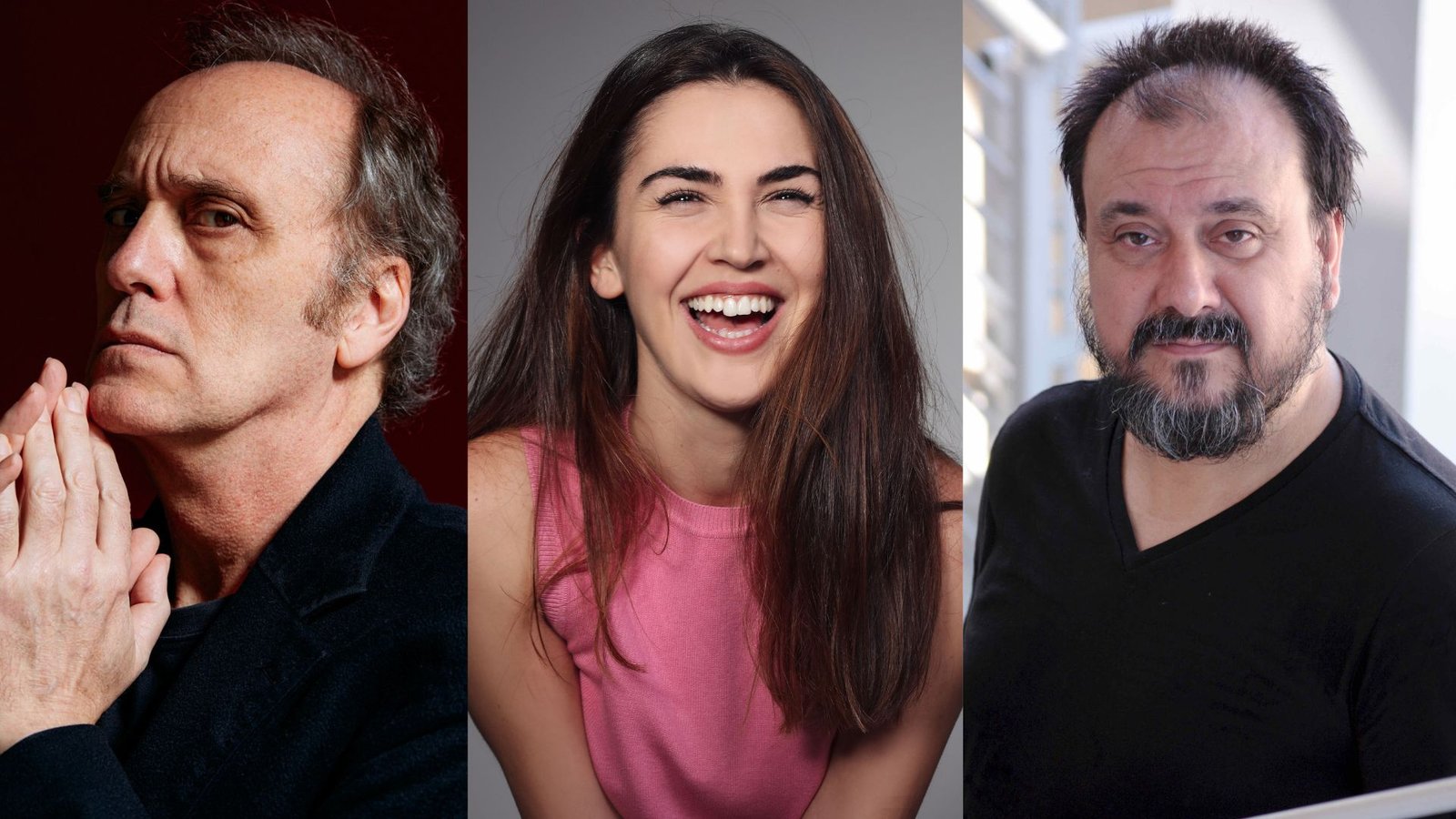
The cast of Othello at Teatro Argentina numbers 10 actors, listed in alphabetical order: Alessandro Balletta, Francesco Biscione, Paolo Cresta, Rossella De Martino, Luca Lazzareschi, Gianluca Merolli, Pierluigi Misasi, Sara Putignano, Mersila Sokoli and Federico Vanni. Federico Vanni is Othello, Luca Lazzareschi is Iago, Mersila Sokoli is Desdemona.
Federico Vanni, the Moor
Federico Vanni graduated in 1992 from the acting school of Teatro Stabile di Genova and built much of his career alongside Marco Sciaccaluga, who directed him among other things in Chekhov's The Seagull (as Sorin, 2017) and in Eduardo's Il sindaco del rione Sanità (2014). He has worked several times with Andrei Konchalovsky: Petruchio in The Taming of the Shrew (2013), Oedipus in Oedipus at Colonus (2014), Bergman's Scenes from a Marriage (2018). He was Lopakhin in The Cherry Orchard directed by Ferdinando Bruni (2015), Tartuffe for Jacopo Bellorini (2022) and took part in Carrozzeria Orfeo's Miracoli Metropolitani. On screen he was seen in Marco Bellocchio's Esterno notte, in Donato Carrisi's Io sono l'abisso, in Konchalovsky's Sin and in Pupi Avati's La via degli angeli. On television in Il Re and Doc. The detail that interests the November audience: in 2016 Vanni was Iago in the Othello directed by Elio De Capitani. 10 years later he moves to the other side of the handkerchief.
Luca Lazzareschi, Iago
Luca Lazzareschi graduated from the Bottega Teatrale in Florence run by Vittorio Gassman and Giorgio Albertazzi and in 1999 won the Premio Randone. His Shakespeare résumé is long: with Gabriele Lavia he acted in Richard II, Othello, Richard III and Hamlet, as well as Oedipus Rex and The Misanthrope. With Gassman in Macbeth. With Glauco Mauri in A Midsummer Night's Dream. With Guido De Monticelli in Henry V. He has also been directed by Gianfranco De Bosio, Mario Missiroli, Giuseppe Patroni Griffi, Marco Tullio Giordana and Cesare Lievi. In film he worked with Charles Sturridge on Where Angels Fear to Tread, and on television he was among the leads of Incantesimo. De Fusco had already directed him in the past: the partnership between the two is one of the reasons this Iago deserves attention.
Mersila Sokoli, Desdemona
Mersila Sokoli is Desdemona, the third point of the triangle on which the direction builds the show. She's part of the core of actors De Fusco also takes into the season's next production, John Ford's 'Tis Pity She's a Whore, on at the Argentina from December 2 to 13, 2026: a sign of a company designed to last beyond a single title.
The rest of the company
Alessandro Balletta, Francesco Biscione, Paolo Cresta, Rossella De Martino, Gianluca Merolli, Pierluigi Misasi and Sara Putignano complete the cast. Almost all of them return in the December Ford, and that says something about Teatro di Roma's method under its current direction: a stable group tackling two classics in sequence, with the same director, the same adapter and the same designer. It's a way of working seen less and less in Italy, and the audience, in the hall, senses it in the tightness of the ensemble.
Luca De Fusco, the director who runs Teatro di Roma
Luca De Fusco, born in Naples on July 10, 1957, has been artistic director since January 20, 2024, of Fondazione Teatro di Roma, the organization that runs Teatro Argentina, Teatro India, Teatro Torlonia and Teatro Valle. Othello is therefore a production signed by the director of the theater hosting it, and that alone says how much weight the house gives it.
Training and the early festivals
With a degree in Performing Arts from DAMS in Bologna, De Fusco directed the Festival delle Ville Vesuviane in the 1980s and worked for a long time for Rai Radio 3, where he made many radio dramas, including a 120-episode Story of My Life by Giacomo Casanova. Later, from 2011 to 2014, he led the Napoli Teatro Festival Italia.
Venice, Naples, Catania
From 2000, for 10 years, he was director of Teatro Stabile del Veneto Carlo Goldoni. From 2011 to 2019 he directed Teatro Stabile di Napoli, which under his management became a National Theater in 2015. In 2022 he moved to the direction of Teatro Stabile di Catania. In 2005 and 2006 he chaired the Association of Italian Repertory Theaters. Together with Maurizio Giammusso he created the Le Maschere del Teatro Italiano award.
Shakespeare and the classics in his repertoire
Othello doesn't come out of nowhere. De Fusco has already staged The Merchant of Venice (2006), Antony and Cleopatra (2013), Macbeth (2016) and The Tempest (2019), as well as a long series of Greek tragedies: Heracles, Electra, Andromache, the Oresteia, Oedipus Rex. Three of his productions were staged at the Greek Theater in Syracuse, including the centenary one. He has also directed opera, for the San Carlo, La Fenice, Teatro Massimo in Palermo and the Arena di Verona. The actors he has worked with include Eros Pagni, Gianrico Tedeschi, Mario Scaccia, Massimo Ranieri, Lina Sastri, Galatea Ranzi and Luca Lazzareschi himself.
The return to John Ford
This autumn's diptych has a curious precedent: De Fusco had already staged John Ford's 'Tis Pity She's a Whore in 2008. 18 years later he returns to the text with a new adaptation written together with Gianni Garrera, and schedules it at the Argentina right after Othello. Anyone who sees both shows understands the design: two tragedies of passion and blood, one Elizabethan and one Jacobean, read by the same eye.
Translation, sets, lighting and music for Othello
The creative team of Othello is Gianni Garrera for the translation, Marta Crisolini Malatesta for sets and costumes, Gigi Saccomandi for lighting, Alessandro Papa for projections and Ran Bagno for music. The assistant director is Lucia Rocco.
Gianni Garrera's translation
The translation is by Gianni Garrera, who also worked on the adaptation with the director. It's a detail not to underestimate: in Shakespeare the Italian language of the evening decides half the experience. A new translation, written for the stage and for these actors, makes it possible to cut the text to the timing of a modern performance without resorting to the 19th-century versions still in circulation.
Sets and costumes by Marta Crisolini Malatesta
Sets and costumes are by Marta Crisolini Malatesta, who also designs the December Ford production. The task is precise: to build a 20th-century colonial South that is imaginary and at the same time recognizable, a place where uniforms and clothes immediately say who commands and who serves.
Lighting and projections
The lighting is by Gigi Saccomandi, the projections by Alessandro Papa. In an Italian-style hall like the Argentina, with boxes looking at the stage from very different angles, light and projected images have a delicate job: they have to work for the central stalls seat and for the fourth-tier side box.
Ran Bagno's music
The original music is by Ran Bagno. In a show set in a colonial South the soundtrack works as landscape: it suggests the climate, the heat, the distance from Venice.
Shakespeare's Othello: from Cinthio to the Globe
Othello, whose full title is The Tragedy of Othello, the Moor of Venice, was written by William Shakespeare around 1603 and is considered one of his great tragedies, alongside Macbeth, King Lear and Hamlet. The story unfolds between Venice and Cyprus: the Moorish commander Othello is manipulated by his ensign Iago until he suspects his wife Desdemona of infidelity.
An Italian novella at the origin
The main source of the plot is Italian. Shakespeare took the story of a Moorish captain from the Hecatommithi by Giovanni Battista Giraldi, known as Cinthio, a collection of 100 love novellas published in 1565 and arranged in 10 «decades»: the story is the seventh of the third decade. In Cinthio the only character with a name is Disdemona. The others are simply the Moor, the Ensign, the Captain. Shakespeare took the plot and reworked it deeply, giving names, voice and above all motivations to each.
The premiere at court in 1604
The first documented performance dates to November 1, 1604: the King's Men, the company Shakespeare belonged to, performed Othello at court, as noted in the accounts of the Master of the Revels. The play returned to court in 1612 and 1613, among the celebrations for the wedding of Princess Elizabeth to Frederick V of the Palatinate. The title role was created by Richard Burbage, who was admired in that part, as the verses written in his memory also recall.
Two printed texts
Othello wasn't published during Shakespeare's lifetime. The first edition is a 1622 quarto, followed the next year by the text's appearance in the 1623 First Folio. The 1622 title page recalls that the tragedy had been performed several times at the Globe. The differences between the two versions are a classic field of work for translators, and that too is why every new translation is a choice.
Othello on the stage across the centuries
The history of performances of Othello is also a history of who was allowed on stage. The first known Black actor to play the role professionally was James Hewlett at the African Grove Theatre in New York in 1822. His pupil Ira Aldridge took Othello to the Royalty Theatre in London in 1825 and performed Shakespeare all over Europe for 40 years. In the 20th century Paul Robeson's Othello became a landmark. It's a history De Fusco's direction, setting the drama in the years of modern racism, recalls without needing to explain it.
Othello and opera: Rossini, Verdi and a great Italian actor
Othello is one of the Shakespeare tragedies that have generated the most music, and two of its most famous operatic versions are Italian: Gioachino Rossini's Otello of 1816 and Giuseppe Verdi's of 1887.
Rossini, 1816
Rossini's Otello, ossia il Moro di Venezia premiered in 1816 and shifted the story's center of gravity onto Desdemona. It's the same year in which, in February, Teatro Argentina had hosted the premiere of The Barber of Seville: a 1816 in which the composer tied his name to Rome and to Shakespeare a few months apart.
Verdi and Boito, 1887
The most important version remains Verdi's Otello of 1887, with a libretto by Arrigo Boito, considered a masterpiece equal in power to the play. Boito returned faithfully to the original plot, including the pillow as the murder weapon, where other adaptations had introduced a dagger. Franco Zeffirelli made a film of it in 1986. Verdi too has a direct link with the Argentina, which we'll see further on.
Tommaso Salvini, the Italian Othello
For Tommaso Salvini, a great 19th-century Italian actor, Othello was a lifelong project. He always performed it in Italian, even when the rest of the company was performing in English. He's an illustrious ancestor for any Italian actor tackling the role today.
A curious fact about Othello at Teatro Argentina, November 4 to 29, 2026
The first documented performance of Othello was on November 1, 1604. The first Rome performance of this production is on November 4, 2026. 400 22 years and three days later, the tragedy of the Moor once again opens in autumn, in the same week in which Shakespeare's company performed it before the court of James I. It's a calendar coincidence, but it makes concrete a fact that would otherwise remain textbook material.
The juiciest curious fact, though, concerns the actors. Federico Vanni, who is Othello at the Argentina, was Iago in 2016 in the Othello directed by Elio De Capitani. Luca Lazzareschi, who is Iago here, had already been through Othello in Gabriele Lavia's company. Two actors who know the tragedy from the inside, each from a different side of the trap, find themselves facing each other. Anyone who has seen Vanni as the ensign knows he knows every lever of the manipulation: now he has to suffer it. It's the kind of fit that makes a casting interesting even before the curtain goes up.
Then there's a link between Othello and the hall. In 1816 Rossini premiered The Barber of Seville at the Argentina and, in the same year, wrote his Otello. The theater hosting Shakespeare's tragedy today is therefore the same one that saw the birth, amid the boos, of the most famous opera by the author of the first successful Italian operatic Othello. For lovers of coincidences, November 2026 offers quite a few.
Teatro Argentina: what the hall is like
Teatro Argentina has 720 seats: 354 in the stalls and 366 spread over six tiers of boxes, according to Teatro di Roma's figures. It's an Italian-style horseshoe hall, red and gold, with a decorated green ceiling and a large 16-arm candelabra chandelier. Teatro di Roma calls it Rome's golden theater, and the label holds up.
The name comes from a tower
The name Argentina has nothing to do with the South American country. It comes from the tower of the late Gothic palace, built between 1491 and 1500, of Johannes Burckardt, known as Burcardo, a papal master of ceremonies from Strasbourg. The Latin name of Strasbourg was Argentoratum, and Burcardo signed himself episcopus argentinensis. So the tower took the name Argentina, and with it the square, the street and the theater. Palazzo del Burcardo still stands today on Via del Sudario, next to the theater.
The Sforza Cesarini and the architect Theodoli
The theater was commissioned by the Sforza Cesarini family, who in 1730 started construction reusing part of the small palace and the tower they owned: a secondary building was demolished to make room for the stage, while the tower and other rooms became services and dressing rooms. The hall was designed by architect and marquis Gerolamo Theodoli in a horseshoe shape, chosen to obtain the best acoustics and the best visibility. Originally it was all wood, except for the masonry walls and stairs. The stalls had a plank floor and 40 rows of benches, and there were 186 boxes.
The facade and the inscription
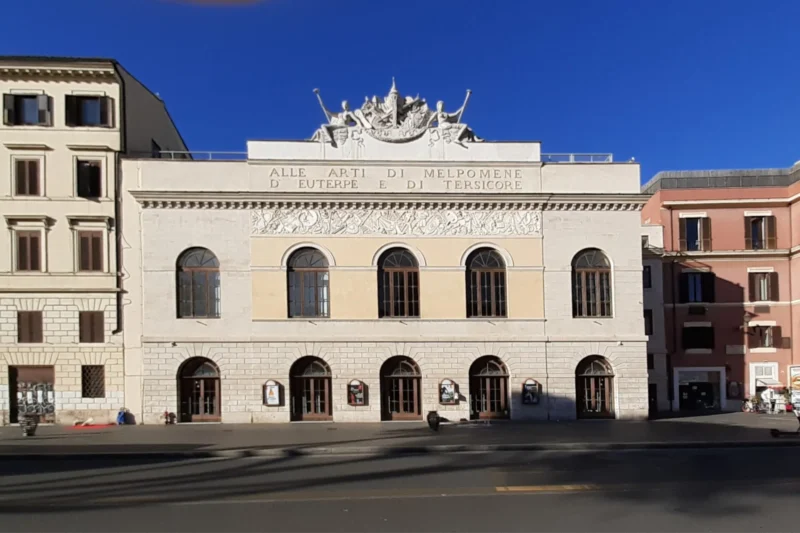
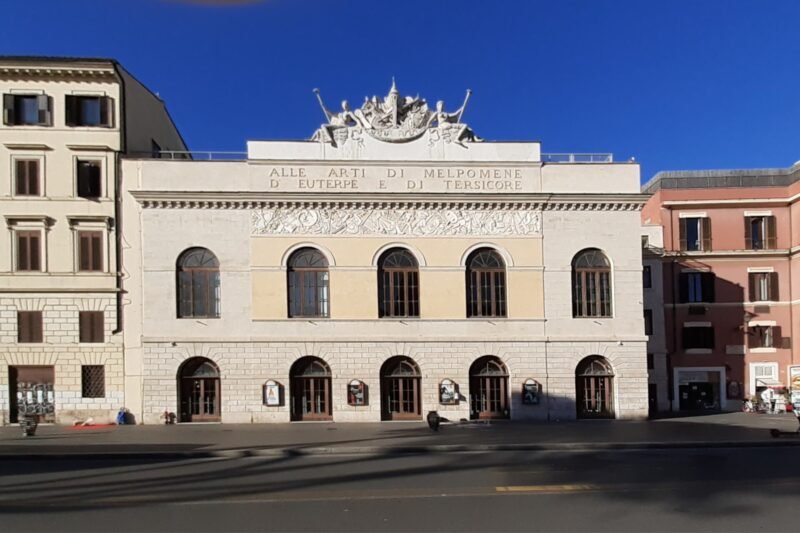
The facade only came in 1826, designed by architect Pietro Holl, in neoclassical forms. Above the large arched windows runs a dedication to the muses of tragedy, lyric poetry and dance: Alle arti di Melpomene d'Euterpe e di Tersicore. It's worth looking up before going in: in the evening, with the square lit, the inscription is easy to read.
Paolo Portoghesi's restoration
In 1993 the theater was restored by Paolo Portoghesi. The work was needed to make the stage usable again, but it respected the original structure: Portoghesi restored the red of the upholstery, replacing the gold yellow introduced in the 1970 restoration, and gave the box valances back their festoon shape. It's thanks to that work that the hall has its 18th-century look again today.
The theater today
The Argentina is the main venue of Fondazione Teatro di Roma, the capital's National Theater, which became a foundation in 2022. It hosts drama, dance and music. Inside is a historical museum of the theater, with a photographic and documentary archive that the Fondazione's Study Center makes available to students and researchers.
Something nobody tells you about Othello at Teatro Argentina, November 4 to 29, 2026
Teatro Argentina stands on part of the great complex of the Theater of Pompey, and the Curia where Julius Caesar was killed in 44 BC was part of that complex. Teatro di Roma says so openly: the history of this theater begins with a political assassination. Anyone coming to see Othello, a tragedy of manipulation and death, is therefore entering a building constructed a few meters from the site of the most famous political murder of antiquity.
What almost nobody knows is that this closeness isn't only geographical. The route of Teatro di Roma's theatrical tours ends in the refectory of the old convent of the Benedictines of Farfa Abbey, in the archaeological area between the theater and the Curia of Pompey. So within the theater's perimeter there's access to that layer of the city. During the Othello performances those spaces can't be visited, but knowing they exist changes the way you look at the hall.
A second, more practical detail: Teatro Argentina is the only one of the Fondazione's theaters subject to the hours of the historic center's ZTL. Teatro India and Teatro Torlonia, which aren't in the historic center, don't have this problem. Many spectators who drive in from the outskirts find out only from the fine. The theater has no private parking. The right solution is to leave the car outside the limited traffic zone and take tram 8, which stops in front of the sacred area.
How to get to Teatro Argentina
Teatro Argentina is at Largo di Torre Argentina 52, opposite the sacred area, in the historic center of Rome. The easiest way to get there is tram 8, which has a stop right at Torre Argentina.
By tram
Tram 8 has a stop at Torre Argentina, a few steps from the theater entrance. If you're coming from Trastevere, on the other bank of the Tiber, it's the most convenient option in the evening too, when you come out of the show.
By metro
No metro station is right by the theater. The most convenient are Colosseo and Circo Massimo on line B, from where you continue on foot or by surface transit. In the future the theater will also be served by the Venezia station of line C. From Piazza Venezia to Largo Argentina the walk along Via delle Botteghe Oscure takes a few minutes.
By bus
Largo di Torre Argentina and Corso Vittorio Emanuele II are crossed by many surface lines connecting Termini station, Piazza Venezia, the Vatican and Trastevere. Lines and evening times should be checked on the Rome public transit information service before setting out.
By car
The theater has no private parking and is subject to the hours of the historic center's ZTL. If you come by car you have to park outside the limited traffic zone, in paid lots outside it, and complete the trip by transit or on foot. A taxi remains the simplest alternative for those with mobility difficulties.
On foot
From the Pantheon, Piazza Navona, Campo de' Fiori and the Ghetto the theater is a handful of minutes away. It's one of the rare theaters in Rome where arriving on foot is the best choice, and where the walk is part of the evening.
My advice for seeing Othello at Teatro Argentina, November 4 to 29, 2026
The advice is clear: for Othello choose the stalls or a stall-level, first- or second-tier box, and leave the high boxes to those who already know the show. It's a tragedy of words and looks, built on three actors. The difference between seeing Iago's face as he works on Othello and seeing only his outline is the difference between understanding and guessing. The official price list makes it possible without crazy spending: the stalls cost 44 euros full price and 35 reduced, the stall-level, first- and second-tier boxes 35 euros full price and 30 reduced.
Those under 35 or over 65 pay the reduced price, and university students or students at an affiliated drama school get even lower rates (20 euros in the stalls), valid though only until the fourth-to-last performance: the last three performances are excluded. If you fall into this category, then, avoid the weekend of November 27, 28 and 29.
Second piece of advice: arrive at least 40 minutes early. The box office automatically cancels bookings not collected an hour before the start, and from then on sells only for that evening's performance. Arriving early also lets you look at the empty hall, which at the Argentina is a show in itself: six tiers of red and gold boxes lighting up one after another. Third piece of advice, if you want to do things properly: reread the first act the evening before. Othello begins at night, in a street in Venice, with two men speaking ill of a third. If you already know those lines you immediately see where the direction shifts the emphasis.
Tickets, discounts and the Teatro Argentina box office
The Teatro Argentina box office, at Largo di Torre Argentina 52, is open Monday to Saturday from 11:00 to 19:00 and on Sunday three hours before the show starts. When there's a show it always stays open until the start. The numbers given by the theater are 06 684000311 and 06 684000314.
Who is entitled to the reduced price
Teatro di Roma's reduced ticket is for people under 35 and over 65, teachers, associations, affiliated company recreation clubs and people with disabilities. Performing arts professionals and artists have a dedicated 15-euro rate, on request to the promotion office.
University students and drama school students
For university students and students of affiliated drama schools and academies Teatro Argentina applies dedicated rates: 20 euros in the stalls, 15 euros in the stall-level, first- and second-tier boxes, 13 euros in the third- and fourth-tier boxes. These rates don't apply to the last three performances of each show.
Collection and changes
Booked tickets must be collected an hour before the show starts, unless the promotion office says otherwise. After that deadline the system cancels the booking. Once issued, tickets can't be exchanged or canceled. The box office accepts card payments.
Subscriptions and cards
Teatro Argentina offers fixed-seat subscriptions, for seven shows or for seven plus two of your choice, and the TdR Card. If you plan to see the December Ford too, or other titles in the season, it's best to compare the options on the theater's website before buying single tickets.
Another well-known fact, yet rarely mentioned
Everyone in Rome knows that «fare il portoghese» (playing the Portuguese) means getting into a show without paying. Less known is that one of the most widespread explanations of this saying leads right to Teatro Argentina. According to this version, in the 18th century the Portuguese ambassador to the Papal States invited the Portuguese living in Rome to attend a show at the Argentina for free: no written invitation was needed, it was enough to state your nationality. Many Romans took advantage by passing themselves off as Portuguese, and the expression was born from that.
It should honestly be said that it's a hypothesis, not a documented fact. There's another, older explanation, going back to 1514 and Pope Leo X, who supposedly allowed the Portuguese ambassador and his retinue to attend theaters and taverns for free to thank the king of Portugal for the gift of the elephant Hanno. And there are others still, linked to customs exemptions or Portuguese folk tales. The Argentina version, though, is the one dictionaries cite most often, and a Portuguese book, O Barco Pescarejo by José Coutinhas, tells it too.
For the Othello spectator there's a simple and unromantic moral: the Portuguese don't get into the Argentina today. The ticket must be bought and collected in time. But it's nice to know that the hall you sit in has left a mark on Italians' everyday language, and that its name, besides in the annals of opera, survives in an expression still used at the stadium and the movies.
Accessibility at Teatro Argentina
Teatro Argentina is accessible to the public with disabilities: the historic building doesn't allow architectural barriers to be eliminated entirely, but it has elevators and services that make access easier.
Reserved seats in the stalls
For people with disabilities the theater reserves some seats in the stalls, according to safety regulations. The companion sits in a nearby seat. To check availability the theater asks you to write to the box office or phone during opening hours.
Ticket for the companion
Spectators with disabilities buy the reduced ticket at the box office. For holders of an attendance allowance certified by INPS a free ticket is provided for the companion. The hall staff are available for any need.
The right photo to take at Othello at Teatro Argentina, November 4 to 29, 2026
The right photo is taken from the stalls, before the lights go down, with the lens pointed upward: the six tiers of red and gold boxes, the green ceiling and the candelabra chandelier with its 16 arms. It's the shot that tells the Argentina better than any description, and it works with a phone too, as long as you keep the whole hall in the frame and don't go for detail. The best moment is when the audience is still coming in and the house lights are fully on. As soon as the show begins the phone goes off, and it's not just a question of manners: in a tragedy built on silence and suspicion, a lit screen in the stalls can be seen from every box.
The second photo is outside, in the evening, from the other side of the square. From there you see together the theater's neoclassical facade with its dedication to the muses, Melpomene, Euterpe and Terpsichore, and in the foreground the lit columns of the sacred area. It's the image that sums up the whole history of the place: the 18th-century theater, the 19th-century city that surrounded it with streets, and below the Republican temples. If you have a little patience you can wait for tram 8 to pass to add movement.
A third option, if you arrive early: Palazzo del Burcardo on Via del Sudario, behind the theater, with its late Gothic facade. It's the tower that gave the Argentina its name, and almost nobody photographs it.
Around Teatro Argentina: what to see before and after the show
Teatro Argentina is in the historic center of Rome, a few minutes' walk from the Pantheon, Piazza Navona, Campo de' Fiori and the Ghetto. It's one of the few Roman theaters where an evening of drama can be combined, without transportation, with a walk among the city's most important sites.
The Largo Argentina sacred area
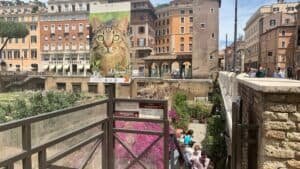
Opposite the theater lies the Largo Argentina sacred area, with the remains of ancient temples and structures linked to the great complex of the Theater of Pompey, which included the Curia where Caesar was killed. Among the ruins lives a colony of cats looked after by volunteers: the page on the Largo Argentina cat sanctuary explains how it works.
The Pantheon and the Minerva
A five-minute walk north brings you to the Pantheon and, just behind it, the Basilica of Santa Maria sopra Minerva with the Minerva obelisk in front of the facade. It's the shortest route if you want a walk before going into the hall.
Piazza Navona and Campo de' Fiori
To the west, beyond Corso Vittorio Emanuele II, you reach Piazza Navona and Campo de' Fiori. On the way is the Basilica of Sant'Andrea della Valle, which faces right onto Corso Vittorio Emanuele II. If you have time in the afternoon you can go down into the underground remains of the Stadium of Domitian, under Piazza Navona.
The Gesù, the Ghetto and the Theater of Marcellus
To the east, a few steps away, is the Church of the Gesù. Heading down toward the Tiber you enter the Jewish Ghetto and reach the Theater of Marcellus: an ancient Roman theater a short distance from an 18th-century one, two ways of understanding the stage centuries apart.
Piazza Venezia
Continuing along Via delle Botteghe Oscure you reach Piazza Venezia, a hub for traffic and public transit, also useful if you have to take a bus or taxi after the show.
Some important events that happened here in history
Teatro Argentina was inaugurated in January 1732 with Berenice, an opera by Domenico Sarro, and since then its history has intertwined with that of Italian music and that of Roman politics. In the 18th century, according to foreign travelers, it was considered the most important of the Roman theaters.
On February 20, 1816, the premiere of Gioachino Rossini's The Barber of Seville was staged here, with Manuel García. It was a resounding flop: in the stalls sat many admirers of Giovanni Paisiello's Barber, who booed in protest. From the second evening on, though, the opera triumphed and began a success that continues today. On January 28, 1822, the Argentina hosted the world premiere of Gaetano Donizetti's Zoraida di Granata, and some operas by Saverio Mercadante were also first presented here. In 1827 it was Niccolò Paganini's turn, in concert.
Giuseppe Verdi brought two premieres here: I due Foscari in 1844 and La battaglia di Legnano in 1849. The latter wasn't just an evening at the opera. According to Teatro di Roma's account, it was precisely on the occasion of that performance that the Romans started the demonstrations against the papal government that led to the Roman Republic. A patriotic opera, in a packed theater, at the tensest moment of the Roman Risorgimento: it's hard to imagine a more theatrical event.
After 1870, with Rome as capital, the city's urban transformation also changed the Argentina's fate. The opening of Corso Vittorio Emanuele II, connecting Piazza Venezia to the Tiber and the Vatican area, put the theater at the center of the new city. The building passed to the city and became a theater for institutional occasions. In the 20th century, with the birth of Teatro di Roma, the Argentina became the home of the capital's public drama, and in 2022 its management passed to a foundation.
Who has passed through Othello at Teatro Argentina, November 4 to 29, 2026
Some of the greatest names in Italian music and theater have passed across the stage of Teatro Argentina. Gioachino Rossini presented The Barber of Seville here in 1816, with Manuel García. Gaetano Donizetti premiered Zoraida di Granata here in 1822, with Domenico Donzelli and Luigia Boccabadati. Giuseppe Verdi brought I due Foscari and La battaglia di Legnano. Niccolò Paganini played here in 1827.
The route of Teatro di Roma's theatrical tours recalls that the works of Gabriele D'Annunzio and Luigi Pirandello, two authors who shaped 20th-century Italian theater, were staged at the Argentina. Marcel Proust, who loved the theater's boxes, described them as little suspended drawing rooms, according to Teatro di Roma itself.
Then there are the directors who led the house and who, with their choices, brought a decisive part of the Italian scene here: Vito Pandolfi from 1964, Franco Enriquez, Luigi Squarzina, Maurizio Scaparro, Pietro Carriglio, Luca Ronconi from 1994 to 1999, Mario Martone, Giorgio Albertazzi, Gabriele Lavia, Antonio Calbi, Giorgio Barberio Corsetti and today Luca De Fusco. One of the inner rooms is named after Squarzina.
The list grows with this season's actors. The cast of Othello includes Luca Lazzareschi, who trained precisely with Albertazzi and Gassman at the Bottega Teatrale in Florence and who acted Shakespeare several times with Lavia: through him, two historic directors of the Argentina in some way return to the stage of the theater they led.
How to plan an evening of Othello in Rome
An evening of Othello at Teatro Argentina is easy to organize on foot: dinner before or after in the historic center, the show, back home on tram 8 or by taxi from Piazza Venezia. November in Rome is a month of cool and often rainy evenings, and that should be factored in.
Where to eat before or after
The historic center around the Argentina offers every kind of place: Roman trattorias on the streets toward Campo de' Fiori, Roman Jewish cuisine in the Ghetto, pizza by the slice and bakeries along Corso Vittorio Emanuele II if you prefer a quick meal before the show, wine bars and bistros around the Pantheon for after the theater. On weekends it's best to book, especially after 22:00, when kitchens start to close.
With teenagers
Othello is a text studied in school and it speaks to a teenager more than you'd think: jealousy, manipulation, racism, violence against a woman. For a high school student it's a good first Shakespeare in the theater, especially if they arrive prepared on the plot. For younger children the themes make it inadvisable. Teatro di Roma has a Teatro Ragazzi program with dedicated rates, which is the most suitable choice for them.
Cloakroom and clothing
There's no dress code at the Argentina, but the 18th-century hall invites a minimum of care. In November a coat and an umbrella are almost always needed: if you're walking from far away, reckon with the wet cobblestones of the historic center.
November in Rome
The month of Othello is also the month when Rome returns to its normal rhythms, after summer and before Christmas. Museums are less crowded, the days get shorter and evenings in the historic center become more intimate. It's the best time for an evening at the theater in the center, with the city still lively but less congested.
After Othello: Teatro Argentina's 2026/2027 season
Othello opens the drama part of Teatro Argentina's 2026/2027 season, after three October events co-produced with Romaeuropa Festival: the dance of Wim Vandekeybus and Ultima Vez, Max Richter's Four Seasons Changed with the Bryggen String Orchestra and Romeo Castellucci's Faust.
'Tis Pity She's a Whore
From December 2 to 13, 2026, the same group of actors, with Luca De Fusco directing and the adaptation by De Fusco and Garrera, stages John Ford's 'Tis Pity She's a Whore. If you've seen Othello you'll find many familiar faces, including Mersila Sokoli, Gianluca Merolli and Sara Putignano.
Popolizio, Binasco, Andò
In January 2027 Massimo Popolizio arrives with Alan Bennett's The Madness of George III, from the 9th to the 31st. In February Valerio Binasco with Goldoni's Una delle ultime sere di Carnovale and Roberto Andò with Non posso narrare la mia vita, from texts by Enzo Moscato, performed by Lino Musella.
Another Shakespeare: Hamlet
From March 2 to 14, 2027, Shakespeare returns to the Argentina with Hamlet directed by Leonardo Lidi, in a translation and adaptation by Diego Pleuteri. If you want to compare two contemporary readings of Shakespeare in the same hall you have Othello in November and Hamlet in March.
The theatrical tours
Teatro di Roma organizes theatrical tours led by the company's actors. The Argentina one, Ve lo faccio vedere io ora il teatro!, curated by Claudio Longhi, lasts 60 minutes, takes up to 35 people and has a date scheduled on Sunday, December 13, 2026, at 11:00. The ticket costs 18 euros full price, 15 for groups, 8 for schools. The route starts from the foyer and ends in the archaeological area between the theater and the Curia of Pompey.
The return of Teatro Valle
The 2026/2027 season also marks the reopening of Teatro Valle, closed since 2014 and now part of the Fondazione as the home of contemporary playwriting. At the season presentation it was described as the oldest modern Italian-style theater in Europe still in operation, and lovers of historic halls now have one more reason to come back to the historic center. If you also want to get to know the venue on the Tiber, the page on summer at Teatro India tells the story of the former Mira Lanza factory.
Frequently asked questions about Othello at Teatro Argentina
When is Othello on at Teatro Argentina?
Othello at Teatro Argentina is on from November 4 to 29, 2026, Tuesday to Sunday, for 23 performances. On Mondays November 9, 16 and 23 the theater rests. The start times of the individual performances are published on the Teatro di Roma website, on the show's page, together with the full calendar.
Who are the actors in Othello directed by De Fusco?
Luca De Fusco's Othello has Federico Vanni as the Moor, Luca Lazzareschi as Iago and Mersila Sokoli as Desdemona. The cast is completed by Alessandro Balletta, Francesco Biscione, Paolo Cresta, Rossella De Martino, Gianluca Merolli, Pierluigi Misasi and Sara Putignano. The translation is by Gianni Garrera, the music by Ran Bagno.
How much are tickets for Othello at Teatro Argentina?
Teatro Argentina's price list has the stalls at 44 euros full price and 35 reduced, the stall-level, first- and second-tier boxes at 35 and 30 euros, the third- and fourth-tier boxes at 26 and 20 euros. University students and students of affiliated drama schools have rates from 13 to 20 euros, excluding the last three performances.
Who is entitled to a reduced ticket at Teatro Argentina?
At Teatro Argentina the reduced price is for those under 35 or over 65, teachers, associations, affiliated company recreation clubs and people with disabilities. For holders of an attendance allowance certified by INPS the companion gets in with a free ticket, to be requested at the box office.
How do you get to Teatro Argentina by public transportation?
Teatro Argentina, at Largo di Torre Argentina 52, can be reached on tram 8, Torre Argentina stop, and on the many bus lines crossing the square. The nearest metro B stations are Colosseo and Circo Massimo. The theater has no parking and is subject to the ZTL hours.
How many seats does Teatro Argentina have?
Teatro Argentina has 720 seats: 354 in the stalls and 366 spread over six tiers of boxes. It's an Italian-style horseshoe hall, inaugurated in 1732 and restored by Paolo Portoghesi in 1993, with red upholstery, gilded decorations and a 16-arm candelabra chandelier.
Does Othello tour after Rome?
Yes, Othello is a co-production of Teatro di Roma with Teatro Stabile di Torino and Teatro Biondo of Palermo. After the Rome performances the show is scheduled in Palermo, in the Sala Grande of Teatro Biondo, from January 9 to 17, 2027, with nine performances.
When is the Teatro Argentina box office open?
The Teatro Argentina box office is open Monday to Saturday from 11:00 to 19:00 and on Sunday three hours before the show starts. Booked tickets must be collected an hour before the start. From then on only tickets for that day's performance are sold. The numbers are 06 684000311 and 06 684000314.
One last piece of advice applies to this Othello more than to other shows: get a seat from which you can see the faces well, arrive early and take a look at the hall before the lights go out. Three actors who know the tragedy from the inside, a director who runs the theater hosting them, a hall from 1732 built next to the site of Caesar's assassination: these are reasons enough to choose a November evening and devote it to Shakespeare.
Article written by the editorial team of Tour Leader Pro, contact them for Private/Corporate/V.I.P. Tours and Experiences.
Planning a trip to Rome? English guides for visiting the city are on ItalyPlanner.com.
Contact Information
Nearby
 Teatro Argentina100 m
- Teatro Centrale100 m
- Largo Torre Argentina – Sacred Area of Campo Marzio100 m
- Cat Sanctuary at Largo Argentina100 m
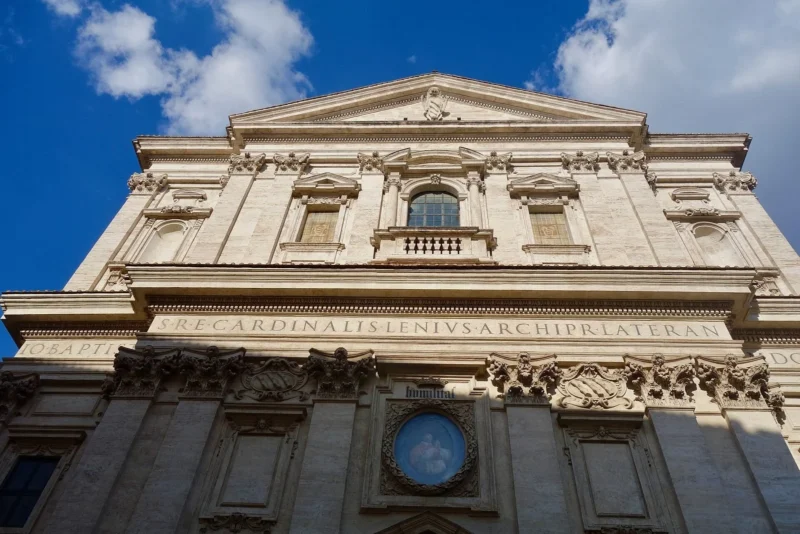
- San Carlo ai Catinari200 m
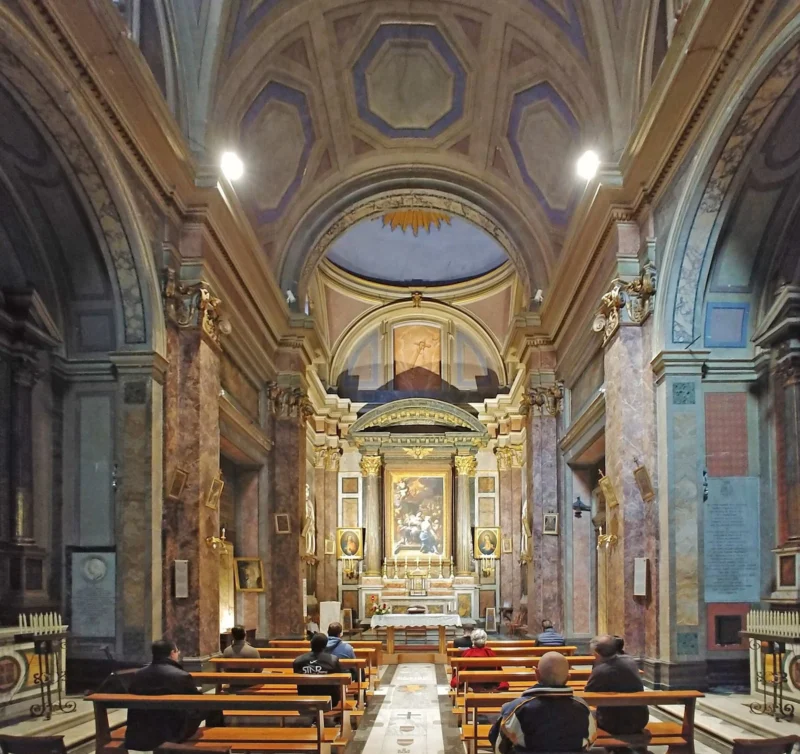
- Santa Maria in Publicolis200 m
Upcoming events nearby
- The Madness of King George with Massimo Popolizio at Teatro Argentina in Rome, January 9 to 31, 2027100 m
- Una delle ultime sere di Carnovale at Teatro Argentina, February 2 to 14, 2027100 m
- Lo zar by and with Stefano Massini at Teatro Argentina in Rome, March 16 to 25, 2027100 m
- I Solisti della Filarmonica: Mahler, Symphony No. 4 at Teatro Argentina, November 5, 2026100 m
You might also like
- C’era una volta… Scugnizzi at Teatro Sistina, November 18 to 29, 2026
- La moglie fantasma at Teatro Sistina, November 11 to 15, 2026
- Le dieu du carnage with Antonio Zavatteri at Teatro Quirino, March 30 to April 4, 2027
- L’uomo, la bestia e la virtù with Vanessa Gravina at Teatro Quirino, March 16 to 21, 2027
- Ispettore in casa Birling with Ettore Bassi and Galatea Ranzi at Teatro Quirino, March 2 to 7, 2027
- Il commissario Montalbano with Vincenzo Pirrotta at Teatro Quirino, February 16 to 28, 2027