La moglie fantasma at Teatro Sistina, November 11 to 15, 2026
In short. From November 11, 2026, Maria Grazia Cucinotta and Pino Quartullo are at Teatro Sistina, Via Sistina 129 (00187 Rome), with La moglie fantasma, a comedy by David Tristram directed by Marco Rampoldi.
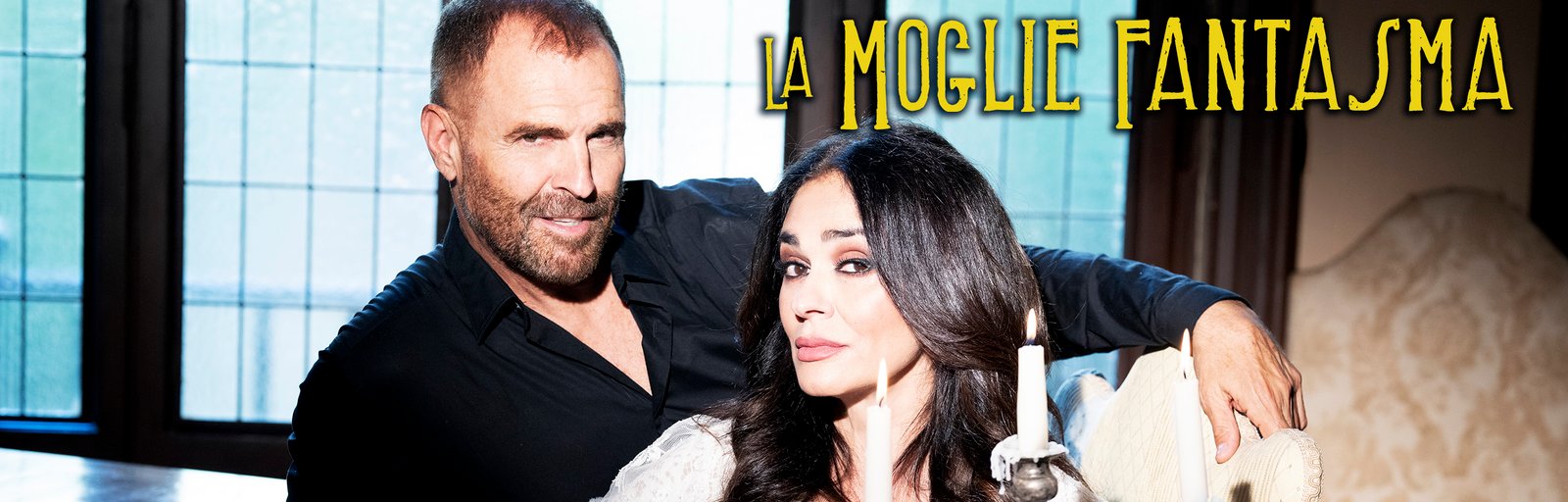
From November 11, 2026, Maria Grazia Cucinotta and Pino Quartullo are at Teatro Sistina, Via Sistina 129 (00187 Rome), with La moglie fantasma, a comedy by David Tristram directed by Marco Rampoldi. The Sistina lists the times as Wednesday to Saturday at 20:30 and Sunday at 16:00: the performances announced for Rome run from Wednesday, November 11 to Sunday, November 15. The theater is a few steps from Piazza Barberini, served by metro A, Barberini stop. The prices published by the theater are 49 euros in poltronissima, 45 in poltrona, 41 in the first gallery, 36 in the second gallery and 30 in the third gallery. Tickets are sold on the Sistina's official website, in the online box office linked to the show's page, or at the box office on Via Sistina.
Language: performed in Italian. No English version or English surtitles are announced.
A mystery comedy with a ghost, a playwright in crisis and a company of actors suspected of murder. The Sistina presents it as a recipe: a base of Shakespeare, a good dose of Blithe Spirit, a sprinkling of Pirandello and a pinch of Agatha Christie. It's theater within theater, built to make the audience laugh at the pettiness of people in this profession. Here you'll find the plot, who the leads are, what the Sistina is like and how to organize the evening.
La moglie fantasma at the Sistina at a glance
La moglie fantasma is on at Teatro Sistina in Rome from November 11, 2026, with Maria Grazia Cucinotta and Pino Quartullo, produced by CMC/Nidodiragno and Rara and directed by Marco Rampoldi.
The performances
Wednesday the 11th, Thursday the 12th, Friday the 13th and Saturday, November 14 at 20:30, Sunday, November 15 at 16:00. The Sistina's official page lists the show as on from November 11, with times Wednesday to Saturday at 20:30 and Sunday at 16:00.
The cast
Alongside the two leads are Giorgio Verduci, Roberta Petrozzi and Giorgio Centamore, with the participation of Alessandra Faiella.
Running time
The show's listing circulated for the tour gives a running time of 90 minutes in a single act, with no intermission: with the 20:30 start you come out around 22:00.
The production
The show is presented by CMC/Nidodiragno and Rara, and was produced in 2025. It has already toured theaters in several regions, including the Lazio and Marche circuits, before arriving at the Sistina.
The plot of La moglie fantasma
La moglie fantasma tells of an actress found dead after the closing party of a triumphant tour, a case closed as suicide, who a year later reappears as a ghost to her ex-husband, a playwright, to reveal that she was murdered by a member of the company.
The crime
The death was quickly dismissed: the alcohol, the barbiturates, the increasingly tense relationship with her husband. But exactly a year later, the woman's ghost, played by Maria Grazia Cucinotta, returns from the afterlife and seeks out her husband, played by Pino Quartullo.
The stratagem
Once past the inevitable shock, the husband agrees to put into action a stratagem modeled on the play within Hamlet. With the help of his dearest friend he summons all the actors who were at the party to read a script that reconstructs the evening, so as to flush out the culprit through their reactions. Only then can the woman be freed from the limbo she's in.
The rehearsal
Then the rehearsal begins, poised between paradoxical and funny situations. The summoned actors reveal the pettiness and fragility of people in this profession, and the show becomes a game of Chinese boxes in which you can no longer tell where reality ends and fiction begins, in a crescendo of twists up to the finale.
The characters
In the tour presentations circulated by the Lazio theater circuit the playwright is called Edward, the dead wife Ruby, and among the characters is Glenda, a young and attractive actress who enters Edward's life just when he seems ready to start over.
Shakespeare, Coward, Pirandello, Christie: the comedy's sources
La moglie fantasma openly declares its models, and the Sistina lists them in its presentation: Shakespeare, Blithe Spirit, Pirandello, Agatha Christie and, as a garnish, an idea from In the Bleak Midwinter.
Hamlet
The heart of the mechanism comes from Hamlet: the prince has a scene reproducing his father's murder performed in front of his uncle, to watch his reaction. Here the ghost is the wife and not the father, and the prince is a middle-aged playwright, but the trick is the same.
Blithe Spirit
Noël Coward's Blithe Spirit is the English comedy about the ghost of a first wife who returns to torment her remarried husband. La moglie fantasma's debt is evident already in the title, and in the triangle between the widower, the dead wife and the young actress.
Pirandello
From Pirandello comes the theater within theater: actors reading a script about their own lives, and the line between character and person thinning until it disappears. For the Italian audience it's the most familiar reference.
Agatha Christie and Branagh
From Agatha Christie comes the structure of the mystery with gathered suspects, in which the culprit is one of those present. In the Bleak Midwinter, Kenneth Branagh's film about a company of penniless actors staging Hamlet in a country church, adds affectionate irony for the world of theater companies. The line attributed to the show in the Sistina's presentation sums it all up: if you have to copy, you might as well copy from a comedy that has worked for centuries.
The author David Tristram and the director Marco Rampoldi
La moglie fantasma is a comedy by David Tristram, a British author of light comedies, brought to Italy by director Marco Rampoldi.
A successful text abroad
The Lazio theater circuit presents it as a very successful comedy abroad. It's the kind of text theater circuits look for: a solid comic mechanism, few settings, a company of six performers.
Marco Rampoldi
Rampoldi, according to the same presentation, has for years been committed to staging valuable texts still unknown in Italy. The choice of a contemporary British author fits this line: bringing to the Italian audience today's English comedy, not just the classics.
The production
Nidodiragno and Rara produce the show, which has already played theaters in several regions in the 2025/2026 season. It arrives at the Sistina with a short run, five performances in a week: it's the format of the big drama tours, which stop for only a few days in Roman theaters of more than 1,000 seats.
Maria Grazia Cucinotta, the ghost
Maria Grazia Cucinotta, born in Messina on July 27, 1968, is an actress, film producer and former model, known worldwide for Il postino alongside Massimo Troisi and for the James Bond film The World Is Not Enough.
From Miss Italia to Indietro tutta!
After graduating from high school she moved to Brescia, where she worked in fashion. In 1987 she took part in Miss Italia and was chosen by Renzo Arbore as a showgirl on Indietro tutta! In 1989 she was the female lead in Zucchero's music video for Diamante, and in 1990 she made her film debut in Vacanze di Natale '90.
Il postino
In 1994 Massimo Troisi chose her as his partner in his film Il postino, directed by Michael Radford: it's the role that made her known worldwide. The following year she was in Leonardo Pieraccioni's I laureati and in Álex de la Iglesia's Spanish horror film The Day of the Beast.
Hollywood and American TV
In 1999 she acted in an episode of The Sopranos and appeared in Michael Apted's The World Is Not Enough. In 2000 she was alongside Woody Allen and Sharon Stone in Picking Up the Pieces, and in 2011 she was in the cast of Mikael Håfström's The Rite. In Italy she has worked with Simona Izzo in Camere da letto and with Gigi Proietti in the series Avvocato Porta.
Producer and director
Since 2005 she has also been a producer: her first film was All the Invisible Children, directed by several hands including Emir Kusturica, Spike Lee, Ridley Scott and John Woo, then Last Minute Marocco, Viola di mare, L'imbroglio nel lenzuolo, which she also co-wrote. In 2011 she made her directing debut with the short film Il maestro, in competition at the Venice Film Festival, of which she had been hostess in 2009.
Theater and TV today
On stage she starred in Salotto italiano in 2017 and Figlie di Eva in 2019. Since 2021 she has hosted L'ingrediente perfetto on La7. With La moglie fantasma she returns, as the Lazio circuit writes, to her love for the theater, in a comic and slightly spectral role that plays with her diva image.
Pino Quartullo, the playwright husband
Pino Quartullo, born in Civitavecchia on July 12, 1957, is an actor, director, screenwriter and playwright, nominated for an Oscar in 1987 for the short film Exit, made with Stefano Reali.
His training
With a degree in architecture, he graduated in directing from the Accademia d'arte drammatica Silvio D'Amico and in acting from Gigi Proietti's Laboratorio di esercitazioni sceniche. It's a double training, as director and actor, that shows in the way he builds comic characters.
Cinema
He debuted very young in Mario Monicelli's Il marchese del Grillo, in 1981, and has worked with Luigi Magni, Ricky Tognazzi, Gérard Oury, Giovanni Veronesi, Federico Moccia and Pupi Avati. As a director he made Quando eravamo repressi, Le donne non vogliono più, Storie d'amore con i crampi, Le faremo tanto male. His is the voice of Jim Carrey in the Italian versions of The Mask and Dumb and Dumber.
A life on stage
The theater is his home. He has worked with Aldo Trionfo and Giuseppe Patroni Griffi, with Pietro Garinei in A che servono gli uomini?, with Gigi Proietti in Dramma della gelosia, Stregata dalla luna and Quella del piano di sopra, and with Armando Pugliese in Tennessee Williams's Summer and Smoke. He has directed dozens of shows, from Machiavelli to Goldoni, from Woody Allen to Shakespeare, and with Ornella Muti he staged Mia moglie Partenope.
The artistic director
From 2000 to 2013 he was artistic director of Teatro Traiano in Civitavecchia, and he teaches acting at the ACT Multimedia Academy at Cinecittà. An actor who has run a theater and written comedies is the ideal performer for a playwright in crisis who organizes a rehearsal to unmask a murderer: the character resembles him more than it seems.
The company: Verduci, Petrozzi, Centamore, Faiella
Alongside Cucinotta and Quartullo, the company of La moglie fantasma announced by the Sistina includes Giorgio Verduci, Roberta Petrozzi and Giorgio Centamore, with the participation of Alessandra Faiella.
The suspected actors
In a comedy built like a mystery with gathered suspects, the company is everything: each of the actors summoned to the rehearsal has to be believable as the culprit, and at the same time funny in their theatrical fragilities.
Alessandra Faiella
Alessandra Faiella's name is listed on the poster as a participation: a prominent role that the posters single out separately.
A team game
Theater within theater only works if the ensemble is close-knit. The tour presentations speak of a close-knit cast, and after a season of performances in provincial theaters the company arrives at the Sistina broken in.
A curious fact about La moglie fantasma at Teatro Sistina, November 11 to 15, 2026
The tastiest curious fact concerns Pino Quartullo and the Sistina. In 1981 the young Quartullo appeared in Mario Monicelli's Il marchese del Grillo, the film with Alberto Sordi. Almost 40 years later, under the artistic direction of Massimo Romeo Piparo, the Sistina turned Il marchese del Grillo itself into a musical comedy, with Enrico Montesano and then with Max Giusti. The actor from that film now returns to the same stage where his first film became a show.
There's more. Among Quartullo's shows is A che servono gli uomini?, from 1989, directed by Pietro Garinei: the Garinei who with Sandro Giovannini ran the Sistina from 1960, and alone, after 1977, until 2006. Quartullo therefore worked with the man who made the Sistina the home of Italian musical comedy.
The second curious fact is about the plot. La moglie fantasma is a comedy about a theater company, and the Sistina is the Italian theater that more than any other has built its history on companies: those of Garinei and Giovannini, of Rascel, of Delia Scala, and today those of Piparo's musicals. Seeing here a comedy that pokes fun at actors' little vanities has the flavor of a family joke.
Teatro Sistina, Italy's answer to Broadway
Teatro Sistina, at Via Sistina 129, opened on December 28, 1949 to a design by Marcello Piacentini and is one of the most important private theaters in Italy, with 1015 seats in the orchestra and 566 in the gallery. The American magazine Variety called it Italy's answer to Broadway.
A hall without columns
The hall is semicircular, 28 meters wide and 30 deep, without columns: from every seat you see the stage without obstacles. For a comedy of words like this one, where the two leads' facial expressions matter as much as the lines, the gallery remains a perfectly valid choice.
Where a church once stood
The theater was built between 1946 and 1949 on the site of the church of Santa Francesca Romana, along what was called Strada Felice. The first film shown was Le mura di Malapaga, the first revue Bada che ti mangio, with Totò and Isa Barzizza.
The temple of musical comedy
From 1960 to 2006 the theater was run by Garinei and Giovannini, the authors of Rugantino and Aggiungi un posto a tavola, and since 2013 the artistic director has been Massimo Romeo Piparo. The full program is on the Sistina's official website.
Something nobody tells you about La moglie fantasma at Teatro Sistina, November 11 to 15, 2026
What's rarely said is that short runs at the Sistina sell out in the best seats sooner than long ones. A musical on the program for months leaves time to choose. A comedy with five performances in a week, with two popular names like Cucinotta and Quartullo, concentrates demand into a few days. If you have a specific night in mind, especially Saturday or Sunday afternoon, it's worth buying in advance.
The second thing concerns the audience. La moglie fantasma is a comedy about the actor's craft, full of allusions to Shakespeare, Coward and Pirandello. It's perfectly understandable even without catching every reference, but those with some familiarity with Hamlet will enjoy it twice as much: the rehearsal called to unmask the murderer is an affectionate parody of Hamlet's mousetrap. Rereading the third act before leaving home isn't a bad idea.
The third point is the running time: 90 minutes without intermission, according to the tour listing. It means there's no mid-evening break for the bar, and that latecomers risk waiting a long time to get in. In a theater of more than 1,500 seats, 20 minutes early is the minimum to settle in calmly.
My advice for La moglie fantasma at Teatro Sistina, November 11 to 15, 2026
My advice is to choose Sunday afternoon, at 16:00, if you're coming from outside Rome or in a group. You come out around 17:30, with a little light still left, and have plenty of time for a walk to Trinità dei Monti and the Pincio, or for an early dinner in the center. For a Roman couple, on the other hand, Wednesday or Thursday evening has the advantage of a less crowded hall and a quieter center.
Second piece of advice, on seats. With prices from 30 to 49 euros, the first gallery at 41 euros offers the best overall view of a comedy of movement, with entrances and exits, doors, misunderstandings. The poltronissima makes sense for those who want to see the leads' expressions up close. The third gallery at 30 euros is still decent, because the hall has no columns.
Third: arrive on foot from above. Those with time can get off the metro at Spagna, climb the Spanish Steps to Trinità dei Monti and walk along Via Sistina on the flat to number 129. It's 10 minutes, and the November light on the steps is worth the effort. For the return, coming out around 22:00, the Barberini metro is a few steps away.
Another well-known fact, yet not often mentioned
Almost everyone knows Rugantino and Aggiungi un posto a tavola were born at the Sistina. Less often remembered is that in the 1950s the theater risked becoming a cinema for good. A group of film industrialists turned it into a Cinerama hall, with three projection booths and a screen 27 meters wide and 11 high. The experiment failed, and it went back to theater. Without that failure, Italian musical comedy would have had a different history.
The second fact concerns cinema inside the theater. Shortly after the opening, the finale of Totò cerca moglie was shot at the Sistina: Totò and his fiancée take refuge in the theater, where the billboard shows the title of the film itself, go into the hall and see the scene of their wedding on the screen. A game of mirrors between reality and fiction that La moglie fantasma, 70 years later, repeats by other means: actors playing actors playing their own lives.
The third fact is a coincidence of titles. Totò was looking for a wife on the Sistina stage in 1950, and in 2026 on the same stage a husband finds his wife again, as a ghost. The Sistina loves these symmetries, and those who catch them leave the theater with one more story to tell.
How to get to Teatro Sistina
Teatro Sistina can be reached by metro A, Barberini stop: from Piazza Barberini you go up Via Sistina and the theater is at number 129, a few minutes' walk.
By metro
Line A connects Barberini to Termini in two stops and to San Giovanni and Ottaviano in a few minutes. It's the easiest way to get there and back, even after 22:00.
On foot from the center
Via Sistina connects Piazza Barberini to Trinità dei Monti, at the top of the steps of Piazza di Spagna. Those in the center can climb the steps and walk along the street on the flat.
By car
The Sistina is in the historic center, inside the ZTL: the car isn't recommended. Those coming from outside should leave it in a garage outside the limited traffic zone and continue by metro.
By taxi
For the evening exit a taxi is convenient for those who don't live near line A. Piazza Barberini is an easy pickup point to give.
The right photo to take at La moglie fantasma at Teatro Sistina, November 11 to 15, 2026
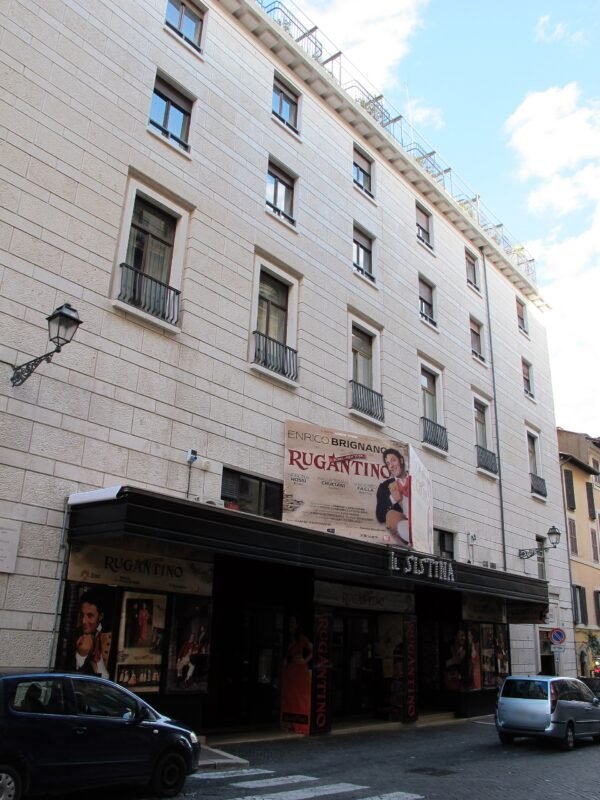
The Sistina photo is taken from the other side of Via Sistina, with the theater's sign and lit facade in the frame. In the evening, before the show, the light at the entrance and the crowd in front of the doors give the image of a living theater. Take it when you arrive: at the exit the street fills up and the photo comes out worse.
For those coming as a couple there's a wittier photo, in keeping with the show: one of you sharp in the foreground, the other blurred and a bit transparent behind, achieved with a long exposure and slight movement. A homemade ghost in front of the poster: with the night mode of a modern phone it works more easily than you'd think.
The third photo is taken at Trinità dei Monti, at the end of Via Sistina, with the Spanish Steps lit below you. It's five minutes from the theater and, on a Sunday afternoon in November, coming out at 17:30, the sunset light is just right.
Inside, during the show, no photos or videos: it's a theater rule and a form of respect for the actors. The final applause is the moment to ask an usher if a shot is allowed.
Some important events that happened here in history
On December 28, 1949 the Sistina opened as a cinema and theater. Shortly after, the first revue was staged, Bada che ti mangio, produced by Remigio Paone, with Totò and Isa Barzizza. In October 1950 the curtain rose on Pietro Garinei and Sandro Giovannini's La Bisarca, with sets by Giulio Coltellacci: it was the start of a relationship that would mark the history of Italian theater. On December 15, 1952 Attanasio cavallo vanesio with Renato Rascel premiered, the first of a trilogy of musical fables that opened the era of musical comedy.
In 1953, during a charity show, Sandro Giovannini saw Delia Scala dance a Charleston and decided she would be the star of the new musical theater. After the Cinerama interlude, in 1960 management passed to Garinei and Giovannini, who would keep it until 2006. From 1977, after Giovannini's death, Garinei ran it alone. These were the years of Rugantino, Aggiungi un posto a tavola, Il giorno della tartaruga, Un paio d'ali, Alleluja brava gente.
Since 2013 the artistic director has been Massimo Romeo Piparo, who brought the Sistina back to producing its own musicals: Jesus Christ Superstar with Ted Neeley, Mamma Mia!, Evita, Billy Elliot, School of Rock, Il marchese del Grillo, Cats, Matilda, West Side Story. Alongside the musicals the theater hosts concerts and drama tours like that of La moglie fantasma, which in November 2026 brings a contemporary English comedy to this stage for a week.
Who has passed through La moglie fantasma at Teatro Sistina, November 11 to 15, 2026
The great names of Italian entertainment have passed across the Sistina stage, many of whom debuted or were consecrated here: Marcello Mastroianni, Renato Rascel, Delia Scala, Carlo Dapporto, Aldo Fabrizi, Walter Chiari, Gino Bramieri, Johnny Dorelli, Paolo Panelli, Bice Valori, Enrico Montesano, Gigi Proietti, Mariangela Melato, Sabrina Ferilli, Valerio Mastandrea, Massimo Ghini, Serena Autieri. And Totò, who opened the theater season here.
During the Piparo years the Sistina has hosted concerts by John Legend, Massimo Ranieri, Ornella Vanoni, Renzo Arbore and Fiorello, and musicals with Ted Neeley and Lillo.
Among these names, two have a direct link to November's leads. Gigi Proietti was Pino Quartullo's teacher, who trained at his Laboratorio di esercitazioni sceniche and was then directed by him in Dramma della gelosia, Stregata dalla luna and Quella del piano di sopra, and Proietti worked with Maria Grazia Cucinotta in the series Avvocato Porta. Renzo Arbore, who brought his music to the Sistina, is the man who in 1987 chose the young Cucinotta for Indietro tutta!, the show that made her known to the Italian public. The two actors of La moglie fantasma, in short, arrive at the Sistina carrying a piece of this stage's history with them.
Via Sistina and the area around the theater
Teatro Sistina is between Piazza Barberini and Trinità dei Monti, in one of the most elegant areas of central Rome.
Piazza Barberini
At the foot of Via Sistina is Piazza Barberini, with Bernini's Triton Fountain. Just above, Palazzo Barberini houses the Galleria nazionale d'arte antica, and opposite begins Via Veneto.
Trinità dei Monti and the Pincio
At the other end of Via Sistina you reach Trinità dei Monti and, continuing on, the Pincio, with its terrace over Piazza del Popolo, and then Villa Borghese. For the Sunday afternoon performance, a morning walk on the Pincio is the ideal complement.
Toward Trevi
Going down from Piazza Barberini toward Via del Tritone you reach the Trevi Fountain in 10 minutes. In the evening, after the show, it's less crowded than by day.
Where to eat before and after the show
The area between Piazza Barberini, Via Sistina and Piazza di Spagna has a wide choice of restaurants, trattorias and bars, with prices on average higher than in other neighborhoods.
Before 20:30
With the 20:30 start it's best to eat something quick beforehand, or have dinner afterward. Around Piazza Barberini and toward Via del Tritone there are bars and places for a light meal.
After 22:00
With 90 minutes without intermission you come out around 22:00: a perfect time for an after-theater dinner, and many downtown kitchens are still open. Going down toward Trevi and the Pantheon the choice grows. Those who want to spend less can move toward Monti, a few metro stops away.
On Sunday
With the 16:00 performance you can have a relaxed lunch beforehand and an early dinner afterward. On Sunday the center is crowded: booking is wise.
Accessibility and practical information
For accessibility needs, wheelchair spaces and companions, the reference is the Teatro Sistina box office, to be contacted before buying.
Arriving on time
At the Sistina, as in all large theaters, latecomers are let in only at specific moments. With a single-act show, arriving late can mean staying outside for a long time.
With teenagers
La moglie fantasma is a light comedy with a mystery plot and a few adult allusions to the theater world. The theater doesn't list age limits. In our view it's suitable from 13 or 14, especially for teenagers studying Shakespeare or Pirandello at school.
November in Rome
In mid-November Roman evenings are cool and often rainy: an umbrella in your bag is a must for the climb up Via Sistina. It's also a good month to visit the city, with fewer crowds than in spring and theaters in full season.
Frequently asked questions about La moglie fantasma at the Sistina
When is La moglie fantasma on at Teatro Sistina?
La moglie fantasma is on at Teatro Sistina in Rome from November 11, 2026, Wednesday to Saturday at 20:30 and Sunday at 16:00. The announced performances run from Wednesday, November 11 to Sunday, November 15. The updated calendar is on the theater's official website.
How much are tickets for La moglie fantasma?
Tickets for La moglie fantasma at the Sistina cost 49 euros in poltronissima, 45 in poltrona, 41 in the first gallery, 36 in the second gallery and 30 in the third gallery, according to the price list published by the theater.
Who's in La moglie fantasma?
La moglie fantasma stars Maria Grazia Cucinotta, as the ghost, and Pino Quartullo, the playwright ex-husband, with Giorgio Verduci, Roberta Petrozzi, Giorgio Centamore and the participation of Alessandra Faiella. Direction is by Marco Rampoldi.
What is La moglie fantasma about?
La moglie fantasma tells of an actress who died after a party, a case closed as suicide, who a year later appears as a ghost to her ex-husband and reveals that she was killed by a colleague. He summons the company for a reading, as in Hamlet, to unmask the culprit.
How long is La moglie fantasma?
La moglie fantasma lasts about 90 minutes, in a single act, according to the show listing circulated for the tour. With the 20:30 start you come out around 22:00, and with the Sunday 16:00 performance, around 17:30.
Who wrote La moglie fantasma?
La moglie fantasma is a comedy by British playwright David Tristram, brought to Italy by director Marco Rampoldi and produced by Nidodiragno and Rara. The text plays with Shakespeare, Noël Coward's Blithe Spirit, Pirandello and Agatha Christie.
How do you get to Teatro Sistina?
Teatro Sistina is at Via Sistina 129 and can be reached by metro A, Barberini stop, a few minutes' walk away. From the center you can also get there by climbing the Spanish Steps and walking along Via Sistina from Trinità dei Monti. The theater is in the ZTL.
My final advice
People usually go to the Sistina for the big musicals. This time you go for a comedy of words, short and funny, with two performers who have known the craft for 40 years. It's an unpretentious, no-waste evening. My advice is clear: take the first gallery, reread the play scene in Hamlet before going out, and enjoy Quartullo playing a middle-aged Hamlet with Cucinotta's ghost behind him.
Article written by the editorial team of Tour Leader Pro, contact them for Private/Corporate/V.I.P. Tours and Experiences.
Planning a trip to Rome? English guides for visiting the city are on ItalyPlanner.com.
Contact Information
Nearby
 La Sciantosa with Serena Autieri at Teatro Sistina, from April 21, 2027100 m
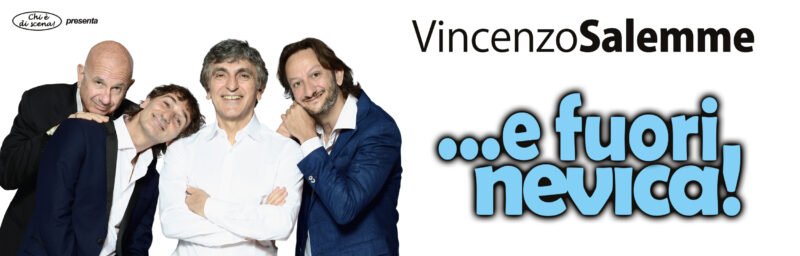
- E fuori nevica with Vincenzo Salemme at Teatro Sistina, from May 4, 2027100 m
- Teatro Sistina100 m
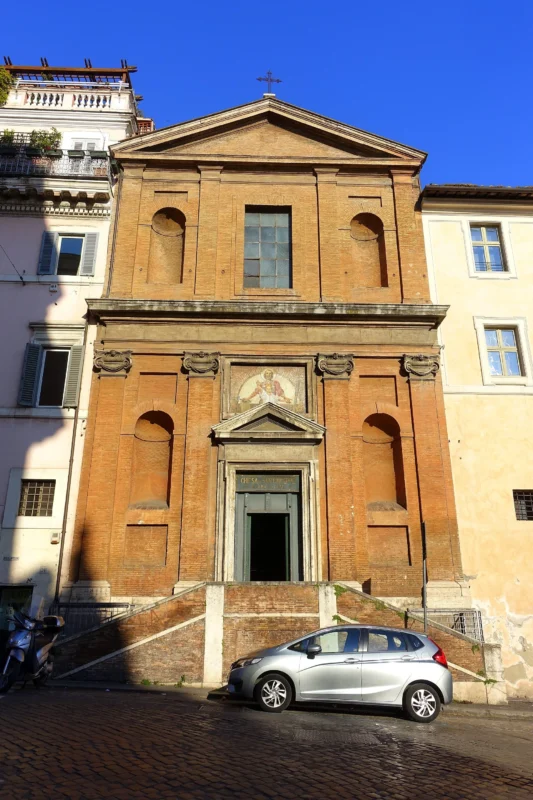
- San Giuseppe a Capo le Case100 m
- Galleria d’Arte Moderna di Roma (GAM)100 m
- Triton Fountain100 m

Upcoming events nearby
- Mamma Mia! the Musical at Teatro Sistina, December 17 to 31, 2026100 m
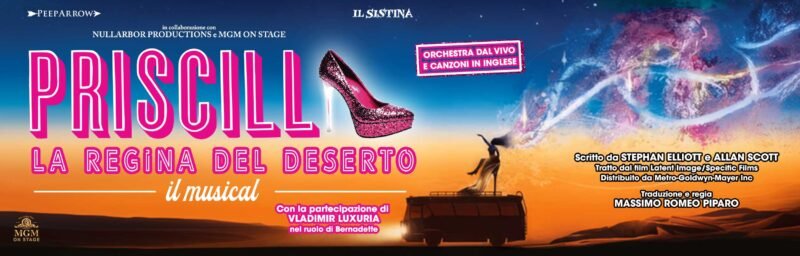
- Priscilla, La regina del deserto, the musical at Teatro Sistina, from February 10, 2027100 m
- Belle Ripiene at Teatro Sistina in Rome, from April 8, 2027100 m
- C’era una volta… Scugnizzi at Teatro Sistina, November 18 to 29, 2026100 m

You might also like
- L’uomo, la bestia e la virtù with Vanessa Gravina at Teatro Quirino, March 16 to 21, 2027
- Ispettore in casa Birling with Ettore Bassi and Galatea Ranzi at Teatro Quirino, March 2 to 7, 2027
- L’inconveniente with Milena Vukotic at Teatro Quirino, January 19 to 31, 2027
- Sfidati di me, Paolo Kessisoglu at Teatro Sala Umberto, April 1 to 4, 2027
- L’anatra all’arancia with Emilio Solfrizzi at Teatro Quirino, April 20 to May 2, 2027
- Barutz in Due ore d’aria at Teatro Sala Umberto, March 8, 2027