San Giuseppe a Capo le Case
In short. San Giuseppe a Capo le Case stands at the top of the climb of Via di Capo le Case, on the corner with Via Francesco Crispi, and it is not a museum: it is a working church that opens for services, with free entry and no reservation.
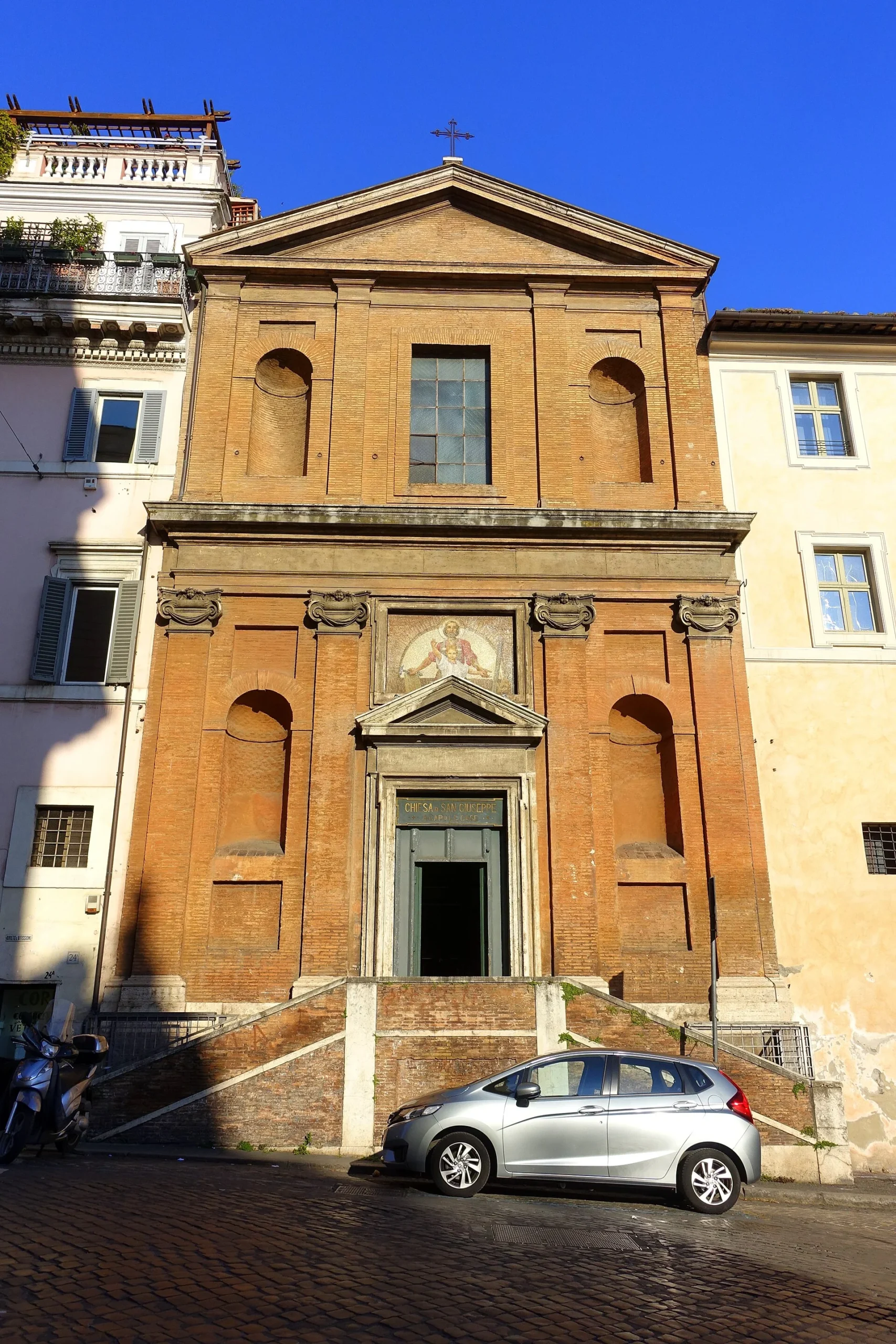
San Giuseppe a Capo le Case stands at the top of the climb of Via di Capo le Case, on the corner with Via Francesco Crispi, and it is not a museum: it is a working church that opens for services, with free entry and no reservation. The monastery next door is the Galleria d’Arte Moderna di Roma Capitale, Via Francesco Crispi 24, open Tuesday through Sunday from 10 to 19, full ticket €14.50.
The confusion comes from the fact that church and museum are the same complex, born in the late 16th century for the Discalced Carmelite nuns, the first monastery of their order opened in Rome. After the suppression laws the convent passed to the city, which made it first a museum of applied arts and then, from the 1990s, the seat of the municipal Gallery. The church stayed in worship use and follows another road.
The practical information on the Gallery comes from the check of September 29, 2026 on the museum’s official website, which answers to the Capitoline Superintendency. For the church, the calendar of services is not published on the diocese’s website, and the sources that report it do not agree on weekdays. Before crossing the city to see the interior, go on Sunday in the late morning, which is when the door is found open most regularly.

Where it is and what you see from outside
The church closes off the top of the climb of Via di Capo le Case, the street that starts from the area of Piazza di Spagna and passes in front of Sant’Andrea delle Fratte. Once you reach the top, the facade presents itself in front of you, raised on a double staircase that makes up the difference in level with Via Francesco Crispi. It is a small building and you understand that right away: no dome, no chapel jutting out on the sides, a single door in the middle of the facade.
The facade is austere and has to be looked at up close. A brick curtain, very little marble, travertine reserved for the door frame, the pediment, the string course and the Ionic capitals of the pilasters. Above the entrance is a 20th-century mosaic, made from a cartoon by the Roman painter Cleto Luzzi. Anyone arriving used to the baroque facades of the center mistakes it for a service door, which is exactly the effect an enclosed church was meant to have.
Inside, when it is open, you find a rectangular hall with no side aisles and no chapels, covered by a barrel vault. The four altars, two per side, were added after construction. The high altar is raised in a scarsella, meaning a narrower recess at the end of the hall, and on the sides open four windows with a grille through which the nuns followed Mass without being seen by the faithful.
Next to the church, along Via Francesco Crispi, runs the front of the former monastery. Here the entrance at number 24 leads into the Galleria d’Arte Moderna, and from inside the museum you see what stays hidden from the street: the 18th-century cloister, the old roofs preserved by the restoration and the garden enclosed between the wings of the convent. The complex extends back as far as Via Zucchelli, and that side tells the story of the monastery better than the main facade.
The neighborhood around helps in understanding the proportions. Via Francesco Crispi is a late 19th-century street, wide and uphill, with the buildings of capital-city Rome. Via di Capo le Case is narrower and older, and keeps the layout of the climb that the nuns saw from the windows. The church sits exactly at the point where the two Romes touch, and that is why it seems out of scale compared with everything around it.
A curiosity about San Giuseppe a Capo le Case
The name is an address from five centuries ago. A capo le case, in Latin ad capita domorum, means at the top of the houses, that is, where the built-up area ended. In the late 16th century this area was the fringe of the built city, beyond which began kitchen gardens, vineyards and hedges. The Gallery recalls that in 1600 the monastery is already documented in an area called alle fratte, meaning among the bushes and hedges.
The same place name survives in the nearby church, Sant’Andrea delle Fratte, and together the two names draw the map of a Rome that today is hard to imagine. Today you are between Via del Tritone and Via Sistina, in one of the most built-up quarters of the center. Back then the nuns chose this place precisely because it was marginal, quiet and with room to grow, something unthinkable in the crowded streets around the Pantheon.
What pushed urbanization was the road policy of Sixtus V, who in the previous decade had laid out the axis of Strada Felice, today’s Via Sistina, all the way to Santa Maria Maggiore. Religious communities followed the new streets the way supermarkets follow ring roads today. Look at Via Sistina from the top of the climb and you will have before your eyes the reason why a Carmelite church was born exactly at this point.
There is a detail the Gallery stresses that is worth the climb. The front of the convent that closes onto Via di Capo le Case looks toward the baroque forms of the bell tower of Sant’Andrea delle Fratte, the work of Francesco Borromini. The nuns, who arrived in an area of hedges, saw one of the most inventive bell towers in Rome rise in front of them within a few decades. The marginal quarter had become a showcase building site.
Something nobody tells you about San Giuseppe a Capo le Case
This is a place built for not going out. Cloistered nuns could not make the tour of the Seven Churches, the Roman pilgrimage that carried important indulgences. The founder solved the problem inside the enclosure: he had seven chapels built to which plenary indulgences equivalent to those of the city tour were attached. The nuns made the pilgrimage by walking in their own monastery, from one chapel to the next.
The same logic produced, in 1717, a private Holy Stairs. It was wanted by the monastery’s superior, Mother Serafina of the Most Holy Trinity, and designed by the architect Tommaso Mattei, a pupil of Carlo Fontana and Carlo Rainaldi. 28 marble steps, like the one at the Lateran, under a vault decorated with stucco. The nuns could climb it on their knees and obtain the same indulgences as the Holy Stairs next to San Giovanni.
Pope Clement XI granted the indulgences and, according to the sources that reconstruct its history, came in person to bless the stairs on May 15, 1718 with a retinue of cardinals and prelates. For a pope, climbing all the way to a peripheral monastery for an internal staircase was not a given, and it can also be read as a sign of favor toward an order that in Rome had Spanish roots and powerful patrons.
The point nobody makes is the last one. The grilles, the seven chapels and the stairs make up a system, and the public church you see from the street was only its shop window. The real sacred space was on the other side of the wall, where today there are the rooms of a civic museum. Anyone who enters the church and then the Gallery walks, without knowing it, inside the same architecture of enclosure, split in two by a 19th-century law.
The church and the museum: who runs what
The division is sharp and it is best to have it clear before arriving. The church is a place of worship with its own services, and the sources that reconstruct its history list it as entrusted since 1936 to the Arciconfraternita del Preziosissimo Sangue. The convent belongs to Roma Capitale and houses the Galleria d’Arte Moderna, run by the Capitoline Superintendency within the system of civic museums. Separate entrances, separate hours, separate rules.
The Gallery’s website adds a detail almost everyone ignores: the nuns still keep a small part of the old convent. It is not the enclosure of the past and it cannot be visited, but it means the complex never became entirely secular. Behind the same facade live together a public museum, a confraternity and a residual religious presence, each with its own doors.
For the visitor the practical consequence is only one. The Gallery ticket does not open the church, and the fact that the church is open does not get you into the museum. There is no common route, there is no internal passage accessible to the public between the two parts. From the Gallery’s cloister, however, you can understand the position of the church relative to the monastery, and it is the only way to read the complex as it was conceived.
The church’s old works, moreover, followed the nuns and not the city. The Coronation of Saint Teresa of Avila by Giovanni Lanfranco is today in the new Carmelite monastery, the Flight into Egypt by Tommaso Luini has been lost. What you see on the altars is almost all the work of Cleto Luzzi, who in the early 20th century repainted the same subjects to give the church back its figurative program.
The interior you see today is therefore the result of two restorations more than of the foundation. The first, in 1863, comes in the last years of the papal government, when the nuns are still in the house. The second, in the 1930s, coincides with the arrival of the confraternity and with Luzzi’s new decoration. Anyone looking for the 16th-century church must look at the plan, the vault and the grilles, not the altars.
My advice for visiting San Giuseppe a Capo le Case
Do both things on the same Sunday morning, in this order: first the church, then the museum. Sunday in the late morning is when the church is found open most continuously, and the Gallery opens at 10. Go into the church before the service or right after it, never during: it is a community at prayer, not an exhibition hall, and visits in the middle of a service annoy everyone.
At the Gallery buy the ticket online on the official channel indicated by the museum, which expressly recommends it. If you live in Rome or in the Metropolitan City do not buy anything: since February 2026 entry for residents is free on showing your ID card at the desk. The same goes for holders of the MIC card, the annual pass for the civic museums. These are two categories that cover much of the Roman visitors, and very few people know it.
Inside the museum look for the cloister right away. It is the part that links the exhibition rooms to the monastery, and without passing through it the complex stays an ordinary museum in an ordinary palace. The garden enclosed between the wings is the quietest place in the whole quarter between Spagna and Barberini. Sit for 10 minutes before going up to the rooms, and look at the roofs: they are the same ones the Carmelites saw.
One last thing: look at the church twice, on arrival and on leaving. On arrival from the bottom of the climb you see it as people coming up from the center saw it, at the top of the street, with the staircase setting it apart from the sidewalk. On leaving the museum you see it from the side, from Via Crispi, and you grasp how small it is compared with the convent. The two views together explain the relationship between public space and enclosure better than any panel.
If you can choose the date, come before October 11, 2026. Until that day the Gallery hosts the centenary exhibition, which reconstructs a century of the civic collection and brings into the rooms works that usually stay in storage. After that date the museum will go back to its ordinary route, which remains valid but is less rich. For those visiting Rome in autumn it is a lucky combination, and Sunday morning works for both parts of the complex.
Hours and tickets of the Galleria d’Arte Moderna
The Galleria d’Arte Moderna is open Tuesday through Sunday from 10 to 19, with last entry 30 minutes before closing. It is closed on Monday, May 1 and December 25. From December 24 to 31 the hours are reduced to 10-14. The published fares are €14.50 full and €10 reduced, with free entry for residents of Rome and the Metropolitan City. The official contact is 060608, active every day from 9 to 19.
You buy the ticket where the museum sells it, and that’s all. The official channel is the ticket page of the Galleria d’Arte Moderna, which points to online sales and to the call center 060608, both with a one-euro presale fee. At the ticket office you pay in cash or by card. Tickets bought in advance are neither refundable nor changeable. There is no need to look elsewhere for a skip-the-line ticket for a civic museum that rarely has a queue.
Anyone entitled to free entry for other reasons must read the page on the conditions for free entry and reductions on the museum’s website, which is the only valid reference. Schools enter free with mandatory, free booking. Groups of five to 25 people plus the guide book for free at 060608. For the centenary exhibition the museum offers an audio guide in Italian and English at €4.
For the church, on the other hand, there is nothing to buy. Entry is free during opening, there is no reservation and there is no published official guided tour. The operator gives no public contact for requesting special openings or visits to the Holy Stairs, and the diocese’s website carries no page with hours. Anyone with a specific interest must show up at the end of a service and ask whoever looks after the church.
A note on timing. For the Gallery allow a good hour and a half if you want to see the collection and the cloister without rushing, more if there is a temporary exhibition that interests you. For the church 10 minutes are enough if it is open. Overall it is half a morning, which fits well with a walk among Trevi, Spagna and Barberini with no need for transport.
Another well-known fact, yet rarely mentioned
This is the first monastery of Discalced Carmelite nuns opened in Rome, and it was born a few years after the death of Teresa of Avila, in 1582. The Spanish reformer was not yet a saint: she would be canonized only in 1622. The Roman monastery is therefore a direct child of the first generation of the Teresian reform, and it is no accident that a Spaniard founded it. Every historian of the order knows it, almost no guide in the city does.
The link with Teresa explains the most important painting the church ever had, Lanfranco’s Coronation of Saint Teresa. It also explains why, a few minutes from here, the Carmelite church of Santa Maria della Vittoria houses Bernini’s Ecstasy of Saint Teresa. In the Rome of the early 17th century the reformed order grew fast, and this expanding quarter became its natural base.
Lined up, the stops tell the same story from three points of view: the enclosure here at Capo le Case, the spectacular devotion of the Cornaro chapel, the canonized saint on the altars of all Rome. Anyone interested in the great baroque cycles can follow the thread with the itinerary on Bernini in Rome, which passes through these streets anyway.
For those who like connections between places, the question of the nuns’ transfer after the suppression remains open. The Gallery points to the college of San Pietro in Montorio on the Janiculum, other reconstructions to the new monastery on Via della Nocetta, where Lanfranco’s painting is today. The two versions may indicate two successive stages of the same path, but the open sources do not clarify it and it is best to keep both.
The relic and the Holy Stairs, between documents and tradition
On this point three levels are needed, because the church has become material for curiosity sites and the levels get mixed up. What the documents and historical reconstructions say: the Holy Stairs dates to 1717, has 28 marble steps, was designed by Tommaso Mattei at the superior’s wish, and Clement XI granted indulgences to those who climbed it on their knees. The 1718 blessing is reported with a precise date.
What the tradition tied to the church says: in the chapel of the Stairs a relic is kept in a glass and metal reliquary, arranged according to tradition by Saint Gaspare del Bufalo, founder of the Missionaries of the Most Precious Blood. The link with devotion to the Blood fits with the confraternity that runs the church, but the popular sources do not report the document that attests its path.
What is legend in the technical sense: the relic is described as a fragment of cloth soaked in the blood that flowed from Christ’s side after Longinus’s spear thrust. It is a devotional tale, from a family of relics spread across Europe, and has to be taken as such. No analysis has been published, and no church authority claims there should be one in order to venerate it.
There is then a current fact. An ACI Stampa article from March 2022 reported that the Stairs needed urgent restoration by the competent authorities. In the open sources there is no announcement of completed works. For this reason the Stairs should not be considered a visit element: if it is shown, good, but do not plan the trip counting on climbing it.
The right photo to take at San Giuseppe a Capo le Case
The photo is taken from below, halfway up Via di Capo le Case, with the church at the end of the perspective. The street climbs, the buildings squeeze it on both sides and the facade closes the frame at the top with its staircase. Vertical format, normal focal length, no strong wide angle that distorts the buildings. It is the photograph of an urban backdrop, and Roman urban backdrops are read on axis.
The good light is early morning, when the street is still empty and the facade gets side light. In the early afternoon the climb ends up in shadow and the bricks turn dark. On weekdays from nine onward the street fills with parked scooters and delivery vans, and the photo becomes impossible without something in front. Sunday morning remains the best window.
The second photo is a detail: the mosaic above the door, taken from the bottom of the staircase, with the travertine pediment above. It is a small image but says a lot about the church, because it puts together the 17th-century travertine and the 20th-century mosaic. If you want a photo of Sant’Andrea’s Borromini bell tower, the Gallery indicates that the convent front toward Via Capo le Case frames it, and the view from the street works.
Inside the museum the rules on photographs depend on the works and the temporary exhibitions: ask at the ticket office before taking out your phone. In church, during services, you do not photograph, and outside services you ask. The cloister, on the other hand, is the photo you will gladly take home: loggia, garden, soft light, nobody in front. The best shot of the complex is there, not on the facade.
How to get there
On foot, which is the only sensible answer. From Piazza di Spagna you go up toward Sant’Andrea delle Fratte and take Via di Capo le Case to the top, 10 easy minutes. From the Trevi Fountain you go along Via del Tritone and climb Via Francesco Crispi. From Piazza Barberini you go down toward the Tritone and climb back up. In every case you are in a compact pedestrian quarter.
By public transport, the area is served by metro and buses that stop between Via del Tritone and Piazza di Spagna. Lines and stops change with works in progress in the center, so the advice is to use Rome’s official public transport route planner on the same day, entering Via Francesco Crispi 24 as the destination. The Gallery’s website gives no specific lines and refers you to the map.
By car, no. You are inside the limited traffic zone of the historic center, street parking is for residents and the garages in the area are expensive. Anyone coming from outside Rome should leave the car at a park-and-ride and continue by metro. For people with mobility difficulties, the climb of Via di Capo le Case is steep and the church can be reached only by its staircase: Via Crispi, which climbs more gently, is the gentler access to the museum.
For the museum, accessibility is described on a dedicated page of the Gallery’s website, maintained by the Capitoline Superintendency, and it is best to read it before leaving. Anyone planning a wider tour will find useful indications on our page on Accessible Rome, which gathers museums and routes designed for people with mobility difficulties.
Some important events that happened here in history
The foundation falls in the late 16th century, and the sources disagree between 1597 and 1598. The founder is Francesco Soto, a Castilian priest of the Oratory of Saint Philip Neri, who opens the first community of Discalced Carmelite nuns in the city. In 1607 Cardinal Marcello Lante becomes its protector, and in 1628 he starts major renovation works. The church grows along with the quarter that is born around the Sistine streets.
In 1717 the superior has the Holy Stairs built and on May 15, 1718 Clement XI blesses it. During the 18th century the monastery reaches its definitive form, with the cloister that can still be seen today and the extension toward Via Zucchelli. It is the moment of the complex’s greatest expansion, when it occupies the whole block behind the church with cells, chapels, gardens and courtyards.
Then come the expulsions. The nuns are driven out during the Roman Republic of 1798 and 1799, and again during the French occupation in the Napoleonic age. They return in 1814 with the restoration of the papal government. In 1863 the church is restored. For anyone who wants to understand those years of upheaval in Rome, the Museo della Repubblica Romana tells of the political climate in which they matured.
After Rome became the capital, with the liquidation of church property, the monastery is suppressed. The sources do not agree on the exact dates: 1873 for the suppression, 1879 for the transfer to the city given by the Gallery. The convent becomes the seat of the Museo Artistico Industriale, devoted to applied arts. The nuns move out, and on their first destination too the reconstructions diverge between San Pietro in Montorio and Via della Nocetta.
In the 20th century the church is restored in the 1930s, and from 1936 it is listed as entrusted to the Arciconfraternita del Preziosissimo Sangue. In the early 1990s the Capitoline Superintendency restores the former convent, from 1995 the municipal modern art Gallery moves in, closing for works in 2003 and reopening in 2011. In 2025, for the Gallery’s centenary, investigations bring to light a 17th-century mural painting.
Who passed through San Giuseppe a Capo le Case
Francesco Soto, first of all. A Castilian, a priest of the Oratory, raised in the circle of Filippo Neri, where music and popular devotion were pastoral tools. In the community of the Oratorians in Rome he also left a mark as a musician tied to spiritual songs. For a man of his circle, founding a Teresian monastery meant bringing Spanish spirituality to Rome. To understand his world, go to the Oratorio dei Filippini.
Cardinal Marcello Lante, protector from 1607, is the man of connections. A cloistered monastery needed a cardinal who would speak for it in the Curia and find the money for the works, and Lante did both. Then there is Mother Serafina of the Most Holy Trinity, the superior who in 1717 wanted the Holy Stairs: one of the few women whose name the history of the complex preserves.
Another woman was rediscovered recently. During the investigations for the Gallery’s centenary, in 2025, a 17th-century mural painting emerged, attributed to Sister Eufrasia della Croce, born Flavia Benedetti, who lived between 1597 and 1676. The museum presents her as a significant figure in women’s artistic production in the Rome of her time. A woman painter in an enclosure, in a monastery that today exhibits modern art.
Tommaso Mattei, the architect of the Holy Stairs, a pupil of Carlo Fontana and Carlo Rainaldi, is a name that rarely appears in guides and who here signed the most singular piece of the complex. Clement XI, the Albani pope, climbed all the way up here to bless his work. Giovanni Lanfranco, the Emilian painter of Rome’s great domes, worked for the altar with the Coronation of Saint Teresa now kept elsewhere.
Gaspare del Bufalo, a Roman, founder of the Missionaries of the Most Precious Blood and a saint, appears in the church’s history because of the tradition that credits him with arranging the reliquary in the chapel of the Stairs. That he passed through here is plausible, given the weight of his devotion in the Rome of the early 19th century, but the account comes from tradition and not from a published document. I point it out because every so often it is given as certain.
In the 20th century the name to remember is Cleto Luzzi, a Roman painter who remade the face of the church after the dispersal of the old works, including the cartoon for the mosaic over the door. And then, from 1995, thousands of Gallery visitors who enter a convent without knowing it. The civic collection gathers works by Giacomo Balla, Giorgio de Chirico, Renato Guttuso, Giorgio Morandi and the other protagonists of early 20th-century Italian art.
What to see at the Galleria d’Arte Moderna
The civic collection counts more than 3,000 works among painting, sculpture and graphics, from the late 19th century to the first half of the 20th. It was born from the purchases the Comune di Roma made at the international exhibition of 1883 and became an official gallery in 1925. Only a part of it is on view in the rooms. For a dedicated page on the museum, with its routes, read our page on the Galleria d’Arte Moderna di Roma.
Until October 11, 2026 the centenary exhibition is open, GAM 100, a century of the municipal Gallery 1925-2025, with over 120 works. It is the right time to come, because it reconstructs the history of the collection and brings out of storage pieces that normally cannot be seen. Throughout 2026 the museum also offers dedicated tactile routes, and until mid-October a series of talks.
A tip on the order of the visit inside the museum. Start from the cloister and the garden, then go up to the rooms, and return to the cloister before leaving. The first time you look at it as a courtyard, the second as the space where the nuns spent the day, after seeing how small and intimate the rooms carved from their cells are. It is a tour of an hour and a half that is remembered more than many visits to larger museums.
The against-the-grain judgment, plainly put: the secret Holy Stairs that curiosity sites keep sharing is the wrong reason to climb all the way up here. It is not on the visit, it needed restoration and the church door does not open on demand. The right reason is the whole complex, with the cloister and the civic collection. Whoever comes for the stairs stays in front of a closed door, whoever comes for the convent leaves happy.
And a frequent mistake to avoid: the Galleria d’Arte Moderna di Roma Capitale is not the Galleria Nazionale d’Arte Moderna at Valle Giulia. They are two different museums, one municipal and one state-run, with different collections, tickets and passes. Confusing them means buying the ticket for one and showing up at the door of the other. Check the address: here it is Via Francesco Crispi 24, between Spagna and Barberini.
The Gallery and its moves
The collection you see today in the convent has a history of moves that is worth knowing. The core was born from the city’s purchases at the fine arts exhibition of 1883, the gallery was constituted in 1925 and in 1931 it changed its name according to the political climate of the time. In 1938 it closed, in 1949 it reopened. For decades it was a collection without a stable home, moved among temporary locations.
The home arrives in the 1990s, when the Capitoline Superintendency restores part of the former monastery and makes it a museum space while keeping the typical elements of the convent, starting with the cloister and the old roofs. The move dates to 1995. In 2003 the Gallery closed again for works and reopened in 2011, with the layout that, in its general lines, you still see today.
The result is a civic museum of modern art inside a 16th-century enclosed monastery, and the combination works better than you might imagine. The rooms are not large, light comes in from the convent windows, the routes are short. For an overall idea of the city’s museums and the free ones, look at our pages on the museums of Rome and on free museums in Rome.
When it is closed and what not to expect
The church is closed for much of the week. It opens for services, and outside those the door at the top of the staircase stays barred. There are no tourist visiting hours, no volunteer guides, no ticket office. Anyone arriving on a Tuesday afternoon almost certainly finds the facade and nothing else. Consider the interior a bonus and not the center of the day.
The Gallery is closed on Monday, May 1 and December 25, and between Christmas and New Year’s it closes at 14. Don’t expect a large national museum: it is a mid-sized civic collection, with orderly rooms and a quiet public. The museum’s website does not mention a cafe and does not promise refreshment services. Bring water and plan lunch elsewhere.
Don’t expect to see the seven chapels or the Holy Stairs either. The sources indicate no public access to those spaces, and visits to the museum do not pass through the part still used by the nuns. What you see is the church when it is open, the facade, the convent front and the cloister from the museum. They are enough to understand the place, as long as you know what to look at.
Watch out for holidays too. At Christmas and on bridge days the Gallery follows special hours published on the website, while the church may have additional services on liturgical feasts, starting with March 19, the feast of Saint Joseph, and with the month of July dedicated to the Most Precious Blood. None of these openings is published in advance on an official channel, so take it as an opportunity, not as an appointment.
For those arriving with a group
With a group the complex is easy to manage, as long as you split the two parts. For the Gallery, booking is free at 060608, with a minimum of five people and a maximum of 25 plus the guide. Above that threshold you do two shifts. Schools enter free with mandatory booking. The most convenient meeting point is in front of number 24, keeping the group together so as not to block the sidewalk.
For the church the matter is different, because there is no channel for booking and it is not a place designed for tour groups. If you find it open, go in in small groups and in silence, and give the explanation outside, on the staircase or at the top of the climb. With 40 people it is the only solution that respects those who are praying and does not clog the hall, which is small and has a single entrance.
The climb of Via di Capo le Case is short but steep, and with a group of elderly people it is best to arrive from Via Crispi, which climbs more gently from the Tritone. At peak hours the sidewalks of the quarter are narrow and crowded, and a long group easily breaks up. It is best to give the general explanation outdoors before entering the museum, and inside leave freedom in the cloister.
Eating in the area
The quarter among Trevi, Spagna and Barberini is the hardest in Rome for eating well at an honest price. The tourist flow is continuous and the temptation to live on passing customers is very strong. There are serious kitchens here too, but you have to know how to tell them apart, and the signs are always the same. The Romans who work in the area know them by heart and steer clear.
First sign: the menu with photographs of the dishes, translated into five languages and laminated. A restaurant that has to show you the picture of carbonara is talking to someone who doesn’t know what it is. Second sign: the lady rolling fresh pasta in the window or on the sidewalk. It is theater, not a guarantee. Well-made pasta is prepared in the kitchen, in the morning, away from the dust of the street and from prying eyes.
Third sign: the person at the door inviting you in. A place that has to stop passersby has no regular customers, and regular customers are the only guarantee that exists. The same goes for places open continuously from morning to late at night: a real kitchen has a break, because the crew has to rest and prepare the evening service.
Fourth sign, very common around the Trevi Fountain and the Trinità dei Monti staircase: the price adapted to the customer. Items without a price on the menu, fish of the day without a figure, different price lists between the indoor room and the tables outside. Always ask the price before ordering, and if the answer is vague, get up. No Roman takes offense if a customer wants to know how much he is paying.
The criterion is to look at who is seated. If at half past one on a weekday there are office workers from the area speaking Romanesco, you have found it. If there are only tables of visitors and the waiter switches to English at first glance, it is not a moral judgment, it is information. To get your bearings without trial and error there is our list of the places where we eat.
What to combine with it in a day
The first pairing is obvious and is at the bottom of the climb: Sant’Andrea delle Fratte, with Borromini’s bell tower and dome. Anyone following the thread of baroque architecture can continue with the itinerary Borromini in Rome, which leads to San Carlo alle Quattro Fontane and the Quattro Fontane, and from there to Bernini’s Sant’Andrea al Quirinale.
To the north, Via Sistina leads to Trinità dei Monti and the Pincio, with Villa Medici halfway. Going down the staircase you reach the Barcaccia Fountain and the Keats-Shelley House, and a little further to the Casa di Goethe on the Corso. It is half a day of literature and travelers.
To the east you climb to Piazza Barberini with the Triton Fountain and Palazzo Barberini, then Via Veneto with Santa Maria della Concezione and the Capuchin Museum. A little above Piazza Barberini is San Nicola da Tolentino, and halfway along Via Veneto the Casa Museo Boncompagni Ludovisi, which stays on the decorative arts.
To the south the tour of churches leads to Santi Vincenzo e Anastasio a Trevi, to San Silvestro in Capite and to the Galleria Sciarra, then to the Corso with Gesù e Maria al Corso and, toward Piazza Colonna, San Bartolomeo dei Bergamaschi. For the Carmelite thread the stop is Santa Maria della Vittoria, and a few steps away is Santa Susanna, closed for restoration.
Anyone who wants to stay with art after the Gallery has two nearby choices. Toward the Quirinal there are the Scuderie del Quirinale with the major temporary exhibitions and the Quirinal Palace on opening days. To the north, beyond the Pincio, you enter Villa Borghese and reach the Galleria Borghese, which however requires a reservation and has to be organized in advance.
For those following the Holy Stairs theme, the natural comparison is with the original next to the St. John Lateran Basilica, on the other side of the city. Seeing them a few days apart makes you understand what it meant, for a cloistered community, to reproduce at home one of the most venerated places in Rome. It is a thematic pairing, not a geographic one, and should be done on another morning.
Frequently asked questions
Is the church of San Giuseppe a Capo le Case open?
The church is a working one and opens for services, especially on Sunday in the late morning. Outside services it stays closed and has no tourist visiting hours. The calendar of services is not published on the website of the Diocese of Rome and the sources do not agree on weekdays, so Sunday morning is the safest choice for seeing the interior.
Is the church deconsecrated or part of the museum?
No, the church is not deconsecrated and is not part of the museum. The Carmelite monastery next door passed to the city after the 19th-century suppression and today houses the Galleria d’Arte Moderna di Roma Capitale. The church stayed in worship use and is listed as entrusted to the Arciconfraternita del Preziosissimo Sangue. Entrances and hours are separate.
How much does it cost to get in?
The church has free entry during openings. The Galleria d’Arte Moderna costs €14.50 full and €10 reduced, with a one-euro presale fee for buying online or at the call center 060608. Residents of Rome and the Metropolitan City enter free with an ID card, and entry is also free for holders of the MIC card.
What are the hours of the Galleria d’Arte Moderna?
The Gallery is open Tuesday through Sunday from 10 to 19, with last entry 30 minutes before closing. It is closed on Monday, May 1 and December 25, and from December 24 to 31 it keeps the reduced hours from 10 to 14. For information, 060608 answers every day from 9 to 19.
Can you visit the Holy Stairs?
The sources consulted indicate no regular public access to the Holy Stairs built in 1717 by Tommaso Mattei. In 2022 the need for urgent restoration was reported and there are no announcements of completed works. Anyone with a specific interest can ask whoever looks after the church at the end of a service, without counting on a positive answer.
Can you see anything of the convent without going into the church?
Yes, from the Galleria d’Arte Moderna. The museum occupies the former Carmelite monastery and keeps the 18th-century cloister, the old roofs and the inner garden enclosed between the wings of the convent. In 2025, for the centenary, a 17th-century mural painting attributed to Sister Eufrasia della Croce also emerged. It is the best way to read the complex as a whole.
Why is it called Capo le Case?
The name comes from the Latin ad capita domorum, meaning at the top of the houses, and indicated the point where Rome’s built-up area ended in the late 16th century. Beyond began kitchen gardens and hedges, the fratte that give their name to the nearby Sant’Andrea delle Fratte. The area filled with buildings after the streets opened by Sixtus V.
How do you get there and how much time do you need?
You get there on foot in a few minutes from Piazza di Spagna, the Trevi Fountain or Piazza Barberini, climbing Via di Capo le Case or Via Francesco Crispi. A car is not recommended because of the limited traffic zone. For the church 10 minutes are enough, for the Gallery with the cloister a good hour and a half.
Who runs the Galleria d’Arte Moderna?
The Galleria d’Arte Moderna di Roma Capitale is a civic museum and answers to the Capitoline Superintendency, within the Musei in Comune system. It should not be confused with the Galleria Nazionale d’Arte Moderna at Valle Giulia, which is a state museum with its own tickets and hours. The official contact is 060608, or the email given on the museum’s website.
Who wrote this page
The page comes from the editorial team of Tour Leader Pro, the Rome-based outfit that designs itineraries, tours and cultural events across Rome and Lazio. The Gallery’s hours and fares come from the museum’s official website as of the date given at the start, while the church’s openings depend on services and may change without notice. Let us know what you find changed.
Lining up a morning in the center of Rome means fitting together churches that open only for services, museums with different weekly closures, exhibitions with end dates and foot traffic that slows everything at peak hours, for yourself or for a group of 40 people. Anyone facing this kind of puzzle will find on Tour Leader Pro working materials designed for those who guide and for those who organize on their own.
For the wider picture, meaning regional trains and seasonal timetables, airports, moves between one province and another and Lazio destinations outside the center of Rome, from the Castelli to the volcanic lakes of the north and on to the Tyrrhenian coast and the inland villages, a useful resource for putting together a multi-day itinerary is Italy Planner.