Casa Museo Boncompagni Ludovisi
In short. The Boncompagni Ludovisi Museum is at number 18 on Via Boncompagni, two blocks from Via Vittorio Veneto, and occupies a private villino built between 1901 and 1903.
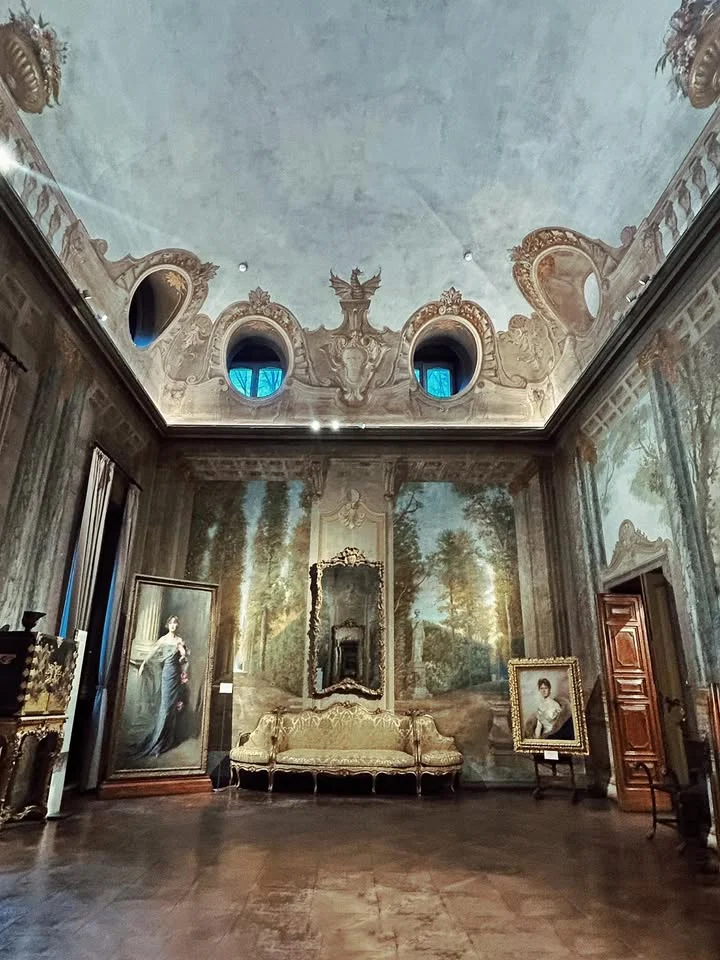
The Boncompagni Ludovisi Museum is at number 18 on Via Boncompagni, two blocks from Via Vittorio Veneto, and occupies a private villino built between 1901 and 1903. Today the official name is Casa Museo Boncompagni Ludovisi, admission costs €6.00 and it is no longer free, as it was for years. If you want twentieth-century Italian fashion inside a real house, and not inside a shop window, you have come to the right address.
The first thing to clear up is a confusion that has always followed it around. This is not the Casino dell'Aurora, it is not Villa Ludovisi, and it has nothing to do with the Caravaggio mural that made the newspapers because the auctions went unsold. It is a family's villino, donated to the State in 1972 and opened to the public in 1995. Three different things, three different addresses, three different stories.
This museum works as a counterweight. After the Galleria Borghese or Palazzo Barberini, where the line eats up half a morning, here you walk in and there is almost nobody. Silence in a state museum in the Ludovisi district, 300 meters from the most photographed street of postwar Rome, remains an oddity that deserves an explanation.
The explanation is simple and nobody writes it. The museum has no postcard masterpiece. There is no statue you go to see, no painting from the school textbooks. There is a house with its furniture, a painted salon and a group of dresses that tell how wealthy Roman women dressed between 1950 and 1990. Whoever arrives looking for a coup de théâtre leaves disappointed. Whoever arrives knowing what they are looking at leaves happy.
Where the Boncompagni Ludovisi Museum Is and How to Get There
The address is Via Boncompagni 18, 00187 Rome, Ludovisi district. The street starts at Via Vittorio Veneto and ends at Via Lucania, cutting through the neighborhood that was born from the subdivision of Villa Ludovisi starting in 1883. Number 18 falls in the first stretch, the one closest to Via Veneto, and the entrance portal is set back from the facade of the neighboring buildings.
The most convenient metro is line A, Barberini stop. From there you walk up Via Vittorio Veneto for 8 or 10 minutes, on a moderate uphill, and turn right onto Via Boncompagni. If you get off at Spagna and cross the Pincio, it takes longer and you arrive from the opposite side, from Porta Pinciana, on a walk that is nicer but longer.
The closest surface stop is Veneto/Emilia, on the climb of Via Vittorio Veneto, served by lines 61, 63 and 83. From that stop to Via Boncompagni it is a walk of less than 3 minutes. Routes checked on September 28, 2026 on the line pages: Roman routes change often, because of roadworks or events, and it's best to recheck them on the day of the visit.
A taxi works well because the street is wide and there is somewhere to stop, which is a difference from half of Rome. A private car does not: we are inside the green belt and in the limited traffic zone of the historic center, the surface parking is paid and almost always taken by residents. If you arrive by car you lose more time circling than visiting.
One detail that helps if you're walking. Via Boncompagni has wide, tree-lined sidewalks, the surface is asphalt and not sampietrini, so wheeled suitcases and strollers don't suffer. It is one of the few streets in the center where you can arrive on wheels without cursing. The uphill stretch is all on Via Vittorio Veneto, not here.
Hours, Tickets and Booking: How Things Stand in 2026
The museum is open Tuesday to Sunday from 9:00 to 19:30, with last admission at 18:30. On Monday it is closed, apart from some special openings scheduled between March 30 and October 12, 2026 with hours 14:00 to 19:30. It is closed on December 25 and January 1. Hours recorded on September 28, 2026 on the page of the Direzione Musei nazionali della città di Roma, which is the source to check before you go.
The full-price ticket costs €6.00. The reduced ticket is €2.00 and applies to European Union citizens between 18 and 25. Under 18 you get in free, along with the other exemptions provided by law. On the first Sunday of the month admission is free for everyone, as in the other state museums: the reference page on free Sundays at museums explains how the mechanism works.
Here we have to take apart a piece of news that still circulates on dozens of sites. For many years this museum had free admission, and that was its main claim to fame: the state museum you could walk into without paying anything. That is no longer the case. At the check on September 28, 2026 the fare published on the page of the Ministero della cultura and of the Direzione Musei di Roma is €6.00 full price. Whoever read the opposite read an old page.
Booking is not required for individual visitors. You buy the ticket online on the Italian museums portal, or with the Musei Italiani app, or at the automatic kiosk placed at the entrance. Groups and school classes of 10 people or more must instead book by email. This is a museum rule, not a suggestion.
The published contacts are the phone 06 42824074 and the address dms-rm.museoboncompagni@cultura.gov.it. There is no municipal booking channel for this place: the museum is a state one and is not part of the 060608 circuit of the Sovrintendenza Capitolina, which manages something else entirely. Anyone who offers you an official paid booking is selling you a service of their own.
There is also a promotion that in 2026 changes the math for people visiting Rome. From July 1 to December 31, 2026, on an experimental basis, the Castel Sant'Angelo ticket, raised to €18.00, includes one free admission to the Casa Museo Boncompagni Ludovisi and to the Casa Museo Hendrik Christian Andersen. The admission is used on the same day as the castle visit or in the following two days, according to the official notice on the new admission ticket.
This is the most useful piece of information on the whole page, and almost nobody knows it. If you go into Castel Sant'Angelo and then don't stop by here, you throw away two tickets already paid for. The Hendrik Christian Andersen Museum, the other one included, is at Piazzale del Manicomio 20 near Piazza del Popolo and is another place that is almost always empty.
A Notice to Read Before You Go: Works on the Piano Nobile
As of September 28, 2026 the museum publishes an explicit notice on its own site: the rooms of the piano nobile are not completely usable because of maintenance and refitting works. This means that part of the route, the one that includes the most decorated spaces in the house, could be closed or only partly accessible on the day of your visit.
A museum under works is not a tragedy, but it changes the calculation. If you come to Rome for a week and have three museums on your list, knowing that here you will perhaps see two thirds of it matters. If instead you live in the city or come back often, go in anyway: €6.00 for an hour in an early twentieth-century house is still money well spent even on a reduced route.
The practical advice is a phone call to 06 42824074 the day before. Not an email, which can go unanswered for days: a phone call during opening hours, asking which rooms can be visited at that moment. The staff of these small museums answer gladly, because they don't get a hundred calls a day like the Colosseum ticket offices.
Notices change without warning and without announcements. A construction site that closes, a room that reopens, a temporary exhibition that takes up half the ground floor: all of this appears and disappears on the site without fanfare. The pages of the Roman state museums are updated, but nobody sends notifications to whoever read a guide six months earlier.
What It Is Not: The Museum, Villa Ludovisi and the Casino dell'Aurora
Villa Ludovisi was an enormous park, among the largest suburban residences of Rome, built in the seventeenth century by Cardinal Ludovico Ludovisi on the grounds of the horti of Sallust. Of that villa the park no longer remains: starting in 1883 the land was subdivided and the Ludovisi district was born on top of it, with its straight streets and its Umbertine buildings. Via Boncompagni is one of those streets.
The Casino dell'Aurora Ludovisi is instead a surviving building of that villa, and is at number 46 on Via Lombardia, a few minutes' walk from here. It is private property, it preserves the Aurora frescoed by Guercino and a small mural painting attributed to Caravaggio, and since 2022 it has repeatedly gone to auction without finding buyers, with an estimated base price that started from hundreds of millions of euros.
The three things are confused all the time, even by printed guides. Whoever is looking for Caravaggio won't find him here. Whoever is looking for Guercino won't find him here. Here there is a villino from the early twentieth century built by the same family on a piece of the land of the villa that was sold, and the link between the two buildings is the surname, not the architecture and not even the century.
You should know this before going in, because otherwise you spend the visit looking for something that isn't there. The Casino dell'Aurora cannot be freely visited, the openings have been occasional and tied to the owners' will, and the court case has made it even less accessible. The museum on Via Boncompagni instead opens six days out of seven.
A Curiosity About the Boncompagni Ludovisi Museum
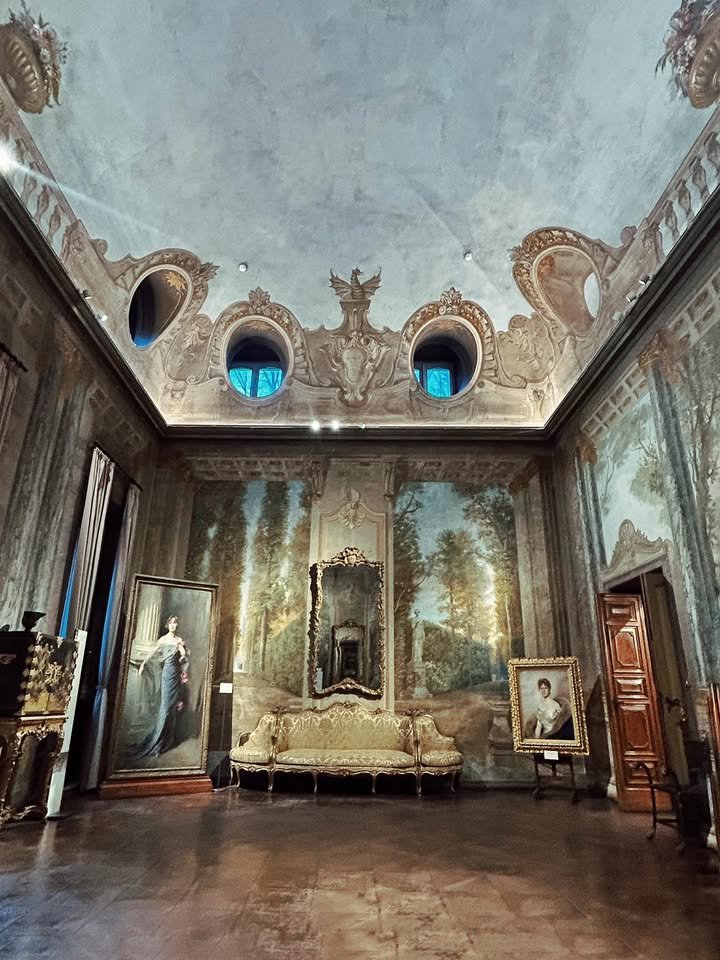
Inside the villino there is a salon with a pavilion vault and walls painted in tempera. What you see depicted there are the avenues and gardens of Villa Ludovisi, that is, of the park that had been sold and destroyed precisely to build the neighborhood you are standing in. The family had painted in its own house the landscape it had just subdivided.
It is the most interesting piece of the house and almost nobody tells it. It is not generic nostalgia: it is a pictorial inventory of what was there before, commissioned by the people who had taken it apart. Something like this is not often seen in Rome, because usually whoever demolishes has no wish to preserve the memory of what was demolished.
Villa Ludovisi had been for two centuries a fixed stop on the Grand Tour, and foreign travelers of every language had written about it. Then Rome became the capital, the building fever of the 1880s arrived, and the park disappeared in a little over a decade. Those tempera paintings are one of the few first-hand visual testimonies still standing.
It is the room where it's worth stopping more than anywhere else. All it takes is pointing out that the painted hedges lie exactly under the feet of whoever is looking, buried under the buildings of Via Boncompagni and Via Sardegna, and the room changes meaning. It is worth the ticket on its own, provided the piano nobile is open that day.
The Villino, Giovanni Battista Giovenale and the New Neighborhood
The villino was built between 1901 and 1903 to a design by Giovanni Battista Giovenale, a Roman architect who lived from 1849 to 1934, for the Boncompagni Ludovisi princes. Giovenale is the same name you meet when studying the restoration of Santa Maria in Cosmedin, and this says a lot about his way of working: cultured, measured, little inclined to show.
The style is a sober barocchetto, with facades marked by pilasters and string courses, and a few rococo touches in the decoration. The portal looks to Parisian models of the hôtel particulier, the urban residences with a courtyard that in Paris were the norm and in Rome almost not. The result doesn't resemble any of the neighboring buildings.
You have to understand the context to understand the building. Between 1883 and the early 1900s the Ludovisi district filled up with small apartment houses and income-producing buildings, all tall, all lined up on the street edge, all with the same rhythm of windows. An isolated villino with a garden, in the middle of that grid, was already back then a declaration of social distance.
Whoever is interested in Roman architecture between the nineteenth and twentieth centuries finds here a chapter that is missing almost everywhere. The Coppedè neighborhood, built some 20 years later, is the extreme and theatrical version of the same season. The villino on Via Boncompagni is the sober version, the one the owners chose when they didn't want to attract attention.
On the same Via Boncompagni there is also the church of San Patrizio, built in 1908 for the Irish community of Rome. It is another building of that season and another piece of the district that almost nobody looks at. Whoever arrives half an hour before the museum opens can take a look while walking by.
One Thing Nobody Tells You About the Boncompagni Ludovisi Museum
The museum exists because of a clause in a will. In 1972 Princess Blanceflor de Bildt Boncompagni donated the villino to the Italian State, putting in writing that it should serve exclusively artistic and cultural purposes of public utility. Without that clause, in that location, the building would have become offices or apartments within 10 years.
Between the donation and the opening to the public, 23 years went by. The museum opened only in 1995. 23 years is a lot even by Italian standards, and it tells how hard it is to turn a private house into a state museum: you need a project, you need a collection, you need staff, and none of these three things comes with the donation.
The fashion collection was not in the house. It was built afterwards, with later donations, and that is why the route has the air of a layering more than of a display conceived once and for all. The dresses live alongside the family furniture in a balance that doesn't always work, and this is a real limit, not a flaw to hide.
The official name has changed. For years it was called the Museo Boncompagni Ludovisi for the decorative arts, costume and fashion of the nineteenth and twentieth centuries, a very long formula that nobody pronounced in full. Today the ministry pages call it Casa Museo Boncompagni Ludovisi, in line with the other two house museums run by the same directorate.
What You See Today, and What Changes From One Visit to the Next
The collections rotate, and this has to be said before any list. Textiles and dresses cannot stay on display permanently because light ruins them, so the museum alternates the pieces. What I describe here is the general picture documented by the official sources, not a guarantee of what you will find in the display case on the day you walk in.
The fashion core includes dresses from Roman and Italian houses between the late nineteenth century and the twentieth century: among the names documented by the official pages are Valentino, Roberto Capucci, Fernanda Gattinoni and the Sarli tailoring house. It is the fashion that was made in Rome when Rome counted in fashion, that is, between the postwar period and the 1960s, before the center of gravity moved to Milan.
The decorative arts include original furnishings of the house, seventeenth-century Flemish tapestries, bronzes by Giulio Monteverde and works by Giacomo Balla. The route is organized into themed rooms: the gallery of tapestries, the Savoy cradle room, a room dedicated to modernism and to Duilio Cambellotti, the fashion atelier. There are also stained-glass windows, carpets and accessories.
The piece I recommend looking for, if it is on display, is the section of Palma Bucarelli's jewelry. These are not jeweler's jewels: they are objects made by artists, and the difference shows from a meter away. In 2022 the museum acquired a pendant by Lorenzo Guerrini from 1966, a necklace and a ring by Umberto Mastroianni from 1970, and a pair of glasses with an earring by Gastone Novelli from 1966.
Those three pieces were shown at the Montreal World's Fair in 1967, inside the Italian pavilion. They are design objects and sculpture at once, born at a time when Italian artists were taking up goldsmithing as an extension of their own work. In a fashion museum they end up being the least predictable thing of the visit.
Temporary exhibitions come and go. In the summer of 2026, between June 5 and September 6, the museum hosted an exhibition on footwear as an object of material culture, with loans from a New York collection. As of September 28, 2026 that exhibition is closed and no temporary one is listed as running in its place.
My Advice for Visiting the Boncompagni Ludovisi Museum
Go early in the morning, between 9:00 and 10:30, and go on a weekday. In that time slot the museum is practically empty and the light coming in from the windows on the garden makes the rooms look as they were meant to. After 15:00 a few school groups arrive and the private-house effect is lost.
The second piece of advice is about the order of the day. This museum works well as a second stop, not as the first. First something big, maybe the Galleria Borghese with a timed reservation, then the walk down through Villa Borghese and Porta Pinciana, then here for an hour. It also works the other way around, but less well.
The third is about the ticket. If on that trip you plan to visit Castel Sant'Angelo, buy that ticket first and come here afterwards, within two days: you save the €6.00 thanks to the experimental promotion valid until December 31, 2026. If instead you are in Rome only on a Sunday, check if it is the first of the month.
The fourth is a recommendation I make to everyone and almost nobody follows. Put your phone away for 20 minutes in the painted salon. Those tempera paintings should be looked at in sequence, avenue by avenue, the way you look at a map, and a photograph doesn't do them justice because they are light in color and the wall is large. Then, if you want, take photos.
One last thing about time. An honest visit lasts between 40 minutes and an hour and a quarter. Whoever takes 20 minutes has looked only at the dresses, whoever takes two hours is reading every label. With the works under way on the piano nobile the times get shorter, so don't squeeze an appointment in right afterwards with a stopwatch in hand.
Palma Bucarelli, the Wardrobe of a Museum Director
Palma Bucarelli directed the Galleria nazionale d'arte moderna from 1940 to 1975 and was the woman who brought contemporary art into Italian institutions, against resistance that today seems incredible. Her exhibition choices reached Parliament twice in the form of parliamentary questions. In 1996 her wardrobe entered this museum.
The wardrobe tells a life in chapters. Monochrome suits for everyday work, blue jeans for free time, haute couture for official occasions. It is not the collection of a rich lady: it is the closet of a professional who used clothing as a tool, in a trade where she was almost always the only woman in the room.
Among the documented pieces there is an evening outfit from 1959 in salmon-colored satin, made on a Balenciaga pattern, and dresses from Italian tailoring houses including the Sorelle Botti. These are garments that read well next to the artist jewelry of the same donation, because they show two different ways of relating to the artists she exhibited.
Whoever wants the complete picture of twentieth-century Italian art must however plan for another stop. The works that Bucarelli bought and defended are at the Galleria Nazionale d'Arte Moderna on Viale delle Belle Arti, on the other side of Villa Borghese. From here you get there on foot in a good half hour, all of it inside the park.
Another Well-Known Fact, Yet Rarely Cited
Rome has a network of state and municipal house museums that almost no itinerary puts in a row, and this one is part of it. They are small buildings, with regular hours, low ticket prices and zero lines, and together they tell the Roman twentieth century better than any big museum. The problem is that nobody presents them as a circuit.
The same ministerial directorate includes the Hendrik Christian Andersen Museum, home and studio of a Norwegian-American sculptor, and the Mario Praz Museum, the apartment of a critic who collected Empire furnishings. On the municipal side there are the Alberto Moravia House Museum and the Casa di Goethe on Via del Corso.
The thing rarely cited is how cheap these places are compared with the rest. Six euros here, similar figures elsewhere, against more than 20 at the flagship museums. A day built on three house museums costs less than a single admission to a big archaeological site, and gives you many more conversations with the room staff.
Then there is the question of the free days. On the first Sunday of the month the state museums open without a ticket, and in the big places that translates into hours-long lines. Not here. Here the first Sunday of the month stays a quiet day, and it is one of the few places in Rome where free admission doesn't bring a crush.
The Contrary Position: Don't Come Here for the Dresses
Now I'll say something that almost all guides contradict. The fashion collection of this museum is the weakest part of the visit. It is patchy, it rotates out of conservation necessity, and it does not stand up to comparison with the great European costume collections or with the Florentine one at Palazzo Pitti. Whoever arrives here imagining a parade of Italian haute couture leaves empty-handed.
What does hold up, and holds up very well, is the house. Giovenale's architecture, the furnishings left in their place, the salon with Villa Ludovisi painted on the walls: that is first-rate material, and it is the only place in Rome where you see it. The dresses are a complement, not the reason for the trip.
There's more, and here the argument becomes less popular. If the museum presented itself for what it really is, that is, an aristocratic early twentieth-century house left intact, it would have triple the visitors. The very long formula of the old name, with the decorative arts and the costume and fashion of the nineteenth and twentieth centuries, kept the wrong public away for 30 years and attracted the one that then left disappointed.
The change of name to Casa Museo goes in the right direction. Calling it a house means telling the visitor what they will find: rooms, furniture, a family, a story of property and inheritance. Whoever wants the history of twentieth-century Italian fashion has other addresses, starting with the themed exhibitions that are occasionally held at the Centrale Montemartini, like the one on Moda in Luce 1955-1975.
The Right Photo to Take at the Boncompagni Ludovisi Museum
The right photo is not a dress in a display case. It is the painted salon shot from a low angle, with the pavilion vault entering the frame above the wall: this is how you see that the painted landscape continues upward and that the room was conceived as a single environment, not as a backdrop.
The good moment is the morning, when natural light comes in from the side through the windows. The tempera paintings are light in color and flatten out in full light, while side light brings back the relief of the brushstroke. Keep the ISO low and lean on a door jamb, because you don't bring a tripod inside these museums.
The second photo to take is outside. From the opposite sidewalk, toward late afternoon, the facade of the villino stands out from the neighboring buildings in height and color, and in one shot you understand the difference between an isolated residence and the building fabric of the district built around it. It is an urban planning photograph disguised as an architecture photograph.
On the rules: check the shooting conditions at the entrance, because in state museums they change from room to room and can change when there are outside loans. Flash is almost always forbidden on textiles and has excellent reasons to be. The display cases reflect a lot, and the only serious remedy is to bring the lens close to the glass.
A mistake I see made often. People photograph the dresses head-on, from a meter and a half, and get flat images that convey neither the cut nor the fabric. Better to move to the side, catch the line of the shoulder and the fall of the cloth, and let the display case act as a frame instead of fighting it.
Some Important Events That Happened Here in History
The first event is the subdivision. From 1883 Villa Ludovisi, one of the historic parks of Rome, is broken up and sold in lots to build the district on top of it. It is the most debated real estate operation of post-unification Rome, and it produced controversies that reached the international press. The villino was born on a piece of that land that stayed with the family.
The second is the construction, between 1901 and 1903, to a design by Giovanni Battista Giovenale. In those two years an architect used to restoring medieval churches takes on a private residence of international taste. The result is a building that resembles neither his restored churches nor the Umbertine buildings of the street.
The third is the donation of 1972. Princess Blanceflor de Bildt Boncompagni hands the villino over to the State with a cultural-use restriction. It is a rare decision: in the same years, in that area, dozens of similar villini are sold, split up or demolished to make room for offices and embassies.
The fourth is the opening to the public in 1995, after 23 years of waiting. The fifth is the Bucarelli donation of 1996, which gives the museum a recognizable identity and a core of collection with a story behind it. The sixth, more recent, is the renaming as Casa Museo and the entry into the promotional circuit tied to Castel Sant'Angelo, from July 2026.
One event is missing that many expect to find and that isn't here. No famous episode of the history of Rome took place in these rooms. It is not a place of conspiracies, conclaves or battles. It is a bourgeois and aristocratic house of the twentieth century, and its interest lies exactly in this lack of events.
Who Has Passed Through the Boncompagni Ludovisi Museum
The figure who truly runs through this museum is Palma Bucarelli. She didn't live here, but she left her wardrobe and her jewelry, and through those objects she inhabits these rooms more than anyone else. Whoever knows her story as director of the Galleria nazionale recognizes in the display cases a way of being in the world, not a collection of clothes.
Then there are the artists present with their works. Giacomo Balla, the Futurist who lived and worked in Rome for decades. Giulio Monteverde, the Piedmontese sculptor who in Rome was one of the most sought-after of the Umbertine era. Duilio Cambellotti, to whom the modernism room is dedicated, a central figure of Roman Liberty style.
Among the makers of the jewelry you meet Lorenzo Guerrini, Umberto Mastroianni and Gastone Novelli, three names of Italian art of the second half of the twentieth century that nobody expects to find in a fashion museum. Their works for Bucarelli passed through the Montreal Expo of 1967 before arriving on Via Boncompagni.
On the fashion side appear the signatures documented by the official pages: Valentino, who opened and kept his atelier in Rome, Roberto Capucci, Fernanda Gattinoni, the Sarli tailoring house, the Sorelle Botti. These are the names of the season when Rome was a fashion capital, the one that the news of the 1950s tied to the evenings on Via Veneto.
The family, finally. The Boncompagni Ludovisi arise from the union between the Boncompagni, the family of Pope Gregory XIII, and the Ludovisi of Cardinal Ludovico, nephew of Gregory XV. Two papal dynasties in a single surname, with the wealth that follows and the inheritance quarrels that wealth has produced up to our own years.
The Ludovisi District Around the Museum: What You Can Do in Two Hours
The district is small and can be walked without effort. From Via Boncompagni you go down to Via Vittorio Veneto, reach Porta Pinciana and enter Villa Borghese, where in 10 minutes you reach the Pietro Canonica Museum and the Carlo Bilotti Museum in the Aranciera.
Going down instead toward Piazza Barberini you meet Bernini's Triton Fountain and, a little further up Via Vittorio Veneto, Santa Maria della Concezione dei Cappuccini with its museum and the crypt decorated with bones. The contrast between that crypt and the haute couture shop windows 300 meters away is the most Roman thing of the day.
From Piazza Barberini you reach Palazzo Barberini in a few minutes and, going down further, the Trevi Fountain and the Quirinal Palace. In the opposite direction, toward the northeast, you come out at Porta Pia crossing the embassy district.
If you have half a day and want to stay on the thread of the twentieth century you can continue toward Villa Torlonia, where you find the Casina delle Civette with its Liberty-style stained glass and the Casino Nobile. It is the same world of taste and patronage that you sense on Via Boncompagni, rendered in a more theatrical way inside the park of Villa Torlonia.
On the historic shopping side, coming down from the Pincio you enter the tridente: Piazza di Spagna, Trinità dei Monti, Via dei Condotti and Via del Babuino. From a fashion museum to the street of shop windows the step is short and it tells a real continuity, not one built at a desk.
How Much Time You Need and How to Fit the Visit Into a Day
40 minutes is enough for a quick pass: the house, the salon, the main display cases. An hour and a quarter is the right time to read the labels and really stop in the two or three rooms that deserve it. Beyond an hour and a half you enter the zone of complete reading, which makes sense only for those who study decorative arts.
The recommended combination takes a whole morning. Entrance here at 9:00, an hour of visit, descent to Porta Pinciana, crossing Villa Borghese to the Pincio and the terrace, then descent to Piazza del Popolo. It is about four hours with the dead time included, and you don't need to book anything except the big museum, if you put it in the queue.
Whoever has a free afternoon can instead link this museum to the Galleria Nazionale d'Arte Moderna and the Etruscan Museum of Villa Giulia, all three reachable on foot inside or around the park. It is a long day but without public transport, and in Rome this is a luxury.
With children the matter changes. Here there are no educational paths or activities, the rooms are small and the display cases closed, and the interest of a child under 10 runs out in a quarter of an hour. Better to include it as a short stop inside a day at Villa Borghese, where the Civic Museum of Zoology and the Casa del Cinema rebalance the program.
Whoever travels in the rain has an advantage. This is one of the few museums in the center where on a bad-weather day you don't find a crush, while Palazzo Massimo and the Baths of Diocletian fill up. It is a trivial seasonal piece of information and no guide writes it.
Accessibility, Services and Practical Matters
The museum occupies a historic building on several levels, and this poses the limits that all historic buildings pose. If you move in a wheelchair or have mobility difficulties, ask in advance at 06 42824074 which floors can be reached during the period of the visit, all the more now that maintenance works are under way on the piano nobile.
No luggage storage service for large suitcases is listed. In small museums the cloakroom, when there is one, accepts coats and backpacks of normal size and refuses wheeled suitcases. If you arrive from the station with luggage you have to solve the problem beforehand, and this applies to almost all Roman house museums.
The ticket is bought online on the Italian museums portal, with the Musei Italiani app or at the automatic kiosk on site. The kiosk works with a card, and in the Roman state museums it is by now the fastest channel, because it avoids the line at the counter when the counter is staffed by a single person.
A bar or an inside cafe is not listed. The bookshop, when open, is small and holds little more than the catalogs of past exhibitions. Whoever wants a specific catalog would do well to ask for it by phone before counting on buying it on site, because the print runs of these volumes sell out and are not reprinted.
One last practical note, and the most important of all. Fares, hours and access conditions of state museums change more often than anyone imagines, and in 2026 this museum is the proof: name changed, ticket introduced, experimental promotion activated in the middle of the year. The data reported here are those published at the check of September 28, 2026.
Eating Nearby: the Ludovisi District Is a Minefield
It has to be said without beating around the bush: the area around the museum is one of the hardest in Rome to eat well in. Via Vittorio Veneto and the streets around it have luxury-neighborhood prices and a clientele of hotel guests, which changes every night and never comes back. Where the customer doesn't come back, the kitchen has no reason to improve.
The first warning sign remains the menu with photographs of the dishes displayed on the sidewalk. A photographed menu serves someone who doesn't read the language and doesn't know the names, and tells the passerby that the place counts not on word of mouth but on random foot traffic. No trattoria that lives on regular customers needs to show a picture of a carbonara.
The second sign is the lady rolling out the pasta in the window or directly on the sidewalk. It is a staged scene, not a clue to quality: real fresh pasta is made in the kitchen, in the morning, away from dust and passersby. When the making becomes street entertainment, you are looking at a commercial lure, not a working method.
The third is the person at the entrance inviting you to sit down, in two or three languages, often with the menu in hand. A place that works doesn't send anyone to the sidewalk to collect customers, because the tables fill by themselves. Whoever recruits on the street has empty tables and a high margin to compensate, and that margin is paid by you.
The fourth sign is the continuous schedule. A serious kitchen in Rome closes in the afternoon and reopens in the evening, because the cook has to prepare and the staff have to rest. A place that serves hot dishes from 11:00 in the morning to midnight without a break works with semi-finished products and with the microwave, and there is no way to do it otherwise.
The fifth concerns the price lists. In the places in front of the most photographed sites the price adapts to the customer: items with no price on the menu, fish and meat by the kilo with no indication of the portion weight, different prices between the list displayed outside and the one that reaches the table, cover charges and services added that appear only on the bill. Ask the price before ordering, always, and ask for the itemized bill.
The Repeated Signs of the Center
In the center of Rome there are chains with the same sign in 10 or 15 different spots, all in the places with the most foot traffic. I don't name them and there's no need to: you recognize them because you find the same one near the station, near the Colosseum, near the Pantheon and, without fail, inside the Ludovisi district. Same decor, same menu, same photographs.
Those chains work the way tourist attractions work: they guarantee a predictable result to those who don't want to take risks. There is nothing shameful in going in, and anyone traveling with tired children or with little time understands perfectly why they exist. It's simply that Romans don't go there, and they don't go for an economic reason before a gastronomic one.
The reason is that for the same spend, by moving 10 minutes on foot, you eat much better. The Ludovisi district is small and surrounded by neighborhoods where people really live: toward Porta Pia and the Sallustiano district, or going down past Piazza della Repubblica toward the Castro Pretorio district, the clientele goes back to being made up of people who live there.
The Criterion, Just One
Look at who is sitting at the tables and in what language they order. If there are people who order in Italian without opening the menu, and maybe greet the server by name, the place holds up. If at the tables there are only customers with the map open and the backpack on the chair, move on without regret. It's a rough criterion and it works almost always.
Whoever prefers to start from an already filtered list can consult Daniele Dezi's personal list on Google Maps, a curated and unsponsored collection. For the extended reasoning on the method there is the page on where to eat in Rome, and for long-established places the one on historic cafes and shops.
A clarification on coffee. At the little tables of the most scenic streets coffee costs 3 to 6 times what it costs at the bar of any other street, and the difference you pay is for the chair and the view, not for the blend. Whoever wants a historic coffee sitting down has better addresses in the tridente, for example the Antico Caffè Greco on Via dei Condotti, which is another category of spending and of history.
Frequently Asked Questions About the Boncompagni Ludovisi Museum
Is the Boncompagni Ludovisi Museum free?
No, not anymore. The full-price ticket costs €6.00 and the reduced one €2.00 for European Union citizens between 18 and 25, with free admission for under-18s and for the other cases provided by law. For years admission was free, which is why many pages online still report the old information. Fares recorded on September 28, 2026 on ministerial sources.
What are the hours of the Boncompagni Ludovisi Museum?
The museum is open Tuesday to Sunday from 9:00 to 19:30, with last entry at 18:30. Monday is a closing day, with the exception of some special openings scheduled between March 30 and October 12, 2026 from 14:00 to 19:30. Annual closures on December 25 and January 1. It's best to recheck before you go, because the hours of state museums change.
Do I need to book to visit the Boncompagni Ludovisi Museum?
For individual visitors booking is not required: you buy the ticket online on the Italian museums portal, with the Musei Italiani app or at the automatic kiosk at the entrance. Groups and school classes of 10 people or more must instead book by email at dms-rm.museoboncompagni@cultura.gov.it. The museum is not part of the municipal 060608 circuit.
Is the Boncompagni Ludovisi Museum the same as the Casino dell'Aurora?
They are two different buildings a few minutes' walk apart. The museum at Via Boncompagni 18 is a villino from 1901 to 1903 donated to the State in 1972 and opened in 1995. The Casino dell'Aurora Ludovisi, at Via Lombardia 46, is a surviving building of the seventeenth-century Villa Ludovisi, remains private property, preserves works by Guercino and a mural painting attributed to Caravaggio, and since 2022 has gone to auction several times without being awarded.
What do you see at the Boncompagni Ludovisi Museum?
You see an aristocratic early twentieth-century house with original furnishings, a salon with a pavilion vault and walls painted with the gardens of the vanished Villa Ludovisi, seventeenth-century Flemish tapestries, bronzes by Giulio Monteverde, works by Giacomo Balla and a room dedicated to Duilio Cambellotti. To this are added dresses and accessories from Italian tailoring houses and the wardrobe with the jewelry of Palma Bucarelli. The textile collections rotate for conservation reasons.
How long does it take to visit the Boncompagni Ludovisi Museum?
40 minutes for a quick pass, an hour and a quarter for a visit done calmly reading the labels. Whoever is specifically interested in decorative arts or costume history can go up to an hour and a half. With the works under way on the piano nobile part of the route may not be accessible, and the times get shorter accordingly.
How do you get to the Boncompagni Ludovisi Museum by public transport?
The simplest solution is metro A to Barberini and then 8 or 10 minutes on foot going up Via Vittorio Veneto. On the surface the closest stop is Veneto/Emilia, served by lines 61, 63 and 83, from which it is a walk of less than 3 minutes. Routes verified on September 28, 2026: Roman routes change often and must be rechecked on the same day.
Does the Castel Sant'Angelo ticket include the Boncompagni Ludovisi Museum?
From July 1 to December 31, 2026, on an experimental basis, the Castel Sant'Angelo ticket, raised to €18.00, includes one free admission to the Casa Museo Boncompagni Ludovisi and to the Casa Museo Hendrik Christian Andersen. The admission is used on the same day as the castle visit or within the following two days. The exemptions provided by law remain valid.
Is the museum accessible to people with mobility difficulties?
The building is historic and is arranged on several levels. As of September 28, 2026 the museum reports that the rooms of the piano nobile are not completely usable because of maintenance works, so the situation is evolving. If you move in a wheelchair you must phone 06 42824074 before coming and be told which floors can be reached in that period.
Who Wrote This Page
This page is curated by the editorial team of Tour Leader Pro, the Roman project office that designs and coordinates visits, itineraries and cultural events in Rome and Lazio. Hours, fares and access conditions reported here are checked at the date of publication against the official sources cited in the text: before setting out it's best to recheck them, because they change often. Anyone who finds an outdated detail can report it.
Whoever builds a Roman itinerary has to make things add up with museums that change name and fare in the middle of the year, experimental promotions that expire on December 31, floors closed for maintenance and walking distances that look short on paper and are not once they're uphill. For yourself or for a group, planning tools and working materials are found on Tour Leader Pro, designed for those who lead visits and for those who organize on their own.
For the broader picture, from rail connections to rentals, from airports to the destinations of Lazio outside the center of Rome, from the Castelli to the lakes to the coast, a good resource is Italy Planner, which reasons in terms of real days and real train times instead of lists of places. Whoever arrives in Rome for a few days and wants to understand how much getting around really costs finds the math done there.