San Nicola da Tolentino
In short. San Nicola da Tolentino is at Salita di San Nicola da Tolentino 17, a few minutes on foot from Piazza Barberini, and it is the church of the Pontifical Armenian College and of the Armenian Catholic community of Rome.
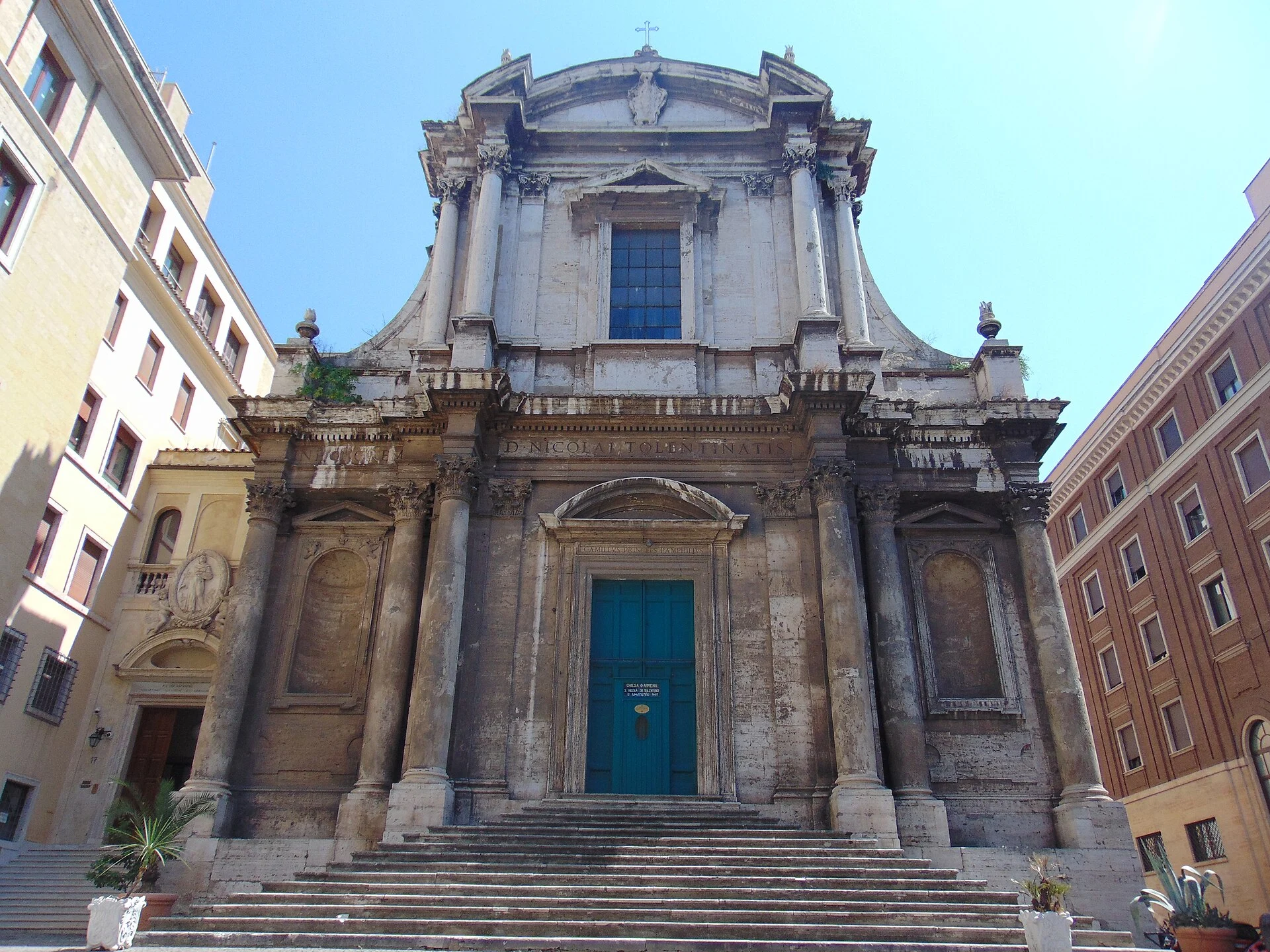
San Nicola da Tolentino is at Salita di San Nicola da Tolentino 17, a few minutes on foot from Piazza Barberini, and it is the church of the Pontifical Armenian College and of the Armenian Catholic community of Rome. Entry is free and at no charge, with no tickets or reservations. It opens in practice for services in the Armenian rite: the operator doesn't publish a schedule online and the tourist portal of Roma Capitale points to the contacts, that is email@comunitaarmena.it and the number 06 0608.
From the outside it looks like one of the many Baroque churches built between the 17th and 18th centuries along the street that runs down toward the Tritone. Inside you find another story. Built by the Discalced Augustinians and paid for by the Pamphilj, it now hosts the Armenian liturgy sung in the Armenian language, the memory of the patriarchs of the Armenian Catholic Church and, on the climb, a stone cross that recalls the victims of 1915. Roman Baroque and Armenia are in the same building.
The practical information reported here is as of September 29, 2026 from the page of the Roma Capitale tourist portal, from the website of the Pontifical Armenian College and from the other sources cited further on. The delicate point is the hours: the church has no up-to-date notice board online and the services follow the calendar of the community and the college. Before crossing Rome on purpose, write or call and have the day and time of the liturgy confirmed.
Where it is and what you really see
The church is in the Trevi district, on the flank of the hill that climbs toward Via Bissolati, in an area that old maps call Orti Sallustiani, from the name of the gardens of the historian Sallust that occupied the valley between the Pincio and the Quirinale. From Palazzo Barberini you get there in five minutes. The full name you find in specialist guides, San Nicola da Tolentino agli Orti Sallustiani, comes precisely from there.
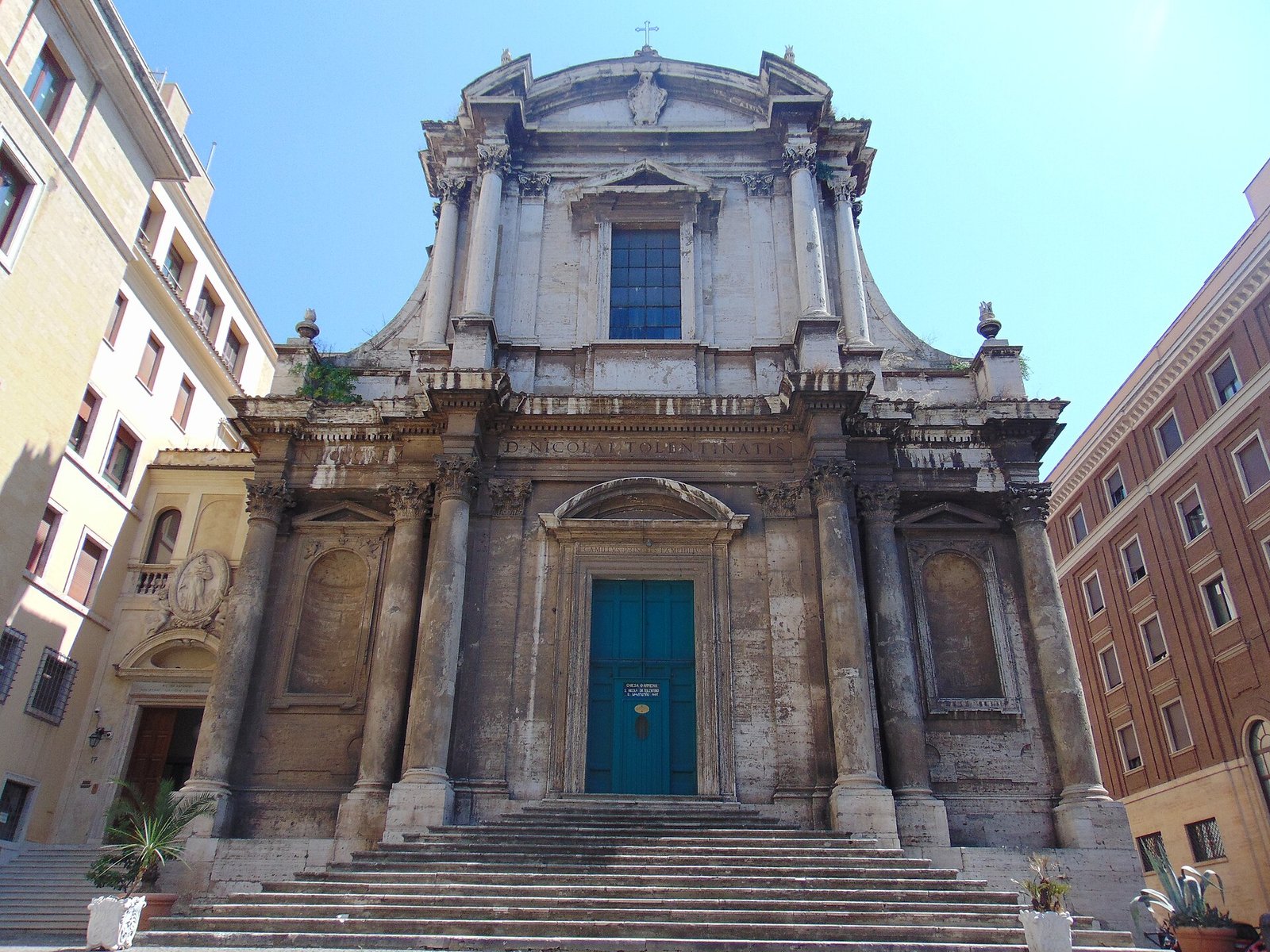
The facade has two orders, divided into three parts by columns and pilasters, with the central portal under a curved pediment. In the lower order two documented inscriptions can be read: IN HONOREM D. NICOLAI TOLENTINATIS, the dedication to the saint, and CAMILLUS PRINCEPS PAMPHILIUS, the name of the one who paid. In the spandrels is the dove with the olive branch, the Pamphilj coat of arms. The two side niches, topped by triangular pediments, are empty.
The interior is a Latin cross, with three chapels per side, a transept topped by the dome and a shallow rectangular apse. The measurements reported by the specialist entries are 35 meters in length, 20 in width and 25 in height at the dome. It is not a big church. The vault of the nave has a coffered ceiling with lilies, the choir loft above the entrance rests on four columns of fior di pesco marble, and the marble floor dates from 1950.
Look also at the old portal of the convent, next to the church. Above a curved pediment there is an oval roundel inside a garland held up by putti, with a relief of Saint Nicholas of Tolentino that the specialist entries attribute to Giovanni Francesco Rossi. It's a piece of 17th-century sculpture that almost everyone ignores, because it sits at second-floor height and the climb forces you to watch where you put your feet. Look up before going in.
The main altar is what strikes you on entering. The design is by Alessandro Algardi, with four fluted columns of bigio marble. The sculptural group shows the Madonna with Child, Saint Augustine and Saint Monica handing the miraculous bread to Saint Nicholas. The sector entries assign the Virgin and the two saints to Ercole Ferrata and the figure of Saint Nicholas to Domenico Guidi. The dome has a fresco with the glory of the saint, by Giovanni Coli and Filippo Gherardi.
In the same area are the seats of other ecclesiastical colleges, and the Roma Capitale tourist portal lists nearby the Pontifical Germanic-Hungarian College. The surrounding neighborhood is made of offices, hotels and embassies. On Sunday morning, when the church is open for the liturgy, the street is almost empty and the effect is strange: you come out of a celebration in Armenian and find yourself among the service entrances of the hotels of Via Veneto.
How to get in, hours and services
You get in free. There is no ticket office, there are no paid guided tours organized by the operator, and no portal sells access to this church. The problem is not the cost, it's finding the door open. The church is run by the Pontifical Armenian College, the seminary of Armenian Catholic priests founded by Leo XIII in 1883, and it works first of all as the community's church, not as a monument to visit during office hours.
The Roma Capitale tourist portal, in the dedicated entry, writes that for Mass times and visiting conditions you have to consult the contacts, and gives the email of the Armenian community of Rome, email@comunitaarmena.it, and the number of the city contact center 06 0608. The college's website describes the seat and the history, but in the pages available the operator gives no calendar of services. Write a few days in advance.
Specialist guides to the churches of Rome have described the same situation for years: a church open for liturgical services, with the Sunday divine liturgy in late morning and some activity beforehand, when the choir is being prepared. These are indications from unofficial sources, useful to understand the rhythm of the week but not for planning. The official hours information is not published. For a feast or an anniversary, always ask the community.
Two dates are worth noting. On September 10 the Latin Church celebrates Saint Nicholas of Tolentino, and the church's calendar takes it into account. On April 24 Armenians all over the world remember the start of the deportations of 1915, and it's best to ask the community if celebrations are planned. On those days the chance of finding the church open goes up, but so does the presence of the faithful, and the visit should be made with discretion.
A curiosity about San Nicola da Tolentino
The Armenian church of Rome is dedicated to a Latin saint who has nothing to do with Armenia. Nicholas of Tolentino was an Augustinian friar from the Marche, who died in 1305, and the church was named for him by the Discalced Augustinians who founded it in 1599. When Leo XIII entrusted it to the Armenians in 1883, the dedication stayed as it was. Nobody thought of changing it, and this tells well how Rome layers its churches.
Bread is the key to the sculptural group on the main altar. According to the hagiographic tradition, the sick Saint Nicholas received in a vision from the Madonna the instruction to eat a piece of bread dipped in water, and recovered. From this come the rolls of Saint Nicholas, blessed in Augustinian churches on the feast day. What the documents say is the canonization of 1446. What tradition says is the bread. The miraculous healing belongs to devotional legend.
There is then a second coincidence that Rome likes. A short distance away, on Via Giulia, the church of San Biagio degli Armeni is known as San Biagio della Pagnotta for the small loaves blessed on February 3. The two Armenian churches of the city are both tied to a bread handed out to the faithful, for reasons that have nothing in common. It's chance, but it's the kind of chance that makes you smile if you visit both.
The Gavotti Chapel and the artists of the 17th century
The second chapel on the left is the Gavotti Chapel, designed by Pietro da Cortona, who also frescoed its dome. The date of the arrangement given by the entries is 1668, a year before the painter's death. It is dedicated to the Madonna della Misericordia venerated near Savona, the city of origin of the patron family, and has two large columns of verde antico marble. Anyone who knows Cortona only for his ceilings finds it much more intimate.
The sculpture is divided among three hands. Cosimo Fancelli executed the relief with the apparition of the Virgin to Blessed Antonio Botta, the peasant of Savona in the tradition. Ercole Ferrata carved Saint Joseph, Antonio Raggi Saint John the Baptist. On the walls are the memorials of the Gavotti, one from 1661 and one from 1706, and the second is recognizable because the columns framing it imitate verde antico without being it. Look at them up close.
Rest of the church. The first on the right has an altarpiece by Filippo Laurenzi of 1710 with a miracle of Saint Nicholas of Bari. The third on the right, the Lante della Rovere Chapel, arranged in 1648, has polychrome marbles all the way down to the floor. In the right transept the altarpiece of the Baptist is by Giovanni Battista Gaulli, the Baciccio who painted the vault of the Church of the Gesù. In the pendentives of the dome are the female figures by Pietro Paolo Ubaldini, from 1643.
Two chapels deserve an extra stop. The Buratti Chapel is tiny, reached through a side door, and according to the sector entries it may be what remains of the friars' original chapel, with a design by Giovan Battista Mola and stories of the Virgin by Giovanni Francesco Romanelli. The third on the left has a copy of the icon of the Madonna del Buon Consiglio venerated at Genazzano, inside a glory of gilded stucco.
Now the contrarian position. Art guides send people here for the Gavotti Chapel, and in our judgment it's the wrong reason. It's a good chapel, but anyone who has seen Cortona's vault at Palazzo Barberini or his church of Santi Luca e Martina at the Forum finds a minor work here. What you won't find elsewhere in Rome is the Armenian liturgy sung inside a Baroque interior.
Something nobody tells you about San Nicola da Tolentino
The organ is war booty. The encyclopedia entries attribute it to the Roman organ builder Celestino Testa, with the date 1629, and say it comes from the church of San Savino at Castro, the city of the Farnese duchy razed to the ground in 1649 on the orders of Innocent X, that is of a Pamphilj. The same family that paid for the reconstruction of this church took to Rome the instrument of the destroyed city.
The paradox becomes sharper if you look at the date. Castro was destroyed in 1649, and in just those years the Pamphilj were financing the construction of this church with Algardi in charge. The sources don't say who decided to bring the organ to Rome or in what year it arrived here. What can be stated is the provenance given by the entries and the coincidence between the family that destroyed and the one that built. The rest is reconstruction.
The same sources say the organ is still working and that it is the only surviving object of the old San Savino. Castro today is an area of ruins in the woods, in the Tuscia on the border with Tuscany, and in the old center of that city almost nothing has been left standing. That its surviving voice sounds in the Armenian church of Rome is a paradox that no panel in the church will explain to you, because there are no panels.
Second thing almost nobody knows. In the first chapel on the left there is a model of the Holy Sepulchre of Jerusalem, which came here from the church of Santa Maria Egiziaca, that is from the ancient Temple of Portunus at the Forum Boarium, which until the 20th century was the national church of the Armenians. The specialist entries date it to 1679 and describe it as plaster painted in imitation of marble. It's a humble devotional object, and for that very reason rare.
Third detail, for those who look up. The sector entries report cracks in the dome, in the nave and in the left transept, left by an earthquake in the early 20th century, and add that the structure has been checked and judged safe. Those cracks are worth looking at, because they are the most honest account of the building's age. Nobody needs to worry, but it's right to know that a church four centuries old moves.
Armenians in Rome, from the Forum Boarium to here
The organized Armenian presence in Rome is old. The specialist sources recall that in the 16th century the community first had the church of San Lorenzo dei Cavallucci, lost when Pius V enlarged the enclosure of the Ghetto, and then in compensation Santa Maria Egiziaca, with a hospice for Armenian pilgrims built next to it starting in 1571. For more than three centuries the center of the community was on the Tiber, near the Forum Boarium.
The 20th century moved everything. In 1921 the State seized the seat of Santa Maria Egiziaca, because the church was a Roman temple and official archaeology wanted to free it. The religious left the building in 1924, the hospice was demolished in the following years. The furnishings that could be saved took the road to San Nicola da Tolentino, where the college had been since 1883. Since then this has been the home of the Roman Armenian Catholic community.
A clarification that is needed. The Armenians who celebrate here are Catholics of the Armenian rite, that is in communion with the pope, with their own patriarch based in Lebanon and their own liturgical tradition. It is not a church of the Armenian Apostolic Church, which is separate from Rome. Many visitors confuse the two, and even some online guides mix them up. The difference matters for anyone who wants to take part in a service.
The Armenian network in the city can be read outside the churches too. Anyone with time can tie this visit to San Biagio della Pagnotta on Via Giulia and to Santa Maria Egiziaca at the Forum Boarium, and compare it with other churches of Eastern communities like Sant'Atanasio dei Greci or Santo Stefano degli Abissini. Each has a different rite, and the difference is better understood by seeing them in sequence.
My advice for visiting San Nicola da Tolentino
Go for the liturgy, not the church. Put another way: don't try to walk in on a Tuesday afternoon hoping for an open door, because almost always you'll find it closed. Write to the community, have them tell you when they celebrate on Sunday and arrive a quarter of an hour early. Stay at the back, remain for the whole celebration or at least a substantial part of it, and leave without hurrying. It's the only way to see the interior calmly and in the right light.
The Armenian liturgy is long and sung, with a choir and a use of incense and veils that anyone coming from the Latin rite doesn't know. You don't need to understand the language. You need to know it's not a show, that the people in front of you are praying and that photos are not taken during the celebration. If you want to photograph Cortona's chapel, ask at the end, politely, the person tidying the church if it's possible for two minutes.
Dress as for a Mass in any Roman church, shoulders covered and no beach shorts. Bring a few coins if you want to leave an offering: there's no ticket, but the community maintains the building and the college. If you travel with a group, give notice beforehand by email and don't show up as 20 during the liturgy: the church is small and the faithful are few, a large group changes the atmosphere of the celebration.
If Sunday isn't possible, ask the community if there are weekday celebrations, feasts or concerts. The college also has a reception hall used for cultural events, according to the encyclopedia entries, and on those occasions the church sometimes stays open. Keep an eye in particular on the period around April 24 and the Armenian feasts. And if the door stays closed, the climb with the khachkar is worth the detour anyway.
One last thing about time. Don't put this church in as a quick stop between two museums. A Sunday Armenian liturgy takes up a good part of the morning, and leaving halfway to chase a reservation at the Galleria Borghese ruins the experience for you and disturbs the others. Organize Sunday this way: liturgy in the morning, lunch, then the round of Baroque churches of the Quirinale in the afternoon, when the others reopen.
The Armenian rite for first-time visitors
The Armenian rite has Antiochene origins and over the centuries has taken elements from both the Byzantine and the Roman traditions. The language of the celebration is classical Armenian, with parts in the everyday language of the community. What strikes a Latin visitor is the almost continuous singing, with the celebrant and the choir answering each other, and the moment when a curtain in front of the altar closes and then opens again, hiding and showing the preparation of the gifts.
Don't expect the iconostasis of the Greek churches. Here the Baroque altar has stayed that of the Augustinians, and the Armenian liturgy has adapted to a space designed for the Latin rite. It's one of the interesting things about the church: seeing how an Eastern tradition inhabits a building made for another. The presbytery with Algardi's altar becomes the backdrop for gestures its architect had not foreseen, and it works better than you would imagine.
Anyone who wants to understand before going in can read something about the history of Armenian Christianity, the first nation to adopt Christianity as an official religion according to tradition, with Gregory the Illuminator and King Tiridates. What the documents say is a conversion of the kingdom at the start of the fourth century. The precise date varies among scholars, and Armenian tradition fixes it at 301. In the church you find this story in the second chapel on the right.
A frequent question: can a Latin-rite Catholic receive communion here? Yes, because the Armenian Catholic Church is in full communion with Rome, and a Catholic believer can receive the sacraments in any Catholic rite. The practical details do change, though, and the Eastern custom involves dipped bread or gestures different from the Latin ones. If you have doubts, watch those ahead of you or ask the priest beforehand.
Another well-known fact, yet rarely cited
This is a Pamphilj church, and that's known, but almost nobody remembers the reason. The specialist entries report that Camillo Pamphilj and his wife Olimpia Aldobrandini financed the construction as a vow for her recovery. Olimpia Aldobrandini, princess of Rossano, is the noblewoman of the family villas and palaces, and Camillo was the nephew of Innocent X. She should not be confused with the pope's more famous sister-in-law, Olimpia Maidalchini, the Donna Olimpia of the Roman chronicles.
There is also a political reading that the guides skip. The church stands on the hill overlooking Palazzo Barberini, the palace of the family of Urban VIII. When Innocent X Pamphilj was elected, in 1644, he opened an inquiry into the finances of the Barberini nephews, who fled to France. A church with the name of a Pamphilj prince on the facade, a few steps from the palace of the fallen rivals, in the Rome of the time read without needing captions.
The inscription with Camillo's name on the facade has the same weight as the one on the church of Sant'Agnese in Agone: the churches paid for by the Pamphilj carry the patron's name in plain view. Anyone doing the round of the family's places passes through Piazza Navona, through the Palazzo Doria Pamphilj on the Corso and through Villa Doria Pamphilj on the Janiculum, and rarely climbs up here. A mistake, because the Pamphilj dove on the facade is the same.
The second fact known and little told is the chain of religious communities. After the Discalced Augustinians, in 1775 the complex passed to the Battistine nuns, a contemplative order founded in the 18th century. In 1798 the French requisitioned it during the Roman Republic, then it was returned. In 1883 the Armenians arrived. The nuns' choir is still behind the main altar, reachable through two doors with grilles above, which today people look at without knowing what they were for.
The right photo to take at San Nicola da Tolentino
The photo is from the bottom of the climb, vertical, with the staircase in the foreground and the whole facade up to the pediment. The climb is narrow and the facade tall, so you'll have to back away to the point where the street allows it and accept some convergence of the lines. Correct it afterward, don't try to avoid it by craning your neck. The good light is in the morning, when the stone catches the sun from the side.
The second image is the khachkar with the plaque next to it, up close and from three quarters, because the carved cross has low reliefs that can be read only in raking light. At noon the relief disappears. The common-sense rule applies: it's a memorial, not a backdrop for portraits. Photograph the stone, not yourself in front of the stone, and if a commemoration is under way wait for it to end.
Inside, if it's allowed to you when the church is empty, the framing that works is the dome of the Gavotti Chapel from below, with the verde antico columns at the sides. You need a wide lens and a long exposure, because the chapel is poorly lit. Alternatively, from the back of the nave, the central axis toward Algardi's altar, with the bread group in the center and the choir loft framing you from above.
Avoid flash, which on the polychrome marbles of the Lante Chapel creates white reflections and flattens the colors, and which is not used during a service anyway. Also avoid photos of the faithful and the clergy during the liturgy: the community is small and people know each other, a lens pointed at them is noticed immediately. For the travel account the facade, the stone cross and one chapel are enough.
The khachkar and the memory of 1915
The khachkar is a stone stele with a carved cross at the center and interlaced decoration around it, typical of medieval Armenian art and still produced today. The one on the climb of San Nicola da Tolentino recalls the victims of the Armenian genocide, which began in 1915 in the Ottoman Empire. Next to it is a plaque that uses the formula Armenian genocide. The Italian free encyclopedia also records a plaque placed in 2006 by the City of Rome in memory of the victims of the Metz Yeghern.
Metz Yeghern means great crime, and it is the name by which Armenians refer to the extermination. The most cited estimates speak of about a million and a half victims, a figure that Armenian sources and a large part of historians adopt. Italy has officially recognized it as genocide, and so has the European Union. Turkey contests this definition. It's not a discussion for the churchyard, but anyone bringing teenagers or groups should know that plaque carries political weight even today.
There is also a second, older khachkar in the inner cloister of the college. That one can't be seen: the college is a training institute with residents and the cloister is private. Don't ring the gate to ask to see it, and don't try to peek in through the service entrances. If you have a scholarly interest, write to the college explaining who you are. The cross on the climb is public and is enough to understand what a khachkar is.
To read a khachkar you need only a few elements. At the center is the cross, often flowering, that is with arms ending in scrolls and buds, meaning the cross as a tree of life. Below there often appears a disk or a rosette, around it a dense geometric interlace. Every stone is different from the next, and in Armenia thousands are preserved. Anyone who wants to understand the difference from a Latin cross sees it here in a minute.
How to get there
On foot from Termini station it's a good quarter of an hour's walk, passing through Piazza della Repubblica and Via Leonida Bissolati. From Piazza Barberini you take Via di San Nicola da Tolentino, and in a few minutes of climbing you find the ramp with the staircase leading to the church. The route is sloped but short, and with a stroller you go along the street.
By metro the closest stop is Barberini, on Line A. In recent years the station has had long closures for work on the escalators, so check on the city transport company's website that it is open before counting on it. Alternatively the Repubblica stop, also on Line A, leaves you about 10 minutes on foot away. From there the way to the church passes next to the Baths of Diocletian.
By car, forget it. The area is central and busy, street parking is scarce and contested, and on Sunday morning the streets around Via Veneto have parking rules that change with events. Taxis stop with no problem in Piazza Barberini, from which you climb on foot. Shared bikes and scooters are found throughout the area.
Anyone arriving with a group by coach should know that tour buses don't go up the surrounding streets. The most practical drop-off point is an authorized area, and from there you walk. For a group the recommended sequence is the Triton Fountain, the climb to the church, then down toward the Quattro Fontane and the Quirinale. It's a loop of an hour and a half with all the pauses.
Some important events that happened here in history
In 1599 the Discalced Augustinians, a reformed branch of the Augustinian order, settle on this ground, then countryside, at the wish of Clement VIII according to the Roma Capitale tourist portal. They buy the site in 1604 and build a chapel with two altars, one to Saint Nicholas and one to the Madonna of the Rosary. From 1615 the complex becomes their novitiate house, that is the place where new friars are trained.
In the 1620s the real church begins. The sources don't agree on the name of the first architect: Carlo Buti for the Roma Capitale tourist portal and for the English encyclopedia, Carlo Buzzi for other specialist entries. The church opens for worship in 1624, but construction goes on slowly for lack of money. Then the Pamphilj arrive and everything changes. Alessandro Algardi directs the works until 1650, and Martino Longhi the Younger oversees some parts.
In the middle of the century Giovanni Maria Baratta, a pupil of Algardi, completes the structure and the facade. Here too the dates vary, between 1651 and 1654 according to the sources. In 1670 Francesco Buzio modifies the facade and builds the staircase. In 1668 Pietro da Cortona arranges the Gavotti Chapel. In 1671 Coli and Gherardi paint the dome. The consecration comes only in 1685, almost 90 years after the foundation.
In 1775 the convent passes to the Battistine nuns, in 1798 it is requisitioned by French troops and then returned. In 1883 Leo XIII assigns the complex to the new Pontifical Armenian College, intended for the training of the Armenian Catholic clergy. The recognized founder is the patriarch and cardinal Antonio Pietro IX Hassun, who died the following year. In 1908 the second chapel on the right is dedicated to Saint Gregory the Illuminator, the apostle of the Armenians.
The chapel of Saint Gregory the Illuminator holds the altarpiece by Giovanni Gagliardi with the meeting between Gregory and Pope Sylvester I in Rome, with Constantine and King Tiridates in the background. Here the three levels have to be kept apart. The documents attest the conversion of the Armenian kingdom at the start of the fourth century. Armenian tradition ties that conversion to Gregory. The journey to Rome and the meeting with the pope and the emperor belong to legend, which the painting tells as history.
In the 20th century the surroundings change. The seizure of Santa Maria Egiziaca in 1921 brings the community's seat here. In the 1930s the opening of Via Bissolati, one of the streets of the Fascist period, takes away the old convent, and the college's present buildings occupy the area of the old gardens. In 1950 the floor is redone. In 2006 the City of Rome places the plaque on the Metz Yeghern, according to the Italian free encyclopedia.
Who has passed through San Nicola da Tolentino
Camillo Pamphilj, prince, nephew of Innocent X, cardinal for a few years and then a layman again to marry Olimpia Aldobrandini. A man of great building projects: to him are owed a good part of the villa on the Janiculum and this church. His name on the facade is a signature of ownership in the literal 17th-century sense: whoever paid made himself seen, and the passerby had to know whom to thank.
Alessandro Algardi, from Bologna, the great rival of Bernini in sculpture in the high 17th century, the favorite of Innocent X when the pope wanted to distance himself from the Barberini artists. Here he left the main altar and the layout of the building site. Anyone who wants to see Algardi on a large scale should find his relief with the meeting of Leo the Great and Attila in St. Peter's Basilica, then come back to look at this altar.
Pietro da Cortona, from Tuscany, painter and architect, the man of the vault of the great hall of Palazzo Barberini. The Gavotti Chapel is one of his last works, and some sources report that the dome was completed after his death, in 1669, by his pupil Ciro Ferri: the sources don't agree on the division of the work. For Cortona's architecture in Rome the key stop is the facade of Santa Maria della Pace.
Giovanni Battista Gaulli, called il Baciccio, from Genoa, left here the altarpiece of the Baptist in the right transept, next to the memorials of Giuseppe Oreggi from 1669 and of Cardinal Nicola Oreggi from 1672. Ercole Ferrata and Antonio Raggi, who in Rome carved for half the city between Sant'Agnese and the Gesù, work here side by side in the same chapel. San Nicola da Tolentino is a small anthology of Roman sculpture of the second half of the 17th century.
Antonio Pietro IX Hassun, Armenian Catholic patriarch and cardinal, recognized founder of the college, who died in 1884. In the second chapel on the right the specialist entries note his memorial, with the cardinal's hat, following the old custom of hanging the galero over the tomb of a deceased cardinal. In the same chapel is the funerary monument of Gregorio Pietro XV Agagianian, patriarch and cardinal of the Curia, who died in 1971.
Agagianian is the best-known figure to have passed through here in the 20th century. Trained in Rome, patriarch of the Armenian Catholic Church and then prefect of the Vatican congregation for the missions, he was considered among the possible popes in the conclaves of 1958 and 1963 according to the reporters of the time. In the church another figure dear to the community is also remembered, Blessed Gomidas Keumurgian, an Armenian priest killed in Constantinople in 1707, to whom the altar of the left transept is dedicated.
When it's closed and what not to expect
The church is closed for most of the week. It has no tourist visiting hours, no attendant at the entrance, no information office. Showing up on a weekday in mid-afternoon means, in the great majority of cases, finding the door closed and nobody to ask. The college next door is an institute with residents and is not an information point: don't ring to ask them to open the church.
Don't expect panels, audio guides, postcards or a bookshop. The works have no captions, the electric light is what the liturgy needs, some chapels stay in half-light. Don't expect a freshly restored church either: the cracks are visible, some surfaces are tired, and the specialist entries have noted for years a need for maintenance. It's part of the character of the place and takes nothing away from the experience.
Finally, don't expect a visit in Italian. The liturgy is celebrated in Armenian, and the community's communications can be in Italian or in Armenian. At the end of the celebration you can try asking for information from whoever is tidying the church. On accessibility, the access staircase is a real obstacle for anyone in a wheelchair: the operator gives no alternative entrance, so ask beforehand by email.
Eating in the area
The area between Piazza Barberini, Via Veneto and Via Bissolati is one of the hardest in Rome for eating well at an honest price. It's a neighborhood of hotels, offices and airlines, full of passing people who won't come back. The result is an offer designed for those in a hurry or for those paying on an expense account. There are exceptions, but they have to be sought with precise criteria, not with noon hunger.
First sign to avoid: the menu with photographs of the dishes, translated into five languages, displayed on an easel in front of the door. It talks to someone who doesn't know what a cacio e pepe is, and cooks accordingly. Second sign: the person at the door who stops you to invite you in. A place that has to get customers on the sidewalk lives on customers who won't come back, and Romans know it without needing explanations.
Third sign: the woman rolling out pasta dough in the window. It's theater. Fresh pasta is made in the kitchen in the morning, not in front of exhaust pipes. Fourth: places open from 11:00 to midnight with no break, where the kitchen never stops because it works on ready-made preparations. Fifth: items with no price, the fish of the day by undeclared weight, the menu that differs between the outside tables and the dining room inside.
In front of monuments and on famous streets, like Via Veneto or the squares around the Trevi Fountain, the price tends to adapt to the customer. It's not snobbery to say Romans don't go there. It's that a Roman knows what a plate of pasta costs and doesn't pay double to eat it with a view of traffic. Anyone traveling with tired children has good reasons to sit wherever they land, and I understand that.
The criterion is to look at who is sitting there. If at half past one on a weekday you see office workers with badges around their necks, taxi drivers and families speaking Roman dialect, go in. If there are only tourists with backpacks and the waiter answers you in English before you open your mouth, you've got useful information. So you don't have to go by trial and error, here you find our list of the places where we eat.
What to combine in a day
The most sensible loop from the church is the Baroque of the Quirinale. In less than 10 minutes on foot you get to Santa Maria della Vittoria with Bernini's Cornaro Chapel, then to Santa Susanna, the Moses Fountain and San Bernardo alle Terme. Then you go down toward Borromini's San Carlo alle Quattro Fontane and Bernini's Sant'Andrea al Quirinale.
From Piazza Barberini side the natural route climbs along Via Veneto. You pass Santa Maria della Concezione dei Cappuccini and the Museum of the Capuchin Friars with the ossuary crypt, and you arrive at the Boncompagni Ludovisi House Museum. Those who prefer the ancient find under the palace the Barberini Mithraeum, which can be visited only by reservation.
Anyone who wants to stay on the thread of the Orti Sallustiani can reach Trinità dei Monti, where the Sallustian obelisk stands, which was right in Sallust's gardens before being brought to the top of the staircase of Piazza di Spagna. On the way, on Via Francesco Crispi at the height of Via Capo le Case, is the church of San Giuseppe a Capo le Case.
For a day on community churches, the thread stretches toward the center: Santi Vincenzo e Anastasio a Trevi, then Sant'Atanasio dei Greci on Via del Babuino and farther on Via Giulia with San Biagio. Anyone looking only for the masterpieces of Algardi and the Pamphilj should finish at Santa Maria in Vallicella, where Cortona painted the vaults, and then Piazza Navona. The complete Baroque tour is on our page on Baroque Rome.
Frequently asked questions
How much does it cost to enter San Nicola da Tolentino?
Entry is free and at no charge, as in all churches of Rome that function as places of worship. There are no tickets, mandatory reservations or paid guided tours organized by the operator. If you want to leave an offering for the building's maintenance, you can do so at the end of the celebration. Anyone offering a ticket for this church is selling something the operator doesn't provide.
When is the church open?
The operator doesn't publish opening hours online. The church opens in practice for the services of the Armenian Catholic community, and the Roma Capitale tourist portal points to the contacts for Mass times and visiting conditions: the email email@comunitaarmena.it and the city contact center 06 0608. Write a few days ahead and have the date confirmed.
Who runs the church today?
The church is entrusted to the Pontifical Armenian College, the seminary for the training of the Armenian Catholic clergy founded by Leo XIII in 1883, which is next door. It is the reference church of the Armenian Catholic community of Rome, that is of Armenians in communion with the pope. It does not belong to the Armenian Apostolic Church, which is a distinct Church separate from Rome.
In what language is Mass celebrated?
The services follow the Armenian rite and are held in the Armenian language, with songs of the choir and the celebrant for almost the whole duration. Those who don't know the language can take part by staying at the back of the church and following the gestures. The liturgy is longer than a weekday Latin Mass, so allow for the time if you have other appointments planned.
What is there to see artistically?
The main things are the main altar designed by Alessandro Algardi with the miraculous bread group, the Gavotti Chapel designed and frescoed by Pietro da Cortona, the dome painted by Giovanni Coli and Filippo Gherardi, the Baciccio altarpiece in the right transept, the polychrome marbles of the Lante della Rovere Chapel and the 17th-century organ from the destroyed city of Castro.
Where is the khachkar?
The public khachkar is on the climb of San Nicola da Tolentino, near the church, next to a plaque that recalls the Armenian genocide of 1915. You can see it from the street at any time, even when the church is closed. A second, older khachkar is in the inner cloister of the Pontifical Armenian College, which is private and not open to visits.
Can you take photos inside?
Not during the liturgy: it is a celebration with the faithful at prayer, and photographing people and clergy is rude. When the church is empty, before or after the service, ask whoever is there if you can take a few pictures without flash. The operator doesn't publish a specific policy on photography, so permission is given each time by whoever opens the church.
What is the difference from San Biagio degli Armeni?
They are the two churches of the Armenian Catholic community of Rome, both tied to the Pontifical Armenian College. San Nicola da Tolentino, near Piazza Barberini, is the college's church and the main seat of the community. San Biagio degli Armeni, on Via Giulia, is a small rectory known as San Biagio della Pagnotta for the loaves blessed on February 3.
How do you get there from Piazza Barberini?
From Piazza Barberini you take Via di San Nicola da Tolentino, on a slight uphill, and in a few minutes you find the ramp with the staircase leading to the church, at number 17 of the street of the same name. The route is short but sloped. The Barberini stop on Metro Line A is the closest, but check beforehand that it is open, because in recent years it has had closures for work.
Who wrote this page
The page comes from the editorial team of Tour Leader Pro, the Rome-based company that designs itineraries, visits and cultural events across Rome and Lazio. Address, contacts and access arrangements reported here come from the official sources cited in the text as of the date given at the top. Since it is a church that opens for the community's services, hours change with the liturgical calendar: always check them again before leaving and let us know what you find changed.
Building a route among the churches of Rome's foreign communities means fitting together liturgies celebrated once a week, rectories with no website, colleges that don't answer in August and climbs that don't show on the map, for yourself or for a group of 40 people. Anyone facing this kind of puzzle will find on Tour Leader Pro working materials designed for those who guide and for those who organize on their own.
For the big picture, that is regional trains and seasonal timetables, rentals, airports, transfers between one province and another and destinations in Lazio outside the center of Rome, from the Castelli to the volcanic lakes of the north to the Tyrrhenian coast and the hill towns of the interior, a useful resource for putting together a multi-day itinerary is Italy Planner.