Santa Susanna
In short. Santa Susanna is at Via XX Settembre 15, on Piazza San Bernardo side, and today it can't be visited: the church has been closed to the public for restoration since July 2013 and no reopening date appears to have been published.
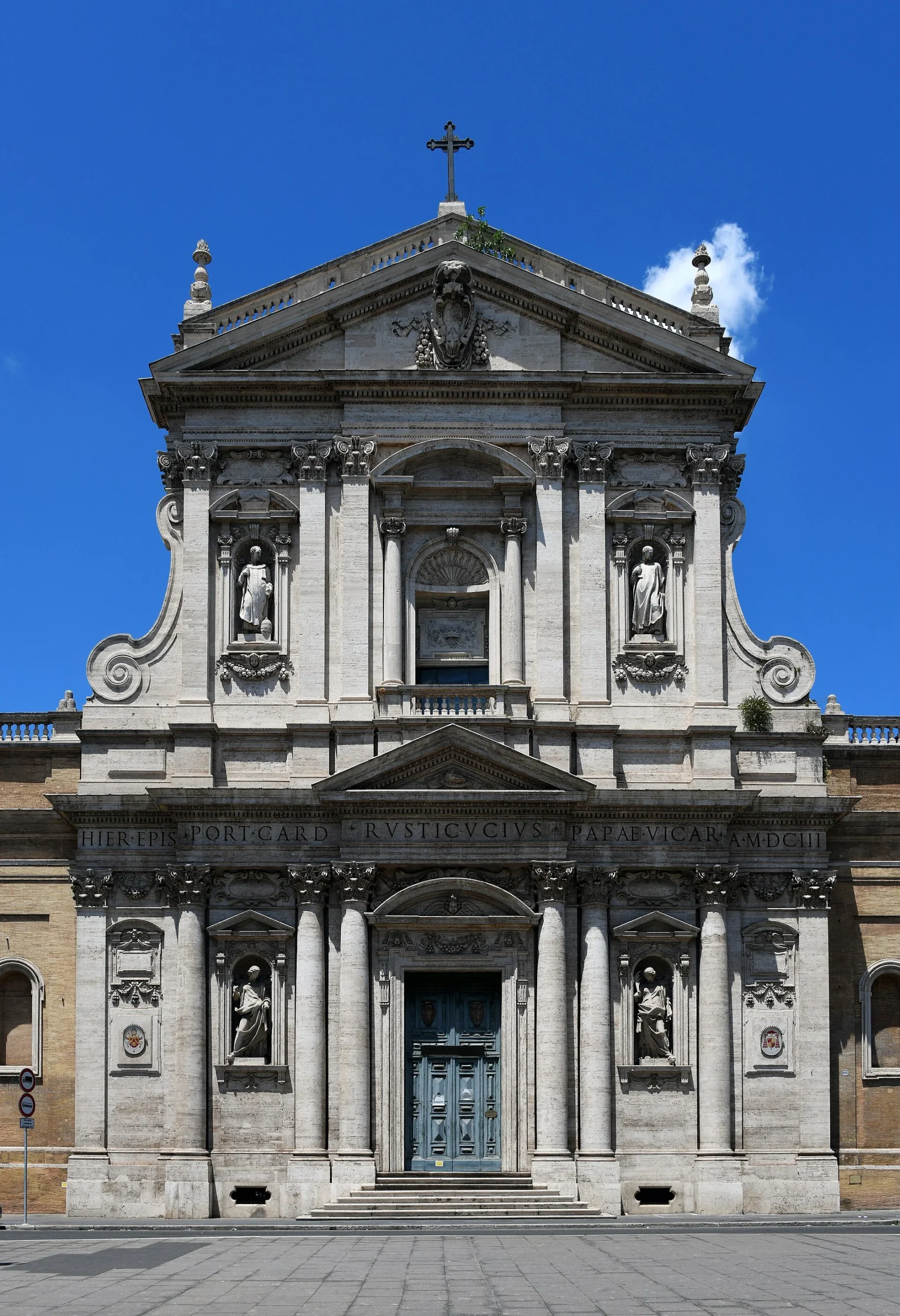
Santa Susanna is at Via XX Settembre 15, on Piazza San Bernardo side, and today it can't be visited: the church has been closed to the public for restoration since July 2013 and no reopening date appears to have been published. The complex belongs to the community of Cistercian nuns of Santa Susanna, who have run it alone since August 1, 2017. The facade can be seen free from the street. For updated news you phone the monastery, at 06 42013734 or 06 42014554.
For 95 years this was the Americans' church in Rome. From 1922 the Paulist Fathers celebrated English-language Masses, weddings and baptisms here for the US community, until in 2017 the parish moved to San Patrizio, on Via Boncompagni. Anyone searching online still finds old pages with the times of the American Masses at Santa Susanna: they have been out of date for years, and the English-speaking community is now found elsewhere.
The practical information you read here was checked on September 28, 2026 on the Roma Capitale tourism pages, on the website of the American parish of San Patrizio, in the diocesan press and on the listings of the national catalog of cultural heritage. The state of works in a cloistered church changes without announcements: before organizing a visit, above all with a group, call the monastery and have them tell you if anything has moved.
Where it is and what you see today
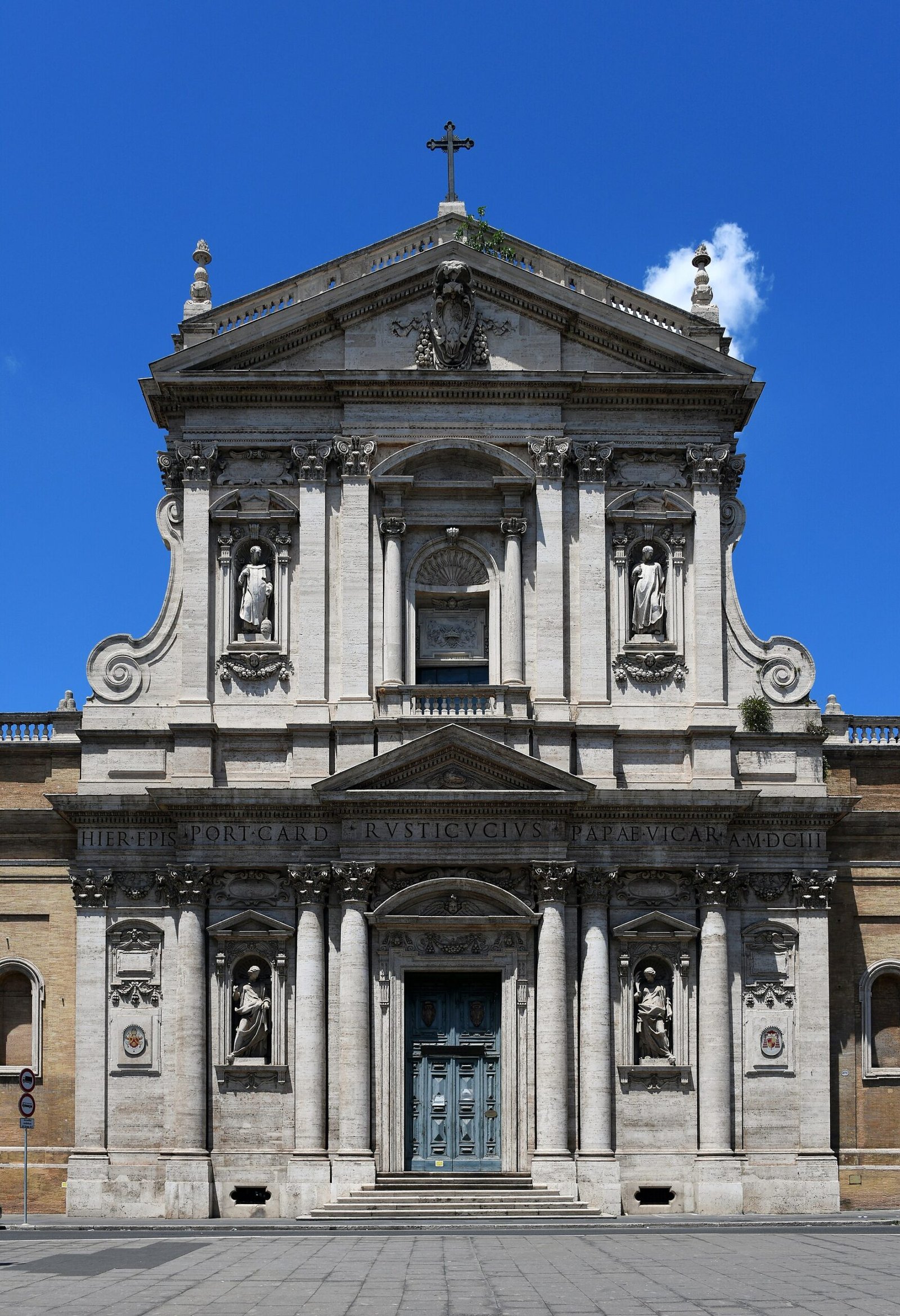
The facade faces Piazza San Bernardo, along the old Strada Pia that after 1870 took the name Via XX Settembre. A few meters away, on the same intersection, is Santa Maria della Vittoria, and on the same piazza the rotunda of San Bernardo alle Terme. Three churches within 100 meters, and an intersection where the Rome of Sixtus V can still be read without any need for explanation.
Next to the church opens the Largo di Santa Susanna, the widening that leads toward Via Barberini. In the central garden of the largo are displayed stretches of the Republican walls, the so-called Servian Walls, that came out during the works of 2003. At number 13 is the building constructed between 1873 and 1880 for the Geological Office. It's a corner of the city that almost everyone crosses in a hurry toward Termini or toward Via Veneto.
What you see today, concretely: the facade by Carlo Maderno, finished in 1603, with its statues, the closed portal and the side of the church along the monastery. From the outside you can also read the traces of the old three-aisle basilica, reduced to a single one in the 15th century. The frescoed interior, the nuns' choir, the excavations under the floor are not accessible, and no official channel offers extraordinary visits.
The monastery is cloistered. This means the nuns don't organize guided tours, don't run a ticket office and don't have a tourist office. They have a phone, an email box published on the Roma Capitale pages, monastero-s.susanna@libero.it, and a life marked by prayer. If you call, do it at a reasonable hour and with precise questions: you are speaking with a religious community, not with a public service.
Closed since 2013: the current state, source by source
The closure has a precise date. The American parish gives July 5, 2013 as the last day of Santa Susanna open for worship, and the accounts of that summer speak of pieces falling from the ceiling. The English-language Masses were quickly moved to the basilica of Santa Maria degli Angeli and to the church of San Camillo de Lellis, awaiting a solution that then became permanent.
Since then the news is scarce and all in agreement. In 2018 the diocesan press wrote that the church had been under restoration for several years and that the Lenten station was celebrated at Santa Maria della Vittoria. In 2021 the church was still closed, with the station moved to San Camillo. In October 2025 those who passed in front of the portal found the same situation: you only see it from outside.
Who officiates there today, then? Since August 1, 2017 the Paulist Fathers have left the church and the female Cistercian community has remained the sole holder of the complex. The nuns follow their internal liturgy, with the divine office sung in Gregorian chant. Some aggregator sites report times of Mass open to the public, but the monastery doesn't publish them on official channels, so they must be asked by phone before counting on them.
The cardinal's title is also frozen. Santa Susanna is one of the titular churches of Rome, assigned to a cardinal priest, but after the death of Cardinal Bernard Francis Law, on December 20, 2017, no one has received it. The directory of the Catholic hierarchy, in its update of late September 2026, still lists it as vacant. A very ancient title with no cardinal and a church with no faithful: hard to find a similar case in Rome.
Then there is the stational liturgy. Santa Susanna is one of the churches of the Roman Lent, and tradition assigns it the Saturday of the third week, which in 2026 fell on March 14. In the years of closure the celebration was hosted elsewhere: at Santa Maria della Vittoria in 2018, at San Camillo de Lellis in 2021. For 2026 the place of the celebration doesn't appear to be published. Anyone who wants to take part next year should ask the monastery in good time.
A curiosity about Santa Susanna
Entering, when you could enter, almost everyone thought they were looking at the life of the saint. Wrong. The six large scenes painted along the nave by Baldassarre Croce tell the story of another Susanna, the one of the book of Daniel: the wife of Joakim spied on by the two elders while she bathes, accused of adultery because she rejected them, saved by the young Daniel who exposes the two old men by questioning them separately. A biblical story, not a martyr's passion.
The listing of the national catalog of cultural heritage says it bluntly: the cycle illustrates the biblical story of Susanna in six episodes, from the encounter with the elders to the accusation, from the interrogation conducted by Daniel to the exoneration and the final thanksgiving. The scenes are painted as fake tapestries hung on the walls, separated by fake twisted columns. The architectural quadratura is by Matteo Zaccolini, a specialist in perspective, who worked alongside the Bolognese painter.
Why the biblical Susanna in a church dedicated to the Roman martyr? Because in the program conceived at the end of the 16th century, attributed by the diocesan press to Cardinal Cesare Baronio, the two women mirror each other. Both reject a powerful man, both are accused, both defend their chastity. The biblical one is saved, the Roman one dies. For an audience of cloistered nuns the message was perfectly clear and designed on purpose.
There are printed guides, even serious ones, that still speak of stories from the life of Saint Susanna without specifying which one. Popular sources confuse the two figures with some regularity. The detail is not pedantry: it's the key to reading the whole decoration of the church, which works through pairs and cross-references. When it reopens, go in knowing it and look at the walls as a parallel story, not as a biography.
Something nobody tells you about Santa Susanna
The story of the martyr, as tradition and the panels of half of Rome tell it, has a big problem. According to the passion written in the sixth century, Susanna was asked in marriage by the son of the emperor Diocletian. Diocletian, from what we know from ancient sources, had no sons. The only known daughter is Valeria, given in marriage to Galerius. The rejected suitor of the legend is a character with no historical evidence.
The most widespread version of the tale, reported in 1588 by the scholar Pompeo Ugonio, calls that son Maximus and adds other details: the secretly Christian empress who prays with the girl, the imprisoned father, an angel who protects her from violence, the tribune Macedonius who beats her and has her beheaded inside her own house. It's a narrative pattern that returns identical in many passions of Roman virgin martyrs.
This doesn't mean Susanna didn't exist. It means we know nothing verifiable about her life, and that what we know for sure concerns the place and the cult, not the person. The name of Susanna is attested as the title of this church already in the sixth century, and the cult has never been interrupted. The rest is devotional literature, built according to precise models.
What nobody adds is that this takes nothing away from the visit, quite the contrary. A church that tells of two Susannas, one biblical and one legendary, and that rests on a real Roman house, excavated and documented, is a textbook case of how in Rome memory is built on top of walls. In front of the closed facade, it's best to tell it to your guests this way.
Susanna on three levels: documents, tradition, legend
What the documents say. In the oldest lists of Roman titles the church appears as titulus Gai, the title of Gaius, and at a later stage as the title of Susanna. On the date of the change the sources disagree: one reconstruction indicates the synod of 565, another places the new dedication around 590. The Liber Pontificalis then records the rebuilding ordered by Leo III at the end of the eighth century.
Still on the level of documents, or rather of walls: under the church there are structures of a Roman house, dated to the third century, identified as early as 1830 under the altar of the confessio. There are mosaic floors, painted walls, a well about 20 meters deep. A domus of that period under a titular church is a concrete archaeological fact, compatible with the hypothesis of a private house used by Christians for worship.
What tradition says. The place was called ad duas domos, near the two houses: that of Gabinius, Susanna's father, and that of Gaius, his brother, whom tradition identifies with Pope Caius, bishop of Rome at the end of the third century. Tradition places the transformation into a proper church around 330, under Constantine. No contemporary document confirms it, but the hypothesis is reasonable.
What is legend. The son of Diocletian, the secret Christian empress, the angel, the martyrdom in her father's house, the date of 295 that circulates on some popular pages. All of this belongs to the late antique passion, a literary genre with its own rules and its edifying aims. It can be told with respect, and it should be told, as long as you say clearly that it is a tale and not a chronicle.
The cult, on the other hand, is a fully historical fact. In the church are venerated the relics of five saints of the early centuries: Susanna, her father Gabinius, Felicity with the tradition of the seven martyred sons, Pope Eleutherius and Genesius, the mime who according to legend converted on stage while parodying a baptism. Genesius is the patron of actors, and finding him here, a few minutes from the Teatro dell'Opera, makes you smile.
My advice for visiting Santa Susanna
Don't make the trip on purpose. Santa Susanna closed takes five minutes to look at, and makes sense only within a wider tour of Via XX Settembre intersection. The advice is to pair it with Santa Maria della Vittoria, which is a few meters away and open: inside is Bernini's Ecstasy of Saint Teresa, and everyone goes there. You, before going in to see Teresa, stop at the intersection and calmly look at the facade of Santa Susanna.
The right spot to look at it is the opposite sidewalk of Via XX Settembre, on the San Bernardo side, not the churchyard of Santa Susanna. Up close the facade flattens, the columns overlap and you lose the play of planes. From the distance of the width of the street you instead see how Maderno moves the building forward toward the center, layer after layer. Watch out for cars and scooters coming fast down Via XX Settembre.
Second stop, the Largo di Santa Susanna right next door, with the Republican walls on display in the garden. They are a few blocks of tuff, but they are the oldest walls in the city, centuries older than the church, and they give the measure of how many layers overlap at this point. Third stop, the Moses Fountain at the corner of the piazza, the display of the Acqua Felice commissioned by Sixtus V.
If you really want to go in, the only way is to phone the monastery and ask if on the occasion of particular celebrations, such as the saint's feast on August 11 or the Lenten station, the church is opened even only in part. There is no published calendar of these occasions. Don't promise a group entry without written confirmation, because the most likely answer, in the current state, is no.
The last indication concerns time. Come in the morning. Via XX Settembre is a street of ministries, offices and traffic, and at peak hours the sidewalk is an obstacle course among office workers and tourists headed to Termini. On Sunday morning, instead, the street empties, the sun comes in from the side on the facade and you can stop on the opposite sidewalk without being pushed.
For anyone leading a group, here is how to tell it in front of the closed portal, in 10 minutes. First the facade, because you can see it. Then the two Susannas, the biblical one of the fake tapestries and the martyr of the altar, because they spark curiosity. Finally the 95 American years, because almost nobody knows them and they explain the wrong old guides. It's best to close by pointing out the Servian Walls in the largo: the group leaves with the feeling of having seen something, even without going in.
The Maderno facade, line by line
Carlo Maderno, a Ticinese architect from Capolago, finishes it in 1603, a few years before receiving the commission for the facade of Saint Peter's Basilica. At Santa Susanna he works on a much smaller scale and with more freedom. The facade is in travertine, on two orders, and the basic layout descends from the model of the Gesù: a wide lower level, a narrow upper level, joined by scrolls.
The novelty is read in the first order, going from the sides toward the center. At the extremes are flat pilasters, then columns half-engaged in the wall, then at the center two paired columns, one half-engaged and one in the round, framing the portal. The wall advances in successive steps and the decoration thickens toward the center. In the second order the columns give way to less prominent pilasters, closed by a pediment with a balustrade.
The statues are four. Below, at the sides of the portal, Susanna and Felicity, attributed to Stefano Maderno, the sculptor of the reclining Saint Cecilia that you see in the Basilica of Santa Cecilia in Trastevere. Above, two male figures that the sources don't identify the same way: one version speaks of Pope Caius and Genesius, another of Caius and Gabinius. Look at them from the opposite sidewalk and form your own idea.
Now the position against the grain. The formula first Baroque facade, repeated in every handbook, is overrated. Santa Susanna is the very intelligent conclusion of the Counter-Reformation facade in the manner of the Gesù, not the beginning of something new. The true Baroque, the one that bends the wall, arrives with Borromini and Pietro da Cortona. Maderno orders, grades, accelerates. He never bends anything.
That said, the facade deserves all its fame for a different reason from the one you read. It is a lesson in measure: each element grows one degree over the previous one, none shouts. Anyone who wants to understand where the young Borromini, a relative and pupil of Maderno, starts from, should look at this facade and then walk to San Carlo alle Quattro Fontane. The distance between the two is a few minutes on foot and a generation.
Another well-known fact, yet rarely mentioned
Every American who has lived in Rome knows it, and almost no Italian does: for almost a century this was the national church of the United States. In December 1921 Benedict XV authorized the Paulist Fathers, a congregation founded in New York in 1858, to run the church for American residents. On January 1, 1922 the abbess handed the keys to the new rector, and on February 26 Cardinal O’Connell of Boston celebrated the first public Mass.
The story of the American community has little-told chapters. In the spring of 1940, with war at the door and Americans leaving, the community closed. According to the reconstruction published by the parish, during the Nazi occupation the Cistercian nuns hid Jewish women and children in the monastery. In 1944 a Paulist returned to Rome with the Allied troops and resumed activity, also distributing food to the population.
Another fact rarely cited: the church had already been closed once for restoration, from 1986, for about seven years. In that period the American community moved to Sant’Agnese in Agone, on Piazza Navona. John Paul II came to the reconsecration in 1993 and publicly recognized it as the Americans' church. 20 years later, in 2013, the second closure turned out to be the definitive one for the parish.
The third fact concerns the nuns. In the monastery they still make the Agnus Dei, small medallions of blessed wax finished with lace and embroidery, a craft that the diocesan press describes as traditionally tied to this community alone. In 2018 the nuns numbered 11, with sisters from Lebanon and Korea alongside the Italians. An international cloister inside the church that was the Americans'.
What is inside, when it reopens
The church has a single nave, with a side chapel near the balustrade of the presbytery. The coffered ceiling in carved, painted and gilded wood is designed by Carlo Maderno and bears at its center the image of the Madonna topped by the coat of arms of Cardinal Girolamo Rusticucci, titular from 1570 to 1597 and protector of the Cistercians. He is the patron of everything you see, from the frescoes to the choir.
The walls of the nave are covered by the fake tapestries of the biblical Susanna by Baldassarre Croce. On the dating the sources disagree: the national catalog gives about 1598 with continuation beyond 1599, other reconstructions speak of 1595. In the apse half-dome is the Glory of Saint Susanna by Cesare Nebbia, a painter from Orvieto who worked in Rome for a long time on the great building sites of Sixtus V.
On the high altar is the Martyrdom of Saint Susanna by the Palermo-born Tommaso Laureti, that is, the beheading of the martyr. In the presbytery Paris Nogari painted the martyrdom of Saint Felicity and her seven sons. It is here that the two Susannas meet: the biblical one on the walls, the martyr on the altar, in a path that leads the gaze from the nave toward the most sacred point of the church.
The side chapel on the left is the Peretti chapel, dedicated to Saint Lawrence. It was designed by Marsilio Fontana, brother of the more famous Domenico, the architect of Sixtus V, and Marsilio died in 1597 during the works. Inside are a Martyrdom of Saint Lawrence attributed to Cesare Nebbia and a Baptism of Saint Genesius by Baldassarre Croce. Some sources assign the decoration of the chapel to Giovan Battista Pozzo.
Behind the apse, separated by an iron grille, is the nuns' choir, commissioned by Rusticucci in 1596, with a coffered ceiling and frescoes attributed to Francesco Mezzetti. Here are also the reliquaries with figures of Saint Benedict, Saint Scholastica, Saint Bernard and Saint Susanna painted by Avanzino Nucci in 1599. The choir is part of the cloister and even with the church open it is seen only through the grille.
A note for those interested in music. In the church there is a pipe organ by the Fratelli Ruffatti of 1965, with two keyboards and electric transmission, designed for the sung Masses of the American community. In the nuns' choir there is instead a positive organ built in 1765 by Antonio Raimondi, which came from the church of San Bernardo in Nepi. The 18th-century instrument accompanies the cloister's Gregorian chant.
Under the church: the Roman house and the 7,000 fragments
Under Santa Susanna there is a city in miniature. The first discovery dates to 1830, from the crypt, then came excavations in 1938 and an important campaign in the 1990s, during the restoration of the cellars, with Professor Margherita Cecchelli of La Sapienza. In the 2000s the works followed by Father Domenico Lino Pacchierini brought to light a very large portion of the underground spaces, until then unknown.
The third-century domus preserves black and white mosaic floors, walls decorated with plant motifs, a painted corridor and portions of masonry in opus reticulatum. The most refined pieces are two emblemata in opus vermiculatum, that is, mosaics with minuscule tesserae, with mythological scenes in which Mercury and Neptune are recognizable. The sources on who lived in the house stop at hypothesis, as is right.
The most moving find came from the sacristy. In the excavations of the 1990s a Roman sarcophagus reused as a burial was found, with the body covered by about 7,000 fragments of painted plaster. The Istituto Centrale del Restauro reassembled them like a puzzle and out came five faces of saints and a Byzantine-style image of the Madonna and Child, referred to the early medieval church.
Through a glass slab in the sacristy floor you see part of the early Christian church and the remains of the Roman house. The excavations also yielded a pediment with the Lamb of God between John the Baptist and John the Evangelist. All of this is inside the cloister and is not accessible to the public today. If a visit to the excavations is ever organized, it will be a rare event, to book on the fly.
The right photo to take at Santa Susanna
The good photo is taken from the opposite sidewalk, on the San Bernardo side, vertically, with the lens at the shortest focal length you have and the phone held straight, without tilting it upward. If you tilt, the lines of the facade fall backward and all of Maderno's work on the successive planes is lost. Better to cut a bit of street at the bottom and correct afterward than to distort the columns.
The best light is the morning light, when the sun comes in low and brings out the relief of the travertine. At midday the facade becomes a pale flat surface, and in the late afternoon it loses the sun. With an overcast sky the statues in the niches remain readable but the whole loses depth. Wait for the bus to pass, because on this street there is always a vehicle in front.
The second shot is the detail of the two columns at the sides of the portal, one half-engaged and one in the round. Move in close and photograph the corner, at three quarters, from the left. It's the photo that explains the facade better than 100 words, because you see the wall advancing. Add the statue of Susanna in the niche, at the upper left of the frame, to give scale.
Third photo, the most Roman one: from the Largo di Santa Susanna, with the blocks of the Servian Walls in the foreground in the garden and the side of the church in the background. In the same image you put together the fourth century BC and the 17th century. Avoid instead the frontal photo from the middle of the street: besides the danger, you get a compressed facade and a closed portal, that is, the least interesting part.
Some important events that happened here in history
Around 280, according to the most widespread reconstruction, at this point of the high Quirinal there was a house used by Christians to gather. The area was then residential, with villas and stately houses, and a few years later it would see the enormous building site of the Baths of Diocletian, inaugurated in the first years of the fourth century. The church took the name Santa Susanna alle Terme di Diocleziano precisely from that cumbersome neighbor.
At the end of the eighth century Pope Leo III rebuilt the church almost from scratch, adding the large apse and keeping the relics in the crypt. In the half-dome he had a mosaic made with Christ between himself and Charlemagne, the same sovereign he would crown emperor on Christmas Day of 800. The mosaic was seriously damaged in the following centuries and today no visible trace of it remains in the church.
In 1475 Sixtus IV, the pope of the Sistine Chapel, rebuilt the church, probably reducing it to a single nave with two side chapels. The side aisles of the Carolingian basilica disappeared, and what remains of them are the traces that can be read from the outside. It is the second life of the building, the one that leads up to the great campaign of the late 16th century and to Cardinal Rusticucci's building site.
On October 7, 1587 a bull of Sixtus V entrusted the complex to the Cistercian nuns, the sisters of San Bernardo at Santa Susanna, who had been constituted the year before. There followed the transformation promoted by Rusticucci with Domenico Fontana and Francesco da Volterra, then the conclusion by Carlo Maderno with the facade of 1603. From that moment the church has had the appearance we know, and the cloister has never been interrupted.
In the 20th century the chronology speeds up. In 1922 the Paulists arrive and the church becomes national for Americans. It closes in 1940, reopens in 1944, closes for restoration from 1986 to 1993. On July 5, 2013 it closes again for structural problems. On August 1, 2017 the American parish moves to San Patrizio and the nuns are left alone. On December 20, 2017 the last titular cardinal dies.
Who has passed through Santa Susanna
Girolamo Rusticucci, titular cardinal for 27 years, vicar of the pope for the diocese of Rome and protector of the Cistercians. Without him the church of today would not exist. He chose the artists, wanted the nuns' choir, put his coat of arms at the center of the ceiling. He is the typical Counter-Reformation cardinal who uses art as an instrument of religious discipline, and does so with a very precise taste.
Carlo Maderno and Stefano Maderno worked here in the same years, one on the facade and the other on the statues of the lower niches. Carlo would become the architect of the facade of Saint Peter's and of the dome of Sant’Andrea della Valle. Stefano had already signed in 1600 the Saint Cecilia that made his name famous.
William Henry O’Connell, cardinal archbishop of Boston, who in February 1922 inaugurated the American period. After him the title of Santa Susanna went for decades to the pastors of large English-speaking dioceses: Arthur Hinsley of Westminster, Edward Mooney of Detroit, then the archbishops of Boston Richard Cushing and Humberto Medeiros. The link between the church and Boston lasted almost 60 years.
Bernard Francis Law, archbishop of Boston, titular cardinal from 1985 until his death in 2017. He had resigned from Boston in 2002 after the abuse scandal in the archdiocese and had spent his last years in Rome. With his death the title remained vacant. It is a painful page that the American community knows well and that is part, like it or not, of the recent history of this church.
John Paul II, who in 1993 came for the reconsecration after the restorations. And then the generations of Americans married or baptized here, the seminarians, the diplomats, the tourists of the Sunday morning English Mass. Finally the nuns, who have always remained. Among the forgotten figures is the abbess who on January 1, 1922 handed the keys of the church to the American rector.
The Americans' church today: San Patrizio
Anyone arriving in Rome looking for the American community's English Mass has to go to San Patrizio, the church of Villa Ludovisi, at Via Boncompagni 31 on the corner with Via Piemonte. The parish gives it that way for taxi drivers too. Since 2017 the Paulist Fathers have run it as the American parish, with the hospitality of the Irish Augustinians. From Santa Susanna you reach it on foot in a few minutes.
The times published by the parish for English Masses are Saturday at 18:00, Sunday at 9:00 and 10:30, Monday to Friday at 18:00. The rector listed on the site is Father Matt Berrios, a Paulist, and the published phone number is 06 8881 8727. Here too the usual rule applies: in holiday periods and in summer the times change, so check the parish website before going.
The move happened after a long phase of uncertainty and, according to the most widespread English-language reconstruction, also on the initiative of the nuns, who wanted to go back to running their church with full autonomy. There are no public statements by the parties explaining the affair in detail. The correct tone is that of a change of venue, without looking for culprits: the cloister has its church, the American community has a home.
If you're interested in the churches of Rome's foreign communities, the surrounding area has other useful cases for comparison. On Via Nazionale there's St. Paul's Within the Walls, the American Episcopal church, and in the Campo Marzio district there's All Saints, the Anglican church. Two different ways of being an English-speaking community in the city of the pope.
How to get there and get around the area
The most convenient metro stop is Repubblica, on line A, a few minutes on foot from Piazza San Bernardo. From Termini Station it's a quarter of an hour on foot, passing through Piazza della Repubblica and the Baths. Several city bus lines run along Via XX Settembre. Check the number and route on the website of Rome's transport company, because they change often with the construction sites.
Driving isn't worth it. Street parking is scarce and largely reserved, Via XX Settembre is a fast through road that's always full of traffic, and the rules for entering the center change with the access gates and time bands. Check the Roma Capitale website before you move. If you're coming from outside Rome, you're better off leaving the car in a park-and-ride lot and taking metro A to Repubblica.
On foot the area is easy and partly flat. Via XX Settembre climbs slightly toward Porta Pia, which sits at the end of the straight stretch, and goes down toward the Quirinale and the Quattro Fontane. The sidewalks are wide but crowded during office hours. For people with mobility problems the route is accessible, but in any case the church can't be visited.
What not to expect
Don't expect to go in. I repeat it because it's the most common mistake: many guidebooks printed before 2013 and some travel apps still list Santa Susanna as an open church with Masses in English. That information is more than 10 years old. Anyone who brings a group there without checking ends up in front of a closed portal and has to invent something to tell them on the sidewalk.
Don't expect signs explaining the closure or the timeline of the restoration either. There are no construction panels on the facade with amounts and dates, as on public works, and the cloistered community doesn't publish press releases. Anyone who wants to know where the restoration stands can only ask the monastery, and should be ready for a generic answer. It's religious property, not a state museum.
Don't expect services. On the square there are no dedicated public restrooms, no information points, no ticket offices. For a restroom and a break indoors, the practical solution is the Baths museum, which has its own facilities for paying visitors, or a bar in the area where you buy something. If you're bringing elderly people or small children, it's better to plan the break elsewhere.
Eating in the area
The area between Via XX Settembre, Piazza della Repubblica and Termini is an area of offices and people passing through, and the food follows those two sides. On one side, bars and tavole calde for the ministry employees, with quick lunches and prices of a working neighborhood. On the other, toward the station, places aimed at people who arrive with a suitcase and won't come back. The distinction matters more than the neighborhood.
The first sign to avoid is the buttadentro, the person on the sidewalk who stops you with a menu in hand. A place that has to get its customers one by one has no regulars, and regulars are the only guarantee. The second is the menu with laminated photos of the dishes and translations in 5 languages: it speaks to people who don't know what a carbonara is.
The third sign is theatrical: the woman rolling out the pasta sheet in the window, under the eyes of passersby. It doesn't indicate quality, it indicates a staging designed to stop you. Serious fresh pasta is made in the morning, in the kitchen. The fourth is non-stop opening hours from 10:00 in the morning to midnight with no break: a real kitchen stops, because the people working in it have to prep and rest.
Then there are the price traps. In places set up in front of monuments, and around here there are several, you can find items with no price, fish by an undeclared weight, different menus between the dining room and the outside tables, bills adjusted for whoever looks like they're passing through. Always ask the price before ordering and check the bill. It isn't distrust, it's a habit Romans have too.
Why don't Romans go there? Not out of snobbery. Simply, people who live and work here know the 2 or 3 places where the office workers eat, know that at lunch you can find a seat only before 13:00 or after 14:30, and don't need photos to choose. To start from a safe base there's our list of the places where we eat.
What to combine in a day
The essential pairing is Santa Maria della Vittoria, a few meters away, with the Cornaro Chapel and the Ecstasy of Saint Teresa, the central stop of every tour on Bernini in Rome. Then San Bernardo alle Terme, carved out of one of the corner rotundas of the Baths of Diocletian. With Santa Susanna they make a triptych that goes from the Counter-Reformation 17th century to full Baroque within 100 meters. Finish with the Fountain of Moses.
If you have half a day, continue toward Piazza della Repubblica and the basilica of Santa Maria degli Angeli, the bath hall transformed by Michelangelo. From there you enter the Baths museum and the Aula Ottagona, and on the other side of Piazza dei Cinquecento you reach Palazzo Massimo, with the frescoes from the Villa of Livia. It's the perfect archaeology day for anyone sleeping near Termini.
The opposite direction leads to the Baroque. Going down toward the Quattro Fontane you find San Carlino by Borromini and Sant’Andrea al Quirinale by Bernini, then Piazza del Quirinale. If you prefer painting, go down to Palazzo Barberini. To build the route in an orderly way, you need our itineraries on Baroque Rome and on Borromini in Rome.
Going north you climb up to Via Veneto, with the Capuchin church and its crypt, and with the Casa Museo Boncompagni Ludovisi, in the district that grew up on the old villa where San Patrizio also stands today. A little farther, the Sallustian obelisk marks the edge of the ancient Gardens of Sallust.
If you'd rather stay on the theme of ancient churches and early Christian titles, head toward the Esquilino: Santa Pudenziana, with one of the oldest apse mosaics in Rome, Santa Prassede and Santa Maria Maggiore. The tour of the neighborhood is completed by our guide to the Esquiline Hill and the one on Rione Monti.
If you're following the thread of Rome's national and community churches, the other entries in this series help compare similar stories: Santo Spirito dei Napoletani, San Biagio degli Armeni, Sant’Atanasio dei Greci, Santa Maria Odigitria of the Sicilians and Santo Stefano degli Abissini. Each one tells a different way of being a foreigner in the city of the popes.
Frequently asked questions
Is the church of Santa Susanna open?
No. Santa Susanna has been closed to the public since July 5, 2013 for structural problems and restoration, and as of the date of verification no reopening date has been published. The facade can be seen freely from Via XX Settembre. For updated news you can call the Cistercian nuns' monastery at the numbers 06 42013734 and 06 42014554 published by Roma Capitale.
Where is the English-language Mass of the American community?
Since August 1, 2017 the American parish has been at San Patrizio, at Via Boncompagni 31 on the corner with Via Piemonte, run by the Paulist Fathers. The published times are Saturday at 18:00, Sunday at 9:00 and 10:30, and Monday through Friday at 18:00. It's best to check the parish website during holiday periods.
Who runs Santa Susanna today?
The complex belongs to the monastic community of the Cistercian nuns of Santa Susanna, present here since 1587 at the wish of Sixtus V. After the Paulist Fathers left in 2017, the community remained the sole holder of the church and the monastery. It is a cloistered community: the nuns don't organize tourist visits and don't run ticket offices.
Who designed the facade of Santa Susanna?
The facade is by Carlo Maderno, completed in 1603, a few years before his commission for the facade of St. Peter's. It's in travertine, on two levels, with a progressive advance of pilasters and columns toward the portal. The statues of Susanna and Felicity at the sides of the portal are attributed to Stefano Maderno, the author of the Santa Cecilia.
Do the frescoes in the nave tell the life of the martyr?
No, and the mix-up is common. The 6 scenes by Baldassarre Croce along the nave, painted as fake tapestries at the end of the 16th century, tell the story of the biblical Susanna from the Book of Daniel, accused by the two elders and saved by the prophet. The Roman martyr appears instead in the altarpiece of the main altar by Tommaso Laureti and in the apse by Cesare Nebbia.
Is the story of Susanna the martyr true?
The cult is ancient and documented, and the name of Susanna has been tied to this church since at least the 6th century. The story of the marriage refused to a son of Diocletian comes instead from a late-antique passio of a legendary nature, and the ancient sources don't attribute male children to that emperor. Under the church there really is a Roman house of the 3rd century.
Can you visit the excavations under the church?
The excavations of the Roman domus and the remains of the early Christian church are inside the cloistered monastery and today are not accessible to the public. There is no published calendar of visits. If you have a scholarly interest, you can write to the monastery at monastero-s.susanna@libero.it, explaining the reason for the request precisely and accepting the community's timing.
Does Santa Susanna still have a cardinal titular?
No. The cardinal title of Santa Susanna has been vacant since the death of Cardinal Bernard Francis Law on December 20, 2017. For much of the 20th century the title went to English-speaking cardinals, in particular to the archbishops of Boston, in line with the church's role as a reference point for the American community in Rome.
Who wrote this page
The page comes from the editorial team of Tour Leader Pro, the Rome-based company that designs itineraries, visits and cultural events across Rome and Lazio. The opening status, contacts and times given here come from official sources and the diocesan press as of the date indicated at the start. Since this is a cloistered church closed for restoration, recheck them with the monastery before you go. Tell us what you find changed.
Leading a group among the churches of Via XX Settembre means knowing which are open and which aren't, what time the right light hits the facades, where to take a break, and how to describe a closed church without losing the attention of 40 people on the sidewalk. If you face this kind of work, on Tour Leader Pro you'll find materials designed for those who lead groups and for those who organize on their own.
For the wider picture, meaning connections between airports and stations, seasonal schedules, and trips outside central Rome toward the Castelli, the volcanic lakes of the north, the Tyrrhenian coast and the villages of the interior, a useful resource for putting together a multi-day itinerary is Italy Planner.