San Bartolomeo dei Bergamaschi
In short. San Bartolomeo dei Bergamaschi, whose full title is Santi Bartolomeo e Alessandro dei Bergamaschi, stands at Piazza Colonna 360, with the confraternity’s headquarters behind it at Via di Pietra 70, and in practice opens only for Mass:…
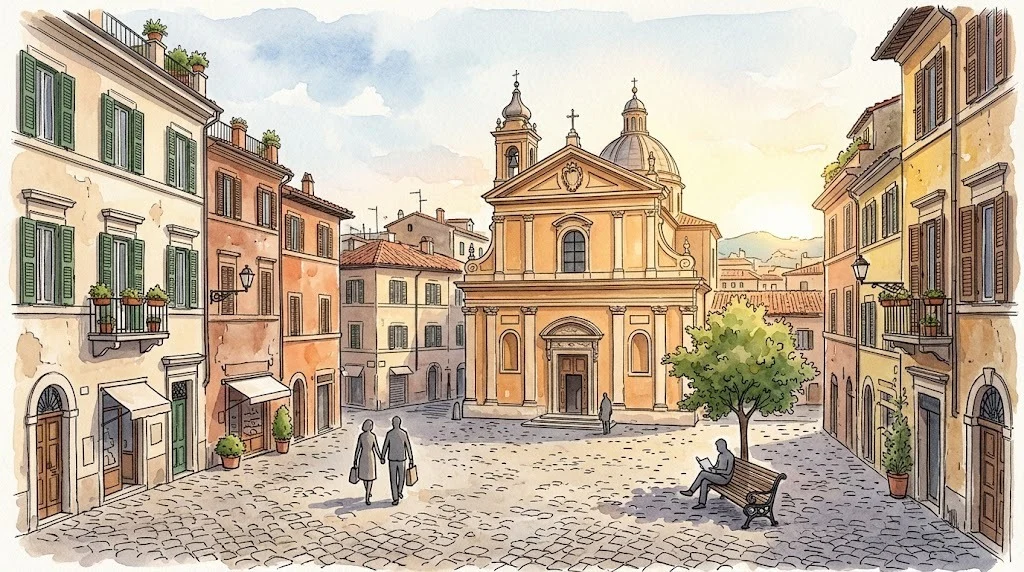
San Bartolomeo dei Bergamaschi, whose full title is Santi Bartolomeo e Alessandro dei Bergamaschi, stands at Piazza Colonna 360, with the confraternity’s headquarters behind it at Via di Pietra 70, and in practice opens only for Mass: Sunday at 10 and Wednesday at 13:15. Entry is free and open to all, and there is nothing to book. It is run by the Arciconfraternita dei Bergamaschi in Roma, which can be reached at 06 69920723 and at segreteria@arciconfraternitabergamaschi.it.
It is the church almost everyone photographs without knowing it, because its facade closes one side of the square of the Column of Marcus Aurelius, a few meters from Palazzo Chigi. Founded in the 16th century as the chapel of the hospital for the insane, under the name Santa Maria della Pietà, it passed in 1725 to Rome’s Bergamo community, which added its two saints: Bartholomew the apostle and Alexander, the martyr who is patron saint of Bergamo.
Mass times, address and contacts were checked on September 29, 2026 on the Arciconfraternita’s website, on the Roma Capitale tourist portal and on the other institutional sources cited further on. The confraternity itself warns that times can change, and in summer and on holidays it is normal for them to do so: if you are crossing Rome specifically to get in, call the secretariat during office hours and have the day’s celebration confirmed.
Where it is and what you actually see
Anyone looking for the church in Piazza di Pietra is on the wrong side. The facade opens onto Piazza Colonna, on the side of the palaces, not onto Via del Corso, and the confraternity’s complex extends back as far as Via di Pietra, the street that leads to the square of the Temple of Hadrian. The encyclopedia entries describe it exactly that way: a block lying between the two squares.
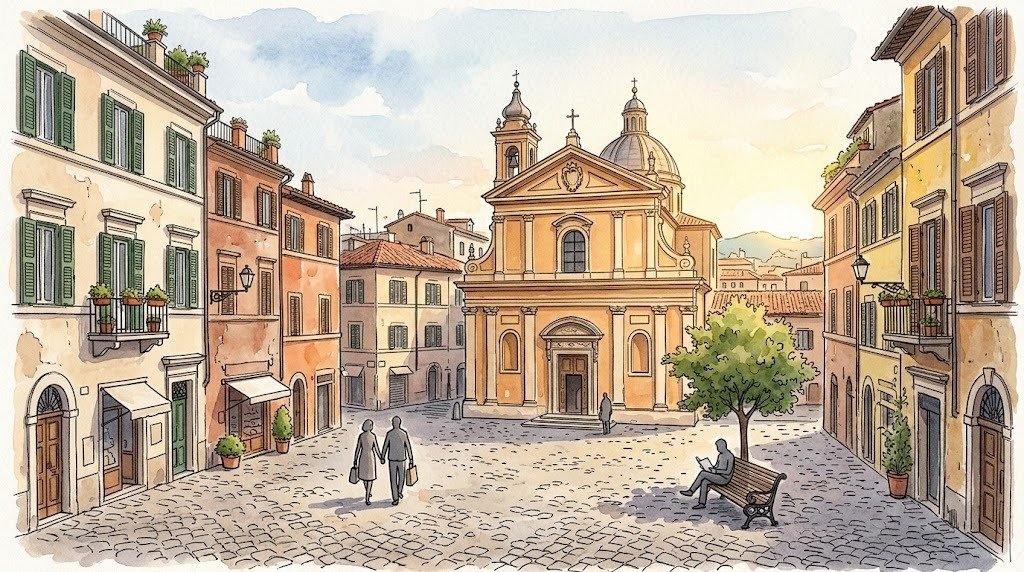
The facade is small, with a single order, squeezed between taller buildings that steal the scene. You recognize it by its broken pediment, curved and split, which the confraternity itself calls triangular and wavy, and by the portal with the Pietà in relief inside an oval, the sign of the old dedication. Along the entablature runs the dedication to the Virgin and the two Bergamo saints. From a distance it looks like the entrance to a palace, and many people mistake it for one.
Inside there is a single hall, long and intimate, with three chapels on each side and a deep presbytery. The vault was frescoed in the early 20th century, when the architect Giuseppe Sacconi, the same one behind the Vittoriano, gave the church the layout you see, and the painter Emilio Retrosi painted the Madonna of the Pietà among the saints. The overall impression is 19th century and early 20th century, not Baroque, and it helps to know that before going in.
What you do not see: the confraternity’s 18th-century oratory, the finest part of the complex, which is not open to the public during Mass hours, the historical archive, which can be consulted only on written request, and any visible trace of the hospital for the insane. Anyone who arrives hoping to find wards, cells or plaques from the old asylum comes away empty-handed. What remains of the 16th-century asylum is a name on the facade and a story in the archives.
How to get in, times and Masses
You get in during Mass, and in practice only then. The Arciconfraternita’s website publishes two weekly celebrations, Sunday at 10 and Wednesday at 13:15, and the Roma Capitale tourist portal gives the same times with a warning that they may change. The census entries for Rome’s churches state clearly that the church today opens only for these Masses. The rest of the week the door stays shut.
There is no ticket, no required offering, no reservation. It is a confraternity church, not a museum site, and for that reason you will not find visitor services, guides or panels. If you want to see the interior unhurried, arrive 10 minutes before the Sunday Mass, sit at the back, and wait for the end of the celebration to take a discreet walk around the chapels, as long as the sacristan isn’t already closing up.
The Wednesday Mass at 13:15 is the most interesting one to watch. The time makes it suited to people who work nearby, among government offices, newsrooms, banks and professional firms, and it fits into a lunch break. It is a piece of weekday Rome that visitors almost never see, and it explains well what a community church in the very center is today.
For requests other than Mass, meaning group visits, consulting the archive, genealogical research on the Bergamo presence in Rome, the channel is the secretariat: telephone 06 69920723, email segreteria@arciconfraternitabergamaschi.it, office at Via di Pietra 70. The operator gives neither a fee nor a calendar of special openings. Write in advance, explain who you are and what interests you, and accept the date they propose.
A curiosity about San Bartolomeo dei Bergamaschi
The saint of Bergamo, inside the church of Bergamo, may not be him. In the first chapel on the left there is a small round painting of Saint Alexander, mounted in 1904 inside a gilded bronze glory. The census entries for Rome’s churches report that on the back of the canvas an inscription identifies the subject as Saint Florian, the soldier martyr venerated in the German-speaking world. One military saint was recycled into another military saint.
It makes sense. Alexander of Bergamo, according to his city’s tradition, was a soldier of the Theban Legion, and in devotional painting he appears as a young man in armor with the palm of martyrdom. Saint Florian has the same iconography. For a confraternity that in the 20th century was looking for an image of its patron to put on the altar, a well-painted Florian was perfectly fine. All it took was not turning the picture over.
The information comes from a serious but unofficial source, and the confraternity does not mention it on its pages. For the visitor it changes little: the painting is still there, behind the glass and inside its glory. For people in this trade, though, it is a useful reminder. In Rome’s churches many images have been renamed, adapted, repainted, and the little plaque under a picture tells you what it represents today, not what it was yesterday.
There is a second curiosity, simpler and more Roman. The name everyone uses for the church, San Bartolomeo dei Bergamaschi, cuts out the saint who matters most to the community. Alexander is the patron of Bergamo, Bartholomew was the titular saint of the old church of San Macuto and comes by inheritance. In Rome the short usage won, as almost always happens with double titles, and nobody notices anymore.
Something nobody tells you about San Bartolomeo dei Bergamaschi
This is one of the few churches in Rome personally tied to a 20th-century saintly pope, and almost nobody knows it. Angelo Giuseppe Roncalli, a Bergamo native from Sotto il Monte, studied at the Roman Seminary from 1901 thanks to a scholarship from the Collegio Cerasoli, the foundation the confraternity administered for the sons of its members. The Arciconfraternita’s website says that the future John XXIII kept a great affection for the brotherhood all his life.
As pope he received the confraternity members in audience on January 13, 1963, a few months before his death. Today the first chapel on the right is dedicated to him, with a portrait painted in 1960 by the Bergamo painter Natale Bertuletti, when Roncalli was still alive and reigning. Under the altar, according to the census entries for Rome’s churches, a gilded reliquary holds one of the pope’s skullcaps, which came to the church in 2007.
The detail that deserves more attention is another one. The Collegio Cerasoli was at the center of a court dispute in the late 19th century between the confraternity and the bishop of Bergamo over who should manage it, and the Court of Cassation sided with the bishop. The scholarship that brought Roncalli to Rome therefore came through a foundation contested between the emigrant community and the diocese of origin. A very Italian story, told by the confraternity itself without reticence.
Anyone who comes here for the good pope therefore finds more than a portrait. They find the place that kept the thread between Bergamo and Rome for a country boy who became pontiff. If this side of the visit interests you, Sunday morning is the right time: after Mass is the moment when you are most likely to find someone from the confraternity to ask.
The hospital for the insane in Piazza Colonna
The story begins in 1548, when the Confraternity of Santa Maria della Pietà was born in Rome to assist poor people with mental illness. According to the account published by the Lazio Region, the first location was a small space near the monastery of Santa Caterina dei Funari, and in 1550 the institution moved to a house in Piazza Colonna. The Roma Capitale tourist portal calls it the first hospital for the mentally ill to appear in the city.
The founders, according to the census entries for Rome’s churches, were Spaniards: the priest Ferrante Ruiz and two Navarrese nobles, Diego and Angelo Bruno. It is a detail that fits 16th-century Rome, where the Iberian communities had their own churches, hospitals and confraternities, as you can still see at Santa Maria in Monserrato. The names do not appear on the institutional pages I consulted, and I take them as probable.
The church was built next to the asylum. The Arciconfraternita dates the building to between 1569 and 1573, as the hospital’s chapel dedicated to Santa Maria della Pietà, while other entries push the first chapel to 1591: the sources do not agree. The wooden Christ at the Column that you see in the nave bears the date 1569, and this tips the balance toward the confraternity’s version, which keeps the archive.
In 1725 Pope Benedict XIII decided that the hospital had to be moved. The Lazio Region reports the transfer to Via della Lungara, into a building designed by Filippo Raguzzini, a few steps from the hospital of Santo Spirito in Sassia. From there, at the end of the 19th century, the patients moved to Monte Mario, into the large Santa Maria della Pietà complex, today home to health services, archives and the Museo Laboratorio della Mente.
So the name many Romans associate with the asylum, Santa Maria della Pietà, comes from here, from this square and this church. It is the only material thread linking the Monte Mario complex to the historic center. Anyone who visits the museum of the mind and then passes through Piazza Colonna closes a circle of almost five centuries, and understands why the Pietà on the portal of this facade is not a decorative choice but an inheritance.
My advice for visiting San Bartolomeo dei Bergamaschi
Go on Wednesday at 13:15, not on Sunday. On Sunday morning Piazza Colonna is full of groups, the church has its regular faithful and you are the outsider at the back. On Wednesday the Mass is short, the square is the one of working days, with the government buildings open and the comings and goings of the offices, and you see the church in its real use. Leave at two with a precise idea of the place.
Arrive a few minutes early and look first at the facade from the other side of the square, near the column. It is the only point from which you understand the relationship between the small front and the palaces that crush it. Then go in and sit halfway down the nave on the right side: from there you have the Christ at the Column in front of you and, at the far end, the Madonna of the Pietà on the high altar inside her gilded halo of rays.
Respect the celebration. It sounds obvious and it isn’t: in a church that opens one hour a week, anyone who wanders around with a phone during the consecration gets noticed immediately, and the next time finds less goodwill. Take photos at the end, without flash, asking with a gesture the person who is closing up. In Rome a polite question opens more doors than any written permit.
If you are interested in the oratory, don’t hope to see it with the Mass. Write to the secretariat explaining the reason, preferably as a small group with a specific interest, historical or architectural. The operator gives no scheduled visits and no conditions, so I can’t give you a guarantee. I can tell you that Rome’s confraternities respond better to people who show up with a name, an association and a flexible date.
The interior, chapel by chapel
As you enter, on the wall inside the facade, there is the neoclassical funerary monument of Countess Caterina Negroni, who died in 1840 at the age of 23, with the cameo portrait sculpted by Pietro Tenerani, a pupil of Thorvaldsen. It is the finest piece of sculpture in the church and almost everyone walks past it without turning, because it is behind the person entering. Turn around before moving forward.
On the right, after the chapel of John XXIII, the second is dedicated to Saints Fermo and Rustico, martyrs much venerated in the Bergamo area, with an altarpiece attributed to Giovanni Antonio Valtellina showing the two saints in front of the idol they refuse to honor. The third holds an anonymous wooden crucifix that the Roma Capitale portal dates to around 1570, protected by old panes of glass.
On the left side, starting from the back, there is the chapel of the Sacred Heart, with a group of 18th-century paintings including an early work by Marco Benefial with Saint Anne and the Virgin as a child. Then the chapel of Saint John the Baptist, with the saint’s martyrdom painted in 1732 by the Bolognese Aureliano Milani, caught at the moment of execution. Finally the small tondo of Saint Alexander whose double identity has already been told.
In the nave the large wooden statue of Christ at the Column dominates, carved in 1569 by Filippo del Borgo and painted, according to the census entries, by Girolamo da Sermoneta. It is a work from the time of the hospital, and for me it is the strongest piece in the whole church: a scourged Christ placed there for those who suffered in body and mind, in a chapel of the sick.
On the high altar is the Madonna of the Pietà, oil on panel that the confraternity and the Roma Capitale portal describe as inspired by Guido Reni, inside a large halo of rays in gilded bronze with putti, between the busts of Saints Bartholomew and Alexander. On the right wall of the presbytery is the monument of Cardinal Furietti. The bronze altar facing the people was added in the 1990s.
Take a good look at the vault too, without hurrying. Retrosi painted at the center the Madonna of the Pietà with Saints Bartholomew, Alexander and Agnes, and in the side lunettes he put medallions with the Marian invocations of the litanies. Where there were once windows, later walled up, there are false openings onto painted gardens. It is an early 20th-century decorative trick that makes a hall closed in on three sides by taller buildings feel less oppressive.
San Macuto, the first home of the Bergamo community
Before Piazza Colonna there was San Macuto, a small church dedicated to a Breton saint, on the square of the same name between the Pantheon and Sant’Ignazio. The chapter of Saint Peter’s in the Vatican entrusted it to the Bergamo community in August 1539, a few months after the confraternity’s founding. In 1544 the members restored it and added an oratory and a small hospital for fellow countrymen who were sick or out of work. For almost two centuries the community lived there.
The loss came in 1725, when Benedict XIII ordered San Macuto handed over to the Jesuits, who had the Roman College next door and were looking for space. The confraternity resisted, negotiated and in the end accepted the exchange for the church of the hospital for the insane. It took along what it could: furnishings, memorabilia, and above all the late 16th-century wooden paneling that today lines the oratory on Via di Pietra.
The name of San Macuto survives in a place that everyone sees. The Egyptian obelisk that rises in front of the Pantheon, on the fountain in Piazza della Rotonda, is called Macuteo because it was found near that church. Every day thousands of people photograph it without knowing that its nickname is tied to the Bergamo community’s first Roman home.
Another well-known fact, yet rarely mentioned
Without an archaeologist cardinal this church would not belong to the Bergamo community. In 1725, when Benedict XIII ordered San Macuto handed over to the Jesuits, the confraternity resisted, and according to its own account it was the intervention of the Bergamo priest Alessandro Furietti, the future cardinal, that won in exchange the church of Santa Maria della Pietà with the hospital that was being emptied. The exchange suits everyone: the insane go to the Lungara, the Bergamo community to Piazza Colonna.
Giuseppe Alessandro Furietti is known to art historians for another reason. He excavated at Hadrian’s Villa, in Tivoli, and from those digs came two pieces that can be seen today at the Capitoline Museums: the two dark marble centaurs that bear his name and the mosaic of the doves drinking from a cup. If you have done the visit to the Capitoline Hill you have seen them, without knowing that their discoverer is buried here.
The cardinal’s monument, he died in 1764, is on the right wall of the presbytery with his portrait. It is the most direct link between a small confraternity church and Rome’s great public collections. If you bring a group to the Capitoline, tell the story of the centaurs and then, passing along the Corso, stop for a minute in front of this facade. The story closes itself.
I’ll add a second fact that guides know and keep quiet about. The confraternity, founded in 1539 to assist poor Bergamo natives in Rome, has also been a mutual aid and charity society since 1915, and since 1985 its statute admits women as full members. It is not a devotional relic. It is an association of emigrants that changed its form to stay alive, and it succeeded.
The right photo to take at San Bartolomeo dei Bergamaschi
The right photo is taken from the opposite side of the square, with the Column of Marcus Aurelius in the foreground and the church facade in the background, small, squeezed between the palaces. It is the relationship of scale that tells the story of the place: an imperial column of historiated marble and a community church elbowing its way in. Vertical, because the column won’t fit sideways.
The good light is early afternoon, when the sun turns and hits the facade from the side, bringing out the broken pediment and the stucco of the portal. In the morning the front is in shadow, in the evening the square fills with official cars and barriers in front of Palazzo Chigi. On Sunday, before 10, the square is almost empty and you can compose a shot with no people in front.
Inside, if you are allowed after Mass, the photo is the Christ at the Column shot from three-quarters, with the nave running off toward the gilded altar. No flash, no tripod, and ask first. Retrosi’s vault comes out poorly in photos because the windows were walled up and the light is scarce, and the false garden views painted in the closed openings read better to the naked eye.
Avoid the close frontal photo of the facade from the sidewalk. The front is too squeezed by its neighbors, the perspective distorts it upward and the result looks like a big door with a hat. If you want the detail, photograph only the portal with the oval of the Pietà, at mid height, and forget the rest. A well-taken detail says more than a crooked facade.
Some important events that happened here in history
1539 is the year the community was born. A group of Bergamo natives living in Rome, pushed by the canon Giovanni Giacomo Tasso, founded the Venerabile Arciconfraternita dei Santi Bartolomeo e Alessandro della Nazione Bergamasca. In August of the same year the chapter of Saint Peter’s in the Vatican entrusted to it the small church of San Macuto, near today’s Sant’Ignazio, where in 1544 the confraternity opened an oratory and a small hospital for fellow countrymen.
Between 1548 and 1550 the hospital for the insane was born and settled in Piazza Colonna, and between 1569 and 1573 its church was built, dedicated to Santa Maria della Pietà. For more than a century and a half, in this corner of the city, the asylum for the mentally ill, the passing traffic of the Corso and the palaces of the great families lived side by side. In 1725 Benedict XIII had the hospital moved to the Lungara.
In that same 1725 the confraternity lost San Macuto, handed over to the Jesuits of the Roman College, and obtained the church in Piazza Colonna. Here the sources on the facade do not agree: the confraternity writes that it was carried out in 1719 by the Roman architect Carlo De Dominicis, the Roma Capitale portal adds Giovan Battista Contini, other entries speak of work between 1728 and 1735. The oratory by Gabriele Valvassori was inaugurated in 1733.
In 1809 Napoleonic troops seized the confraternity’s assets, and after the return of the papal government in 1814 it recovered only part of them. Between 1836 and 1839 Giuseppe Valadier restored the church, and it was one of the last works of his life. In 1847 Cardinal Fabio Asquini, appointed protector, restored order and discipline in a brotherhood that internal chronicles describe as worn down by difficult decades.
In 1890 the Crispi law on charitable institutions forced the statute to be rewritten, and the new text of 1915 turned the body into a mutual aid society. At the beginning of the 20th century, the confraternity gives 1902, Giuseppe Sacconi redesigned the interior and lengthened the presbytery, and Emilio Retrosi frescoed the vault. The dates for this phase vary by a couple of years among the sources, but the look you see today was born here.
The 20th century closes the story with the papal link. In 1960 came the portrait of John XXIII, on January 13, 1963 the audience of the confraternity members at the Vatican, in 1985 the statute opening to women. Between 1986 and 2006 the church was consolidated and restored, with the last work on the facade. Since then life in the place has been what it always was: two Masses a week and a community that has not dissolved.
Who passed through San Bartolomeo dei Bergamaschi
Giovanni Giacomo Tasso, Bergamo canon, founder of the confraternity in 1539. Encyclopedias list him as the uncle of the poet Torquato, a relationship that the confraternity’s pages do not specify. What is certain is that the Tasso family was of Bergamo origin, and that the poet’s name comes back twice in the history of this block. The canon never knew Piazza Colonna location: his world was San Macuto.
Torquato Tasso, precisely. The Roma Capitale tourist portal writes that the poet was hosted in the Pazzarelli hospital between the end of 1589 and the beginning of 1590. By that date Tasso had behind him the seven years of confinement in the Sant’Anna hospital in Ferrara and was traveling around Italy amid patrons, illnesses and publishing quarrels. I devote a separate chapter to his stay, because a lot of legend has formed around this episode.
Alessandro Furietti, the Bergamo priest who in 1725 obtained the church for the confraternity and who later became a cardinal. A man of the Curia, a scholar, an amateur archaeologist with an exceptional nose. He is buried here, and his monument is in the presbytery. At the Capitoline you find the rest of his story, with the centaurs and the doves that the public photographs every day without reading the caption.
Gabriele Valvassori and Carlo De Dominicis, two Roman architects of the early 18th century, the first known for the facade of Palazzo Doria Pamphilj on the Corso, the second for Santi Celso e Giuliano in Banchi. The confraternity attributes to Valvassori the reconstruction of the church and the oratory, and to De Dominicis the facade. On the exact division of tasks the sources do not agree, and with the documents published today the question remains open.
Giuseppe Valadier, the architect of Piazza del Popolo and the Pincio, who in the last years of his life, between 1836 and 1839, restored this church. It is a minor job in his career, and nobody notices. It is worth remembering because it shows that in Rome even the smallest churches passed through the hands of the best names of their era.
Giuseppe Sacconi, the architect of the Vittoriano, who at the beginning of the 20th century gave the interior its present form. Next to him the painter Emilio Retrosi for the vault. Then Pietro Tenerani, who sculpted the Negroni monument, and the Bergamo native Natale Bertuletti with the portrait of John XXIII. A sequence of artists spanning two centuries that, lined up, tells the story of Roman taste from the 19th century to the postwar years.
Angelo Giuseppe Roncalli, finally, who as a seminarian lived in Rome thanks to the Collegio Cerasoli scholarship and as pope received the confraternity members in audience. There are no published documents attesting that he celebrated in this church, and for that reason it is not told here. The link documented by the confraternity is enough: a boy from Sotto il Monte who came to Rome on the money of the Bergamo emigrants, and became pope.
Torquato Tasso at the Pazzarelli: facts, tradition, legend
What the institutional sources say is precise and limited: according to the Roma Capitale tourist portal, and according to the encyclopedia entry on the church, Torquato Tasso was hosted in the Pazzarelli hospital in Piazza Colonna between the end of 1589 and the beginning of 1590. Hosted, not locked up. The verb matters, because words change the story you tell a group in front of the facade.
What tradition says is something else. Tasso is, for everyone, the mad poet, and the popular tale combines the documented confinement at Sant’Anna in Ferrara, from 1579 to 1586, with the Roman stay. The result is the image of the poet in chains among the madmen of Piazza Colonna, which you hear repeated on evening tours. The two episodes are separated by years and by hundreds of kilometers.
What is legend, finally, is the novelistic detail: cells, chains, verses written on the walls. The census entries for Rome’s churches in fact recall that the confraternity’s first rules forbade chains and straitjackets, a ban later revoked in 1635. Tasso died in 1595 in the convent of Sant’Onofrio al Gianicolo, where his tomb and the oak that bears his name are found. That is the documented Roman stop.
The position is clear-cut and against the grain: the asylum church with the mad poet inside is an overrated tale, good for an hour of theatrical visit and poor in content. Nothing visible remains of the hospital, and nothing of Tasso remains here. The real reason to go in is another: the Christ of 1569, Cardinal Furietti’s centaurs and the story of a pope who came to Rome with a scholarship from emigrants.
Piazza Colonna, Piazza di Pietra and how to get there
The church lives between two squares that tell of two different Romes. In front is Piazza Colonna, with the Column of Marcus Aurelius and its reliefs of the wars against the Marcomanni, Palazzo Chigi seat of the government, Palazzo Wedekind with its portico of ancient columns and, across the Corso, the early 20th-century shopping gallery. It is the square of politics, of live television broadcasts and of demonstrations.
Behind, a few minutes along Via di Pietra, is Piazza di Pietra with the Temple of Hadrian, dedicated to the deified emperor by his successor Antoninus Pius. The 11 surviving Corinthian columns were incorporated in the 17th century into the papal customs house, later the seat of the Stock Exchange and today of the Chamber of Commerce. It is one of the most beautiful squares in the center, and in the evening, with the columns lit, it is also one of the quietest.
The confraternity has the entrance to its headquarters and archive right on Via di Pietra, at number 70, and that is why you sometimes see the church placed in Piazza di Pietra. It is not so: the church opens onto Piazza Colonna. But anyone who wants to understand the block must walk around it, enter from the Corso, pass along Via di Pietra and come out in front of the temple. In 10 minutes you see the building block where for two centuries the insane lived and then the Bergamo community.
The history of the block can be summed up in one passage: from the company of Santa Maria della Pietà of the insane to the archconfraternity of the Bergamo community, between the 16th and 18th centuries, while the area went from the edge of the center to a district of palaces. What matters to the visitor is simple: the building you see was rebuilt and enlarged several times on the same lot.
Piazza Colonna is halfway along Via del Corso, between Piazza Venezia and Piazza del Popolo, inside the limited traffic zone. Driving there makes no sense, and in front of Palazzo Chigi parking is impossible anyway for security reasons. The easiest way is on foot: from the Trevi Fountain it is a few minutes, crossing the Corso at the Galleria Alberto Sordi.
By public transport, the stops of the surface lines that run along Via del Corso and the nearby streets are the most convenient, but routes change often because of construction sites, demonstrations and detours tied to the institutional buildings. Before setting out, check the ATAC route planner with Piazza Colonna as your destination. The nearest stations of metro line A are a walk away, not in front of the church.
Keep one practical thing in mind: the square is guarded because of the seat of government, and on certain days barriers and checks narrow the passages. They don’t stop you from reaching the church, but they may make you go the long way round from Via di Pietra or from the Corso. If you are rushing in for the Wednesday Mass, allow five extra minutes.
The churches of the regional and national communities nearby
The Rome of the 16th and 17th centuries was a city of communities, and each had its church, its hospital and its confraternity. The Bergamo community at Piazza Colonna, the Lombards at Santi Ambrogio e Carlo al Corso, the Florentines at San Giovanni dei Fiorentini, the Neapolitans at Santo Spirito dei Napoletani, the Germans at Santa Maria dell’Anima. Lining them up is the best way to read the city of the emigrants.
The comparison with San Carlo al Corso is instructive. The Lombards, people from Milan and its duchy, built one of the largest churches on Via del Corso, with a dome and relics of Saint Charles Borromeo. The Bergamo community, who politically belonged to the Republic of Venice, were left with a small church and a confraternity of their own. Two communities close in language and far apart in flag, less than a kilometer from each other.
Anyone who likes the theme finds other stops close by: San Biagio degli Armeni on Via Giulia, Sant’Atanasio dei Greci on Via del Babuino, Santo Stefano degli Abissini inside the Vatican. Many share with this church the same practical problem: they open little, for the community’s services, and have to be tracked down with the calendar in hand.
Among the other confraternity and community churches of the center are Santa Brigida in Piazza Farnese, the church of the Swedes, Santi Celso e Giuliano on Via del Banco di Santo Spirito, now closed for restoration, and Santa Maria del Suffragio on Via Giulia, seat of a confraternity dedicated to the dead. The theme of Rome’s confraternities is the common thread.
When it is closed and what not to expect
The church is closed at every hour when no service is held, which means almost always. There are no visiting hours, no permanent custodian, and the door on Piazza Colonna does not even have a sign with times that can be read well from a distance. Showing up on a Tuesday afternoon means finding the door barred. In summer and on holidays the Masses can change, and the operator says so clearly.
Don’t expect a large Baroque building. The interior is a small hall, remade between the 19th and 20th centuries, with interesting pieces but without a masterpiece that justifies the trip on its own. Don’t expect the remains of the hospital for the insane either, which do not exist in visible form. Anyone who goes in knowing what to look for, the Christ of 1569, the Negroni monument, the portrait of Roncalli, leaves satisfied.
The feasts of the two titular saints fall at the end of August, August 24 for Saint Bartholomew the apostle and August 26 for Saint Alexander, patron of Bergamo. The operator does not indicate a public program for these dates on its website, and in Rome at the end of August the confraternities work with reduced staff. If you want to attend a solemn celebration of the community, ask the secretariat well in advance if and when one is planned.
On accessibility the operator indicates nothing specific. The church is at street level with the square, but the historic entrance, the side chapels and the presbytery have the level changes typical of buildings of this kind. Anyone who uses a wheelchair or has difficulty moving should phone the secretariat before Mass, so that someone from the confraternity can be alerted and lend a hand at the entrance, which is usually the most delicate part.
Eating in the area
The area between Piazza Colonna, the Pantheon and Montecitorio is the hardest in Rome for eating well at an honest price. Members of parliament, civil servants and journalists work here, a large part of the city’s visitors pass through, and the restaurants divide between those that serve people who work here every day and those that serve people passing once. There are signs for telling them apart, and they are always the same.
First sign, the menu with photographs of the dishes, laminated and translated into five languages. Second, the person at the door who stops you on the sidewalk and invites you in. Third, the lady rolling out pasta in the window or on the sidewalk: it is a stage prop, serious pasta is made in the kitchen in the morning. All three speak to passing trade, and the bill knows it.
Fourth sign, tables set out in front of monuments, where the price tends to adapt to the customer. Items without a price, fish by weight with no weight indicated, one price list inside and a different one at the tables outside. Always ask the price before ordering. Fifth sign, a kitchen open without a break from morning to night: a real kitchen crew stops in the afternoon, because it has to prepare for the evening.
Romans don’t avoid these places out of snobbery. They avoid them because they know the alternative, often on the next street, where at one o’clock ministry employees, shop clerks and journalists sit who have lunch in 40 minutes and would never go back to a place that treats them badly. Look at who is sitting inside at lunchtime on a weekday, and in what language they order: it is the most reliable criterion I know.
So you don’t have to rely on trial and error, I keep a public list of the places where I really eat in the center and the surrounding area, with no sponsors and updated when places change: our list of the places where we eat. If you come for the Wednesday Mass at 13:15, book lunch for a quarter to two: at that hour the tables are freeing up in the area and the kitchens are still open.
What to combine with it in a day
The natural pairing is the tour of the squares of power. From Piazza Colonna you go on to Piazza di Montecitorio with its obelisk and the palace of the Chamber of Deputies, then down Via di Pietra toward the Temple of Hadrian, with its Corinthian columns incorporated into the Stock Exchange building. From there Sant’Ignazio and the Pantheon are a few minutes away.
Anyone who prefers to stay on the theme of churches finds a string of stops on the Corso: San Marcello al Corso, Santa Maria in Via Lata, San Lorenzo in Lucina, San Silvestro in Capite. Not far away are Gesù e Maria al Corso, San Giuseppe a Capo le Case and San Nicola da Tolentino toward Barberini.
For those who want to follow the thread of Cardinal Furietti, the morning at the Capitoline Museums with the centaurs and the mosaic of the doves and the afternoon at Hadrian’s Villa, where those pieces were found, make a full but sensible day. Those who instead follow the thread of the hospital for the insane can go to Monte Mario, to the former Santa Maria della Pietà complex, and visit the museum of the mind by reservation.
For a casual stop there remain the Galleria Alberto Sordi, across the Corso, and the courtyard of the Galleria Sciarra with its Liberty-style paintings, a few minutes away. Anyone with legs left continues toward Palazzo Doria Pamphilj or ends the day with an itinerary of Baroque Rome among churches, squares and fountains.
Frequently asked questions
Is San Bartolomeo dei Bergamaschi open every day?
No. The church opens in practice only for the Masses published by the Arciconfraternita dei Bergamaschi in Roma, Sunday at 10 and Wednesday at 13:15, with the caveat that times may change. The rest of the week it is closed and there are no visiting hours. For confirmation the secretariat can be reached at 06 69920723 and at segreteria@arciconfraternitabergamaschi.it.
Where exactly is the church?
The facade opens onto Piazza Colonna, at number 360 according to the Roma Capitale tourist portal, in the Colonna district, facing the Column of Marcus Aurelius and on the same square as the seat of government. The confraternity’s headquarters and archive are at the back, at Via di Pietra 70, the street that leads to the square of the Temple of Hadrian.
Do you pay to get in?
No, entry is free and open to all, as in all churches during services. There is no ticket, there are no paid guided tours offered by the operator and no portal sells access. If someone offers you a ticket for this church, they are selling something else. A voluntary offering to the confraternity, which lives on its members’ contributions, is always welcome.
Why is it called “of the Bergamo natives” if it is in Rome?
Because it belongs to the confraternity of Rome’s Bergamo community, founded in 1539 to help fellow countrymen who had emigrated to the city. In 1725 the confraternity left its old home at San Macuto and obtained this church, which was called Santa Maria della Pietà, adding its patron saints: Bartholomew the apostle and Alexander, martyr and patron of Bergamo.
Is it true there was an asylum here?
Yes, the church was born as the chapel of the hospital for the insane of the Confraternity of Santa Maria della Pietà, which arrived at Piazza Colonna in 1550 and was transferred to the Lungara in 1725 by order of Benedict XIII. Later the hospital moved to Monte Mario, into the complex that still bears that name. In Piazza Colonna no visible trace of it remains.
Was Torquato Tasso really hospitalized here?
The Roma Capitale tourist portal writes that the poet was hosted in the Pazzarelli hospital between the end of 1589 and the beginning of 1590. The confinement for madness that everyone remembers took place instead in Ferrara, in the Sant’Anna hospital, between 1579 and 1586. The images of chains and cells in Piazza Colonna are popular tale, not documents.
What link does the church have with John XXIII?
Angelo Roncalli, a Bergamo native, studied at the Roman Seminary from 1901 thanks to a scholarship from the Collegio Cerasoli, administered by the confraternity, and as pope received the confraternity members in audience on January 13, 1963. In the church a chapel is dedicated to him, with a 1960 portrait by the Bergamo painter Natale Bertuletti and, according to the census entries, one of his skullcaps.
Can you visit the 18th-century oratory?
The oratory, designed by Gabriele Valvassori and inaugurated in 1733, has gilded stucco, canvases with popes and saints tied to the Bergamo nation and a late 16th-century wooden paneling that came from San Macuto. The operator does not publish scheduled openings or visits. The only route is a reasoned request to the confraternity’s secretariat, in advance and with flexible dates.
Who wrote this page
The page comes from the editorial team of Tour Leader Pro, the Rome-based outfit that designs itineraries, tours and cultural events across Rome and Lazio. Mass times, addresses and contacts reported here come from the official sources cited in the text as of the date given at the start. Since this is a confraternity church that opens only for services, check again before setting out and let us know what you find changed.
Building a morning in the historic center around churches that open one hour a week, guarded government buildings, traffic detours and museums with entry time slots means working out how it all fits together, if you travel alone or with a group of 40 people. Anyone facing this kind of puzzle will find on Tour Leader Pro working materials designed for those who guide and for those who organize on their own.
For the wider picture, meaning regional trains, airports, rentals, moves between one city and another and Lazio destinations outside the center of Rome, from Tivoli and Hadrian’s Villa to the Castelli and on to the coast and the inland villages, a useful resource for putting together a multi-day itinerary is Italy Planner.