Basilica of Santi Ambrogio e Carlo al Corso
In short. The basilica of Santi Ambrogio e Carlo al Corso occupies the upper stretch of Via del Corso, at number 437, just before the street opens onto Piazza del Popolo.
The basilica of Santi Ambrogio e Carlo al Corso occupies the upper stretch of Via del Corso, at number 437, just before the street opens onto Piazza del Popolo. Anyone walking on the Corso necessarily crosses it and almost always walks straight on, because the yellow facade blends in with the buildings and because at that point of the stroll you look at the shop windows.
The mistake costs little to correct: inside is one of the largest domes in Rome, a semicircular corridor behind the high altar that no other Roman church has in the same form, and the heart of Saint Charles Borromeo inside a reliquary. This page lines up what is really there, what the sources say, where the sources contradict each other, when the church is closed and why three Roman churches named after Saint Charles generate constant confusion.
Where the Basilica Is and How to Get There
The address is Via del Corso 437, in the Campo Marzio district. The facade faces the Corso, the apse and the dome look the other way, toward Piazza Augusto Imperatore and the Mausoleum of Augustus. This double exposure explains why the church looks small from the front and enormous from behind: on the Corso you see only the narrow front between two buildings, from the back you see the whole Baroque machine in elevation.
By Metro
The most convenient stop is Flaminio on Line A, which takes you directly to Piazza del Popolo: from there you take the Corso and in five or six minutes on foot you reach the portal. The alternative is Spagna, also Line A, with an exit on Piazza di Spagna and a 10-minute walk via Via del Babuino or cutting through Via dei Condotti. If you arrive from Termini, take Line A in the direction of Battistini and get off at Flaminio.
By Bus
Via del Corso is pedestrian for most of its length and has no surface lines running its whole course. The useful terminals are at Piazza del Popolo, Piazza San Silvestro and Via del Tritone, all within a short walking distance. Roman lines often change route because of roadwork, events and closures: check on the same day in the transit company's app. We've collected the general picture of the means in the page on how to get around Rome.
On Foot, Which Is the Right Way
The basilica works better as a stop on a walk down than as an isolated destination. You start from Piazza del Popolo, look at the twin churches and step briefly into Santa Maria del Popolo, then take the Corso on the right-hand side looking south. After 300 meters you find the basilica. Continuing, you reach Piazza Colonna and the Column of Marcus Aurelius.
By Car and by Bike
You can't arrive by car: Via del Corso is closed to private traffic in the stretch in question and the whole area falls within the limited traffic zone of the historic center, with activation hours that change between weekdays and holidays. The nearest garage parking is that of the Tridente and the one under the Pincio, both at high hourly rates. By bicycle you arrive without problems along the Lungotevere and then going up from Via di Ripetta: for the Roman bike lanes that really work we have an honest assessment in the Rome by Bike page.
Three Saint Charles Churches in Rome: How Not to Confuse Them
The mix-up is frequent and should be cleared up right away, because it sends people to the wrong place with some regularity. In Rome there are three main churches tied to the name of Saint Charles Borromeo, all three important, all three in different neighborhoods, and Romans call all three by abbreviations that resemble each other.
San Carlo al Corso
This one, that is, Santi Ambrogio e Carlo al Corso, is the national church of the Lombards, is the largest of the three, has the dome by Pietro da Cortona and the saint's heart. It is the one the page you're reading is about. When a Roman says San Carlo al Corso he means this one and no other.
San Carlo alle Quattro Fontane
The church of San Carlo alle Quattro Fontane is on the Quirinal, at the crossing of the Quattro Fontane, and is the masterpiece of Francesco Borromini. Romans call it San Carlino because of its small size, which is the exact opposite of that of the basilica on the Corso. If you're looking for Borromini you have to go there, not here: on his Roman architecture we have a dedicated itinerary.
San Carlo ai Catinari
The church of San Carlo ai Catinari is instead in the area of Via dei Giubbonari, toward Campo de' Fiori, and is the church of the Barnabites. The name comes from the makers of basins who worked on that street. Whoever sets the navigator to San Carlo and accepts the first result has one chance in three of ending up in the right place: it's best to type out Santi Ambrogio e Carlo al Corso in full, or enter Via del Corso 437 directly.
The National Church of the Lombards
Rome is full of national churches, that is, churches entrusted to the foreign or regional communities present in the city, which built them, maintained them and used them as an assistance center for their compatriots. The French have San Luigi dei Francesi, the Spanish have Santa Maria di Monserrato, the Lombards have this one. It's not a heraldic curiosity: it is the reason the basilica exists and has the form it has.
1471 and Pope Sixtus IV
On August 29, 1471 Pope Sixtus IV approved the foundation of the Confraternity of the Lombards and assigned it as its seat the church of San Nicola de Tufis in Campo Marzio, a small building already mentioned in papal documents of the 10th century. The tradition reported by several sources links the grant to the work of the Lombard craftsmen employed on the papal building sites of the time, the Sistine Chapel included. The fact of the grant is documented, while the link with the Sistine should be taken as established tradition and not as a notarial act.
Why the Lombards
The Lombard community in Rome in the 1400s was large and specialized. Masons, stonecutters, stucco workers, master builders: the Roman building sites of the Renaissance and then the Baroque functioned largely with labor and craftsmen who came from the Lombard lakes and from the Ticino. The architects who will build this very basilica, the Longhi, come from Viggiù, in the province of Varese. The national church is their social headquarters even before being their place of worship.
From Saint Ambrose to Saint Charles
The little church of San Nicola was rededicated to Saint Ambrose, patron of Milan, and between 1513 and 1520 it was enlarged and renovated. The leap came in 1610, when Charles Borromeo was canonized: the confraternity added his name to the dedication and decided to build a new church, of completely different size, on the very site of the old one, which was demolished. The confraternity would later become the Arciconfraternita dei Santi Ambrogio e Carlo della Nazione Lombarda.
The Link with Milan, Still Today
The cardinal title tied to this basilica is traditionally associated with the archbishop of Milan. The basilica still functions as a reference point for Lombards in Rome and hosts celebrations tied to Ambrosian observances. The archconfraternity has its seat in the palace to the left of the church, a four-story building with a monumental portal at street level that few passersby connect with the basilica next door.
The Building Site and the Architects: 80 Years of Work
The present basilica is the result of a very long building site, begun in 1612 and closed at the end of the 1600s, with at least four different hands and a chronic lack of money. Understanding this layering is the key to reading the building, which in fact lacks the coherence of a church designed and built by a single architect in a few years.
Onorio Longhi, the Initial Designer
Onorio Longhi, born in Viggiù in 1568 and died in Rome on December 31, 1619, son of the architect Martino Longhi the Elder, is the author of the original project. He had studied letters and taken a law degree at the Sapienza, and his career was less linear than his father's. The project for the new church of the Lombards comes right after the canonization of Borromeo, and is his most important commission.
The biography of Onorio Longhi contains an episode that ties him to the most famous Roman crime story of the 1600s. The Dizionario Biografico degli Italiani has him involved in the brawl of May 1606 in which Ranuccio Tomassoni died at the hand of Caravaggio, of whom Longhi was a friend. He too was banished from Rome, moved to Milan and northern Italy, and obtained the papal pardon on March 14, 1611. The basilica project comes a few months after his return.
Anyone who knows Caravaggio's Roman affairs finds here a little-trodden appendix: the architect who designs the church of the Lombards is one of the men present at the brawl on Via di Pallacorda. On the painter's works still visible in the city we have a dedicated page, and the Contarelli Chapel remains the place to start.
Martino Longhi the Younger
Onorio dies in 1619 with the church very far from finished, and leaves his son Martino Longhi the Younger as his professional heir. Martino follows the building site continuously and designs a facade that was never built: concave, squeezed between two cylindrical bell towers punctuated by a crowd of travertine columns. Anyone who has seen the facade of Santi Vincenzo e Anastasio at Trevi, which is his, understands what kind of front the basilica would have had.
Borromini, an Attribution to Handle with Caution
Several popular sources cite a brief involvement of Francesco Borromini in the building site. The entry also appears on Italian-language Wikipedia, where however it is marked with an explicit request for a citation in support, a sign that whoever reports it has not found the document. We report it as it is found, that is, as widespread and unverified news, and we suggest not repeating it as established until an archival source comes out.
Pietro da Cortona: the Tribune and the Dome
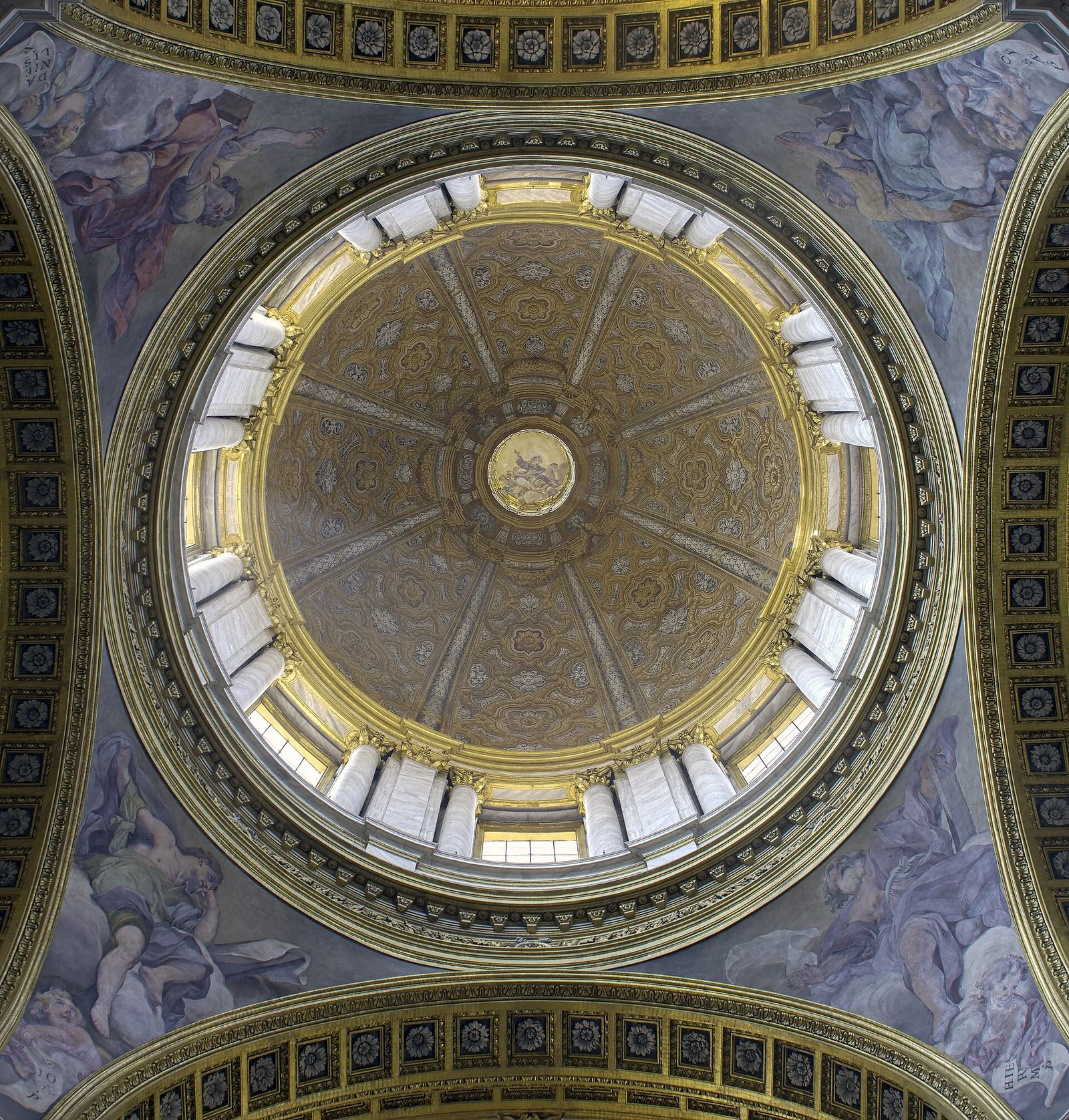
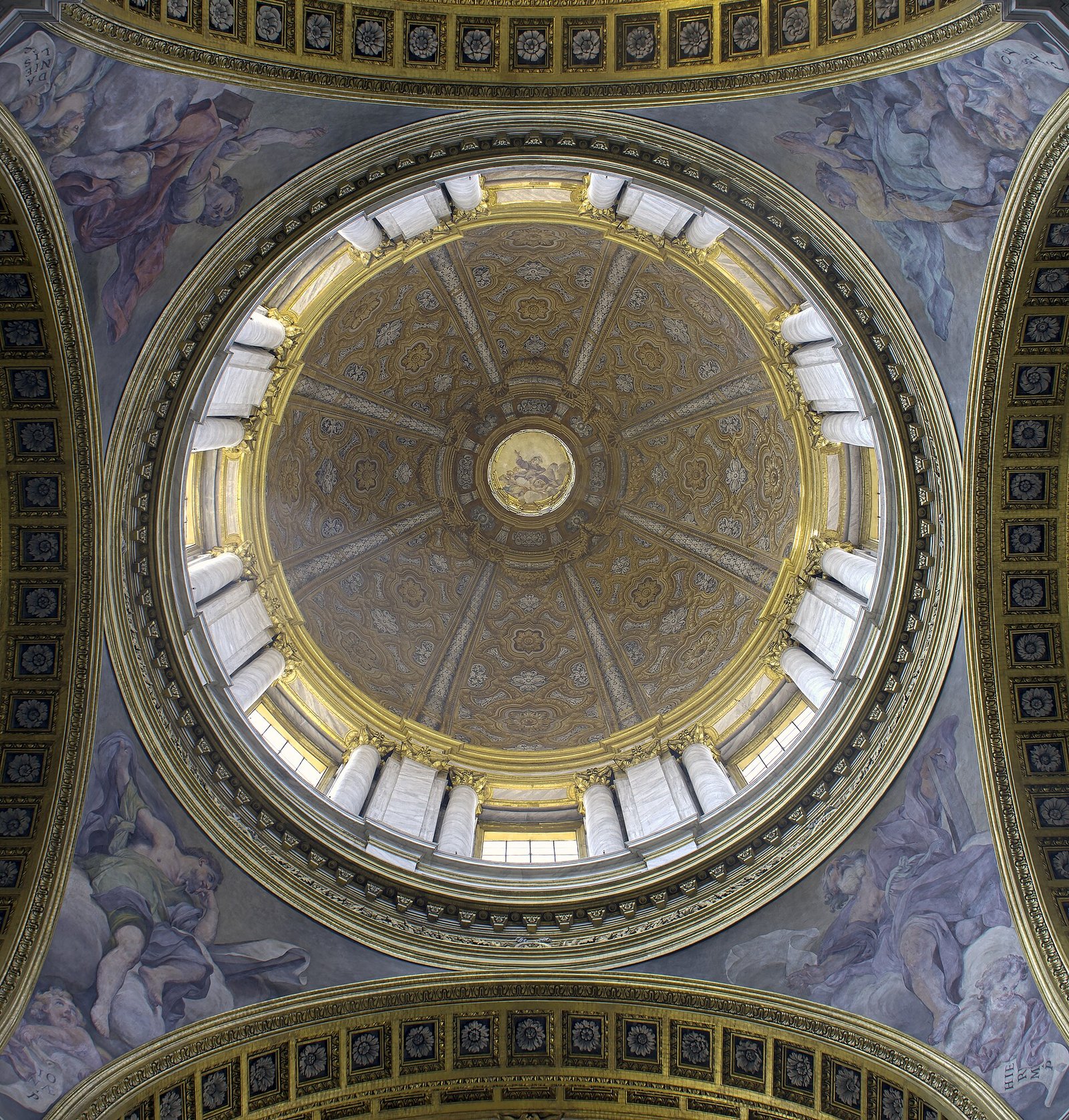
The turning point comes between 1668 and 1669 with Pietro da Cortona, who completes the tribune and designs the dome and the high altar, also taking care of the stucco decoration. The design of the dome is indicated as his last important architectural work. Pietro da Cortona dies on May 16, 1669: the dome will be materially finished in 1688, almost 20 years later, on his design.
This gap between design and execution explains something you don't notice by eye. The dome is Cortonesque in layout, with the tall drum punctuated by eight pillars, the rectangular windows, the eight oval oculi in the intermediate band and the ribbed lead-covered shell, but it was executed by others in an already different climate. Anyone who wants to see Cortona the architect in his most concentrated version has to go to Santi Luca e Martina, in the Roman Forum.
The Facade and Its Author
The facade you see today is not by any of the Longhi and is not by Pietro da Cortona. The design is due to Cardinal Luigi Alessandro Omodei, who financed the work, and the execution was directed by Gian Battista Menicucci together with the Capuchin friar Mario da Canepina. On the date the sources diverge sharply: most of the entries, including that of the city's tourism portal, give 1682-1684. The Italian Wikipedia entry instead reports 1694, citing a printed source of 1808.
The divergence is not irrelevant and it's worth knowing, because the 10 years of difference change the context. In the absence of an archival study available online, the dating most widespread in institutional sources remains that of the 1680s. Anyone writing a thesis should check the documents of the archconfraternity.
The facade has a single order, tripartite, with colossal half-columns with Corinthian capitals covered in yellow stucco, a central portal and two side ones. It is sober compared with what Martino Longhi had imagined, and sober also compared with what is inside. The contrast between a restrained front and a lavish interior is one of the reasons people walk past and don't go in.
The Ambulatory, the Rarest Thing in Here
Behind the high altar runs a wide semicircular corridor that goes around the presbytery as a continuation of the two side aisles. It's called an ambulatory, or ambulacrum, and it's the element that makes this church a case apart in the Roman landscape. The sources, from the Touring Club to the city's portal to the archconfraternity's own entry, define it as unique in Rome.
What an Ambulatory Is and Why Rome Has None
The ambulatory is a typical element of Gothic architecture north of the Alps and of the great French cathedrals: a corridor that lets you walk behind the choir without crossing the presbytery, generally to allow pilgrims to reach the radiating chapels and relics without interrupting the services. In France it is the norm, in Italy it is rare, in Rome it is an isolated case.
The reason is chronological before stylistic. Rome has practically no Gothic architecture: when in France they were building cathedrals with a choir ambulatory, here they kept building basilicas on an early Christian plan, and then went directly to the Renaissance and the Baroque. The only Roman church commonly called Gothic is Santa Maria sopra Minerva, which however has no ambulatory.
The Other Roman Churches That Go Behind the Altar
We looked for Roman counterexamples and the result is that no equivalent ones emerge. Santo Stefano Rotondo, on the Caelian Hill, has concentric annular corridors, but belongs to a completely different type: it is a circular-plan early Christian church, and its ambulatories are rings around a central core, not a corridor behind a choir. Confusing the two is a mistake often read.
Some major basilicas have passages and paths behind the apse tied to the confessio or the crypt, which allow you to pass behind the altar, but these are functional solutions of another nature and not continuous architectural ambulatories. The correct formulation, and the one we would use on a guided visit, is that Santi Ambrogio e Carlo al Corso is the only church in Rome in which the ambulatory appears as a declared choice of layout.
Why Here: the Milan Cathedral
The choice is not a whim. The sources agree in saying that the ambulatory was wanted as an explicit reference to the architecture of the Duomo of Milan, which has one and which is the cathedral of Saint Ambrose and Saint Charles. The national church of the Lombards in Rome cites its own cathedral with an element of layout, not with a decoration. It is a declaration of identity written in the plan.
This is also the reason the ambulatory is not a mere formal flourish: it serves, because it leads to the shrine with the heart relic. Whoever enters and stops in front of the high altar sees Maratta's painting and thinks the church ends there. Whoever continues along the side aisle and turns behind enters another room, lower, more intimate, with its own frescoes on the ceiling.
What You See in the Ambulatory
The frescoes on the ambulatory ceiling continue the allegorical program of the side aisles, with figures of virtues. The sources attribute Devotion to Carlo Ascensi, Humility, prayer, perfection and strength to Giovanni Battista Boncore, Patience, tolerance and prudence to Fabrizio Chiari, and Vigilance to Ludovico Gimignani. They are second-rank names compared with the greats of the Roman Baroque, and it is one of the reasons this part of the church almost never appears in guidebooks.
The Heart of Saint Charles Borromeo
The best-known relic of the basilica is the heart of Saint Charles Borromeo, kept in a reliquary placed in a shrine, that is, a small altar, set against the back of the high altar and therefore facing the ambulatory. It can't be seen from the nave and can't be seen from the presbytery: you have to go around behind. It's the reason many visitors leave the basilica convinced they did not find it.
How It Got Here
On the sequence the sources agree in substance and diverge in details, and it's worth reporting both. The Italian Wikipedia entry writes that in 1613 the relic was sent to Rome from Milan, and in another passage of the same entry that the reliquary was donated to the church in 1614 by Cardinal Federico Borromeo, cousin of the saint. Cathopedia gives 1613 and calls Federico a nephew rather than a cousin.
On the degree of kinship the correct wording is cousin and not nephew: Federico Borromeo was a cousin of Charles. The reading that holds up best is that the relic left Milan in 1613, in the climate of the canonization just occurred, and that the formal donation of the reliquary to the archconfraternity was completed the following year.
Who Federico Borromeo Was
Federico Borromeo, cardinal and archbishop of Milan after his cousin, is the figure who founded the Biblioteca Ambrosiana and whom Italian readers know above all as a character in I Promessi Sposi (The Betrothed). His presence in this story is not occasional: it was he who promoted the cult of Charles and organized the spread of his relics, and the sepulchral monument concerning him is in the left aisle of the basilica.
The Reliquary
The available descriptions speak of a monstrance held by the figure of an angel, with a crystal base. The Cathopedia entry places the tabernacle in a broad chronological span, between 1682 and 1730, which suggests that the present apparatus is the result of later interventions on the relic that arrived in 1613. Above the shrine is a painting of Saint Charles in Adoration of the Virgin and Child, assigned to the school of Giacinto Brandi.
The Relic Has Moved
In 2011, for the fourth centenary of the canonization, the heart left Rome and was taken to Acquarica del Capo, in the province of Lecce, seat of the first parish of the Terra d'Otranto dedicated to the saint. On May 15 it was exposed for veneration during a mass presided over by Cardinal Salvatore De Giorgi, with the placing of a commemorative plaque. It's a useful fact to remember that relics are not fixed furnishings and can be absent.
A Curiosity About Santi Ambrogio e Carlo al Corso
In the ambulatory, on the ceiling, there is a painting turned the opposite way from all the others. It is the Glory of the Angels by Luigi Garzi, made between 1678 and 1681, and it is rotated 180 degrees relative to the neighboring frescoes. Whoever passes under it without knowing thinks they have misread their own orientation, or doesn't notice at all.
The explanation is documented and concerns the history of the building site. The painting was meant to be seen from the high altar, that is, from the side opposite the one from which you look at it today. When the great altarpiece by Carlo Maratta with the Glory of Saints Ambrose and Charles was placed above the shrine, the view from the altar was closed off and Garzi's fresco remained oriented toward a direction that no longer served anyone.
What You See Inside: the Interior and the Works
The interior has three aisles with a Latin cross plan, barrel vaults and six side chapels. It is very bright, thanks to the windowed drum, and is loaded with stuccoes, faux marbles and frescoes. The entries describe it as one of the most characteristic examples of the theatrical lavishness of the late Roman Baroque, and it's a correct definition: here the richness is declared, not hinted.
The Vault of the Central Nave
The Fall of the Rebel Angels is the fresco that occupies the vault of the central nave and it was made by Giacinto Brandi between 1676 and 1679. It depicts Saint Michael the Archangel leading the host of angels against the rebel angels led by Lucifer. It's an illusionistic machine of great ambition and should be viewed standing still in the center of the nave, not walking. Also by Brandi are the semi-dome of the apse, with a Saint Charles among the Plague Victims, the pendentives of the dome with the prophets and the Saints in Glory in the arms of the transept. Giovanni Battista Beinaschi collaborated on the decoration of the dome.
The Altarpiece of the High Altar
The Glory of Saints Ambrose and Charles above the high altar is by Carlo Maratta and is dated between 1685 and 1690. This point must be clarified because it circulates with a wrong attribution: the Glory is by Maratta, not by Pietro da Cortona. To Cortona are due the tribune, the design of the dome, that of the altar and the stucco decoration, that is, the architecture and the apparatus, not the painted altarpiece.
Maratta is the painter who closes the Roman Baroque and opens onto 18th-century classicism, and he is a figure you meet everywhere in Rome without noticing. His Immaculate Conception in the Cybo Chapel at Santa Maria del Popolo is repeated here as a mosaic copy on the altar of the right transept, erected in 1769, probably by Paolo Posi on behalf of Cardinal Erasmo Paravicini.
Stuccoes, Chapels and Altars
The stucco decoration is by Giacomo and Cosimo Fancelli, two names that anyone who frequents the Roman Baroque finds again in the building sites of Bernini and Pietro da Cortona. The side aisles have a program of allegorical virtues entrusted to different hands: Moderation by Paolo Albertoni, Justice, Peace, Law and Truth by Girolamo Troppa, Religion, strength, purity and chastity by Beinaschi in the right aisle. Faith by Luigi Garzi, Mercy by Francesco Rosa, Hope and truth by Pio Paolini in the left.
In the first chapel on the left is the altarpiece with The Prophecy of Saint Barnabas by Pier Francesco Mola. In the chapel dedicated to Saint Philip Neri are two canvases by Giacomo Zoboli from 1726, Saint Aloysius Gonzaga among the Plague Victims and The Communion of Saint Stanislaus Kostka. The second chapel of the right aisle is dedicated to Mary Help of Christians and keeps an image of the Virgin donated by Saint Vincent Pallotti in the 1800s.
The Chapel of Saint Olav
In the left aisle opens a chapel you don't expect in a Lombard church: it is dedicated to Saint Olav, king of Norway, killed in the battle of Stiklestad in 1030, and works as the national chapel of the Norwegians in Rome. It was inaugurated by Cardinal Lucido Maria Parocchi on April 9, 1893, on the 50th anniversary of the first mass legally celebrated in Norway after the Reformation.
The altarpiece, oil on canvas by the Polish artist Pius Weloński, depicts the Viking king's victory over his own pagan past, represented by a dragon. It was donated to Pope Leo XIII on March 3, 1893 by Bishop Johannes Olav Fallize, then apostolic vicar of Norway, for the 50th anniversary of his episcopal ordination. In the altar are buried the relics of a Roman martyr, Saint Saturninus, of whom nothing is known except the name.
Mass in Norwegian is celebrated at Christmas, on May 17, which is the Norwegian national holiday, and on October 16, the feast of the conversion of Saint Olav. Many Norwegian expatriates attend, even non-Catholics. Anyone who happens into the basilica on one of these dates finds a Lombard church that speaks Norwegian, which is one of the most Roman things that exist.
Something Nobody Tells You About Santi Ambrogio e Carlo al Corso
The most important painting this church has owned is no longer here today. It is the Madonna and Child with Four Doctors of the Church by Moretto, painted between 1540 and 1545, which is in the Städelsches Kunstinstitut in Frankfurt am Main. No panel in the basilica points it out, and no Roman guide tells it, because telling what is missing suits nobody.
The second thing nobody says concerns the underground. The basilica stands in the ancient Campo Marzio, in an area that in Roman times was built up with blocks, warehouses and shops along Via Lata. The studies carried out on the underground of the nearby Santa Maria in via Lata have yielded structures of that type, and by analogy it is presumed that under this church there is something similar.
The conditional however remains obligatory, and it should be said clearly: under Santi Ambrogio e Carlo there are no published systematic excavations or visitable archaeological routes. The church of the 1500s and then that of the 1600s were built on top without investigation, and the demolition of the previous building took place without preserving a record of it. Anyone looking for the Roman underground in this area has to go to Santa Maria in via Lata, not here.
The Advice I Give You for Visiting Santi Ambrogio e Carlo al Corso
Go in and don't stop at the back. The instinctive gesture, in a church like this, is to stay on the threshold, look at the vault, take two steps into the central nave and leave. Done that way, the visit lasts four minutes and leaves nothing. The church is understood only by walking along a side aisle to the end, going around behind the altar and walking the whole ambulatory.
The complete tour takes 20 minutes and should be done in a precise order. First the central nave, standing still in the center for Brandi's vault, then the right aisle with the chapels, then the right transept with the 1769 altar, then the ambulatory from right to left with a pause in front of the shrine of the heart, then the left transept, then the left aisle with the chapel of Saint Olav and the monument to Federico Borromeo.
The Right Time
The light here depends on the drum of the dome, therefore on the position of the sun. The best window is late morning on a clear day, when the drum sends light onto the vault and the apse without backlight. In late winter afternoons the church falls into dimness and the Fall of the Rebel Angels becomes illegible. Early afternoon is often awkward because of closures.
The Services
Visits are not allowed during masses, and the basilica states this explicitly. Weekday masses are at 7:30, 12:00 and 18:30. On Sundays and holidays they are at 8:00, 9:30, 11:00, 12:00 and 18:30. Anyone who wants to walk around at leisure should avoid those slots and allow for the calendar changing on Lombard or Norwegian feast days.
Sensible Pairings
The basilica works well within a tour of the Tridente. The package we recommend is Piazza del Popolo, Santa Maria del Popolo, a walk down the Corso with a stop here, then cutting toward the Ara Pacis and the Mausoleum of Augustus via San Rocco all'Augusteo, which is 200 meters away and which almost nobody opens. A full half day, all on foot, with no tickets except the one for the Ara Pacis.
Another Well-Known Fact, Yet Rarely Cited
The dome of this basilica is one of the largest in Rome, and almost nobody knows it because it can't be seen from the Corso. Whoever walks under the facade has no way of guessing that behind it is a structure of those dimensions: the narrow front between the buildings hides it completely. You see it only from far away, from the skyline, or by going around the back toward Piazza Augusto Imperatore.
On the exact ranking the sources diverge and it's worth saying so. Italian Wikipedia places it fifth in width among Roman domes, after the Pantheon, St. Peter's, Sant'Andrea della Valle and the basilica of Santi Pietro e Paolo at EUR. Other popular entries put it third after St. Peter's and Sant'Andrea della Valle, evidently counting only the domes of modern churches.
The discrepancy depends on what you put in the list. Including the Pantheon, which is an ancient dome, and including Santi Pietro e Paolo, which is from the 1900s, you get fifth place. Restricting to Baroque domes alone, the count changes. The cautious wording, the one we would use, is that this is among the five widest domes in the city.
The practical fact that follows is another. The tall, windowed drum serves to light the interior, and it works: this is one of the brightest Roman Baroque churches, much brighter than you'd expect from a 1600s building squeezed between palaces. Anyone used to the dimness of the Gesù or Sant'Ignazio notices the difference as soon as they enter.
The Right Photo to Take at Santi Ambrogio e Carlo al Corso
The photo that's worth it is not taken from the Corso. From the street the facade is squashed between the buildings and there is not enough room to step back and frame it whole without distortion: what comes out is a crooked yellow front, the same as a thousand others. Anyone who wants a decent photograph has to go around the back.
The Back, Which Is the Right Spot
From Piazza Augusto Imperatore, with the Mausoleum of Augustus in front, you frame the apse of the basilica with the dome rising behind it and the two colossal statues of the titular saints at the sides. The sources list these statues among the largest in Rome. The composition puts together a monument of the first century BC and a Baroque machine of the 1600s, which is exactly how this city holds together.
The best time is late afternoon, when the raking sun hits the flank of the dome and the brick drums warm up in color. The square is wide and lets you step back as far as you need. With a moderate wide-angle lens you can keep the Mausoleum and the dome in the same frame.
Inside, the Vault
The other photograph that holds up is the one of Brandi's vault, taken standing still in the center of the nave and pointing straight up. The Fall of the Rebel Angels is built for a central view and from any other position the figures go out of alignment. You need a steady hand or a support, because the interior light, however good for a Baroque church, remains insufficient without a tripod.
The Detail Not to Miss
The third shot is the shrine with the reliquary in the ambulatory, taken at three-quarters and not head-on, so as to keep in the curving course of the corridor too. It's a photograph that explains something: it says where the relic is and why you have to go around behind to find it. Head-on, instead, it gives back only a gilded object in dimness, with no context.
Some Important Events That Happened Here in History
On August 29, 1471 Pope Sixtus IV approves the foundation of the Confraternity of the Lombards and assigns them the church of San Nicola de Tufis. It is the birth certificate of the institution that will build everything else, and remains the date from which the organized Lombard presence at this point in Rome is counted.
In 1610 Charles Borromeo is canonized. The confraternity adds his name to that of Saint Ambrose and decides on total reconstruction. It's the decision that demolishes a church of the 10th century and opens a new one of incomparable size, in a phase when Rome is rewriting its center around the axis of the Corso.
In 1612 the works start on a design by Onorio Longhi. In 1613 the heart relic arrives from Milan. In 1614, according to the most widespread dating, Cardinal Federico Borromeo formally donates the reliquary. They are three dense years in which the identity of the basilica is fixed forever.
Between 1668 and 1669 Pietro da Cortona steps in, completing the tribune and designing dome and altar. He dies in May 1669. The dome is finished in 1688. The facade is built on a design by Cardinal Luigi Alessandro Omodei, under the direction of Gian Battista Menicucci and Mario da Canepina, at a date that the sources place between 1682 and 1694.
From 1906 the care of the basilica is entrusted to the priests of the Institute of Charity, that is, the Rosminians, who still officiate it. It is an institutional step that changes the daily management without touching the link with the Lombard archconfraternity, which continues to exist and to have its seat in the palace next door.
On December 21, 1929 Pope Pius XI raises the church to the dignity of minor basilica with the apostolic brief Lombardi in Urbe. The same pontificate leaves other traces in the building: the Tamburini organ of 1928, the altar of the Blessed Sacrament by Cesare Bazzani of 1929 and a restoration of the high altar.
Between 1987 and 2004 the basilica is the object of a restoration campaign promoted by the archconfraternity and documented in a dedicated publication. It is the intervention that gave legibility back to the frescoes and stuccoes, and explains why today the interior appears in better condition than many Roman churches of the same era.
Who Passed Through Santi Ambrogio e Carlo al Corso
Angelo Giuseppe Roncalli, the future Pope John XXIII, was ordained bishop in this basilica on March 19, 1925, before leaving for Bulgaria as apostolic visitor. The official biography published by the Holy See confirms the date and the generic place, Rome, while the precise indication of the church appears in the literature on this building. It is one of those pieces of information that the sources confirm at different levels of detail.
Also here were ordained bishops the Milanese Efrem Forni, on February 20, 1938, and Clemente Riva, on June 22, 1975. Riva, who would become auxiliary bishop of Rome and a well-known figure of ecumenical and interreligious dialogue in the city, had been rector of this very basilica in 1966. It is a fairly rare case of personal continuity with the building.
Pietro da Cortona left here his last important architectural work, the design of the dome. Anyone who wants to follow his Roman path finds at Santi Luca e Martina his most radical experiment, and at the Chiesa Nuova and Santa Maria della Pace the proofs of urban direction. He died in 1669 without seeing this dome built.
Carlo Maratta passed through here at the end of his career with the altarpiece of the high altar, after dominating Roman painting for decades. His name returns in the basilica also in indirect form, with the mosaic copy of the Immaculate Conception of the Cybo Chapel of Santa Maria del Popolo installed on the altar of the right transept.
Onorio Longhi, the designer, got here after a banishment from Rome and a papal pardon, with behind him the friendship with Caravaggio and the night on Via di Pallacorda. His son Martino Longhi the Younger spent a good part of his career here on a facade design that he never saw built. Father and son are the Lombard thread that holds the whole story together.
Federico Borromeo, cardinal and founder of the Ambrosiana, is present here with the donation of the reliquary and with a sepulchral monument in the left aisle. Saint Vincent Pallotti donated in the 1800s the Marian image of the second chapel on the right. Bishop Johannes Olav Fallize brought in 1893 the altarpiece that made the Lombard basilica also the national shrine of the Norwegians.
Hours and Opening Regime
The basilica is a rectory church open for worship and entrance is free, as in all active Roman churches. There is no ticket office, no reservation, no museum route. The opening regime is that of the churches of the center: morning and afternoon, with a closure in the middle hours of the day that you must allow for.
What the Sources Say
The sources consulted do not agree on a single time window. Some popular entries indicate continuous opening from 7:00 to 19:00, though noting themselves that the information needs confirming. The Rome city tourism portal publishes the mass times and states explicitly that during services visits are not possible and that times may vary.
The cautious reading is this: the basilica opens early in the morning, before the 7:30 mass, closes at midday in the early afternoon window like almost all Roman rectory churches, and reopens in the late afternoon until after the 18:30 mass. If you want certainty, call the published numbers, 06 68805941 and 06 68192527.
When the Church Can't Be Visited
During all masses visits are suspended. Weekday masses are three, at 7:30, 12:00 and 18:30. On holidays they become five, at 8:00, 9:30, 11:00, 12:00 and 18:30. On Sunday mornings, then, the useful windows for walking around at leisure are very narrow. Saturday afternoon and early weekday afternoon remain the best slots.
Special dates must be added. On November 4, the feast of Saint Charles Borromeo, and December 7, the feast of Saint Ambrose, the basilica is in solemnity mode with celebrations and Lombard institutional presence. On May 17 and October 16 there are the Norwegian celebrations. On days of funerals or ceremonies access may be barred without notice.
Accessibility
The entrance from the Corso has steps. The church has a 1600s layout and no complete accessible route or elevator is declared. The ambulatory, which is the part that justifies the visit, is reached from the side aisles on a level floor, so whoever manages to get in gets there. It's best to ask in the sacristy, because conditions can change.
The Basilica, Via del Corso and the Roman Carnival
This church faces what was for three centuries the track of a horse race. Via del Corso carries that name because of the races of the barbary horses that took place along its course during Carnival, and the basilica was an obligatory spectator of them throughout its modern history. The subject would deserve a page of its own, and in fact we have it: the Roman Carnival.
The mechanism was simple and brutal. Horses without jockeys started from Piazza del Popolo and ran along the whole Corso to Piazza Venezia, amid the crowd held back by improvised barriers, with everything you can imagine in terms of accidents. The race of the moccoletti closed Carnival with the city lit by candles that each person tried to blow out on the others.
The basilica is in the upper part of the course, a few hundred meters from the start, that is, in the stretch where the horses were fastest. The stands and windows overlooking the Corso were rented at a high price, and the buildings next to the church were no exception. For the complete history of the street, from its origins as Via Lata to its pedestrianization, we refer you to the page on Via del Corso.
The Neighborhood Around: What Is Five Minutes Away
The basilica is in one of the points with the highest density of things to see in all of Rome, and it's worth knowing what is within a short walk in order to build a sensible tour instead of bouncing around at random.
Toward the Tiber
Passing behind the church you reach in two minutes Piazza Augusto Imperatore with the Mausoleum of Augustus and, alongside, the Ara Pacis museum. Continuing on Via di Ripetta you go down toward the river and cross San Rocco all'Augusteo, a church that almost nobody opens and that has been there since the 1500s.
Toward Piazza del Popolo
Going up the Corso you reach in five minutes Piazza del Popolo, with the Flaminio obelisk, the twin churches and Santa Maria del Popolo, which holds two Caravaggios in the Cerasi Chapel. From there you climb to the Pincio or enter Villa Borghese.
Toward the Center
Going down the Corso you find San Lorenzo in Lucina, which is the reference parish of this basilica, then Piazza Colonna with Montecitorio and the obelisk, then San Marcello al Corso and Palazzo Doria Pamphilj with its gallery.
Toward Piazza di Spagna and the Quirinal
Cutting left you reach Piazza di Spagna with the Barcaccia and the Trinità dei Monti, or you continue toward San Silvestro in Capite. Climbing further you enter the quadrant of Sant'Andrea al Quirinale and the Galleria Colonna.
Eating in the Area: Let's Be Clear
The band that runs from the upper Corso to Piazza del Popolo, with the two side streets of Via di Ripetta and Via del Babuino, is one of the areas of Rome most exposed to the problem of restaurants built on passing trade. The reasons are structural: enormous foot traffic, very high rents, customers who pass once and don't return. Under these conditions quality is not rewarded by the market, because the market has no memory.
The Signs to Recognize
The menu with photographs of the dishes displayed outside is the first. No venue that works with regular customers needs to show the image of a carbonara: the photograph is for those who don't read Italian and will never come back. The second is the person standing at the door inviting you to come in and sit: whoever has full tables doesn't send anyone out on the street to recruit.
The third sign is the woman rolling fresh pasta behind the glass or even on the sidewalk. It must be said without half measures: it's a staged setup, designed to be photographed, and it says nothing about what comes out of the kitchen. In the Roman trattorias that work, pasta is made in the back and not in the window, because the window serves another purpose.
The fourth is the hours. A venue open without a break from nine in the morning to midnight doesn't have a kitchen crew working two defined services, it has one that reheats. Serious Roman kitchens close in the afternoon, and that pause is the most reliable clue that exists in this neighborhood.
The fifth concerns the venues placed in front of monuments. Around Piazza del Popolo and in the final stretch of the Corso there are businesses that adjust the bill to the customer in front of them, with items without a price on the menu, cover charges and service added at the end of the bill and different price lists between the indoor room and the outside tables. Asking the price before ordering is not rudeness, it's bookkeeping.
The Chains with Repeated Signs
In the center of Rome in recent years a restaurant style with repeated signs has taken hold, with the same menu in several points of the city, the line at the entrance and the product built to be photographed. It works very well as a tourist attraction and Romans don't go there. It's not snobbery, it's that this model sells a uniform experience, and those who live in the city look for the opposite.
On this axis the repeated signs are particularly dense, because the foot traffic on the Corso is among the highest in Italy and that kind of business settles exactly where the flow is guaranteed. Recognizing them is easy: same setup, same sign, same line. They are not a scam, they simply tell you nothing about the city you are in.
The Criterion, Which Is Only One
Look at who is sitting at the tables and in what language they order. If there are people ordering in Italian without opening the menu, the place holds up. If at the tables there are only patrons with backpacks, maps and cameras, you move on without regret. The criterion works in every city and in Rome, in this quadrant, it works more than elsewhere.
Where to Move
Moving 300 meters away from the Corso the picture changes. The side streets toward Via di Ripetta and the area behind the Mausoleum of Augustus still have businesses that work with office workers and residents at lunch. Whoever has time does better to go down toward Campo Marzio or go back up toward Via del Babuino in the inner side streets, where prices remain high but the relationship with the customer is different.
If you want an already filtered reference you can consult Daniele Dezi's personal list on Google Maps, a curated and unsponsored collection. For the full reasoning on how to choose in Rome without falling into the traps we refer you to the page on where to eat in Rome, and for venues with a real story to the page on Rome's historic cafés and shops.
Frequently Asked Questions About Santi Ambrogio e Carlo al Corso
How much does it cost to enter the basilica of Santi Ambrogio e Carlo al Corso?
Entrance is free. The basilica is a rectory church open for worship and has no ticket office, reservation or paid route. If you find a price online referring to this church, it is a package sold by a third-party operator that includes other stops, not a ticket for the basilica.
What are the opening hours of the basilica of Santi Ambrogio e Carlo al Corso?
The hours published by the sources do not match. Some entries indicate opening from 7:00 to 19:00 while noting themselves that the information needs confirming, while the city portal publishes only the mass times, warning that they may vary. The realistic reading is opening early in the morning, closing in the early afternoon and reopening until after 18:30. Call the numbers 06 68805941 and 06 68192527.
Where exactly is the heart of Saint Charles Borromeo?
The heart is kept in a reliquary inside a shrine set against the back of the high altar, therefore visible only from the ambulatory that goes around behind the presbytery. From the central nave it can't be seen. You have to walk a side aisle to the end and go around behind the altar. The relic arrived from Milan in 1613 and the reliquary was donated by Cardinal Federico Borromeo, cousin of the saint, according to the sources in 1613 or 1614.
Is the basilica of Santi Ambrogio e Carlo al Corso the same thing as San Carlo alle Quattro Fontane?
No, they are two different and distant churches. San Carlo alle Quattro Fontane is on the Quirinal, is the work of Borromini and is very small, so much that Romans call it San Carlino. There is also San Carlo ai Catinari, near Campo de' Fiori, which is the church of the Barnabites. To get here type Santi Ambrogio e Carlo al Corso or Via del Corso 437.
What is the ambulatory and why is it important?
The ambulatory is a corridor that goes around behind the presbytery as a continuation of the side aisles. The sources define it as unique in Rome and link it to a deliberate reference to the architecture of the Duomo of Milan, the cathedral of Saint Ambrose and Saint Charles. It is a typical element of Gothic architecture north of the Alps and in a Roman Baroque church it is entirely anomalous.
Is the Glory on the high altar by Pietro da Cortona?
No. The Glory of Saints Ambrose and Charles above the high altar is by Carlo Maratta and is dated between 1685 and 1690. To Pietro da Cortona are due the tribune, the design of the dome and the altar and the stucco decoration, that is, the architectural part. The attribution of the altarpiece to Cortona often circulates and is wrong.
How long does it take to visit the basilica?
For a quick pass through the central nave five minutes are enough, but it's a tour that leaves nothing. The complete route, with side aisles, transepts, ambulatory, shrine of the heart and chapel of Saint Olav, takes 20 or 25 minutes. Adding the stop at the back to see the apse, dome and colossal statues, you reach 40 minutes.
Can you take photographs inside the basilica?
Photography without flash and without a tripod is generally tolerated in Roman churches open for worship, unless a notice at the entrance says otherwise and unless a service is in progress. During masses the visit is suspended and so is photography. When in doubt, ask in the sacristy, which is the simplest and quickest thing.
Is the basilica accessible to those with mobility difficulties?
The entrance from the Corso has steps and no complete accessible route is declared. Once inside, the floor of the aisles and the ambulatory is level, so the most interesting part is reachable. Anyone using a wheelchair should have the situation at the entrance checked in advance, because conditions can change and are not published.
Who Wrote This Page
The page is curated by the editorial team of Tour Leader Pro, a Rome-based project office that designs and coordinates visits, itineraries and cultural events in Rome and Lazio. Hours, contacts and access conditions reported here are checked on the date of publication against the official sources cited in the text, and should be rechecked before leaving because they change frequently. Reports of outdated data are welcome.
If you have to build a Roman itinerary that holds together rectory churches with their own hours, churches that close in the early afternoon, services that suspend visits without notice and walking distances that look like nothing on paper and are not in the crowd of the Corso, for yourself or for a group, you'll find planning tools on Tour Leader Pro, where we collect materials designed for those who lead visits and for those who organize on their own.
For the broader picture, which includes trains, airports, rentals and destinations in Lazio outside the center of Rome, from the Castelli to the lakes to the coast, a useful resource is Italy Planner.