Roman Carnival
In short. The Roman Carnival is a festival that today almost no longer exists in Rome, and that for four centuries was the most famous thing the city produced, more than the museums and more than the papal ceremonies.
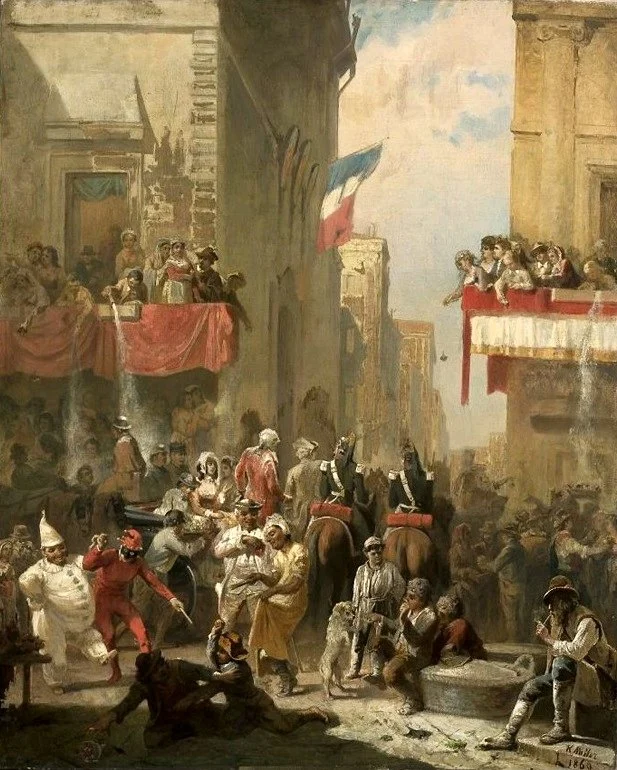
The Roman Carnival is a festival that today almost no longer exists in Rome, and that for four centuries was the most famous thing the city produced, more than the museums and more than the papal ceremonies. It lasted around 10 days, occupied a single street, today's Via del Corso, and ended every evening with a race of riderless horses launched into the crowd. Anyone looking today for the Roman Carnival finds a few neighborhood parades and the frappe in pastry shops, and does well to know that what they are looking for was taken apart piece by piece between 1668 and 1882. This page lines up what really happened, what the sources say, where the sources diverge from one another, what remains in Rome and where in Lazio the festival is still alive.
What the Roman Carnival is and why you can't find it today
The Roman Carnival was the cycle of festivities held in Rome in the days before Lent, under the government of the popes and until the first years after 1870. It was not a festival spread across the whole city: it had a precise stage, the straight stretch between Piazza del Popolo and Piazza Venezia, and a program that repeated every day with few variations. Around that straight stretch revolved races, floats, masks, paid grandstands and a number of foreign visitors who came to Rome on purpose.
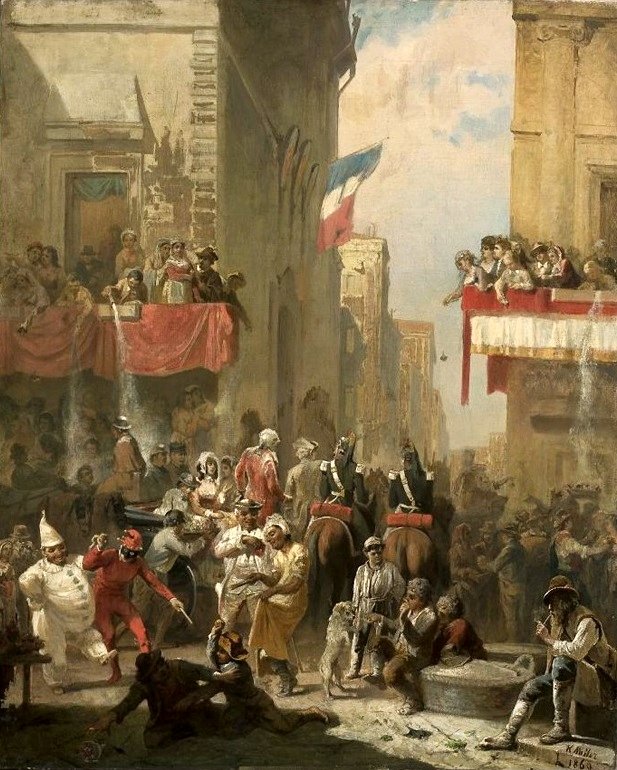
Today nothing of that apparatus remains standing. The horse race was abandoned in 1882, the moccoletti ended with it, the games imposed on the Jews of the ghetto had already been abolished in 1668, and the street that hosted everything has become the shopping street. Anyone arriving in Rome in February looking for the Roman Carnival finds Via del Corso with its shop windows and end-of-season sales.
Why the street is called Corso
The name of the street comes precisely from the race. The street was called Via Lata, the urban stretch of the ancient Via Flaminia, and took the name Via del Corso because for centuries the palio of the barberi horses was run there. The ancient place name survives in a church, the Basilica of Santa Maria in Via Lata, which faces the Corso at the height of Palazzo Doria Pamphilj.
The movable dates: how Carnival is calculated
Carnival has no fixed date because it depends on Easter, which is itself a movable feast. The practical rule is simple to apply: Fat Tuesday, the last day of Carnival, falls 47 days before Easter Sunday. The following day is Ash Wednesday and Lent begins. Easter in turn falls on the first Sunday after the first full moon following the spring equinox, and hence the oscillation: Fat Tuesday fell on February 17 in 2026, falls on February 9 in 2027 and February 29 in 2028.
Fat Thursday, which opens the final week, falls six days before Fat Tuesday. Between the two, Carnival Sunday is the day of the parades in most towns of Lazio, because it is the only one on which everyone works and on which children have no school. Anyone planning a trip around Carnival must start from the date of Easter that year and count backward.
How long the Carnival of the popes lasted
The historical duration of the Roman Carnival was not fixed and changed several times by papal decision. In the consolidated form of the modern age it occupied the last 8 days before Ash Wednesday, excluding Fridays and in some periods also Sundays, considered improper days for public amusements. The sources that describe an 11-day Carnival refer to phases in which the cycle had been lengthened.
The official start was given from the Campidoglio, and the closing came with the Ave Maria on Fat Tuesday, when the bell marked the end of license and the beginning of fasting. That sharp border between revelry and penance is the reason for the festival's existence: without Lent Carnival would make no sense, and that is why its date moves together with that of Easter.
Carnival at Testaccio: what the sources really say
Before arriving on the Corso, the Roman Carnival took place at the foot of Monte Testaccio, the artificial hill made of amphora shards that closes the district to the south. The medieval sources speak of carnival ludi held there, with the participation of the Roman people organized by district and the presence of the pope or his representatives. It is the period in which the Comune of Rome looks for a civic festival of its own and places it in a spot outside the built-up area, where there is room for the crowd.
On the precise forms of those games the documentation is much poorer than current popularization lets on. The medieval chronicles are brief, often secondhand, and recent studies on the ludi of Testaccio have shown how much the 19th-century reconstruction added color where the documents remain generic. Anyone who reads very detailed descriptions of those days would do well to ask on what text they are based.
The killing of animals
On the killing of animals the sources agree in substance and diverge in the details. The documents and reconstructions speak of bulls and pigs involved in the games, in forms that included fights and public slaughter, with the meat then distributed. The most recurrent description concerns the pigs made to roll down the slope of the hill inside carts or cages, with the crowd recovering them at the bottom.
It is best to treat this part with measure, and not out of modesty. The problem is that the scene of the pigs rolling down from Testaccio circulates in dozens of different versions, with numbers and methods that change from one account to another, and that the primary sources cited are almost always the same two or three, read through later reworkings. What holds up is the general fact: the ludi of Testaccio included the public killing of animals and a distribution of meat to the people. The scenographic details hold up much less.
The place, on the other hand, can still be visited. The Monte dei Cocci is there, about 50 meters high and made entirely of fragments of Roman olive-oil amphorae, and it opens only with guided visits by reservation. The context of the district is reconstructed on the page about Testaccio and in the rooms of the Museo Diffuso del Rione Testaccio.
Paul II and the move to the Corso
The turning point comes in the mid-1400s with Pietro Barbo, a Venetian, pope from 1464 with the name Paul II. Barbo was having his palace built next to San Marco, the building we now know as Palazzo Venezia, and moved the carnival festivities from Testaccio to Via Lata, which passed in front of him. The sources place the intervention around 1466, with the fixing of the rules of the races. From then on Carnival has an axis and a direction: it starts from Piazza del Popolo, the gateway to the city for those arriving from the north, and ends under the pope's palace, which today houses the National Museum of Palazzo Venezia.
The reason for that move is simple and has little to do with devotion. A pope who builds a new residence wants the city's most popular festival to take place under his windows, and to be able to watch it from the balcony. Carnival thus becomes a court spectacle offered to the people and at the same time an occasion of prestige, with a declared budget of hundreds of gold florins charged to the Apostolic Chamber.
The races by category
The races were not just one. The program provided for separate competitions by categories of runners, and this is the point where the Roman Carnival shows its least pleasant face. The boys ran, the old men ran, the donkeys and the buffaloes ran, and the Jews of the ghetto ran, obliged to do so. The race of the barberi horses was the final piece and the one that drew the paying public.
The race of the barberi: how it really worked
The barberi were horses of small size and sturdy build, originally from Barbary, that is, from the coastal strip of northwestern Africa. The name indicated the breed and not the Barberini family, with which it has nothing to do. In practice many of the horses entered belonged to the stables of the Roman aristocratic families, who ran for prestige and for the palio, a banner of fine cloth given as the prize.
The feature of the race was that the horses ran loose, that is, without a jockey. They were held back at the start by men called barbareschi, lined up behind a rope stretched across the street, and released all together at the signal. From that moment they ran alone along the Corso, driven by the crowd on the sides and by a series of spurs fixed to the back.
The spurs, which is the part that is told least
The sources describe two systems for keeping the horses running. The first consisted of balls fitted with sharp points, fastened to the flanks or the rump, which pricked the animal at every leap. The second, reported by several descriptions, involved applying boiling pitch to the hindquarters. Dickens, who witnessed the race in 1845, describes the heavy little balls with points hung at the horses' sides to spur them on.
The start at Piazza del Popolo
The start took place at the northern end of the Corso, in the mouth between the twin churches of Piazza del Popolo. The piazza offered the space to gather the horses, the owners and the barbareschi, and to hold the crowd that wanted to see the start. Anyone who today arrives in that piazza from Santa Maria del Popolo and looks south sees exactly the funnel that was entered.
Above the piazza is the terrace of the Pincio, which then as now was the point from which the whole scene could be overlooked. At the center of the piazza rises the Flaminian Obelisk, brought to Rome by Augustus and placed there by Sixtus V. Anyone who wants to understand the race must stand up there and look down.
The ripresa at Piazza Venezia
The worst moment was the arrival, which was called the ripresa. The horses reached the southern end of the Corso at full speed and were stopped by large canvas sheets stretched across the street, against which they crashed, while the barbareschi tried to grab them. It was the point where the accidents were concentrated, both for the animals and for those who were there.
Period prints and photographs from the late 19th century document that scene with precision: a mass of people pressed against the houses, the swollen canvases, the horses piling up on one another. The place name of the ripresa of the barberi remains in the captions of the images kept in the photographic archives and in the collections of the Museo di Roma at Palazzo Braschi, which holds views and paintings of the Carnival.
Where it could be watched and how much it cost
Along the whole Corso, wooden structures, stands and grandstands were put up, rented to wealthy families and foreign travelers. The price changed according to the floor, the position and the day, with the highest in the last days and in the central stretch, toward Piazza Colonna. The windows of the palaces were rented separately, and the owners made an income from them.
The accident and the end of the race: the date almost nobody reports the same way
Three different dates circulate for the abolition of the race of the barberi, and it is the point on which it pays to be precise, because almost all popular texts pick one and treat it as certain. The versions in circulation are 1874, with a decree attributed to Victor Emmanuel II after the death of a boy who was run over. 1882, with a fatal accident on the last day of Carnival. And 1883, given as the year of the formal ban.
The most solid source we have read is a contemporary chronicle. Emma Perodi, a journalist who lived in Rome from 1878 and published a year-by-year chronicle of the Italian city from 1870 to 1895, tells the Carnival of 1882 in a detailed way: in the first days the people did not hear the start signal and found the horses upon them, with two seriously injured, but the race continued in the following days. On the last day, at the height of San Lorenzo in Lucina, a barbero knocked a person down and fell on top of them. The horse that followed met the same fate and in the fall ran over 11 people, two of whom died.
The sequel, in the same account, explains how the tradition ended. The event made such an impression in the city that it became the subject of an interpellation in the Chamber, and Prime Minister Agostino Depretis promised to intervene with the mayor so that the races would no longer be held. From that year the custom was abandoned. Not a royal decree, then, but political pressure following an accident that killed two people in the middle of the crowd.
The chronology helps to discard the most widespread version. Victor Emmanuel II died in January 1878, so he cannot have signed anything in 1883. And the date of 1874, which also recurs on many pages, finds no confirmation in a contemporary chronicle comparable to that of 1882. The 1883 version is explained as the year of the first Carnival without the race. Anyone who has to cite a date in a serious text should refer to the last Carnival with the race, 1882, and say that the ban was not a solemn act but an agreed abandonment.
The church cited in the account is still there, on the Corso, and it is the Basilica of San Lorenzo in Lucina: the point where the street widens slightly and where, according to the chronicle, the horses lost their footing. Anyone who passes there today walks on the site of the last accident of the race of the barberi.
The festival of the moccoletti, the last evening
The closing of the Roman Carnival was the festival of the moccoletti, which took place at sunset on Fat Tuesday along the whole Corso. Each participant held a lit moccolo, that is, a wax candle of variable size, from the thick taper to the small candle, and the game consisted of two simultaneous things: keeping your own lit and putting out everyone else's. The sources date the appearance of this form of the festival to 1773.
The cry that accompanied the snuffing out was senza moccolo, repeated in chorus against those left in the dark, and Dickens reports it that way in his account of 1845. Those left without light, according to the descriptions, had to take off their mask, which in the code of the festival was equivalent to being eliminated from the game. Candles were put out with handkerchiefs, with puffs of breath, with canes extended from the windows.
The scene that all witnesses describe is the same: a street more than a kilometer and a half long, all lit by thousands of little flames that light up and go out, with the windows and the grandstands taking part from above. Then, at the Ave Maria, everything stopped at once. The next day was Ash Wednesday, and Carnival was over.
What it meant to put out other people's candles
Scholars read the moccoletti as a symbolic funeral of Carnival, and the reading holds up on its own just by looking at the mechanics of the game. A festival that ends with everyone trying to put out someone else's light, and that closes in the dark at the sound of the bell, stages its own death and opens the time of fasting. There is no need to add anything.
The game was also a formidable leveler. In that half hour, according to the descriptions of travelers, the cardinal in his carriage and the porter on foot snuffed out each other's candle without distinction of rank, and it was the only moment of the year in which this was possible in Rome. Once the Ave Maria was over, order returned to where it had been before.
The games imposed on the Jews of the ghetto
Among the races of the Roman Carnival there was one in which the runners did not take part by choice. The Jews of the Roman community were obliged to run along the Corso as part of the program of the festival, and the practice is documented starting from the 1400s. One of the most cited attestations concerns the palio of the Jews run on February 2, 1467, under Paul II, that is, in the same years in which the festival is reorganized on Via Lata.
The conditions of the race worsened over time, and on this the sources agree. In the early phases the runners were clothed and the participation could have margins of formality. From the second half of the 1500s, after the establishment of the ghetto by Paul IV in 1555, the race becomes openly an exposure to public ridicule. Michel de Montaigne, who passed through Rome in 1581, recorded in his travel diary the race of the Jews among the contests of Carnival.
There is no need to go into the details, and we don't write them. The sources report them, the studies have analyzed them, and whoever wants to read them knows where to find them. What matters here is the substance: a community that lived in a closed and guarded district was required to supply the runners for a public amusement, in front of the city and the authorities, and to pay the expenses of the festival that humiliated it.
When it ended and who abolished it
The race was abolished in 1668 by Pope Clement IX, after a long series of petitions presented by the Roman Jewish community. The abolition was not free: the race was replaced by an annual tribute of 300 scudi charged to the community, which in fact continued to finance a good part of Carnival without running anymore. The trade-off is explicit in the documents, and says precisely what was at stake.
In place of the race, however, a rite of submission remained. Every year the representatives of the community had to present themselves on the Campidoglio before the senator and the conservators of Rome for the formal homage opening Carnival, with codified gestures of deference. The so-called giudiate also remained, masked burlesque performances that staged the Jews as ridiculous figures, and which continued for a good part of the 1700s.
All of this is documented in the archives. The historical archive of the Jewish Community of Rome preserves collections of petitions presented to the pontiffs, and the bibliography on the subject is substantial. Anyone who wants to understand the material context in which this story took place can read the page on the Jewish Ghetto of Rome, visit the Jewish Museum under the Synagogue, and walk along the Portico of Octavia, which was one of the gates of the closed district.
Why it has to be told
Many reconstructions of the Roman Carnival skip this chapter or dismiss it in a line. The reason is understandable and it is not a good reason: the festival that Grand Tour travelers described as the triumph of popular freedom had inside it, as a structural element and not as an accident, the organized humiliation of a minority. The two things went together and have to be read together.
A curiosity about the Roman Carnival
The main ammunition of the Roman Carnival was not confetti but plaster confetti. They were little balls of plaster or kneaded lime, white, hard, thrown by the handful from the grandstands and the carriages, and which left the street and the clothes covered in white dust. Participants used wire-mesh masks to protect their eyes and light canvas overgarments so as not to ruin their clothes.
The thing deserves a practical clarification that no period print conveys: at the end of the day the Corso was white as after a snowfall and the plaster dust hung suspended in the air. Several accounts speak of coughing, irritated eyes and clothes to throw away. Real confetti, made of sugar, existed but were a luxury reserved for those who courted someone from the windows.
Anyone who today looks at the paintings and engravings of the race and sees that pale haze above the street is not looking at an atmospheric effect. They are looking at the plaster.
One thing nobody tells you about the Roman Carnival
The Roman Carnival was not abolished by the Italian State for ideological reasons, as is often read, and it was not banned outright either. It died in three distinct stages and for different reasons. The games imposed on the Jews ended in 1668 by papal decision and against payment. The horse race ended in 1882 after a fatal accident and a parliamentary interpellation. The rest emptied out on its own in the following decades, when the Corso changed function and became the street of the shops.
The third phase is the least told and the most decisive. After 1870 Rome becomes the capital, the population grows quickly, the center fills with offices and traffic, and a street that for 8 days a year was closed and filled with wooden grandstands stops being compatible with the city that is being born. Carnival was not banned: it was made impracticable by logistics.
The advice I give you for visiting the Roman Carnival
The advice is counterintuitive: don't come to Rome at Carnival expecting the Roman Carnival, because you won't find it. If you want to see the festival of floats, masks and horses, leave the city and go to Lazio, where the tradition has not been interrupted. If instead you want to understand the Roman Carnival, then Rome is useful, but in a different way from what you imagine.
The way that works is a walk of an hour and a half, better on a weekday early in the morning, when the Corso is still empty. You start from Piazza del Popolo, walk down the whole Corso to Piazza Venezia, and stop at three points: the mouth between the twin churches, where the start was given. The height of San Lorenzo in Lucina, where the last accident happened. And the head toward the pope's palace, where the horses were stopped by the canvases. It is about 1,500 meters and you understand everything by walking them.
The second thing to do is to go up to the Pincio first and look at the street from above, because the race can only be read from the perspective, not from the sidewalk. The third is to go into the Museo di Roma, which preserves views, paintings and materials on Carnival, and where you see the scenes that no plaque in the street tells.
When to avoid it altogether
The Corso in December and on sale weekends is impassable, with a dense crowd that makes it impossible to look at anything that isn't a shop window. Saturday afternoon, in any season, has the same problem. Early Sunday morning is the best moment of the year to make this walk, because the street is empty and the perspective can be seen in full.
Another well-known fact, yet rarely cited
Everyone knows that Via del Corso takes its name from the horse race. Many fewer connect that name to the fact that the street is the urban stretch of the ancient Via Flaminia, and that its straightness, unique in that piece of the historic center, is a Roman inheritance and not a Renaissance project. The race was possible there because there was already a straight line a kilometer and a half long inside the city.
The consequence is that the entire geography of the Roman Carnival depends on an urban-planning choice made 2,000 years earlier. Without that straight stretch, Paul II could not have moved the festival from Testaccio to his palace, and Rome would not have had the race of the barberi. The Column of Marcus Aurelius and the other ancient presences along the route are there for the same reason: it was a monumental axis before being a racetrack.
A second fact little cited concerns the churches of the Corso. During Carnival they remained open and functioning, and in some of them the 40 Hours' Devotion was held, a form of Eucharistic adoration conceived precisely as a counterweight to the revelry of the street. A few meters from the galloping horses, people prayed in reparation for the festival. This holds for San Marcello al Corso and for the other churches facing the route.
The right photo to take at the Roman Carnival
The photograph that tells the Roman Carnival contains no masks. It is the view along the axis of the Corso taken from the terrace of the Pincio or from the balustrade above Piazza del Popolo, with the straight stretch slipping between the two twin churches and vanishing toward the south. In that frame you see the whole track, its ridiculous narrowness compared to its length, and the reason why that race caused injuries every year.
Technically the early morning works best, when the light comes from the east and the road surface remains readable, or the late afternoon in winter, when the low sun enters the axis of the street. You need a moderate telephoto lens to compress the perspective: with a wide angle the straight stretch gets lost and the photograph no longer says anything. Traffic is lower in the early hours and on Sunday morning.
The two alternative frames
The first is from below, from inside the Corso, at the height of Piazza Colonna: stand in the middle of the street when it is closed to traffic and look north, with the facades squeezing in from both sides. It is the horse's view, and it is the only one that makes you understand the bottleneck.
The second is from the far end, in front of Piazza Venezia, looking up the Corso with the straight stretch vanishing: it is the perspective of the ripresa, the point where the canvases were stretched. Those who want a counterpoint can then climb up to the terrace of the Altar of the Fatherland, from which the entire axis is overlooked from above, with the palace of Paul II on the left.
Some important events that happened here in history
In the Middle Ages the Carnival of Rome takes place at the foot of Monte Testaccio, with games organized by district and with the participation of the papacy. Around 1466 Paul II, having just built his palace next to San Marco, moves the festival to Via Lata and fixes the rules of the races: it is the birth certificate of the Carnival of the Corso. In 1467 the palio of the Jews run on February 2 is documented.
In 1555 Paul IV establishes the ghetto, and in the following decades the conditions of the race imposed on the Jews worsen. In 1581 Michel de Montaigne attends Carnival and leaves testimony of it in his travel diary. In 1668 Clement IX abolishes the race of the Jews and replaces it with an annual tribute of 300 scudi.
In 1773 the sources place the appearance of the festival of the moccoletti in the form that later became famous. In 1788 Goethe attends the Roman Carnival and writes an account of it that comes out the next year. In 1829 Carnival is skipped because of the death of Leo XII, one of the rare cases of suspension.
In 1832 Berlioz spends the winter in Rome as the winner of the Prix de Rome, and 10 years later signs an overture titled after the Roman Carnival. In 1844 Alexandre Dumas père publishes The Count of Monte Cristo, in which Carnival and the moccoletti occupy several chapters. In 1845 Charles Dickens attends the festival and describes it in Pictures from Italy, published the following year.
In 1870 Rome becomes the capital and the picture changes. In February 1882, on the last day of Carnival, two horses run over the crowd in front of San Lorenzo in Lucina causing two deaths. The matter reaches Parliament and the race of the barberi is abandoned from that year. From then on the Roman Carnival progressively shrinks until it disappears as a city festival.
Who passed through the Roman Carnival
Johann Wolfgang von Goethe attended the Roman Carnival of 1788, during his second stay in the city, and drew from it a standalone text, The Roman Carnival, published in 1789 and later merged into Italian Journey. It is the most analytical account we have: Goethe describes the festival as something the people offer to themselves, and devotes whole pages to the mechanics of the moccoletti and to the race of the barberi.
Michel de Montaigne passed through Rome in 1581 and recorded in his travel diary the races of Carnival, including the one imposed on the Jews. It is a brief and dry testimony, lacking literary enthusiasm, and for this very reason it is one of the most useful for understanding how the festival worked a century after the reform of Paul II.
Charles Dickens arrived in Rome in 1845 and described Carnival in the 10th chapter of Pictures from Italy, published in 1846. His account is the most visual: the balconies covered with red, green, blue, white and gold drapes. The carriages lined with white cotton to protect against the confetti. The riderless horses with the pointed little balls hung at their sides to spur them on. And the cry of senza moccolo repeated by the crowd on the last evening.
Alexandre Dumas père set some chapters of The Count of Monte Cristo in Rome, published between 1844 and 1846, and inserted into them the Carnival of the Corso and the festival of the moccoletti. The scene is literature and not chronicle, but it rests on a direct knowledge of the festival and circulated across Europe, contributing more than any guidebook to the fame of the Roman Carnival.
Hector Berlioz spent the winter between 1831 and 1832 in Rome as the winner of the Prix de Rome, a guest of Villa Medici. From that Roman experience come the second act of Benvenuto Cellini, set in Piazza Colonna on the last evening of Carnival, and the overture Le Carnaval romain, composed between the autumn of 1843 and January 1844 and first performed in Paris on February 3, 1844. One thing must be said about Berlioz: his music on the Roman Carnival is documented, while prose descriptions that do not appear to exist should not be attributed to him.
Among the Romans, the reconstructions report the masked participation of Gioachino Rossini and Giuseppe Gioachino Belli, the chronicler in verse of the people of those years. These are reports from popular and institutional sources, and we give them as such.
The Roman masks: Rugantino, Meo Patacca and the others
Rome has masks of its own, which however were not born in the street Carnival and never had the role that Harlequin has in Venice or Pulcinella in Naples. They were born in popular theater, in dialect comedies and above all in puppet theater, and only secondarily became Carnival costumes. It is a difference that matters, because it explains why the Roman mask is less recognizable than the others.
Rugantino is the best known. He is a young braggart, brazen, skilled with words and with the knife, with a good heart underneath that always emerges in the end. The name comes from the Roman-dialect adjective that indicates arrogance and insolence. The sources link him now to Testaccio, now to Trastevere, a sign that his origin is popular and has no precise birth certificate.
Meo Patacca is older and has a certain literary paternity. He is the protagonist of the comic poem in Roman dialect by Giuseppe Berneri, Il Meo Patacca ovvero Roma in feste ne i trionfi di Vienna, published in 1695 and inspired by the siege of Vienna of 1683. In the poem Meo is the most feared swordsman in Rome and organizes an expedition to free Vienna. On hearing that the city is already saved, the money raised ends up in a great feast. The character had enormous success in the 1800s.
Alongside these two recur minor figures: Cassandrino, the fallen nobleman tricked by women, born in the Roman puppet theater of the early 1800s. Don Pasquale de' Bisognosi, the vain rich man who is the victim of pranks, with a long coat and a gray wig. And General La Rocca, a rag-and-bone man of Campo de' Fiori who went around Rome on a donkey's back. Anyone who wants to see the places of these figures can start from Campo de' Fiori.
What remains today in Rome, and it has to be said that it is little
In the city of Rome, today, Carnival is a minor and fragmented thing. There is no citywide masked procession, there are no allegorical floats of tradition, there is no unified program. What there is changes every year: some entertainment along the Corso and in Piazza del Popolo in the final week, parades organized by the municipi and the neighborhood committees, activities for children in the civic museums and libraries.
There are two or three recurring events that have taken on a character of their own. A masked parade on the Tiber, by boat, from the upstream landing point to the height of Castel Sant'Angelo. A masked skate that starts from the Pincio bridge and crosses Villa Borghese. And the neighborhood parades in the outlying municipi, which are the liveliest thing and the least publicized. The dates change every year and must be checked on the Comune's program.
For those traveling with children, the Roman Carnival comes down to museums and workshops more than to piazzas. The practical information is collected on the page about Rome with kids, and in the free-entry days listed on the page about free museums in Rome. Those looking for a comparison with the other festivals of the Roman calendar can read the pages on Estate Romana and on the Birthday of Rome on April 21.
The attempts at revival
Over the last 15 years there have been attempts to bring the historic Roman Carnival back to life, with costumed parades, horses and shows between Piazza del Popolo and the Corso. They have had a discontinuous life, dependent on public funding and permits, and have not consolidated into a stable event. Anyone who reads of a historic Roman Carnival referring to a past edition should check the year before organizing the trip.
Where Carnival is still alive in Lazio
Anyone who wants to see a real Carnival must leave Rome. Lazio has a network of continuous historic carnivals, some with centuries of documentation behind them, and in one case it preserves exactly what has vanished in Rome: the race of the riderless horses.
Ronciglione, where the race of the barberi is still run
The Carnival of Ronciglione, in the province of Viterbo, is one of the oldest in Italy and has a documented history going back to the public festivities of the Farnese era. The races of the barberi are attested there from at least 1609, when the local historian Papirio Serangeli records them, and are tied both to the summer festival of Saint Bartholomew and to the winter Carnival, with organized documentation for the February races from 1866.
Here the horses still run loose, without a jockey, along the main street of the town, and it is the only occasion in Lazio where you can see live what for four centuries was the most famous thing in Rome. The rules and the protections are naturally those of today, and there is neither pitch nor points. Alongside the race are the cavalcade of the Hussars, born according to local tradition in 1866, the allegorical floats documented from 1881, and the company of the Red Noses, founded in 1900, which on Monday hands out rigatoni with ragù in terracotta bowls in the piazza.
Ronciglione is reached in a little over an hour from Rome and sits on the shore of Lake Vico, a few kilometers from Caprarola and the Palazzo Farnese. On the gala parade days the town is closed to traffic and the parking lots fill up early: it is best to arrive in the morning.
Poggio Mirteto and the Carnevalone liberato
In the Sabina, at Poggio Mirteto, a Carnival is held that takes place during Lent, that is, out of season, and is openly anticlerical. The Carnevalone liberato commemorates the popular revolt of February 24, 1861 with which the town broke away from the Papal States. It was suppressed in 1929 after the Lateran Pacts and restored in 1977. Today it draws thousands of people. Alongside this the town also celebrates a Carnevalone poggiano of 19th-century tradition, with allegorical floats and a procession of moccoletti.
The others
At Acquapendente, in the upper Tuscia, the local mask is Saltaripe, a figure of the harlequin family but more elegant, and the Carnival has a component of itinerant popular theater. At Frosinone the Festa della Radeca, on Fat Tuesday, commemorates the resistance against the French occupation of 1798 and 1799 with agave leaves waved by the crowd. In the Castelli Romani the Carnival is mostly float parades and town festivals, from the area of Frascati to Marino and Genzano, all inside the perimeter of the Castelli Romani Park.
A note of method on these festivals. The programs change every year, come out late, often well into January, and the dates depend on Easter. Check the website of the comune or the pro loco, and don't trust the previous year's articles left online.
Carnival and the other festivals of the Roman calendar
The direct link with the Saturnalia, which is read on almost all popular pages, must however be handled with caution. The Saturnalia fell in December, had a different ritual setup and a different place in the calendar, and the continuity between the two festivals is an interpretive hypothesis of long standing more than a documented fact. That there is a kinship of function is reasonable. That Carnival descends from the Saturnalia is another claim, and a more fragile one.
Anyone who wants to reconstruct the festive calendar of ancient Rome, with the places where the celebrations took place, will find the picture on the page about the festivals of ancient Rome. For the modern side, the Capitoline Hill is the place from which the official openings of the Carnival of the popes were given, and from which the city's civic ceremonies are still opened today.
Eating in the area: frappe, castagnole and the trap of the Corso
The Roman Carnival today is eaten more than it is seen, and it is the only part of the tradition that has never been interrupted. The sweets are two, and in Rome they have precise names that are best used: frappe and castagnole. Calling them chiacchiere, bugie, cenci or crostoli is not wrong, they are the names of the same things in other regions, but in Rome and Lazio you say frappe and that's it.
Frappe are strips of thinly rolled dough, cut into ribbons, fried and dusted with powdered sugar. The point of reference is crispness: a good frappa breaks at the first bite and does not bend. If it bends, it was rolled too thick or fried at the wrong temperature, and no powdered sugar will save it. Castagnole are balls of fried dough, dense, served plain or filled with cream or ricotta. Here too the difference is made by the frying, and you can tell at the first mouthful whether the oil was tired.
The tradition of the fried Carnival sweet is ancient and widespread across the peninsula, with a common root in the festival fried foods of the Roman age. In pastry shops, in Rome, frappe and castagnole appear in the window from the end of January and disappear on Ash Wednesday. Buying them in November makes no sense and generally means buying an industrial product kept aside.
Neighborhood pastry shops versus those in the center
The most effective criterion for frappe in Rome is geographic and must be said without beating around the bush. Neighborhood pastry shops, in the residential districts and in the neighborhoods outside the center, fry on the same day because they sell to customers who come back every week and who notice right away if the product slips. The pastry shops of the central stretch, exposed to passing traffic, have an audience that doesn't come back and no incentive to maintain the same standard.
The practical signal to look for is rotation. A window where the frappe run out and are restocked during the day says that frying is going on back there. A window equally full from morning to evening says the opposite. The second signal is sale by weight with the counter weighing them in front of you, versus the ready-made sealed package. The third is the smell: in a pastry shop that fries you can smell it, in one that resells you can't. At the bakers' stalls inside the neighborhood markets frappe cost less than in the center and are often better.
The signs of the trap, applied to the Corso and Piazza del Popolo
The area this page talks about, that is, the axis between Piazza del Popolo and Piazza Venezia with the side streets toward Piazza di Spagna and Via del Babuino, is one of the stretches of Rome with the highest density of venues built for people who pass through once. The signs to recognize are always the same and in this area you find them all within 200 meters.
The first is the menu with photographs of the dishes, inside or outside. Photographing the food is for those who don't read the language and won't come back: in a place that works with regular customers nobody does it. The second is the woman who rolls out the sheet or the fresh pasta in the window or right on the sidewalk. It is a staging designed for those who walk by, a visual lure, and it says absolutely nothing about what comes out of the kitchen.
The third is the person standing at the doorway who invites you to come in and sit down. A place that has to stop passersby works on flow and not on return, and the bill reflects it. The fourth is the continuous schedule: a place open from morning to late night without a break between services doesn't have a brigade organized in kitchen shifts, it is serving anything at any hour.
The fifth concerns the places set in front of a monument or on a famous piazza, and here the axis of the Corso offers plenty. In those places the price adapts to the customer in front of them: items with no price shown on the menu, cover charges and service fees that appear only on the bill, and different price lists between the table inside and the one outside. Asking the price before ordering is legitimate and is enough to avoid almost all problems.
The chains with a repeated sign
In the center of Rome in recent years a restaurant business with a repeated sign has multiplied, with the same menu at several points of the city, the same decor and often a line outside the door. It works as a tourist attraction in every respect, with the queue becoming part of the experience, and Romans don't go. There is nothing snobbish in this observation: that model sells a product identical to itself and predictable, and it is exactly the opposite of what you look for in a place near home. The Corso and its side streets have quite a few.
The criterion, just one
Look at who is sitting and in what language they order. If at the tables there are people speaking Italian with a Roman accent and ordering without opening the menu, the place holds up on its own. If there are only backpacks, maps and conversations in other languages, walk another five minutes toward the interior of the districts, where prices drop and the clientele changes. This criterion works everywhere and doesn't require knowing anything about cooking.
Those who want an already filtered reference can consult Daniele Dezi's personal list on Google Maps, a curated and non-sponsored collection. The complete reasoning on how to choose where to eat in this city is on the page about where to eat in Rome, while for places with a long history behind them, many of them facing right onto the central stretch of the Corso, there is the page on historic cafes and shops of Rome.
Frequently asked questions about the Roman Carnival
Is Carnival still celebrated in Rome?
In Rome Carnival exists in a reduced and fragmented form. There is no citywide masked procession and no tradition of floats: there is entertainment along Via del Corso and in Piazza del Popolo in the final week, parades organized by the municipi and the neighborhood committees, a boat parade on the Tiber, a masked skate at the Pincio and activities for children in the museums. The program changes every year and must be checked on the Comune's channels.
What was the race of the barberi?
The race of the barberi was the contest that closed each day of the Roman Carnival. Horses of the Barbary breed, of small size, ran loose, that is, without a jockey, along Via del Corso from Piazza del Popolo to Piazza Venezia, driven by balls fitted with points fixed to their flanks and in some descriptions by boiling pitch. They were stopped at the finish by canvases stretched across the street, in the phase called the ripresa of the barberi. The street took its name from that very race.
In what year was the race of the barberi abolished?
The sources diverge and three dates circulate: 1874, 1882 and 1883. The best documented reconstruction is that of Emma Perodi in her chronicle of Italian Rome from 1870 to 1895, which places the decisive accident on the last day of Carnival in 1882, in front of San Lorenzo in Lucina: two horses fell, running over 11 people, two of whom died. An interpellation in the Chamber followed, along with Depretis's commitment to intervene with the mayor, and from that year the race was abandoned. The version that attributes the ban to Victor Emmanuel II in 1874 is the most widespread and the least supported.
What were the moccoletti?
The moccoletti were the game that closed Carnival at sunset on Fat Tuesday along Via del Corso. Everyone carried a lit candle and had to keep it lit while putting out those of the others, to the cry of senza moccolo. Those left in the dark, according to the descriptions, had to take off their mask. The festival in its known form is attested from 1773 and ended abruptly at the Ave Maria, when Lent began. Goethe and Dickens both describe it.
Is it true that the Jews were forced to run during Carnival?
Yes, and it is documented. The Jews of the Roman community were required to take part in the Carnival races on the Corso, with attestations from the 1400s, among them the palio run on February 2, 1467 under Paul II. The conditions worsened after the establishment of the ghetto in 1555, and Montaigne recorded its running in 1581. The race was abolished in 1668 by Clement IX, after repeated petitions from the community, and replaced with an annual tribute of 300 scudi, together with an annual rite of homage on the Campidoglio.
Which foreign writers described the Roman Carnival?
The most important verifiable testimonies are three. Michel de Montaigne saw it in 1581 and noted it in his travel diary. Goethe attended the Carnival of 1788 and published in 1789 a standalone text devoted to the festival, later merged into Italian Journey. Charles Dickens described it in 1845 in the 10th chapter of Pictures from Italy. To these is added Alexandre Dumas père, who set some chapters of The Count of Monte Cristo there, and Hector Berlioz, who dedicated an overture and the second act of Benvenuto Cellini to the Roman Carnival.
Where can you see the race of the riderless horses today?
In Lazio it can be seen at Ronciglione, in the province of Viterbo, where the races of the barberi are documented from at least 1609 and are still held, along the main street of the town, with the horses running without a jockey. It is the most important historic carnival in the region, with the cavalcade of the Hussars, the allegorical floats documented from 1881 and the company of the Red Noses. Ronciglione is a little over an hour from Rome, on the shore of Lake Vico.
When is Carnival and how is it calculated?
Carnival depends on Easter, which is movable. Fat Tuesday falls 47 days before Easter Sunday, and the day after is Ash Wednesday. Fat Thursday falls six days before Fat Tuesday. The date therefore oscillates between early February and early March: Fat Tuesday fell on February 17 in 2026, falls on February 9 in 2027 and February 29 in 2028.
What are the sweets of the Roman Carnival?
In Rome the Carnival sweets are frappe and castagnole. Frappe are strips of thinly rolled dough, fried and covered in powdered sugar, and they are judged by their crispness: they must break, not bend. Castagnole are balls of fried dough, plain or filled with cream or ricotta. The same sweet is called chiacchiere, bugie, cenci, crostoli or galani in other regions. In pastry shops they appear from the end of January and disappear on Ash Wednesday.
Who wrote this page
This page is edited by the team of Tour Leader Pro, the Rome-based project office that designs and coordinates visits, itineraries and cultural events in Rome and Lazio. The dates, names and divergences between the sources reported here were checked against the sources available at the date of publication. On the year of abolition of the race of the barberi we wrote that there are three versions and which one holds up best, instead of choosing the one most convenient to cite. If you find an outdated piece of information, let us know.
Anyone putting together a Roman route that includes a vanished festival, having to make movable dates that change every year add up, with municipal programs that come out well into January, village carnivals outside Rome with their own schedules and road closures, and museums that alternate permanent collection and temporary exhibitions, for themselves or for a group, will find planning tools on Tour Leader Pro, where we collect materials for those who lead visits and for those who organize on their own.
For the overall picture on trains, rentals, airports and destinations in Lazio beyond the ring road, from the Tuscia to the Castelli and on to the Sabina and the coast, a useful resource is Italy Planner.