The Madness of King George with Massimo Popolizio at Teatro Argentina in Rome, January 9 to 31, 2027
In short. The Madness of King George (La pazzia di Re Giorgio) by Alan Bennett, directed by and starring Massimo Popolizio, is staged at Teatro Argentina in Rome, at Largo di Torre Argentina 52, from January 9 to 31, 2027, for 17 performances.
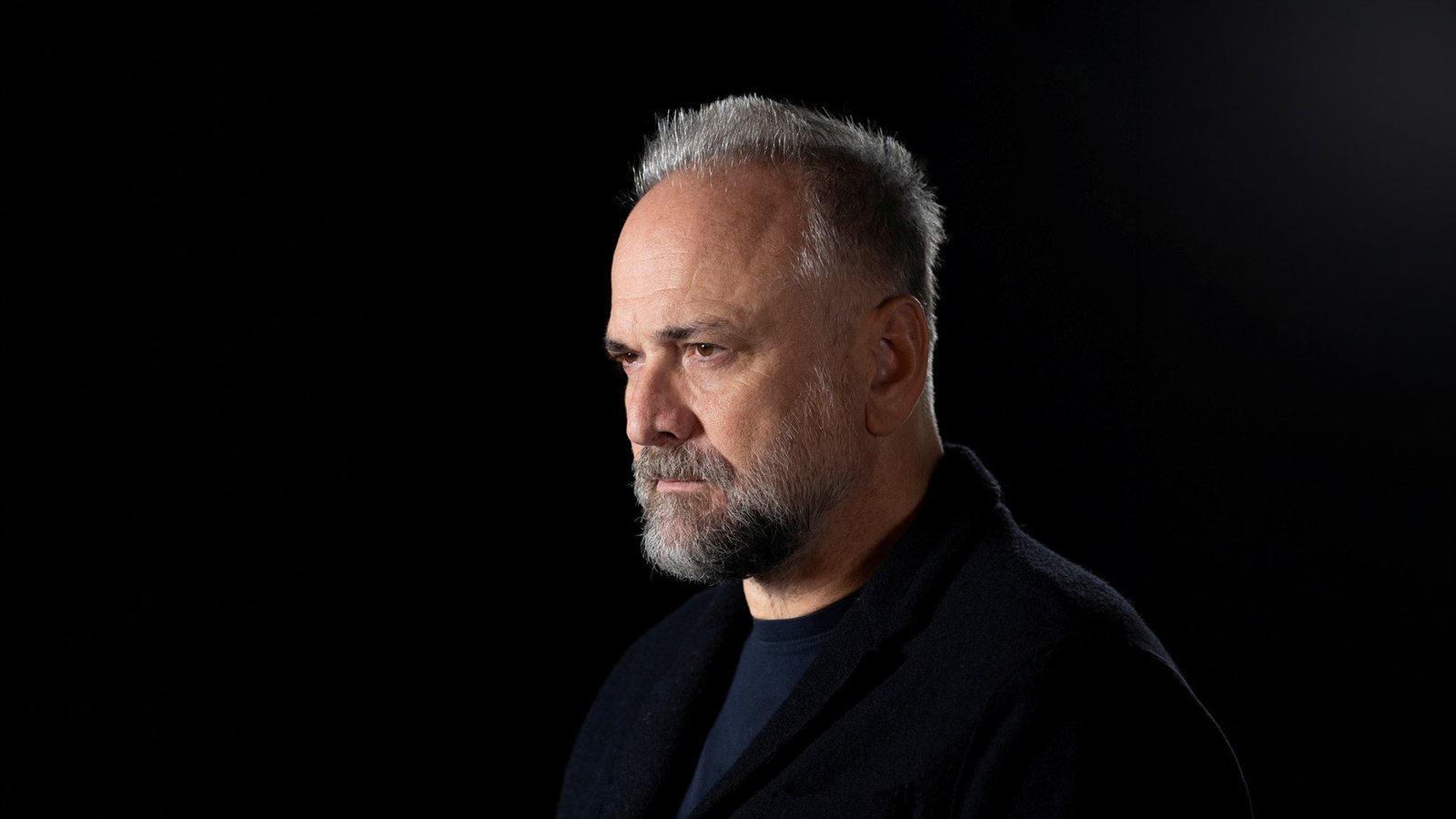
The Madness of King George (La pazzia di Re Giorgio) by Alan Bennett, directed by and starring Massimo Popolizio, is staged at Teatro Argentina in Rome, at Largo di Torre Argentina 52, from January 9 to 31, 2027, for 17 performances. The dates published by the Teatro di Roma are Saturday 9 and Sunday January 10, Tuesday 12 to Sunday 17, Tuesday 19 to Saturday 23, Thursday 28 to Sunday 31. The start times of the individual performances are given on the official Teatro di Roma website. The theater is reached by tram 8, Torre Argentina stop, or on foot from Piazza Venezia in a few minutes. The Teatro Argentina price list published by the Teatro di Roma sets the orchestra seat at 44 euros full price and 35 reduced, the boxes of the orchestra level, first and second tier at 35 and 30 euros, the boxes of the third and fourth tier at 26 and 20 euros. Tickets are bought at the theater box office or online on the authorized presale circuit indicated by the Teatro di Roma.
Language: performed in Italian. No English version or English surtitles are announced.
January at the Argentina belongs to Popolizio. The oldest theater of Rome's public drama entrusts the heart of winter to one of its house actors, with an English text about a king who loses his reason and a court that does everything to hide it. 21 performers on stage, four national theaters in coproduction, an author who is seen in Italy less than he deserves: enough for one of the most interesting evenings of the season. Below you will find the text and its history, Popolizio's career, the company, the dates to choose, and then the golden hall of Largo Argentina and everything around it.
The Madness of King George: what it is about
The Madness of King George tells of George III, sovereign of England in the late eighteenth century, who loses his mind completely, and of the court that must decide how to save the stability of the kingdom. The Teatro di Roma presents it as a text of strong topicality, about the relationship between illness and power.
When power loses control
The question at the center of the drama is simple and uncomfortable: what happens when a political leader, at the summit of power, loses control of his mental faculties? Bennett follows the sovereign's vulnerability and the reaction of those around him, divided between loyalty, opportunism and despair.
The management of information
The second theme, as the theater's presentation stresses, is the management of news. The plot moves among court intrigues and the way the government manipulates information about the king's health to stay in power. Whoever reads today's newspapers will need no explanation.
A comedy, more than a drama
The Teatro di Roma says it expressly: the drama, and it would be better to say the comedy. Bennett is an ironic writer, and his George III makes you laugh before he moves you. It is one of the reasons Popolizio, an actor able to go from the grotesque to the tragic within the same line, is the right choice.
The man beneath the crown
Beyond the intrigues, the theater says further, the text is an exploration of the king's humanity: Bennett strips George III of his regality to show a frightened, humiliated man, fighting with himself, and invites reflection on the fragility hidden behind every man of power.
Alan Bennett's text: from London to the movies
The Madness of George III is a play by Alan Bennett from 1991, which debuted on November 28, 1991 at the Lyttelton Theatre of the National Theatre in London. In Italy it is staged in Franco Salvatorelli's translation.
The premiere at the National Theatre
The premiere was directed by Nicholas Hytner, with sets by Mark Thompson. In the role of the king was Nigel Hawthorne, with Janet Dale as Queen Charlotte and Michael Fitzgerald as the Prince of Wales, Julian Wadham was William Pitt, Charles Kay Dr. Willis.
The tour and the film
After London the show toured the United Kingdom and the United States, returned to the National in 1993 and in 1994 was presented in Athens and Israel. In 1994 Hawthorne reprised the role in the film The Madness of King George, and was nominated for the Oscar as best actor.
The English revivals
The text has returned to the stage several times: in San Diego in 2010, at the Apollo Theatre in London in 2012 with David Haig, at the Nottingham Playhouse in 2018 with Mark Gatiss, in a production the National Theatre then streamed online in 2020.
A text for a great actor
English critics have always considered it a test for the performer of the king: the success of the different editions has been attributed above all to the leads. It is exactly the kind of text that an actor-director like Popolizio chooses for himself.
Who Massimo Popolizio is
Massimo Popolizio is an actor, theater director and voice actor born in Genoa on July 4, 1961, winner of six Ubu prizes for acting and directing. He is one of the protagonists of Italian theater of the past 40 years, and one of the most recognizable faces of auteur cinema.
The Academy and Luca Ronconi
Born in Genoa to a family of Apulian origin, he trained at the Accademia d'arte drammatica Silvio D'Amico and right after began a long collaboration with Luca Ronconi. He debuted in 1983 in Shaw's Saint Joan, directed by Ronconi, and with him went through O'Neill's Strange Interlude, Kraus's The Last Days of Mankind, Measure for Measure, King Lear, The Brothers Karamazov, Goldoni's The Venetian Twins, Lolita, The Bacchae, The Frogs, Professor Bernhardi.
The Ubu prizes
The first Ubu came in 1995, as best actor, for King Lear and Verso Peer Gynt. Then those of 2001 for The Venetian Twins, of 2005 as supporting actor for Professor Bernhardi, of 2015 for Stefano Massini's Lehman Trilogy, of 2017 for the direction of Ragazzi di vita and of 2019 for An Enemy of the People as best show. He also received the Eschilo d'oro in 2006, the Hystrio prize in 2015 and the Riccoboni prize in 2016.
Popolizio the director
Since 2015 he has signed his own productions: Arthur Miller's The Price, Ragazzi di vita from Pasolini, Ibsen's An Enemy of the People, Furore from Steinbeck, M. Son of the Century from Antonio Scurati in 2022, Miller's A View from the Bridge in 2023, Gorky's The Lower Depths in 2024, Pinter's The Homecoming in 2025. The Madness of King George continues this line: great twentieth-century texts, large companies, a theater of actors.
Cinema
In film he is remembered in Michele Placido's Romanzo criminale, Luchetti's My Brother Is an Only Child, Sorrentino's Il divo and The Great Beauty, Martone's Il giovane favoloso, where he is Monaldo Leopardi, Era d'estate, where he plays Giovanni Falcone, Sono tornato, where he is Mussolini. He won the Nastro d'argento and the Ciak d'oro as supporting actor for Pietro Castellitto's I predatori, in 2021.
The voice
As a voice actor he is the Italian voice of Lord Voldemort in the Harry Potter films, of Tim Roth in The Legend of 1900 and in the series Lie to Me, of Tom Cruise in Eyes Wide Shut, of Scar in the 2019 Lion King. In 1998 he won the Nastro d'argento for the dubbing of Kenneth Branagh's Hamlet. For Rai Radio3 he read, among others, The Tartar Steppe and The Master and Margarita.
The company: 21 performers
On stage with Massimo Popolizio are Sandra Toffolatti, Raffaele Esposito, Michele Nani, Massimo Nicolini, Paolo Serra, Alberto Onofrietti, Giampiero Cicciò, Francesco Migliaccio, Tommaso Cardarelli and Riccardo Bocci. With them Luca Carbone, Adriano Exacoustos, Alessandro Leonardi, Michele Lisi, Paolo Minnielli, Michele Montironi, Eros Pascale, Arianna Pozzi, Giorgio Sales and Gianluca Scaccia.
A court on stage
21 actors is a lot, today, for a drama production. Bennett's text requires it: king, queen, princes, ministers, doctors, servants, an entire court bustling around the sovereign. In a show like this the quality of the second and third tier counts as much as that of the lead.
Familiar faces
Giampiero Cicciò and Alberto Onofrietti were among the stars of Ragazzi di vita, Popolizio's production that debuted at the Argentina itself in October 2016. The director likes to work with a loyal company, and it shows.
The coproduction
The show is produced by Teatro di Roma, Teatro Nazionale, Piccolo Teatro di Milano, Teatro d'Europa, ERT Emilia Romagna Teatro Fondazione and Teatro della Toscana. After Rome it goes to the Piccolo in Milan, at the Teatro Strehler, from February 4 to 28, 2027.
Dates of the 17 performances at Teatro Argentina
The Madness of King George is at the Argentina for 17 performances between January 9 and 31, 2027. The calendar has a peculiarity worth knowing before you buy.
The first two weeks
It starts on Saturday 9 and Sunday January 10. Then, after the Monday rest, from Tuesday 12 to Sunday 17 and from Tuesday 19 to Saturday 23.
The late-January pause
From Sunday 24 to Wednesday January 27 there are no performances. The show resumes on Thursday 28 and closes on Sunday 31. Anyone who planned to go in the middle of the last week has to move.
The times
The start times of individual performances are published on the Teatro di Roma website and on the presale circuit. The Argentina box office opens three hours before the show on Sundays.
Tickets, prices and discounts
Teatro Argentina tickets cost 44 euros in the orchestra seats, 35 euros in the boxes of the orchestra level, first and second tier, 26 euros in the boxes of the third and fourth tier, according to the Teatro di Roma price list. The reduced prices are 35, 30 and 20 euros respectively.
Who is entitled to the reduced price
The reduced price goes to people under 35 and over 65, teachers, associations, affiliated CRAL groups and people with disabilities. Show-business workers and artists have a rate of 15 euros, on request to the promotion office.
Students and schools
For university students and pupils of affiliated drama schools: 20 euros in the orchestra seats, 15 in the lower boxes, 13 in the upper ones. For schools: 17, 15 and 12 euros. These rates do not apply to the last three performances, that is, here, to Friday 29, Saturday 30 and Sunday January 31.
The box office
The Teatro Argentina box office is open Monday to Saturday from 11:00 to 19:00 and on Sunday three hours before the show, the numbers given are 06 684000311 and 06 684000314. Reserved tickets must be picked up within an hour of the start, otherwise the system cancels the reservation, once issued they cannot be exchanged or canceled.
A curiosity about The Madness of King George with Massimo Popolizio at Teatro Argentina in Rome, January 9 to 31, 2027
The first performer of George III, Nigel Hawthorne, was nominated for the Oscar for the same role in the 1994 film, and the film's title changed from that of the play. On stage it was The Madness of George III, in cinema it became The Madness of King George.
The title change left a mark in Italy too: La pazzia di Re Giorgio, the title chosen for this edition in Franco Salvatorelli's translation, follows the film's path, with the word king in place of the dynastic number. It is a detail, but it says how much the film fixed the image of this story in the European public, to the point that the stage text, from which everything was born, presents itself today under the name of its film version.
The second curiosity concerns Popolizio and figures of power. In film he has been Vittorio Sbardella in Sorrentino's Il divo, Mussolini in Sono tornato, Giovanni Falcone in Era d'estate, in the theater he directed M. Son of the Century from Scurati. With George III he adds a king to his gallery of public men. The difference is that this time power is seen from inside a crumbling head, and laughter comes before pity. For an actor who gave his voice to Lord Voldemort, going from the absolute villain to the fragile sovereign is a leap worth the ticket.
Teatro Argentina: how the hall is laid out
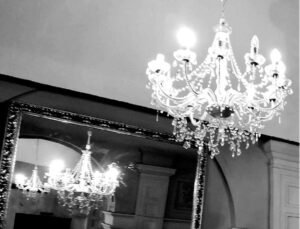
Teatro Argentina has 720 seats, 354 in the orchestra and 366 spread over six tiers of boxes, according to the Teatro di Roma's figures. It is a horseshoe-shaped Italian-style hall, red and gold, with a green ceiling and a 16-arm candelabra chandelier.
A tower from Strasbourg
The name has nothing to do with the South American country. It comes from the tower of the palace of Johannes Burckardt, the Burcardo, a papal master of ceremonies born in Strasbourg, in Latin Argentoratum, Burckardt signed himself episcopus argentinensis. The palace, built between 1491 and 1500, still stands on Via del Sudario, next to the theater.
The Sforza Cesarini and Theodoli
The theater was wanted by the Sforza Cesarini, who in 1730 opened the building site reusing part of their small palace and the tower. The hall was designed by the marquis-architect Gerolamo Theodoli in a horseshoe shape, for the best acoustics and visibility, originally it was entirely of wood, with 186 boxes.
The 1826 facade
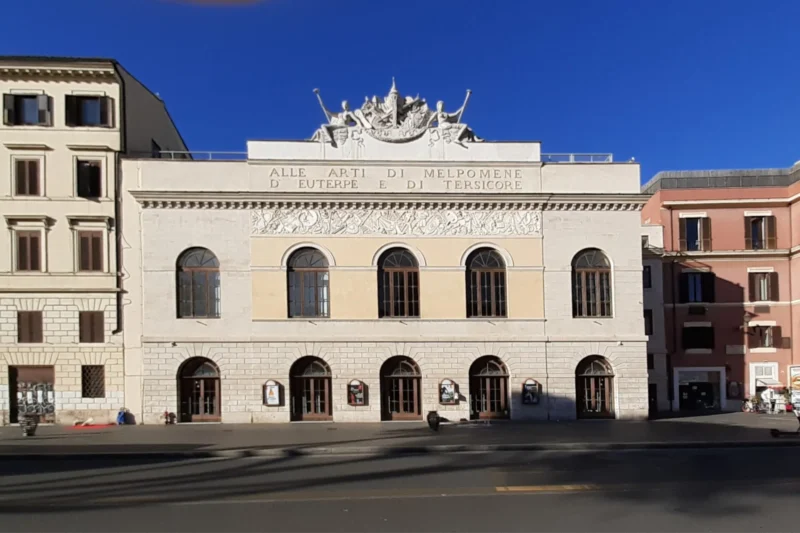
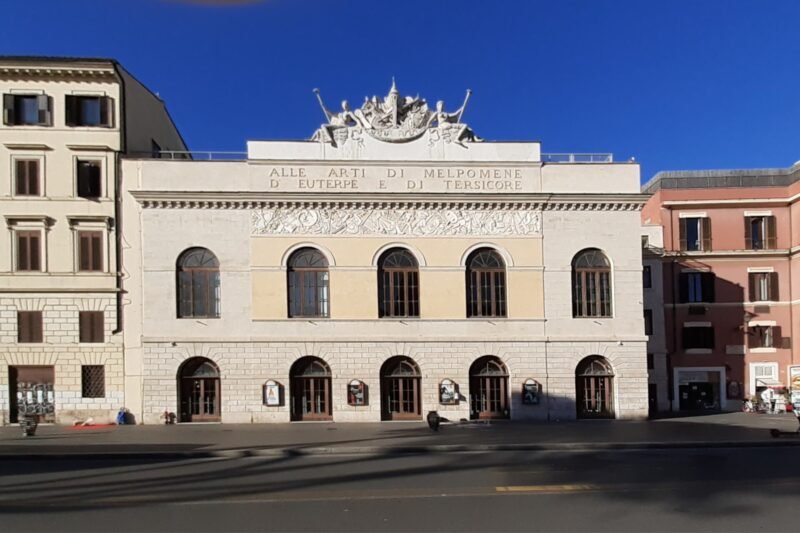
The neoclassical facade arrived in 1826, to a design by Pietro Holl. Above the arched windows runs the dedication Alle arti di Melpomene d'Euterpe e di Tersicore: tragedy, lyric poetry, dance.
Portoghesi's restoration
In 1993 Paolo Portoghesi restored the theater, bringing back the red of the upholstery in place of the 1970 golden yellow and the festoon outline of the box valances. The hall you will see is that one.
One thing nobody tells you about The Madness of King George with Massimo Popolizio at Teatro Argentina in Rome, January 9 to 31, 2027
Teatro Argentina stands on part of the complex of the Theater of Pompey, which included the Curia in which Julius Caesar was killed in 44 BC. The Teatro di Roma tells it openly: the history of this place begins with a political assassination.
For a show about power and its fragility, the coincidence is strong. Bennett tells of a court wondering how to manage a sovereign no longer able to govern, among ministers who calculate, doctors who quarrel and an heir who waits. 2,000 years earlier, a few meters from this hall, a group of senators had solved the problem of personal power in the most brutal way. It is not a parallel the show proposes, and it should not be forced, but whoever arrives at Largo Argentina and looks at the sacred area before going in brings one more question with them.
The second detail is practical. The Argentina is the only theater of the Foundation bound by the ZTL hours of the historic center, and it has no parking. Many spectators arriving by car discover it with a fine. The solution is to leave the car outside the limited traffic zone and take tram 8, which stops in front of the sacred area, or arrive on foot from Piazza Venezia.
How to get to Teatro Argentina
Teatro Argentina is at Largo di Torre Argentina 52, opposite the sacred area, and the simplest way to reach it is tram 8, which stops right at Torre Argentina.
By tram
Tram 8 links Trastevere and Piazza Venezia and stops a few steps from the entrance. On the way out, in the evening, it is the most convenient solution for those who live on the other bank of the Tiber.
By metro
No station is right next to the theater. The most convenient are Colosseo and Circo Massimo on Line B, from which you continue by surface transport or on foot. From Piazza Venezia to Largo Argentina, along Via delle Botteghe Oscure, it is a few minutes' walk.
By bus
Largo di Torre Argentina and Corso Vittorio Emanuele II are crossed by many lines linking Termini, Piazza Venezia, the Vatican and Trastevere. Evening times and routes should be checked on the Rome public transport information service before leaving.
By car and taxi
The theater has no parking and is inside the ZTL. Those arriving by car must leave it outside the limited traffic zone and complete the trip by public transport. A taxi remains the simplest solution for those with mobility difficulties.
The advice I give you for visiting The Madness of King George with Massimo Popolizio at Teatro Argentina in Rome, January 9 to 31, 2027
The advice is to choose a weekday performance between Tuesday 12 and Thursday January 21, in a central orchestra seat or a first-tier box, and to buy right away. Popolizio at the Argentina fills the hall, and with 17 performances in all the margin is not large.
The reason for the date is simple. The first weekend, January 9 and 10, falls right after the holidays, with the city still full of visitors. The last week has the gap from the 24th to the 27th, and the last three performances, from the 29th to the 31st, are excluded from student and school rates: they will be the most requested by those who put it off. Mid-month, with the theater now warmed up, is the best moment to see a show with 21 performers, when the stage mechanisms are well oiled.
On site: in a spoken text, with a whole court on stage, it matters to see the faces and follow the exchanges. The central orchestra seat and the first-tier boxes, frontal, are the right choice. The high side boxes cost less, but in a horseshoe hall they cut off part of the scene.
Last piece of advice: reread or rewatch something before going. The 1994 film with Nigel Hawthorne can be found, and it is the quickest way into the story. Then forget it: Popolizio is not an actor who imitates.
Another well-known fact, yet rarely mentioned
In Rome "fare il portoghese" means getting into a show without paying, and one of the most widespread explanations of this saying leads precisely to Teatro Argentina. Almost everyone knows it, almost no one knows where it comes from.
According to this version, in the eighteenth century the Portuguese ambassador to the Papal States invited the Portuguese residing in Rome to attend a show at the Argentina free of charge, without a written invitation: it was enough to declare one's nationality. Many Romans took advantage by passing themselves off as Portuguese, and the expression was born there.
It must be said honestly that it is a hypothesis. There is an older explanation, tied to Pope Leo X and to 1514, who supposedly allowed the Portuguese ambassador and his retinue to attend theaters and taverns for free to thank the King of Portugal for the gift of the elephant Hanno, and there are others still. The Argentina version remains, however, the one most cited by dictionaries.
For the January spectator the moral is practical: the Portuguese, today, do not get into the Argentina, and a reserved ticket not picked up within an hour of the start is canceled by the system. The nice part is knowing that the hall you sit in left a mark on Italians' everyday language, and that every time someone jumps a turnstile at the stadium, without knowing it, they are quoting Teatro Argentina.
Accessibility at Teatro Argentina
Teatro Argentina is accessible to audiences with disabilities: the historic building does not allow all barriers to be removed, but it is equipped with elevators and dedicated facilities.
Reserved seats
Some orchestra seats are reserved for people with disabilities, under safety regulations, the companion sits nearby. For availability the theater asks you to contact the box office during opening hours.
The companion's ticket
Spectators with disabilities are entitled to the reduced price. For holders of an attendance allowance certified by INPS, a complimentary ticket for the companion is provided.
The right photo to take at The Madness of King George with Massimo Popolizio at Teatro Argentina in Rome, January 9 to 31, 2027
The right photo is taken from the orchestra, before the lights go down, with the lens aimed upward: six tiers of red and gold boxes, the green ceiling, the 16-arm chandelier. For a show about a court, it is the most coherent frame: the hall itself is an eighteenth-century court, with the boxes that Proust, according to the Teatro di Roma, described as small suspended salons.
Keep the whole hall in the frame, do not look for detail, and shoot while the audience files in and the lights are full. As soon as the show begins the phone goes off: in a horseshoe hall a lit screen can be seen from every box, and with 21 actors on stage concentration is everything.
The second photo is outside, in the evening, from across the square. From there you frame together the neoclassical facade with its dedication to the muses and, in the foreground, the lit columns of the sacred area. In January darkness arrives early, and at 19:00 the light is already right. Whoever is patient waits for tram 8 to add movement.
Third possibility, for those arriving early: the Burcardo palace on Via del Sudario, behind the theater, with its late Gothic facade and the tower that gave the Argentina its name. Almost nobody photographs it, and it is the origin of everything.
Around Teatro Argentina: before and after the show
Teatro Argentina is in the historic center, a few minutes on foot from the Pantheon, Piazza Navona, Campo de' Fiori and the Ghetto. It is one of the rare Roman theaters where the walk is part of the evening.
The sacred area
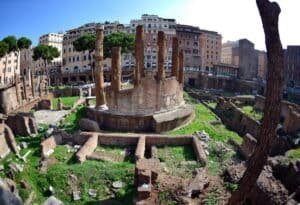
In front of the theater opens the sacred area of Argentina square, with the Republican temples and the remains tied to the Pompey complex. Among the ruins lives the cat colony of the Largo Argentina cat sanctuary.
Pantheon and Piazza Navona
In five minutes northward you reach the Pantheon, westward, beyond Corso Vittorio, Piazza Navona and Campo de' Fiori.
The Gesù and the Ghetto
To the east is the Church of the Gesù, going down toward the Tiber you enter the Jewish Ghetto and reach the Theater of Marcellus, an ancient theater a few minutes from an eighteenth-century one.
Piazza Venezia
Along Via delle Botteghe Oscure you reach Piazza Venezia, a hub for buses and taxis for the ride home.
Some important events that took place here in history
Teatro Argentina was inaugurated in January 1732 with Berenice by Domenico Sarro: The Madness of King George debuts almost exactly 295 years later, in the same month. In the eighteenth century foreign travelers considered it the most important of Rome's theaters.
On February 20, 1816 the premiere of Rossini's The Barber of Seville took place here, with Manuel García: a fiasco, with supporters of Paisiello's Barber whistling in the orchestra, and from the second night a triumph that lasts still. On January 28, 1822 the Argentina hosted the premiere of Donizetti's Zoraida di Granata, in 1827 Niccolò Paganini played.
Giuseppe Verdi brought I due Foscari here in 1844 and La battaglia di Legnano in 1849. According to the Teatro di Roma's reconstruction, it was on the occasion of that performance that Romans began the demonstrations against the papal government that led to the Roman Republic: a patriotic opera turned political gesture, in a theater that stands on the site of Caesar's assassination.
After 1870 the opening of Corso Vittorio Emanuele II put the theater at the center of the new capital, and the building passed to the city. In the twentieth century the Argentina became the home of Rome's public drama, in 2016 Popolizio's Ragazzi di vita debuted here, an Ubu prize for direction, and in 2022 management passed to the Fondazione Teatro di Roma.
Who has played at The Madness of King George with Massimo Popolizio at Teatro Argentina in Rome, January 9 to 31, 2027
Across the stage of Teatro Argentina have passed Gioachino Rossini, Gaetano Donizetti, Giuseppe Verdi and Niccolò Paganini, and the works of Gabriele D'Annunzio and Luigi Pirandello. In the twentieth century it was led by some of the decisive names of Italian directing.
Among the house's directors the Teatro di Roma recalls Vito Pandolfi from 1964, Franco Enriquez, Luigi Squarzina, Maurizio Scaparro, Pietro Carriglio, Mario Martone, Giorgio Albertazzi, Gabriele Lavia, Antonio Calbi, Giorgio Barberio Corsetti and today Luca De Fusco. And Luca Ronconi, director from 1994 to 1999.
Ronconi is the name that matters for this show. Popolizio trained with him, debuted in 1983 in one of his productions and for over 30 years was one of his key actors, from King Lear to The Brothers Karamazov, up to Lehman Trilogy in 2015. When today Popolizio steps onto the same stage as director of a production with 21 actors, he brings that school with him: the taste for great texts, large companies, the sculpted word.
Marcel Proust, the Teatro di Roma recalls, described the boxes as small suspended salons. For a text set at court, the image should be taken literally: every box at the Argentina, in January, will be a small antechamber of the king.
How to organize the evening
An evening at The Madness of King George is easily organized on foot: dinner in the historic center, the show, the ride home on tram 8 or by taxi from Piazza Venezia.
Where to eat
The historic center around the Argentina has every kind of place: Roman trattorias toward Campo de' Fiori, Roman-Jewish cuisine in the Ghetto, pizza by the slice and bakeries on Corso Vittorio for a quick meal, wine bars and bistros around the Pantheon for after the theater. On weekends it is best to book.
With teenagers
For a high school student Bennett's text is a good entry into drama: ironic, political, with a memorable lead. The school and university rates make it accessible, but they do not apply to the last three performances. For children the Teatro di Roma has a dedicated Teatro Ragazzi program.
January in Rome
January, after Epiphany, is the month when Rome empties of tourists and returns to its rhythms. The museums are quiet, the evenings in the historic center are cold and intimate. Bring a real coat and an umbrella: the wet cobbles of Largo Argentina are unforgiving.
The 2026/2027 season at Teatro Argentina
The Madness of King George is one of the central titles of the Teatro di Roma's 2026/2027 season, titled Il teatro è vita. Before it, in November, the Argentina hosted Luca De Fusco's Otello, and in autumn the titles co-realized with the Romaeuropa Festival, including Max Richter's Four Seasons Changed. For the full picture of the schedule see the page on the Teatro di Roma season.
Frequently asked questions about The Madness of King George in Rome
When is The Madness of King George staged at Teatro Argentina?
The Madness of King George with Massimo Popolizio is at Teatro Argentina from January 9 to 31, 2027, for 17 performances: January 9 and 10, 12 to 17, 19 to 23, 28 to 31. There are no performances on Mondays or between January 24 and 27.
Who is in the cast of The Madness of King George?
The Madness of King George has 21 performers: Massimo Popolizio, who also directs, with Sandra Toffolatti, Raffaele Esposito, Michele Nani, Massimo Nicolini, Paolo Serra, Alberto Onofrietti, Giampiero Cicciò, Francesco Migliaccio, Tommaso Cardarelli, Riccardo Bocci and 10 other actors.
How much do tickets at Teatro Argentina cost?
The Teatro Argentina price list sets the orchestra seat at 44 euros full price and 35 reduced, the boxes of the orchestra level, first and second tier at 35 and 30 euros, the boxes of the third and fourth tier at 26 and 20 euros. University students and schools have dedicated rates, excluding the last three performances.
Who wrote The Madness of King George?
The Madness of King George is a play by Alan Bennett from 1991, The Madness of George III, born at the National Theatre in London with Nigel Hawthorne and made into a film in 1994. In Rome it is staged in Franco Salvatorelli's translation.
How do I get to Teatro Argentina by public transport?
Teatro Argentina, at Largo di Torre Argentina 52, is reached by tram 8, Torre Argentina stop, or on foot from Piazza Venezia in a few minutes. The most convenient Metro B stations are Colosseo and Circo Massimo. The theater is in the ZTL and has no parking.
Does The Madness of King George tour after Rome?
Yes, after Teatro Argentina The Madness of King George goes to the Piccolo Teatro di Milano, at the Teatro Strehler, from February 4 to 28, 2027. The show is a coproduction of Teatro di Roma, Piccolo Teatro di Milano, ERT Emilia Romagna Teatro and Teatro della Toscana.
When is the Teatro Argentina box office open?
The Teatro Argentina box office is open Monday to Saturday from 11:00 to 19:00 and on Sunday three hours before the show. Reserved tickets must be picked up within an hour of the start, from an hour before, only tickets for that day's performance are sold.
The advice is plain: do not wait for the last week. Popolizio at the Argentina, with a Bennett text and a company of 21 actors, is the kind of evening that in late January you find only in the upper boxes. Take an orchestra seat in mid-month, arrive on foot from Piazza Venezia, look at the sacred area before going in, and let a mad English king tell you something about power at home.
Article written by the editorial team of Tour Leader Pro, contact them for Private/Corporate/V.I.P. Tours and Experiences.
Planning a trip to Rome? The English guides to visiting the city are on ItalyPlanner.com.
Contact Information
Nearby
 Teatro Argentina100 m
- Teatro Centrale100 m
- Largo Torre Argentina – Sacred Area of Campo Marzio100 m
- Cat Sanctuary at Largo Argentina100 m
- San Carlo ai Catinari200 m
- Santa Maria in Publicolis200 m
Upcoming events nearby
- Othello at Teatro Argentina, November 4 to 29, 2026100 m
- Una delle ultime sere di Carnovale at Teatro Argentina, February 2 to 14, 2027100 m
- Lo zar by and with Stefano Massini at Teatro Argentina in Rome, March 16 to 25, 2027100 m
- I Solisti della Filarmonica: Mahler, Symphony No. 4 at Teatro Argentina, November 5, 2026100 m
You might also like
- L’inconveniente with Milena Vukotic at Teatro Quirino, January 19 to 31, 2027
- Se devi dire una bugia è meglio dirla grossa by Ray Cooney at Teatro de’ Servi, from February 23 to March 7, 2027
- Figli maschi by Centouno at Teatro Sala Umberto, February 16 to 28, 2027
- Don Giovanni with Simone Toni and Enzo Paci at Teatro Sala Umberto, February 2 to 14, 2027
- Totalmente incompatibili, Nuzzo and Di Biase at Teatro Sistina, January 22-24, 2027
- From Broadway to Hollywood at Cinema Quattro Fontane, September 20, 2026 to January 3, 2027