Villa Lais
In short. Villa Lais is open and free to enter: the public park of Roma Capitale in the Tuscolano district, Municipio VII, opens every day from 7:00 to sunset according to the Capitoline Superintendency, with four entrances at Piazza Giovanni…
Villa Lais is open and free to enter: the public park of Roma Capitale in the Tuscolano district, Municipio VII, opens every day from 7:00 to sunset according to the Capitoline Superintendency, with four entrances at Piazza Giovanni Cagliero 20, Via Paolo Albera, Via Deruta and Via Giacomo Costamagna. There are no tickets or reservations. The villino, the owners' small villa, however, cannot be visited: according to the local press it has been closed since January 2019 and awaits a structural restoration that was never funded.
It covers about 28,000 square meters, the figure given by both the Superintendency and the tourism portal of Roma Capitale, right next to the urban stretch of Via Tuscolana. The villa originated from two vineyards of the Lateran Chapter, passed in the 1600s to the Merolli merchants, in the 1800s to the Costantini and from 1906 to the Lais family, who turned it into a bourgeois country residence. The tourism portal states that it has belonged to the Comune di Roma since 1975. The park's latest redevelopment was completed on November 5, 2022.
Data checked on September 29, 2026 on the Capitoline Superintendency page dedicated to Villa Lais, formerly Vigna della Campagnola, on the tourism portal of Roma Capitale, on the Roma Culture portal and on the press sources cited further on in the text. The operator does not publish a month-by-month closing time, or the opening status of the internal services. For extraordinary closures and information, the reference given by the tourism portal is 060608, the contact center of Roma Capitale.
At a glance: address, hours, ticket
- Address: Piazza Giovanni Cagliero 20, with other entrances at Via Paolo Albera, Via Deruta and Via Giacomo Costamagna, Tuscolano district, Municipio VII.
- Operator: Roma Capitale, with the historic villa in the catalog of the Capitoline Superintendency, information at 060608.
- How to get in: free entry through the four gates, without reservation, during opening hours.
- Price: free, and the most recent summer events also appear to be free, until seats run out.
- Hours: from 7:00 to sunset according to the Capitoline Superintendency, barring extraordinary closures decided by the city.
- Services: playground, open-air amphitheater, picnic area, fitness area and dog area according to the tourism portal of Roma Capitale.
- Accessibility: the operator does not publish a map of barrier-free routes, so ask at 060608.
Where it is and what you really see
The villa occupies a block between the Appio Latino and Tuscolano districts, as the LaPresse agency describes it, in an area that grew mostly from the 1950s. The Superintendency places it near the urban stretch of the Tuscolana, and recalls that originally the area stood at the second kilometer of the consular road, bounded on the north by the Acqua Mariana stream and on the east by the ancient aqueducts. Of that countryside what remains is a green enclosure surrounded by apartment blocks, with the four gates opening onto residential streets.
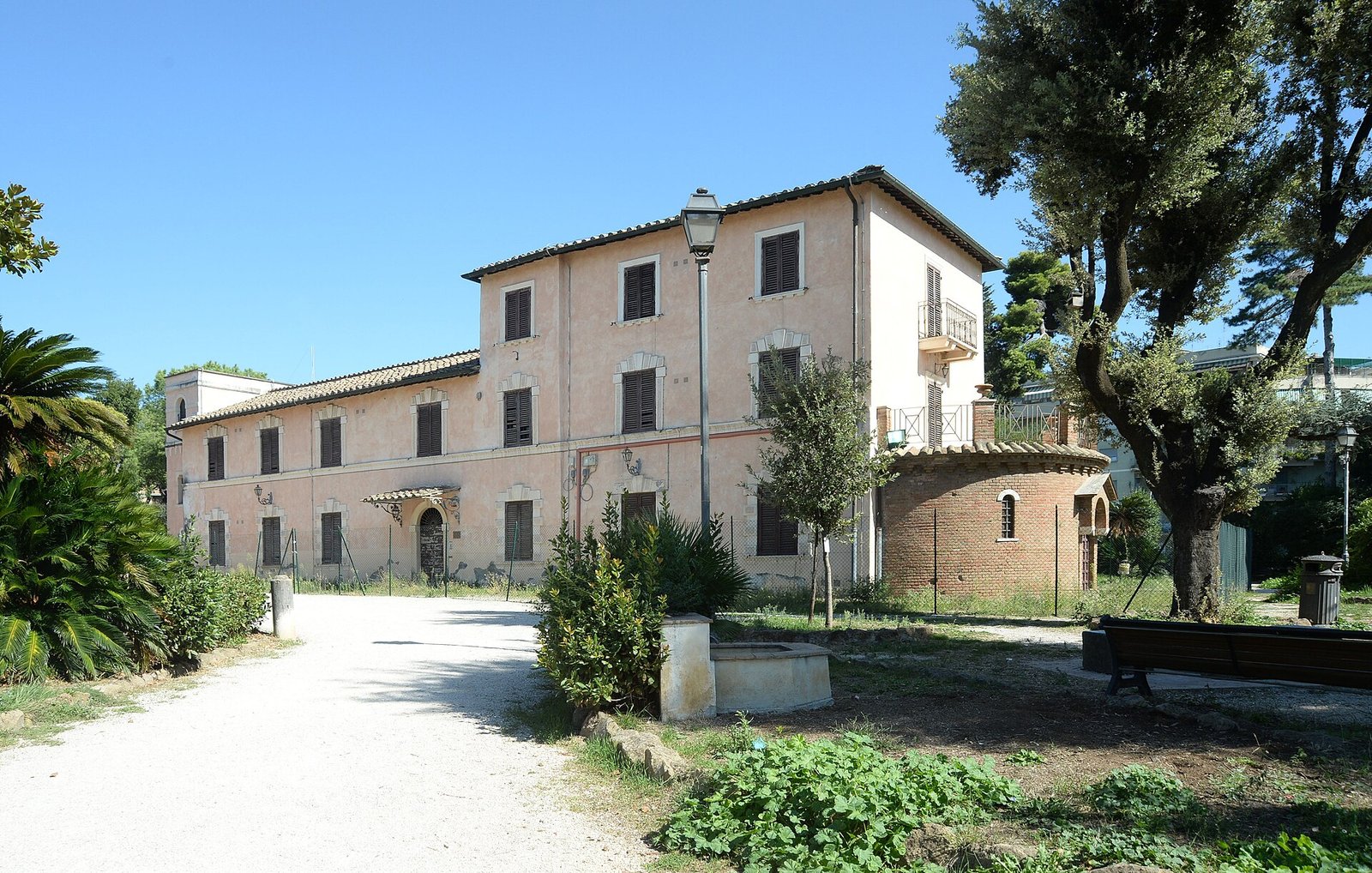
What is inside? The villino, a building on a rectangular plan with two taller sections, one of which houses a small private chapel in an eclectic taste while the other is decorated like a small tower, according to the Superintendency. Around it are seven other buildings of different sizes, the small owners' garden and part of the old vegetable gardens. Then the park's services: a 950-square-meter playground, an open-air amphitheater, areas for picnics and physical activity, an area reserved for dogs.
The park is compact, with paths redone in 2022 with a draining surface. You can walk all of it in 20 minutes at an easy pace. It's not a forest and not a monumental garden. It's a neighborhood villa, used every day by the people who live around it: parents with small children, elderly people on benches, kids after school, dog owners. Anyone arriving from outside should know that the life of the place is this, and that the most interesting historic piece is looked at from the outside.
The amphitheater is the other element to know. The Superintendency cites it as an open-air theater and writes that the 2022 redevelopment restored it, with a new access. It's the heart of the summer cultural activities, hosting the events organized with the support of Municipio VII and Roma Capitale. Outside show nights it remains a space of the park like the others, with the seating free, available to anyone passing by.
The eight remaining buildings, writes the Superintendency, have different sizes and uses. Besides the villino there are the service buildings that came with the Lais family, which the tourism portal lists as a carriage house, garage, greenhouse and dwellings. Some now house the services of the Centro Famiglie. The operator does not publish a plan with the current function of each building, and from the outside it's not always clear what lies behind a door. It's best to consider them workspaces, not pavilions to visit.
A curiosity about Villa Lais
The official name is not the one everyone uses. For the Capitoline Superintendency the place is called Villa Lais, formerly Vigna della Campagnola, and appears in the catalog of villas of the bourgeoisie, not in that of the villas of the nobles. The distinction matters. Here there is no cardinal or prince at the origin of the residence, but a family that in the early 20th century turned a productive vineyard into a country house with a garden, chapel and carriage houses, at the gates of a growing city.
The second curiosity concerns the place's other names. Wikipedia reports that the villa was also known as Vigna Costantini, from the surname of the family that owned it in the second half of the 19th century, and as Orti Lais alla Marrana. The reference to the marrana points to the watercourse that the Superintendency calls the Acqua Mariana stream, which marked the northern boundary of the property. Names change with the owners, and each captures a different phase: the vineyard, the vegetable gardens, the villa.
Third curiosity: the rooms of the villino are not all decorated the same way. The Superintendency writes that each room has a style tied to its function, with a parlor with floral motifs in the Liberty style and a reception hall with medallions portraying famous men. The tourism portal of Roma Capitale speaks of interior frescoes and Art Nouveau decorations. It's the furnishing of a bourgeois house that wanted to show culture and good taste, more than noble wealth, and today it remains closed to the public.
The last curiosity concerns the garden. According to the tourism portal, the Lais family created a garden with myrtle hedges and exotic plants, next to new service buildings: a carriage house, a garage, a greenhouse and some dwellings. The 2022 redevelopment, writes the Superintendency, included pruning and new plantings following the original layouts. In a neighborhood park dominated by playgrounds and paths, the design of the owners' garden is the most direct trace of the villa of a hundred years ago.
Something nobody tells you about Villa Lais
The villino, the historical reason the villa has a name, cannot be visited. According to the online newspaper 7colli, in an article from February 2025, the main building has been closed since January 2019, and the feasibility study approved in 2022 estimated the necessary structural and systems work at about 2.8 million euros. Those funds, at the date of the article, had not been found. The 2022 redevelopment renovated the park, not the house.
Hence the opposing view worth keeping in mind. In our opinion Villa Lais is overrated as a historic destination for people coming from outside the neighborhood: online guides talk about a chapel, frescoes and Liberty rooms, but all of this is behind closed doors. Coming from the center on purpose to see the villa makes little sense. It does make sense for those who live in the southeast quadrant, for those looking for a park equipped for children or for those coming to an evening show at the amphitheater.
A second thing rarely said: the entrance on Piazza Cagliero is the one all the portals give, but it's not the only one and not always the most convenient. The Superintendency also lists Via Paolo Albera, Via Deruta and Via Giacomo Costamagna. The most recent summer events often give Via Paolo Albera as the reference for the amphitheater. Anyone arriving on foot from different streets can choose the nearest gate and save the walk around the enclosure, which on one side takes up an entire block.
Third thing: inside the park there is a public service for families. The Superintendency states that the villa houses the Centro Famiglie Villa Lais, with pedagogical, educational, cultural, recreational, social and psychological interventions. The service spaces are places of work and meeting for those who turn to them, not attractions. You pass by staying on the paths, without photographing people and without entering the buildings except to use the services.
How did the Lateran Chapter's vineyard become a villa?
Between the 17th and 18th centuries, writes the Superintendency, the area was divided into two vineyards, one called alli Condotti and the other alla Ferriera. The owner was the Lateran Chapter, that is, the college of canons of the Basilica of Saint John Lateran. The two names describe the landscape of the time: the condotti recall the aqueducts that the Superintendency places on the eastern boundary, the ferriera a craft activity about which the official sources say nothing more.
In 1685 the Chapter handed the lands over to the Merolli merchants. Here the sources do not agree on the type of contract: the Superintendency speaks of a grant in emphyteusis, that is, a long-term right of use with an obligation to improve the land, while the tourism portal of Roma Capitale writes of a sale to the Merolli brothers. In both cases the family kept the vineyards until the first half of the 19th century, when the property passed to the Costantini, who held it in the second half of the century.
The leap comes in 1906. According to the Superintendency, in that year the central core of the estate became part of the Orti Lais, and the redevelopment works started by Filippo Lais turned the vineyard into a suburban bourgeois residence. The garden, the chapel, the interior decorations and the service buildings came into being. The tourism portal calls it a significant example of a suburban residence of the early 20th century, when the Roman countryside southeast of the walls was still made of vegetable gardens and farmhouses.
The rest of the century tells of the advancing city. The tourism portal writes that in the 1950s urbanization reduced the estate to its current extent of about 28,000 square meters, and that since 1975 the villa has belonged to the Comune di Roma. The villino was restored by the city administration in 1997 and 1998, according to the Superintendency. Then the closure of 2019 and the park's redevelopment completed in November 2022.
My advice for visiting Villa Lais
Choose the reason for the visit before setting out. If you're looking for a large, renovated playground, Villa Lais works on any afternoon. If you're looking for the historic villa, it's best to arrive prepared: the villino is looked at from the outside, and the visit lasts as long as a loop of the paths. If you're looking for culture, the right choice is to check the calendar of Municipio VII and Roma Culture and come on one of the show evenings at the amphitheater, when the park changes audience and rhythm.
For the walk, the advice is to enter from Piazza Cagliero, go straight to the villino and the owners' garden, observe from the outside the two raised sections with the chapel and the small tower, and then do the wide loop passing by the amphitheater. Leave by the gate most convenient for your next stop, after checking it on the map, because the four entrances open onto different streets and save quite a few steps for anyone continuing on foot.
Choose the time well. School-day afternoons are the peak time for the playground, which since 2022 measures 950 square meters and draws families from the whole neighborhood. Anyone looking for calm finds the park quieter in the morning, after the 7:00 opening, or in the middle hours of weekdays. On fine-weather weekends the lawns and picnic areas fill up early, and shaded benches become rare.
Respect the rules of municipal green space. Dogs on a leash outside the dedicated area, trash taken away, no glass on the lawns. In parks with tall trees, after storms and on days of strong wind, there may be fenced-off zones, and the barriers must not be crossed. The same goes for the villino, secured with temporary measures: the fences around the building are there to protect passersby, and must not be bypassed to look more closely at the decorations.
Do you pay anything, and do you need to book?
No. Villa Lais is a free-entry municipal public park, with no ticket office and no reservation. You enter during the gates' opening hours, from 7:00 to sunset according to the Capitoline Superintendency. The operator does not offer regular visits to the villino, which is closed to the public, and there is no paid tour dedicated to Villa Lais worth mentioning. For the Centro Famiglie activities, the operator does not publish hours and access arrangements on the villa's portal.
The summer events follow their own rules, set by the organizers. For the 2026 .MOV video dance festival the Roma Culture portal lists free entry until seats run out, with information at 339 2824889 or at the email promozione@triangoloscalenoteatro.it of the organizing association. For other events, from book presentations to shows, it's best to check the Municipio VII website and the organizers' pages, because capacity and reservations change from one event to another.
Anyone organizing an outing with a class, an association or a group of friends does not need permits for a walk during opening hours. The operator does not publish a procedure for parties, filming, setups or organized activities inside the park, however. In these cases it's best to contact Roma Capitale well in advance, starting from 060608 and the offices of Municipio VII, taking into account the presence of the Centro Famiglie and the use of the playground.
Another well-known fact, yet rarely cited
Everyone in the neighborhood knows that Villa Lais is the villa on the Tuscolana. Few remember that the oldest ownership was the Church of Rome's. The Lateran Chapter, which the Superintendency lists as the owner of the two vineyards, administered the property of the cathedral of Rome, the same one you reach by heading back up toward the walls. The link between this area and the Lateran is old: the Tuscolana leaves the city exactly from that side, and the canons' vineyards were one of the many ecclesiastical properties of the Roman countryside.
The second fact known and little cited concerns water. The Superintendency writes that the property was bounded on the north by the Acqua Mariana stream and on the east by the ancient aqueducts. The name of the vineyard alli Condotti and the boundary marked by water tell of a countryside of vineyards and vegetable gardens, far from the built city. The best-known stretch of the ancient aqueducts can be seen today at the Aqueducts Park, farther along the line of the Tuscolana, where the arches still cross the meadows.
Third fact, often ignored by those passing in front of the gates: the villino closed since 2019 had already been restored by the city. The Superintendency writes that the main building was restored by the city administration in 1997 and 1998. Between that restoration and the closure reported by the local press, about two decades passed. The fact says a lot about the maintenance of historic buildings in neighborhood parks, where one intervention is not enough if the funds for routine care then run out.
Finally, a figure that surprises those who read only the numbers: 28,000 square meters is just under three hectares. Villa Lais is small compared to Villa Doria Pamphilj or Villa Ada, but it survived the urbanization of the 1950s which, according to the tourism portal, reduced its extent. For a densely built neighborhood like Tuscolano, even three hectares make the difference between a street of apartment blocks and a place where children run outdoors.
The right photo to take at Villa Lais
The photo that tells the story of the place is the one of the villino with the two raised sections, the chapel and the small tower described by the Superintendency, shot from the paths of the owners' garden. It works horizontally, with a bit of green in the foreground and the whole building in the frame. The best light is the side light of the morning or late afternoon, which gives relief to the cornices and the facade decorations. The safety fences must be respected: the photo is taken from where you're allowed to stand.
The second useful image is the amphitheater, better on a show evening, with the audience on the seating and the stage light. During events, though, the organizers' rules apply: no flash during screenings and performances, no filming of the artists without consent. Outside events the empty amphitheater, with the seating and the greenery around, tells of the park's cultural vocation more than any sign.
Third choice: the owners' garden, with the pruning and the new plantings done in 2022 following the original layouts. It's the part that most recalls the villa of the early 20th century. People should be left out of the frame or shot only with their consent. Near the playground and the Centro Famiglie spaces, no photos of children or of people using the services: the privacy of the neighborhood's families comes before any image.
On the calendar, autumn and spring give the best results, with the canopies changing color or the blooms in the garden. In summer the high sun flattens everything, and it's best to shoot only in the first hours of the morning. Anyone looking for urban contrast can frame the villino with the apartment blocks in the background, beyond the fence: it's the image that explains better than any text how the city surrounded the old vineyard until leaving only an island of it.
How do you get there from central Rome?
The operator does not publish public transport directions, and the tourism portal of Roma Capitale gives only the address of Piazza Giovanni Cagliero 20. The most convenient stop depends on the gate chosen, and surface lines change with roadworks, detours and new schedules. For the route on the day, use the planner on the ATAC website or call 060608, giving Piazza Giovanni Cagliero as the destination.
Wikipedia places the villa in the urban area of Furio Camillo, within the Tuscolano district. From the historic center the direction is that of Porta Asinaria and the Lateran, then southeast between Via Appia Nuova and Via Tuscolana. On foot from San Giovanni it's a long walk, on busy sidewalks, that makes sense only for those who want to cross the neighborhood. For the return trip it's still best to check the lines on the ATAC website.
By car the area is residential, with street parking and rules that change from street to street. The operator does not list parking dedicated to the park. On the evenings of the summer events, finding a spot near the gates becomes difficult, and public transport remains the simplest choice. A bicycle works well for the neighborhood, but the operator does not publish rules on bikes entering the paths: it's best to ask at 060608 or to walk it.
Anyone who walks with difficulty finds paths redone in 2022 with a draining surface according to the Superintendency, and a playground with inclusive equipment. The operator does not publish, however, which entrances are free of steps or level changes, nor the location of any accessible restrooms. Before the visit it's best to ask at 060608 which gate to use and if there are construction sites or barriers on the main routes.
Some important events that happened here in history
Between the 17th and 18th centuries the area was divided between the vineyard alli Condotti and the vineyard alla Ferriera, owned by the Lateran Chapter according to the Capitoline Superintendency. In 1685 the lands passed to the Merolli merchants, in emphyteusis according to the Superintendency and by sale according to the tourism portal of Roma Capitale. The Merolli held them until the first half of the 19th century. For more than a century and a half this was an agricultural property like many others, along the roads leaving the walls toward the Colli Albani.
In the second half of the 19th century the property passed to the Costantini, hence the name Vigna Costantini recalled by Wikipedia. In 1906 the central core entered the Orti Lais, and Filippo Lais started the works that turned the vineyard into a bourgeois residence, with a garden, private chapel, Liberty decorations and new service buildings. It is in these years that the villa is born as it can still be seen from the outside, with the small tower and the two raised sections of the villino.
In the 1950s the urbanization of the quadrant reduced the estate to the current roughly 28,000 square meters, according to the tourism portal. In 1975 the villa passed to the Comune di Roma. The villino was restored by the city administration between 1997 and 1998, writes the Superintendency. In January 2019, according to 7colli, the main building was closed, and in 2022 a feasibility study was approved for structural and systems work of about 2.8 million euros.
On November 5, 2022 the redevelopment of the park was completed, with pruning, new plantings, the expansion of the playground to 950 square meters, the restoration of the theater with a new access, the fitness and picnic areas, the draining paths and the new street furniture, according to the Superintendency. In January 2025, reports 7colli, some areas of the garden reopened after temporary securing works. Since 2023 the villa has hosted the .MOV video dance festival every year.
Who has passed through Villa Lais
The first names are those of the owners. The canons of the Lateran Chapter, who owned the two vineyards. The Merolli merchants, who held them under concession from 1685 until the first half of the 19th century. The Costantini family, owners in the second half of the century. Then Filippo Lais, who according to the Superintendency started the transformation of the vineyard into a bourgeois residence and gave the villa the name it bears. The official sources do not publish biographical data on him or on his profession.
The 20th century brings a public owner. Since 1975 the Comune di Roma, which between 1997 and 1998 restored the villino and in 2022 renewed the park. According to 7colli, the president of Municipio VII Francesco Laddaga had announced the intention to start the work on the villino the year after the approval of the feasibility study. Inside the villa works the Centro Famiglie Villa Lais, the public service listed by the Superintendency, used by parents and children of the neighborhood.
Then the people of culture. The association Il Triangolo Scaleno, which organizes the .MOV festival in the amphitheater under the artistic direction of Roberta Nicolai, according to the Teatri di Vetro project website. The organizers of Villa Lais Legge, the independent publishing festival, namely the association CrunchEd, Tab Edizioni and a Roman bookstore, according to the LaPresse agency. Dozens of Italian and foreign publishers, authors, dancers and videomakers have passed through the villa's paths in recent years.
The last, and the largest group, are the residents. The park is first of all a neighborhood service, and those who frequent it every day use it as a shared courtyard: children on the playground, elderly people on the benches, kids training in the fitness area, dog owners in the reserved area. It is this daily use, more than the historic dates, that explains why in the neighborhood the fate of the villino is followed so attentively, as the local press articles show.
Why is Villa Lais villino closed and when does it reopen?
What the sources say: according to 7colli, in an article of February 1, 2025, the villino has been closed since January 2019. The technical and economic feasibility study approved in 2022 indicated structural and systems work for about 2.8 million euros. The redevelopment completed the same year concerned the park, not the building. On January 30, 2025 the reopening of some areas of the garden was announced, after temporary securing works.
What remains open: according to the same article, Municipio VII said it wanted to look for the funds again in the following budget sessions. A start date for the work on the villino is not confirmed by an official source. The operator does not publish on the villa's portal the status of the construction site or a reopening calendar. Anyone following the story can look at the Municipio VII news on the Roma Capitale website, where resolutions and press releases appear.
What changes for visitors? Little, in the short term. The park stays open with the same hours, and the villino is looked at from the outside. The private chapel in an eclectic taste, the Liberty parlor and the room with the medallions of famous men described by the Superintendency remain inaccessible. Anyone who comes on purpose for the interiors leaves disappointed. Anyone who comes for the park, instead, finds a renewed place, with services that many more famous historic villas don't have.
In our opinion the case of Villa Lais is instructive for understanding Rome's municipal villas. The greenery gets redeveloped with relatively modest sums and with municipal projects. Historic buildings instead require millions of euros, structural projects and long timelines. It happens elsewhere too: at Villa Paganini the Casino Nobile is used by a school and cannot be visited. The historic villa, often, survives mostly as a park.
What events are held at Villa Lais?
The most recognizable is .MOV, an international video dance festival organized by the association Il Triangolo Scaleno. The Roma Culture portal documents the first edition from July 23 to 30, 2023 at Villa Lais, winner of the Estate Romana 2023-2024 call, with free entry until seats run out. The Teatri di Vetro project website lists the third edition from September 12 to 24, 2025 at Villa Lais amphitheater, on Via Paolo Albera, with all activities free.
The fourth edition, in 2026, appears on the Roma Culture portal with a period from July 15 to October 8, 2026 and venue at Villa Lais, Piazza Giovanni Cagliero 20. The evening of July 18, for example, ran from 20:00 to 23:15 with meetings with the artists, video dance screenings and performances. The project is listed as winner of the Roma Creativa 365 public call, supported by the Culture Department of Roma Capitale with Zètema and with the patronage of Municipio VII.
The second recurring event is Villa Lais Legge, dedicated to independent publishing. According to the LaPresse agency the sixth edition took place from May 28 to 31, 2026 in the villa's gardens, on Via Paolo Albera, with book presentations, readings, workshops and meetings on the environment, rights, memory and urban transformations. The organizers are the association CrunchEd, Tab Edizioni and a Roman bookstore, with the support of Municipio VII and its culture department.
The dates change every year, and the park also hosts smaller initiatives by the Municipio and local associations. Before organizing an evening, it's best to check the Roma Culture portal, the news section of Municipio VII on the Roma Capitale website and the organizers' websites. For the city's summer programs, among our pages you'll also find the one on Free Rome, with other events and free-entry places.
How does Villa Lais fit into the greenery of the southeast quadrant?
Between Appia Nuova and Tuscolana, within Municipio VII, the historic greenery comes in two forms. On one side the big archaeological parks of the Roman countryside, with the aqueducts and the ancient villas. On the other the small neighborhood villas, born as vineyards or country residences and left in the middle of the apartment blocks. Villa Lais belongs to the second group, and the Capitoline Superintendency catalogs it precisely among the villas of the bourgeoisie.
For the first group the reference is Parco degli Acquedotti, with the ancient arches along the line of the Tuscolana, and farther south the Appia Antica Park system, with the Villa of the Quintilii and Capo di Bove. Among our entries on the greenery of the area there is also Parco Appio. They are different spaces in size, management and hours, and it's best to check each on its operator's website before putting them together.
Villa Lais, compared with these, has a precise advantage: it is equipped. The expanded playground, the dog area, the fitness and picnic zones, the restored amphitheater with its calendar of events make it a park for daily use, more than a destination to visit. The archaeological parks offer space and landscape, but little organized shade and few services. For a neighborhood family the choice changes depending on the day, and the two forms of greenery complement each other.
Anyone organizing a day in the quadrant's greenery can combine the two forms. In the morning an archaeological park, with comfortable shoes and water, when the light is still soft and the heat doesn't weigh. In the afternoon Villa Lais, with the shade of the paths and the services for children. In the evening, in the months of the events, the show at the amphitheater. The operator does not publish a single calendar for Municipio VII, and individual openings must be checked one by one.
When is it closed, and what not to expect?
The park closes every evening at sunset and reopens at 7:00, according to the Capitoline Superintendency. The operator does not publish a table with the exact closing time for each month, so the reference is daylight, and in winter the gates close early in the afternoon. Like all tree-lined parks, Villa Lais can stay closed for safety reasons, work on the trees or weather alerts for strong wind, with notices published by Roma Capitale.
On show evenings the rules change: events at the amphitheater take place after sunset, with access regulated by the organizers. The Roma Culture portal, for .MOV, lists evening hours and entry until seats run out. The operator does not publish, however, which gate is used on event nights, and it's best to follow the organizers' directions, which for recent editions often cite Via Paolo Albera as the reference entrance for the amphitheater.
What should you not expect? A museum: the villino is closed and the decorated rooms cannot be visited. A forest: the park is compact, designed for play and rest. An internal refreshment point: the tourism portal does not list one. A map of the restrooms: the operator does not publish it. And not explanatory panels on the history of the villa either, which are best read before arriving, to know what you are looking at.
Don't expect silence either. Villa Lais is surrounded by residential streets and apartment blocks, and on weekday afternoons the playground is the noisiest part of the park. Real calm is found early in the morning, away from the playground. For those looking for broad lawns and long routes, in our opinion, Parco degli Acquedotti and the Appia Antica Park do better. Villa Lais works as a neighborhood park, not as an excursion.
Eating in the area
Inside the park there is no refreshment point listed, and the tourism portal of Roma Capitale lists a picnic area among the services. The general rules of municipal green space apply: no fires, no glass left on the ground, trash taken away. Outside the gates Tuscolano is a residential neighborhood, with places designed for those who live, study and work there. Tourist pressure is low, and the typical traps of the historic center are rare here.
The traps exist anyway, especially along the busiest roads and near the metro stations. The signs are always the same: the tout on the sidewalk, the menu with photos of the dishes, items without prices, a different menu outside and inside, a kitchen open nonstop without a break. Romans avoid these places because quality depends on the flow of occasional customers and not on the neighborhood's regulars.
The practical rule is to choose where you see local people on their lunch break, with a short menu, handwritten or printed every day, and clear prices. On the evenings of the summer events it's best to eat before the show, because the amphitheater evenings generally start after dinner and end late. To find addresses chosen with care there is the list of addresses on Google Maps, also useful for organizing the day between Tuscolano, the Lateran and the Appia.
What to combine in a day
The pairing most consistent with the villa's history is the Lateran, on which the vineyards depended. You start from the cathedral of Rome, continue with the Holy Stairs, the Lateran Palace and the Lateran Obelisk, and go down toward the southeast beyond the Aurelian Walls. It's a way to understand where the owners of the countryside came from.
A little east of the Lateran are the Basilica of Santa Croce in Gerusalemme and the Castrense Amphitheater, and farther still Porta Maggiore with the Underground Basilica of Porta Maggiore, visitable only during the operator's openings. From there start the Pigneto and Torpignattara neighborhoods, described in the pages on Pigneto and Torpignattara.
Toward the south, Appio Latino offers a little-known underground stop, the Hypogeum of Via Dino Compagni, visitable only with a permit. Farther on is the Porta Latina area, with San Giovanni a Porta Latina, the Parco degli Scipioni and the Tomb of the Scipios. From there you enter the Appia Antica, with the Catacombs of San Callisto and the Mausoleum of Cecilia Metella.
Following the Tuscolana outward you reach Parco degli Acquedotti, the Villa dei Sette Bassi and Cinecittà Studios, with the museum and the studio tours. The road, once out of the city, leads toward the Colli Albani, and anyone with a full day can go as far as Frascati, with Villa Aldobrandini and the Tusculum archaeological area, inside the Castelli Romani Park.
For more ideas with little ones there is the page on Rome with kids, where a park with a large playground like that of Villa Lais finds a place beside the big parks. Among the city's other free-entry historic gardens, on the site you'll also find Villa Celimontana, Villa Sciarra and Villa Torlonia, all born as private properties and later passed to the city.
Frequently asked questions
Is Villa Lais open today, and until what time?
The park is open every day from 7:00 to sunset, according to the Capitoline Superintendency, and entry is free. The operator does not publish a precise closing time for each month, so in winter the gates close earlier. Extraordinary closures are possible for safety reasons, work on trees or weather alerts. To confirm on the day of the visit, call 060608 or check the notices on the Roma Capitale website.
Where do you enter Villa Lais?
The entrances listed by the Capitoline Superintendency are four: Piazza Giovanni Cagliero 20, which is the address used by the tourism portal of Roma Capitale, Via Paolo Albera, Via Deruta and Via Giacomo Costamagna. For evenings at the amphitheater the organizers of recent events often cite Via Paolo Albera. It's best to choose the gate closest to the transit stop or the street you arrive from, to avoid walking around the enclosure.
Can you visit Villa Lais villino?
No. According to the local press the villino has been closed since January 2019 and awaits structural and systems work estimated at about 2.8 million euros by the feasibility study approved in 2022. The private chapel, the Liberty parlor and the reception hall described by the Superintendency remain inaccessible. The building is looked at from the outside, staying on the paths and respecting the safety fences. A reopening date is not confirmed by an official source.
Is Villa Lais suitable for children?
Yes. With the redevelopment completed in 2022 the playground was expanded to 950 square meters with inclusive equipment, according to the Capitoline Superintendency. The park is fenced, with short paths that are easy to keep an eye on. On school-day afternoons the playground is very busy with neighborhood families. Inside the villa there is also the Centro Famiglie Villa Lais, a public service with educational and recreational activities.
Can you bring a dog to Villa Lais?
Yes. The tourism portal of Roma Capitale lists a play area reserved for dogs among the services. Outside that area the rules for municipal green spaces apply: dogs on a leash, waste picked up, and care near the children's play area and the spaces of the Centro Famiglie. The operator doesn't publish specific rules for the villa, so if you have doubts about the dog area's hours or closures, the reference remains 060608.
What is the .MOV festival at Villa Lais?
It's an international video dance festival organized by the association Il Triangolo Scaleno, which brings screenings, performances, meetings with the artists and workshops to the villa's amphitheater. The first edition took place in July 2023. For 2026 the Roma Culture portal lists a period from July 15 to October 8, with free-entry evenings until seats run out. The day-by-day program should be checked on Roma Culture and on the organizers' website.
What is Villa Lais Legge?
It's the independent publishing festival held in the villa's gardens. According to the LaPresse agency, the sixth edition took place from May 28 to 31, 2026, with book presentations, readings and workshops and dozens of independent Italian publishers. It's organized by the association CrunchEd, Tab Edizioni and a Roman bookshop, with the support of Municipio VII. The dates of the next edition should be checked on the festival's website.
Can you have a picnic at Villa Lais?
Yes. The tourism portal of Roma Capitale lists a picnic area among the park's services, and the Sovrintendenza notes that it was created with the redevelopment completed in November 2022. The general rules for municipal green spaces apply: no fires, no glass left on the lawns, trash taken away with you. On weekends with good weather the spots in the shade fill up early, and it's best to arrive in the morning to find a free corner.
How do you get to Villa Lais by public transport?
The operator doesn't publish the transport lines, and the most convenient stop depends on which of the park's four entrances you choose. The simplest way is to enter Piazza Giovanni Cagliero 20 in the route planner on the ATAC website on the day of your visit, or to call 060608. For evening shows it's best to also check the night service schedules before leaving.
Who wrote this and from which sources
The text comes from the editorial team of Tour Leader Pro, the Roman company that designs itineraries, visits and cultural events across Rome and Lazio. The fares, hours and access arrangements given here come from the official sources cited in the text, as of the date indicated at the start. For Villa Lais the reference points are the page of the Sovrintendenza Capitolina and the notices of Roma Capitale. Tell us what you find has changed.
Organizing a day in the southeast quadrant for a group means working on how the pieces fit together more than on tickets: choosing the right gate of Villa Lais, checking the calendar of events at the amphitheater, calculating transit times between Laterano, Tuscolano and Appia, and booking visits to underground sites where needed. For anyone planning outings of this kind, a useful resource for people who organize group travel is Tour Leader Pro, with tools designed to coordinate visits and itineraries.
Villa Lais is also a gateway to a less beaten Rome, made of postwar neighborhoods, vineyards turned into public parks, ancient aqueducts and consular roads that lead to the Colli Albani. Putting together the Tuscolano, the Appia Antica, the Castelli Romani and maybe the Aniene valley takes a few days and a bit of planning, and a useful resource for building a multi-day itinerary is Italy Planner.
Contact Information
Nearby
 Santa Libbirata-La Carretteria400 m
- Piscina Le Mura500 m
- Snodo Mandrione500 m
- Pescheria600 m
- Ellington Club800 m
- 30Formiche900 m


Upcoming events nearby
- Agnes Cecile. Spirits at Chroma Mandrione, from September 26 to November 14, 2026400 m
- Second evening for Guccini at Santa Libbirata la Carretteria, November 8, 2026500 m
- Cyberfuck by Jazzy Boho at Magma, November 5, 2026600 m
- Strrronz3 with Cruz Luma, Nebula and Mylla Issues at Magma, November 7, 2026600 m