Villa Paganini
In short. Villa Paganini is open: the public park of Roma Capitale on Via Nomentana can be walked through for free every day from 07:00 to sunset, according to the Capitoline Superintendency, with three entrances given by the operator, on Via…
Villa Paganini is open: the public park of Roma Capitale on Via Nomentana can be walked through for free every day from 07:00 to sunset, according to the Capitoline Superintendency, with three entrances given by the operator, on Via Nomentana opposite number 70, where Villa Torlonia is, on Vicolo della Fontana and on Largo di Villa Paganini. There are no tickets, no booking needed. The Casino Nobile, however, can't be visited: the buildings in the park house a school.
It is about two and a half hectares, 25,400 square meters according to the Superintendency, in the Nomentano district, Municipio II, next to the Trieste district. The villa began as a vineyard bought in 1585 by Cardinal Mariano Pierbenedetti da Camerino, passed in 1722 to Cardinal Giulio Alberoni, in 1890 to Senator Paganini, and in 1934 to the City of Rome, which opened it to the public with the layout by the architect Raffaele De Vico. After a major restoration, which reactivated the grotto and the pond, it reopened in 2004.
Data checked on September 29, 2026 on the Capitoline Superintendency page devoted to Villa Alberoni Paganini, on the Rome city tourism portal, on the website of the Villa Torlonia Museums and on the news from the National System for Environmental Protection cited further on. The operator does not publish seasonal hours, an updated list of services or the status of the pond. For extraordinary closures and information the reference is 060608, the Roma Capitale contact center.
In brief: address, hours, ticket
- Address: entrances from Via Nomentana opposite number 70, from Vicolo della Fontana and from Largo di Villa Paganini, Nomentano district, Municipio II.
- Operator: Roma Capitale, with the historic villa in the catalog of the Capitoline Superintendency, information at 060608.
- How to enter: free entry, no booking, during the opening hours of the gates.
- Price: free.
- Hours: from 07:00 to sunset according to the Capitoline Superintendency, except for extraordinary closures decided by the City.
- Services: equipped playground for children and sports equipment according to the Rome city tourism portal, public restrooms not indicated by the operator.
- Accessibility: the operator does not publish a map of accessible routes, it's best to ask at 060608.
Where it is and what you really see
The villa occupies a block on the left side of Via Nomentana for those leaving Porta Pia, after the intersection with Corso Trieste according to the Rome city tourism portal. On the other side of the street is the big park of Villa Torlonia, with the entrance at number 70. The two villas look at each other across the Nomentana, and first-time visitors can confuse them. They are two different properties, with different histories and sizes.
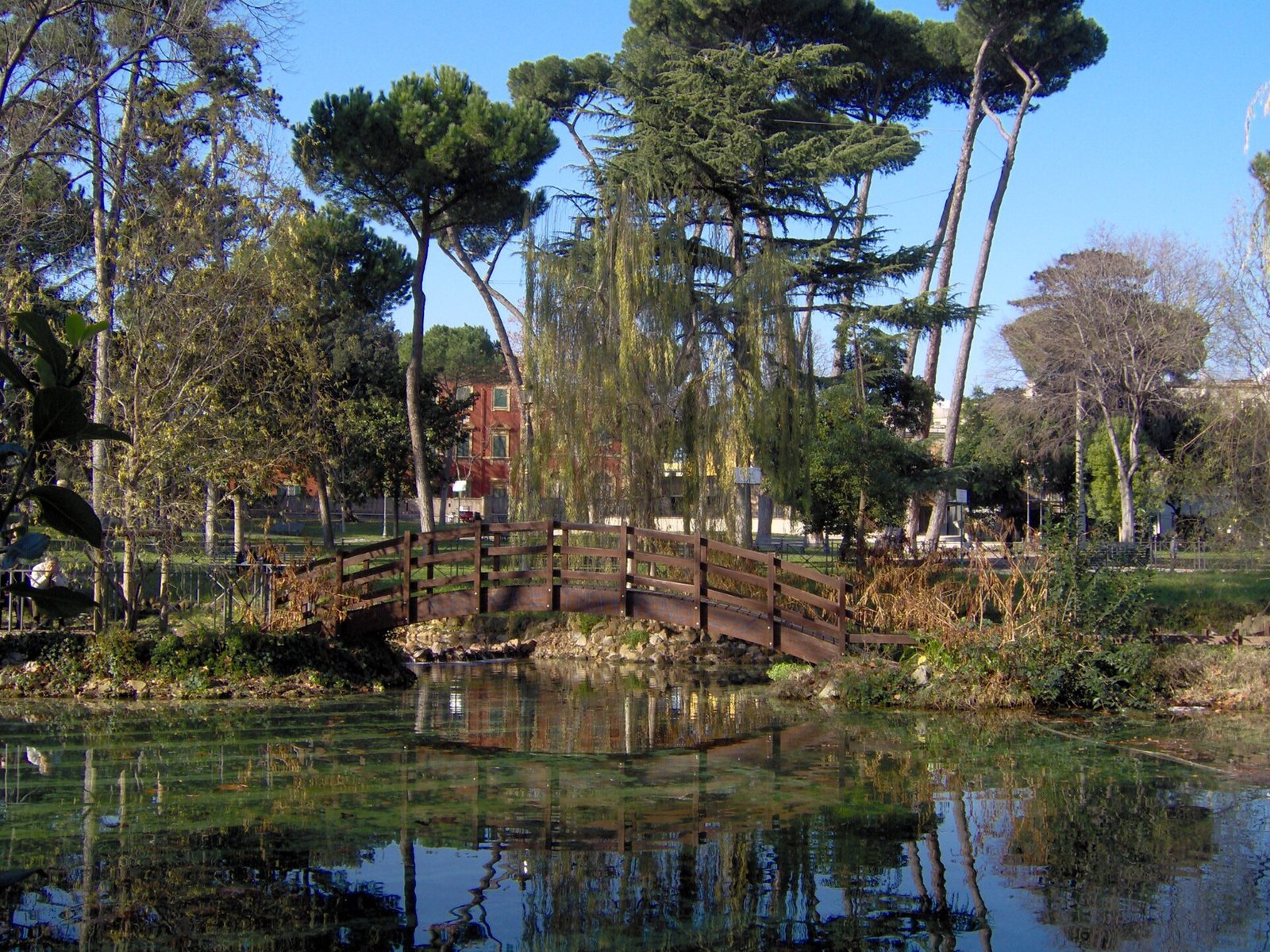
What do you find inside? A garden with a Romantic layout, with winding, irregular paths, tall trees, lawns and shade. The rustic pond with an artificial islet, restored in 2004 according to the Superintendency. A nymphaeum grotto reactivated in the same restoration. Several fountains. The Casino Nobile, restored and used for school activities. The World War I war memorial by Arnaldo Zocchi, from 1938. A playground and some sports equipment.
The oldest part is not a building but a fountain. The Capitoline Superintendency notes that from the period of Cardinal Pierbenedetti, at the end of the 16th century, a marble fountain remains. According to the online guide Romeguide it stands at the intersection of Via Nomentana and Vicolo della Fontana, the same lane from which one of the park's three entrances starts. It's the piece that ties today's neighborhood park to the late Renaissance suburban villa, when here there was countryside and vineyard outside the walls.
Villa Paganini is not big, and you take it in quickly. A full circuit of the paths takes less than half an hour at an easy pace. The value of the place is the 19th-century design, which De Vico kept in the 1930s by arranging it as an English-style garden, according to the tourism portal. The curved paths, the pond and the grotto are designed to hide the boundaries: from inside, the park seems larger than the numbers say, and the traffic of the Nomentana is heard less than you would expect.
Those who use it every day treat it as a neighborhood garden. Parents with small children, students from the school occupying the buildings, residents who cut through the park between the Nomentana and the inner streets of the Trieste district. On weekdays, at school dismissal, the playground tends to fill up. Early in the morning and in the middle hours of the day the park is calmer, with a few readers on the benches and people walking their dogs around the paths.
A curiosity about Villa Paganini
The date of the opening to the public is not random. The Capitoline Superintendency writes that the villa was opened on April 21, 1934 in the presence of Benito Mussolini. April 21 is the traditional date of the Birth of Rome. Mussolini, in those years, lived on the other side of the street, at Villa Torlonia. In our judgment, the opening of a public garden in front of the residence of the head of government, on that day, should be read also as an image-building gesture, as well as a service to the neighborhood.
The second detail concerns the official name. For the Capitoline Superintendency the villa is Villa Alberoni Paganini, with the names of two owners separated by almost two centuries. Alberoni is the cardinal who in 1722 bought the estate and began a major redesign of it. Paganini is the senator who bought it in 1890. The cardinal's surname has been lost in common use, and today in Rome everyone says Villa Paganini, even on the street signs of the largo that bears his name.
Third curiosity: the name Paganini has no links to the Genoese violinist. The official sources speak simply of Senator Paganini, owner from 1890, and in the park there is nothing that refers to music. The Rome city tourism portal adds that in 1913 the Paganini heirs sold the property to Enrico Lutzow. Whoever looks in this park for a memory of the composer of the Caprices will not find it: here the memory is that of a family of Roman owners of united Italy.
The last curiosity is recent and concerns science. In September 2026 Villa Paganini was presented as a sentinel park, according to news issued by the National System for Environmental Protection and by the trade press. It means that in the park and its surroundings air quality, particulate matter, ozone and biodiversity are measured, to understand how much the vegetation manages to reduce heat and pollution. A small neighborhood garden has become an open-air laboratory.
One thing nobody tells you about Villa Paganini
The bunker many people come looking for is not here. The World War II air-raid shelters that can be visited on the Nomentana are those of Villa Torlonia, under the side esplanade of the Casino Nobile, on the other side of the street. The official pages of Villa Paganini, of the Superintendency and of the Rome city tourism portal do not list a visitable air-raid shelter inside the park. This is the opposite position worth keeping in mind: those who enter Villa Paganini looking for an underground space leave empty-handed.
Second thing rarely said: in our judgment Villa Paganini is overrated as a destination in itself for those coming from outside Rome. It's a well-designed neighborhood garden, not a monumental park with museums like Villa Torlonia or Villa Borghese. Coming from the center on purpose just for it makes little sense. It does make sense to fit it into a morning on the Nomentana, as a green break between a museum, a basilica and a walk in the Trieste and Coppedè districts.
Third thing: the Casino Nobile can't be visited like the one at Villa Torlonia. The Rome city tourism portal says the park's buildings are used as a school and a kindergarten using the Montessori method, and the Superintendency recalls the prefabricated buildings put up in the 1950s for schools and service rooms. They are school spaces, used by children and teenagers. You look at them from outside staying on the paths, without approaching the fences and without photographing those who study or work there.
Fourth thing, a practical one: the entrance on the Nomentana is the one everyone uses, but it's not the only one. The entrances on Vicolo della Fontana and Largo di Villa Paganini, given by the Superintendency, are more convenient for those arriving from the inner streets of the Trieste district or from the Coppedè district. Those coming on foot from the north or the west save the stretch along the Nomentana, busy and noisy at rush hour, and enter the park from the quieter side.
How did the villa change from the cardinal's vineyard to the neighborhood garden?
At the end of the 16th century the area was countryside outside Porta Pia, made of vineyards and farmhouses along the consular road. In 1585, according to the Capitoline Superintendency, Cardinal Mariano Pierbenedetti da Camerino bought a vineyard to make it a prestigious residence. It was the model of the suburban villas of Roman prelates, places of rest and display a short distance from the city. From that phase the marble fountain recalled by the Superintendency remains.
In 1722 the estate passed to Cardinal Giulio Alberoni, who according to the Superintendency undertook major redesign works. During the 19th century the successive owners transformed the garden according to Romantic taste, with winding and irregular layouts, a rustic pond and several fountains. It's the design that can still be read today. The geometry of Italian gardens, with straight paths and trimmed hedges, was replaced by a landscape that imitated nature, with water, grottoes and trees apparently placed at random.
In 1890 the property was bought by Senator Paganini, when the surrounding area was already subject to growing building expansion, writes the Superintendency. Rome as capital of Italy was growing fast, and the Nomentana was filling with villini and small apartment buildings. In 1913 the heirs sold to Enrico Lutzow, according to the tourism portal. The villa survived the subdivision of the district while many other nearby vineyards disappeared, and this explains why today it is an island of green surrounded by residential buildings.
In 1934 the City of Rome bought the complex and entrusted the layout to Raffaele De Vico, the architect of the municipal gardens. The opening to the public, on April 21 of that year, turned a private villa into a service for the neighborhood. In 1938 came Arnaldo Zocchi's war memorial. In the 1950s the prefabricated buildings for the schools were built. The restoration completed in 2004 reactivated the nymphaeum grotto and restored the pond with its islet.
The advice I give you for visiting Villa Paganini
Enter from Largo di Villa Paganini or from Vicolo della Fontana, not from the Nomentana. The park opens that way from the quietest side, and the pond with the grotto arrives as a discovery instead of as the first thing seen from the gate. Take a wide loop of the paths, stop at the 16th-century fountain and the war memorial, and finally exit onto the Nomentana, ready to cross toward Villa Torlonia if the day continues with the museums.
Choose the time well. On school days, at the students' arrival and dismissal, the areas near the buildings get crowded, and the playground in the afternoon is full of local families. Those seeking calm find the park quieter in the morning, after the 07:00 opening, or in the middle hours of weekdays. On weekends the public changes, with more families and fewer students, but the park remains a neighborhood place more than a visitors' one.
Don't expect explanatory panels or a marked route. The villa's history has to be read beforehand, because on site the signs are few. It's useful to know that the pond, the grotto and the curved paths are the legacy of the Romantic 19th century, that the marble fountain dates to the 16th century and that the war memorial is from 1938. With these three references in mind, half an hour's stroll is enough to understand what you're looking at.
Respect the rules of municipal green space. Stay on the paths where the lawns are fenced, keep the dog on a leash near the playground and the school areas, take your trash away. In parks with many tall trees, after storms and days of strong wind, there may be cordoned-off areas: the barriers must not be crossed. In summer bring water, because the operator does not publish a list of working drinking fountains inside the park.
Do you pay anything and do you need to book?
No. Villa Paganini is a free-entry municipal public park, with no ticket office and no booking. You enter during the opening hours of the gates, from 07:00 to sunset according to the Capitoline Superintendency. The operator does not sell ordinary guided visits to the park, and no paid tour devoted to Villa Paganini is known that is worth mentioning. The Casino Nobile and the school buildings are not open to the public, so there is no ticket to go in.
Those who come to the Nomentana for the underground space have to book elsewhere. The bunker and air-raid shelters of Villa Torlonia can be visited only by guided tour with mandatory booking, according to the page of the Villa Torlonia Museums, which gives 060608 as the number. The route, reopened in April 2024, is offered in Italian, English, French and Spanish. The fee should be checked on the museums' website at the time of booking.
For the period from September to December 2026 the Rome city tourism portal lists individual visits to the bunker on Saturday and Sunday, with Italian-language turns spread between morning and afternoon and an English turn on Saturday at 11:00. The calendar changes month by month, so before planning the day it's best to check the museums' notices page. Villa Paganini can be the break before or after the visit, a few minutes' walk away.
Those organizing an outing with a class, an association or a group of friends don't need permits for a simple stroll during opening hours. The operator does not, however, publish a procedure for events, filming, installations or organized activities inside the park. In these cases it's best to ask Roma Capitale well in advance, starting from 060608 and the offices of Municipio II, taking into account the presence of the school in the buildings.
Another well-known fact, yet rarely cited
Many people know that Mussolini lived at Villa Torlonia. Few connect this fact with the garden opposite. The Capitoline Superintendency writes that Villa Paganini was opened to the public on April 21, 1934 in the presence of Mussolini, a few months after the City bought it. The villa of the head of government and the new public garden stood one in front of the other, separated only by the Nomentana, and the opening ceremony was part of the regime's calendar of celebrations.
The second fact, known to scholars of Roman green space and rarely cited, concerns the architect. Raffaele De Vico, who arranged Villa Paganini in 1934, is the same designer who 10 years earlier had designed the Parco della Rimembranza at Villa Glori, according to the Capitoline Superintendency. Here his intervention was more discreet: the Rome city tourism portal speaks of a layout in the style of the English garden, which respected the Romantic design of the 19th century instead of replacing it.
Third fact, often ignored by passersby: the World War I war memorial dates to 1938 and bears the signature of Arnaldo Zocchi, according to the Superintendency. The online guide Romeguide specifies that it commemorates the fallen of the Nomentano district. The choice of place matters more than the style of the monument. Here the memory of war entered a place meant for rest and children's play.
Finally, a figure that surprises those who look only at numbers: 25,400 square meters, just over two and a half hectares. Villa Paganini is much smaller than the city's great historic parks, but it is one of the noble villas of the Nomentano quadrant that survived the building expansion of the late 19th century. The Superintendency catalogs it among the villas of the nobles, next to much more famous residences. Its value lies precisely in having remained, when around it almost everything was being subdivided.
The right photo to take at Villa Paganini
The photo that tells the place is the one of the pond with the islet, among the trees, in the hours of side light in the morning or late afternoon. It works in landscape orientation, with the water in the foreground and the vegetation of the islet as backdrop. The operator does not publish the state of the water, and it's not certain you'll find it full: if you find it dry, the right photo becomes the one of the nymphaeum grotto, with the artificial rock and the light filtering through the branches.
The second useful image is the 16th-century marble fountain, the oldest element of the villa according to the Superintendency. It should be shot up close, paying attention to the details of the workmanship, and from some distance, to show the relationship with the street that bears its name. Avoid summer noon, when flat light erases the relief of the marble. A cloudy day, for this subject, does better than a clear sky.
Third choice: Arnaldo Zocchi's war memorial, from 1938, photographed with the trees around to tell the choice of putting memory inside a garden. People should be left out of the frame or shot only with their consent. Near the school buildings and the playground, no photos of children: these are spaces used every day by local families, and the privacy of minors comes before any framing.
On the calendar, autumn gives the best results, with the canopies changing color and the low sun entering between the trunks. Spring works for the green of the lawns and the blossoms. Those looking for an urban contrast can step out onto the Nomentana and photograph the gate of Villa Paganini with the entrance of Villa Torlonia in the background, the two villas one in front of the other. It's the image that explains the geography of this stretch of road better than any text.
How do you get there from central Rome?
The operator does not publish public transport directions, and the Rome city tourism portal gives only the position on Via Nomentana, after Corso Trieste, opposite Villa Torlonia. The Nomentana is served by several bus lines, but lines and stops change with works and new timetables. For the route of the day it's best to use the planner on the ATAC website or call 060608, giving as destination Villa Torlonia, Via Nomentana 70.
On foot from the historic center it's a long but straightforward walk. From Via XX Settembre you reach Porta Pia, then follow Via Nomentana toward the northeast, among villini and apartment buildings from the early 20th century, up to Villa Torlonia, which stays on the right, with Villa Paganini opposite. In the same quadrant is Villa Massimo, seat of the German Academy. For the return it's best to use public transport, checking the lines on the ATAC website.
By car the area is residential, with street parking and rules that change from street to street. The operator lists no dedicated parking for the park. The Nomentana at rush hour is very busy, and finding a space near the gates on school days is hard. The bicycle is a good solution for the district, but note that the Villa Torlonia Museums say that entering Villa Torlonia by bicycle is not allowed.
Those coming from the Trieste district or from Coppedè can enter from the Largo di Villa Paganini side, avoiding the Nomentana. Those coming from the university city and from San Lorenzo go north up to the Nomentana. The park is small and the paths are short, but those who have difficulty walking should calculate the sidewalk stretch to the chosen entrance carefully and ask 060608 which entrances have no steps.
Some important events that happened here in history
In 1585 Cardinal Mariano Pierbenedetti da Camerino bought the vineyard on the Nomentana to turn it into a prestigious residence, according to the Capitoline Superintendency. In 1722 the estate passed to Cardinal Giulio Alberoni, who began major redesign works. For more than a century the villa was one of the many suburban holdings of prelates and nobles along the consular roads, with vineyards, casini and gardens just outside the city walls.
In the course of the 19th century came the Romantic transformation, with the winding layouts, the rustic pond and the fountains described by the Superintendency. In 1890 the property was bought by Senator Paganini, when the surrounding district was already swept by the building expansion of Rome as capital. In 1913 the Paganini heirs sold the villa to Enrico Lutzow, according to the Rome city tourism portal. In the meantime, along the Nomentana, many similar properties were being divided into lots and built on.
In 1934 the City of Rome bought the complex and entrusted the layout to Raffaele De Vico. On April 21, 1934 the villa was opened to the public in the presence of Benito Mussolini, according to the Superintendency. In 1938 Arnaldo Zocchi's World War I war memorial was placed. In the 1950s, with the growth of the district's population, prefabricated buildings for schools and service rooms were built in the park.
In 2004 the villa was reopened after a major restoration, which according to the Superintendency restored the pond with its artificial islet and reactivated the nymphaeum grotto. The last chapter dates to September 2026: the project Villa Paganini, an Urban Park in the Anthropocene, promoted with Roma Capitale, ARPA Lazio and the CNR Research Institute on Terrestrial Ecosystems, has made the villa a laboratory for measuring the effect of vegetation on pollution and heat.
Who has passed through Villa Paganini
The first names are those of the owners. Cardinal Mariano Pierbenedetti da Camerino, who bought the vineyard in 1585. Cardinal Giulio Alberoni, who acquired it in 1722 and tied his name to the villa, so much so that the Superintendency still calls it Villa Alberoni Paganini. Alberoni was a churchman from Piacenza with a long political career, and with him the vineyard became for the first time a carefully laid out villa, according to the Superintendency.
Then the owners of united Italy. Senator Paganini, who bought the villa in 1890 and gave it the name by which everyone knows it. His heirs, who in 1913 sold it to Enrico Lutzow, according to the Rome city tourism portal. They are figures of the bourgeois and political Rome of the late 19th century, less known than the cardinals who preceded them, but decisive: without them the villa would perhaps have ended up subdivided like many nearby vineyards.
The 20th century brings public names. Benito Mussolini, present at the opening of April 21, 1934, who lived at Villa Torlonia opposite. Raffaele De Vico, architect of the City, author of the garden layout and of many other Roman parks. Arnaldo Zocchi, sculptor of the 1938 war memorial. And, from the 1950s, generations of students: the park's buildings still house a school today, and the tourism portal also mentions a kindergarten using the Montessori method.
The latest arrivals are the researchers. In 2026 the architecture firm Schiattarella Associati, ARPA Lazio, CNR-IRET and the Environmental Protection Department of Roma Capitale worked together on the sentinel park project, according to the National System for Environmental Protection. The presentation of the results was scheduled for September 16, 2026, and the magazine Artribune announced among the speakers the botanist Stefano Mancuso. The park has thus also become a place of study.
Is there really an air-raid shelter under Villa Paganini?
What the documents say: the official pages of Villa Paganini, that is, the one of the Capitoline Superintendency and the one of the Rome city tourism portal, describe the pond, the grotto, the fountains, the Casino Nobile, the war memorial and the schools. Neither lists a visitable air-raid shelter inside the park. The air-raid shelters open to the public on the Nomentana, with a bunker and a multimedia route, are those of Villa Torlonia, run by the municipal museums of the villa opposite.
Villa Torlonia helps explain the confusion. According to the Villa Torlonia Museums, under the side esplanade of the Casino Nobile underground structures were built during World War II to protect Mussolini and the population from Allied bombing, including a cylinder-shaped bunker protected by four meters of reinforced concrete. The closeness of the two villas, one in front of the other, is enough to explain the confusion: those who read about the bunker on the Nomentana and see two parks facing the same street can easily pick the wrong gate.
What remains without proof: the existence of an air-raid shelter under the lawns of Villa Paganini is not confirmed by any official source. During the war Rome equipped itself with public and private shelters in many districts, and it cannot be ruled out that some existed in this area too. Until the City or the Superintendency document one inside the park, however, a Villa Paganini bunker open to visitors does not exist. The visitable underground remains on the other side of the street.
For those interested in the theme, the right choice is to book the visit to the Villa Torlonia bunker and complete the day with other underground places in the city. Among our entries you find the page on underground Rome, with the sites visited below street level, and the one on the places of memory in Rome, which tells the story of World War II Rome through monuments, plaques and museums.
What is the 2026 sentinel park project?
The project is called Villa Paganini, an Urban Park in the Anthropocene. According to the news published on September 12, 2026 by the National System for Environmental Protection, it arises from the collaboration between the architecture firm Schiattarella Associati, ARPA Lazio, the CNR Research Institute on Terrestrial Ecosystems and the Environmental Protection Department of Roma Capitale. The goal is to measure atmospheric pollutants and the effect of plant barriers in mitigating heat in the city.
How is it measured? With samplers for fine particulate, PM1, PM2.5 and PM10, for nitrogen dioxide, ozone and meteorological parameters. Alongside the instruments, a biological method: bags of devitalized moss used as bioaccumulators, the so-called moss bags. The researchers also analyze the particulate deposited on tree leaves. The data are compared with those of the Boncompagni fixed monitoring station, about a kilometer away, according to the same source.
The first result released by CNR-IRET concerns plant diversity. According to the institute, a mix of trees, shrubs and herbaceous plants with different characteristics removes pollutants from the air more effectively than single-species plantings, because each plant interacts differently with the different size fractions of particulate. It's a useful indication for those who design public green space: the Romantic garden, with its mixture of species, works better than a uniform row.
For those who visit the park the project changes little in the short term. The park stays open with the same hours, and the measuring instruments do not limit access to the paths. The operator has not published works or closures tied to the project. Those following the matter can watch the news from ARPA Lazio, the CNR and Roma Capitale, where any developments will appear. In our judgment it's one more good reason to look at this small garden with different eyes.
How does Villa Paganini fit among the villas of the Nomentana?
Via Nomentana, between Porta Pia and the Aniene, was once lined with villas and vineyards of cardinals and nobles. Today some remain, different in state and access. Villa Torlonia is the largest and best known, with a public park and paid museums in the Casino Nobile. Villa Massimo is the seat of the German Academy and opens only on special occasions. Villa Paganini is the smallest and most domestic public garden of the series.
Under Villa Torlonia are also the Jewish catacombs of Villa Torlonia, which are not open to the public. In the park opposite Villa Paganini are the obelisks of Villa Torlonia, erected by the princes in the 19th century. Putting the two villas together lets you see in an hour two ways of understanding the garden: the scenic and monumental one of the Torlonia and the intimate and Romantic one of Villa Paganini.
Continuing north, the Nomentana leads to the Basilica of Sant'Agnese fuori le Mura and the Mausoleum of Santa Costanza, two essential stops of early Christian Rome. Farther on, beyond the Monte Sacro neighborhood, the Ponte Nomentano crosses the Aniene at the edge of the Valle dell'Aniene Nature Reserve. It's the axis of a full day, from the center to the countryside.
To the west, in the Trieste neighborhood, the system of villas continues with the Villa Chigi Park, another public garden of Municipio II, and farther on with Villa Ada on Via Salaria. Also on the Salaria is Villa Albani Torlonia, private property that can be visited only on request. Villa Paganini doesn't compete with any of these in size, but it is the most convenient starting point for anyone arriving from Porta Pia.
When is it closed, and what should you not expect?
The park closes every evening at sunset and reopens at 7, according to the Sovrintendenza Capitolina. The operator doesn't publish a table with the exact closing time for each month, so the reference is daylight. In winter the gates close early in the afternoon. Like all parks with many tall trees, Villa Paganini can stay closed for safety reasons, work on the trees or a weather alert for strong wind, with notices published by Roma Capitale.
Before going on a day of bad weather, it's best to check the notices on the city's website or call 060608. The same goes for days of extraordinary maintenance of the pond or the paths, which the operator announces case by case. If the Nomentana gate is barred for a localized intervention, it's worth checking the entrances at Vicolo della Fontana and Largo di Villa Paganini before giving up, because closures may affect only part of the park.
What should you not expect? A museum: the Casino Nobile can't be visited. A bunker: the air-raid shelters open to visitors are at Villa Torlonia. A pond that's always full: the operator doesn't publish the state of the water, and it's best not to take it for granted. A fenced dog area: the operator doesn't list it among the services. A café inside: the tourist portal doesn't mention one. And not a big park for running either, because the paths are short and crowded when the schools let out.
Don't expect absolute silence either. Villa Paganini is surrounded by busy streets and residential buildings, and you can hear the Nomentana from the paths closest to the road. Real calm is found around the pond and the grotto, in the innermost part. For anyone looking for extensive woods and long routes, in our judgment, Villa Ada and the Valle dell'Aniene Nature Reserve do better. Villa Paganini works as a break, not as an excursion.
Where to eat nearby
There is no refreshment point inside the park, and the operator doesn't publish specific rules on picnics. The general rules for city green spaces apply: no fires, no glass left on the ground, trash taken away with you. Outside the gates, the Nomentana and the Trieste neighborhood are residential areas, with places meant for the people who live, study and work there. Tourist pressure is low, and the traps of the historic center are less frequent here.
The traps exist anyway, especially near the busiest spots such as the entrance of the Villa Torlonia museums and Porta Pia. The signs are always the same: the barker on the sidewalk, the menu with photos of the dishes, items with no price, a different menu outside and inside, a kitchen open nonstop with no break. Romans avoid these places because the quality depends on passing crowds and not on regular customers.
The practical rule is to choose where you see people from the neighborhood on their lunch break, with a short menu, handwritten or printed daily, and clear prices. When schools and offices let out, the places in the area fill up quickly, so it's best to have lunch earlier or later. To find addresses selected with care there is the list of addresses on Google Maps, also useful for organizing the day between the Nomentana, Trieste and the center.
Anyone who prefers to eat outdoors will find benches and shade along the paths, but the park is small and very busy in the hours after school. It's best to choose spots away from the playground and the school entrances, keeping the passages clear. For a longer break, with wide lawns and room to sit, the Villa Torlonia park across the street offers more surface. In both cases the advice is to leave the place as you found it and head out before the gates close.
What to pair with it in a day
The natural pairing is Villa Torlonia, across the street. The Musei di Villa Torlonia, that is Casina delle Civette, Casino Nobile and Casino dei Principi, are open Tuesday to Sunday from 9 to 19, with last entry at 18, and closed on Monday, May 1 and December 25, according to the museums' website. The bunker visit must be booked. Villa Paganini thus becomes the green break before or after the museums.
To the west, a few blocks away, is the Coppedè neighborhood, with its fantastical architecture around Piazza Mincio. Farther on, in the Trieste neighborhood, the Villa Chigi Park. Anyone coming from the center can start from Porta Pia and the nearby Porta Pinciana, along the Aurelian Walls, and then go down Via Veneto toward the center in the afternoon.
To the south you reach the La Sapienza University City and the San Lorenzo neighborhood, described on the page San Lorenzo: what to see. From there you get to the Basilica of San Lorenzo fuori le Mura and the Verano Cemetery. It's a route that brings together the 20th-century city, early Christian Rome and the city's great monumental cemetery.
To the north, beyond Sant'Agnese, the Monte Sacro neighborhood and the Parco delle Valli, a large green space along the Aniene. To the west, beyond the Salaria, the Catacombs of Priscilla, which can be visited with the operator's tours. Anyone who prefers art museums can move to Villa Borghese, with the Galleria Borghese by reservation and the National Gallery of Modern and Contemporary Art in Valle Giulia.
For more zero-cost ideas there are the pages on Free Rome and Rome with Kids, where Villa Paganini sits next to the big parks. Among the other free-entry historic gardens of the city, on the site you will also find Villa Celimontana, Villa Sciarra and Villa Doria Pamphilj, all with a history of noble owners and later passed to the city.
Frequently asked questions
Is Villa Paganini open today and until what time?
The park is open every day from 7 to sunset, according to the Sovrintendenza Capitolina, and entry is free. The operator doesn't publish an exact closing time for each month, so in winter the gates close earlier. Extraordinary closures are possible for safety reasons, work on the trees or a weather alert. To get confirmation on the day of your visit, it's best to call 060608 or check the notices on the Roma Capitale website.
Where do you enter Villa Paganini?
The entrances indicated by the Sovrintendenza Capitolina are three: on Via Nomentana opposite number 70, that is in front of the Villa Torlonia entrance, in Vicolo della Fontana and in Largo di Villa Paganini. The Nomentana entrance is the most convenient for anyone arriving by public transport or from the Villa Torlonia museums. The other two are quieter and suit anyone arriving on foot from the Trieste neighborhood or from Coppedè.
Is there a bunker or air-raid shelter to visit at Villa Paganini?
The official pages of Villa Paganini don't list an air-raid shelter open to visitors. The bunker and air-raid shelters that you can visit on the Nomentana are at Villa Torlonia, under the side square of the Casino Nobile, across the street. You enter only with a guided tour and a mandatory reservation, according to the Musei di Villa Torlonia, who give 060608 for information. The fee must be checked on the museums' website.
Can you visit the Casino Nobile of Villa Paganini?
No. The Casino Nobile of Villa Paganini is not a museum and has no visiting hours. The buildings in the park are used as a school, and the Roma Capitale tourist portal also mentions a Montessori kindergarten. You can look at them from the outside, staying on the paths, without getting close to the school fences. The Casino Nobile you can visit on the Nomentana is the one at Villa Torlonia, which is part of the city museums with a ticket.
Are Villa Paganini and Villa Torlonia the same park?
No. They are two separate parks, one opposite the other, separated by Via Nomentana. Villa Torlonia is larger, with paid museums, the bunker and the Jewish catacombs underground. Villa Paganini is a romantic garden of about two and a half hectares, with a pond, a grotto and fountains, with free entry. You go from one to the other by crossing the street, and together they make a full morning of history and greenery.
Is Villa Paganini suitable for children?
Yes. The Roma Capitale tourist portal lists a playground equipped for children and some sports equipment. The park is small and fenced, with short paths that are easy to keep an eye on. On school-day afternoons the playground is very busy with families from the neighborhood. Near the pond it's best to keep an eye on the little ones. For more ideas, on the site you'll find the page Rome with Kids.
Does the pond at Villa Paganini have water?
The pond with the artificial islet was restored in 2004, according to the Sovrintendenza Capitolina, but the operator doesn't publish its current state or a maintenance calendar. Don't take it for granted that you'll find it full. Anyone going specifically to photograph it would do well to ask for information at 060608 before leaving, or to consider the nymphaeum grotto as an alternative for the photo.
How do you get to Villa Paganini by public transport?
The operator doesn't publish the transport lines. The simplest reference is Villa Torlonia, Via Nomentana 70, because the main entrance of Villa Paganini is right opposite. The Nomentana is served by several bus lines, which are best checked on the day with the route planner on the ATAC website or by calling 060608. On foot from Porta Pia, follow the Nomentana to the northeast.
What is the sentinel park of Villa Paganini?
It's the Villa Paganini project, an urban park in the Anthropocene, presented in September 2026 by Roma Capitale, ARPA Lazio, CNR-IRET and the Schiattarella Associati studio. In the park and the surrounding area they measure particulate matter, nitrogen dioxide, ozone and weather parameters, with instruments and moss bags used as bioaccumulators. The goal is to understand how much the vegetation reduces pollution and heat. Access to the paths doesn't change.
Who wrote this and from which sources
The text comes from the editorial team of Tour Leader Pro, the Roman organization that designs itineraries, visits and cultural events between Rome and Lazio. Fees, hours and access arrangements reported here come from the official sources cited in the text as of the date indicated at the opening: for Villa Paganini the reference is the page of the Sovrintendenza Capitolina and the notices of Roma Capitale. Let us know what you find changed.
Organizing a visit on the Nomentana for a group means working on how the pieces fit together more than on tickets: booking the Villa Torlonia bunker slot, calculating the museum hours, choosing the right Villa Paganini entrance for the break and taking into account when the schools let out. For anyone planning outings of this kind, a useful resource for people who organize group trips is Tour Leader Pro, with tools designed to coordinate visits and itineraries.
Villa Paganini is also a gateway to a less beaten Rome, made of early 20th-century neighborhoods, noble villas turned into public gardens and early Christian basilicas along the consular roads. Putting together the Nomentana, the Salaria, the Aniene valley and perhaps the Sabina and the Castelli takes a few days and a bit of planning, and a useful resource for building a multi-day itinerary is Italy Planner.