Villa Glori
In short. Villa Glori is open: the public park on the Parioli hill can be crossed for free every day from 7 until sunset, with entrances from the piazzale of the Parco della Rimembranza and from Viale Maresciallo Pilsudski, in Rome's Municipio II.
Villa Glori is open: the public park on the Parioli hill can be crossed for free every day from 7 until sunset, with entrances from the piazzale of the Parco della Rimembranza and from Viale Maresciallo Pilsudski, in Rome's Municipio II. There are no tickets or reservations. The park belongs to Roma Capitale, and the latest official notice about the works lists the Environmental Protection Department as the competent office. For information the reference number is 060608, the city's contact center.
It covers 25 hectares on a rise that overlooks the bend of the Tiber, between the Flaminio and the Parioli, behind the Auditorium. The name comes from Vincenzo Glori, hydraulic engineer of the Papal States who owned the vineyard in the mid-19th century. Here on October 23, 1867 a group of Garibaldians led by the brothers Enrico and Giovanni Cairoli was stopped by the papal troops. In 1924 the hill became the Parco della Rimembranza for the fallen of World War I.
Data checked on September 29, 2026 on the page of the Capitoline Superintendency dedicated to the villa, on the closure notice of October 2025, on the tourist portal of Roma Capitale and on the other sources indicated later in the text. The operator does not publish a street number for the entrances, a different schedule by season or information on a dog area. It does publish the entrances, the main services and the closure notices, which are worth checking before going in the months of the works.
At a glance: address, hours, ticket
- Address: entrances from the piazzale of the Parco della Rimembranza and from Viale Maresciallo Pilsudski, Parioli neighborhood, Municipio II.
- Operator: Roma Capitale, competent office named in the 2025 notice as the Environmental Protection Department, information at 060608.
- How to get in: free entry, no reservation, during the opening hours of the gates.
- Price: free.
- Hours: from 7 until sunset according to the Capitoline Superintendency, barring extraordinary closures announced by the city.
- Services: playground on the avenue of Villa Glori, drinking fountains, pony rental on Viale Maresciallo Pilsudski according to the Superintendency.
- Accessibility: the paths redone in 2025 are described as usable by people with disabilities, the operator does not publish an accessible map.
Where it is and what you actually see
The villa occupies the hill between Viale del Pinturicchio, Via Venezuela and the piazzale of the Parco della Rimembranza, in the northern sector of the city. The tourist portal of Roma Capitale places it between the Parioli and the Flaminio, behind the Auditorium Parco della Musica. The Capitoline Superintendency speaks of a hill that overlooks the bend of the Tiber. Anyone climbing from the river side understands the point of the position at once: you look down from above on the plain where Via Flaminia runs.
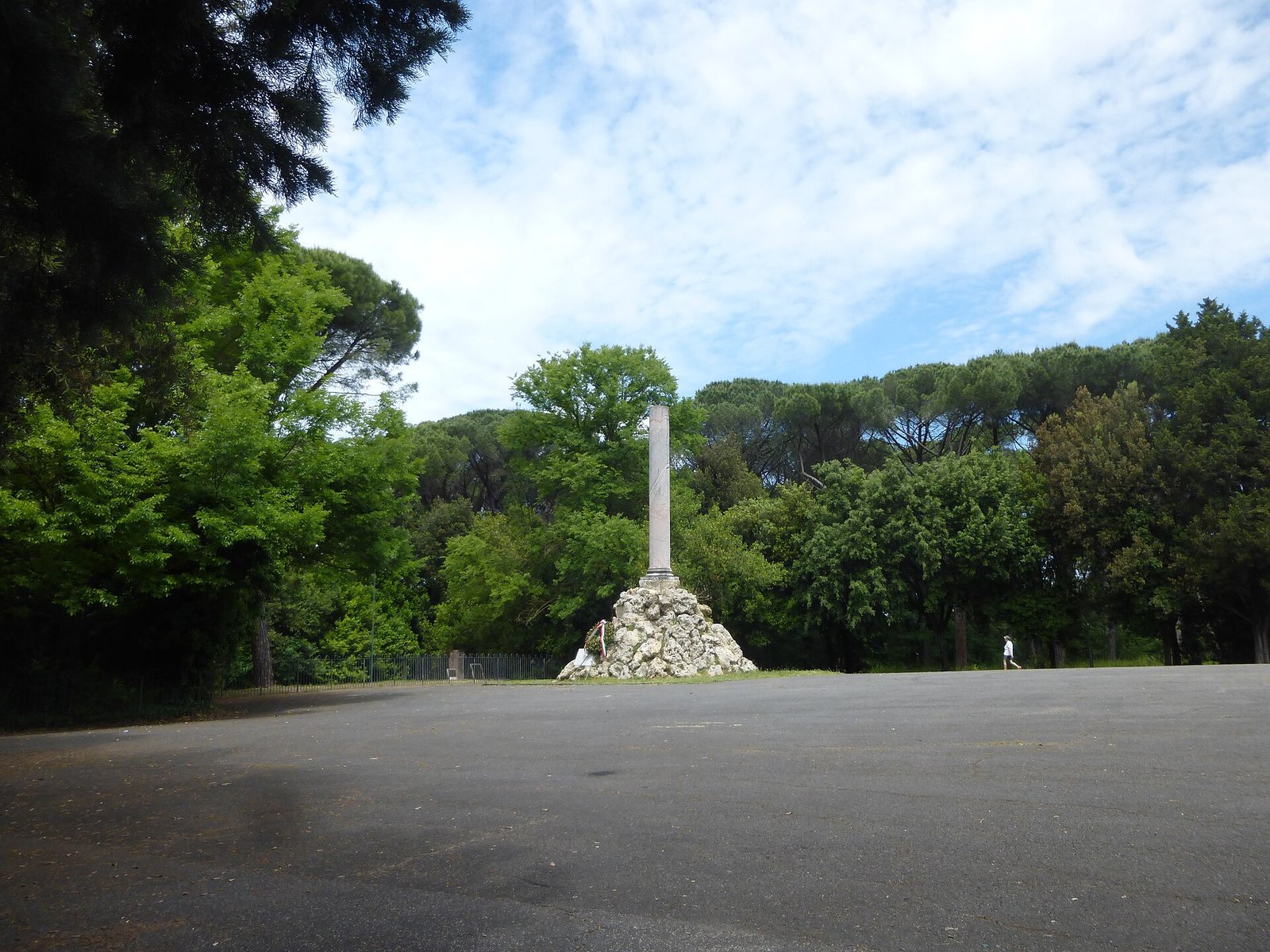
What do you find inside? Wide lawns, groves, pines, oaks, cypresses, olives, horse chestnuts and cedars, according to the tourist portal's list. A network of avenues in packed earth and in draining material. The monumental entrance piazzale on the Rimembranza side. The column that recalls the fallen of 1867, near the spot where tradition places the almond tree under which Enrico Cairoli died. And then a series of contemporary sculptures scattered in the greenery, installed between 1997 and 2000.
The least visible part is the one underfoot. The tourist portal of Roma Capitale mentions a hypogeum cut into the tuff, discovered in 1794 and dated to the Antonine age, between the 2nd and 3rd centuries AD. The operator does not state visits or openings of this space, and it is not to be looked for on the ground: it is a historical fact that helps to understand how long the hill has been frequented, inhabited and farmed well before the 19th-century vineyard.
To someone arriving for the first time, the park looks like a great lung of the neighborhood, with runners, families and dogs on leashes. It is also a place of national memory, with a geometry designed on purpose to remember. The two souls coexist without too many signs, and this is why many cross it without noticing the design. Reading the villa means looking for the axes, the elliptical piazzas and the points where the 1924 design opens onto the city.
The landmarks for finding your way are few and clear. The entrance piazzale of the Rimembranza, from which the main avenues start. Piazza del Mandorlo, one of the two elliptical piazzas recovered with the 2025 works according to the press, near the column of the fallen. The meditative roccolo, the other elliptical piazza. The belvedere axis, reconnected during the restoration, which looks toward Saint Peter's and the Tiber. With these four points in mind the park can be read without a map.
A curiosity about Villa Glori
The date chosen by the city to turn the hill into the Parco della Rimembranza is not random. According to the Capitoline Superintendency the resolution bears the date of October 23, 1923. The clash of the Cairoli brothers with the papal troops had happened on October 23, 1867. Exactly 56 years separate the two events, and the choice of the day ties Risorgimento memory to that of the Great War, as if the hill were meant to recall two generations of fallen for Italy.
The second curious detail concerns the name. Villa Glori has never been a noble villa in the Roman sense of the term, with a casino, an Italian garden and collections. It was a vineyard with agricultural and hunting functions, and according to historical reconstructions it passed from the Boncompagni to the engineer Glori, from whom it took its name. The word villa, here, indicates a large tract of land outside the gate more than a showpiece residence like Villa Borghese.
Then there is the literary name. The Roman poet Cesare Pascarella dedicated to the 1867 clash a collection of 25 sonnets in Romanesco titled Villa Gloria, published in 1886. The form of the title is not a misprint: Gloria in place of Glori turns the owner's surname into a word loaded with meaning. Literature thus gave the hill a second name, which those who know Roman dialect poetry still recognize, before and beyond the public park.
A third curiosity concerns horses. Today on Viale Maresciallo Pilsudski ponies are rented for children, according to the Superintendency. It is a small echo of a bigger story: according to historical reconstructions, in 1908 a racetrack for trotting races was built on the plain below the hill, which stayed active until the end of the 1950s, when the races moved to Tor di Valle. For half a century the name Villa Glori was tied also to Roman horse racing.
One thing nobody tells you about Villa Glori
The great monument to the Cairoli brothers with the bronze statues is not here. It is at the Pincio, above Piazza del Popolo. At Villa Glori there is instead a commemorative column for the fallen of 1867, inaugurated in 1895 according to the Capitoline Superintendency. Many arrive in the Parioli looking for the sculptural group they saw in a photograph and find a column in a meadow. This is the opposing view worth keeping in mind: the site of the clash and the most famous monument are in two different parts of the city.
Second thing rarely said: the entrance almost everyone uses, the one on Viale Maresciallo Pilsudski, is the most convenient for those coming from the Flaminio but the least suited to understanding the park. In our judgment the visit should begin from the piazzale of the Parco della Rimembranza, the monumental access of Raffaele De Vico's design. From there the axes read in the order in which they were conceived, and the 1867 column arrives as a point of arrival and not as an object found by chance.
Third thing: inside the park not everything is public. According to historical reconstructions, in 1929 three pavilions named after Ettore Marchiafava were built as a dispensary and summer camp for poor youths at risk of tuberculosis. The Superintendency recalls a wooden summer camp of the same year. Since 1988, according to the same reconstructions, Caritas of Rome has run in that area a group home for people with AIDS. They are lived-in spaces of care, to be respected by staying on the avenues.
Fourth thing, practical: the villa appears among the historic villas and parks on the site of the Capitoline Superintendency, but the 2025 closure notice lists the Environmental Protection Department as the competent office. The park therefore depends on more than one office of Roma Capitale. For lectures and cultural initiatives it's best to look at the Superintendency's calendar, for maintenance, trees, gates and reports the channel is the city, reachable through 060608. Knowing whom to turn to avoids useless phone calls.
What really happened on October 23, 1867?
In the fall of 1867 the Garibaldians tried to take Rome, still the capital of the Papal States. Historical reconstructions place the clash in the campaign in the Agro Romano for the liberation of the city. Within that campaign, a group of volunteers led by the brothers Enrico and Giovanni Cairoli approached Rome with the aim of freeing it from papal rule. The tourist portal of Roma Capitale speaks of about 70 men. On the hill of the Vigna Glori, on October 23, they were intercepted by the papal army.
The outcome of the clash is summed up by the same source bluntly: Enrico Cairoli was killed, Giovanni was gravely wounded. Other volunteers fell with him. Tradition places Enrico's death under an almond tree, and near that spot the column in memory of the fallen was later erected. In early November the defeat at Mentana closed the Garibaldian campaign. Rome would become Italian only in 1870, with the breach of Porta Pia.
Why did such a small clash leave such a large mark? The Cairoli were a family from Pavia that gave the Risorgimento several sons, and Enrico's death soon became a symbol. The Pincio got its monument, the Parioli their column. Popular poetry did the rest, with Pascarella's sonnets. To understand the context it's worth visiting the Museum of the Roman Republic and Garibaldian Memory on the Janiculum.
On the Janiculum there is also the Janiculum Ossuary Mausoleum, dedicated to those who fell for Rome in the Risorgimento period. Hill against hill, north against south: the Janiculum recalls above all the Roman Republic of 1849, Villa Glori the attempt of 1867. Anyone with time for a themed route can put the two stops in the same day, with the historic center in between. On the site you will also find the page on the places of memory in Rome.
The advice I give you for visiting Villa Glori
Enter from the piazzale of the Parco della Rimembranza and follow the design of the park, not the flow of runners. De Vico's plan is made of crossing avenues, elliptical piazzas and an axis that opens toward the city. The 2025 works, according to the press, recovered precisely these geometries, with Piazza del Mandorlo and the meditative roccolo. A slow one-hour loop is enough to see the essentials, from the 1867 column to the contemporary sculptures.
Extra care in the months of the works. Where new plants have been set or where the lawns are being reseeded, areas may be fenced off: stay on the paths and respect the barriers, even when they seem excessive. Construction fences must not be crossed for any reason. Take your trash away, because the park is not designed for organized picnics, and keep the dog on a leash near the children's play areas and the lived-in pavilions.
Choose the right moment. The gates open at 7 and close at sunset, and the operator does not publish a precise time for each month. On the short winter days closing comes early, so anyone going up in the afternoon must keep an eye on the light. The best hours are the first of the morning, when the park is used mostly by people exercising, and late afternoon in spring, with the raking light on the lawns.
Bring water in summer even though there are drinking fountains. The park is large, exposed and uphill from the Flaminio side. Comfortable shoes, because part of the paths is packed earth or draining material, and after rain it can be slippery. Anyone coming with small children finds the playground on the avenue of Villa Glori, according to the Superintendency. For the rest there are no services published as at a museum: no coat check, no permanent information point.
If the historical side interests you, first stop by the Pincio to see the Cairoli monument, then climb to the Parioli. The reverse order works less well: the Villa Glori column is sober, and without the story in your head it risks looking like a simple stone marker in a meadow. Anyone who prefers contemporary art can do the opposite, starting from the MAXXI in the Flaminio and then climbing among the park's sculptures.
Do you pay anything and do you need to book?
No. Villa Glori is a free-entry municipal public park, and there is no ticket office. There is no need to book, and no turns or access limits are published. You enter during the opening hours of the gates, from 7 until sunset according to the Capitoline Superintendency. The operator does not sell ordinary guided visits to the park, and there appears to be no paid tour dedicated to Villa Glori worth mentioning. Be wary of anyone offering a paid entry.
There are, however, free cultural occasions tied to the park. In June 2023, for example, the Superintendency organized, in the cycle Le ville raccontano, a lecture dedicated to Villa Glori and the Sculpture Park, curated by Alessandra De Romanis and Costantino D'Orazio, free and with a maximum of 50 seats. It was held at the Casino dell'Orologio in Villa Borghese, near Piazza di Siena. Similar initiatives should be looked for in the Superintendency's calendar.
The only paid service documented inside the park is the pony rental on Viale Maresciallo Pilsudski, which the Superintendency lists among the services. The operator does not publish rates or hours for this service, which must be asked about on site. The same page lists a bar or refreshment point on Viale Pilsudski, but the sources disagree on if it operates: the local press reported a ruling in favor of the city on the closure of a kiosk in the park.
Anyone organizing a group outing, a class or an association doesn't need permits for a simple walk during opening hours. The operator does not publish a procedure for organized initiatives, events, filming or activities with setups. In these cases it's best to ask Roma Capitale well in advance, starting from 060608 and the offices of Municipio II, and to keep in mind that during the works some areas may be fenced off or unavailable.
Another well-known fact, yet rarely cited
That Villa Glori is a Parco della Rimembranza many know. Few remember what that meant. In the 1920s, all over Italy, parks and avenues of Remembrance were born with a precise idea: one tree for every fallen soldier. According to historical reconstructions, for Villa Glori De Vico designed the central piazzale and a network of avenues and had more than 6,000 trees and shrubs planted. The woodland that today shades the runners was born as a memorial.
The park was inaugurated on May 18, 1924, according to the Capitoline Superintendency. The years are those of the first Fascist governments, and the language of the war memorials bears the mark. Reading the villa today as a simple green space loses this dimension. Anyone walking it from the entrance piazzale toward the interior still crosses a layout designed for a collective ceremony, with axes and gathering spaces more than secluded corners.
A second fact known to historians and rarely cited concerns the city plan of 1883, which according to the Superintendency already foresaw the transformation of the vineyard into public green space. The idea of a park on the hill, therefore, is four decades older than the Rimembranza. It took decades, and a strong symbolic occasion like the memory of the war, for the project to become reality. It is a story common to many Roman parks, conceived long before they were opened.
Finally there is a fact that concerns the landscape and escapes anyone who looks only at the monuments. The woodland of Villa Glori is largely artificial, the result of the 1924 plantings and of later interventions. The second phase of works announced by the press, with about 400 trees and more than 1,000 shrubs, continues that story. The park is not a surviving fragment of countryside, but a landscape built and rebuilt several times, and should be judged that way too.
The right photo to take at Villa Glori
The photo that tells the place is the one of the 1867 column of the fallen in its meadow, with the trees around. It works vertically, with the column off-center and the sky above, in the hours of side light in the morning or late afternoon. Avoid summer noon, when flat light squashes everything. An honest photo, without heavy filters, does better justice to the monument's sobriety, which is made not to amaze but to remember.
The second useful image concerns the belvedere axis. According to the press that covered the 2025 works, the restoration reconnected the axis that looks toward Saint Peter's and the Tiber. Anyone who finds it has one of the few views from above over the northern city, with the dome in the distance. You need a slightly long lens to bring it closer, and a day of north wind, when the air is clear and the haze over the Tiber valley thins.
Third choice: one of the contemporary sculptures set in the greenery, for example the Ruote by Mauro Staccioli from 1997, cited by the Superintendency. Photograph them with the landscape around, because the sense of the project was precisely the dialogue between work and nature. People should be left out of the frame or included only with their consent. Near the pavilions of the group home, no photos: they are spaces lived in by people who have a right to privacy.
On the calendar, two seasons give the best results. Autumn, when the crowns of the horse chestnuts and deciduous trees change color and October 23 brings attention back to the site of the clash. And spring, with green lawns and still-soft light. In summer the park gives more at dawn. Anyone photographing for a story on the Risorgimento can pair the Villa Glori column with the Pincio monument, two images of the same event.
How do you get there from central Rome?
The operator does not publish directions for public transport, and the tourist portal of Roma Capitale limits itself to saying that the villa can be reached by the network of buses, trams and metro. The simplest reference point is the Auditorium Parco della Musica, at the foot of the hill according to the same source. For the day's lines it's best to use the route calculator on the ATAC site or call 060608.
Anyone arriving on foot from the Flaminio climbs toward Viale Maresciallo Pilsudski entrance, the closest to the Olympic neighborhood. Anyone arriving from the Parioli enters from the piazzale of the Parco della Rimembranza, reachable from the neighborhood's residential streets such as Via Venezuela and Viale del Pinturicchio. The climb from the river is short but steep in some stretches. Keep that in mind if you are traveling with strollers or with people who struggle to walk uphill.
By car the area is residential, with street parking and rules that change from street to street. The operator does not state a parking lot dedicated to the park. On days of concerts at the Auditorium or matches at the Stadio Olimpico traffic on the Flaminio increases a lot, and it's best to avoid the car. The bicycle is a good solution for anyone arriving along the Tiber, with the last uphill stretch to allow for.
On foot from the historic center it is a long walk, possible for anyone with good legs and time. The most pleasant route goes through Piazza del Popolo, climbs to the Pincio, crosses Villa Borghese and descends toward Valle Giulia and the Flaminio. You thus see in sequence the Cairoli monument and the site of the clash. For the return it's best to use public transport, checking the lines on the ATAC site, especially if the visit ends at sunset with the closing of the gates.
Some important events that happened here in history
The hill was frequented already in Roman times: the tourist portal of Roma Capitale mentions the hypogeum in the tuff of the Antonine age, discovered in 1794. For centuries the land was vineyard and hunting reserve, with a fortified farmhouse as the oldest structure according to historical reconstructions. On October 23, 1867 the clash between the volunteers of the Cairoli brothers and the papal troops turned an agricultural property into a symbolic place of the Risorgimento, destined to enter national memory.
In 1883 the city plan of Rome provided for allocating the area to public green space, according to the Capitoline Superintendency. In 1895 the monument to the fallen of 1867 was inaugurated, the column that can still be seen today near the site of the almond tree. In 1908, again according to historical reconstructions, a racetrack for trotting races was built on the plain below, which stayed active until the end of the 1950s, when racing moved to Tor di Valle.
With the resolution of October 23, 1923 the hill was designated as the Parco della Rimembranza for the fallen of the Great War. The official inauguration took place on May 18, 1924, with the design of the architect Raffaele De Vico. In 1929 came the wooden summer camp recalled by the Superintendency and the pavilions named after Ettore Marchiafava, conceived as a dispensary for youths at risk of tuberculosis. In 1988 part of those spaces passed to the Caritas group home.
In 1997 the exhibition Varcare la soglia was born, conceived by Daniela Fonti according to the Superintendency, with works installed until 2000 and designed from the start as a permanent exhibition. The last chapter is recent. The city launched a redevelopment worth about €3.8 million, with a first phase of €2 million concluded in the fall of 2025. To complete it the park stayed closed from October 27 to October 30, 2025, according to the notice published by the Capitoline Superintendency.
Who has passed through Villa Glori
The first names are those of the owners. The Boncompagni, according to historical reconstructions, then the engineer Vincenzo Glori, whom the tourist portal describes as a papal hydraulic engineer, owner of the vineyard in the mid-19th century. His surname stayed with the hill more by chance than by merit. Had the 1867 clash happened on a nearby plot, today the park would bear another name and Pascarella's poetry another title.
Then the protagonists of 1867. Enrico Cairoli died here, his brother Giovanni was gravely wounded, and with them were about 70 Garibaldian volunteers according to the tourist portal of Roma Capitale. The Cairoli family, originally from Pavia, is remembered in Rome also by the Pincio monument and by streets and piazzas named for them. Cesare Pascarella, a Romanesco poet, was not on the hill that day, but with his sonnets of 1886 he made of it a popular tale.
The 20th century brings other names. Raffaele De Vico, architect of the city, signed the design of the Parco della Rimembranza and left his imprint on many Roman gardens. Ettore Marchiafava, a physician, gave his name to the pavilions of 1929. In the 1990s came the artists of Varcare la soglia: the Superintendency cites Uncini, Canevari, Castagna, Dompè and Kounellis, the tourist portal adds Caruso and Staccioli. The curator was the art historian Daniela Fonti.
Finally those who pass through every day. The park is used by residents of the Parioli and the Flaminio, by people who run, by families with children and by those who bring the dog. Children who take a ride on the ponies of Viale Pilsudski also pass through, one of the services listed by the Superintendency. And the people hosted in the group home live there, who are part of the hill's story as much as the monuments, and deserve the same respect.
How much truth is there in the story of the Cairoli almond tree?
What the documents say: on October 23, 1867 on the hill of the Vigna Glori there was a clash between Garibaldian volunteers and papal troops, Enrico Cairoli died and Giovanni was wounded. In 1895 a monument to the fallen was inaugurated. In 1923 the resolution on the Parco della Rimembranza chose precisely October 23. On these points the Capitoline Superintendency, the tourist portal of Roma Capitale and the historical reconstructions agree without exception.
What tradition says: Enrico supposedly died under an almond tree, and the column was erected near that spot. Historical reconstructions speak of a dry almond tree, near which the commemorative column was erected. The city administration itself has told the story of the villa starting from the Cairoli almond tree, a sign that the tree is part of official memory. The operator does not state, however, if the tree visible today is the original, a descendant or a later commemorative plant.
What belongs to the tale more than to the chronicle: the details of Enrico's last hours, of the gestures and words of the volunteers, come largely from patriotic memory and from poetry, starting with Pascarella's sonnets. They are literary texts, written almost two decades later, and should be read as such. The true story, without additions, remains strong: a group of young volunteers stopped on a hill outside the gate, three years before Rome became the capital of Italy.
What did the 2025 works change and what happened to the sculptures?
The redevelopment launched by Roma Capitale is worth about €3.8 million in total, according to the press. The first phase, of €2 million, mainly concerned the paths: more than 5,000 square meters of paving removed and replaced with draining materials, 4,139 square meters of asphalt eliminated, light-colored surfaces designed to reduce heat. The paths have been described as usable by people with disabilities. The children's play areas have been moved to an area considered more suitable.
The restoration drew on De Vico's original design. Two elliptical piazzas were recovered, Piazza del Mandorlo and the meditative roccolo, and the belvedere axis toward Saint Peter's and the Tiber was reconnected. The water of the fountains was recovered for irrigation. The second phase, according to the press of November 2025, provides for the planting of about 400 trees and more than 1,000 shrubs. The operator does not publish an end date.
The sources disagree on the verdict. The administration presents the intervention as a return to the historic design and a park better suited to the changing climate. According to the local press, some neighborhood committees have instead criticized the intervention, objecting to the new surfaces and the cutting of some pines. In our judgment it's best to go and see and form an idea, especially after the second phase has given back the planned trees.
And the sculptures? Varcare la soglia, conceived in 1997 by the critic Daniela Fonti, was born as a permanent exhibition of sculptures, with works installed between 1997 and 2000 according to the Superintendency. The works are outdoors, exposed to sun, rain and vandalism, and the operator does not publish an updated list with their state of conservation. Anyone going on purpose for a specific work must allow for finding it marked by time, or not finding it where an old map found online says it is.
A tip for anyone following the story of the works. Official news comes out on the Roma Capitale site, which reported the start of the first phase, its conclusion and the reopening of October 30, 2025, and on the Superintendency's site, which publishes the closure notices. The dates of the second phase are not confirmed by any official source. Before organizing a visit with many people, it's best to check that there are no off-limits areas on the chosen day.
How does Villa Glori fit among the parks of the northern quadrant?
Villa Glori is part of a chain of large green areas that occupy the hills north of the center. To the west, beyond the Tiber, is Monte Mario with Villa Mazzanti. To the east, along Via Salaria, Villa Ada, much larger and wilder. To the south, toward the center, Villa Borghese and the Pincio. Villa Glori is not the largest of the group, but it is the most tied to a precise theme, the memory of the fallen.
The comparison with Villa Ada is the one that comes most naturally, because the two parks are close and used by the same neighborhood public. Villa Ada offers dense woods, a small lake and long paths. Villa Glori is more compact, with open lawns and a readable design. For a long run many choose Villa Ada. For a walk with a historical meaning, and for the view from above over the Tiber plain, Villa Glori works better.
The link with Villa Borghese is instead historical and design-related. Raffaele De Vico, who designed Villa Glori, worked as an architect for the city's gardens, and the Superintendency's lecture on Villa Glori was held precisely at Villa Borghese, at the Casino dell'Orologio. Anyone who wants a day entirely on historic greenery can descend the hill toward Valle Giulia, cross Villa Borghese passing through the Secret Gardens of the Galleria Borghese and reach the Pincio for the Cairoli monument.
For anyone who loves Rome's historic parks, Villa Glori is also a good point of comparison with the noble villas. Villa Borghese, Villa Doria Pamphilj and Villa Sciarra began as gardens of aristocratic families, with casinos, statues and fountains. Villa Glori began instead as a public park and memorial, wanted by the city. The difference shows at once: less decoration, more open space, a design conceived for the community and not for the display of a noble house.
When is it closed and what should you not expect?
The park closes every evening at sunset and reopens at 7. The operator does not publish a table with the exact time for each month, so the reference is daylight. Besides the evening closing, Villa Glori can stay closed for works or for safety reasons: in October 2025 it stayed closed from 7 on October 27 until around 14 on October 30 to complete the redevelopment, according to the notice of the Capitoline Superintendency.
During the second phase of the works, with the planting of trees and shrubs announced by the press, there may be fenced-off areas or detoured paths. In case of a weather alert for strong wind, closures of parks with many tall trees may be ordered, and it's best to check the day's notices. The most direct channel is 060608, or the news published on the site of Roma Capitale and of the Superintendency.
What should you not expect? An open-air museum with signs and guided routes, because the historical signage is scarce. A fenced dog area: the operator does not list it among the services, so the dog must be kept on a leash under the general rules of municipal greenery. A sure bar: the sources disagree on the refreshment point. Visits to the ancient hypogeum: they are not published. And not the great Cairoli sculptural group either, which is at the Pincio.
Don't expect a place isolated from the city either. Villa Glori is surrounded by residential streets and faces the Flaminio, with traffic noise rising from the valley at rush hour. Real calm is found in the central zones of the hill, away from the entrances, and in the first hours of the morning. For anyone seeking silence and dense woods, in our judgment, Villa Ada and the Valle dell'Aniene Nature Reserve do better.
Eating nearby
Inside the park the refreshment point listed by the Superintendency should not be taken for granted, because the press reported a court case tied to the closure of a kiosk. Better to bring water and something to eat, respecting the rules of public greenery and taking your trash away. Outside the gates the Parioli and the Flaminio are residential neighborhoods, with places designed for those who live and work there, less exposed to the traps of the historic center.
The traps exist anyway, especially near places of heavy traffic like the Auditorium and the stadium on event days. The signals are always the same: the barker on the sidewalk, the menu with photographs of the dishes, items without a price, a different menu outside and inside, the kitchen open continuously with no break. Romans avoid these places because quality depends on passing crowds, not on regular customers.
The practical rule is to choose where you see neighborhood people at the lunch break, with a short menu and clear prices. On concert or match days it's best to eat before or away from the event, because the places around fill up and change rhythm. To find addresses selected with care there is the list of addresses on Google Maps, useful also for organizing the day among the Flaminio, the Parioli and the center.
Anyone who prefers a packed lunch in the park finds wide lawns and shade under the pines, but the operator does not publish specific picnic rules or equipped areas with tables. The general rules of municipal greenery apply: no fires, no barbecues, no glass left on the ground, trash taken away. It's best to choose zones far from the play areas and from the avenues most used by runners, and to leave the park before the gates' closing time, which in winter comes early.
What to pair it with in a day
At the foot of the hill is the Auditorium Parco della Musica, worth a visit even outside concerts for its architecture. A little farther south, along Via Flaminia, the MAXXI - National Museum of 21st Century Arts, which pairs well with the sculptures of Varcare la soglia. In the same area is the Teatro Olimpico. Anyone staying on the theme of sport can descend toward the Olympic neighborhood and the Tiber.
Across the river is the Foro Italico, with the stadium and the architecture of the 1930s. A little upstream, Milvian Bridge, site of the battle between Constantine and Maxentius and today an evening strolling area. It is a route that puts together antiquity, the Risorgimento of Villa Glori and the 20th century, all in the northern quadrant. In the Flaminio area there is also the Hendrik Christian Andersen Museum, the house museum of a sculptor.
Toward the south Via Flaminia leads to Valle Giulia, with the National Etruscan Museum of Villa Giulia, Villa Poniatowski and the National Gallery of Modern and Contemporary Art. From there you climb to Villa Borghese, with the Galleria Borghese by reservation, the Pietro Canonica Museum and the Casa del Cinema. Anyone traveling with children can stop at the Casina di Raffaello.
Anyone who chooses the opposite direction climbs toward Via Salaria and Villa Ada. From there you reach the Catacombs of Priscilla and, a little farther on, Villa Albani Torlonia, which however is not open to the public on regular hours. In the nearby Trieste neighborhood is the Coppedè district. Farther east, on the Nomentana, Villa Torlonia offers another historic park with paid museums.
Anyone who wants to end the day in the center can descend from the Pincio to Piazza del Popolo passing by the Porta del Popolo and the Flaminio obelisk. For more free ideas there are the pages dedicated to Free Rome and to Rome with kids. Among the other parks of the city, on the site you will also find Villa Celimontana and the Aqueducts Park, both with free entry.
Frequently asked questions
Is Villa Glori open today and until what time?
The park is open every day from 7 until sunset, according to the Capitoline Superintendency, and entry is free. The operator does not publish a precise closing time for each month, so in winter the gates close earlier. Extraordinary closures are possible for works, strong wind or weather alerts, like the one from October 27 to 30, 2025. To get confirmation for the day it's best to call 060608 or check the notices on the sites of Roma Capitale and the Superintendency.
Where do you enter Villa Glori?
The entrances listed by the Capitoline Superintendency are two: the piazzale of the Parco della Rimembranza, on the Parioli side, and Viale Maresciallo Pilsudski, on the Flaminio side. The first is the monumental access of the 1924 design and lets you read the park's layout in the order conceived by De Vico. The second is more convenient for anyone arriving from the Auditorium or the Olympic neighborhood. The operator does not publish a street number for either entrance.
Is there a dog area at Villa Glori?
The operator does not list a fenced dog area among the park's services. The Superintendency lists children's play areas, drinking fountains, pony rental and a refreshment point, but not an off-leash area. Dogs are a regular presence among the neighborhood's users, and the general rules of municipal greenery on leashes and picking up waste apply. To find out if dedicated areas exist in Municipio II it's best to ask 060608 or the offices of the Municipio.
Where is the column of the Cairoli brothers?
The commemorative column for the fallen of 1867 is inside the park, near the spot where tradition places the almond tree under which Enrico Cairoli died. It was inaugurated in 1895, according to the Capitoline Superintendency. It should not be confused with the monument to the Cairoli brothers at the Pincio, a bronze sculptural group above Piazza del Popolo. Anyone looking for the statues must go to the Pincio, anyone looking for the site of the clash must climb to Villa Glori.
Can you go horseback riding at Villa Glori?
The Capitoline Superintendency lists among the park's services pony rental on Viale Maresciallo Pilsudski, designed mainly for children. The operator does not publish rates, hours or terms of the service, which must be asked about directly on site. No other equestrian activities open to the public inside the park appear in official sources. The area's horse-racing tradition is older: according to historical reconstructions, from 1908 there was a racetrack for trotting on the plain below.
Are Villa Glori and Villa Ada the same park?
No. They are two distinct parks, close but separate. Villa Glori is the hill of the Parco della Rimembranza between the Parioli and the Flaminio, with entrances from the piazzale of the Parco della Rimembranza and from Viale Maresciallo Pilsudski. Villa Ada is farther east, along Via Salaria, and is much larger, with dense woods and a small lake. Anyone who wants to see them on the same morning must allow for a stretch of road between the two, through the residential streets of the Parioli.
Is Villa Glori suitable for children?
Yes, with some care. There are children's play areas on the avenue of Villa Glori, moved during the 2025 works to an area considered more suitable, drinking fountains and wide lawns. Pony rental is an attraction for the little ones. The climbs from the Flaminio side are steep in some stretches, so with a stroller it's best to enter from the piazzale of the Parco della Rimembranza. For more ideas, on the site you will find the page Rome with kids.
Is the park wheelchair accessible?
The press that covered the first phase of the 2025 works describes the new paths, in draining material, as usable by people with disabilities. The operator does not, however, publish a map of the accessible paths or information on step-free entrances. The hill has noticeable slopes, especially from the Flaminio side. Before the visit it's best to ask for updated information at 060608, specifying your mobility needs and the entrance you plan to arrive from.
What is the Villa Glori sculpture park?
It is the set of contemporary artworks installed in the greenery starting in 1997 with the exhibition Varcare la soglia, conceived by Daniela Fonti and designed as a permanent exhibition, with works installed until 2000 according to the Capitoline Superintendency. Among the artists cited by the sources are Uncini, Canevari, Castagna, Dompè, Kounellis, Caruso and Staccioli, author of the Ruote of 1997. The operator does not publish an updated list of the works present.
Who wrote this and from what sources
The text comes from the editorial team of Tour Leader Pro, the Rome-based outfit that designs itineraries, visits and cultural events across Rome and Lazio. Fees, hours and access terms given here come from the official sources cited in the text, as of the date stated at the top: for Villa Glori, the authority is the page of the Capitoline Superintendency and the city's notices. Tell us what you find changed.
Organizing a visit to Villa Glori for a group means working on the route more than on the ticket: choosing the entrance, calculating daylight, allowing for climbs and rest points, linking the hill to the Pincio or the Janiculum to give a thread to the Risorgimento story. For anyone planning outings of this kind, a useful resource for those organizing group trips is Tour Leader Pro, with tools designed to coordinate visits and itineraries.
Villa Glori is also a doorway to a different way of seeing Rome, made of hills, parks and 20th-century neighborhoods more than of monuments of the center. Putting together the northern city, the Tiber, the Castelli, the Sabina and the Aniene valley takes a few days and a bit of planning, and a useful resource for building a multi-day itinerary is Italy Planner.