Piscina Le Mura
In short. There's an outdoor pool in east Rome where, if you stand at the long edge and look up past the fence and the pine trees, you can see an aqueduct passing by.
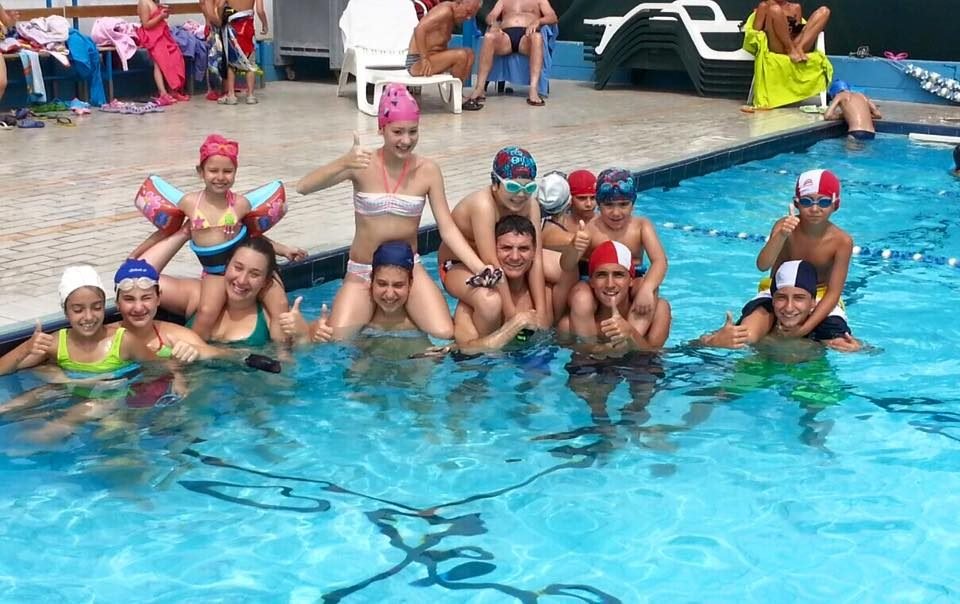
There's an outdoor pool in east Rome where, if you stand at the long edge and look up past the fence and the pine trees, you can see an aqueduct passing by. Not a replica, not a tufa wall rebuilt for show: real arches, brick by brick, cutting across the sky above the pool and continuing for kilometers through the workshops, railway tracks and apartment blocks of this part of the city. The pool is called Le Mura, and the name is not a marketing gimmick: it's the literal description of what you have in front of you while you swim.
People who go for the first time usually arrive by chance. They look for an outdoor pool that doesn't cost like a beach club, find it on a map in a strip of green between via Casilina and via del Mandrione, assume it's the usual neighborhood facility with chlorinated water and plastic chairs, and then find themselves with a sixteenth-century monument resting on the shoulders of a 200 BC monument, acting as a natural fence. The typical reaction is a laugh, followed by a photo, followed by the question: why didn't anyone tell me?
This is a long guide to a small place. I'll tell you exactly where you are, what that ancient wall you see from the water is, how the prices work without chasing numbers that go out of date quickly, when it's worth going, what photo you can take home and what history comes with this piece of Rome, which is one of the densest and least touristy stories in the city. At the end, if you feel like walking instead of going home, I'll also give you a few pointers on what's within a 20-minute walk.
Where you actually are
The address is via Piegaro 174, in the urban area of Villa Certosa, within the historic boundaries of Torpignattara, next to via del Mandrione, in a corner of Municipio VII that borders Quadraro. The postal code is 00181. I'm piling up so many place names because here administrative and real boundaries have been arguing for a century: the urban planning zone says one thing, the neighborhood another, the municipality a third, and the people who live here use yet another name, which is usually simply Mandrione.
The most honest way to explain it is geographic rather than bureaucratic. Take Porta Maggiore, the big hub where the ancient waters entered the city. From there runs a long, very narrow strip of land, squeezed between the bundles of tracks leaving Termini toward the south and via Casilina running parallel a bit higher up. That strip of land is the Mandrione, and an aqueduct runs through it. The road heads south-east to Porta Furba, where it crosses via Tuscolana. Via Piegaro is a side street opening onto this axis, in its central stretch, where the road widens a little and the leftover countryside turns into courtyard, workshop, vegetable garden, tennis court.
The practical consequence is that you're in Rome in the full sense, just under 5 kilometers from the Colosseum as the crow flies, yet in a setting that has almost nothing of central Rome. There are no Umbertine palazzi, no domes, no souvenir shops. There are low warehouses, body shops, nurseries, a couple of restaurants with pergolas, painted iron gates, dogs barking from behind fences, and over all of this an aqueduct as long as a stopped train.
What that wall you see from the pool is
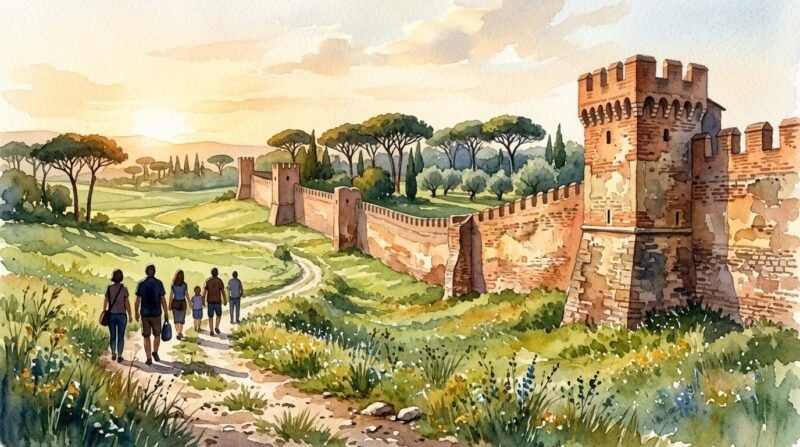
A clarification is needed here, because all sorts of things are written about it online and often wrong. Along the Mandrione, the arches you see are not just one aqueduct: they are two overlapping eras. The structure running along the top, continuous, with its masonry channel and regular profile, is the Felice Aqueduct, commissioned by Pope Sixtus V, born Felice Peretti, and built between 1585 and 1587. It's the first aqueduct built in Rome after the fall of the Western Roman Empire, and it's a fact worth pondering: for more than 1,000 years the city had not been able to build a new one.
Below, and in places inside, are the older Roman arches, those of the Aqua Marcia with the Tepula and Iulia conduits stacked in the same order of piers, following the logic of structural economy the Romans had always used: one arch, three channels, three different waters at different levels. Giovanni Fontana, who completed the Sistine worksite after the first director of works had got the gradients wrong, reused and in part demolished those ancient structures to make the new water flow. It's a brutal and brilliant reuse at once, and as you walk along the road you can see it with the naked eye: the bricks change, the mortars change, the color changes.
Then there are the aqueducts that everyone mentions when they talk about eastern Rome, but they run farther south: the Anio Novus and the Claudio, inaugurated in AD 52, the very tall arches that form the backdrop to the Aqueducts Park and that intertwine with the Felice near Tor Fiscale, where two aqueducts cross each other, forming a closed quadrilateral that in the Middle Ages was used as a defensive enclosure. And there is the Alessandrino aqueduct, the eleventh and last of the great ancient aqueducts, built in AD 226 by Alexander Severus to supply the Baths of Nero, which had been rebuilt in Campo Marzio, which descends from Pantano Borghese, crosses the current Viale Palmiro Togliatti with arches reaching 20.65 meters, and then goes underground right near Torpignattara.
So: from the pool on Via Piegaro, you're looking at the sixteenth-century Felice resting on the shoulders of the Marcia from the second century BC. The Claudio and the Alessandrino are your neighbors, a few hundred meters or a few kilometers away, and they're part of the same water system. Put another way: you swim inside the most ambitious water network the ancient world ever built, and there's no sign telling you so.
What the Structure Is
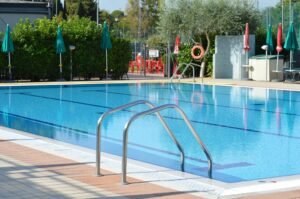
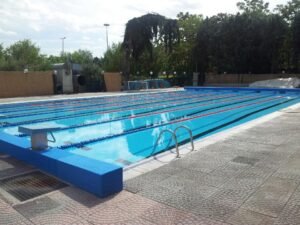
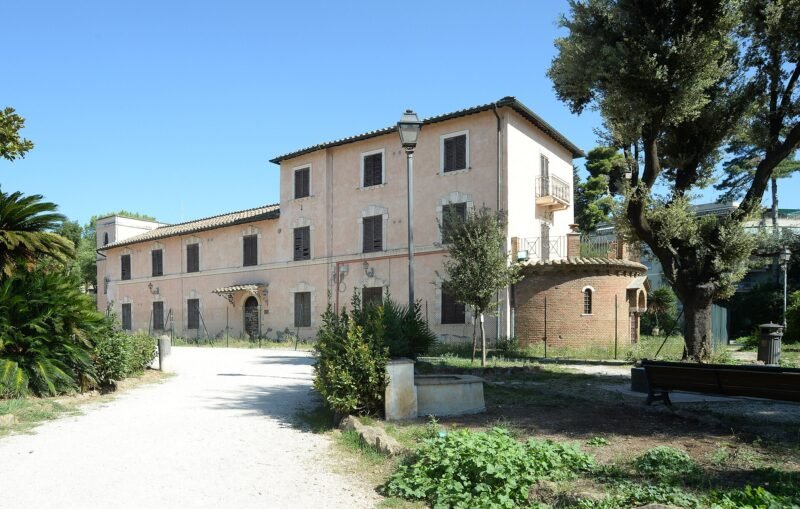
Le Mura is not a municipal pool and it's not a water park. It's a private sports club with a long history in tennis: seven courts, an outdoor summer pool, an indoor pool for the winter under an air-supported dome, a fitness room, a bar with a restaurant and pizzeria, and an on-site parking lot, which is an absolute rarity in this part of the city. The company name that appears in the records is that of an associazione sportiva dilettantistica, an amateur sports association, and this is why the price list includes an item you won't find at public pools: the membership fee.
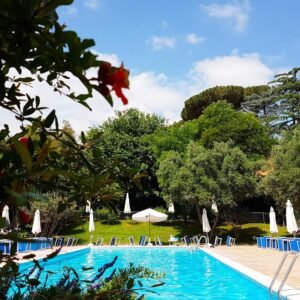
The layout is the classic one of the suburban Roman clubs founded between the 1960s and 1980s: first the tennis courts, which were the real business, then the pool added as a summer service for members, then the winter cover to extend the season and make the numbers work, then children's swimming lessons, which today keep a large part of the budget afloat. The solarium area is genuinely green, with trees, not a slab of concrete: and it's a difference you feel on your skin in July, because natural shade in Rome is worth more than any misting system.
How the Price List Works
Here I have to be clear about the method, because this is the part that does the most damage when it's reported badly. Online you'll find exact rates for Le Mura, with figures in euros, and they've been circulating for years, copied from page to page without anyone saying which season they refer to. Presenting them as today's prices would be the quickest way to get you to the gate with the wrong amount in your pocket. So I won't do it. Instead, I'll explain how the price list is built, which is something far more stable than the numbers and much more useful to know, and for up-to-date amounts I'll refer you to the club itself, the only source that doesn't go out of date.
The price list has five elements, and you'll find them almost identical at every Roman club with an outdoor pool.
The first element is the distinction between a full day and a half day. The full day covers the whole opening time, from the morning until closing in the afternoon. The half day usually has a fixed cutoff around lunchtime: either you come in the morning and leave early afternoon, or you come in after lunch and stay until evening. It's worth asking for the exact cutoff time, because it varies from club to club, and because the price difference between the two formulas is usually small: if you plan to stay more than four or five hours, the full day pays for itself.
The second element is the difference between weekdays and holidays. Saturday and Sunday cost more than weekdays, under both formulas. It's the same logic as seaside beach clubs, and it reflects a simple reality: on the weekend the club fills up and the sun loungers run out. The gap between weekday and weekend prices at pools of this kind is almost always modest in absolute terms, but it changes the quality of the day a lot, because on Tuesday you have the pool almost to yourself and on Sunday you don't.
The third element is the umbrella, which here is included in the ticket. This isn't a given and it isn't a minor detail: at many Roman clubs the umbrella is an extra charge, and with July and August temperatures, it's the item that decides whether the day is manageable or not. If the umbrella is included, it means the price you see is really the price you pay to stay in the shade, with no surprises at the cash register.
The fourth element is the sun lounger, which is charged separately. It's the opposite choice from the umbrella, and it has a management reason: sun loungers are a finite number, they wear out, they need repairs, and charging the people who use them is the simplest way to keep them from all disappearing by nine in the morning. The unwritten rule is that if you bring a large towel and settle on the grass, you won't need a sun lounger, if instead you need to be raised off the ground, include it when you add up the cost.
The fifth element is the seasonal membership fee. It's a one-time charge, valid for the whole summer, that you pay the first time you go in and don't pay again on later visits. It's not a trick: it's the way an amateur sports association holds together its legal nature and its insurance coverage. Anyone who enters becomes a formal member, and as a member is covered by the club's insurance. The practical result is that if you plan to go only once, you have to add the fee to the day ticket, while if you go five or six times in a season the fee is spread out and the cost per day drops quite a bit. It's a price list built for regulars, not for the passerby.
A sixth element, which isn't a fee but weighs as much as one: parking inside the grounds is free. In an area where parking means driving around three times and then leaving the car 400 meters away, that gate that opens is a real piece of value.
For prices in euros, calling the facility is still the fastest and most reliable method. Ask three things together: the day rate for the day you want to go, the cutoff time between morning and afternoon, and whether the outdoor season is still running. The three answers together give you everything you need to plan the day.
A curiosity about Piscina Le Mura
The curiosity I like best is about the name, and it's not the one you think. Everyone assumes Le Mura is called that because of the ancient walls next to it, and in a way that's true. But what you see isn't walls: it's an aqueduct. An aqueduct is exactly the opposite of a wall, because a wall is there to stop things and an aqueduct is there to let them pass. Yet in Rome, for centuries, people have called anything that's old, long, made of brick and taller than a person "mura." The Mandrione neighborhood lived for generations with the arches of the Felice, calling them simply "il muro" or "le mura," and from that popular linguistic confusion comes the name of a sports club.
The topic gets more fun if you look at the official place names in the area. Rome has at least three completely different things called mura that nobody tells apart: the Mura Aureliane, which is the defensive circuit of 271 AD, and they are real walls. The Servian Walls, much older, of which scraps remain around Termini and the Aventine. And then everything else, meaning any brick structure that crosses a field. The arches of the Mandrione belong to the third category, the affectionate one, and the name of the pool certifies this habit better than any dialectology essay.
Second curiosity, minor but instructive: the water that fed those arches and the water that fills the pool today have the same geographic origin, 2,200 years apart. The historical springs of the Roman eastern system are all in the same belt, between Subiaco, the Aniene valley and the Pantano Borghese area at the foot of the Alban Hills. The Marcia water rises in the upper Aniene valley, while the Felice water was captured at Pantano de' Grifi, later Pantano Borghese, at the 20th kilometer of the Casilina, exactly where Alexander Severus had taken water for his aqueduct 14 centuries earlier. The papal engineers didn't look for new springs. They went back to the ones the Romans had already found, because they were the best, and they were still there.
Third curiosity, the kind that makes Romans smile and everyone else amazed: the calculated flow of the Alexandrine Aqueduct, our neighbor, was about 21,632 cubic meters a day, roughly 250 liters per second. Try to imagine what that means in terms of pools. A medium-sized open-air pool holds a few hundred cubic meters of water. That aqueduct alone carried enough to fill dozens of pools like this one, every day, to bring water to a thermal complex in the city center. And it wasn't the largest of the 11.
Something nobody tells you about Piscina Le Mura
It didn't start out as a pool for bathers. It started out as a pool for members of a tennis club, and this origin stays with you in every detail, if you know how to read it.
You can tell from the proportions of the space: the courts take up much more ground than the pool, and the greenery around the pool is what was left over between one court and the next, not a sundeck designed on a drawing board. You can tell from the layout, since the pool isn't in the best position in the complex, which is where the central courts are. You can tell from the crowd, because on a weekday in July you see at the same time families with small children, kids in swim lessons, adults doing laps with monastic consistency, and gentlemen in white who come off the courts sweaty and dive in for five minutes before going to the bar. It's a mix you won't find in commercial pools.
The second thing nobody tells you is that summer here is the short season. The business model of these clubs rests on winter: the air-supported dome goes up over the pool in autumn, and inside it you get the children's swim lessons, aqua gym, and athletic training, and that is revenue that doesn't depend on the weather. The open-air summer season is lovely, it's the reason to talk about the place at all, and it's also the most fragile part: it depends on the heat, it depends on seasonal staff, it depends on how many people still want to stay in the city in July. Which means the opening and closing dates of the outdoor season change from year to year, and you have to ask, not assume.
The third thing nobody tells you is about the noise, and it matters for deciding whether this place is right for you. Trains pass through here. Three railway lines wind around the Mandrione, and the bundle of tracks leaving Rome Termini heading south runs a short distance away. If you have the absolute silence of a resort in mind, this is not the right pool. If instead you like the idea of floating while a regional train passes behind a sixteenth-century aqueduct, then that noise becomes part of the experience, and personally I don't mind it at all. It's the sound of Rome at work, not of Rome posing for the camera.
The fourth, finally: the area has a layer of human history that no promotional material tells, because it's uncomfortable. The Mandrione was for 40 years one of the poorest and most photographed areas in Italy, and I'll talk about it in more detail later. Today it's residential, craftsmanlike, quiet, with a few good places to eat and drink. But the memory of that past is inside the walls, and anyone who arrives expecting a piece of the historic center with a pool is thrown for half an hour and then, usually, grows fond of it.
The tip I give you for visiting Piscina Le Mura
The big tip, the one everything else depends on, is this: call ahead. It's not a generic tip. In a private club with seasonal management, the outdoor pool may be closed for a day of maintenance, may have reduced hours, may be reserved for lessons in the morning, or may already have been dismantled for the end of the season. None of this information ends up online in real time. A two-minute phone call saves you a trip.
The second tip is about the day. Go on a weekday, if you can. Tuesday and Wednesday are the best days: the pool breathes, all the loungers are there, the bar serves without a line, and the sun deck isn't a game of Tetris with towels. Saturday and Sunday the club fills up, and you pay more too. If the weekend is your only option, then get there early: being at the gate at opening, not at 11:30, completely changes the day, because you get to choose a spot in the shade instead of taking whatever is left.
The third tip is about the time of day, and it's counterintuitive. At many outdoor pools in Rome the best moment isn't noon: it's late afternoon, between 16:00 and closing time. The light softens, families with small children leave, the water is still warm from a full day of sun, and the half-day afternoon rate costs less than the full day. If your goal is to swim in peace and watch the aqueduct light up orange, that's the right window, and nobody will compete with you for it.
What to bring
A swim cap is required. In Italian pools it's the rule almost everywhere, and in clubs with swim lessons it's enforced without exception. If you forget it, you can buy one at the bar or the front office, but you'll pay three times its value and they'll give you whatever is left. Bring one.
Pool slides, and not for style. The walkways at some summer facilities become scorching at noon and slippery near the showers. A large towel, bigger than you think you need, because if you don't get a lounger, the grass is your base. A dry change of clothes: going home in wet swimwear in a Roman summer is a classic that has never worked out for anyone.
Bring your own water, in bottles. There's the bar, and in a club the bar works, but at 40 degrees the amount of liquid an adult needs in a day in the sun is more than most people feel like buying by the glass. High-SPF sunscreen, reapplied: there's shade here, but it's tree shade, which means it moves, and by mid-afternoon you find yourself in the sun without noticing.
Cash. Many clubs accept cards, but many others prefer cash for the membership fee and for the bar, and the nearest ATM isn't within flip-flop reach. An ID, because the membership fee involves a membership registration, and the registration requires a first name, a last name and often a tax code.
How to get there
By public transport it's simpler than the place makes it seem. Line A of the metro has two useful stops, Porta Furba and Numidio Quadrato, and from the upper part of the Mandrione you walk down to the pool in about 20 minutes, following the aqueduct the whole way, which is the most beautiful route and is worth doing at least once. On the opposite side, the Pigneto stop on the same line and the railway station of the same name drop you at the north end of Via del Mandrione. Line C of the metro instead serves the Casilina further east, with the Malatesta and Pigneto stops.
By bus, the Casilina is served by frequent lines that connect Porta Maggiore to Torpignattara and beyond, and if you get off at the right stop you have only a few 100 meters left. By tram, the network that serves Porta Maggiore and the Prenestina area gets you close enough to walk the last stretch.
By car there's the internal parking lot, free, and in this area that's a decisive argument. Keep in mind, though, that Via del Mandrione is narrow, one-way in places, with blind curves and work vehicles stopped in double file: take it easy and don't trust the first direction from your GPS too much, which every so often sends you onto service roads that don't go through.
By bicycle it's an excellent choice, with one warning: the road surface of the Mandrione is uneven, with cobblestones, potholes and railway crossings, and with thin tires it's a struggle. With a city bike or a gravel bike, though, it's one of the most striking urban routes in Rome, because for 2 kilometers you have an aqueduct on your left and the trains on your right.
A Mistake to Avoid
Don't treat Le Mura as a half-day stop in a packed tourist schedule. It doesn't work. This is a place for a slow day: you arrive, settle in, swim, eat something, sleep for an hour in the shade, swim again, leave when the sun goes down and walk along the aqueduct toward Porta Furba or toward the Pigneto. If you get there at two with the idea of leaving again at four to go to the Vatican Museums, you've spent your money badly and your afternoon worse.
Another Well-Known Fact, Yet Rarely Mentioned
That Rome invented the public swimming pool and then forgot about it for 1,500 years.
Everybody knows the Romans took baths. What is rarely mentioned is the scale of the phenomenon and its deeply urban nature. The imperial baths weren't luxury establishments for a few: they were mass infrastructure, free or nearly so, where people washed, exercised, read, chatted and really swam. The natatio, that is the open-air basin for swimming, was a standard element of large complexes. At the Baths of Caracalla the natatio is still there, measurable: an enormous outdoor rectangle, with decorated walls, which in plan looks embarrassingly like a modern Olympic pool. At the Baths of Diocletian the complex was even bigger.
The point is that this whole system worked thanks to the aqueducts. Without the water brought from outside the city with slopes calculated to the finest degree, none of those basins could have existed. The sequence is linear: spring, aqueduct, distribution castellum, baths. When the aqueducts stopped working, during and after the Gothic Wars of the sixth century, the baths emptied within a short time and the Roman population withdrew toward the Tiber, into the bend where water could still be drawn by hand. The city shrank by 10 times partly for this reason too.
And then, for 15 centuries, nobody in Rome swam in a pool anymore. People washed in basins, bathed in the river, built monumental fountains when the aqueducts came back, and the fountains are the proof that the water had returned: the Trevi Fountain is the terminus of the Acqua Vergine, the Acqua Paola Fountain is the terminus of the Acqua Paola, the Triton Fountain was fed by the Acqua Felice itself, the same one that passes over this pool. But the basin for swimming, as a public institution, did not come back. It came back only in the twentieth century, and in a sporting form, not a thermal one.
Here is the rarely mentioned fact: modern Roman outdoor pools, the neighborhood ones, the ones at clubs, the ones that open in June and close in September, are the late and minor reincarnation of the ancient natatio, and almost none of them knows it. Le Mura knows it by chance, because it has the aqueduct in its courtyard. But the link holds for all of them.
There is then a second well-known fact that deserves to be told better. Rome is a city with very few outdoor pools relative to its size and its climate. Seaside cities have the sea and don't feel the need, northern cities have less heat, Rome has 40 degrees in July, the sea a good 40 minutes away with traffic, and a number of outdoor basins you can count without effort. The result is that the few that exist are a collective asset, and that each has its own fiercely loyal public. The Piscina delle Rose in EUR is the best known, with its outdoor Olympic pool and its history tied to the 1960 Olympics. The others are small, scattered, often tied to clubs, and live on word of mouth. Le Mura belongs to this second family, and is an almost perfect example of it.
A third element that is rarely mentioned: the City of Rome, for several years now, within the measures of the so-called heat plan, opens some outdoor pools with easier access during heat waves, with a booking system. It's a public health measure before it's leisure, designed for people who don't have air conditioning at home and for those over 65. It doesn't concern private clubs like this one, but it concerns the same underlying question: in a city that turns into an oven in summer, water is not a luxury, it's a service.
The right photo to take at Piscina Le Mura
There's only one right photo and it isn't the one everybody takes.
The one everybody takes is the close-up of the water with the arches in the background, shot from the pool edge standing up, at noon. It almost never works, for three technical reasons: at noon the sun is directly overhead and flattens the bricks, which become a gray mass with no relief. From the standing edge the aqueduct enters the frame as a thin strip at the top, squashed. And the reflection of the water at 12 is white and burns everything out.
You take the right photo in the last hour and a half before closing, when the sun goes down in the west and hits the arches from the side. Roman brickwork, lit at a raking angle, lights up: it goes from gray to brick red to honey, and every single course of bricks casts its own shadow, so that the structure regains its three-dimensionality. It's the same principle for which photographers of ancient architecture never work at noon.
The right position is low. Kneel, or better yet rest the camera or phone almost level with the surface of the water, on the edge, holding the lens a few centimeters above the surface. From that height two things happen together: the aqueduct rises in the frame and dominates the scene instead of acting as a backdrop, and the surface of the pool becomes a mirror. If the water is still, that is, if you wait for the moment when nobody is swimming, you get the full reflection of the arches: a real row of arches at the top and an inverted row of arches at the bottom. It's the image that's worth the trip.
If instead you want the photo with people, and it's the more honest one, then wait for someone to get in the water and shoot while they swim toward you, still keeping the viewpoint low and the aqueduct high in the background. The contrast between an utterly everyday gesture, a swim stroke, and an infrastructure 400 years old that in its lower stretch is 2,200 years old is all the photography you need. You don't need any filter.
The other photos in the area worth taking
Outside the gate, the Mandrione is one of the most photographed and most photogenic places in Rome, and not since yesterday. The images that defined the imagery of this street were made by Franco Pinna in April 1956, accompanying the anthropologist Franco Cagnetta on an investigation of the borgate, and they are considered among the most important works of all Italian neorealist photography. Pinna photographed the shacks built literally under the arches of the Felice aqueduct, the families who lived there, the children, the dances. Anyone who arrives today with a camera in hand is walking, whether they know it or not, through an archive.
The framings that work best along the street today are three. The first is the single arch with the road passing under it, shot head-on, which gives the scale relationship between a car and a 16th-century span. The second is the long perspective: line up with the axis of the aqueduct and let the arches repeat until they vanish in the haze, which is the classic image of Roman aqueducts and which you have here within reach of the sidewalk. The third, the hardest and the most beautiful, is the train: there is a moment when a regional train passes parallel to the arches and for two seconds you have in the same frame 1587, the 1860 of the railway and the present.
If you then feel like going as far as the monumental arches, the very tall ones, the destination is the Aqueducts Park, a little farther south, where the Claudian aqueduct runs in the open meadow and where half of Italian cinema set in the periphery is shot. In the opposite direction, toward the center, the Underground Basilica of Porta Maggiore lies under the area where all these waters arrived together, and it's one of the strangest and least crowded visits in the city.
A note on respect for others
A practical thing that applies at any pool and that here, with the temptation of the view, is easily forgotten: in the water and on the sun deck there are other people, often children, and not all of them want to end up in a photograph. Frame the empty pool, frame the aqueduct, frame the people with you. If you want the scene with strangers in it, keep them small, from behind, or ask. It costs nothing and changes the atmosphere.
Some important events that happened here in history
Here, and I mean in this patch of land between Via Casilina and Via Tuscolana, much more has happened than the landscape lets you imagine. I'll try to put it in order, because it's a sequence that explains Rome better than many museums.
The second century BC: the Marcia water
In 144 BC the praetor Quinto Marcio Re received a mandate from the Senate to repair the existing conduits and bring a new one into the city. The result was the Aqua Marcia, captured in the upper valley of the Aniene, more than 90 kilometers long, considered by the ancients the best water in Rome for freshness and clarity. The last stretch toward the city ran on arches, and it is on those arches that the Felice rests today along the Mandrione. 20 years later, in 125 BC, the Aqua Tepula was made to run on the same structure. In 33 BC, during the aedileship of Marco Vipsanio Agrippa, the Iulia was added. Three channels, one row of piers: the idea we would today call shared infrastructure was 2,000 years old before it even had a name.
The first century AD: Claudius and the Anio Novus
Caligula started the work in AD 38, and Claudius completed it in AD 52. Two aqueducts together, the Aqua Claudia and the Anio Novus, with the highest and most spectacular arches in the whole system. Those are the arches that now form the backdrop of Parco degli Acquedotti, and where they cross the Felice at Tor Fiscale they form an enclosed space. In the Middle Ages this quadrilateral was used as a natural fortification, and the place name that still gives the park its name arose around one of the control towers.
226: the last of the ancient aqueducts
Alexander Severus had the Alessandrino aqueduct built to supply the Baths of Nero in Campo Marzio, which he renovated at his own expense and renamed the Alexandrine Baths for the occasion. It was the eleventh and last of the great aqueducts of ancient Rome. It ran 22 kilometers and 700 meters from the springs of Pantano Borghese, almost entirely on brick arches, with the underground sections reduced to tunnels 72 centimeters wide and 1.80 meters high. Past the Marranella area, a few steps from here, the conduit went underground and continued toward Porta Maggiore. No trace of the route remains visible inside the Aurelian Walls.
The sixth century: the dark
During the Gothic War the conduits were cut. In 537 the forces of Vitiges severed the aqueducts that supplied besieged Rome, and from that moment on the system never returned to full working order. The baths emptied, the water mills stopped, and the population collapsed. The countryside reclaimed this entire eastern strip, and for nearly 1,000 years the arches were quarries for building materials, shelters for shepherds, and property boundaries. The very name Mandrione comes from there: from the herds that were driven out to graze in these meadows.
1585 and 1587: Sixtus V brings the water back
Felice Peretti became Pope Sixtus V and, on the same day he took possession of the basilica of San Giovanni in Laterano, decided to build a new aqueduct. It was 24 kilometers long, from the countryside between Zagarolo and Palestrina to the Viminal and the Quirinal. The works were entrusted to Matteo Bartolini, who made design errors on the gradients so serious that the water would never have reached the city. The commission then passed to Giovanni Fontana, who completed the work in 1587, at the cost of destroying parts of the very ancient conduits of the Marcia, the Tepula and the Iulia. It is the paradox still read today on the piers: to bring water back into the city in the 1500s, they tore down the aqueduct that had carried it for six centuries.
In that same 1585, where the new aqueduct crossed the via Tuscolana, a monumental arch was erected that we still call Porta Furba, and beside it a fountain, later restored and enlarged by Pope Clement XII in 1733. That arch is just over a kilometer from here, at the end of the road, and it's worth the walk.
The 1800s: the tracks arrive
In the second half of the century the railway cuts this countryside in two. The bundle of lines leaving Rome toward the south and the east runs parallel to the aqueduct for kilometers, and it creates the condition that still defines the Mandrione today: a strip of land enclosed between an ancient wall and a railway embankment. No man's land, hardly buildable, hardly controlled. It is the physical premise for everything that will happen in the 1900s.
July 19, 1943: the bombing of San Lorenzo
Allied bombs hit the San Lorenzo neighborhood and the adjacent railway yard. Thousands of people lose their homes. Many displaced people move toward the southeast and build shacks exactly where they find a wall already standing to use as a side: under the arches of the Felice aqueduct, along the via del Mandrione. Thus, from one night to the next, one of the most photographed shantytowns in Europe is born. The arches you look at from the pool have housed families living inside them for decades.
April 17, 1944: the roundup of Quadraro
A few hundred meters from here, on the other side of the Casilina, one of the harshest episodes of the German occupation of Rome took place. The German command called the Quadraro a "nest of wasps" because of the widespread resistance they found there: a poor neighborhood, full of people displaced from the front lines, where people said that to escape the Germans you either went to the Vatican or went to the Quadraro. On the morning of April 17, 1944, the neighborhood was surrounded and rounded up. Over 900 men were deported to Germany. At the end of the war, about half of them returned. On April 17, 2004, 60 years later, the neighborhood was awarded the gold medal for civic merit. The monument commemorating that day stands in the garden of Monte del Grano, around the third-century Roman mausoleum that gives the square its name.
April 1956: the investigation at the Mandrione
The anthropologist Franco Cagnetta and the photographer Franco Pinna go down to the Mandrione to investigate the Roman borgate, backed by the publisher Giangiacomo Feltrinelli and closely followed by Elsa Morante, Goffredo Parise and Pier Paolo Pasolini. The work builds on an ethnomusicological study by Giorgio Nataletti and Diego Carpitella on the musical and dance practices of the Roma communities settled along the Casilina: Pinna's photographs and the sound recordings were produced together, in an integrated documentation that had no precedent in Italy. The investigation continues along the road to the shacks by the Felice aqueduct. Those images are considered, in current judgment, among the most important in all of Italian neorealist photography.
1960s and 1970s: the Appio Claudio shantytown
The phenomenon doesn't concern only the Mandrione. Under the arches of the Felice aqueduct, further south, toward the Appio Claudio, another settlement of shacks arose, and it has left sporadic and moving traces: kitchen tiles still stuck to the aqueduct walls, at the height where someone's sink used to be. Anyone walking today through Parco degli Acquedotti walks right past those tiles without seeing them. They're still there.
1975 and 1984: the Mandrione changes
The work of Angelina Linda Zammataro, also known as Linda Fusco, psychologist and educator, founder of the psychoanimation method, takes place between these two years. Starting from the school integration of Roma children in an elementary school in the Tuscolano, she reaches the conclusion that without solving the housing problem, no integration is possible, and she leads a long political and cultural campaign, accompanied by two documentaries made for Rai directed by Gianni Serra and by related exhibitions. The result is the assignment of public housing in Spinaceto to the families who lived in the shacks of via del Mandrione. This is the moment when the road stops being what it had been for 30 years.
1997: the restoration
The last significant work on the Alessandrino aqueduct dates to 1997, in the area of the Sangalli park, a little further north. It's the date that marks the definitive shift of these structures from inhabited ruin to protected and restored heritage, with everything that follows in terms of maintenance, lighting, and accessibility.
Today
The Mandrione is a residential and artisan area, with workshops, shops, low-rise buildings, a few good restaurants, the trains that pass through, and the aqueduct that holds everything together like a seam. The sports clubs that occupy the leftover pockets of green, and Le Mura is one of them, are the direct result of this history: they settled exactly where the city couldn't build apartment blocks, that is, in the protected strip between the aqueduct and the railway. The fact that you can swim while looking at a sixteenth-century monument isn't an aesthetic stroke of luck: it's an urban planning consequence.
Who has come through Piscina Le Mura
The real answer is less glamorous and more interesting than you'd expect: the neighborhood has come through here. Whole generations of kids from the Tuscolano, Torpignattara, the Quadraro and the Pigneto learned to swim in a pool like this one, with an instructor shouting from the edge and a swim cap that pulled at their hair. Neighborhood clubs, in a city with few pools, have done for decades the work of teaching water safety that no public facility could cover, and they continue to do so. If you ask around in the neighborhood, you'll easily find people who took their first dive here 30 years ago and people who bring their children here today.
The second group is the tennis players. Before the pool, there was tennis here, and Roman neighborhood tennis is a world with its own dynasties, its historic coaches, its social tournaments at the end of the season and its decades-long rivalries between clubs three kilometers apart. The seven courts on via Piegaro have seen thousands of matches, and the pool was born as a reward after the match.
The third group is the workers, craftsmen and railway employees of the Mandrione, because a pool with a half-day rate and the umbrella included has never been a place for the upper class of the city. You come here after your shift, you come on Saturdays with the family, you come so you don't have to leave town.
And who has come along this road
Outside the gate, the story changes, and it becomes a list that carries weight in Rome. There is no evidence that any of these people ever set foot inside the club. What is documented is that they frequented, walked through, and in some cases lived on this street and its surroundings.
Pier Paolo Pasolini, first of all. The Mandrione is mentioned in several literary and film works, and Pasolini's are the best known. He was photographed many times walking along via del Mandrione and in the surrounding area. The human geography he portrayed in his novels and early films is exactly this: the strip between the Casilina, the Prenestina and the Tuscolana, the borgate, the boys from the shacks, the river and the marane. Anyone who arrives here with those pages in mind recognizes the distances and the light.
Elsa Morante and Goffredo Parise followed the 1956 investigation closely, along with Pasolini himself, and for them this street was a workplace, not an outing. Franco Cagnetta brought the tools of anthropology, Franco Pinna those of photography, and Giorgio Nataletti and Diego Carpitella those of ethnomusicology. Giangiacomo Feltrinelli put up the money.
Gianni Serra shot the two documentaries tied to the work of Angelina Linda Zammataro here for Rai, and those films show the move from the shack to the public housing with a precision no chronicle has matched.
And then there are the thousands of people no one photographed: the displaced people of San Lorenzo in 1943, the deportees of the Quadraro in 1944, the Roma and Sinti families who lived under the arches for 30 years, the immigrants from the Cassinate who arrived with the war, the workers from the South who came in the 1960s, and the more recent communities, Bangladeshi, Chinese, Romanian, Egyptian, that have made Torpignattara one of the most mixed neighborhoods in Italy. This street has seen all of them pass through, and the arches of the Felice are the only thing that was already here before and will still be here after.
What's around, if you have time
The best thing about this corner is that you walk a little and change worlds. I'll give you four directions.
Heading southeast along the Mandrione, you reach Porta Furba in just under 20 minutes: the monumental arch from 1585 with the fountain of Clement XII, the point where the aqueduct crosses the Tuscolana. Continuing on from there, you enter the area of Tor Fiscale and then the Aqueducts Park, which is the natural final destination of this whole walk and one of the most recognizable landscapes in Rome. In summer, arenas and film series are held there, such as Roma Cinema Arena, with screenings under the arches.
Heading northwest, still along the Mandrione, you reach Porta Maggiore in half an hour, where all the ancient waters entered the city and where the Underground Basilica of Porta Maggiore is located, a 1st-century hypogeum with its stuccoes intact, one of the most surprising and least crowded visits in the city. Along the same route, just before, the road passes Snodo Mandrione.
Heading north, crossing the Casilina, you're in the heart of Torpignattara and the Pigneto: markets, bakeries, Bangladeshi restaurants, historic bars, murals. It's the area that has changed its skin more than any other in Rome over the last 15 years, and in the evening it has a real nightlife. The Castagneto Prenestino and the Circolo Sportivo Villa De Sanctis are two more green and sports spots in the same area.
Heading east, along the Casilina, you reach Centocelle and then the great spine of viale Palmiro Togliatti, where the Alessandrino aqueduct reaches its highest point and becomes truly monumental. Also on this side, the Cinecittà Studios are a few minutes away by metro, and they close the circle with the neighborhood's history: a large part of the workforce of Italian cinema lived right here.
September, and the season that ends
It's worth saying clearly, because it changes the meaning of everything you've read so far. By mid-September, the outdoor pool season in Rome is over or nearly over. The outdoor pools usually close between the end of August and the first half of September, when winter classes restart and the air-supported domes go back over the water. The exact dates are set by each management, based on the weather and enrollments, and there is no single citywide calendar.
This means two practical things. First, if you're reading these lines in autumn or winter, a day in the sun with the aqueduct in front of you is a plan for next summer, not for the coming weekend. Second, the club doesn't close: the indoor pool, the fitness room and the tennis courts run all year, and if you're interested in a swimming course in the area, September is exactly when enrollments are organized.
There's also a completely different way to look at it. The walk along the aqueduct described above is much better in September and October than in July: the light is lower, the heat is manageable, the colors of the brick are warmer, and you don't have to walk on scorching asphalt. If the pool is closed, the landscape around it is open all year and costs nothing.
Frequently asked questions
Is the pool open to the public or only to members? You pay the daily entry fee plus the seasonal membership fee, so in practice it's open to anyone, but formally you become a member. It's a very common arrangement at Roman clubs and comes with no obligations beyond paying.
Do you need to book? Usually not for pool entry, but on weekends in high season the club fills up, and a phone call is still worth making to confirm hours and availability.
Is a swim cap required? Yes, as almost everywhere in Italy. Bring one from home.
Is there food? Yes, the club has a bar with a restaurant and pizzeria. Many people, however, bring lunch from home and eat it in the shade, and nobody thinks anything of it.
Is it good for kids? Yes, and that's one of its strong points, because the setting is that of a neighborhood club and not an anonymous facility. Check with the staff about the rules on depth and the hours reserved for classes.
Can you park? Yes, inside the grounds, for free, and it's one of the reasons many people prefer it to other pools that are more central.
Can you really see the aqueduct from the water? Yes. It's not an advertising line: the arches are there, above the fence, and at certain times in the afternoon they're reflected in the pool.
Is it noisy? Trains pass by, and you can hear them. For some people that's a drawback, for many others it's exactly why they keep coming back.
Frequently asked questions about Piscina Le Mura
Where is Piscina Le Mura?
Piscina Le Mura is at via Piegaro 174, in the urban area of Villa Certosa, within the historical boundaries of Torpignattara, close to via del Mandrione, in a strip of Municipio VII bordering Quadraro, postal code 00181.
Is Piscina Le Mura open to the public or only to members?
Piscina Le Mura is formally reserved for members, but in practice it's open to anyone, since you get in by paying the daily entry fee plus the seasonal membership fee. It's a very common formula at Roman clubs and comes with no obligations beyond paying.
Do you need to book to go to Piscina Le Mura?
Usually you don't need to book to get into Piscina Le Mura, but on weekends in high season the club fills up, so a phone call before you leave is recommended to make sure you find a spot.
How much does admission to Piscina Le Mura cost?
The exact admission cost for Piscina Le Mura is not stated with certainty in the available information: for years, rates have been circulating online, copied from page to page, without it being clear which season they refer to, so it's best to check the current price list directly with the club before you go.
Is Piscina Le Mura open in mid-September?
In mid-September, the outdoor pool season in Rome, including Piscina Le Mura, is generally over or nearly over, since the outdoor pools close between late August and the first half of September, when the winter classes start up again. Each management sets the exact dates, so calling ahead is the main advice.
Why is it better to call before going to Piscina Le Mura?
It's worth calling before you go to Piscina Le Mura because, at a private club with a seasonal setup, the outdoor pool may be closed for maintenance, have reduced hours, be reserved for classes in the morning, or already have been taken down for the end of the season. None of this information is available online in real time.
Continuing your trip
If this walk past water, arches and tracks has made you want to plan something bigger, there are two places where I go to find the right tools. The first is Tour Leader Pro, useful when you need a professional perspective: itineraries built around real travel times, not the theoretical ones on maps, and a range of practical solutions for keeping sights, meals and transfers together without driving anyone crazy. The second is Italy Planner, which is where I send people who need to build a trip to Italy from scratch, even starting from abroad, and want to understand how to fit Rome together with the rest without losing whole days on the wrong trains.
Between the two, they cover pretty much everything: the operational detail of a day in Rome and the overall design of an Italian vacation. As for the rest, the only advice that really counts is the same as always: when you're in a pool with a 400-year-old aqueduct over your head, turn off your phone for an hour and look up.
Contact Information
Via Piegaro,
Roma Roma Città, Roma Città
Nearby
 Villa Lais500 m
- Circolo Arca700 m
- Santa Libbirata-La Carretteria800 m
- Pescheria900 m
- Snodo Mandrione900 m
- Quadraro1.0 km
Upcoming events nearby
- Agnes Cecile. Spirits at Chroma Mandrione, from September 26 to November 14, 2026700 m
- Spazi sconfinati (Boundless Spaces): Talk with Natalia Vallebona of Poetik Punkers, Nov 15, 2026700 m
- Punk la Ville! Urban Performance in Torpignattara with Feel That Swing, Nov 15, 2026700 m
- CoreoCorteo, collective choreographic walk in Torpignattara, Dec 6, 2026700 m