Santa Libbirata-La Carretteria
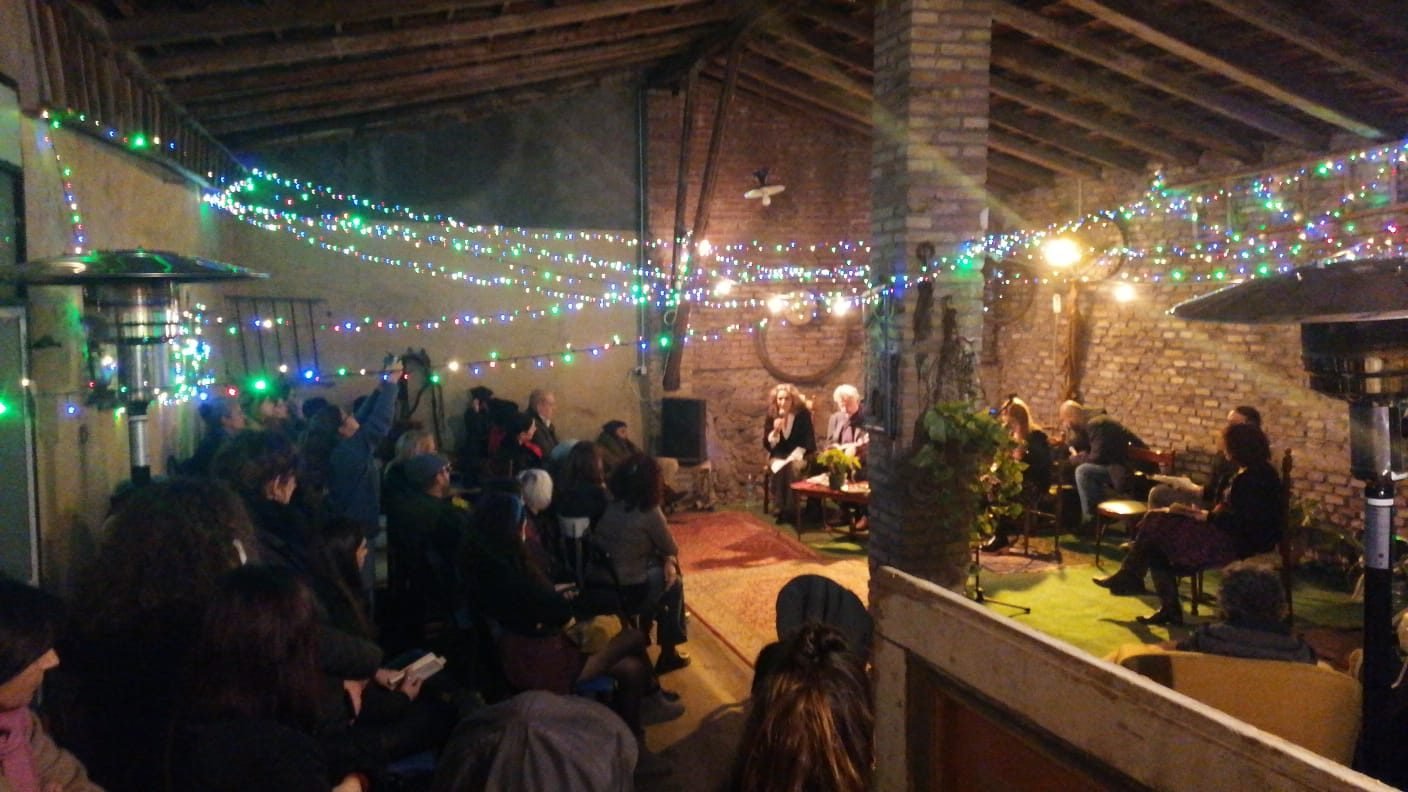
Santa Libbirata-La Carretteria occupies a former workshop on Via Galeazzo Alessi 96, in eastern Rome, in the heart of the Certosa zone within the Torpignattara area: live music, shows, dancing and a family atmosphere, inside a neighborhood membership club.
Via Galeazzo Alessi, 96
Rome
The description that circulates online for this place takes up a line and a half: in the heart of Certosa and Torpignattara, with music, live shows and a family atmosphere. It's true, and it's also the quickest way to understand nothing about what it is. Because a line like that could be stuck on 200 Roman venues, while here we are facing something fairly precise: a membership club, born inside the bay of an old mechanic's workshop, on a street in eastern Rome that within a few street numbers has put together a density of music venues that no longer exists in the center.
I'll try to tell it properly. I start from the address, which is not a bureaucratic detail but the key to everything, because it explains why a place like this can exist here and not inside the Walls. Then I get into what a club is and why the difference from a commercial venue is substantive and not formal. Then I take apart the name, which is the funniest part and also the most misunderstood. And finally I widen the view to the neighborhood, which has a long, documented and not at all decorative history: an imperial mausoleum, a borgata that grew outside the plan, an ancient consular road, a cinema that invented part of the Italian imagination and a community that today is one of the most mixed in the city.
Where Santa Libbirata-La Carretteria Is
The Exact Address and the Quadrant
The address is Via Galeazzo Alessi 96, postal code 00176. The street runs in the zone that the municipal street-name register calls Villa Certosa, within the territory of Municipio V, in the area everyone in Rome calls Torpignattara, close to via Casilina and a short distance from Pigneto and Mandrione. We are outside the Aurelian Walls, outside the perimeter of the four standard tourist days, inside that band of the city that formed between the end of the 1800s and the second postwar period along the lines of the consular roads.
Galeazzo Alessi, by the way, was a 16th-century architect from Perugia, the one who designed Strada Nuova in Genoa and worked on Palazzo Marino in Milan. In this quadrant of Rome the streets carry the names of architects and artists: it is a convention of 20th-century street naming that gave a fabric of public housing and workshops a nomenclature out of an art history treatise. The contrast between the name of the street and the building substance of the street is one of the most Roman things there are.
Why It's Not the Tuscolano, and Why It's Worth Knowing
You often read that this stretch of street belongs to the Tuscolano. It doesn't, and the distinction matters if you have to get there. The real Tuscolano is farther south, beyond the railway and beyond the Casilina, and has an urban history of its own, made of INA-Casa plans, blocks designed by important architects and a street grid drawn at the desk. Here instead we are in the fabric that descends from the Casilina toward the Mandrione: finer, more irregular, grown by successive additions and often without a plan that really governed it.
The two areas touch, share the aqueduct and the bundle of tracks as a boundary, and by feel the atmosphere is related. But whoever looks for the address starting from the Tuscolano ends up on the wrong side of the railway and loses a good half hour. The right reference is the Casilina, Pigneto, Mandrione: from there you go down into the grid of Villa Certosa and find yourself among the low houses.
How to Get There
Metro line C is the most convenient way for this part of the city: the Pigneto and Malatesta stops serve the area north and east of the Casilina, and from both you walk a handful of minutes into the neighborhood. On the Casilina run the surface lines that connect Porta Maggiore with Centocelle and the eastern periphery, and along the same axis runs the old narrow-gauge railway that goes from Termini toward Centocelle and then continues toward the Castelli: one of the most characteristic railway remnants of Rome, with tracks grazing the walls of the houses and level crossings wedged into traffic.
Whoever arrives by tram from Porta Maggiore gets off on the Prenestina and crosses the fabric of Torpignattara on foot: it's a good 20 minutes of walking, but it's the best way to understand where you are, because you pass in front of the shops, the bakeries, the halal butchers, the Bengali and Chinese stores, the historic bars and the murals that in the last 15 years have changed the face of this quadrant. You can arrive by car, but parking in this grid of streets is a lottery that you almost always lose in the evening: the roadways are narrow, double parking is the rule and the time you save on the approach you give back circling around.
What You Have Around You Within 200 Meters
This is the part that surprises first-time visitors. Via Galeazzo Alessi, within a few hundred meters, concentrates a density of places devoted to music and gathering that in the historic center has simply disappeared. At number 57/59 of the same street there is Pescheria, a former neighborhood fish shop turned into a listening and recording room for experimental music. A little farther on, past number 100, there is another space devoted to music and food. On the Mandrione, a few minutes on foot, other venues open up, along with a fabric of breweries, hybrid spaces and osterie that have redrawn the area over the last decade.
The result is that an evening here is never a single-theme evening. You can head out with the idea of hearing a concert and end up in a completely different direction 200 meters away, simply because that evening at the next street number something more interesting was happening. It is a pedestrian, dense geography, covered on foot, and it resembles very little the logic of the single venue where you book a table and stay put.
What Santa Libbirata-La Carretteria Really Is
A Club, Not a Commercial Venue
The point that changes everything is this: we're not talking about a bar with concerts, we're talking about a club. Formally it is a social promotion association affiliated with the ARCI network, registered under the name Santa Libbirata-La Carretteria APS, headquartered on via Galeazzo Alessi at numbers 96 and 98. Whoever walks in is not a customer, they are a member: you fill in a membership request, you get the card, and from that moment you are part of an association that has a statute, a tax code, an assembly and declared purposes.
Put like that it sounds like a bureaucratic formality. It isn't, and it's the reason a huge part of Roman cultural life survives. The club is the legal tool that allows a group of people to put a space together, run cultural and recreational activities in it and hold up economically without having to think like a business that must maximize revenue per square meter. It doesn't mean there are no costs: it means the place's corporate purpose is not profit, and so evenings can be programmed that a commercial venue would never do because the numbers wouldn't add up.
What Being an ARCI Club Means in Practice
ARCI is the largest Italian association network for culture and solidarity, born in the postwar period from the tradition of the case del popolo and the mutual aid societies, and today organized in territorial committees that federate thousands of clubs. The Roman committee alone counts tens of thousands of members and about 90 clubs, spread from the Tiber Valley to the shoreline. Whoever takes the card in one club can enter all the others: it's a sort of parallel cultural citizenship that is valid across the whole national territory.
The declared activities of this club, in the network's register, are many more than you would imagine reading the presentation line. There are the visual arts and the organization of exhibitions, dancing, cinema and video with film series, training, photography, the themes of global justice, peace and disarmament, interculture and anti-racism, DJ set music and live bands, the organization of meetings, conferences and debates, gender policies, youth involvement and theater with the organization of shows. It is a list that tells a project, not a program.
The practical difference for those who go is this: in a commercial venue the audience consumes a product that someone else has packaged, in a club the audience is in theory an active part. In practice the distance between theory and reality varies enormously from place to place, and it would be naive to claim that every member takes part in the assemblies. But the structure remains, and you feel it: in the way they greet you at the entrance, in the fact that whoever makes your card is probably playing or setting up the stage tonight, in the absence of that professional distance that is the norm in for-profit venues.
The Former Workshop, the Body of the Place
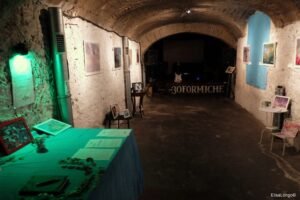
The bay that hosts the club was a workshop. The listings that describe the place say so and the structure itself says so: ground-floor units of this kind, in eastern Rome, are easy to recognize. High ceiling, roll-up shutter in place of the shop window, packed-earth or concrete floor, thick walls, often a mezzanine added later, sometimes a closed-over work pit. These are the bays where for decades cars, scooters and car bodies were repaired, and before that carts and bicycles.
This type of space has features that make it perfect for live music, and not by chance. The high ceiling gives air volume and therefore a manageable reverb. The shutter lets you open the street front completely in summer and close it tight in winter. The floor bears weight and dirt without anyone despairing. The blind walls on the sides reduce problems with neighbors, at least the lateral ones. And above all the square meter, on a side street in eastern Rome, costs a fraction of what it would cost elsewhere.
The whole history of music venues in European metropolises passes through here: when the center becomes too expensive, music goes looking for the bays that industry and crafts have left free. It happened with the warehouses of Berlin, the sheds of Manchester, the depots of London. In Rome it happened with workshops, print shops, pasta factories and cart sheds: a trajectory that starts from San Lorenzo and Testaccio in the 1980s and gradually moves toward Pigneto, Torpignattara, Quadraro and Centocelle.
The Name, Read Word by Word
Why Two Names Joined
The first thing that confuses is that there are two names: Santa Libbirata and La Carretteria, joined by a hyphen. The structure of the name suggests two souls living at the same address, or two names that overlapped over time, as often happens when a space changes management or when two groups decide to join forces. The official name of the association keeps both, so it's not a case of an old name replaced by a new one: they coexist by choice.
On this point I prefer to stop here, because reconstructing the internal genealogy of a club is exactly the kind of thing guides make up. What can be said with certainty is that the double name is the registered form, and that those who use it pronounce it in full.
Libbirata
Santa Libbirata is not a name from the calendar. It is the transcription, in a spelling that imitates southern dialect pronunciation, of Santa Liberata. A Santa Liberata really exists in Catholic tradition: virgin and martyr, remembered on January 11, venerated as patron in some towns of central-southern Italy, with a very ancient hagiographic story much debated by scholars, who place her somewhere between the Iberian peninsula and Gaul. In popular devotions her name has often been deformed in local pronunciation, and the doubling of the consonant you hear in Libbirata is typical of a good part of the South.
The play, though, is double, and it's the reason the name works. Liberata, in Italian, is also simply the past participle of liberare, to free. A freed saint is at once a figure of popular devotion and a programmatic statement: the space as a place where you take something off your shoulders. The choice of a non-canonical spelling, with those two b's, serves precisely to hold the two readings together without resolving the ambiguity. It is a name that sounds like an invocation from a procession and like a slogan, at the same time.
This way of taking the lexicon of popular devotion and using it in a secular and festive key has a very long tradition in southern Italy and in its urban diasporas. Patron saint festivals were for centuries the only moment in which music, dancing, food and excess had public legitimacy. Naming a space after a saint, in a spelling that winks at dialect, means claiming that genealogy: not the parish, but the square in front of the parish, with the festival lights and the band.
Carretteria
La Carretteria is the second half, and it points to a precise family of words: the cart, the carter, the cartwright. Carretterie were the places where carts were built, repaired, stored and painted. In an area like this, crossed by an ancient consular road and full of craft activities until a few decades ago, a bay that we call a workshop today and that yesterday we called a carretteria is exactly the same thing seen in two different eras: the place where you fix the vehicle people work with.
Put together, the two names draw a fairly clear program: popular festival and manual labor. The saint and the workshop. It is a combination that in 20th-century Italy had a precise name, that of the case del popolo, where in the same building they held the dance, the union assembly, the screening and the communal lunch. This club, with a more ironic lexicon and a more playful spelling, sits within that same tradition.
A Curiosity about Santa Libbirata-La Carretteria
The curiosity I like best concerns the opening date. The space opened on May 1, and the invitation that circulated said it bluntly: the point was to consecrate the former workshop, with songs, dances and instruments, permanently to pleasure, joy, happiness and cheerfulness. A formula that seems written to make people smile and that is instead built with surgical precision.
Because May 1, in Italy, is not a neutral date. It is the workers' holiday, and in Rome it is also the date of the concertone in Piazza San Giovanni, the biggest mass music event in the country. Opening on that day a space carved out of a workshop, that is, out of a place of manual labor, and using for it the verb consecrate, which belongs to the liturgical vocabulary, is a perfectly calculated short circuit: labor, the sacred and festival in the same sentence, which is the triad that holds up all of Italian popular culture.
And there is a further detail that makes the thing more elegant. The list that appears in the invitation, pleasure, joy, happiness, cheerfulness, is not a list of synonyms thrown in at random to fill space. They are four words that in Italian mean four different things: pleasure is sensory and instant, joy is emotional and sudden, happiness is a lasting state, cheerfulness is collective and contagious. Lining them up in that order, from the most individual to the most shared, describes exactly the arc of a good evening in a place like this. I don't know if whoever wrote the invitation thought of it. But the result holds.
I'll add a second curiosity, minor but significant. In the association's register of activities, next to music and theater, entries appear such as global justice, peace and disarmament, gender policies, interculture and anti-racism. These are the standard categories with which the network classifies its clubs, so they shouldn't be read as the program of a single evening. But the fact that they were selected says something about how the place presents itself: not a club with a program, but an association that also does music.
What Happens Inside
Live Music
The bulk of the programming is played music. Bands, solo projects, ensembles that tour the Italian clubs, neighborhood musicians and guests passing through. The size of the room imposes a certain kind of concert: no imposing stages, no separation between artist and audience, short distances, a sound system sized for the space. It is the format in which live music was born and in which it still works best, because the audience sees the hands of those who play and those who play see the faces of those who listen.
Music of southern, Latin American and Mediterranean roots has an important presence. Among the events documented in the autumn 2026 calendar there is an evening devoted to women in the roda de samba, that is, that Brazilian circular form in which the musicians play around a table and the audience is around them without there being a stage. The roda is not a concert in disguise: it is a social practice in which the boundary between those who play and those who listen is deliberately porous, and whoever knows the repertoire sings. Programming it inside a former workshop in Torpignattara means having understood well what a small space can do and what a theater cannot.
DJ Sets and Dancing
Alongside the concerts there is the dancing part. In the September 2026 calendar there is a clubbing evening, and among the club's registered activities dancing appears explicitly. Don't expect a nightclub: expect the dimension of dancing inside a room, with people who know each other, with genres that change from evening to evening and with the console a meter from the audience.
This double nature, concert and dancing in the same space, is the norm in clubs and the exception in commercial venues, where usually one formula is chosen and kept. The reason is that a club programs for a community, and a community over the course of a month wants different things: one evening listening seated, another dancing on its feet, another still discussing. Keeping everything inside the same bay is possible only if the space is flexible, and an emptied former workshop is so by definition.
Cinema, Theater, Photography, Training
The declared activities include the organization of film and video series, the organization of theater shows, photography, visual arts with exhibitions, and training. These are the entries that fill the afternoons and weekday evenings, when the room doesn't host a concert. In a club this is the least visible part from the outside and often the most solid: the courses, the groups rehearsing, the screenings for 20 people, the book presentations, the debates.
Among the titles that appear in local chronicles tied to this address there is one about a show on a mysterious helmet, and another that tells of a gathering of social choirs reaching its eighth edition. Social choirs are a substantial and little-told Roman reality: amateur vocal groups, often born in neighborhood contexts or in union and association settings, who sing repertoires of struggle, work and popular tradition. That a gathering like this reaches its eighth edition and passes through here says more than 10 reviews about the kind of audience that frequents this place.
The Family Atmosphere
The word that recurs in all the descriptions is family, and for once it's not filler. In a space of this size, run by an association, with an audience that in large part lives within a kilometer, anonymity is impossible. You walk in and someone looks you in the face. The second time someone recognizes you. The third time they ask what you do for a living.
For some it's exactly the reason they go, for others a source of discomfort. It's worth knowing beforehand: if you're looking for the evening where nobody notices you, this is not the right place. If instead you feel like getting out of that mode of consumption where you go in, pay, watch and leave without having exchanged a word with anyone, then the human scale of a neighborhood club is precisely what you're looking for.
There is also a bar service, as in all clubs, and in the categories under which the place is classified it appears next to those of social space, association and hybrid space. The usual common-sense rule applies: the bar is a service, not the reason you come. Whoever goes for the music finds the music, and the evening works exactly the same with a glass of water in hand.
One Thing Nobody Tells You about Santa Libbirata-La Carretteria
The thing you won't find written anywhere is that to get in you have to become a member, and that this changes the way you organize the evening.
It looks like an administrative detail. It isn't, and it's the source of 90 percent of the misunderstandings between those who frequent clubs regularly and those who land in one for the first time. In a commercial venue you pay a ticket and you're in. In a club, the first time, you have to become a member: it means giving your personal details, filling in a form, receiving a personal card that has an annual validity. It is not a formality invented by the place to complicate your life, it is the direct consequence of the legal form: an association carries out its activities for its members, and that card is what makes the whole thing legal.
The practical consequences are three and it's worth knowing them all. The first is that it takes a few extra minutes at the entrance, especially if you arrive as a group and you all need cards: if the concert starts at 21:00 and you show up at 21:00 sharp, eight of you, you walk in halfway through the first piece. The second is that you need an ID, so don't leave the house with just your phone. The third, the one nobody expects, is that the card is valid across the whole national network: once made here, that same card opens the doors of hundreds of other clubs all over Italy for the rest of the membership year.
This last point turns an annoyance into an advantage, and it's surprising how few people know it. If in one year you end up in a club in Rome, one in Bologna and one in Salento on vacation, you've paid only once. It's a system built exactly for this, and it has worked for decades.
Then there is a second thing nobody says, and it concerns the calendar. A club doesn't program every day and doesn't program with the regularity of a theater. There are dense weeks and empty weeks, and the summer months have a different rhythm because Rome moves outdoors and a part of association life shifts to parks, arenas and festivals. Showing up at random hoping there's something on is the worst strategy. The calendar has to be checked beforehand, and it's better to check it on the association's own channels rather than on aggregators, which for this category of venues are chronically incomplete.
The Neighborhood Around, Which Is Half the Reason to Come
Torpignattara and the Mausoleum of Saint Helena
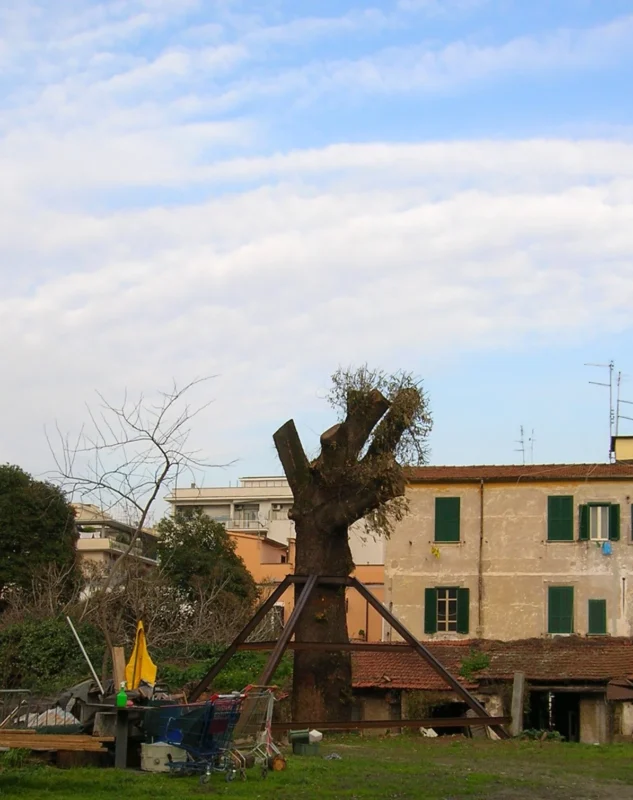
The name Torpignattara comes from a monument. A few hundred meters from here, on the Casilina, is the Mausoleum of Saint Helena, the tomb built in the 4th century AD for Helena, mother of the emperor Constantine, the figure to whom Christian tradition attributes the finding of the cross in Jerusalem. It is a circular-plan structure, in brick, of imposing size, which was part of a larger complex including a basilica and the catacombs of Saints Marcellinus and Peter.
The dome of the mausoleum was built with a technique that left its mark on Rome's place names: inside the masonry, amphorae and terracotta pots, the pignatte, were embedded to lighten the weight of the vault. It is an ancient and clever structural solution, used elsewhere too, that allows you to cover large spans without overloading the supports. Over the centuries, when the structure partly fell into ruin, the pignatte remained visible in the masonry mass, and Romans began to call that ruin the tower of the pots. From there Tor de' Pignattara, and finally Torpignattara.
I find this one of the most beautiful etymologies in Rome, because it is entirely popular. Nobody decided at a desk to name the neighborhood that way: the name was born from the gaze of those who passed in front of a ruin and described what they saw. An entire quadrant of a European capital, with tens of thousands of inhabitants, bears the name of the cooking pots walled into a vault of the 4th century. And the mausoleum, which nonetheless held the body of an emperor's mother, has always been for the locals simply the tower with the pots in it.
The Casilina
Via Casilina is the axis that explains the whole quadrant. It follows the route of the ancient via Labicana, the consular road that left Porta Maggiore and headed toward the Alban Hills and then toward the South. For centuries it was a country road dotted with farmhouses, vineyards, inns and ancient tombs. With the 1800s and especially the 1900s it became the backbone of Rome's eastern expansion: along the Casilina the borgate formed, workshops moved in, public housing was built and the tracks arrived.
The character of this road, still today, is to be one thing and its opposite at once: a high-traffic road and a neighborhood street, a through axis and a place where people do their shopping. Walking along it for a kilometer means passing in front of an imperial mausoleum, a supermarket, a level crossing, an informal mosque set up in a ground-floor unit, a bar from 1950 and a venue that opened last year. It is exactly this layering that makes the quadrant interesting and that makes it tiring.
Villa Certosa
Villa Certosa is the name of the urban planning zone in which the address falls, and it comes from a historic estate present in this area before urbanization. It is one of those place names that survive only in municipal cartography and in the memory of those who have lived here for generations, while in everyday speech they are absorbed by the name of the larger neighborhood, in this case Torpignattara.
The fabric is the typical one of the expansion between the wars and the postwar period: small apartment buildings of three or four floors, a few leftover villini, irregular lots, inner courtyards, and at ground level a quantity of commercial units that is the real hidden asset of the area. It is those units, emptied of the craft activities that occupied them and not yet saturated by large-scale retail, that made possible in the last 15 years the birth of dozens of cultural, association and music spaces.
Pigneto and Mandrione
To the northwest, beyond the Casilina, opens Pigneto, which in the last 20 years has become the symbol of the transformation of eastern Rome: from a working-class neighborhood to a nightlife zone, with everything that this entails in terms of rent prices, conflicts with residents and transformation of the commercial fabric. Torpignattara has followed the same trajectory about 10 years behind and with a different character, because the social composition of the neighborhood, much more international, has prevented the transformation from being homogeneous.
The Mandrione is the other direction, toward the southeast, and is perhaps the most cinematic place in the whole city. It is a narrow road that runs alongside the pillars of the Felice aqueduct, with houses leaning against the arches and in some stretches literally wedged inside them. For decades it was one of the symbolic places of the Rome of shanties, the one told by postwar literature and cinema. Today it is an extraordinary walk, with the aqueduct running for hundreds of meters and the railway passing beside it.
The Neighborhood Community
Torpignattara is one of the most international quadrants of Rome. The Bengali presence is particularly substantial and visible in the shops, butcher shops, tailor shops and phone centers. There are Chinese, Romanian, Egyptian, Filipino, South American and African communities. The neighborhood's schools have classes in which 10 different languages are spoken at home. Over the years this has produced tensions, alarmist journalistic rhetoric and political campaigns, and at the same time an extraordinary quantity of association, school and cultural experiences born to hold the neighborhood together.
From this point of view, a club that declares interculture and anti-racism among its activities is not doing it to tick a box. It does it because in this quadrant the issue is concrete and daily. And it is also the reason the nightlife here doesn't resemble that of other areas: the audience is more mixed by age, origin and social class, and you can see it.
If you're interested in understanding this part of the city, nearby there are also other neighborhood cultural outposts, such as the Casa della Cultura di Villa De Sanctis, inside the park of the same name, which is one of the green lungs of this part of eastern Rome.
My Advice for Visiting Santa Libbirata-La Carretteria
The advice is only one and I sum it up in a sentence: arrive an hour early and on foot, from the Mandrione.
I'll explain why, point by point. Arriving an hour early serves three purposes. The first is trivial and it's the card: if you need to join, you take care of it without queuing and without missing the start. The second is that in a small space the best spots, the ones where you can really hear, run out. I don't mean the front rows, I mean that middle band of the room where the sound comes together and where the monitor doesn't hit you: whoever arrives late ends up against the back wall, and from there the perception is different. The third is social: the first hour is the one when people talk, and in a club the first hour is half the experience.
Arriving on foot from the Mandrione is instead a piece of method, and it applies even if you live on the other side of Rome. Get off at the most convenient metro C station, or have yourself dropped on the Casilina, and do the last 20 minutes walking along the aqueduct and then into the streets of Villa Certosa. You'll see the arches, the tracks, the low houses, the courtyards, the murals, the workshops. When you then walk into the former workshop, you'll have the context in your head, and you'll understand why a place like this exists precisely there and not elsewhere. It is the difference between going to a concert and visiting a piece of the city.
I'll add three smaller practical recommendations. Bring ID, because without it they won't sign you up. Check the program on the association's direct channels and not on aggregators, because this kind of space communicates earlier and better on its own channels. And dress for the season thinking about the entrance and the exit more than the room: in winter these streets are windy, and in summer, when the shutter stays open, it's as hot inside as it is outside.
One last thing, which applies to the trip back. At night, in this quadrant, connections thin out. If you don't have a car, check the times of the last runs beforehand or factor in a taxi. It's not a problematic area, it's simply an area where at two in the morning nothing comes by for quite a while, and finding that out on the way out is not fun.
Another Well-Known Fact, Yet Rarely Mentioned
The well-known fact is that eastern Rome is the engine of the city's independent cultural life. Everyone knows it, it's been repeated for 20 years, and it has become almost a journalistic cliché. What is almost never said is why, and the why is much less romantic than the way it's told.
The magazine version says there's a creative vitality here, a neighborhood spirit, an energy. All true, but it is not the cause. The cause is the building stock. Eastern Rome has a quantity of ground-floor commercial units, wide, high, with a roll-up shutter and a floor drain, that no other part of the city has in the same concentration. They are the remains of a small-scale craft and productive economy, made of workshops, carpenters' shops, body shops, print shops, marble cutters, fish shops, bakeries, cellars, which occupied the ground floors of the whole quadrant until the 1980s and 1990s.
When that economy collapsed, through the effect of offshoring, large-scale retail and generational change, those bays emptied all at once. In the center, bays emptied in this way would have been immediately filled by high-yield activities per square meter: chain stores, fast food, short-term rentals. Not here, because the demand wasn't there and because the real estate value didn't justify it. So they stayed available, with low rents, for years.
And that's where independent culture slipped in. Not because of a superior artistic vocation of the neighborhood, but because in a 120-square-meter bay with a shutter, at a sustainable rent, you can do live music, theater, a rehearsal room, a bookshop, a club. The creativity everybody talks about is, in large part, a function of the price of the property.
The corollary of this reasoning is less cheerful, and it's the reason it's worth saying. If the cause is economic, then the phenomenon has an expiration date. The moment the neighborhood becomes attractive, rents rise, and the first who can no longer sustain them are exactly the spaces that made the neighborhood attractive. It happened in San Lorenzo, it happened in Testaccio, it is happening in Pigneto. The difference is made by the legal form: a club, which doesn't have to pay a return to capital and can count on the volunteer work of its members, holds out longer than a business. Not forever, but longer. And it is another reason why the distinction between venue and club, which seemed bureaucratic, turns out instead to be decisive.
The Right Photo to Take at Santa Libbirata-La Carretteria
Inside, the right photo is not the stage. It's the shutter.
In a former workshop converted into a room, the element that tells the whole story at once is the street front: the corrugated shutter, often repainted, which in summer stays raised and lets light and sound out onto the sidewalk. Photographed from the street, in the evening, with the room lit inside and the darkness of the street around, that image contains at the same time the bay's past and its present. It's a photo you take in two seconds and that says more than 20 shots of the concert.
The composition that works best is frontal and slightly off-center: stand on the opposite sidewalk, keep the whole bay in the frame, let a piece of the facade of the building above enter at the edge, with the apartment windows and maybe the laundry hanging out. That contrast between domestic life on the first floor and public life on the ground floor is the substance of this quadrant. If someone passes on the sidewalk, wait for them to enter the frame: a human figure gives scale and takes away from the image that real-estate-catalog look.
For lighting, don't use the flash. In these situations the flash flattens everything and kills exactly the contrast between lit interior and dark exterior that makes the photo. Better to rest the phone or the camera on a parked car, on a pole or on a low wall and let the exposure be long. If something moves and gets blurred, all the better: the blur of a person walking in tells the movement of the evening.
Outside the venue, within 10 minutes on foot, the two photographs to take are elsewhere and are much more important. The first is the Mausoleum of Saint Helena, which should be photographed from the side where the masonry is most chipped, the one where the brick mass shows its structure. Go in the late-afternoon light, when the brick turns orange and the texture comes out. The second is the Mandrione, and here the photo is almost obligatory: the aqueduct in perspective, with the arches getting smaller, and below the road with the cars and the houses wedged between the pillars. It is one of the strongest images of Rome and almost never appears in guides.
A rule of manners, to finish, that applies inside. In a small space, with the audience a meter from the musicians, pulling out your phone and filming half a concert is rude to those who play and to those around you. A shot is taken and bothers nobody. Three minutes of video with the screen lit in your neighbor's face is something else. In rooms of 1,000 people nobody notices, here they do.
Some Important Events That Happened Here in History
On this point I want to be honest about method: the documented history of this address as a cultural space is recent, and it would be wrong to inflate it with invented episodes. What can be reconstructed with certainty is of two kinds: the events of the space and the events of the place where the space sits. I keep them separate.
The Events of the Space
The first event is the opening, on May 1, with that invitation to consecrate the former workshop with songs, dances and instruments to pleasure, joy, happiness and cheerfulness. It is day zero, and it is publicly declared.
The second is the affiliation with the ARCI network as a social promotion association, with enrollment in the register of clubs of the Roman committee and a list of activities that ranges from visual arts to theater, from training to photography, from gender policies to interculture. It is the act that turns a group of people with a space into a recognized entity, inside a national network with tens of thousands of members.
The third is the eighth edition of the gathering of social choirs, which brought here a collective musical practice with a much longer history than the space that hosted it. A gathering at its eighth edition means an established circuit that has chosen this address as a stop, and in the life of a young space this kind of recognition is worth more than a review.
The fourth is the continuity of the programming up to today, September 2026, with the calendar recording clubbing evenings and concerts, including an event devoted to women in the roda de samba set for September 26, 2026. Put like that it seems little, but for a neighborhood club surviving and programming with continuity is the hardest result to achieve.
The Events of the Place
Here the discussion widens and gets much longer, because this piece of Rome has a layered history.
The oldest fact is the fourth century AD, with the construction of the Constantinian complex on via Labicana: the catacombs of Saints Marcellinus and Peter, the basilica and the mausoleum intended for Helena. It is one of the fundamental cores of early Christian Rome, at a moment when the capital of the empire was changing religion and changing geography, moving its sacred places outside the walls, along the consular roads, into the cemeteries.
The second moment is the 1800s, with the arrival of the railway and the construction of the big infrastructure that cuts through the Roman countryside. The bundle of tracks that leaves Termini and Porta Maggiore drew the boundaries of this quadrant definitively, separating pieces of city that were previously contiguous and creating those barriers that still today make it complicated to move from here to the Tuscolano.
The third is the first half of the 1900s, with the birth of the borgate. Rome grows outside the master plan, often by private initiative and often without services: people build along the consular roads, occupy land, put up buildings on the cheap. Torpignattara forms in this phase, together with Pigneto, Prenestino, Quadraro, Certosa. The population comes from the countryside of Lazio, from Abruzzo, from the Marche, from the South, and brings with it dialects, trades, patron saint festivals and forms of solidarity that are then the culture medium from which the case del popolo and the clubs are born.
The fourth is the war and the Resistance. This quadrant, with Quadraro and Prenestino, was one of the places of urban partisan struggle in Rome, and paid very high prices. The roundup of Quadraro in 1944, with hundreds of men deported, is one of the harshest episodes of the occupation of the city, and it left a memory that in these streets is still alive and guarded. It is not an abstract historical detail: a good part of the neighborhood association culture of eastern Rome is born from there.
The fifth moment is the postwar period and cinema. On these streets, along the Mandrione and inside Pigneto, Italian cinema shot some of its most important pages, choosing the Roman periphery as the place to tell the real country. The shanties, the aqueducts, the houses under construction, the street kids: an imagination that from the immediate postwar period to the 1960s passed through here and went around the world.
The sixth is the small-scale deindustrialization of the 1980s and 1990s, the one that emptied the craft units and prepared, without knowing it, everything that would happen afterward. The seventh is the transformation of the last 20 years, with the arrival of metro C, the explosion of Pigneto as a nightlife zone, the murals, the commercial transformation and the settlement of large, rooted international communities. It is inside this seventh chapter that a club like this takes its place.
Who Has Been to Santa Libbirata-La Carretteria
Here too I distinguish, because mixing the two would be dishonest.
Who Has Been on the Stage
In the calendars that record the programming of this address there appear names of music projects that tour the circuit of Italian clubs: ensembles that play singer-songwriter and experimental music, DJs, groups tied to music of roots and to Latin American and Mediterranean sounds, social choirs. Among the documented events are concerts by groups such as Traindeville, DJ set evenings with artists from the Roman scene, projects such as Mamarua and singer-songwriter concerts, plus the evening devoted to women in the roda de samba scheduled for the end of September 2026.
I prefer not to stretch this list artificially. A recently opened neighborhood club does not have and should not have a list of celebrities: it has a list of working musicians, many of them very good and almost all unknown to the general public. That is its nature, and whoever looks for the famous name is looking in the wrong place. The value of a space like this is measured the other way around: by how many people have played there for the first time, and how many of them will continue.
Who Has Been through the Neighborhood
If we widen the view to the surrounding streets, the list becomes important. Pier Paolo Pasolini lived and worked in this quadrant, shot his first film here and set his Roman novels among these borgate: Pigneto, Mandrione, the aqueducts, the houses at the margins are the landscape in which he built his imagination. Roberto Rossellini shot fundamental scenes of postwar cinema in this part of eastern Rome, on streets that can still be recognized.
Through these streets have also passed generations of Roman musicians from the popular and experimental scene, singer-songwriters, actors and directors who found sustainable rents and rehearsal spaces here. And, above all, the people who make a neighborhood a neighborhood have passed through: the partisans of Quadraro, the workers of the workshops, the carters of the Casilina, the families who arrived from the South in the 1950s and those who arrived from Bangladesh in the 2000s. A neighborhood club is, in the end, the place where all these stories find themselves in the same room.
How to Organize an Evening Here
Before
The sequence that works best starts in the late afternoon. Get to the area an hour and a half early, leave your vehicles on the Casilina and walk. Pass in front of the Mausoleum of Saint Helena when the light is low and the brick lights up. Then go down toward the Mandrione and walk a stretch under the aqueduct. From there climb back into Villa Certosa and arrive at the address.
For eating, the quadrant is one of the most interesting in the city, and for a precise reason: the international makeup of the neighborhood has produced a density of different cuisines that doesn't exist elsewhere in Rome. Bengali, Chinese, Egyptian, South American, traditional Roman cooking and new openings coexist within a few streets and at prices that are unthinkable in the center. I'm not giving you names because in this area openings and closings are quick, and a list gets old in six months: walk on the Casilina or into the side streets and choose by looking inside.
After
If the evening ends early and you still feel like more, the same street offers alternatives 200 meters away: Pescheria, a little farther down, works in a completely different register, devoted to listening and recording. On evenings when both are programming, a three-minute walk changes your musical genre and type of experience.
If instead the evening ends late, as I said, organize the trip back before leaving the house. It's the most boring advice in the whole piece and it's the one that saves you.
With Whom
This is a place that works very well for two or three people, and works badly for big groups. The reason is physical: the room is small, and a group of 10 people takes up a significant portion of the space and inevitably ends up talking over the music. In a club, where the scale is domestic, this is noticed and annoys people. If there are many of you, better to choose a dance evening, where the volume and the format can handle the group, and leave the concerts to small groups.
On children, it depends on the evening. An afternoon of activities, a screening or an early-hour concert can be perfectly suitable, and Roman association culture is traditionally welcoming to families. A clubbing evening at two in the morning, obviously, is not. The common-sense rule applies: look at the time and the type of event.
Quick Questions about Santa Libbirata-La Carretteria
What exactly is it?
A membership club inside a former workshop at Via Galeazzo Alessi 96, in eastern Rome, affiliated with the ARCI network as a social promotion association, which programs live music, DJ sets, dancing, theater, cinema, exhibitions, meetings and training.
What neighborhood is it in?
In the urban planning zone of Villa Certosa, within the area commonly called Torpignattara, in Municipio V, close to the Casilina and near Pigneto and Mandrione. It's not the Tuscolano, which is farther south beyond the railway.
Do I have to get a membership card to get in?
Yes, because it's a club and not a commercial venue. The first time you fill in a membership request and receive a personal annual card, so you need an ID. The same card is then valid in all the other clubs of the national network.
What music do you hear there?
Concerts by groups and solo projects, music of Mediterranean and Latin American roots, social choirs, DJ set and dance evenings. The programming changes from week to week and it's better to check it on the association's channels.
Is it open in 2026?
Yes. The calendar records regular events also in September 2026, including a clubbing evening and a concert devoted to women in the roda de samba on September 26, 2026.
How do I get there by public transport?
The most convenient stops are those of metro line C in the Pigneto and Malatesta area, from which you walk. On the Casilina run the surface lines from Porta Maggiore toward Centocelle, and from the Prenestina you can also arrive by tram with a 20-minute walk into the neighborhood.
Can you park?
With difficulty. The streets are narrow and in the evening the spots run out. If you can, arrive by public transport or on foot from the Casilina.
Is it suitable for children?
It depends on the event. Afternoon activities, screenings and early-hour concerts can be, dance evenings late at night are not.
What is the best time to come?
The season from October to May, when the indoor programming is densest. In summer Rome moves outdoors and club life thins out or changes form.
How much time does the evening take?
Count on a whole evening. If you follow the advice of arriving on foot from the Casilina via the mausoleum and the Mandrione, allow four or five hours between the walk, dinner and the concert.
Why a Place Like This Matters
To finish, the most important thing of all. A city is also measured by the number of rooms it has in which it is possible to do something that doesn't produce an immediate profit. Rome has had very many and is losing quite a few, replaced by activities that yield more per square meter and that ask much less of the city and give back even less.
A former workshop in Torpignattara in which an association programs concerts for 70 people, screenings for 20 and a gathering of social choirs once a year is, in accounting terms, an irrelevant matter. In terms of the city it is exactly the opposite: it is the kind of place from which, within 10 or 20 years, come records, bands, trades, friendships and forms of solidarity that no municipal cultural plan would be able to produce on command. And it is also one of the few places where a 22-year-old who plays can find a real stage, a real audience and someone who tells him the truth about his piece.
The name, then, already says it all. A freed saint in a carretteria: the popular festival inside the workshop, the sacred inside manual labor, the dialect spelling that takes seriously the language of those who built this neighborhood by arriving from far away. In a city that often treats its periphery as a public order problem or as a scenic backdrop, a name like this is already taking a stand.
So the invitation is direct. Take an evening, come down to this quadrant, walk under the aqueduct, look at the mausoleum with the pots walled into the vault, cross the streets of low houses and then walk into a former workshop where someone decided that bay should be for playing music instead of for pulling down a shutter forever. Get the card, stay until the end, talk to whoever is next to you. You won't need to know the music on the program. You'll only need the willingness to be in a room with people you don't know, which in 2026 has become a rarer discipline than it seems.
Frequently Asked Questions about Santa Libbirata-La Carretteria
Where is Santa Libbirata-La Carretteria?
Santa Libbirata-La Carretteria is at via Galeazzo Alessi 96, in the zone that the municipal street-name register calls Villa Certosa, within Municipio V, in the area everyone in Rome calls Torpignattara. The space is close to via Casilina, a short distance from Pigneto and Mandrione, outside the perimeter of the historic center and the Aurelian Walls.
What is Santa Libbirata-La Carretteria, really?
Santa Libbirata-La Carretteria is not a bar with concerts but a club, that is, a social promotion association affiliated with the ARCI network, registered as Santa Libbirata-La Carretteria APS with its seat at numbers 96 and 98 of via Galeazzo Alessi. Whoever walks in is not a customer but a member, and this changes the way you present yourself the first time.
Do you need a card to get into Santa Libbirata-La Carretteria?
Yes, since it is an ARCI-affiliated club and not a commercial venue, to get in you need to join with a membership request. It is a quick but real administrative step, different from a simple entrance ticket, and it is the main source of misunderstandings between those who frequent clubs regularly and those who arrive for the first time.
Why is the name made of two parts?
The name Santa Libbirata-La Carretteria joins two names, Santa Libbirata and La Carretteria, linked by a hyphen. The structure suggests two souls living at the same address, or two names that overlapped over time, as happens when a space changes management or when two groups decide to join forces in a single project.
What is there inside Santa Libbirata-La Carretteria?
Inside Santa Libbirata-La Carretteria the programming focuses above all on live music: bands, solo projects and ensembles that tour the circuit of Italian clubs, along with neighborhood musicians. The small size of the room imposes an intimate format, without imposing stages and without real separation between artists and audience.
When was the space inaugurated?
The space of Santa Libbirata-La Carretteria opened on May 1, with an invitation that spoke of consecrating the former workshop to pleasure, joy, happiness and cheerfulness. The venue thus occupies a former workshop converted into a room, with the original shutter still clearly visible on the street front.
What is there to see in the neighborhood around Santa Libbirata-La Carretteria?
A few hundred meters from Santa Libbirata-La Carretteria, on via Casilina, is the Mausoleum of Saint Helena, the circular-plan brick tomb built in the 4th century for Helena, mother of the emperor Constantine. The name of the neighborhood, Torpignattara, derives precisely from this monument.
Article written by the editorial team of TourLeaderPro, contact them for Private/Corporate/V.I.P. Tours and Experiences.
Planning a trip to Rome? The English guides for visiting the city are at ItalyPlanner.com.
Contact Information
Via Galeazzo Alessi , 96
Roma Roma Città, Roma Città
Nearby
 Pescheria200 m
- Snodo Mandrione200 m
- Villa Lais400 m
- Ellington Club400 m
- 30Formiche600 m
- Piscina Le Mura800 m

Upcoming events nearby
- Agnes Cecile. Spirits at Chroma Mandrione, from September 26 to November 14, 2026100 m
- Cyberfuck by Jazzy Boho at Magma, November 5, 2026200 m
- Strrronz3 with Cruz Luma, Nebula and Mylla Issues at Magma, November 7, 2026200 m
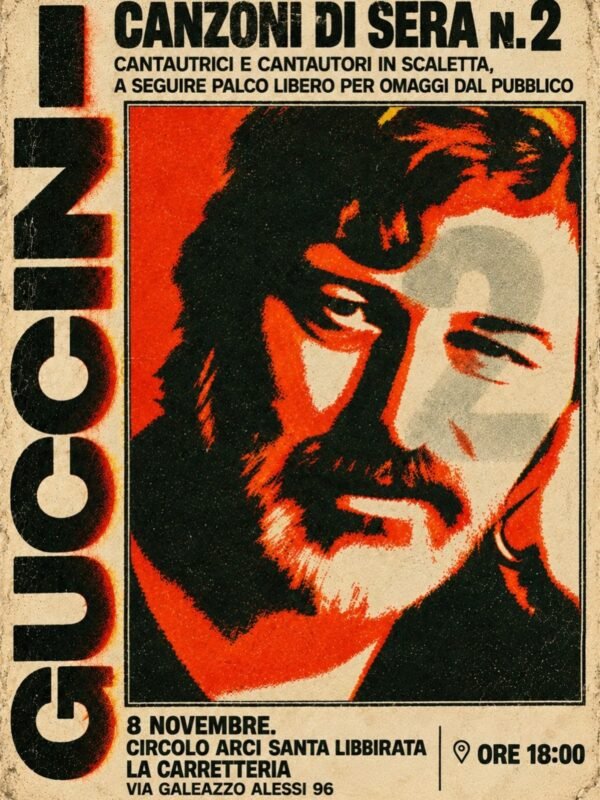
- Second evening for Guccini at Santa Libbirata la Carretteria, November 8, 2026200 m