30Formiche
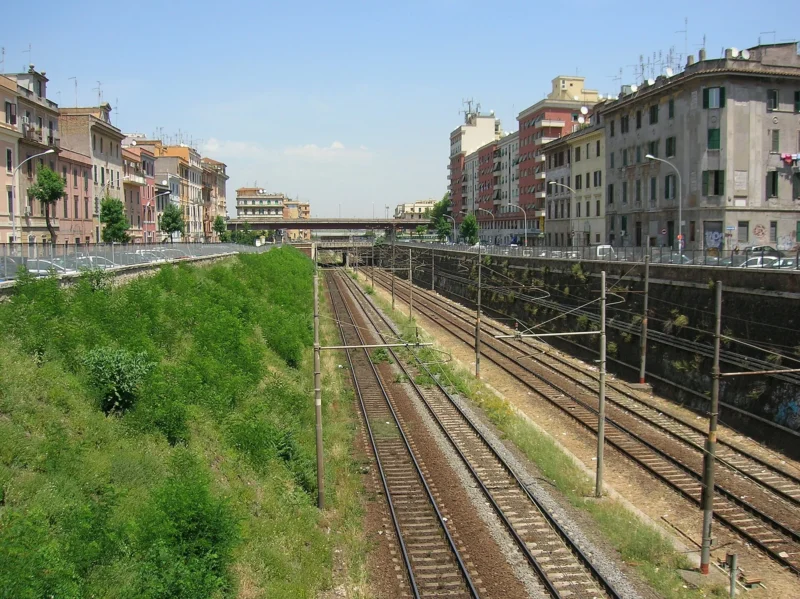
In short. 30Formiche is in Rome at Via del Mandrione 3, where Via Casilina meets the start of the Mandrione, in a building wedged between two railway lines and in the shadow of the arches of the Roman aqueduct.
30Formiche is in Rome at Via del Mandrione 3, where Via Casilina meets the start of the Mandrione, in a building wedged between two railway lines and in the shadow of the arches of the Roman aqueduct. It is a cultural club affiliated with ARCI Roma, not a commercial venue open to anyone passing by: you enter as a member, and this difference explains almost everything else, from the way the program is built to the kind of crowd you find inside.
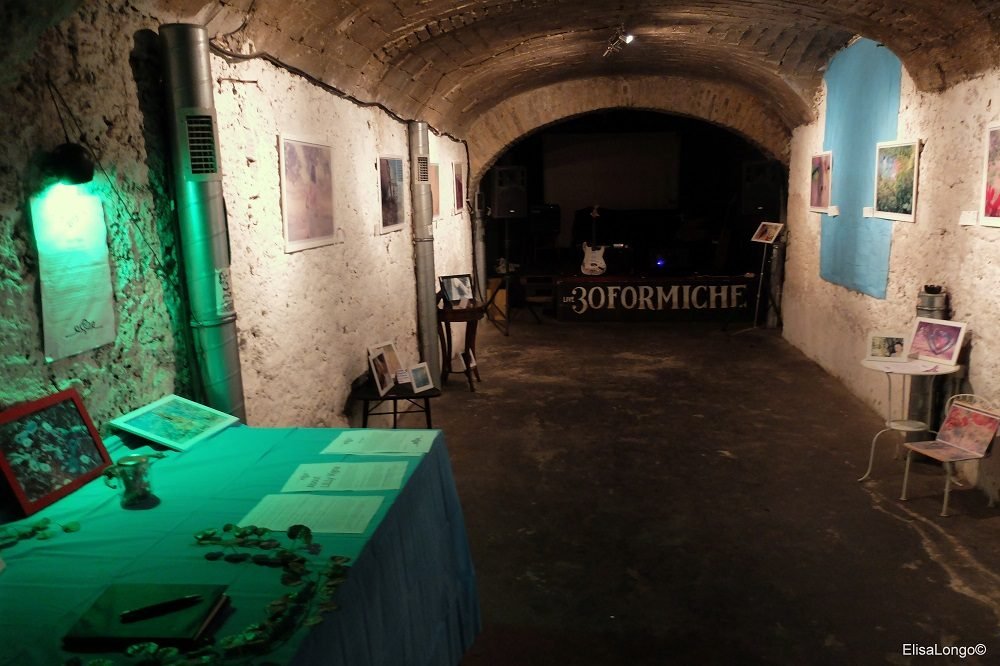
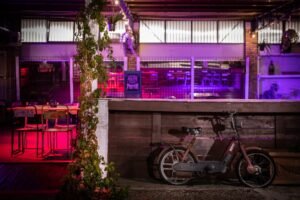
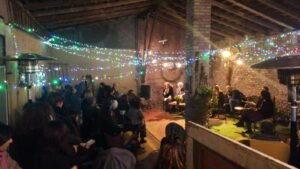
The shortest description you can give of the place is given by its own physical structure: two rooms, one dedicated to hanging out and drinking, the other to live music. The second has hosted for years a repertoire the club has never tried to tame, made of off-kilter, noisy sounds, often garage or punk, other times electronic and built on synths, in some cases deliberately stifling. In the two brick corridors, parallel and wide, volume has never been a problem, for a reason that in Rome is almost funny: the train passes overhead, and the background noise of the neighborhood is louder than any amplifier anyway.
The place is where nobody expects it, under the bridge that leads from Via Casilina to Via del Mandrione. Before it became a club, the space housed the workshop of an old blacksmith, and the feeling when you walk in is that those rooms were carved out by digging into the rock and tuff, without an architectural plan but following what the ground allowed. Today, in place of the forge, there are two bars, sofas, chairs and a DJ booth.
What follows explains where the club is, how you really get there, what it contains, how access works, what urban context it sits in and what is worth knowing before heading out. The schedule of the nights, the names of the guests, any entrance contributions and the times of individual dates change constantly and depend on who organizes the night: that information is found only on the club's official channels, and no general description can replace it.
Where 30Formiche Is and How You Really Get There
The address declared by the club on its official channels is Via del Mandrione 3, Rome. The contact given for information is the mailbox info@30formiche.it, and the opening hours published by the club are Tuesday to Saturday from 22:00 to 02:00. These are three pieces of information worth keeping together, because they already draw the profile of the place: it opens late, closes early by the standards of Rome's longest nights, and stays closed at the start of the week.
Via del Mandrione is one of the most unusual streets in Rome and looks like nothing a foreign visitor expects when thinking of the city. It runs parallel to the tracks, squeezed between walls, fences, low sheds, unauthorized vegetable gardens, car repair shops and the monumental remains of the Felice aqueduct and the Claudian aqueduct, which here are not isolated in an archaeological park but absorbed into the built fabric, with houses leaning against the arches and arches turned into house walls. Number 3 is at the northwest end of the street, the one closest to Via Casilina and the Pigneto, not at the opposite end toward Porta Furba. This is a useful clarification, because Via del Mandrione is several kilometers long and getting the wrong end means walking a long way on a street without continuous sidewalks.
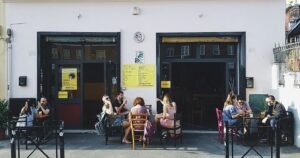
The simplest reference for getting your bearings is the intersection between Via Casilina and the start of the Mandrione. If you come from Porta Maggiore, you take Via Casilina toward the southeast, pass the Pigneto area and find the entrance on the right, marked by the railway underpass. If you come from the opposite direction, you head up Via Casilina toward the center. In both cases the building can be recognized from afar for a reason that deserves its own chapter: its facade is covered by a large mural.
For public transport the natural reference is the network serving the Pigneto and Via Casilina. The Pigneto station on metro line C and the Roma Pigneto railway stop are within walking distance, as are the stops of line 105 and the other buses that run along Via Casilina, while the Roma Giardinetti railway, the old narrow-gauge line starting from Laziali, runs right along the Casilina route with closely spaced stops. Evening schedules of Roman transport, however, don't help those leaving at 2 in the morning: after midnight service is reduced to night lines and taxis, and it's better to know in advance how you'll get home rather than find out at the exit. Night lines and actual frequencies should be checked on the transport company's channels the same day, because they change with the seasons and roadworks.
For those arriving by car or scooter, the area offers street parking along Via Casilina and in the side streets, but with two practical warnings. The first is that Via del Mandrione, in the stretch near number 3, is narrow and in some places one-way, and it is not a street in which to improvise maneuvers. The second is that the neighborhood fills up on weekend evenings, because the Pigneto a few hundred meters away has a very high concentration of venues, and finding a spot after 10 at night becomes an exercise in patience. The scooter remains the most Roman and most effective solution.
One last note on arriving on foot. The stretch under the bridge and along the tracks is dark and little frequented in the evening, and those who don't know the area tend to read it as inhospitable. In practice it is a through street like many on the outskirts, but the rule that applies everywhere holds: arrive accompanied or at a time when there is activity, and don't walk distracted with your phone in your hand.
What 30Formiche Really Is: An ARCI Club, Not Just Any Venue
The point that creates the most misunderstanding is the legal and cultural nature of the place. 30Formiche is not a bar with concerts: it is a cultural association, constituted as an APS and affiliated with ARCI Roma, which runs a club. The practical consequence is that entry is reserved for ARCI members, as the club itself states on its channels, and that there is an online pre-enrollment procedure through the association's national portal. Anyone who shows up at the door without a card does not face a bouncer who decides by gut feeling, but an association rule that applies equally to everyone.
The difference is not bureaucratic. A club does not have to maximize the number of paying customers per night, and this changes the program. It means that one night you may find an unknown garage band playing in front of 40 people, and the next night an assembly, a presentation, a screening or a workshop. It also means the venue can afford musical choices that no nightlife entrepreneur would make, because the economic risk is distributed differently and because the reference audience is not the general public but a community that comes back.
The club defines itself on its channels as a space for independent music and visual arts, with a formula that describes its nights as off-kilter. It is not a verbal affectation: it is a statement of poetics. The dominant repertoire, for years, has been that of rough sounds, dirty guitars, punk and garage, with forays into handmade electronics and the most difficult experimentation. If you want a dance night with recognizable music you have dozens of alternatives in the city. Those who come in here are looking for something that doesn't play elsewhere.
The association structure also explains the other side of the activity, which many miss entirely. 30Formiche takes part in social and territorial projects, not only musical ones. The club appears among the active groups within Akkittate, a mutual aid project born from Circolo ARCI Pianeta Sonoro that provides assistance and refreshment to homeless people, with the declared goal of building paths back to reintegration. About 24 different groups come together in the project, including ARCI Roma, a large part of the network of ARCI clubs in Rome and its province, neighborhood associations, social centers and committees. The collection of basic necessities takes place every Friday from 15:00 to 20:00 at the venue, and covers non-perishable food, clothing, blankets, sleeping bags, hygiene products and items useful to those living on the street, from phones with chargers to trolley bags. Within the same project, the Akkittate n'attimo formula runs a shelter that houses 8 people in a building temporarily granted by Municipio I. Anyone who wants to support or take part will find the project's direct contacts, including the address info@akkittate.it, on the project's own channels.
Keeping the two things together is essential to understanding the place. The club is not a neutral container rented to whoever pays: it is an organization that does cultural programming and social activity under the same name and in the same venue, and that considers the two activities part of the same work.
The Two Rooms, the Brick Corridors and the Train Passing Overhead
The floor plan of the club is the thing that most strikes first-time visitors, because it does not resemble any of the usual schemes of a concert venue. There is no single room with the stage at the back, no gallery, no balcony. There are two distinct rooms and two brick corridors, parallel and rather wide, that run through the space along its whole length.
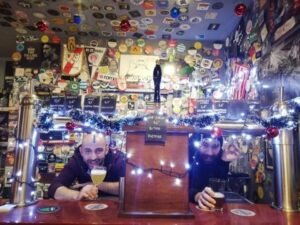
The first room is the hanging-out one: bar, sofas, chairs, the place where you drink and talk. The second is for live music, with the DJ booth and space for the bands. The physical separation of the two functions is a choice that radically changes the experience of the night, and that Roman venues often can't afford for lack of square meters. It means that those who want to listen can listen without the bar queue behind them, and those who want to talk can do so without shouting over the music. It seems like a small detail and yet it is the reason many people keep coming back.
The brick corridors are the architectural signature of the place. The exposed brick, the low arches, the irregular run of the walls tell a story of excavation and adaptation, not of design. Before the club, a blacksmith worked here, and those who know the history of the space say the rooms were carved literally out of the rock. The story may be accurate in its details or may have become neighborhood legend, but the fact remains that the geometry of the rooms is that of a place born to work iron and later adapted to music, not the other way around.
The train deserves a paragraph of its own. The building is set between two railway lines and under the Casilina bridge, and the trains pass exactly overhead. This produces two opposite and complementary effects. The first is technical: the ambient noise of the neighborhood is high, the acoustic tolerance of the context is very high, and the club has been able to build for years a program that elsewhere would have generated complaint after complaint. The second is atmospheric: standing outside, on the sidewalk, glass in hand, you hear the metallic noise arrive from afar, see the window frames tremble slightly, and then hear the roar pass overhead and fade. It is one of the most recognizable sound experiences of east Rome, and in a place that makes loud music its poetics it almost becomes a signature.
The size of the rooms, the capacity and the exact arrangement of the furnishings should not be sought in a general description. The setups change depending on the night, and a concert, a screening, a presentation and an assembly use the same space in completely different ways. Anyone who needs firm numbers to organize something has to ask the club directly.
A Curiosity About 30Formiche
The curiosity concerns the name, and almost no one tells it in full. 30Formiche is not a descriptive name like Lanificio or Officina: it does not say what was there before, does not allude to the neighborhood, does not cite a musical genre. It is a name that names a tiny, organized multitude, and those who know the club know the metaphor works better than it seems. An association club lives on collective work, distributed, done by many people who each move a weight out of proportion to their size, and whom nobody sees individually.
The second part of the curiosity is that the name exists in two forms that have always coexisted. On documents and in archives the club appears as 30Formiche, all one word, with the number in digits. On its own channels the club also presents itself as Trenta Formiche, spelled out, and uses the extended form as the main heading of the site. Anyone searching for the place online and finding nothing with one of the two spellings has to try the other, because archives, event platforms and social networks have never standardized the entry. It is a trivial detail that has made quite a few people miss nights.
Then there is a third level, the one concerning location. The club sits exactly at the point where three areas touch that in Rome are described as separate worlds: the Pigneto, the Certosa and the zone toward Torre Spaccata, within the boundaries of Municipio V. It is not a border neighborhood in a figurative sense: it is a place where the type of building, the type of commerce and the type of crowd change within 200 meters. A club that settles there makes a precise choice, and those who go there notice it as soon as they walk out the door.
The last curiosity concerns the relationship with the railway. The building is wedged between two railway lines, and this means the club is one of the very few live music venues in Rome where outside noise is not an enemy to be shielded but an accepted element of the soundscape. Whoever records something inside the venue will sooner or later find a train in the file. Several musicians consider it a flaw. Others have used it as color.
The Mural on Via Casilina: Il suono del tempo by Luca Zamoc
The facade of the building that houses the venue is covered by a mural of 170 square meters titled Il suono del tempo, made by the Modena-born artist Luca Zamoc. The work was painted in December 2021 and publicly presented by ARCI Roma in February 2022 as the new look of the facade of the building that houses the association.
The mural was not born as a decorative operation. It is the third phase of a street art workshop titled Dalla teoria alla prassi, an initiative funded by the Lazio Region and carried out in collaboration with PalomArt, an international network of independent art that directed the production of the work. The workshop was coordinated by Maura Crudeli, project manager for Yourban 2030, and involved dozens of young participants, in person and in live streaming on social channels. Some of them later worked as volunteer assistants during the days of execution.
The painted subject deserves to be read, because it is not abstract. At the center of the work a large mirror, a symbolic element of the contemporary, shatters against the Belvedere Torso, the famous Neo-Attic sculpture of the 1st century BC kept in the Vatican Museums. The background of the giant facade bears the evident influence of Giorgio De Chirico's metaphysical painting. The theme, as the artist explained, picks up a suggestion that has already run through art history over the centuries, from Michelangelo to De Chirico: the fascination of the ancient and the duality between present and past.
The sentence with which Zamoc explained his work during the workshop has remained the best summary of the operation. Every wall is mute, he said, but he wanted to give this one a voice, he wanted it to sound like the club it hosts. The reference is direct to the fact that 30Formiche is a reference point for the underground music and art scene, and that the idea of making a blank wall on a consular road sound is not a play on words but a statement of function.
Zamoc, born Luca Zanni, was born in Modena in 1986. He studied at Accademia di Belle Arti in Milan, where he trained in graphic design and art direction, and his work spans different media, from ink on paper to digital, from comics to public art. In the years before the Roman mural he had lived and worked in Milan, Berlin, London, Istanbul, Los Angeles and Barcelona.
The president of 30Formiche, Giuseppe Giannetti, explained the choice by linking it to the association's path: street art has been one of the most appreciated languages in the club's cultural promotion work, and the main interest concerns the impact these works have on the territories that host them. Hence the decision to seize the opportunity of the public notice from LAZIOcrea. Zamoc added a remark that holds for all Roman street art: murals are temporary monuments, they have their own transience, and this is precisely part of their charm, because from their presence a new point of interest arises that characterizes the urban context as long as it lasts.
For visitors, the mural is the easiest thing to use as a reference. You see it from Via Casilina, it is big, it is recognizable, and it lets you identify the building without searching for the street number in the dark. Anyone not interested in the music but who follows Roman street art can come by in the daytime, look at it and leave: the wall is on a public street and requires neither card nor ticket.
Something Nobody Tells You About 30Formiche
What almost nobody says is that the program of a club like this does not exist weeks in advance, and that this is not disorganization but a model. A commercial venue builds its schedule months ahead, because it has to sell tickets and cover fixed costs. An ARCI club works on much shorter timelines, crossing the availability of the bands, the proposals of the members, the collaborations with other groups in the network, and it often happens that a date appears with only a few days' notice. Anyone expecting to find the full calendar for the month will be disappointed, and will wrongly read it as a sign that the place is closed.
To this is added a fact that, at the time of writing, can be verified on the official channels: the club's events page lists no scheduled dates, and the same goes for the section dedicated to courses, where the workshops are marked as coming soon. The wording used by the club speaks of a fine-tuning phase. This can mean many different things, from a seasonal pause to a reorganization of the programming, and should not automatically be read as a permanent closure: the venue is still listed, the contacts are still active, and the social activity tied to the mutual aid project has its own independent weekly calendar. But it means that anyone planning a night here absolutely must write or check the channels before leaving the house, and not take for granted that the door will be open.
The second thing nobody mentions concerns the card. Many people discover the membership requirement at the door, at 11:30 at night, and experience it as an improvised obstacle. In reality the club publishes the link to online pre-enrollment on its channels, and ARCI membership is a standard procedure valid across the national network of clubs, not an invention of the single venue. Doing it calmly beforehand, from home, eliminates the problem and is valid for the whole membership year and for all affiliated clubs. The exact procedures, activation times and costs should be checked on the official ARCI channels, because they change from year to year.
The third thing concerns musical expectations. Anyone arriving thinking they'll find a club with a powerful sound system and dancefloor programming won't find that. The club has built its identity on a demanding repertoire, which sometimes is noise, sometimes difficult electronics, sometimes a punk band that plays for 25 minutes and breaks down. It is not a venue that tries to please everyone, and it would be wrong to describe it as such.
The Advice I Give You for Visiting 30Formiche
The most useful advice is to do two things before leaving, in the right order. The first is the card: if you intend to go in, it's best to take care of the online pre-enrollment a few days ahead, so you can show up at the door with no arguments and no queue. The second is checking the date: write to the mailbox info@30formiche.it or check the club's social channels, and ask explicitly if you can get in that night and what time it starts. These are two messages to send while doing something else, and they solve 90 percent of the problems people describe after having come all the way there.
The second piece of advice concerns the time. The club declares opening from 22:00 to 02:00, Tuesday to Saturday. In a place like this, arriving at 22:30 means finding the rooms still empty and a night that hasn't started. Arriving at 01:00 means risking catching the tail end of the concert. The reasonable window for those going for the music is between 23:00 and midnight, but this too depends on the single night, and asking in advance remains the safest move.
Third piece of advice, very practical: don't go alone the first time, and don't go with the idea of a quick stop inside a bar crawl. Via del Mandrione is not a street for strolling and the club is not a place you enter for a 20-minute aperitivo. It is a place that works if you stay, if you settle in the hanging-out room to talk, if you listen to the whole band even when the first 10 minutes seem tough. Those who use it as a stop on a tour find it disappointing. Those who spend the night there understand why it exists.
Fourth piece of advice: the way back. Leaving the Mandrione at 2 in the morning means finding yourself in an area with reduced public transport. It's best to decide beforehand how you'll get home, be it a booked taxi, a car left on a side street off the Casilina, a scooter or a group of people going the same direction. Improvising at that hour, on that street, is what most often ruins the memory of the night.
Fifth and last: if you come from outside Rome and have only one evening available, this is not the place to choose blindly. It is a niche club, with irregular programming and a membership requirement. It becomes an excellent choice for those looking for the Rome of clubs and independent music, and a wrong choice for those who simply want a safe night with live music. In that second case there are more predictable alternatives in the city, like the Alexanderplatz Jazz Club for jazz or Monk for broader and more continuous programming.
How You Get In at 30Formiche and How Membership Works
Access is reserved for ARCI members. The club states this explicitly on its channels, indicating that entry is reserved for members and pointing to online pre-enrollment through the association's national portal. The same page also links to the ARCI app, the tool by which the card is managed in digital format.
The mechanism, for those who don't know it, works like this in the ARCI network in general. The card is annual, tied to the membership year and not the calendar year, and once issued it is valid in all affiliated clubs across the country. It is therefore not a toll for a single night but a membership of the association, with the rights and duties that come with it, including the possibility of taking part in association life. Online pre-enrollment serves to fill in the data in advance, so that only the formalization is left at the door. Amounts, duration and exact procedures should be checked on the official ARCI channels, because they are set at the association level and change periodically.
On the practical side there are three things to know. The first is that you need an ID, because membership is registered by name. The second is that membership does not automatically equal entry to a specific night: some dates may carry an additional contribution to cover the bands' fees, and the decision rests with whoever organizes. The third is that no figure given outside the official channels of the club and the association should be taken at face value, because contributions vary from night to night.
Finally, there is a point of behavior that matters more than the procedure. A club is not a public venue and the relationship between those who come in and those who run it is different: members are expected to treat the space as their own, not as a purchased service. This means not making a racket in the street on the way out out of respect for the people living around, not expecting the program to adapt to your own taste, and accepting that sometimes the night is an assembly and not a concert.
Another Well-Known Fact, Yet Rarely Mentioned
The well-known fact is that Via del Mandrione is one of the most written-about places of postwar Rome, and almost nobody tells this to those who go there for a concert. This street, with its shacks leaning against the arches of the aqueduct, was one of the symbols of the Roman periphery of the postwar years, a place of housing misery that ended up in literature, cinema and the news. Pier Paolo Pasolini frequented it and named it, Cesare Zavattini wrote about it, and photographic images of the Mandrione shacks are among the most reproduced when talking about the Roman housing problem of those years.
The rarely mentioned fact is the transformation that followed. The shacks were cleared and the street changed nature without ever becoming an ordinary residential neighborhood: it remained a narrow, hybrid strip, made of workshops, depots, vegetable gardens, sheds and low houses, squeezed between the tracks and the arches. This very anomalous condition, which no urban plan has ever fully resolved, made the Mandrione one of the few places in the city where a space like a loud-music club could settle without immediate conflict with the neighbors.
There is a second level, even less often cited. The arches seen along the street are not one aqueduct but two on top of each other: the Claudian aqueduct, from the imperial age, and the Felice aqueduct, built at the end of the 16th century at the will of Sixtus V partly reusing the ancient structures. Walking along the Mandrione therefore means passing under 2,000 years of overlapping hydraulic engineering, with 19th- and 20th-century railways cutting across it all diagonally. Anyone interested in the subject finds the same layering, in a more readable and orderly form, at the Aqueducts Park, a little further south, and in another form at the Aqua Virgo, the only ancient aqueduct still working in the city.
The third rarely cited element concerns the Roma Giardinetti railway, the narrow-gauge line that runs along the Casilina and survives as a fascinating relic of a transport system now vanished. It is one of the few urban railways in Italy that still cross a neighborhood like a slow tram, stopping a few dozen meters from front doors. Anyone arriving at the club by passing next to it sees a Rome that no tourist guide tells.
The Right Photo to Take at 30Formiche
The right photo is not taken inside the venue but outside, and concerns the facade. The mural Il suono del tempo covers 170 square meters on the wall facing the Casilina, at the point where the consular road meets the start of the Mandrione. The subject, with the mirror shattering against the Belvedere Torso and the background of metaphysical ancestry, holds up very well in a frontal shot, but requires stepping back far enough to take in the whole wall. The best moment is late afternoon, when the raking light separates the painted volumes without flattening them and without producing the harsh contrast of midday.
The second photo, the one that tells the place best, is instead a night shot and has to be built with patience. You focus on the entrance or the stretch of street under the bridge and wait for the train to pass overhead. With a long exposure, resting the camera or phone on a low wall, you get the light trail of the train above the building and the street motionless below: it is the image that sums up in a single frame the reason why this club can exist right here. You need a stable support, because handheld the result is only blur.
The third possibility is the aqueduct arches along the Mandrione, with the houses leaning against them and the signs of the workshops. It is the classic documentary photograph of the street, the one that unwittingly repeats the iconography of the postwar years, and it works better on gray days than in full sun, because gray returns the harshness of the context without prettifying it.
Inside the rooms, a common-sense rule applies, not a prohibition: you ask. During concerts the flash is annoying for those playing and those listening, and in a small club the disturbance is immediate. In the hanging-out room, with the sofas and the bars, nobody is scandalized by a photograph, but framing people who haven't given consent remains improper in a place where everyone knows each other. Anyone who wants to photograph the bands on stage does the simplest thing: asks first of whoever runs the night.
Some Important Events That Happened Here in History
The history of the space begins before the club. The venue that today houses the two rooms was a blacksmith's workshop, and the layout of the rooms, dug out and irregular, belongs to that era. It is a story that holds for much of the Mandrione: workshops, depots, warehouses, small craft businesses wedged between the tracks and the arches, in a strip of the city that was never planned as a residential neighborhood and that for decades hosted the manual work the center pushed out.
The second historical step is the opening of the club. The association has been active in this place for about a decade according to what ARCI Roma stated in 2022, which places the settlement around the early 2010s. The source that first described the place in the circuit of event archives noted, without giving the year, that the club was preparing to blow out its first 10 candles at the end of the year: indirect confirmation of the same chronology.
The third step is December 2021, when the facade was painted. The mural Il suono del tempo by Luca Zamoc, 170 square meters, was made as the third phase of the street art workshop Dalla teoria alla prassi, funded with Lazio Region funds through a public notice from LAZIOcrea and carried out with PalomArt, an international network of independent art that directed its production. The workshop, coordinated by Maura Crudeli for Yourban 2030, involved dozens of young participants between in-person and streaming, some of whom worked as volunteer assistants during the execution. In February 2022 ARCI Roma publicly presented the work as the new look of the building's facade.
The fourth step is not a date but a path: the club's entry into the Akkittate network, the mutual aid project born from Circolo ARCI Pianeta Sonoro that gathers about 24 groups among ARCI Roma, clubs of the Rome and provincial network, territorial associations, social centers and committees. The weekly collection of basic necessities, held on Friday afternoons at the venue, has turned the club into a logistics point and not only a place for music, and the Akkittate n'attimo formula has added the running of a shelter for eight people in a building temporarily granted by Municipio I.
The fifth step concerns the present. At the time of writing, the club has a renewed website presenting the sections for program, courses, initiatives and video archive, but none of these sections lists appointments on the calendar: the events page states that there are no nights scheduled and that the club is getting itself back in shape, the courses page marks the workshops as coming soon, the videos page notes that the archive will return online. The fact should be read for what it is, that is a transition phase declared by the club itself, and verified in person on the channels before organizing a night.
For the rest, individual dates, hosted festivals, series and collaborations with other Roman groups should not be reconstructed from memory or deduced. Those looking for the precise chronology of what has passed through that stage will find material in the club's archives and on its social channels, not in a general description.
Who Has Passed Through 30Formiche
The honest answer is that an underground club does not build its reputation on headline names, and that the list of bands that have passed through here does not exist in a public, verifiable form. What can be said with certainty is the kind of musicians this stage has hosted: garage and punk bands from the Roman and Italian scene, electronic projects built with handmade equipment, foreign bands touring the European self-managed circuits who stop in Rome outside commercial venues, and experimenters who would find no room in a ticketed venue. It is the same network that feeds the other outposts of Roman independent music, from Fanfulla 5/a to the Wishlist Club, with which the audience largely overlaps.
For documented people, on the other hand, there are names. The facade mural bears the signature of Luca Zamoc, born Luca Zanni, born in Modena in 1986, trained at Accademia di Belle Arti in Milan in graphic design and art direction, with a path that took him through Milan, Berlin, London, Istanbul, Los Angeles and Barcelona before arriving on the Casilina. The workshop that produced the work was coordinated by Maura Crudeli, project manager for Yourban 2030, and its production directed by PalomArt. The association's president, Giuseppe Giannetti, is the voice who publicly explained the choice of street art as the club's language of cultural promotion.
Then there is a category of people who have passed through here that no poster records: the dozens of young participants in the street art workshop, some of whom worked as volunteer assistants on the scaffolding, and the network of volunteers who every Friday afternoon collect and sort basic necessities within the mutual aid project. In an association club this is the largest part of those who have really passed through, even if it appears in no music archive.
Anyone looking for confirmation of individual concerts or individual artists should go directly to the club or its social archives. Attributing to this stage names that are not documented would be a narrative convenience and not information.
The Mandrione, the Pigneto and the Certosa: The Context Around the Club
The club sits at a hinge point between three areas with different histories. To the northwest is the Pigneto, the neighborhood that in the last 20 years has concentrated the highest density of nightlife venues in east Rome, with its pedestrian zone, its market, its low houses from the 1920s and 1930s and a population that mixes longtime residents, recent immigration and newcomers drawn by the rents. To the southeast are the Certosa and the strip toward Torre Spaccata, 20th-century residential areas much less written about, made of apartment buildings and ordinary neighborhood life. In the middle is the Mandrione, which doesn't really belong to either and works like a fault line.
This position has a concrete consequence for visitors. Leaving the club and walking toward the Pigneto, you enter the circuit of venues, beer halls and restaurants, with a density of offerings that lets you build a complete evening. Walking in the opposite direction, you enter a residential Rome that after 9 in the evening is silent. The same street, 200 meters away, offers two different cities.
The Pigneto also has another face, less trodden by visitors. It is a neighborhood with a precise cinematic history, because its streets appear in some of the best-known sequences of neorealism and of Pasolini's early cinema, and its popular identity is not a recent invention for tourists. Those who move around with a minimum of curiosity find public-housing architecture from the 1920s, local markets still working and a street life that in daytime hours has nothing to do with the night-time nightlife.
Within a few kilometers there are also some of the most interesting places of non-monumental Rome. The former SNIA Viscosa with its lake born by mistake from an excavation, the Underground Basilica of Porta Maggiore, the large spaces of the Centrale Montemartini and, along Via del Mandrione itself, the Snodo Mandrione. They are destinations that combine well with a night at the club, because they all sit within the same geography of industrial archaeology and historic periphery.
When to Go to 30Formiche and When to Avoid It
The club declares opening Tuesday to Saturday from 22:00 to 02:00. This automatically excludes Sunday and Monday, and narrows the choice to a fairly tight evening window. Within that window, the weekend is when the chance of finding a built-out night is highest, while weekday evenings have historically been those of the most experimental proposals and the smallest crowds. Those looking for a full atmosphere go on Friday or Saturday. Those looking to really listen, with 40 people in the room, go earlier in the week.
The moment to avoid, absolutely, is when nothing has been verified. With a calendar that at the moment lists no appointments and that the club itself describes as in a fine-tuning phase, showing up without having written is the most effective way to make a wasted trip. This holds especially for those coming from outside Rome or from another quadrant of the city, because the Mandrione offers no immediate alternatives to those who find the door closed: you have to head back up toward the Pigneto anyway.
Then there is a Roman seasonality that holds for all clubs. August is the month when most association venues stop or sharply reduce activity, while autumn and spring are the periods of densest programming. The period around the year-end holidays is variable and depends on the choices of the individual management. This too, like everything else, should be verified and not deduced.
One last note concerns the kind of night you are looking for. If the goal is dinner, this is not the place: the club was born around music and bar sociability, not around cooking. Those who want to combine dinner and live music in the same area find different formulas in other venues nearby, like the Ellington Club in the Pigneto. Those looking instead for large spaces and high-capacity events head elsewhere, toward places like Lanificio159 in Pietralata or the Atlantico Live Club.
Quick Questions About 30Formiche
Where exactly is it?
At Via del Mandrione 3, in Rome, where Via Casilina meets the start of the Mandrione, in a building between two railway lines and under the arches of the aqueduct. The building is recognizable by the large mural on the facade.
Do you need a card to get in?
Yes. The club states that entry is reserved for ARCI members and offers an online pre-enrollment procedure on the association's national portal. Amounts and procedures are checked on the official ARCI channels.
What are the hours?
The hours published by the club are Tuesday to Saturday from 22:00 to 02:00. Individual nights may have different start times depending on who organizes.
How do you contact the club?
The contact given for information is the mailbox info@30formiche.it. The club is also present on the main social channels, which remain the place where dates appear first.
What music do you hear?
The club's historic line favors rough, little-tamed sounds: garage, punk, handmade electronics, experimentation. It is not a dancefloor venue with recognizable music.
Are there events scheduled right now?
At the time of writing, the club's events page lists no dates on the calendar and notes a fine-tuning phase, just as the courses section marks the workshops as coming soon. It's best to check directly before heading out.
Can you see the mural without going in?
Yes. Il suono del tempo by Luca Zamoc covers the facade on a public street and can be viewed freely, by day, without a card and without an appointment.
Is it suitable for people who don't know the Roman underground scene?
It depends on the attitude. Those who arrive curious and willing to listen to a band they don't know find exactly the kind of night that no longer exists in the center. Those looking for a guarantee of predictable fun would do better to choose something else.
How do you get home at the end of the night?
Night public transport in the area is reduced. It's best to arrange the return before going out, with a taxi, your own vehicle or a group going the same direction, and to check the night lines the same day.
Is the club still active?
The venue is still listed, the contacts are still active and the club's website was recently renewed, but the public calendar lists no appointments and the club itself speaks of a reorganization phase. A direct contact before planning a night remains the most sensible precaution, especially for those coming from far away.
Frequently Asked Questions About 30Formiche
Where is 30Formiche?
30Formiche is at Via del Mandrione 3, in Rome, where Via Casilina meets the start of the Mandrione, in a building between two railway lines and under the arches of the aqueduct. The building is recognizable by the large mural on the facade facing the Casilina.
What is 30Formiche?
30Formiche is not a simple bar with concerts, but a cultural association constituted as an APS and affiliated with ARCI Roma, which runs a club with two distinct rooms and two brick corridors, linked to the mural "Il suono del tempo" by Luca Zamoc on the facade.
Do you need a card to get into 30Formiche?
Yes, entry to 30Formiche is reserved for ARCI members, as the club states on its channels. There is an online pre-enrollment procedure through the association's national portal and the ARCI app, which manages the card in digital format.
What are the opening hours of 30Formiche?
30Formiche declares opening Tuesday to Saturday from 22:00 to 02:00, so Sunday and Monday are excluded. The weekend is when the chance of finding an organized night is highest, while weekday evenings often offer more experimental nights.
Should you book or prepare anything before going to 30Formiche?
Yes, it's best to take care of the online pre-enrollment as an ARCI member a few days ahead, so you can show up at the door of 30Formiche with no arguments and no queue, and to check the date by writing to the mailbox info@30formiche.it or checking the club's social channels, because the program is not set weeks in advance.
Is 30Formiche suitable for people who don't know the Mandrione area?
30Formiche sits at a hinge point between the Pigneto, the Mandrione and the Certosa area, a part of east Rome with an important popular history tied to the postwar years. Those arriving for the first time find a neighborhood in transformation, well connected by the tracks and the aqueduct arches.
If you organize itineraries in Rome for groups, school classes or foreign clients and need to fit a night of independent music or a street art stop into a wider program, you'll find the professional tools on TourLeaderPro: the quote request and direct contacts are on the TourLeaderPro contact page, while tour operators building thematic packages on outlying Rome and independent culture will find the section dedicated to tour operators.
If you are preparing a trip to Rome and looking for guides in English, you'll find them on ItalyPlanner.com. To understand how to get around between metro, trams, buses and regional trains, even in the evening hours, the guide to public transport in Rome is useful. If you want to build your stay around neighborhoods like the Pigneto and the Mandrione, you'll find a broader overview on what to do in Rome.
Contact Information
Nearby
 Ellington Club300 m
- Snodo Mandrione400 m
- Alvarado Street400 m
- Sparwasser500 m
- Pigneto500 m
- Santa Libbirata-La Carretteria600 m
Upcoming events nearby
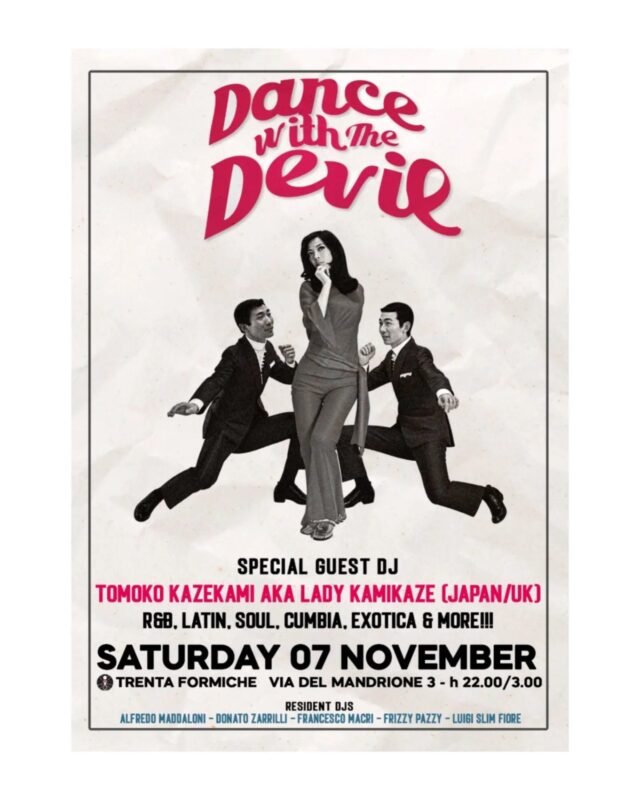
- Dance with the devil with Lady Kamikaze (Tomoko Kazekami) at 30 Formiche, November 7, 2026200 m
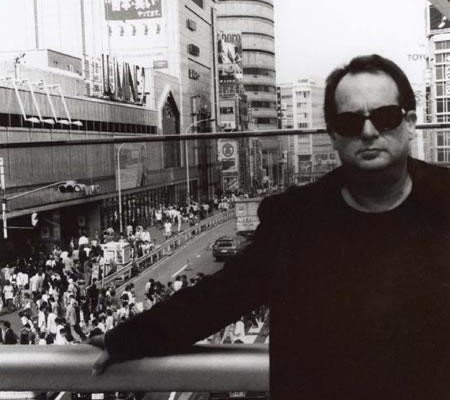
- Carl Stone and Mike Cooper at 30 Formiche, November 4, 2026200 m
- Crown Flash and Omis Elegia at 30 Formiche, November 5, 2026200 m
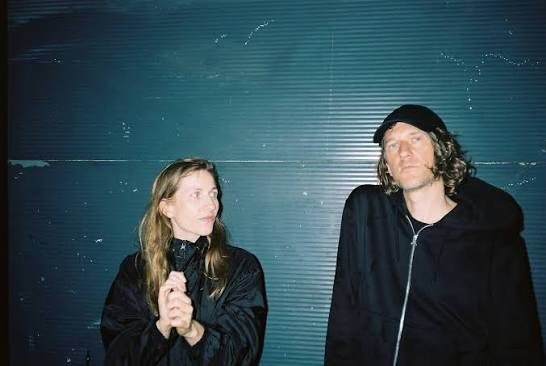
- Soft as Snow with AMEN at 30 Formiche, November 10, 2026200 m