Sparwasser
In short. Via del Pigneto 215, Rome. The street number is high, and anyone who knows the street already knows what that means: we are in the eastern part of Via del Pigneto, the one that moves away from the pedestrian stretch and the café tables…
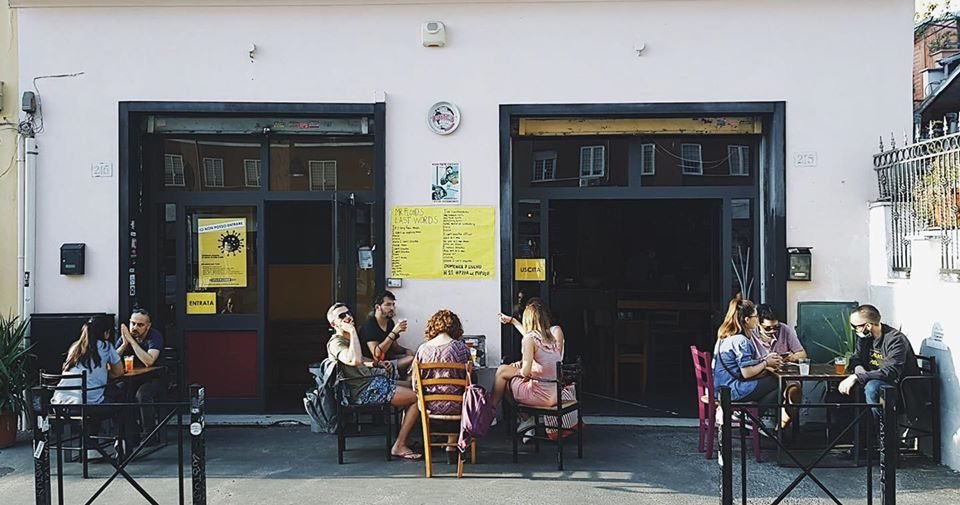
Via del Pigneto 215, Rome. The street number is high, and anyone who knows the street already knows what that means: we are in the eastern part of Via del Pigneto, the one that moves away from the pedestrian stretch and the café tables to slip into the denser and more residential fabric of the quadrant. Here, since 2015, is Sparwasser: a space for the production and enjoyment of the most disparate forms of sociality, culture and mutualism in East Rome. It is the definition the place gives of itself, and it is a definition worth taking apart word by word, because each of those words was chosen with care and none is decorative.
I start with the name, because it is the first thing everyone asks. Sparwasser is not an invented word, not an acronym and not a play on syllables. It is the surname of an East German footballer, Jürgen Sparwasser, and the circolo carries his silhouette in its logo. It is a choice that says a great deal, but to understand it you first have to tell the goal that surname carries with it, and then understand what it means to practice mutualism on a street in the Pigneto in 2026. In the pages that follow I do both, always keeping separate what is documented from what is neighborhood chatter, because the Pigneto produces neighborhood chatter in industrial quantities.
A note on method, before starting. Sparwasser is a circolo, and a circolo is not a public venue like any bar. The legal form changes the way you get in, the way evenings are programmed and the way the place answers for itself to the city. Whoever arrives expecting the logic of a commercial venue is thrown off. Whoever arrives knowing how a circolo works feels at home within 20 minutes. I make this difference clear right away, because it is the key to understanding everything else.
Where Sparwasser Is and How to Get There
The Address, and What It Really Means
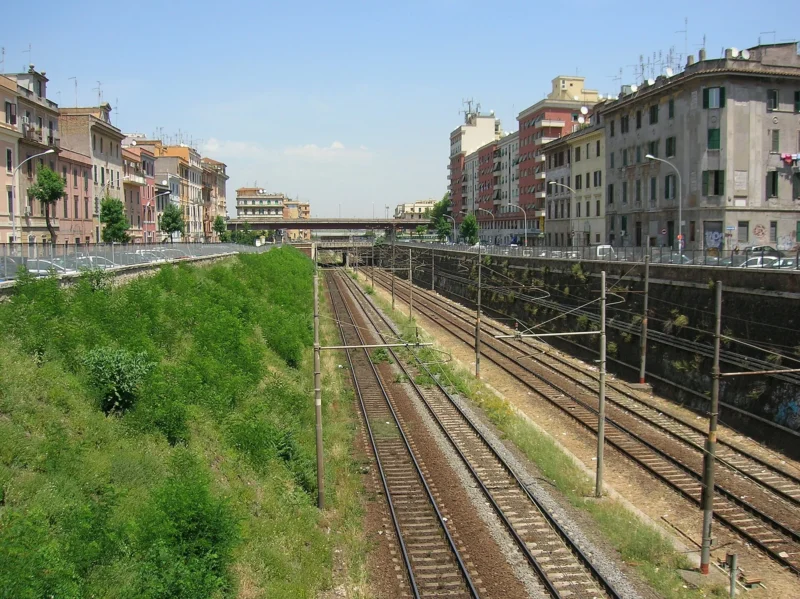
The address is Via del Pigneto 215, postal code 00176. Via del Pigneto is the backbone of the neighborhood and changes nature three or four times within a kilometer. In the central stretch, the pedestrianized one, the street is wide, full of outdoor seating, lights, people walking slowly because they don't have to dodge cars. Then the pedestrian zone ends, the cars return, the narrow sidewalks return, and the street becomes what it was before it became famous: a neighborhood street with doorways, roll-down shutters, scooters propped against the wall and antennas on the roofs. Number 215 belongs to this second part.
The practical consequence is immediate. Anyone who comes out of the metro and starts walking thinking they will arrive in two minutes gets the sums wrong: number 215 requires a real walk along the street, and in the final part the signs thin out, the light drops and the noise of the nightlife stays behind. It is not a flaw, quite the opposite. A space that deals with mutualism and organized sociality has every interest in placing itself where people live, not where they consume, and the geography of the high street number is consistent with the project.
Then there is the question of borders. The Pigneto proper, that of the quadrilateral between the Circonvallazione Casilina, Via Prenestina and Via di Acqua Bullicante, has moving edges that every Roman traces slightly differently. In the upper part of Via del Pigneto you are already in the transition band toward Torpignattara, where building density changes, where prices change and where above all the public changes. Whoever lives here does not come to the Pigneto: they live inside it. It is a distinction that seems subtle and yet determines who comes through the door of a circolo on a Tuesday night.
How to Get There by Metro
The reference is line C. The Pigneto station, which entered service on June 29, 2015, runs under the street and serves the whole quadrant. From there you walk eastward, along the pedestrian stretch first and along the drivable part afterward. The next station, Malatesta, serves the outermost portion toward Torpignattara and for the high street numbers it is often an equally sensible alternative, depending on where you get off and how much you feel like walking. Anyone coming from the center takes line A to San Giovanni and changes there, at the point where the two lines meet.
It is worth noting a coincidence that nobody ever points out and that says something about the neighborhood: the metro station opens in June 2015 and the circolo opens in November of the same year. It is not a relationship of cause and effect, and it would be silly to tell it that way. It is, however, the snapshot of a precise moment, the one in which the Pigneto stops being a peripheral neighborhood reachable only by surface transport and becomes a piece of city 15 minutes by metro from the center. Everything that has happened here in the last 10 years, for better and for worse, passes through that date.
On metro hours the usual Roman rule applies, which I repeat because it saves evenings. A circolo that programs concerts and assemblies works until late. Line C does not. The last useful run on weekdays arrives long before the end of an evening, on Friday and Saturday the service is longer but does not cover the whole night. The practical advice is banal and it works: decide how you are getting home before going out, not at half past midnight on the sidewalk with your phone battery on reserve.
Tram, Bus, Railway
The surface network in this sector is dense and, unlike the metro, covers wider time bands. The tram lines that run along Via Prenestina and the Circonvallazione Casilina drop you a few hundred meters from the quadrilateral, and Piazzale Prenestino remains the most convenient hub for those coming from the center via Porta Maggiore. Along the Casilina also runs the old Roma Giardinetti railway, the narrow-gauge line that starts from Porta Maggiore and has stops with names that tell the neighborhood better than any guide: Alessi, Ponte Casilino, Sant'Elena, Villini. Riding it once, even for just two stops, is the quickest way to understand how this part of the city was formed.
Then there is the chapter of the future Roma Pigneto railway station, designed as an interchange between metro C and the suburban lines. The works marked the landscape of the neighborhood for years, up to the demolition of the old bridge over the railway. When the interchange goes into operation the accessibility of the quadrant will change substantially, and in all likelihood the public of its spaces will change too. In September 2026 the station is not yet operational: anyone planning to arrive by train should refer to Termini or Tiburtina and then continue by metro.
On Foot and by Bicycle
From the historic center the Pigneto is closer than the mental map suggests. From Porta Maggiore, that is, from the point where the Aqua Claudia and the Anio Novus cross over the road and where the underground basilica of Porta Maggiore is located, to number 215 you walk in a little over 20 minutes, almost always on the flat, following the Casilina. It is a walk I recommend doing at least once in daylight: in a kilometer and a half you cross 2,000 years of urban layering, from the travertine arches of the first century to the self-built small apartment buildings of the 1920s, almost without noticing.
By bicycle the matter is different. The quadrant is flat and the distances are short, but the streets are narrow, often one-way, with patched surfaces and double-parked cars that appear out of nowhere. It is not the route I would recommend to someone cycling in Rome for the first time. Anyone who knows Roman traffic, on the other hand, finds here one of the most practicable contexts in the city, because speeds are low and the frequent intersections force everyone to slow down. In the upper part of Via del Pigneto, in particular, it is better to cycle in the evening than during the day.
Hours, and Why It Is Worth Checking Them
The public listings for the place indicate an evening opening, from 19:00 until night, every day of the week. Take it as a general indication and not as a clock: spaces of this kind modulate their opening on the programming, close for long periods in August, reopen with calendars that are announced on direct channels and nowhere else. The rule that holds for all Roman circoli holds here too: before crossing half the city for a specific evening, a check on the place's channels saves you the disappointment of the closed door.
What Sparwasser Is, in Concrete Terms
The formula the place uses to describe itself is compact and must be taken seriously: a space for the production and enjoyment of the most disparate forms of sociality, culture and mutualism in East Rome. Five concepts in a single line. I try to take them apart one by one, because lined up they describe a precise model and not a generic declaration of good intentions.
Production, Not Just Enjoyment
The word that comes first is production, and the order matters. A normal venue produces consumption: it buys something and sells it back to you, and the successful evening is the one where you spent and had a good time. A space that declares itself one of production says something else: that part of what happens inside is made there, by those who frequent it, and not bought from outside. It means rehearsals, workshops, organizing meetings, groups that meet to put together something that did not exist before.
It is a distinction that in Rome has a long history. For decades the city has produced a tradition of self-managed spaces in which the line between audience and organizers is deliberately blurred: whoever walks in today as a spectator may walk in six months from now as the one who opens the door and sets up the chairs. This passage, which from the outside looks like folklore, is in reality the economic mechanism that keeps these places going. Without volunteer work, the numbers of a neighborhood circolo would never add up.
The second word is enjoyment, and it serves to balance the first. Not everyone who comes in feels like taking part in a meeting, and nobody expects them to. A healthy space holds together those who produce and those who simply come in, sit down and watch. The balance point between the two is the measure of the health of a place like this: if it only produces it becomes a closed club, if it only offers it becomes a bar with the aesthetics of a circolo.
Sociality
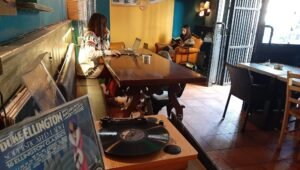
Sociality is the most overused word in the Italian cultural vocabulary of the last 20 years, so it is worth bringing it back to earth. In a neighborhood like this one sociality means something very concrete: an indoor place, heated in winter, where you can stay without having to consume continuously and without anyone letting you know the table is needed. Put like that it seems little. In a city where indoor public spaces are rare and where homes are small, it is instead the premise of everything else.
The Pigneto, from this point of view, has a problem that few talk about. Its fame as a nightlife neighborhood multiplied the places where you drink and left almost unchanged those where you stay. In the pedestrian stretch, on peak evenings, the density is very high and the chance of sitting down to talk with someone without shouting is close to zero. A circolo in the upper part of the street, away from the peak, occupies exactly the space left uncovered: there is less noise, less foot traffic, and this allows conversations that 200 meters farther on would not be possible.
There is also a generational dimension that deserves attention. Circoli work well when they hold together different age groups, and work badly when they become monochrome. In the Prenestino-Casilino quadrant the coexistence between those who have lived here for 50 years, those who arrived in the 2000s and those who were born elsewhere is the central urban question. A space that declares itself one of sociality implicitly takes on the task of making these populations cross paths, which in the daily life of the neighborhood brush against each other far more than they talk.
Culture
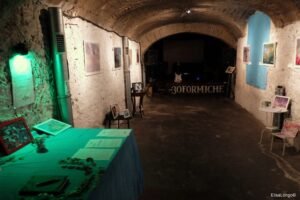
The word culture, in a place of this size, does not mean a theater season with the program printed in September. It means concerts by small groups, book presentations, screenings, debates, exhibitions hung on the walls, DJ sets. City listings classify Sparwasser together with bars, social spaces and music clubs, and that multiple classification is already an answer: the place does a bit of all these things and does not let itself be pigeonholed in any of them.
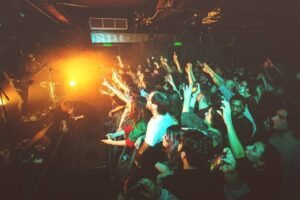
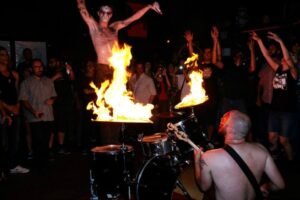
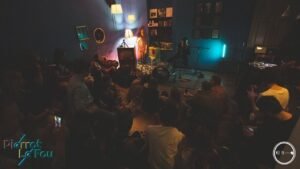
The concert format in a circolo has its own rules. The sound system is what is enough to be heard by a few dozen people, the stage is often a corner cleared by moving two tables, and the distance between those who play and those who listen is two meters. Those who play know it and adapt the repertoire. It is the circuit that in Rome has for decades fed non-commercial live music, and that in the last 20 years has moved east following the available square footage: when rents in the center and in Trastevere made it impossible to keep a small place open with non-commercial programming, the musicians followed the places, and the places were in the Pigneto, in San Lorenzo, in the Quadraro, in Torpignattara.
The result is a diffuse network of micro-venues in which every evening, somewhere, someone plays in front of an audience that almost all know each other. It is not the circuit that fills the arenas. It is, however, the circuit from which sooner or later comes whoever will fill the arenas, and it is also the circuit that allows those who will never fill them to keep playing anyway. Of the two functions, the second is the one that matters most for the cultural health of a city.
Mutualism
I come to the word that makes Sparwasser different from a concert hall. Mutualism is a term with a long history and a precise meaning: it indicates practices of mutual aid organized among peers, going through neither the market nor public assistance. In the Italian tradition it has its roots in the mutual aid societies of the 19th century, those that pooled workers' contributions to guarantee a common fund in case of illness or injury, long before a welfare system existed.
In the contemporary practice of Roman social spaces mutualism takes smaller and more everyday forms: orientation desks, after-school programs, language courses, solidarity collections, skill exchanges. The common principle is always the same: whoever receives today is whoever gives tomorrow, and the relationship is not between a provider and a user but between two people who belong to the same community. This reciprocity is what distinguishes mutualism from charity, and it is a distinction to which those who practice it are particularly sensitive.
Declaring mutualism in your own presentation means declaring a political identity, and there is no point pretending it isn't so. Sparwasser writes it openly, together with sociality and culture, and whoever comes through the door knows where they have come in. I tell it for what it is: an explicit choice, consistent with a Roman tradition that has produced dozens of similar experiences in this quadrant of the city. It is not a characteristic that makes the place inaccessible to those who do not share that history, and it is not a detail to sweep under the rug to make everything seem more neutral than it is.
A Circolo, Not a Venue: How It Works in Practice
Sparwasser is an Arci circolo, and this determines the mechanics of entry. In a circolo you enter as a member: the membership card is national, valid for a year, made on the spot in a few minutes and valid in all affiliated circoli in Italy. It is not a bureaucratic expedient: it is the legal form that allows a place to carry out cultural activity directed at its own members without having to behave like an ordinary commercial business.
For those arriving from outside Rome, or simply for those who have never set foot in a circolo, this can seem an obstacle. It is not. The procedure is simple, the cost is modest, and the card almost always turns out to be a smart investment, because it opens the doors of a very wide network that includes rehearsal rooms, summer arenas, libraries, neighborhood spaces throughout the city and the whole country. Anyone who spends a week in Rome and frequents the independent scene pays it off within two evenings.
There is also a cultural consequence of the membership form that I find more interesting than the practical one. A member is not a customer. The difference can be felt in the way people behave inside the space: they tend to put the chair back, to take the glass to the counter, to lower their voice when something begins. Not always and not everyone, obviously. But the percentage of people who do it, in a circolo, is systematically higher than in a venue, and that percentage is what makes it bearable to be 50 in a room made for 40.
A Curiosity About Sparwasser
The curiosity is the name, and the story behind the name is one of the most beautiful that 20th-century football has produced. Jürgen Sparwasser was born in Halberstadt on June 4, 1948 and was a midfielder for 1. FC Magdeburg, a team of the German Democratic Republic. On June 22, 1974, at the Volksparkstadion in Hamburg, he scored the goal that decided the only match ever played between the senior national teams of East Germany and West Germany. It ended 1-0 for the East Germans, in the home of the West Germans, during the World Cup that West Germany was hosting and would then win.
That the Pigneto circolo takes its name from him is not a fascinating reconstruction put together after the fact: it is a recorded fact. The Arci circolo opened in Rome in November 2015 carries that surname and carries in its logo the silhouette of the footballer. Whoever draws a sign with the outline of a DDR midfielder above the door of a mutualism space does not do it by chance, and does not do it out of generic love of football either. They do it because that goal, in the collective European memory, means something very specific.
It means the small beating the big at the moment and in the place where it was not supposed to happen. It means the system that loses from the sporting point of view winning the only direct confrontation in history. It means a team given up for lost spoiling the party for 50,000 people in their own home. In a neighborhood that built its own identity on being periphery with respect to the center, the allegory stands on its own and needs no explaining to anyone. The name on the sign is, in three syllables, a declaration of belonging.
I add a linguistic note for those who know a little German, because it produces a rather funny involuntary short circuit. The surname, read as a compound word, puts together the verb for saving and the noun for water. A surname that sounds like "save water" hanging above the door of a bar is the kind of coincidence that no copywriter would have the courage to invent. Obviously it has nothing to do with the reasons for the choice, but it is the kind of detail that makes a story memorable.
The Goal of June 22, 1974, Minute by Minute
It is worth telling that match with a minimum of precision, because the barroom version oversimplifies and loses the best pieces. The two Germanys had ended up in the same group at the 1974 World Cup, Group 1. West Germany, the host, was coached by Helmut Schön, East Germany by Georg Buschner. They reached the direct confrontation both already qualified for the next stage: the Westerners had beaten Chile and Australia, the Easterners had got past the Australians and drawn with the Chileans. On the strictly sporting level the match put at stake only first place in the group, and the favor of the forecast was all on one side.
On the political level, instead, it was the match of the century. The government of the Democratic Republic, which as a rule granted exit permits sparingly, for that occasion issued more than 8,000 tourist visas valid just for the time needed. 8,000 people crossed the border to see a football match and then went back. This detail alone would be enough to explain what was at stake that afternoon, and how little it had to do with the group standings.
The match was made by West Germany. They attacked for long stretches, even hit a post, and found in front of them a well-organized team that repelled everything. East Germany had its chances, including a glaring scoring chance wasted by Hans-Jürgen Kreische in front of an empty goal. Then came the 77th minute. The defender Kurbjuweit sent a diagonal pass to Sparwasser, who controlled the ball on the run first with his head and then with his thigh, dribbled past Höttges and Vogts and deposited it behind Sepp Maier. 1-0.
What happened afterward is the part I love most. For the remaining minutes more than 50,000 home fans, until then cheering, stayed silent, while the Eastern minority present in the stands celebrated. An entire stadium struck dumb is a sound image worth more than any chronicle. West Germany, to be complete, took a crushing revenge: it continued in the tournament and came out world champion. But the only direct confrontation in history between the two national teams remains that one, and remains with that result.
What Happened to Sparwasser After the Goal
The second part of the story is less told and in some ways more interesting than the first. Sparwasser became a national hero in the DDR, and this had heavy consequences on his life. He ended his career in 1979, at 31, because of a hip injury, after a career spent entirely with Magdeburg: 271 appearances and 111 goals in the top league, 27 appearances and 22 goals in the second, 49 matches and 20 goals in the national cup, 41 appearances and 20 goals in European cups. With the national team he finished with 49 appearances and 14 goals, plus the Olympic bronze of Munich in 1972.
There is another result worth remembering: in the spring of 1974 itself, a few weeks before the World Cup, Magdeburg won the Cup Winners' Cup beating Milan 2-0 in the final. For an East German team it was the most prestigious international success ever, and it remains the only European trophy won by a DDR club. Sparwasser's 1974, lined up, is one of the densest years a footballer can have.
After retirement things got complicated. Sparwasser had a degree in mechanical engineering and obtained his coaching license in 1980. Magdeburg offered him the bench several times and he refused every time, so as not to take on the political commitment that role entailed. He preferred to be a research assistant at the Scuola Superiore di Pedagogia in Magdeburg. When his daughter applied for an exit permit, Sparwasser's position became untenable, and on January 10, 1988, on the occasion of a match between old glories in Saarbrücken, he crossed to the West together with his wife.
The communiqué of the DDR press agency deserves to be quoted in full, because it is a masterpiece of wooden language: "Anti-sporting forces took advantage of the presence of an old-glories team of 1. FC Magdeburg in Saarbrücken to abduct Jürgen Sparwasser, who has betrayed his team." The man who had scored the most political goal in the history of East Germany was dismissed as an object taken away. Less than two years later the wall would fall.
In the Federal Republic Sparwasser worked as a coach. Between 1988 and 1990 he was an assistant at Eintracht Frankfurt under Karl-Heinz Feldkamp, and in that team he coached a very young Jürgen Klopp. He then had a single head coach job at Darmstadt 98, until his dismissal in November 1991, and later an experience at Rot-Weiß Walldorf. He left active football for sports marketing, chaired the association of professional footballers between 1997 and 1999 and became a consultant to players.
The last chapter is the most symbolic. In 2003 an entrepreneur from Krefeld won at auction the number 14 jersey worn by Sparwasser in that match and donated it to the Haus der Geschichte in Bonn, the museum of German history, where it is still on display. A football shirt kept in a national history museum: it is all there, in that gesture, the weight that that June afternoon had for two countries.
Something Nobody Tells You About Sparwasser
The thing almost nobody makes clear is that the mutualism declared in the presentation is not a side adjective stuck on for color, but concretely changes the way the place works, and therefore changes what you should expect when you walk in. Whoever arrives thinking they will find a venue with alternative aesthetics and the service of a bar is thrown off, and sometimes a bit unhappy too, without understanding quite why.
The first difference concerns time. In a commercial venue time is a resource to be optimized: the faster the table turnover, the better the books work. In a circolo time works the other way around: whoever stays a long time is not a problem, it is the point. Evenings start later than announced, end when they end, and the most interesting phase is often the one after the event, when the chairs are moved and the room reorganizes itself into small knots. Anyone with a tight schedule who wants to leave at 23:00 loses the best part.
The second difference concerns work. Behind the counter of a circolo there is almost never only paid staff: there are members lending a hand, in turns, often after a day of work elsewhere. This means the service is less polished and slower than that of a bar in the center, and it also means the person in front of you is not obliged to wait on you. It is an implicit pact that everyone who frequents these places in Rome knows and that those arriving from outside sometimes struggle to decipher. Once understood, everything becomes simpler: you ask politely, you wait your turn, you say thanks.
The third difference, the most important, concerns belonging. A space that does mutualism is not neutral and does not pretend to be. It has positions, it has reference networks, it hosts assemblies and initiatives that come from a precise part of the city debate. Whoever comes through the door does not have to sign anything and nobody asks what they think, but it is honest to know that you are entering a place with a declared identity, not an empty container. I find this clarity a merit, not a limit: it is much more loyal than many places that practice the same politics without writing it anywhere.
I add a fourth, more prosaic, concerning the calendar. Spaces of this kind have a marked seasonality. They light up from October to May, when assemblies resume and indoor programming makes sense, and slow down a lot in summer, when half of Rome moves outdoors and the summer arenas absorb the audience. Anyone who happens upon the Pigneto in August and finds the neighborhood switched off has not found a place in decline: they have found a place on vacation, like the whole city.
The Advice I Give You for Visiting Sparwasser
The main advice is only one and concerns the choice of evening. Don't go on the weekend the first time. On Friday and Saturday the Pigneto is full, the places are crowded, and in a full room you understand nothing of how a space works: you see only heads and hear only noise. Go on a Tuesday or Wednesday, possibly on an evening with something on the program, but not the headline event of the season. On an average evening you walk in, sit down, manage to talk with someone and understand in half an hour what the place is. On a peak evening you only understand that it is full.
Second piece of advice: get the card calmly and ask how it works. It is not a formality to dispatch with your eyes elsewhere while you think of something else. It is the moment when whoever works the counter tells you, if you ask, what is going to happen in there in the coming months. The best information about a circolo is not online: it is in the two-minute conversation you have while filling out the form. A simple question like "what do you recommend I come and see" almost always produces a useful answer.
Third piece of advice, on the route. Arrive on foot and arrive from the wrong side. By this I mean: don't get off at the metro, walk 400 meters and slip inside. Get off at Porta Maggiore or at Piazzale Prenestino and walk along the Casilina, or cross the whole pedestrian stretch and continue to the high street number. In both cases you arrive having seen the neighborhood and not just the sign, and the difference in understanding the place is enormous. A neighborhood space without the neighborhood around it is a piece of scenery.
Fourth piece of advice, on how to be there. Put your phone away. I say it in an unoriginal way but I say it anyway, because in small places the difference between one evening and another is made by the willingness to talk to whoever is next to you. In a hall of a thousand people anonymity is guaranteed. In a room of 50 it is a choice, and mostly a losing one. In the Roman circoli the best conversations often start from a banal question asked of a stranger while waiting at the counter.
Fifth and last piece of advice, on drinking. The place is also classified as a bar, and it is, but the reason to come here is not alcoholic. If the evening goes well, it goes well because of who you met and what you listened to. Drinking little and remembering the conversation is, in a place like this, simply the most efficient way to use the evening. And it also simplifies quite a lot the question of getting back, which in the quadrant after the last metro run is never trivial.
The Pigneto Around It: Why This Neighborhood and Not Another
How the Pigneto Was Born
To understand a circolo you have to understand the street. The Pigneto was born as a working-class neighborhood outside the walls, in a sector of countryside crossed by two ancient routes, the Casilina and the Prenestina, and then cut by the railways. Its current form is defined between the end of the 19th century and the first decades of the 20th, when the areas between the railway lines fill up with low small houses, often built by the inhabitants themselves, in a fabric that looks like no other piece of Rome. The place name refers to an estate with a pine grove, and the memory of that countryside survives only in the name.
The urban peculiarity of the quadrilateral is that the fabric stayed low-density while all around the city grew in height. The result, a century later, is a block with narrow streets, buildings of two or three floors, interior courtyards and a human scale that the rest of the Roman periphery has lost. That scale is the reason the neighborhood became attractive first to artists and then to everyone else, with the consequences on prices that anyone living here knows by heart.
The streets carry names from the Marche. Via Macerata, Via Fanfulla da Lodi being the exception, and then a whole series of place names that make up a small map of the Marche transplanted two kilometers from Porta Maggiore. It is one of those details that serves no purpose and yet, once noticed, changes the way you walk through the neighborhood.
Pedestrianization and Its Effects
The central stretch of Via del Pigneto is pedestrian, and pedestrianization is the single intervention that has changed the life of the street the most in recent decades. It allowed the neighborhood market, it allowed the café tables, it allowed the evening stroll. It also produced, inevitably, a very high concentration of food and drink businesses in a few hundred meters and the conflicts that derive from it between those who live there and those who go out in the evening.
This tension is not a detail of color: it is the context within which a space that declares itself one of sociality and mutualism is placed. The implicit question that a place like this poses to the neighborhood is if it is possible to be together in the evening without being together coinciding with consumption. It is a serious question, whose answer does not depend on a single circolo, but the fact that someone poses it changes the public conversation of a street.
The Network of Places in the Quadrant
Sparwasser does not live alone. In the quadrilateral and around it there is a network of addresses that pass the public to each other instead of competing. The Fanfulla 5/a is the historic circolo of music and screenings in the neighborhood. Pierrot Le Fou, on Via Macerata, is the small venue where musicians, actors, photographers and illustrators take turns. Kif Kif, on the same sidewalk, works on multicultural ground. A little farther on, the Wishlist Club and the Monk cover the mid-size scale of concerts, while the Largo Venue and the Lanificio 159 work on still different formats.
Toward the Prenestino there is the area of the ex Snia with its lake, which is the most significant story of urban conflict of the last 30 years in East Rome and which any discussion of self-management and commons in this quadrant must go through. On the other side, Strike represents another of the historic experiences of self-managed public space in the area. They are realities different in history and in form, but they belong to the same cultural ecosystem, and whoever frequents one sooner or later crosses paths with the other.
Another Well-Known Fact, Yet Rarely Mentioned
The well-known fact is that the Pigneto is the neighborhood of Pier Paolo Pasolini. Everyone knows it, all the guides write it, there is the mural, there are the signs. What is mentioned far less often is what exactly Pasolini was looking for here, and why that search has to do with a circolo that today deals with mutualism 200 meters from where he was filming.
Accattone, his first film, is from 1961 and has in the Pigneto one of its recognizable settings. But Pasolini did not come here for the colorful postcard of the borgata: he came because in this fabric he found a language, a spoken tongue and a way of being together that the official city did not produce and that Italian cinema of the time did not know how to record. The low streets, the courtyards, the relationship between inside and outside of the houses, the life that took place on the sidewalk: it was all documentary material before it was scenery.
The rarely cited point is this. The borgata that Pasolini filmed was a place where survival went through the network of close relationships: loans between neighbors, work obtained through acquaintance, mutual watching of children, information that circulated from doorway to doorway. They didn't call it mutualism and it had no organized form, but it was exactly the same social function: mutual aid among peers, outside the market and outside the State. When a space of 2015 puts the word mutualism in its presentation, it places itself, consciously or not, in continuity with that history.
There is a second thing rarely mentioned, and it concerns the landscape. The Pigneto and the quadrant around it were, in the 1950s and 1960s, the border between the city and the countryside: the apartment buildings ended and the fields began, with the aqueducts running across them. That border has disappeared today, swallowed by construction, and survives almost only in the Aqueducts Park, farther south, where the landscape Pasolini filmed is still readable. Anyone who wants to understand visually where the mythology of this periphery comes from should spend an afternoon there before spending an evening here.
Third and last thing rarely mentioned. The Pasolini rhetoric about the Pigneto has produced, in the last 20 years, a heavy side effect: it made the neighborhood desirable, attracted real estate investment and set off a process of population replacement that is exactly the opposite of what Pasolini was telling. It is a paradox that everyone here knows and that is talked about a lot in neighborhood assemblies. Quoting Pasolini in a real estate brochure and quoting him at a meeting on housing are two opposite operations, and the distance between them is the measure of what has happened to this part of the city.
The Right Photo to Take at Sparwasser
The right photo is the sign with the footballer's silhouette. No contest: it is the image that contains the whole story in a single frame. The outline of an East German midfielder above the door of a neighborhood space on a street in East Rome is a geographic and historical short circuit that works on its own, without a caption. If you then manage to frame the street number and a piece of Via del Pigneto in the same shot, you have a photograph that explains itself and that nobody has in their archive.
The right moment is dusk, the half hour in which the light of the sky and that of the signs have more or less the same intensity. It is the only moment when you can keep both the facade and the far end of the street readable without blowing out one or crushing the other. Half an hour after sunset the street becomes a violent contrast between darkness and neon, and at that point you either photograph only the sign or you don't photograph anything decent.
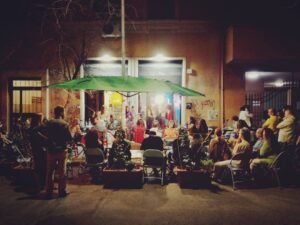
The second photo I recommend is less obvious and worth more than the first. It is the interior seen from the open door, from the street, with the cut of light that spills onto the sidewalk. It is the image that tells what a space like this does on a neighborhood street: it produces a patch of light and voices on a street that would otherwise be dark and silent. Technically it is an awkward shot, with a difficult dynamic range, and it is best to expose for the interior lights and let the sidewalk go into shadow.
Third photo, for those with patience: the knot of people on the sidewalk between one set and the next. It is the most honest photograph you can take of a circolo, because that is where you see the social function in action. Here, though, two rules of common sense are needed, and they are non-negotiable rules. The first: ask. A group in front of a space with a declared political identity is not scenery at your disposal, and there are a thousand legitimate reasons why someone may not want to end up in a public photograph. The second: if someone says no, the no counts, and there is no need to explain that it's for a blog.
What to avoid. Avoid flash inside, which is unpleasant for everyone and produces ugly images. Avoid photographing during a concert while holding your phone up for three minutes, because in a small room you are blocking the view of whoever is behind you. Avoid photos of documents, of flyers with names and contacts and of internal bulletin boards, which often contain personal information of people who did not ask to be published. They are minimal precautions that in these contexts make the difference between a welcome guest and a guest who is not invited back.
Last technical note for those who photograph seriously. This stretch of Via del Pigneto, with its low buildings and narrow sidewalks, has a quality of night light that the pedestrian part does not have: fewer signs, fewer reflections, longer and more readable shadows. Whoever looks for night street images in this quadrant does well to work here rather than in the heart of the evening stroll, where the overexposure of the shop windows flattens everything.
Some Important Events That Happened Here in History
The Birth of the Neighborhood
The first event is the formation of the urban fabric itself, between the end of the 19th century and the 1920s. The areas between the Casilina, the Prenestina and the railways fill up with small-scale building, largely built through self-promotion by the inhabitants themselves, often workers of the workshops and the railways. This is how a neighborhood is born that is neither consolidated city nor official borgata, with a physiognomy of its own that has withstood a century of transformations.
The second event concerns infrastructure. The narrow-gauge railway for the Castelli and for Fiuggi, opened in the first decades of the 20th century and surviving in the stretch of the Roma Giardinetti, gave the quadrant an elongated shape along the Casilina, with the settlements leaning on the stops. The stops Alessi, Ponte Casilino, Sant'Elena and Villini are still there, and their names work as an index of local history.
The War
The third event is the most dramatic. The summer of 1943 marked the whole eastern sector of the city: the bombing of July 19 hit San Lorenzo and the area of the rail yards, and the band along the lines, of which this quadrant is part, paid a heavy price for its closeness to the targets. Whoever walks today between the Casilina and the Prenestina crosses a fabric that still bears, in the discontinuities of the buildings and in the reconstructions, the mark of those months. San Lorenzo fuori le mura, a little farther north, also tells that story in a way evident to anyone who raises their eyes to the facade.
The postwar period brings the phase that produced the imagery of the neighborhood: the borgate, internal immigration from the South and the countryside, the cinema that comes looking here for the faces and voices the center no longer had. It is the season of Accattone and of all the literature and cinema derived from it, and it is the season in which the Pigneto enters Roman mythology.
The Years of Transformation
The fourth event is slow and has no date: it is the cultural transformation of the 1990s and 2000s, when the neighborhood becomes a hub of nightlife and of the independent scene. Venues open, circoli open, artists and students arrive, the pedestrianization of the central stretch consolidates the phenomenon. Within 20 years the Pigneto goes from a little-visited periphery to a destination, with everything this entails in terms of housing prices and conflicts between residents and people who come to go out.
The fifth event has a precise date: June 29, 2015, when the Pigneto station of metro C goes into service. It is the day the neighborhood is stably hooked to the heavy public transport network, and from that moment its accessibility from the center changes irreversibly. In the same year, in November, the circolo we are talking about opens. 2015 is, for the Pigneto, a hinge year.
The sixth event is still going on and concerns the works for the Roma Pigneto interchange railway station, with the demolition of the old bridge over the railway and the construction site that has marked for years the daily landscape of those who live here. In September 2026 the interchange is not yet operational. When it is, this part of the city will change again, and with it the public of its spaces will change.
And the History of This Space
Of the internal chronology of Sparwasser the certain and documented fact is the opening, in November 2015, as an Arci circolo with the footballer's surname on the sign and his silhouette in the logo. Everything that came after belongs to the ordinary life of a neighborhood space: seasons of programming, assemblies, concerts, the long interruption that between 2020 and 2021 hit all Italian circoli and the laborious restart that followed. I prefer to tell this part by categories rather than invent episodes, because a detailed chronology of a circolo cannot be reconstructed at a desk and those who were there know it better than anyone writing from outside.
It is worth adding a note of context on the decade just past. Between 2020 and 2022 the system of Italian circoli took the hardest blow of its recent history: prolonged closures, income wiped out, membership collapsed. Many spaces did not reopen. Those that made it almost always did so for the same reason, namely because the membership base kept paying for the card even when it could not use it. It is a detail that seems like bookkeeping and is instead the practical demonstration of what mutualism means.
Who Passed Through Sparwasser
First of all the most honest answer: the name that stands out on the sign belongs to a person who, as far as is known, never passed through this street. Jürgen Sparwasser has nothing to do with Rome, with the Pigneto and with Roman mutualism. The circolo chose his surname for what that surname means, not for any acquaintance. It is one of the things that make the choice even more interesting: it is a tribute from a distance, built on a sporting gesture that became a political symbol, and not on a personal acquaintance.
The second answer concerns the categories of people that a place like this goes through, and here I can be precise without inventing names. Through a space that holds together a bar, a social space, a music club and cultural programming pass in a season dozens of musicians from small and medium groups, DJs who work on selections and not on charts, authors presenting books that chain bookstores don't display, directors screening documentaries that television doesn't buy, and above all a very high number of people who live within 500 meters and who come in simply because they come in.
On this Roman scene a general observation holds that also concerns the nearby places, from the Fanfulla 5/a to the Wishlist Club: the small circuits are the first step of careers that then move elsewhere. Whoever plays today in the summer arenas of this city, 10 years ago was playing in a room of 50 people in a peripheral circolo, and in many cases comes back gladly for an off-format date. It is the reason why following the programming of small places is, for those who love live music, a better investment than following the big seasons.
Who Passed Through the Name, Instead
There is a second way to answer the question, and it concerns who has passed through the story the name carries with it. Here the references are documented and it is worth lining them up, because they form a small bibliography for those who get curious.
Francesco Piccolo cites Sparwasser several times in the first part of Il desiderio di essere come tutti, the Einaudi book that won the Premio Strega in 2014. It is probably the text that brought that surname to the ear of a generation of Italian readers who knew nothing about East German football, and it is one of the reasons why, in 2015, that name could work as a sign in Rome without being incomprehensible.
Federico Buffa and Federico Ferri told that World Cup in the series Storie Mondiali for Sky Sport, in the episode dedicated to 1974, released in 2014. In 2024 came the first Italian biography dedicated to the footballer, Sparwasser. L'eroe che tradì by Giovanni Tosco, published by Minerva edizioni. In Germany, in 2007, the director Franziska Meyer Price had made a television film built on a journey backward to the moment of that goal. The story also has a paragraph dedicated to it in Samba Mondiale by Luigi Guelpa and Gigi Cavone, from 2014.
Lined up, these titles tell a curious thing: between 2014 and 2024 the figure of Sparwasser returned to circulate in Italy with an insistence that it had not had in the previous 30 years. The Pigneto circolo opens in 2015, that is, in the middle of that resurgence of attention. There are no elements to say if it is a direct consequence, and nobody has declared a link. The chronological coincidence remains, which is significant anyway.
Nearby, If You Want to Build a Day Around It
The quadrant holds up very well for a whole day, and a whole day is the best way to arrive in the evening having understood where you are. Toward the center, the underground basilica of Porta Maggiore is one of the most enigmatic spaces of ancient Rome and is located at the exact point where the Casilina leaves the walls. A little farther north, San Lorenzo fuori le mura and the Verano cemetery make up a block of Roman and 20th-century history that is worth half a day on its own.
Toward the east and south, the Castagneto Prenestino and the Aqueducts Park give back the agrarian landscape that this periphery has devoured. The Casa della Cultura di Villa De Sanctis is the public cultural hub of the quadrant, while the Cittadini del Mondo intercultural library works on the same social ground on which, in its own way, a space that declares itself mutualist works.
For those who want to eat or shop in an interesting way, the Nuovo Mercato Esquilino is the most international market in the city and can be reached in a few minutes. For those who prefer industrial archaeology, the Centrale Montemartini puts ancient statues next to diesel engines and is, in our judgment, the most beautiful museum in Rome in terms of surprise relative to effort. In summer, the Casilino Urban Fest and the rooftop cinema of the Casilino Sky Park tell the outdoor version of the same neighborhood culture.
For the evening, if you want to widen the circuit without leaving the world of small places, Snodo Mandrione works on a railway and aqueduct landscape that is the other face of the same periphery, while those looking for jazz find different but complementary references in Alexanderplatz and the Casa del Jazz. They are separate worlds, but the people who cross them are often the same.
Frequently Asked Questions About Sparwasser
Where Is Sparwasser?
Sparwasser is at Via del Pigneto 215, postal code 00176, along the backbone of the Pigneto neighborhood, in the stretch where the street becomes drivable again after the central pedestrianized part.
What Is Sparwasser?
Sparwasser is a space for the production and enjoyment of sociality, culture and mutualism in East Rome, in the Pigneto, and not a simple venue with alternative aesthetics and the service of a bar. The mutualism declared in its presentation concretely changes the way the place works.
When Is the Best Time to Go to Sparwasser for the First Time?
To go to Sparwasser the first time it is best to avoid the weekend, when the Pigneto is full and in a crowded room you see only heads and hear only noise. Better a Tuesday or a Wednesday, possibly with something on the program but not the headline event of the season.
Is Sparwasser Open Every Day?
The opening hours of Sparwasser are not indicated in the available information: the programming changes with the seasons and assemblies are added to the calendar with a few days' notice. Before crossing half the city for a specific evening it is best to check the place's direct channels.
Where Does the Name Sparwasser Come From?
The name Sparwasser comes from Jürgen Sparwasser, a midfielder of 1. FC Magdeburg who on June 22, 1974 scored the goal that decided the only match ever played between the senior national teams of East Germany and West Germany, at the World Cup. The Pigneto circolo chose that surname for its meaning, not because Sparwasser ever came through Rome.
How Do You Get to Sparwasser?
Sparwasser is in the Pigneto, a neighborhood well connected to the rest of East Rome, with the underground basilica of Porta Maggiore at the point where Via Casilina leaves the walls, not far from the circolo. The available information does not specify the metro stop nearest to Via del Pigneto 215.
Before Leaving the House
Sparwasser is a neighborhood space, and neighborhood spaces live on cycles that do not go through press releases. The programming changes with the seasons, assemblies are added to the calendar with a few days' notice, hours adapt to what happens inside. Before crossing half the city for a specific evening it is always best to check the place's direct channels, exactly as you would for any other independent Roman address. It is the simplest way to avoid the closed door and, above all, to discover the initiative that appears in no public calendar.
Bring with you the willingness to get the card, which is the real key to entering this kind of place, and bring also the willingness to stay past the end of the event, because that is where the part worth having happens. If you are interested in the story the name carries with it, arrive having read something about that June 22 of 1974: the conversation that comes out of it, with someone who knows that story by heart, is the quickest way to stop being a stranger in a room.
If you are building a wider itinerary on Rome and Lazio and want to hold together the periphery told well with the center you already know, you will find useful material on ItalyPlanner, which works precisely on trip planning in Italy day by day. If instead you accompany groups for a living and need tools to build and manage them, the reference is TourLeaderPro. They are the two points where this same care for detail becomes a work tool instead of evening reading.
The street does the rest. Via del Pigneto 215, a German surname above the door, the silhouette of a midfielder who in 1974 silenced an entire stadium, and a neighborhood of East Rome that has practiced mutual aid for 120 years long before having a word to define it. Source
Contact Information
Via del Pigneto, 215
Roma Roma Città, Roma Città
Nearby
Upcoming events nearby
 RCC Special, Saverio Raimondo One Man Show at Maison Rosé, November 5, 2026100 m
- RCC Bananas, stand-up at Maison Rosé, November 8100 m
- RCC One Stand Up at Maison Rosé, November 22100 m
- Gelo, Comedy Happening with Saverio Raimondo at Maison Rosé, November 19, 2026100 m