Alvarado Street
Alvarado Street
Via Attilio Mori, 27
Rome
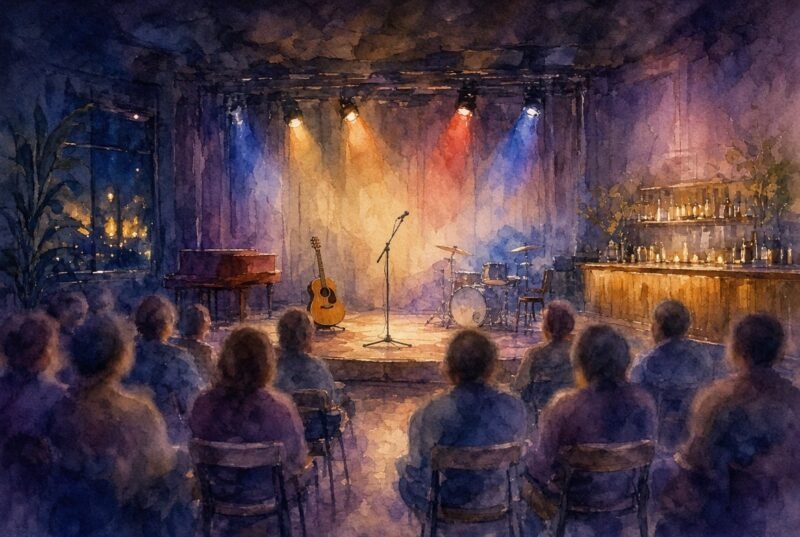
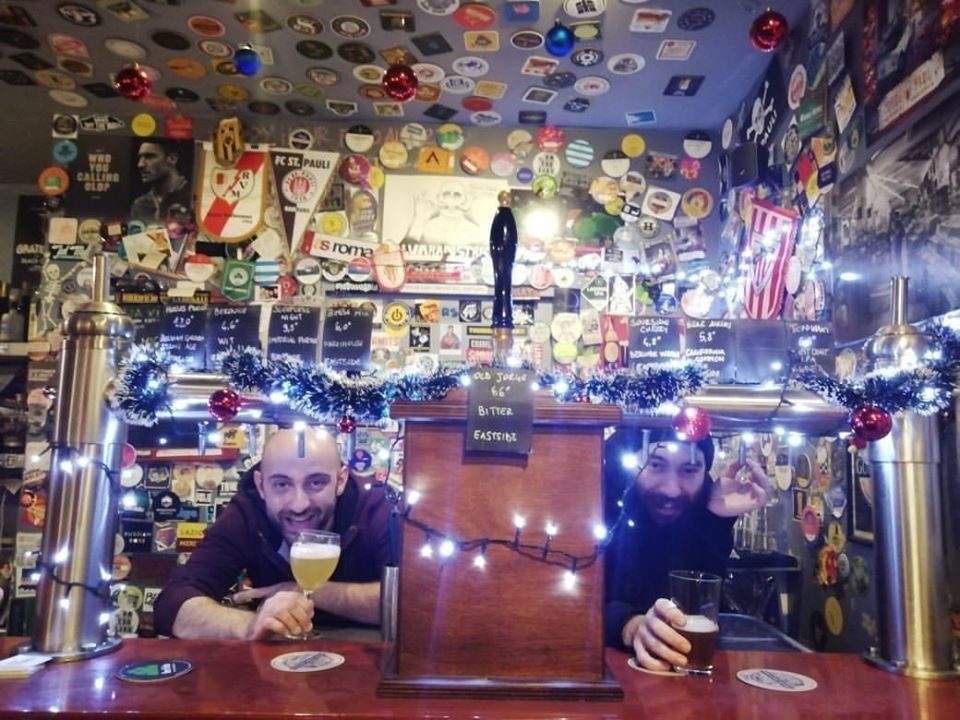
A place halfway between the English pub, with its quality beer and matches watched in company, and the small live club, with sets that range from punk to acoustic rock. They are two sides that most Roman venues keep separate: on one hand the places where you drink and watch the league, on the other the rooms where you play and listen. Here they live in the same room, which is why it's worth a few thousand words instead of being dismissed in one line.
We are on a side street off Via del Pigneto, about a hundred meters from the pedestrian stretch, inside that triangle of east Rome that everyone calls Pigneto and that the city offices classify within urban zone 6A Torpignattara. The administrative quarter is Q. VII Prenestino-Labicano, the municipio is V, the postal code is 00176. Via Casilina runs a few tens of meters to the south, Via Prenestina a few hundred meters to the north, and in between there are low apartment buildings, two-story villini and the narrow streets that made this part of the city iconic.
Below you'll find everything you need to understand where you're setting foot: what this place really is and how it works, what the street that hosts it looks like, the history of the quadrilateral around it, when it's best to arrive, what you see when you step out the door, and a long questions-and-answers section at the end for those who just want the bare information without reading everything else.
What Alvarado Street Really Is
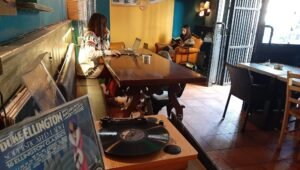
Let's start with the definition, because it's the part that creates the most misunderstandings. Alvarado Street is not a nightclub, not a theater, not a members-only club with a card required at the door, and not a dinner place either. It's a pub with a stage. The difference from an ordinary pub is that the stage is used for real, with a certain regularity, and the difference from a proper live club is that on nights without a concert the space goes back to being what it was: a place where you sit down, have a drink, talk and every now and then glance at a screen showing soccer.
This double nature has very concrete consequences for how you behave when you walk in. In a club the evening has a precise start time, a ticket, a line, a schedule. In a pub the evening has no start time: you arrive, you stay, you leave. Here the two patterns overlap, and the overlap explains almost everything that usually throws off first-timers, including the fact that the same room can look half empty at nine and packed to bursting at half past 11.
The Pub-with-a-Stage Formula
The formula is not a Roman invention. It was born in British and Irish pubs, where the concert at the back of the room is an old custom and not a special event: the band plays while people drink, those who want to listen listen, those who want to chat chat, and the musician works inside that noise instead of inside the religious silence of the concert hall. It's a school that has produced generations of bands able to hold a stage in difficult conditions, because playing for 30 distracted people is a much tougher training ground than playing for 300 paying, focused ones.
In Rome this formula took hold in waves. For long periods live music in small venues was squeezed by noise regulations, licensing constraints and competition from the centri sociali, which offered bigger spaces at lower costs. The places that held out did so by keeping the course steady on one point: the stage is not a decorative accessory, it's the reason the venue exists, and everything else, beer included, is there to keep it standing.
Why Soccer and Concerts Coexist So Well
It would seem like a short circuit: the crowd watching a match and the crowd listening to a punk band are, in the popular imagination, two different peoples. In neighborhood practice they aren't at all. They are often the same people at two different moments of the week, and above all they are people looking for the same thing, a place close to home where they can meet without making plans. The neighborhood makes the difference here: in an area of out-of-town students, workers with odd shifts, musicians, graphic designers, people who moved in recently and people whose families have lived here for three generations, the neighborhood venue works as a covered square.
In this scheme soccer serves a precise function: it fills the nights with no program. A Monday in November with no concerts, no DJs, nothing, is the night when a small venue risks losing money. A screen turned on and a league in progress turn that Monday into a normal night. It's management, not philosophy, and anyone who has tried to keep open a space with a capacity of a few dozen people knows that without those normal nights the special nights don't even arrive.
From Punk to Acoustic Rock: What It Means in Practice
The programming formula described in the listings is truly wide: it goes from punk to acoustic rock. Translated, it means that in the same week the stage can host a band with distorted guitars, drums and high volume, and two nights later a singer-songwriter with a single guitar and a microphone. It's not indecision. It's how small spaces work when they want to stay alive: the calendar gets filled with whatever is available, and what is available in a city like Rome is enormously varied.
Punk, in a venue for a few dozen people, sounds different from how you imagine it if you've only heard it at festivals. There is no distance between the band and the people watching, there is no barrier, often there isn't even a raised stage worthy of the name. The amplification is toned down compared to big spaces, because the walls are close and the room saturates quickly. The result is a compressed, direct sound, where you feel the drums physically before you even hear them acoustically. Acoustic rock, in the same room, has the opposite effect: closeness becomes intimacy, you hear the fingers on the strings, and the audience lowers its voice on its own, without anyone asking.
Capacity and Its Consequences
In venues of this kind capacity is the factor that determines everything else, and it's generally measured in tens of people, not hundreds. Three things follow from this that are worth knowing before you leave the house. The first: on concert nights, arriving late means standing at the back, or even in the doorway. The second: the relationship between those who play and those who listen is up close, so good manners matter more than elsewhere, and talking loudly during an acoustic set is much more annoying here than in a big hall. The third: the room changes temperature and acoustics with the number of people present, so much so that the same venue, with 40 people inside or with 15, literally seems like another place.
Where It Is: Via Attilio Mori and the Pigneto Triangle
Via Attilio Mori is a short, residential street that branches off the main axis of Pigneto. It's the kind of street you would never cross by chance: you get there because you're going to a specific place. The street naming in the area follows a recognizable criterion, with names tied to geography, cartography and earth sciences on the surrounding streets, a detail Romans rarely notice and which makes this grid more readable than it looks.
The administrative fact, the one you need when you look up the address on a map or when you have to explain to someone where you are, is this: we're in Municipio Roma V, in the Q. VII Prenestino-Labicano quarter, inside urban zone 6A, which bears the name of Torpignattara. Pigneto, in terms of official urban planning, is not an autonomous quarter: it's an urban area within that zone, and this explains why, depending on who is talking, the same address is described as Pigneto or as Torpignattara or as the Casilina area. Everyone is right, with different degrees of precision.
The Triangle: Prenestina, Casilina, Acqua Bullicante
The shape of Pigneto is an almost isosceles triangle. The three sides are Via Prenestina to the north, Via Casilina to the south and Via di Acqua Bullicante to the east. The three vertices are just as identifiable: Piazzale Labicano and Porta Maggiore to the west, Largo Preneste to the northeast, Piazza della Marranella to the southeast. Inside this triangle runs, zigzagging, Via del Pigneto, which starts a few hundred meters outside Porta Maggiore and arrives more or less halfway along Via di Acqua Bullicante.
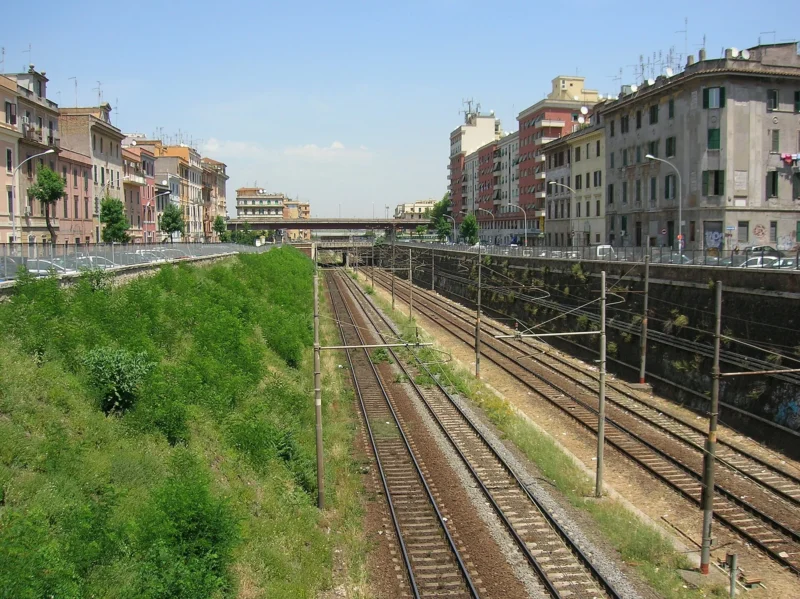
Once you get this geometry, the neighborhood suddenly becomes readable. The inner streets are narrow because they began as private lots between the two consular roads. The houses are low because they were built by private owners and small companies, one floor at a time, with terraced roofs precisely so they could add the next floor when the money allowed it. And the venues cluster along the central spine because that was, and has remained, the street where people pass.
Pedestrianization and Its Effects
The central stretch of Via del Pigneto has been a pedestrian zone since 2015, and the pedestrianization has clearly changed the commercial look of the area. Where there used to be cars double-parked there are now small tables, a market in the morning and strolling in the evening. For a venue like this one, which is on a side street and not on the pedestrian street, the effect is ambivalent: on one hand the evening flow increases, because people arrive in the area anyway and then spread out. On the other the competition gets denser, because within a radius of 200 meters there are dozens of signs.
This is also the reason a place on a side street has to have a precise identity to survive. Whoever opens a generic bar on a pedestrian street lives off passing traffic. Whoever opens a hundred meters from the pedestrian street lives off people who look for them. It's an enormous difference, and it explains why the venues on the side streets of Pigneto tend to be more characterized, more focused on one thing only, more like a community than a business.
What You Have Around You Within a Two-Minute Walk
Step out the door and walk just a little and you run into quite a few things. The nearest, on the same axis, is the row of venues and shops on Via del Pigneto, with wine bars, neighborhood kitchens, historic signs and new signs alternating at a quick pace. A bit farther on, toward Via Casilina, there is Villa Serventi, a 19th-century villa from 1860 that almost nobody notices because the surrounding wall hides it from the street. To the west, toward Porta Maggiore, there are the Tomb of Eurysaces, a monument from 30 BC dedicated to a baker and among the most curious pieces of Roman funerary architecture, and Porta Maggiore itself, from AD 52.
Right down below there, and this is one of the least known surprises of the area, is the underground basilica of Porta Maggiore, a building from the first century discovered by chance during railway works and attributed to a Neopythagorean cult. To the north, beyond Via Prenestina, there is the area of the former SNIA Viscosa factory, with its lake born from an excavation that hit the water table: one of the most extraordinary urban stories of east Rome, and a stone's throw from here.
The Neighborhood: A History That Starts Long Before the Venues
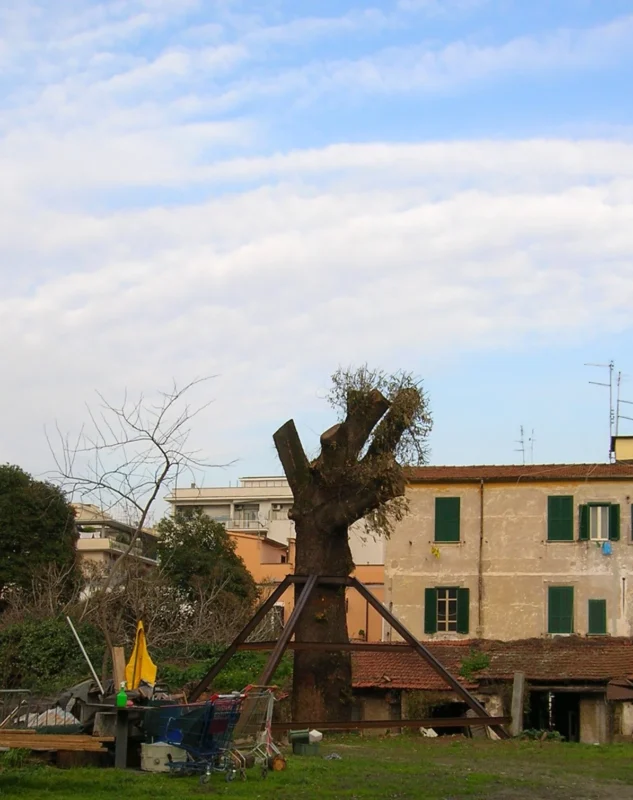
The temptation, with Pigneto, is to tell it as if it were born in the 2000s with the opening of the bars. It's an error of perspective that takes the meaning out of everything else, including the fact that a pub with a stage on a side street has a loyal audience. The neighborhood has a long and rather dense history, and knowing it changes the way you look at the street as you walk along it.
Before the Neighborhood: Vegetable Gardens, Vineyards and Villas
The place name Pigneto is attested as early as the 1600s, when the area was entirely suburban and consisted of vegetable gardens, villas and vineyards. There was no settlement: there were fields outside the walls, crossed by the two consular roads heading southeast. The name of Via Casilina is also recent: before the 1920s that road was called Via delle Vigne, because it crossed estates planted with vines. One of these, known as la Favorita, later took the name Villa Certosa because it originally belonged to the Carthusian monks.
Farther east, where Torpignattara is today, in the imperial age there stretched a vast suburban area that archaeologists have called the villa Ad Duas Lauros, that is, at the two laurels. The name appears in Tertullian, who, writing about the conspirators against the emperor, uses the rhetorical question Inter duas lauros obsident Caesarem, near the two laurels they lie in ambush for the emperor. In the same locality, in March 455, Emperor Valentinian III was assassinated while practicing archery in the parade ground of the imperial residence.
The Mausoleum That Gave Torpignattara Its Name
The monument that gives its name to the whole urban zone is the Mausoleum of Helena, built in the fourth century at the will of Constantine. The structure is an enormous concrete drum, and inside the conglomerate you can see terracotta amphorae set into the masonry to lighten the vault. Those amphorae, in Romanesco, are the pignatte: hence Torre delle pignatte, then Tor Pignattara, then Torpignattara. It's one of those folk etymologies that for once is also the right and documented one.
Helena's sarcophagus, in red porphyry, is no longer there: it is in the Vatican Museums, where it is one of the most imposing works in the collection. Next to the mausoleum open the Catacombs of Saints Marcellinus and Peter, one of the largest Christian cemetery complexes in Rome. The whole is included in the perimeter of the Ecomuseo Casilino ad Duas Lauros, the project that holds together, on paper and in part in practice too, the archaeological sites and the social memory of this urban sector. If you want to pair an evening with a daytime walk, the Casa della Cultura di Villa De Sanctis is in the park that surrounds that very mausoleum.
The Birth of the Working-Class Neighborhood
The first built-up cluster formed starting in 1870, from the union of scattered settlements: the Prenestino, the Torrione, the Galliano borgata, the Acqua Bullicante, the Marranella borgata, the Casilino, with Pigneto at the center. In Piazza Caballini, between 1886 and 1891, the Società Romana Tramways Omnibus built the first depot for omnibuses and horse-drawn trams constructed outside the Aurelian Walls. In 1904, with the electrification of the line, the depot became exclusively a tram depot. These are dates that tell what this area was better than any adjective: the point where the city ended and work began.
In the following decades industry arrived. The Pantanella pasta factory, born in 1871 as a grain-milling plant, expanded in the 1900s and stayed in operation until the 1970s, and was then turned into a residential complex in 2001. The Serono pharmaceutical institute was inaugurated on March 22, 1909, in the presence of its founder, the pharmacist chemist Cesare Serono, and today the building is a hotel. The CISA Viscosa factory, later SNIA Viscosa, produced rayon from 1923 to 1954. Houses were built around these factories, and around the houses everything else was born.
Self-Promoted Building, or How the Neighborhood Was Built
There is one aspect of local history that deserves more attention than it gets, because it explains the physical shape of the streets you walk on. The historian Stefania Ficacci has studied the phenomenon of self-promoted building: in Tor Pignattara and Pigneto, from the early 1900s, houses were built on the initiative of private individuals gathered in small companies or consortia, not by large firms or the State. Buildings of one or two floors, with a terraced roof to allow adding a floor in later years, when the money would be there.
Ficacci has also shown that after the Second World War this practice was confused with Roman illegal building, with the result of pinning on the neighborhood a historically false label, now as a borgata, now as an unauthorized area. It wasn't the same thing: it was a popular, incremental and largely regular model of construction, which produced exactly that fabric of low villini and narrow streets that is considered colorful today. By 1930 the local population already counted 30,000 residents.
The War, the Bombings, the Resistance
On July 19, 1943, at 11 a.m., the Allied bombing that hit San Lorenzo also hit this sector, at the Marranella and at Villa Certosa, damaging sewers and the water network. On August 13 of the same year, again at 11 a.m., came the second bombing, aimed at the railway lines toward southern Lazio: devastation on Via dei Savorgnan, on Via Angelo Bertola, on Via Giulio Buratti, bombs on Via dell'Acqua Bullicante, strafing on Via Casilina, tram tracks badly damaged. In Pigneto the bombings of 1943 and 1944 also caused the death of 50 employees of the tram company.
During the nine months of Nazi-Fascist occupation the strategic position of the area, straddling Via Casilina and right up against the railway line toward Cassino, put it at the center of the liberation struggle. Three main partisan formations operated here. The local section of the Associazione Nazionale Partigiani d'Italia, named after Giorgio Marincola, bears the name of an Italian-Somali partisan awarded the gold medal for military valor, and the fact that it is named jointly for Pigneto and Torpignattara says well how much the two areas are, in the perception of those who live there, one and the same.
The Neighborhood of Cinema
Pigneto has a documented and deep relationship with Italian cinema. Pier Paolo Pasolini chose it for his images of the Roman periphery and defined it with a formula that has remained famous, the crown of thorns that encircles the city of God. The low streets, the peeling walls, the osterie and the courtyards of this triangle entered the visual canon of neorealism and of what came after. Whoever walks today between Via Fanfulla da Lodi and the neighboring side streets moves inside a landscape that has been filmed many times.
The Cinema L'Aquila, on Via L'Aquila, was confiscated from the Banda della Magliana in 1996 and, after modernization works, has become a public place of the neighborhood again. In 2003, on December 20, the hideout of the new Red Brigades was found in a cellar on Via Raimondo Montecuccoli. They are two episodes very far from each other, but together they tell the double face of this area in the late 1900s: a working-class fabric crossed by heavy stories and capable, at the same time, of taking back its own spaces.
A Curiosity About Alvarado Street
The most immediate curiosity concerns the name, and it's worth tackling right away because it's the first question everybody asks. Alvarado Street is a Californian place name. An Alvarado Street exists in Los Angeles, in the MacArthur Park area, and it is one of the densest and most written-about arteries of the city. Another, very different, is the main street of the historic center of Monterey, the town on the Pacific coast tied to the literary memory of early 20th-century California. Which of the two inspired the sign of a side street in Pigneto, the sign doesn't say anywhere, and whoever chose it probably had the overall image in mind, that is, the America of streets with Spanish names, more than a specific street on a map.
The interesting thing, though, is something else: it's a name that works very well precisely here. In a neighborhood where the street naming is made of Italian geographers, cartographers and naturalists, a Californian name stuck on a door is exactly the kind of graft that Pigneto has been practicing for decades. It's the same mechanism by which a triangle of working-class houses built one floor at a time has become, without asking anyone's permission, one of the most international places in the city.
The Name and Roman Geography
There is also a small funny short circuit. On a street named for Attilio Mori, geographer and cartographer, a venue takes its name from a street 10,000 kilometers away. I know no detail better suited to describing this area: the scientific rigor of official street naming on one side, the imported imagery on the other, and neither of the two really winning over the other.
A Second-Level Curiosity: The Signs of Pigneto
If you walk the area paying attention to the names of the venues you notice a precise phenomenon: the names divide into three families. There are those that cite the neighborhood and its history, those that cite foreign places (America, South America, Eastern Europe, Japan) and those that mean nothing and only serve to sound good. The three families correspond roughly to three generations of openings, and by learning to recognize them you almost always understand, at a glance, if a sign has been in the neighborhood for 20 years or for two.
One Thing Nobody Tells You About Alvarado Street
What nobody tells you is that, in a pub with a stage of this size, the evening doesn't start when the concert starts: it starts much earlier, with the soundcheck. In a small space the soundcheck is not a moment reserved behind closed doors, as in theaters: it's a phase that takes place while the venue is already open and while someone is already sitting inside. If you arrive early you get a free dress rehearsal, you hear the band play whole songs without an audience, you see how the amplifiers are set up and you immediately understand what kind of evening it will be.
There's more: in small spaces the soundcheck is also the moment when the best listening position is decided. A room with close walls has spots where the sound arrives muddy and spots where it arrives clean, and they are almost never the ones you imagine. The worst spot, in most of these rooms, is the corner behind the stage, where everything booms. The best spot is usually two thirds of the way from the stage, slightly off to the side, where the two channels add up without canceling each other out.
The Second Thing Nobody Says: The Dynamic of Nights Without a Concert
The other thing nobody puts in the descriptions is that nights without a concert have a value of their own, and in some ways they describe the venue better than the peak nights. With no band on stage people talk, you hear recorded music, you understand who the regular crowd really is. Anyone who wants to get to know a place and not just see a show should stop by once on an ordinary night, maybe a weeknight: that's where you see if the venue has a community around it or lives only off its programming.
The Third: The Acoustics of Small Rooms Don't Forgive
In small rooms the concept of a comfortable volume doesn't exist. Either the band plays loud and the room saturates, or the band plays quietly and you hear every conversation at the bar. The balance point is very narrow and depends on how many people are inside, because bodies absorb high frequencies. That's why a set that seemed aggressive at 10 can seem perfectly calibrated at half past 11, when the room has filled up: the band hasn't changed, the room has.
The Fourth: The Threshold as a Social Place
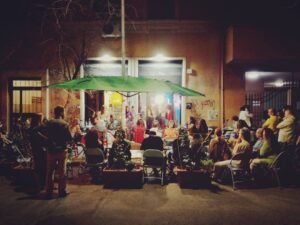
In the small venues of Pigneto the threshold, that is, the sidewalk in front of the door, is an integral part of the space. People go out to talk, meet, wait for each other. This comes with a responsibility that in Rome is often mentioned and less often respected: above the venues there are inhabited apartments, and in a neighborhood of low villini the distance between a knot of people talking loudly and a bedroom is a few meters. Coexistence between venues and residents is a real issue here, discussed at neighborhood meetings for years, and those who frequent these places are part of the equation as much as those who run them.
My Advice for Visiting Alvarado Street
The main advice is one and it's not about the venue but about how to get there: come on foot and come with some time to spare. Pigneto is crossed on foot, and the difference between arriving here by car after looking for parking for 20 minutes and arriving on foot from Porta Maggiore or from the metro station is a difference in mood, besides time. Parking on the side streets is complicated at any hour of the evening, the streets are narrow, many are one-way and double-parked cars are a local classic that it's best not to add to.
How to Get There Without Losing Your Mind
The area is served by Pigneto station on metro line C, by the surface lines running on Via Prenestina and Via Casilina, and by the tram that goes up along Via Prenestina toward Porta Maggiore. From Termini you get there in a few minutes with several different combinations. If you're coming from the historic center, the walk from Porta Maggiore is a little over a kilometer and passes, in order, the Tomb of Eurysaces, the initial stretch of Via del Pigneto and finally the side streets. It's a walk worth doing at least once in the light of sunset.
When to Go
For a first time I recommend a weeknight, ideally with one of the acoustic concerts on the program. The reason is simple: on peak nights the room is full and the first impression risks being just a mass of people. On a calmer night you see the venue for what it is, you talk with the people who work there, you understand the logistics of the space, and by the second visit, the one on the full night, you already know where to stand.
For the season the reasoning is the opposite of the one you apply to Rome in general. The Roman summer pushes everyone outdoors, and indoor venues in July and August have difficult months, with part of the programming moving to the arenas and the festivals. The best months for live music in small spaces are October to May, when the calendars fill up and the closed room stops being a disadvantage and becomes the right place.
What to Bring
Cash, because even where cards are accepted on a crowded night the line at the bar moves better with cash. Comfortable shoes, because on concert nights you stand for a long time. And a minimum of tolerance for volume, which in a small room is always louder than your ear expects. If you're sensitive to noise, discreet earplugs completely change the experience of a punk concert in a small space: they take nothing away from the music and take a lot away from the next day's headache.
The Uncomfortable Advice
And then there's the advice nobody gives because it seems trivial: if you go to hear a band you don't know, stay until the end. In small venues the audience tends to trickle out after three songs, and for someone playing in front of 30 people the difference between 30 and 12 is enormous. Staying is the cheapest thing you can do to keep alive a circuit that, in Rome, has thinned out quite a lot over the last 20 years.
Another Well-Known Fact, Yet Rarely Cited
The well-known fact is that Pigneto is the neighborhood of Roman nightlife in the east, the one of bars, concerts, evenings out. Everybody knows it, everybody writes it, and in fact you only have to walk 50 meters to see it. What almost nobody adds, though it's perfectly documented, is that Pigneto doesn't exist as an autonomous administrative entity: it's an urban area within urban zone 6A, which is called Torpignattara. The address of Via Attilio Mori, for the municipal registry, is inside Torpignattara, and the official quarter is Prenestino-Labicano.
It seems a bureaucratic detail and yet it changes quite a lot how you read the place. It means that the separation between the Pigneto told by the guidebooks and the Torpignattara told by the crime pages is a recent construction, built through articles, rent prices and perception. On the ground, for those who live there, the border between the two areas is a line nobody can trace precisely: you go from one side to the other by crossing a street, and the shops, schools, buses and markets are the same.
Why the Distinction Really Matters
It matters because it's at the root of the phenomenon that anyone who frequents the area notices right away: the mix. In a few blocks live side by side the families who have lived here for three generations, the Bangladeshi community that has opened shops along Via Casilina and the side streets, the Sapienza students looking for affordable rents, the cultural workers who moved from the center when the center became unreachable. A venue with a stage, in a context like this, is not a style operation: it's a service, and it's used as such.
It also matters for a more prosaic reason. When you look up the address on a map, or when you book a ride, the name that shows up may be one or the other, and more than one person has lost 20 minutes because the navigation took them to the opposite end of the urban zone. The safe reference is always the same: Via del Pigneto, central stretch, and from there the side street.
The Second Rarely Cited Fact: The Shape of the Houses
There is another element that goes unmentioned and yet is visible to the naked eye. The low houses with terraces, the external staircases, the inner courtyards you glimpse through open doorways are neither a rural leftover nor a case of illegal building: they are the product of a precise model, self-promoted building in the first decades of the 1900s, with families and small consortia building one floor at a time and leaving the roof flat so they could add another. The neighborhood that today gets photographed as colorful is in reality an open-air archive of how a Roman periphery was built without money and without big companies.
The Right Photo to Take at Alvarado Street
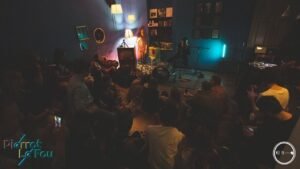
The right photo is not the one of the sign. The sign is the photo everybody takes, it always comes out the same, and on a narrow side street with little light it also comes out badly. The right photo, in a place like this, is the one you take from inside looking toward the stage, at the eye level of those listening, with the heads of the audience in the foreground and the band in the background. It's the only framing that captures the most important fact about these spaces: the minimal distance between those who play and those who watch.
How to Do It Without Ruining the Night for Others
Three practical rules, and they are rules of coexistence before technique. No flash: in a small room the flash hits the face of the performers, and the face of everybody else. No phone raised above your head for entire songs: the person behind you paid, or at any rate came to watch, not to look at a screen. And no long recordings: 10 seconds capture the atmosphere better than four minutes nobody will ever watch again.
The Settings, If You Have a Camera in Hand
The light on small stages is scarce, colored and moving. With a DSLR or a mirrorless it's best to work wide open, with high sensitivity, and to accept digital noise instead of chasing clean images that don't exist in that light. Autofocus struggles on backlit faces: if you can, focus on the microphone or on the edge of a guitar, which have sharp outlines. With a phone, the trick is to turn off night mode, which lengthens the exposure times and turns every movement into a streak.
The Alternative Photo: The Street
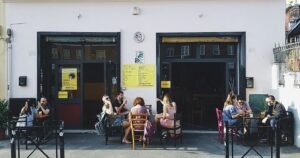
If you're looking for an image that tells the context and not the night, go outside and photograph the side street from the intersection, with the row of low villini, the scooters lined up and the light of the streetlamps. It's the Rome that never appears on postcards and yet defines the historic periphery better than any monument. Going another 200 meters, the pedestrian zone of Via del Pigneto at night offers another kind of photograph, more crowded and softer, with the lit shop windows and the small tables.
The Historic Photo Nobody Thinks of Taking
A few hundred meters away, toward Porta Maggiore, is the Tomb of Eurysaces, the tomb of a baker of the first century BC decorated with cylinders that represent kneading machines. It's one of the strangest funerary monuments in Rome, it celebrates a trade instead of a public office, and at sunset, with the low light coming in between the arches of Porta Maggiore, it gives remarkable images. An evening in a pub with a stage and a photograph of a Roman baker from 2,000 years ago are, when you think about it, a perfectly coherent pairing with this piece of the city.
Some Important Events That Happened Here in History
The venue is recent, the place is not. Within a radius of a few hundred meters from Via Attilio Mori a number of events have taken place that left a mark on the city's history, and it's worth listing them in chronological order because, put in a row, they tell a periphery that had very little peripheral about it.
The Roman Age
The first is the construction, in the first century BC, of the Tomb of Eurysaces at Piazzale Labicano, at the point where the roads to the southeast converged. In AD 52 Emperor Claudius had Porta Maggiore built, which is actually a monumental double arch of the Claudio and Aniene Nuovo aqueducts, later turned into a city gate by the Aurelian Walls. Also in the first century, below street level, the Neopythagorean underground basilica was built, discovered only in 1917 during railway works: a hypogeal building decorated with stucco, unique of its kind.
In the fourth century Constantine chose this area, at the third mile of Via Labicana, for the basilica dedicated to Saints Marcellinus and Peter and for the mausoleum intended for himself and then used for his mother Helena. The mausoleum is the monument that gave Torpignattara its name, and its construction involved the destruction of the camps of the equites singulares, the cavalry corps that had stayed loyal to Maxentius. In March 455, not far away, Emperor Valentinian III was assassinated.
The 1800s and the Birth of the Neighborhood
In 1860 Villa Serventi was built, on Via Casilina, and the building still exists. Starting in 1870 the residential cores that would form the neighborhood began to aggregate. In 1871 the grain-milling plant that would become the Pantanella pasta factory opened. Between 1886 and 1891 the Società Romana Tramways Omnibus built in Piazza Caballini the first depot for omnibuses and horse-drawn trams outside the Aurelian Walls, electrified in 1904. In the 1880s, a little farther east, the landowner Anna Maria Caracciolo called a family of sharecroppers from the Marche to farm her property along Via Casilina, and in 1884 officials of the Ministry of Agriculture classified that estate as the best run farm in Rome.
The Industrial 1900s
On March 22, 1909 the Serono pharmaceutical institute was inaugurated, in the presence of its founder Cesare Serono and of the municipal authorities. In 1916 the single-track tram line arrived, running from Termini to Tor Pignattara along Via Casilina. In 1917 the Due Allori cinema opened. In 1923 the CISA Viscosa, later SNIA Viscosa, began producing rayon, and it would close in 1954. In 1924 Istituto Autonomo per le Case Popolari built Complesso Casilino I to a design by Innocenzo Costantini, 76 apartments between Via Galeazzo Alessi and Via Casilina. Around 1928 the subdivision of Villa Certosa estate into small lots gave life to the Borghetto degli Angeli. In 1929 and 1930 Giovanni Michelucci designed Villa Valiani, at the intersection of Via Conte di Carmagnola and Via Romanello da Forlì. In 1930 the residents were already 30,000 and the Mille Vani complex was built. In 1938 the Michelazzi school, today Pisacane, and the Impero cinema opened, the latter designed by Mario Messina.
The War
On July 19, 1943, at 11 a.m., the first Allied bombing of Rome also hit this sector, at the Marranella and at Villa Certosa. On August 13, 1943, again at 11, the second bombing devastated the homes on Via dei Savorgnan, Via Angelo Bertola and Via Giulio Buratti, hit the convent of the Sisters of Our Lady of Namur, fell on Via dell'Acqua Bullicante and strafed Via Casilina, badly damaging the tram tracks. The bombings of 1943 and 1944 cost the lives of 50 employees of the municipal tram company. During the nine months of Nazi-Fascist occupation, with Via Casilina as a direct route to the Cassino front, the neighborhood was one of the centers of the Roman Resistance, with three main partisan formations active in the area.
The Postwar Period and the City Today
In 1950 the Pantanella pasta factory was rebuilt after war damage, only to be abandoned in the 1970s and turned into a residential complex in 2001. In 1996 the Cinema L'Aquila was confiscated from the Banda della Magliana, and after years of works it has returned to the city. On December 20, 2003, in a cellar on Via Raimondo Montecuccoli, the hideout of the new Red Brigades was identified. In 2010 the former Serono plant became a hotel. In 2015 the pedestrian zone of Via del Pigneto came into operation, changing the commercial life of the area. In the following years the construction sites of metro line C and the rebuilding of the bridge over the railway reworked the geography of the area, with all the inconvenience that implies and with a result that made the area much easier to reach than it was.
Who Has Played at Alvarado Street
The honest answer to this question, for a neighborhood pub with a stage, is not a list of famous names: it's a description of categories of people, and they are much more interesting than they seem. A place like this sees bands at their first real concert, the ones who have recorded four tracks and need to find out if they can hold an audience that isn't made of friends. It sees the long-running bands who play on weekends and work the rest of the week, who are the backbone of any music scene in any city in the world. It sees singer-songwriters with a guitar, who in a small room find the only context where a lyric is really heard.
And then the neighborhood comes through, which is the part that counts most. The residents of the side streets, the out-of-town students, the sound technicians who work in theaters by day and come to listen in the evening, the bands' friends, the neighbors who come in for a beer and stay because there's music. This is the reason it's worth defending spaces with a few dozen seats: they are the only place where all these people find themselves in the same room, with no ticket-office hierarchies.
The Chain of Small Venues
To understand the role of a place like this it helps to look at the whole chain of Roman live music. At the base there are rehearsal rooms and pubs with a stage, where a band plays its first 10 concerts. At the next level there are the real clubs, with a ticket, a sound system and a capacity of a few hundred people. Above that there are theaters and big arenas. Nobody reaches the third level without passing through the first, and when the first level thins out, as has happened in Rome in more than one period, it's not the venues that lose out: it's the generations of musicians left without a training ground.
In Rome the upper part of the chain is well visible: there is Atlantico in EUR, there is Largo Venue in the Prenestina area, there is Monk in Portonaccio, there is Wishlist Club, there is the historic Piper, there is the big summer umbrella of Rock in Roma. Beneath this visible part there is a network of pubs with a stage, social clubs and spaces for a few dozen people that almost never ends up on the lists, and that is exactly the terrain this venue moves in.
Punk in Rome as a Historical Phenomenon
It's worth spending a couple of words on the genre that appears first in the description. Punk arrived in Italy in the late 1970s and found a particular terrain in the big cities: less tied to the record industry than in the Anglo-Saxon world, much more intertwined with self-managed spaces, shared rehearsal rooms, tiny labels, photocopied fanzines. In Rome this intertwining was especially strong, because the city had and has a fabric of centri sociali and clubs that for decades acted as an alternative infrastructure to commercial venues.
The consequence is that in Rome punk never became just a musical genre: it also remained a way of organizing nights, with low or symbolic fees, pay-what-you-want entry, bare-bones tech and a direct relationship between those who play and those who listen. When today a pub with a stage programs a punk night in a room for a few dozen people, it applies a model that in this city has 40 years of history behind it, and that has come through trends, crises and generational changes unscathed.
Acoustic Rock, the Other Half of the Bill
At the opposite end of the programming is the acoustic set, which in small spaces is by far the most common format for a mundane reason: it costs less, takes up less space, doesn't fight with the neighbors. It's also the most merciless format, because without volume there's nowhere to hide: you hear every mistake, every word of the lyric, every uncertainty. The singer-songwriters who cut their teeth in these rooms learn to manage silence, which is the hardest skill to acquire for anyone who steps on a stage.
The Neighborhood Around: What to Do Before and After
An evening here works better if you fit it into a route, because the area has quite a lot to offer within walking distance.
In the Afternoon
The market on Via del Pigneto, on the pedestrian stretch, runs in the morning and in the first hours of the afternoon, and it's one of the liveliest street markets in the city, with historic stalls and stalls run by the communities that live in the area. Toward Via Casilina you come to Villa Serventi. Toward Porta Maggiore you reach the Tomb of Eurysaces and the underground basilica. To the north, beyond Via Prenestina, the area of the former SNIA Viscosa preserves the industrial shed and above all the lake formed in the 1990s when an excavation hit the water table, which has meanwhile become a natural area defended by the neighborhood. Farther east, inside the park that surrounds the Mausoleum of Helena, the Casa della Cultura organizes activities for the neighborhood.
For Dinner
The area has a very high and very varied density of kitchens, from Roman trattorie that survived gentrification to Bangladeshi kitchens along Via Casilina, from pizza by the slice places to new-generation spots. It's one of the few parts of Rome where you eat well at reasonable prices without having to book weeks ahead, at least on weekdays.
Afterward
If the night continues, the area offers other venues within 200 meters, and the night transport network along the consular roads works better than you'd think. Night bus lines cover Via Casilina and Via Prenestina, and Termini is the hub where everything converges.
Practical Information
Address and Landmarks
The address is Via Attilio Mori 27, in Rome, postal code 00176, Municipio V. The easiest landmark for finding your way is the pedestrian stretch of Via del Pigneto, from which the side street is reachable on foot in a couple of minutes. The collaborative mapping of OpenStreetMap records the venue with an on-site check dated late August 2026, with wi-fi and payment accepted in cash and by card.
Hours
The listing on zero.eu, which is the reference source for this venue, indicates evening opening every day of the week, from 18:00 on. Venue hours change with the seasons and with the programming, so for a specific night it's always best to check the venue's channels, starting with its Facebook page, before leaving the house.
Entry and Reservations
In pubs with a stage, access to music nights works in different ways depending on the type of concert and the agreements with the bands. Some nights are free entry, others involve a contribution for the performers, others still require a membership card if the organizing body is a club. There is no single rule, and it's information that has to be asked case by case when you're looking for a specific night.
Accessibility
The historic venues on the side streets of Pigneto generally occupy the ground floors of early 1900s buildings, with thresholds, steps and narrow spaces. Those with specific accessibility needs do well to ask in advance what the entrance is like and where the restrooms are, because the layout of these spaces varies enormously from one street number to the next.
Noise and the Neighborhood
One last practical note, which is also a matter of respect: when you leave the venue, especially after midnight, you are on a residential street with inhabited apartments a few meters away. Lowering your voice on the sidewalk is the difference between a neighborhood that coexists with its venues and a neighborhood that asks to close them.
Frequently Asked Questions About Alvarado Street
Where Exactly Is It
At Via Attilio Mori 27, a side street in the central part of Pigneto, in east Rome. Administratively it falls within the urban zone of Torpignattara, Prenestino-Labicano quarter, Municipio V.
Is It in Pigneto or in Torpignattara
Both answers are correct. Common perception places it in Pigneto, the city's urban planning classification places it in zone 6A Torpignattara, which contains the whole Pigneto area.
What Kind of Venue Is It
A pub with a stage: a beer hall and meeting place on ordinary nights, a small concert space when a band is on the program. The industry listings classify it together with pubs, clubs and music clubs, which describes its double nature well.
What Music Do You Hear
The official description speaks of sets ranging from punk to acoustic rock, so a wide range within the rock area, with electric lineups and stripped-down lineups.
Is It Still Open
The most recent mapping data report an on-site survey carried out in late August 2026, so just a few days from today, and the zero.eu listing remains published with hours and contacts. For a single evening, the venue's own channels remain the reference.
What Are the Hours
The source listing indicates daily evening opening starting at 18:00. Actual hours may vary depending on the season and the programming.
Do You Pay for Entry
It depends on the night. In venues of this kind, free entry, contributions for the bands and membership cards alternate. It's best to find out about the specific night.
Can You Reserve a Table
In pubs with a stage, reservations, when they exist, concern tables on nights without a concert. On music nights the space in front of the stage works standing and with no assigned seats.
How Big Is It
It's a small space, in the order of a few dozen people. Don't expect the size of a club: closeness to the stage is the main feature.
Can You Eat
The vocation is that of a pub, so the food, where present, goes with the evening and doesn't replace it. The neighborhood around offers every kind of cuisine a few steps away.
Are Cards Accepted
The most recent mapping data indicate that cash, credit cards and debit cards are accepted. On crowded nights cash is still the fastest way at the bar.
Is There Wi-Fi
The same mapping sources report the presence of a wireless connection.
Can You Watch Matches
The venue's historical description explicitly mentions soccer viewings as part of the identity of the place, alongside quality beer and concerts.
How to Get There by Public Transport
The area is served by Pigneto station on metro line C, by the surface lines on Via Casilina and Via Prenestina and by the tram along Via Prenestina. From Termini the trip is short with several combinations.
Is There Parking
Little and badly, as everywhere in Pigneto. The side streets are narrow, often one-way, and illegally parked cars are a daily problem for residents. Better to arrive by public transport or on foot.
Is It Suitable for Those Who Don't Know the Genre
Yes, and in fact small spaces are the best place to discover music you don't know, because you don't need to invest in tickets and because you can walk in and out without ceremony.
Can You Bring Children
An evening pub with concerts is not a setting designed for little ones, especially because of the volume levels on live music nights. For daytime and family activities the neighborhood offers parks and cultural spaces.
When Is the Best Time to Go the First Time
A weeknight, ideally with an acoustic set on the program: the room is calmer and you understand the place better.
What Time Does the Music Start
In spaces of this type concerts usually start late in the evening, after the venue has filled up. Arriving early lets you watch the soundcheck and choose where to stand.
How Long Does a Concert Last
A set in a pub with a stage generally lasts between 40 minutes and an hour and a half, sometimes with two bands on the program in the same evening.
Is It Loud
On concert nights yes, and in a small room the perceived volume is higher than in a big hall. Those sensitive to noise find relief with discreet earplugs.
Can You Catch Just Part of the Evening
Yes, the pub format allows it. The fact remains that for those playing in front of a few dozen people, the audience staying until the end makes an enormous difference.
What Is There to See in the Surroundings
The Tomb of Eurysaces, Porta Maggiore and the underground basilica to the west, Villa Serventi toward Via Casilina, the area of the former SNIA Viscosa with its lake to the north, and the Mausoleum of Helena and the park around it to the east.
Is the Neighborhood Safe at Night
Pigneto at night is very busy and well lit along the main routes, with the precautions that apply in any nightlife area of a big city: watch your belongings and the deserted side streets late at night.
Where Does the Name Come From
Alvarado Street is a Californian place name, found both in Los Angeles and in Monterey. The venue doesn't publish an official explanation of the choice.
Where Do I Find the Updated Program
On the venue's channels, starting with the Facebook page Alvarado Street, and on the listings of the city portals dedicated to Rome's venues.
Before You Leave the House
A place like this is a piece of the city that works only if someone passes through it. An evening at a concert in a room for a few dozen people, on a side street of a working-class neighborhood built one floor at a time a hundred years ago, is worth much more than it costs, and it's the kind of experience no standard tourist itinerary will ever offer you.
If you're planning a visit to Rome and want to build a route that doesn't end only in the historic center, the right tools exist: for custom itineraries and for organizing trips in Italy a useful reference is Tour Leader Pro, which works on the operational side of groups and accompaniment, while for day-by-day planning in English the reference guide is Italy Planner. They are two complementary tools: the first helps line up the logistics, the second to understand how many days you really need for each city and how to fit neighborhoods like this one into a broader trip. For those arriving from outside Italy who want a general guide to the city, the Rome section of Italy Planner remains the most convenient starting point, and those who organize groups find on Tour Leader Pro the practical side of the trade.
Then you go out, take Via Casilina, turn into the side street and go in. The stage does the rest.
Contact Information
Via Attilio Mori, 27
Roma Roma Città, Roma Città
Nearby
Upcoming events nearby
 Libertà da…, libertà di… Autogenic Training at Entrature, October 19 to December 17, 2026100 m
- What Is Dramaturgy? Encounters Between Text and Stage with Attilio Scarpellini, October 20 to December 13, 2026100 m
- Officina Pigneto at Biblioteca Mameli and Nuovo Cinema Aquila, April 2 to December 31, 2026300 m
- Prima di ogni cosa. Per un futuro Crip, book presentation at Libreria Tuba, November 4, 2026300 m