What Is Dramaturgy? Encounters Between Text and Stage with Attilio Scarpellini, October 20 to December 13, 2026
In short. What Is Dramaturgy? Encounters Between Text and Stage is the workshop led by Attilio Scarpellini within the Entrature > libere 2026 program of the association Tuttoteatro.com, in three stages: Tuesday, October 20, Wednesday, October 21…
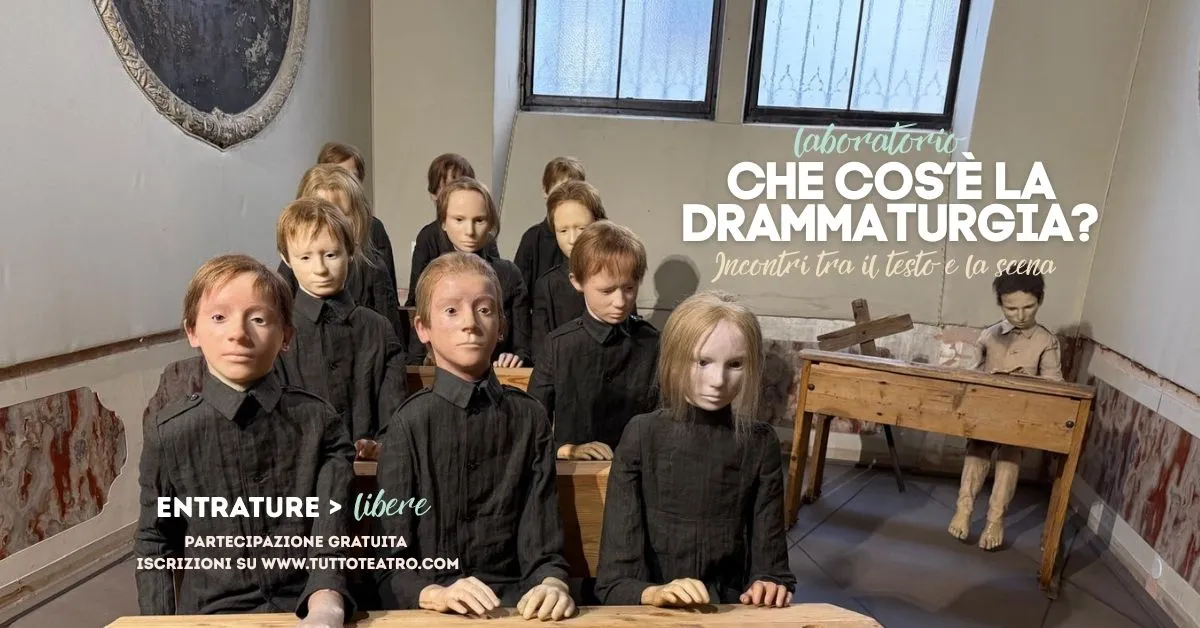
What Is Dramaturgy? Encounters Between Text and Stage is the workshop led by Attilio Scarpellini within the Entrature > libere 2026 program of the association Tuttoteatro.com, in three stages: Tuesday, October 20, Wednesday, October 21 and Thursday, October 22, 2026, from 16:30 to 18:30, at the operating base of Tuttoteatro.com > Entrature at Via Campobasso 9/a, in Pigneto. Monday, November 23, Tuesday, November 24 and Wednesday, November 25, 2026, same time, at Spazio Celestino at Via di Tor Pignattara 169. And on Sunday, December 13, 2026 at 21:00 a public opening at the Casa del Quartiere of Municipio VII, at Via del Fosso di Gregna 4. Via Campobasso venue is reached by metro C, Pigneto stop, or by buses 105, 412, 81 and the night bus N11, and by regional trains FL1, FL3 and FL5. For Spazio Celestino the most convenient metro C stop is Malatesta, with buses 105L, 409 and 558. For the Casa del Quartiere, the terminus of metro A, Anagnina, and buses 502, 503, 533 and 654. Participation is free: to sign up you send a simple résumé, without a photo, to laboratori@tuttoteatro.com. Places range from a minimum of six to a maximum of 12, and at least half the group must be between 18 and 35. The full program is on the official site tuttoteatro.com/entrature.
Language: performed in Italian. No English version or English surtitles are announced.
A theater critic who teaches actors to write for the stage: the formula alone says a lot. In a city where acting workshops number in the hundreds and playwriting ones can be counted on the fingers, a free, limited-enrollment course, led by one of the best-known voices of Roman criticism and built on a theoretical text by Joël Pommerat, is a rare opportunity. Anyone who acts and has a script in a drawer, or wants to stop being merely the executor of other people's words, should write to the organizers right away.
What Is Dramaturgy? The workshop at a glance
What Is Dramaturgy? is a free workshop for actresses and actors, in training or already trained, divided into two blocks of three afternoons each, October and November 2026, with a public opening on December 13. It is led by Attilio Scarpellini, critic, writer, radio author and dramaturg.
The two parts of the work
The official presentation divides the course into two moments. The first is study: reading and discussing the theoretical text by the French playwright and director Joël Pommerat, Théâtres en présence, translated into Italian as Teatri in presenza, whose translation is sent to participants before the start. The second is practical: short writing experiments and the related stagings, carried out by the working group. You start, then, from reflection and arrive at the stage, with the actors' bodies testing what the pen has written.
Who it's for
The workshop is aimed at actresses and actors, in particular those who intend or plan to add playwriting to acting, or who want to make an authorial contribution to the interpretation of other people's texts. It's an important clarification: you don't need to be a playwright already, you need the curiosity to look at the text from the other side, that of the person who builds it.
The time between one block and the other
A month passes between the October block and the November one. The organizers say it plainly: in that interval participants will have time to develop or improve their texts. It's a methodological choice that distinguishes this course from an intensive seminar. Writing needs to settle, and a month of personal work, with the October discussions fresh in mind, is worth more than three more days of lessons.
The group
The number of participants ranges from six to 12. At least half the group must be made up of people between 18 and 35: a rule that comes from the public call that supports the project and that guarantees a mixed group, where young actors and more experienced performers work together. In a writing workshop, the difference in generations is a richness: references change, rhythms change, even the way of understanding dialogue.
The calendar of What Is Dramaturgy?, stage by stage
The calendar of What Is Dramaturgy? provides seven meetings in three different venues: three afternoons in October in Pigneto, three afternoons in November in Tor Pignattara, one evening open to the public in December at Osteria del Curato.
October: Via Campobasso
Tuesday, October 20, Wednesday, October 21 and Thursday, October 22, 2026, from 16:30 to 18:30, at the operating base of Tuttoteatro.com > Entrature, at Via Campobasso 9/a. It was the study phase: the reading of Pommerat, the discussion, the first exercises. Two hours a day for three days in a row is the right time to enter a theoretical text without being overwhelmed by it.
November: Spazio Celestino
Monday, November 23, Tuesday, November 24 and Wednesday, November 25, 2026, again from 16:30 to 18:30, at Spazio Celestino at Via di Tor Pignattara 169. Here the work becomes practical: the texts written or revised during the month's pause are tried out on stage by the group. The change of venue is no accident: the Entrature project takes workshops to the neighborhoods, and Spazio Celestino is a cultural center designed for theater and rehearsals too.
December: the public opening
On Sunday, December 13, 2026 at 21:00, at the Casa del Quartiere of Municipio VII, at Via del Fosso di Gregna 4, a public opening is planned. It's the only meeting of the course that can be attended by someone who isn't taking the workshop: the moment when two months of work are shown to an audience. The same date closes the entire Entrature > libere 2026 program.
Times and punctuality
Two hours of workshop pass quickly, especially when you work on stage. Latecomers force the group to start the explanations again. It's best to show up 10 minutes early, especially in the first week, when the venue is still unfamiliar.
How to sign up for What Is Dramaturgy?
Signing up for What Is Dramaturgy? is free and is done by sending a simple résumé, without a photo, to laboratori@tuttoteatro.com. For information the organizers also give the number 347 0444624.
The résumé without a photo
The request for a résumé without a photograph is a detail worth attention. In the world of auditions the image often counts as much as the experience. Here you're asked to present yourself with your path, training and shows done. It's consistent with the nature of the workshop: you're not selecting a face for a role, you're putting together a writing group. Write a few clear lines, state your age, because half the places are reserved for people between 18 and 35, and mention any writing experience, even small.
Limited places
At most 12 places, with a quota reserved for under-35s, means the group forms quickly. The workshop began on October 20. Anyone interested who hasn't signed up yet should write to the organizers right away: they put the group together and send participants the translation of Pommerat's text.
Who Attilio Scarpellini is, the workshop leader
Attilio Scarpellini is a theater critic, writer, radio author and dramaturg. Since 2010 he has hosted the program Qui Comincia on Radio 3 Rai, and from 2011 to 2014 he directed the Quaderni del Teatro di Roma. The biography published by Tuttoteatro.com tells of a path that holds together criticism, teaching, writing and directing.
Training between Rome and Paris
Scarpellini graduated in Political Science and obtained the Licence de Philosophie at the University of Paris I. He was a Cnr fellow at the École Pratique des Hautes Études en Sciences Sociales in Paris. The twofold training, political and philosophical, and the tie with France explain much of his attention to contemporary French dramaturgy, and therefore also the choice of Pommerat as the workshop's starting text.
Criticism in the newspapers
He began writing about theater in the weekly Diario, then in the magazine Carta and in the Rome pages of the daily L'Unità. Between 2006 and 2009 he was among the founders and editors of the online criticism magazine La differenza and of the association of independent journalists Lettera 22. Today he is part of the editorial staff of the quarterly Nuovi Argomenti and writes for the site Doppiozero.
The Quaderni del Teatro di Roma
From 2011 to 2014 he directed the Quaderni del Teatro di Roma, an independent monthly funded by the capital's repertory theater, which according to his biography hosted some of the most prestigious names in Italian criticism and performance. For those who follow Roman theater it's a familiar name: those quaderni were found in the foyers of the Argentina and India theaters, and told the season with a rare ambition for a theater publication.
Teaching
With Francesca Corona and Fabrizio Arcuri he opened the theater criticism school of the Roman festival Short Theatre, and for several years he collaborated with the dramaturgy workshops of the company Frosini/Timpano. He is an appointed lecturer in Dramaturgy of the Image and Dramaturgy at the advanced training school Da.re directed by Adriana Borriello and Ada D'Adamo. Within the Fabula Mundi project he has led workshops on European dramaturgy, mostly French. Between 2018 and 2019 he taught Analysis and Methodology of Contemporary Performance at Sapienza in Rome.
The books
Among his books: L'angelo rovesciato. Quattro saggi sull'11 settembre e la scomparsa della realtà (edizioni Idea, 2008). La fortezza vuota. Discorso sulla perdita di senso del teatro, written with the director Massimiliano Civica (edizioni dell'Asino, 2014). Il tempo sospeso delle immagini (Mimesis, 2020). The play Figlio di cane (Mimesis, 2024) and the collection of theatrical texts Storia, finzioni. Cinque fughe teatrali (Hopefulmonster, 2024). La fortezza vuota, in particular, is a book many Roman actors and directors know: a severe dialogue on the meaning of making theater today.
Translator and director
For the theater he has translated texts by Peter Handke, David Lescot, Guillaume Poix and Alexandra Badea. As a director he staged Pushkin's Mozart and Salieri with the company Garbuggino/Ventriglia in 2020, Se salissimo un gradino. Primo studio sulla leggenda del Grande Inquisitore, with the same company in 2021, and the staged reading Il bufalo. Omaggio a Rosa L., with Monica Piseddu, Aglaia Mora and Bernardo Casertano, at Teatro Basilica in Rome in 2024.
The voice of Radio 3
Since 2010 he has hosted on Radio 3 Rai Qui Comincia, the program that opens the day on the public cultural network. Those who listen in the morning know his voice even before his face: one more reason, for an actor, to spend two months working with him.
Joël Pommerat and Teatri in presenza: the starting text
The text on which What Is Dramaturgy? opens is Théâtres en présence by Joël Pommerat, a French playwright and director, which participants receive in Italian translation before the workshop begins.
An author who writes on stage
Pommerat is known for a way of working in which the writing of the text and the staging proceed together: the playwright is also the director, and the script is built in work with the actors. That is why his theoretical text is a sensible choice for a workshop aimed precisely at actors: it tells of a dramaturgy that is born not at the desk but in the rehearsal room.
Why start from theory
A writing workshop that begins by reading an essay may seem a paradox. It isn't. The first question of the title, what is dramaturgy, asks for an answer before you start writing: if the theatrical text is literature to read or material to act, if the author is the master of the words or one of the many craftspeople of the show. Discussing Pommerat helps the group give itself a common vocabulary.
Entrature > libere 2026: the project hosting the workshop
Entrature > libere 2026 is the third edition of the Entrature project by the association Tuttoteatro.com, scheduled from September 19 to December 13, 2026 in several places in Municipio V and Municipio VII. What Is Dramaturgy? is one of its flagship workshops.
The previous editions
The project was born in 2024 with Entrature > Sonore. In 2025 the second edition, Incursioni teatrali, took place at Teatro Tordinona. With the third edition the project leaves the center and spreads across the neighborhoods, between the association's base on Via Campobasso, Spazio Celestino, Teatro Sala Vignoli and the Casa del Quartiere of Municipio VII.
Who supports it
The project is carried out with the support of the Ministry of Culture, Performing Arts Directorate, and is a winner of the public call Lo spettacolo dal vivo fuori dal Centro, year 2026, promoted by Roma Capitale, Culture Department, in collaboration with SIAE. It has the patronage of Municipio V and Municipio VII. The title of the call explains the geography of the program: taking live performance out of the historic center.
The other events
At the same venue on Via Campobasso, in the same months, the autogenic training workshop Libertà da…, libertà di…, led by Domenico Surianello, is held. At the Casa del Quartiere on Via del Fosso di Gregna the program offers events for families such as the workshop Con il naso all'insù and the evening Il cielo sopra la città. Anyone taking the dramaturgy workshop can build a whole autumn inside the project.
The three venues of What Is Dramaturgy?
What Is Dramaturgy? takes place in three venues in the eastern and southeastern outskirts of Rome: Tuttoteatro.com's base in Pigneto, Spazio Celestino in Tor Pignattara and the Casa del Quartiere in Osteria del Curato.
Tuttoteatro.com > Entrature, Via Campobasso 9/a
This is the operating base of the cultural association Tuttoteatro.com, in the western part of Pigneto. It isn't a theater hall but a working and training space, suited to small groups: this is where the October study phase took place, around a table, with Pommerat's text in hand. Via Campobasso belongs to the group of Pigneto streets named after Italian cities, like the nearby Via Macerata and Via Perugia.
Spazio Celestino, Via di Tor Pignattara 169
Spazio Celestino presents itself on its public page as a welcoming and versatile cultural center, suited to sets, concerts, theater, events, art workshops, tailoring and coworking. The Entrature listing indicates it as an accessible space. For the practical phase in November, the one of the staging experiments, exactly such a space is needed: free enough to move chairs and tables and turn a room into a stage.
Casa del Quartiere, Via del Fosso di Gregna 4
The Casa del Quartiere of Municipio VII is a multipurpose civic center of about 150 square meters, with two units linked by wide glass walls and a garden. Made available to the community by the Municipio through a collaboration pact with the Neighborhood Committee, it was inaugurated in September 2019. It is in Osteria del Curato, opposite the park dedicated to Lucia Iungo. The Entrature listing indicates it as an accessible space.
Pigneto and Tor Pignattara: the workshop's neighborhoods
Pigneto and Tor Pignattara are two adjacent neighborhoods of Municipio V, between Via Prenestina and Via Casilina, which for 20 years have hosted one of the liveliest independent cultural scenes in Rome.
Pigneto
Pigneto is enclosed in a triangle between Via Prenestina, Via Casilina and Via di Acqua Bullicante, starting from Porta Maggiore. The name comes from a row of pines planted by the Caballini family along the wall of Villa Serventi. The neighborhood forms after 1870 and grows with the factories of the 20th century, from Serono to the viscose factory on the Prenestina, today the ex SNIA. Cinema has told its story more than any other working-class neighborhood: Roma città aperta, Pasolini's Accattone, Bellissima, Il ferroviere, Una vita difficile. Since 2015 Via del Pigneto has been a pedestrian zone.
Tor Pignattara
The name Tor Pignattara comes from the pignatte, the amphorae set in the vault of the Mausoleum of Helena, Constantine's mother, on Via Casilina. They served to lighten the construction and ended up giving their name to an entire neighborhood. The area was the ancient locality ad Duas Lauros, where in March 455 the emperor Valentinian III was killed. In the 20th century Tor Pignattara became a working-class neighborhood, hit by the bombings of the summer of 1943.
A theater outside the center
Bringing a dramaturgy workshop to these neighborhoods means working where independent Roman theater has found a home in recent years, among social spaces, venues like Fanfulla 5/a and festivals like the Pigneto Comedy Fest. Anyone who writes for the stage finds plentiful material in these streets: voices, stories, conflicts of a changing city.
How to get to the venues of What Is Dramaturgy?
All three venues of What Is Dramaturgy? are reachable by metro: line C for Via Campobasso and for Spazio Celestino, line A for the Casa del Quartiere.
Via Campobasso 9/a
The Entrature listing indicates the Pigneto stop of metro C, buses 105, 412, 81 and the night bus N11, and the regional rail lines FL1, FL3 and FL5, as well as the trams of Via Prenestina. From the Pigneto metro C station it's a few minutes' walk. Line C connects with line A at San Giovanni: anyone arriving from Termini changes there.
Spazio Celestino, Via di Tor Pignattara 169
For Spazio Celestino the listing indicates the Malatesta stop of metro C and, farther away, Arco di Travertino on line A. Buses 105L, 409, 558 and the night buses N409 and N11. The FL5 railway. From Malatesta you go down Via di Tor Pignattara, the street that crosses the neighborhood from north to south.
Casa del Quartiere, Via del Fosso di Gregna 4
For the evening of December 13 the reference stop is Anagnina, the terminus of metro A, then buses 502, 503, 533 and 654. The listing also indicates the FL4 railway. It's the venue farthest from the center: at 21:00 on a December Sunday it's best to check the bus times for the return in advance, or arrange to go by car with other spectators.
By car and by bike
In Pigneto parking in the afternoon isn't easy, and the pedestrian zone forces long detours. In Tor Pignattara the situation is similar. The bicycle, for those who live in the eastern quadrant, is the quickest solution between the two venues of October and November. At the Casa del Quartiere, in Osteria del Curato, the car is instead a reasonable choice.
How to get organized to take part
To take part in What Is Dramaturgy? you need to keep six weekday afternoons free, from 16:30 to 18:30, plus the evening of Sunday, December 13, and set aside a few hours of personal writing in November.
The work between the two blocks
The month between October 22 and November 23 is an integral part of the workshop. Anyone who underestimates it arrives in November empty-handed. The advice is to put two or three appointments with yourself in the calendar, a couple of hours each, to pick up the texts sketched in October. Writing for the stage also means reading aloud what you've written: do it, perhaps with a colleague.
What to bring
Pommerat's text in translation, printed or on screen, a notebook and a pen. For the November sessions, comfortable clothes: the staging experiments are done standing, moving through the space.
Where to eat near the venues
Pigneto and Tor Pignattara are among the areas of Rome with the most varied food offering at affordable prices: Roman trattorias, pizzerias, kitchens of different traditions.
In Pigneto
The pedestrian zone of Via del Pigneto and the side streets concentrate bars, wine bars, trattorias and pizzerias. After a workshop that ends at 18:30, an aperitivo or an early dinner is the natural conclusion to an afternoon of work.
In Tor Pignattara
Along Via di Tor Pignattara and the nearby streets you find bakeries, pizza-by-the-slice shops and kitchens of different traditions, at neighborhood prices. After the November sessions, which end when it's already dark, a quick dinner before taking the metro again is the most practical choice.
In Osteria del Curato
For the December evening it's best to have dinner beforehand, along Via Tuscolana, where neighborhood places are not lacking. The public opening starts at 21:00: arriving with a full stomach helps you listen.
Accessibility and practical information
The official Entrature listing indicates Spazio Celestino and the Casa del Quartiere as accessible. For Via Campobasso venue and for specific needs it's best to write to laboratori@tuttoteatro.com when signing up.
Age
The workshop is aimed at adult actresses and actors, and half the places are reserved for the 18 to 35 age group. It isn't designed for children or teenagers. The public opening on December 13, on the other hand, is an evening anyone can attend.
Costs
Participation is free, thanks to the public funds supporting Entrature > libere. The only expenses are transport and, if you wish, Pommerat's text in the original language.
A curiosity about What Is Dramaturgy? Encounters Between Text and Stage with Attilio Scarpellini, October 20 to December 13, 2026
The most interesting curiosity concerns the teacher. Attilio Scarpellini comes to dramaturgy from criticism, that is, from the side of those who watch shows and tell about them. It's a less rare path than you might think, but rarely declared with such consistency. The critic spends a lifetime asking why one text works on stage and another doesn't. The dramaturg, a figure who is institutional in Germany and still little widespread in Italy, does the same thing from inside a company, accompanying the construction of the show. Scarpellini has done both, and has also written a play, Figlio di cane, published in 2024, and a collection of theatrical texts.
There is a second curious detail. One of his most-read books, La fortezza vuota, written with Massimiliano Civica, has the subtitle Discorso sulla perdita di senso del teatro. A workshop titled What Is Dramaturgy? seems the natural continuation of that reflection: after discussing the loss of meaning, you return to the simplest question, the one every actor should ask before opening their mouth on stage. And you ask it of a group of 12 people, in a room in Pigneto, instead of a university classroom.
Something nobody tells you about What Is Dramaturgy? Encounters Between Text and Stage with Attilio Scarpellini, October 20 to December 13, 2026
What nobody says is that a writing workshop aimed at actors is more useful to those who will never write a script than to those who will. Anyone who learns how a dialogue is built, why one line comes before another, where a character falls silent and why, reads every text entrusted to them differently. The official presentation says it discreetly, speaking of an authorial contribution to the interpretation of other people's texts: it means the actor stops being an executor and becomes an interlocutor of the text.
The second thing nobody says concerns the age rule. Half the places for people between 18 and 35 may seem a limitation for more mature actors. In reality it's a guarantee for them: a mixed group forces you to confront different references, and a 50-year-old actor writing next to a young woman fresh out of the academy learns as much as she does. Those over 35 shouldn't be discouraged: the other half of the places is open to everyone.
Finally, the public opening on December 13 is not a finished show, and nobody should expect it to be. It's the showing of a work in progress, and that is precisely why it's worth going.
The advice I give you for visiting What Is Dramaturgy? Encounters Between Text and Stage with Attilio Scarpellini, October 20 to December 13, 2026
It was best to arrive at the first meeting having read Pommerat's text at least twice. The translation arrived before the start for exactly this reason: three afternoons of two hours are few, and a group that has already read the text discusses, while a group discovering it in the room listens. Mark in the margin the sentences that don't convince you: they are the ones that spark the best discussions.
Second piece of advice: between one block and the other, go to the theater. One or two contemporary dramaturgy shows, preferably by living authors, seen with the eye of someone asking how they were written. Rome in autumn offers many possibilities, from the theaters of the center to the independent spaces of the eastern quadrant.
Third: really use the month's pause. Write a short scene, two characters, one situation, and read it aloud. Bring it to November willing to change it, because the staging experiments serve exactly this: to discover what works only on paper.
Finally, if you can't take part, mark the evening of December 13 at the Casa del Quartiere. It's the best way to see what happens when a group of actors tries to write.
Another well-known fact, and yet rarely mentioned
It's well known that Western theater was born with authors who were also actors and directors of their own texts. It's less often remembered that the separation between those who write and those who act is relatively recent, and that for centuries the great playwrights were men of the company. Shakespeare wrote for the actors of the Lord Chamberlain's Men, of whom he was a shareholder. Molière was head of the company and the main performer of his comedies. In Italy the commedia dell'arte didn't even have a written text, but scenarios that actors filled in on stage. The playwright shut in his study, who hands the finished script to the director, is a figure mostly of the 19th and 20th centuries.
This fact explains the sense of a workshop like Scarpellini's. Joël Pommerat, whose text opens the course, works in a way similar to the old men of the company: he writes and stages together with his actors, and the text is born in the rehearsal room. Proposing that a group of performers write is therefore not a contemporary eccentricity, but a return to the origins of the trade. Italian theater, from Eduardo De Filippo to Dario Fo, continued this tradition throughout the 20th century: authors who wrote for themselves and their own company. Those who take part in the workshop slot, even without knowing it, into that line.
The right photo to take at What Is Dramaturgy? Encounters Between Text and Stage with Attilio Scarpellini, October 20 to December 13, 2026
During the work sessions you don't take photos: a writing workshop lives on concentration, and a raised phone breaks the atmosphere. If the group agrees, a photo at the end of the day, with the sheets on the table and the chairs moved around, tells what happened better than any portrait.
The photo to take outside is that of the neighborhoods. In Pigneto, leaving Via Campobasso at 18:30 in late October, the sunset light on the murals of Via del Pigneto and on the low houses of the neighborhood is the most beautiful of the day. In Tor Pignattara, in November, it's already dark: the right photo is that of the lit shop signs along Via di Tor Pignattara, which tell the neighborhood better than any guide.
For those with time, a detour of a few minutes leads to the Mausoleum of Helena, on the Casilina. The pignatte of the vault that gave the neighborhood its name are visible from outside, and the mass of bricks of the mausoleum against the late-afternoon sky is an image that stays. On the evening of December 13, at the Casa del Quartiere, the wide lit glass walls onto the garden are the most effective frame.
Some important events that happened here in history
The history of the workshop's places is a story of outskirts becoming city. In the area of the ancient locality ad Duas Lauros, today Tor Pignattara, the mausoleum of Constantine's mother Helena rose in the 4th century, whose pignatte would give the neighborhood its name. Here, in March 455, the emperor Valentinian III was killed.
Pigneto was born after 1870, outside Porta Maggiore, in an area of vineyards and farmhouses. Between 1886 and 1891 at Piazza Caballini there was a horse-drawn tram depot, electrified in 1904. In the 20th century the factories arrived: Serono in 1909, the viscose factory on the Prenestina from 1923 to 1954. In the summer of 1943 the Allied bombings hit the quadrant hard, with victims among Atac employees too. Villa Certosa, in Tor Pignattara, was hit on July 19 and August 13. Between 1943 and 1945 the neighborhood took part in the Roman Resistance along with Quadraro and Centocelle.
In the postwar period Pigneto became a set: here Pasolini shot Accattone in 1961. More recently, in 2015, Via del Pigneto became a pedestrian zone and the L'Aquila cinema, confiscated from organized crime, reopened. In Osteria del Curato, in September 2019, the Casa del Quartiere of Municipio VII was inaugurated, and a few months later the archaeological park with the 2nd-century columbarium. On December 13, 2026, in that same hall, Entrature > libere closes.
Who has passed through What Is Dramaturgy? Encounters Between Text and Stage with Attilio Scarpellini, October 20 to December 13, 2026
An important part of Italian cinema has passed through the workshop's streets. In Pigneto Roberto Rossellini shot scenes of Roma città aperta on Via Montecuccoli. Pier Paolo Pasolini set Accattone here in 1961. Luchino Visconti shot Bellissima here, Pietro Germi Il ferroviere, Dino Risi Una vita difficile. The neighborhood also appeared in Fantozzi, in Monicelli's Un borghese piccolo piccolo and in Audace colpo dei soliti ignoti. For a dramaturgy workshop it's remarkable company: screenwriters and directors who found dialogues and characters in these streets.
Through Attilio Scarpellini the workshop also draws on a network of names from contemporary theater: Massimiliano Civica, co-author of La fortezza vuota. Francesca Corona and Fabrizio Arcuri, with whom he founded the criticism school of Short Theatre. The company Frosini/Timpano. Adriana Borriello and Ada D'Adamo of the Da.re school. The actors Monica Piseddu, Aglaia Mora and Bernardo Casertano, with whom he created Il bufalo at Teatro Basilica. And, on the page, the authors he has translated: Peter Handke, Nobel Prize winner in literature, David Lescot, Guillaume Poix, Alexandra Badea. Finally Joël Pommerat, who won't be present, but whose thinking on theater will guide the group for two months.
Frequently asked questions about What Is Dramaturgy?
When is the workshop What Is Dramaturgy? held in Rome?
The workshop What Is Dramaturgy? was held on October 20, 21 and 22, 2026 at Via Campobasso 9/a and continues on November 23, 24 and 25, 2026 at Spazio Celestino, always from 16:30 to 18:30. On Sunday, December 13 at 21:00 a public opening is planned at the Casa del Quartiere of Municipio VII.
How much does it cost to take part in What Is Dramaturgy?
Participation in What Is Dramaturgy? is free. The workshop is part of Entrature > libere 2026, supported by the Ministry of Culture and a winner of Roma Capitale's public call Lo spettacolo dal vivo fuori dal Centro. To sign up, just send a simple résumé without a photo to laboratori@tuttoteatro.com.
Who can sign up for Attilio Scarpellini's workshop?
Attilio Scarpellini's workshop is aimed at actresses and actors in training or already trained, in particular those who want to add writing to acting. Places range from six to 12, and at least half the group must be between 18 and 35.
Who is Attilio Scarpellini?
Attilio Scarpellini is a Roman theater critic, writer, radio author and dramaturg. He has hosted Qui Comincia on Radio 3 Rai since 2010, directed the Quaderni del Teatro di Roma from 2011 to 2014 and wrote La fortezza vuota with Massimiliano Civica. He teaches dramaturgy at the Da.re school.
What text does the workshop What Is Dramaturgy? work on?
What Is Dramaturgy? starts from the theoretical text Théâtres en présence, Teatri in presenza, by the French playwright and director Joël Pommerat, whose Italian translation is sent to participants before the start. The second part of the workshop is devoted to short writing and staging experiments.
How do you get to Spazio Celestino?
Spazio Celestino, at Via di Tor Pignattara 169, is reached by metro C, Malatesta stop, or by buses 105L, 409 and 558 and the FL5 railway. The official Entrature listing indicates it as an accessible space.
Can you attend the public opening on December 13?
The public opening of What Is Dramaturgy?, on Sunday, December 13, 2026 at 21:00 at the Casa del Quartiere at Via del Fosso di Gregna 4, is the meeting of the course open to those not taking part. For information on admission it's best to write to the organizers at laboratori@tuttoteatro.com.
In closing
It often happens that good actors ruin a good text because they don't understand its structure, and that average actors rescue a weak one because they know where to put their hands. The difference, almost always, was familiarity with writing. Two months with a critic who knows the French and Italian stage like Scarpellini, free, in a group of 12, are an investment any performer should make at least once. Send the résumé, read Pommerat twice, and on December 13 bring someone to see what you've written.
Article written by the editorial team of Tour Leader Pro, contact them for Private/Corporate/V.I.P. Tours and Experiences.
Planning a trip to Rome? The English guides for visiting the city are on ItalyPlanner.com.
Contact Information
Nearby
 Alvarado Street100 m
- Pigneto200 m
- Biblioteca Goffredo Mameli200 m
- Kif Kif200 m
- Pierrot Le Fou200 m
- Cinema Aquila300 m

Upcoming events nearby
- Libertà da…, libertà di… Autogenic Training at Entrature, October 19 to December 17, 2026100 m
- Prima di ogni cosa. Per un futuro Crip, book presentation at Libreria Tuba, November 4, 2026200 m
- Officina Pigneto at Biblioteca Mameli and Nuovo Cinema Aquila, April 2 to December 31, 2026200 m
- Periferie Umane (Human Suburbs), final performance at Teatro Sala Vignoli, Nov 21 and 22, 2026300 m

You might also like
- Feroci at Spazio Diamante, April 21 to 24, 2027
- Centrale Preneste Teatro Kids Season 2026-2027 in Pigneto, October 11, 2026 to May 3, 2027
- Qui vivremo bene by Dopolavoro Stadera and Argot Produzioni at Centrale Preneste Teatro, November 13, 2026
- Strega Bistrega by Ruotalibera Teatro at Centrale Preneste Teatro
- Bob e Singer: Missione Natura! (Mission Nature!) at Centrale Preneste Teatro, Nov 15, 2026
- Il principe delle tenebre (The Prince of Darkness) at Centrale Preneste Teatro, Nov 22, 2026