Pierrot Le Fou
In short. Via Macerata 58, Rome. It's an address that doesn't make noise: a side street in the Prenestino-Casilino quadrant, narrow sidewalks, low buildings, scooters leaning against the wall.
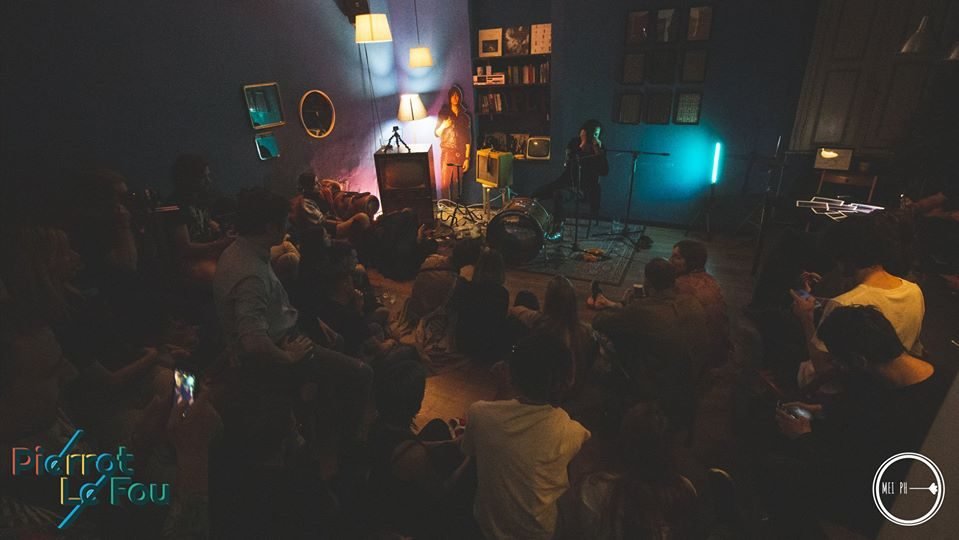
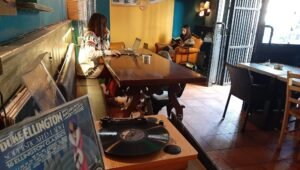
Via Macerata 58, Rome. It's an address that doesn't make noise: a side street in the Prenestino-Casilino quadrant, narrow sidewalks, low buildings, scooters leaning against the wall. Here, among the doorways and the roll-down shutters, is Pierrot Le Fou: a small venue in the heart of Pigneto where musicians, actors, photographers and illustrators take turns, soccer games are watched and cineforums are organized. Five key words, one after the other, that describe a precise format and are worth taking seriously one by one, because each tells a piece of how the cultural life of this neighborhood works.
The first thing to make clear is the scale. It's not a concert hall, it's not a multiplex, it's not a cultural center with staff and a budget. It's a small place, and small here is not a flaw to excuse: it's the condition that makes everything else possible. In a room where the audience and the people playing breathe the same air, you don't need a 3,000-watt PA, you don't need a ticket office, you don't need a press office. You need someone to open the door, someone else to bring a guitar or a projector, and a handful of people willing to sit down and keep quiet when it starts. It's the oldest model there is and it keeps working.
The second thing to make clear is the geography. Via Macerata is not just any street in Pigneto: it's one of the side streets that carry names from the Marche region, in a part of the city where the street signs make up a map of the Marche transplanted a few kilometers from Porta Maggiore. At number 54 on the same street, a few steps away, is Kif Kif, a multicultural bar with a kitchen and occasional events: two signs on the same sidewalk, two different ways of being inside the same block. A few hundred meters farther on, in the heart of the quadrilateral, is Fanfulla 5/a, the Arci club that has kept concerts, DJ sets and screenings going for years. Three addresses that don't compete with each other: they pass the audience along.
In the next pages I take you inside the venue and above all inside the neighborhood that contains it, because without Pigneto around it Pierrot Le Fou remains a name on a sign. I tell you where that name comes from, what each of the activities that take place there means in concrete terms, how to get there, what to expect the first time, what to photograph, what really happened around here in the 20th century and who has passed through, always keeping what is documented separate from what is local gossip. Because Pigneto produces quite a lot of local gossip.
Where Pierrot Le Fou is and how to get there
The address, and what it really means
The address is Via Macerata 58, Rome, postal code 00176. The street number is high, so the venue sits in the part of the street farthest from the pedestrian core of Via del Pigneto and closest to the dense fabric that slides toward Torpignattara. It sounds like a pedantic point, but it changes the experience: if you leave the metro and walk along the pedestrian stretch, you first cross the area of outdoor seating, tables and lights, and then you enter a more residential strip, where the noise drops suddenly and signs become rare. Pierrot Le Fou belongs to this second strip.
The practical consequence is that if you come for the first time, you risk walking right past it. There is no 20-meter shop window, no illuminated totem, no bouncer signaling the entrance from far away. There is a door, and on nights when something is happening there is a small cluster of people on the sidewalk and a light coming out from inside. The most obvious advice is also the most useful: check the street number before you arrive, not after. Via Macerata is long enough to make you walk five more minutes in the wrong direction without anything warning you of the mistake.
Then there is the question of the administrative and mental border. City guides assign this stretch to Pigneto, and they aren't wrong, but the real Pigneto, the quadrilateral between the Circonvallazione Casilina and Via di Acqua Bullicante, ends a little before, and from here onward begins the strip that many already call Torpignattara. It's not a parochial dispute: they are two different urban histories, with two different building densities and two different audiences, and a venue that sits on the hinge between the two inherits both. On Saturday night the people who come are the ones who came on purpose for the nightlife. On Tuesday night the people who come are the ones who live 200 meters away.
How to get to Pierrot Le Fou by metro
The simplest way is Line C. Pigneto station, which opened on June 29, 2015, runs under Via del Pigneto and is the reference point for the whole area: from there you walk, crossing the pedestrian stretch and then slipping into the side streets heading east. The next station, Malatesta, serves the outermost part toward Torpignattara and for number 58 on Via Macerata it's often just as convenient, depending on where you get off and how much you feel like walking. If you're coming from the center, take Line A to San Giovanni and change there, where the two lines meet.
About hours, there's something to say that in Rome makes the difference between a successful evening and an hour spent looking for a ride. A small venue hosting a concert or a screening works until late. The metro doesn't. The last useful ride on weekdays arrives long before the end of an evening, and on Friday and Saturday the service runs longer but not until dawn. The rule, valid for everyone: decide how you're getting back before you leave the house, not at two in the morning on the sidewalk with your phone at five percent.
Tram, bus, train
The surface network in this area is dense and, unlike the metro, it covers wider time slots. The tram lines that run along Via Prenestina and the Circonvallazione Casilina drop you a few hundred meters from the quadrilateral, and Piazzale Prenestino remains the most useful hub for anyone coming from the center via Porta Maggiore. On the Casilina also runs the old Roma Giardinetti railway, the narrow-gauge line that starts from Porta Maggiore and has stops with names that tell the story of the neighborhood better than any guidebook: Alessi, Ponte Casilino, Sant'Elena, Villini.
Then there is the chapter of the future Roma Pigneto railway station, designed as an interchange between metro C and the suburban lines. For years the works marked the landscape of the neighborhood, up to the demolition of the old bridge over the railway. When the interchange goes into service, the accessibility of the area will change substantially, and in all likelihood the audience of its small venues will change too. In September 2026 the station is not yet operating: if you're planning to arrive by train, use Termini or Tiburtina and then continue by metro.
On foot and by bicycle
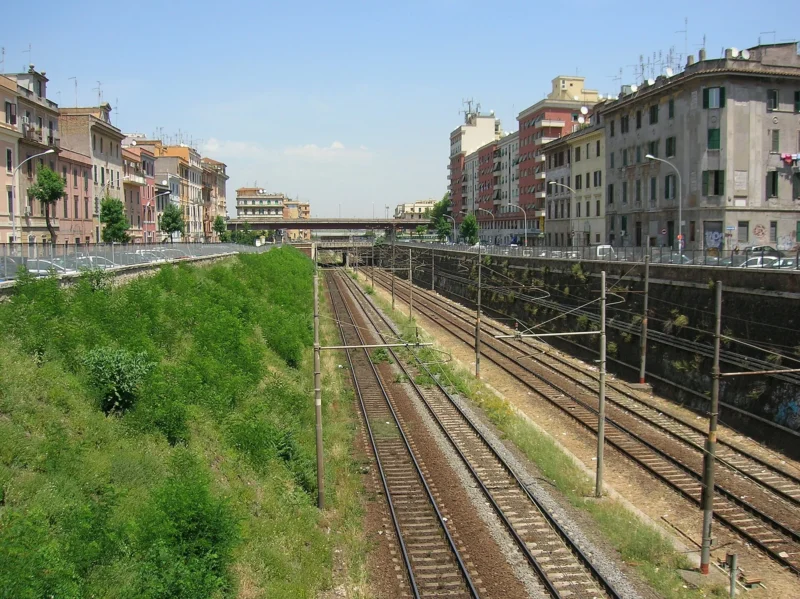
From the historic center, Pigneto is closer than your mental map suggests. From Porta Maggiore, that is from the point where the Claudian Aqueduct and the Anio Novus cross above the road and where the Underground Basilica of Porta Maggiore is located, it takes a little over 20 minutes to walk to Via Macerata, almost always on the flat, following the Casilina or the Prenestina. It's a walk I recommend doing at least once in daylight: in that kilometer and a half you cross 2,000 years of urban layering, from the travertine arches of the first century to the self-built houses of the 1920s, almost without noticing.
By bicycle it's a different matter. The area is flat and the distances are short, but the streets are narrow, often one-way, with patched surfaces and rows of double-parked cars that appear out of nowhere. It's not a route to recommend to someone cycling in Rome for the first time. Anyone who already knows Roman traffic, on the other hand, finds in this part of the city one of the most workable settings, because speeds are low and the frequent intersections force everyone to slow down.
What Pierrot Le Fou is, in concrete terms
The formula that has circulated for years and describes the place is compact: a small venue in the heart of Pigneto where musicians, actors, photographers and illustrators take turns, soccer games are watched and cineforums are organized. Read in a rush it looks like a generic list. Read with attention it's a rather precise statement of identity, because it puts together five practices that almost never coexist under the same roof. I'll try to take it apart piece by piece.
Musicians
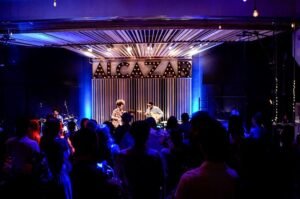
The verb used in the description is “avvicendarsi,” and the choice matters. To avvicendarsi means to take turns, to alternate, to occupy the same space in turn. It's not the word you would use for a concert season with the program printed in September. It's the word you use for a place where the people playing change constantly and where nobody has a fixed hall. In a venue of this size the stage, when there is one, is a corner cleared by moving two tables. The sound system is just enough to be heard by 20 or 30 people, no more. The people playing know it and adapt the repertoire: acoustic, voice and guitar, small ensembles, projects that elsewhere would find no room because they don't bring in numbers.
It's a format with a long tradition in Rome, and over the last 20 years it has moved east. When rents in the center and in Trastevere made it impossible to keep a small place open with non-commercial programming, musicians followed the available square footage, and the available square footage was in Pigneto, in San Lorenzo, in Quadraro, in Torpignattara. The result is a spread-out network of micro-venues where every night, somewhere, someone plays in front of an audience that almost all know each other. It's not the circuit that fills the arenas, but it's the circuit from which, sooner or later, the person who will fill the arenas comes out.
Actors
The presence of actors in the description is the part that surprises people who read in a hurry, and yet it's the one that best explains the neighborhood. Pigneto and the surrounding areas have for decades hosted a population of actors, directors and entertainment technicians drawn by affordable rents, big spaces and the proximity to Cinecittà along the axis of Via Tuscolana. Where actors live, sooner or later theater happens, and where there are no theaters, theater happens in the places that exist. A staged reading in a 30-seat venue doesn't need wings: it needs a table, a light and someone to turn off the music.
This kind of evening has unwritten rules that are worth knowing before you go in. The first is that when it starts you don't talk, and that the background murmur that's acceptable in a bar becomes a serious problem here, because no amplification can hold up against 10 people chatting two meters from the actor. The second is that the duration is short, almost always under an hour: nobody wants to endure two acts on a stackable chair. The third is that at the end you applaud and then you stay, because in these settings the social part of the evening begins exactly when the artistic part ends.
Photographers and illustrators
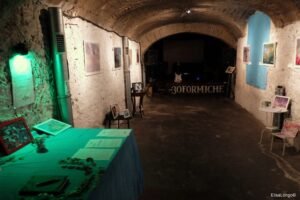
The walls of a small venue are an underrated resource. A room with four free walls is, from the point of view of someone who photographs or draws, a gallery at no cost with an audience that comes by for other reasons and therefore isn't already convinced from the start. It's the opposite of the vernissage at a gallery, where whoever walks in has decided to walk in: here the work intercepts someone who came for a game or a concert and finds a series of prints in front of them while waiting.
For an illustrator or a photographer just starting out, this exposure is worth more than it seems. It doesn't produce significant sales and almost never produces reviews, but it produces two things that count: the practical test of hanging a work and seeing it in a real context, and the conversations that start when someone stops in front of a photo and asks who made it. In a neighborhood where the density of people who work with images is high, this second thing often turns into collaborations. Whole editorial projects sometimes start from an exchange of remarks under a crooked frame.
There is also a more prosaic reason why these spaces host exhibitions: the bare walls of a small venue are sad, and filling them costs less than furnishing them. From this convergence of practical needs comes a good part of the art displayed in the bars of eastern Rome, and there is nothing to be ashamed of. The Renaissance was financed by bankers who wanted to look good, so a venue that hangs a young guy's prints because it has empty walls is in excellent historical company.
Soccer games
Watching a game in a small venue is a completely different experience from watching it in a sports pub with six screens. Here there is one screen, there is one good angle, and this produces a precise social geometry: everyone looks in the same direction, everyone reacts together, and whoever arrives late watches standing from the back. It's the reason why in places like this the cheering is louder than elsewhere even though there are fewer people: the sound doesn't disperse.
There's something to say about the makeup of the crowd. In a neighborhood like this, on a soccer night, the same room holds fans of the two Roman teams, fans of northern teams who came to Rome for work, and people who follow foreign leagues because they come from other countries. This mix works well, much better than you would imagine from outside, and the reason is simple: in a room of 30 people nobody can afford to be unbearable, because the other 29 would recognize them the next night at the market.
Cineforum
The cineforum is the most demanding item on the list, and also the most significant. A cineforum is not a screening: it's a screening followed by a discussion, and the discussion is the part that justifies the format. Organizing one requires three things that a small venue struggles to have all together: a decent projector, darkness, and someone who can lead a conversation without turning it into a lecture. When the three elements come together, though, the result is one of the sturdiest forms of cultural socializing that exist, and it's no accident that it has survived 60 years of technological change that should have buried it.
It's worth remembering where this practice comes from. Cineforums were born in Italy in the years after the Second World War, tied to Catholic and left-wing associations, in a country where cinema was the popular medium par excellence and where discussing it publicly was a way of doing political and civic education. Parish halls and community houses showed for decades films that the commercial circuits didn't program, and they built an audience. When those structures weakened, the practice didn't die: it moved into clubs, into social centers, into bookstores and, precisely, into small venues with a white wall.
In a place that carries the name of a film by Jean-Luc Godard, organizing cineforums is not a neutral choice. It's a declaration of belonging to a certain idea of cinema: the one in which you watch a film and then you talk about it, and in which the conversation that follows is as much a part of the work as the frames. I'll talk about this name, and that film, in a moment, because it's the key to understanding everything else.
The name comes from a film: Pierrot le fou, Jean-Luc Godard, 1965
What film it is
Pierrot le fou is the film that Jean-Luc Godard shot and released in 1965, with Jean-Paul Belmondo and Anna Karina in the leading roles. Belmondo plays Ferdinand Griffon, a man bored with his bourgeois Parisian life. Anna Karina plays Marianne Renoir, who drags him into a flight toward the south of France, through a story that starts as a sentimental comedy, continues as a gangster film and ends as a tragedy. The screenplay starts, very loosely, from the novel “Obsession” by the American writer Lionel White, published in 1962: one of those cases where the source material serves only as a pretext, because the film that comes out of it looks like no crime story.
The cinematography is by Raoul Coutard, the cameraman who gave visual form to a good part of the Nouvelle Vague, and the film is shot in color Techniscope: widescreen, saturated reds and blues, shots that look like posters. The music is by Antoine Duhamel. The film is presented at the Venice Film Festival in 1965, and from there it enters the canon of the decade. Anyone who watches it today for the first time is almost always thrown off balance: the plot proceeds in jerks, the characters address the camera, the literary and pictorial quotations pile up without warning. It's not a film that can be summed up, and that is exactly why it's still being screened 60 years later.
Why a venue chooses this name
A venue that's named after a film says something about itself, and the choice of the title says a lot. Calling yourself Pierrot Le Fou is not like calling yourself after a blockbuster: it's a quotation that only someone with a certain familiarity with European cinema of the 1960s recognizes, and so it works as a small password. Whoever reads the sign and smiles has already understood that films are screened inside and discussed. Whoever doesn't recognize it goes in anyway, and sooner or later someone explains it to them: that's how good passwords work, the ones that divide without excluding.
There is also a deeper coherence between the film and the format of the place. Pierrot le fou is a film about the rejection of organized life: the protagonist walks out of an unbearable society dinner, where the guests speak in advertising slogans, and leaves. A small venue that hosts people playing without a contract, people acting without a theater and people exhibiting without a gallery does, in its small way, the same operation: it takes itself out of the official circuit and tries to see what happens. It's not a reading I want to load with too much meaning, but the symmetry is there, and it's hard to believe it's entirely accidental.
A curiosity about Pierrot Le Fou
The curiosity I like best concerns the name, and specifically a detail of the film that almost nobody remembers even after seeing it. In the film, the protagonist is not called Pierrot. He's called Ferdinand. It's Marianne, Anna Karina's character, who calls him Pierrot for the whole length of the story, and every time he corrects her with the same sentence: “Je m'appelle Ferdinand,” my name is Ferdinand. The running gag goes through the film from beginning to end and is never resolved: she keeps calling him Pierrot, he keeps correcting her, neither of them gives in.
It's a comic detail that hides the dramatic core of the film. The title of the work, that is, is the name that the protagonist refuses for the whole duration of the work itself. The character fights against the identity attributed to him and loses, because that identity outlives him: the audience, the poster, the history of cinema all call him Pierrot. And “le fou,” the madman, is the adjective stuck on him by others, not the one he uses to describe himself. In two words of title there is already the whole film: a man who is defined from outside and who cannot disprove the definition.
Now try to transfer this to a Roman sign. A venue named with a name that its own protagonist rejected is, like it or not, a venue that has written above its door a small reflection on the identity assigned by others. In Pigneto, a neighborhood that over the last 20 years has had an impressive number of labels attributed to it from outside, from “Pasolini neighborhood” to “new Trastevere” to “nightlife zone,” the coincidence makes you smile. The neighborhood too keeps saying that its name is Ferdinand, and everyone keeps calling it Pierrot.
Pierrot, the mask, before the film
It's worth adding that the name has a history that precedes Godard by three centuries. Pierrot is a mask of the French stage, derived from the Pedrolino of the Italian commedia dell'arte, and it settles in the 17th century on the Parisian stages: floured face, loose white shirt, black buttons, melancholy expression. He's the naive servant who loves without being loved back, and in the 19th century he becomes, above all thanks to the mime Jean-Gaspard Deburau, the figure of silent sadness par excellence. Poets and painters fall in love with him, and Pierrot crosses symbolism, the 20th century and then popular music without ever losing his character of wounded innocent.
When Godard titles a film “Pierrot le fou” he is therefore working on a figure that the French public has always known. Adding “le fou” to it means taking it beyond melancholy and into something more dangerous. And that's what happens to Belmondo's character, who begins as a bored man and ends as something much more desperate. For those who organize cineforums in a small room, having this layering above the door is a gift: you can start an evening talking about commedia dell'arte and end it talking about French cinema of the 1960s without ever leaving the name of the venue.
Something nobody tells you about Pierrot Le Fou
The thing that nobody writes in the descriptions of small venues, and that is nonetheless the most important to know, concerns their fragility. A 30-person place that hosts concerts, readings, exhibitions, games and screenings doesn't have margins comparable to those of a restaurant or a bar with outdoor tables. It lives on attendance, and attendance depends on word of mouth, on the season, on the weather and on what happens in the two streets next door. This means the program is never a fixed fact: it changes, it stops, it starts again. No guide says so, because admitting it would seem like a pan, and instead it's simply the way this kind of place works.
The practical consequence is only one and I'm happy to repeat it: before you set out for a specific evening, check the venue's channels. Not the page of a guide, not a list updated who knows when: the direct channels of whoever opens the door. This applies to Pierrot Le Fou as to any other address of this size in the city. The difference between a memorable evening and half an hour of metro to find a closed shutter is two minutes of checking before you leave. It's the least glamorous advice that can be given and it remains the most useful.
The noise issue, and why it concerns you too
There is also a topic that is talked about little outside the neighborhood and a great deal inside it: the relationship between the venues and the people who live above them. Pigneto and the adjacent areas have a high residential density and a building structure that isolates nothing: low buildings, thin walls, courtyards that amplify. When nightlife concentrated here, in the 2000s, the conflict became daily, with complaints, city ordinances on hours, limits on takeout sales in the late hours and endless discussions in the borough councils. Whoever comes from outside sees none of this and is surprised if at 11 p.m. someone asks them to lower their voice on the sidewalk.
It concerns you because the survival of small places depends in large part on how their audience behaves outside the door. A venue doesn't close because the music inside is too loud: it closes because 30 people who come out at midnight talking loudly under the windows produce a level of noise that no soundproofing can contain. The unwritten rule of these addresses is simple: inside you do what you want, outside you lower your voice. Whoever respects it concretely helps make sure that next year that door is still open.
The audience you don't see
Another thing that is never said: the true audience of these venues is not the one on the full nights. It's the one on the empty nights. The Tuesday in November when there are six people and a guy trying out new pieces in front of an audience that could be at home, that is the night that defines the place. Anybody can do the crowded nights, sooner or later. Holding up the Tuesday in November is another matter, and it takes a community of people who go out of habit and not for an event.
If you really want to understand a venue like this, then, the wrong time to go is Saturday. On Saturday you see the neighborhood in its export version, with the flow that comes from the metro and spreads among the tables. On any Wednesday, in the rain, you see the real thing: whoever walks in greets people by name, whoever plays knows half the room, and the conversation picks up from where it left off the week before. It's less photogenic and worth much more.
The advice I give you for visiting Pierrot Le Fou
The main advice is not to treat it as an isolated destination. A 30-person place can't bear the weight of an evening built entirely around it: if you get there at nine expecting to spend four hours, you risk finding it closed, full, or simply on a night with no program. Treat it instead as a stop inside a walk that starts earlier and ends later. The neighborhood is designed for this, even though nobody designed it: the distances are very short, and within a radius of 400 meters there are dozens of different doors.
The route I recommend
Get off at Pigneto station on metro C while there's still some light, walk the pedestrian stretch of Via del Pigneto looking at the facades instead of the shop windows, and take the time to get as far as the market, which by day is one of the few things in this city that has hardly changed at all. Then slip into the side streets heading east: Via Fanfulla da Lodi with its murals, Via Braccio da Montone, and then the system of the Marche streets, among them Via Macerata. At number 54 you find Kif Kif, at 58 Pierrot Le Fou, and a few hundred meters away Fanfulla 5/a. See what's on that night in each of the three and decide on the spot.
This way of moving has an advantage that guidebooks can't convey: it hands you the neighborhood instead of handing you an address. You understand Pigneto by walking it, because it changes character every 100 meters, and because the differences between one side street and the next tell 80 years of urban history. Whoever arrives by taxi at a door and leaves by taxi three hours later has seen a room. Whoever walks has seen a city.
What to keep in mind
Keep in mind that space is limited and that on nights with a program it's tight. Keep in mind that if you arrive halfway through a screening or a reading you will enter quietly and stay standing at the back. Keep in mind that you won't find restaurant service, because it's not a restaurant, and that the logic of the place is that of informal hospitality and not that of professional performance. If these three things seem like flaws to you, you're probably looking for a different kind of evening and you'll easily find it elsewhere. If they seem normal, you're in the right place.
Keep in mind, finally, the question of membership cards. Many Roman spaces with cultural programming are membership clubs and require a card, which is usually done on the spot in two minutes and costs little. I can't tell you with certainty what formula this address uses today, and I'd rather not make one up: ask directly before you go, especially if you have a specific evening planned. It's a question nobody finds rude and it settles in advance the small embarrassment at the door.
When to go
The best period, if you can choose, is the in-between season: September and October, or April and May. In winter the evenings inside are pleasant but the neighborhood outside empties early and the walk loses its point. In high summer many indoor spaces slow down or suspend activity, because Rome moves outdoors and the summer offer of events absorbs all the available audience. September in particular is the month when programs start again and when you find the greatest concentration of opening nights, presentations and new series.
Another well-known fact, yet rarely cited
Everyone knows that Pigneto is the neighborhood of Pier Paolo Pasolini and of Accattone. The guides repeat it, the murals, the newspaper articles, the signs in front of Bar Necci on Via Fanfulla da Lodi, where the director had his base during the shooting of the film, released in 1961. It has become an automatic caption: Pigneto equals Pasolini. The well-known fact is this, and there is nothing wrong with it.
What almost nobody adds is the reason why Pasolini chose these streets, and the reason completely changes the meaning of the caption. He didn't choose them because they were scenic. He chose them because they were the exact opposite of the Rome that Italian cinema showed: a fabric of low self-built houses, courtyards, unpaved roads on the edges, inhabited by people who never appeared in films except as background. Pigneto in the 1950s was a recent periphery, grown by tiny lots sold to people who built their own house on weekends, without adequate sewers and with services that arrived decades later. Pasolini went there because there was a reality there that nobody was looking at.
So there is a small historical paradox in the way that link is cited today. The neighborhood is celebrated for a film that depicted it as a place of exclusion, and the celebration has become one of the elements that made the neighborhood desirable, therefore expensive, therefore progressively different from what the film showed. I'm not saying it to moralize: it's a process that has hit dozens of European neighborhoods and that nobody has ever managed to stop. I'm saying it because walking along Via Macerata knowing this makes the walk much more interesting than a sign with Pasolini's face on it makes it.
The second little-cited fact: cinema was here before the venues
The link between this area and cinema is older than Accattone and wider than Pasolini. In 1945 Roberto Rossellini shoots Rome, Open City, and one of the best-known sequences in the history of Italian cinema, the one in which Anna Magnani's character runs after the truck and is shot, is filmed on Via Raimondo Montecuccoli, that is in this part of the city, a few minutes' walk from here. Neorealism, put another way, put the camera around here before Pigneto even had a name in public discourse.
This explains why a cineforum in a room on Via Macerata is not an exotic graft. It's the local continuation of a vocation that this piece of Rome has had for 80 years. The streets here were looked at through a lens before being looked at by a tourist guide, and whoever today screens a film in a small venue is using the same neighborhood for the same thing, with a slightly smaller budget. The difference is that back then cinema came to tell the story of the neighborhood, and today the neighborhood tells its own story. It's not a decline: it's a form of autonomy that wasn't there then.
The third: the neighborhood's name isn't about people
One last detail that almost always slips by. The place name Pigneto doesn't derive from a family, a saint or an event, like most Roman names: it derives from a pine grove. In the area there was a villa with a small wood of pines, and the diminutive was fixed on the map and then on the signs. It's one of the few neighborhoods in Rome whose name tells of the landscape that existed before the city, and not the city that exists now. When you walk on Via Macerata among the buildings, the hardest thing to imagine is exactly that: that in place of the asphalt there were trees, and that less than a century and a half ago you could see the countryside from here all the way to the Castelli.
The right photo to take at Pierrot Le Fou
I'll start with the wrong one, because everybody takes it. The wrong photo is the sign shot head-on with flash, at night, from the opposite sidewalk. It gives you a bright rectangle on a black background, says nothing about the place, and looks like any other sign in any other city. It's the photo you take to say “I was here,” and it's perfectly fine for that purpose, but it's not a photograph: it's a receipt.
The photo I really recommend
You take the right photo from the inside toward the open door, at the hour when outside it's still light and inside it's already lit. At that moment, which lasts 20 minutes at sunset and not one more, the relationship between the warm light of the room and the cold light of the street balances out, and the frame holds together the two things that define a neighborhood venue: the inside and the outside. The door works as a frame, the street becomes a rectangle of neighborhood set into the wall, and if someone passes by on a bicycle at that exact instant you have the photograph.
Technically it takes little equipment and a bit of patience. Expose for the interior and let the street go slightly overexposed, instead of the opposite: the result is more faithful to real perception, because the eye of someone sitting inside sees exactly that. If you have a recent phone, turn off the mode that automatically brightens the shadows, because it will give you back a flat room with no atmosphere. And don't use the flash: in a small room the flash erases everything that makes it interesting.
The second photo: the detail, not the whole
The second photograph worth taking home is not of the venue but of a detail of it. A poster stuck up badly, the corner of a wall with prints hanging, a cable crossing the ceiling, the pile of chairs against the wall before somebody sets them out. These are the images that tell how a small place works, and they are also the only ones that don't look like everybody else's. The whole of a room is always the same as itself. The detail is unrepeatable because it changes every week.
A rule of good manners, since we're talking about a place where people spend their evening: you photograph people only if they agree, and in a 30-seat room asking is very easy. On concert or screening nights, then, a second rule applies: a lit phone screen in a dark room ruins the evening for the whole row behind you. One photo at the start, the phone in your pocket for the rest of the time, and you're at peace with your conscience and with your seatmates.
The third photo: the street, not the venue
If I had to choose a single image to take away from here, though, it wouldn't be of the venue. It would be of Via Macerata seen all the way down, with the perspective squeezed between the two rows of buildings and the sky reduced to a strip. It's the photograph that explains everything: the width of the street, the height of the houses, the absence of trees, the way a neighborhood born lot by lot produces an urban landscape that no master plan would ever have drawn. A small venue can only be understood inside the fabric that holds it up, and that fabric, in a photograph, fits entirely in a street perspective at sunset.
Some important events that happened here in history
A venue that opened a few years ago doesn't have a history of its own long enough to fill a chapter, and inventing one for it would make no sense. What it has, and what is worth much more, is an address inside a piece of the city that over the last century and a half has gone through some of the most significant events of contemporary Rome. Here are the documented ones, because walking on Via Macerata knowing them makes the street much less anonymous.
Before the city: the countryside and the pignattari
Until the last decades of the 19th century this was agricultural territory outside the walls, organized in estates and vineyards along Via Casilina, with scattered farmhouses and very few buildings. The name Torpignattara, which identifies the area immediately to the east, derives from the Mausoleum of Saint Helena, the funerary monument of the Constantinian era where terracotta amphorae, the pignatte, were used, set into the masonry to lighten the vaults. The place name comes from those pignatte, and the monument is still there, absorbed into the urban fabric that grew up around it. It's one of the clearest Roman cases in which the name of a 20th-century neighborhood comes from a construction technique of the fourth century.
The birth of the neighborhood by lots
Between the end of the 19th century and the first decades of the 20th, the estates are broken up and sold in tiny lots, often a few dozen square meters, to working-class families and to immigrants who came to Rome from nearby regions, in particular from the Marche, Abruzzo and inland Lazio. This is where the system of Marche names for the side streets comes from, Via Macerata included. Whoever bought the lot built the house themselves, often on holidays, raising one floor at a time as the money came in. It's the phenomenon that urbanists call self-building or self-promoted construction, and it produced the landscape you still see today: low buildings, irregular heights, facades all different, narrow streets because they only served to reach the lots.
This growth model has a consequence that can still be read today in the social life of the neighborhood. A fabric made of small houses and resident owners generates a density of relationships much higher than a fabric made of big apartment blocks, because everyone looks out on the same street and because nobody lives 12 floors off the ground. It's the structural reason why, a century later, a 30-seat venue works here: the neighborhood audience exists physically, lives around it, and doesn't need to take a car to leave the house.
The war: July 19, 1943
On July 19, 1943 Allied aircraft struck Rome for the first time. The declared target was the railway yards, and the eastern quadrant of the city, the one crossed by the bundles of tracks between Termini, the San Lorenzo yard and the Prenestina, was the most devastated area. The bombing caused thousands of victims and destroyed entire residential blocks: the San Lorenzo neighborhood is the one that remained in collective memory, but the bombs also hit Prenestino, Casilino, Tuscolano and Tiburtino. This part of the city, grown up against the railway, found itself in the middle.
That day is the fracture point of the local 20th century. The houses self-built in the 1920s and 1930s were fragile, and the damage was heavy. The reconstruction, in the years immediately afterward, happened with the same quick and informal methods as the original construction, which explains why the fabric keeps such a layered and uneven look. Walking these side streets today means walking among buildings of different eras touching each other, and part of that unevenness comes from there.
Cinema: 1945 and 1961
In 1945 Roberto Rossellini shoots some scenes of Rome, Open City in this quadrant, among them the sequence on Via Raimondo Montecuccoli that would become one of the most reproduced images of Italian cinema. In 1961 Pier Paolo Pasolini shoots Accattone, his first film as a director, using Pigneto as one of the main sets and relying on Bar Necci on Via Fanfulla da Lodi. In 16 years, this piece of periphery enters the history of cinema twice, and in both cases because it offered something the rest of the city didn't: real streets, real faces, a landscape that didn't look like a postcard.
The 2000s: the transformation
Between the end of the 1990s and the early 2000s Pigneto becomes one of the hubs of Roman nightlife. The mechanism is the classic one: low rents, available spaces, the presence of artists and students, the opening of small venues, the arrival of an audience from the rest of the city, a progressive rise in property values. Within a decade the neighborhood goes from being considered peripheral to being considered desirable, with all the tensions this brings: the conflict over hours and noise, the city ordinances, the protests of residents, the public discussion about what a street should be at night.
The pedestrian stretch of Via del Pigneto is one of the visible results of this season, and it permanently changed the way the neighborhood is used: a street where cars don't pass produces a different kind of sociability, and as a consequence a different kind of commerce. Whoever knew the street before and sees it again afterward recognizes almost nothing, except the market and some facades.
June 29, 2015: the metro arrives
The opening of Pigneto station on Line C, on June 29, 2015, is the most recent structural event in chronological order. A metro stop changes a neighborhood more than any urban furnishing project, because it changes the pool of people who can get there without thinking about it. Since that day, for anyone along Line C or along Line A with a change at San Giovanni, Pigneto has become a decision to make in 10 seconds instead of an expedition to organize. For small venues this has meant more potential audience and, along with it, more competition, because everyone makes the same calculation.
The chapter of the interchange railway station remains pending, which when it goes into service will connect the area to the suburban lines. At the time of writing it's not yet active. It will be the next important event on this street, and in all likelihood it will change everything again.
Who has passed through Pierrot Le Fou
Here I have to be honest about method, because this is the chapter in which people most often tell something they don't know. For a small venue with informal programming there is no public archive of the names of who played, acted or exhibited there: the posters circulate for a few days on social channels and then disappear, the concerts aren't reviewed, the exhibitions have no catalog. Anyone who confidently lists 10 famous names who have passed through a 30-seat room in Pigneto is most likely deducing them instead of documenting them. It matters more to know who passes through, which is information you can verify with your own eyes.
The four categories that make up the audience
The first category is the one declared in the description of the venue: musicians, actors, photographers, illustrators. They're not occasional guests, they're the raw material. In a neighborhood where these professions have a residential density out of scale with the rest of the city, a place that offers a wall, a corner and a microphone automatically becomes a gathering point. A good part of those who come in as audience one night return as program three months later, and vice versa. It's the characteristic that distinguishes a community from a clientele.
The second category is the residents of the block, and they are the ones who keep the place going on nights when nothing special happens. People who live 200 meters away, who come in because they were passing by, who know whoever opens up. In the sociology of neighborhood venues this group is called the proximity audience, and its existence is the real health indicator of an address: if a venue lives only on outside flow, it closes as soon as the flow moves elsewhere.
The third category is Romans from other neighborhoods who arrive by metro. They are the audience for nights with strong programming, the ones who look at the announcement online and decide to cross the city for a concert or a screening. They bring numbers and they bring curiosity, and they rarely come back a second time in the same month. They're useful and they're volatile.
The fourth category is foreign visitors, who over the last 15 years have increased enormously in this part of the city. They come because they read somewhere that Pigneto is the neighborhood where you see the Rome that Romans live, and they're right, as long as they remember that the Rome that Romans live also includes the residents sleeping upstairs. Whoever behaves like a guest in someone else's home is welcomed very warmly here. Whoever behaves as if on an entertainment strip is not, and the neighborhood is right to be strict on this point.
Who has passed through the neighborhood, and this is documented
In the surrounding area, on the other hand, documented names are not lacking. Pier Paolo Pasolini worked on these streets for Accattone in 1961, relying on the bar on Via Fanfulla da Lodi that is still open and that has become a small involuntary monument. Roberto Rossellini shot part of Rome, Open City here in 1945, with Anna Magnani as the lead in the most famous sequence. In the Pasolini circle of those years appear figures who really came from the neighborhood and from the ones nearby, Franco and Sergio Citti above all, bringing into Italian cinema a language and a posture that had never entered it before.
This is the heritage that a cineforum on Via Macerata can lean on without having to invent anything. Screening Accattone 400 meters from the places where it was shot, and then going out and walking through them, is an experience that no hall in the center can offer. The same goes for Rome, Open City. It's the kind of programming that a small venue can do better than an institution, because it doesn't need authorizations, budgets or a year of preparation: all it needs is a white wall and someone who knows what they're talking about.
And who will pass through
The most interesting question, for a place of this size, isn't who has already passed through but who will. Venues with 30 seats are the first infrastructure of the career of anyone who works with an audience: it's there that you learn to hold a room, to manage silence, to understand when something works and when it doesn't. Some of the people playing tonight on Via Macerata in front of 20 people will play in 10 years in front of 2,000, and the only way to have seen it earlier is to have gone when nobody knew them. It's the best reason to walk into a small place without knowing what's on the program.
Pigneto all around, and how to build a whole evening
To finish, the practical part, because an address like this yields much more if you place it in a wider design. The Pigneto quadrilateral and the strip that slides toward Torpignattara contain, in a few hectares, a concentration of independent cultural spaces that's hard to find elsewhere in the city. On the same Via Macerata, at number 54, is Kif Kif. In the heart of the neighborhood is Fanfulla 5/a with its almost daily programming. A little farther on, along the Casilino axis, series and festivals bring cinema and music back every year to open-air spaces, such as the Casilino Urban Fest and the screenings of Cinema on the Roof at Casilino Sky Park.
If you then want to widen out to all of eastern Rome, the perimeter naturally extends toward San Lorenzo and toward Tiburtino, where venues like Monk and Wishlist Club cover bigger formats and complete the picture. The logic is always the same: none of these places is enough on its own, and all together they form a circuit that gives those who make music, theater and cinema in this city a ladder of growth. A 30-seat venue on Via Macerata is the first step of that ladder, and the low steps are the ones that break first if nobody climbs them.
For those visiting Rome who want to build a sensible day around an evening here, the advice is to stay on the eastern axis during the daytime hours too, instead of crossing the city twice. The Aqueducts Park in the afternoon, or a visit to the Centrale Montemartini, fit well with an evening in Pigneto and don't require absurd transfers. You'll find the rest of the city's programming gathered in all the events, which is the quickest way to see what's going on in the city on the days you're there.
Before closing
Frequently asked questions about Pierrot Le Fou
Where is Pierrot Le Fou?
Pierrot Le Fou is at Via Macerata 58, in Rome, postal code 00176, in the part of Pigneto closest to the dense fabric that slides toward Torpignattara, away from the pedestrian core of Via del Pigneto.
Where does the name Pierrot Le Fou come from?
The name Pierrot Le Fou comes from the film Pierrot le fou by Jean-Luc Godard, released in 1965 with Jean-Paul Belmondo and Anna Karina in the leading roles. Curiously, in the film the protagonist is actually called Ferdinand: it's Marianne, Anna Karina's character, who calls him Pierrot throughout the story.
What can you do at Pierrot Le Fou?
Pierrot Le Fou is a small venue in the heart of Pigneto where musicians, actors, photographers and illustrators take turns, soccer games are watched and cineforums are organized. It's a small space, for about 30 people.
Is it worth going to Pierrot Le Fou as the only destination of the evening?
No, the advice is not to treat it as an isolated destination: being a place for about 30 people, it can't bear the weight of an evening built entirely around it. It's better to treat it as a stop inside a walk through Pigneto that starts earlier and ends later.
What is near Pierrot Le Fou in Pigneto?
In the same Pigneto quadrilateral, on the same Via Macerata at number 54, is Kif Kif, and in the heart of the neighborhood is Fanfulla 5/a with its programming, along with a concentration of independent cultural spaces that's hard to find elsewhere in Rome.
Who performs at Pierrot Le Fou?
For a small venue with informal programming like Pierrot Le Fou there is no public archive of the names of those who played, acted or exhibited there: the posters circulate on social channels for a few days and then disappear, so it isn't possible to provide a reliable list.
If you're planning a trip to Italy and this kind of itinerary interests you, meaning the ones built on real neighborhoods instead of on the list of monuments, you'll find planning tools on italyplanner.com, which helps line up days, transfers and real timing without turning the vacation into a marathon. If instead you guide groups for a living and need to manage itineraries, quotes and logistics in an orderly way, you'll find the dedicated set of tools on tourleaderpro.com. They are two different ways of facing the same problem: making the time you have match the city you want to see.
The street does the rest. Via Macerata is not in the guidebooks, it doesn't appear in the lists of unmissable places, it has nothing to see in the sense usually meant. It has a door, behind which every now and then someone plays, reads, screens or hangs prints, and 30 people who sit down. 60 years ago a French director shot a film about a man who drops everything to head for the sea and whom nobody manages to call by his real name. That a piece of that story ended up on a sign on a side street in Pigneto keeps seeming to me one of the most Roman things I know.
Contact Information
Via Macerata, 58
Roma Roma Città, Roma Città
Nearby
 Kif Kif100 m
- Fanfulla 5/a100 m
- Cinema Aquila200 m
- Biblioteca Goffredo Mameli200 m
- Giove200 m
- Pigneto300 m

Upcoming events nearby
- Prima di ogni cosa. Per un futuro Crip, book presentation at Libreria Tuba, November 4, 2026200 m
- Periferie Umane (Human Suburbs), final performance at Teatro Sala Vignoli, Nov 21 and 22, 2026200 m
- Libertà da…, libertà di… Autogenic Training at Entrature, October 19 to December 17, 2026200 m
- What Is Dramaturgy? Encounters Between Text and Stage with Attilio Scarpellini, October 20 to December 13, 2026200 m