Lanificio159
In short. Lanificio159 is in Rome at Via di Pietralata 159, on the right bank of the Aniene, inside the perimeter of the Pietralata neighborhood.
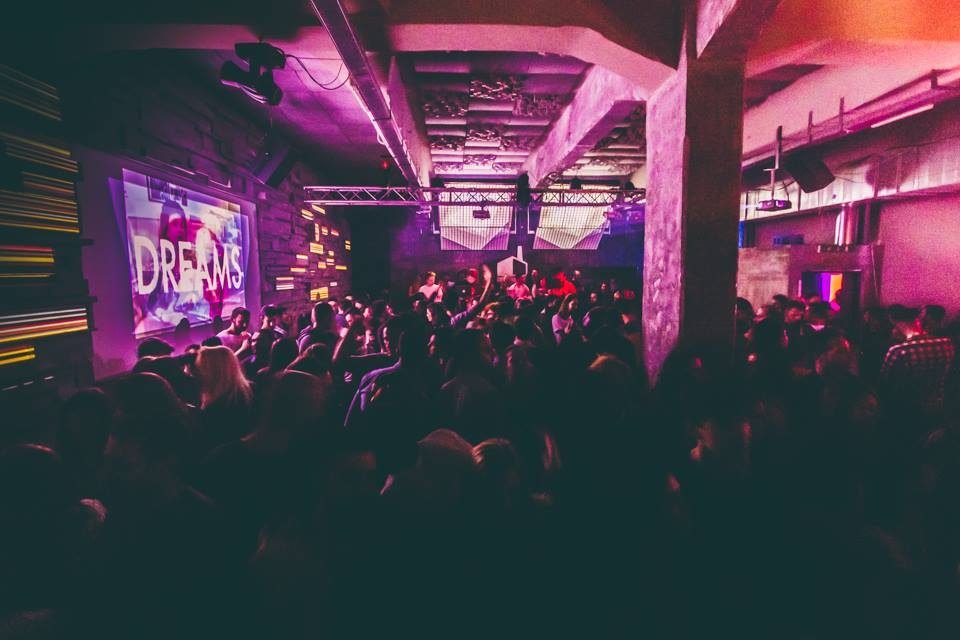
Lanificio159 is in Rome at Via di Pietralata 159, on the right bank of the Aniene, inside the perimeter of the Pietralata neighborhood. The name is not a marketing invention and doesn't allude to anything: it simply declares what was there before. Wool was worked here, in an industrial plant that belongs to the season when the northeast periphery of Rome was made of warehouses, depots, workshops and public housing built in a hurry, and not of night clubs. When production stopped, the building stayed there, with its bays, its high ceilings and its view over a river that almost nobody in the city looks at. Since 2007 that same volume has hosted a complex of spaces for events, concerts, dance nights, dinners, exhibitions and creative work, declared by the owners at about 3,500 square meters in total.
One thing should be made clear right away, because it is the main source of misunderstandings. Lanificio159 in everyday language indicates two different things depending on who is speaking. For those who go on a Friday or Saturday night, Lanificio159 is the dance hall, the club, the rectangular room with the console at the back and the terrace over the river. For those organizing a wedding, a corporate presentation or a private party, the Lanificio is instead the whole complex, divided into several spaces called Club 159, Le Tappezzerie, Feria, RiverLoft, L'Officina and L'Atelier, which can be rented separately or together. The two things coexist at the same address and in the same building, and understanding which of the two you are looking for is the first step to not showing up on the wrong night.
The page that follows tells where the place is, how to really get there, what it contains, what you can expect, what is instead not guaranteed at all, and in what neighborhood context it sits. Programs, guest names, prices, hours and entry procedures change from week to week and depend on who organizes the individual night: that information is found only on the official channels of the venue and of the organizers, and no general description can replace it.
Where Lanificio159 is and how to really get there
The address is Via di Pietralata 159, with the street numbers 159 and 159/A both appearing in the official references of the complex, postal code 00158. The telephone contact of the office listed by the venue is 06 41780081, with office hours Monday to Friday from 10:00 to 19:00: it is a detail that matters more than it seems, because it means that whoever calls at 11 at night to ask if they can get in is calling a number designed for a completely different kind of request.
Via di Pietralata is a long street, which cuts the neighborhood from southwest to northeast and doesn't resemble a nightlife street at all. It runs among warehouses, auto repair shops, depots, building material dealers, a few residential buildings and long stretches where there is nothing to look at. Street number 159 is in the lower part of the street, the one closest to the bend of the Aniene, and whoever arrives for the first time almost always has the same reaction: the feeling of having made a mistake. You haven't. The entrance is an industrial gate, not a lit shop window, and this is part of the identity of the place.
By subway
Subway line B has a stop called precisely Pietralata, along the stretch that goes up Via Tiburtina toward Rebibbia. It is the natural gateway for those coming from the center, because line B passes through Termini, Piramide and the Colosseum, and therefore covers much of the areas where visitors to Rome stay. Beware, however, of one point that causes a great many errors: the Pietralata stop is on the branch of line B that leads to Rebibbia, not on the one that leads to Jonio. Line B splits at Bologna, and whoever gets on the wrong train ends up on the other side of the northeast sector without realizing it until two or three stops later. Before boarding it is best to read the terminus shown on the front of the train and on the platform monitors.
From the subway stop to number 159 the distance is not covered in two minutes. The venue itself indicates as a connection the combination of subway and bus 211, which is already useful information: if a short walk were enough there would be no reason to mention a bus. Anyone who decides to walk anyway should be ready for a long route, on discontinuous sidewalks, in an area that at night is little frequented and poorly lit. It is not dangerous in the dramatic sense of the word, but it is desolate, and it is the kind of walk you gladly do in pairs or in a group and much less gladly alone.
By bus
The line the venue indicates as a reference is the 211, with the Pietralata/Itor stop. It is the most direct solution for those who want to minimize the stretch on foot. As with all Roman surface lines, evening frequency thins out, and in the hours when a night at the club really ends the ordinary surface service in many cases is gone. Whoever counts on going home by bus after one in the morning risks being left on foot: it is best to check the last run times in advance and, above all, to already have an alternative plan in mind.
By car and by taxi
The car, in this specific case, is a more reasonable choice than at most Roman clubs. Pietralata is not a limited traffic zone, it doesn't have the bottlenecks of the historic center and it has that mix of wide streets and industrial areas that makes street parking a less acute problem than in Trastevere or Pigneto. The venue, among the services it lists for private events, also mentions private parking: it is an element designed for those who rent a space, so it should not be taken for granted as freely available on just any night open to the public. Whoever parks on the street should keep in mind the usual rule, valid in Rome as elsewhere: nothing visible inside the passenger compartment, not even a phone charger.
The taxi remains the most convenient solution for the return, and it has to be arranged beforehand. In the area there is no staffed taxi stand a few dozen meters away, and finding one passing by at three in the morning along Via di Pietralata is an optimistic hypothesis. Whoever comes from outside Rome and is not familiar with the city's nighttime geography should do the math in advance: the ride from the center to Pietralata is short in terms of time, because at night there is no traffic, but the distance is real and the return must be planned as part of the night, not improvised at the exit.
The river, and why it changes your orientation
One last element of orientation is worth more than any street directions: the Aniene. The river flows along the northern edge of the Pietralata neighborhood and marks the boundary toward Monte Sacro. The complex faces this watercourse, and the club's terrace opens directly onto the river. Whoever orients themselves keeping in mind that the water is to the north immediately understands which way they are heading, even without looking at the map. It is also the reason why, inside the building, the rooms that matter most all have a relationship with that side: the view of the river is the thing this place has and that almost no other Roman club can offer.
What Lanificio159 really is: a complex, not a single hall
The definition the venue gives of itself is clear and worth taking seriously: an epicenter of creativity and fun that occupies about 3,500 square meters and combines the industrial character of the building with renovated spaces. Three words of that formula deserve attention. The first is the floor area, because 3,500 square meters is a lot: it is not a club, it is a city block. The second is the reference to the industrial character, which is not an aesthetic pose but the physical consequence of what the building was. The third is the idea of spaces in the plural, which describes exactly the way the complex works.
The date the venue gives as the start of its activity is 2007. Since then, according to the numbers the complex declares, over 1,400 events in total have passed through here, with a breakdown that says a lot about the nature of the place: about 600 corporate events, over 700 private events and more than 100 weddings. These are figures supplied by the venue itself, so they should be read for what they are, that is, a statement by an interested party, but they still tell of a balance that someone who knows the place only from Saturday nights doesn't imagine. The Lanificio doesn't live only on clubbing. It lives in large part on commissioned events, and the nights open to the public are one part of its activity, not its only reason for existing.
This also explains a feature that disorients first-time visitors. In a traditional club the identity is given by the artistic direction: there is a musical line, a reference audience, a way of being in the room that you recognize immediately. In a space that also works as a container for third-party events, the identity is given by the place, and the content changes with whoever fills it. The same hall that one night hosts a techno party with the sound system pushed to the maximum, the next night can host a corporate event with set tables and a completely different setup. Whoever arrives thinking they will always find the same place quickly notices that it is the same place, physically speaking, but from the point of view of the experience, no.
It is a logic that is not unique in Rome. The city has built an important part of its cultural life inside converted industrial containers, and Lanificio159 belongs to that family. Just think of the Mira Lanza Museum, carved out of the spaces of a former soap factory on the bank of the Tiber, or the ex Snia Viscosa on Via Prenestina, with its lake born by chance from a construction site excavation. In all these cases the logic is the same: a volume built to produce something emptied out, and the city put into it a use that nobody had foreseen when the walls went up.
Club 159, the terrace and the view over the Aniene
The space that gives its name to all the rest, at least in the language of those who frequent Rome's nightlife, is Club 159. The venue describes it as one of the reference points of the Roman clubbing scene since 2007, and presents it as a large hall with direct access to a terrace overlooking the Aniene river. That view is the element emphasized first in the official communication too, and it is no accident: it is the hardest thing to replicate elsewhere.
The hall, in the descriptions that have circulated for years among those who frequent it, has a rectangular plan, with the console placed at the back and a reserved space behind the booth. One of the long walls is covered with wooden boards that are used as a projection surface for video mapping, that is, for images calibrated to the geometry of the wall rather than to a flat screen. On the opposite side the bar area extends. On one side you step out onto the terrace, which is the natural outlet of the night: the place you go to get air, to talk without shouting, to smoke, to look at the darkness of the river while the music continues inside.
A word is worth saying about video mapping, because it is the thing most often misunderstood. It is not a screen on which generic videos scroll. It is a technique in which the projected image is deformed so as to fit the irregularities of the real surface, so that the wooden boards, their joints and their protrusions become part of the design. The effect, when it is done well, is that the wall seems to move. It is a language that goes well with industrial architecture, because it works on raw surfaces instead of hiding them, and it is one of the reasons why former industrial spaces have become the preferred places for this kind of setup.
On the use of the hall the venue is explicit: it is adaptable to all types of events, and is equipped as a complete disco but also available for private rentals and custom parties. This means, in practice, that Club 159 is not always a club. It is a club when someone uses it as a club. On other occasions it is a large technically equipped hall that can be set up in a completely different way. Whoever phones to find out if there is dancing on a certain night would do well to ask explicitly, because the answer is not a given.
On capacity an honest clarification must be made. The official sources that can be consulted do not state a number of people admitted, either for Club 159 or for the other spaces. Figures of every kind circulate online, taken from third-party sites and from old listings never updated, and none of them can be verified. Whoever needs the real figure, for example because they are evaluating the space for an event, should ask the venue directly: it is information that also depends on the configuration of the setup and the type of authorization, and so it has no single answer.
The terrace deserves a discussion of its own, because it is the piece of this place that stays in the mind. The Aniene, in this stretch, flows sunken between vegetated embankments, in an area that belongs to the system of the Aniene Valley Nature Reserve. At night you don't see the water, you see darkness: a black strip without lights, with the profile of the trees against the orange sky of the urban lighting. It is a strange experience for those who know Rome only as a city of stone and squares. Here the landscape is that of a margin, of an edge where the city breaks off and something else begins. Whoever steps out onto the terrace at three in the morning, with the music muffled behind them, understands on their own why the complex insists so much on that view.
A curiosity about Lanificio159
The curiosity concerns the name, and it is more interesting than it seems. The number 159 is not a reference to a date, a record label or an internal code: it is simply the street number. Via di Pietralata 159. A club that takes the name of its own address is an unusual choice, and it tells a precise idea: the place did not want to give itself an evocative name, it preferred to declare where it is and what was there before. It is a form of toponymic honesty rarely seen in Rome, a city where night clubs have historically preferred names taken from films, songs or English.
The most curious part, however, is that this street number has a history of its own. The Pietralata neighborhood preserves the memory of a textile activity documented precisely along this street, a former wool mill known as the Luciani wool mill, which appears among the historical references of the neighborhood and which in reconstructions of the area is also indicated as a place later used for television shoots. It is a trace worth pointing out with the caution it deserves: the link between that specific historical name and the present complex at Via di Pietralata 159 is not explicitly confirmed by the venue's official communication, which speaks of industrial conversion and of the industrial character of the building without citing the name of the company that occupied it. What is certain, and what nobody disputes, is that wool was worked in this area and that the building was born as a production plant.
The other spaces of the complex: Le Tappezzerie, Feria, RiverLoft, L'Officina, L'Atelier
Club 159 is the visible tip, but the complex declares six spaces, and knowing their names helps to understand what happens here when there is no dancing. The spaces listed by the venue are Club 159, Le Tappezzerie, Feria, RiverLoft, L'Officina and L'Atelier. On each of them the official communication is stingier than one would like: the names are there, the detailed descriptions, floor areas and capacities are not. What follows therefore takes the names seriously and what can be honestly deduced from the structure of the complex, without attributing to each space features that no verifiable source confirms.
Le Tappezzerie
The name directly recalls a craft, and it is consistent with the vocation of the building: where there was wool, the natural chain continues with furnishing fabrics, upholstery, the restoration of upholstered furniture. The historical description of the complex that has circulated for years in fact speaks of lofts and spaces dedicated also to furniture restoration, besides dance, visual arts and exhibitions. Le Tappezzerie have a telephone contact of their own, distinct from that of the general office, which indicates a management with some autonomy. Whoever is looking for information on this specific space will be quicker using that number than the switchboard.
Feria
Feria also has a dedicated contact, in this case a separate email address. The name recalls the idea of the fair and of the popular festival, and in general identifies in the complex a space designed for conviviality. In the account the place has given of itself over the years, the presence recurs of an area dedicated to quality food and drink, historically indicated as Lanificio Cucina: a detail that helps to understand how this was never a simple warehouse with an audio system, but a place where people have always tried to keep the table and the dance floor together.
RiverLoft
The name speaks for itself and is perhaps the most explicit of the six. Loft on the river: a space that exploits the view over the Aniene, with the characteristic type of the industrial loft, that is a single, tall volume without rigid interior partitions. In the venue's historical account there appears a first-floor gallery with a view of the river, used as a decompression area during club nights, and the RiverLoft clearly belongs to that family of spaces. It is the space on which the complex plays its difference from any Roman competitor, because a view over water, in a city that has turned its back on its rivers, is a rare commodity.
L'Officina and L'Atelier
The last two names close the semantic circle of the building. Officina is the word of mechanical work, atelier that of artistic and tailoring work: placed side by side they tell exactly the double nature of a complex that inherited a productive architecture and put a creative activity inside it. They are in all likelihood the more contained spaces, the ones that lend themselves to workshops, rehearsals, labs, small events, presentations. Here too the general rule applies: whoever needs precise numbers on area and capacity must ask for them, because they are not published.
Something nobody tells you about Lanificio159
The thing nobody highlights is that the programming of the nights open to the public, historically, does not belong to the venue but to whoever produces it. The model told for years about this place is that of entrusting the hall to outside organizers in rotation: different parties, with different audiences and different musical lines, who take the hall for one night and bring their own world into it. This has a practical consequence that completely changes the way it is best to approach the place.
The consequence is this: searching for information about the venue alone is almost never enough. If you look only at the name of the place you get a description of the building, the spaces and the services, which is useful for knowing where you are going but says nothing about what you will find that night. The information that really matters, that is who is playing, what music is on, what time it starts, how much it costs and if there is a list, is in the hands of whoever organizes the individual date. Whoever arrives without having checked both things, the place and the organizer, has a good chance of finding a night that has nothing to do with what they hoped for.
The second thing almost never said is that the nature of the place changes radically depending on the season. A complex that has a terrace on the river and open spaces lives in a completely different way in July and in February. In summer the outdoor space becomes the center of gravity of the night and the inside hall empties at regular intervals. In winter the outside shrinks to a quick stop for smokers, and everything concentrates indoors. Whoever has frequented the place in only one season and talks about it as if it were always the same tells half the story.
The third thing concerns the venue's silence on some data. There are no public indications, on the official channels that can be consulted, of capacity, entrance prices, hours of the nights open to the public or membership procedures. The absence of this data is not an oversight: it reflects the fact that those parameters depend on the specific event and on the party producing it. Any third-party site that reports precise figures on these points is reporting unconfirmed data, often inherited from versions years old. Whoever needs to know how much they will spend or what time it closes should ask whoever organizes.
Finally there is a point about the neighborhood that almost no description addresses. Pietralata at night has no life of its own. There is no surrounding cluster of venues, no street with outdoor tables, no before and after like you find around a club in Pigneto or San Lorenzo. Whoever comes here comes to come here, and when they leave the night is over. It is a characteristic, not a flaw, but it must be known beforehand: whoever counts on prolonging the night by walking to something else will be disappointed.
My advice for visiting Lanificio159
The main piece of advice is only one and is worth more than all the others put together: decide the way back before deciding the way there. This place is reachable without problems in the evening, when the subway runs and the buses pass. The problem is not getting there, it is getting back. Whoever ends the night at half past two or at three finds themselves in an industrial neighborhood, far from any staffed taxi stand, with the ordinary surface service now stopped. There are three sensible solutions: come by car with someone who doesn't drink, arrange the taxi in advance, or check which night lines cover the northeast sector and memorize the time of the last useful run. Improvising, here, costs an hour of waiting in the cold.
The second piece of advice concerns checking beforehand. Before setting out it is best to check three distinct things: that that night the complex is hosting an event open to the public and not a private event, who is organizing it, and if there is an access, booking or list procedure. These are three different pieces of information and none implies the others. The most frustrating case, and it happens more often than you would think with multipurpose spaces, is that of someone who crosses half the city to find themselves in front of a closed gate because that night a wedding was being celebrated.
The third piece of advice concerns clothing, and it has a practical reason. A converted industrial building has high ceilings, big volumes and an open terrace: it means that the perceived temperature changes a lot between the dance floor and the outside, and that in winter the difference between the two spaces is brutal. It is best to dress in layers and to count on spending time outdoors, because the terrace is where you end up talking. Shoes are the other point: industrial floors, level changes, outdoor areas not always perfectly regular. It is not the context for delicate footwear.
The fourth piece of advice is for those coming from outside Rome. Don't build the night as an isolated stop within a classic tourist program. Pietralata is far from the monumental center and has nothing to offer someone who arrives in the afternoon hoping to visit something in the area before going in. Whoever wants to keep the day and the night together should make a different choice: spend the afternoon in an area with a reason of its own to exist, for example along the axis of the MAXXI and the Flaminio neighborhood, or inside Villa Ada, and move here only for the night. They are two separate experiences, and treating them as such works much better than trying to stitch them together.
Pietralata: the neighborhood you cross to get here
To understand Lanificio159 you have to understand where it is, because the neighborhood explains the building far more than the building explains the neighborhood. Pietralata is the 21st neighborhood of Rome, in the northeast sector of the city, and corresponds to urban zone 5G of Municipio IV. It borders Monte Sacro and Monte Sacro Alto to the north, Ponte Mammolo to the northeast and east, Collatino and Tiburtino to the south, Nomentano to the west. It is a hinge position between Via Tiburtina and Via Nomentana, the two historic axes that go up toward the Aniene and beyond.
The name, as said, comes from the Latin prata lata and describes the agricultural estate that occupied the whole area: about 2,150 hectares of open countryside. The transformation arrives with Fascism. Between 1935 and 1940 the regime built 12 official borgate to relocate outside the center the families displaced by the demolitions of the historic center, and Pietralata is one of them. Whoever knows the urban history of Rome knows what this means: minimal little houses, absent services, unpaved roads, and a population transplanted by force from districts that were being demolished to open monumental axes. It is not a happy foundation, and it is the reason why this part of the city has carried a difficult reputation for decades.
The second act begins in the 1950s. In 1953 the original little houses are replaced by sturdier dwellings, between 1957 and 1964 the apartment buildings arrive, and in 1961 the borgata is promoted to an official neighborhood. In parallel the productive fabric grows: warehouses, depots, storage, workshops, which is exactly the imprint you can still read today walking along Via di Pietralata. That industrial fabric, in recent decades, has partly emptied out, and the volumes left vacant have become the raw material of conversions like this one.
The other protagonist of local history is the Aniene. The river flows along the northern edge of the neighborhood, and for much of the 20th century it was above all a problem: the undersized road level caused recurring floods in the middle decades of the century. The perception changed only when the river course became the object of protection and of projects for public use, within the system of the Aniene Valley Nature Reserve, which protects one of the most extensive and least known green belts in the city. A club that puts its terrace on the Aniene, in this sense, performs a cultural operation as well as a commercial one: it shows a city audience a piece of landscape that the same audience, a few kilometers away, never looks at.
Pietralata today is not a neighborhood for an evening stroll and doesn't pretend to be. It has a daytime life made of offices, productive activities, a large hospital and university hub not far away, dense commuter traffic on the Tiburtina. In the evening it shuts down early. This explains why the places of nighttime gathering, here, are few and isolated: they don't fit into a fabric, they create it on their own. And it is also the reason why the neighborhood has seen in recent years a slow emergence of cultural initiatives in dedicated spaces, like the dance and performing arts activity that takes place at the DAF center in Pietralata, which appears among the offerings of Territori Creativi. They are scattered outposts, not a circuit, but they point in a direction.
Another well-known fact, yet rarely mentioned
The well-known fact is that Rome built a good part of its nightlife inside buildings born to do something else. Everyone knows it, and nobody draws the consequences. The historic center, for reasons of protection, residence and noise, cannot host large volumes dedicated to amplified music. The result is that everything that requires space and decibels has moved outward, and found a home in warehouses, former workshops, former depots, former markets, former factories. It was not an aesthetic choice: it was an urban planning necessity that then turned into a language.
The rarely mentioned consequence is that the map of the Roman night coincides almost point for point with the map of 20th-century industrial archaeology. Whoever follows the nights in the city ends up, without knowing it, taking a tour of what Rome produced until 50 years ago: soaps, textiles, building materials, mechanical work. Ostiense with its gasometers and its wholesale markets, Prenestina with the Snia, Tiburtino and Pietralata with their warehouses, Testaccio with the former slaughterhouse. They are all areas that are associated with music today and that 50 years ago were associated with work.
From here follows a second fact, even less mentioned: Roman nightlife is structurally peripheral, and this conditions everything else. It conditions the hours, because you arrive later when you have to cross the city. It conditions transport, because night service is not designed to bring thousands of people from a warehouse on the outskirts to the center at four in the morning. It conditions the audience, because whoever has no car or budget for taxis is effectively excluded from part of the offering. And it conditions the fragility of the venues, because a business that lives in a warehouse depends on a lease, an authorization and an economic balance that real estate transformations can break quickly.
There is then a third aspect, technical but decisive. Industrial buildings have difficult acoustics. Large volumes, hard surfaces, high ceilings and masonry or metal walls produce long reverberations and sound tails that, if untreated, turn any system into mush. All the best Roman industrial reuses have had to face this problem, with paneling, dropped ceilings, curtains, sound-absorbing materials and calibration of the system. When you walk into a former warehouse and the sound is clean, it is no accident and it is not the merit of the architecture: it is the result of work done on purpose to counter the architecture. The wooden cladding of an entire wall, like the one described in the main hall of this complex, belongs by nature to this family of solutions, because wood is at once a projection surface and a material with useful acoustic behavior.
The right photo to take at Lanificio159
The right photo isn't the one of the dance floor. Dance floor photos all look alike, in any club in the world: the backs of heads, colored lights, raised arms, an overall blur that looks like energy on the phone and the next day looks like nothing more than a bad photo. The right photo, here, is from the terrace toward the river.
The reason is that this framing contains something you can't find anywhere else in Rome: the darkness of the Aniene. In a night image shot from that parapet, the foreground is the industrial structure, with its sharp profile and the artificial light coming from inside. The background is a black band of vegetation that follows the watercourse. Above, the city sky, which in Rome is never black but a dirty orange produced by street lighting reflected off the humidity. Three horizontal bands, three different materials. It's a composition that builds itself and tells you exactly where you are: at the edge, where the city ends.
On the technical side there are three tricks that make the difference. The first: rest the phone or camera on the parapet instead of holding it in your hands. In the dark the exposure time gets longer, and the difference between a blurry photo and a sharp one is all there, not in the sensor. The second: don't use the flash toward the river. The flash lights up the dust half a meter from the lens and leaves the background as black as before, giving the worst possible result. The third: lower the exposure compared to what the automatic mode suggests. At night, cameras tend to brighten everything to bring out detail in the shadows, and the result is a gray, noisy image. Darkening by one or two stops gives back the black that was really there and makes the lights readable.
The second photograph worth looking for is in the daytime, and almost nobody takes it because almost nobody comes here in daylight. Via di Pietralata at 10 in the morning is a perfect showcase of Roman industrial architecture from the second half of the 20th century: warehouses with shed roofs, that is, those sawtooth roofs with north-facing glazing that brought even light into the work areas without direct sun, faded painted signs, sliding gates, boundary walls with plaster fallen off in patches. It's a Rome that appears in no guidebook and that, photographed with care, has a formidable dignity.
One last recommendation, and it isn't technical. In a dance venue, photography is a delicate matter, because the people around you haven't agreed to appear in any image. Framing architecture, lights and landscape is always fine. Framing recognizable faces in a nighttime setting and publishing them is something else. Here, common sense and respect are the same thing.
Some important events that happened here in history
The history of this address reads in phases, and each phase is an event that changed what it meant to be at Via di Pietralata 159.
The agricultural phase
The first phase is the one in which none of this was here. The Pietralata estate, with its roughly 2,150 hectares between Via Tiburtina and Via Nomentana, was countryside, and it remained so until well into the 20th century. It's a phase that leaves no visible traces along the street, but it survives in the name of the neighborhood and of the whole area. Whoever walks among the warehouses today is walking over a large estate.
The birth of the borgata
The second event is the founding of the borgata, between 1935 and 1940, within the program of the 12 official borgate meant to house the people displaced by the demolitions in the historic center. It's the act that brings a population here and makes Pietralata an inhabited place. It's also the act that determined its condition as a margin for decades, because the borgate were born without services, without adequate transport and without continuity with the rest of the city.
Reconstruction and the leap to neighborhood
The third event is the postwar building transformation. In 1953 the original little houses were replaced, between 1957 and 1964 the apartment blocks arrived, and in 1961 the borgata became an official neighborhood of the city. In those same years the manufacturing fabric that fills the street with warehouses consolidated. It's the season in which a building meant for textile processing on this street made full economic sense: there was labor, there were connections to Via Tiburtina, there were the land prices of a periphery.
The decommissioning
The fourth event is the least documented and the most important: the emptying out. Between the 1970s and the 1990s, manufacturing production inside the urban perimeter of Rome contracted drastically, because of costs, regulations and offshoring. The warehouses stayed standing and emptied out. It's in this window that the building stops being a plant and becomes an empty container: a condition that, in a city where building from scratch is extremely difficult, is worth its weight in gold.
2007 and the conversion
The fifth event has a precise date, and it's the one the venue itself points to: 2007, the year from which the complex presents itself as a reference point for events and from which Club 159 presents itself as one of the reference points of the Roman clubbing scene. From that moment the industrial volume begins a second life, divided into the rooms it holds today. The total number of events the venue says it has hosted since opening, more than 1,400, gives the measure of how intense that second life has been.
A note of honesty about individual nights
No lists are given of what has happened here in terms of individual concerts, festivals and appointments. The reason is simple and should be stated clearly: there is no public, searchable, verifiable archive of this space's programming, and reconstructing line-ups from memory or by copying them from third-party listings means producing information that can't be checked. Anyone who wants to reconstruct the history of the events hosted here will find material on the venue's official channels and on those of the organizers who have used its rooms over time.
Who has passed through Lanificio159
Here too a methodological premise applies, because it's the only way to be useful without being inventive. Listing artists' names based on memories, on flyers circulating online or on other people's listings is the easiest thing in the world and the least reliable. A venue that since 2007 has hosted nights run by different organizers in rotation has seen hundreds of people pass behind the decks and on the stage, and no partial list reconstructed without sources would do justice to that history. What can be said precisely concerns the categories of people who have passed through, and those are documented by the very nature of the place.
The organizers
The first category is the people who produce the nights. In the Roman scene the role of the organizer, the collective or the crew is as central as that of the artist: they build a musical line, win the loyalty of an audience, bring guests, give a recognizable character to a night. A space like this works as a platform for that work. The constant rotation of organizers, which is the formula historically associated with this place, means that over the course of a year the same room has hosted musical worlds far apart from each other, each with its own audience.
Those who work with images
The third category is less visible but decisive: the technicians and the video authors. A video-mapped wall implies someone who designs, calibrates and stages those images, and it implies collaboration between whoever does the sound and whoever does the lighting. It's a trade that in Rome grew up inside spaces like this one, where the surface to project on is part of the building and not an accessory hung on the wall.
Those who used the place for something else entirely
The fourth category is the one that most surprises people who know the complex only as a club. According to the numbers the venue states, among those who have passed through here there are more than 600 businesses that held corporate events, more than 700 private clients and more than 100 couples who celebrated their wedding here. It means that in the same room where someone remembers a night of electronic music, someone else remembers a toast, a speech, a cake cutting. It's an overlap of memories that multipurpose spaces produce all the time and that nobody ever talks about.
Where to look for names
Whoever wants the proper names, the real ones, has two routes. The first is the archive of the complex's official channels, where past nights generally remain searchable going back. The second is to follow the organizers, because they are the ones who keep the memory of their own dates. To place this venue within the geography of Roman venues where names can be verified more easily, useful reference points are spaces with a declared program such as Atlantico Live Club, Largo Venue, Monk, Alexanderplatz and Piper Club, each with a different history and audience.
When to go to Lanificio159 and when to avoid it
The weekly calendar historically associated with this place concentrates the dance nights on Friday and Saturday. It's the classic rhythm of Roman clubs and has a banal explanation: they are the two nights when people can afford to stay out late. Whoever is looking for the typical night should therefore look in that direction, keeping in mind, though, that the actual program depends on the event and that on the other days of the week the space may be taken up by activities of a completely different kind.
The seasons
The best season for the kind of experience this place can offer is the one in which the terrace is usable: late spring, summer, early fall. With mild weather the view over the river becomes the real center of the night, and the relationship between inside and outside balances out. In the dead of winter the outdoors shrinks to a short stop, and the place loses part of what makes it specific, though it remains a working room.
Hours
There is no published official information on the precise opening and closing hours of the nights open to the public, and so none is given. What can be said with certainty is that the office hours, Monday to Friday from 10 to 19, concern administrative matters and event management, not evening access. The general rule of Roman clubbing applies: things start late, and arriving at the nominal opening time almost always means finding an empty room.
When to skip it
There are three situations in which it's better to give up. The first: when you haven't been able to verify that there's an event open to the public that evening. A complex that lives largely on private events can be perfectly active and still closed to anyone who isn't invited. The second: when you don't have a plan to get back. This isn't rhetorical advice, it's the main reason a night here can end badly. The third: when you're looking for a long aperitivo setting or a light evening with the option of moving elsewhere on foot. The neighborhood doesn't allow it, and the risk is ending up in the middle of an industrial zone with two hours to fill.
What's around Lanificio159
The short answer is: not much, and this has to be said without beating around the bush. Via di Pietralata has no surrounding venues, and the neighborhood offers no alternatives within walking distance. Whoever wants to build a bigger day or evening has to think on an urban scale, not on the scale of a block.
Green space and the river
The nearest resource is the Aniene, with the system of the Aniene Valley Nature Reserve that accompanies the watercourse for kilometers. It's a daytime environment, suited to anyone who feels like walking and seeing a river-side Rome that never appears in images of the city. Continuing north you reach Parco delle Valli. To the east are Parco di Aguzzano and, farther on, Cervelletta Park with its farmhouse. On the opposite side of the city, for anyone who wants a point of comparison on the relationship between Rome and its watercourses, Parco del Pineto tells a different but equally instructive story.
Culture within reach of the metro
Line B puts Pietralata in direct contact with a substantial part of the city. In a few minutes you reach the Tiburtina hub and, by changing, you get anywhere. For cultural venues, the northern quadrant of the city offers MAXXI and the Auditorium Parco della Musica, which together make up the most solid contemporary hub in Rome, as well as the Teatro Olimpico. Not far away are Villa Ada, with its avenues and its little lake, and the Casino Nobile of Villa Torlonia, which is one of the least crowded and most surprising visits in the city.
The other night reference points
Whoever builds a musical itinerary over several nights would do well to spread it by quadrants, because Rome has no concentrated nightlife district. In the north you find Alexanderplatz and, for a different setting, Music Inn. In the east, Monk, Largo Venue and Ellington Club. In the south, Atlantico Live Club and Casa del Jazz. Toward the center, Gregory's Jazz Club and Elegance Cafè Jazz Club. Whoever is looking instead for the big summer format should look at Rock in Roma, which occupies another scale of audience and production.
Other industrial reuses
For those who find the theme of conversion interesting, the natural route leads to ex Snia Viscosa on Via Prenestina and its lake, to the Mira Lanza Museum on the Tiber bank and to Snodo Mandrione in the former workshops of the Felice aqueduct. Four different stories of buildings born to produce and ended up hosting people.
Quick questions about Lanificio159
Where exactly is it?
At Via di Pietralata 159, with reference also to number 159/A, postal code 00158, in the Pietralata neighborhood, Municipio IV of Roma Capitale. The building faces the Aniene.
How do you get there by public transport?
The venue indicates bus line 211, stop Pietralata/Itor, and the combination of metro line B, Pietralata stop, and the same bus 211. Watch out for the right branch of line B, the one toward Rebibbia.
How big is it?
The complex states roughly 3,500 square meters in total, divided into six rooms: Club 159, Le Tappezzerie, Feria, RiverLoft, L'Officina and L'Atelier.
What is the capacity?
No official capacity is published, either for the main room or for the other rooms. Anyone who needs the figure should ask the venue directly, keeping in mind that it depends on the setup configuration.
How much does it cost to get in?
There is no fixed published entry price, because the nights open to the public are produced by different organizers and each sets its own conditions. Any figure given outside the official channels of the event risks being out of date.
Do you need a membership card?
There is no public official information on any form of membership or registration. The access arrangements depend on the event and should be checked with whoever organizes it.
When do people dance?
The dance nights are historically concentrated on Friday and Saturday, but the actual calendar changes from week to week and the space also hosts events of a completely different nature. Checking beforehand is essential.
Can you rent it for a private party or a wedding?
Yes, and it's a substantial part of the complex's activity, which states hundreds of corporate and private events and more than 100 weddings since opening. The contacts for requests are the office, open Monday to Friday from 10 to 19, and the event-dedicated contacts indicated by the venue.
Can you eat there?
The complex offers catering service for events, and in its history a zone dedicated to the kitchen appears. Food service on any single night open to the public should still be checked each time.
Is it accessible to people with mobility difficulties?
Converted industrial buildings have very different access solutions, with level changes, service ramps and rooms on several floors. It's best to contact the venue in advance and ask explicitly about routes, steps and restrooms.
Is it suitable for someone who doesn't know the Roman scene?
Yes, on one condition: knowing in advance what night you're going to see. The place has no single musical line, so the right question isn't if you'll like the venue, but if you'll like what's happening there that night.
Is the venue still active?
The complex appears to be present at the stated address and its official channels appear to be operating, with active phone and email contacts. In the nightlife sector, though, managements, signs and formulas change often, and the individual activities inside a multipurpose complex can change without the whole being affected. A direct check before heading out remains the most sensible precaution, especially for those coming from far away.
Frequently asked questions about Lanificio159
What exactly is Lanificio159?
Lanificio159 is a complex of roughly 3,500 square meters in Rome, not a single room: it combines the industrial character of the building with renovated spaces and includes six different rooms, among them Club 159, a reference point of the Roman clubbing scene since 2007.
Where is Lanificio159?
Lanificio159 is at Via di Pietralata 159, with reference also to number 159/A, postal code 00158, in the Pietralata neighborhood, Municipio IV of Rome. The building faces the Aniene river.
How do you get to Lanificio159 by public transport?
To reach Lanificio159 the venue indicates bus line 211, stop Pietralata/Itor, or the combination of metro line B, Pietralata stop, and the same bus 211.
What are the spaces of the complex?
The Lanificio159 complex states six rooms: Club 159, Le Tappezzerie, Feria, RiverLoft, L'Officina and L'Atelier. Club 159 is the main room, with direct access to a terrace facing the Aniene river.
When is it best to go to Lanificio159?
The weekly calendar historically associated with Lanificio159 concentrates the dance nights on Friday and Saturday, the two nights when people can afford to stay out late, even though the actual program depends on the event on the bill.
How do you get home after a night at Lanificio159?
The main advice for Lanificio159 is to decide on the way back before deciding on the way there: the venue is reachable without problems in the evening, but whoever ends the night in the small hours finds themselves in an industrial neighborhood, far from any staffed taxi stand.
Is there someone you can call for information?
Yes, the phone number of the Lanificio159 office is 06 41780081, with office hours Monday to Friday from 10 to 19, so it can't be used for last-minute information during nighttime hours.
Anyone who organizes itineraries in Rome for groups, school classes or foreign clients and needs to fit a music night or a private event into a broader program will find the professional tools on TourLeaderPro: the quote request and direct contacts are on the TourLeaderPro contact page, while tour operators working on packages tied to music, clubbing and contemporary Rome will find the section dedicated to tour operators.
Anyone preparing a trip to Rome and looking for guides in English will find them on ItalyPlanner.com. To understand how to get around among metro, buses, trams and regional trains, including the complications of the nighttime hours, the guide to Rome public transport is useful. Whoever builds a stay by also counting the Rome that lights up after midnight will find a broader overview in what to do in Rome.
Contact Information
Via di Pietralata, 159
Roma Roma Città, Roma Città