Ex Mira Lanza
In short. The Ex Mira Lanza is the former soap, candle and chemical plant that occupies the bend of the Tiber between Lungotevere Vittorio Gassman and Via dei Papareschi, in the Portuense district, Municipio XI of Rome, a few hundred meters from Ponte Marconi.
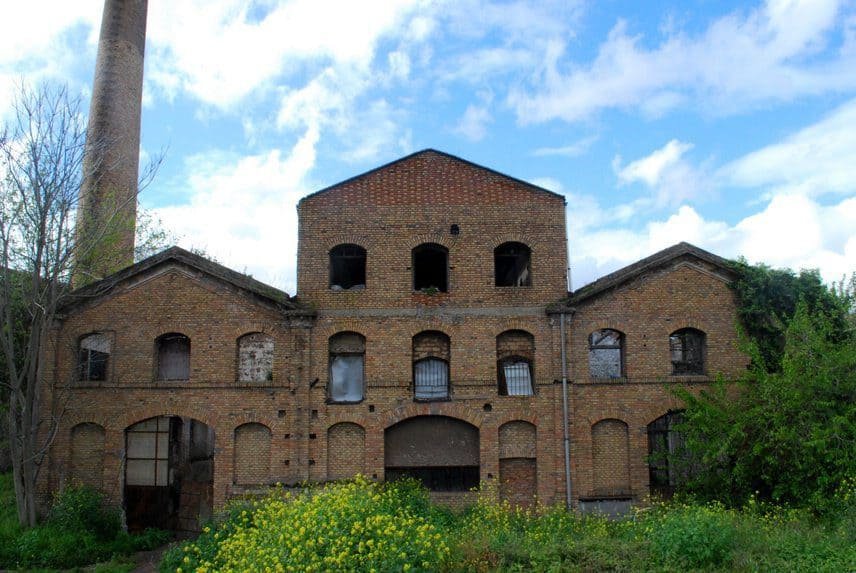
The Ex Mira Lanza is the former soap, candle and chemical plant that occupies the bend of the Tiber between Lungotevere Vittorio Gassman and Via dei Papareschi, in the Portuense district, Municipio XI of Rome, a few hundred meters from Ponte Marconi. Today it can't be visited. The disused industrial area is a fenced work site, subject since June 2025 to a cleanup and securing operation, and destined to become a student residence for Roma Tre University with an adjoining public park. The Ex Mira Lanza Museum, the urban art museum born in 2016 inside the abandoned soap factory around the paintings of the Frenchman Seth, is closed and shut down: those walls are inside a restricted perimeter and there is no lawful way to enter. The only part of the complex that can be visited legally, and with a ticket, is the Teatro India of the Fondazione Teatro di Roma, Lungotevere Vittorio Gassman 1, 00146 Rome, phone 06 87752210: single numbered seat €22 full price and €18 reduced, outdoor area €15 full price and €10 reduced, €15 for performing arts professionals, €12 for the single numbered seat for university students. The Teatro India box office opens only on show days, two hours before the start of the performance, and tickets can also be bought at the Teatro Argentina or through the sales circuit indicated by the theater itself. The nearest subway station is Marconi, on Line B, from which you cross Ponte Marconi and continue along the river. The buses that go up Viale Guglielmo Marconi and Via Antonio Pacinotti drop you a few minutes' walk away, and it's wise to check the lines in service on the transit company's website before leaving, because on this stretch the network changes often. The rest of the complex, that is the plant proper with the smokestack, the soap factory and the brick buildings, can only be seen from outside, from the riverside road and the side streets.
If you want to place the Ex Mira Lanza within the rest of the city, the page on tourist attractions in Rome gathers monuments and museums neighborhood by neighborhood, and in the case of Ostiense and Portuense it helps to understand how dense the fabric of industrial archaeology around this place is.

What You See Today of the Ex Mira Lanza
Anyone who arrives here expecting a museum finds a fence. It's worth saying so right away and without mitigation, because online there are still dozens of pages inviting people to slip through a hole in the wire mesh as if it were an experience to recommend: that season is over, and it ended badly for those who lived inside. What remains, and remains imposing, is a piece of early 20th-century industrial city leaning on the Tiber, with a brick smokestack visible from afar and a sequence of low, long sheds with gabled roofs and ribbon windows. The dominant color is the matte red of Roman brick, the one you find again in Testaccio at the Mattatoio and on Via Galvani.
The Perimeter of the Ex Mira Lanza
The complex occupies an irregular polygon between the river, Via Antonio Pacinotti, Via Amedeo Avogadro, Via Alberto Einstein and Via dei Papareschi. The riverfront is the most photogenic and also the most legible: from there you understand the logic of the plant, which was born to receive and ship by water and by rail, and which turned its back to the river only for reasons of elevation. The inner front, toward Via Avogadro and Via Einstein, is the one that in the last 20 years has seen everything go by: evictions, fires, occupations, barriers, the opening of the unauthorized museum and its end.
The place names of this strip of city tell a story on their own. The lungotevere has been called Vittorio Gassman only since December 29, 2006, when the Capitoline administration dedicated to the Genoese actor, born in 1922 and died in Rome in 2000, the stretch until then called Lungotevere Papareschi. That Lungotevere dei Papareschi had been established in 1940, within the great design of Rome's expansion toward the sea that the war interrupted: the factories were already there, were never dismantled, and the result is the somewhat crooked stratification still seen today, with a public theater wedged inside a soap factory and a street named for a medieval noble family that passes in front of a shed of 1919.
The Buildings of the Ex Mira Lanza Seen from the Street
From the sidewalk of the riverside road you can make out at least three different buildings. The first, the recovered and plastered one, with the sign and the gravel courtyard, is the Teatro India: it was the warehouse of 1919. Next to it, uphill, the taller and more run-down building is the soap factory, also of 1919, the one that housed the Ex Mira Lanza Museum and that went up in flames in 2014. Farther on you can sense the volumes of the boiler plant and of the fat extraction, and finally the smokestack, which is the element that holds the whole river front together visually.
On Via Pacinotti side the look changes completely: there the buildings are in use, tidy, with closed gates and the signs of the Red Cross. These are the warehouses and depots that were the last to be shut down, in the 1970s, and that had the luck of not staying empty long enough to fall into ruin. On Via dei Papareschi, instead, you recognize two low buildings: they were housing for the workers, and are abandoned.
Why You Can't Enter the Ex Mira Lanza
The reasons are three and they add up. The first is ownership: the area is public, in the hands of Roma Capitale, and under concession to Roma Tre University for building the student residence. The second is safety: after 70 years of abandonment, repeated fires and partial collapses, the structures are not usable, and securing them with the removal of the degraded parts is one of the first items of the work site. The third is the environmental cleanup: sulfuric acid, nitric acid, superphosphate and glycerin were produced here, and pyrites were burned. The soil must be characterized in a laboratory before anything can be put on top of it, and the procedure goes through the regional environmental agency.
I add the reason no sign writes: in June 2026 the fence was largely torn down, with the orange construction netting flattened on the ground and gaps open on the Teatro India side, on Via Avogadro and on Via Einstein. That one can physically pass does not mean one should. Inside there is dry vegetation, rubble, glass, potential asbestos and people. Entering is unlawful, it is dangerous and, in practice, it spoils the work of those trying to restart the work site.
The Work Site That Is Changing the Ex Mira Lanza
This is the part worth knowing before you arrive, because the place you see today will not be the one you see in a few years, and the transformation has already begun.
The 2025 Cleanup at the Ex Mira Lanza
On June 16, 2025 the cleanup and site-setup operations of the former plant began. The coordination was by the Capitoline Urban Planning office, together with the Heritage department, the environment, Municipio XI, the municipal environment company, the local police and the city's in-house company. The first phase, estimated at three or four months, included clearing the occupants, removing the waste accumulated over decades and securing the buildings. The declared figures speak of about 1,500 tons of waste to be hauled away and about 800,000 euros in costs for the disposal alone. Anyone who knows the area knows it is not an inflated number: inside the perimeter there had accumulated rubble, mattresses, carcasses of appliances, remains of fires.
The clearing phase was followed by the characterization of the soils, that is the campaign of core samples and analyses that establishes what is really in the soil and at what depth, with the involvement of the Lazio regional environmental protection agency. Only after this step can the area be handed over to the university for the studies preparatory to the project. It is a slow and unspectacular sequence, and it explains why a year later the place still seems stopped.
The Roma Tre Student Residence at the Ex Mira Lanza
On April 9, 2026, in the Aula Giulio Cesare in the Campidoglio, the act was approved that assigns the former plant to Roma Tre University in a 30-year renewable concession. The project calls for a public student residence of about 300 beds, with a guesthouse for visiting professors and spaces for teaching, research and cultural activities. The declared investment is about 30 million euros, borne by the university. Roma Tre was born in 1992 and has its center of gravity right here, between Ostiense and Marconi: the choice has an evident territorial logic, because it puts out-of-town students within walking distance of the classrooms.
The architecturally most interesting point is that the historic shell is not torn down. The core of 1899 is under monumental protection, and the adopted solution provides that the new building organism be encapsulated within the existing masonry box. It is the same philosophy that worked at the Centrale Montemartini and the Mattatoio: you keep the shell, you change the content. If done well, it produces buildings that tell two eras together. If done badly, it produces fake facades with a hotel behind. On this, the game is played on the execution details, and it's worth coming back to look in a few years.
The Parco Papareschi Next to the Ex Mira Lanza
Along with the student residence the Parco Papareschi is planned, a public green area of about 1.5 hectares integrated into the Ostiense Marconi Urban Project. For the Marconi district, which has very little equipped green space, it would be the first real public park. The restyling of the green areas was entrusted by the Urban Planning department to a company in the environmental sector, with an amount indicated at around 2.75 million euros.
In our judgment the park matters more than the student residence, for the neighborhood. 300 beds change the life of 300 students. 1.5 hectares of green on the river changes the life of 10,000 residents who today, to let a child run, have to take the bus. And if the park really arrives before the residences, this part of Portuense will stop being a backyard.
The Precedent: Reinventing Cities and the Competitions on the Ex Mira Lanza
Before the agreement with Roma Tre, the area had ended up in the international Reinventing Cities call, the competition promoted by the climate cities network that in 2019 put some disused Roman sites out to bid, asking for low-emission proposals, with a public park, spaces for crafts and social inclusion. What remains of that season are the renderings and the university theses: the Milan polytechnic, for example, hosted in 2023 and 2024 a thesis dedicated precisely to the identity of the Ex Mira Lanza between memory and transformation. This too is a useful fact for anyone looking at the fence and thinking nothing ever happened: here, on paper, a great deal has happened. On the ground, until 2025, almost nothing.
The Industrial History of the Ex Mira Lanza
The factory we call Ex Mira Lanza was not born as Mira Lanza. It was born as a chemical plant, and the difference is not a scholar's detail: it explains why the soil must be cleaned up, why there is such a tall smokestack and why the complex has that comb layout, with long buildings side by side and maneuvering courtyards in between.
1899: the Società Prodotti Chimici Colle e Concimi
In 1899 the Società Prodotti Chimici Colle e Concimi acquires from the engineer Giulio Filippucci a strip of land south of Rome, on the right bank of the Tiber, opposite the Mattatoio that the city was completing in Testaccio. The plant produces superphosphate, nitric acid and sulfuric acid, and to do so it puts into operation the pyrite furnaces meant for fertilizers. The first industrial building dates to 1899 and in the architectural history records the names that recur for the historic buildings are those of Filippucci, Moretti and Bagnasco.
It's worth pausing a moment on what such a plant meant at the end of the 1800s. Superphosphate is the fertilizer that allowed Italian agriculture to leave the medieval rotation. To produce it you need phosphorites and sulfuric acid. To produce sulfuric acid you burn pyrites in dedicated furnaces, with emissions that no city today would accept a kilometer from the built-up area. Rome as the capital, in those years, pushes the dirty processes outside the walls and along the river, where water serves as a transport route and as a drain. Ostiense becomes the industrial zone of the city for the same reason that the Gazometro, the thermoelectric plant on Via Ostiense, the Mercati Generali and the Mattatoio were built there.
Why the Factory Was Born Right Here
The location of the Ex Mira Lanza is not random and should be read by looking at the opposite bank. The municipal Mattatoio of Testaccio, designed by Gioacchino Ersoch and active from 1891, produced enormous quantities of animal waste every day: fats, bones, blood, trimmings. That waste was the raw material of soap-making and of stearic candles. A soap factory placed a few hundred meters away, on the other bank, with an iron bridge just downstream, had a logistical advantage no competitor could match: the raw material arrived fresh, daily, without significant transport costs.
Add the other two factors. The river, which until the first decades of the 1900s was still a commercial navigation route, with the river port of San Paolo and the general warehouses. And the railway, with the Ostiense yard and the industrial sidings that served the whole strip. Anyone who visits the district today and sees only buildings from the 1960s struggles to imagine it, but for half a century this was the point where Rome made things instead of just consuming them.
1906 and 1913: Petroleum, Bankruptcy, the City
In 1906 part of the area is sold to the Società Italo Americana del Petrolio, which sets up its depots there: it is the building that on the historic map of the complex bears the number 9. In 1913 the chemical company goes bankrupt and the City of Rome acquires the site. The administration's initial idea is to turn it into a plant for treating urban waste, a hypothesis later shelved.
The war intervenes. Producing glycerin in Rome becomes a strategic matter, because glycerin is the ingredient of nitroglycerin and therefore of dynamite factories. The city transfers the area to the Fabbrica Candele Steariche di Mira, which from 1918 expands the plant and reorients it toward soap-making and stearin production. The construction dates of the main buildings cluster right there: 1918 for the management, the gatehouse and the services, 1919 for the warehouse, the soap factory, the boiler plant and the pyrite furnaces, 1920 for the stables. In two years, under the war push, the plant doubles.
The Soap War and the Birth of Mira Lanza
In the years that followed, what the business press of the time called the soap war was fought. On one side was Mira, from the Veneto, a candle factory founded in 1831 along the Riviera del Brenta on the initiative of Viscount De Blangi with capital from Trieste, which in 1880 was turning out 1,200 tons of soap a year and in 1905 became a joint-stock company listed in Milan. On the other was Turin's Premiata Reale Manifattura di saponi e candele steariche fratelli Lanza, founded in 1832, which Cavour called a priority industry of the Kingdom of Sardinia and which by 1907 had already merged with Genoa's Piaggio to create the Unione Stearinerie Lanza.
On May 9, 1924 the two merged. Mira Lanza was born, headquartered in Genoa with plants in Genoa, Rivarolo, Mira, Rome and Naples. Costantino Moretti was president and Giuseppe Piaggio vice president. In 1926 the company was listed in Milan. In 1927 the Banca Commerciale Italiana came in and the presidency passed to Giuseppe Toeplitz, who held it until 1934. The reason for the merger is the one you read in every business history textbook: foreign multinationals, the German ones in the sector and the American Procter and Gamble, were eroding the Italian detergent market, and two medium-sized companies together held up better than two medium-sized companies apart.
What changes in Rome after the merger
The Rome plant immediately felt the effects of the streamlining. The management building and offices became superfluous, because the new company's headquarters was in Genoa. It was decommissioned and handed over to the City of Rome, which put a school there from 1924. It is building number 8 on the map, and the school still exists today, named after Giovanni Pascoli. Walk past it and think about it: generations of Roman children have learned to read inside the former technical office of a candle factory.
In the meantime new buildings went up, almost all unrelated to production: logistics, services, workers' housing. Two of those housing blocks are still standing, abandoned, on Via dei Papareschi. Between the two wars the company grew, revenues and profits rose, and during Fascism it even came to manufacture on commission for its competitor Palmolive, which in this way got around the regime's protectionism. It's a detail that says a lot about the elasticity of autarky: the foreign brand was forbidden, contract manufacturing was not.
The crisis, synthetic detergents and the 1952 closure
The Second World War hit hard. Labor was lacking, raw materials were lacking, and one wing of the complex was partly destroyed by bombing. When the war ended Mira Lanza started up again, but with a new technology: the first synthetic detergents, which no longer needed animal fats. That was the end of the Rome plant. Its whole reason for being was its proximity to the Mattatoio and the processing of slaughterhouse waste. Converting it to synthetic chemistry would have cost more than building a new plant somewhere else.
Production in Rome closed in 1952. Some local accounts give 1957 as the year the remaining operations finally ceased. The date that recurs in company documents and historical sheets is nonetheless 1952, and the difference probably comes from a tail of non-production activities. In 1961 the plant proper passed to the City of Rome. The buildings and warehouses facing Via Pacinotti, on the other hand, stayed in use for years, serving for distribution to wholesalers and for managing the prizes of the trading card collection, the one that filled the drawers of half of Italy.
After Mira Lanza: what happened to the brand
The company's story continues far from Rome, and it's worth finishing it, because it explains why the Mira Lanza name no longer appears on shelves today. In 1972, after the arrest of Andrea Maria Piaggio and the breakup of the family group, Mira Lanza passed to the Bonomi group. In 1984 it was sold to Montedison. In 1987 control went to Raul Gardini with Ferruzzi. In November 1988 the company was sold to the German-Dutch Benckiser, which in December 1999 merged with Reckitt and Colman to form Reckitt Benckiser. In 2001 the Mira Lanza brand was definitively retired. The Pontinia plant, opened in 1966, had already closed in July 1989. Of the old empire, the research center in Mira, in the province of Venice, is still active.
The buildings of the Ex Mira Lanza, one by one
The historical map of the complex numbers 14 lots. It's worth going through all of them, because it's the only way to understand what you're looking at when you view the fence from the Lungotevere. Many of these buildings can still be seen, some have been restored, others have disappeared.

1. The 1919 warehouse, now Teatro India
Building number one is the warehouse, built in 1919. It is the only building in the complex that has been fully renovated and put back into use. Since 1999 it has housed Teatro India. The original structure is that of a three-nave shed with a roof of wooden and iron trusses, and anyone who walks into the hall notices right away, because the design left the beams exposed and hid nothing.
2. The 1919 soap works, home of the Ex Mira Lanza Museum
Number two is the soap works, also from 1919, the productive heart of the plant in its Mira phase. It is the abandoned building that housed the Ex Mira Lanza Museum between 2016 and its closure. In 2014, after an eviction, this building was set on fire. The walls blackened by the blaze are exactly the ones Seth found and painted on two years later. It is the most fragile building in the complex and the one that needs the most consolidation work.
3. Boilers and fat extraction, 1919
The third building housed the boilers and the fat extraction plant, that is, the department where animal waste was cooked and separated. It is abandoned. From the standpoint of industrial archaeology it is the most interesting part, because it preserves traces of the original production cycle, and at the same time the most compromised.
4. Pyrite furnaces and sulfuric acid storage, 1919
The fourth lot holds the pyrite furnaces and the sulfuric acid storage, a direct legacy of the 19th-century chemical phase. It is listed as under renovation, in the care of Teatro India. It is the theater's natural expansion uphill, and its fate will depend on how the student housing construction site fits together with the theater one.
5 and 6. The superphosphate storage and the 19th-century offices
Number five is the superphosphate storage, which dates to 1907. Number six is the offices and residences, dated between 1899 and 1907. It is the oldest core of the whole complex, the one that carries the monumental protection order and that the redevelopment project promises to preserve by encapsulating the new inside it. Both are assigned to the Military Red Cross.
7. Gatehouse, infirmary, nursery and canteen, 1918
The seventh building is the one that tells the story of the factory as a social organism. In 1918 a building was put up that holds together a gatehouse, an infirmary, a nursery for the workers' children and a canteen. It is early 20th-century corporate welfare, with all its ambiguities: real assistance and equally real control. Anyone who studies industrial archaeology knows that these buildings are often the most modest and the most significant.
8. The 1918 general management building and the Giovanni Pascoli school
Eighth lot: general management, technical offices and chemical laboratories, built in 1918. Sold to the City of Rome after the 1924 merger, it has housed the Giovanni Pascoli school ever since. It is the only building in the complex that has never stopped functioning, and the fact that its function is a school gives the neighborhood a continuity that the other lots have lost.
9. The area of the Società Italoamericana del Petrolio, 1906
The ninth lot corresponds to the oil depots set up in 1906, when part of the area was sold to the Società Italoamericana del Petrolio. It is a little-told chapter: this bend of the Tiber housed not only chemicals and soap but also hydrocarbon storage, with everything that implies for soil contamination.
10 and 11. Truck station and stables
The tenth lot is the 1919 truck station, currently assigned to the Red Cross. The eleventh is the stables from 1920. The coexistence is the most eloquent thing in the whole list: in 1919 the garage for trucks was built, in 1920 the stable for horses. For at least a decade the transport of goods in Rome went on with both systems, and a serious factory had to be equipped for both.
12 and 13. The workers' housing on Via dei Papareschi
Twelfth and thirteenth lots: the housing. Both abandoned, both still recognizable on Via dei Papareschi. They are low buildings with no architectural pretensions, and they are the only trace left of the working community that lived here. When they are restored or torn down, nothing visible will remain of that community.
14. The empty area and the thermoelectric plant that was never built
The fourteenth lot is an empty space today. It housed the superphosphate machinery, the nitric acid storage, the copper sulfate storage, the locker room and canteen, a gatehouse, the oil refining and the plant for lye glycerin. In this same area a thermoelectric plant fueled with olive pomace waste was supposed to rise. The project was submitted to the city with the building application in 1939, but the approaching war stopped its construction. A biomass plant in 1939, fueled with the residue of olive milling, is an idea that would pass for environmental innovation today and that back then was simply the cheapest way of not throwing anything away.
Teatro India inside the Ex Mira Lanza
Teatro India is the only legal and elegant way to set foot inside the Ex Mira Lanza. It isn't a consolation prize. It is one of the most beautiful theaters in Rome, and it is so precisely because it wasn't built as a theater.

How Teatro India came to be
Teatro India opened on September 7, 1999 inside the 1919 warehouse, in the citadel of the former factory on the banks of the Tiber. The name was chosen by Mario Martone, then artistic director of the Teatro di Roma, to echo Teatro Argentina with another exotic place name and at the same time to evoke the idea of exploration. Martone, born in Naples on November 20, 1959, held the directorship between 1999 and 2001 and personally wanted the construction of the new spaces. This theater exists thanks to him, and the fact is documented in the encyclopedia entries devoted to him as well.
Teatro India was the last theater opened in Rome in the 20th century. Put that way it sounds like quiz trivia, but in reality it marks a watershed. Until the 1990s, theaters in Rome were carved out of historic halls, deconsecrated churches, disused cinemas. With India the city chose for the first time to take an industrial shed and treat it as a noble material, without disguising it. The conversion project, begun in 1999 and continued in the following years, is attributed to the firm Colombari e De Boni, and the criterion adopted is that of a sequence of covered squares: flexible spaces, without level changes, that can be used frontally, in the round, vertically or in a roving format.
The halls of Teatro India
The total capacity declared by the theater is about 400 spectators per evening, spread over three modular spaces. Sala A has a fixed grandstand and holds from a minimum of 180 to a maximum of 300 people. It has black walls and an industrial concrete floor, and those who perform in it say the sound behaves unusually generously thanks to the wooden trusses. Sala B instead has a movable grandstand and runs from 132 to 300 seats, with the same aesthetic signature as the first. Sala C, 8.6 meters wide and 47 meters long, has a parquet floor and is the rehearsal room, suitable for dance as well.
Then there is the atrium, about 400 square meters with white walls and a truss ceiling, which works as a foyer, an exhibition space and sometimes a stage. And there is the outdoor courtyard, divided into two large spaces, with a gravel floor interspersed with grassy areas. In summer it becomes the most beautiful hall of the complex, and tickets for the outdoor area cost less precisely because the theater considers that space a setting of its own.
What you see of the old factory when you enter Teatro India
If industrial archaeology is on your mind, find time to arrive half an hour before the show and walk around the courtyard. The theater preserves the dark bricks on the outside, the pitched roofs, the wood and iron beams, the three-nave layout of the original warehouse. From the courtyard you can also look at the rest of the complex, and from there the view onto the ruined soap works is the best you can get while staying on the right side of the fence. The theater's bar is open on show nights and has an outdoor seating area that on July evenings is one of the most civilized places in Rome.
Tickets, hours and reservations for Teatro India
The prices listed by the Fondazione Teatro di Roma for Teatro India are €22 for the full-price numbered single seat and €18 reduced. For the outdoor area it is €15 full price and €10 reduced. It is €15 for performing arts workers, and €12 for the numbered single seat for university students, with the usual exclusion of the last performances. The India box office opens only on show days, two hours before the start of the performance, so don't count on stopping by during the day to buy tickets. They are bought at Teatro Argentina, in Largo di Torre Argentina, or through the sales network the theater lists on its website. The phone number is 06 87752210. Rates change from season to season and it's best to check them on the website of the Fondazione Teatro di Roma before you go.
The Fondazione Teatro di Roma runs four venues: Argentina, India, Torlonia and Valle. If you come to Rome for the theater and not just for the monuments, India is the hall where you see experimental work and Argentina is the one where you see the big repertory productions. It's best not to choose by the name of the show but by the space: at India, what uses the industrial volume works better, and drawing-room theater works less well.
India Città Aperta and summer at Teatro India
In summer the theater doesn't close. The India Città Aperta festival takes over the courtyard and the outdoor spaces with theater, music, performance and talks. In 2026 it ran from July 14 to 31, and you can find the program on the page devoted to India Città Aperta at Teatro India. It's the best time of year to see this place: low lights on the bricks, the river behind, the black chimney against a sky still light at nine in the evening. If I had to name a single Roman evening when industrial archaeology and live performance walk hand in hand without rhetoric, I would name an open-air performance at India in mid-July.
Teatro India is declared accessible to people with motor disabilities. Anyone who needs dedicated seats should still make a phone call first, because the layout of the grandstands changes from production to production and Sala B has movable bleachers.
The Ex Mira Lanza Museum: the story of an unauthorized museum
Here we need to be precise, because it's the part of this story that circulates the most distorted. The Ex Mira Lanza Museum was never a museum in the administrative sense of the term, it never had a permit, it never had a ticket, and today it no longer exists.

999Contemporary and Stefano Antonelli's idea
In 2016 the cultural association 999Contemporary, led by the curator Stefano Antonelli, decided to bring an international artist into an occupied ruin and call the result a museum. The operation cost about €23,000, a figure stated by the organizers, and it was conceived as a political act even before an aesthetic one: a way of forcing the city institutions to look at an area nobody had looked at in 60 years. Antonelli said at the time that he wanted to bring the mayor here, and the circumstance had something mocking about it, since the headquarters of her political movement was a few steps away.
999Contemporary was not a group of improvisers. It is the same outfit that worked on some of the most discussed urban art projects in Rome in the 2010s, and that has always held together two things that are hard to hold together: the quality of the artists it brought in and the placement in politically uncomfortable places.
Who Seth is, the painter of children
Julien Malland, who signs as Seth, was born in Paris and graduated from the national school of decorative arts in 2000. He began by signing as Set, then adopted the final form. He earned the nickname Globe painter by painting in dozens of countries, from France to Canada, from China to Chile, from Indonesia to Ukraine, and between 2009 and 2014 he made 13 reports titled Globe painter for a French television series about the new explorers. He published Kapital in 2000, Globe painter in 2007, Tropical Spray in 2010, Extramuros in 2012 and the two volumes of Lascars.
His signature is recognizable at a glance: anonymous children, almost always seen from behind or with their faces replaced by fields of color, immersed in chromatic geometries that leave the figure and invade the wall. They are not reassuring children. They are figures about to cross something, and the color is the gateway. In a ruin blackened by fire, that language works with a force it doesn't have on a facade in the suburbs.
Seth's works inside the soap works
Seth worked in the summer of 2016 on number two on the map, the soap works. He colored the brick pillars of the main gallery and covered the walls with frescoes of his child figures set in contemporary contexts. The spaces were given names. The open-air area with the painted columns was called Palmira, a direct reference to the Syrian ruins that were in the news in those months. The main gallery carried the title Lux in tenebris. One of the works was titled Lampedusa. There was the artist's signature, painted in huge letters in red paint across an entire wall, and there was the inscription that became the manifesto of the whole operation, an explicit invitation to break the law right there.
The formula with which the museum presented itself deserves to be quoted because it sums up everything: open 24 hours a day, free admission, no toilets, no souvenir shop, no high heels, yes to Roma. It is written in English, with a deliberate crudeness, and the final word is the one the authors chose deliberately in order to reverse its sign.
Tito and the Unauthorized Museum Run by the Roma
From 2017 a Roma family settled at the end of the gallery. The head of the family, Tito, split his job as a parking attendant at Piazzale della Radio with that of director and curator of the museum, and acted as guide to those who came. The acronym by which the project was renamed, M.A.G.R., stands for Museo Abusivo Gestito dai Rom, the Unauthorized Museum Run by the Roma. In March 2018 999Contemporary organized free guided visits by reservation, warning in writing that the visit was free, illegal and at the visitor's own risk.
This is the point where the operation becomes something more than an artistic intervention. A group of people the city considers a problem found themselves administering a cultural heritage, explaining it to visitors, deciding the hours. The national press covered it at length, with very distant positions. Some saw an experiment in cultural citizenship, some denounced the paradox of an unauthorized museum with public sponsorship, and some questioned the danger of letting people into an unsafe ruin. All three positions had good arguments, and the affair ended without any of them winning.
Why the Ex Mira Lanza Museum no longer exists
The museum was shut down and can no longer be visited. The reasons are the same ones that made the whole area inaccessible: progressive decay, fires, the impossibility of guaranteeing safety, and finally the setting up of the construction site in June 2025 with the eviction of the occupants. The works had also already deteriorated considerably on their own, because the place changed constantly, with structures put up and taken down by the people who lived there, water infiltration, minor fires and other writing layered on top.
Put plainly: that operation got what it set out to get. It drew attention to an area that was invisible, and in 10 years it went from absolute nothing to a 30-year concession with 30 million in investment and a public park. The price was that the museum had to disappear for the rest to happen. It is a paradoxical outcome and, in its own way, consistent with the ephemeral nature of urban art. Those who grew attached to those images will miss them. Those who live on Via Avogadro will breathe easier.
What it is not: the MURo is not here
One misunderstanding you often read needs clearing up. The MURo, Museo di Urban Art di Roma, is something else and is located elsewhere. It is the project founded by the artist David Vecchiato, known as Diavù, and its works are spread mostly across Quadraro and Tor Pignattara, in the eastern part of the city. If you are looking for Rome's open-air urban art museum, take Metro Line A and get off at Porta Furba or Numidio Quadrato. Don't come to Portuense. At the Ex Mira Lanza there was a different experience, with other protagonists and another story, and confusing the two does justice to neither.
Calimero, the Dutch girl and the trading cards: the Ex Mira Lanza in Italian memory
There is a reason the Mira Lanza name means something even to people who have never set foot in Portuense, and it has to do with television and with the drawers of Italian kitchens.
The black chick and the Ava detergent
On July 14, 1963 the first episode aired on Carosello with a black chick complaining about being treated unfairly. His name is Calimero, the copyright belongs to the brothers Nino and Toni Pagot and to Ignazio Colnaghi, co-author of several scripts, and the product he advertises is Ava detergent from Mira Lanza. The line everyone remembers is the protest about the injustice suffered. The slogan that accompanied the product played on the similarity between the name of the detergent and the verb to wash. The narrative solution always came from the Dutch girl, the spokeswoman in traditional costume who explained that the chick wasn't black, he was just dirty, and gave him back white and happy.
It's worth thinking about it for a second, because it is an ambiguous piece of Italian cultural history. A discriminated chick who is rehabilitated by being whitened is, read today, an advertising parable of a cultural bleach before it was a chemical one. At the time nobody put it in those terms, and Calimero became one of the best-loved characters on Italian television, so much so that he outlived the company that created him and had a second life in animation, Japanese animation too. The link with this factory is indirect but real. When Calimero aired, the production in Rome had been closed for 11 years, but the warehouses on Via Pacinotti still served distribution and the prizes.
The trading cards and the prize catalog
The other feature that tied Mira Lanza to Italian home life is the collection of trading cards inserted in the packages, a prize points system that ran from 1954 to 1991. 37 years of colorful cards slipped into the detergent drums, of albums to complete, of prize catalogs to leaf through. Whole Italian living rooms were furnished with Mira Lanza points.
The part that concerns this place directly is that the management of the prizes went through here for a long time. The buildings and warehouses facing Via Pacinotti, the last to be decommissioned in the 1970s, were used for distribution to wholesalers and for the administration of the famous collection. It means that for two decades after production closed, this block of Portuense remained the place where trading cards turned into pots, blankets and bicycles. It is an intangible legacy, and for a neighborhood that lost its factory it is probably the most tenacious.
The Mira Lanza brands
For those who remember the products: among the group's main brands were Ava, Lip, Kop, Biol, Calinda, Perla, Nix, Lanza and Tres. In the 1960s and 1970s the company dominated the Italian detergent market, and its advertising on Carosello, with Calimero and the Dutch girl, was among the most recognizable on the schedule. Then came the changes of ownership, the finance, the multinationals, and in 2001 the name disappeared from shelves. What remains is the chimney on the Tiber and a black chick.
The Ex Mira Lanza and the industrial archaeology of Rome
This plant is not an isolated case. It is part of a system, and understanding that changes the way you look at it. Within a radius of two kilometers, between the two banks of the Tiber, Rome preserves the densest concentration of industrial archaeology in central Italy, and it has chosen a different path for each piece: museum, theater, nightclub, ruin, construction site.

The Gazometro, the bulky neighbor of the Ex Mira Lanza
The Gazometro is the tall lattice structure you see from the river front of the Ex Mira Lanza and from half the city. It was part of the San Paolo gasworks, a plant created to meet Rome's energy needs after 1871, and work on the complex began in 1908. Today the perimeter belongs to the national energy company, which has set up research and innovation activities there. It is not a monument you can visit with a ticket. Public openings happen on scheduled occasions, in collaboration with the environmental foundation that organizes the visit days, and you have to book when they are announced.
From the outside, though, it looks great, and it is the perfect counterpart to the Ex Mira Lanza: one is all iron, air and emptiness, the other all brick, weight and fullness. Photograph them together from the bridge and you'll have in one shot the two ways Rome built its industry.
The Centrale Montemartini, the successful model
On the other bank, at Via Ostiense 106, the Centrale Montemartini is the proof that a conversion can succeed perfectly. It was Rome's first public thermoelectric plant. Today it houses ancient statues from the Capitoline Museums among diesel engines and boilers, with a visual short circuit that no traditional museum manages to produce. It is open Tuesday to Sunday from 9:00 to 19:00, closed Monday, May 1 and December 25, with last entry one hour before closing. It's best to check rates and special openings on the official website before going.
If someone wants to understand in half an hour what the Ex Mira Lanza could become, I send them to the Montemartini. It's the same mental operation: you don't hide the machine, you don't pretend the factory was never there, you put the new content inside the old container and let the two look at each other.
The Mattatoio di Testaccio, the twin factory
The Mattatoio, across the river, is the building without which the Ex Mira Lanza would never have existed: it was the source of the animal fats. Designed by Gioacchino Ersoch and active from 1891, decommissioned in 1975, it is now a cultural hub with exhibition spaces, university facilities and the Città dell'Altra Economia. If you want to read the two factories together, walk from the bridge to the Mattatoio. It's just under 20 minutes and the relationship between the two complexes becomes physical.
In the district there is also the Museo Diffuso del Rione Testaccio, which tells the working-class memory of the neighborhood, the Nuovo Mercato Testaccio and the Monte dei Cocci, which is industrial archaeology 2,000 years ahead of schedule: an artificial hill made of broken olive oil amphorae, the first planned waste disposal site in European history.
The river port, the bridges and the railway
The last piece of the system is the bridge. The Ponte dell'Industria, which Romans call Ponte di Ferro, was built between 1862 and 1863 and is 130 meters long. It began as a railway bridge to connect Rome with the line to Civitavecchia, and later became the road bridge of the industrial zone. On October 2, 2021 a fire put it out of service. After a work package worth €18 million carried out by the national roads company, with dismantling of the deck, consolidation of the supporting structures, restoration of the lattice girders and widening of the roadway from 5.5 meters to 8, the bridge reopened to traffic in March 2025, with a pedestrian walkway and a bike lane.
It's worth crossing on foot. The original lattice girders, reassembled, are a piece of 19th-century English engineering that arrived in Rome when the city had not yet decided to be a capital. And the view of the Ex Mira Lanza from there is one of the best.
What to see around the Ex Mira Lanza
Those who make it this far shouldn't go back disappointed because the fenced area is closed. Within a 20-minute walk, or one metro stop, there is material for a whole day.
10 minutes on foot from the Ex Mira Lanza
The first ring is the neighborhood. The Lungotevere uphill leads to the bridge, and from the bridge you cross to the other bank into Ostiense. Downstream, the Lungotevere continues along the right bank to the green areas of Pietra Papa. The Giovanni Pascoli school, in the former factory management building, is a stone's throw away and is worth a look from the outside for its facade of a converted industrial building, converted before converting was fashionable. On Via dei Papareschi you can recognize the abandoned workers' housing.
On the food front Portuense is not Testaccio, and let's not pretend it is. Here you eat in unpretentious neighborhood trattorias and at pizza-by-the-slice places, and that's perfectly fine. The bar at Teatro India, on show nights, remains the most pleasant choice for a drink while looking at the bricks.
20 minutes: Ostiense, Piramide, Testaccio
Once you cross the river you enter the most interesting triangle of 20th-century Rome. The Pyramid of Cestius, the tomb of Gaius Cestius built between 18 and 12 BC and incorporated into the Aurelian walls, is the monument that gives the whole area its name. Next to it, the Cimitero Acattolico, where Keats and Shelley rest, is one of the quietest places in the city. A little farther on the Museo della Via Ostiense, housed in Porta San Paolo, tells the story of the ancient road that led to the port of Ostia.
Continuing along Via Ostiense you reach the Basilica di San Paolo fuori le Mura, the second largest in Rome, rebuilt after the fire of 1823 and with a Cosmatesque cloister that alone justifies the trip. And there is the Archivio Storico e Museo Birra Peroni, which completes the picture of Roman industry with the story of another great city plant.
A little farther: Garbatella, EUR and the right bank
One metro stop away is Garbatella with its 1920s lots, and in summer the film festival that runs through Garbatella and Ostiense, described on the page for Laperossa between Garbatella and Ostiense. Going further down you reach EUR, which is the other great urban planning operation of 20th-century Rome and deserves a day of its own. On the right bank, toward Trullo, the Necropoli di via Portuense is a reminder that beneath the factories there was already a city of the dead from the imperial age.
For those who want to stay with the contemporary, the MACRO and the MAXXI are the other two hubs of the art of our time in Rome, both reachable in just under half an hour, and both useful for putting in context what happened in the years when Rome was debating street art in ruins.
The street art around the Ex Mira Lanza
Ostiense was one of the first Roman neighborhoods to become an urban art route, and anyone who comes this far for Seth would do well to shift the search to the other bank, where the works are on the street, legal and visible.
The neighborhood's main works
On Via del Porto Fluviale there is Iena Cruz's ecological mural from 2018, made with photocatalytic paint that absorbs pollutants and long described as the largest of its kind in Europe. Also on Via del Porto Fluviale is Agostino Iacurci's work from 2011, with its children swimming among fish. On Via dei Magazzini Generali you'll find JB Rock's Wall of Fame, a procession of portraits of contemporary icons, and the series of faces of Ostiense residents signed by the duo Sten and Lex, who have one of their densest concentrations here. On Via delle Conce there is another Sten and Lex portrait from 2011, a hyperrealist work by MTO and a monochrome wall by Herbert Baglione. On Via del Commercio, the 65 meters of Kid Acne, from 2011.
The practical advice is to walk the ring starting from Piramide and finishing on Via Ostiense. It's about two kilometers, takes an hour and a half at an easy pace, and the best light is late afternoon, because many walls face west.
What has already disappeared
If you arrive with a guidebook from five years ago, some addresses will disappoint you. The mural Blu painted in 2014 on the former occupied barracks at the corner of Via del Porto Fluviale and Via delle Conce is gone. The facades were repainted during the renovation of the building, financed with funds from the national recovery and resilience plan, which turns the historic occupation into regular housing for the same residents. The artist, according to local press accounts, consented to the removal, judging that the project achieved the goal for which the work was created, namely the right to housing. Other works by different authors have also vanished over the years through renovations, demolitions or simple wear.
This is the point no tourist guide ever makes clear: urban art is not permanent heritage, it is an art with an expiration date. Whoever photographs it preserves it, whoever waits loses it. The Ex Mira Lanza Museum is the extreme case of this rule.
How to really visit the Ex Mira Lanza
The outer loop, an hour well spent
The route I recommend to those who want to see the place anyway is this, and it takes between 50 minutes and an hour and a quarter. You start from the bridge, looking at the river front of the complex and the Gazometro in the background. You go down to Lungotevere Vittorio Gassman and follow it to the gate of Teatro India, reading the sequence of factory buildings. You continue on Via Antonio Pacinotti, where the buildings in use show what the complex was like when it was working. You turn onto Via dei Papareschi for the abandoned workers' housing. You return toward the river, passing in front of the school in the former management building. And you finish, if possible, with a coffee or a beer at the theater's bar on show nights.
When to go to the Ex Mira Lanza
The best season is between October and May, for two reasons: the low vegetation lets you see more and the low sun lights up the brick. In summer the place is arid and the walk along the Lungotevere, with no shade, is punishing at noon. The best time of day is the last hour and a half of light, when the western front of the complex catches the full sun and the chimney casts a long shadow over the theater's courtyard.
Avoid early Sunday morning, when the area is deserted and there is nobody around. It's not a place where it makes sense to find yourself alone. On show nights, on the other hand, the neighborhood is lively and the outer loop becomes pleasant even after sunset.
The Ex Mira Lanza with kids
It isn't a destination for small children, and it would be dishonest to say otherwise: there is nothing to touch, nothing to go into, nothing to eat within immediate reach. It works very well, though, with kids aged 12 and up who study contemporary history or are interested in urban art, because the story of the factory, the unauthorized museum and the construction site is a complete case study of what happens to a building when its function dies.
With younger children it's best to shift the center of gravity of the day. The Centrale Montemartini, with its statues among the engines, works at every age, and the Monte dei Cocci with its story of broken amphorae is a tale that children follow gladly. Teatro India, moreover, has a part of its seasonal program devoted to schools and families, and the Fondazione Teatro di Roma has been running for years an integrated theater workshop devoted to inclusive participation.
Accessibility of the Ex Mira Lanza
Teatro India is listed as accessible to people with motor disabilities, with dedicated seats in the hall. For the exact layout a phone call to the theater's number is advisable, because the grandstands change from show to show. The outer loop along the Lungotevere can be done in a wheelchair, with the caveat that the sidewalks of Via dei Papareschi and Via Pacinotti are uneven, with level changes and roots, and that there may be narrowings in the construction stretch. The factory area, obviously, is not accessible to anyone.
How much it costs to see the Ex Mira Lanza
The outer loop costs nothing. The only cost is the Teatro India ticket if you want to enter the complex: €22 for the full-price numbered single seat, €18 reduced, €15 full price and €10 reduced for the outdoor area, €12 for university students on the numbered single seat. A practical tip: if there are two of you and you want to pair something with it, the most efficient combination is an evening show at India preceded in the afternoon by the Centrale Montemartini. It costs little, takes a day and tells the entire arc of Roman industry, from the power plant that becomes a museum to the soap works that becomes a theater.
A curiosity about the Ex Mira Lanza
The curiosity I like best concerns a power plant that never existed. In 1939 the plant's management submitted to the City of Rome the project and the building application to construct, in the area that is empty today corresponding to lot 14 on the map, a thermoelectric plant fueled with olive pomace waste. It wasn't a whim. Exhausted pomace, that is, the residue of olive milling after the oil has been extracted, has a considerable calorific value and Italy produced it in enormous quantities. The factory would have burned an agricultural waste product to feed its own furnaces and boilers, closing the loop on industrial waste almost 80 years before the expression circular economy entered the vocabulary.
Construction never started. The world war was at the door and the site stopped before it began. It is one more missed opportunity for a place that has collected quite a few, but it is also the most eloquent document of the mentality that governed this factory. Nothing was thrown away here on principle. Waste from the Mattatoio became soap and candles. Spent lye became glycerin. The olive residue was supposed to become electricity. Anyone who passes the fence today and sees a heap of waste of 1,500 tons to be disposed of should know that this same perimeter, a century ago, was designed to be the exact opposite of a dump.
A second detail worth keeping in mind: the factory was born to produce fertilizers and acids, not soaps. The name found on the oldest papers, Società prodotti chimici colle e concimi, says exactly that. Soap came 20 years later, for wartime reasons, and the glycerin produced here served the dynamite factories. A scented candle factory that is born out of gunpowder is a genealogy no Mira Lanza advertisement ever told.
One thing nobody tells you about the Ex Mira Lanza
That the complex has a building that never closed, and that no industrial archaeology guide ever names: the school. Building number eight on the map, the general management with the technical offices and chemical laboratories built in 1918, was sold to the City of Rome right after the 1924 merger, because the new company's headquarters was in Genoa and those offices were no longer needed in Rome. The city put a school there, which has operated without interruption since 1924 and is named after Giovanni Pascoli.
It means that while the soap works burned and the unauthorized museum opened and closed, 100 meters away children kept going to school inside a piece of the same factory, without interruption, for over a century. It is the most underrated fact of the whole story, and it overturns the narrative of total abandonment: the Ex Mira Lanza was never completely dead, it's just that the living part didn't make the news.
The second thing nobody says concerns the administrative geography. Everyone places the Ex Mira Lanza in Ostiense, and even the name of the urban planning project that concerns it is called Ostiense Marconi. But Ostiense is on the left bank and this complex is on the right: we are in the Portuense district, Municipio XI, and the Lungotevere in front of it was established in 1940 as Lungotevere Papareschi and renamed Vittorio Gassman only on December 29, 2006. This is not toponymic pedantry. If you look for the address with a navigator by entering Ostiense, you end up on the other side of the river and lose 20 minutes looking for a bridge.
The third warning: the official street number of Teatro India is Lungotevere Vittorio Gassman 1, but some institutional databases also record the entrance on Via Luigi Pierantoni. If your driver insists on one address and can't find the other, know that it is the same complex seen from two different sides.
The advice I give you for visiting the Ex Mira Lanza
Buy a ticket for a show at Teatro India and arrive an hour early. It is the only advice that is really useful, and it is worth more than any attempt to get around the fence.
The reasons are practical. First: with the ticket you legally enter the perimeter of the former plant, that is, building number one on the map, the 1919 warehouse, and you see from the inside an early 20th-century industrial structure with its trusses and its three naves. Second: the theater's courtyard offers the best view that exists of the rest of the complex, soap works included, without risk and without breaking the law. Third: the box office opens only two hours before the performance, so arriving early is not a sacrifice, it is the condition for finding a seat and for having time to walk around.
If you have to choose the evening, choose July and the summer festival that takes over the courtyard. The open-air shows also have the cheapest ticket, €15 full price and €10 reduced, and they sit you inside the former factory with the chimney over your head. In winter Sala A works well, with its black walls and industrial concrete floor. It is the space that best brings back the memory of the shed.
The secondary advice concerns the rest of the day. Don't come here and nothing else: the place, by itself, holds you for an hour. Build a day around the theme of Roman industry, starting from the Centrale Montemartini in the afternoon, walking across the Ponte di Ferro, arriving here for sunset and staying for the show. It's a day that costs less than €30 per person and shows you the Rome that no tour of the historic center will ever show you.
One last recommendation, and I make it with some insistence: do not enter the fenced area. It is not a formal prohibition to get around with a wink. It is a ruin with crumbling parts undergoing controlled demolition, soil awaiting environmental characterization, and the passage of construction vehicles. The photos you see online were taken when that place was something else.
Another well-known fact, yet rarely cited
That this factory exists because of the Mattatoio, and that without the Testaccio slaughterhouse it would never have been there. Everyone who deals with Roman industrial history knows it, and almost nobody tells it to those passing through.
The mechanism is elementary and worth reconstructing in full. Traditional soap is obtained by saponification of fats, that is, by the reaction between a fat and a strong base. Until the arrival of synthetic surfactants, the fat was animal: beef tallow, lard, bones. Stearic candles come from the same cycle, by isolating stearic acid. Glycerin is the byproduct of saponification. A plant that processes slaughterhouse waste therefore produces, from the same raw material, soap, candles and glycerin, and in wartime glycerin is worth gold because it goes into explosives.
Now look at the map. The municipal Mattatoio of Testaccio, designed by Gioacchino Ersoch, went into operation in 1891 and for 80 years slaughtered for the entire city. The factory settled on the opposite bank in 1899 and specialized in soap-making from 1918. Between the two, the river and an iron bridge built in 1862. The distance between the point where the animal was slaughtered and the point where its waste became soap is measured in hundreds of meters.
The corollary is the reason for the closure, and it's the part that is really rarely cited. When synthetic detergents arrived after the war, the advantage of proximity to the Mattatoio suddenly turned into a sentence. A plant built around animal waste can't be converted to petroleum chemistry without demolishing it and rebuilding it. The plant closed in 1952 not because Mira Lanza was in crisis, but exactly the opposite: because the company was innovating and Rome was no longer needed. It's Italian industrial history in miniature, and it has the merit of being true.
The right photo to take at the Ex Mira Lanza
There is only one photograph that works and it has to be taken from the Ponte dell'Industria, in the last hour of light, looking downstream. In a single frame you get the brick chimney of the Ex Mira Lanza, the lattice structure of the Gazometro and the water of the Tiber. Iron and brick, emptiness and fullness, the two ways Rome built its industry. Use a lens around 50 millimeters equivalent so you don't distort the verticals, and wait until the sun is low enough to color the brick without burning out the sky.
The second shot, less obvious and more beautiful, is taken from Lungotevere Vittorio Gassman looking diagonally at the front of the complex: the theater gate in the foreground, the sequence of sheds receding, the chimney as the vanishing point. It is a classic industrial photography composition, the one the great photographers of German industrial archaeology made canonical, and here it works because the row of buildings is regular and there is almost nothing to disturb it.
The third is the night reverse shot on show nights: from the theater's gravel courtyard, with the warm lights of the bar down low and the black silhouette of the soap works against the sky. With a modern camera you can hold it by hand. With a tripod you gain the details of the brick.
Two warnings from someone who has seen plenty of people get it wrong. The first: don't climb the fence for the photo. There is no image worth a fine or a broken ankle, and the walls painted by Seth, photographed today, would be unrecognizable compared with the images in circulation anyway. The second: the sky, here, is almost always the problem. At noon the complex is flat and without shadows, and the photos all come out the same. If you only have one pass available, do it after six in the evening in winter or after seven 30 in the evening in summer.
Some important events that happened here in history
The first event is the bankruptcy of 1913. The Società prodotti chimici colle e concimi, which had built the plant starting in 1899, went belly up and the site passed to the City of Rome. The administration thought of making it a municipal waste treatment plant, then changed its mind. It was the first of a long series of alternative fates imagined for this perimeter and never carried out.
The second is the wartime turn of 1918. With the war on, producing glycerin in Rome became a strategic matter for supplying the dynamite factories, and the city handed the area over to the Fabbrica candele steariche di Mira. Within a few months the construction sites started. In 1918 came the management building, the gatehouse, the infirmary, the nursery and the canteen. In 1919 the warehouse, the soap works, the boilers and the pyrite furnaces. In 1920 the stables. A 19th-century chemical plant turned into a city of soap in the space of two years.
The third is May 9, 1924, the merger between Mira, from the Veneto, and Turin's Unione Stearinerie Lanza, which closed the so-called soap war and created Mira Lanza. For Rome the immediate consequence was the handing over of the management building to the city, which opened the school there that is still active.
The fourth is the bombing of the Second World War, which partly destroyed one of the factory buildings. The traces of that collapse can still be read in the structure.
The fifth is the closure of 1952, followed in 1961 by the transfer of the plant to the City of Rome. From that moment the factory stopped producing and the very long season of abandonment began, interrupted only by the warehouses on Via Pacinotti, which stayed operational until the 1970s for distribution and for managing the prizes of the trading card collection.
The sixth is September 7, 1999: the opening of Teatro India in the restored warehouse, the last theater opened in Rome in the 20th century, wanted by Mario Martone.
The seventh is the fire of 2014. After an eviction, the soap works was set on fire. The blackened walls that resulted became, two years later, the support for Seth's paintings.
The eighth is July 2016, the opening of the Ex Mira Lanza Museum, and 2017, when a Roma family settled in the gallery and the project took the name Museo Abusivo Gestito dai Rom, the Unauthorized Museum Run by the Roma.
The ninth is June 16, 2025, when the cleanup and the setting up of the construction site began, with the eviction of the occupants, the removal of about 1,500 tons of waste and the securing of the buildings.
The tenth is April 9, 2026, when the Aula Giulio Cesare approved the 30-year concession to Roma Tre University for the student residence with 300 beds and for the Parco Papareschi. It is the act that, 73 years after production stopped, gives the place a stable purpose.
Who has passed through the Ex Mira Lanza
The first name is that of Giulio Filippucci, the engineer from whom the Società prodotti chimici colle e concimi acquired the land in 1899. His surname also appears among the designers of the historic buildings, together with those of Moretti and Bagnasco. They are the three names that architectural history sheets associate with the original factory.
Then there are the leaders of the company born in 1924. Costantino Moretti, first president of Mira Lanza. Giuseppe Piaggio, vice president, a member of the Genoese family that had brought the Unione Stearinerie Lanza as its dowry. And from 1927 to 1934 Giuseppe Toeplitz, the banker of the Banca Commerciale Italiana, one of the most powerful men in Italian finance between the wars. That the president of a Roman soap factory was the head of the Comit says how much that sector counted in the economy of the time.
The third name is Mario Martone, born in Naples on November 20, 1959, theater and film director, head of the Teatro di Roma between 1999 and 2001. He is the one who wanted the new spaces of Teatro India and the one who chose the name, as an echo of Teatro Argentina. Since 1999 hundreds of Italian and foreign companies have appeared on the India stage, and the hall has established itself as the space of Roman theatrical experimentation.
The fourth is Julien Malland, known as Seth, the French muralist who graduated from the national school of decorative arts in 2000, author in 2016 of the paintings that made the soap works famous. With him the curator Stefano Antonelli and the association 999Contemporary, who conceived and financed that operation with about €23,000.
The fifth is Tito, the Roma head of family who lived in the gallery from 2017 and became its director and curator, splitting that role with his job as a parking attendant at Piazzale della Radio. His is not a name that will enter the textbooks, and he is the one who has accompanied more visitors than anyone else through those rooms.
The sixth group is the institutional one of recent years: Mayor Roberto Gualtieri, the city councilors for urban planning and for property, the president of Municipio XI, present on site on June 16, 2025 at the start of the cleanup and then protagonists of the process that led to the concession to Roma Tre in April 2026. They too, literally, went through that gate.
Finally there is someone who never passed through here but left his name on it: Vittorio Gassman, born in Genoa in 1922 and a Roman by adoption until his death in 2000, after whom the Lungotevere in front of the factory has been named since December 29, 2006. And, in a form all its own, Calimero, the black chick who appeared on television on July 14, 1963 to advertise a detergent of this company. He never set foot on Via dei Papareschi, but he is the character thanks to whom the Mira Lanza name entered every Italian home.
Quick questions about the Ex Mira Lanza
Can you visit the Ex Mira Lanza?
The area of the former plant cannot be visited. It is fenced, off limits and subject to a cleanup and securing operation begun in June 2025. The only part legally accessible is Teatro India, which occupies the former 1919 warehouse and is visited by buying a ticket for a show. Everything else is viewed from the outside, from Lungotevere Vittorio Gassman, Via Antonio Pacinotti and Via dei Papareschi.
Does the Ex Mira Lanza Museum still exist?
No. The urban art museum born in 2016 around Seth's paintings was shut down and can no longer be visited. The works are inside the closed perimeter and for the most part had already deteriorated because of fires, water infiltration and layers of other writing.
How much does a Teatro India ticket at the Ex Mira Lanza cost?
The numbered single seat costs €22 full price and €18 reduced. The outdoor area is €15 full price and €10 reduced. Performing arts workers pay €15. University students pay €12 on the numbered single seat, with the last performances excluded. Rates change from season to season and should be checked on the website of the Fondazione Teatro di Roma.
Where exactly is the Ex Mira Lanza?
The complex occupies the area between Lungotevere Vittorio Gassman, Via Antonio Pacinotti, Via Amedeo Avogadro, Via Alberto Einstein and Via dei Papareschi, in the Portuense district, Municipio XI of Rome. The address of Teatro India is Lungotevere Vittorio Gassman 1, 00146 Rome. Some institutional databases also record the entrance on Via Luigi Pierantoni.
How do you get to the Ex Mira Lanza by public transportation?
The nearest metro station is Marconi, on Line B, opened on April 26, 1994, with the passenger building facing Viale Guglielmo Marconi and Via Ostiense. From there you cross the bridge and continue along the river. The buses that run along Viale Marconi and Via Pacinotti drop you a few minutes' walk away. The lines in service should be checked on the transit company's website, because on this stretch the network changes frequently.
Is the Ex Mira Lanza dangerous?
The fenced area is. These are unsafe structures, with crumbling parts being removed, soil awaiting environmental characterization, dry vegetation and rubble. In June 2026 the fence was torn down in several places, with gaps open on the Teatro India side, on Via Avogadro and on Via Einstein. The fact that you can get through doesn't mean it is lawful or safe. The outer loop along the public streets, on the other hand, is calm.
What will the Ex Mira Lanza become?
A public student residence of about 300 beds run by Roma Tre University, with guest quarters for visiting professors and spaces for teaching, research and cultural activities, plus the Parco Papareschi, a public green area of about a hectare and a half. The concession is for 30 years and renewable. The declared investment is about €30 million, borne by the university.
When was the Ex Mira Lanza built?
The first industrial building dates to 1899, built by the Società prodotti chimici colle e concimi. The big expansion was in 1918 and 1919, when the Fabbrica candele steariche di Mira reoriented the plant toward soap-making. The warehouse, the soap works, the boilers, the pyrite furnaces, the management building and the services are from those years. The stables are from 1920.
Why is it called Mira Lanza?
From the merger, on May 9, 1924, of Mira, from the Veneto, a candle factory founded in 1831, and Turin's Unione Stearinerie Lanza, heir to the manufacture of the Lanza brothers founded in 1832. The new company had its headquarters in Genoa and plants in Genoa, Rivarolo, Mira, Rome and Naples.
When did the Ex Mira Lanza factory close?
Production in Rome ceased in 1952, made obsolete by the arrival of synthetic detergents that no longer required animal fats. In 1961 the plant passed to the City of Rome. The warehouses on Via Pacinotti stayed in use until the 1970s for distribution to wholesalers and for managing the prizes of the trading card collection.
Can you take photos at the Ex Mira Lanza?
From the outside yes, without limits: the Lungotevere and the side streets are public land. Inside Teatro India the theater's rules apply, which forbid filming during shows. You don't enter the fenced area, so the question doesn't arise.
Who painted the murals of the Ex Mira Lanza?
The Frenchman Julien Malland, known as Seth, in 2016, on the initiative of the association 999Contemporary and the curator Stefano Antonelli. Seth is known for his figures of anonymous children immersed in fields of color and for the nickname Globe painter, earned by painting in dozens of countries.
What does M.A.G.R. mean?
Museo Abusivo Gestito dai Rom, the Unauthorized Museum Run by the Roma. It is the name the project took on from 2017, when a Roma family settled in the painted gallery and the head of the family, Tito, became its director and curator, acting as a guide to visitors.
Is the Ex Mira Lanza the same thing as the MURo?
No. The MURo, Museo di Urban Art di Roma, is the project founded by David Vecchiato, known as Diavù, and its works are found mostly in Quadraro and Tor Pignattara, in the eastern part of the city. The Ex Mira Lanza experience is another one, with other protagonists and another story.
Is Teatro India wheelchair accessible?
Yes, Teatro India is listed as accessible to people with motor disabilities. It's still best to call the theater's number before the evening, because the layout of the grandstands changes from production to production and Sala B has movable bleachers.
How long does a visit to the Ex Mira Lanza take?
The outer loop, done at an easy pace along the Lungotevere, Via Pacinotti and Via dei Papareschi, takes between 50 minutes and an hour and a quarter. If you add a show at Teatro India, the evening covers three or four hours. By itself, this place doesn't fill a day: it should be combined with the rest of the neighborhood.
Do you need to book for the Ex Mira Lanza?
For the outer loop no, there is nothing to book. For Teatro India yes, it's best to book the ticket in advance, because the total capacity is about 400 spectators per evening and the on-site box office opens only two hours before the performance.
When is the best time to go to the Ex Mira Lanza?
Between October and May, in the last hour and a half of light. The low vegetation lets you see more and the low sun lights up the brick. In summer, at noon, the Lungotevere with no shade is punishing. Show nights are when the area is most lively.
Is there parking at the Ex Mira Lanza?
There is no dedicated parking for the complex. You park along the neighborhood streets, with the usual Portuense difficulties in the evening hours. On show nights at Teatro India the advice is to arrive by metro and on foot, or to allow for a 10-minute drive around the block.
What is the difference between the Ex Mira Lanza and the Centrale Montemartini?
They are two opposite examples of the same problem. The Centrale Montemartini, at Via Ostiense 106, was Rome's first public thermoelectric plant and today is a fully active museum of the Capitoline Museums, open Tuesday to Sunday from 9:00 to 19:00. The Ex Mira Lanza is the same bet not yet won: industrial shell preserved, new function just assigned, construction site under way. Whoever wants to see the finished result should go to the Montemartini. Whoever wants to see the process should come here.
What is the relationship between the Ex Mira Lanza and the Gazometro?
They are two pieces of the same industrial landscape, on opposite banks. The Gazometro was part of the San Paolo gasworks, started in 1908 to supply the capital, and today it is in the hands of the national energy company, with public openings only on scheduled occasions and by reservation. From the Ex Mira Lanza you see it constantly, and it is the visual reference of all the photographs of the area.
Are there guided tours of the Ex Mira Lanza?
There are no official guided tours of the industrial area, because the area is closed. The free visits that 999Contemporary organized in 2018 inside the unauthorized museum, explicitly declaring them illegal and at the visitor's risk, belong to a season that is over. The Teatro di Roma, on the other hand, offers in its program initiatives to visit its own theater spaces. It's best to consult the foundation's website.
Is the Ex Mira Lanza suitable for children?
For small children no: there is nothing to touch or do, and you don't go inside. With kids aged 12 and up it works very well as a case study in industrial archaeology, urban reuse and street art. For a family day it's best to shift the center of gravity to the Centrale Montemartini and the Monte dei Cocci.
How many buildings did the Ex Mira Lanza have?
The historical map of the complex numbers 14 lots, among production buildings, warehouses, storage, offices, staff services, workers' housing, truck station and stables. Some have been restored, like the warehouse that houses Teatro India and the management building that houses the school. Others are in use by the Red Cross. Still others are abandoned or gone.
What was the soap works of the Ex Mira Lanza?
Number two on the map, built in 1919, was the department where the animal fats coming from the Mattatoio were turned into soap, stearic candles and glycerin. It is the building that burned in 2014 and that housed Seth's paintings from 2016. Today it is the most fragile part of the complex.
Who manages the Ex Mira Lanza buildings on Via Pacinotti today?
Some buildings facing Via Antonio Pacinotti, including the 1907 superphosphate storage, the offices and residences of 1899 and 1907 and the 1919 truck station, are listed as assigned to the Red Cross. They are the part of the complex that has remained in use and in better condition.
Why was the Ex Mira Lanza left abandoned for so long?
Because of a combination of fragmented public ownership, soil contamination to be cleaned up, monumental protection orders on the oldest core and very high restoration costs. Since 1961, the year the plant passed to the city, projects, international competitions and reuse proposals have followed one another without any of them reaching a construction site. The 2025 cleanup is the first work really carried out on the spot.
One last thing about the Ex Mira Lanza
It's wise to distrust places that tell better than they look. The Ex Mira Lanza is exactly that: a place whose fame, over the last 10 years, was built on photographs taken inside a ruin that nobody should have entered, and which today gives the visitor much less than the web promises. Those who arrive convinced they will find a museum find a fence, and are right to feel taken for a ride.
And yet it is worth the trip, on two conditions. The first is to arrive knowing that you look from the outside, and that the value of the place is in its history and its profile, not in an entrance. The second is to buy that ticket for Teatro India, because walking into a 1919 shed and sitting down to listen to theater inside the walls where soap was made from slaughterhouse waste is one of the most honest experiences Rome can offer to anyone who wants to understand the city of the 20th century instead of settling for the city of the emperors.
Then go back in a few years. If the park and the student residence really arrive, this will be one of the few Roman cases in which a dead factory became a piece of living city without first being reduced to scenery. If they don't arrive, at least the chimney will be there to remind us that we tried.
Article written by the editorial team of TourLeaderPro, contact them for Private/Corporate/V.I.P. Tours and Experiences.
Planning a trip to Rome? The English guides for visiting the city are on ItalyPlanner.com.