Ellington Club
In short. Ellington Club is in Rome at Via Anassimandro 15, in the heart of Pigneto, within Municipio V and a few hundred meters from the pedestrian stretch of Via del Pigneto.
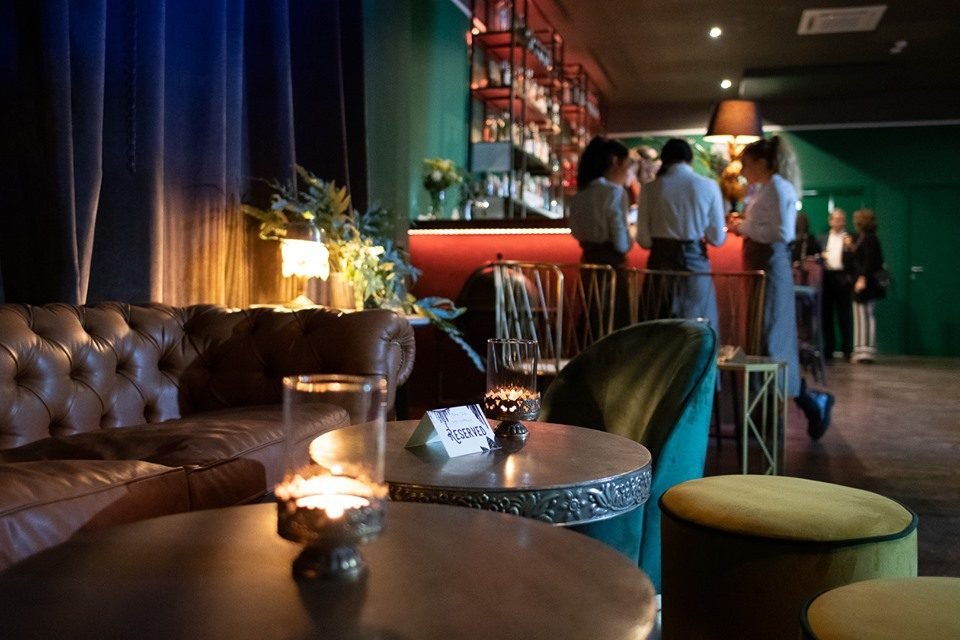
Ellington Club is in Rome at Via Anassimandro 15, in the heart of Pigneto, within Municipio V and a few hundred meters from the pedestrian stretch of Via del Pigneto. It's a venue that holds together three things that in Rome almost always travel separately: live music played on a real stage, a kitchen that stays on until late and a cocktail bar put together with judgment. The name refers to Duke Ellington and immediately declares the aesthetic horizon of the room, that is the 1920s and 1930s, the season of the American clubs in which the orchestra, the set tables and the shaker coexisted in the same space. The artistic direction is reported as entrusted to Alessandro Casella, the same name tied to the Micca Club, and to Vera Dragone. The room is a single one, with about 150 covers, the stage and the bar in the same space. The interior design is signed by Gioia di Paolo, owner of La Santeria. The natural wine selection is reported as built with the sommelier Diego Lambertini. The gastronomic consulting is reported as by Vincenzo Mancino, the name tied to Pro Loco DOL, and the cocktail consulting by Domenico Dragone, tied to Vecchio Magazzino Doganale and Compagnia dei Caraibi. Anyone who moves in the Roman live music circuit already knows the coordinates of the historic venues such as Alexanderplatz Jazz Club, Gregory's Jazz Club and Casa del Jazz. Ellington Club sits on that line, but with a different posture, more neighborhood venue than temple of the genre.
Where Ellington Club is and how to really get there
The address is Via Anassimandro 15, postal code 00176. The street belongs to the grid of Pigneto and is part of that group of streets named after geographers and cartographers of antiquity that mark the inner part of the neighborhood: Anaximander, the philosopher of Miletus to whom the first map of the known world is attributed, gives his name to a narrow residential street, poorly lit, with no shop windows, which stays quiet at night. It's a detail that matters, because whoever arrives for the first time expects a venue facing the noisiest part of the neighborhood and instead finds themselves on a quiet side street, a few hundred meters from the front of bars.
Pigneto occupies a triangle between Via Prenestina, Via Casilina and Via dell'Acqua Bullicante, with the three vertices recognizable in Piazzale Labicano, just outside Porta Maggiore, in Largo Preneste and in Piazza della Marranella. Via Anassimandro falls inside that triangle, in the lower band relative to the pedestrian island, toward the Casilina side. Whoever knows the neighborhood gets oriented right away. Whoever doesn't risks going around in circles, because the side streets of Pigneto change name every 50 meters and the street numbering doesn't follow a linear logic.
By metro
Metro Line C serves the neighborhood with the stops of Pigneto and Malatesta, both located along the Casilina axis. From both, the venue can be reached on foot in a time that ranges between eight and 12 minutes, depending on the route chosen and how long you wait at the crossings. Malatesta, in Piazza Roberto Malatesta, is the most convenient option for those arriving from the east, that is from Centocelle, Alessandrino and Torre Maura. Pigneto serves better those coming down from the center. Line C, it must be said, has operating hours that don't always coincide with those of the other two lines and that can vary on weekends: anyone planning to use it to get home after a concert should check the last useful run on the Atac channels before going out, because a live music evening often ends after midnight and finding yourself in front of a closed station is an avoidable ending.
By train
The Roma Pigneto railway stop, on the line that crosses the city from east to west, is at the western end of Via del Pigneto, a little under a kilometer from Via Anassimandro. It's a surface stop, with direct access to the neighborhood, and it's convenient above all for those arriving from Tiburtina or from Ostiense who don't want to change metro. Here too the evening frequencies thin out a lot compared to rush hours and the times must be checked on the railway operator's channels the same day.
By tram and bus
The Roman tram network passes on the north side of the neighborhood, along Via Prenestina, with the lines that connect Termini and Largo Preneste and with the cross connection that goes up toward Flaminio. The stops at Largo Preneste and the intermediate ones on the Prenestina leave you a 10 or 15 minute walk from Via Anassimandro, crossing the neighborhood diagonally. On the opposite side, along Via Casilina, run the bus lines that connect Porta Maggiore to the eastern periphery. The tram, when it runs regularly, remains the most reliable way to get back toward the center in the early hours of the night, but here too the last runs must be checked: the Roman night network exists, but it covers the neighborhood with long frequencies and routes different from the daytime ones.
By car and scooter
Arriving by car is possible but not convenient. Pigneto is a dense neighborhood, built almost entirely before the car became mass-market, with narrow streets and curbside parking that is always saturated. On weekend nights finding a spot within a reasonable radius takes patience and illegal parking is fined with a certain consistency. Those who drive do better to aim straight for the outer arteries, that is the Casilina or the Prenestina, and to count on a walk. The scooter remains the most practical solution for Romans, taking care not to leave it in the middle of the sidewalks of the residential side streets. Those coming from outside the city who don't want to face the traffic of the eastern quadrant can reason as they do for the peripheral venues like Orion Club, that is leaving the car at an interchange hub and finishing by metro.
On foot from the rest of the neighborhood
From the pedestrian island of Via del Pigneto, where most of the bars are concentrated, you get there in five or six minutes. From Piazza della Marranella it takes a good 10 minutes. From Porta Maggiore, walking along the Casilina, it's more than 25 minutes: doable, but on a narrow and busy sidewalk that does no justice to the walk. Anyone who wants to arrive on foot along a more interesting route can come up from Snodo Mandrione along Via del Mandrione, under the arches of the aqueduct, and then cut north: it's one of the most photogenic urban routes in this part of the city and it completely changes the perception of the neighborhood.
What Ellington Club really is: a concert club with the kitchen on
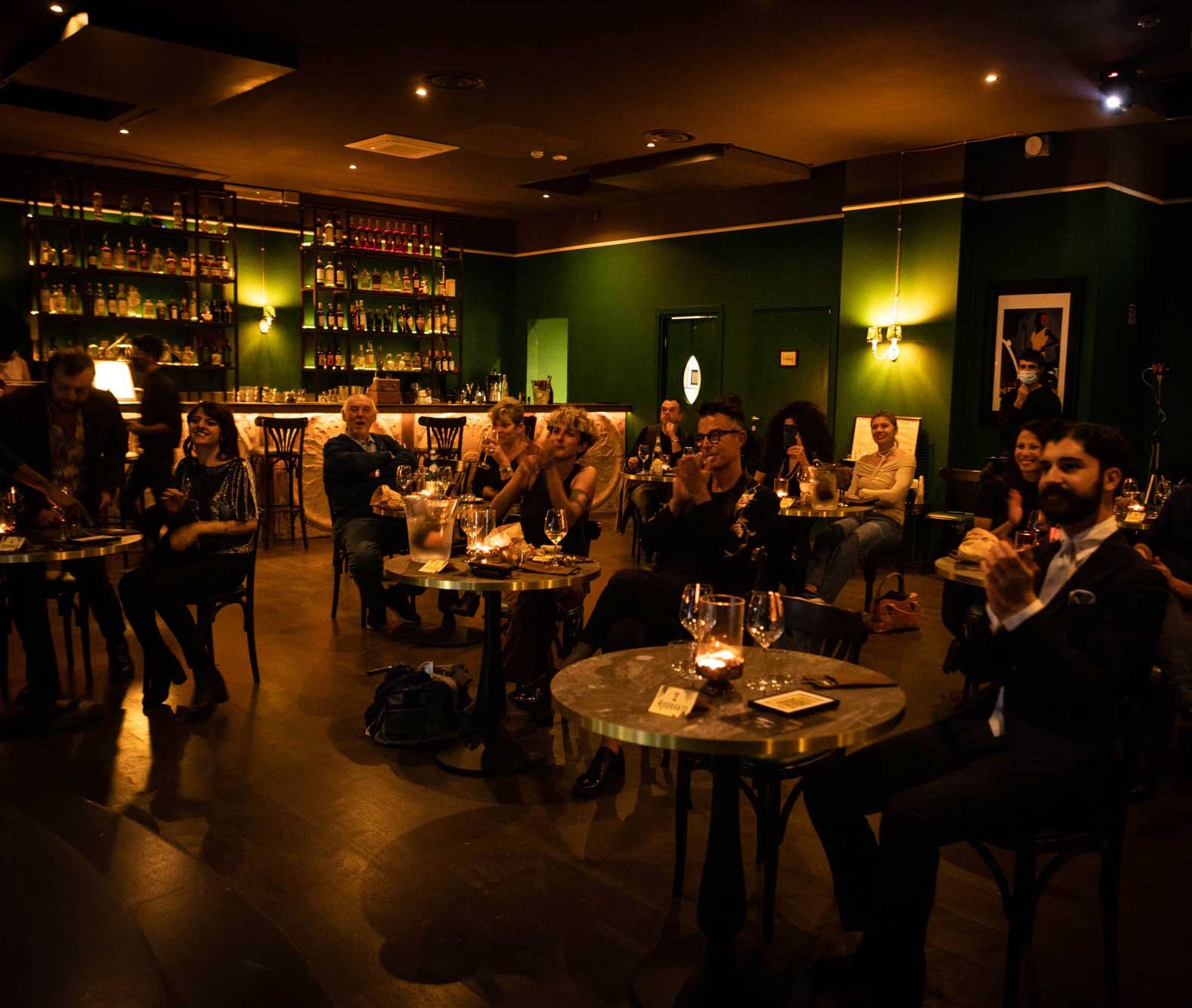
The right category for understanding Ellington Club is not the nightclub and it's not the restaurant with background music. It's the club in the old sense of the term, the one the sign declares explicitly: a single space in which the stage, the tables and the bar are in the same room and in which the evening has a precise rhythm. First you eat, then they play, then you drink and dance if the evening allows. There aren't three separate rooms, there isn't a different entrance for those who dine and for those who come only for the concert, there isn't the physical barrier typical of Roman venues in which the music part is relegated to the back.
This choice has concrete consequences for how the evening is experienced. Whoever books a table for dinner occupies the same space in which shortly after the band will perform, so they have a guaranteed seat and a privileged view. Whoever arrives later finds an already warm room, with the tables occupied and the free space concentrated around the bar and in the area in front of the stage. It's a model that few venues in Rome have practiced and that derives directly from the American clubs of the 1920s and 1930s, in which the orchestra played while the room dined and in which the distinction between concert audience and restaurant audience simply didn't exist.
The aesthetic reference to the 1920s is not purely decorative. The decade that runs from the end of the First World War to the crash of 1929 produced in the United States an entirely new form of nightclub, born paradoxically from Prohibition: speakeasies served clandestine alcohol and to justify the crowding they put jazz orchestras on the bill. From that combination came the Cotton Club in Harlem, where Duke Ellington led his own orchestra for years, and the whole visual mythology that we still associate with early jazz today. Ellington Club recovers that imagery and carries it to a side street in Pigneto, where the contrast with the urban context produces exactly the intended effect.
Compared with the other Roman hubs of live music, the placement of Ellington Club is clear. It doesn't compete with the big concert halls like Atlantico Live Club or Auditorium Parco della Musica, which work with numbers 10 or 100 times higher. Nor is it a pure jazz club like Alexanderplatz Jazz Club or Music Inn, where the programming follows a rigorous genre line. It sits rather in the intermediate band of clubs of barely 200 people, the same one in which venues like Monk, Lanificio159 and Largo Venue work, with the difference that here the food and the cocktails are not a side dish but a declared part of the project.
Anyone looking for a more precise comparison can think of Elegance Cafè Jazz Club for the idea of dinner and concert in the same space, or of Vinile for the explicit nod to a musical imagery of the past. Neither of the two, though, works in exactly the same way, and that's the point: in Rome the venues that put the stage in the middle of the tables and keep the kitchen open past 22:00 can be counted on the fingers of one hand.
The room, the stage and the bar of Ellington Club
The room is a single one and the capacity declared at the time of opening was about 150 covers. It's a number that has to be read properly: 150 covers means 150 people seated at tables, not 150 people inside the venue. On nights when the restaurant part gives way to the music part the layout changes, some tables are removed or pushed together and the standing space increases. The actual capacity of a concert night therefore depends on the setup chosen and on the safety rules that apply, and it's not a figure that can be fixed once and for all.
The stage and the bar coexist in the same space. This is the strongest design choice of the venue and it determines everything else. In a room like this, the sound is not engineered to fill a big volume: the band plays at a level that allows conversation at the farthest tables and that concentrates the intensity in the central area. It's a kind of listening very different from that of a rock club, where the volume crushes every other activity. Whoever arrives expecting the wall of sound of a 500-person hall is surprised. Whoever is looking for close listening, with the musicians a few meters away and no barriers, finds exactly what they want.
The interior design
The design of the spaces is signed by Gioia di Paolo, who in Rome is known as the owner of La Santeria. The recognizable signature is that of the warm, material environment, built by subtraction compared with the din of the neighborhood: dark woods, low lights, a precise relationship between the bar area and the tables. The idea of the 1920s that comes out of it is not the carnival-like one of the themed costume, with feathers and coupe glasses, but something more sober, closer to the architecture of the clubs than to the costumes of the movies.
This distinction deserves emphasis because in Rome the retro vein has produced many superficial operations, in which the nod to the past is exhausted in a few posters and a swing playlist. Here the approach is different: the historical reference concerns the very structure of the evening, that is the fact that music, food and drinks happen together, and not just the furnishings.
The bar and the cocktails
The consulting on mixology is reported as entrusted to Domenico Dragone, a name tied to Vecchio Magazzino Doganale and to Compagnia dei Caraibi. It is a profile that works on rum, on amari and on Italian spirits, and this gives an indication of what kind of menu to expect: not the standard list of international cocktails replicated everywhere, but a selection built around a few recognizable product lines. The cocktail menu of a venue changes with the seasons and with changes in the management of the bar, so it's better to read the one displayed that same night instead of trusting descriptions found elsewhere.
The wines
The natural wine selection is reported as built with the sommelier Diego Lambertini. Natural wine in Rome spread quickly starting precisely from neighborhoods like Pigneto, San Lorenzo and Quadraro. Having a natural wine list in a concert club sets the venue apart from the average of places with live music, where wine remains a fallback.
The kitchen
The gastronomic consulting is reported as by Vincenzo Mancino, a name tied to Pro Loco DOL, that is to a Roman experience built on the products of the Lazio territory and on the short supply chain. Here too the useful indication is not the single dish, which changes with the seasons and with the menus, but the approach: cured meats, cheeses, Lazio raw materials, a club kitchen that stands up to comparison with a dedicated restaurant and that stays available even at hours when a good part of Roman restaurants have already closed the kitchen. Anyone arriving after another evening activity, for example from a show at the Teatro Ambra Jovinelli, finds here one of the few options to really dine and not only to drink.
A curiosity about Ellington Club
The curiosity concerns the name and the way it was chosen. Edward Kennedy Ellington, whom everyone knows as Duke, was not a singer and was not the lead soloist of his own orchestra: he was a pianist, a composer and above all an organizer of sounds, someone who wrote the parts thinking of the personality of the individual musician rather than of the instrument in the abstract. Naming a venue after him, rather than after a name more immediately recognizable to the general public, means declaring a preference for the ensemble over the individual, for the blend over the solo. It's a statement of poetics disguised as a sign.
Then there is a second level, a more Roman one. Duke Ellington played in Italy on several occasions over the course of his career and the American orchestras on tour left a deep mark on the formation of Italian musicians of the postwar period. Jazz reached Rome through oblique channels: the records brought by sailors, the radio broadcasts picked up in secret during Fascism, when syncopated music was officially frowned upon, and then massively with the Liberation. In the 1940s and 1950s, while the first jazz circles were being born in the center, in neighborhoods like Prenestino and Pigneto people played something else: dance music, Neapolitan song, liscio. The fact that 80 years later a venue dedicated to Duke Ellington opens right here, and not in the center, speaks of a cultural shift that has crossed the whole city.
The third curiosity is linguistic and it's the one regulars notice first. In the neighborhood the venue is called simply l'Ellington, with the article, as is done in Italian with cinemas and theaters. The full name is almost never used. It's a sign of adoption: the places the neighborhood accepts lose their surname within a few months, exactly as happened with Monk, with the Nuovo Cinema Aquila or with Lanificio. The ones that stay foreign keep the full name.
The thread linking Ellington Club to the Micca
The curiosity most cited by those who follow the Roman scene concerns, however, the continuity with the Micca Club, the venue that for years was located on Via Pietro Micca, near Piazza Vittorio, and that was for a whole generation the Roman point of reference for everything concerning retro taste: burlesque, sixties sounds, themed nights built with philological competence. Alessandro Casella, who tied his name to that experience, is reported as artistic director of Ellington Club together with Vera Dragone. Ellington, however, is not a re-edition of the Micca: the formula declared at the time of opening looked back another 40 years or so, to the clubs in which live music, mixology and dining formed a single organism, while the Micca worked above all on the recovery of the middle decades of the 20th century. Anyone expecting to find the atmosphere of the Esquilino exactly as it was faces a small disappointment. Anyone looking for the same care in building the evening finds it intact.
The signatures behind Ellington Club: artistic direction, design and consulting
A venue like this is better understood by looking at who put it together, because the list of the people involved says more than any description of atmosphere. The model adopted is that of specialist consulting: instead of entrusting everything to a single management, each area was assigned to a professional who already has a recognizable history in that field in Rome.
The artistic direction
Alessandro Casella and Vera Dragone are reported as responsible for the artistic direction. The artistic direction of a club does not coincide with the choice of the bands to put on the bill: it includes the overall tone, the consistency between the evenings, the way the venue presents itself, the selection of guests, the relationship with labels and promoters. In a room of 150 covers the artistic direction weighs more than elsewhere, because there isn't the volume of audience that lets you absorb a wrong evening: every event has to work on its own.
The design of the spaces
Gioia di Paolo, owner of La Santeria, signed the interior design. It's an interesting case of the passing of skills within the same scene: someone who runs a venue knows the practical problems of spaces differently from someone who only designs them on paper, and this usually translates into more functional solutions on service paths, on the position of the bar and on queue management.
The food side
Vincenzo Mancino, tied to Pro Loco DOL, took care of the food side. Pro Loco DOL was one of the Roman experiences that pushed the concept of Lazio designation of origin, that is the idea that you can build a menu entirely on products of the region without giving up quality. Bringing that approach inside a concert club means raising the bar in a sector where people usually eat badly and in a hurry.
The cocktails and the wines
Domenico Dragone, tied to Vecchio Magazzino Doganale and Compagnia dei Caraibi, took care of the cocktail side, and Diego Lambertini, sommelier, of the natural wine selection. They are two worlds that in theory fight over the same space on the bar and that here come across as placed in sequence instead of in competition: wine for the dinner part, cocktail for the concert part and for afterward. This too is a structure that comes from the American clubs, in which the evening changed register along with the music.
Something nobody tells you about Ellington Club
The thing nobody says concerns the acoustics of single-room venues and how to choose your spot. In a venue where the stage, the tables and the bar occupy the same space, there is no absolutely good seat: there are seats that are good for different things, and choosing one means giving something up.
The front table, the one in front of the stage, gives the best view and the most direct listening, but it's also the spot where the sound arrives least balanced, because you receive the stage before the PA. In a small room the result is often a perception skewed toward drums and horns, with the voice arriving a moment later. The side table, mid-room, receives the sound already mixed and lets you talk between one piece and the next without shouting, but sacrifices part of the view, especially if the band is large. The bar area is the least suited to listening and the best suited to the social evening: you hear everything, you see little, you stay standing and you can go out and come back in without disturbing anyone.
The second element nobody explains concerns the relationship between dinner and concert. In a venue like this, whoever books for dinner isn't just buying a table: they're buying the certainty of being inside when the room fills up, and of being seated. On big nights the difference between who booked and who arrives at 11 p.m. hoping to find a spot is enormous, and it isn't about the price but about the quality of the evening. Whoever cares about the concert books and arrives early. Whoever only wants to stop by for a drink arrives late and accepts standing.
The third element concerns the neighborhood and the time you leave. In the evening Pigneto changes character several times: until nine it's still a residential neighborhood in which families do their shopping, between 10 p.m. and one in the morning it becomes the densest nightlife zone in Rome east of the center, and after two in the morning it empties out abruptly. Whoever comes out of a concert at two 30 in the morning finds themselves on empty, poorly lit streets: nothing alarming, but it's worth knowing in advance how you're getting home instead of improvising at the exit.
The fourth element, the one that escapes people who don't frequent concert clubs, is that the programming of a 150-person room doesn't work like that of a theater. There isn't a season announced months ahead with the printed booklet: there are events that come together week by week, guests who are added at the last moment, evenings that change formula. Asking a venue like this what will be on in two months is a question nobody can answer honestly. That's why the only serious way is to check the venue's official channels in the days immediately before the evening.
The advice I give you for visiting Ellington Club
The main advice is only one: book the table and arrive for dinner, even if your real interest is the concert. In a single room of 150 covers the seat is the variable that determines the quality of the evening, and booking is the simplest way to get it. Whoever arrives after the concert has started finds the venue already settled and has to make do with the standing area.
The second piece of advice concerns timing. The kitchen of this venue was born to stay open past 22:00, that is to serve those who arrive after an evening commitment. It's a concrete possibility and little exploited: whoever comes out of a theater in the center, or from a screening at the neighborhood cinema, can really have dinner instead of falling back on pizza by the slice. Whoever instead wants to enjoy the whole evening should arrive early, around 20:30, and consider dinner as the first part of the appointment and not as a preliminary to get through.
The third piece of advice concerns how to check what's happening. The programming of a club changes from week to week and the evening formulas are modified often: no information found online and not dated is worth as much as a phone call or a message to the venue's official channels the same day. This applies to opening hours, to the weekly closing day, if any, to whether or not there's a concert and to the access arrangements. It also applies to the membership card, if any, which many clubs in Italy adopt and which can be introduced or dropped at any time: asking beforehand avoids arguments at the door.
The fourth piece of advice is to treat the evening as a neighborhood evening and not as an isolated stop. Pigneto works better if you cross it: an aperitivo on the pedestrian stretch of Via del Pigneto, dinner and concert on Via Anassimandro, possibly a last round toward Marranella or toward the Mandrione. Whoever arrives by taxi, goes in, comes out and leaves misses the best part of the experience, which is the contrast between the street and the room.
The fifth piece of advice concerns clothing, because the nod to the 1920s is misleading. You don't need to dress up. The venue is designed around an idea of elegance, not around a dress code: a shirt or a simple dress is more than enough, and whoever shows up in party gear for a theme risks being the only one. The exceptions are nights that explicitly declare a theme, but in that case the official communication specifies it.
The sixth piece of advice, for those arriving from outside Rome, is not to concentrate everything in the same night. Pigneto is worth a daytime visit, when you see the market, the murals and the architecture of the public-housing buildings of the 1920s and 1930s. The evening is another thing and deserves to be experienced without the tiredness of a day of sightseeing in the center.
How to get into Ellington Club and how booking works
The access arrangements for Roman clubs are not uniform and they change over time. Some venues work with free entry and a drink purchase, others with a concert ticket, still others with an annual membership card required at the entrance, others combine the three depending on the evening. For this reason the honest answer to the question of how you get in is that it depends on the evening and that it should be asked of the venue's official channels before showing up.
What can be said with certainty is how the general logic of a room with a kitchen and a stage in the same space works. Booking the table is the main tool and covers the dinner part. For nights with a big concert an additional contribution may be required, which in clubs of this size is usually communicated along with the announcement of the event. Whoever books for dinner in practice has priority on access, because they physically occupy the space before the room fills up.
Why it's better to ask than to take it for granted
A venue of 150 covers reaches full capacity with numbers that are easily hit in Rome: three groups of friends and a well-announced evening are enough. On weekend nights and for the most followed events, showing up without a reservation means accepting the possibility of not getting in. It's a dynamic well known to the regulars of rooms of similar size, from Monk to Lanificio159, and it applies all the more when seats are the real object of contention.
Accessibility
Information on the accessibility of Roman clubs should be asked case by case. The buildings of Pigneto date in large part to the 1920s and 1930s and many venues carved out of these buildings have steps at the entrance, small restrooms or internal level changes. Anyone with mobility needs does well to contact the venue in advance and ask explicitly whether there is level access, how many steps there are and how the restrooms are arranged: it's a question the managers receive constantly and answer without any problem.
Noise, neighbors and neighborhood rules
Via Anassimandro is a residential street. This means the venue lives alongside the apartment buildings and the rules about leaving, volume and staying in the street are stricter than you would expect in a nightlife neighborhood. Whoever steps out to smoke or make a call has to keep their voice down: it's not a recommendation of etiquette, it's the condition that allows a live music venue to keep existing in an inhabited setting. Over the last 15 years Pigneto has seen many closures and many ordinances tied precisely to the coexistence of night venues and residents, and the clubs that remain are the ones that have learned to manage the street front.
Another well-known fact, yet rarely cited
The well-known fact is that Pigneto was born as a working-class borgata and that its current identity is the result of a very recent transformation. What is rarely cited is the urban planning reason for that transformation, which also explains why a venue like Ellington Club makes sense precisely here.
The neighborhood was formed between the end of the 19th century and the first decades of the 20th, in an agricultural area between two ancient consular roads, the Prenestina and the Casilina, and cut by the railway bundles leaving Termini. The houses, in large part low buildings of two or three floors with a courtyard, were built for the workers of the railways and the workshops and for the families arriving from the countryside of Lazio and Abruzzo. The result is an urban fabric that is anomalous for Rome: narrow streets, small blocks, contained heights, inner courtyards, all very different from the Umbertine districts of the center and from the postwar borgate.
That very small scale made the neighborhood suitable for hosting, 80 years later, dozens of small venues. A 150-cover club doesn't find room in an Umbertine building in Nomentano, where the ground floors are destined for other uses, and doesn't work in a borgata of the 1960s, where the distances are too great to walk from one place to another. It works very well, instead, in a fabric made of disused artisan ground floors, converted garages and old warehouses, all reachable on foot within a radius of 10 minutes.
The Second World War and the memory of the quadrant
There is then a historical fact that concerns the whole eastern strip of the city and that in Pigneto is particularly felt. The quadrant between Prenestino, Casilino and San Lorenzo was hit hard by the Allied bombings of 1943, precisely because the target was the railway yards. The bombing of July 19, 1943 on San Lorenzo is the one remembered in history books, but the raids repeatedly affected the whole railway axis toward the east. Whoever walks through Pigneto today sees rebuilt buildings next to original ones, discontinuities in the street fronts, lots filled in at different times: they are the traces of that season.
Cinema and the image of the neighborhood
The second well-known and little-explored fact concerns cinema. Pigneto is the neighborhood in which Pier Paolo Pasolini shot a good part of Accattone, his first film, at the beginning of the 1960s. That choice was not random: Pasolini was looking for a humanity on the margins and an urban landscape that told of the Rome excluded from the economic boom, and the Pigneto of the time, with its taverns and its unpaved streets, offered exactly that repertoire. The legacy of that shoot still weighs on the image of the neighborhood and is evoked constantly, at times to the point of fatigue. It's worth remembering that the Pigneto of Accattone has not existed for decades and that the present neighborhood, with its venues and its real estate prices, is almost the opposite of the one filmed then.
The name
The third little-cited detail is the origin of the place name. The name derives from a wooded estate, a pine grove, that occupied the area before urbanization. Rome is full of these plant-based place names that survived the disappearance of the vegetation that generated them: Pigneto is one of the most evident cases, because today you count very few pines in the neighborhood and almost all recently planted. Whoever wants to see what the agricultural landscape of this part of the city was can head to Castagneto Prenestino or, farther south, to the Aqueducts Park.
The right photo to take at Ellington Club
Photography in a concert club is an exercise in renunciation. The light conditions are the worst possible for any device: very low lights in the room, colored point sources on the stage, violent contrasts between the lit face and the black background. Anyone who tries to photograph with the phone on auto almost always gets the same result, that is a blurry, noisy image with the subject overexposed in the center. The right photo, in an environment like this, is not the photo of the band playing.
The first choice: the bar instead of the stage
The photograph that works best in a single room is the one of the bar seen at an angle, with the backlit bottles in the background and the dark shape of someone in the foreground. It's an image that uses the only constant light in the venue, which doesn't depend on the timing of the concert and doesn't require raising the sensitivity past the limit. The lit bar gives depth, the reflections on the glass create orderly points of light and the silhouette in the foreground solves the problem of underexposed faces by turning it into a choice.
The second choice: the detail instead of the whole
In a small room the wide frame is almost always wrong, because it shows tables, heads and cables without a hierarchy. The detail works better: hands on the keys, the drum cymbal from the side, the bell of a saxophone catching a side light, the glass on the table with the stage out of focus in the background. The detail tells the environment better than the whole and doesn't require standing in front of others with the phone raised, which in a 150-seat room ruins the evening for whoever booked in order to see.
The third choice: the street
The most recognizable photograph of an evening at the Ellington is probably not taken inside the venue. It's taken outside, on Via Anassimandro, with the sign lit and the residential street around it, dark and empty. That contrast between the venue and the neighborhood is the real subject: the idea of the American 1920s landed on a side street in Pigneto. To do it well it's enough to rest the phone on a car or a low wall, lengthen the exposure time and let the lights of the room come out of the door.
A rule of behavior
In small clubs the unwritten rule is that you photograph little and quietly. No flash, which blinds the musicians and bothers those listening, no prolonged video shooting with your arm raised, no tripods. Some productions explicitly forbid filming and in that case the notice comes from the stage or from the room staff: it's worth respecting it without argument, because in a room of 150 people any friction immediately becomes public.
Some important events that happened here in history
The history of a venue opened in recent years is necessarily short, and it's better to be clear about this instead of building an invented chronology. The events that really concern the place are of two kinds: those that have to do with the story of the neighborhood, which is more than a century long, and those that have to do with the Roman music scene in which the venue fits.
The formation of the neighborhood
The first event is the subdivision of the agricultural area between Prenestina and Casilina, begun at the turn of the 19th and 20th centuries and continued intensively in the 1920s. It is in that phase that the grid of streets in which Via Anassimandro is located was born and that the neighborhood took the triangular shape it still keeps. The low buildings with courtyards, which today define the character of Pigneto, belong to that season.
The war
The second event is the wartime period. The proximity to the railway yards made the whole eastern quadrant a target: the bombing of San Lorenzo on July 19, 1943 is the best-known episode, but the raids repeatedly affected the strip along the railway, and Pigneto bore the consequences. In the same period the area was the scene of episodes of the Roman Resistance, and the memory of those months remains engraved in the plaques and monuments scattered among Prenestino, Casilino and Quadraro.
The postwar period and cinema
The third event is cultural. With neorealism first and then with Pasolini's debut, Pigneto enters the Italian cinematic imagination as the landscape of poor Rome. The shooting of Accattone at the beginning of the 1960s fixes that image definitively and hands it over to decades of later quotations.
The recent transformation
The fourth event is the transformation of the last 25 years, which has seen the neighborhood go from a working-class area to a quadrant of Roman nightlife. The pedestrianization of the central stretch of Via del Pigneto, the opening of dozens of venues, the arrival of the metro along the Casilina and the redevelopment of the Nuovo Cinema Aquila have worked together. It is inside this transformation, and in its mature phase, that the opening of Ellington Club should be placed: not the first venue in Pigneto, but one of those that arrive when the neighborhood already has a consolidated audience and looks for more structured offerings.
The story of the Micca
The fifth event concerns the scene and not the place. The closing of the Micca Club on Via Pietro Micca left Rome with a precise void: that of a venue that worked on historical recovery with competence and without easy irony. Ellington Club was born declaredly inside that legacy, with the same artistic direction and with an idea of an evening that is built and not improvised. Anyone reconstructing the history of Roman clubs of the last 20 years finds here one of the most recognizable threads of continuity.
A necessary clarification
All the rest, that is the dates of individual concerts, the names of the guests who have taken turns on the stage and any awards, belongs to a chronicle that changes continuously and that no static source can capture reliably. Anyone looking for the exact chronology of past events will find it in the archives of the venue's official channels, which are the only reliable source on this point.
Who has passed through Ellington Club
The question of who has passed through a club lends itself to complacent and hard-to-verify answers, so it's better to answer differently: by describing the categories of musicians that a room of this type hosts and the people who built the venue, without attributing to the stage performances that are not documented.
Who made it
The certain names are those of the project. Alessandro Casella, whose signature in Rome remains tied to the Micca Club, and Vera Dragone are reported at the artistic direction. Gioia di Paolo, owner of La Santeria, signed the interior design. Diego Lambertini, sommelier, worked on the natural wine selection. Vincenzo Mancino, tied to Pro Loco DOL, took care of the food side. Domenico Dragone, tied to Vecchio Magazzino Doganale and Compagnia dei Caraibi, the cocktail side. They are five professionals who in the Rome of food, drink and nightlife have distinct histories, and their presence in the same project is in itself a relevant fact.
Who plays there
A room of 150 covers with the stage and the bar in the same space typically hosts small-scale ensembles: jazz trios and quartets, swing and American dance music groups of the 1930s and 1940s, soul and rhythm and blues ensembles, singers accompanied by a rhythm section, projects that work on the repertoire of the 20th century. It's not a room for high-volume rock or for electronic music: the size and the coexistence with the kitchen impose a choice. Anyone looking for those genres looks to other Roman rooms, from Monk to Qube, from Largo Venue to Villaggio Cultura Pentatonic.
The figure who gives the name
There remains Duke Ellington, who takes his name to the venue without ever having set foot in it for obvious chronological reasons. It's worth remembering who he was, though, because the reference is not generic. Ellington led his own orchestra for almost 50 years, wrote thousands of compositions, worked at the Cotton Club in Harlem in the years when orchestral jazz was defining its form, and kept producing new music until the 1970s. His idea of the orchestra as a collective organism, in which every musician is irreplaceable, is exactly the metaphor that a venue with a stage, a kitchen and a bar in the same space can afford to claim.
The neighborhood around Ellington Club: Pigneto beyond the nightlife
Leaving the venue and stopping at the first 100 meters means seeing a tiny part of the neighborhood. Pigneto has at least four different souls and it's worth getting to know them, because they completely change the evening depending on where you head.
The pedestrian island
The pedestrian stretch of Via del Pigneto is the recognizable heart of the neighborhood: neighborhood market by day, a continuous row of bars at night. It's the most crowded and most photographed part, the one that appears in all the articles on Roman nightlife. It works very well for an aperitivo before dinner and becomes difficult after midnight, when the density of people in the street reaches unpleasant levels. The morning market, on the other hand, remains one of the liveliest in the city and deserves a visit of its own.
The Marranella side
Going down toward Piazza della Marranella the neighborhood changes register and becomes the multicultural Rome of Municipio V: Bangladeshi shops, halal butcher shops, tailors, greengrocers open until late. It's a part of the city that Romans from the center know little and that tells of an important demographic transformation of the last 30 years. Walking there in the evening, between 11 p.m. and midnight, offers a sharp contrast with the retro aesthetic of the venue you've just left.
The Mandrione and the aqueducts
To the south, toward the Casilina and beyond, runs Via del Mandrione, one of the most singular streets in Rome: a long straight stretch that follows the arches of the Felice Aqueduct, with houses leaning against the arcades and an atmosphere suspended between countryside and periphery. It's the place where part of the cinematic and literary memory of the poor Rome of the postwar period concentrated. Along that axis there is also Snodo Mandrione, which in the warm season becomes one of the reference points of the quadrant.
San Lorenzo and Porta Maggiore
To the northwest, beyond the Prenestina and the tracks, you reach San Lorenzo, the university neighborhood par excellence, and Porta Maggiore, where some of the most notable ancient remains of the area are concentrated: the gate itself, built as a crossing of two aqueducts, and the tomb of the baker Marcus Vergilius Eurysaces, one of the most curious funerary monuments in the whole city. On that side there are also reference venues like Container San Lorenzo and the Basilica of San Lorenzo fuori le Mura, which is worth a daytime visit.
What to do in the area on another evening
Anyone staying in Rome a few days and wanting to build a musical itinerary can alternate registers. Historic jazz is heard at Alexanderplatz Jazz Club, at Gregory's Jazz Club and at Music Inn. Institutional programming, with a park and open-air concerts in the good season, is found at Casa del Jazz and in series like Summertime. In summer free jazz is heard under the Baths of Caracalla with Jazz & Image and at Villa Celimontana with the Village Celimontana. For real clubbing there remain the Circolo degli Illuminati, the Piper Club and the Wishlist Club. On the neighborhood front, the Casilino Urban Fest tells of the self-produced scene of the eastern quadrant.
When to go to Ellington Club and when to avoid it
A club with a kitchen has a different seasonality from that of a summer venue. The high season runs from October to April, that is the months when in Rome people gladly stay indoors and when the clubs' programming reaches maximum density. In the warm months, on the other hand, the city moves outdoors: the arenas, the series in the parks and the festivals absorb a good part of the audience and many indoor venues reduce activity or close for a period. Anyone planning an evening between July and August does well to check in advance that the venue is open, because summer closures in the sector are the rule and not the exception.
The days of the week
In Roman clubs Friday and Saturday are the days of maximum attendance and also those when the music side is most carefully curated. Wednesday and Thursday generally offer more intimate evenings, with less audience and more room for listening. Sunday night, when the venue is open, has a character all its own: an older audience, slower rhythms, evenings that end early. The weekly closing days vary over time and should be checked on the official channels before heading out.
The hours
The typical rhythm of an evening in a venue of this kind includes opening in early evening, kitchen service that continues past 22:00, the concert in the middle band of the night and closing between two and three in the morning. The actual hours change with the seasons, with city regulations and with the management's choices, so here too checking beforehand is the only sensible way.
When to avoid
To avoid, if you're looking for listening, are the nights when the neighborhood is crossed by mass events: the all-night festivals, the long weekends and the evenings when a big series fills the pedestrian zone. In those cases the venue works anyway, but the surroundings become tiring and getting home takes longer than expected. Also to avoid is trying to arrive without a reservation on an announced concert night: the room is small and a line in the street, on a residential side street, is not a workable solution.
Quick questions about Ellington Club
Where exactly is Ellington Club?
At Via Anassimandro 15, in Rome, postal code 00176, in the Pigneto neighborhood, Municipio V. The street lies inside the triangle between Via Prenestina, Via Casilina and Via dell'Acqua Bullicante, a few hundred meters from the pedestrian stretch of Via del Pigneto.
How do you get there by public transport?
By metro Line C, stops Pigneto and Malatesta, both about 10 minutes away on foot. By train, the Roma Pigneto stop at the western end of Via del Pigneto. By the trams and buses that run along Via Prenestina and Via Casilina. Evening hours and last runs should be checked on the public transport operator's channels the same day.
What kind of venue is it?
A club with a single room, about 150 covers, the stage and the bar in the same space, in which live music, kitchen and mixology are part of the same project. The declared inspiration is the American clubs of the 1920s and 1930s.
Do you really have dinner or is it just a bar with music?
The food side is a structural component of the project, with dedicated consulting and a kitchen designed to stay active even past 22:00. The menus change with the seasons and should be read on the spot or on the official channels.
Do you need to book?
For the table yes, especially on weekend nights and for the most followed musical events. The room is small and the seat is the truly scarce resource.
Do you need a membership card?
The access arrangements for Roman clubs vary over time and from evening to evening. The correct answer should be asked of the venue's official channels before showing up, because any cards, contributions or fees can be introduced or dropped at any time.
What music do you hear?
Small ensembles consistent with the approach of the room: jazz, swing, soul, rhythm and blues, 20th-century repertoire. The specific lineup comes together week by week and should be checked on the official channels.
Is it suitable for people who don't know jazz?
Yes. A venue where you dine and drink while listening is exactly the context in which jazz was formed, and it is much more welcoming than a concert hall for those approaching the genre for the first time. Nobody expects you to know the repertoire.
How much does it cost?
The prices of food, wines and cocktails change with the menus and with the seasons, and any contribution for the concert depends on the individual evening. Any figure given outside the official channels risks being out of date: it's better to ask directly.
Is it accessible to people with mobility difficulties?
The buildings of Pigneto date in large part to the 1920s and 1930s and the access solutions vary from venue to venue. It's best to contact the venue in advance and ask explicitly about the presence of steps, the width of the entrances and the restrooms.
Is the venue still active?
The venue is listed and operating at the indicated address, but in the nightlife restaurant sector managements and signs change with some frequency. A check on the official channels before heading out remains the most sensible precaution, especially if you're coming from far away.
Frequently asked questions about Ellington Club
What is Ellington Club really?
Ellington Club is a concert club with the kitchen on, in Rome: a single space in which the stage, the tables and the bar are in the same room, with a precise rhythm to the evening, first you eat, then they play, then you drink and dance if the evening allows. It is neither a nightclub nor a restaurant with background music.
Where is Ellington Club?
Ellington Club is at Via Anassimandro 15, postal code 00176, in the Pigneto neighborhood in Rome, Municipio V, inside the triangle between Via Prenestina, Via Casilina and Via dell'Acqua Bullicante, a few hundred meters from the pedestrian stretch of Via del Pigneto.
How do you get there by public transport?
Ellington Club, on Via Anassimandro in Pigneto, can be reached by metro Line C, at the Pigneto and Malatesta stops, both within walking distance of the venue. The street on which the club faces is residential, narrow and poorly lit.
How many seats are there in the room at Ellington Club?
The room at Ellington Club is a single one and the capacity declared at the time of opening was about 150 covers, that is 150 people seated at tables, not 150 people inside the venue. On nights with more of a musical focus the layout of the tables changes and the standing space increases.
Do you need to book to go to Ellington Club?
Yes, the advice is to book the table at Ellington Club and arrive for dinner, even if the main interest is the concert: in a single room of 150 covers the seat determines the quality of the evening, and whoever arrives after the concert has started has to make do with the standing area.
How does entry to Ellington Club work?
The access arrangements at Ellington Club depend on the evening: some Roman venues work with free entry and a drink purchase, others with a concert ticket, others with a membership card. The correct answer should therefore be checked each time on the venue's official channels.
What is the best time to go to Ellington Club?
The high season at Ellington Club runs from October to April, the months when in Rome people gladly stay indoors and the clubs' programming reaches maximum density. In the warm months the city moves outdoors, between arenas and festivals in the parks, and indoor programming shrinks.
Anyone who organizes itineraries in Rome for groups, school groups or foreign clients and needs to build a musical evening inside a broader program will find professional tools on TourLeaderPro. The quote request and direct contacts are on the TourLeaderPro contact page, while tour operators working on themed packages tied to music and Roman nightlife will find the dedicated section for tour operators.
Anyone planning a trip to Rome and looking for English guides will find them on ItalyPlanner.com. To understand how to get around between metro, trams, buses and regional trains, even in the evening hours, the guide to public transport in Rome is useful. Anyone building their stay around an evening of live music will find a broader overview on things to do in Rome.