Vinile
In short. Vinile is at Via G. Libetta 19, in the Ostiense neighborhood of Rome, a few minutes on foot from Ostiense station and the Garbatella stop on metro line B.
Frequently asked questions about Vinile
Where is Vinile?
Vinile is at Via G. Libetta 19, in the Ostiense neighborhood of Rome, a few minutes on foot from Ostiense station and the Garbatella stop on metro line B. The street runs parallel to Via del Porto Fluviale and Via Ostiense, in a former industrial neighborhood that has become one of the densest nightlife hubs in the city.
What kind of venue is Vinile?
Vinile is a hybrid format that combines restaurant, cocktail bar and club in the same space and the same evening, with a program that alternates dinner, aperitivo, DJ sets and, on some nights, live music. The name recalls the vinyl record and the musical roots of the project.
Since when has Vinile been open?
According to available sources, Vinile opened in 1996, at a time when the Ostiense neighborhood was only just beginning to be seen as a possible alternative to the historic center for Roman nightlife.
How does an evening at Vinile work?
An evening at Vinile unfolds in three overlapping moments. In the aperitivo and dinner window the atmosphere stays more subdued, with the room set up for table service. As the hours pass the lighting changes, the volume rises and the space reorganizes toward a more club-like atmosphere.
Does Vinile offer live music?
Yes, Vinile's weekly program alternates nights with live music, often cover bands or groups specializing in soul, funk and disco repertoire, and nights with DJs who build sets designed to accompany the transition from dinner to the more clubbing moment.
What crowd goes to Vinile?
Vinile's crowd reflects the dual nature of the venue: in the dinner window a clientele more mixed in age prevails, often groups of friends or couples, while in the later hours, when the program shifts to the DJ set, the average age tends to drop.
What is near Vinile?
A few minutes on foot from Vinile is the Pyramid of Cestius, the Roman funerary pyramid that symbolically marks the boundary between Testaccio and Ostiense, as well as other historic venues in the area such as the Circolo degli Illuminati, with a program ranging from electronic music to themed nights.
Is it a good idea to book before going to Vinile?
The most direct channel for up-to-date information remains the venue's phone number, useful for checking the availability of tables, any entrance fees tied to the specific evening and the type of program planned, since a venue that combines dining and clubbing tends to vary its access conditions depending on the day.
Where Vinile is and how to get there
Vinile occupies a precise address in the heart of industrial Ostiense, Via G. Libetta 19, in Rome. The street runs parallel to Via del Porto Fluviale and Via Ostiense, in a neighborhood that until the 1980s was an area of warehouses, gasometers and freight tracks, and that over the last three decades has turned into one of the densest nightlife hubs in the city. Those coming from outside Rome can get off at Ostiense station, served by regional trains and the line to Fiumicino, and continue on foot in about 10 minutes along the murals of the Porto Fluviale. Alternatively the Garbatella stop on metro line B leaves you with a similar walk, crossing a stretch of neighborhood that mixes public housing of the 1920s and converted sheds.
Those traveling by car find the area well connected to the Circonvallazione Ostiense and the Lungotevere, but evening parking is never a given: Via Libetta and the nearby side streets fill up fast on weekend nights, when the whole area, with venues like Circolo degli Illuminati a short distance away, becomes a single corridor of club entrances and exits. Many choose public transport or a taxi for exactly this reason, or leave the car near the Pyramid of Cestius and continue on foot along Via Ostiense. Anyone organizing an evening from out of town may find it useful to compare train times and transport combinations on italyplanner.com, which gathers practical directions for getting around Rome in the evening, when service frequencies thin out.
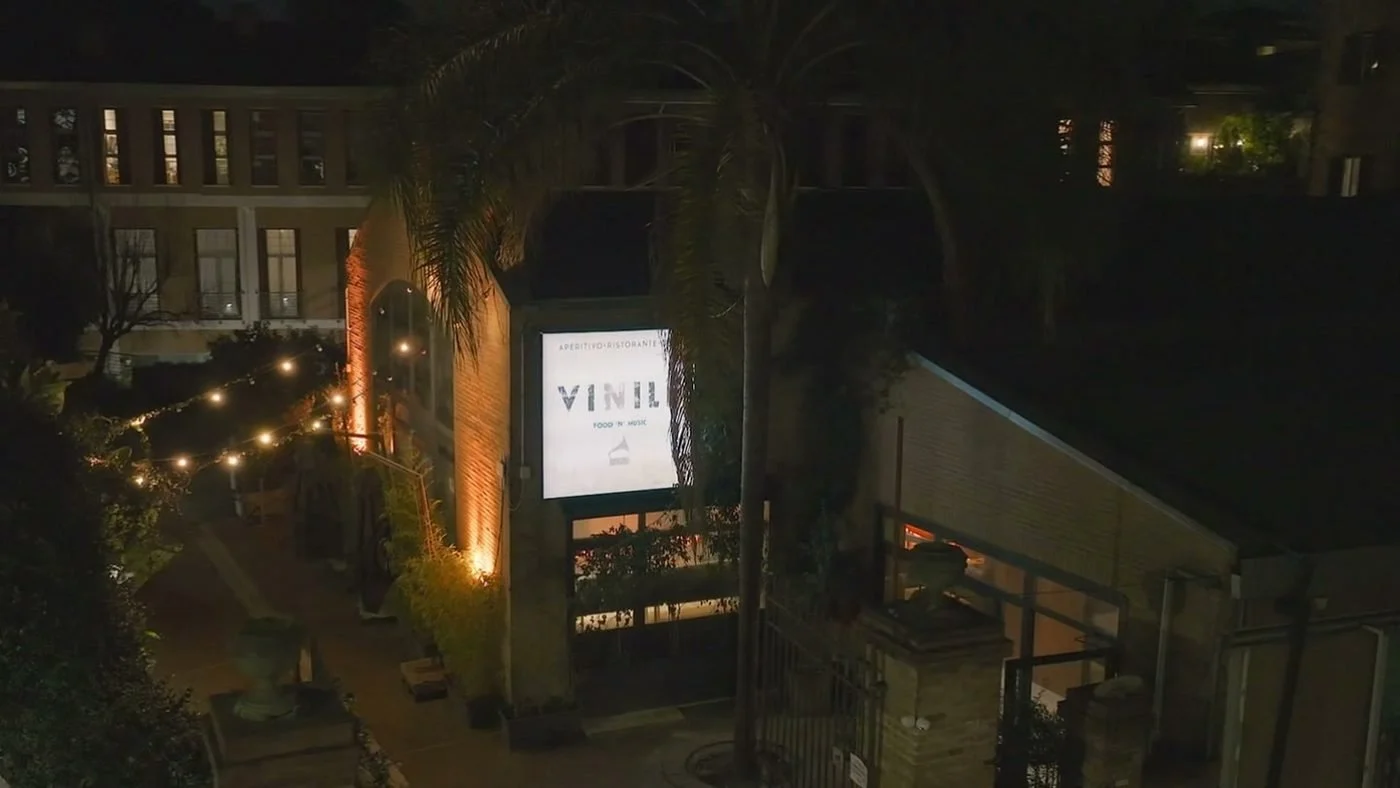
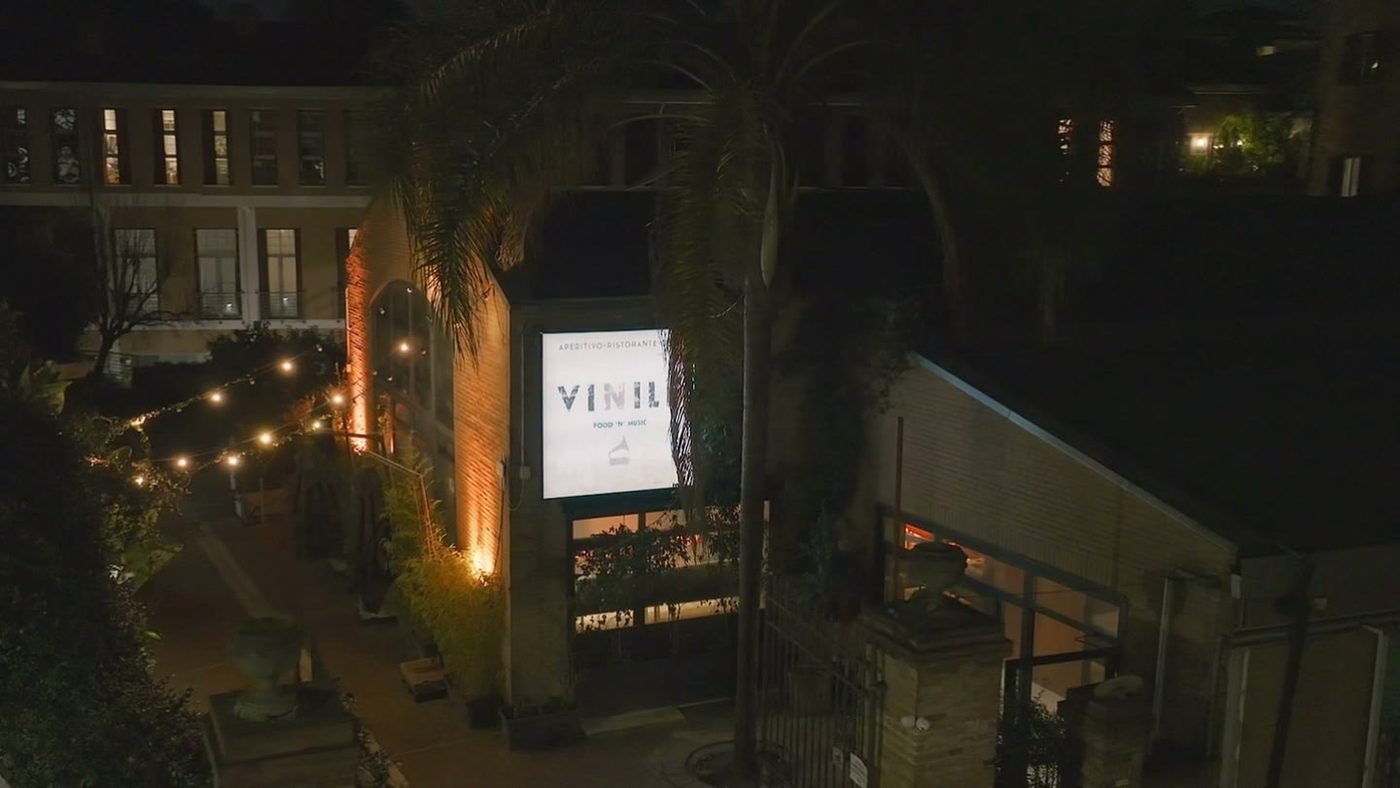
Number 19 on Via Libetta has no showy sign: whoever looks for Vinile for the first time risks walking past it, because the entrance blends in with the industrial facades of the neighboring numbers. It's a detail that belongs to the history of the neighborhood more than to a marketing choice: Ostiense built its nightlife identity precisely on buildings that don't immediately declare their function, from the former rail depots to the sheds that today host galleries, breweries and concert halls.
The layout of Via Libetta, like many streets in Ostiense, follows an urban plan older than the current appearance suggests, dominated by sheds and 20th-century conversions that came after the original street design: a detail that helps read the neighborhood as a stratification of different eras more than as an urban block born all at once.
What Vinile really is: a venue halfway between restaurant, cocktail bar and club
Vinile was born as a declared hybrid: not a simple restaurant, not a pure cocktail bar, not a discotheque in the strict sense, but the sum of these three formats in the same space and the same evening. The name itself, which recalls the vinyl record, points to the musical roots of the project, conceived since the opening as a place where dinner flows inside a club atmosphere, with volumes that rise gradually as the evening advances and the kitchen gives way to the bar counter.
The sources that catalog the venue place it in the category of Rome's clubs and discotheques, with an explicit reference to an opening dating back to 1996, a year of activity that makes Vinile one of the longest-standing outposts of the Ostiense nightlife scene, having survived the cycles of opening and closing that affected many other venues in the area in the same period. A history of almost three decades, in a neighborhood that has changed its skin several times, tells in itself of the ability to adapt: from a gathering place for a younger public in the 1990s and 2000s, to a more structured format in the following years, with an evening food offer that precedes the DJ set.
The venue's aesthetic recalls the 1970s and 1980s: furnishings, lights and visual references that bring back a precise era of Italian and international popular culture, the one in which vinyl was still the main medium on which music was listened to in dance venues. It isn't an isolated case: several Roman clubs have built a similar identity in recent years, playing on nostalgia for a pre-digital aesthetic, but Vinile does so from a position of long experience, having gone through that historical period directly in its own activity.
The musical offer alternates DJ sets and, on some nights, moments of live music, with a repertoire ranging from soul to disco, from funk to more contemporary sounds reinterpreted in a retro key. Not all nights have the same format: some are designed more for dinner, others bet decisively on dancing and clubbing, an approach typical of Roman venues that live the week with differentiated offers between midweek and weekend.
The Ostiense neighborhood: from industrial area to nightlife district
To really understand Vinile you need to look at the neighborhood around it, because the venue is not an isolated phenomenon but a tile in an urban mosaic that took decades to put back together. Ostiense arises as a productive area straddling the 1800s and 1900s, tied to the river port on the Tiber, the general markets and the industrial plants that stood along the consular road to Ostia. Gasometers, mills, cold-storage warehouses and rail depots defined the landscape of a neighborhood designed for production and logistics, not for entertainment.
The decommissioning of much of this industrial apparatus, which took place progressively between the 1970s and 1990s, left as a legacy a heritage of enormous buildings, often empty for years, with high ceilings and iron and brick structures that proved perfect for being converted into cultural spaces, galleries, artist studios and, precisely, nightlife venues. Vinile fits exactly into this dynamic: a space born for other purposes, readapted to a new function without entirely distorting the original shell, an operation typical of many addresses in the area.
In the same years in which Vinile opened, Ostiense was also beginning to be discovered by the university and artistic world: the proximity to the Architecture faculty of Roma Tre and other academic hubs brought to the neighborhood a constant flow of students, a public naturally inclined to look for venues with affordable prices and a less standardized musical offer than the historic center. This meeting of available industrial spaces, student population and demand for alternative entertainment formed the ground on which the area's current nightlife scene developed, street by street.
Today Ostiense coexists with other parallel transformations: the street art that has turned the walls of Via del Porto Fluviale into one of the most photographed open-air galleries in Rome, the arrival of offices and company headquarters in some of the converted former sheds, and the increasingly stable presence of restaurants and venues that cover the whole day, from breakfast to the last drink. In this constantly evolving context, a venue like Vinile, which has been through the whole arc of the transformation without changing address, represents a kind of common thread that lets you read the recent history of the neighborhood.
Rome's nightlife of the 1990s and the context of the opening
To place the birth of Vinile correctly, it's worth remembering that Roman nightlife in the 1990s was organized along geographies very different from today's. The historic center, with the historic venues of Testaccio and the areas near the Colosseum, still represented the hub of the city's offer, while neighborhoods like Ostiense remained at the margins of the entertainment map, perceived as peripheral areas and little frequented after sunset. In this scenario, opening a venue on Via Libetta was a bet that wasn't a given, far from the established routes of Rome's nightlife of the time.
The 1990s were also the decade in which the Italian-style club model began to diversify, partly abandoning the rigidity of the traditional discotheque to experiment with more hybrid formulas, able to include dinner, live music and DJ sets in the same container. Vinile fits into this phase of experimentation, helping to define a model that in the following years would become much more widespread across the city, not only in Ostiense.
The musical context of the time should also be considered: the second half of the 1990s saw in Italy a strong spread of DJ set culture, with venues beginning to structure their nights around fixed residencies and recognizable weekly programs, a model that progressively replaced the simple background music selection. The 1970s and 1980s aesthetic chosen by Vinile, in this sense, was not only a nostalgic homage, but also a precise statement about the kind of music and atmosphere the venue intended to offer, against the trend of many more electronic sounds that were taking hold elsewhere in the city.
The fact that Ostiense, a neighborhood then still peripheral to Rome's nightlife, became in the following years one of the most relevant nightlife districts in the city makes the choice made in the mid-1990s to open precisely in this area retrospectively significant. Anyone who has followed the evolution of Roman nightlife over three decades recognizes in this kind of geographic bet one of the factors that allowed some neighborhoods to transform radically, while others, once central, progressively lost weight in the city's evening offer.
A curiosity about Vinile
The venue's name is not a graphic affectation but a statement of intent that has crossed the decades without ever being updated, in an era when music is listened to almost exclusively by streaming. Staying faithful to a sign that recalls a now niche physical medium, while everything around changed format, platform and way of use, is a choice that tells of the will to anchor the venue's identity to an idea of an evening rather than to a passing fashion. Many Roman clubs born in the same years changed name, management or format several times. Vinile has kept its original name, a sign of continuity that is rare in a sector where turnover is the norm.
Another little-known aspect concerns the location of the venue on a stretch of Via Libetta that, in the same years in which Vinile opened its doors, was beginning to fill with other addresses that later became famous in Roman nightlife. That street, today known as one of the backbone axes of Ostiense nightlife, was by no means a given as an entertainment hub when the venue settled there: the transformation of the area from a disused industrial zone into the district of Roman nights took place largely thanks to the arrival of businesses like this one, which anticipated a trend that later became structural for the whole neighborhood.
One thing nobody tells you about Vinile
What is rarely told is how much the dinner plus club format, today perceived as an established formula in many Roman venues, was an anomaly when Vinile adopted it: in the 1990s the separation between restaurant and discotheque was sharp, and mixing the two moments in the same space, with the same team and the same evening, was not the norm. The venue helped normalize a model that today seems obvious but that at the time required more complex management, able to hold together table service and the running of a dance floor or dance area in the same room.
Another little-publicized element concerns the acoustics and the layout of the interior spaces: venues born in converted industrial buildings, like many in Ostiense, have to deal with high ceilings, hard surfaces and reverberation that make the sound very different from a club designed from scratch for music. Those who work behind the scenes in these spaces know that acoustic setup, between sound-absorbing panels and the placement of the sound systems, is ongoing work, not a project completed once and for all, and it is one of the aspects the public hardly notices while dancing but that heavily affects the quality of the evening.
It should also be remembered that the street numbers of Via Libetta, including 19, belong to an urban fabric where several addresses have changed use more than once over the decades: sheds that were warehouses, then studios, then nightclubs, in a sequence of conversions that makes the real map of the neighborhood different, and more layered, than a simple glance from the outside suggests.
The advice I give you for visiting Vinile
Before organizing an evening, the most useful advice is to check the program of your chosen night directly on the venue's official channels, because a format that alternates dinner, aperitivo and DJ set changes noticeably depending on the day of the week: a night designed for dinner has a different rhythm and atmosphere from one designed for dancing, and booking without knowing which of the two is on the calendar can lead to the wrong expectation. Phone contacts and social channels remain the most reliable tool for up-to-date information on hours, reservations and the dress code of the specific night.
It's worth arriving with some time to spare to get your bearings in the area: Via Libetta and the nearby side streets aren't lit like the streets of the historic center, and anyone who doesn't know Ostiense may find it useful to work out the walking route from the station or the metro stop in advance, perhaps with a preliminary daytime walk to fix the landmarks. The choice of shoes is also not a detail to underestimate: the sidewalks of this industrial area, often uneven, go poorly with high heels or delicate footwear.
Anyone who wants to build a wider itinerary around the evening, perhaps pairing dinner at Vinile with an afternoon visit to the museums of the area or a walk toward the Gazometro, can find useful ideas on tourleaderpro.com, which gathers proposals for guided visits and themed routes in Rome that can be combined with an evening in Ostiense. Setting up the outing as a route that starts in the afternoon, with a cultural stop, and ends late at night at the venue lets you make better use of the day instead of concentrating everything in a few evening hours.
The format of the evening: dinner, aperitivo and DJ set
The typical structure of an evening at Vinile has three moments that overlap rather than follow one another rigidly. In the first part, usually the aperitivo and dinner window, the venue keeps a more subdued atmosphere, with the room set up for table service and the music present but not dominant. As the hours pass the lighting changes, the volume rises and the space physically reorganizes, with the tables progressively giving way to an area more oriented to dancing.
This transition is one of the distinctive elements of the format: it isn't a change of venue, but a transformation of the same room over the course of the same evening. Whoever dines early and whoever arrives later for the DJ set live two different experiences while being in the same space, a mechanism that lets the venue intercept a mixed public, from those looking for dinner with a curated background to those who bet exclusively on the more nocturnal part.
Managing this transformation requires precise logistics: the floor staff has to coordinate with the bar staff and with whoever handles the music setup, so that the passage from one moment of the evening to the next happens without interruptions perceptible to the public. It is a kind of organization that, over the years, historic venues like this one have refined until it is almost imperceptible to anyone attending for the first time, but which is one of the most complex aspects to manage for anyone trying to replicate the same format elsewhere.
The musical offer usually follows a common thread tied to disco, funk and soul, genres that lend themselves naturally to the 1970s and 1980s aesthetic claimed by the venue, but the nights are not all identical to one another: some favor a more international repertoire, others insert moments of live music with ensembles that reinterpret classics of the period. In no case, it should be specified, are the lyrics of the songs on offer reproduced in the venue's communications, which limits itself to listing titles and artists as a programming reference.
The kitchen and the service: what to expect at the table
The restaurant component of Vinile follows the typical logic of Roman venues that combine dinner and nightlife: a menu designed to be eaten at a good pace, able to accompany the transition toward the more clubbing part of the evening without weighing down the experience too much. It isn't the kitchen of a gourmet restaurant in the strict sense, but a service oriented to conviviality, with offerings that often include dishes meant to be shared at the table, a format common in many venues in the capital that want to favor a group atmosphere rather than the more intimate dinner for two.
The table service in the first part of the evening keeps the rhythms of a real restaurant, with attention to the mise en place and the welcome that differs sharply from what happens later, when the staff's attention shifts toward running the bar, the drinks and the dance floor. This dual nature of the service requires an uncommon flexibility from the staff, able to move from the logic of a restaurant room to the much more dynamic one of the club within a few hours, keeping adequate standards in both phases.
For those approaching this kind of format for the first time, it can be useful to know that the bill and the way of consuming often change depending on the moment of the evening you arrive: whoever shows up for dinner will find a restaurant logic with a menu and courses, while whoever arrives later, when the room has already transformed, may face a formula more like that of a club, with drinks at the bar or entry regulated according to the practices of the specific night. Checking in advance with the venue what formula is planned remains the simplest way to avoid surprises.
Live music and DJ sets: how the program is organized
In venues that alternate live music and DJ sets, like Vinile, the weekly program usually follows a precise logic: some nights are designed for performances with live ensembles, often cover bands or groups specializing in soul, funk and disco repertoire, while others bet on DJs who build sets designed to accompany the whole transition from dinner to the more clubbing moment. This alternation lets the venue keep a varied offer over the week, preventing the nights from all being the same.
The choice of musical genres is not random: disco, funk and soul are the sound core most consistent with the 1970s and 1980s aesthetic claimed from the venue's name onward, but the most recent program tends to include also more contemporary reinterpretations of these same genres, able to attract a younger public that approaches these sounds through modern productions influenced by the disco revival of recent years. This double track, between fidelity to the historical repertoire and openness to new productions, is one of the keys with which the venue has kept a public of mixed ages over the years.
One important point should be underlined: whatever the program of the evening, promotional content and communications about the events limit themselves to listing song titles, names of artists or ensembles involved, never reproducing the lyrics of the songs on offer, a practice common to all venues that promote their nights in respect of the copyright tied to the music performed or played during the event.
Those who closely follow the live music scene in Rome know that keeping for years a program able to alternate DJ sets and live performances continuously requires a network of collaborations consolidated over time, among musicians, DJs and organizers who often work at several venues in the city. This network of professional relationships, more than the single night, is what lets a historic venue like this one periodically renew its offer without losing coherence with the identity built over the decades.
Another well-known fact, yet rarely cited
It is known among those who have frequented Ostiense for a long time that the whole area around Via Libetta has gone through a transformation parallel to that of other Roman industrial neighborhoods, like Testaccio with the Monte dei Cocci and the gas district tied to the Gazometro, but Vinile's role in this process is cited less often than it deserves. The venue lived through the entire period in which Ostiense went from a disused productive area to a nightlife district, without ever moving elsewhere, a fact that makes it a fixed observation point on how the neighborhood has changed.
It should also be remembered how much the presence of several historic venues in the same handful of streets, between Via Libetta, Via del Commercio and the adjacent side streets, has created over the years a self-feeding nightlife ecosystem: people leaving one venue often continue to another within a radius of a few hundred meters, a phenomenon that has made Ostiense one of the rare Roman neighborhoods where you can organize an entire evening on foot, without having to move by car or taxi between one stop and the next.
The right photo to take at Vinile
The most successful shot in a venue like this is rarely the frontal one of the sign, which is often not very showy: it's better to look for interior glimpses, where the warm lights and the furnishings recalling the 1970s and 1980s create a natural contrast with the industrial shell of the building. The best moment for a photo that truly conveys the atmosphere of the venue is the window of passage between dinner and the DJ set, when the lights go down but the room isn't yet saturated with people in motion, letting you capture the details of the setting without the chaos of the full dance floor.
Anyone who prefers an image more tied to the urban context can instead step outside and photograph the discreet entrance on Via Libetta, perhaps including in the frame the murals and the industrial architecture of the nearby streets: it is a way to tell not only the venue but the neighborhood that hosts it, conveying that contrast between converted sheds and nightlife that is the distinctive mark of the whole Ostiense area.
Keep in mind that, as in almost all clubs, the use of flash and prolonged filming during the DJ set can be annoying to other guests and is not always welcomed by the staff, so discretion remains the simplest rule to follow to take home a good memory without disturbing the evening of those who are there to dance.
Anyone who loves detail photography can concentrate on the decorative elements recalling the 1970s and 1980s aesthetic: surfaces that play with materials and finishes of that period, warm lighting that recreates a vintage atmosphere, objects and furnishings that lend themselves to close-up framing. This kind of shot, more than the group photos taken during the clubbing moment, conveys more faithfully the visual identity the venue has built over the years, and is often the material that best tells the specificity of Vinile compared with other clubs in the area with a more anonymous aesthetic or one more oriented to the trends of the moment.
Some important events that happened here in history
The history of Vinile is intertwined with that of the reconversion of the whole Ostiense neighborhood, a process that in Rome was slower and more discontinuous than in other European cities with similar industrial districts. The opening of the venue, placed according to available sources in 1996, comes at a moment when the area was only beginning to be perceived as a possible alternative to the historic center for nightlife, in an era preceding the great expansion of venues along Via del Porto Fluviale and in the nearby side streets.
In the following years the neighborhood saw the opening and closing of dozens of venues, many of which changed management, name or format several times, while Vinile kept a constant presence at the same address, a fact that in the history of Roman nightlife is by no means a given. The stability of a venue in a sector subject to high turnover, where opening and closing within a few years is the norm rather than the exception, is in itself a relevant historical fact for anyone wanting to reconstruct the map of Rome's nights over the last 30 years.
The neighborhood surrounding the venue has gone through, in parallel, significant urban transformations, from the redevelopment of the area of the former Centrale Montemartini, now a museum, to the progressive recovery of industrial spaces along Via Ostiense that have hosted over the years art galleries, university campuses and new dining formats. Vinile went through all these phases remaining a fixed reference point for those who were looking, and still look today, for an alternative to the more touristy nightlife of the historic center.
The growth of the cultural offer in the area, with the opening over the years of contemporary art galleries and exhibition spaces carved out of former industrial sheds, has also helped change the overall perception of Ostiense, transforming it from a neighborhood associated almost exclusively with nightlife into a district with an increasingly structured daytime cultural offer. Vinile, together with the other historic venues of the area, accompanied this evolution while keeping its original identity, a balance not easy to achieve in an urban context that changes so quickly.
Who has been through Vinile
A venue active for almost 30 years in the heart of Roman nightlife has inevitably seen different generations of regulars pass through: those who discovered it young in the 1990s and 2000s, those who got to know it more recently through word of mouth among people who frequent Ostiense, and a wider public that came closer in recent years thanks to the neighborhood's growing popularity as an alternative hub to the center for Roman nightlife. There are no public sources that systematically list artists, DJs or well-known figures who performed at or frequented the venue over the decades, and reporting specific names without direct confirmation would risk attributing presences that never happened.
What can be stated with greater certainty is that the venue's long activity has made it a shared reference among those involved in live music and DJ sets in the Roman disco, funk and soul scene: niche musical formats compared with the big mainstream genres, but able to attract a loyal and mixed public, often the same one that over the years also frequented other historic venues in the area, like the nearby Circolo degli Illuminati, in a circuit of enthusiasts that moves between one address and another in the same neighborhood.
Over almost 30 years of activity, a venue like this inevitably becomes part of the nocturnal biography of several generations of Romans: there are those who frequented it as university students in the years of the Architecture faculty nearby, those who rediscovered it as adults returning to the neighborhood for different reasons, and those who know it today through the stories of older friends who went there when Ostiense was still at the beginning of its transformation. This kind of intergenerational continuity, common in historic venues able to cross several decades without closing, is one of the aspects that best tells Vinile's role in the collective memory of Roman nightlife.
The historic venues of the area and the dialogue with Vinile
Over the years Ostiense has seen a series of addresses born and grow alongside Vinile that together make up the backbone of the nightlife in this part of Rome. The Circolo degli Illuminati, located a short distance away, is another fixed point of the area, with a program that over the years has ranged among electronic music, themed nights and events aimed at a younger public. The presence of several historic venues concentrated in a few streets has made Ostiense a district comparable, for density of evening offer, to similar neighborhoods in other European cities where former industrial areas were converted into entertainment zones.
This concentration produces a network effect that benefits all the venues involved: whoever organizes an evening in Ostiense rarely limits themselves to a single address, and word of mouth among regulars creates a continuous flow between one venue and another, with Vinile which, thanks to its longer history than many neighbors, often serves as an initial reference point for those who don't yet know the area well. It is not rare for an evening to begin with dinner at this venue and then continue at other addresses in the area, in a route that is built night after night, depending on the musical program of the moment.
It must be said that the comparison among these venues has never been one of pure competition: the survival of such a dense nightlife ecosystem depends in large part on the ability of the single addresses to differentiate themselves, offering distinct publics and musical proposals while sharing the same geographic perimeter. Vinile has found in its hybrid format, between dinner and clubbing, and in the 1970s and 1980s aesthetic a recognizable position within this panorama, standing apart from venues more oriented to the discotheque component alone or from those concentrated exclusively on dining.
Dress code, average age and atmosphere of the crowd
The crowd that frequents Vinile reflects the dual nature of the venue: in the dinner window a clientele more mixed in age prevails, often made up of groups of friends or couples who choose the venue for its curated atmosphere more than for the clubbing component, while in the later hours, when the program shifts decisively to the DJ set, the average age tends to drop and the room fills with a public more oriented to dancing, often coming also from other venues in the area during the same evening.
As for clothing, there is no strict publicly declared dress code, but the aesthetic of the venue, with its nod to the 1970s and 1980s, naturally invites a kind of care in appearance that goes beyond the simple casual weekday look: items recalling that era, from brighter colors to more refined fabrics, fit the general atmosphere, even if they remain a personal choice more than an obligation imposed at the entrance.
As in many venues that combine dining and club, the atmosphere also changes noticeably by day of the week: midweek nights, with a program more oriented to dinner, bring a smaller crowd and a more relaxed climate, while the weekend brings higher attendance and a higher overall energy, in line with what happens in most of the historic venues of Ostiense in the same time slots.
Vinile's role in the culture of music collecting
The name chosen for the venue is not unrelated to a broader phenomenon that has affected recorded music over the last two decades: the return of interest in vinyl as a physical medium, after years of almost absolute dominance of digital. If in the 1990s, when the venue opened, vinyl still represented a remnant of the recent past compared with the compact disc, in the last 15 years there has been a rebirth of the format among collectors, enthusiasts and new generations of listeners, a phenomenon that has made the venue's name, over time, even more current than it was at its founding.
This parallel between the venue's history and that of the physical medium that gives it its name is not random in the perception of those who frequent the Roman music scene: a sign that in the 1990s recalled an object already considered almost obsolete found itself, with the passing of time, coinciding with an object that came back into fashion, sought after in specialized shops and in the music-collecting markets that in recent years have multiplied in Rome too.
Beyond the name, the link between the venue and vinyl culture is also reflected in the music selection offered during the nights, often built around genres, like disco, funk and soul, that lived their golden age precisely in the era of vinyl as the main medium of distribution. This coherence between name, aesthetic and musical offer is one of the elements that makes the venue recognizable compared with other clubs in the area with a less defined identity.
When to go to Vinile and when to avoid it
The choice of the day of the week affects the experience a lot: weeknight evenings tend to have smaller attendance, with an atmosphere better suited to a quiet dinner accompanied by background music, while the weekend brings a larger crowd and a format more oriented to the DJ set and dancing. Anyone looking for a relaxed evening would do well to avoid Saturday night at peak hours, when attendance across the whole Via Libetta area makes it hard even just to move between one venue and another.
The seasonal factor should also be considered: like many Roman venues with a hybrid format between indoor and outdoor, the program can vary between the winter months, more concentrated on indoor activity, and the summer months, when all of Ostiense's nightlife partly shifts toward venues with open spaces nearby. Before planning a visit in a specific period of the year, it's always best to check on the official channels whether the venue is operating with its usual format or is running a reduced program, as happens in many Roman clubs in the middle months of summer.
For those who suffer in noisy or crowded environments, the early hours of the evening remain the most suitable time: the dinner window, before the venue transforms into its more clubbing version, offers a more contained sound level and a less chaotic management of space than the central hours of the night.
The time of year also affects the choice of when to plan the visit, beyond the weekly program alone: the months between October and April, with lower temperatures, naturally push the Roman public toward indoor venues like this one, while in the summer months a good part of the city's nightlife offer shifts toward outdoor formats, terraces and seaside venues, a fact that can be reflected in different attendance in the middle months of summer compared with the cold season. Here too, checking directly with the venue remains the most reliable way to know what to expect in a given period of the year.
What's around Vinile: Ostiense, the Pyramid of Cestius and the Centrale Montemartini
Whoever moves around Via Libetta has at hand one of the densest stretches of converted industrial history in all of Rome. A few minutes on foot away is the Pyramid of Cestius, the Roman funerary pyramid that symbolically marks the boundary between the Testaccio neighborhood and Ostiense, visible from several points of the area and an almost obligatory stop for anyone visiting the area during the day too. A little farther, along Via Ostiense, is the complex of the Centrale Montemartini, a former thermoelectric power plant converted into a museum that hosts Roman sculptures in a display that sets ancient finds beside industrial machinery of the early 1900s, one of the most original museums in the city for those who like unusual pairings between different eras.
In the same area is also the Museo della Via Ostiense, which reconstructs the history of the ancient consular road and of the relationship between Rome and the river port, a useful piece for anyone wanting to understand how the urban fabric that today hosts clubs and nightlife venues formed over the centuries. Not far away, toward Testaccio, the Monte dei Cocci tells another face of Roman industrial and commercial layering, that tied to the ancient river emporia, while the Nuovo Mercato di Testaccio remains a reference point for those who want to pair the evening with a more informal food stop during the daytime hours.
For those coming from outside Rome who want to build a stay that includes an evening in Ostiense together with the city's main attractions, advance planning helps avoid wasting time on transfers: resources like italyplanner.com offer itineraries and practical directions on how to organize Roman days including both the museums and the nightlife, while those who prefer to rely on guided routes with expert guides can look at the proposals available on tourleaderpro.com, useful for discovering with more historical context the neighborhoods you pass through before arriving at a venue like this one.
Anyone with time to widen the radius of exploration can head up toward Garbatella, the neighboring district built in the 1920s on a model of widespread public housing that today coexists with the same nightlife vibrancy as Ostiense: the Orti Urbani di Garbatella are a green, daytime counterpoint to the intensity of the evenings in the area, a place where the neighborhood shows a quieter and more residential face than the one you feel in the evening along Via Libetta.
Going south along Via Ostiense, past the station, you arrive at the Basilica of San Paolo fuori le Mura, one of the four major papal basilicas of Rome, whose monumental interior offers a sharp contrast with the industrial atmosphere of the rest of the neighborhood: a stop that lets you widen the daily itinerary by including one of the most imposing places of worship in the city, a short distance from the nightlife axis of Via Libetta. Continuing farther south you reach the EUR district, with its rationalist architecture of the 1930s and 1940s, a further piece for those who want to compose a Roman day that joins very different eras and styles within a few metro stops.
Trastevere, Testaccio and Ostiense: three models of Roman nightlife compared
Anyone who knows Roman nightlife knows that each neighborhood has developed over the years a character of its own, recognizable and hard to overlap with the others. Trastevere, with its medieval lanes and the concentration of pubs, wine bars and trattorias, remains the most touristy and crowded hub, frequented largely by international visitors and a younger public looking for a lively but intimate atmosphere in the tight spaces of the historic center. Testaccio, with the Monte dei Cocci and the Nuovo Mercato, has built its identity on food and on a clubbing more rooted in tradition, with historic venues that have occupied the same spaces for years along Via di Monte Testaccio.
Ostiense stands apart from both for the scale of its spaces and the type of urban reconversion that generated it: where Trastevere and Testaccio work on a preexisting, dense urban fabric, Ostiense could count on large industrial buildings, able to host bigger formats, often with higher capacities than the smaller, more intimate venues of the other two neighborhoods. This allowed the birth of businesses like Vinile, able to offer in the same space both a restaurant room and a dance area, a combination harder to achieve in the tighter spaces of the historic center.
Another difference concerns the type of public: while Trastevere attracts to a greater extent tourists and occasional visitors, Ostiense has kept over the years a more Roman component, tied to the university, artistic and professional world that gravitates around the neighborhood. This doesn't mean the area is unknown to those visiting Rome for the first time, but its fame was built more on local word of mouth than on systematic tourist promotion, a factor that helps keep in historic venues like Vinile an atmosphere perceived as more authentic than in areas where tourism has partly transformed the evening offer.
Finally, it should be observed that the physical closeness among these three neighborhoods, all connected by walking routes or a few metro and tram stops, lets anyone staying in Rome build in a single week a fairly complete panorama of the city's nightlife, alternating one evening in Trastevere, one in Testaccio and one in Ostiense, so as to catch the differences in atmosphere, public and musical offer that characterize each of these areas.
Practical information: contacts, reservations and social channels
For those organizing a visit, the most direct channel for up-to-date information remains the venue's phone number, useful for checking the availability of tables, any entrance fees tied to the specific evening and the type of program planned for the chosen date. Venues that combine dining and clubbing tend in fact to vary access and reservation conditions depending on whether the evening is oriented more to dinner or more to the DJ set, so a prior check avoids misunderstandings on arrival.
Social channels remain the most up-to-date tool for following the weekly program, with announcements about the musical ensembles involved in the nights with live music or the names of the DJs headlining the scheduled sets. Here too, direct checking on the official profiles is the most reliable way to plan a visit in line with your musical tastes, avoiding showing up on a night with a format different from the one you want.
For those coming from out of town who want to fit the evening into a longer stay, it's best to plan your movements taking into account the reduced hours of Rome's night public transport, which in the later hours relies mainly on a night bus service with lower frequencies than during the day. Booking a taxi or a private transport service for the return trip, especially on weekend nights with greater attendance across the whole Via Libetta area, remains the most practical solution for those who don't want to rely exclusively on public transport in the small hours.
Quick questions about Vinile
Where is Vinile in Rome?
The venue is at Via G. Libetta 19, in the Ostiense neighborhood, a few minutes on foot from Ostiense station and the Garbatella stop on metro line B.
What kind of venue is Vinile?
It is a hybrid format that combines restaurant, cocktail bar and club, with a program that alternates dinner, aperitivo, DJ sets and, on some nights, live music.
Since when has the venue been open?
Available sources indicate an opening dating back to 1996, a fact that places Vinile among the historic venues of Ostiense's Roman nightlife.
What musical genre does Vinile offer?
The program recalls the 1970s and 1980s aesthetic, with a repertoire oriented to disco, funk and soul, alongside more contemporary selections.
Do you need to book for dinner?
For the restaurant part it's advisable to contact the venue directly to check availability and booking procedures for the chosen evening.
How do you get to Vinile without a car?
The most practical combination remains train or metro to Ostiense or Garbatella, followed by a short walk along Via Ostiense and the nearby side streets.
What can you visit nearby during the day?
Within a few minutes you'll find the Pyramid of Cestius, the Centrale Montemartini, the Museo della Via Ostiense and, a little farther, the Orti Urbani di Garbatella.
Is Vinile also suitable for those who don't want to dance?
The evening window devoted to dinner, in the first part of the night, offers a more subdued atmosphere that suits also those looking mainly for a convivial moment at the table, without necessarily staying until the part more oriented to dancing.
Are there other historic venues nearby?
Yes, Via Libetta area hosts other well-known addresses of Roman nightlife, including the Circolo degli Illuminati, within a few minutes' walk, which lets you build an evening in several stops.
What is the best time to visit the neighborhood during the day?
Spring and the start of autumn offer comfortable weather conditions for a walk among the murals of the Porto Fluviale and the museums of the area, before a possible evening in the venues of the area.
Is it a good idea to pair the evening with a cultural visit?
Yes, the closeness of museums like the Centrale Montemartini and sites like the Pyramid of Cestius lets you build a route that joins the discovery of industrial and ancient Rome with an evening in Ostiense's nightlife.
Contact Information
Via G. Libetta, 19
Roma Roma Città, Roma Città