Circolo degli Illuminati
In short. The Circolo degli Illuminati is one of those Roman clubs that don't exist during the day.
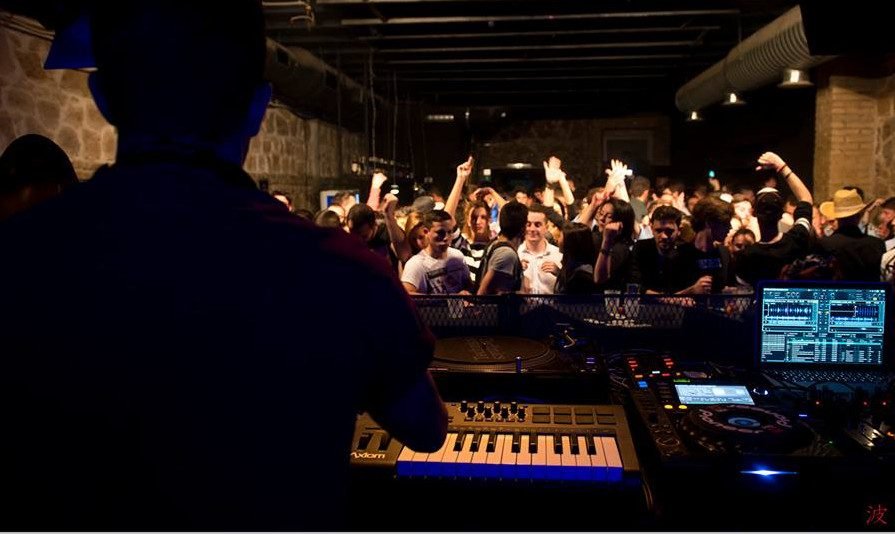
Via Giuseppe Libetta, 1
Rome, Ostiense neighborhood
The Circolo degli Illuminati is one of those Roman clubs that don't exist during the day. You walk down Via Giuseppe Libetta at three in the afternoon and you see a crooked street, a bit industrial and a bit residential, with the low walls of warehouses, a few rolled-down shutters, vans parked badly and the background noise of the Ostiense flowing a little farther on. No lit sign, no line, no bouncer. Then you come back to the same address at night, on the weekend, and the same street becomes something completely different: little groups of kids looking for each other on the phone, scooters double-parked, the bass coming out of the wall and hitting you before you've even figured out where the door is. Well, number 1 on Via Libetta is exactly that kind of place.
I'll say it right away, because it's the thing that most often confuses first-timers: the Circolo degli Illuminati is not a place that announces itself. It has no storefront window, no menu on display, no sign with arrows. It has an entrance, a tree-lined courtyard, and behind the courtyard a room. If you don't know it's there, you walk right past it without noticing. It's a trait the place shares with half of Via Libetta and it is part of its identity: here the night doesn't advertise itself, you go looking for it.
The formula, boiled down to the bone, is that of the dance club: a room with a bar, a booth, a sound system that pushes, and a program that on weekends goes fairly straight and hard, especially on Saturday. But reducing the Circolo degli Illuminati to a sound system and a booth would be like describing a trattoria by listing its tables. What makes this address interesting, and the reason it deserves a page of its own instead of ending up in the pile of generic clubs, is the layering: under the Circolo degli Illuminati there is the old Classico, under the old Classico there is a piece of Roman industrial archaeology, and under that there is the story of a street that from the 1990s onward served as a laboratory for this city's night.
Let's start there, because without the street the place is only half understood.
Via Libetta, the street that invented a different kind of night
Via Giuseppe Libetta is a side street that branches off Via Ostiense and ends almost immediately, without urban-planning pretensions of any kind. It is short, it is narrow, and its surface in places looks more like a service lot than a city street. In postwar Rome and up to the 1980s it was a working street: workshops, warehouses, depots, small factories, everything that gravitated around the river port, the General Markets, the power plant, the railway yards. Daytime activities, shutters down at 18:00 and silence until the next morning.
Then the thing happens that happened in many European cities in the same period: manufacturing moves elsewhere, the warehouses empty out, and those large, tall spaces, with no neighbors to wake up, with thick walls and warehouse ceilings, suddenly become the most desirable thing in the world for those who want to make music at night. It is the same arc that in London filled the old depots of Shoreditch, in Berlin the heating plants and the factories on the east side, in Barcelona the warehouses of Poblenou. In Rome it was Ostiense's turn, and within Ostiense it was above all Via Libetta's turn.
From the 1990s onward this side street becomes an anomalous concentration: within a few hundred meters, clubs, dance halls, concert spaces pile up, places that open, close, change name, change management, change music. A density that in a city like Rome, where nightlife tends to spread out by district and by piazza, was and remains an almost unique case. Those who lived through those years still tell it with a certain emphasis: you parked wherever you could, you went into one place, you came out, you walked 20 meters and went into another, and the evening was built by walking. For years Via Libetta was the closest thing Rome has had to a nightlife district in the strict sense of the term.
The Circolo degli Illuminati was born inside this story, not beside it. And number 1 has a precise position in that geography: it is the first one you meet coming in from Via Ostiense, the threshold of the street, the point where the evening begins or ends depending on how it went.
From the old Classico to what you find today
The passage that any Roman with a few years behind them will tell you as you walk in is this: before, the Classico was here. Classico Village was for a long season one of the most recognizable addresses in the area, one of those places that shaped the musical taste of entire cohorts of Roman 20-somethings and that in the city's collective memory take up a space out of proportion to their real square meters. When that season ended, the space did not stay empty for long: the Circolo degli Illuminati was born, in part, from the ashes of that experience, taking up its walls and reinventing its purpose.
This passage explains many things about the place today. It explains the floor plan, which is that of a space designed for standing and listening, not for sitting and having dinner. It explains the courtyard, because the old industrial spaces almost always had a yard in front for maneuvering, and that yard in the conversion naturally becomes a garden. It explains the acoustics, which are those typical of a volume built to hold machinery and not to hold people: high, generous, with hard surfaces that sound attacks in a way that purpose-built clubs never have.
It also explains, if you like, a certain roughness of the whole. Here nobody tried to make the designer venue with warm light and velvet. It is a space that doesn't hide where it comes from, and most of those who go appreciate exactly that. It is not a luxurious place and it is pointless to expect it to be: it is an honest place.
One detail to underline, because it helps to read the whole street: the conversion of Via Libetta was not an urban-planning project handed down from above. Nobody decided at a table that that street would become the nightlife district. It happened by accumulation, by word of mouth, because one person found the warehouse at a good price and opened, and then another thought that if it worked for him it could work for me too. The street built itself, one street number at a time, and number 1 is one of the pieces that have held out the longest while changing skin.
A curiosity about Circolo degli Illuminati
The real curiosity, the one almost nobody stops to consider, concerns the name. Circolo degli Illuminati is a name that, read in passing, seems to wink at the whole imagery of the secret society, cabals, symbols, invisible hands that govern the world. And it is an imagery that over the last 20 years has swelled quite a bit, fed by novels, films, and above all by a river of online content that has nothing historical about it.
The funny point is that the name, read properly, does exactly the opposite of what it seems: it doesn't evoke the mystery, it makes fun of it. The key is the word circolo. A circolo, in the Italian and especially the Roman tradition, is the least secret thing in the world: it is the tennis club, the recreational club, the workers' club, the bocce club. It is the neighborhood association with plastic chairs, the TV on and the annual fee. Attaching the word circolo to the word illuminati produces a short circuit that is pure Roman humor: the most feared secret society of the popular imagination demoted to a neighborhood branch with its membership card and the card clerk.
And here is the second level, which concerns the legal form. Many Roman venues of this kind have historically operated as private clubs, that is, as cultural or recreational associations with a membership card for members. It is a formula with long roots, tied to the world of Italian associationism of the 20th century, and for decades it has been the way a huge part of this city's nightlife and cultural life was organized: from the Arci clubs to the social centers, from dance halls to film clubs. So calling yourself a circolo was not just a joke: it was also a declaration of belonging to a very concrete and very Italian tradition.
On the historical side, then, it is worth putting things in order, because it is one of those pieces of information that make a good impression when told aloud. The expression illuminati refers to an 18th-century context, that of the Enlightenment, that is, the movement that put reason, criticism and shared knowledge at the center of everything. Illuminato, in that vocabulary, did not mean initiated into a secret: it meant emerged from the darkness of ignorance, able to reason with one's own head. The later reversal, the one that turned the word into the label of a supposed world conspiracy, is a much later and much less serious product, and has no foundation in historical research.
All that said: it is obvious that whoever chose the name played with it, and it would be hypocritical to pretend otherwise. The suggestion of the cabal, of the wise gathered indoors, of knowledge passed on only to those who enter, is part of the fun. It simply works the way a good pun works: it winks and then laughs at itself. If you go in expecting pyramid symbols on the walls and coded messages in the music, you will be disappointed. If you go in understanding the joke, you have twice the fun.
I'll add a third level, which is the one I prefer. In practice, a club really works as a small community with voluntary enrollment. It has its rites, its language, its hours that seem absurd to outsiders, its informal hierarchies, its veterans who recognize other veterans with a nod. There is nothing occult, but there is effectively an inside and an outside, and anyone who spends enough time there develops a kind of shared knowledge that is written down nowhere. In this sense, for once, the name hit the mark more than it meant to.
The courtyard, which is the part people remember
Anyone who has been there, if they have to describe the Circolo degli Illuminati in one sentence, will in all likelihood talk about the courtyard before the room. It is something you often notice and it says a lot about how an evening here really works.
The little garden in front of the entrance is, in practice, the second room of the venue. It is the place where you go out for air when it's too full inside, where you answer the phone because inside you can't hear anything, where you wait for friends who are late, where the real conversations of the evening happen. Inside you don't talk: you shout in an ear and nod without having understood. Outside, with the bass muffled by the wall, you can finally exchange a couple of words.
Anyone who goes to clubs knows it well: the outdoor space is not an accessory, it is a piece of social infrastructure. Venues that have one have a completely different evening dynamic from those that don't. With a courtyard, people stay longer, mingle more, and the evening has a rhythm in waves: you go in, you dance, you go out, you catch your breath, you go back in. Without a courtyard, you have a compressed room and a sidewalk full of people whom the apartment building across the street cordially hates.
The tree-lined courtyard also has a practical effect on the climate. Rome in summer is a city that at two in the morning is still lukewarm, and a closed venue full of dancing people becomes a sauna within an hour. Being able to step out under the trees completely changes how bearable the evening is in the warm months, and it is one of the reasons Roman clubs with outdoor space get through the summer better than the others.
A sincere warning, though: the courtyard is also the point where the venue meets the neighborhood. Via Libetta is not uninhabited, there are residential buildings a few meters away, and the relationship between the clubs of the area and those who live there has been anything but simple over the years. So, if you go: the volume of your voice outside matters, and so does how you leave the street when you go. It is the most banal thing in the world to say, and it continues to be the one that does the most damage when nobody says it.
One thing nobody tells you about Circolo degli Illuminati
What nobody tells you is that a venue like this isn't judged by the average evening, it's judged by the wrong half hour. The concept needs explaining, because it applies to all clubs but here it is particularly evident.
Anyone who tells you about the Circolo degli Illuminati will describe the full moment: room loaded, sound system at full blast, people dancing, that feeling of a machine running. It is the moment the place exists for and the reason people come back. But the true character of a club you see in the two moments nobody ever photographs: the first hour and the last.
The first hour is when the room is half empty, the lights show the floor, the bartender arranges the glasses and in the booth someone is building the ground for what comes next. Many consider it wasted time and deliberately arrive later. It's better to do the opposite, for a practical reason: the first hour is the only time you can understand how the space is made. You see where the columns are, where the sound gets muddy and where instead it's clean, where there's a good draft of air, where the bottleneck forms when people arrive. This is information that is valid all night, and that you can no longer gather afterward because you can't see anything.
The last hour is the other face. It is the moment when the venue empties in fits and starts, those who don't want to go home remain, and the sound changes nature because a half-empty room resonates in a completely different way from a full one. Bodies absorb sound: it's physics, not poetry. The same track that seemed perfect to you at two in the morning, at five in the emptied room sounds long and metallic. Those who know clubs know this and organize accordingly.
The second thing nobody tells you concerns the relationship between venue and programming. A club is not a neutral container: it is a place that on a certain evening sounds one way and on another evening is a different venue. The same address, the same sound system, the same bar, and a completely different evening depending on who is in the booth and who organized. This holds everywhere, but it holds in an extreme way for spaces like this, which have an articulated program and host different collectives and organizations over the course of the week.
The practical consequence is clear-cut: asking whether the Circolo degli Illuminati is a good venue is a badly posed question. The right question is who is playing that night and what kind of evening it is. The same place can give you the night of the year and, three weeks later, an evening that tells you nothing, without a single nail in the walls having changed. Anyone who goes to an address on a sure bet, without looking at what's on, sooner or later ends up disappointed and blames the venue.
Third thing, and I say it for those coming from outside Rome. Roman clubs have hours that throw off people coming from northern Europe or the United States. They start late and finish late, and before a certain hour the room is simply empty. Arriving early because in your own country at that hour things are already in full swing is the classic mistake of the foreign visitor, who ends up dancing alone and concludes that the venue doesn't work. It's not the venue: it's the cultural time zone.
Fourth and last thing, the most underestimated of all: the return. In a city where night transport is what it is, the most delicate part of the evening is not the entrance, it's the exit. I'll come back to it further on, because it deserves a space of its own.
The advice I give you for visiting Circolo degli Illuminati
There is only one piece of advice and I sum it up in one line: prepare the evening the way you would prepare an outing, and above all prepare the return.
We say it because most of the evenings that end badly in the Ostiense area don't end badly inside the venue, they end badly outside. They end badly because someone didn't realize that at a certain hour the metro has closed, because the group scattered and nobody has a signal anymore, because they came by car without knowing where to park, because they underestimated how much it costs to get home to the other side of the city at four in the morning.
So, in order, the things to do.
One: check the program before you move. Not the address, the program. Look at the official channels of the venue and of the organizers to find out who is playing, what time it opens, whether you need presale tickets and whether there are lists. Many Roman clubs work heavily on presales, and showing up at the door without having looked at anything is the easiest way to be left outside or to pay more than necessary. I'm not giving you prices and hours here because they are the thing that changes most often in the world, and a page that writes them down for you is a page that lies to you six months later.
Two: consider the membership card. If the venue operates as a circolo, entry may require an association membership card, which is usually made at the door and is valid for a period. It is a bureaucratic formality, not a trap, but it's useful to know beforehand so you're not surprised at the moment of entering and so you have ID with you.
Three: ID and cash. The ID is often needed for the membership and in any case for the check at the entrance. Cash is needed because in the Roman night it still happens that something has to be paid in cash, and finding yourself without it is an avoidable nuisance.
Four: think about the return before leaving. It's the part almost nobody does and the one that changes the evening. The Rome metro does not cover the deep night on ordinary evenings, and even when the schedule is extended on weekends it certainly doesn't reach dawn. There are night surface lines, which have their own time and their own patience. There are taxis, which at that hour and in that area are not always immediate. The sensible thing is to decide beforehand how you get back and, if you're in a group, to decide on a physical meeting point in case the phones run out of battery or can't get a signal.
Five: shoes. It seems silly and it isn't. The road surface of Via Libetta and the side streets around it is not a living room, and inside a club you are on your feet for hours on a floor that doesn't forgive. Those who go with the wrong shoes find out around one in the morning and spend the rest of the night thinking about it.
Six: water. The most useful thing you can do in a full, hot and noisy room is to drink water with some regularity. It's not nutritionist's advice, it's advice from someone who has seen too many evenings ruined by a simple heatstroke. The water bar exists, use it.
And one thing on the subject of alcohol, which should not be brushed off with a joke. The joke was funny and I won't repeat it, but the serious advice is the opposite: the best moment of an evening like this has nothing to do with how much you drink, and those who overdo it miss exactly the part they came for. If you go for the music, music is heard better sober. If you're in a car, the matter isn't even up for discussion: someone else drives.
Seven: the neighborhood outside. One last piece of advice nobody ever gives. Arrive in the area two or three hours earlier, have dinner somewhere between Ostiense and Garbatella, take a stroll. Turning the club evening into a neighborhood evening improves it enormously, because you reach the venue already inside the atmosphere instead of being catapulted in from a taxi. Further on I'll tell you what to see in the area, calmly.
How to get there, really
Via Giuseppe Libetta branches off Via Ostiense at a point that, if you look at a map, is very convenient, and that, if you look at the nighttime reality, is a little less convenient than it seems. Let's go through the options one by one.
Metro. Line B serves the whole Ostiense axis with the stops Piramide, Garbatella, Basilica San Paolo. The area of Via Libetta can be reached on foot from the stops in the zone, with a walk that depends on which end of the street you need. The problem isn't the way there, it's the way back: the metro closing hours don't cover the club night. So the metro is perfect for getting there and almost never useful for getting back.
Railway and regional trains. Roma Ostiense station is a short distance away and serves both regional traffic and the connection with Fiumicino airport. For those arriving from out of town it's a convenient reference by day. At night, again, the situation changes.
Night buses. Rome has a network of night lines that covers the main axes with wide intervals. It isn't as convenient as a metro, but it exists, it works and it is the cheapest solution for getting home at absurd hours. It's worth checking beforehand which line passes near you and where you catch it, because at that hour looking for the stop with your phone at 10 percent battery is an experience I don't recommend.
Taxis and car service with driver. They work, but at certain hours and in certain areas availability is not immediate, and on nights of heavy turnout you can wait quite a while. If you're in a group, booking the exit time in advance is the smart move.
Your own car. Possible, with two warnings. The first is parking: on peak evenings the area fills up and finding a spot nearby becomes a small feat, with the real risk of leaving the car somewhere that costs you a fine the next morning. The second is obvious and has already been said: whoever drives doesn't drink, and it's not a ritual formula.
On foot from the center. Not recommended as a nighttime return, but by day the walk from Piramide toward the Ostiense is one of the most interesting in the city for those who love industrial Rome, and I describe it further on.
Another well-known fact, yet rarely cited
The well-known fact is that the Ostiense is the industrial district of Rome. Everyone knows it, everyone says it, it appears in every guide. What is cited much less is how anomalous it is that such a thing exists in this city, and how much this anomaly explains the character of the night around here.
Rome, for historical reasons, never had a large industry. It is not Turin, it is not Milan, it is not Genoa. For centuries it was an administrative, religious and symbolic capital, with an economy made of bureaucracy, crafts, construction, services, commerce and land rent. The smokestack, in the Roman mental landscape, is an exotic object. And yet, in a well-defined piece of the city, between the Tiber and Via Ostiense, industry really did exist, and it left architecture that today is among the most fascinating of 20th-century Rome.
This piece of the city is the result of a precise choice made at the turn of the 20th century: to concentrate along the river and along the axis to the sea the productive and logistical functions that the capital of the new State required. The river port, the railway yards, the general warehouses, the wholesale markets, the gas works, the thermoelectric plant. All lined up along one axis, all outside the walls, all rigorously far from the monumental Rome that was not to be soiled by smoke.
The result, a century later, is a catalog of industrial archaeology that very few Italian cities can claim in so few square kilometers. And the point that is never cited enough is this: the night of Via Libetta was not born by chance in just any neighborhood. It was born exactly where there were the only Roman spaces large enough, tall enough and isolated enough to put a sound system in and turn up the volume. The geography of Roman nighttime music is the direct child of the industrial geography of a century earlier. Without the workshops of the early 1900s, there would have been no clubs in the 1990s.
There is a second fact, equally well known and equally little explored: the neighborhood is called Ostiense because Via Ostiense is the road that led to Ostia, that is, to the port of ancient Rome. It is an axis more than 2,000 years old that has kept doing the same thing over the centuries: carrying goods and people from the river and the sea toward the city. The 19th-century river port, the freight yards, the warehouses: everything was built along the same line that the ancient Romans used for the same purpose. Few roads in Europe have so long a functional continuity.
And there is a third element, which is what makes this part of the city truly special: the coexistence of registers. Within a kilometer and a half you have an ancient pyramid, a monumental cemetery, a gigantic basilica, a power plant turned into an archaeological museum, a gasometer that looks like it came out of a film, a working-class neighborhood of the 1920s designed as a garden city, and a street of clubs. These are layers that elsewhere would be in different neighborhoods and here they look at each other from one side of the street to the other.
What's around and why it's worth arriving earlier
This is the part I really recommend to those coming from out of town, and also to those who live in Rome and out of laziness have only ever seen the Ostiense at night. The neighborhood around Via Libetta is one of the densest in interesting things in the whole city, and almost all of them are within walking distance.
The Centrale Montemartini is the thing I recommend first, always, to anyone. It is the city's old thermoelectric plant, and today it hosts part of the Capitoline archaeological collections. The effect is memorable: ancient white marble statues displayed in front of turbines, boilers and enormous diesel engines, with the black of the industrial machine serving as a backdrop to the whiteness of classical sculpture. It is one of those juxtapositions that on paper seem a strange idea and in person work wonderfully. If you have two free hours before an evening in the area, that's where I'd spend them.
The Pyramid of Cestius is the other thing it makes no sense to skip. It is a monumental tomb of the Augustan age, built by a person who evidently had a passion for Egypt, and for centuries it has been incorporated into the walls of the city. Seeing it wedged between the traffic, the station and the tracks is one of those typically Roman experiences in which the monument is not put on a pedestal but lives alongside everyday life.
Next to the Pyramid is the Non-Catholic Cemetery of Rome, which is probably the quietest and most moving corner of this whole part of the city. Cypresses, cats, gravestones of travelers, artists and scholars who arrived here from half the world and never left again. It is a place that completely changes the rhythm of the day for anyone who enters.
The Basilica of St. Paul Outside the Walls is on the other side, toward the outskirts, and is one of the four papal basilicas. The interior dimension is hard to convey in words: it is an enormous, cold and solemn space, with the row of portraits of the popes running along the whole nave and producing a hypnotic effect. Those who know only St. Peter's are often left disoriented by the fact that there is another Roman basilica of this scale.
The Museum of Via Ostiense is a small institution that almost nobody visits and that instead tells with precision the story of the axis we were talking about before: the road, the port, the links between Rome and the sea. It's the kind of half-hour museum that makes you understand all the rest of the neighborhood.
The Monte dei Cocci, a little farther toward Testaccio, is perhaps the most incredible and least spectacular thing of ancient Rome: an artificial hill made entirely of amphora fragments accumulated over centuries, that is, a Roman dump that became landscape. There is nothing to see in the classical sense and everything to understand.
The Nuovo Mercato Testaccio and the Museo Diffuso del Rione Testaccio complete the picture from the other side, for those who want to understand how a working-class Roman district really lives, one that over the last 30 years has become one of the most sought-after in the city.
And then there is Garbatella, which deserves a discussion of its own. It is the neighborhood that climbs up the opposite side of Via Ostiense, born in the 1920s as a working-class district on a garden-city model: low lots, shared courtyards, little stairways, small piazzas, arches, ivy. Walking through Garbatella in the evening, before heading down to the clubs, is one of the most pleasant things you can do in Rome without spending anything. The urban gardens are one of the nicest pieces of this world.
Finally the Gazometro, which technically can't be visited but is the visual symbol of the whole area: the great iron lattice structure that can be seen from half the city and that has by now become the involuntary logo of the Ostiense. It is the backdrop of an incalculable number of photographs, music videos and news reports, and when the light falls it becomes almost theatrical.
The right photo to take at Circolo degli Illuminati
I start from a premise, because otherwise the advice can't be understood: inside a club photography is almost always a disaster. Very low light, colored lights going crazy, smoke, people in motion, a phone that raises the ISO until it produces a paste of noise. 90 percent of the photos taken on a dance floor are an orange blur in which nobody is recognizable. Add that in many venues photographing on the floor is frowned upon or explicitly discouraged, out of respect for those who are dancing, and the picture is complete.
So the right photo here isn't on the dance floor. It's outside, and it's this: the courtyard at the entrance, shot from the inside toward the outside, with the tree branches at the top, the artificial light filtering from the venue behind you and the silhouettes of the people against the light. It is a photo that tells exactly how the evening is built, has a readable hierarchy of light and needs no tricks. The backlight, which in a daytime photo is a problem, here is the solution: it solves the noise, it draws the figures and it keeps you from capturing recognizable faces without permission.
Second photo I recommend, and perhaps the best of all: the street number. Number 1 of Via Giuseppe Libetta, the street plaque, the wall. Taken in night light, with the street empty and the reflection on the asphalt if it has rained, it is a photograph worth far more than the usual shot of the booth. It's the kind of image that in 10 years will make you remember the evening, while the photo of the dance floor you will have forgotten within the month.
Third option, for those who arrive early: the street itself in the blue hour, that 15 minutes after sunset in which the sky is still deep blue and the artificial lights are already on. In that window Via Libetta is photogenic in a way it isn't by day, because the warehouses become clean volumes and the signs start to count. If you have the patience to wait, it's the best moment of the day around here.
Fourth, widening the field: the Gazometro at sunset, which is the unofficial postcard of the Ostiense, and the tracks of the area with the iron structure in the background. These are images that anyone recognizes as Roman even though they contain not a single classical monument, and that is exactly why they work so well.
Two practical recommendations. The first: inside, if you really want to shoot, ask. Asking is the difference between a photo and a rudeness, and in a place where people come to disconnect from the outside world the difference is felt. The second: don't use flash on the dance floor. It ruins the moment for those around you and produces a worse photograph anyway than the one you would have taken without it.
Last note, which is more an invitation. The most interesting thing to photograph in this area isn't the venue: it's the contrast between the venue and what surrounds it. A series of four or five shots that puts together the turbine of the Centrale Montemartini, the Pyramid, the Gazometro, a courtyard in Garbatella and the wall of Via Libetta tells the Ostiense better than any text. Try it, it works.
Some important events that happened here in history
When talking about the history of a club you have to be honest about one thing: the history of the night is the worst documented history there is. It leaves no notarial deeds, no catalogs, no commemorative plaques. It leaves crumpled flyers, blurry photos, contradictory memories and a few boxes of cassettes. So I won't give you precise dates and detailed lineups that I can't verify. I'll tell you instead the events that actually passed through this address and this street, which are more interesting than any list.
The industrial decommissioning. The first event is the one that made everything else possible: the emptying out of production in the Ostiense strip between the 1970s and 1980s. Workshops that close, depots that free up, warehouses that remain standing with no function anymore. For the neighborhood it was a real economic and social wound, with loss of jobs and decay. For the city it was the involuntary creation of a reserve of enormous spaces a few minutes from the center. Everything that happened afterward on Via Libetta descends from there.
The season of the Classico. The second event is the transformation of number 1 into a space for live music and for the night with Classico Village. That season consolidated Via Libetta as an address, brought here an audience that before had no reason to come to this street, and created the collective habit that made every later opening possible. In the memory of those who were in their twenties in those years the name Classico still weighs quite a lot, and it's not rare to hear it pronounced even today by someone who walks in and comments on the walls.
The birth of the Circolo degli Illuminati. The third event is the passing of the baton: the space doesn't die with the end of the previous season, but is taken up and reinvented under a new name and with a new approach, more oriented to the club and to electronic dance music. It is an important passage because it demonstrates something rare in Rome: that a nightlife space can survive its own era instead of closing and becoming a supermarket. In a city that has lost an impressive number of historic venues, the continuity of an address is already in itself a fact worthy of note.
The building of the district. The fourth event doesn't concern just this street number but the whole street: the accumulation, over the course of the 1990s and the 2000s, of a concentration of venues that made Via Libetta a name known even to those who didn't live in Rome. That concentration produced system effects: it drew an audience from all over the city and from outside, created related business, pushed other spaces to open nearby and made the Ostiense a neighborhood that in the Roman youth imagination means something precise.
The conflict with the neighborhood. The fifth event, which nobody likes to tell but which is part of the story, is the decades-long tug-of-war between nightlife and those who live here. Noise, rowdiness, trash, wild parking: these are the same issues that repeat in every nightlife district in every European city, and the Ostiense is no exception. There have been appeals, limitations, ordinances, negotiations, early closures, periods of tension and periods of truce. Anyone who frequents the venues of the area would do well to know that the truce is always a fragile balance and that it is also managed by the behavior of those who leave at four in the morning.
The cultural rediscovery of the Ostiense. The sixth event is more recent and more institutional: the transformation of the neighborhood from a decommissioned industrial periphery to a recognized cultural zone. The opening of the Centrale Montemartini as a museum venue, the recovery of part of the spaces of the General Markets, the arrival of university campuses, the flowering of street art on the walls of Via Ostiense, the proliferation of venues, restaurants and exhibition spaces. The club on Via Libetta went through this whole transformation from the inside, and in a sense was one of its first engines: the night arrived before the museums, not after.
The blow of the two years of closures. The seventh event concerns the whole sector: the season of health closures in the early 2020s hit clubs more than any other business, because they were the first to close and the last to reopen. Many spaces across Italy did not hold up. The fact that the Roman nightlife ecosystem started up again, even with losses and changes, is in its own way a historic event and worth remembering when speaking of the fragility of these places.
If you're looking for precise dates, names of historic nights and lineups, the best source is not a web page: it's people. In this city it is enough to find someone who was 20 when Via Libetta was the center of the world, and the oral history that comes out is worth 10 archives.
Who has passed through Circolo degli Illuminati
Here too I prefer to be honest instead of filling the paragraph with names. I won't list DJs and artists that I can't document with certainty, because that is exactly how false legends are born that someone then copies and repeats for 20 years. More interesting is to say who really passes through a place like this.
The international guests of electronic music. A Roman club of this size and with this kind of programming works with the international DJ circuit, which is a system that runs on dates, agencies and European tours. Over a season a space like this hosts names who the week before were in Berlin and the week after will be in Barcelona or Amsterdam. This is the reason why, as I said before, the right question isn't what the venue is like but who is there that night.
Roman collectives and organizations. A large part of the evenings at Italian clubs is not organized by the venue but by groups that rent the space and bring their own audience, their own graphics, their own musical identity. They are often kids who do this work out of passion before income, and they are the real creative engine of the night. A venue that hosts different collectives is a venue that changes face every week.
Roman DJs. Rome has a scene of selectors and producers deeper than its reputation suggests, often overshadowed by the fact that the spotlights of Italian electronic music have historically shone on other cities. Many of these names grew up precisely in the clubs of the Ostiense.
The generations of 20-somethings. The largest category and the most important. Quite a few cohorts of students, out-of-town university students, Saturday-night workers, people from the neighborhood, people from the other side of the Raccordo have passed through these walls. For a great many people, and I say it without rhetoric, a venue like this was the place where they discovered the music they then listened to for the rest of their lives, where they met someone, where they spent nights they still tell about.
Foreign visitors. In recent years a growing part of the audience of Roman clubs comes from outside Italy. They are travelers who aren't satisfied with the round of monuments and who look for the living city, and for them an address like this is a piece of contemporary Rome that no classic guide tells.
Those who work there. Last category, the one nobody ever cites: sound technicians, lighting technicians, bartenders, security staff, cashiers, stockroom workers, whoever cleans the room at seven in the morning when everyone has gone to sleep. The Roman night rests on a small army of people who work while others have fun, and every so often it would be right to remember it.
The most frequently asked questions
Does the Circolo degli Illuminati really have anything to do with secret societies? No, and it's a question some people ask in earnest. The name is a game, and as explained above it is a game built on the contrast between the word circolo, which in Italy evokes the neighborhood bocce club, and the word illuminati, which in the popular imagination evokes something else entirely. The conspiracy theories that circulate on this subject have no historical foundation and it would be a shame to take the joke seriously instead of laughing at it.
What music do you hear? The prevailing approach is that of an electronic dance music club, with a preference for straight beats especially on weekend evenings. That said, the programming varies and the type of evening depends on who organizes it. Checking beforehand remains the only sensible strategy.
Can you go alone? Yes, and in a club it is less strange than elsewhere. Those who go for the music often go alone, stay on the dance floor and don't have to answer to anybody. If it's your first time, arriving early helps a lot, because you enter when the room is still readable and you get your bearings calmly.
Is there a dress code? The area is not that of venues with a door selection in downtown style. Common sense counts for more than any written rule: comfortable shoes, nothing that bothers you after three hours on your feet, and something light because inside it's hot and outside in the courtyard much less so.
How much does it cost to get in? It changes depending on the evening, the guest and the moment you buy the ticket, and for that reason you won't find a figure here. Presale tickets on the organizers' channels remain the most sensible way to know in advance how much you'll spend and to avoid lines.
Is it also good for people who don't dance? Let's say it's a place built for dancing. Those who have no intention of doing so can still spend a nice evening between the courtyard and the bar, but the center of gravity of the evening remains the room.
Is it easy to get there from the center? On the way there, yes, no problem. On the way back you need to get organized, for the reasons explained in the paragraph on transport. It's the advice I repeat most often and that is ignored most often.
Why an address like this still matters
To finish, a consideration that goes beyond the individual venue. Over the last 20 years European cities have lost an enormous number of nightlife spaces, squeezed between real estate costs, residential pressures, regulations and changes in the way young people spend their free time. Berlin, London, Amsterdam have addressed the issue explicitly, even going so far as to set up figures and offices dedicated to protecting nightlife understood as cultural and economic heritage. In Italy the debate is more timid, and clubs continue to be treated as a public-order problem more than as cultural infrastructure.
And yet electronic music, the DJ scene, artists' careers, audio technologies, entire creative sectors are born in there. A club is not just a place where people dance: it is the laboratory in which a city experiments with the sounds, graphics, fashions and languages that then arrive everywhere five years late. When a venue closes, you don't lose just a room: you lose a piece of that laboratory, and it isn't easily recovered.
Via Libetta was exactly this for Rome: an open-air laboratory carved out inside empty warehouses, without a plan, without subsidies, with only the strength of a group of people who wanted to do something. The fact that number 1 has gone through more than one season, changing name and formula but remaining a space for the night, is proof that that desire never went out completely.
So, if you go: go with the right curiosity. Look at the walls, look at the courtyard, look at the height of the ceiling and try to imagine what happened there when that space served something else. The music you'll hear anyway, but the rest you only see if you look for it.
Frequently asked questions about Circolo degli Illuminati
Where is the Circolo degli Illuminati?
The Circolo degli Illuminati is on Via Giuseppe Libetta, a short, narrow side street that branches off Via Ostiense, in the Ostiense neighborhood of Rome. The street was an area of workshops and depots until the 1980s, and today it is one of the most recognizable nightlife addresses in the area.
Where does the name Circolo degli Illuminati come from?
The name of the Circolo degli Illuminati is a play on words built on the contrast between the two terms that compose it. The word circolo, in Italy, evokes the familiar image of the neighborhood bocce club, while illuminati recalls the popular secret-society imagery fed by novels and films, without any real foundation in that connection.
What was the venue before it became Circolo degli Illuminati?
Before the opening of the Circolo degli Illuminati, at that same address was Classico Village, one of the most recognizable venues of the Ostiense area for a long season, able to shape the musical taste of entire generations of young Romans.
What makes the courtyard of the Circolo degli Illuminati special?
The courtyard of the Circolo degli Illuminati works, in practice, as a second room of the venue: it is the space in front of the entrance where people move to get some air during the evening. Those who have been there often remember it even before the interior room, so much does it count in the overall experience.
How do you get to the Circolo degli Illuminati by metro?
To reach the Circolo degli Illuminati it is best to use metro line B, which serves the whole Ostiense axis with the stops Piramide, Garbatella and Basilica San Paolo. From these stops, Via Libetta area is then reached with a walk on foot.
How do you get home after an evening at the Circolo degli Illuminati?
Getting home from an evening at the Circolo degli Illuminati requires knowing in advance what time the metro closes, because many of the evenings that end badly in the Ostiense area don't end badly inside the venue but outside, when the group has scattered and nobody has thought about the return.
What is it best to do before going to the Circolo degli Illuminati?
Before going to the Circolo degli Illuminati it is best to prepare the evening like a small outing: check hours and presales on the official channels, bring an ID, decide in advance how to get home and choose comfortable shoes to hold up for several hours on your feet.
Before leaving the house
In points, what to keep in mind when planning an evening around here: look at who is playing and not only where you're going, check hours and presales on the official channels, bring an ID, decide beforehand how you get home, wear shoes that can hold up four hours on your feet, drink water regularly, respect the neighborhood when you leave and take your photos outside instead of on the dance floor. It's not a complicated list and it makes the difference between a successful evening and one to forget.
If you're organizing a trip to Rome and want to fit a night like this into an itinerary that also works by day, the real work is figuring out what to put in the previous afternoon and what to postpone to the next day, because an evening that ends at dawn eats up a whole morning. For the planning part and for guided visits in the city you'll find a serious reference at Tour Leader Pro, which works on guided experiences in Rome and the surroundings. For building the complete itinerary of a trip to Italy, with travel times, the number of days per city and the combinations that make sense, the guide I recommend is Italy Planner. Between the two you cover practically everything you need: the day and the trip.
And if after the evening in the Ostiense you feel like seeing the rest of the neighborhood in the light of day, start again from the Centrale Montemartini and finish at the Basilica of St. Paul Outside the Walls. Barely 2 kilometers, 2,000 years of distance, and the precise feeling of having understood something about this city.