Fanfulla 5/a
In short. Fanfulla 5/a is the Arci club at Via Fanfulla da Lodi 5/a, in the Pigneto, a few dozen meters from the Casilina ring road: a rectangular room where concerts, DJ sets, screenings and presentations have coexisted for years, and which…
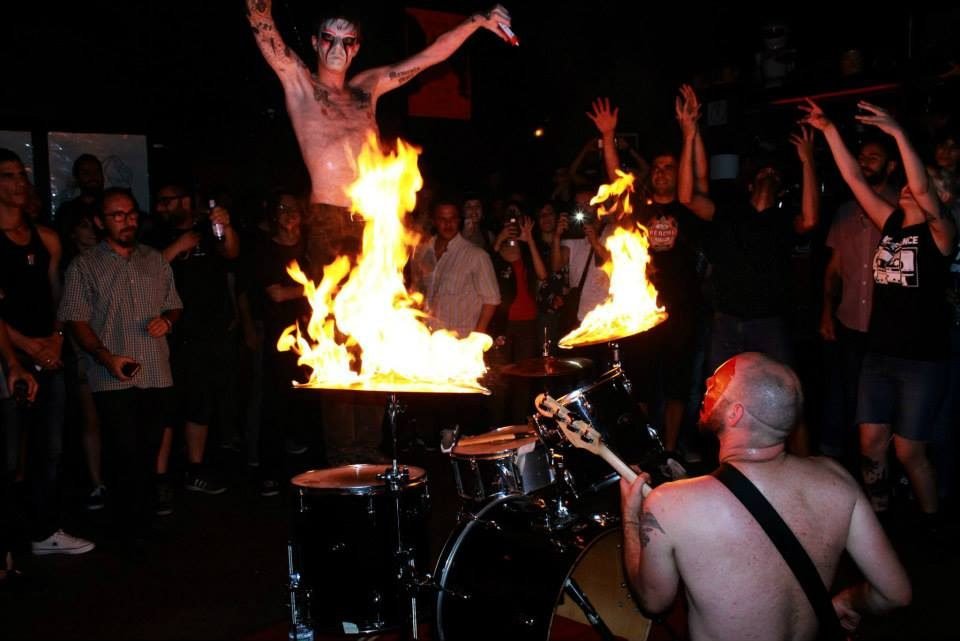
Fanfulla 5/a is the Arci club at Via Fanfulla da Lodi 5/a, in the Pigneto, a few dozen meters from the Casilina ring road: a rectangular room where concerts, DJ sets, screenings and presentations have coexisted for years, and which remains one of the reference points of the so-called weirdo-cultural resistance of East Rome. The official name, the one that appears on the website and on the posters, is Fanfulla 5/A Circolo Arci. For a period the place was called Forte Fanfulla, and people who have been going to the area for a long time still call it that. Entry is reserved for members with a valid Arci card, doors usually open at 22:00 on music nights and an hour earlier on cinema nights, and the program runs practically every day of the week.
Like a cat, Fanfulla has seven lives. It has changed premises, it has changed name, it has gone through seasons in which the Pigneto went from working-class neighborhood to cultural laboratory to contested nightlife zone, and each time it has managed to reopen without distorting its starting approach: semi-serious live shows, crazy DJ sets, visionary cinema, mad programs and plenty of the cheer of an East Rome that knows how to have fun. It's not a club with a guest list, it's not a venue with table service, it's not a concert hall with a barrier in front of the stage. It's a circolo, in the most literal sense of the word: an association of members that opens a room and puts into it whatever the room can hold.
The rest of these pages explains why such a small address weighs so much in the city's nighttime geography, what's around it, how you get in, how you get there and what stories have settled on those 50 meters of street. Because Via Fanfulla da Lodi is not just any street: it's one of the inner arteries of the Pigneto, it bears the name of a 16th-century condottiero, it hosts some of the most photographed murals in the neighborhood and it passes a few steps from the bar that Pier Paolo Pasolini used as a base during the filming of Accattone.
Where Fanfulla 5/a is and how to get there
The address of Fanfulla 5/a
The address is Via Fanfulla da Lodi 5/a, Rome. The street number is low, so it's in the part of the street closest to the Casilina ring road, that is, on the side where the Pigneto faces the railway trench and not on the side of via di Acqua Bullicante. People arriving for the first time almost always make the same mistake: they look for a lit sign. There isn't one. There's a door, often a small crowd on the sidewalk and, on program nights, a membership table just inside. On nights when the club is running at full capacity the most reliable signal isn't visual, it's sound: the bass coming through the wall.
The street is narrow, one-way for a good part of its length, lined with low buildings from the 1920s and 1930s with their little inner courtyards and iron balconies. It looks nothing like the idea of the outskirts that visitors have in mind: distances are short, heights are modest, and the feeling is of a village wedged inside the city. Fanfulla fits into this fabric without imposing itself. Anyone passing by in the daytime sees a rolling shutter and keeps walking.
How to get to Fanfulla 5/a by subway
The simplest way is Metro line C. The Pigneto station, opened on June 29, 2015, runs under via del Pigneto and is the reference stop for the whole area: from there it's a few minutes' walk to the club, crossing the pedestrianized part of via del Pigneto or cutting along the Casilina ring road. The next station, Malatesta, serves the outer area toward Torpignattara and is convenient for people staying over there.
One thing needs saying about hours, and in Rome it makes the difference between a successful evening and a night spent looking for a taxi. The club opens at 22:00 and closes in the dead of night, and the subway doesn't. Anyone counting on the metro to get home has to consider the last useful run, which on weekdays comes well before the end of a concert and which on Friday and Saturday runs later but not until dawn. The practical advice is simple: decide on the return before leaving the house, not at two in the morning on the sidewalk.
How to get to Fanfulla 5/a by tram, bus and train
The Pigneto is served by a dense surface network. The tram lines running along via Prenestina and the Casilina ring road drop you a few hundred meters from the inner quadrilateral of the neighborhood, and piazzale Prenestino is the most useful hub for people coming from the center via Porta Maggiore. The Roma Giardinetti railway, the old narrow-gauge line that starts from Porta Maggiore and runs along via Casilina, has intermediate stops whose names tell the story of the neighborhood better than any guidebook: Alessi, Ponte Casilino, Sant'Elena, Villini.
Then there's the chapter of the future Roma Pigneto railway station, planned as an interchange between metro C and the suburban lines connecting the airport and the northern area. The works marked the neighborhood's landscape for years, up to the demolition of the old bridge over the railway. When the interchange comes into service the Pigneto will change its accessibility substantially, and in all likelihood the crowd at its venues will change too. At the time of writing, September 2026, the station is not yet operational: anyone planning to arrive by train should refer to Termini or Tiburtina.
Getting there on foot or by bicycle
From the historic center the Pigneto is closer than visitors' mental map suggests. From Porta Maggiore, that is, from the point where the Claudian aqueduct and the Anio Novus cross above the road and where the underground basilica of Porta Maggiore is located, to number 5/a on via Fanfulla da Lodi it's a good 20-minute walk, almost always on the flat, following the Casilina or the Prenestina. It's a walk worth doing at least once in daylight, because in that kilometer and a half you cross 2,000 years of urban layering almost without noticing.
What Fanfulla 5/a really is
An Arci club, not a venue
The distinction matters, and it isn't a formality. Fanfulla 5/a is a club affiliated with Arci, that is, a social promotion association. Activities are reserved for members, entry requires a valid Arci card, and the program isn't a commercial listing but the result of what the members, the guest collectives and the internal working groups manage to put together. That's why the artistic line can afford choices that a commercially run venue would never make: documentary screenings on uncomfortable subjects, experimental music projects with no draw for an audience, evenings built around a collective rather than around a name.
This legal form has a corollary that occasional visitors discover on the doorstep: without a card you don't get in. The club writes it on every announcement, at the top of every evening, with the formula notice to members, entry with Arci card. It isn't a barrier put there to be unfriendly, it's the condition that makes everything else possible.
How to get the Arci card
The procedure today is much quicker than it was 10 years ago. Arci has a dedicated app and a portal for digital membership: whoever fills in the pre-registration online arrives at via Fanfulla da Lodi with the paperwork already started and picks up the card at the entrance in a few minutes, without standing in line at the table while the concert has already begun. Those who show up having done nothing can still sign up on the spot, but should allow a few extra minutes and, on crowded nights, a line.
The card follows the membership year, not the calendar year: in the current season the club asks for the 2026/2027 card. It's valid in all Arci clubs in Italy, which makes it a sensible investment for anyone planning to visit more than one place of this kind during a fairly long stay in Rome. It also holds for the association's national discounts, which cover cinemas, theaters and other services.
The room and what to expect
The room is rectangular, of modest size, with the bar along one side and space for the audience in front of the area for the musicians. There's no high stage, no rigid separation between those who play and those who listen, and this is exactly why certain concerts work better here than in rooms 10 times bigger. The distance between the microphone and the front row is measured in centimeters. When the place fills up, and it often does, the air gets thick and the temperature rises.
Drinks are moderately priced, which in the contemporary Roman scene is not a minor detail. Those who don't drink alcohol still find what they need at the bar, and on cinema nights the audience's attention is entirely on the screen. The room is what it is: anyone looking for comfort, armchairs and guaranteed visibility from every spot has the wrong address, and anyone looking for a concert a meter away has found the right place.
What happens during the week
The typical program alternates concerts, music selections, dance nights and cinema. Tuesday is traditionally the night of Kinema Fanfulla, the club's own film series, with doors at 21:00 and the screening shortly after. When the film ends, a DJ set sometimes kicks off, and the room goes from the silence of the screening to the noise of the night within 10 minutes. On the other days there is a rotation of live shows by Italian and foreign bands, evenings of music selections entrusted to guests, and what the club itself calls, with understatement, a small discotheque.
The calendar is published week by week on the club's website and social channels, and changes often: it isn't a listing decided months in advance, it's a living schedule. Anyone who wants to play it safe checks the program the same day. Anyone who wants to go on an adventure just shows up, which is, after all, how many of the regulars first found out about the place.
A curiosity about Fanfulla 5/a
The best curiosity concerns the name, and to understand it you have to lift your eyes from the club's door and look at the street sign. Via Fanfulla da Lodi is named after a Renaissance soldier of fortune, one of the 13 Italian knights who on February 13, 1503 faced the same number of French knights on the plain between Andria and Corato, in the episode that went down in history as the Challenge of Barletta. The East Rome club most identified with contemporary counterculture thus bears, without having chosen it, the name of a 16th-century mercenary who fought on horseback with his lance couched.
The coincidence becomes funnier when you find out who Fanfulla really was. The sources don't even agree on his birth name: historians are split between Bartolomeo Giovenale, Giovanni Fanfulla and Giovanni Bartolomeo Fanfulla, and the only probative documents of his existence are the Cedole della Tesoreria di Napoli, that is, accounting ledgers. They don't agree on his birthplace either: it is claimed by Ferrara, Guardasone in the province of Parma and Basiasco in the province of Lodi. Legend wanted him from Lodi, and as a man from Lodi he passed into collective memory and Roman street naming.
There's more. In Basiasco two plaques from 1903 are preserved that tell an almost novelistic story: a 16th-century parish priest is said to have noted the birth of the future Fanfulla in the baptismal register, hiding the news under a cryptogram, because the man had a very bad reputation, given as he was to plunder and violence. The name that today appears on the sign of a street in the Pigneto is, literally, a name that someone tried to encrypt out of shame.
Posthumous fame arrives three centuries later, and it arrives from literature. In 1833 Massimo d'Azeglio publishes Ettore Fieramosca o La disfida di Barletta, a novel that turns the 13 fighters into national heroes and Fanfulla into a colorful, swaggering, likable figure. It's that book, more than the Neapolitan Cedole, that put Fanfulla on the street signs of half of Italy. Whoever walks into the club on via Fanfulla da Lodi is walking inside an operation of 19th-century Italian identity building, and almost nobody knows it.
One last detail, for those who like symmetries. Fanfulla dies, according to the chronicle of Fabio Vecchioni, on February 24, 1525 on the plain of Terracina. Other sources have him fallen in the Battle of Pavia on the same day. Even about his end, then, the documentation quarrels. A man whose name, birthplace and place of death are not known with certainty gave his name to one of the most recognizable addresses of the Roman night. If anyone were looking for a metaphor for the Pigneto, they would hardly find a better one.
Via Fanfulla da Lodi and the condottieri of the Pigneto
Why the streets here bear the names of captains of fortune
The street naming in the Pigneto is not random, it is divided into three thematic zones with the logic of an early 20th-century technical office. The triangle between via Prenestina, the Casilina ring road and via Casilina bears the names of Italian cities. The quadrilateral bounded by via del Pigneto, via di Acqua Bullicante, via Casilina and the Casilina ring road is dedicated to geographers, cartographers and engravers. And the quadrilateral bounded by via Prenestina, via di Acqua Bullicante, via del Pigneto and the Casilina ring road, the one where the club is, is dedicated to war captains and Italian condottieri of the period between 1330 and 1550.
Some of those names refer to the Challenge of Barletta, others to the Battle of Anghiari. You only have to walk two blocks to meet via Romanello da Forlì, another fighter of the challenge, or via Braccio da Montone, an Umbrian captain of fortune among the most famous of the 1400s. The result is a working-class Roman neighborhood that, in its network of low alleys and courtyards, keeps a roll call of Renaissance mercenaries. Once you notice, you never stop reading the signs.
The Challenge of Barletta in two minutes
The context is the war between France and Spain for possession of the Kingdom of Naples. On November 11, 1500 Louis XII of France and Ferdinand II of Aragon sign the Treaty of Granada and split the kingdom. The treaty leaves the assignment of the middle land undefined, and in the summer of 1502 hostilities reopen between the armies of Louis d'Armagnac and Gonzalo of Cordoba. The Spanish, outnumbered, barricade themselves in Barletta and from there administer what remains of their holdings.
On January 15, 1503, during a banquet given for the French prisoners, the nobleman Charles de Torgues, known as la Motte, questions the valor of the Italian fighters, accusing them of cowardice. The Spaniard Inigo Lopez de Ayala answers in kind. It is decided to settle the matter with a clash between 13 knights per side, set for February 13. Prospero and Fabrizio Colonna build the Italian team, led by Ettore Fieramosca. Fanfulla da Lodi is among the 13.
On how it went, the ancient sources diverge, as always happens with episodes that become legend right away. Jean d'Auton claims that the Italians resorted to a stratagem, falling back and opening gaps in their own ranks to let some opponents out of the field. Bishop Paolo Giovio instead says they stood still with their lances lowered, waiting for the French charge. On Fanfulla, though, the chronicles agree: when his horse fell he went on fighting on foot, spear in hand, slaughtering enemy mounts. The Italians won, and returned to Barletta with the French in tow.
Keeping this scene in mind while waiting for a concert to start in a room 20 meters by 8 produces an estranging effect that I recommend to anyone. It's the kind of layering that makes Rome different from any other European city: there is no neighborhood, however recent and however working-class, that doesn't rest on a sediment of stories much older than itself.
Something nobody tells you about Fanfulla 5/a
What nobody tells you is that Fanfulla is not only a place where music is played: it is a screening room with a precise editorial line, and that editorial line is probably the most radical part of the whole project. The series is called Kinema Fanfulla, takes place on Tuesday, has its own independent social channel and builds themed cycles that last weeks. These are not entertainment nights with a film chosen to fill the room: they are reasoned programs, with introductions, with difficult films, with documentaries that hardly play anywhere else in the city.
In the autumn 2026 season the cycle under way is titled Abitare è un diritto, volume two (Living Is a Right, volume two), and it is the sequel to a path already taken in previous years. The premise written by the club is blunt: in a reality where housing has gone from a primary good to a speculative good of financial capital, and where there are no supporting social policies, people appropriate or reappropriate spaces that institutions have denied them. The cycle explores, film after film, how people have shaped their own need for housing when institutions gave no answer.
The chosen titles say everything about the level of ambition. Below Sea Level (Sotto il livello del mare), Gianfranco Rosi's first feature from 2008, shot in a disused military base 250 kilometers from Los Angeles and 40 meters below sea level, where a community of homeless people lives. Babushkas of Chernobyl by Holly Morris and Anne Bogart, from 2015, about elderly women who chose to keep living in their homes inside the radioactive exclusion zone of reactor number four. The Children of Leningradsky by Andrzej Celinski and Hanna Polak, from 2005, about homeless children who live in the Leningradsky subway station in Moscow. Dark Days by Mark Singer, from 2000, shot over two and a half years inside the disused tunnels of the New York subway, with a soundtrack by Dj Shadow and a crew made up of the film's own protagonists.
And then Punta Sacra by Francesca Mazzoleni, from 2020, about the community of the Idroscalo of Ostia: about 500 families who self-built their own homes in one of the areas of highest flood risk on the Lazio coast, between threats of eviction and environmental risks, claiming their own history against the stigma of an illegal neighborhood. That screening, in the September 2026 program, is announced with the director present.
So this is the point that escapes those who know Fanfulla only as a place to dance. A neighborhood club with a small room and an essential bar builds every year a documentary schedule that many cultural institutions with 10 times its resources can't put together. It does it without a box office, without a press office, without press releases. It does it for its own members. Anyone who lives in Rome and cares about documentary cinema should put the Pigneto Tuesday in their fixed calendar, much more than they suspect.
A note on method, for honesty's sake. The film notes the club publishes are not summaries taken from a catalog: they contain judgments, even sharp ones, on the works in the program and on their authors. It's militant writing, which takes responsibility for what it says. In a landscape of cultural communication made of interchangeable adjectives, reading a program that bothers to have an opinion is already a small piece of news in itself.
The Pigneto around Fanfulla 5/a
Where the name Pigneto comes from
The place name is attested already in the 1600s, when the area was entirely suburban and consisted of vegetable gardens, villas and vineyards outside Porta Maggiore. The origin of the name is agricultural and surprisingly concrete: it comes from a long row of pines planted by the Caballini family along the wall of the 18th-century Villa Serventi, on via Casilina. A line of trees gave its name to a neighborhood that today counts tens of thousands of inhabitants, and piazza Caballini still preserves the surname of the family that had those pines planted.
The first cluster of buildings forms starting in 1870, from the union of separate settlements: the Prenestino, the Torrione, the Galliano hamlet, the Acqua Bullicante, the Marranella hamlet and the Casilino, arranged along the perimeter of the triangle, with the Pigneto proper at the center. It is not a planned neighborhood, it is a coagulated neighborhood. This origin explains many things about its present character: the irregular layout of the streets, the mix of building types, the absence of a monumental center and the presence of dozens of micro-centralities at block level.
The Marranella, the river you can't see
A river runs under the Pigneto. The Marranella ditch rises among the Alban Hills under the name Marrana, enters the urban area and takes the name it gave to the hamlet and the square. The name would derive from the fundus or ager maranus skirted by the stream in its initial stretch. At the level of via di Acqua Bullicante the watercourse receives the waters of the bullicame springs, so called for the sulfurous gas emanations that made them bubble and that gave their name to the estate still existing in the 1800s.
The ditch stayed visible until 1934. Then, in the urban stretch, it was channeled into an underground collector and vanished from sight. It re-emerges farther downstream: it follows via della Marranella, reaches largo Preneste, crosses the former SNIA Viscosa plants after feeding the artificial lake of the former SNIA and finally flows into the Aniene along via di Pietralata. In the more rural stretches you can still see it running in the open.
It's worth knowing before spending an evening at Fanfulla, because it changes the perception of the place. Whoever walks on via Fanfulla da Lodi walks over a buried watercourse, in an area that the archaeological digs on via di Acqua Bullicante have returned as a rural village active since at least the second century BC, perhaps identifiable with the ancient city of Caenina on Via Labicana. The Pigneto wasn't born in 1870: in 1870 it merely became visible.
Pasolini, Accattone and the neighborhood as a set
Pier Paolo Pasolini's phrase about the Roman borgate, the crown of thorns that girds the city of God, has become the involuntary epigraph of this area. Accattone, from 1961, is Pasolini's directorial debut and brings to the screen Franco Citti in a Rome of the margins that found its natural landscape in the Pigneto. The director used a historic venue on via Fanfulla da Lodi as his production base, a few dozen meters from where the club is today: the same street, the same sidewalk, the same slanting light between the low buildings.
It is not the only film to have chosen these streets. The most famous scene of Roberto Rossellini's Rome, Open City, from 1945, with Anna Magnani as Pina killed by the Germans, was shot on via Raimondo Montecuccoli, inside the same grid. Since then the neighborhood has appeared in Bellissima by Luchino Visconti from 1951, in Il ferroviere by Pietro Germi, in Audace colpo dei soliti ignoti by Nanni Loy from 1959, in Una vita difficile by Dino Risi from 1961, in Un borghese piccolo piccolo by Mario Monicelli from 1977, up to Cover-boy by Carmine Amoroso from 2006 and Questione di cuore by Francesca Archibugi from 2009.
Lining up these titles means reading 70 years of Italian cinema using a few hundred square meters of outskirts as the common thread. It's also the reason why a documentary series inside a club on via Fanfulla da Lodi is not a quirky detail: it is the continuation of a vocation the neighborhood has had since before its present inhabitants were born.
The historic bar and the cave under the floor
A few dozen meters from the club, on the same street, is the bar that everyone in the area calls by name and that has served the neighborhood since 1924: the venue that Pasolini used during the making of Accattone and that today is one of the most photographed places in the Pigneto. What almost nobody knows is that under that floor there is a hypogeum, an underground cavity that resurfaced relatively recently and was reported by the local press as one of the neighborhood's archaeological surprises.
It's one more confirmation of a Roman rule that admits no exceptions: under everything there is something else. The Pigneto looks like a 20th-century neighborhood and in large part it is, but it rests on an ancient district, the one the late antique sources call ad Duas Lauros, that is, the great imperial estate that stretched between the basilica of Santa Croce in Gerusalemme, Porta Maggiore, via Prenestina and via Casilina, tied according to the Liber Pontificalis to the figure of Helena, mother of Constantine.
The Casilina, the SNIA and industrial memory
Via Casilina is the axis that made the neighborhood. Along its course are lined up the 18th-century Villa Serventi, the church of Sant'Elena from 1913, the former Pantanella pasta factory from 1871 later expanded in the 1900s, and the former Serono pharmaceutical institute from 1906, at the corner with piazza del Pigneto. On the Casilina also runs the old narrow-gauge railway to Giardinetti, one of the most distinctive and most neglected means of Roman public transport.
On the Prenestina side industrial memory has an involuntary monument: the former SNIA Viscosa factory, a rayon production plant born as CISA Viscosa in 1923 and active until 1954, now the parco delle Energie. During the 1990s an excavation for a construction site intercepted the water table and generated a lake nobody had foreseen: the former SNIA lake, fed by the Marranella itself, which over the years became the symbol of one of the city's longest urban planning disputes and one of the most loved green spaces of the area.
Anyone spending an evening at Fanfulla who wants to understand the context should give the parco delle Energie at least an afternoon, preferably in full daylight. It's a quarter of an hour's walk away and it tells, better than any plaque, what the term reappropriation means in Rome.
Cinema Aquila and the neighborhood's cultural network
Another useful piece: Cinema Aquila, confiscated from the Magliana gang in 1996 and reopened after modernization works in the mid-2010s, is now a public cinema and a cultural stronghold a few minutes from the club. Around the Pigneto also gravitate small and mid-sized theaters like the Centrale Preneste, the Teatro San Luca and Spazio Diamante, the Goffredo Mameli library, the Museo storico didattico di giochi e giocattoli del Novecento on via Vincenzo Coronelli and, a few stops away, places like Castagneto Prenestino and Snodo Mandrione.
It's a density that no other peripheral Roman area reaches with this continuity. Fanfulla 5/a, in this setting, is not an isolated exception: it is the nighttime node of a much wider daytime network, which includes associations, bookshops, self-managed spaces, craft workshops and neighborhood collectives.
My advice for visiting Fanfulla 5/a
There is only one piece of advice and I put it above everything: get your Arci card before leaving the house. Download the app, fill in the online pre-registration, arrive at via Fanfulla da Lodi with the code ready and pick up the card at the entrance. You save the line, you walk in as the concert starts and you don't spend the first 20 minutes of the evening filling out a form leaning on the bar. It's the kind of precaution that seems trivial until you find yourself among 30 people in front of the door with the band already into its second song.
The second piece of advice is about timing, and it holds especially for those arriving from outside Rome. Here things don't start early. Doors for music nights are at 22:00 and the room really fills up around midnight. For cinema nights doors open at 21:00 and the screening starts around 21:30, so in that case punctuality really counts. Arriving at 21:30 for a concert means finding a half-empty room and the wrong impression. Arriving at 21:30 for a screening means finding a seat. The difference is all there.
Third: check the program the same day. The schedule is published week by week, it changes, gets additions, shifts. The club's website and the association's social channels are the only sources that count. Distrust the automatic event aggregators circulating online, because they have a habit of reporting dates months old.
Fourth: dress for a small, crowded room. When the place is running at full capacity the inside temperature rises a lot, and the winter coat becomes a logistical problem. Don't expect a structured cloakroom as in a theater. Whoever arrives in winter should work out how much they're willing to carry on themselves for three hours.
Fifth, and for me the most important: go on a night when you don't know anyone on the bill. Fanfulla gives its best right there, on the night when the name on the flyer means nothing to you and you find yourself a meter from a music project you will discover exists only in that moment. It's a place built for discovery, not for confirmation. Anyone who goes only when someone they already listen to at home is playing gets a tenth of what they could.
Sixth, on getting home: decide it beforehand. Metro C closes well before the club, taxis in the Pigneto in the dead of night are not plentiful and the ride-hailing apps at that hour apply generous multipliers. Whoever stays until closing should work out the bicycle, the scooter, a friend with a car or the prospect of a long walk to Termini station. It's not a drama, it's simply something to know in advance.
Seventh, and it concerns the neighborhood more than the club: treat via Fanfulla da Lodi as a street where people live, because people live there. The balconies above the club's door belong to families who get up at seven the next morning. The relationship between nightlife venues and residents in the Pigneto has been for years a hot political topic, with ordinances, restrictions and mutual complaints. Keeping your voice down on the sidewalk is not a rule of etiquette, it's the condition for places like this to keep existing.
Another well-known fact, yet rarely mentioned
The well-known fact is that the club has changed skin several times, including its name: for some years it was called Forte Fanfulla, and under that sign it built a substantial part of its reputation. Anyone who has been going to East Rome for at least a decade knows it and says so. What almost nobody adds, though, is that this ability to be reborn in different forms is not a folkloric anecdote: it is the very structure of the project, and it's the reason the place still exists while dozens of venues opened in the same years have closed without leaving a trace.
The difference between a venue and a club emerges exactly in these passages. A commercial venue is tied to a license, a lease, a company: if one of the three elements fails, the project dies. An associative club, on the other hand, is tied to a social body. The members make up the identity, not the wall. This allows it to move, to redefine the space, to change its name and to start over without losing its audience, because the audience is not a clientele but a membership base. Like a cat, Fanfulla has seven lives, and the seven lives have a legal explanation as well as a poetic one.
There's a second, subtler level. The Arci model has allowed Rome, and East Rome in particular, to build a circuit of small and mid-sized spaces in which a foreign band on a European tour, a neighborhood collective and a self-produced film series can coexist in the same weekly calendar. Without that circuit, a great many music projects that we now take for granted in the Italian scene would never have had a stage to play on in their first years. Fanfulla 5/a is one of the nodes of that network, together with places like Monk, Lanificio 159, Largo Venue and Traffic.
Last point, and here I speak from direct experience of years of evenings in this area: Fanfulla's longevity has produced a curious age effect. In the same room, the same night, you find people in their twenties on their first night out and people in their fifties who went to the place when it was still called something else. It isn't a given. Most Roman nightlife spots specialize by age group and stay there. Here the turnover didn't erase the previous audience, it layered it.
The right photo to take at Fanfulla 5/a
I'll start with a recommendation that holds inside the club and in any small room: the best photograph you can take at Fanfulla is the one that bothers nobody. Flash always off, phone low, and at screenings the phone screen turned off completely. In a room where the audience is a meter from the microphone, a flash is not an annoyance, it's an interruption. That said, there are quite a few things to photograph on those 50 meters of street, and they are better than the average visitor suspects.
The murals of via Fanfulla da Lodi
The right photo, the one I really recommend, is taken in the daytime and a few meters from the club's door. Via Fanfulla da Lodi is part of the Museo a cielo aperto del Pigneto, one of the three diffuse public art museums surveyed by the Ecomuseo Casilino ad Duas Lauros together with those of the Quadraro and Tor Pignattara, created with the collaboration of the Wunderkammern gallery, the M.U.Ro project and Muri Sicuri. On via Fanfulla da Lodi alone there are four mapped works: Maupal at number 41, Mr. Klevra at 56, Omino 71 at 62 and Luis Albert Alvarez at number 1A, that is, practically next to the club.
The piece by Luis Albert Alvarez at number 1A is the one closest to the entrance of Fanfulla and is therefore the photograph that joins the two things: the street of public art and the street of the night. A few hundred meters away, on via del Pigneto at number 126, is Aloha Oe, and along the Prenestina at 173 the murals of the parco delle Energie. A complete photographic tour of the open-air museum takes a couple of hours and is, in our judgment, the best free thing you can do in this part of Rome.
The right light and the right hour
The buildings on the street are low and daylight stays on the street much longer than on the streets of the center: the best moment for the murals is late afternoon, when the raking sun lights up the ocher plaster and the shadows of the balconies draw geometries on the walls. At night the picture changes. Public lighting here is warm and uneven, with patches of darkness and sharp cones of light: it's a hard condition for anyone looking for a clean, perfect photograph and ideal for those who accept grain and high contrast. The classic scene, the one that tells the place better than any close-up, is the group on the sidewalk in front of the door, between one band and the next, with the light coming out of the entrance and tracing the profiles. It should be shot from far off, discreetly, and asking whether recognizable faces are in the frame.
Photos to take within a 10-minute radius
In the surroundings, worth the detour are the bridge over the railway trench on via del Pigneto, a historic vantage point over the bundle of tracks and the construction site of the future station, the pedestrian zone with its morning market, the Torrione Prenestino wedged between modern buildings at the second mile of via Prenestina and the former SNIA lake inside the parco delle Energie.
If time is short and you have to choose, go for the lake. There is no other image that sums up with equal effectiveness the industrial, environmental and social history of this piece of Rome: a rayon factory from 1923, a water table intercepted by a construction site, a lake foreseen by no master plan and a park won through years of neighborhood mobilization. All in the same frame.
Some important events that took place here in history
Before listing, an honest note on method. The internal history of an associative club is not documented like that of a public theater: there are no consultable archives, season catalogs or official chronologies. What follows therefore concerns the place in the broad sense, that is, the street and the area where Fanfulla 5/a is located, and the events that made this address what it is. It's the most correct way to tell a story without inventing its details.
February 13, 1503, the challenge
It didn't happen here, obviously, but it is the event that gave the street its name and therefore the club. 13 Italian knights against 13 French ones on the plain between Andria and Corato, under Venetian jurisdiction and therefore on neutral territory. The Italians won. Among them was Fanfulla da Lodi, who according to Paolo Giovio, when his horse fell, went on fighting on foot with his spear. Three and a half centuries later, Massimo d'Azeglio's novel turned that chivalric skirmish into a national myth, and the national myth ended up on the street signs of a Roman borgata under construction.
From 1870, the birth of the neighborhood
The joining of the Prenestino, Torrione, Galliano hamlet, Acqua Bullicante, Marranella hamlet and Casilino gives shape to the urban area of the Pigneto. It's the conventional birth date of everything built here afterward. Between 1886 and 1891 the Società Romana Tramways Omnibus builds in piazza Caballini the first depot for omnibuses and horse-drawn trams outside the Aurelian Walls, which in 1904, with electrification, becomes an exclusively tram depot. The neighborhood is born together with the public transport that links it to the city.
1923 and the rayon factory
CISA Viscosa is founded, later SNIA Viscosa, a plant for the production of rayon on via Prenestina, active until 1954 and absorbed in 1969 by the SNIA group. It's the industrial episode that gave the area its working-class social makeup and that, after its closure, left the urban void from which the neighborhood's longest conflict would arise.
1943 and 1944, the bombings
The Pigneto, working-class in composition like San Lorenzo, was very active in anti-fascism and like San Lorenzo suffered the Allied bombings, which caused the death of 50 Atac employees. The neighborhood still preserves plaques and stops of a memory trail dedicated to the victims and protagonists of those years, and the local section of the Associazione Nazionale Partigiani d'Italia is named after Giorgio Marincola. Anyone walking these streets with a minimum of attention comes across the plaques without having to look for them.
1945 and 1961, the neighborhood becomes cinema
Two cinema dates mark the imagery of the Pigneto more than any urban planning document. In 1945 Roberto Rossellini shoots on via Raimondo Montecuccoli the sequence of Rome, Open City with Anna Magnani, perhaps the most quoted scene in the history of Italian cinema. In 1961 Pier Paolo Pasolini makes his directorial debut with Accattone and chooses these same streets, together with the aqueducts area, as the landscape of his epic of the margins. From that moment the Pigneto stops being only a place and also becomes an image.
1996 and the confiscation of Cinema Aquila
Cinema Aquila is confiscated from the Magliana gang. After years of neglect and a long neighborhood mobilization, and after modernization works, it becomes a working cinema again in the mid-2010s. It's one of the few Roman cases in which an asset taken from organized crime has become a local cultural stronghold again, and not an empty container.
2015, metro C and the pedestrian zone
On June 29, 2015 the Pigneto station of line C opens, under via del Pigneto. In the same year the pedestrian zone is established on the neighborhood's main street, with an immediate increase in evening visitors. These are the two interventions that transformed the Pigneto from a neighborhood known to insiders into a mass nighttime destination, with all the positive effects and all the conflicts that this brings. The debate between residents and business owners on managing the nightlife dates back, in organized form, to precisely those years.
Recent years, the construction site and the station to come
The demolition of the old bridge over the railway and the works for the future Roma Pigneto station, destined to become an interchange between metro C and the suburban lines, have deeply marked the landscape of the lower part of the neighborhood. When the work is completed, access to via Fanfulla da Lodi will change substantially. Fanfulla 5/a will find itself, for the first time in its history, a few hundred meters from a rail hub of metropolitan scale.
Who has been to Fanfulla 5/a
Here too I prefer to be precise about what I can document and what I can't. A club that programs almost every night for more than a decade has hosted a number of artists impossible to reconstruct without an archive, and I don't intend to compile lists of famous names that someone might have seen here. What I can do, and what has much more value, is show what actually passes through this room, taking the program published by the club in the weeks around today, September 2026. It's a faithful picture of the artistic line, and it's worth a thousand anecdotes.
Live music and DJ sets
In the season's opening week the club opened with Les Cacahuètes From Mars, a music selection project signed by Hugo Sanchez and Bob jr, presented with the formula that conveys the house tone: cacahuètes rain down like meteorites. In the following days Vic Sinex took turns at the selections, an evening of what the club calls a small discotheque, and a live show by Sofi Naufal, an alt-folk singer-songwriter from the British scene whose music is described as a blend of dark folk songs that get lost in ambient layering, between melodies, looped voices, protest songs and breakbeat, with Berna from Germany on the DJ set.
On Saturday it was the turn of A-Tweed, the moniker of Antonio De Oto, an Italian DJ and producer based in Rome, whose set was announced with the interrogative title Should I offend someone. The club's description is a good summary of the house's musical taste: an essential smoothie of acid and bizarre downbeats, dark electronics, cosmic disco, tribal techno and polyrhythms, with sets that exceed every limit of beats per minute, from slow, lysergic, industrial rhythms to tribal breakbeats of the British school. The following Sunday the selections passed to GLM.
In the immediately following weeks the published calendar includes, among others, The Chamber Book in its first edition, the Scarno Autunno night, the double concert of Scatterism and Scroll, the Spitbank live show, the Dark Womb night, the one titled Acetato, the 23RedAnts concert and the NED Ensemble one. They are names that will mean nothing to most readers, and that's exactly the point: this is a place where you go to discover, not to verify an already acquired fame.
Cinema and filmmakers
On the cinema side, the cycle Abitare è un diritto, volume two brings to the room works by Gianfranco Rosi, Holly Morris and Anne Bogart, Andrzej Celinski and Hanna Polak, Mark Singer and Francesca Mazzoleni. The latter, in the program for late September 2026, is announced in the room to accompany the screening of her own film on the community of the Idroscalo of Ostia. The presence of filmmakers is not an exception: it's part of the series' method, which treats the screening as the beginning of a conversation and not the end of an evening.
The audience, which is the most interesting thing
If I had to really answer the question of who has been through here, though, I wouldn't start from the names on the posters. Whole generations of Roman 20-somethings have passed through this room, and passed through it by staying: many of those who today organize festivals, run labels, direct series or play in bands that fill rooms 10 times bigger started going to places like this before having anything to show. A circuit of small clubs is the invisible infrastructure on which everything else in a city's music scene rests.
Many foreigners have also passed through, often students on university exchange or musicians on tour with European dates built on associative circuits. For them Fanfulla is one of the first practical tests of what an Italian circolo is: a place where they ask you for a membership card instead of a ticket, where the price of a drink stays reasonable, where nobody checks your shoes at the door and where the band playing may well be eating at the same bar where you ordered. It's not folklore, it's an organizational model. And it works.
Frequently asked questions about Fanfulla 5/a
Do you need a card to enter Fanfulla 5/a
Yes. Entry is reserved for members with a valid Arci card, and in the current season the club requires the 2026/2027 card. You can sign up on the spot, but the most convenient way is pre-registration through the association's official app, with the card picked up at the entrance.
What time does Fanfulla 5/a open
Music nights usually start at 22:00. Tuesday screenings open at 21:00 with the film starting shortly after. The reference listings for the club indicate evening opening hours extended to every day of the week, closing in the small hours. The actual hours, however, depend on the individual event, so the rule is to check the announcement for the specific night.
Is Fanfulla 5/a still open in 2026
Yes. The club publishes its weekly program and, as of the date I'm writing, has an active calendar covering the whole month of September 2026 with concerts, music selections and screenings. It's a legitimate question, because the place has gone through closures and changes of form over the years, but today the answer is yes and it is documented by the public calendar.
What is the difference between Fanfulla 5/a and Forte Fanfulla
They are the same project in different phases. For a certain period the club operated under the name Forte Fanfulla. Today the sign and the official name have gone back to being Fanfulla 5/A Circolo Arci. Anyone searching for information online will find both wordings, and finding material under the name Forte Fanfulla doesn't mean having found a different place.
Can you eat at Fanfulla 5/a
The club is organized around a drinks bar, not around a kitchen. Anyone who wants to have dinner beforehand will find within a five-minute walk a density of trattorias, pizza-by-the-slice shops, bakeries and kitchens of every origin that is hard to match elsewhere in the city. The classic sequence of an evening in the Pigneto includes dinner out, a stroll on the pedestrian zone and entry to the club around 22:30.
Is Fanfulla 5/a accessible
It's a street-level room, so the problem of level differences is smaller than in many Roman venues carved out of cellars or basements. That said, the modest size of the room and the crowding on peak nights make it hard to stay for anyone with specific needs for space or movement. Anyone who needs precise information should write to the club before going, because the answer depends on the individual night more than on the structure.
What to do around Fanfulla 5/a, before and after
Whoever arrives early has in front of them a neighborhood that by day is completely different from how it looks at night. The pedestrian zone of via del Pigneto hosts a morning market, the historic shops hold out next to the recent openings, and the network of alleys between the Prenestina and the Casilina can be walked in a good half hour. For a full day in the area I recommend the pairing of the parco delle Energie with the former SNIA lake in the morning and the open-air mural museum in the afternoon, in the raking light.
For those who want to widen the radius, the area offers quite a lot. To the south, along the Casilina, you reach the Quadraro and then the Aqueducts Park, that is, the landscape Pasolini used as a monumental counterpoint to the borgate. To the north, beyond the railway, is San Lorenzo with its Verano and its student nightlife. To the west, Porta Maggiore and its underground basilica. To the east, the Casilino with events like the Casilino Urban Fest and the rooftop cinema arenas at Casilino Sky Park.
Finally, to build a Roman week that doesn't stop at the historic center, the circuit of clubs and venues in this part of the city is the right thread: besides Fanfulla, Monk toward Portonaccio, Lanificio 159 on the Salaria, Largo Venue in the Prenestino, Wishlist, Traffic, Alexanderplatz for jazz and the Casa del Jazz for concerts in the greenery. They are different worlds, but they belong to the same city and often to the same audience.
Before you go
I'll sum up in a few lines what you really need. Address: Via Fanfulla da Lodi 5/a, Pigneto, Rome. Transport: metro C, Pigneto stop, plus trams and buses on the Prenestina and the Casilina ring road. Entry reserved for members with an Arci card, best to get it online before heading out. Evening opening, usually from 22:00, with Tuesday screenings starting earlier. Program published week by week by the club, to be checked the same day. Small room, close-up concerts, low prices, no pretense of comfort and a great deal of substance.
And one last thought, to close. Places like Fanfulla 5/a exist as long as someone goes to them and as long as those who go behave in a way that doesn't make them unsustainable for those who live upstairs. No complicated rules are needed: low voices on the sidewalk, respect for the street, attention to those who work inside. It's the minimum pact that holds up half a century of Italian associative culture, and it is much more fragile than it seems.
To build a Roman itinerary that holds together the monumental center and these neighborhoods, and to be accompanied by licensed professionals who truly know the city's nighttime geography, a useful reference is the network of tour leaders and guides at TourLeaderPro. To plan the whole trip to Italy instead, with travel times, the right seasons and the combinations between cities, the starting point I recommend is ItalyPlanner. The Pigneto works much better when you fit it into a plan, and not when you treat it as an improvised end-of-night stop.
Contact Information
Via Fanfulla da Lodi, 5/a
Roma Roma Città, Roma Città