Traffic
In short. Traffic is the first place to name when someone asks where to hear metal concerts in Rome, and then doom, stoner, hardcore and every now and then an indie rock gem that pops up in the middle of the rest like a flower in a crack in the asphalt.
Via Prenestina, 738
Rome
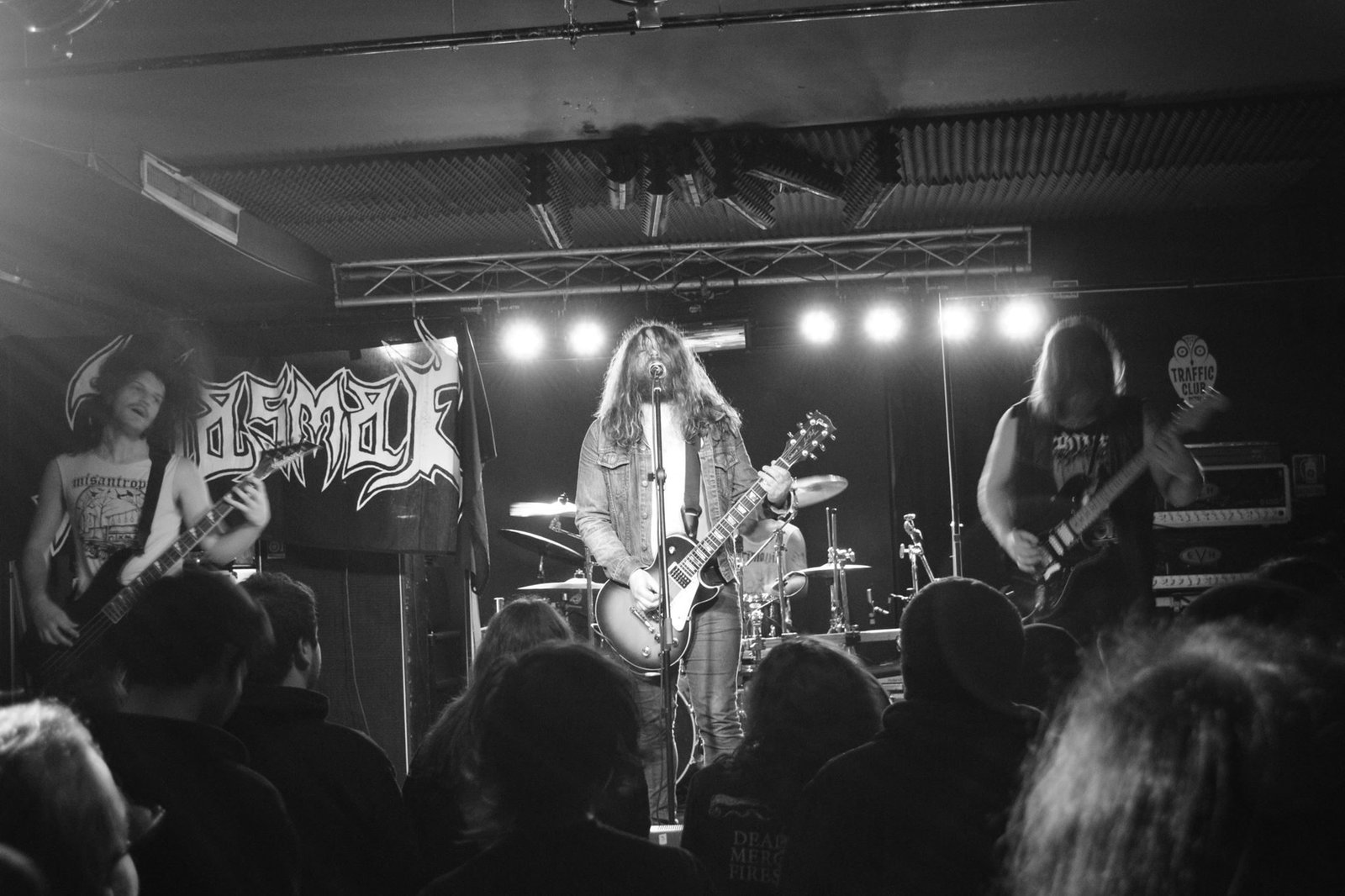
Traffic is the first place to name when someone asks where to hear metal concerts in Rome, and then doom, stoner, hardcore and every now and then an indie rock gem that pops up in the middle of the rest like a flower in a crack in the asphalt. It's not a theater, it's not an auditorium, it's not one of those halls where they give you a numbered seat and ask you not to stand up. It's a club, with everything the word carries with it: a single room, a stage a few steps from the audience, a sound system that hits your sternum before it even reaches your ears, and the precise feeling of being inside something that is happening now and won't repeat itself the same tomorrow.
I got there the first time following a band that would never have filled a big hall and yet deserved to be heard from two meters away. I've been back dozens of times, and every time the feeling is the same: here heavy music is not a tolerated niche, it's the house language. Rome has many places where music is played, some beautiful, others improbable, still others born and closed within a single season. Traffic belongs to the category of places that have put down roots, that moved physically but took with them the audience, the name and a reputation built evening after evening.
Before everything else, what's worth knowing is where your GPS takes you: Via Prenestina 738, east Rome, Quarticciolo area. It's not the center, it's not even the first ring of neighborhoods that tourists cross by mistake. It's real Rome, the one that begins where the postcards end, and whoever comes for the first time often notices it with a small jolt of surprise. After years of service on Via Vacuna, around Portonaccio, where it had earned fame and esteem in every kind of circuit, Traffic moved a few kilometers east and set up house here.
Next to the venue is the Giolli bar, a mix of east Rome humanity especially active in the night hours: people from the neighborhood, people coming out of the concert, people who skip the concert and come only for the after. It's one of those corners where the venue and the street talk to each other without filters, and that's a plus: it means the club is not a spaceship landed in the middle of the houses, but a piece of the place where it stands.
Inside: a single spacious room, a small bright bar area, old school drawings on the bathroom doors. The live activity leans toward metal, for which Traffic is a reference point in Rome, doom and a few indie gems. Too bad about the view of the parking lot, and here the solution is only one: in climbing vines we trust. A couple of seasons of ivy and the aesthetic problem would solve itself.
Now, though, I'll tell you everything properly, because around this address there's much more than what you see from the parking lot.
Where it is and how I get there
Via Prenestina 738 is a high street number, and high street numbers on Rome's consular roads mean only one thing: you're far from the center. Via Prenestina starts at Porta Maggiore, cuts through Pigneto and Prenestino, passes under and over a sequence of bridges, intersections and underpasses, skirts Villa Gordiani, crosses Tor de' Schiavi, meets Viale Palmiro Togliatti and continues east until it leaves the Grande Raccordo Anulare and slips into the countryside that leads toward the Monti Prenestini. Traffic is in that stretch where the city is still city, but has already changed rhythm: more workshops, more warehouses, more open spaces between one building and the next, fewer shop windows and more rolling shutters.
The simplest way to get there, if you're not driving, is the tram. Line 14 runs along Via Prenestina starting from Termini and goes as far as the Togliatti area, and from there a bus or a walk covers the last stretch. Lines 5 and 19 serve the same axis in the inner part, as far as Largo Preneste, and are very handy if you're coming from San Lorenzo, from the Verano or from the university area. The buses that run along Via Prenestina in its outer part are several and change schedule and frequency depending on the time slot, so before going out it's always best to take a look at the public transport app instead of trusting memory.
If instead you drive, the good news is that here parking really exists, which in Rome is almost a front-page news item. The lot in front of the venue and the streets around absorb without drama the cars of a full evening. The bad news is that you see that parking lot from the entrance too, and it's not exactly an Italian garden. But I'll come back to the point, because Traffic's parking lot has become for me a small case study in sentimental urban planning.
A practical tip worth more than a thousand directions: Via Prenestina at night is wide, fast and with few people on foot. If you head back by car, go slowly on the stretches with the tracks, because tram and wet asphalt together play tricks. If you head back by scooter, watch the rails. If you head back on foot toward the stop, do it with someone: not out of alarmism, but because walking in pairs on a consular road at two in the morning is simply more pleasant than walking alone.
There's also a detail worth explaining to those coming from outside Rome. Via Prenestina doesn't carry that name by chance: it's the road that anciently led to Praeneste, that is, present-day Palestrina, one of the most important cities of ancient Latium, home to a monumental sanctuary dedicated to Fortuna Primigenia that occupied the whole flank of the hill. So when you take Via Prenestina to go hear a doom band, technically you're traveling the route of an ancient oracular pilgrimage. At concerts I don't say it out loud too often, but I think about it every time.
A curiosity about Traffic
The curiosity I like best concerns the move. Traffic wasn't born where it is now: its story begins on Via Vacuna, in the area between Portonaccio and Casal Bertone, in a piece of east Rome that over the years has changed its skin several times. In there the venue built the reputation it still carries today, becoming a reference point recognized not by a single crowd but by quite a few different circuits, which in Rome is the hardest thing in the world, because every scene tends to defend its own fence and look with suspicion at the one next door.
Then the move: a few kilometers further east, from the Tiburtina station area toward Quarticciolo. On paper it's a short shift, 10 minutes by car with the right traffic. In the mental geography of those who frequent Roman venues, though, it's a notable leap: you go from an inner area, stitched between the railway and the established neighborhoods, to a historic borgata zone with a very strong identity and a history that begins in the 1940s. Changing address that way also means changing the neighborhood audience, the relationship with neighbors, hours, habits.
The real curiosity is that the name held. This, if you think about it, is not at all a given. In live music venues the bond between sign and walls is almost always tighter than people admit: you move the room and lose half the audience, because people weren't following the project, they were following the habit of that street, that bar, that stop. Traffic instead carried its reputation along the way you carry an amplifier: heavy, bulky, but working. Those who went to Via Vacuna learned a new street, and meanwhile the new address added other people who would never have gotten there before.
There's a second curiosity, minor but nice, and it concerns the name itself. Being called Traffic and ending up on a consular road where traffic is a permanent condition has something prophetic about it. I don't know if the choice of name contained this irony from the start, but it works: you arrive cursing the row of traffic lights on Via Prenestina, you park, you go in, and the sign reminds you exactly where you come from. Few venues manage to be so honest right from the facade.
There's a third thing, which maybe isn't a curiosity but is right to point out. The neighborhood around, Quarticciolo, is an official borgata built between 1940 and 1943, designed on rationalist criteria and organized around a square with the tower, the market and the services. It's not a cluster that grew at random: it's a piece of city drawn at a desk at a precise moment of Italian history. Having a metal club inside a 1940s rationalist borgata is one of those overlaps that happen in Rome all the time and that nobody notices anymore, and that would deserve a plaque.
Quarticciolo, the borgata around it
To understand Traffic it's worth understanding Quarticciolo, because the two hold together. The borgata was born in the early 1940s, in the middle of the war, as one of the so-called official borgate: settlements built by the administration to house families coming from the demolitions in the historic center and from internal migration. The name comes from the area, and the urban layout follows rationalist schemes: low, aligned buildings, green spaces between the lots, a central square with the tower and the market, a church, the school.
Those who imagine the borgata as a disorderly heap are thrown off the first time they enter. Quarticciolo has a clear, almost didactic geometry, with streets crossing at right angles and inner courtyards where hanging laundry draws flags. The years have added and removed, balconies have been closed in, facades have changed color several times, but the original skeleton can still be read perfectly. Walking through it by day, before an evening concert, is an exercise in architectural history far more instructive than quite a few guided tours downtown.
Quarticciolo also has a memory of war and resistance that is little told in the rest of the city. During the months of the occupation the borgata was one of the places where the Roman resistance took concrete and popular forms, with actions, hiding places and a network of solidarity among families. To that season also belongs the most legendary figure of the place, the so-called Gobbo del Quarticciolo, a real person and at the same time a local myth, who entered Italian fiction and cinema as the archetype of the borgata boy who challenges power. His historical story is complex and full of gray areas, and shouldn't be turned into folklore: it's enough to note that in this quadrant the memory of 1943 and 1944 is not book material, it's family-story material.
In recent decades Quarticciolo has lived through what many historic Roman peripheries have lived through: depopulation and repopulation, aging and new arrivals, services that have shrunk and associations that have partly replaced them. There's a public theater that works, a library, a people's gym, a neighborhood market, and a quantity of cultural initiatives that start from below and often don't leave the borders of the quadrant. A live music club inside this fabric is not a foreign body: it's another piece of the same mosaic, with the difference that on Saturday night it brings here people who otherwise would have no reason to come.
The hope is that whoever comes to Traffic from Trastevere or from the Parioli, and maybe sets foot in Quarticciolo for the first time in their life, takes home something besides the concert. Even just the awareness that Rome doesn't end at the ring road, and that here there are neighborhoods with a precise history, a recognizable architecture and a full social life. There's no need to turn the place into a tourist stop, for heaven's sake. It's enough to cross it with open eyes instead of with the hurry of someone who's only looking for a parking spot.
One thing nobody tells you about Traffic
Nobody tells you that the single room completely changes nature depending on how many people are inside, and that learning to read this makes the difference between a good evening and a memorable one. A single spacious space, without columns that break the view and without galleries, behaves differently from a theater: with 200 people it's intimate and warm, with double that it becomes a compact mass, with 100 it becomes an open rehearsal. It's not a flaw, it's a characteristic, and knowing it you choose better where to stand.
Let me give you the concrete example. Crowded evening, awaited headliner, people already inside an hour earlier: in that case the good spot is not the front row, it's the central band slightly off the axis of the stage, where the sound of the speakers adds up without canceling and where you don't find yourself crushed against the barrier by the movement of the crowd. Average evening, three bands on the bill, room half full: then it's best to stand in front, because close-up sound in a room that isn't saturated is clear and the stage at close range is a privilege you'll never have in the big arenas. Low-key evening, empty room, a few devoted fans: stand in the middle of the room and enjoy the reverb, because that kind of listening, in a big, half-empty room, has something intimate that can't be recreated elsewhere.
Second thing nobody says: the small, bright bar area is a social tool, not a simple refreshment point. In many venues the bar is far from the room, isolated, and whoever goes there excludes themselves from the concert. Here instead the scale is small, the passage is short, the light is different from that of the room, and the result is that the bar area works as a kind of decompression chamber where people look each other in the face, recognize each other and talk. The best conversations, in a venue like this, are born in the interval between one band and the next, with a glass in hand and ears still full of feedback.
Third thing, and this counts as an affectionate warning: the old school drawings on the bathroom doors are a detail most people never look at. They go in, do what they have to do, go out. Too bad, because those marks tell a precise aesthetic story, made of venue graphics, of freehand, of iconography that anyone who has frequented heavy music clubs recognizes at a glance. They are the kind of detail that when a place closes disappears first and that nobody bothered to photograph. So, photograph them.
Fourth thing, the most practical of all: the relationship between announced time and real time. In a club the door opening time and the time of the first band are two different pieces of information, and the second is often communicated at the last minute or not communicated at all. Whoever arrives punctually at the opening finds an empty room with the technician doing soundcheck. Whoever arrives at the headliner's time misses the support bands, which are often the most interesting part of the evening. It's best to arrive about 40 minutes after doors open: you get a drink in no hurry, look around, and are in the room when the first set starts.
The room, the bar, the bathrooms with the drawings
I describe the space as I remember it, because in live music venues the description of the environment counts at least as much as the bill. The room is single and spacious, with the stage on one side and the rest of the surface free. This kind of layout has an enormous advantage: anyone, at any point, has a direct relationship with the stage. There are no structural blind spots, no sections condemned to look at a column. It also has a limit, namely that when the room is full the movement of the crowd spreads like a wave from the center to the edges: if you don't like physical contact, the sides are calmer.
The bar area is small and bright, and the light is what strikes you most, because the room is dark as rooms should be. Going from the darkness of the concert to the white of the counter is a small optical shock that serves to remind you there's a world with the lights on. Venues that take care of this passage, even without meaning to, give the audience a rhythm: dark, light, dark, light, and at the end of the evening the body has lived a kind of breathing.
The bathrooms with the old school drawings deserve the paragraph I'm giving them. In club culture the bathroom door is an expressive surface: stickers, markers, drawings made by whoever works in the venue or by some friend with a good hand. They are traces of an era when the visual material of concerts passed through the photocopier, through flyers stuck up with tape and through hand-written signs. Seeing them still in place, in a venue that moved and started over, means someone decided that graphic was part of the identity and had to be carried on.
An observation on the sound, which is after all the reason you go to a club. Single rooms with a large volume need careful management of low frequencies, because the volume of air amplifies everything that happens below 100 hertz. On metal and doom nights, where bass and kick do much of the work, the difference between a careful mix and a rough one is heard immediately: in the first case you hear the guitar strings inside the wall of sound, in the second you only hear the wall. The impression, as spectators and not as technicians, is that here it's taken seriously, and that when the sound doesn't convince, the responsibility lies more often with the mixing desk of whoever is touring the band than with the room.
Last note on the atmosphere: the temperature. In a full single room, with the system on and the crowd jumping, the climate becomes tropical within 20 minutes. Dressing in layers is not simple advice, it's survival. The heavy jacket kept on out of laziness is the evening's first enemy, and the second is the backpack, which in the middle of the crowd becomes an obstacle for you and for everyone around.
My advice for visiting Traffic
The big piece of advice, the one I'd give anyone, is to consider the evening as something that begins before the concert and ends after. If you arrive five minutes before the headliner and leave as soon as the last song ends, you've seen a band play, which is already a good thing, but you've missed the place. Traffic gives its best to those who give it time: arriving early, drinking something in the bright part of the bar, listening to the opening band even if you don't know it, talking to someone, going out and coming back in.
The second piece of advice concerns open-mindedness about the bill. Here metal is the main line, doom is a constant presence, and every now and then an indie night appears that seems out of place and instead works very well. If you follow only one of these lines and ignore the others, you miss the most interesting part of the programming, namely the crossings. The evenings with a mixed audience are the ones where the best things happen, because there are people listening to something they usually wouldn't listen to and reacting in a genuine way.
Third piece of advice, technical and very serious: earplugs. Not the construction-site kind, which cut the highs and turn everything into mush. The filtered ones, the ones that lower the volume while keeping the frequency curve. They cost little, fit in a pocket, and let you leave a loud doom night without the ringing that stays with you until the next day. People who have been going to concerts for many years and still have intact hearing are almost always people who started using them in time.
Fourth piece of advice: cash. In clubs card payment now works almost everywhere, but the merchandising table of touring bands is a world apart, run directly by the band or by those traveling with them, and there cash solves situations that otherwise get complicated. If you're interested in buying a T-shirt or a record, bring a few bills. Those tables, for many bands, are the difference between a tour that breaks even and a tour that loses money.
Fifth piece of advice, the simplest: look at the dates in advance and don't trust last-minute word of mouth. Club programming changes, gets added to, gets moved, and the most reliable information is always that from the venue's official channels and the bands on the bill. Check times, entry price and any membership cards before leaving home, because in the Italian club circuit the organizational formula varies from place to place and also changes over time.
Sixth and last piece of advice, the most important: if you liked the evening, say so. To the band, at the table, to whoever works behind the counter. Clubs live on a very fragile economy, made of thin margins and uncertain seasons, and the part of the audience that comes back and says so is literally the infrastructure that keeps them open. It's not rhetoric, it's bookkeeping.
Metal, doom and the indie gems
The Roman metal scene has a characteristic that sets it apart from other Italian scenes: it's wide and fragmented. Different generations coexist, subgenres that elsewhere ignore each other, bands that have been playing for 30 years next to bands born last year, and an audience that moves among these worlds with more freedom than you usually imagine from the outside. Thrash, death, black, doom, stoner, the crossover with hardcore punk: in Rome each of these words corresponds to a circle of people, a group of venues, a handful of recurring nights.
In this landscape Traffic occupies a precise position, that of the reference point. Not in the sense that everything passes through it, because no venue can afford to book everything, but in the sense that when a mid-level foreign band comes to Italy and looks for a date in Rome, this is one of the addresses that appear first on the list. And it's also the place where Italian bands that are growing find a decent stage, with a real sound system and a real audience, which is what they need most in the middle phase of their story.
Doom deserves its own discussion, because it's the genre the room shows off best. Doom lives on slowness, repetition, constant sound pressure: it needs an environment that supports the low frequencies without muddying them and an audience willing to stand still inside a 10-minute piece. A single wide room does exactly this job. When the evening is right, the sensation is physical: you feel the air move, you feel your chest vibrate, and the perception of time stretches as it does in only a few other situations.
The indie gems are the variable that makes the programming more interesting than it seems. Every now and then, between two heavy nights, a name appears that belongs to another world, a band of guitars and melody that in the metal circuit would have no reason to be there. Those evenings change the audience and change the air. You find people coming here for the first time looking around with curiosity, and you find the regulars staying at the bar assessing the matter with a mix of suspicion and sympathy. They are evenings that do everyone good.
Another thing I often notice and that's worth writing down: the opening bands. In the club circuit the opening band is almost always a local band, just starting out or nearly, bringing its friends and playing in front of a room still half empty. In many venues this moment is dismissed as a formality. Here the opposite happens more often: the opening band has its space, its soundcheck, and an audience that is at least partly already inside. It looks like an organizational detail, and instead it's the way a scene reproduces itself over time.
One last observation on how the audience for heavy concerts has changed in the last 15 years. It's much more mixed than before in age and gender, much less tied to the uniform, much more used to discovering bands on streaming and arriving at the live date as a moment of verification. This has consequences for venues: the audience is better informed, more selective, and willing to travel only if the evening promises something. The clubs that endure are those that have built a reputation solid enough to make people move even toward outlying addresses. Traffic is one of them.
Another well-known fact, yet rarely mentioned
The well-known fact is that east Rome, and in particular the Pigneto, Prenestino, Casilino, Quarticciolo axis, has been for decades one of the city's cultural engines, and that almost no guide tells it as such. Everyone who lives there knows it, everyone who goes to concerts, neighborhood cinemas, small theaters and squatted spaces knows it. Then you open any presentation of Rome and you find the Colosseum, Trastevere, Villa Borghese, and absolute emptiness beyond the ring road. This imbalance is so entrenched that we no longer even notice it.
And yet this is where a good part of the Roman imagery of the twentieth century was born. The Pigneto of low houses and peeling walls is the set of some of the best-known pages of postwar Italian cinema, and it's the neighborhood that Pier Paolo Pasolini crossed, recounted and partly invented as a literary place. The Prenestino and the borgate around it supplied faces, voices and cadences to an entire season of fiction and film. When someone today talks about Roman authenticity, they're talking, almost always without knowing it, about an imagery built in these square kilometers.
The second little-cited aspect concerns the cultural geography of the present. In this quadrant there are public neighborhood theaters, municipal libraries, theater production centers, street festivals, self-managed spaces, people's gyms and a quantity of associations that work on school and after-school programs. A substantial part of the free cultural programming of east Rome comes out of these realities and never appears in the central communication circuits. Whoever comes to the concert and then goes home doesn't notice. Whoever passes through by day sees it right away.
Third aspect: archaeology. Via Prenestina is dotted with remains that most Romans have never visited. The monumental complex of Villa Gordiani, with its mausoleums and Roman masonry in the middle of a heavily used public park, is a few tram stops from here and is one of the most underrated places in the city. Further east, toward the countryside, the same road leads to ancient sites of the first rank. The overlap between archaeology and daily life in this sector of Rome is total, and for this very reason it becomes invisible.
The fourth aspect, the most interesting, is the relationship between club and neighborhood. A live music venue in the outskirts produces concrete effects on the area where it stands: it brings people, generates a small night economy, forces transport to exist at certain hours, creates occasions for meeting between those who live there and those who come from outside. It also produces friction, because loud music and people leaving at two in the morning are not a gift for whoever lives upstairs. This tension is the natural price of having live culture inside the city instead of confined to isolated warehouses, and it's a tension managed with mutual common sense.
The fifth and last aspect is a bitter observation. Live music venues in Italy have a very high mortality rate. Between rents, regulatory upgrades, energy costs, relations with neighbors and difficult seasons, whoever reaches 10 years has already accomplished something, whoever reaches 20 is material for study. Every time a club closes, not just a room disappears but a piece of infrastructure for emerging bands, who without intermediate stages remain stuck between the rehearsal room and nothing. That is why I write long pages about outlying clubs instead of about panoramic terraces.
Via Prenestina, a road that leads far
I want to devote a few lines to the road, because the road explains the place. Via Prenestina is an ancient consular road: it left Rome toward the east and reached Praeneste, the city on the flank of the mountains that today is called Palestrina and that preserves one of the most imposing sanctuary complexes of the ancient world, dedicated to Fortuna Primigenia. Anyone who wants to understand how much that route mattered can take a trip to the archaeological museum of Palestrina, where the great Nile mosaic is kept, one of the most extraordinary objects that antiquity has left us.
Along the route of Via Prenestina, between the city and the countryside, you meet layers from every era: Roman tombs built into walls, medieval farmhouses, towers, rural villages turned into neighborhoods, disused industrial complexes, warehouses, shopping centers. It's a geological section of Roman urban history, readable from a bus window. In the outer part, beyond the Raccordo, the road crosses the countryside of the eastern Agro Romano and meets places like the castle of Lunghezza, which mark the passage from the periphery to the open territory.
Within the urban fabric, instead, Via Prenestina is an axis of work and passage. Workshops, body shops, warehouses, depots, trams clattering, long traffic lights. It's not a beautiful road in the conventional sense, and that's exactly what makes it interesting: it's a functional road, which shows without shame the part of the city that produces and moves. The venues that open along axes of this kind have a quality that downtown venues can't have, namely space. Space for a big room, space for a parking lot, space to make noise without having four buildings pressed against you.
Nearby, for those who want to extend the day before an evening of concerts, there are green areas worth the detour. The Cervelletta Park, with its farmhouse and the remaining countryside, and the Parco di Aguzzano are in the northeast quadrant and show what the landscape was like before the city reached it. Toward the south, the Prenestino chestnut grove bears the name of the same road and tells of the hilly side of the area.
One useful thing to note: these places aren't alternatives to the concert, they're the surroundings. East Rome is best enjoyed as a whole day rather than a nighttime transfer. You arrive in the afternoon, walk around a borgata or a park, eat something, and then go into the hall when it's time. You'll go home with the feeling of having seen a city and not just a stage.
The Right Photo to Take at Traffic
First the photo that doesn't work, to get it out of the way: the photo of the stage taken from the back of the hall with your phone, flash on, during the fast song. You get a black rectangle with three bright dots and a few heads in the foreground. Anyone can take it, nobody looks at it, and the flash bothers the people around you and the people playing. If you really want a memento of the concert, turn off the flash, keep your elbows against your body to steady the shot, and wait for the moments when the lights are up and still.
The right photo is a different one, and it isn't inside the hall: it's the bathroom door with the old school drawings. Artificial light, a flat surface, hand-drawn graphics that belong to a specific visual tradition. Shoot it head-on, filling the frame, without looking for effects. In 10 years that image will be worth much more than any shaky video of the headliner, because everybody has concert videos and nobody photographs bathroom doors. It's the kind of document that disappears without anyone noticing the loss.
Second option, if you prefer an atmosphere shot: the small, bright bar area, taken from the side of the hall, with the contrast between the dark in the foreground and the white of the counter in the back. It's an image that explains how a club works better than any caption: two color temperatures of light, two ways of being together, the door between one and the other. If you wait for the right moment, with someone crossing the threshold, you get movement too.
Third option, the best one when the season is right: the exterior at sunset, with the sign and the parking lot in front. It sounds like a provocation, given that the parking lot is the weak point of the place, and that is exactly why it works. An honest photograph of a club on the Roman outskirts includes the asphalt, the cars, the light poles, the wide sky that is much more visible here than in the center. It's the real portrait of how live music gets made in a big city: not among Baroque columns, but between a parking lot and a consular road.
Fourth option, for those who feel like walking: the borgata. The rationalist apartment buildings of Quarticciolo with the cut of late-afternoon light are a serious photographic subject, with clean geometry and a quality of light that works very well on brick. Photograph the buildings, the courtyards seen from the street, the sequence of windows. Avoid close-ups of people without asking. It's a rule of courtesy before it's a rule of law, and in a borgata where people live and don't perform it matters even more.
One last recommendation, always valid: if you shoot during the concert, check the rules of the venue and the band. Some bands ask people not to take photos, some expressly ban video, some have no problem. 10 seconds of attention to the sign or the announcement avoid arguments and, above all, avoid turning an hour of music into an hour of raised screens. A concert watched through a phone is a concert you didn't attend.
The Parking Lot, the Climbing Plants and the Question of Looks
The weak point of Traffic, if we want to call it that, is the view of the parking lot. You step out of the hall, get some air, and what you have in front of you is a stretch of asphalt with cars. It's not a tragedy and it doesn't ruin the evening, but it's a shame, because the outdoor space of a club is an enormous asset: it's where people smoke, talk, make introductions, decide where to go afterward. A well-kept outdoor space extends the social life of the evening by a good hour.
The solution comes down to three words: in climbing plants we trust. A row of planters along the perimeter, ivy, Virginia creeper, jasmine, a net or taut cables to cling to, and within two seasons the wall of asphalt becomes a green wall. It costs little, needs modest maintenance, lowers the perceived temperature in summer and radically changes the photograph of the place. You don't need a landscaping project, you need soil, plants and a bit of patience.
There's a more serious reason behind this fixation. In suburbs built in a hurry, nearby greenery is almost always the first thing that's missing and the thing that makes it hardest to become attached to a place. A parking lot with four trees and a wall of ivy doesn't solve a neighborhood's problems, but it changes how people use it. In venues it works the same way: the audience stays longer, scatters less, and the impression they take home is different.
I'll add a note about noise, which has more to do with greenery than it seems. A plant barrier doesn't stop sound in any significant way, that's a myth, but it changes perception: people talking in front of a hedge lower their voices, those talking in the middle of an empty parking lot raise them. In a residential neighborhood, where the windows of the houses face the street, the difference between 100 people talking quietly and 100 people talking loudly at 02:00 is exactly the difference between a neighborhood that coexists and a neighborhood that protests.
Some Important Events That Happened Here in History
Let's start with the big history, the kind that concerns the place before the venue. Between 1940 and 1943 Quarticciolo was built, one of the official borgate constructed by the Rome city administration to house families moved out of the center and new arrivals. It is an urban planning event of the first magnitude for this sector of the city: a neighborhood designed entirely, with a rationalist layout, a square, a tower, a market and shared services. From that moment the map of East Rome changes shape.
Right after comes the war, and with the war the nine months of the occupation between September 1943 and June 1944. Quarticciolo belongs to the geography of the popular Roman resistance, the one made of street actions, solidarity between families, improvised hiding places and supplies recovered however possible. This is the setting for the figure of the so-called Gobbo del Quarticciolo, a historically documented character and at the same time a borgata legend, later turned into an archetype in film and fiction. His real story is more complicated than the myth, and that is exactly why it's worth learning it from books rather than by hearsay.
In the following decades come the less dramatic and more decisive events: the growth of the sector, the arrival of services, the transformation of Via Prenestina into a productive axis with workshops and sheds, the expansion beyond the Raccordo, the construction of Viale Palmiro Togliatti as a great transverse artery. In the meantime Pigneto and Prenestino become the set and the narrative material of a season of Italian cinema and literature that fixed the image of the Roman borgata forever.
As for the history of the venue, the central event is the move. Traffic was born and grew in Via Vacuna, in the area between Portonaccio and Casal Bertone, and there it built the reputation that still precedes it today, becoming a recognized reference point for music circuits that differ from one another. Then the change of location: a few kilometers east, to Via Prenestina 738, next to the bar Giolli, inside the fabric of Quarticciolo. It's the kind of transition that in the life of a club is worth as much as a lineup change in the life of a band.
The third event, the one that has no date but is visible to the eye, is the consolidation of the venue as a fixed point of the Roman metal calendar. It doesn't happen in a day. It happens through seasons of listings, through Italian bands that come back, through foreign bands on tour that add the Rome date, through the audience learning the way. When a place becomes a reference point, you can tell because people say the name of the venue instead of the address, and that is exactly what happens here.
In all honesty, there are no dates of individual historic nights here. In the club world, precise chronologies circulate by word of mouth, get distorted, get attributed to the wrong venue, and end up repeated as truth. I prefer to tell you what the place is, and leave it to those who lived it firsthand to tell their own memorable nights, which are the ones that really count anyway.
From Via Vacuna to Quarticciolo, What Really Changes
When a venue moves, four things change together: the nearby audience, the transport, the neighbors and the space available. Via Vacuna is in a more inner and denser urban context, where getting there is easy from many directions but where every square meter costs a lot and every decibel reaches someone. Upper Prenestina, by contrast, offers larger volumes and distances, and obliges the audience to a small investment in travel.
This investment, curiously, produces a positive effect. Someone who travels 8 kilometers for a concert arrives more motivated than someone who steps out of the house and crosses the street. The entry threshold selects, for better and for worse: you lose the casual passerby, you gain the person who has decided. In outskirts halls the audience is more attentive, stays until the end, applauds the opening bands. It's not just an impression. People who book concerts often say so.
The relationship with time changes too. In the center you walk into a concert by chance, maybe in the middle of an evening that began somewhere else. On the outskirts the evening has a structure: you get organized, you agree on car rides, you decide who drives and who drinks, you set the time to go home. This organization creates a group. People who ride home together in the car at 02:00 after a concert have lived through something more than the sum of the tickets they paid for.
Finally, the identity of the place changes. A club inside a historic borgata can't behave like a club in a central neighborhood. It has to find a balance with the people who live around it, with the hours, with the noise on the way out, with the street in front. This balance is negotiated every season, and when it works it produces something rare, a venue that the neighborhood considers its own even though the neighborhood doesn't listen to doom.
Who Has Played at Traffic
I'll tell you right away how I mean to answer, because it's a question that's very easy to answer badly. I could fill 10 lines with band names and get a convincing and completely unreliable list. In the club world memories get confused, dates get attributed to the wrong venue, and a list made from memory becomes a source that somebody else will copy. So I leave the band names to the official listings and the venue's archives, and I tell you instead who really passes through a place like this, which is much more interesting.
The bands in vans pass through. They are the biggest category and the least celebrated: five people, a rented van, the amps in the back, a schedule with a city a day for two or three weeks. They arrive in the afternoon, unload, do the soundcheck, eat something, play for 40 minutes, sell T-shirts, reload and leave. Halls like this are their infrastructure, and without halls like this a mid-level European tour simply doesn't exist.
The technicians pass through. The front-of-house sound engineer, the monitor engineer, the lighting person, the stagehand, whoever opens and whoever closes. They're the people who really decide if your evening will be good, and they're the ones nobody ever thanks. In a club of this kind they often work in small numbers, with long hours and a capacity for improvisation that isn't needed in big theaters, because in big theaters there is a department for every problem and here there is one person for all the problems.
The photographers pass through. The ones with a pass and the ones without, the ones who publish in trade magazines and the ones who do it for love, the first three songs without flash and then out. The photographic record of Italian clubs, the one that will let people reconstruct a scene in 20 years, is being built in large part by them, often for free.
The independent organizers pass through. The associations, the collectives, the small promoters who put together three bands and one date hoping to cover their costs. They are the middle class of live music, and their survival is the condition for anything to exist between the rehearsal room and the arena.
The families pass through, and this is the most touching category. The father or mother who takes their 15-year-old to a first concert and stays at the back of the hall with earplugs in and an air somewhere between amused and worried. The parents who came to concerts 20 years ago and now come back bringing their kids. Generational continuity in heavy music is stronger than people think, and in outskirts halls you can see it very well.
And then the neighborhood passes through. The group of friends who live 500 meters away and come because there's music, even without knowing who is playing. The audience of the bar next door, the ones who look in out of curiosity. Those who leave the concert and mix with those who never went in. It's the least predictable part of the evening and, if you look at it closely, it's the reason clubs on the outskirts make a kind of sense that halls isolated in industrial sheds never will.
Before and After the Concert
Before. If you arrive early and have time, Quarticciolo can be visited in half an hour of walking: the square, the tower, the neighborhood market, the apartment buildings with their courtyards. It's not a tourist itinerary, it's an exercise in reading the city, and it interests me much more. If instead you have the whole afternoon, pick a park: the sector has several, and walking for two hours before an evening of loud music is the best way to get into the hall with a clear head.
During. The right rhythm is to arrive after doors open, have a drink, go in for the first band, step out during the break, go back in for the headliner, stay until the encores. It seems obvious, but most people do something else: they arrive late, stay at the bar, walk in halfway through the main set and leave before the end to avoid the line. The result is an evening lived by half.
After. The after-concert on the outskirts is a simple matter: the parking lot, the chatting, the bar next door for those who still have energy, and then the road home. Whoever drives should count what they drank honestly, with no shortcuts, because Via Prenestina at night is wide and invites speeding, and it's the kind of road where mistakes are paid for dearly. Whoever goes back by public transport should check the times of the last runs first, which change on weekends and don't always coincide with the end of the concert.
Frequently Asked Questions
Is Traffic only metal?
No. Metal is the main line and the reason the venue is a reference point in Rome, but the program includes doom, related genres and every now and then indie rock nights that widen the audience. Check the listings before assuming the genre of the evening.
Can you get there by public transport?
Yes, Via Prenestina axis is served by the tram and by several bus lines, with the 14 covering the longest stretch toward the east and lines 5 and 19 on the inner part. For the return at night, check the times of the last runs before you leave home, because the concert almost always ends later than you imagine.
Is parking easy?
Much easier than at most Roman venues. The area has space, and this is one of the concrete advantages of an outskirts location. The view isn't memorable, but you'll find your car where you left it.
Is it suitable for people who don't know the genre?
I'd say yes, as long as you choose the night with some judgment. A doom date with three bands and high volumes is not the gentlest way to approach the world of clubs. A night with a growing Italian band and a couple of local supports, on the other hand, is an excellent baptism.
Do you need a membership card?
In the Italian club circuit the organizational formula varies quite a lot, and it can change over time even for the same venue. Always check the official information for the specific date before showing up at the door, so you avoid surprises on price and entry terms.
Why I Keep Going Back
I go back because it's one of those places where live music isn't a side dish to something else. There's no kitchen to fill, no disco that starts when the band stops, no audience talking over the concert. There's a hall, a stage, a sound system and people who came to listen. In a city where the word live gets stuck on anything that makes noise, you notice the difference right away.
I also go back for a reason of geography. Rome has a center that absorbs all the attention and an outskirts that produces much of its real cultural life. Going to a club on upper Via Prenestina means, on a small scale, rebalancing this imbalance: giving time and money to a piece of the city that doesn't appear in the guidebooks and that keeps a space open for bands that are growing.
And then, quite simply, you go back because you feel good there. The bright counter, the drawings on the bathroom doors, the parking lot with the cars and the wide sky, the bar next door with its nighttime humanity, the hall that fills slowly and then all at once. They are tiny details that make up the experience of a club, and when a club closes we find out we took them for granted.
If you're planning an evening of heavy music in East Rome, or even just a day in a part of the city you don't know, here you'll find a good reason to cross half of Rome. Bring earplugs, arrive early, photograph the bathroom doors, and if you happen to talk to someone on the staff, tell them climbing plants are still a good idea.
Frequently Asked Questions About Traffic
Where is Traffic?
Traffic is at Via Prenestina 738, in the Quarticciolo neighborhood, in East Rome, well beyond Pigneto and Prenestino, along the consular road that leads out toward the Grande Raccordo Anulare. The high street number signals a position far from the center, in a borgata born in the early 1940s.
How do you get to Traffic?
Traffic is reached along Via Prenestina axis, served by the tram and by several bus lines, with line 14 covering a large part of the route. It isn't a venue you pass by chance on your way from the center, and it's wise to allow longer travel times than for a venue in the historic center.
What music do you hear at Traffic?
At Traffic the main line is metal, in all its forms: thrash, death, black and doom, with different generations of bands living together in the same scene. The program also includes indie rock nights that widen the audience, so it's worth checking the listings before assuming the genre of the evening.
Was Traffic born where it is today?
No, Traffic wasn't born on Via Prenestina. Its story begins in Via Vacuna, in the area between Portonaccio and Casal Bertone, a more inner and denser piece of East Rome. There the venue built the reputation it still carries today, recognized by different music circuits, before moving to Quarticciolo.
Is it worth arriving early at Traffic?
Yes, Traffic gives the most to those who give it time, according to the advice of those who go there regularly. Arriving only a few minutes before the headliner means seeing one band play but missing the rest of the evening, while arriving early lets you experience the bar and the audience gathering before the concert too.
Is Traffic a venue only for metal?
No, metal is the main line and the reason Traffic is a reference point in Rome, but the program also includes doom, related genres and every now and then indie rock nights. The single hall, with no columns or galleries, still guarantees everyone a direct relationship with the stage on any kind of night.
To Plan the Rest of Your Trip
If you're in Rome for a few days and want to build an itinerary that holds together the city of monuments and the city of neighborhoods, on ItalyPlanner you'll find guides and tools to line up your days without wasting time between one sector and another, which in East Rome is the most useful thing of all. If instead you organize trips for work, lead groups or build programs for others, TourLeaderPro is designed exactly for that trade, from logistics to the materials you hand to participants.
For the rest, the advice stays the usual one: check the dates on the official channels of the venue and the bands, check times and entry terms before leaving, and leave room for curiosity about what you find around the address. Via Prenestina, in this respect, never disappoints.
Contact Information
Via Prenestina, 738
Roma Roma Città, Roma Città