Basket Playground
In short. The Basket Playground at Scalo San Lorenzo is a neighborhood basketball court, small and sturdy, self-managed by the kids who use it and surrounded by a green area, on Viale dello Scalo di San Lorenzo, near Largo Settimio Passamonti,…
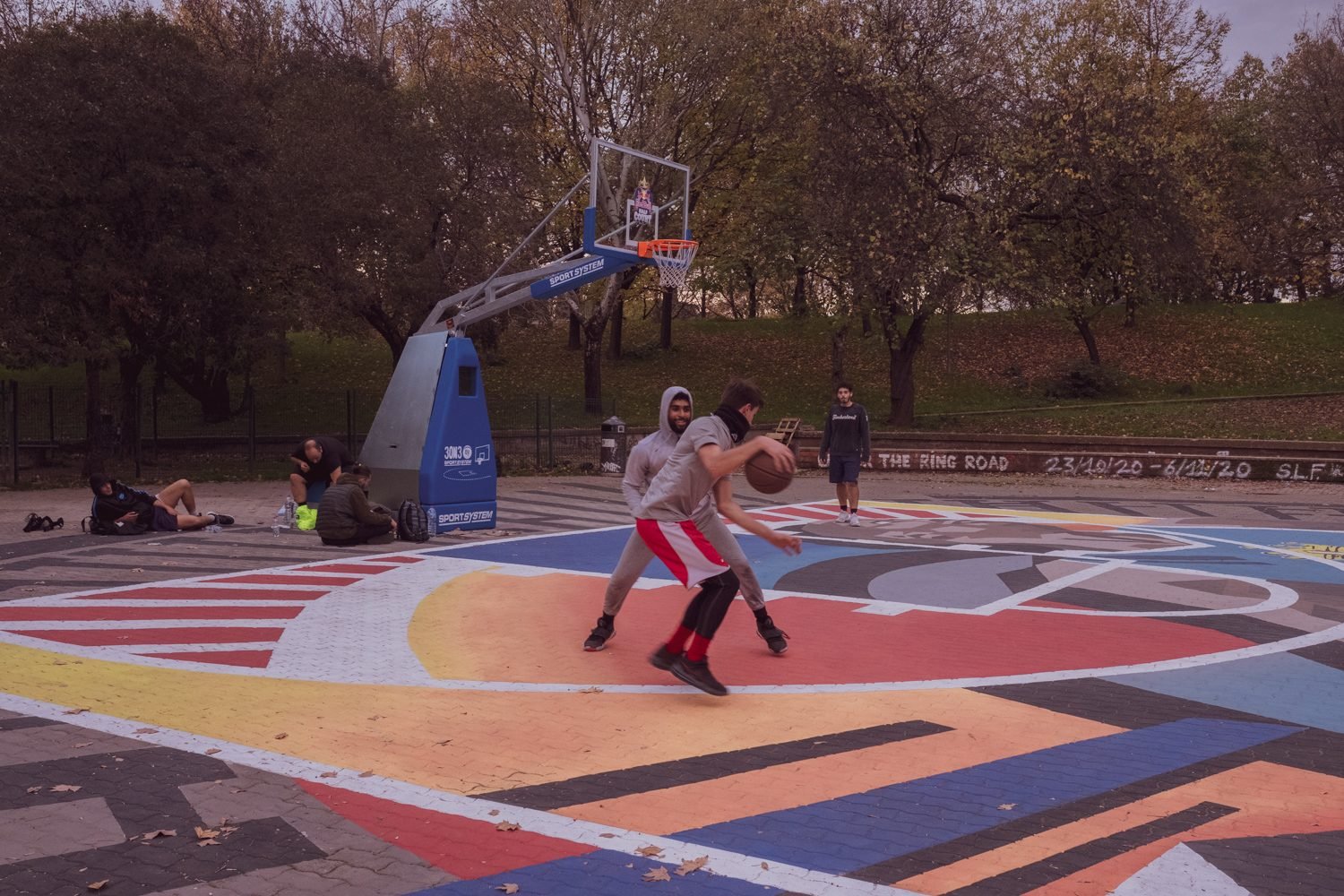
The Basket Playground at Scalo San Lorenzo is a neighborhood basketball court, small and sturdy, self-managed by the kids who use it and surrounded by a green area, on Viale dello Scalo di San Lorenzo, near Largo Settimio Passamonti, under the Tangenziale Est overpass, in the part of the San Lorenzo neighborhood that looks toward the rail yard. It is busy all day, from morning until the light gives out, mostly with kids from the neighborhood and the nearby university departments. In 2020 the playground was spruced up thanks to Red Bull with the work of street artist Piskv, whose real name is Francesco Persichella, who turned the 800 square meters of surface into a one-of-a-kind work: the floor plan of the Colosseum drawn on the asphalt, and inside the ellipse a player caught in midair in the act of dunking. Since then the little court is no longer just a little court. It's a piece of successful urban regeneration, painted together with the people who play on it, and on July 31, 2021 it hosted the Italian national final of the Red Bull Half Court, the international three-on-three street basketball tournament.
I'm telling you about this place because I pass by often and because, in Rome, street basketball courts tell the story of the city better than some monuments. A little court survives only if someone takes care of it. This one survived, and became beautiful, without a municipal resolution and without an inauguration with a tricolor sash: it happened because a group of kids was already on it every afternoon and because an artist had the good idea of asking for their help instead of showing up with the project closed in his pocket.
Where the Basket Playground is and how to get there
The address you'll find in the listings is Viale dello Scalo di San Lorenzo 4, 00185 Rome. In practice the most useful landmark is Largo Settimio Passamonti, the almost elliptical open space where Viale dello Scalo di San Lorenzo meets the bundle of ramps of the Tangenziale Est. The court occupies a portion of that open space, with the green area around it and the overpass overhead acting as an irregular ceiling. Those who arrive for the first time usually look for it on the wrong side, because the view from the street doesn't help: the court reveals itself only when you're already inside the open space.
By public transport
The most convenient way is Termini station and then a tram. Tram 19 and tram 3 serve the San Lorenzo area via Viale Regina Elena and Piazzale del Verano: from the Verano stop you walk toward the rail yard and in about 10 minutes at a relaxed pace you're there. Alternatively you get off at Termini and continue on foot along Via Marsala and then toward Via dei Reti and Via dello Scalo di San Lorenzo, a good 20 minutes but with a crossing of the neighborhood that's worth the walk. The bus lines that run along the Circonvallazione Tiburtina and Viale dello Scalo di San Lorenzo drop you a short distance away, and Tiburtina station can be reached on foot by anyone with legs and the will.
By bike or scooter
Many get there on two wheels, and it's probably the best solution. San Lorenzo is flat, the traffic is dense but slow, and from the Scalo it's easy to pick up the route toward Tiburtina or toward Pigneto. The only advice is not to leave the bike leaning against the hoop: it seems obvious, but a clear sideline is a rule the regulars keep very much, and a bike in the middle of the baseline is the fastest way to get dirty looks.
By car
Not recommended, as almost everywhere in San Lorenzo. Free spots around the rail yard are few and contested, and the area lives with construction sites and with the traffic of the Tangenziale. If you really must, expect to circle and to park a few hundred meters farther on, toward the Circonvallazione or toward Via dei Volsci, and to arrive on foot.
What you physically find when you get there
The honest description is this: an outdoor playing rectangle, colored resin surface, hoops with backboards, nets that depending on the month are new, worn or missing, benches and trees at the edge of the court, and above it the ribbon of the overpass. There are no locker rooms, no ticket office, no caretaker. There isn't even a gate that someone opens in the morning and closes in the evening: the court is a piece of open city, and its upkeep depends in large part on those who use it.
The size and the surface
The total surface of the intervention is about 800 square meters, as Piskv himself has said. It's not a regulation arena parquet and doesn't want to be: it's a playground, that is, a space where the most played game is not five-on-five but three-on-three, two-on-two, one-on-one and short-score pickup games. The surface was redone with a resin technology for sports flooring, the Mapecoat TNS Race Track system by Mapei, which was the technical partner of the operation: it does two things at once, giving the artist a stable palette of colors and giving the players a non-slip surface that holds even when wet and doesn't wear out in a couple of seasons.
The green area around it
The court isn't planted in the middle of nowhere. Around it there is a green strip with trees, which in the hot months makes an enormous difference: without that shade the rectangle would become a scorching slab from June to September. The green is also the reason the place works as a spot to hang out and not only as a facility: some sit, some watch, some wait for their turn, some bring the dog. A living playground always has more people around the court than on it.
The overpass
Above and alongside runs the Tangenziale Est. The noise is there, it's constant, and it's part of the experience: playing here means playing inside a background sound of traffic. Many find it annoying the first time and then it stops existing. The concrete structure also acts as a screen against the low sun and as partial shelter when it rains, which for an uncovered court is a non-trivial advantage. And it's precisely the contrast between the gray of the infrastructure and the bright colors of the flooring that makes this place photogenic: the mural stands out from the urban context with more force precisely because it has concrete around it.
Piskv's mural: the Colosseum seen from above
The part that made this little court famous is the drawing on the surface. It isn't a decoration applied to an existing court, it's an idea born from the court itself.
How the idea was born
Piskv was contacted by Red Bull after the mural dedicated to Kobe Bryant that he had made at the Pala Tellene, in Spinaceto, in the months following the player's death in January 2020. The goal was to redevelop a court in view of the Red Bull Half Court, the international three-on-three basketball competition played in urban settings. The artist did what an architect would do, and not by chance he has a degree in architecture: before drawing, he went to look at the site. He sent up a drone and photographed the space from above. From above you see something that completely escapes you from the ground, namely that the open space that holds the court has an elliptical shape. A small arena, in short.
The floor plan of the Colosseum
From there the step was immediate: if the space is already an arena, then you might as well put the arena par excellence in it. Piskv took the floor plan of the Flavian Amphitheater, the ellipse of the Colosseum with its internal structure, and laid it over the playing rectangle. It's an idea that works on three levels at once. Graphically, because the ellipse and the concentric lines give movement to a flat surface. Symbolically, because it connects the contemporary athletic gesture with 2,000 years of city spectacle in the same physical place, Rome. Practically, because it makes the work unrepeatable: an abstract drawing can be replicated in Berlin or Melbourne, the Colosseum cannot. This court can exist only here.
The player dunking
Inside the ellipse is the figure of an imaginary player, not a portrait, caught at the moment of the jump while dunking. The style is Piskv's recognizable one: figurative work contaminated by cubism and futurism, with heavy use of geometric shapes and planes of color that break up the figure and give it dynamism. The body is broken into sections, the lines extend the movement beyond the outline, and the result from above is a figure that still seems to be in flight. The colors are bright by precise choice, in deliberate contrast with the gray of the Tangenziale.
A participatory work
The most important detail of the whole story is the method. Piskv designed the drawing on the computer, transferred it to scale onto the ground, and then called on the kids who already used the court to paint. Not as extras for the final photograph: actually to spread color. The artist has told it several times, explaining that the contribution of those who already used that playground would be decisive for how well the work held up over time. He was right, and I come back to this later, because it's the point where this story stops being a street art story and becomes a neighborhood story.
Who Piskv is
Francesco Persichella, who signs his works as Piskv, is originally from Canosa di Puglia and has lived and worked in Rome since 2011. He has a degree in architecture, and it shows in everything he does: the geometric construction of his figures, the attention to the relationship between work and context, the habit of designing first and painting afterward. He himself prefers not to call himself a street artist and describes himself rather as an urban creative, because his work spans illustration, painting and interventions at an architectural scale.
The portraits of Roman cinema
Before basketball came cinema. In 2016 he made a mural dedicated to Alberto Sordi as the Marchese del Grillo, and later one dedicated to Carlo Verdone in the guise of Furio, one of the most quoted characters of his filmography. The two works came out of the urban art festival Pinacci Nostri, and they share an idea: telling the story of Rome through the faces that played it in the movies, putting them back on the walls of the neighborhoods.
The Kobe Bryant at Pala Tellene
The work that changed the scale of his fame is the tribute to Kobe Bryant painted on the Pala Tellene, in Spinaceto, after the plane crash of January 2020 in which the player and his daughter Gianna Maria died. Piskv fully self-funded that project, and it deserves to be said because it explains the rest: the work had a media resonance that reached as far as the United States, and from there came the later collaborations, including the one with Red Bull for Scalo San Lorenzo. Between the Spinaceto mural and the San Lorenzo court there is a direct thread, and it's basketball.
The thread that ties his works together
If you look at the Kobe in Spinaceto and the Scalo playground together, the common trait is evident: human figures in motion, broken up by geometric planes, solid colors, and a relationship always explicit with the place that hosts them. They're not works that could stand elsewhere. They're works born from the site visit.
The San Lorenzo Family and the question of self-management
The redevelopment was carried out in collaboration with the San Lorenzo Family, the crew of kids who already frequented that court and who are in effect its reference community. It's a passage that in press releases usually ends up at the bottom, and yet it is the heart of the matter.
What self-managed means
Self-managed, in a context like this, doesn't mean occupied or outside the rules. It means that the ordinary maintenance, the cleaning, the social oversight of the space and the management of playing turns don't depend on an agency but on the people who use it. Nobody sells tickets, nobody assigns time slots, nobody locks up. It works as long as there is a stable group that considers the place its own, and it stops working the day that group disperses.
Before and after 2020
The most interesting testimony on this point was given by the artist. He said that in the winter months, before the intervention, it was easy to find abandoned bottles and trash on the court, and that after the redo the kids began to take care of it in a different way, also picking up the garbage left by others. It's the mechanism that those who study urban regeneration know well and that in Italian we call appropriazione positiva: if you painted that floor yourself, you don't throw a bottle on it, and you don't let someone else throw one on it. The value of the operation isn't aesthetic, it's behavioral.
Why it's not a given
It's worth not romanticizing. A self-managed little court remains a fragile space: it depends on the continued presence of a group, it suffers the wear of time and weather, and it has no budget line to fund its redo in 10 years. This court, today, holds up because there are people keeping it up. If you go, the least you can do is behave accordingly.
Red Bull Half Court, the tournament that brought the world here
The redo of the court wasn't born as an artistic intervention for its own sake: it was functional to a tournament. The Red Bull Half Court is an international three-on-three basketball competition played on urban playgrounds, with national qualifiers in many countries and a world final that changes location every year.
The national final of July 31, 2021
On Saturday, July 31, 2021, the Italian national final of the Red Bull Half Court was played right here, on the redeveloped court at Scalo San Lorenzo, at the end of a qualifying path that went through several Italian cities, including Bari and Florence. In the men's tournament the Silverback team prevailed, while in the women's tournament SemoLillo won, a team tied to the San Lorenzo community. The two winners earned access to the international phase. To put it directly: the little court under the Tangenziale hosted a national final, and the home teams won it.
The world final in Rome in October 2021
The second edition of the tournament closed in Rome on October 16, 2021 with the world final, 15 teams representing Italy, Turkey, Germany, Serbia, Japan, Russia, Spain, Switzerland, Great Britain and Greece. In the men's final Serbia beat Russia 10 to 9, decided by a two-point basket in the last second by Dušan Bulut, one of the most recognized names in world three-on-three. In the women's tournament the title went to Russia. Mapei, which had supplied the technology for the surface, was among the technical partners of that event too.
What a tournament like that leaves behind
The cynical answer is: a painted court and a lot of promotional material. The honest answer is more interesting. Operations like this make sense when the court stays with the neighborhood after the trucks have left, and in this case that happened. The playground wasn't fenced off, wasn't handed over to anyone to manage, didn't become a paid facility. It stayed a free little court, just much nicer and much sturdier than before. Not all sports sponsorship operations end this way, and it's worth acknowledging when it happens.
The scheme, replicated elsewhere
The model adopted at San Lorenzo was repeated in other cities. In Italy courts were redone in Rome, Ancona and Rimini for the following edition. In Naples, for a twin tournament dedicated to soccer, the Campo Sgarrupato was redeveloped with a work by the artist Zeus40 depicting San Gennaro with the ball in his hand and the inscription dedicated to Pino Daniele. Outside Italy the scheme reached Mannheim in Germany, Lausanne in Switzerland, Melbourne in Australia and Cairo, where the 2022 world final was played on a surface designed by the Egyptian artist Ahmed Nofal. In every case the formula is the same: local artist, local community, technical surface, tournament, and the court that remains.
The playground as an institution: a long story
To understand why a little court under an overpass can matter, it helps to step back and recall what a playground is in the history of this sport.
The American origins
Basketball is born indoors, in a gym in Massachusetts, but becomes mass culture outdoors. In American cities of the first half of the 1900s, public playing courts, often carved out of leftover spaces between buildings, became the place where kids learned to play without coaches and without clubs. The most famous playground of all, in Harlem, gave its name to a summer tournament that from the 1950s on saw generations of players pass through, some who became professionals and others who remained only local legends. That's where the idea comes from that the street court is a place of proof: what counts in the gym only truly counts if it also holds up on the asphalt, in front of people who know you.
A game without a referee
The structural characteristic of street basketball is the absence of third parties. There is no referee, so the foul is called by the one who suffers it, and the call is accepted. There is no clock, so you play to a score. There is no electronic scoreboard, so the score is kept by voice. There are no substitutions, so the winner stays and the loser leaves. It's a system that rests entirely on one's word, and that's why the little courts produce an ethic recognizable anywhere in the world: whoever cheats loses face, and face is the only currency in circulation.
The arrival in Italy
In Italy basketball has a strong club history and a street history that is more underground but continuous. From the 1980s on, the little courts of parish oratories, schools, parks and public housing courtyards trained an enormous number of players who never reached Serie A and who nonetheless kept the sport alive where the clubs didn't reach. Three-on-three, which today is a recognized Olympic discipline and has a structured international circuit, is the codification of that game: half court, a single hoop, short games, small teams. The Scalo San Lorenzo playground, by shape and size, belongs exactly to that world.
The little court as a stronghold
Then there's the social function, which in Rome is particularly evident. In many neighborhoods the little court is the only free sports space within kilometers. It doesn't ask for membership, it doesn't ask for a medical certificate, it doesn't ask for an enrollment fee, it doesn't even ask that you know how to play. Anyone with a ball and a pair of shoes can walk in. This total absence of cost is rare in a city where almost every other sports activity has a price, and it makes the little courts real strongholds: they keep public spaces open, fill afternoons, create relationships between kids of different backgrounds. They don't solve a neighborhood's problems, but they take space away from emptiness.
The unwritten rules of the court
If you come to play here and you're not part of the scene, there are things nobody will explain to you out loud but that are good to know. They aren't rules written anywhere: they're customs of street basketball, valid in Italy as elsewhere, and those who respect them are welcomed without problems.
You wait your turn
If the court is occupied by a game, you wait. You stand at the edge of the court, signal that you want to play the next game and wait. The classic criterion is that the winning team stays on the court and the challenger comes in for the losing one. Walking into the middle of a game in progress to shoot at the other basket is the most annoying thing you can do, and the regulars won't fail to let you know.
The foul is called by the one who suffers it
Without a referee, the call is an act of mutual trust. The one who suffers it calls, the one who committed the foul accepts without arguing, and play resumes from the inbound. Calling nonexistent fouls to stop the opponent's play is considered as unsporting as committing them. The same goes for the score: you say it aloud after each basket, and you trust each other.
You respect the residents
This court has houses and streets around it, and people who live there. Keep the music volume down, no shouting after a certain hour, no glass bottles. They seem like trivialities, but the history of Roman little courts is full of facilities closed or dismantled after years of neighborhood complaints. A playground also lives on the consent of those who sleep next to it.
You don't leave a mess
The simplest and most important rule, in a place that nobody cleans except those who use it. Here it counts double, because there's a work of art under your feet: cigarette butts, glass and cans on Piskv's drawing aren't just dirt, they're damage. The regulars have gotten into the habit of picking up what others leave too. If you come, take your own stuff away, and if you have a minute pick up something else too.
You share the hoop
In less crowded moments it happens that several groups on the court shoot at the same time. You split the hoop, you fetch other people's ball when it rolls, you leave room for whoever is shooting. These are minimal gestures that define who is part of the scene and who isn't far more than technical skill.
Playing level is not a requirement
One last thing, worth saying because it discourages many: you don't need to play well. People of every level come through the little courts, from kids learning to players from the leagues training in the summer. Those who can play generally have no problem with those who can't: they have problems with those who are unfair or rude. They are two different things.
San Lorenzo, the neighborhood around the court
The court can't be understood without the neighborhood. San Lorenzo is one of the places in Rome densest with recent history, and one of the most debated.
How it was born
The neighborhood takes shape from the last decades of the 1800s, outside Porta Tiburtina, as a working-class settlement tied to the railway, the workshops and the construction sites of a city becoming a capital. It was born without a master plan, with tall buildings and narrow streets, and with a population of laborers, stonecutters, railwaymen and craftsmen. The streets bear the names of Italic peoples, Volsci, Sabelli, Marsi, Equi, Reti, and the street naming has remained one of the recognizable traits of the area. The rail yard that gives its name to the street of the court is the very reason the neighborhood exists.
July 19, 1943
The date every Roman associates with San Lorenzo is July 19, 1943, the day of the Allied bombing that hit the rail yard and the neighborhood around it, causing thousands of deaths and enormous destruction, and also damaging the Basilica of San Lorenzo fuori le mura. It is a fact the neighborhood has never stopped remembering and that explains much of its character: the antifascist memory, the distrust of official rhetoric, the habit of organizing from the bottom up. Anyone walking today between Viale dello Scalo di San Lorenzo and the inner streets passes over a geography that has been rebuilt twice.
The university and the night
From the postwar period on, the closeness to Sapienza turned San Lorenzo into a student neighborhood, with everything that entails: rents, shared apartments, improvised study rooms, and a nightlife that in recent decades has become so intense as to be heavy for those who live there. The neighborhood has lived for years with the tension between its function as a nighttime hangout and the needs of residents, and it's a real conflict, not a postcard complaint. The little court, in this picture, belongs to the daytime San Lorenzo, that of the kids who play in the afternoon, and it's one of the reasons its existence is precious.
The Verano and the basilica
A few hundred meters from the court open the monumental cemetery of the Verano, which is for all intents and purposes an open-air museum of funerary sculpture, and the basilica of San Lorenzo fuori le mura, one of the seven jubilee churches, with its double body from different eras and the Cosmatesque portico. If you come all the way here for the little court and have an extra hour, you have within walking distance two of the most intense places in the city.
San Lorenzo today
Today the neighborhood is a mix: historic workshops and art galleries, haberdasheries and bars, students and families who have lived there for three generations, social spaces and real estate speculation. The Scalo San Lorenzo court is one of the few places where these pieces cross without conflict, because on a basketball court the only hierarchy that counts is who scored the last basket.
Street art and sports redevelopment: why this formula works
In recent years in Italy, interventions combining urban art and neighborhood sports facilities have multiplied. It's not a random fashion, and it's worth understanding the mechanism.
The cost and the time
Redoing a little court with an artistic intervention costs a fraction of what it would cost to build a new one, and it's done in weeks instead of years. For an administration or for a sponsor it's the most favorable ratio between investment and visibility that exists in public space. This explains the spread of the formula, but it doesn't explain its success.
The difference between decorating and regenerating
Success depends on one thing only: if the community that uses the space is involved or not. A court painted by an artist who arrives, executes and leaves is a nicer court for a couple of seasons, then goes back to how it was. A court painted together with the people who play on it changes the way those people treat it. At San Lorenzo the second path was chosen, and that's why the place holds up. The difference between decoration and regeneration lies exactly here, and not in the quality of the drawing.
The risk of the showcase effect
The flip side has to be said too. When a little court becomes photogenic, people who don't play show up: photographers, productions, photo sessions, filming. If it happens now and then it's an enrichment, if it happens every day it becomes a problem, because the court stops being available to those who really use it. It's a tension that affects many playgrounds that have become famous, and that here is handled with common sense: if the court is occupied by a game, the photograph waits.
The maintenance nobody talks about
A painted resin surface needs care. The sun fades it, rain and frost attack it, use wears it down at the points of greatest contact, under the hoop and along the shooting lines. The choice of a technical technology for sports flooring instead of simple paint served precisely this, to extend the life of the work. But no material is eternal, and the long-term fate of this drawing will depend on the willingness to redo it when needed.
A curiosity about Basket Playground
The curiosity is that the idea for the work didn't come from looking at the court, but from looking at it from above. Piskv sent up a drone to photograph the space from above and only at that moment noticed that the open space that holds the playing rectangle has an elliptical shape, that is, the shape of an arena. The drawing everyone recognizes today, the floor plan of the Colosseum, is the direct consequence of that discovery: the artist didn't impose a theme on the place, he read the place and gave it the theme it already contained.
The practical consequence is curious in turn. The mural is conceived for the aerial view, so the way the players see it, from eye level, is not the way it was thought out. Whoever plays walks inside an image they can't see in full. Only the photographs from above give back the complete work, and that's why almost all the images circulating of this court are shot from above. It's a kind of contemporary geoglyph, drawn for a point of view that almost nobody, on the ground, ever has.
I'll add a second curiosity, minor but nice: the choice of the Colosseum makes the work technically unrepeatable. The same projects carried out in other cities use abstract patterns or local figures, which in theory could migrate elsewhere. The ellipse of the Flavian Amphitheater cannot. If they copied this court in Berlin, it would make no sense at all. It's perhaps the only playground in the world whose design is legally and culturally tied to a single address.
Something nobody tells you about Basket Playground
What no article will tell you is that this is not a tourist place, and that behaving as if it were is the fastest way to ruin the experience for everyone, you included.
The photographs in circulation show an empty, colorful, perfect court, shot from above on a sunny day. The reality, for most hours of the day, is a court full of kids playing a game that matters to them. If you arrive expecting the postcard, you'll find a noisy place, with the traffic of the Tangenziale over your head, worn edges, a few torn nets and the drawing marked by use. Anyone who goes thinking they'll find an art installation is disappointed. Anyone who goes knowing they're walking into a working neighborhood court understands everything.
The second thing nobody says is that the drawing, the way it's made, works better worn than new. The regulation court lines are overlaid on the artwork, and as the seasons go by the points of heaviest foot traffic, the area under the hoop, the three-point arc, the paths of changes of direction, become visibly lighter. In practice the court records by itself where people play most. It's a map of use that draws itself over the map of the Colosseum, and to me it seems the most interesting detail of the whole place.
Third thing: there are no opening hours, but there is a real schedule. The court empties when the light fades, because the lighting isn't that of a sports facility. Anyone who arrives after sunset finds little, except on evenings when someone organizes something. If you come to see the drawing, you have to come during the day, period.
The advice I give you for visiting Basket Playground
The advice is trivial and changes your day: come early in the morning, between 8 and 10, on a weekday.
There are three reasons. The first is the light: the low morning sun crosses the space under the overpass from the side and lights up the colors of the resin without flattening them the way the vertical light of noon does. The second is the crowd: at that hour the court is almost always free or nearly so, so you can look at the whole drawing without disturbing anyone and without feeling out of place. The third is the noise: the Tangenziale traffic is there anyway, but before 9 it has a different rhythm, and the neighborhood around is still in its everyday phase, with the bars open and the deliveries under way.
What to bring
If you come to play: your own ball, because it's not guaranteed there will be one available, outdoor shoes with a sole suited to asphalt and resin, and water, because there are no vending machines and the nearest drinking fountain requires a walk. If you come to watch, a camera or a phone is enough and the willingness not to get in the way.
How to behave if the court is full
Ask. A nod and a direct question are enough: if you want to shoot a few, you ask if you can join the next game, if you want to photograph the court, you ask if it bothers anyone. In 99 percent of cases the answer is yes and friendly. What doesn't work is behaving as if the people weren't there.
To combine in the same outing
The court alone takes up 20 minutes. It makes sense to fit it into a neighborhood tour: the basilica of San Lorenzo fuori le mura and the Verano Cemetery are within walking distance, and the grid of inner streets deserves an aimless drift. If you want to stay on the theme of sport and self-management, in the neighborhood you'll also find the Palestra Popolare San Lorenzo, which belongs to the same family of experiences.
Another well-known fact, yet rarely cited
The well-known fact is that the court was redone by Red Bull in 2020 with Piskv's intervention. Every article says so, the listing for the place says so, the photo captions say so. What is cited much less often is who held the roller.
The work was carried out in collaboration with the San Lorenzo Family, and the kids who already frequented the court physically took part in spreading the color, after the artist had transferred onto the ground the drawing designed on the computer. It's not a press release detail: it's the reason this intervention has lasted while others degraded quickly. Piskv said it explicitly, that is, that the contribution of the young people who already used that playground would be decisive for how well the work held up, and that after the redo those same kids began to pick up the trash left by others too.
The second rarely cited fact concerns the technique. The court isn't painted with wall paint but made with a resin system for sports flooring, the Mapecoat TNS Race Track, supplied by Mapei as technical partner. It means the surface is designed to guarantee grip even when wet and to keep its roughness over time. It's the difference between a horizontal mural and a playing court: here they made a playing court that is also a mural, not the other way around. Anyone who has played on it feels the difference under their shoes.
Third fact, cited even less: the initial push came from another work. Red Bull contacted Piskv after seeing the mural dedicated to Kobe Bryant that the artist had made, self-funded, on the Pala Tellene in Spinaceto. Without that free gesture in another Roman periphery, this court would probably still be gray.
The right photo to take at Basket Playground
The right photo, here, is that of the empty court, for two reasons: because it's the only one that gives back the drawing, and because it's the only one you can take without putting anyone in the frame.
The rule above all
There are kids on the court, often minors. You don't photograph people, and even more so you don't photograph minors. If you want an image with human figures, ask, and if you have young kids in front of you the answer is no anyway. This isn't a formality: it's a neighborhood court, not a set. Anyone who arrives with the camera pointed at the players immediately puts themselves in the wrong position, and also does harm to those who come after.
The framing that works
The best is the one that exploits the contrast between the color of the surface and the gray of the overpass concrete. Stand on a short side, crouch down almost to the ground and frame the court on the diagonal with the structure of the Tangenziale in the upper part: the perspective compresses the drawing and the lines of the infrastructure act as a frame. It's the image that best tells what this place is, namely beauty slipped inside an infrastructure.
The detail instead of the whole
Since the whole work can be read only from above, and you won't be going up there, the smartest strategy is to give up on the whole and look for details. A stretch of ellipse passing under the three-point line. A piece of the player figure cut by the edge of the court. The worn resin under the hoop where the color has lightened. The point where the drawing meets the grass. They're more honest images than the aerial view, because they show the work as those who play on it live it.
The light
Early morning or late afternoon. At noon the vertical sun and the sharp shadow of the overpass create a contrast that no camera handles well: either you blow out the lit areas or you lose everything in shadow. In the low hours, instead, the light comes in from the side and the colors of the resin hold up very well. Overcast days work better than you'd imagine: the white sky acts as a diffuser and the color saturation comes out clean.
What to avoid
Avoid the drone, unless authorized: you're in a dense urban area, next to a road infrastructure, and it's not a space where you fly a device lightly. Avoid backlit photographs toward the Tangenziale, which flatten everything. And avoid setting up tripods in the middle of the court: if you need the court free, you ask and wait for the change of game.
Some important events that happened here in history
The history of this court, as a recognized place, is short, and precisely for this reason it's possible to tell it precisely instead of filling it with anecdotes.
Before 2020
For years the space was what it is today in substance, a free basketball court next to the rail yard, but in very different conditions: anonymous, with a deteriorated surface and, in the winter months, often marked by neglect, with bottles and trash left on the ground. People used it anyway, and that's the decisive point: the space was already alive before becoming famous. Nobody invented a community, the work was done on an existing community.
January 2020, the Spinaceto backstory
The chain of events leading to the redo begins elsewhere. After the death of Kobe Bryant, Piskv made at his own expense a tribute mural on the Pala Tellene, in Spinaceto. The work gets a resonance that goes beyond Italy's borders and reaches the United States, and from there comes the contact with Red Bull.
2020, the redevelopment
The playground is redone: new technical resin surface and new drawing, the floor plan of the Colosseum with the player dunking, made by the artist together with the court's regulars and the San Lorenzo Family. The operation is designed with the Red Bull Half Court in mind. From that moment the court becomes one of the most photographed places of contemporary sporting Rome.
July 31, 2021, the national final
The court hosts the Italian national final of the Red Bull Half Court, the end point of a qualifying path that went through several Italian cities. The Silverback win the men's tournament and SemoLillo the women's, two teams tied to the home community. It's the only sporting event of international significance that, as far as I know, has ever been played on this rectangle.
October 16, 2021, the world final in Rome
The second edition of the tournament closes in Rome with the world final: 15 teams from 10 countries, Serbia's victory over Russia 10 to 9 in the men's, with the decisive basket at the buzzer by Dušan Bulut, and the women's title to Russia. The two home teams coming from the national final played at Scalo San Lorenzo represent Italy in that phase.
From 2022 to today
After the tournament season the court went back to its ordinary function, which is the best thing that could have happened to it: neighborhood games, afternoons, groups taking turns. The drawing has begun its natural aging, and the daily watch of those who use it has remained its only real maintenance. In the meantime the formula tried out here has been replicated in other Italian and foreign cities, which makes this little court, in a sense, a prototype.
Who has passed through Basket Playground
On this point I prefer to be careful and cite only those who are documented, because many legends circulate about little courts and almost no verification.
Francesco Persichella, known as Piskv
The artist who designed and made the work, from Canosa in Puglia, a Roman by adoption since 2011, with a degree in architecture. Before this court he had signed the tributes to Alberto Sordi as the Marchese del Grillo and to Carlo Verdone in the guise of Furio, and the Kobe Bryant at Pala Tellene. The Scalo playground is, among his works, the one that has had the widest international circulation.
The kids of the San Lorenzo Family
They are the true protagonists, and not out of rhetoric: they painted the court together with the artist and since then have handled its ordinary maintenance. If I had to point to who passed through here leaving a mark, I would point to them before anyone else, even though none of them has a name known outside the neighborhood.
The teams of the 2021 national final
The Silverback, winners of the men's tournament, and SemoLillo, winner of the women's tournament, played and won the Italian final of the Red Bull Half Court on this court, earning passage to the international phase. They are names that count in the Italian three-on-three circuit, even if you won't find them in the general sports papers.
The three-on-three community
Around the tournament, players and teams came through here from several Italian cities for the final phases, together with the event's organizing machine and the technicians who built the surface. For a few days, in the summer of 2021, a neighborhood court under an overpass was the center of Italian street basketball.
Who comes by every day
Then there are those who really matter for the life of the place and whom nobody has counted: Sapienza students, kids from the schools in the area, neighborhood people who have played for 20 years, those who come from elsewhere with the ball under their arm because they saw the photographs and want to try. A playground is the sum of these presences, not of the events it hosts.
What to see around the Basket Playground
The court takes a few minutes, the neighborhood much more. Here is what makes sense to put in the same tour.
The basilica and the cemetery
The basilica of San Lorenzo fuori le mura is one of the most layered buildings in Rome, born from the merging of two churches of different eras, with the 13th-century portico and the Cosmatesque furnishings. Next to it opens the Verano Cemetery, which is worth visiting the way you visit a museum: funerary sculptures of great quality, monumental avenues and a quantity of Roman history concentrated in a few hectares.
The neighborhood on foot
The inner streets, Via dei Volsci, Via dei Sabelli, Via degli Equi, Via dei Reti, tell the story of the original working-class layout and its transformation. There you'll find surviving artisan shops, murals, social spaces, bookstores, and the visual layering typical of a neighborhood that has never been cleaned up for tourism. Walking aimlessly here yields more than any itinerary.
Neighborhood experiences
Those interested in the theme of self-management and spaces built from the bottom up will find in the area several organizations that belong to the same culture as the little court, among them the Palestra Popolare San Lorenzo and the Container San Lorenzo. In summer the neighborhood also hosts series and open-air arenas, like the Festival del Cinema di San Lorenzo, which tells its memory starting precisely from the 1943 bombing.
If the theme is basketball
Those who want to stay on the theme can widen the view to the Roman basketball scene, which has in the Palazzo dello Sport in EUR its largest facility and in neighborhood organizations like Cinecittà Basketball Polaris its daily base. Between the little court under the overpass and the Olympic arena of Nervi lies the entire social distance of this sport in the city.
When to go
The season
April, May, September and October are the ideal months: manageable temperatures, good light, a court that is busy without being overcrowded. In midsummer and in August the heat on the resin is heavy in the central hours, and the court comes alive mostly in the evening. In winter the place remains usable, but the short days reduce the useful window to a few hours and the rain leaves the surface wet for a long time, with the partial advantage of the shelter offered by the structure above.
The day and the time
To see and photograph: early weekday morning. To play and to understand how the place works: late afternoon, when the court is full and teams form. For something in between: Sunday morning, which in San Lorenzo is the quietest hour of the week.
How much time you need
For the court alone 20 minutes is enough, half an hour if you photograph. With the basilica, the Verano and a walk in the neighborhood you easily reach half a day.
The playground with kids and accessibility questions
With kids
It's a suitable place, provided you manage it. The green area around allows you to stay outside the rectangle while a game is going on, and for a child who loves basketball watching a street game is worth more than an hour of practice. The rule is simple: the court, when occupied by a game, is not a play space. You wait for a free moment to let the little ones shoot, and generally those who are playing gladly leave the hoop for a few minutes if you ask.
Accessibility
The court is at street level and the surface is smooth and continuous, so in itself it's reachable also by those who use a wheelchair. The limits are in the route and the surroundings: the sidewalks in the area are uneven, the crossings near the ramps require attention, and there are no restrooms or equipped rest points. Those with specific needs should factor in the context, which is that of a marginal urban area and not of a sports facility.
Safety and common sense
The area is busy and has no particular problems during daylight hours. In the evening, as in many areas next to rail yards, the lighting is poor and foot traffic thins out: it's not a place for a nighttime visit. Always watch out for the traffic of the ramps around it, especially if you're with kids or on a bike.
Why this little court matters
In the end, the question is legitimate: why devote all this space to a neighborhood basketball court, when in Rome you can choose among 2,000 years of ruins, churches, museums and villas? The answer is that this place demonstrates something that is often said in the city and rarely seen: that regeneration works when it starts from those who inhabit the space, and not when it is dropped on them.
Here there was no big project, no public call, no structure to build. There was a court already in use, an artist with a good idea, a sponsor willing to pay, a company that supplied the right technology and a group of kids who picked up the rollers. The result is a work of art that is used every day, that wears down under the shoes of those who play on it, and that for exactly this reason stays alive. The Colosseum drawn on the asphalt, with the player dunking inside the ellipse, is a way of saying that the history of Rome didn't end up in museums, and that the arena continues to be the place where the city watches itself play.
If you go, bring the ball and bring respect. They're the only two things required at the entrance of a place that has no entrance.
Quick questions about Basket Playground
Where exactly is the Basket Playground?
On Viale dello Scalo di San Lorenzo, near Largo Settimio Passamonti, in the San Lorenzo neighborhood, under the Tangenziale Est overpass, a short distance from the rail yard.
Do you pay to get in?
No. It's a public and free court, with no ticket, no membership and no reservation.
Are there opening hours?
There are no official hours because there is no fence with a managed gate. In practice the court is used during daylight hours, and it empties at sunset for lack of adequate lighting.
Can you play if you're not from the neighborhood?
Yes. You wait your turn, you ask to join the next game and you behave properly. Nobody asks for residency.
Do you need to bring a ball?
It's best. There is no storage and no rental, so the equipment is what you bring or what the people you find there bring.
Who painted the court?
The street artist Francesco Persichella, known as Piskv, on Red Bull's initiative, together with the kids who frequented the court and the San Lorenzo Family.
When was the court redone?
In 2020, in view of the Red Bull Half Court international street basketball tournament.
What does the drawing represent?
The floor plan of the Colosseum, with inside the ellipse the figure of an imaginary player caught in the act of dunking.
Why the Colosseum?
Because, photographing the space from above with a drone, the artist noticed that the open space that holds the court has an elliptical shape, that is, the shape of an arena, and decided to connect it to the Roman arena par excellence.
How big is the court?
The intervention covers about 800 square meters of surface, according to what the artist has stated.
What material is the surface?
A resin system for sports flooring, the Mapecoat TNS Race Track supplied by Mapei, chosen to guarantee grip even in wet conditions and durability over time.
Can you see the drawing well from the ground?
Only in part. The work is conceived to be seen from above: from the ground you read the details and the lines, not the whole.
Can you take photographs?
Of the court yes, of people not without consent, and of minors in no case. If the court is occupied, you wait for the change of game instead of getting in the way.
Is it suitable for kids?
Yes, with adult supervision and with the awareness that when a game is under way the rectangle isn't available for free play.
Is there a restroom?
No. There are no restrooms or drinking fountains on site: it's best to sort it out beforehand, in the neighborhood's businesses.
What events have taken place here?
The most important is the Italian national final of the Red Bull Half Court on July 31, 2021, won by the Silverback in the men's tournament and by SemoLillo in the women's.
Is the court wheelchair accessible?
The rectangle is level and the surface is continuous, but the urban surroundings, with uneven sidewalks and road ramps, require attention and are not fully equipped.
How do you get there by public transport?
By the trams that serve San Lorenzo and the Verano from the Termini area, or on foot from Termini in about 20 minutes crossing the neighborhood. Tiburtina station can be reached on foot.
Is it a good idea to go by car?
No. Parking in the area is hard and the traffic around the ramps is constant.
Is it a safe place?
During the day yes, and it's busy. In the evening the area is poorly lit and little traveled, so it's not a destination for a nighttime visit.
Who takes care of maintenance?
Largely those who use it. It's a self-managed court: cleaning and ordinary care depend on the community of regulars, not on an operator.
What is there to see nearby?
The basilica of San Lorenzo fuori le mura, the Cimitero del Verano and the inner streets of the neighborhood, all reachable on foot in a few minutes.
What is the best time to go?
Early morning on a weekday to see and photograph the drawing, late afternoon to see the court alive and to play.
Frequently asked questions about Basket Playground
Where exactly is the Basket Playground?
The Basket Playground is at Viale dello Scalo di San Lorenzo 4, near Largo Settimio Passamonti, in the San Lorenzo neighborhood, under the Tangenziale Est overpass and a short distance from the rail yard. The court occupies a portion of the open space, with the green area around it and the overpass overhead acting as a ceiling.
Do you pay to get into the Basket Playground?
No, the Basket Playground is a public and free court: there is no ticket, no membership and no reservation needed. There are no locker rooms, no ticket office and no caretaker, because the court is for all intents and purposes a piece of open city without gates that someone opens or closes.
Are there opening hours at the Basket Playground?
No, there are no official hours at the Basket Playground because there is no gate to open or close: the court, as a public space, remains accessible at any time of the day. In practice attendance depends on the light and on the schedules of those who live in the neighborhood.
What is the mural drawn on the court?
The mural covering the surface of the Basket Playground depicts the Colosseum seen from above and is the work of the artist Francesco Persichella, known as Piskv, contacted by Red Bull after a mural dedicated to Kobe Bryant made at the Pala Tellene in Spinaceto. The idea came from observing from above, with a drone, the elliptical shape of the open space that holds the court.
Is the court tied to a basketball tournament?
Yes, the redevelopment of the Basket Playground was functional to the Red Bull Half Court, an international three-on-three basketball competition played on urban playgrounds. The Italian national final was held here on Saturday, July 31, 2021, bringing to the San Lorenzo court a tournament with qualifiers in many countries and a rotating world final.
When is the best time to go to the Basket Playground?
The best time to see the Basket Playground is early morning, between 8 and 10, on a weekday, when the low light crosses the space under the overpass from the side and lights up the colors of the resin, and when the court is more often free than at other hours of the day.
Is the Basket Playground suitable for kids?
Yes, with some care: the green area around the court lets you stay outside the playing rectangle while a game is going on, and it's a good observation point for a child who loves basketball. The rule is simple, when the court is occupied by a game it isn't a play space, and you wait for a free moment to shoot at the hoop.
Article written by the editorial team of TourLeaderPro, contact them for Private/Corporate/V.I.P. Tours and Experiences.
Planning a trip to Rome? The English-language guides to visiting the city are on ItalyPlanner.com.
Contact Information
Largo Settimio Passamonti,
Roma Roma Città, Roma Città
Nearby
 Palazzo San Lorenzo, Cinema and Theater in San Lorenzo300 m
- Esc Atelier Autogestito, self-managed social space in San Lorenzo300 m
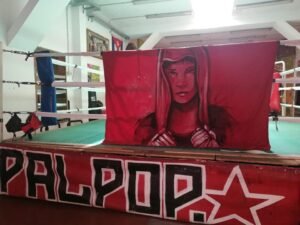
- Palestra Popolare San Lorenzo300 m
- San Lorenzo400 m
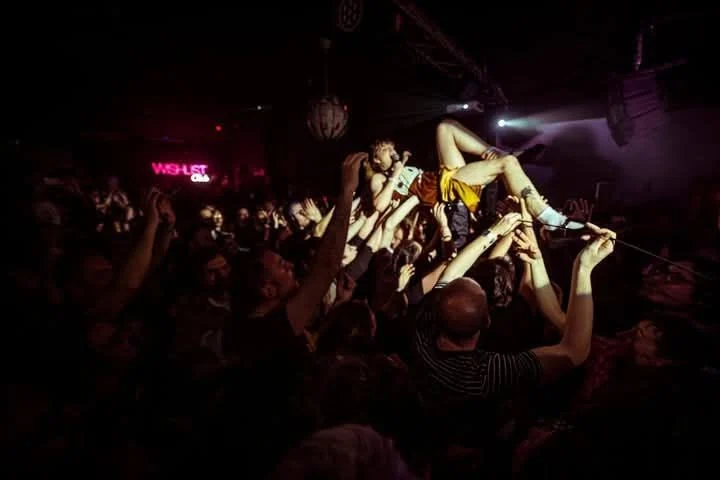
- Wishlist Club400 m
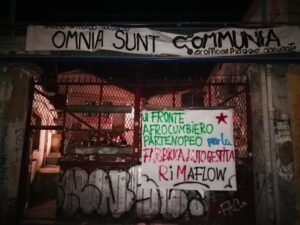
- Communia500 m

Upcoming events nearby
- A che gioco stiamo giocando? at Galleria Gilda Lavia, from September 12 to November 14, 2026100 m
- Deposito morte Gerry by Gerardo Iudicone at Fondazione Pastificio Cerere, September 23 to November 14, 2026200 m
- BENU by Eugenio Tibaldi at Fondazione Pastificio Cerere, September 23 to November 28, 2026200 m
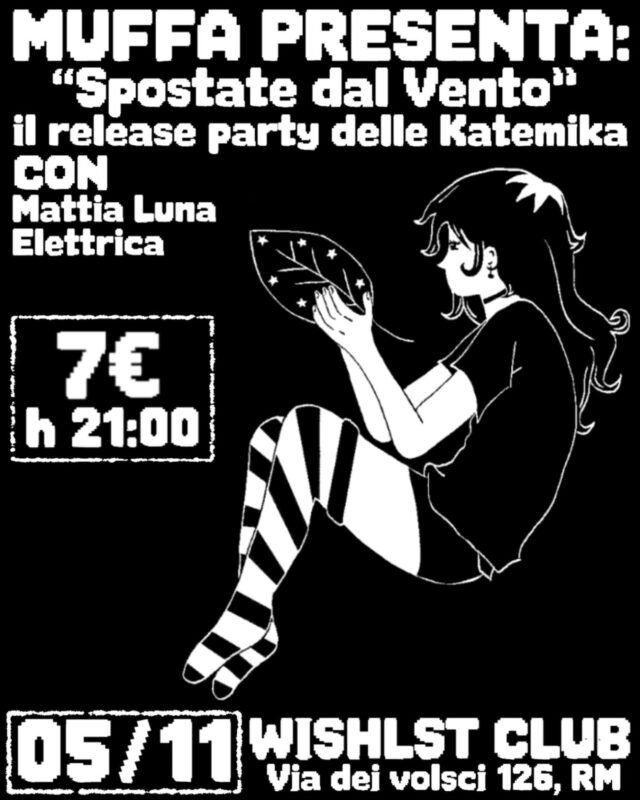
- Muffa #2, Spostate dal Vento with Katemika at Wishlist Club, November 5, 2026300 m