A che gioco stiamo giocando? at Galleria Gilda Lavia, from September 12 to November 14, 2026
In short. A che gioco stiamo giocando?, a group exhibition of 11 artists curated by the sociologist Anna Simone, is open at Galleria Gilda Lavia from September 12 to November 14, 2026, at Via dei Reti 29/C, in the San Lorenzo neighborhood of Rome.
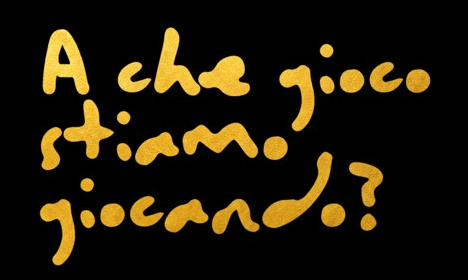
A che gioco stiamo giocando?, a group exhibition of 11 artists curated by the sociologist Anna Simone, is open at Galleria Gilda Lavia from September 12 to November 14, 2026, at Via dei Reti 29/C, in the San Lorenzo neighborhood of Rome. The gallery is open Tuesday to Saturday from 14:00 to 19:00. On other days it can be visited by appointment, by writing to info@gildalavia.com or calling 06 5803788. As is customary in contemporary art galleries, the visit does not involve a ticket, and for any admission price what the gallery announces is what counts. San Lorenzo can be reached by public transport from every part of the city: for lines and stops from your own starting point it's best to use the ATAC route planner. The official information is on the site of Galleria Gilda Lavia.
The artists in the exhibition are Elena Bellantoni, Marco Bernardi, Élle de Bernardini, Pamela Diamante, Lucia Marcucci, Sofia Mari, Claudio Martinez, Maria Eugenia Moya, Giancarlo Mustich, Leonardo Petrucci and Federica Rugnone. The question in the title concerns the role of art in a time when war, the climate crisis, migration and human relationships are being turned into a game. What follows covers the theme of the exhibition, the works published by the gallery, the curator, the history of the gallery and of the neighborhood, and tips for organizing the visit.
A che gioco stiamo giocando? at Galleria Gilda Lavia: dates and hours
The group show A che gioco stiamo giocando? opened on Saturday, September 12, 2026 at 18:00 and remains open until November 14, 2026 at Galleria Gilda Lavia, at Via dei Reti 29/C.
The hours
The gallery gives its opening hours as Tuesday to Saturday, from 14:00 to 19:00. On Sunday and Monday, and at other times, a visit is possible by appointment.
Contacts
To book a visit outside hours or ask for information on the works, the gallery gives the phone number 06 5803788 and the email address info@gildalavia.com. A contact form is also available on the site.
Admission
Private contemporary art galleries in Rome can normally be visited freely during opening hours. For any special events or meetings tied to the exhibition, it's best to check the gallery's official channels.
The theme of A che gioco stiamo giocando?: art in the age of gamification
A che gioco stiamo giocando? starts from an observation: the digital revolution has brought the dynamics of gamification into narrative and everyday experience, to the point of turning even war, the climate crisis, migration and human relationships into a game.
The question of the exhibition
The gallery's presentation text poses the question directly: can artistic practice regain the strength of a critical language, singular and collective at once, or is it destined to be reduced to a consumer good, an event to photograph and a gadget of the contemporary? The exhibition was born to explore this question.
The curator's words
In the critical text that accompanies the exhibition Anna Simone writes that "the creative act is always a revolutionary act because it is itself what generates the rules of its game." This is the conceptual center of the show: if power plays a destructive game, art can still create friction and invent rules of its own.
A choral route
The route, according to the gallery, joins intimate introspection and irreverent provocation. It goes from dystopian suggestions about narratives of the end of the world to the denunciation of neocolonial, patriarchal and land-overexploitation logics, from the geometries of the languages of war to the ironic reappropriation of the everyday and of gender stereotypes. The works, in the words of the presentation text, demystify the staticity of the roles imposed by power.
The works in A che gioco stiamo giocando?
The gallery publishes on its site seven works from the group show, with titles, years, techniques and measurements, alongside five views of the installation.
Federica Rugnone, Fai la brava
From 2025, it's an installation made of 10 shears with laser engravings on steel alloy, of variable dimensions. The title, an expression that anyone who received a traditional upbringing recognizes, meets a cutting tool: it's one of the works that most directly work on gender stereotypes.
Elena Bellantoni, La Corvessa
Ceramic on a brass base, with black engobe and clear glaze, 45 by 35 centimeters, from 2021. It is part of the project "Pensate domani è la fine del mondo," a title that dialogues with the part of the exhibition devoted to apocalyptic narratives.
Marco Bernardi, Carrarmatino
From 2013, in fabric, foam rubber, wood and metal, 32 by 34 by 28 centimeters. A soft tank, at toy scale: the language of war reduced to an object to hold in your hand.
Élle de Bernardini, Countersexual Hieroglyphs #2
From the series Countersexual Forms, from 2020: acrylic on leather with gold-plated metal rings and rope, 86 by 66 centimeters.
Pamela Diamante, Il personale è politico
A work from 2026, in fabric, photographic paper and wood, 86 by 45 centimeters. The title takes up a historic slogan of the feminist movement.
Lucia Marcucci, Kapital wolf
From 2008, acrylic and collage of printed canvas, 80 by 60 centimeters: a work by the master of visual poetry, who brings to the group show the generation of the avant-gardes of the 1960s.
Maria Eugenia Moya, Cheese grater
Glazed ceramic from 2021, 38 by 28 by 20 centimeters: a grater, the household object par excellence, turned into a sculpture.
The 11 artists of A che gioco stiamo giocando?
The group show brings together 11 artists of different generations: Elena Bellantoni, Marco Bernardi, Élle de Bernardini, Pamela Diamante, Lucia Marcucci, Sofia Mari, Claudio Martinez, Maria Eugenia Moya, Giancarlo Mustich, Leonardo Petrucci and Federica Rugnone.
A dialogue between generations
The dates of the published works run from 2008 to 2026: next to brand-new works, like Pamela Diamante's, there are works by a historic figure like Lucia Marcucci, born in 1933. It's one of the most interesting aspects of the exhibition, which places the avant-gardes' research on language next to that of the youngest artists.
Materials and techniques
The techniques range from ceramics to acrylic painting, from collage to installation with everyday objects like shears and graters, through to fabric, foam rubber, leather, ropes and photography. The variety of materials is consistent with the theme: play as a reappropriation of the everyday.
The other presences
For Sofia Mari, Claudio Martinez, Giancarlo Mustich and Leonardo Petrucci the gallery does not publish the individual exhibited works on its site: you discover them in the show.
Lucia Marcucci, visual poetry on view
Lucia Marcucci, born in Florence on July 29, 1933, is an Italian artist and writer, among the central figures of visual poetry.
The beginnings at the Grattacielo in Livorno
After interrupting her studies at the Accademia di Belle Arti, in 1955 she moved to Livorno and worked in a small avant-garde theater, the Grattacielo, as an assistant director and maker of masks, posters and set designs. There she began making poetry with the collage technique, borrowing phrases and languages of every kind.
Gruppo 70
In 1963 she made L'indiscrezione è forte, her first technological collage poem, and met the exponents of the Gruppo 70 of Florence, whom she invited to the Grattacielo for a first version of Poesie e no, a show curated by Eugenio Miccini and Lamberto Pignotti. In 1965 she debuted with the Gruppo 70 in Palermo, at the Gruppo 63 Festival.
From Poesia Manifesto to the Gruppo Internazionale
Years of experimentation follow: Poesia Manifesto, Poesia Auditiva, Cinepoesia with old 16 millimeter films, Poesia Tecnologica, object books. With the Gruppo 70 dissolved at the end of 1968, she founded with Miccini, Ori, Perfetti, Sarenco and others the Gruppo Internazionale di Poesia Visiva. In recent years she has also worked with digital media and with advertising posters from urban outskirts, manipulating them. Her solo shows have been curated by, among others, Renato Barilli and Gillo Dorfles.
Anna Simone, the curator
The gallery presents Anna Simone as a sociologist: a curatorial choice that explains the exhibition's approach, built more on a social and political question than on a formal theme.
The critical text
The text that accompanies the exhibition starts from power's destructive game, by now visible to everyone in everyday life, and assigns to art the task of generating friction and resistance, up to creating new worlds. It's an angle that makes the group show readable even for those who don't regularly visit galleries.
Why it matters
In our opinion the presence of a scholar of the social sciences as curator gives the exhibition a clear thread: every work can be read as an answer to the question in the title.
Galleria Gilda Lavia in San Lorenzo
Galleria Gilda Lavia was founded in 2018 by Gilda Lavia and is located at Via dei Reti 29/C, in the San Lorenzo neighborhood.
The approach
The gallery aims to represent and promote emerging and established artists, Italian and foreign, with a preference for those who pursue conceptual research and use their works to reflect on society, bringing out the poetic and hidden aspects of everyone's life.
A coherent group show
A che gioco stiamo giocando? is in line with this approach: 11 artists called on to reflect on power, on roles and on the language of the present.
The other sections
The gallery's site has sections devoted to the artists, past exhibitions, news and a videoroom.
San Lorenzo, the gallery's neighborhood
San Lorenzo is urban zone 3B of Municipio II of Rome and takes its name from the nearby basilica of San Lorenzo fuori le mura. It extends between the Aurelian Walls, at Porta Tiburtina, and the Verano cemetery.
A working-class neighborhood
Before Rome became the capital, beyond the walls there was countryside, with the basilica and the first core of the Verano. In 1865 the San Lorenzo freight yard went into operation and in 1879 the Rome-Tivoli steam tramway. Between 1884 and 1888 housing was built for railway workers, laborers and artisans: hence the working-class character of the neighborhood and the case a ringhiera.
The Casa dei Bambini
To improve the residents' conditions, a redevelopment plan promoted by the Istituto dei Beni Stabili di Roma provided for structural and social interventions. Here Maria Montessori established in 1907 the first Casa dei Bambini in the world.
The university city
In the 1930s, north of the neighborhood, the Città universitaria of the Sapienza was built, together with the building of the Consiglio Nazionale delle Ricerche: since then the life of San Lorenzo has been tied to that of the university.
How to get to Galleria Gilda Lavia
Galleria Gilda Lavia is at Via dei Reti 29/C, in San Lorenzo, in Municipio II, in a neighborhood crossed by the initial stretch of Via Tiburtina.
By public transport
The ATAC route planner is the most reliable tool for finding the combination of metro, tram and bus from your own starting point.
On foot
San Lorenzo is a compact neighborhood and is easy to explore on foot: from the gallery you can reach the other galleries in the area and the neighborhood's historic places.
By car
The advice is to prefer public transport or the bicycle: the streets of the neighborhood are narrow and busy, especially in the afternoon and evening.
A curiosity about A che gioco stiamo giocando? at Galleria Gilda Lavia, from September 12 to November 14, 2026
The exhibition brings together two worlds that rarely meet in a private gallery: the verbo-visual avant-gardes of the 1960s and artists born around the turn of the new century. The presence of Lucia Marcucci, class of 1933, is the key to understanding it. Marcucci began working in an avant-garde theater in Livorno, the Grattacielo, making masks and posters, and invented her poetry by cutting out other people's phrases: literary collage, Poesia Manifesto, Cinepoesia made with old 16 millimeter films. Put another way, she built her work by playing with the languages of advertising and mass communication, taking them apart and putting them back together by rules of her own. It is exactly the gesture that Anna Simone's critical text describes as a creative and revolutionary act: generating the rules of one's own game, composing them, decomposing them or ignoring them. Kapital wolf, the 2008 work on view, is an acrylic with a collage of printed canvas: the title plays with the language of economics and that of animals. Beside her, Marco Bernardi's fabric tank and Federica Rugnone's engraved shears show how the same gesture of ironic appropriation has reached the youngest generations.
Something nobody tells you about A che gioco stiamo giocando? at Galleria Gilda Lavia, from September 12 to November 14, 2026
The gallery's hours are afternoon hours: from Tuesday to Saturday you can enter only from 14:00 to 19:00. Anyone who plans to drop by in the morning finds it closed, and the same goes for Sunday and Monday, when a visit is possible only by appointment. The detail seems trivial, but it changes how you organize the day: it's best to build the afternoon around the gallery and leave the morning for something else. There's also an aspect concerning how to see a group show in a private gallery. 11 artists in a space of this kind means the works live side by side at close range, and the meaning of the exhibition comes precisely from the pairings: Maria Eugenia Moya's ceramic grater next to Élle de Bernardini's countersexual hieroglyphs, Elena Bellantoni's crow next to Lucia Marcucci's collage. The advice is to ask the gallery for Anna Simone's critical text, if available, and read it before making the round: the exhibition is built on a precise idea and that idea is better understood with the curator's words in mind. Finally, private galleries are not museums: you can talk to whoever is in the room and ask questions about the works, even with no intention of buying.
My advice for visiting A che gioco stiamo giocando? at Galleria Gilda Lavia, from September 12 to November 14, 2026
The advice is to set aside a weekday afternoon for the show, between 15:00 and 18:00, when the gallery is open and the neighborhood isn't yet crowded with evening life. Before going in, it helps to read the title as a question addressed to the viewer, and not only to the artists: what game are we playing, we, when we photograph a work to share it, when we turn a war news story into content to scroll through? With this question in mind you can do a first quick round, to get the overall picture, and a second slow round, stopping in front of the works that struck you most. In our opinion Federica Rugnone's shears, Fai la brava, are the place to start: the installation is immediate and sums up the irony and the harshness of the whole show. Those with time can then continue on foot to the other galleries of San Lorenzo, starting with Monitor in Via degli Aurunci, which opened its own show the same evening, September 12, and end the day in one of the neighborhood's venues. For a visit outside opening hours, or for those coming as a group, it's best to write to the gallery first.
San Lorenzo and contemporary art
San Lorenzo has a close bond with Roman contemporary art, and Galleria Gilda Lavia is part of a network of exhibition spaces in the neighborhood.
The shared openings
On Saturday, September 12, 2026, the evening of the opening of A che gioco stiamo giocando?, the neighborhood hosted San Lorenzo Gallery Night #4, an evening of shared openings announced by the Monitor gallery for its own show.
A university neighborhood
The nearby Città Universitaria makes San Lorenzo a young neighborhood, full of students, and explains the presence of cultural spaces and independent groups. The Sapienza is home to the Museo Laboratorio di Arte Contemporanea.
Another well-known fact, yet rarely mentioned
Nearly everyone knows that San Lorenzo was hit by the Allied bombing of July 19, 1943. The numbers and the context are less well known. That morning, at 11:03, 662 American bombers dropped about 4,000 bombs, about 1,060 tons, aiming at the freight yard. Prenestino, Casilino, Labicano and Tuscolano were hit as well. The dead were about 3,000, of whom 1,377 were identified, and the wounded 11,000. After the bombing Pope Pius XII went in person to the stricken neighborhoods, an exceptional gesture for the time. Public memorial ceremonies are held in San Lorenzo every year, because it was the first neighborhood hit and the most devastated, six days before the fall of Fascism and the arrest of Mussolini. A witness, Gaetano Bordoni, wounded in the bombing and deprived of many relatives, turned his father's barber shop into a house of memory, and some historians considered him a source of oral history. It's a detail that gives depth to a show about the languages of war turned into play: Marco Bernardi's cloth tank is on view a few streets from a neighborhood that lived through the war without any fiction.
The Right Photo to Take at A che gioco stiamo giocando? at Galleria Gilda Lavia, September 12 to November 14, 2026
The right photo, in a show that criticizes art reduced to an event to be photographed, is paradoxically a photo that doesn't describe the work on its own, but places it in relation to the person looking. Fai la brava, the shears, an installation of variable dimensions, lends itself to a close-up on the laser engravings, where the phrase engraved on the steel becomes legible and the light plays on the metal. Marco Bernardi's cloth tank, about 30 centimeters tall, works well if photographed at floor or pedestal level, as a child would see it: the low perspective accentuates its ambiguity between toy and weapon. Before shooting, it's best to ask at the gallery if photos are allowed and if there are guidelines for publishing them, as courtesy toward the artists requires. Outside, the image that tells the context is the street: Via dei Reti with the facades of the 19th-century neighborhood, the workers' houses built for railway workers and artisans at the end of the 19th century. The advice is to shoot in natural light, in the late afternoon, and to keep the flash off in the gallery, where it reflects on the glazed surfaces of the ceramics.
How to plan an afternoon in San Lorenzo around the show
An afternoon devoted to A che gioco stiamo giocando? works well in three parts, taking advantage of the gallery's hours from 14:00 to 19:00.
Before the gallery
If you arrive early, you can spend an hour at the basilica of San Lorenzo fuori le mura and at the Verano cemetery, which border the neighborhood to the east.
The show
For the group show it's best to allow at least three-quarters of an hour, to see the works without rushing and to talk with the people in the room.
Afterward
On the way out, the neighborhood offers other galleries, bookshops and venues. If you prefer a historic stretch, you can walk to the Aurelian Walls at Porta Tiburtina, the western edge of San Lorenzo.
Where to eat in San Lorenzo
San Lorenzo also lives off the presence of the students of the nearby Città Universitaria, and its range of venues reflects it.
For every budget
For dinner after the gallery, it's best to choose among the places on the surrounding streets, from trattorias to pizzerias, checking hours and reviews before heading out.
The advice
After the gallery closes, at 19:00, it's a good idea to stop for an aperitivo or dinner in the neighborhood: it's the hour when San Lorenzo starts to come alive. On weekends it's wise to book.
Some important events that happened here in history
The history of San Lorenzo coincides with that of Rome as a capital. The first public document that names the neighborhood is a 1887 resolution on the street names of the post-unification city. In 1909 San Lorenzo enters the master plan of the Nathan administration. In 1907 Maria Montessori opened the world's first Casa dei Bambini here, as part of a social renewal program. In her inaugural speech, later published as an appendix to La scoperta del bambino, Montessori herself tells how the interventions had made originally dilapidated rooms clean and decent. Between 1921 and 1922 the neighborhood, with a strong Socialist and Communist presence, repeatedly repelled the raids of the Fascist squads thanks to the Arditi del Popolo and the residents. On October 30, 1922, in the final phases of the March on Rome, Tuscan squadristi attacked San Lorenzo: eight people died and 13 were wounded, and the next evening another anti-Fascist was killed. In the 1930s the Città Universitaria was built to the north. On July 19, 1943 the first Allied bombing of Rome hit the freight yard and the neighborhood, with about 3,000 dead. In the postwar period San Lorenzo was a protagonist of the season of student protest, because of its closeness to the university.
Accessibility, children and practical information
Galleria Gilda Lavia is open Tuesday to Saturday from 14:00 to 19:00, and by appointment on other days, until November 14, 2026.
Accessibility
For information on access to the gallery spaces with a wheelchair or stroller, it's best to contact the gallery before your visit at 06 5803788.
With children
The show deals with adult themes, from war to gender stereotypes, but some works, such as the cloth tank or the ceramic grater, can be a good starting point for talking with older kids about the relationship between play and reality.
Purchases
Works shown in a private gallery are generally for sale: for information on prices, ask the gallery directly.
Who has passed through A che gioco stiamo giocando? at Galleria Gilda Lavia, September 12 to November 14, 2026
11 artists and their stories pass through this show, and through them some seasons of Italian art. Lucia Marcucci brings with her the Gruppo 70 of Florence, Eugenio Miccini and Lamberto Pignotti, the 1965 Festival of the Gruppo 63 in Palermo where she made her debut with Poesie e no, the Gruppo Internazionale di Poesia Visiva founded after 1968 with Alain Arias Misson, Jean François Bory, Paul De Vree, Luciano Ori, Michele Perfetti and Sarenco, and the critics who curated her solo shows, from Renato Barilli to Gillo Dorfles. Elena Bellantoni arrives with a work from the project «Pensate domani è la fine del mondo», Pamela Diamante with a 2026 work that takes up one of the best-known slogans of feminism, Élle de Bernardini with the series Countersexual Forms. On the neighborhood side, those who have passed through San Lorenzo include Maria Montessori, who opened her first Casa dei Bambini here, the Arditi del Popolo who defended the streets in 1921 and 1922, Pope Pius XII who visited the rubble after July 19, 1943, and generations of Sapienza students. This is the context in which a sociologist like Anna Simone chose to ask 11 artists what game we are playing.
What to see around the gallery
Around Galleria Gilda Lavia there are places to combine with the visit, all reachable on foot or with a short ride.
The Verano
The monumental Verano cemetery closes off the neighborhood to the east, next to the basilica of San Lorenzo fuori le mura, from which the neighborhood takes its name.
The walls and Porta Maggiore
The Aurelian Walls mark the western edge. In the area there is also Porta Maggiore, with the underground basilica.
The university
To the north lies the Città Universitaria of the Sapienza, with the Museo Laboratorio di Arte Contemporanea.
Frequently asked questions about A che gioco stiamo giocando?
Until when is the show A che gioco stiamo giocando? open?
The show A che gioco stiamo giocando? is open at Galleria Gilda Lavia until November 14, 2026. It opened on September 12 and can be visited Tuesday to Saturday from 14:00 to 19:00. On other days the gallery receives visitors by appointment.
Where is Galleria Gilda Lavia?
Galleria Gilda Lavia is at Via dei Reti 29/C, 00185 Rome, in the San Lorenzo neighborhood, between the Aurelian Walls and the Verano. To get there by public transport from your starting point, it's best to use the ATAC route planner.
Is there an admission fee at Galleria Gilda Lavia?
Galleria Gilda Lavia is a private contemporary art gallery and, as is usual for this type of space, it doesn't publish an admission ticket for its shows. For information or for a visit by appointment, write to info@gildalavia.com.
Who are the artists of A che gioco stiamo giocando?
A che gioco stiamo giocando? brings together Elena Bellantoni, Marco Bernardi, Élle de Bernardini, Pamela Diamante, Lucia Marcucci, Sofia Mari, Claudio Martinez, Maria Eugenia Moya, Giancarlo Mustich, Leonardo Petrucci and Federica Rugnone, curated by the sociologist Anna Simone.
What is the show about?
The show A che gioco stiamo giocando? questions the role of art in a time when gamification turns war, the climate crisis, migration and human relationships into a game. The works take on apocalyptic narratives, neocolonial and patriarchal logics, languages of war and gender stereotypes.
Is the gallery open on Sunday?
No, Galleria Gilda Lavia is open Tuesday to Saturday from 14:00 to 19:00. On Sunday and Monday you can visit only by appointment, by contacting the gallery by phone at 06 5803788 or by email.
How much time does it take to see the show?
For the group show A che gioco stiamo giocando? at Galleria Gilda Lavia, three-quarters of an hour is usually enough to see the works without rushing. It's best to add time for a walk in San Lorenzo and, perhaps, for the other galleries of the neighborhood.
Final advice on A che gioco stiamo giocando?
In our opinion A che gioco stiamo giocando? is a group show worth seeing for the clarity of the question it asks and for the pairing, rare in a private gallery, of a protagonist of visual poetry like Lucia Marcucci with artists of younger generations. The advice is to pick a weekday afternoon, go in with the title in mind as a personal question, stop in front of Federica Rugnone's shears and Marco Bernardi's tank, and then leave yourself time for San Lorenzo, a neighborhood that has seen plenty of power games and resistance.
Article written by the editorial team of Tour Leader Pro, contact them for Private/Corporate/V.I.P. Tours and Experiences.
Planning a trip to Rome? The English-language guides to visiting the city are on ItalyPlanner.com.