Communia
In short. Since 2013 Communia has been a social space for self-organization and mutual aid, a laboratory for off-market self-production and for independent culture, in the occupied and redeveloped spaces of the former Officine Piaggio.
Communia
Viale dello Scalo di San Lorenzo 4
Rome
Since 2013 Communia has been a social space for self-organization and mutual aid, a laboratory for off-market self-production and for independent culture, in the occupied and redeveloped spaces of the former Officine Piaggio. In one line, that's all you need to know to understand where you're setting foot: it's not a bar, it's not a theater, it's not a shopping mall of culture with a café attached. It's a piece of the city that a group of people took in hand and put back into operation on their own terms, openly declaring it, and which since then has run on the rules those people gave themselves in assembly.
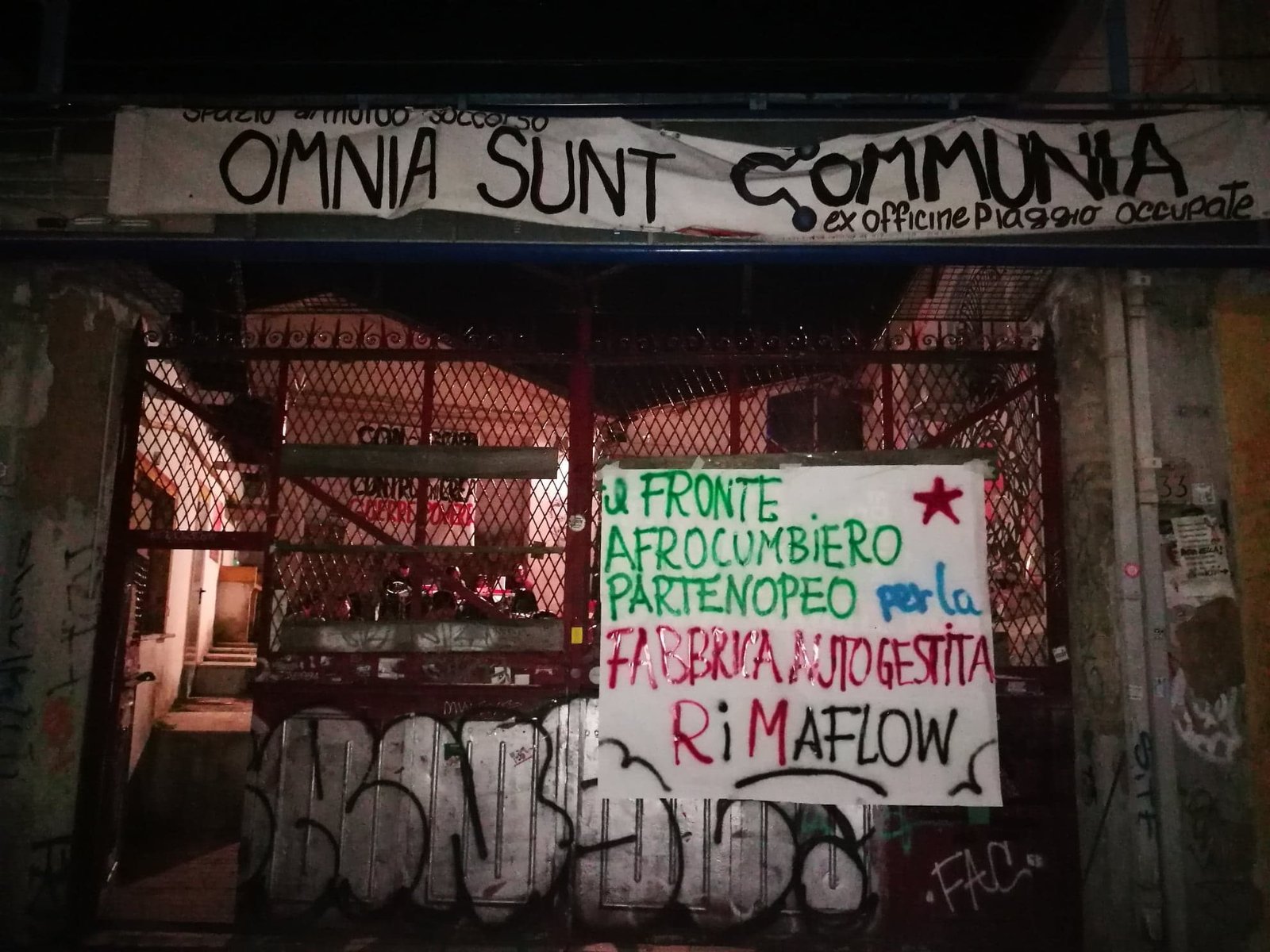
I'll say it right away because it's what most often creates misunderstandings: Communia is an occupation, and it doesn't hide it. It isn't a management assigned by a public tender, it isn't a project with a public budget and an artistic director. Those who frequent it know, those who arrive by chance understand within three minutes, because the walls speak plainly and nobody pretends otherwise. This premise is neither a warning nor a promotion: it's simply the frame within which everything else has to be read. A place with a declared political identity has to be described for what it is, without hiding the uncomfortable part and without turning it into a flag.
The rest of these lines serves to give the context that is usually missing: where exactly it is, what was in that shed before, why that street is called Scalo di San Lorenzo, what relationship the place has with the neighborhood around it and what to expect concretely when you push the door. At the end I also put in a few coordinates on what's within a kilometer, because San Lorenzo is one of the neighborhoods of Rome where the density of interesting things per square meter is highest and where you most easily walk past something important without noticing.
Where It Is, Exactly
Viale dello Scalo di San Lorenzo is the street that runs along the southern edge of the San Lorenzo neighborhood, parallel to the tracks, between the Porta Maggiore area and the Verano area. The name isn't decorative: the San Lorenzo freight yard was for decades one of the most important rail hubs in Rome, the place where the goods supplying the city arrived and were sorted. A street with that name already tells half the story of the neighborhood before you even reach the street number.
Number 4 is a short distance from the start of the avenue, in the stretch where the city changes skin within 50 meters: on one side the wall of residential buildings of the neighborhood, on the other the bundle of tracks, the long walls, the low sheds, the fences. Anyone arriving by car risks driving past, because the entrance doesn't have the visibility of a shop. Anyone arriving on foot recognizes it sooner, because in that area every doorway is worth looking at: they are almost all pieces of industrial archaeology reused, or waiting to be.
How to Get There
The simplest way is to get off at Termini station and walk east, or take the tram that goes up Via dei Reti and Piazzale del Verano: San Lorenzo is well served by the tram lines linking Termini, Porta Maggiore and the university area, and in 20 minutes on foot from Termini you arrive without effort. From Porta Maggiore, which is the big tram and track hub a bit farther south, the walk is even shorter. Anyone coming from the San Giovanni area or from Pigneto can cut along the railway and find themselves in the neighborhood almost without noticing.
On the car I give blunt advice: forget it. San Lorenzo has narrow streets, a system of one-way streets that seems designed to punish anyone who doesn't know the area, and parking pressure that becomes unsustainable on weekend evenings. The avenue along the tracks looks promising precisely because it's wide, and that's exactly why at a certain hour there's not a spot left. Tram, bus, bicycle or legs: all four options work better than four wheels.
What the Building Looks Like
The former Officine Piaggio are an industrial building, not a palace. That means high ceilings, wide bays, exposed structures, big windows taking in light from above, floors that have seen heavy vehicles pass. It also means cold in winter and heat in summer, because a shed isn't an apartment and no redevelopment done by hand and without public money can change its physics. Anyone who has frequented similar spaces in other cities recognizes the type at once: generous volumes, essential finishes, everything you need and nothing more.
The redevelopment the original description speaks of is exactly this: a shed left empty was cleaned up, made safe as far as possible, divided into usable rooms and returned to a function. The work was done by the people who use it, with salvaged materials, entire Saturdays spent taking apart and putting back together, and a number of hours nobody ever counted. This is the point that deserves respect regardless of what you think about the rest: a building that was out of use came back into use, and it didn't happen by chance.
What Social Space of Self-Organization Means, in Practice
The formula recurs the same in the descriptions and risks becoming a sound without content. I'll try to take it apart piece by piece, because every word means something precise and anyone arriving from outside deserves the translation.
Social space means that the main function of the building is not to host a commercial activity but to hold people together. The activities are there, and there are many, but they exist for the sake of the group that does them, not the other way around. A bar opens to sell, a social space opens to be together and then finds a way to cover the expenses.
Self-organization means there is no owner who decides, no director who programs, no office that approves. Decisions are made in assembly, with timing that seems very long to anyone coming from the working world and with a level of discussion that is sometimes exhausting. The advantage is that nobody can impose a program from above. The disadvantage is that everything takes three times as long and that something nobody agrees on simply doesn't get done.
Mutual aid is probably the part least understood, and it's the heart of the matter. It doesn't mean charity, it means exchange among equals: whoever knows how to do something makes it available to the others, knowing that when they need something they will find someone else who knows how to do that. Help desks, after-school programs, courses, buying groups, legal and housing support: they are different forms of the same principle, which has behind it a very long Italian tradition, that of the 19th-century mutual aid societies, born precisely in working-class neighborhoods like this one.
Off-market self-production means producing things without going through the commercial circuit: beer, food, prints, screen prints, objects, music, publications. Not as a hobby, but as a practice: building a short supply chain, knowing who made the thing you're consuming, keeping the price low because there's nobody in between who has to profit. It's the same logic that makes a beer in these places cost half what it does downtown, and not because it's worse.
Independent culture closes the circle: concerts, presentations, screenings, exhibitions, debates built without sponsors and without the obligation to fill the room at all costs. It means you can afford to host a band with an audience of 30 and an author with 15, because the criterion isn't the box office. It also means the quality is uneven, and I come back to this further on, because it's one of the honest things to say.
The Former Officine Piaggio and the Scalo di San Lorenzo
The name of the building is the trace of a Rome that almost nobody tells anymore: the industrial one. In the current imagination Rome is the city of offices, cinema, bureaucracy and tourism, and industry is something that was elsewhere, in the northern triangle. It's a simplification that doesn't hold up. Along the railway, between Porta Maggiore, San Lorenzo, Prenestino and Casilino, for a century there were workshops, depots, warehouses, plants, small and medium factories, and around them formed the neighborhoods where the workers who worked there lived.
The San Lorenzo freight yard was the pivot of that system. A rail yard isn't a station: it's the place where freight trains are made up and broken down, where the cars are sorted, where goods are unloaded and move onto roads. It was noisy, dirty, enormous and vital. Around it gathered all the activities that depend on a yard: warehouses, trucking, depots, vehicle repair shops. The avenue that still bears that name was a service road of work, not a promenade.
On the workshops dedicated to Piaggio vehicles I don't want to invent dates or details I can't stand behind: what is certain, and what can be read in the name by which the building is known in the neighborhood, is that the building belonged to that world, and that when that world withdrew the building stayed there, empty. It's a story that has repeated identically in dozens of Roman places: production moves or stops, the property loses its function, waits for a destination for years or decades, and in the meantime deteriorates. In some cases a real estate project arrives, in others a museum arrives, in still others a group of people arrives who decide not to wait any longer.
The Same Story, Elsewhere in the City
Anyone who wants to understand the logic of these places can look at what happened to Rome's other big industrial containers, each of which ended up differently. The Centrale Montemartini was the city's first public thermoelectric plant and became one of the most beautiful museums in Europe, with ancient statues among the turbines. The former Snia Viscosa complex on Via Prenestina had a different fate again, with a lake born by mistake in a building site and turned into a natural asset defended by the neighborhood. The former Mira Lanza in Trastevere became a theater and a giant mural. The MACRO on Via Nizza occupies the former Peroni brewery.
Communia belongs to that same family of reuses, with the substantial difference of legal title: the others had a council resolution, funding, an agreement. Here the reuse started from below and without permission. You can consider it a forced move or a stopgap, depending on how you see it, but the urban dynamic is the same: an empty container becomes full again.
A Curiosity About Communia
The curiosity I like best concerns the name. Communia is Latin, neuter plural, and simply means the common things. It points directly to the formula omnia sunt communia, all things are in common, which has a long and precise history: it's the phrase associated with Thomas Müntzer and the German peasant revolts of the 1500s, and it was taken up again in the 20th century and in our own as a slogan of the movements concerned with the commons. It's a name that contains a program in two and a half syllables, and at the same time doesn't shout: those who don't know the reference read a Latin word with a neutral sound, those who do know exactly what it's about.
The second curiosity is geographic and almost ironic. The place is on a street that bears the name of a freight yard, that is of an infrastructure made to keep goods circulating. A space that declares itself a laboratory for off-market self-production has set up house on the avenue of Roman logistics par excellence. I don't think the coincidence was sought: empty spaces are where they are, and whoever occupies takes what's there. Still, it remains one of those overlaps the city produces on its own and that tell more than a thousand declarations.
The third is less noble and more concrete: the address is one that GPS navigators handle badly. Viale dello Scalo di San Lorenzo, Via dello Scalo di San Lorenzo and the nearby ring roads look alike, low street numbers on long avenues are always treacherous, and more than one person has found themselves on the other side of the tracks with the feeling of having got the wrong city. Near the tracks, after all, Roman geography always gets a bit capricious: you see the destination 100 meters away and to reach it you have to cover 800.
San Lorenzo, the Neighborhood Around
You can't understand Communia unless you understand San Lorenzo, because the place is the child of the neighborhood far more than it is the child of a theory. San Lorenzo was born in the last quarter of the 1800s, after Rome became the capital, on land just outside the walls to the east, in the area between Porta Tiburtina and the cemetery. It's one of the first neighborhoods built to house the workers who had come to the city for the great building sites of the new capital: bricklayers, stonecutters, railway workers, laborers. The building speculation of the era threw it up fast, with compact blocks, grid streets, railing-balcony houses, narrow courtyards.
A peculiarity worth mentioning: the neighborhood was born essentially without the services that should have come with it. Few schools, little green space, inadequate sanitation, very high density. This produced two lasting consequences. The first is an urban fabric still recognizable at a glance today, made of low, regular blocks you almost never see in the rest of Rome. The second is a tradition of organizing from below that comes out of that: when services don't arrive, the residents build them themselves, and from the 19th-century mutual aid societies to the people's houses, from neighborhood committees to today's spaces, that line has never really been broken. Communia, in this sense, isn't a foreign body dropped from above: it's one more chapter of a story that has been going on in those streets for 150 years.
The Verano, Which Is Much More Than a Cemetery
The northern boundary of the neighborhood is the monumental cemetery of the Verano, one of the most underrated places in Rome. Anyone who has never been in imagines just a cemetery: in reality it's an open-air museum of funerary sculpture, with a century and a half of Italian art, from neoclassical to Liberty to rationalism, and with the names of half the country's cultural history on the gravestones. You can walk there for hours. And it is, along with the basilica, the oldest part of the neighborhood in the strict sense, because the cemetery was there before the houses.
Next to it is the basilica of San Lorenzo fuori le Mura, one of the great Roman basilicas, which gives its name to the whole neighborhood. It's a building layered in a fascinating way, born from the merging of two different churches, with a portico, a Cosmatesque floor, an ambo and a cloister that are worth the trip on their own. It's also the building that most visibly carries the scar of the worst day in the history of this piece of the city.
La Sapienza Two Steps Away
On the other side is the University City of La Sapienza, inaugurated in the mid-1930s on a design coordinated by Marcello Piacentini, one of the most coherent complexes of Italian rationalist architecture. Its presence changed the social makeup of San Lorenzo forever: from the postwar period, and massively from the 1970s, the working-class neighborhood also became a neighborhood of out-of-town students, with everything that follows in terms of rents, nightlife, street life and tensions between those who have always lived there and those who pass through for three years.
Inside the campus, and almost always ignored, there are real university museums: the MLAC, the contemporary art museum laboratory, the plaster cast gallery with its casts, the Giuseppe Sergi anthropology museum and the earth sciences museum. They are open to everyone, cost little or nothing and are almost always empty. Anyone who comes to San Lorenzo in the daytime and has an hour to fill before something in the evening has their best hour right there.
The Neighborhood at Night, With All Its Problems
From the 1980s on San Lorenzo became one of Rome's nightlife poles, and today that is both an attraction and a wound. Within a few hundred meters you can count dozens of bars, beer pubs, pizzerias, clubs. On weekend evenings the streets fill up, the sidewalks become spontaneous outdoor seating areas, the noise reaches the upper floors and the next morning the neighborhood has to be cleaned up. The longtime residents have been protesting for years, ordinances alternate, the problem remains. I say this because it's part of the real picture: the same liveliness that makes San Lorenzo attractive makes it exhausting for those who sleep there.
On this point, by the way, runs one of the practical differences between a social space and a commercial venue. A venue lives on the number of drinks sold and so has an interest in bringing as many people as possible, for as long as possible. A space like this doesn't have that constraint, and the relationship with the neighbors is a matter discussed in assembly, not a cost to dump outside. It doesn't mean the problems don't exist: it means there is a forum where they are addressed.
Something Nobody Tells You About Communia
What is almost never said is that a place like this is cyclical, and that the cycle doesn't coincide with that of the commercial city. A social space lives on people who keep it open for free, in their spare time, after work or study. That means there are full periods, with a calendar so dense a week can't contain it, and periods when the place slows down because the group running it is tired, has changed, has other urgencies. In August many of these realities close completely. In January they restart slowly. It's not disorganization: it's the physiology of an activity that pays nobody to be there.
The practical consequence for anyone who wants to go is simple and nobody ever writes it: the calendar must be checked always, every time, on the space’s own channels, and never on a generic aggregator. Aggregators copy the information once and leave it there for years. An event from three seasons ago keeps appearing as if it were imminent, while next Saturday’s assembly, which may be the most interesting thing happening that month, appears nowhere. Anyone who shows up without checking risks finding the shutter down and concluding the place no longer exists, when in fact there was simply nothing on that evening.
The second thing rarely said concerns the economic side. Almost all these spaces work on the club formula: annual membership card at a symbolic amount, very low internal prices, free or almost free contribution for events. Anyone arriving expecting to pay a ticket at a box office and consume as at a bar is thrown for 30 seconds, then understands. It's not a trick to get around something: it's the legal form that in Italy lets a group of people carry out activities in common without being a business. The corollary is that getting the card is not a token payment, it's an act of joining, and the level of participation expected is different from that of a customer.
The third is the most delicate, and I write it without beating around the bush because the reader deserves it: an occupied space is, by definition, in a legally precarious condition. The future of places like this depends not only on their activity but on decisions made elsewhere, in court or in the offices of an agency. Some Roman occupations have found some form of recognition over the years, others have been evicted after decades, others still live in balance for very long times. Anyone planning to go should take this into account and check beforehand, without alarmism but without taking anything for granted.
My Advice for Visiting Communia
The main advice is to choose the occasion well, because in a place like this the difference between a memorable evening and an awkward half hour isn't made by the place but by the reason you go. The best occasions for a first time are those with a structure: a book presentation, a screening, an announced concert, a social dinner, a fundraising day. These are moments with a program, a beginning and an end, in which even someone who knows nobody has something to do with their hands and their head. Showing up at random on any evening, with no event, is the quickest way to find four people arranging chairs and to wonder what you came there to do.
Second piece of advice: arrive at the right time, which isn't the one written. In clubs and social spaces events start late compared with the announcement, almost always. If a presentation is listed for 19:00, at 19:00 someone is setting up the microphone. The academic quarter-hour here is a good half hour. It's not sloppiness, it's the rhythm of a place where the organizers come straight from work. Arriving 20 minutes after the stated time is usually the perfect moment: you find the room filling up and you have time to get a drink before it starts.
Third piece of advice, the most important: talk to people. It's not a museum, it's a place made of people, and the experience changes radically depending on if you stay leaning against the wall with your phone in hand or ask someone what that thing hanging in the back is. In these places the direct question works very well: asking who painted the mural, how the space began, what was in the shed before, opens long conversations. The people who keep it going care a lot about telling it, and they tell it better than any written page.
Fourth: respect two unwritten rules that apply in all spaces of this kind. The first concerns photographs of people, which I come back to further on, and boils down to: you ask first. The second concerns the contribution: if you consume, you pay the full price even when it's ridiculously low, and if there's a collection box for self-financing you leave something. Those two euros aren't a profit margin, they're the month’s electricity bill.
Fifth, for those coming from outside Rome: you can build a whole afternoon around this area, and it comes out better than many days spent downtown. A walk through the Verano, an hour in the basilica, a university museum, a stroll through the neighborhood streets with the plaques and the murals, a beer in one of the clubs and then the evening here. It's a Rome that doesn't appear in the guides and that in our judgment tells the city better than certain lines in the sun.
Eating, Drinking and the Question of Prices
One of the reasons Roman social spaces have a wide audience, going well beyond those who share their political positions, is simply the price. In a city where an aperitivo downtown has come to cost as much as a lunch, a place where you drink and eat at prices from 20 years ago makes a huge difference for students, people in precarious jobs, retirees and anyone with a spending ceiling. It's not a folkloric detail: it's the material reason these places stay busy even when the political season changes.
The mechanism that makes the low price possible is that of self-production and volunteer work. If behind the counter there is a person who isn't paid, if the kitchen is run in shifts, if the beer comes from a small producer with whom there is a direct relationship or is made in-house, if there is no commercial rent to cover and no margin to distribute, the bill drops automatically. The flip side is that the service isn't that of a venue: you order at the counter, you wait, you clear your own table, and nobody comes by to ask if everything is to your liking.
Social dinners are the best form in which to meet this cooking. They are fixed-menu dinners, often tied to a specific date or to a fundraiser for a particular cause, with simple dishes made in industrial quantities: baked pasta, meatballs, vegetables, desserts brought by someone. You eat together at long tables, you end with a concert or a debate, and the price covers the expenses and leaves something for the common fund. Anyone with experience of village food festivals or Festa dell’Unità events recognizes the format at once, which is basically the same.
Watch Out for One Practical Point
In most of these spaces you can't count on paying by card. Many have adopted electronic payments, others stay with cash by choice or for convenience. Coming with some cash in your pocket avoids embarrassment, especially at occasions like social dinners and self-financing days, where the cash box is literally a metal box on a table. A small precaution from someone who has been there: large bills at a self-managed counter are a problem, because the change runs out quickly.
Another Well-Known Fact, Yet Rarely Cited
The well-known fact is that San Lorenzo was bombed on July 19, 1943, and that it was the first aerial bombing of Rome. Everybody knows it, it's written on the plaques of the neighborhood, Pope Pius XII arrived on the spot and the photograph of him in his white robe among the rubble became a very familiar stock image. What is cited much less often is why that neighborhood and not another: the declared target of the attack was precisely the railway facilities, the freight yard and the bundles of tracks, that is the logistics network that supplied the front. San Lorenzo was hit because people lived right on top of and around a strategic hub, and because the railway workers’ houses had been built next to the place where the railway workers worked.
It means that the avenue this building faces is, in the literal sense, the target of that day. The yard road, the warehouses, the workshops along the tracks: that was the point. The number of victims has never been fixed definitively and the estimates in circulation are very different from one another, so I don't write one as if it were certain. What is certain is that many thousands of people were affected among dead, wounded and homeless, and that entire streets of the neighborhood were razed to the ground. The basilica of San Lorenzo fuori le Mura was badly damaged, with the facade and the portico rebuilt in the postwar period, and that's why today you see what you see: an ancient building with visibly rebuilt parts.
The second element rarely cited is the political consequence. The bombing of July 19 contributed directly to the fall of Fascism, which came six days later, on July 25. The blow to the regime’s credibility, which had promised that Rome would not be touched, was enormous. And, something told even less, the memory of that day is one of the foundations of the neighborhood’s antifascist identity, along with the episodes of resistance of 1943 and 1944 and the working-class presence. When you look today at a mural or a piece of writing on the walls of San Lorenzo, that history is the ground it comes from. You can share it or not, but ignoring it makes everything you see incomprehensible.
There is also a third fact, of an urban-planning kind, that always passes in silence. The postwar reconstructions left pieces of 1950s construction in the 19th-century fabric of the neighborhood that are easy to recognize by eye: taller small apartment buildings, different plaster, alignments that break the original grid. Walking through San Lorenzo looking at the difference between an intact 19th-century block and a mended one is an exercise that says a lot, and that can be done in half an hour without a guide. What looks like a homogeneous neighborhood is in reality a mended neighborhood.
The Right Photo to Take at Communia
The right photo is the one of the industrial architecture, not of the people. I say it in this order for a precise reason: in a social space, photographing people is a serious matter, not a breach of etiquette. People come through these places who for a thousand different reasons prefer not to end up in a published photograph, and the unwritten rule, which applies in all spaces of this kind in Italy, is that you ask first and accept a no without argument. Anyone who arrives with a camera around their neck and starts shooting in bursts gets stopped, and rightly so.
That said, the material for a beautiful photograph is there in abundance. The structure of the shed is a natural frame: bays, trusses, pillars, tall windows through which the light falls diagonally. The best photograph is late afternoon, when the light comes in low through the openings and cuts the interior volume leaving the back in shadow. An industrial interior photographed with that light always works, because the contrast between the hard geometry of the structure and the warmth of the light does the work by itself.
The second subject is the painted walls. In social spaces murals, screen prints, posters and writing layer up over time and form a visual archive that tells years of activity: campaigns, concerts, mournings, victories and defeats, all overlaid. A close-up photograph of a piece of wall with three layers of torn posters says more than a group portrait, and puts nobody in difficulty. It's also, looking ahead, a document: those walls change constantly and what's there today won't be there in two years.
The Photo I Really Recommend, Though, Is Outside
If I had to indicate a single shot, I'd say the one from outside, on the avenue, with the industrial building on one side and the bundle of tracks on the other. It's the frame that tells the whole story: the railway that gave birth to the neighborhood, the shed that stopped producing, the reuse that came afterward. Backlit, with a regional train passing slowly in the background, you get a photograph that says more than any caption. The best moment is dusk, when the street lamps come on and the sky above the tracks is still light.
Fourth idea, for those with patience: the Verano seen from the bridge and from the neighborhood streets, with the cypresses and the funerary aedicules rising beyond the wall. It's an image nobody takes and one that conveys the double character of San Lorenzo, a neighborhood of the living built on top of a city of the dead. From there to here it's a few minutes on foot and the early morning light on the cemetery wall is the kind worth waking up for.
Some Important Events That Happened Here in History
Here is what has happened in this piece of the city, distinguishing clearly between the history of the place in the broad sense, which is documented and verifiable, and the internal chronicle of the space, made of hundreds of evenings for which no consultable archive exists. Starting with the first helps to understand why the second happens right here.
The Birth of the Yard and the Neighborhood, Late 1800s
After 1870, with Rome as capital, the city expands east along the railway line. The monumental cemetery, the working-class neighborhood and the system of railway facilities that includes the freight yard are born almost together. It's the founding event of everything: without the railway there would have been no neighborhood, without the neighborhood there would have been no social history that followed, without the facilities there would be no sheds being reused today.
Labor Struggles and Opposition to Fascism, the 1920s
San Lorenzo enters national political news early. In the years immediately before and after the March on Rome the neighborhood is one of the points in the city where the Fascist squads meet organized resistance, with episodes of clashes that remain in collective memory and are still recalled today by plaques and commemorations. From there comes the neighborhood’s reputation as an antifascist area, which runs through the entire 20th century and arrives intact in the present.
July 19, 1943
The date that splits the history of the neighborhood in two. The bombing hits the railway facilities and the houses built around them, destroys entire blocks, badly damages the basilica and leaves a very high number of victims and displaced people. Six days later Fascism falls. The memory of that day is still a physical presence in the streets, among plaques, markers, pieces of wall left exposed and annual commemorations.
The Postwar Period, Reconstruction and the Slow Withdrawal of Industry
In the 1950s and 1960s the neighborhood is stitched back together and continues to be working-class and popular. Then begins the process that concerns the whole city: productive activities leave the central areas, the yard gradually loses importance with the change in freight transport, the sheds empty out. It's a movement lasting decades, not a single event, and it's the material premise of everything that comes after.
The Arrival of Students and the Transformation, the 1970s and 1980s
With the growth of La Sapienza and the explosion of university enrollments, San Lorenzo becomes the neighborhood of out-of-town students. Rents change, shops change, the first nightlife venues appear, the neighborhood takes on the double nature it still has today: working-class and university, residential and nocturnal. It's in this phase that the network of self-managed spaces, clubs and social centers also consolidates, which in the 1990s becomes one of the densest in Italy.
2013 and the Birth of Communia
In the thick of the years of the economic crisis, when across Italy youth unemployment reaches figures not seen in generations, Communia is born in an empty shed of the former Officine Piaggio. The date is not accidental: that season produces across Europe a new wave of social spaces oriented toward concrete mutual aid, toward the help desk, the service, the practical answer to need, much more than toward the dimension of youth counterculture alone. Communia belongs to that generation of spaces, and you can see it in the vocabulary it uses to define itself: self-organization, mutual aid, self-production, laboratory. These are words that speak of work and income, before music.
The Internal Chronicle
Since then the history of the space is made of what the history of all places of this kind is made of: very long assemblies, concerts with the audience pressed against the stage, book presentations, screenings, language courses for foreigners, after-school programs, help desks, parties, fundraising dinners, small markets, tournaments, neighborhood campaigns, participation in city demonstrations, moments of difficulty and moments of relaunch. No archive collects all this in an orderly way, and anyone wanting to reconstruct it would have to do as one does in these cases: talk to people, look at the walls, scroll the space’s social pages from the bottom up. I add, in honesty, that on the current state of the space in 2026 I report no claims I can't support with a source: the correct way to proceed is to check the space’s channels shortly before going.
Who Passed Through Communia
There are no lists of famous names here. It would be very easy to build a plausible list of Roman bands, authors and activists, and it would be the least useful and least serious thing I could do. In spaces of this kind the flow of people is enormous and largely untracked, and the lists you read around are often compiled by approximation. So I tell you who really passes through, by category, which is truer and more useful information than three names dropped in.
The Neighborhood
The first category is the one least visible from outside: the residents of San Lorenzo. Families bringing their children to after-school, older people coming to a dinner, tenants with an eviction or lease issue looking for someone to help them make sense of it, workers looking for help with a pay stub. In a mutual aid space this is the main part of the activity, and it's the part that never ends up in the stories, because it produces neither photographs nor posters.
Students and Researchers
La Sapienza is a few minutes away, and the university population constantly crosses the neighborhood. Out-of-town students looking for a place to spend an evening at human prices, university collectives, doctoral students, self-organized study groups. In many cases the relationship runs both ways: the space hosts seminars and presentations, the university supplies the audience and some of the people who run it.
Musicians and Groups of the Independent Scene
For 30 years the circuits of social spaces have been one of the real infrastructures of Italian independent music. A band just starting out hardly finds a stage in a commercial venue, while here it finds an evening, a sound system, a curious audience and an honest reimbursement. Many bands that fill theaters today started out in exactly such places, all over Italy. It's a chain that is rarely recognized as such but without which half of Italian music of recent decades would not have existed.
Authors, Translators, Small Publishing
Book presentations in social spaces are a circuit parallel to that of bookstores, and for small political, nonfiction and militant publishing they are often the main channel. Here a publisher who prints 1,000 copies finds 30 people who have read the book and ask questions, and that's worth more than a downtown shop window.
Activists, Union Members, Neighborhood Networks
Then there is the network: committees for the right to housing, urban environmentalist groups, grassroots unions, migrant solidarity networks, feminist and transfeminist collectives, popular sports associations like the San Lorenzo people’s gym and nearby realities like the Container, which form a continuous fabric in the neighborhood. Many initiatives come from the crossing of two or three of these realities, and the physical place where the crossing happens is almost always a space like this one.
The Curious
Finally there are people like whoever is reading now: people who walk past, read a flyer, come in for a concert and then come back. It's not a minor category. Most of the people who keep these places open today got there that way, by chance, one evening, with no particular intention.
What’s Around, Within a Kilometer
One of the reasons I recommend building a whole afternoon around here is that the density of things to see is high and the distance between them is ridiculous. Here is how to organize it.
To the north, the Verano and the basilica of San Lorenzo fuori le Mura: two or three hours if you want to really look, 40 minutes if you only want to understand what it is. I recommend going into the basilica first and the cemetery after, because the cemetery closes early.
To the east, the University City with its museums: MLAC, plaster cast gallery, anthropology, earth sciences. Limited openings and often only during office hours, so they need to be checked beforehand, but the ratio between what you see and what you pay is unbeatable in all of Rome.
To the south, the Porta Maggiore hub with the underground basilica, which is one of the most surprising ancient spaces in the city and which almost nobody visits, and the stretch of the Aurelian Walls that closes the neighborhood toward the center. From there you reach the Esquilino and its market on foot in barely a quarter of an hour.
To the west, walking along the tracks, you quickly reach the Termini area and then the center. In the other direction, toward Prenestino, there are the former Snia and its lake, which perfectly complete the discussion of the reuse of industrial voids begun here.
Inside the neighborhood, then, you just walk. San Lorenzo is small, you can do all of it in an hour, and the reward is the details: plaques, murals, surviving craft workshops, restoration and marble workshops historically tied to the cemetery, open courtyards, 1920s buildings, a quantity of history visible to anyone who looks up. In summer the neighborhood also takes part in the city’s programming with outdoor initiatives, for example the San Lorenzo film festival, which explicitly ties its title to the memory of the bombing.
When to Go and What to Expect, Season by Season
Autumn is the best period by far. From October to December the calendars of the social spaces are full: the season restarts, courses begin, students are back, the Roman climate is still good in the evening. If I had to pick a week, I'd pick any one in November.
Winter is the season of indoor things and ongoing activities: courses, after-school, help desks, presentations. An industrial shed in January is cold and nobody denies it: you go dressed for outdoors, even inside.
Spring is the season of street initiatives and outdoor days, with the programming moving outside as soon as the weather allows. It's also the period when the neighborhood is nicest to walk, with the plane trees growing their leaves back and the evenings getting longer.
Summer is the most uncertain season. Many spaces reduce activity or close in August, others build summer programs in the courtyard or in outdoor areas. July can be excellent, August is almost always empty, the second half of September restarts. Anyone planning a midsummer visit must check, without exception.
Accessibility and Practical Aspects
On access for people with disabilities I give no guarantees I can't give: an industrial shed readapted by volunteers may have level entrances and wide rooms, just as it may have steps, level changes and unequipped restrooms. The sensible thing is to write to the space beforehand and ask: in places like this people answer, and answer precisely, because the question is taken seriously.
For the rest: dogs generally welcome, children too, loud music on concert nights, smoking kept outside as everywhere, essential lighting. Anyone with hearing problems will do well to choose presentation evenings rather than concert ones. Anyone coming with small children will do well to choose the afternoon.
Frequently Asked Questions
Can you go in if you don’t share the space’s political positions? Yes. A social space doesn't give exams at the door. What it asks for is respect for the place and for the people who keep it going, which is exactly what is asked everywhere. Arguing is normal, provoking is rude.
Do you have to pay to get in? As a rule you pay an annual membership card of a symbolic amount, because the activity is that of a club. Events often have a free contribution or a low amount. Dinners have a fixed price.
Is it a safe place? As safe as any other crowded place in Rome, with the added fact that there is always someone who answers for what happens. The internal rules on harassment and aggressive behavior in these spaces are stricter than in commercial venues, not looser.
Is the food good? The food is simple, in quantity, at low prices and with ingredients often chosen from small supply chains. Anyone looking for chef-driven cooking is in the wrong place and already knows it.
How do I find out what’s happening? The space’s social channels, flyers posted in the neighborhood, word of mouth. In that order of reliability.
Why It’s Worth It, in the End
Because it's one of the few chances, in Rome, to see up close how a city works when someone decides to take care of it directly. You can agree or totally disagree on the method, and the question of the legality of the occupation is real and shouldn't be swept under the rug. But the material fact remains: a disused shed on a street of tracks has become a place again where things happen, where someone learns Italian, where a kid does homework, where a band plays its first concert and where 300 people eat together for €10. In a city that has hundreds of empty spaces, it's a fact that deserves to be looked in the face.
And then, simply, because it's San Lorenzo: a neighborhood that holds together in one square kilometer a monumental cemetery, a 4th-century basilica, a rationalist campus, a war wound still readable on the walls, a working-class tradition, a student population and a very long night. Few places in Rome tell so much in so little space.
Frequently Asked Questions About Communia
Where Is Communia?
Communia is on Viale dello Scalo di San Lorenzo, the street that runs along the southern edge of the San Lorenzo neighborhood, parallel to the tracks, between the Porta Maggiore area and the Verano area, in Rome.
What Does the Name Communia Mean?
Communia is a Latin word, neuter plural, that simply means the common things. It points to the formula omnia sunt communia, all things are in common, historically associated with Thomas Müntzer and the German peasant revolts of the 1500s.
Do You Need a Membership Card to Enter Communia?
Yes, at Communia you generally pay an annual membership card of a symbolic amount, because the activity of the space is that of a self-organization club, not of an ordinary commercial business.
Can You Enter Communia Without Sharing Its Political Positions?
Yes, you can enter Communia even without sharing its political positions: a social space doesn't give exams at the door, but it asks for respect for the place and for the people who keep it going, exactly as is asked everywhere.
What Was the Building That Now Houses Communia?
The building that now houses Communia was tied to the former Officine Piaggio and to the Scalo di San Lorenzo, a piece of industrial Rome that for a century, along the railway between Porta Maggiore, San Lorenzo, Prenestino and Casilino, housed productive activities now largely gone.
Why Is It Worth Eating and Drinking at Communia?
At Communia you drink and eat at much lower prices than the city average, a factor that in a city where an aperitivo downtown costs as much as a lunch makes a huge difference for students, people in precarious jobs and retirees.
Before You Go
If this visit is one piece of a longer trip, here are two useful tools. For those who organize group trips, manage clients, prepare itineraries and need professional tools to do it without going crazy, there's TourLeaderPro, designed precisely for those who accompany people around Italy as a profession. For those instead building their own Italian itinerary who want to understand how many days Rome really takes, what to fit in and what to let go, there's ItalyPlanner, which helps line up the days without turning the vacation into a race. Two different approaches to the same problem: fitting into the time you have the things that are really worth it.
One last reminder, the most important of all: before setting out, check the space’s channels. It's a self-managed place, the calendar changes, the seasons matter, and five minutes of checking avoids a wasted trip.
Contact Information
Viale dello Scalo di San Lorenzo, , 4
Roma Roma Città, Roma Città