Villa Aldobrandini in Frascati
In short. Villa Aldobrandini in Frascati can be visited only in the park, only on weekdays and only after asking permission from the town's tourist information and welcome office, the Frascati Point, at Piazza Marconi 1.
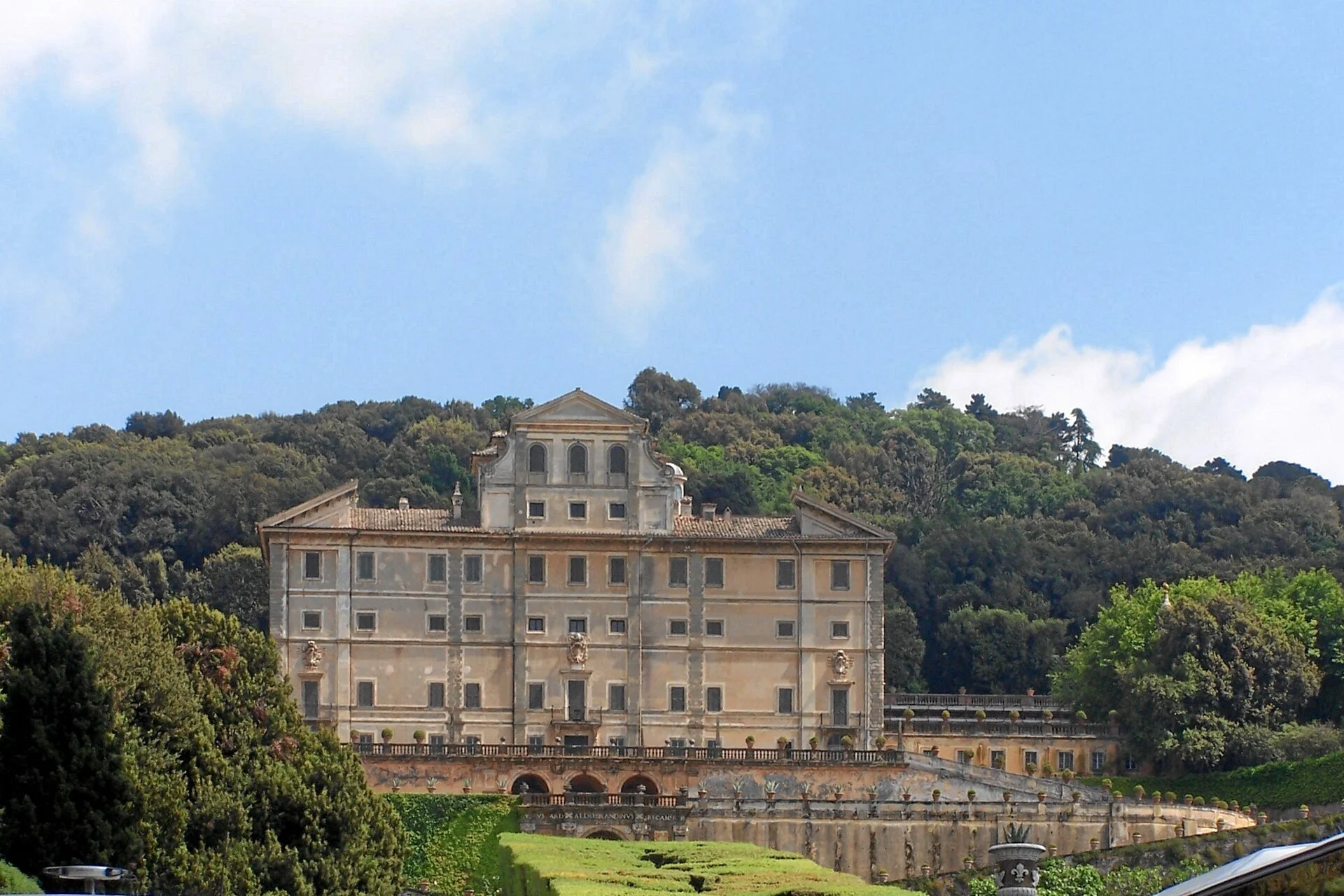
Villa Aldobrandini in Frascati can be visited only in the park, only on weekdays and only after asking permission from the town's tourist information and welcome office, the Frascati Point, at Piazza Marconi 1. The palace is closed. It isn't a museum, it has no ticket office, it has no site selling admission. It's a private home of the Aldobrandini family that grants the garden to those who ask in the right way.
The villa is at Via Cardinal Massaia 18, at the top of the axis that climbs from Piazza Marconi. You can see the monumental gate from the square: it's the one that closes the perspective. Behind it is the double-switchback ramp, then the palace, then, behind the palace, the Water Theater, a semicircle backed against the hill that is the reason this villa entered the books of European architecture and stayed there for three centuries.
Anyone who arrives convinced they'll find a working water garden leaves disappointed. The fountains don't spout, the hydraulic machine doesn't run, the water organ has been silent for generations. What's left is the architecture: enormous, theatrical, built to be looked at from below. It's worth the trip if you know what you're going to see. If you go expecting Tivoli, you'd do better to go to Tivoli.
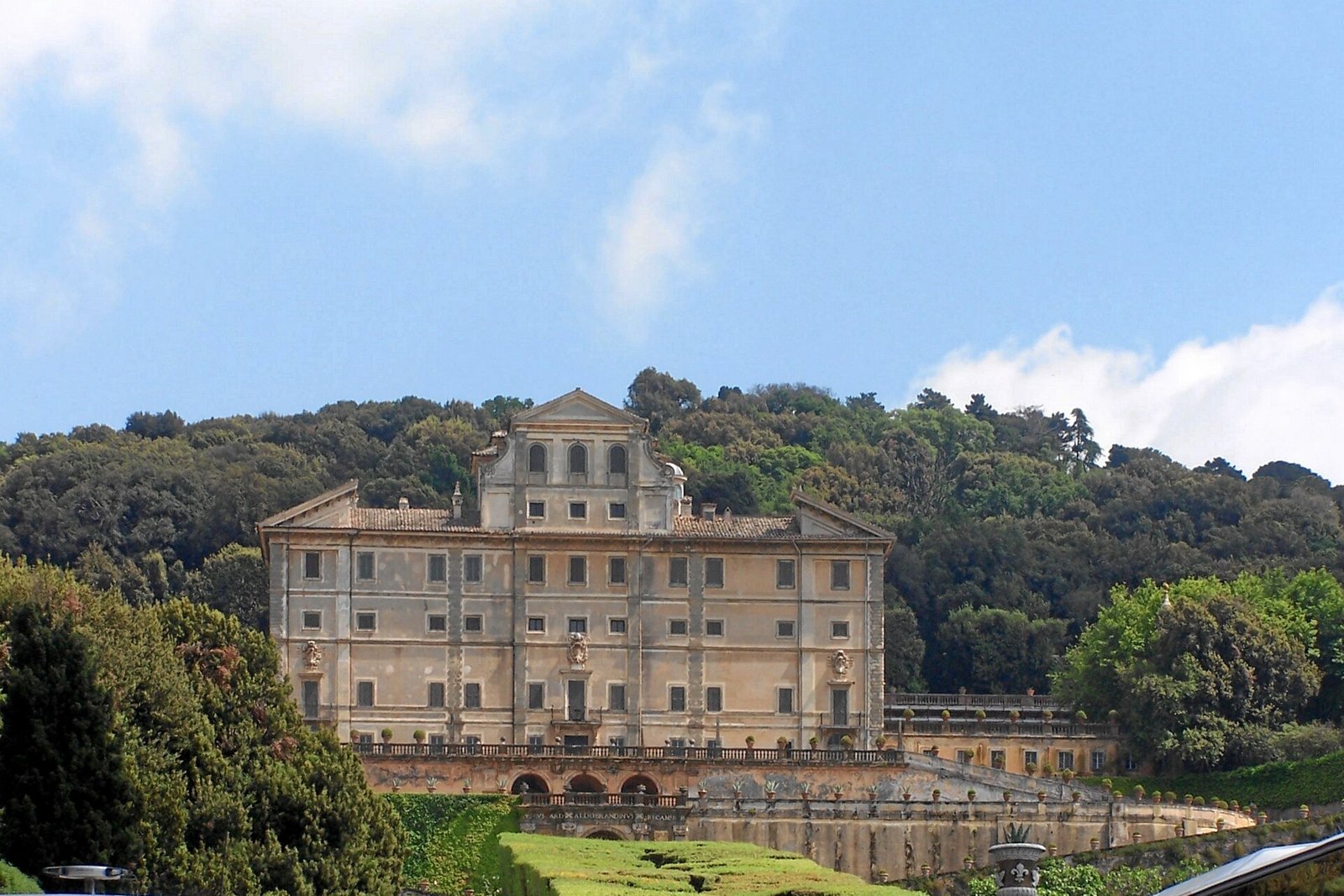
What you really visit and what you don't
The permit covers the park, and the park is enough already. You enter through the monumental gate on Via Cardinal Massaia, climb the ramp, skirt the palace without going in and reach the esplanade behind the building, where the semicircle of the nymphaeum opens. There you stay, walk around, climb a few steps along the sides. The rest of the property, woods included, isn't part of the tour that's allowed.
The palace is closed to the public with no tourist exceptions. Inside are the Chapel of San Sebastiano, the room with the monumental fireplace and the bronze bust of the cardinal attributed to Taddeo Landini, fresco cycles attributed to the circle of the Cavalier d'Arpino and the Zuccari. You won't see any of this. Anyone who promises you the interior is selling you a private event, not a visit.
The Parnassus Room, the one the books always cite, no longer exists as the old guides describe it. Domenichino's frescoes with the stories of Apollo that decorated it were detached and ended up in London: today they are at the National Gallery, cataloged from number NG6284 to number NG6291. Anyone who wants to see them has to take a plane, not a train to Frascati.
The water organ that stood in that room, built on the instructions of Giovanni Guglielmi with the collaboration of Giovanni Anguilla and Jacques Sarrazin, doesn't work. The art-historical records say so and anyone who has been there in recent decades confirms it. The pipes, the space, the structure remain. The sound doesn't. It's a real loss and nobody hides it.
The side grottoes of the nymphaeum are closed off by iron gates. You see them from outside, you understand the layout, you don't go in. The sculpted mask that marks the entrance to one of the grottoes bears the date 1612 and that one you do look at up close. Be patient with the light: the semicircle is in shade for a good part of the day and in winter stays in the dark almost always.
A curiosity about Villa Aldobrandini in Frascati
The water of this garden isn't from Frascati. To make the Water Theater work, a pipeline of about eight kilometers was needed, bringing the water from Monte Algido, that is, from another mountain, through dug conduits and siphons. The cardinal didn't buy a fountain: he bought a private water system, and that was the real investment, far more than the statues.
What strikes you, looking at the accounts of that building site, is that the water cost more than the marble. Every Tusculan villa of the 16th and 17th centuries competed for primacy on how many liters per second it could bring up high and make fall visibly. Whoever had more flow won. The Aldobrandini won, and for a couple of generations nobody caught up.
The flip side is that a system like this, without pumps, lasts as long as someone maintains it. Eight kilometers of pipeline mean eight kilometers of possible breaks, roots, landslides, water intakes disputed with the farmers downstream. The machine stopped for this reason, not because of a single disaster. It stopped because maintaining it cost as much as building it.
It has to be said at the start, before you climb: what you're about to see is the skeleton of a system, not the system. It completely changes the way you look. Someone who knows they're looking at a switched-off machine looks for the pipes, the header tanks, the differences in level. Someone who doesn't know looks for the water and doesn't find it and gets bored in seven minutes.
To get an idea of how a water garden kept in good working order sounded and worked, the point of comparison is half an hour away by car: Villa d'Este in Tivoli, where the hydraulic organ has been put back into operation and plays at set times. Go before or after, not the same day: they're two experiences that cancel each other out.
The Water Theater, piece by piece
The semicircle extends for a considerable length backed against the slope, marked by columns, pilasters, herms, pediments and niches. It's an architectural facade applied to a hill, and this is the invention: not a decorated retaining wall, but a palace front mounted where a palace wouldn't fit. The word theater is to be taken literally, as a scenic structure designed for a spectator placed below.
The statues and their program
At the center of the semicircle is the figure of Atlas holding up the celestial globe. It isn't there for decoration: it's the patron's political signature, the weight of the world held up by those who govern. At the sides, in the niches, a figure of a cyclops and a centaur with musical instruments. The current mythological reading links them to the theme of music and of force tamed by ingenuity.
The so-called Columns of Hercules that flank the water staircase are attributed to Jacques Sarrazin, a French sculptor active in Rome in those years, and are covered in mosaic. The two columns mark the point where the water descended in a spiral along the ramp. Today the spiral is dry and the mosaic has lost pieces, but the design remains legible.
The water staircase climbs behind the semicircle toward the woods. It was the channel that fed the whole system, with the water falling from step to step inside a spiral ridged channel. Anyone who walks it today walks on dry stone. Look at it from below, from the esplanade: only from there do you understand that the staircase and the semicircle are a single design.
What the sources do and what they don't do
On the authorship of the Water Theater the sources converge on Carlo Maderno for the architecture and on Orazio Olivieri for the hydraulics. Some records place alongside or in place of Olivieri Giovanni Fontana, brother of Domenico and a hydraulic engineer by trade, for the execution of the systems. The two attributions don't exclude each other: it's a building site with several hands, and the documents don't allow assigning every pipe to a name.
The start date of the Water Theater is given by specialist records as around 1603, that is, right after the death of Giacomo Della Porta. Here the sources diverge by a year: most studies place Della Porta's death in 1602, some English-language encyclopedia entries in 1603. The difference doesn't change the substance, but it should be said rather than choosing at random.
One thing nobody tells you about Villa Aldobrandini in Frascati
The villa you see wasn't born Aldobrandini. The core was built around 1550 by a Roman prelate, Alessandro Rufini, and for almost 50 years it was his home and that of his heirs. In 1598 Pope Clement VIII had it go to his nephew, Cardinal Pietro Aldobrandini, in recognition of his diplomatic work on the question of Ferrara. The big building project starts from there.
This means Giacomo Della Porta didn't design on free ground. He worked inside and on top of an existing building, enlarging and reorienting it, and the oddness of certain proportions is explained this way. Anyone looking for the perfect plan of the treatise won't find it, because underneath there's a mid-16th-century house that couldn't be knocked down.
The property then changed hands quite a bit. It passed to the Pamphilj, arrived at the Borghese and returned to the Aldobrandini in 1837, almost three centuries after construction. The families of the Roman patriciate swapped these villas through marriages, inheritances and debts, and the name on the gate tells only the last round. Frascati is full of villas that have changed surname two or three times.
The piece almost nobody attributes correctly is the monumental portal toward the town. It isn't 16th-century and isn't by Della Porta: it was designed by Carlo Francesco Bizzaccheri in the early 18th century, 100 years after the rest. It's a late graft on a Baroque layout, and it's the reason the entrance has a different flavor from everything inside.
Then there's the war, which is little discussed in connection with this villa. The Anglo-American bombings of Frascati in 1943 and 1944 hit hard here too, in particular the upper gardens and the water works. The postwar restoration was entrusted to the architect Clemente Busiri Vici. Part of what looks ancient today is 20th-century reconstruction, and there's no sign to tell you.
A further restoration was begun by the owners in 2011, under Prince Camillo Aldobrandini, precisely to correct earlier repairs done badly. A building site lasting years on a private property, without visible public funding, proceeds at paces that don't depend on the tourist calendar. This too explains why certain areas are cordoned off without notice.
How to ask for permission, in practice
There is only one channel and it's municipal: Frascati's tourist information and welcome office, listed as Frascati Point, at Piazza Marconi 1. You go there in person, say how many you are and for what day, and the office issues the permit to enter the park. There's no online platform that does the same thing, and whoever offers you one is selling something else.
Entry to the park is free. On this the sources agree: free admission, permit included. If someone asks you for money to get you into the park, that money isn't paying for a ticket, it's paying for a guide or an accompanying service, which is legitimate but a different thing. Always ask what exactly the sum includes.
The days are weekdays. The sources that publish a schedule give the window from 9:00 in the morning to late afternoon, Monday to Friday, others speak of access arranged in the morning on working days. The two indications don't coincide, and the reason is that the window changes with the season and with the owners' commitments. Verified September 28, 2026, this uncertainty remains.
The practical consequence is simple: phone or stop by the office before organizing your day, not after. The villa's number that appears in tourist directories is 06 9422560, while the contacts of the events secretariat published by the owners are 06 6833785 and the mailbox info@aldobrandini.it. That secretariat handles weddings and receptions, not individual visits.
On weekends the park is normally not visited. It's the period when the villa works as a location for ceremonies, and a ceremony under way closes everything. Anyone who has only Saturday available should expect to find the gate barred and have an alternative ready within a kilometer, which Frascati doesn't lack.
Groups must be announced further in advance and with a number. There is no published cap on people, but a group of 40 that shows up without notice at a private gate is sent back, and whoever sends it back is right. A phone call made 10 days earlier solves 99 percent of the problems.
The advice I give you for visiting Villa Aldobrandini in Frascati
Go early in the morning, on a weekday, and allow 40 minutes inside and an hour and a half of the day in Frascati. The park isn't big and there are no long routes. Anyone who plans three hours inside the villa ends up standing still looking at a wall, however extraordinary that wall is.
Light matters more than anything. The semicircle faces the slope and stays in shade for a long time: the central hours of the morning are the only ones in which you really see the reliefs, the herms, the chiaroscuro of the niches. In the late afternoon the nymphaeum becomes a dark mass and photos come out flat. In winter the useful window shrinks further.
Shoes with a sole that grips. The entrance ramp has cobbles and a slope, the side steps of the semicircle are damp almost always because of seepage, and the moss on the travertine is slippery even in the sun. It isn't a route for sandals. Anyone with walking problems should know that the climb from the gate to the esplanade is neither short nor flat.
Don't make the villa the center of the day. Make it the high point of a tour that includes the center of Frascati, the square, the cathedral and then the descent toward Grottaferrata, where the Greek abbey of San Nilo gives you an hour of things to look at that the villa doesn't have, because there you really get in.
Those traveling with small children should know that there's nothing here for them. No educational route, no panels, no lawn to run on in the visitable part, no moving water. After 20 minutes they ask to leave, and they're right. For a day with children outside Rome, the park of Villa Gregoriana works much better, which is a route and not a facade.
Bring your own drinking water. Inside there's no refreshment point, no public restroom and no information desk. The villa opens a gate for you, it doesn't welcome you with a service. You'll find the restroom in a place in the center, before going up, and it's worth taking advantage of because afterward you come back down the same road.
The view and the question of the belvedere
The villa was called Belvedere even before it was called Aldobrandini, and the name describes the reason it was built exactly there. From that terracing you see the plain all the way to Rome, and on clear days you can make out the dome of Saint Peter's. In the 17th century that view was the real luxury: the Roman countryside under visual control, from the drawing room.
Today the view still works, but you have to look for it. From the esplanade of the nymphaeum you look toward the slope, not toward Rome: for the panorama you have to turn around and use the stretch in front of the palace, where the perspective axis descends toward Piazza Marconi and continues beyond. That axis isn't an accident, it's the backbone of the design, and it's worth a five-minute stop.
Summer haze eats the view almost every day from June to September. If you come for the panorama, choose a day after the rain or the first weeks of October, when the air clears. Don't trust the photographs that circulate: many are taken in conditions that happen 20 days a year, and were waited for a long time.
Another well-known fact, yet rarely cited
Everyone knows that the Tusculan villas are 12 and that this is the most famous. Almost nobody says that they are 12 private or semipublic properties with 12 different access regimes, and that this is the reason Frascati has never worked as an organized day destination. There's no single ticket, no circuit, no body that coordinates the openings.
You see the consequence in the local tourism numbers. Frascati receives a great many passing visitors, almost all to eat and drink, very few for the villas. The most important architectural heritage of the Castelli is the one that generates the fewest visits, and not for lack of interest: for lack of open doors at predictable hours.
The comparison that makes it all clear is with the villas of the State or of public bodies. Hadrian's Villa, Villa d'Este, Villa Lante in Bagnaia and Palazzo Farnese in Caprarola have a ticket office, hours and staff. The Tusculan ones have a municipal office that acts as go-between with private owners. They are two worlds, and the visitor notices at once.
This isn't anyone's moral failing. A family that owns a 17th-century complex with a nymphaeum to maintain has no obligation to open it, and the fact that it grants the park free of charge through the municipality is more than many others do. But the visitor has to know it beforehand, not discover it in front of a closed gate on a Saturday.
In Rome the phenomenon repeats on a different scale in cases like Villa del Priorato di Malta on the Aventine or Villa Poniatowski, where access depends on conditions that change and that no aggregator reports correctly. The rule is always the same: check at the source that holds the place, not at whoever tells about it.
The right photo to take at Villa Aldobrandini in Frascati
There is just one right photo and it's taken from the center of the esplanade behind the palace, backing up until you touch the opposite wall, with the wide-angle lens held horizontal. The whole semicircle fits in, Atlas stays at the center, the water staircase rises behind and you read the depth. Any other framing gives a fragment that explains nothing.
Keep the camera straight. The classic mistake is to tilt the lens up to catch the top and end up with columns falling backward: the facade is tall and close, and the distortion ruins it. If you can't back up enough, take two horizontal shots and stitch them together, or accept cutting off the top and concentrate on the central tier.
The second photo worth taking is the detail of the mask dated 1612 at the entrance of the grotto. Fill the frame, use the raking light of mid-morning, not the flash. Flash on a stone relief flattens everything and gives you a gray surface. Here the natural chiaroscuro is the only thing that shows the carving.
The third is the one almost nobody takes: turn around and photograph the axis toward the town, with the stepped ramp descending and Frascati below. That photograph explains the project better than the nymphaeum, because it shows that the villa was built in relation to the town and not against it. Take it vertically, with a third of sky.
Last recommendation, one of those nobody writes: ask first if you can take photos and how. On a private property the answer depends on the day and on who's there. Commercial use of images and drone footage are a separate chapter and must be agreed with the owners, not decided on the spot by pulling the equipment out of your backpack.
How to get there from Rome, by train and without
The train is Trenitalia's FL4 line, Frascati branch, which leaves from Roma Termini and passes through Ciampino. The average travel time stated for the Frascati branch is about 29 minutes. Frequency is hourly for much of the day, with more frequent runs at rush hour. Check the schedule for the day, because on holidays it thins out.
Watch out for a detail that catches almost everyone out: the FL4 has three branches, Frascati, Albano and Velletri, and the three converge at Ciampino. On the Termini board you have to read the destination, not the line number. Taking the train to Albano convinced you're going to Frascati is a classic, and you notice after Ciampino, when it's too late.
Frascati station is below the center, not in it. From there you climb to Piazza Marconi on a sloping walk of a few minutes, among stairways and ramps. It's no more than 10 minutes at a normal pace, but all uphill and in the heat you feel it. Anyone with luggage or mobility difficulties should keep it in mind before leaving.
From Piazza Marconi to the villa gate on Via Cardinal Massaia is a few hundred meters, still uphill. Adding the two stretches, from the station to the gate is about 10 to 15 minutes of walking, all ascending. It's the reason I recommend the morning: the same climb at 15:00 in July is another matter.
As an alternative to the train there's Metro line A to Anagnina and then a Cotral intercity bus to Frascati. It works, but the total time is almost always longer than the train and the bus is subject to traffic on Via Tuscolana. The train is preferable for a practical reason: it arrives in the center and not at a peripheral terminus.
By car you leave the Grande Raccordo Anulare toward Anagnina and go up Via Tuscolana. The problem isn't getting there, it's parking: the center of Frascati has a limited traffic zone and the spaces around Piazza Marconi are few and paid. Anyone going up for the day would do well to leave the car in the lots below.
Some important events that happened here in history
In 1598 Clement VIII assigned the property to his nephew Pietro Aldobrandini. The date isn't a detail of family chronology: it's the year of the devolution of Ferrara to the Papal State, the diplomatic operation the cardinal had led. The villa was the prize, and the building project that followed was the public declaration of how big that prize was.
Between 1598 and 1602 Giacomo Della Porta directed the transformation of the building, bringing it to its present form with the multilevel front and the central pavilion body. At his death the work didn't stop: it passed to Carlo Maderno and Giovanni Fontana, who completed the arrangement of the terraces and worked on the systems.
From 1603 onward the Water Theater was built. It's the phase that makes the villa a European model: architects, hydraulic engineers and sculptors work together on a single scenic device. In the following decades engraving spreads it throughout Europe, and those who design water gardens in France, Germany and England start from these plates.
In the early 18th century Carlo Francesco Bizzaccheri builds the monumental entrance toward the town. It's the last major intervention on the layout: from then on the villa's history is made of changes of ownership, maintenance and adaptations. The property returns to the Aldobrandini family in 1837 after passing through the Pamphilj and the Borghese.
In September 1943 Frascati was hit by a very heavy bombing, the first of a series that continued in 1944, because the town housed a German military command. The villa suffered damage, in particular in the upper part of the garden and in the hydraulic structures. The historic center of Frascati came out of the war devastated, and this explains much of the town's present appearance.
The postwar restoration was entrusted to Clemente Busiri Vici, a Roman architect active on many reconstruction sites in Lazio. Since 2011 the owners have started a new program of works to remedy earlier restorations judged inadequate. The work proceeds in phases, and the availability of the park depends on this too.
Who passed through Villa Aldobrandini in Frascati
The name everyone cites is Goethe, who on his Italian journey passed through Frascati and the Tusculan villas. The villa was called the queen of villas by Grand Tour travelers, and the phrase has crossed two centuries of travel literature. It should be taken for what it is: an 18th-century judgment, not a modern ranking.
Before the travelers came the artists who worked there. Domenichino frescoed the Parnassus Room with the stories of Apollo, and that cycle is now in London. Taddeo and Federico Zuccari and the Cavalier d'Arpino appear in the attributions of the interior decoration. Jacques Sarrazin sculpted in the nymphaeum before returning to France and becoming one of the protagonists of Parisian sculpture.
The real patron, Cardinal Pietro Aldobrandini, is the figure to keep in mind. He was one of the most powerful nephews in papal history, a collector, patron and politician. His collection scattered over the centuries among Roman families, and pieces that were his are found today in different galleries, including the collections that merged into the Galleria Borghese.
The engravers who spread the image of the villa across Europe deserve a line. The plates with the view and the elevation of the great water theater are cataloged in the national cultural heritage repertories and circulated for two centuries as a model. Before photography, a villa existed for educated Europe if and only if someone engraved its plates.
Today it's mostly newlyweds and reception guests who pass through, because the villa works as a location for private events. It's a use that bothers some people and is instead the reason the complex is still standing. The restoration of a 17th-century nymphaeum has to be paid for, and the free municipal permit doesn't pay for it.
The position you don't expect
I'll say it plainly: Villa Aldobrandini is the most important of the Tusculan villas and also the one I most often advise against for someone coming to Frascati for the first time with half a day. The ratio between what you see and the organizational effort required is the worst in the Castelli.
The reasoning is this. To get in you have to go through an office, during office hours, on a weekday. Inside you find an extraordinary and dry facade, with no interiors, no water, no route. Someone with a free afternoon who wants to understand Frascati gets far more from the historic center, from the wine cellars and from the public park of Villa Torlonia, which is open, free, requires no permits and even has its own water theater.
Villa Aldobrandini should be seen by those who can read architecture, by those who study historic gardens, by those who have already seen Tivoli and want the comparison. For that audience it's a top-tier stop and worth every phone call. For the generic tourist who passes through Frascati at lunch it's an almost guaranteed disappointment, and announced disappointments are best avoided.
I'll add the uncomfortable part. A good half of the pages you find online describe working fountains and flowering gardens because they copy 19th-century descriptions or engraving captions. They aren't lying on purpose, they're reporting a villa that hasn't existed for a century. Go knowing that you're visiting an architecture and not a system, and the visit becomes excellent again.
Eating nearby
Frascati lives on osterie and wine cellars and for that reason it's the place in the Castelli where you get fleeced most easily. The town has a gastronomic reputation built over decades, and around that reputation a ring of places has formed that sell the idea of Frascati instead of the cooking of Frascati. You can tell them apart, and you don't need to be an expert.
The first sign is the menu with photographs of the dishes. A kitchen that's working doesn't need to show you how the carbonara turns out, because whoever walks in already knows what they're ordering. The second sign is the person on the threshold inviting you to sit. A place full of regulars has nobody outside collecting passersby.
Third sign, the woman pulling fresh pasta behind the glass or even on the sidewalk. It's a theatrical lure, not a clue about the cooking: the dough is made in the workshop, not in the window, and whoever puts it on display is advertising. They may cook well too, but that detail doesn't tell you.
Fourth, nonstop hours from morning to night with no kitchen break. A real kitchen closes between lunch and dinner, because between one service and the other you clean and prep. Someone serving dishes at all hours works on preparations kept ready, and it's a legitimate model but it's a different trade.
Fifth, the places set in front of the attractions, which in Frascati means overlooking the main square and the axis of the villa. There the price adapts to the customer: unpriced items on the menu, different price lists between the indoor room and the outside tables, the cover charge that appears only on the bill. Ask the price first, always, without embarrassment.
The chains with a repeated sign that you see in central Rome are arriving here too, around the stations and parking lots. They work as a tourist attraction, with their recognizable look and their audience, and there's nothing wrong with that. It's simply that Romans and people from Frascati don't go there, and if you're looking for the cooking of the Castelli, that isn't it.
The criterion is one and almost never wrong: look at who is sitting and in what language they order. A place with tables of local people speaking Romanesco and ordering without looking at the menu is reliable regardless of the decor. A place with only foreigners in front of the same photographed dish tells you everything in three seconds.
On the fraschetta, two technical words. The fraschetta began as a wine-pouring spot where you brought food from home, and some today are fully restaurants with that name over the door. Nobody is deceiving you, the name has simply changed weight over time, and knowing it helps you understand what to expect: porchetta, cured meats, bulk wine, long tables.
The list of places to eat, updated by hand and with no sponsorships, is here: Daniele's Google Maps list. It isn't a ranking and it isn't complete. It's the safest choice.
Last practical tip: in Frascati you have lunch, not dinner, if you're on a day trip from Rome. The last useful evening train exists but is inconvenient, and a dinner that ends at 23:00 forces you into a taxi or the car. Long lunch, stroll, afternoon train: that's the rhythm that works.
What to see around, on the same day
Frascati is exhausted in half a day and it's best to spend the rest of the time in the neighboring towns. Grottaferrata is a few kilometers away and has the abbey with its Greek-rite church. Marino has the historic center and the Fountain of the Moors. Castel Gandolfo looks at the lake from above and has the papal villas.
Going further down you reach Ariccia, where Palazzo Chigi is one of the few Baroque palaces in Lazio that can be visited with original furnishings, and Nemi, overlooking the lake. Whoever has a whole day and a car can combine Frascati and two of these stops without rushing, which is impossible by public transport.
For those instead building a route on the villas and historic gardens of Lazio, the order I recommend is chronological and not geographic. You start from Hadrian's Villa, pass through Villa of Livia and the imperial residences, then the 16th century with Villa d'Este and Villa Lante, and finally the Tusculan 17th century.
In Rome the chapter of partially open private villas has other useful cases for comparison: Villa Farnesina with Raphael's frescoes, Villa Medici with guided tours of the gardens, Villa Giulia turned into a museum. Three different ways of keeping a 16th-century villa alive, and three different results for the visitor.
Anyone looking instead for real public parks, where you just walk in, has in Rome Villa Borghese, Villa Doria Pamphilj, Villa Ada, Villa Sciarra, Villa Celimontana and the museums of Villa Torlonia. The comparison with Frascati is instructive: there the villa is a common good, here it's a concession.
The hydraulic context, to understand why it matters
Roman fountains don't work with pumps, they work with differences in height. It's an ancient technology that the Papal State took up from the imperial aqueducts and brought to a level of refinement that Europe copied. Anyone who understands this understands why the Water Theater is a masterpiece even switched off, and why it cost as much as the palace.
In Rome the system is clearly visible at two points. The Trevi Fountain is the terminal display of the Aqua Virgo aqueduct, which runs in a tunnel for 11 kilometers and arrives almost level. The Acqua Paola fountain on the Janiculum is the display of the Trajan Paolo aqueduct, and uses the high elevation for flow.
The minor fountains of the center depend on the same aqueducts and the same logic of elevation. The Fountain of the Four Rivers in Piazza Navona and the Triton Fountain in Piazza Barberini come from the 16th- and 17th-century pipelines put back in operation by the popes. The vertical jet of the Triton is a demonstration of pressure, not a decorative whim.
Anyone who wants to see the infrastructure without the architecture should go to the Aqueducts Park, where the arches run through the meadow for kilometers. An hour there explains Villa Aldobrandini better than any panel: you understand physically that water is a problem of elevation, constant slope and endless maintenance, from antiquity to the 17th century.
The Janiculum adds the piece of the panorama as an instrument of power, exactly like the Frascati belvedere. From above you control, show and receive. The villas of the popes' nephews all sit at elevation for this reason, and the fact that Frascati is 400 meters above sea level is not a landscape detail.
Accessibility and services
No accessible route inside the property is declared. The access ramp has a slope and an uneven surface, the nymphaeum esplanade is reached by climbing and the side steps have no continuous handrail. Anyone in a wheelchair must ask the question when requesting the permit, because the answer depends on the point you want to reach.
Inside the park there are no restrooms available to visitors, no refreshment point and no permanent reception staff. It isn't a lack of courtesy, it's the normal condition of a private property that grants passage. Get organized beforehand, in the center, where cafés and public services aren't lacking.
Phone coverage in that basin is spotty. If you plan to consult maps or tickets on your phone, download them first. The same goes for the return: it's best to have the train schedule saved, because hunting for a connection while rushing down to the station is the best way to miss the right train.
Frequently asked questions
Can you visit the interior of Villa Aldobrandini in Frascati?
No. The palace is the private residence of the Aldobrandini family and stays closed to the public. Visits cover the park exclusively, and even those only with a permit. Whoever enters the rooms does so as a guest at a private event organized with the owners, which is a commercial relationship and not a tourist visit. No public channel sells admission to the interiors.
Where do you ask for permission for the park?
At the tourist information and welcome office of the town of Frascati, listed as Frascati Point, at Piazza Marconi 1. It is the only documented institutional channel. The owners' secretariat, reachable at the contacts published on the villa's site, handles events and receptions. There is no online booking portal for the visit to the park.
How much does it cost to get in?
Access to the park appears to be free. The permit issued by the tourist office has no published cost. If you're asked for a sum, that sum pays for a guide or accompanying service, not the ticket, because a ticket doesn't exist. Always ask explicitly what the price includes before paying any amount.
What are the days and hours?
The days are weekdays, Monday to Friday. On the hours the sources diverge: some indicate a window running from the morning to late afternoon, others speak of access arranged only in the morning hours. The window changes with the season and with the owners' commitments. Verified September 28, 2026, the only sure way is to ask the office directly.
Do the fountains of the Water Theater work?
No, not in the sense that Tivoli's do. The water organ and the hydraulic displays aren't operational, and the water works are reported to be in a state of neglect after wartime damage and decades of difficult maintenance. Anyone who arrives expecting jets and cascades is disappointed. Go for the architecture and the sculptures, not for the hydraulic spectacle.
Who designed the villa and the Water Theater?
Giacomo Della Porta directed the transformation from 1598 until his death, placed by the majority of studies in 1602. The work continued with Carlo Maderno and Giovanni Fontana. The Water Theater is attributed to Carlo Maderno for the architecture and to Orazio Olivieri for the hydraulics, with Giovanni Fontana indicated by some sources for the execution of the systems.
How do you get there from Rome without a car?
By FL4 regional train from Roma Termini, Frascati branch, about 29 minutes average travel time and hourly frequency. On the board you must read the destination, because the same line also serves Albano and Velletri. From Frascati station you walk up toward Piazza Marconi and then toward Via Cardinal Massaia, 10 to 15 minutes all uphill.
Is it confused with the Villa Aldobrandini in Rome?
It happens often. In Rome there is another Villa Aldobrandini, above Via Nazionale, with a public hanging garden and an entrance from the climb on Via Mazzarino. They are two different things: the Roman one is a municipal park open freely, this one in Frascati is a private property with a permit. When you look for information, always specify Frascati.
How much time does the visit take?
Inside the park, 40 minutes are enough to go around the semicircle, look at the sculptures, climb a few steps and take photographs. Adding the climb from the station, the descent and a stop in the center of Frascati makes half a day. Anyone who budgets three hours inside the villa is overestimating: there's no long route to do here.
Who wrote this page
This page comes from the editorial team of Tour Leader Pro, the Rome-based organization that designs itineraries, visits and cultural events in Rome and Lazio. Hours, prices and access conditions reported here were checked at the publication date against the sources indicated in the text. Check them again before leaving, because in cases like this they change without notice. Report any errors to us.
Anyone who puts together an itinerary outside Rome knows the problem isn't the kilometers, it's the permits, the offices that close at noon, the private properties that answer every other day and the climbs you can't see on paper. For those who lead groups and for those who organize on their own, planning tools and materials are on Tour Leader Pro.
For the general picture on regional rail connections, rentals, airports and destinations in Lazio outside the center of Rome, from the Castelli to the lakes to the coast, a useful resource is Italy Planner.