Tusculum
In short. You can visit Tusculum in a day from Roma Termini, but only if you accept a fact the park itself states plainly: the archaeological area is not served by local public transport.
You can visit Tusculum in a day from Roma Termini, but only if you accept a fact the park itself states plainly: the archaeological area is not served by local public transport. The train gets to Frascati in half an hour, then you still have 5 kilometers and 380 meters of elevation gain that no regular bus covers. Anyone who doesn't know this sets off convinced they'll find a shuttle and ends up on foot on the provincial road.
What you see up there, 670 meters above the plain, is the square of a Latin city that 1191 wiped off the map and that nobody ever rebuilt over. An entire Roman forum, a theater, a fountain of tuff blocks laid dry, and from the parapet of the terrace Rome spread out all the way to the sea. That's the reason the climb is worth it, and it almost never matches the reason people make it.
Where Tusculum is and who owns it
The Parco Archeologico Culturale di Tuscolo occupies the summit of Monte Tuscolo, about three and a half kilometers outside the town of Monte Porzio Catone, five from the center of Frascati and six from that of Grottaferrata. The park itself publishes the distances on its Dove Siamo page. The municipal boundary runs right through there, and that explains why institutional lists place the site sometimes in Frascati and sometimes in Monte Porzio Catone: the Ministry of Culture lists it with the address 00044 Frascati (RM).
The owner and operator is the Comunità Montana dei Castelli Romani e Prenestini. Many people still call it XI Comunità Montana, from the old regional numbering, but on its institutional website the body signs itself with the name of the two territories, and its seat is listed at Via della Pineta 117. The published contacts are 06 9470944 and 06 9470820, with the mailbox info@cmcastelli.it. It's the same body that holds together Monte Compatri, Rocca Priora, Rocca di Papa, Colonna, Zagarolo, Cave and Palestrina.
The body doesn't run public opening, guided tours and bookings directly. They are handled by the cooperative Iperico, Servizi per la cultura, based in Frascati at Via Principe Amedeo 36. The operating number is 3914225048, also active on WhatsApp, and the two mailboxes are info@tuscolo.org for information and prenotazioni@tuscolo.org for everything else. This double structure, an owning body and a cooperative that opens the gate, is why you find three different contacts online for the same place.
The difference between the monumental area and the equipped area
The park is split into two parts that are paid for separately. The monumental area is the archaeological one: forum, theater, fountains, Via dei Sepolcri. The equipped area is the lawn with tables and braziers, which on May weekends fills up before the forum does. They are two separate tickets and two different logics of visiting, and it's worth knowing before you go, because at the gate the question comes right away.
How you really get there from Rome, without kidding yourself
The train is the FL4 line, Frascati branch, leaving from Roma Termini. The route measures about 24 and a half kilometers, the stated average travel time is 29 minutes, and there are about 15 direct runs a day, generally hourly, more frequent at peak hours on the shared stretch as far as Ciampino. The ticket is the regional one-way fare: just over €2, but the exact fare changes with the yearly updates and should be read at the machine.
The problem starts from Frascati up. The official page of the park settles the matter in one line: the Park is not served by local public transport. No scheduled shuttle, municipal or regional, goes up to the forum. There are rumors of shuttles to Tuscolo, and every now and then one really does exist, but tied to a single evening show or a European heritage day, announced a few days before and gone after that. It's not a service you can plan a trip around.
At Frascati station there are taxis and the Cotral and Schiaffini lines pass by, but they serve the towns, not the summit. The taxi ride to the park covers 5 kilometers of hairpin bends: the fare doesn't appear to be published as a fixed ride, so you agree the price at departure and book the return, because up there taxis don't pass by empty.
On foot, with the real numbers
The trail is CAI 501, Frascati, Croce di Tuscolo. The sheet from the Parco Regionale dei Castelli Romani gives it as 3 kilometers and 800 meters, with 383 meters of elevation gain uphill and 65 downhill, two hours and 20 minutes of walking time, difficulty T, that is the easiest on the hiking scale. It starts in Frascati at the junction of Via del Tuscolo with Viale Borromini, toward Villa Falconieri, and arrives at the Croce di Tuscolo at 677 meters.
Two hours and 20 minutes is the time on the sheet, calculated generously. A fit walker does it in an hour and a half. Anyone bringing children or setting off at noon in July takes longer and arrives wiped out. The route passes Villa Falconieri, the Eremo di Camaldoli and Villa Mondragone, where there is water at the entrance, and this is the only reliable fountain before the park. The trail has horizontal and vertical waymarks and is not accessible to wheelchair users.
Adding it up: half an hour of train, 2 hours of climbing, two or three hours inside the park, an hour and a half of descent, half an hour of train. That makes a full and honest day, which holds up from March to November. In July and August that climb at 11:00 in the morning, exposed, with the sun beating on the white road, is a different thing.
By car
From the Grande Raccordo Anulare you take exit 19 or 20 for the A1 motorway Roma, Napoli, get off at the Monte Porzio Catone toll booth and head for the town without entering it. At the junction you turn right and after 50 meters, near the post office, you turn left onto Via Tuscolo all the way to the top.
The alternative goes along Via Anagnina to Grottaferrata: after the town the road changes name to Via Tuscolana and after about a kilometer you turn left along Via Vecchia di Tuscolo. The parking lot is unpaved and in May it fills up before 11:00.
Hours, tickets and booking, contradictions included
The hours published on the Orari e Tariffe page of the official website, checked on September 28, 2026, follow the seasons. March and November: every Sunday from 9:30 to 13:30, and in those two months only the archaeological area opens. April and October: every Sunday from 9:30 to 18:30. From May to September: every Saturday and Sunday from 9:30 to 19:30, with guided tours at 10:00 and 16:00. December, January and February: open only for groups by reservation.
Here the sources diverge, and the divergence is within the same site. The reopening notice of March 15, 2026 announced for all the Sundays of March a schedule of 9:30 to 16:30, with guided tours at 10:30 and 15:00, so three hours more than the fixed table and at a different time. It means the seasonal calendar is a frame and the notices on the home page correct it month by month. Before going up in March or November, a call to 3914225048 saves you the trip.
What it costs
Archaeological area: full admission €3.00, reduced €2.00 for children and kids from 7 to 12 years old. Admission with guided tour: full €5.00, reduced €2.00 in the same age bracket. Free for children from zero to six years old inclusive and for people with disabilities. Equipped area: use of the tables €2.50 per person, with braziers €3.50 per person, free for children up to three years old inclusive.
Three euros for an entire Roman forum is a price that no longer exists in the rest of Lazio. For an honest comparison, a single ticket to a major state site costs 10 times as much. The two euros of difference for the guided tour are the best investment of the day, because without someone to read it to you that forum remains a series of foundations and you leave convinced there was nothing there.
The €10 integrated ticket
The Comunità Montana, the municipalities of Frascati and Monte Porzio Catone and the Villa Mondragone congress center signed an agreement for a single ticket valid for the Parco di Tuscolo, the Museo Tuscolano delle Scuderie Aldobrandini, the Museo del Vino and Villa Mondragone. It costs €10, lasts a year, is bought at the ticket offices of the sites involved starting in April and lets you enter the four venues on different days. If you plan to come back to the Castelli more than once, it pays for itself on the second entry.
Do you need to book
For the individual visitor, on ordinary opening days, booking is not required: you arrive, pay at the gate, go in. It becomes mandatory in two cases. The first is the winter months, December, January and February, when the park opens only for booked groups. The second is groups and school classes in any season. For the tables and braziers of the equipped area booking is recommended by the park itself, and on spring Sundays it is in practice necessary.
The Latin city and its end
Tusculum was one of the cities of the Latin League, on the ridge that controls the plain between Via Latina and Via Labicana. The forum area began as a market place around two branch roads that split off from those two roads and became the city square from the end of the fourth century BC. The rest is told by the stratigraphy: the archaic phase, the great building renewal of the first century BC, the imperial age, and then the Middle Ages building on top.
In the Middle Ages Tuscolo is the stronghold of the Counts of Tusculum, the family that for a century made and unmade popes in Rome and that the Romans hated for it. The destruction of 1191 was carried out by the Roman army, and according to Treccani it was the event that determined the final collapse of that family. After that day the city was not rebuilt. This is why today you walk on a readable Roman forum: nobody put a town on top of it.
On the exact day, the sources fight
That it happened in April 1191, around Easter, is settled. On the rest, no. Local reconstructions swing between Good Friday and Easter Monday, and one date circulates, April 17, given as Easter Monday: the Easter computation for 1191 in the Julian calendar, however, puts Easter Sunday on April 14, which would make Easter Monday the 15th. Anyone who writes a precise date for this episode should be read with caution.
The role of the authorities is even more debated. The question behind an essay by Piero Zerbi published in the journal Aevum in 1954 is: did Pope Celestine III have a part in handing Tusculum over to the Romans? The title states the problem: an examination of discordant sources on the events of Easter 1191. When a medievalist gives a title like that, the contemporary chroniclers are telling different stories. The popular pages that blame a single figure are simplifying an open matter.
And Frascati
Local tradition has it that the driven-out Tusculans took refuge lower down, in a territory of branches and vegetation, sub frasca, from which Frascati. It's a folk etymology, repeated everywhere and never proven, and it should be taken for what it is: a foundation story. What is documented, instead, is the transfer of the episcopal seat, which did not vanish with the city and which at the start of the 13th century is recorded as settled in Frascati while keeping the Tusculan title. The bishopric outlived the walls.
The Roman theater, the monument everyone comes to see
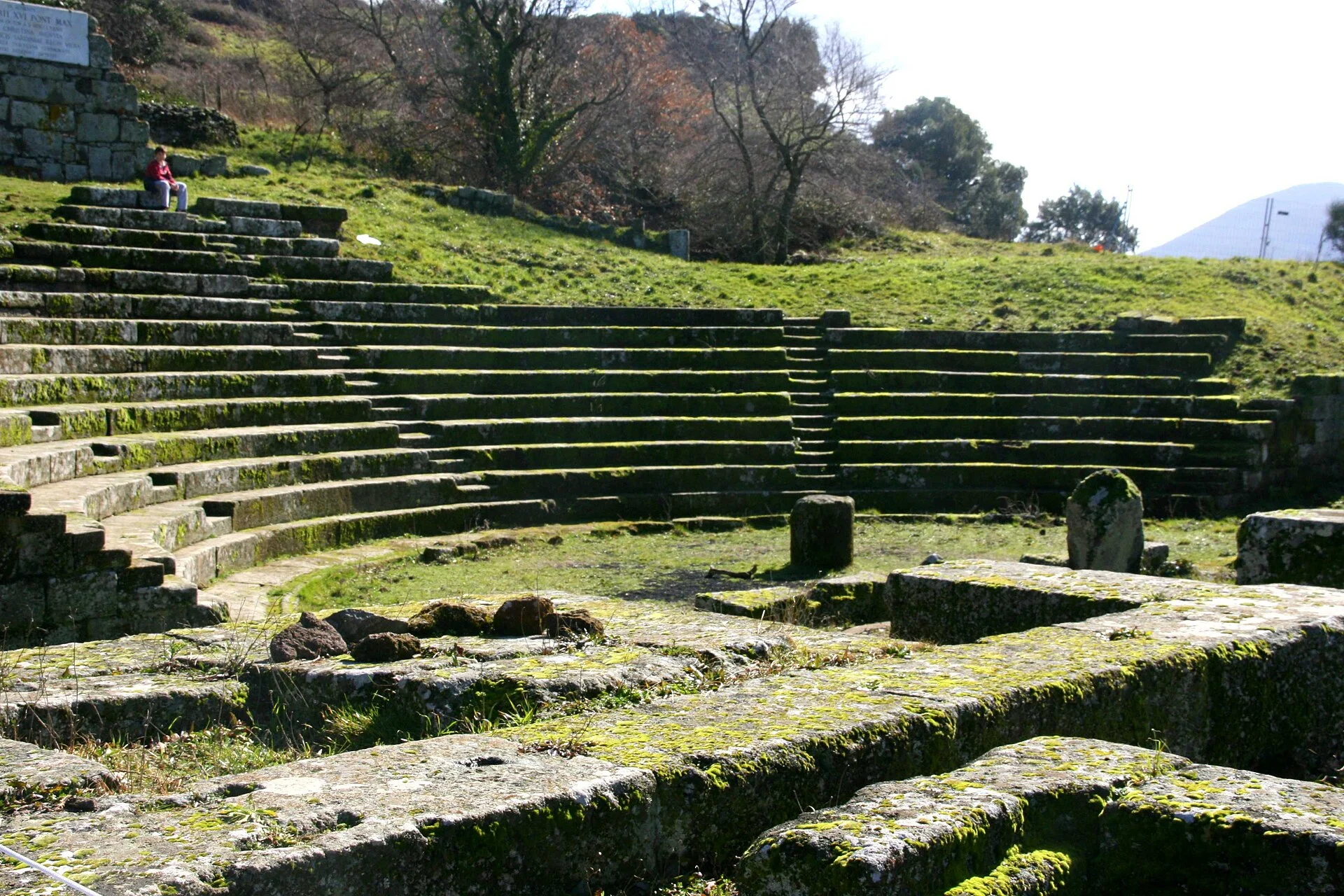
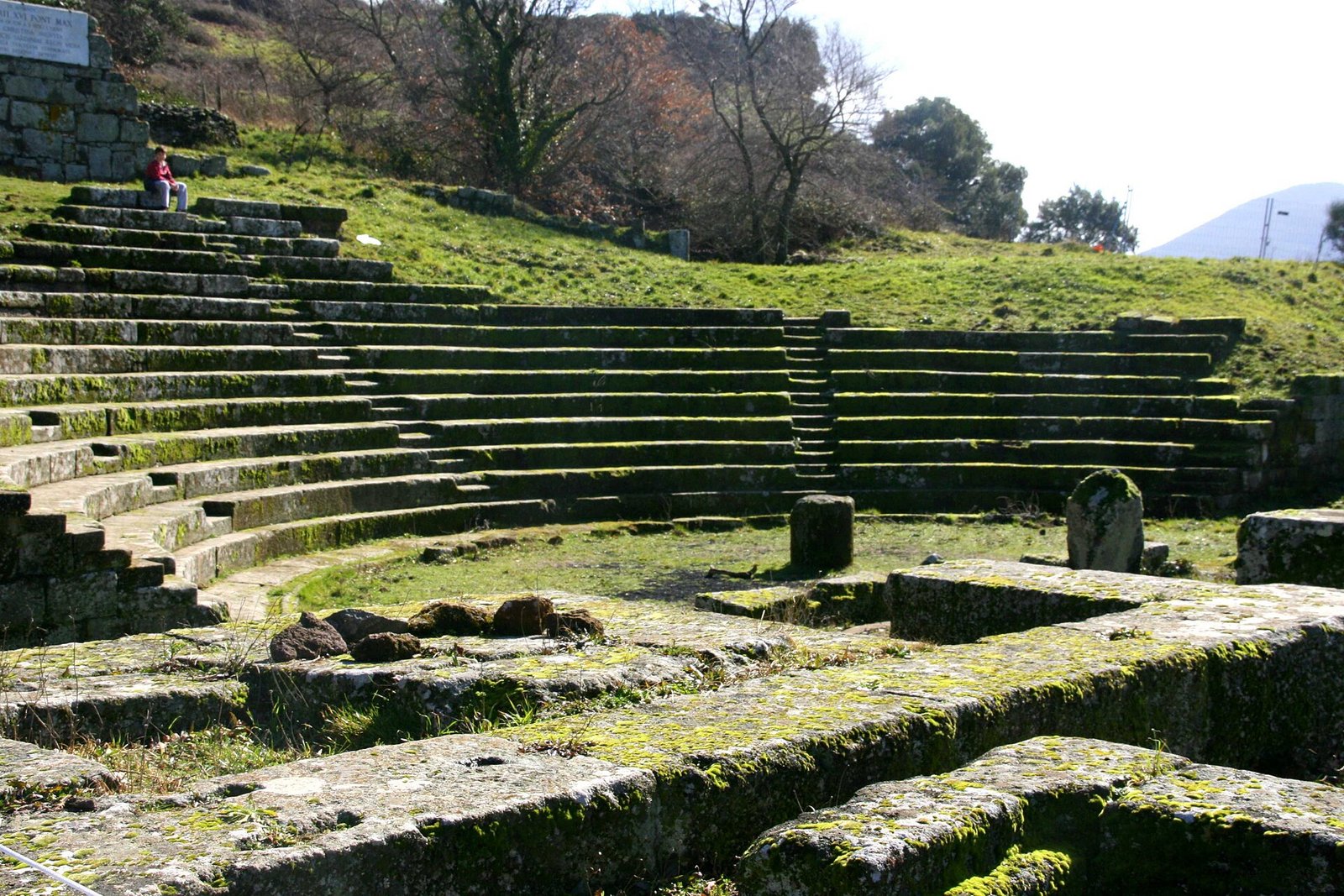
You meet the theater halfway along the visit route, at the foot of the acropolis and facing the forum, of which it formed the architectural backdrop. For the cavea the natural slope of the hill was used, and the lower rows still lean on it today. The upper ones, destroyed, were probably held up by artificial substructures. That's the reason the monument survived: the lower part was cut into the hill, there was nothing to dismantle and carry off.
On the chronology the sources converge on the first century BC. The Ministry of Culture goes into detail and places it around 75 BC. The park's website distinguishes two phases: a first with simple decoration in local tuff, and the current appearance as the result of a major rebuilding in the first half of the first century AD, when the masonry stage building was built and the cavea was enlarged.
How many fit inside
Here the numbers diverge and the sheet says so instead of picking one. The official park site speaks of a cavea enlarged to hold about 2,000 spectators. The current encyclopedia entry gives an original diameter of 45 meters for about 1,500 seats, with the stage later enlarged in the imperial age to 12 by 35 meters and decorated with statues of mythological subjects. The two figures are compatible if they refer to different phases, before and after the enlargement, but neither source states it explicitly.
Part of the new decorative apparatus was a group of bronze statues depicting the main figures tied to the history of the city. A Latin city that in the first century AD stages itself, in its own theater, in front of its own forum. It's a detail that says more than 10 pages on municipal identity.
The via tecta
Under the northern edge of the cavea runs the decumanus. During the works to enlarge the theater they chose to have the road pass under there, covered, instead of diverting it. It's called the via tecta and it's the kind of solution a Roman engineer found normal and that today is hard to explain to a group without showing it to them. Seeing it in person takes 30 seconds and is worth the whole guided tour.
The forum, the archaic fountain and the 2026 restoration
The visit inside the monumental area begins at the road junction where the two branch roads split off from Via Labicana and Via Latina met. On site are the remains of the shrine dedicated to Mercury, a small apsed room in opus reticulatum, with a cella paved in a mosaic of white and black tesserae and, in the southwest corner, an engraved dedication. The travertine base found in front of the entrance to the cella is now displayed in the Museo Tuscolano in Frascati.
Opposite, the great base in opus quadratum of tuff of one of the oldest buildings of the city is preserved, almost certainly an archaic temple. No trace remains of the structure above it, perhaps because it was made of perishable material such as wood. In this area a bucchero spindle whorl with a scratched alpha was found, the oldest written evidence known so far from the site: a loom object with a letter on it, and it's all we have of the Tuscolo that could write.
Along the southern side of the square runs the judicial basilica, from the first century BC, built over an earlier porticoed building and divided inside into three aisles by columns of which a few elements remain. In the northwest corner a small apsed room was later carved out by reusing the perimeter wall. Next to it, a building of still uncertain function, with a massive base on which a body in opus caementicium is superimposed: temple base or curia of the forum, scholars haven't decided.
The fountain that worked until the 20th century
Going down toward the branch road that leads to Via Labicana you find the great terrace wall in opus quadratum of tuff that supports the forum square. Since the 19th century it has been one of the classic views of Tuscolo, the one you find in travelers' engravings. Set against the wall is the archaic fountain, among the oldest known structures of the site: square plan, a false vault of tuff blocks stacked dry, clay covering, two monolithic basins in front of the channel for settling the water.
That structure fed the nearby Fontana degli Edili, from the first century BC, a basin with an inscription naming the pair of Tusculan magistrates of 70 BC, the aediles Quintus Caelius Latiniensis son of Quintus and Marcus Decumius, to whom its construction is owed. The detail that strikes is another one: that fountain kept collecting water until the last century. 2,000 years of uninterrupted service, on a mountain where the city had been gone for 800.
The work site concluded in 2026
The forum area came out of a restoration project funded by the National Recovery and Resilience Plan under the European Union's NextGenerationEU program. The official handover was held on July 9, 2026 in Monte Porzio Catone. The works, overseen by the Soprintendenza Archeologia Belle Arti e Paesaggio together with the Comunità Montana that owns the park, covered the restoration of the mosaic floors and the enhancement of the archaic fountain, with expanded visitor paths and work on accessibility.
Anyone who was there before 2026 and returns now finds a different place. Anyone reading a printed guide from a few years ago finds descriptions that no longer match. The same goes for the images circulating online: many predate the work site.
Cicero's villa, and why nobody knows where it was
Cicero owned a villa in the Tusculan area and set the Tusculanae disputationes there, which take their name from the place. So far the fact is solid and comes from ancient texts. Where that villa stood, however, is not established, and anyone who states it with certainty is selling a certainty that research doesn't have.
The confusion has a precise history. Along the route of the ancient Via dei Sepolcri you meet the imposing structures of an extra-urban sanctuary, overlooking the valley. For centuries that complex was held to be Cicero's villa, then Tiberius's. It was recognized as a sacred place only in the early 1900s, thanks to the insights of Thomas Ashby, and after the work of Lorenzo Quilici and Stefania Quilici Gigli in the 1990s the sanctuary has returned to the center of research, placed among the late Republican sanctuaries of Lazio.
The result is that the monument that for 200 years bore Cicero's name was not his house, and his real house remains without an address. In the Tusculan area there were dozens of Roman villas, the area was the holiday zone of the Republican and imperial aristocracy, and telling one property from another without an inscription naming the owner is impossible. Proposals for locating it exist, they are discussed, and none has produced proof.
The acropolis, the cross and what you see from up there
From the square a walk leads to the summit of Monte Tuscolo, where the remains of the podium of the Temple of the Dioscuri are preserved. On top of that podium, in the medieval period, the palace of the Counts of Tusculum was built, and next to it are the partly still unexcavated structures of the medieval basilica of the Santissima Trinità. Three layers of history stacked in 20 square meters, the most recent 800 years old and the oldest more than 2,000.
On the exact elevation the sources disagree by a few meters: the peak is given as 670 meters, while the Regional Park's hiking sheet gives the Croce di Tuscolo, which today marks the summit, at 677. An irrelevant difference in the field, useful for understanding that even simple data should be taken with a tolerance.
The view takes in the Roman plain as far as the sea, the dome of Saint Peter's on clear days, the cone of the Castelli with the lake, and inland the Prenestini. The good days are the ones after rain, in November and February, when the air is clear and the summer haze isn't there. In July from the cross you see a gray mass: Rome is in there, but you have to believe it.
The baths that lay under the parking lot
Leaving the center of the ancient city along Via dei Sepolcri you meet a bath complex excavated recently in an area that until a few years ago was occupied by a parking lot. The structures, attributable to a patrician domus, already appeared in 19th-century maps and had been documented in the 1950s during the construction of the driveable road. The excavations carried out between 2011 and 2017 brought them definitively back to light.
The reconstructed sequence is this: a Republican-era villa, then a portico from the second half of the first century AD, and above it a bath complex built in the first half of the second century. Of the bath complex, part of the calidarium with an apsed side remains visible, projecting into the center of the pre-existing portico and heated by two prefurnia identified on the east side. In the Middle Ages all this became first a quarry for materials and then a dump.
A curiosity about Tusculum
In 2000, near the so-called tempietti, the lower part of a female statue was found. The inscription on the base made it possible to identify it as an element of a larger sculptural group depicting women of the gens Rutilia. The other two statues of the group had already come out of the ground in 1809, in the excavations led by Lucien Bonaparte, and since 1821 have been part of the collections of the Vatican Museums.
The sculptural family is therefore split across three addresses. The fragment from 2000 is displayed in the Museo Tuscolano in Frascati, the two Bonaparte statues are in the Vatican, and in the castle of Agliè, in Piedmont, there is a portrait of a veiled woman that emerged in Luigi Biondi's excavations of 1825 and that scholars connect with the most recent piece. 200 years of digging and four different provinces to put back together a row of ladies who stood in the same portico.
The tempietti, then, are six small rooms that over time underwent renovations and rebuildings, and to date their function is not certain. The name we know them by is a convenience. A site excavated for two centuries that still doesn't know what to call six rooms of its main square tells you well how little we know about minor Latin cities.
One thing nobody tells you about Tusculum
The modern archaeological work on this site is largely Spanish. From 1994 to 2009 the Escuela Española de Historia y Arqueología en Roma, which depends on the Consejo Superior de Investigaciones Científicas, carried out 13 excavation campaigns, directed by Xavier Dupré Raventós and Trinidad Tortosa. A good part of what you read on the panels today comes from those campaigns.
Dupré Raventós died in 2006, and the park names scholarships after him that it opens to competition periodically. A Catalan archaeologist who spends 15 years on a mountain in the Castelli Romani, dies, and his Italian colleagues keep sending young people to study there with a scholarship that carries his name. You won't find it written on the panel at the entrance.
The practical consequence for visitors is that part of the scientific literature on Tuscolo is in Spanish and Catalan, published in places that circulate little in Italy. Anyone who wants to go beyond the popular level soon notices that the Italian guides stop at a certain point, and that past that point you have to read the CSIC publications.
My advice for visiting Tusculum
Go on a Sunday morning, early, in April or in October, when the hours run to 18:30 and the heat isn't there. Aim for the gate at 9:30, that is at opening, get the €5 ticket with the guided tour and have the forum explained to you. Then, when the group breaks up, stay and walk the loop again on your own, slowly. The second pass is the one where you see things.
Bring water from home. On the mountain, after Villa Mondragone, don't count on other fountains, and the nearest bar is down in the valley. Bring closed shoes with a lugged sole: the paving of Via dei Sepolcri is ancient, uneven and sloped, and on wet November grass it slides. Flip-flops here are a mistake you pay for with your ankle.
If you walk up from Frascati, leave early and figure that trail CAI 501 delivers you to the top around noon, with the park open and your legs gone. After 380 meters of elevation gain, your attention threshold in front of a tuff base collapses. The climb only makes sense for those who came to walk, not for the archaeology.
With children
It works, and works better than many Roman sites, for a simple reason: they run. It's a high-altitude meadow with ruins in it, without barriers every three meters and without custodians blowing whistles. Entry is free up to six years old inclusive and costs two euros from 7 to 12. The equipped area with tables, at €2.50 a head, solves lunch without going down to the valley.
Another well-known fact, yet rarely cited
The amphitheater of Tuscolo exists, but it's not inside the ordinary visit route and almost nobody looks for it. It lies outside the walls, measures 80 by 53 meters overall, with a cavea of 47 by 29, and the brick stamps indicate second-century construction. The estimated capacity is about 3,000 spectators. The structure shows opus quadratum in the lower part and opus mixtum above.
A city with a 2,000-seat theater and a 3,000-seat amphitheater was not a village. 3,000 seats means the amphitheater served a catchment area wider than the town alone, that is the whole Tusculan district with its villas and its hamlets. It's the best way to grasp the real scale of this place before 1191.
Via dei Sepolcri also passed from here, the main access to the ancient city, which split off from the 12th mile of Via Latina and climbed to the monumental center. Funerary monuments lined its sides, of which few remains survive, visible in the stretch farthest down the hill, while the paved walking surface in basalt is still well preserved in many stretches. Walking on it, on those stones, is the only free and authentic thing left of an uphill Roman road.
The right photo to take at Tusculum
It's not the panorama. Everyone takes the panorama from the cross and it always comes out the same: a band of haze with something in it that is supposed to be Rome. The right photo is the terrace wall in opus quadratum of tuff that supports the forum square, shot from below, from the branch road that descends toward Via Labicana, with the archaic fountain set against the base.
It's the view the 19th-century travelers engraved, and it has stayed identical. Squared blocks of yellow tuff, green coming down the sides, and above it the emptiness of the square. It works mid-morning, when the light hits the wall edge-on and the joints between the blocks cast shadow. At noon the wall flattens out and becomes a beige rectangle.
The second, if you want the theater, take it from above, climbing toward the acropolis, with the forum behind the cavea. From there you understand the relationship between the two, that the theater was the backdrop of the forum and not a building by itself. From the stalls, instead, the theater photographed head-on looks smaller than it is, because the upper rows are missing.
A contrarian position on walking up
All the trip reports you find online tell you to walk up from Frascati along CAI 501, as if the trail were the right way to get there and the car a shortcut for the lazy. The opposite is true: for most people who go to Tuscolo for the archaeology, walking up ruins the visit.
The math is simple. 3 kilometers and 800 meters with 383 meters of elevation gain, two hours and 20 minutes according to the official sheet. You arrive sweaty, out of sugars, and ahead of you is an archaeological area that demands attention and slowness. In March and November, when the park closes at 13:30, if you set off on foot at 9:30 you arrive just as they're about to close. The trail is beautiful, the Eremo di Camaldoli and Villa Falconieri deserve it, but that is a hike, not the approach to a site.
The serious proposal is to split it. Either you do the walking day, and then the forum is the final prize that you look at for 40 minutes without expecting to understand it. Or you do the archaeology day: go up by car or taxi, enter at 9:30, stay three hours in the square, and then walk down toward Frascati, which downhill costs little and gets you to the station with good legs. I recommend the second solution to nine people out of 10, and it's not the one on the blogs.
Some important events that happened here in history
The square becomes the city forum at the end of the fourth century BC, transforming a market function born around the crossing of the two branch roads. It's the moment when Tusculum stops being a settlement on the road and becomes a city with a recognizable urban form, with its archaic temple and its public spaces.
In the first century BC comes the great building renewal that gives the forum the look we see today: the three-aisled judicial basilica built over an earlier portico, the theater, the Fontana degli Edili with the inscription of the magistrates of 70 BC. It's the Tuscolo that Cicero frequented, and it's the phase that the 2026 restoration has made readable again.
In the first half of the first century AD the theater is rebuilt: masonry stage building, enlarged cavea, bronze statues of the figures of the city's history. In the first half of the second century, on Via dei Sepolcri, over a Republican villa and an imperial portico, the bath complex with the apsed calidarium is built.
Between the 11th and the 12th century, on the Roman remains of the northeast corner of the forum, a building with a rectangular plan is built, around which a vast necropolis develops, with the first graves dug directly into the Roman paving. The medieval tombs inside the floor of the ancient city are the most direct document of what Tuscolo had become.
In April 1191 the Roman army destroys the city. No reconstruction. At the start of the 13th century the Tusculan episcopal seat is recorded as settled in Frascati. From 1994 to 2009 13 Spanish campaigns bring the forum back to light, and on July 9, 2026 the area restored with funds from the National Recovery and Resilience Plan is handed over.
Who passed through Tusculum
Marcus Tullius Cicero, who had a villa in the Tusculan area and set the Tusculanae disputationes there. Where that villa was we don't know, but that he had it and wrote there is beyond question, and the title of one of the most-read Latin philosophical works carries the name of this mountain.
The Counts of Tusculum, the dynasty that from the acropolis controlled the road to Rome and for a century shaped papal elections. Their palace was built on top of the podium of the Temple of the Dioscuri, which is the most eloquent architectural gesture of their idea of themselves. After 1191 the family did not recover.
Lucien Bonaparte, Napoleon's brother, who in 1809 carried out excavations here and brought to light two of the statues of the gens Rutilia, which ended up in the Vatican collections from 1821. Luigi Biondi, who dug in 1825 and from whom comes the portrait of a veiled woman now in the castle of Agliè. Thomas Ashby, the British archaeologist who in the early 1900s understood that the supposed complex of Cicero was a sanctuary.
Lorenzo Quilici and Stefania Quilici Gigli, who in the 1990s put the structures of the extra-urban sanctuary back in order. Xavier Dupré Raventós and Trinidad Tortosa, who from 1994 directed the campaigns of the Spanish school. And the Grand Tour travelers, who came up here to draw the terrace wall and went back down to the valley to sleep in the Tusculan villas.
What you can't see, and when it's closed
You don't see the amphitheater within the normal visit route, because it lies outside the walls. You don't see the statues: those are in the Museo Tuscolano in Frascati, in Piazza Guglielmo Marconi, in the Vatican Museums and in the castle of Agliè. You don't see the medieval basilica of the Santissima Trinità in readable form, because it is partly still to be excavated. You don't see Cicero's villa, because nobody knows where it is.
The park is closed every weekday. From May to September it opens Saturday and Sunday, in the other months of opening only Sunday, and in December, January and February it stays closed to individual visitors. That means that over a year the days when an ordinary visitor can enter without organizing a group are just over 60. Anyone who shows up on a Tuesday finds a gate.
Days of heavy rain are to be avoided even if the park opens: the ground is grassy and sloped, the paving becomes slippery, and the view that is half the reason to climb isn't there. In case of a weather alert or strong wind, openings may be canceled, and the communication goes through the notices page and the cooperative's number, not through an automatic system.
What to see nearby, which here is the big part
The Museo Tuscolano delle Scuderie Aldobrandini, in Frascati in Piazza Guglielmo Marconi, is the natural complement to the climb, because it holds the material that came out of the park, including the travertine base of the shrine of Mercury and the fragment of the Rutilia statue. The stables, already visible in Matheus Greuter's engraving of 1620, were renovated to a design by Massimiliano Fuksas. The published phone contact is 06 94184407, the weekly closing day is Monday.
A few kilometers away are Castel Gandolfo with the Palazzo Pontificio, Lake Albano, Marino and Albano Laziale. Toward the south you reach Ariccia, Genzano di Roma, Lake Nemi and the town of Nemi, where the Sanctuary of Diana Nemorense is. Farther on Velletri and the Sanctuary of Juno Sospita at Lanuvio.
Staying up high, Rocca di Papa has the Geophysical Museum and above the town is the Boschetto delle Faete. Walkers know the Salita Discesa between Ariccia and Rocca di Papa. Inland the road leads to Palestrina with the Sanctuary of Fortuna Primigenia and the National Archaeological Museum, and to Hadrian's Villa at Palestrina.
Anyone who wants to stay on the theme of the great suburban villas has Tivoli with Hadrian's Villa, Villa d'Este and the Sanctuary of Hercules Victor. On the Roman side of the same idea, the countryside made monumental outside the walls, there remain the Appian Way Park, the Villa of the Quintilii and the Aqueducts Park, which you cross going down from the Tuscolana.
The comparison worth making
After Tuscolo, the best way to measure what you've seen is to go to the Roman Forum and the Imperial Forums, or to Trajan's Markets. The difference in scale between a Latin municipal forum and the forum of the capital is understood in half an hour and not forgotten. Anyone who wants the stratigraphic version of the same lesson should go to the Crypta Balbi.
On the funerary front, the Tusculan Via dei Sepolcri has its Roman parallels in the Tomb of the Scipios and the Columbarium of Pomponius Hylas, both under the Capitoline Superintendency and with a different ticket office from the park's. Anyone interested in Roman domestic building should find time for the Case Romane del Celio. For the ancient roads leaving the city there remain Porta Maggiore and the Acqua Vergine aqueduct.
Anyone traveling on a tight budget should keep in mind the calendar of the free Sundays at state archaeological parks, which however doesn't apply to Tuscolo, run by a local body with its own fare. And anyone who wants the picture of the Latin cities before Rome should add Lavinium and, for the contrast, the Colosseum with its 50,000 people against the 3,000 of the Tusculan amphitheater. For the Christian underground, the catacombs of Rome are a chapter of their own.
Eating between Frascati and Monte Porzio without getting fleeced
There's no food service inside the park. There's the equipped area with tables at €2.50 per person and with braziers at €3.50, and the most sensible choice for a spring Sunday is to bring lunch from home or buy it down in the valley before going up. Book the table, because in April and May the area fills up before the forum does.
Down in the valley, between Frascati, Monte Porzio and Grottaferrata, the warning signs are always the same. A menu with photos of the dishes stuck outside says the place is talking to people who don't read Italian and won't be back: nobody photographs a dish that explains itself.
The lady rolling out the sfoglia in the window or on the sidewalk is staged, a visual lure to stop passersby, not a sign of the kitchen. A person at the door inviting you to sit down is the clearest signal: whoever works well has full tables and doesn't hunt in the street.
Be wary of places open nonstop from morning to night, with no break between services. A real kitchen stops, cleans, starts again. One that never stops heats up portions prepared elsewhere. And watch out for places set in front of attractions, a famous villa or a lookout over the view: there the price adapts to the customer, items with no price show up on the menu, and it happens that the list inside is different from the one posted outside. Ask for the itemized bill and ask before ordering, if the list has silent items.
The repeated signs, the ones you find identical in 10 cities, work like a tourist attraction: they have a standardized product, long hours, staff trained to do volume. They're not a scam and there's nothing wrong with going in, but Romans and locals from the Castelli don't go there, and if you traveled 120 kilometers for a day in the Castelli, going in is a waste of the day. It's not snobbery: it's that around here you eat better spending the same.
The criterion that works is only one and requires no apps: look at who is sitting and in what language they order. If at two on Sunday the place has local families talking to each other in Italian and the waiter knows the names of half the room, you're in the right place. If instead the tables are all passersby and people order by pointing at photographs, change street. In Frascati this check takes 10 seconds from the door.
The fraschette of the Castelli have their own logic, historically tied to serving wine with food brought from home, and today they range from the serious ones to those that are only for show. The same criterion as above applies. Anyone who wants an already-sifted lead can start from Daniele's list on Google Maps: places to eat in Rome and around, which is a selection and not a ranking.
Frequently asked questions about Tusculum
Who runs the Parco Archeologico Culturale di Tuscolo?
Ownership and management belong to the Comunità Montana dei Castelli Romani e Prenestini, the body that many people still call XI Comunità Montana from the old regional numbering. The published institutional contacts are 06 9470944 and 06 9470820 with the mailbox info@cmcastelli.it. Opening, guided tours and bookings are entrusted to the cooperative Iperico, Servizi per la cultura, based in Frascati at Via Principe Amedeo 36, phone 3914225048, also on WhatsApp.
How much does it cost to get in?
Admission to the archaeological area alone costs €3.00 full and €2.00 reduced for kids from 7 to 12 years old. With the guided tour it goes to €5.00 full, with the same reduced rate of €2.00. It's free for children up to six years old inclusive and for people with disabilities. The equipped area with tables is paid separately, €2.50 per person, €3.50 with braziers. Data checked on September 28, 2026 on the Orari e Tariffe page of the official website.
When is it open?
From May to September on Saturday and Sunday from 9:30 to 19:30, with guided tours at 10:00 and 16:00. In April and October every Sunday from 9:30 to 18:30. In March and November every Sunday from 9:30 to 13:30, with the archaeological area only. From December to February it opens only for groups by reservation. The notices on the home page often correct this table: the reopening announcement of March 2026 gave, for example, a longer schedule, up to 16:30.
Do you need to book?
For the individual visitor, on ordinary opening days, no: you pay at the gate. Booking becomes necessary for groups and school classes, for any visit between December and February, and in practice also for the tables and braziers of the equipped area on spring weekends. The mailboxes are info@tuscolo.org and prenotazioni@tuscolo.org, the number is 3914225048.
How do you get there from Rome by public transport?
By the FL4 train from Roma Termini to Frascati, about half an hour, about 15 direct runs a day. From Frascati up, public transport doesn't reach: the official page of the park states explicitly that the site is not served by local public transport. What remains is the taxi from the station, about five kilometers of uphill with a price to be agreed, or the CAI 501 trail on foot.
Is there a shuttle from Frascati to Tuscolo?
There's no regular scheduled shuttle. Every now and then a shuttle service is organized tied to a single event, an evening show or a heritage day, announced a few days before on the park's channels and valid for that date. Planning a trip counting on a shuttle is the quickest way to be left on foot at Frascati station.
How far do you walk if you go up on foot?
The CAI 501 trail, from Frascati to the Croce di Tuscolo, measures 3.8 kilometers with 383 meters of elevation gain uphill and 65 downhill, given as two hours and 20 minutes of walking time and difficulty T on the sheet from the Parco Regionale dei Castelli Romani. It starts at the junction of Via del Tuscolo with Viale Borromini, toward Villa Falconieri, and passes the Eremo di Camaldoli and Villa Mondragone, where there is water at the entrance.
Where was Cicero's villa?
Nobody knows. Cicero had a property in the Tusculan area and set the Tusculanae disputationes there, but the exact spot has not been identified. The complex that for centuries was indicated as Cicero's villa, and then as Tiberius's villa, was recognized as an extra-urban sanctuary in the early 1900s thanks to Thomas Ashby, and later research has confirmed that reading. Anyone who points to an exact spot on the map goes beyond the available evidence.
When was Tuscolo destroyed?
In April 1191, by the Roman army, and the city was never rebuilt. On the exact day and on the role of Pope Celestine III and Emperor Henry VI the medieval sources disagree, so much so that the problem was the subject of a specific study by Piero Zerbi published in Aevum in 1954. The versions that state a day and a single culprit with certainty simplify a question that is still open.
Who wrote this page
The page is edited by the editorial team of Tour Leader Pro, the Rome project office that designs visits, itineraries and cultural events in Rome and Lazio. Hours and fares are checked on the date given in the text against the official sources cited: the website of the Parco di Tuscolo, the portal of the Ministry of Culture and the sheet from the Parco Regionale dei Castelli Romani. On a site run by a local body, with seasonal openings and monthly notices, these data move: a phone call before leaving is worth more than any page.
Fitting in a day outside Rome when the train arrives in one place and the site is five kilometers farther up, with no bus, with hours that change four times a year and a park closed on weekdays, takes method and a few phone calls at the right moment. Anyone who accompanies groups, or who doesn't want to burn a Sunday, finds on Tour Leader Pro operational materials built on this kind of fitting-together, including the case where the planned site turns out to be closed at the last minute and a plan B within 10 kilometers is needed.
For the wider scale, that is regional trains, rentals, airports and destinations in Lazio outside the center of Rome, from the Castelli to the lakes to the coast, the reference we recommend is Italy Planner, where getting around is covered in a practical way and with real times, not the ones from the maps.