Lost and Found Roman Festivals
In short. The calendar of Roman festivals is a map of things that have ended.

The calendar of Roman festivals is a map of things that have ended. Some went out on their own when the city that kept them going came to an end, the Rome of the popes with its vineyards inside the walls and its days of obligation. Others were abolished by law on one afternoon in 1977. Still others came back, but in the form of reenactment, which is a different thing from a festival. This page lines up the Roman popular calendar from the Middle Ages to today: what was celebrated, when it stopped, why, and what came back in what form. Where a tradition was rebuilt recently, you'll find it written plainly, because the difference between a festival that was never interrupted and a new edition with the same name changes what awaits you on the spot.
For the festivals of the ancient calendar, the Saturnalia, the Lupercalia, the Vestalia and the rest of the Republican and imperial religious calendar, there's a separate page on the festivals of ancient Rome. Here we talk about what comes after: the devotional and popular cycle that is born in the Middle Ages, takes shape between the 16th and 19th centuries, breaks after 1870 and is put back together in pieces in the 20th century. A third thing is the city's summer program, which is cultural programming and not tradition: that one is covered in the page on the Estate Romana.
The three breaks that took the Roman calendar apart
The first break is 1870. With the end of the Papal State, the scaffolding that held up half the festivals disappears: the papal cavalcades, the indulgences tied to a date and a church, the handing out of money from the loggias, the days of obligation that counted as civil holidays. Many observances remain in the liturgical calendar but lose their public apparatus, and without a public apparatus a people's festival lasts a few generations.
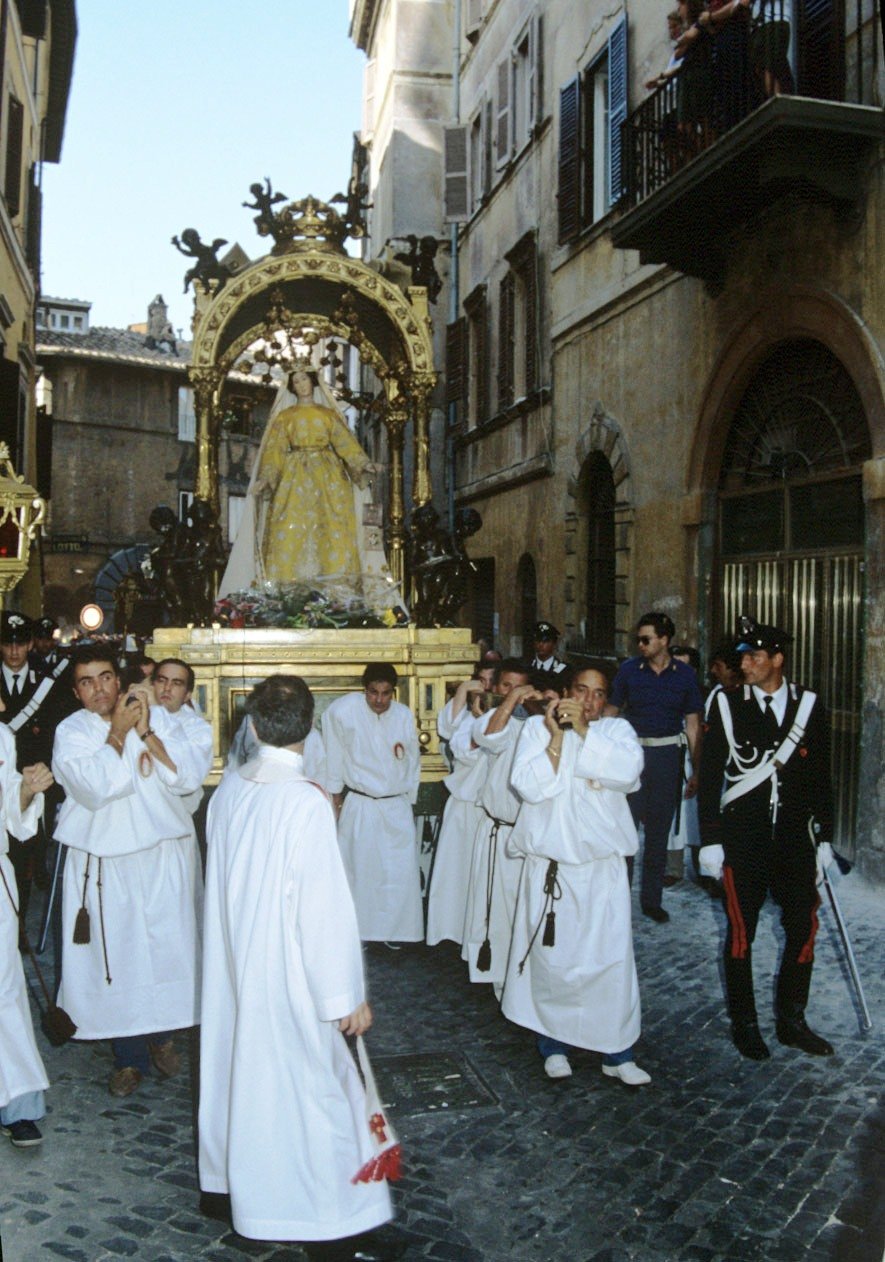
The second break is the two decades of Fascist rule, which acts in two opposite directions. On one side it compresses spontaneous demonstrations and unregimented parades. On the other it invents or reorganizes from above popular festivals to put on display, and in that line fall both the modern form of the Festa de’ Noantri and the construction of April 21 as a mass civic observance, covered in the listing on the Natale di Roma.
The third break is Law number 54 of March 5, 1977. With a single measure Italy removes the status of civil holiday from five Catholic solemnities: Epiphany on January 6, Saint Joseph on March 19, Ascension, Corpus Domini and Saints Peter and Paul on June 29. The same package of rules moves June 2 and November 4 to the first Sunday of the month. The stated goal was to recover working days during an economic crisis.
The consequences are still visible. Epiphany became a holiday again in 1985, and with it Saints Peter and Paul in the city of Rome alone, where they are the patron saints. Saint Joseph did not: March 19 in Rome is an ordinary working day, and this is the main reason the fry cooks' festival has shrunk to a matter of pastry shops. June 2 returned to its fixed date in 2001, November 4 never.
The Festa de’ Noantri in Trastevere: what is true and what is story
The name says it all. De noantri in Romanesco means of us others, as opposed to voantri, you others who live on the other side of the river. It's a declared neighborhood festival, and however much Trastevere is today one of the most heavily trodden districts for visitors to Rome, the week in July remains the moment when the neighborhood talks about itself and not about its audience.
The statue and the legend of 1535
Tradition says that in 1535, after a storm surge, some Corsican fishermen found at the mouth of the Tiber a wooden statue of the Madonna carved in cedar, and that they donated it to the Carmelites of San Crisogono. From that discovery comes the nickname Madonna Fiumarola, the Madonna of the river. The date of 1535 is handed down by tradition and doesn't rest on verifiable archival documentation: it should be taken for what it is, a founding story.
The statue venerated today is the Madonna del Carmine, and its usual home is the church of Sant’Agata in Trastevere, on Via Mameli, not San Crisogono. Anyone arriving in July looking for the statue in the big basilica on Viale Trastevere finds another church and another story. Sant’Agata is small, poorly signposted and off the usual routes, and most people who pass through Trastevere never go in.
When the festival we see was born
The Carmelite devotion in Trastevere is old and documented, but the people's festival in the form we know, with its program of shows, its festive lights and the current name Festa de’ Noantri, takes shape in the 1920s and 1930s, within the Fascist policy of promoting local traditions. It's no small detail: it means the festival has just under a century of life in its present form, not five.
What really happens, and when
The religious pivot is July 16, the feast of the Madonna del Carmine. The main procession leaves on the Saturday after the 16th, in the late afternoon, from Sant’Agata. It crosses Viale Trastevere, touches the San Francesco a Ripa and San Cosimato area and returns to San Crisogono, where the statue stays for days. It's the moment with the most Trastevere natives per square meter of the whole year, and also the only one when the neighborhood's side streets empty of traffic.
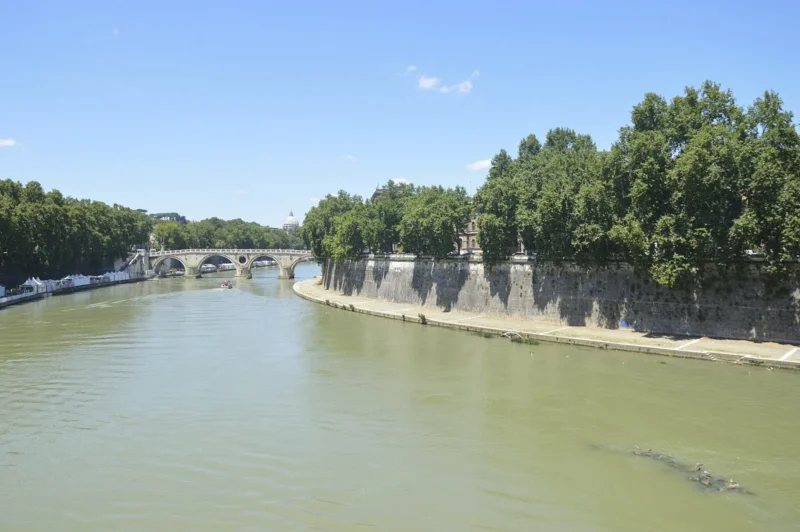
The river procession is the following Sunday, usually around 18:30. The statue goes down to the river at the height of the rowing clubs, passes under Ponte Garibaldi and comes back up, and anyone watching from Ponte Sisto or from the riverside walls near Tiber Island has the best view. It closes with fireworks. The procession by river is a modern reintroduction, tied to the story of the discovery: it isn't the uninterrupted continuation of a 16th-century rite.
On the last day, usually the Monday that closes the fortnight, there's the early-morning procession, mass at 6:30 and parade at 7:30 from Sant’Agata toward Santa Maria in Trastevere, Via della Scala and Via della Lungaretta. It's the least attended part and the most interesting to see: a few dozen people, no billboards, the neighborhood still closed up.
The Ottobrate: what they were and why the new editions aren't the same thing
Ottobrata, in the singular, meant the outing beyond the city gates that Romans took on Sundays and Thursdays in October, once the grape harvest was over. It wasn't a festival with a date, a saint and a route: it was a seasonal custom, spread across the whole month, involving different social classes with different means and destinations. Calling it a festival is already an approximation that complicates understanding what has remained.
Where people went
The destinations were the vineyards and taverns just outside the built-up area, back when just outside the built-up area meant a quarter of an hour on foot from the center. Testaccio with its caves dug into Monte dei Cocci, where wine stayed cool all year, was the most popular destination. Then the meadows toward the Janiculum and Monte Mario, the vineyards of the Esquiline and the Caelian, and for those who could afford a carriage the towns of the Castelli Romani.
The kit was fixed: little carts decked with vine shoots and ribbons, wine from the Castelli in a flask, tripe and oxtail, chestnuts when it started to get cold, the saltarello danced in front of the tavern. Goethe describes the phenomenon in the account of his journey in Italy, and the theme comes back in prints and 19th-century guides for foreigners.
Why they ended
The Ottobrate die of urban planning, not of bans. Between 1870 and the first decades of the 20th century the vineyards inside and just outside the walls are built over: the Esquiline becomes a neighborhood of apartment buildings, Testaccio becomes an industrial and working-class zone around the slaughterhouse, Prati is born out of nothing on the plain's land. The place disappears, and without the place the outing has nowhere to go. The sources agree on this mechanism, less so on the date of extinction.
The finishing blow is delivered by motorization. When the outing beyond the gates stretches to the sea or the lakes, the rite loses its perimeter: it's no longer the neighborhood moving together for four hours, it's a family leaving on its own. The sources place the end of the mass custom between the first postwar period and the 1950s, with no clean breaking point.
The Ottobrate of today, stated clearly
What is called ottobrata in Rome today is two things. The first is a meteorological usage: Romans call ottobrata the week of October with 25 degrees and clear skies, and it's the only meaning still alive in speech. The second is the neighborhood events with that name on the program, the best known of which is held in the Monti district over an October weekend.
The Monti event is a contemporary neighborhood festival, born from local associations and merchants in recent years, with stalls, music and stands: it works well for what it is, but it isn't the continuation of the historic ottobrata, and nobody seriously claims otherwise. Anyone looking for the grape harvest, the little carts and the saltarello has to move to the Castelli, where the wine festivals of Marino and Frascati have a longer documented continuity.
The Befana at Piazza Navona: a fair that has changed its skin three times
The Epiphany fair in Rome wasn't born at Piazza Navona. For a good part of the 19th century it was held in Piazza Sant’Eustachio and the streets around it, and it was a night fair concentrated on the eve of January 6. The move to Piazza Navona is documented in 1872, so two years after the end of the Papal State, when the square had just been freed of the market that had been held there for centuries.
What the old fair was
The heart of Epiphany night wasn't toys: it was racket. Tin horns, whistles, ratchets and putipù sold for a few pennies and played all together until dawn, with a function that in popular tradition was one of driving away. Fair sweets, dried fruit and sugar coal for naughty children were sold. The most useful accounts of this phase come from Giggi Zanazzo, who collected Roman customs and songs in the late 19th century.
The fair rested for a century on a simple balance: few stalls, cheap goods, a neighborhood public that went on foot. That balance breaks in the years of mass tourism, when the concessions become big business and the stalls begin to sell the same things found in any other market in the center. The character of an Epiphany fair stays in the name and the calendar, not in the merchandise.
The controversies, in the right order
From 2015 on, the Municipality tried to reduce the number of stalls and tie the concessions to a public tender with requirements on the type of goods. The assignments were contested several times, with appeals from the historic operators and checks on the procedures. The breaking point came in December 2018, when the Polizia Locale seized the structures that had just been set up.
The irregularities cited on that occasion concerned safety: exposed electrical connections and control boxes, no escape routes, lack of a fire prevention certificate, toys without the CE mark. The fines exceeded 30,000 euros. Since then the number of stalls has dropped and several operators have given up because of the cost of the required upgrades.
Anyone arriving at Piazza Navona today between December and January 6 finds a reduced row of stalls, a carousel and a few candy spots. It's worth the visit for the setting, the square with its fountains and the Stadium of Domitian under your feet, not for the fair itself. Anyone looking for a real fair in the city will be more satisfied with the Porta Portese market on any ordinary Sunday.
The night between June 23 and 24: how much is documented and how much is reconstruction
The feast of Saint John the Baptist falls on June 24, close to the summer solstice, and in Rome it was celebrated at the basilica of St. John Lateran, which is the city's cathedral. There's no doubt about this: the night vigil at the Lateran is attested for centuries and concluded by the papal mass in the morning, with coins thrown from the loggia onto the crowd gathered on the square.
The snails: the most solid piece
Stewed snails with tomato, garlic and wild mint are the best-documented part of the night of San Giovanni. They were eaten on the spot, bought from the stalls set up on the square, or brought from home already cooked by those who didn't trust the innkeepers. The popular explanation ties them to the snail's horns, understood as a symbol of quarrels and worries: eating them meant getting rid of them.
This symbolic reading is an interpretation collected by 19th-century folklorists, not a medieval source. The material fact, that in Rome on the night of June 23 snails were eaten in quantity at the Lateran, is instead very solid and runs up to the postwar period. Even today several trattorias in the quadrant and in the Esquiline Hill put them on the menu around that date.
The witches: where the document ends and the story begins
The tradition of the witches who would gather at the Lateran on the night of the solstice, the din of trumpets and cowbells to scatter them, the bonfires, the heads of garlic, the brooms and fireplace tongs crossed on the threshold, the nighttime gathering of herbs and the water of San Giovanni left out under the open sky: this whole block comes almost entirely through the folkloric collection of the late 19th century, Zanazzo foremost, and through the sonnets of Belli.
This means two things at once. That those customs were actually practiced in 19th-century Rome, because those who describe them saw them. And that their supposed pre-Christian antiquity, the direct continuity with pagan solstice rites, is an interpretive construction typical of 19th-century culture, not a fact. Anyone who tells it to you as an unbroken thread of 2,000 years is simplifying quite a lot.
What remained and what came back
The night festival goes out between the end of the 19th century and the early 20th, from the sum of two factors: the loss of the papal frame after 1870 and the transformation of the Lateran square, which from a countryside space on the edge of the built-up area becomes an urban node and then an enormous traffic hub. The rest is done by the closing of the toll-gate taverns that held up the night.
For some years neighborhood associations and Municipio VII have set up again a Night of the Witches in the gardens around Piazza San Giovanni, with theatrical walks, workshops on the water of San Giovanni, readings and music. It's a recent reenactment and declared as such, with few editions behind it, not a tradition that was never interrupted. Those who go knowing it have fun, those who go looking for the 19th-century festival come away empty-handed.
August 5 at Santa Maria Maggiore: the rain of petals
The legend is well known: on the night between August 4 and 5 of the year 358 the Virgin is said to have appeared in a dream to Pope Liberius and to the patrician John, asking for a church where in the morning they would find snow, and snow fell on the Esquiline in the middle of summer. The story appears in the sources only many centuries later, and it's a founding legend, not a chronicle. The basilica of Santa Maria Maggiore in its known form dates from the following century.
The commemoration is held every August 5 and is one of the few Roman things that need no booking, ticket or program. During the morning pontifical mass, at the singing of the Gloria, and again at afternoon vespers, during the Magnificat, a hatch opens in a coffered ceiling and white rose petals fall onto the altar and the faithful. It lasts a couple of minutes and isn't repeated.
The usual times are the solemn mass around 10:00 and the second vespers around 17:00, but the exact program is published by the basilica a few days before and isn't identical every year. The nave fills up: anyone who wants to see the petals fall must get in at least half an hour early and stand toward the middle of the central nave, not under the presbytery.
The rain of petals inside the basilica is the devotional part. Outside, in the square, in recent years an evening reenactment has been set up with projections, artificial snow, music and costumed performers, organized by private parties with the municipality's patronage. It's a show, it changes format every year and some editions have been canceled. The two things have the same name and nothing else in common.
April 21: the city's birthday
April 21 is the only Roman observance that joins the ancient calendar and contemporary use: the traditional date of the founding, set by ancient scholars at 753 BC, coincides with the agricultural festival of the Parilia. The mass civic celebration, with historical parades, torchlight processions and the Capitoline Hill lit up, is however a 20th-century construction. The full story, with dates, places and typical program, is in the listing dedicated to the Natale di Roma.
Here the calendar fact is enough: April 21 is not a holiday, the civic museums keep ordinary hours and the most visible part of the day is concentrated between the Circus Maximus, the Forums and the Capitoline Hill in the late afternoon. Anyone in Rome in those days should reckon with the frequent coincidence between the 21st and April 25, which completely clogs the center.
January 17: the blessing of the animals
Saint Anthony Abbot is the patron saint of domestic animals and his feast falls on January 17. In Rome the rite is celebrated at Sant’Eusebio on the Esquiline, on Piazza Vittorio side, and local tradition traces the blessing back to 1437. The date of origin is the one the parish itself declares and that the city press repeats every year: it should be taken as an established tradition, not as an archival fact independently verified.
The rite has moved over time. Historically the center of the devotion was the church of Sant’Antonio abate on the Esquiline, not far away, with its 13th-century portal and the attached hospital of the Antonians. Since that church passed to other use, the blessing is held at Sant’Eusebio. Anyone looking for the ancient portal still finds it a few steps away, on Via Carlo Alberto.
What you see today on January 17 is a day of staggered blessings on the churchyard, generally one in the morning and one around noon, with a solemn mass in the afternoon and sometimes the Polizia Locale band. Mostly dogs and cats arrive, a few cab horses, rabbits and birds. Once the carters' mules came through, and the blessing had an economic weight that has disappeared today.
Go knowing two things. The times change every year and the parish publishes them a few days in advance. The blessing requires no ticket or booking, but the churchyard is small and fills up. The neighborhood around it, between Piazza Vittorio and the Esquiline obelisk, deserves the walk regardless.
Nativity scenes, Bambinello and fair: Roman Christmas beyond the lights
The nativity scene in Rome has a primacy that escapes many people: the marble sculpture commissioned by Pope Nicholas IV from Arnolfo di Cambio in 1291 for Santa Maria Maggiore is the oldest monumental representation of the Nativity to have come down to us. A few figures remain, the three Magi, Saint Joseph, the ox and the donkey and the group of the Madonna and Child, the latter retouched in the drapery at the end of the 16th century.
For centuries the complex remained walled up in a niche of the Sistine chapel of the basilica, meaning the chapel of the Blessed Sacrament and not the Vatican one of the same name. After the restoration of the 2000s it is displayed in installations that change, usually visible in the Christmas period, and not always in the same position. Anyone who wants to see it should check beforehand, because it isn't guaranteed to be accessible on any given day in December.
The Bambinello of the Aracoeli
The statuette of the Santo Bambino of Santa Maria in Aracoeli, about 60 centimeters tall, was the most popular object of Christmas devotion in the city. Legend says it was carved by a friar from the wood of an olive tree of Gethsemane at the end of the 15th century. It was taken to the sick at home by carriage, received letters from all over the world and presided over the church's nativity scene between Christmas and Epiphany.
The original was stolen on the night between February 1 and 2, 1994 and has never been found. What is venerated today is a copy. The detail has to be told because it keeps being left out of tourist descriptions, and because it explains the coolness of certain elderly Romans in front of the statue: it isn't the one they remember.
What remains alive instead is the tradition of children who climb onto a stage in front of the Aracoeli nativity scene, between Christmas and Epiphany, to recite poems and prayers. It's free, requires no booking and goes on through the afternoons of the holidays. Anyone climbing the stairway from Piazza d’Aracoeli side should reckon with 124 steps: the easy way is from the Vittoriano, on the left side.
Nativity scenes in churches and living nativity scenes
From December 8 to Epiphany, Roman churches set up their nativity scenes, and the round is worth more than any Christmas market. You should look at those in the major basilicas, but also the small ones in neighborhood parishes, which are often the work of volunteers and change every year. They are all free and all subject to the churches' opening hours, which get shorter in the afternoon at Christmas.
The exhibition of nativity scenes from around the world, which for decades was held under the colonnade of Saint Peter's Square and then in other venues near the Borgo district, changes venue and format fairly often: check the address for the current year before setting off. Real living nativity scenes, with costumed performers and animals, are few in the city of Rome and parish-run. The big ones are held in the towns of Lazio, and the calendar is collected on the page about the festivals and fairs of Lazio.
For the full picture of what opens and what closes in the city during the holidays, including midnight masses and transport hours, the reference page is the one on Christmas in Rome, while the night of the 31st with its rules on fireworks and closures is covered in the listing on New Year's Eve in Rome.
March 19: the bignè and the fry cooks who are no more
Saint Joseph in Rome was the festival of carpenters and fry cooks. The reference church is San Giuseppe dei Falegnami in the Roman Forum, built by the carpenters' confraternity above the Mamertine prison, and on March 19 solemn services and handouts were held there. The saint's popular nickname, Giuseppe frittellaro, comes from the second category.
Who the fry cooks were
In the days around March 19 the fry cooks set up their stations in the street: a brazier, a cauldron of oil, the counter, often a tent and some devotional decorations. They fried rice and semolina fritters and the bignè, and the frying took place in front of the customer. It was a seasonal trade, practiced by families who did other things the rest of the year, and concentrated in a few streets of the center and in the working-class districts.
This trade disappeared for reasons that have nothing romantic about them: the hygiene and safety rules on street frying, the progressive ban on occupying public land with open fires, and the end of March 19 as a holiday in 1977, which took the observance's audience away. Without a day off, the fry cooks' festival becomes a pastry shop showcase.
What remains
What remains is the bignè, which from March 19 has spread over the whole month and in many pastry shops over the whole year. They come in two versions: fried, which is the traditional one, and baked, which is more recent and lighter. Filled with pastry cream, powdered sugar and sometimes a sour cherry on top. Neighborhood pastry shops make it in the morning and sell it during the day. The stands in the center often buy it ready-made.
There also remains a district festival at Trionfale, around the parish of San Giuseppe, with the procession that until the 1960s carried the statue through the neighborhood's streets and that today has shrunk and moved to the weekend. It's a real parish festival, not a reenactment, but of modest size. Anyone coming from the Prati area gets there in a quarter of an hour on foot.
The civic observances: April 25, June 2, November 4
The three civic dates work differently from one another, and anyone who puts them in the same bunch is thrown off. One is a holiday with street parades, one is a holiday with a military parade, one isn't even a holiday. The places, hours, traffic closures and type of crowd you find there all change.
April 25
April 25 is the national Liberation Day and is a holiday in every respect. In Rome it has a particularity that needs explaining: the city was liberated on June 4, 1944, almost a year earlier, so April 25 here doesn't commemorate a local anniversary but the national one. The real Roman anniversary, June 4, has no significant events.
The typical program opens early with a tribute at the Fosse Ardeatine, continues with the gathering at Piazza di Porta San Paolo, where fighting took place in September 1943, and with the parade that sets out around mid-morning in the direction of Ostiense, generally ending at Parco Schuster next to San Paolo fuori le mura. Routes and times change every year and public transport detours are heavy: check before you move.
June 2
The Festa della Repubblica commemorates the institutional referendum of June 2 and 3, 1946. The Roman day has two moments: the laying of the wreath at the Unknown Soldier at the Altar of the Fatherland by the President of the Republic, early in the morning, and right afterward the march along Via dei Fori Imperiali, with the Frecce Tricolori flying over the Vittoriano.
The parade has an intermittent history. It entered the official ceremonial in the early years of the Republic, was suspended from 1976 first for emergency reasons and then to contain spending, and returned permanently in 2000 on the initiative of President Ciampi. In the same period June 2 had stopped being a holiday: from 1977 the celebrations were moved to the first Sunday of the month, and the fixed date was restored with effect from 2001.
Anyone in Rome on June 2 should know that the area between the Colosseum, the Forums and Piazza Venezia is closed from dawn, that the grandstands are by invitation and that the free spots along the route fill up hours ahead. The Museum of the Imperial Forums and the archaeological sites in the area change their hours or stay closed. In the afternoon the Quirinale gardens open, with a long line.
November 4
November 4 is National Unity and Armed Forces Day and commemorates the armistice of 1918. It was a holiday from 1922, lost that status with the 1977 law and has never recovered it: the celebrations are held on November 4, but the day is a working day and the public part is moved to the first Sunday of the month. In Rome it comes down to the ceremony at the Altare della Patria and the Frecce Tricolori flyover.
June 29, the holiday that stayed a holiday in Rome
Saints Peter and Paul fall on June 29 and are the patron saints of Rome. The 1977 law took away the holiday status from this date too, but in 1985 it was restored for the city of Rome alone. Municipal offices and schools close, many shops do not. The papal mass is in Saint Peter's in the morning. In the evening, when it is organized, the girandola fireworks are held from the Janiculum or from Castel Sant’Angelo, with the best view from the Janiculum and from the bridges.
A curiosity about lost and found Roman festivals
The Janiculum cannon is the only daily remnant of a calendar of sound signals that regulated the Roman day. It was established in 1847 by Pius IX to give the exact time to the church bells, which each rang on their own, and it fired at noon from Castel Sant’Angelo, then from Monte Mario, finally from the Janiculum. Today it fires blanks every day at noon, and almost nobody knows why anymore.
The same cannon served as a signal for festivals: the shot announced the opening of certain ceremonies and, on the night of San Giovanni, the pope's arrival at the Lateran at dawn. When a city stops being regulated by its public noises, its festivals lose their trigger. The loss of the Roman calendar is also an acoustic matter, not only a matter of bans and urban planning.
A thing nobody tells you about lost and found Roman festivals
Almost everything we know about Roman popular festivals passes through three men of the 19th century: Giuseppe Gioachino Belli with his sonnets, Luigi Zanazzo, called Giggi, with his collection of customs, habits and prejudices of the people of Rome, and the draftsmen and photographers who documented the city before the demolitions. It's not a library: they're few sources, all concentrated in 50 years.
This creates an optical effect worth keeping in mind. Roman festivals appear to us in the form they had between 1830 and 1890, because that's the moment when someone took the trouble to write them down. What they were in the 17th or 15th century we know far less, and the centuries-long continuity claimed in press releases is often a backward projection of that 19th-century frame.
The practical consequence concerns you. When an event today declares itself the direct heir of a very ancient tradition, it almost always reconstructs the 19th century, not the Middle Ages. Nobody is deceiving you, but knowing which century the thing you're looking at belongs to changes how you look at it.
The advice I give you for visiting lost and found Roman festivals
Pick a single festival and do it all the way through, from beginning to end, instead of collecting five quick drop-ins. The surviving Roman festivals all have a wave structure: a gathering moment in which nothing happens, a short central moment, a long tail. Whoever arrives only for the central moment sees the postcard. Whoever stays for the tail sees the neighborhood.
The timing rule counts more than any other. For processions it's best to arrive 40 minutes early and stand along the route, not at the starting point, where there's only a crush. For blessings and masses it's best to get in half an hour early. For civic parades it's best to reach an intermediate point on the route, because the head of the parade is congested and the tail arrives when everything is already over.
Always verify on two sources, and not on republishing sites. The sources that hold up are the Municipality's website, those of the Municipi, the Diocese of Rome for religious festivals and the individual parishes, which publish the program on the door and on their page a few days before. The dates you find reported by general portals are copied from the previous year more often than you'd imagine.
One last thing: allow for the closures. On civic holidays the center is barricaded, the metro stations closest to the routes close without notice and buses detour. The page on getting around Rome explains the general mechanism, but on parade days the real rule is only one: on foot, and with time to spare.
Another well-known fact, yet rarely mentioned
For centuries Rome had a carnival of European stature, with the race of the barberi along Via del Corso, horses launched without jockeys from Piazza del Popolo to Piazza Venezia, the moccoletti of the last evening and the floats of the neighborhood societies. It was the city's most famous festival, the one for which foreign travelers planned their stay, and Goethe devoted a whole account to it.
The race of the barberi was abolished in 1874, after fatal accidents among the public, and the Roman carnival deflated within a generation. It has never really been rebuilt: the editions attempted in the 20th century and in the 2000s had short lives and no continuity. Today the Roman carnival is a thing for schools and neighborhoods, without a city-center focus.
The right photo to take at lost and found Roman festivals
The photo that works isn't the highlight, which comes out badly because you're far away and there are too many people in front of you. The photo that works is the before: the chairs still empty, the bearers lining up in the churchyard, the stalls set up and not yet open, the street barricaded and deserted. That light, an hour earlier, is also the best.
For the river procession of the Festa de' Noantri, the spot is the embankment wall between Ponte Garibaldi and Tiber Island, on the Trastevere side, with the sun behind you in the late afternoon. For the processions on land, a narrow side street works best, where the crowd frames the procession instead of hiding it. For the blessing of the animals at Sant'Eusebio, you photograph the people waiting, not the blessing.
Inside churches two rules always apply: no flash and no tripod. At the rain of petals on August 5 the flash isn't needed and it disturbs those who are praying. Raise the sensitivity and point upward, toward the coffered ceiling that opens, instead of at the altar. In processions, never stand in front of the bearers to take the frontal photo: it's the gesture that makes everyone angry.
Some important events that happened here in history
On September 20, 1870, the breach of Porta Pia ended the temporal power of the popes and, with it, the system of public festivals that the papacy organized and financed. Within a few years the cavalcades, the distributions of coins from the loggias and the ceremonial role of the trade confraternities disappeared. The religious festivals remain, but they become parish business.
In 1872 the Epiphany fair left Piazza Sant'Eustachio and moved to Piazza Navona, where the historic market had just ceased. In 1874 the race of the barberi was abolished and carnival ended as a city festival. The two dates, two years apart, mark the passage from a calendar run by the papal power to one run by a municipal administration.
In the 1920s and 1930s the regime reorganized some popular festivals from above and built new ones. The Festa de' Noantri took its modern format in that period, and April 21 became a civic mass observance. It is the phase in which the word tradition begins to be used for things that were just invented, an ambiguity that has never been resolved.
On March 5, 1977, Law No. 54 removed the holiday status from five religious solemnities and moved two civic observances to Sunday. It is the most recent date and the least told, but it is the one that changed the lived calendar the most: without the day off, a people's festival shrinks to a religious service and a display of sweets.
On February 1, 1994, the Santo Bambino of the Aracoeli was stolen. In December 2018 the seizure of the stalls blocked the fair in Piazza Navona. They are two minor episodes in historical terms, but they say well how traditions end in the present: not by decree, but by theft, by costs, by safety rules and by the weariness of the operators.
Who passed through the lost and found Roman festivals
Johann Wolfgang Goethe witnessed the Roman carnival of 1788 and the October outings, and wrote about them in the account of his journey to Italy. His Roman carnival remains the most detailed description we have of the race of the barberi and of the moccoletti, and the house where he lived, on Via del Corso, is now a museum overlooking the very street of the race.
Giuseppe Gioachino Belli put the calendar of festivals into his Roman-dialect sonnets, written between 1830 and 1849. San Giovanni, the Befana, San Giuseppe, the ottobrate: each has its verses, and the tone is that of someone who saw them from the inside and didn't find them poetic at all. Belli is the most reliable source on the relationship between religious festival and feasting.
Luigi Zanazzo, known as Giggi, collected at the end of the 19th century the customs, songs and superstitions of the Roman people in a series of volumes that remain the basis of almost everything that is told today. His pages on the night of San Giovanni and on the Befana are the direct source of a hundred contemporary articles, almost always without being cited. Charles Dickens, who saw the carnival of 1845, adds the view of the crowd that the scholars lack.
Eating in the festival areas: Trastevere, Piazza Navona and the rest
Roman festivals are concentrated in the two parts of the city where dining is hardest: Trastevere in July and Piazza Navona in December. On festival evenings the problem multiplies, because a crowd arrives that eats once and will never come back, and the restaurant that works for that crowd has no reason to take care of its cooking. It helps to know what to look for.
The signs that tell you to steer clear
The menu with photographs of the dishes is the first sign, and in the festival areas it is almost a rule. The photographs are for those who don't read Italian and don't know what to order, and a place that works with the neighborhood doesn't need them. In the streets around Piazza Navona you find photo menus translated into six languages and laminated: they are designed for people passing through once.
The woman who rolls out the pasta sheet in the window or right on the sidewalk is a stage prop, not a sign of good cooking. Fresh pasta made in front of passersby has spread over the last 10 years in exactly the busiest streets, and it says nothing about what comes out of the kitchen. On the evenings of the Festa de' Noantri those stations multiply along Viale Trastevere and in the side streets toward Santa Maria.
The person at the entrance who invites you to sit down is the clearest sign of all. A place with customers doesn't send anyone to the doorway to stop passersby, because the tables fill up anyway. If they chase you for two meters with the menu in hand, you have your answer.
A kitchen open without interruption from morning to night is another sign. Roman kitchens that work have set hours: they open around 12:30, close around 15:00, reopen around 19:30. A place that serves carbonara at 17:00 works on continuous rounds of passersby, and keeps ready whatever heats up fast.
In front of monuments there is also the chapter of prices. In the busiest piazzas you can find unpriced items, fish by weight with no indication, cover charge and service stated at the bottom in small print, and in some cases different price lists between the indoor room and the outdoor tables. The defense is simple: ask the price first, in writing on the menu, and keep the receipt.
The chains with a repeated sign
In the center of Rome there are groups of restaurants with the same sign repeated a few hundred meters from one another, often in the most trodden piazzas. They work as tourist attractions in their own right: they have a recognizable visual identity, a photographable line, the same product at every location. It's not a scam and there is nothing scandalous in eating there.
The point is that Romans don't go, and not out of snobbery: the people who go are those who saw that sign online before leaving. If you're looking for the place where the neighborhood eats, that chain is not the answer, not even when the product is good. If instead you want to sit down fast with a known expectation, you already know what you're buying.
The only criterion
Look at who is sitting and in what language they order. A table of four Romans talking among themselves and ordering without opening the menu is worth more than any review. In the festival areas this criterion works even better than usual, because on the night of the procession the neighborhood comes out and sits down: follow the groups leaving the church, not those arriving from the tram stop.
Holiday sweets and where to get them
The Roman sweets calendar is more solid than the festivals that generated it. The bignè of San Giuseppe around March 19, fried or baked. The frappe and castagnole at carnival, which appear in pastry shops as early as January. The pangiallo and the torrone at Christmas, with the pangiallo being a Roman preparation of nuts, honey and candied fruit and not a panforte. The maritozzo with whipped cream, which was a Lenten sweet and today is eaten all year at breakfast.
The difference between the neighborhood pastry shop and the stand in the center is a matter of production cycle. The neighborhood pastry shop fries or bakes early in the morning, sells during the day and starts again the next day. When it's gone, it's gone. The stand on the busy streets buys from an outside workshop, keeps the goods in the window all day and has no reason to limit quantities.
The method that works is to leave the festival area by 300 meters. In Trastevere that means heading back up toward Viale Trastevere and the streets behind Santa Cecilia, where the bakeries work for the neighborhood. Around Piazza Navona it means moving toward Campo de' Fiori during market hours, or toward the Ghetto, where pastry-making has a tradition of its own that is easy to recognize.
For the meals tied to festivals, the snails of June 23 or the tripe of autumn Sundays, the right neighborhoods are those where that cooking has never been interrupted: Testaccio first, with its covered market, and the area around Piazza Vittorio. The general page on where to eat in Rome collects the method by area, and the one on historic cafes and shops is useful for breakfast.
The places checked one by one, with no advertising and no commercial agreements, are collected in Daniele's Google Maps list, updated by walking and eating, not by reading reviews.
The calendar in brief, month by month
January opens with the Epiphany: the fair in Piazza Navona until the 6th, the blessing of the city with the Bambinello at the Aracoeli on the morning of the 6th, and on the 17th the blessing of the animals at Sant'Eusebio. February is the month of carnival, which in Rome no longer has a city center but fills the pastry shops with frappe and castagnole from the first week.
March has the 19th, San Giuseppe, a working day with bignè in all the pastry shops and the neighborhood festival at Trionfale. April concentrates two dates that are close and opposite: the 21st, Birthday of Rome, with the parades between Circus Maximus and the Campidoglio, and the 25th, Liberation Day, with the march from Porta San Paolo. When they fall in the same week the center is impassable for days.
June has the 2nd with the parade at the Forums, the night of the 23rd with what remains of San Giovanni, and the 29th with the patron saints, the only holiday that is Roman alone. July has the two weeks of the Festa de' Noantri in Trastevere, from the 16th onward. August has the 5th at Santa Maria Maggiore and the 15th, which in Rome is the day the city truly empties.
October no longer has the ottobrate but has the sagre of the Castelli. November has the 4th, which is not a holiday, and the 2nd with the visits to the cemeteries. December fills the churches with nativity scenes from the 8th onward and sets up the fair in Piazza Navona, until the following January 6.
Frequently asked questions about the lost and found Roman festivals
When exactly does the Festa de' Noantri take place?
The Festa de' Noantri revolves around July 16, the feast of Our Lady of Mount Carmel, and generally occupies the second half of the month. The main procession is held on the Saturday after the 16th in the late afternoon, the procession on the Tiber on the following Sunday. The program of shows has its own dates, often wider, decided every year by the Municipio: check them on the city website.
Do the Roman ottobrate still exist?
The ottobrate as a collective outing to the vineyards outside the gates no longer exist, because the vineyards inside and just outside the walls no longer exist. The term survives in two uses: as a way of saying the fine days of October, and as the name of contemporary neighborhood festivals, the best known in the Monti district. The latter are recent events, not the continuation of the historic tradition.
Is the Befana fair in Piazza Navona still worth a visit?
The Epiphany fair in Piazza Navona shrank a lot after the inspections and the seizure of December 2018, and today it has few stalls with standard goods. The visit makes sense for the piazza, the fountains and the holiday atmosphere, less for the fair itself. If you travel with children, you'll find a carousel and a few candy stalls.
What do you do in Rome on the night of San Giovanni?
On the night between June 23 and 24, the historic festival at the Lateran has not existed for more than a century. For some years neighborhood associations and Municipio VII have organized a Night of the Witches in the gardens near Piazza San Giovanni, with theatrical walks and workshops: it is a recent re-creation. The liveliest tradition remains the culinary one, the stewed snails served around that date.
What time do the petals fall at Santa Maria Maggiore on August 5?
The white petals come down from the ceiling of the basilica twice during the day on August 5: during the Gloria of the morning pontifical Mass, usually around 10:00, and during the Magnificat of the second vespers in the late afternoon, usually around 17:00. The exact times change from year to year and the basilica publishes them a few days before. Entry is free and the nave fills up.
Where are animals blessed on January 17 in Rome?
The blessing of the animals for Saint Anthony Abbot is held at Sant'Eusebio on the Esquiline, on Piazza Vittorio side. The blessings are staggered at several times during the day on the churchyard, with a solemn Mass in the afternoon. You don't need to book and you don't pay anything. The times are published by the parish a few days in advance and change every year.
Is March 19 a holiday in Rome?
March 19 has not been a public holiday in Italy since 1977, when Law No. 54 removed the civil holiday status from five religious solemnities. Offices, schools and shops stay open. Of the feast of San Giuseppe, what survives is the bignè in pastry shops throughout the month and a neighborhood festival at Trionfale, while the street fryers have disappeared entirely.
What is the oldest festival still alive in Rome?
The answer depends on what is meant by alive. On the liturgical side, the feast of the patron saints Peter and Paul on June 29 has a very long documented continuity and is the only one that remained a holiday in Rome alone. On the popular side, the blessing of the animals on January 17 at Sant'Eusebio is the one that claims the oldest origin, 1437, although the date comes from local tradition.
Is it a good idea to plan a trip to Rome around a festival?
Planning an entire trip to Rome around a festival is risky, because the dates change, the programs come out late and some events are canceled without notice. The opposite works better: choose the dates for other reasons and then check what falls on those days. The only fixed and reliable dates are January 6, January 17, August 5, April 21, April 25, June 2 and June 29.
Who wrote this page
This page is edited by the team of Tour Leader Pro, the Rome-based project office that designs and coordinates visits, itineraries and cultural events in Rome and Lazio. The dates and times given here are valid as of publication and come from the institutional and parish sources cited in the text: festival calendars change every year, so check them again before you leave. Reports of outdated information are welcome.
Anyone who has to build a program around festival days, with parades that close the center, processions that move traffic, churches open at changing hours and municipi that publish the programs at the last minute, for themselves or for a group, will find planning tools on Tour Leader Pro, which collects materials for those who lead visits and for those who organize on their own.
For the wider picture, trains and regional connections, rentals, airports and the calendar of festivals in the towns of Lazio outside the ring road, from the Castelli to the lakes and the coast, the resource to keep open is Italy Planner.