San Giovanni Battista dei Genovesi
In short. San Giovanni Battista dei Genovesi is at Via Anicia 12, in Trastevere, and belongs to the Confraternita di San Giovanni Battista de' Genovesi, which still runs the church and the 15th-century cloister today.
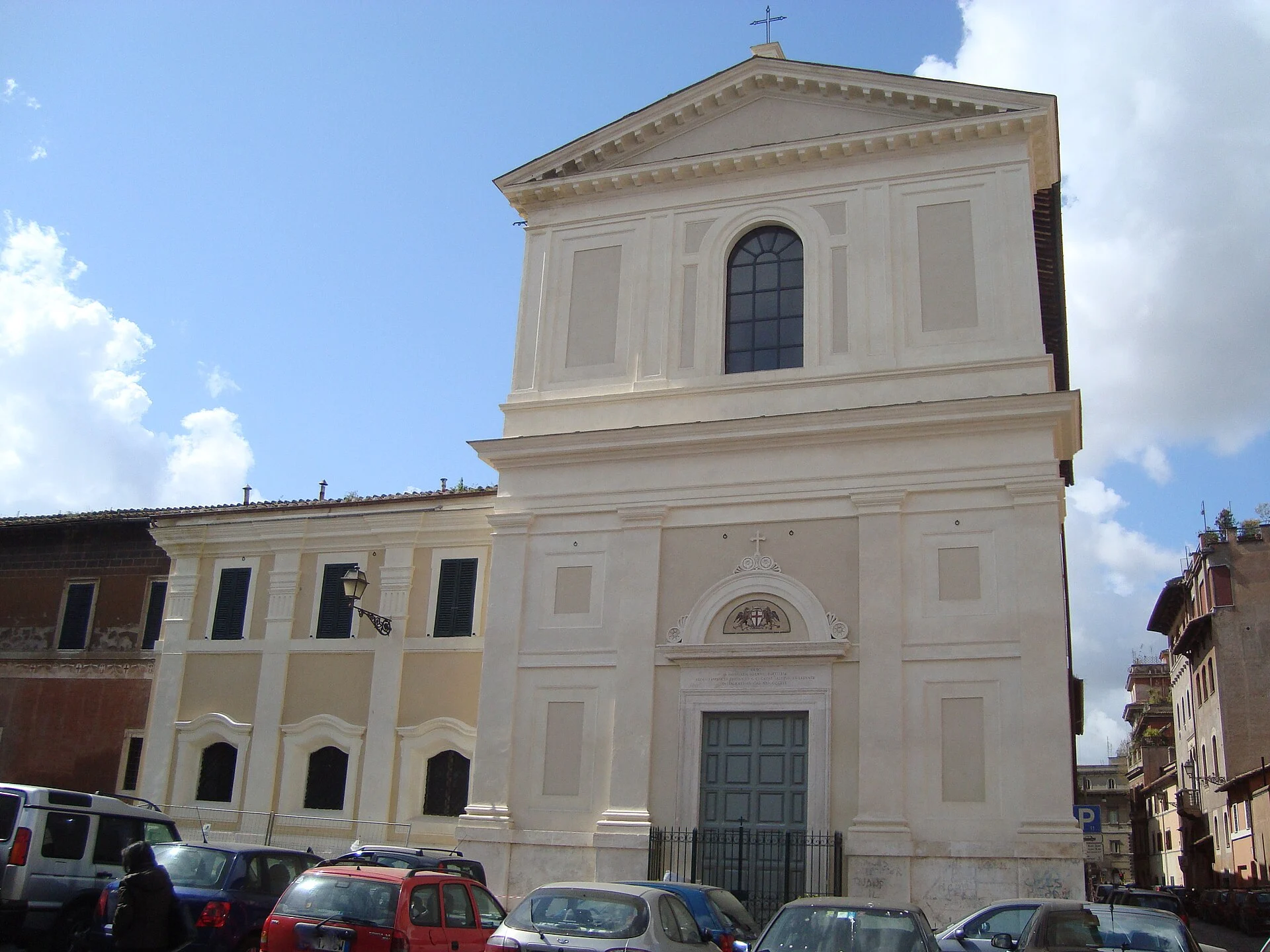
San Giovanni Battista dei Genovesi is at Via Anicia 12, in Trastevere, and belongs to the Confraternita di San Giovanni Battista de' Genovesi, which still runs the church and the 15th-century cloister today. The cloister has no published visiting hours. The church opens for Sunday Mass at 11:00, according to the Mass calendar that the confraternity updates on its own website. For everything else: phone 06 5812416, email confraternita.sgbg@virgilio.it. There are no online tickets.
It is a national church in the old sense of the word: the reference point of the Genoese community in Rome, born at the end of the 15th century together with a hospital for the Ligurian sailors who worked at the port of Ripa Grande, on the Tiber, a few hundred meters away. The Genoese banker Meliaduce Cicala wanted it. From outside it looks like a small 19th-century church like many others. Behind it is one of the cleanest Renaissance cloisters in the city, with a well and a palm in the center.
Address, contacts and access arrangements were checked on September 29, 2026 on the Roma Capitale tourism portal page, which carries September 3, 2025 as its last revision, and on the other sources cited in the text. The Masses appear in the calendar on the confraternity's website, last updated on September 17, 2026, which for October marks Sunday the 4th without a celebration. The cloister's openings, on the other hand, are not published: call and have the day and time confirmed.
Where it is and what you really see
Via Anicia is the quiet street that runs between Viale di Trastevere and the river, in the lower part of the rione, the one Romans still call the Trastevere of the convents. Here the churches follow one another a few meters apart: on the same street is Santa Maria dell'Orto, the church of the guilds of the greengrocers and trades, and toward the river opens San Francesco a Ripa. It is a neighborhood of confraternities, before it is one of osterie.
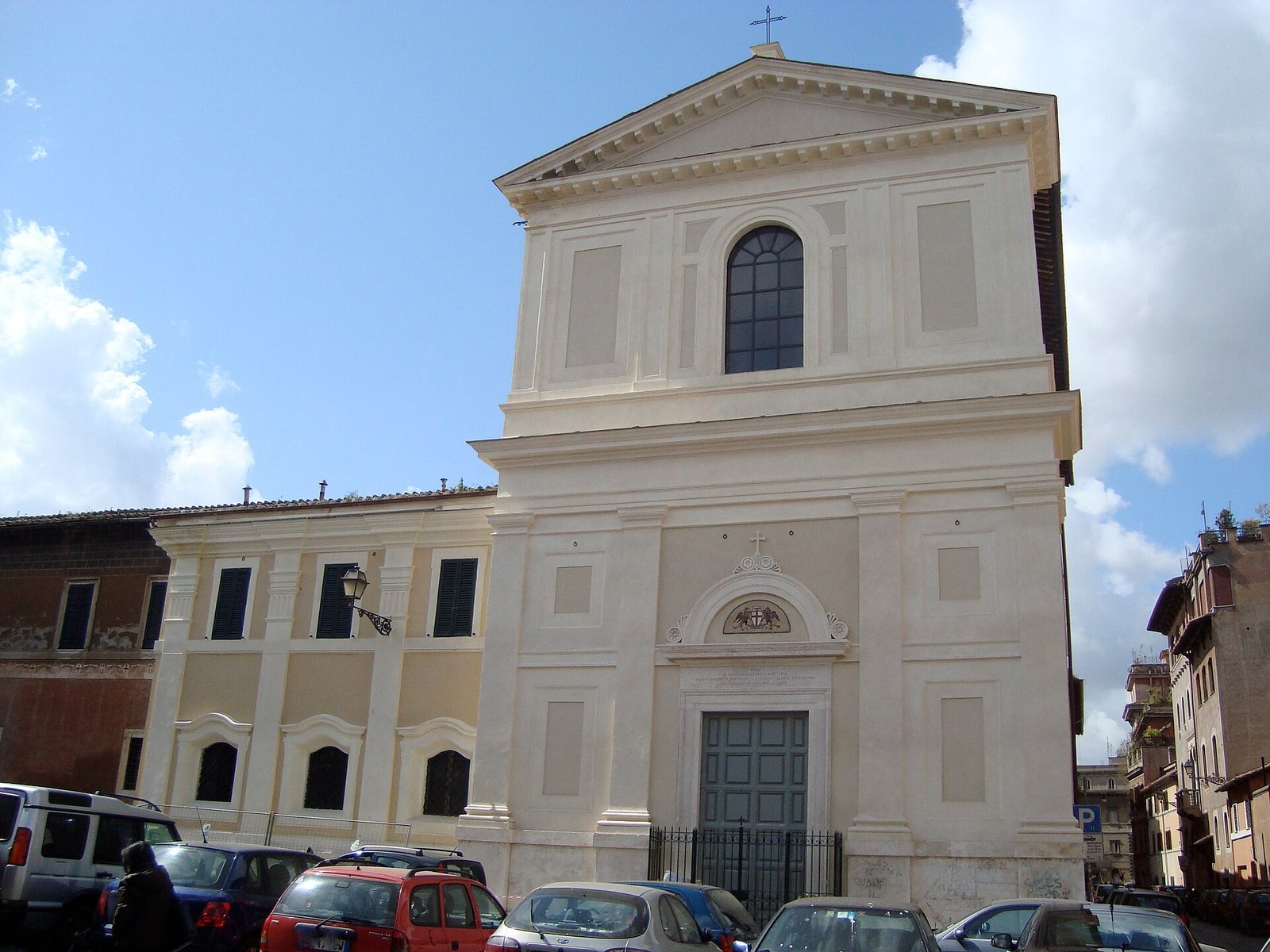
The facade of the Genovesi won't stop you. It is sober, redone in the 19th century, with a portal and little else, and blends in with the buildings of the street. The city's page recalls that the church was almost entirely renovated in 1864, and this is what you see: a hall with a 19th-century look inside which older pieces survive. Whoever arrives expecting an intact Renaissance church is thrown off. The intact 15th-century part is behind, in the cloister.
The cloister is the reason you come. Two orders: below, a portico on octagonal travertine pillars, above, a lighter loggia. In the center, a garden with a Renaissance well from the late 15th century, orange trees and a tall palm that rises above the roofs. The proportion is that of the Rome of Sixtus IV, dry, without superfluous decoration, and you understand at first glance why architectural historians have always cited it among the best in the city.
What you don't see: the rooms of the confraternity, the spaces of what was the sailors' hospital, the archive. They are spaces of a private body that lives and works here, not museum routes. There is no tourist signage, no panels, no bookshop. The whole story depends on whoever opens the door for you, and this is both the limit and the discreet charm of a place that has not been turned into an attraction.
How you get in and who opens the door
The operator is the Genoese confraternity, a lay association that looks after the church, the cloister and the memory of the Ligurian community in Rome. The Roma Capitale tourism portal, in the dedicated page, gives no hours or ticket and says to consult the contacts for Masses and visiting conditions. Translated from administrative language: there is no regular opening guaranteed to the public, and the only serious way in is to make an arrangement with whoever has the keys.
The official channels indicated by the city are the phone 06 5812416, the address confraternita.sgbg@virgilio.it and the website confraternita-sgbg.it, where the confraternity publishes its calendar and notices. The phone remains the quickest route. Call on weekdays, introduce yourself, explain if you are alone or in a group and ask when the cloister will be accessible. The answer depends on the confraternity's activities, not on a fixed calendar.
On Masses, however, the confraternity is clear: the church is a rettoria and the calendar published on its website shows the Sunday Mass at 11:00, with exceptions noted from time to time, such as Sunday, October 4, 2026 with no celebration. Apps with Mass times report something else, but the source to follow is that page. Going to Mass is also the simplest way to see the church open.
One point to state clearly. The cloister is the private space of a religious body, and a closed gate means closed. You don't get in by taking advantage of a door left ajar, you don't follow a supplier, you don't climb over anything to take a photo of the well. Behavior like that makes life harder for everyone who comes after. If it isn't open today, you come back another time, or you wait for an organized opening.
Organized openings exist and are the simplest way for those who have no time to phone. Roman cultural associations periodically offer guided tours of the church and cloister, and the cloister hosts concerts and musical events. Dates and prices of these initiatives are decided by whoever organizes them, and must be checked case by case. Be wary of anyone selling priority entry to the Genovesi: there is no line to skip.
A note on language. There are no official indications of celebrations in Ligurian dialect or of a rite different from the Roman one: the church follows the ordinary Catholic liturgy. The link with Genoa passes through the confraternity, the feasts, the works on the altars and the memory of the confraternity's members, not through the language of the services. Whoever expects a foreign community with its own rite, as in other national churches, won't find it here.
A curiosity about San Giovanni Battista dei Genovesi
The cloister's palm has a bigger reputation than it deserves. The Roma Capitale page reports that in 1588 the first palm tree of Rome was planted here, and the sentence bounces around every guide, every blog, every tour of the neighborhood. It is worth separating the levels. The public document says 1588. Tradition says the first in Rome. Legend adds that the current palm would be that same plant, and this last part doesn't hold up.
A date palm can live a long time, but four and a half centuries in a closed garden, with Roman winters that can be harsh and a history of neglect and changes of use, is a botanical eternity. The one you see is in all likelihood a descendant or a replacement, planted in the same spot to keep the memory alive. It isn't a disappointment. It is the normal way a historic garden preserves a symbol, replacing the plant and keeping the gesture.
Why a palm, and why the Genoese in particular. Liguria and the Riviera di Ponente were palm country well before palms became seafront decoration, and Genoese sailors knew the plant from the ports of the Mediterranean. Putting one in the garden of the sailors' hospital was a sign of home, planted in a rione of boatmen and stevedores. No register can prove with certainty that it was really the first in the city.
Next to the palm grow orange trees, and some call this space the cloister of the melangoli, from the old name of the bitter orange. The name circulates mostly among Roman enthusiasts and popularizers, not in the confraternity's documents that can be consulted. It is a nice detail, to be taken for what it is. Bitter oranges, after all, were the cloister plant par excellence, as you can also see on the Aventine in the garden of Santa Sabina.
Something nobody tells you about San Giovanni Battista dei Genovesi
Baccio Pontelli's name on the cloister is an attribution, not a signature. The city's portal writes that the cloister is attributed to the Florentine architect active for Sixtus IV, and the wording is correct. There is no known contract linking him to this building site, nor an autograph drawing. The attribution comes from stylistic comparison with the Sistine buildings and from the historiographic tradition, and some scholars prefer to speak, more cautiously, of a Pontelli milieu or of workers from his circle.
To understand why Pontelli's name is made you have to look at the Rome of Sixtus IV. The Ligurian pope filled the city with building sites, and Pontelli's name is linked, with varying degrees of certainty, to Ponte Sisto, to the Santo Spirito hospital, to Santa Maria della Pace and even to the Sistine Chapel. These are attributions that critics have been debating for a century and a half. The cloister of the Genovesi enters that family by resemblance.
The second point nobody remembers is Vasari's role. The city's page reports that Vasari called it one of the most beautiful in the city, and the quotation is repeated everywhere as a seal of approval. Vasari was writing almost a century later and his Roman attributions for the 15th century are often fragile. The aesthetic judgment holds up very well on its own. Vasari's authority, on a work from the century before, should not be used as proof of authorship.
Third point, the most practical. Most of the photos of the cloister that circulate were taken during events, concerts or organized visits, that is, with the garden open and set up. On an ordinary day, if they open for you, you find a silent place, sometimes with the confraternity's equipment or stacked chairs, sometimes with gardening work under way. It is a living garden, not a stage set, and it should be taken that way.
The contrarian position is this. The story of the first palm of Rome is the weakest and most overrated part of the whole story of the Genovesi, and whoever builds the visit around that plant is aiming at the wrong target. The value of the place is all in the geometry of the portico, in the relationship between the two orders, in the measure of the Roman 15th century. The palm is a pleasant anecdote. The cloister is serious architecture, and deserves to be looked at as such.
The cloister, piece by piece
Entering the portico you immediately understand the rule of the design. The octagonal travertine pillars carry round arches, without elaborate capitals, with an essential molding that marks the passage from support to arch. It is a solution typical of the Sistine building sites, economical and noble together, which is found in a more monumental key in the Chiostro del Bramante, built a generation later with an already mature language.
The upper floor is lighter than the portico. Popular sources describe an architraved loggia, with slimmer supports, which lightens the mass and lets light into the garden. The relationship between a sturdy ground floor and a slender loggia is the key to the beauty of the place: no show, only proportion. Look at it standing in the center, near the well, and turn slowly around.
The well is the second protagonist. The city's page dates it to the late 15th century and places it in the center of what it calls a garden orchard. It was a functional object, it served the hospital and the kitchens, and only later became a decorative element. Renaissance Roman wellheads are rare in their original position, because many have been moved, sold or reassembled in museums.
The garden today is small, tidy, with the palm dominating and the orange trees along the flower beds. Don't expect a botanical garden. Whoever wants real botany, also in Trastevere, will find the Rome Botanical Garden on the slopes of the Janiculum, with greenhouses and collections. Here the green is a complement to the architecture, as in all the convent cloisters of the city, and its function is to give shade and silence.
A useful comparison, for those who love cloisters, is with those of San Cosimato, a few minutes' walk away, inside the current hospital complex. There too there is a Romanesque cloister and a 15th-century one, there too the visit depends on limited openings. Or with the Michelangelo Cloister at the Baths of Diocletian, which shows the giant scale of the following century. The Genovesi remains the smallest and the most intimate.
My advice for visiting San Giovanni Battista dei Genovesi
Call, and do it a few days ahead. The number given by the city is 06 5812416. Introduce yourself simply, say who you are and how many people you'll be, ask if and when the cloister can be visited. Don't demand a guided tour: whoever answers belongs to a confraternity, not to a tourist services company. Courtesy opens this door far more than any online booking, which, by the way, doesn't exist.
If they tell you to come in a certain time window, respect it precisely. Arriving half an hour late often means finding it closed, because the person who opens has other things to do. Bring a few euros for an offering to the church: it isn't a ticket and no official source gives a fee, but it is the normal gesture of someone entering a space cared for by volunteers. Leave the amount to your conscience.
Choose the morning or early afternoon. The palm and the orange trees filter the light, the portico stays in shade for a large part of the day, and toward sunset the garden gets dark too quickly to see the details of the pillars well. In summer at noon the cloister is the coolest place in the rione, and this is a practical reason, not a poetic one, to put it in the middle of your day.
Allow 20 minutes, half an hour at most. The cloister is seen in a short time, the church even less. The rest of the morning is best built around the nearby churches: the Basilica of Santa Cecilia with its statue of the saint, San Francesco a Ripa with Bernini's Blessed Ludovica Albertoni, Santa Maria dell'Orto with its gilded ceilings. Three nearby churches, three eras, three different communities.
One last recommendation, the most important. Keep your voice down. The cloister is small and echoes, the confraternity works there, some windows look onto homes. Noisy groups with the speaker on ruin the place for those who look after it, and are the reason many Roman cloisters have closed their doors. If you are leading a group, tell the story outside, on the street, and go in to look in silence.
If the phone doesn't answer, don't insist with 10 calls on the same day. Write a short email to the address given by the city, with the dates you are in Rome and a contact number, and try the phone again a few days later. Whoever is organizing for a group must move at least two or three weeks ahead and accept the date proposed by the confraternity, without demanding the time slot that suits their own schedule.
The church and the works that matter
The church is a single hall, with the look given to it by the 1864 renovation. The most important piece for the history of the place is the funerary monument of the founder Meliaduce Cicala, which the city's page assigns to the workshop of Andrea Bregno and which the national catalog of cultural heritage records with a relief with a portrait dated 1481. It is the material document of the foundation, more than any chronicle.
Bregno's name tells you a lot. The Lombard sculptor was the reference for the great patrons of Sistine Rome, and his altar for the Borgia family can still be seen in Santa Maria del Popolo. A monument from the Bregno workshop for a Genoese banker tells of Cicala's social level: a man of the financial curia, rich enough to pay for the cardinals' sculptor.
On the altars the city's page lists a Saint George killing the dragon attributed to Filippo Zucchetti, from the late 17th century, an Apparition of the Madonna of Savona by Giovanni Odazzi and a Baptism of Christ by Nicolas Régnier, earlier than 1627. Saint George is the saint of the red cross on the flag of Genoa, the Madonna of Savona is the Ligurian Marian devotion par excellence, the Baptist is the city's patron. Every altar speaks in Genoese dialect.
Régnier's Baptism is the canvas that will interest most those who follow early 17th-century painting. The painter, born in Hainaut, on the border between France and Flanders, worked in Rome in the years of the Caravaggisti before moving to Venice, and his Roman works are not many. There is also a Renaissance tabernacle from the 15th century, from a Florentine workshop according to the city. All this is seen only with the church open, so ask when you call.
The confraternity, after all, doesn't limit itself to looking after the walls. For years it has published a periodical dedicated to the life of the association and the history of the Ligurian community in Rome, partly available on its website. It is the sign of a living body, with members, meetings and activities, and not of a convenient acronym behind which stands an empty building. This too is why openings depend on its agenda.
Another well-known fact, yet rarely cited
The church was born as an appendage of a hospital, not the other way around. In the founder's idea care came first: a place where sick or wounded Genoese sailors, landed at the port of Ripa Grande, could be treated in a language and in a community they knew. The chapel, later church, served that function. It is a hierarchy found in almost all the Roman national foundations of the 15th and 16th centuries.
The port of Ripa Grande can no longer be seen today. It was Trastevere's river landing for goods that came up the Tiber from the sea, and it was erased when the Lungotevere embankment walls were built after the Unification of Italy. The place name remains, the large building of San Michele on the riverfront remains, the Porta Portese that closed the district toward the sea remains. The Genovesi is one of the few living memories of that port world.
The second rarely cited fact concerns the Ligurian popes. The foundation falls in the years of Sixtus IV, born in the Savona area, and the rise of the Genoese community in Rome continues with Innocent VIII, a Genoese of the Cybo family. Two Ligurian pontiffs in a row within a few years explain why Genoese bankers and merchants carried weight in the curia. It is no accident that the community found its strength to build its Roman home just then.
Third fact. Saint John the Baptist is the patron of Genoa, and the cathedral of San Lorenzo keeps his attributed relics. In Rome June 24 also mattered for another reason: a brief of Gregory XIII from 1576, the confraternity recalls, granted it on that day the right to free one Genoese or Ligurian man condemned to death. Dedicating the Roman church to the Baptist meant bringing the city of origin to Trastevere, exactly as the Florentines did with the Basilica of San Giovanni dei Fiorentini, patrons in common.
The right photo to take at San Giovanni Battista dei Genovesi
The photo is from the portico toward the garden, with an octagonal pillar in the foreground at one side of the frame and the palm rising in the center, beyond the roofline. Stand in a corner of the portico and let the receding line of the arches carry the eye toward the well. Vertical works better than horizontal, because the palm is the line of force and the wide format squashes it.
The second shot is the well with the loggia behind. Lower yourself to the height of the wellhead, keep it in the lower third of the image and use the loggia as a backdrop. With morning light the stone takes on a warm tone and the details stay readable. At noon the contrast between garden in full sun and portico in shade blows out the highlights: expose for the bright areas and recover the shadows afterward.
Avoid the photo of the facade from the street. Via Anicia is narrow, the facade is 19th-century and anonymous, parked cars cut across any framing. It is the photo you take to say you were there, and it tells nothing about the place. If you really want the outside, photograph the portal up close, with the detail of the dedication, and forget the rest of the street.
Two rules of respect. Always ask whoever opened for you if photos are allowed, especially in the church and during services. And don't photograph the windows of the homes that overlook the cloister, or the people working in the garden, without their consent. No tripods, no lights, no drones: in such a small private space they are out of place even before they are forbidden.
How to get there
Via Anicia is in the southern part of Trastevere, between Viale di Trastevere and the Lungotevere. From the historic center the most pleasant route is on foot: you cross the Tiber Island, pass in front of San Bartolomeo all'Isola, come down on the Trastevere side and continue toward Santa Cecilia. From Piazza Venezia it is about a 20-minute walk, with the Ponte Rotto always in view on the river.
By public transport the reference line is the tram that runs along Viale di Trastevere, with stops a short distance from Via Anicia. Line numbers, stops and times must be checked on the Roman public transport company's website the same day, because roadworks and detours on that axis are frequent. By taxi you get to the corner of the street without problems, but the area is a limited traffic zone at several times of day.
By car it isn't worth it. The Trastevere ZTL is active over wide time slots, including evenings and nights on weekends, and free parking in the inner streets is almost nonexistent. Whoever arrives by car from outside Rome is better off leaving it in a park-and-ride on the outskirts and taking the tram. Whoever comes by bicycle finds the bike path along the Tiber, on the quays, comfortable and flat.
To find your bearings in the rione a context guide helps: our page on Trastevere: What to See lines up the main stops and the walking distances. The Genovesi is in the quietest sector, away from the evening crush of Piazza di Santa Maria in Trastevere, and this completely changes the experience of the visit compared to the Trastevere you see on postcards.
Some important events that happened here in history
The 1480s: Meliaduce Cicala, a Genoese banker tied to the curia of Sixtus IV, creates the hospital for sailors and the church dedicated to the Baptist. The funerary monument with his portrait, which the national catalog of cultural heritage dates to 1481, fixes the chronology of the foundation. The building of the cloister falls in the same years, within the great building renewal that the Ligurian pope wanted throughout the city.
June 23, 1553: according to the history published by the confraternity, Julius III establishes the association with the bull Romanum Pontifex, at the suggestion of Cardinal Giovanni Battista Cicala, a descendant of the founder, to administer the assets left by will by Meliaduce. In 1559 the Senate of Genoa grants it the right of consulate over the Genoese captains who land at Ripa Grande, extinguished only with the fall of the Republic in 1797.
1588: according to what the Roma Capitale page reports, a palm is planted in the cloister garden, presented by tradition as the first in Rome. It is the year in which Rome is working furiously under Sixtus V, among raised obelisks and new streets. On the other side of the river, in a closed garden, a community of sailors plants a Mediterranean tree. Two different ways of leaving a mark.
17th and 18th centuries: the altar canvases arrive, from Régnier's Baptism to Odazzi's Madonna of Savona to Zucchetti's Saint George. The church fills with Ligurian devotions, and the Ripa Grande district lives the best years of river traffic. Not far away, the San Michele complex grows to become one of the largest welfare institutions of the papal city.
1864: the church is almost entirely renovated, the last major intervention before the end of the Papal State. A few years later, with Rome as capital, the construction of the embankment walls along the Tiber erases the port of Ripa Grande and with it the reason for the sailors' hospital to exist. The complex survives thanks to the confraternity, which looks after it and still opens it today for celebrations, concerts and arranged visits.
Who passed through San Giovanni Battista dei Genovesi
Meliaduce Cicala, first of all. Banker, man of papal finance, a Genoese transplanted to Rome in the years when Ligurians counted for a great deal in the curia. The Dizionario Biografico degli Italiani devotes an entry to him, a sign of his weight. What remains of him is the face carved on the funerary monument, and above all the idea: a rich man who invests in a hospital for the poor sailors of his homeland, far from home.
The sailors, as a body, for centuries. Men of the Riviera who came up the Tiber with goods, fell ill, got hurt in maneuvers, died far from their families. We know the name of almost none of them, and this is the truest part of the story of the place. The national churches of Rome were born for them, for the migrants of labor, before they were for ambassadors and cardinals who sign their plaques today.
Sixtus IV, who is not known to have frequented the cloister, but without whom the cloister would not have this form. Francesco della Rovere, Ligurian, Franciscan, pope from 1471 to 1484, turned Rome into a building site and gave his fellow countrymen a reason to invest in the city. His name is linked to the bridge that bears his name and to the most famous chapel in the world. Here he is present as a style, not as a person.
The painters of the altars. Nicolas Régnier, who in Rome absorbed the lesson of Caravaggio before making his fortune in Venice. Giovanni Odazzi, Roman, a pupil of Baciccio's school, active in many churches of the city between the 17th and 18th centuries. Filippo Zucchetti, less known, author of the Saint George. None of them is a name for a big exhibition, and for this very reason their canvases here say a lot about Ligurian patronage in Rome.
Today musicians and concert audiences pass through. The cloister has become a valued venue for chamber music, and an international Roman piano competition presents it as its historic home. It is a use consistent with the place: few people, acoustic instruments, silence all around. If you happen to be in Rome on a concert evening, it is the best way to see it, with the garden lit and the portico alive.
Rione Ripa and the world of the sailors
To understand the Genovesi you have to put the water back where the asphalt is today. Until the 19th century the Tiber, at the height of Via Anicia, was not enclosed between high embankment walls: boats moored at sloping quays, goods were carried up on shoulders, and the streets of the rione lived off unloading, customs, warehouses and osterie for those who worked on the river. The church and the hospital were the last stop on land for many of those men.
The large building that stretches today along the Lungotevere, the San Michele a Ripa complex, tells the same story at a different scale. Born as a papal welfare institution, with a hospice, trade schools and even a juvenile prison, it was for centuries the neighborhood's social machine. Today it houses offices of the Ministry of Culture and is not a monument that can be visited at regular hours. From the street you can still gauge its scale.
The confraternities of Trastevere were often confraternities of trades. The greengrocers at Santa Maria dell'Orto, the Ligurian sailors at the Genovesi, the millers and boatmen in other churches of the rione, some vanished. Each defended its own, paid dowries to poor girls, buried the dead, cared for the sick. The welfare of papal Rome passed through these lay associations, far more than through the State, and the rione keeps the trace of them in its facades.
Today that world has vanished, but the geography remains readable. Walking from Via Anicia toward the river, then along the quay to Porta Portese, you cross the space of the old port. Whoever is patient still finds plaques, coats of arms and inscriptions on the buildings that recall properties of confraternities and hospices. It is an exercise that works with the more curious groups, better than any tourist panel.
The Genovesi and the other national churches of Rome
Rome is full of national churches, and the Genovesi must be read within that network. Each community had its church, its confraternity, often its hospital: the Neapolitans at Santo Spirito dei Napoletani, the Bergamasques at San Bartolomeo dei Bergamaschi, the Armenians at San Biagio degli Armeni. They were consulates, first aid and clubs all in one, and this explains their density.
The foreign nations followed the same pattern. The French at San Luigi dei Francesi, the Germans and the Flemish at Santa Maria dell'Anima and at the Camposanto Teutonico, the Spanish at Santa Maria in Monserrato, the Portuguese at Sant'Antonio dei Portoghesi. The great nations built in the Campus Martius, near the curia and the palazzi.
The Genoese made a different choice, and a significant one. They did not put their church next to the palazzi of power, but on the riverbank where their men landed. It is a national church of the port, not of representation, and this brings it closer to the trade confraternities of Trastevere than to the great foundations of the center. Santa Maria dell'Orto, of the greengrocers, and the Genovesi, of the sailors, stand almost door to door for a precise reason.
Whoever wants a direct comparison on the theme of the Baptist as patron can line up the Genovesi and the Fiorentini on the same day. Two communities of merchants and bankers, two cities that venerate the same saint, two national churches with opposite destinies: the Florentine monumental, on the Tiber of Rione Ponte, the Genoese intimate, on the Tiber of Ripa. Looking at them one after the other tells the Rome of the foreigners better than a book.
When it is closed and what not to expect
The rule is simple: without an arrangement, you'll find it closed. Outside the Sunday Mass at 11:00 there is no fixed day of opening published by official sources, and whoever passes by chance on Via Anicia almost always sees a shut door. Don't be fooled by reviews and travel sites that report precise weekly hours: they are information gathered at different times, often out of date. The only information that counts is what the confraternity gives you on the phone.
In the summer months and on holidays openings thin out, as in all confraternity churches run by volunteers. On the other hand, around the Baptist's feast, June 24, and on the occasion of concerts and cultural initiatives, the complex is livelier. Musical events in the cloister are generally in the evening and with admission regulated by whoever organizes them, in ways that change each time.
Don't expect services. There are no public restrooms, no coat check, no informational material in foreign languages, no audio guides. The story comes through the person who welcomes you, if they have time, or through your own preparation. Arriving having already read two lines on the history of the place changes the visit: it lets you ask the right questions and not take up the time of whoever opens.
On accessibility there are no official statements published. The cloister portico is level, but the access from the street and the passage between church and cloister may involve steps. Whoever uses a wheelchair or has difficulty moving must ask when phoning. Better to know before crossing the neighborhood, and to ask if a step-free entrance exists.
The cloister also appears among the places reported in the FAI's I Luoghi del Cuore census, the campaign in which citizens vote for the places they would like to see protected and open. It is not a guaranteed opening or a ticket, but it is a good indicator: when associations and foundations organize days of extraordinary openings in Trastevere, the Genovesi often makes the list. Keep an eye on the calendars of those initiatives, always checking them on the websites of those who promote them.
Eating in the area
Trastevere is the neighborhood of Rome where you eat worst relative to its fame, and I say it with affection. In the streets around Piazza di Santa Maria and along the most beaten streets are concentrated places built for people passing through once. The lower part of the rione, that of the Genovesi and Santa Cecilia, is quieter, but the signs for telling a real kitchen from a trap are the same everywhere.
First sign: the menu with photographs of the dishes, maybe laminated and translated into six languages. A place that has to show you the picture of a cacio e pepe is talking to someone who has never seen one, and builds its cooking on that audience. Second sign: the person at the door who stops you and invites you in. A place with regular customers doesn't need to find them on the sidewalk.
Third sign: the lady rolling out the pasta sheet in the window or even in the street. It is a scene staged to stop the passerby, not a guarantee. Serious fresh pasta is made in the morning, in the kitchen, away from dust and eyes. Fourth sign: the kitchen open without interruption from morning to night. A real kitchen crew has a break, because it has to rest and prepare the next service.
Fifth sign, the most insidious: the price that adapts to the customer. Places in front of monuments and in the most photographed squares tend to have items without a price, like the fish of the day or the house wine, and sometimes different menus between the indoor room and the outdoor tables. Always ask the price before ordering, especially for fish and wine. It isn't distrust, it is good commercial manners.
Romans don't go to those places, and not out of snobbery. Visitors go because they are visible, convenient, always open, and with tired children they have their reasons. The criterion remains one: look at who is sitting and what language they speak at 15:00 on a weekday. To get your bearings there is our list of the places where we eat, updated when places change.
What to combine in a day
The most natural combination is the tour of the churches of lower Trastevere. From the Genovesi to Santa Maria dell'Orto it is a few steps, to San Francesco a Ripa five minutes, to Santa Cecilia another five. From there you climb back toward San Crisogono, with the excavations of the early Christian church under the floor, and toward San Benedetto in Piscinula, one of the smallest churches in Rome, with its Romanesque bell tower in miniature.
Whoever has more time can push on toward the upper part of the rione. The Basilica of Santa Maria in Trastevere with its mosaics, Santa Maria della Luce and Sant'Agata, the Museo di Roma in Trastevere for the daily life of 19th-century Rome. In the morning, on market days, the Mercato di San Cosimato gives the pulse of the neighborhood.
For the panorama you climb the Janiculum, passing by San Pietro in Montorio and Bramante's Tempietto. It is the right climb to understand the geography you have just seen from below: the river, the Island, the vanished port. Whoever prefers Renaissance art goes to the Villa Farnesina, about 20 minutes on foot along the Lungara.
On the other side of the river, a short distance away, is the Rome of ancient trade. Passing by Porta Portese you reach Testaccio and Monte dei Cocci, the hill made of broken amphorae from the Roman emporium: the port of Ripa Grande was, in a way, its heir. Or you cross toward the Ghetto, the Mouth of Truth and the Aventine.
Frequently asked questions
Is San Giovanni Battista dei Genovesi open every day?
No, except for the Sunday Mass at 11:00 published in the confraternity's calendar. The Roma Capitale tourism portal gives no opening hours and refers to the contacts of the confraternity that runs the complex: phone 06 5812416, email confraternita.sgbg@virgilio.it. Without an arrangement made beforehand you are very likely to find the door closed. Call a few days ahead and have it confirmed when the church and cloister will be accessible.
Do you pay to see the cloister?
No official source indicates a ticket for the cloister and the city's page gives no fares. Whoever opens for you is the confraternity, and an offering for the care of the place is the normal gesture, at your discretion. The guided tours organized by cultural associations and the concerts in the cloister, on the other hand, have prices set by whoever organizes them, to be checked each time.
Is the cloister really by Baccio Pontelli?
It is a traditional attribution, also reported by the Roma Capitale page, based on style and on comparison with the building sites of Sixtus IV. No archival documentation that confirms it definitively is known, and part of the critical literature prefers to speak of a Pontelli milieu. The value of the cloister, in any case, doesn't depend on the name: the quality of the design speaks for itself.
Is the cloister's palm the first planted in Rome?
The city's page reports that in 1588 the first palm tree of Rome was planted here. The date is handed down, the primacy is tradition, and the idea that the current plant is the same one as then is not sustainable for botanical reasons. In all likelihood it is a replacement planted in the same spot to keep alive the memory of the gesture.
Are there Masses, and at what times?
Yes. The calendar published by the confraternity on its website shows the Sunday Mass at 11:00 in the rettoria, with exceptions noted from time to time: for example, on Sunday, October 4, 2026 there is no Mass. Unofficial websites and apps report other times, which may be out of date. If in doubt the number is 06 5812416.
How much time does the visit take?
20 minutes or half an hour is enough for the cloister and the church, if both are opened for you. The complex is small and has no museum route. It is best to fit it into a wider tour of the churches of lower Trastevere, with Santa Maria dell'Orto, San Francesco a Ripa and Santa Cecilia, which are all a few minutes' walk from one another.
How do you get there from central Rome?
On foot is the best choice: from Piazza Venezia, crossing the Tiber Island, it is about 20 minutes. By public transport the reference is the tram on Viale di Trastevere, with stops near Via Anicia: lines and times must be checked on the Roman public transport company's website. By car the ZTL and the lack of parking make arriving inconvenient.
Can you take photos in the cloister?
There are no rules published by the confraternity in the official sources that can be consulted. The cloister is the private space of a religious body: always ask permission from whoever opens for you, avoid tripods and lights, don't photograph the windows of the homes and the people at work. During services in the church photos are out of place, out of simple respect.
Who wrote this page
The page comes from the editorial team of Tour Leader Pro, the Rome-based outfit that designs itineraries, tours and cultural events between Rome and Lazio. Contacts and access arrangements reported here come from the official sources cited in the text as of the date given at the opening. Since this is a complex run by a confraternity, with openings that change, recheck them before leaving and tell us what you find different.
Lining up a morning among the confraternity churches of Trastevere means fitting together doors that open by appointment, Masses with unpublished times, volunteer custodians to call on the right days and minimal distances that still take time, for yourself or for a group of 30 people. Whoever faces this kind of puzzle finds on Tour Leader Pro working materials designed for those who guide and for those who organize on their own.
For the wider picture, that is regional trains and seasonal schedules, rentals, airports, transfers between one province and another and destinations in Lazio outside central Rome, from the Castelli to the volcanic lakes of the north to the Tyrrhenian coast and the villages of the interior, a useful resource for putting together a multi-day itinerary is Italy Planner.