Camposanto Teutonico
In short. The Camposanto Teutonico is inside Vatican City, on the left flank of St.
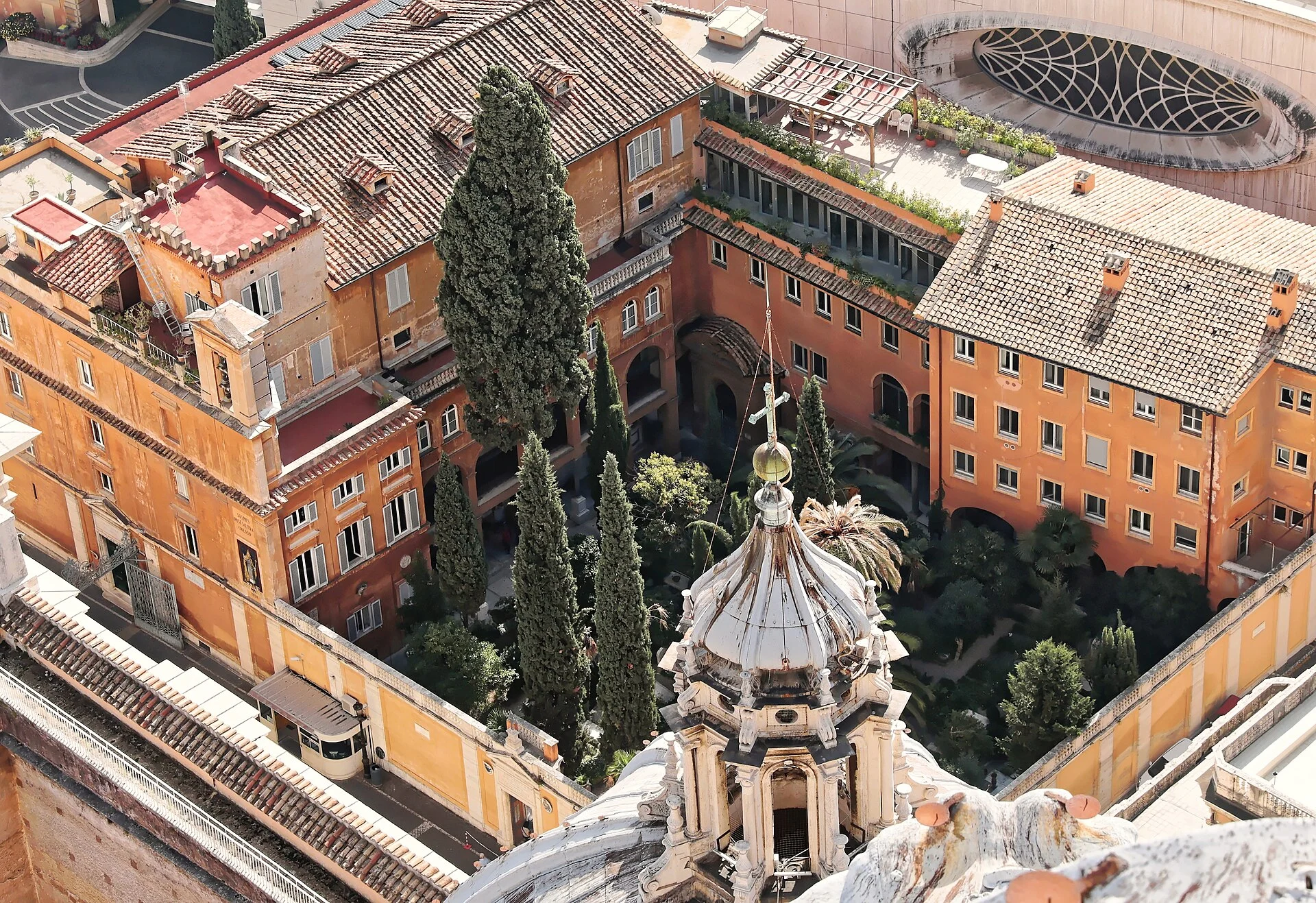
The Camposanto Teutonico is inside Vatican City, on the left flank of St. Peter's Basilica, and admission is free: no ticket, no reservation for the individual visitor. It's run by the Archconfraternity of Santa Maria della Pietà and the Pontifical Teutonic College. You enter Monday through Saturday, in the morning and until 13:00, passing the Swiss Guard checks on Piazza del Sant'Uffizio side. On Sunday you enter only for the 10:00 Mass.
It's the cemetery of German-speaking Catholics and of the Flemish tied to Rome, enclosed by a high wall, with palms, cypresses, gravestones set against the walls and a late 1400s church dedicated to Santa Maria della Pietà, consecrated in 1500. The ground partly coincides with the area of the ancient circus of Caligula and Nero, where Christian memory places the first martyrs of Rome. Next to it is the priests' college, with library and archive.
The practical information was checked on September 29, 2026 on the official website of the Campo Santo Teutonico, in the pages for visitors and the one on the church and the Masses. Hours, closures and access rules depend on the Vatican calendar, on the Wednesday audiences and on extraordinary celebrations: before leaving, recheck the official page, and if you're coming as a group write to the secretariat through the website's contact form.
How you really get in
The official page says one precise thing: access is from Piazza del Sant'Uffizio, the piazza that opens to the left of Piazza San Pietro, behind the colonnade, in front of the building of the Dicastery for the Doctrine of the Faith. There you pass the security checks of the Vatican City State entrusted to the Swiss Guard. The operator asks you to allow the necessary time, and early in the morning, before the audiences and the big celebrations, it's usually short.
Many guides and travel accounts instead speak of the Arco delle Campane, the passage under the clock to the left of the basilica's facade, also guarded. The sources don't agree on the entry point, and the only indication published by the operator remains Piazza del Sant'Uffizio. Present yourself there, say clearly that you're going to the Camposanto Teutonico and follow the instructions of the staff on duty. If they direct you elsewhere, do it without arguing: on Vatican territory they decide.
The published hours are these. Monday through Saturday you enter until 13:00, with an early opening at 7:00 for those coming to the morning Mass. On Wednesday access is suspended during the pope's general audience. On Sunday you enter only for the 10:00 Mass. In August the church stays closed. On Saturday morning the operator warns that a closure for cleaning may occur. There is no afternoon: after 13:00 you turn back.
The rules are few and should be taken seriously. Clothing that covers shoulders and knees, no pocketknives, no glass or metal bottles. The operator asks that the quiet of the place be respected, and the reason is obvious as soon as you cross the gate: it's a cemetery in use, with recent burials and families who come to pray. It's not a garden to pass through between one line and another, and anyone who treats it that way is noticed immediately.
Groups are a chapter apart. For pilgrimages with more than 20 people the operator asks, for organizational reasons, for notice to the secretariat at least five working days before the visit, through the registration page of the official website. No phone number is published on the information page: the channel is the contact form. Anyone accompanying groups would do well to print the confirmation and hold it in hand at the checkpoint.
The Vatican Museums ticket is no use here. The Museums have another entrance, on the wall side on Viale Vaticano, and a closed route that doesn't lead to the Camposanto. No resale portal offers access to the cemetery, because there's nothing to sell: entry is free during the published hours. If someone offers you a ticket or a skip-the-line for the Camposanto Teutonico, they're selling air.
Where it is and what you see
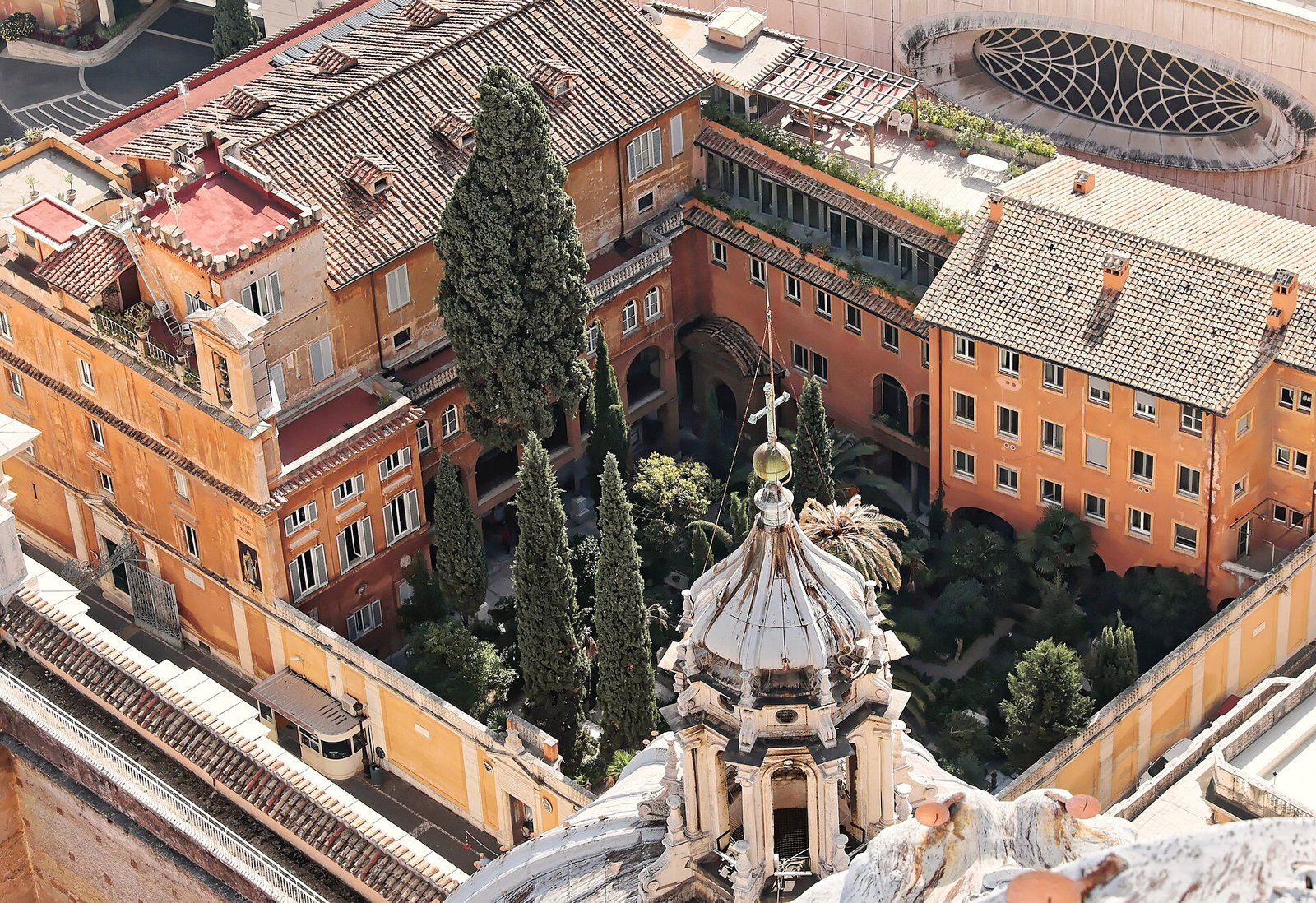
The enclosure occupies a narrow rectangle between the southern flank of St. Peter's Basilica, the audience hall and the college buildings. You get there through Piazza dei Protomartiri Romani, a name the operator explains with the memory of the city's first martyrs. From the street you see almost nothing: a wall, a portal, a few palm tops. All the meaning of the place is found beyond the gate, in a space you walk through in 10 minutes and look at for an hour.
Inside you find a compact funerary garden. The paths are short, the ground tombs are few and close together, most of the memorials are on the walls: gravestones, family coats of arms, reliefs, inscriptions in Latin, German, Dutch, Italian. The plants are those of the Roman Mediterranean, mainly palms and cypresses. Above, a few meters away, the mass of the basilica and the drum of the dome close off the sky on one side. The feeling of a hidden enclosure depends entirely on that contrast.
The church of Santa Maria della Pietà occupies one side of the cemetery, and the operator specifies that you get to it only by passing through the camposanto. No door on the street, no independent entrance. The college, with the residence of the scholar priests, the library and the archive, closes the complex and cannot be visited. Anyone arriving hoping for a museum is thrown off: here you see a cemetery and a church, and that's all.
What you don't see. The spaces of the college, the library, the archive, the underground ossuaries talked about in 2019, the offices of the Archconfraternity. There are no explanatory panels worthy of the name, no marked route, no staff telling the story. It's a place of prayer that tolerates the respectful visitor, not a site organized for tourism. The beauty, for those with patience, is exactly this.
A curiosity about the Camposanto Teutonico
The Camposanto Teutonico is one of the few places in Vatican City where you can still be buried, and the rules for entering as the deceased are stricter than those for entering as the living. The operator lists who has the right to burial: members of the Archconfraternity with their spouses, members of German- and Flemish-language religious institutions in Rome, students of the Anima and Germanico colleges, Catholics who died during official pilgrimages, and the Swiss Guards.
The last item is the one that surprises most. The Swiss Guard, according to what the operator reports, has had burial rights here since 1520, and the link is understood by looking at the map: the barracks are a few dozen meters away, the corps was born in the early 1500s, and seven years after that date its bloodiest page would be played out in the Sack of Rome. The cemetery of the Germans is, since then, also the cemetery of the pope's Swiss soldiers.
The name betrays an old linguistic habit. Teutonic, for medieval and modern Rome, meant more or less the whole Germanic-language world north of the Alps, and the operator in fact speaks of a cemetery born for Franks, Germans and Flemish. Anyone reading the gravestones finds Austrian, Bavarian, Rhenish, Dutch, Belgian, Swiss families. The nation, here, is that of language and faith, not that of today's political borders.
The detail that clarifies everything concerns the national church. The great church of the Germans in Rome is Santa Maria dell'Anima, near Piazza Navona, with its priests' college. The Camposanto is the other half of that presence: there people lived, studied and made careers in the curia, here they were buried next to St. Peter's. Two addresses, a single community, and the Anima and Germanico colleges in fact appear in the list of burial rights.
The church of Santa Maria della Pietà
The church is dedicated to Santa Maria della Pietà and the operator gives it as consecrated in 1500. The exterior is sober, almost anonymous by Roman standards: a simple facade facing the cemetery, without the scenography of the Baroque churches of the center. On the left portal the encyclopedic sources point to a Madonna and Child with the coat of arms of the Archconfraternity, a double-headed eagle recalling the empire and the Germanic world the confraternity came from.
Inside, the piece the operator highlights is the high altar, with a five-part polyptych contemporary with the church. It's an altarpiece of Northern design, closer to the shuttered altars of German churches than to the big canvases of Roman altarpieces, and this is the first signal of the building's national character. Anyone entering after seeing the basilica feels a change of scale and figurative language that is worth the visit by itself.
The encyclopedic sources attribute to Polidoro da Caravaggio, a pupil of Raphael, the frescoes of a chapel tied to the Swiss Guard, recalled in connection with the fallen of 1527. The operator doesn't describe the chapel in the pages for visitors and the attribution, in this form, should be taken with caution. What remains is that the church had cultured patrons well connected to the papal court, and that the side chapels bear the signs of it.
The gravestones continue inside the church too, on the walls and in the floor, with names of clergymen, diplomats, artists and merchants of the German community in Rome. Reading them slowly is the best way to understand who this community was: not a passing colony, but a stable presence, rooted in the curia, in the workshops and in the embassies. Don't expect to be able to walk around during Mass: you go in, sit down, and look at the end.
Something nobody tells you about the Camposanto Teutonico
In the summer of 2019 the Camposanto Teutonico made the front pages because of the disappearance of Emanuela Orlandi. On July 11, at the family's request and with Vatican authorization, two tombs were opened: that of Princess Sophie of Hohenlohe, who died in 1836, and that of Duchess Charlotte Frederica of Mecklenburg-Schwerin, who died in 1840. The tombs turned out to be empty, without even the remains of the two noblewomen buried there in the 1800s.
On July 20, 2019, two underground ossuaries in the college area were inspected, and at the end of July the Holy See announced that no bone examined dated from a time after the end of the 1800s. In April 2020 the Vatican proceeding on the bones of the Teutonico was closed, as reported by Vatican News. According to the Vatican reconstruction, the empty tombs are explained by the expansion works on the college between the 1800s and the 1900s, which moved older burials into the ossuaries.
The reason is this. Because this story has been told a great deal, often in fictionalized versions, and anyone going in risks looking for the princesses' tombs as an attraction. The place displays nothing about it and doesn't make it a matter of curiosity. Anyone who wants to understand should do so from the published papers and the official statements, and in front of the tombs keep the tone you keep in any cemetery where real people rest.
The contrarian judgment is this: the Camposanto Teutonico is described online as the trick for getting into the Vatican for free without a line, or as the place of the mysteries of the Orlandi case. Both keys are wrong and ruin the visit. It's a community cemetery, small and silent, where you understand the Rome of the northern pilgrims better than in any museum. Anyone looking for the thrill or the shortcut comes out disappointed, and rightly so.
The earth, the circus and the martyrs: documents, tradition, legend
What the documents say. In the Vatican area there was the circus begun under Caligula and completed under Nero, which the operator describes as about 540 meters long and 100 wide. Tacitus, in the Annals, tells that after the fire of 64 the Christians were put to death amid mockery and torture, torn apart by dogs or crucified, and that Nero offered his gardens for the spectacle. That the cemetery lies on part of the circus area is an accepted topographical fact.
What tradition says. The martyrdom of St. Peter in this area is a very ancient tradition, supported by the presence of the venerated tomb under the basilica, today visitable with the Excavations of the Vatican Necropolis. The name of Piazza dei Protomartiri Romani comes from here: the place of the blood of Rome's first Christians. That Tacitus's martyrs died exactly on the ground of the cemetery can't be proven, but the memory of the place was built on this conviction.
What is legend, or nearly. A medieval tradition, reported by the operator itself, holds that St. Helena, the mother of Constantine, had earth brought to Rome from Jerusalem for this field. In the version you hear told in the piazza the earth comes from Calvary. The operator is more cautious and gives as the more likely origin, in the tradition, the field of Akeldama, bought with the 30 denarii of Judas, or the basilica of Holy Cross in Jerusalem.
The story of holy earth transported is not exclusive to Rome. It recurs in other monumental camposanti, and always has the same function: to turn a city cemetery into a piece of the Holy Land, where being buried counted as a completed pilgrimage. In Rome Helena's name returns in many places, from the relics of Santa Croce to the Mausoleum of Sant'Elena on the Casilina. No contemporary document proves the transport, and it's best to say so without taking anything away from the value of the tradition.
The Carolingian foundation too has to be put at the right levels. The operator writes that the cemetery was founded by Charlemagne for Franks, Germans and Flemish. That in the early medieval Borgo there existed the scholae of the northern pilgrims, hospitality institutions with a church and a cemetery, is documented, and the Schola Saxonum survives in the name of Santo Spirito in Sassia. Charles's personal founding act, with the date of 799 that circulates in encyclopedias, belongs instead to tradition.
My advice for visiting the Camposanto Teutonico
Go early, on a Monday, Tuesday, Thursday or Friday. On Saturday there's the risk of a closure for cleaning, on Wednesday there's the general audience that suspends access and turns St. Peter's Square into a construction site of barriers. Between 8:00 and 10:00 in the morning the checks are quick, the light comes in low between the palms and in the enclosure there are only the college's priests and a few families. After 11:00 the calm remains, but the light flattens.
If you want to see the church open and alive, go to Mass. The one at 7:00 on weekdays is almost always in German, with Wednesday in Latin, and on Saturday at 8:00 it's celebrated in Italian. On Sunday at 10:00 there's the Mass in German, the only moment you enter on the holiday. Anyone who isn't a believer can take part respectfully or wait for the end: either way the most proper way to see this church is in use.
Bring a notebook and read the gravestones. It's the simplest advice and the one that pays off most. The inscriptions tell of trades, origins, family ties, premature deaths of young priests arrived for their studies, diplomats, painters, craftsmen. With an hour and a list of names in hand the cemetery becomes a history book of the German presence in Rome, and you'll notice that the list of the famous is the least interesting part.
Keep your phone in your pocket for the first 10 minutes. Not by written rule, which the operator doesn't publish, but because the place is understood with the ears before the eyes: the noise of St. Peter's Square dies out within a few meters, you hear the birds and the steps on the gravel. The contrast with the crowd you left on the other side of the colonnade is the real experience of this place, and a photo doesn't give it back.
For those accompanying a group, the practical advice is to separate things. First the Camposanto, at opening, with 10 or 15 people at most, then the basilica. Beyond 20 participants remember the notice to the secretariat five working days ahead, as the operator asks. Explain everything outside, in the piazza, and inside let the place speak: a guide giving a lecture out loud among the tombs is the most out-of-place thing you can see here.
Masses, languages and calendar
The calendar of Masses published by the operator is this. Sunday at 10:00 in German. Monday, Tuesday, Thursday and Friday at 7:00 in German. Wednesday at 7:00 in Latin. Saturday at 8:00 in Italian. In August the church is closed, and on days of special celebrations the website publishes specific notices in the events calendar, as happened for Corpus Domini. Before organizing the morning around a Mass, check the official calendar for the week.
The language says a lot about the function of the place. This is the reference church for German-speaking faithful who work in the Vatican, for the college's priests and for pilgrims arriving from Austria, Germany, Switzerland and South Tyrol. The Saturday Mass in Italian opens the door to Romans too. Anyone who wants to understand how a foreign Catholic community lives next to St. Peter's finds here the clearest example in the city.
The big occasions are tied to the dead. On November 2, 2020, Pope Francis celebrated Mass for the deceased in the college church and then prayed at the tombs of the cemetery, as documented by the Holy See's official pages. On those days access follows extraordinary rules and the ordinary visitor doesn't enter: the ordinary calendar doesn't apply during papal visits.
A note for those coming to pray at a specific tomb. The operator doesn't publish a searchable list of burials or an online search service. If you're looking for a relative, a priest of your diocese or a Swiss soldier, write to the secretariat first from the website's contact form, giving name and year of death. Arriving hoping to find a gravestone by yourself among hundreds, in one morning opening hour, is the surest way to go home empty-handed.
Another well-known fact that is rarely mentioned
The obelisk of St. Peter's Square stood right next door. The Egyptian monolith brought to Rome under Caligula decorated the Vatican circus, and stood in its original position, on the left flank of the basilica, throughout the Middle Ages and the Renaissance. Only in 1586 did Sixtus V have Domenico Fontana move it to the center of the piazza. Anyone looking at the Vatican Obelisk from the colonnade sees a piece of the circus that has left the cemetery's neighborhood.
For more than a thousand years, then, anyone buried in the Camposanto Teutonico rested in the shadow of the only obelisk in Rome that never fell. Guides report that a plaque in Piazza dei Protomartiri marks the place where the obelisk stood before the move. The operator doesn't describe it, but it's one of the details that make the vanished circus legible: the 500-meter length is understood only by lining up the plaque, the basilica and the piazza.
The second fact concerns St. Peter's Square and its shape. Bernini's colonnade, built a century after the obelisk's move, embraces a space that had been conceived around that monolith moved from the circus. The cemetery, which stayed in place, thus preserves the oldest topography of the area, the one before the Baroque piazza. For those studying Bernini in Rome it's a useful flip side.
Third, and still less known: the Camposanto is not a foreign enclave. It's inside the Vatican City State, belongs to a confraternity of pontifical right and follows Vatican access rules. The Lateran Pacts of 1929 left it inside the borders, unlike other properties of the Holy See that enjoy only extraterritoriality on Italian territory. Anyone who thinks they're entering Germany by crossing the gate has the wrong address.
The right photo to take at the Camposanto Teutonico
On photographs the operator doesn't publish specific rules in the pages for visitors: there's no written ban, but no permission either. The rules of common sense in a cemetery in use apply, along with the staff's instructions at the time. No photographs during Mass, no close-ups of recent tombs with legible names, no tripods or set-style video shooting. If someone from the college asks you to put your phone away, do it.
The right photo is only one and is taken from the far end of the cemetery looking toward the basilica. Put a palm or a cypress in the foreground, in the middle the gravestones set against the wall and above, filling the sky, the flank of St. Peter's with the drum of the dome. It's the only framing that tells the place in one shot: a tiny enclosure under the biggest church in Christendom. Vertical works better than horizontal.
The good light is that of the early hours. The basilica rises north of the enclosure and catches the sun, while the walls and the college buildings cast shadows over the cemetery, so at 8:00 you have zones of raking light on the gravestones and the sky still soft. Toward noon the sun comes in from above, flattens the relief and burns out the basilica's travertine. Compensate the exposure on the white of the stone, otherwise the frames of the gravestones disappear.
The second image worth taking home is a detail. Choose a gravestone with a family or city coat of arms and photograph only that, in raking light, with the German or Latin inscription cut in half. It's the photo that tells the nature of the place better than any panorama: a piece of Bavaria, Flanders or Tyrol wedged into the most Roman wall there is. No legible names, no recent tombs.
Avoid the photo of the entrance portal from the piazza with the guards posing. The Swiss Guards are on duty, they're not extras, and the close-up photo at the checkpoint is the thing that makes you lose time and goodwill. If you want the uniform of Vatican City, photograph it from a distance standing in the piazza, where the context is touristic and nobody takes offense.
How to get there
On foot, which is the right way. From Castel Sant'Angelo you walk Via della Conciliazione to the piazza, then turn left along the arm of the colonnade to Piazza del Sant'Uffizio. It's about 20 minutes at an easy pace. Anyone coming from the Janiculum goes down toward Porta Santo Spirito and cuts through the rione Borgo, which remains the nicest way to approach the Vatican without going through the crowd of the avenue.
By public transport the Prati district and the Borgo area are well served by the metro and by many surface lines, but routes change often because of construction, big events and closures tied to Vatican celebrations. Plan the trip on the same day with the route calculator of the Roman transport company. On audience and canonization days, the area around St. Peter's Square is closed to traffic and the nearby stops are moved.
By car it makes no sense. Borgo and Prati are inside the limited traffic zone and street parking spots are rare and expensive, while the area's garage parking fills up early on days of heavy attendance. By taxi, have yourself dropped at the Sant'Uffizio or on Via di Porta Cavalleggeri, not in the piazza. For those with mobility difficulties this is the only case in which the car really helps: the final stretch on foot is short and almost entirely flat.
On accessibility the operator doesn't publish a statement. The route from the piazza to the gate is flat, the cemetery paths are partly gravel and partly paved, the church has a few steps. Anyone moving in a wheelchair would do well to write to the secretariat first to find out if there's easier access to the church. In the cemetery you can get around, with a bit of patience on the gravel, and the rest depends on the conditions of the day.
Some important events that happened here in history
The first event is the persecution of 64, told by Tacitus, which tradition ties to this area of Nero's circus. The second is the burial of Peter in the nearby necropolis, the foundation of everything that came after. The third is the birth, in the early Middle Ages, of the scholae of the northern pilgrims around the Constantinian basilica, which the operator links to Charlemagne. On this network of hospices and national cemeteries the Camposanto you see today was born.
In 1454 the land is entrusted to the confraternity of the Germans of Rome, according to what the operator reports, after the Holy Year of 1450 had shown a cemetery in poor condition. The German members of the curia fund a complete reconstruction of the area, and toward the end of the century the church rises, consecrated in 1500. From 1513 the confraternity has the exclusive right of burial on the ground, and in 1520 it shares it with the Swiss Guard.
On May 6, 1527, the Landsknechts enter Borgo and the Sack of Rome begins. The Swiss Guard covers Clement VII's escape toward Castel Sant'Angelo through the Passetto di Borgo, and most of the guards die in the fighting around the basilica. Tradition places the last stand near the obelisk, and so right next to the Camposanto. Every May 6, the oath-taking of the new recruits recalls that day.
In 1586 the obelisk leaves the flank of the basilica for the center of the piazza, and the cemetery loses its oldest neighbor. Between the 1600s and the 1700s the enclosure fills with gravestones of German-speaking diplomats, prelates and artists. In 1876 next to the cemetery the residence is born for priests who are scholars of archaeology and Church history, wanted by Anton de Waal, from which the Pontifical Teutonic College derives. The encyclopedias add the arrival of a large research library at the end of the 1800s.
In the 1900s the complex changes face with the construction of the new college building, which the encyclopedic sources date to the 1960s with a design by the architect Silvio Galizia, and with the rework of the access in the 1970s. On November 2, 2020, Pope Francis celebrates Mass for the deceased there in the midst of the health restrictions. In July 2019 the opening of the tombs for the Orlandi case brings the cemetery onto the news of the whole world.
Who passed through the Camposanto Teutonico
Joseph Anton Koch, the Tyrolean painter, master of heroic landscape, who spent a large part of his life in Rome and died in 1839, is buried here according to the published lists. Next to him, among the artists, the sources recall Johann Martin von Wagner, painter and archaeologist in the service of the king of Bavaria, who died in 1858. The colony of German artists in Rome, that of the cafes of Via Condotti and the studios on the Pincio, often ended up here.
Carolyne zu Sayn-Wittgenstein, the princess who for years was Franz Liszt's companion and who came to Rome hoping for an annulment of her marriage so she could marry him, who died in 1887, rests in this cemetery. The marriage never happened, and she stayed in Rome writing volumes of theology in a house in the center. One of the most discussed love stories of the 1800s musical world ends among these palms, with a sober gravestone.
Hermann Kanzler, the general of Baden origin who commanded the papal army at Porta Pia on September 20, 1870, who died in 1888, is buried here according to the encyclopedic sources. It's a name Romans know little and that closes an epoch: the last commander of the troops of the pope-king. Anyone walking among these tombs thus meets the Risorgimento seen from the other side, that of those who defended the Papal State to the last day.
Among the scholars, the college's founder Anton de Waal, who died in 1917, the archaeologist Ludwig Curtius, who died in 1954, the Jesuit Engelbert Kirschbaum, who worked on the excavations under the basilica searching for Peter's tomb and died in 1970, and the historian Hubert Jedin, the great scholar of the Council of Trent, who died in 1980. The Camposanto is also the cemetery of 1900s German Catholic historical scholarship.
There are uncomfortable names. The Austrian bishop Alois Hudal, rector of the Anima, who died in 1963, is buried here and is remembered by historians for the help he gave after the war to the flight of Nazi criminals to South America. There is Sister Pascalina Lehnert, for decades at the side of Eugenio Pacelli, later Pius XII, who died in 1983. There is the writer Stefan Andres, who died in 1970. The history of the German community in Rome, here, has not been cleaned up.
And there are the last ones. In 2015 Willy Herteleer was buried here, a homeless man of Belgian origin who had lived for years on the streets of Borgo, thanks, according to the news reports, to the intercession of people who knew him in the Camposanto community. In the following years the news reported other burials of Flemish and German homeless people. Next to princes, cardinals and great scholars, it's the piece of news that says the most about the place.
Archconfraternity and college: who runs it today
The cemetery and the church belong to the Archconfraternity of Santa Maria della Pietà in Camposanto dei Teutonici e dei Fiamminghi, which in German is called Erzbruderschaft zur Schmerzhaften Muttergottes. It's an association of faithful, lay people and priests, with roots in the 1400s, that administers the burials, the church and the celebrations. The encyclopedias date the title of archconfraternity to 1597, but the community that animates it goes back to the previous century.
Next to it is the Pontifical Teutonic College of Santa Maria in Camposanto, a priests' college for German-speaking priests studying in Rome, mainly Christian archaeology and Church history. The official website presents the college, its library and its archive. The residents live in a modern building that closes one side of the cemetery, and they are, in large part, the ones who celebrate the morning Masses that the visitor can attend.
This dual management explains the rules. There's no tourist body, no visit service, no ticket office: there's a religious community that opens its cemetery and its church in the morning hours, and that asks to be notified when large groups arrive. The visitor is a guest in the full sense of the word. Anyone who understands this finds open doors and, at times, a priest willing to explain a gravestone.
To complete the picture of the foreign communities tied to the papacy it's worth also looking at Santo Stefano degli Abissini, the small Ethiopian church behind the apse of the basilica, and the Swiss Institute of Rome for the Swiss cultural side. In the city, among the national churches, San Luigi dei Francesi, Santa Maria in Monserrato and San Giovanni Battista dei Genovesi complete the mosaic.
When it's closed and what not to expect
The Camposanto is closed every afternoon, on Sunday outside the 10:00 Mass, on Wednesday during the general audience, and the church is closed for all of August. To these ordinary closures are added unpredictable ones: Saturday morning for cleaning, papal celebrations, funerals, Swiss Guard ceremonies, big events that lock down the area. Showing up at the checkpoint at 13:15 means turning back without argument.
Don't expect a guided visit on site, an audio guide, a brochure, a bookshop or public restrooms. Don't expect panels that tell who is buried where. Don't expect to be able to enter the college, the library or the ossuaries. Don't even expect the church to be open at every hour of the morning: between one Mass and the next it can be closed. What you find is an open cemetery and, if you're lucky, a church.
Guided group visits exist, organized periodically by cultural associations and by operators who make arrangements with the secretariat. They're not a product of the operator and have no official fee. If you find one that interests you, check that the organizer states it has agreed the visit with the Camposanto, and distrust anyone promising to show the tombs of the Orlandi case or to take you into closed areas.
A note on security. The checkpoint control is that of a sovereign state and follows rules that can change from one day to the next. The operator lists the items not allowed and asks you to allow time for the checks. Bulky backpacks, metal water bottles, multi-tool knives: leave them at the hotel. A run-in at the checkpoint, with 10 people in line behind you and the gate closing at 13:00, is the easiest thing to avoid.
Eating in the area
Borgo and the streets around St. Peter's are one of the places in Rome where you eat worst for what you pay, and not because of the neighborhood. It's the pressure of the flow: millions of people coming out of the basilica and the Museums hungry and in a hurry, who will never come back. Anyone cooking for a public that won't return has few incentives to do it well. The signs for recognizing these places are there, and they're always the same.
The first is the menu with photographs of the dishes, laminated and translated into six languages. The second is the person at the door who stops you and invites you in: a place that has to get customers on the sidewalk has no regulars. The third is the lady rolling out fresh pasta in the window, which is scenery and not a guarantee. Serious pasta is made in the kitchen, early in the morning, away from the street.
The fourth sign is the kitchen open continuously, from noon to midnight with no break: a real crew stops, prepares, starts again. The fifth concerns places set in front of monuments, which tend to adjust the price to the customer, with unpriced items like the catch of the day, and sometimes with a different menu between the tables outside and the dining room inside. Always ask the price before ordering, especially for wine and fish.
Because Romans don't go there. Not out of snobbery, but because they know that 10 minutes' walk away, toward Prati or toward Trionfale, the ratio between price and quality changes completely. Anyone coming to the Camposanto early in the morning has the advantage of being out by 11:00: time to walk a little away from the piazza, sit where the area's office workers eat and watch what language the nearby tables order in.
To avoid trial and error, here is our list of the places where we eat, in Rome and the surroundings. It's unsponsored, it changes when the places change and it contains no addresses chosen for their proximity to monuments. Inside the Vatican, in the Camposanto area, there's nothing for the public: bring a plastic water bottle, since glass and metal don't pass the checkpoint.
What to pair it with in the same day
The natural pairing is the basilica right afterward, entering from the piazza with the public checkpoint and possibly climbing the dome. Anyone who has booked the excavations visit has in the necropolis under St. Peter's the perfect complement to the discussion of the circus and the martyrs. The afternoon can go to the Museums and the Sistine Chapel, with a separate ticket, or to the Vatican Gardens with the visit organized by the Museums.
Those who prefer to stay on the theme of cemeteries and foreign communities have in Rome a direct comparison: the Non-Catholic Cemetery in Testaccio, where Protestant Germans, English and Scandinavians rest. The comparison between the two enclosures, one Catholic next to the pope and one for those who didn't depend on the pope, tells the Rome of foreigners better than any essay. The Verano completes the picture with the city of the Romans.
For the theme of death and memory in Baroque Rome, the crypt of the Capuchin Friars on Via Veneto and Santa Maria dell'Orazione e Morte on Via Giulia show the other way, the theatrical one, of being next to the dead. The catacombs, from Priscilla to San Callisto, instead lead back to the burial of the first Christians, which is the thread tying everything to Nero's circus.
If you have the rest of the morning free, go down toward Borgo and Prati. Santa Maria in Traspontina on Via della Conciliazione and Santo Spirito in Sassia are a few minutes away, and the Auditorium Conciliazione closes off the avenue. Climbing toward the Janiculum you pass Sant'Onofrio and arrive at the Tempietto del Bramante of San Pietro in Montorio, the other place tradition ties to Peter's martyrdom.
Those who want to stay on the German and Nordic presence in Rome can end the day at Santa Maria dell'Anima, with its college, and pass by Santa Brigida in Piazza Farnese, the church of the Swedes. The Basilica of San Giovanni Battista dei Fiorentini, at the end of Via Giulia, shows how another nation, the Florentine one, built its own church and burial places in Rome.
Frequently asked questions
Is there a fee for the Camposanto Teutonico?
Admission to the Camposanto Teutonico and to the church of Santa Maria della Pietà is free and requires no reservation for the individual visitor. You enter during the hours published by the operator, Monday through Saturday until 13:00, passing the Swiss Guard checks. Groups of more than 20 people must notify the secretariat at least five working days ahead.
Where do you enter?
The official website indicates access from Piazza del Sant'Uffizio, the piazza that opens to the left of Piazza San Pietro behind the colonnade. There you pass the Vatican security checks. Many guides cite the Arco delle Campane, next to the basilica's facade: if in doubt follow the official indication and the instructions of the staff on duty at the checkpoint.
Do you need a Vatican Museums ticket?
The Vatican Museums ticket is not needed and doesn't help. The Museums have a separate entrance on Viale Vaticano and a route that doesn't lead to the Camposanto. Access to the cemetery is free during the morning hours, through the Swiss Guard checks. No authorized reseller sells tickets or priority access for this place.
What are the Mass times?
The operator publishes this calendar: Sunday at 10:00 in German, Monday, Tuesday, Thursday and Friday at 7:00 in German, Wednesday at 7:00 in Latin, Saturday at 8:00 in Italian. In August the church is closed. On days of special celebrations the official website publishes specific notices in the events calendar, to be checked before leaving.
Can you take photographs?
The operator doesn't publish specific rules on photographs in the pages for visitors. The respect due to a cemetery in use and the staff's instructions apply: no photos during Mass, no close-ups of recent tombs with legible names, no tripods. The Swiss Guards at the checkpoint are on duty and should not be photographed up close.
Who can be buried in the Camposanto Teutonico?
According to the operator, the right to burial belongs to members of the Archconfraternity and their spouses, members of German- and Flemish-language religious institutions in Rome, students of the Anima and Germanico colleges, Catholics who died during official pilgrimages and members of the Pontifical Swiss Guard. Exceptions, like those granted to homeless people of the area, have been decided case by case.
Is it true that the earth comes from Calvary?
It's a medieval tradition, not a documented fact. The operator reports that according to tradition St. Helena had earth brought from Jerusalem, and gives as the more likely origin the field of Akeldama or the basilica of Santa Croce in Gerusalemme. The Calvary version is the popular one. What is documented, instead, is the position of the cemetery on the area of Nero's circus.
What does the Camposanto have to do with the Orlandi case?
On July 11, 2019, two 1800s tombs of German princesses were opened, which turned out to be empty. On July 20 two ossuaries in the college area were inspected, and the Holy See then announced that no bone dated from after the end of the 1800s. The Vatican proceeding was closed in April 2020. The place displays nothing about the affair.
Who wrote the page
The page comes from the editorial team of Tour Leader Pro, the Rome-based structure that designs itineraries, visits and cultural events across Rome and Lazio. The hours, access rules and calendar of Masses given here come from the official pages of the Campo Santo Teutonico as of the date stated at the start. Since it's a place inside the Vatican City State, always recheck them before leaving and tell us what you find changed.
Lining up a morning around St. Peter's means fitting together different security checkpoints, Wednesday audiences, sudden closures for celebrations, bookings for the excavations and the Museums with different windows, for yourself or for a group of 40 people. Anyone facing this kind of puzzle will find on Tour Leader Pro working materials designed for those who accompany groups and for those who organize on their own, from route notes to site sheets.
For the wide picture, that is regional trains and seasonal schedules, rentals, airports, travel between one province and another and Lazio destinations outside the center of Rome, from the Castelli to the volcanic lakes of the north, the Tyrrhenian coast and the villages of the interior, a useful resource for putting together a multi-day itinerary is Italy Planner.