Santa Maria in Transpontina
In short. Santa Maria in Transpontina is the Carmelite church that opens onto Via della Conciliazione at number 14, halfway between Ponte Sant'Angelo and Piazza San Pietro.
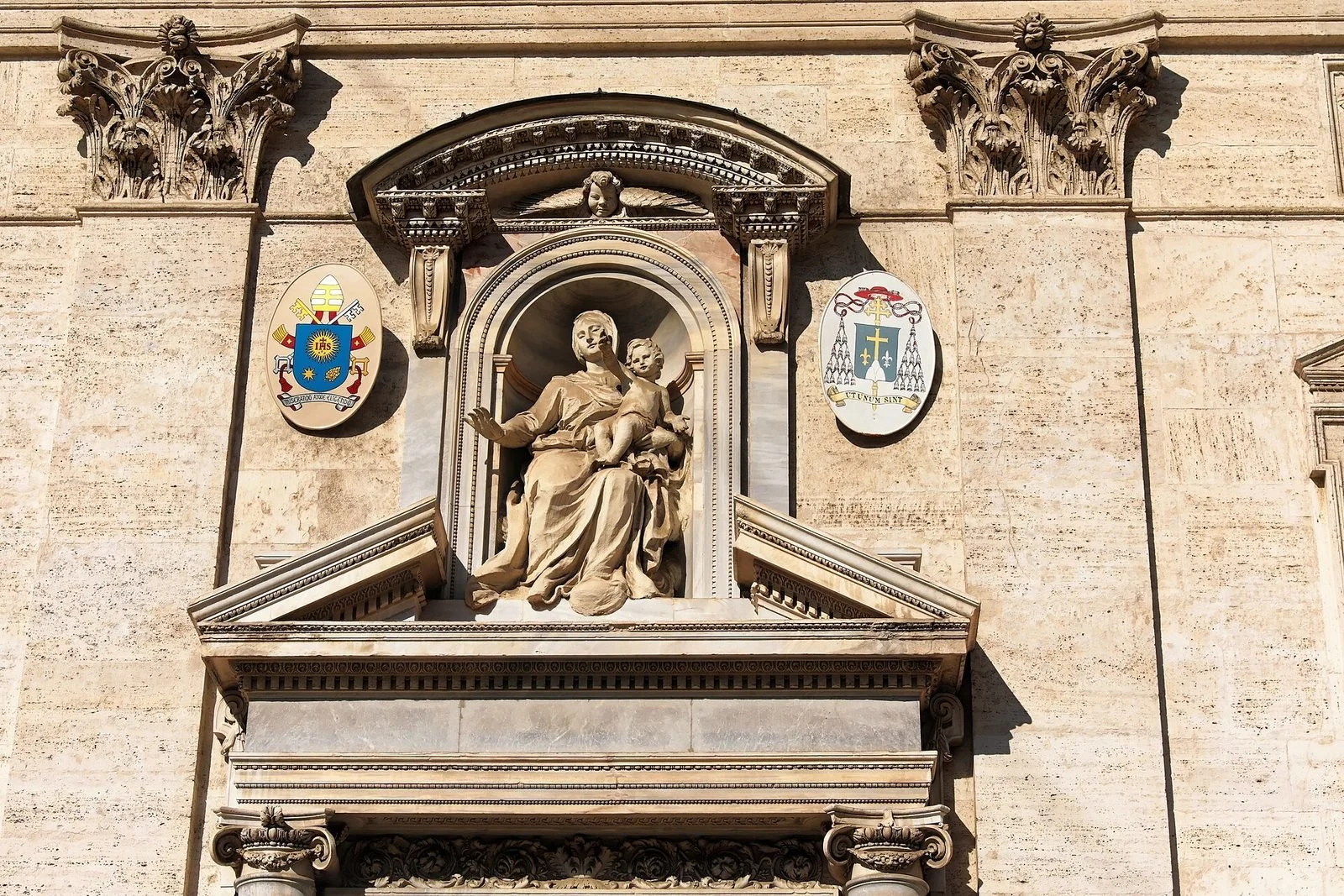
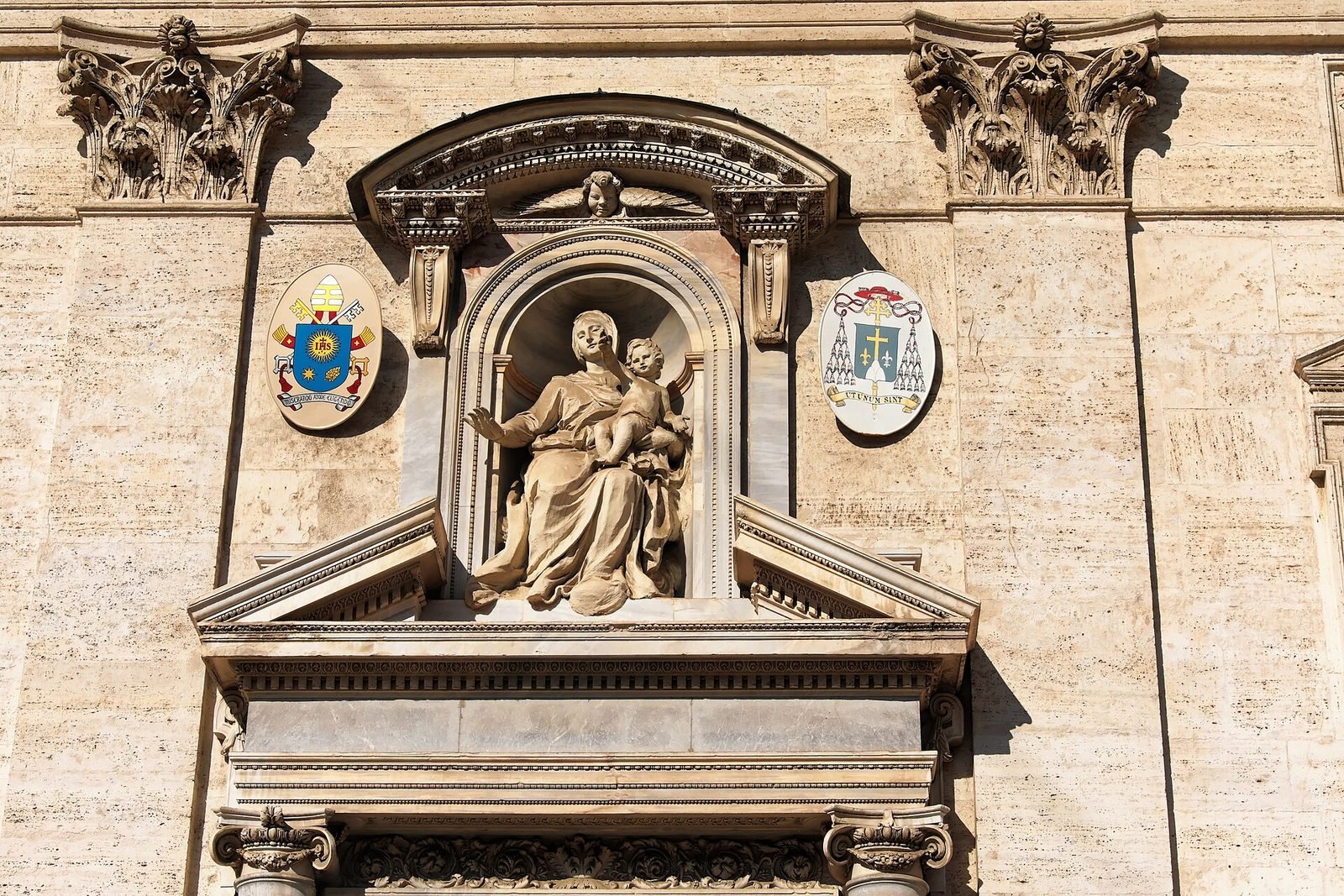
Santa Maria in Transpontina is the Carmelite church that opens onto Via della Conciliazione at number 14, halfway between Ponte Sant'Angelo and Piazza San Pietro. It is the only significant church left standing along that axis. All the others, with the houses and shops of the Spina di Borgo, were torn down between 1936 and 1950 to open the avenue that leads to the Vatican. This one was saved because it lay outside the demolished strip, on the southern front. The paradox is that it owes its existence to another demolition, much older and much less known: that of the building that preceded it, razed in 1564 by order of Pius IV because it obstructed the line of fire of the artillery of Castel Sant'Angelo. The full story of the Spina, of the plans that condemned it and of what was lost is in the entry on the Borgo district, which covers the neighborhood as a whole. Here the subject stays the single church, its construction site and its interior.
Where Santa Maria in Transpontina is and how to get there
The church's address is Via della Conciliazione 14, in the Borgo district, about 200 meters from Bernini's colonnade and a little over 300 from the bridge over the Tiber. The historic postal address of the Carmelite community is instead Borgo Sant'Angelo 15, at the back, and this occasionally confuses GPS navigators. The door you use to go in is the one on the avenue, under the stucco group with the Madonna and Child.
On foot, from the historic center
From the center you almost always arrive on foot, and it is the solution we recommend. From Piazza Navona the route goes along Via dei Coronari, crosses the Tiber on Ponte Sant'Angelo and runs alongside the castle: just under 20 minutes, with no climbs. From Campo de' Fiori it is half an hour along Via dei Banchi Nuovi, the final stretch of Via Papale. Anyone coming from Trastevere can go back up the right bank and slip into Borgo Santo Spirito, parallel to the Conciliazione and much less trodden.
By public transport
The nearest subway stop is Ottaviano, on line A, about 12 minutes' walk. Lepanto, also on the A, is a little farther but often less congested. There is also San Pietro station, served by the regional trains to Viterbo and Civitavecchia, about 15 minutes away. On the surface, the lines that run up the Lungotevere on the right bank and those that serve Piazza Pia let you off at the mouth of the avenue, which in its central stretch is closed to private traffic. We explain tickets, lines and time validity in how to get around Rome.
By car, and why it is best avoided
Arriving here by car is the worst possible choice. Via della Conciliazione is pedestrian in its central stretch, Borgo Pio is a restricted traffic zone, parking in Prati is paid at all daytime hours Monday to Saturday, and on audience days the area is cordoned off with little notice. A park-and-ride on subway line A is better. If you land at Fiumicino or Ciampino, you find the connections in the entry on Rome's airports.
Traspontina or Transpontina: where the name comes from
The name derives from its position relative to the river and the bridge: trans pontem, beyond the bridge, that is, on the other side of Ponte Sant'Angelo for anyone arriving from the inhabited center of Rome. In medieval documents the church appears with an impressive series of variants, and this explains why two spellings are still in circulation today.
The attested spellings
The records call it in capite pontis, transpontem, traspontina, in transpondino, even in turrispadina, a scribe's distortion. The form that has prevailed in current use, and the one used by the parish itself, is Traspontina with a single n. Transpontina, closer to the Latin etymology, remains common in the art-historical literature and in guidebooks. We use them here as equivalents, noting that anyone looking for official information on the parish will get there faster with the single-n variant. An older name, Santa Maria in Virgariis, that is, among the osiers, recalls the marshy reed bed that occupied the bank before the 19th-century embankments.
The old church and its demolition: the cannons of Castel Sant'Angelo
This is the fact that makes Santa Maria in Transpontina different from any other Roman church, and almost nobody knows it: the building you visit today exists because its predecessor was torn down for reasons of artillery. The old church stood closer to the river and to the bulk of Castel Sant'Angelo, and that closeness, which for centuries had been a commercial and devotional advantage, became a military problem in the 16th century.
The church of Hadrian I and the pilgrims' portico
The sources date the first church to Pope Hadrian I, so to the end of the 8th century. It stood along the covered portico that led from the bridge to the Vatican basilica, the Portica, and served to give shelter, water and food to pilgrims who arrived exhausted after weeks of walking. It was a service function before a function of worship, within a system of hospices that occupied the whole stretch between the bridge and the basilica and of which the main surviving witness is Santo Spirito in Sassia. It also had a precise ceremonial role: in imperial coronations the sovereign stopped here to kiss the papal slipper, and from that moment he had to hold the reins of the pontiff's horse on foot.
July 13, 1564: the demolition order
The measure bears the date of July 13, 1564 and the signature of Pius IV. The complex of the old Traspontina, with church, convent and attached structures, was expropriated and demolished to clear the field of fire of the artillery of Castel Sant'Angelo. The reason is understood only by keeping in mind what the Mole Adriana had become in the 16th century, that is, the fortress that guaranteed the physical survival of the pope, as had been seen in the most brutal way during the Sack of 1527, when Clement VII took refuge there by way of the Passetto di Borgo.
After that experience the pontiffs invested enormous sums in the bastioned system around the castle. Artillery of the period fired in a straight line and by sight: any tall building in front of the muzzles took away useful angle and created a dead zone in which a besieger could gather under cover. The old church, tall and set against the defensive perimeter, covered the sector facing the Janiculum. For the military engineers of Pius IV it was an obstacle, and it was treated as one.
What the sources say, and where they diverge
On this point the sources agree in substance and diverge in nuance, and it is right to say so. English-language reference works speak explicitly of clearing the field of fire of the castle's cannons toward the Janiculum. The specialist ones on Roman churches date the act to 1564 and use the broader formula of strengthening the fortifications. The local guides give July 13, 1564 and add that the old church suffered chronically from Tiber floods, which suggests a second, concurrent motive. The most solid proof of the ballistic version, though, is not in the texts. It is in the new building, in the dome without a drum and in the chapel dedicated to the fortress's bombardiers. These are two material clues that are hard to explain otherwise.
The construction of the new church: 1566, and about a century to finish it
The first stone of the present church was laid in 1566, two years after the demolition of the previous one, on a lot set back from the river and carved out where the governor's residence had previously stood. The construction site dragged on for decades and passed through the hands of at least five different architects, with a slow initial phase and a completion that reaches the second half of the 17th century.
Giovanni Sallustio Peruzzi, il Mascherino and the first bays
The initial design and the first four bays of the nave are due to Giovanni Sallustio Peruzzi, son of that Baldassarre who had built the Farnesina and worked on the construction of St. Peter's. The plan he sets out is a Latin cross, with chapels recessed into the thickness of the walls and a dome at the crossing. After a phase entrusted to Battista Ghioldo between 1569 and 1581, the site passes to Ottaviano Nonni, called il Mascherino, who in the 1580s defines the layout of the facade and a good part of the elevation. In 1587 the church was far enough along to be raised by Sixtus V to a cardinal title church, on April 13. This is an indirect and fairly reliable sign that by that date it could be used for services.
When the construction really ends
Francesco Peparelli completes the sacristy, choir and bell tower between 1635 and 1637, and Simone Broggi closes the dome in 1668. On the completion date the sources diverge: some give 1637, others 1668, still others the 1674 of Fontana's altar, which is however a furnishing. The most honest reading speaks of a construction site lasting about a century, with a church usable already from 1587.
The flattened dome: the only one in Rome without a drum, and why
Santa Maria in Transpontina is commonly described as the only church in Rome whose dome does not rest on a drum. The drum is that cylindrical body, often with windows, which in post-Renaissance churches lifts the cap and gives it thrust. The one at St. Peter's, to give an idea, is as tall as a building. Here it is missing altogether, and the cap sits directly on the pendentives. The result, seen from outside, is a low dome that is almost invisible from the street.
The technical explanation
The reason reported consistently by the sources is that the gunners of Castel Sant'Angelo required that neither the dome nor the bell tower of the new church intercept the line of fire from the walls of the fortress. Having just had the old church demolished for that reason, the curia had no intention of rebuilding one that would present the same problem again. Giving up the drum is therefore a choice imposed from outside, one of the few Roman cases in which a decision of sacred architecture was dictated by an artillery office.
The facade on Via della Conciliazione
The facade is in travertine blocks, on two orders and five bays, with a crowning of multiple pediments that is the least banal thing about the front. Above the main portal a stucco group from the 18th century with the Madonna and Child helps you recognize it from far away. Several local sources report that part of the travertine comes from ancient spolia, and in particular from the Colosseum, which until the 17th century worked as a quarry for Roman building sites. This is a fact reported steadily in popular accounts, but we are not able to point to the archive documentation that supports it, and we give it as a traditional attribution.
Why the facade looks out of proportion today
It is worth noting one thing: this facade was not designed to be seen from 30 meters away, but at an angle, from a narrow street, by people walking right along the wall. Via della Conciliazione, by opening a perspective vista 500 meters long, changed its viewing conditions without touching a single stone. The front that looks modest today was, in the context of Borgo Nuovo, a front of considerable standing. It is the least visible damage produced by the demolition of the 1930s and 1940s: it concerns not only what was removed but the scale of what remained.
Inside: the plan, the nave and the 10 chapels
The interior is a Latin cross, with a single broad nave flanked by 10 chapels, five on each side, recessed into the thickness of the walls. Some descriptions speak of side aisles. The chapel formula describes better what you perceive walking through, because they are enclosed spaces and not a continuous colonnade. They are not all equally interesting, and lying about this helps nobody: three deserve a real stop, those of Saint Barbara, of Saints Peter and Paul and of Saint Teresa of Avila. The others you walk through.
The high altar by Carlo Fontana
The high altar bears the date 1674 and is the work of Carlo Fontana, the architect who in Rome picks up the legacy of the Berninian building site and translates it into a more controlled language. The altar structure has the shape of a crown, held up by eight columns of Sicilian jasper, with gilded bronzes, putti and polychrome marbles. Anyone who has in mind the solutions of Bernini in Rome recognizes here the same grammar on a much reduced scale, and the comparison highlights how much space and light from above count in that language.
The icon of the Madonna and the question of the copy
At the center of the altar is an image of the Virgin with Child of the Byzantine type. Carmelite tradition holds that the original was brought to Rome by crusaders returning from the Holy Land, or by friars coming from Mount Carmel, with the 13th century as the reference date. The art-historical sources specify, however, that the image visible today is a 19th-century copy, and that the original was probably lost in the Napoleonic era. Devotion concerns the image as a sign and continues independently of the material story of the object, but visitors have a right to know what is in front of them.
The chapel of Saint Barbara and the gunners of Castel Sant'Angelo
If there is indirect proof that the story of the cannons is not a mere anecdote, it is this chapel. Saint Barbara is the patron of artillerymen and miners, that is, of those who handle explosives, and her chapel in Traspontina was built around 1594 with the money of the confraternity of the gunners of Castel Sant'Angelo, with the support of Cardinal Pietro Aldobrandini, nephew of Clement VIII.
A decoration made of weapons
The decorative apparatus is explicit to the point of surprise: cannons, mortars, swivel guns, culverins, grenades and powder barrels appear in the ornament the way festoons and shells appear elsewhere. The altarpiece is attributed to the Cavalier d'Arpino, active here around the middle of the 1590s, and shows the saint with thunderbolts. The Cavalier d'Arpino is the same painter in whose workshop Michelangelo Merisi passed as a very young man: we have gathered his Roman traces in Caravaggio in Rome. The company of gunners also had the privilege of obtaining the release of two condemned prisoners on the feasts of Saint Barbara and Saint Michael. It was suppressed in 1783.
The two columns of Saints Peter and Paul: devotion, not archaeology
In the chapel dedicated to the two apostles are kept two ancient column shafts, broken, which tradition identifies as those to which Peter and Paul were supposedly tied for the flogging before their martyrdom. It is the object for which most visitors enter this church, and it is also the one about which the most misunderstandings circulate. It helps to separate the levels precisely.
What you see
You see two fragments of marble shaft, of modest size and with a worn surface, set in a display structure that isolates and protects them. The general catalog of cultural heritage records them as fragments of a column shaft of Roman manufacture attributable to the 1st century. They are therefore, materially, two pieces of an imperial-age column, of the kind recovered by the hundreds in any excavation in Rome.
What tradition says
Devotional tradition, attested at least from the late Middle Ages, identifies them as the columns of the flogging of the apostles. The parish sources tell that they came from the chapels of the Portica, along Via Santa that led to St. Peter's, and that they were transferred to the old Traspontina by Celestine III, who consecrated its altar: we are at the end of the 12th century. When the old church was demolished in 1564, the columns were among the very few elements moved to the new one, which is the clearest way to understand how important they were considered.
What history says, and how to take them
No ancient document links those fragments to the apostles, and no analysis could, because a piece of 1st-century marble does not carry written on it what it was used for. We are in front of a contact relic, whose identification rests entirely on devotional transmission. We say so plainly and with no intention of belittling: the story of these columns is true as a story of worship, and that is the level on which it should be read. Whoever enters knowing they are looking at 900 years of unbroken devotion sees much more than someone expecting a certified archaeological find.
Saint Philip Neri and the speaking crucifix
The columns were venerated by leading figures of Counter-Reformation Rome, and the parish sources recall Saint Philip Neri among the devotees. Above the altarpiece, in an oval frame, there is a small crucifix from the old Traspontina, placed here in 1587. To this too tradition attributes a prodigy, that of having spoken to Peter during his imprisonment in the Mamertine Prison. Art history dates it to the 14th century. The paintings of the chapel are due to Giovan Battista Ricci da Novara and were completed in 1619. On the wall two inscriptions remain, one for the patron Giovanni Battista Stanga and one from 1496 that documents the traditions of the old church, proof that the story of the columns was already circulating before the 16th-century move.
The Carmelites, Our Lady of Mount Carmel and the scapular
The church has been served by the Carmelites since 1484, when Innocent VIII entrusted the old Traspontina to them. These are the Carmelites of the ancient observance, those the sources call Calced, distinct from the Discalced branch born from the reform of Teresa of Avila and John of the Cross in the following century. The continuity is remarkable: over 500 years in the same place, through a total demolition and a rebuilding from scratch.
What the Carmel devotion is
The dedication is to the Virgin under the title of Our Lady of Mount Carmel, from the ridge overlooking the Mediterranean where in the 12th century the Latin hermits from whom the order originates settled. The feast falls on July 16 and is one of the most deeply felt Marian celebrations in southern Italy and in the Spanish- and Portuguese-speaking world. Anyone who comes by in mid-July finds a different turnout from the rest of the year. The most characteristic devotional element is the brown scapular, whose imposition is still a living practice here. Tradition traces its origin to a vision of Saint Simon Stock in the 13th century, and like all traditions of this kind it should be taken for what it is.
The chapel of Saint Teresa and Antonio Gherardi
The third chapel to look at carefully is that of Saint Teresa of Avila, decorated entirely by Antonio Gherardi in 1698. Gherardi, born in Rieti, works at once as painter, architect and stuccoist, and here the three skills operate in agreement. The altarpiece is considered by several scholars his masterpiece, with the saint presented in two circular compositions, and the stucco apparatus builds around the painting an architectural frame that governs how it is read. He is the author of the two most inventive Roman chapels of the late 17th century in terms of lighting design, in San Carlo ai Catinari and in San Francesco a Ripa. Here you find a more restrained version, with no line and no ticket.
The only church left on the axis: what vanished with the Spina di Borgo
Between 1936 and 1950 the strip of buildings between Borgo Vecchio and Borgo Nuovo, that is, the Spina, was torn down to open Via della Conciliazione. With the houses went churches, oratories and chapels. Among the most cited losses are San Giacomo Scossacavalli, whose square was the center of gravity of the neighborhood, and Sant'Angelo al Corridore. Santa Maria in Transpontina was not within the demolished strip and found itself, once the works were finished, aligned with the new street front.
Why it was saved
The explanation is geometric before it is cultural. The Spina occupied the wedge of blocks between Borgo Vecchio and Borgo Nuovo, and the demolition concerned that. The church stood on the southern side, beyond Borgo Nuovo, and the route of the new avenue grazed it without touching it. It was not spared because of a value judgment on the monument. It was spared because it was outside the perimeter. Several buildings of equal or greater merit that stood inside that perimeter did not have the same luck.
Where to read the rest of the story
The extended account of the Spina, with the dates of the plans, the names of the designers and the position of the vanished buildings, is in the entry on the Borgo district, which treats the neighborhood as an urban whole. This page deals only with the building. If you want a wider tour, from the Vatican to the Tiber and beyond, you find it in Prati and Borgo, which is an itinerary and not an entry on a single place.

A curiosity about Santa Maria in Transpontina
The curiosity we always tell concerns a fugitive. According to the account handed down by local guides and tied to the famous escape of Benvenuto Cellini from Castel Sant'Angelo, the Florentine goldsmith and sculptor found refuge right in Traspontina after lowering himself from the walls of the fortress. The episode of the escape is told by Cellini himself in his Life and is placed around 1539. The stop at the church is reported by local tradition, and we are not able to verify it against a primary source, so we give it as such.
Why a church could shelter an escaped prisoner
The mechanism is historically rock solid and explains a lot about this neighborhood: churches enjoyed the right of asylum, and whoever crossed their threshold could not be taken by the constables without violating a sacred space. A church 100 meters from the most important prison of the state was, from the point of view of an escapee, the most rational destination possible. The right of asylum was eroded between the 18th and 19th centuries and abolished in the Italian era, but in the 16th century it worked, and it worked like this.
Something nobody tells you about Santa Maria in Transpontina
What nobody says is that this church is the most eloquent monument in Rome to the supremacy of military engineering over sacred architecture, and it is so twice: when the old church is demolished in 1564 to clear the line of fire, and when the new one is born with a dome stripped of its drum. To measure how anomalous this is, just look at the years. While here the drum is given up, a few hundred meters away the dome of St. Peter's is being closed, reaching the lantern in 1590 and becoming the model for all of Catholic Europe. Same neighborhood, same decades, same popes: the tallest dome of Christendom is being built, and a parish is ordered to have almost none. The difference between the two cases is the line of fire. Knowing it, you look at the church in another way, and the first thing to do as soon as you enter is to raise your eyes at the crossing of the transept to notice that the light you would expect is missing.
A recent episode: the Amazonian statues of October 2019
In recent years Santa Maria in Transpontina made international news for an episode tied to a church controversy, and we report it for documentary completeness, briefly and without taking a position. During the Synod of Bishops for the Amazon, held in the Vatican between October 6 and 27, 2019, the church hosted from October 18 an exhibition dedicated to Amazonian cultures that included some wooden statues depicting a pregnant female figure. On October 21 two people went in, took the statues and threw them into the Tiber from a nearby bridge. They were recovered intact by the police.
On October 25 Pope Francis intervened publicly, asking forgiveness of those who had felt offended by the act and declaring that there had been no idolatrous intention in the exhibition. The affair fueled a heated debate for months, with opposing readings. We don't go into the merits: we record facts, dates and outcome, and we note that today no visible trace of the episode remains in the church.
Hours, entrance and visiting rules
Entrance to Santa Maria in Transpontina is open and free, as in all Roman parish churches: there is no ticket office, no booking, no paid circuit that includes it. Anyone who offers a ticket to visit this church is selling something else, usually a guided tour of the neighborhood.
The hours vary, and we don't invent them
Opening hours change with the liturgical seasons, with the needs of the Carmelite community and with Vatican events, and the third-party sources that report them contradict each other. For this reason we don't publish a schedule table: it would be wrong within a few months. The general pattern is the classic one of Roman parishes, morning opening, closing in the middle hours and reopening in the late afternoon until the evening Mass, but the exact times have to be asked directly.
Where to check before going
There are two reliable channels, the parish website, which publishes the times of services and notices, and the church's telephone. A third way is to stop at the door and read the posted notice, which remains the most up-to-date document of all. On general audience days and during large celebrations in Piazza San Pietro, the area may be affected by closures and pedestrian detours decided on the day by the police, regardless of the church's hours. On photographs: without flash and without a tripod they are normally tolerated, but they remain a concession, and during services the visit to the chapels is suspended.
Eating around Via della Conciliazione: how to recognize a trap
Let's say it bluntly: the stretch between Castel Sant'Angelo and the colonnade, together with Borgo Pio and the side streets climbing toward Prati, is among the areas of Rome with the highest concentration of places built on passing trade and not on the customer coming back. The reason is arithmetic. Tens of thousands of people pass through here every day who will never return, and a business that lives off passing trade has no economic incentive to make them eat well. We don't name signs, either favorably or unfavorably: a list of names goes stale in a few months and teaches nothing. What you need is the method.
The five signs we recognize in the field
The first sign is the lady rolling fresh pasta in the window or on the sidewalk. It is a staged lure designed to stop passersby, and in the vast majority of cases the pasta that reaches the table is not that pasta. A kitchen that works well keeps the pasta sheet in the workshop.
The second is the menu with photographs of the dishes, on laminated panels, translated into five or six languages. The photograph serves people who don't need to understand what they are ordering, and a place that addresses people who don't understand has already decided not to be judged on its food.
The third is the barker, the person at the entrance who invites you to sit down. No place where Romans eat needs to convince people to come in, and the cost of that employee is recovered somewhere.
The fourth is continuous hours from morning to night, with no kitchen break. A real kitchen has two services and stops in between, because between 15:00 and 19:00 it is prepping. Whoever serves carbonara at 16:30 is heating up something ready-made.
The fifth is the position: tables in front of the monument, with the view sold together with the dish. Here you may find unpriced items, different prices between the price list displayed outside and the one at the table, cover charges that appear only at the end. The practical rule: if you can photograph the dome from the table, you are paying for the dome.
The chain places in the center
A word on the chains, which have a notable presence here: the same sign repeated a few hundred meters apart, identical menu, lines with a ticket number, standardized service. We don't name any and we don't recommend any. The observation that counts is factual: Romans don't go there. People who work in the area, who live in Prati, who come out of the Borgo offices eat elsewhere, and you only have to look at who occupies those tables at noon to verify it.
The simplest criterion of all
The criterion we always give, and it works everywhere in Rome, is to look at who is sitting and in which language they order. If the tables hold people who speak Italian with a Roman accent, who walk in without looking at the menu displayed outside and who greet the people working the floor, the place holds up. If there are only visitors with backpacks and a map, however pleasant the sign, you are eating in a place that lives off passing trade. A second reliable clue: a Roman neighborhood place fills up at 13:30 and at 20:30, not at 12:00 and at 18:30.
Where to look for something better, and a curated list
The right direction is to move away from the pedestrian axis: 300 meters is enough, going up into Prati toward Via Cola di Rienzo or going down to the Lungotevere and crossing into Trastevere, and the ratio between quality and price changes noticeably. The general criteria are in where to eat in Rome. Those who prefer to start from already selected addresses can use the personal list by Daniele Dezi on Google Maps, a collection curated over time and not sponsored. For lodging, where to stay in Rome.
My advice for visiting Santa Maria in Transpontina
The practical advice is just one and it changes the visit: enter here before St. Peter's, not after. Whoever comes out of the basilica has saturated eyes and no mental availability for a parish church, and in Traspontina stays seven minutes looking at the phone. Whoever stops here coming from Ponte Sant'Angelo, with the colonnade still ahead, arrives in the square having already understood what Borgo was like before 1936.
How to organize the half hour
Half an hour is more than enough. Five minutes at the back of the nave, looking toward the altar and toward the crossing of the transept. 10 in the chapel of Saints Peter and Paul, reading the inscriptions. Eight in that of Saint Barbara looking for the cannons in the ornament, which works with kids too. Five in that of Saint Teresa, two at the high altar for the jasper columns. On the way out, turn left and look at the bell tower from below.
The verdict, without beating around the bush
We give a clear verdict, because a page without an opinion is useless. Santa Maria in Transpontina is a second-tier church on the artistic level: it has no absolute masterpiece, and anyone with two days in Rome can skip it without regret. It does, however, have the most interesting history of the whole stretch, it is free, and it contains three things that are worth the stop. Its value is that of a context: it explains the neighborhood better than any panel. Seen as a five-minute stop between the subway and the colonnade it is wasted time. Seen as a key to reading Borgo, it is a half hour well spent.
Another well-known fact, yet rarely mentioned
The fact is this: Santa Maria in Transpontina has been a cardinal title church since April 13, 1587, by decision of Sixtus V, and it still is today. Many people who deal with Vatican matters know it, and almost no guide mentions it, yet it is the information that explains why a neighborhood parish has furnishings and chapels of this level.
Why the fact matters for visitors
It matters because it changes expectations. A neighborhood parish church in Italy usually has modest furnishings. Here there are an altar by Carlo Fontana, an altarpiece by the Cavalier d'Arpino, a chapel signed entirely by Antonio Gherardi and an apparatus of polychrome marbles that in a provincial town would be the showpiece of the cathedral. The reason is that this has never been an ordinary parish: it is the church of the Carmelites 200 meters from the basilica, in a district inhabited for centuries by the papal bureaucracy, and it has been a cardinal title church for over four centuries.
The right photo to take at Santa Maria in Transpontina
The right photo to take at Santa Maria in Transpontina is not the frontal facade, which is the first that comes to mind and the least interesting, because the width of the avenue squashes the front and flattens it. The photo that works is the one that puts in the same frame the church and the reason it is built the way it is.
The framing we recommend
You stand on the opposite sidewalk, stepping back about 40 meters toward Castel Sant'Angelo, and frame diagonally. Into the frame come the facade at an angle, the slender bell tower, the low dome that barely emerges from the roof and, in the background, the bulk of the castle. It is the only position from which you see together the fortress and the building the fortress shaped, and a lens around 35 millimeters equivalent works better than an extreme wide angle. Inside, detail works and not the whole: the cannons in the ornament of Saint Barbara and the two column shafts shot at three quarters, never head-on.
Some important events that took place here in history
The chronology of Santa Maria in Transpontina covers 1,200 years and goes through two demolitions, a sack, a complete rebuilding and a contemporary controversy. We summarize it by verified dates, noting where the sources diverge.
From the 8th to the 15th century
End of the 8th century: foundation of the first church, attributed to Hadrian I, along the pilgrims' portico. End of the 12th century: Celestine III consecrates the altar of the chapel and has the two columns transferred there from the chapels of the Portica. 1484: Innocent VIII entrusts church and convent to the Carmelites, who have served it without interruption ever since. 1496: the inscription documenting the traditions of the old Traspontina is carved.
The 16th century
1527: the Sack of Rome puts Borgo to fire and sword. July 13, 1564: Pius IV orders the expropriation and demolition of the entire complex to clear the field of fire of the castle's artillery. 1566: the construction of the new church begins, on a design by Giovanni Sallustio Peruzzi. April 13, 1587: Sixtus V raises the church to a cardinal title church, and in the same year the crucifix from the old building is placed. Around 1594: the chapel of Saint Barbara is built with the funds of the gunners' confraternity.
The 17th and 18th centuries
1619: Ricci da Novara completes the decoration of the chapel of Saints Peter and Paul. 1635-1637: Peparelli completes sacristy, choir and bell tower. Around 1640: the chapel of Saint Canute sets the link with the Danish community. 1668: Broggi closes the dome. 1674: Fontana signs the high altar. 1698: Gherardi decorates the chapel of Saint Teresa. 1783: the gunners' confraternity is suppressed.
From the 19th century to today
Between the 18th and 19th centuries, in the years of the Roman Republic, the original Marian icon was in all likelihood lost, later replaced by the copy visible today. 1931: a Danish physician donates the relic of Saint Canute, and the church is still the reference point for Danish Catholics in Rome. 1936-1950: the Spina di Borgo is demolished and Via della Conciliazione opened. The church stays standing and finds itself facing the new avenue. 2003: the cardinal title passes to Marc Ouellet. October 2019: the episode of the Amazonian statues.
Who passed through Santa Maria in Transpontina
The list of who passed through Santa Maria in Transpontina is long for a structural reason: for centuries, anyone who reached the Vatican basilica from Rome passed in front of this church or in front of its ancestor. Here, though, we keep only the names for which the link is documented or steadily attested by the sources, and we distinguish the two levels.
The popes
Hadrian I, to whom the foundation of the old church is attributed. Celestine III, who consecrated the altar of the columns. Innocent VIII, who in 1484 handed the church over to the Carmelites. Pius IV, who in 1564 ordered its demolition. Sixtus V, who in 1587 made it a cardinal title church. Francis, who in October 2019 intervened publicly on the episode of the statues. Five of these six names left a material mark that is still visible.
The artists and architects
Giovanni Sallustio Peruzzi, son of Baldassarre, designer of the new church. Battista Ghioldo and Ottaviano Nonni, called il Mascherino, who continued the construction. Francesco Peparelli, author of the bell tower and the sacristy. Simone Broggi, who closed the dome. Carlo Fontana, author of the high altar. Giuseppe Cesari, called the Cavalier d'Arpino, and Giovan Battista Ricci da Novara for the altarpieces of the two main chapels, Antonio Gherardi for that of Saint Teresa. To place them in the Roman panorama we have pages on Bernini and on Borromini.
The devotees and the fugitives
Saint Philip Neri, whom the parish sources recall among the devotees of the columns. Benvenuto Cellini, who according to local tradition found refuge here after the escape from the castle, with the caveat already given on the value of that report. Kristian Pyngk, the Danish convert who wanted the chapel of Saint Canute. And generations of pilgrims from northern Europe, for whom this was the last stop before the basilica: the district itself takes its name from the Germanic word for town, brought to Rome by them.
What to see around, in half a day
Santa Maria in Transpontina sits in the middle of one of the densest stretches of Rome, and a well-organized half day covers six or seven places without ever taking a vehicle.
Toward the river
200 meters to the east are Castel Sant'Angelo, paid and worth at least two hours, and Ponte Sant'Angelo with Bernini's angels, free. Along the side of the castle runs the Passetto di Borgo, visitable only on occasions and in ways that change from year to year. Staying in the district, one block from here, is the complex of Santo Spirito in Sassia with the Sistine ward and the foundling wheel, and the arcaded streets of Borgo Pio, what remains of the small-scale fabric of the neighborhood.
Toward the Vatican
On the other side, a few steps away, open Piazza San Pietro with the Vatican obelisk at the center and St. Peter's Basilica. The entrance to the Vatican Museums is instead on the other side of the walls, on Viale Vaticano, about 10 minutes' walk away. Inside the route you visit the Sistine Chapel, while the Vatican Gardens can be seen only with a booked guided visit. The general overview of the State is in Vatican City.
A little farther
Climbing the Janiculum you reach Bramante's Tempietto in San Pietro in Montorio and Sant'Onofrio. Beyond the bridge you meet San Giovanni dei Fiorentini and Santa Maria della Pace with Bramante's cloister. Those who want to stay on the theme of Marian churches can continue with Santa Maria in Campitelli, Santa Maria in Aracoeli or Santa Maria in Cosmedin.
Frequently asked questions about Santa Maria in Transpontina
How much does it cost to enter Santa Maria in Transpontina?
Entrance to Santa Maria in Transpontina is open and free, as in all parish churches of Rome. There is no ticket office, no booking, and no museum circuit includes it. If someone offers a ticket for this church, they are selling an accompanying service and not access, which remains free during opening hours. An offering for maintenance is welcome, as always.
What are the opening hours of Santa Maria in Transpontina?
The hours of Santa Maria in Transpontina are variable and change with the liturgical seasons and with Vatican events, so we don't publish a fixed table. The recurring pattern is that of Roman parishes, with opening in the morning, closing in the middle hours and reopening in the late afternoon until the evening Mass. Before going, it is worth checking the parish website, calling the church or reading the notice posted at the door, which remains the most up-to-date information.
Where exactly is Santa Maria in Transpontina?
Santa Maria in Transpontina is at Via della Conciliazione 14, in the Borgo district, on the left side of the avenue for those walking toward Piazza San Pietro. The postal address of the Carmelite community is Borgo Sant'Angelo 15, at the back, and this sometimes confuses GPS navigators. The most convenient subway stop is Ottaviano on line A, 12 minutes on foot.
Are the columns of Santa Maria in Transpontina really those of Peter and Paul?
The two columns kept at Santa Maria in Transpontina are fragments of a shaft of Roman date, assigned to the 1st century by the general catalog of cultural heritage, which devotional tradition identifies as those to which the apostles were supposedly tied for the flogging. No ancient document and no material analysis can confirm it. They are contact relics, whose value is one of worship and not archaeology. The devotion is attested at least from the 12th century and is documented by an inscription of 1496.
Why is the dome of Santa Maria in Transpontina so low?
The dome of Santa Maria in Transpontina is low because the gunners of Castel Sant'Angelo required that neither the dome nor the bell tower intercept the line of fire of the fortress's artillery. It is commonly described as the only dome in Rome that does not rest on a drum. The same reason had already led, in 1564, to the demolition of the medieval church that stood closer to the castle, replaced by the present building starting in 1566.
Can you take photographs inside Santa Maria in Transpontina?
Inside Santa Maria in Transpontina, photographs without flash and without a tripod are normally tolerated, as in almost all Roman parishes, but they remain a concession and not a right. If a cleric or a volunteer asks you to stop, you stop, and during services you put the camera away. For professional shoots, drones and any commercial use of the images you need a permit to be agreed in advance with the Carmelite community.
Is Santa Maria in Transpontina accessible to people with mobility difficulties?
The main entrance of Santa Maria in Transpontina on Via della Conciliazione has some steps, like almost all historic Roman churches, while the interior is on a single level, broad and passable. We don't have verified information on ramps or alternative accesses and prefer not to state anything we haven't checked. Anyone with specific needs does well to phone the parish first. The avenue in front is pedestrian and flat.
Who wrote this page
This page is edited by the team of Tour Leader Pro, the Rome-based project office that designs and coordinates visits, itineraries and cultural events in Rome and Lazio. The hours, fares and access conditions given here were verified at the date of publication on the official sources indicated in the text. It is worth rechecking them before you leave, because they change often. If you find outdated information, let us know.
If you are interested in seeing Santa Maria in Transpontina within a thought-out route through Borgo, with a guide who can tell the story of the demolished Spina and the relationship between the church and the fortress, the reference is Tour Leader Pro, which organizes visits and itineraries in Rome and Lazio with licensed guides and handles logistics for groups, schools and companies.
If instead you are building a longer trip in Italy and need to work out how to fit Rome together with the rest, how many days to give each city and how to move between one stop and the next, you find guides and itineraries on ItalyPlanner, which works on planning the whole itinerary and not the single visit.