San Gioacchino in Prati
In short. San Gioacchino in Prati is on Via Pompeo Magno, at the corner of Piazza dei Quiriti, and the Roma Capitale tourist portal gives street number 106.
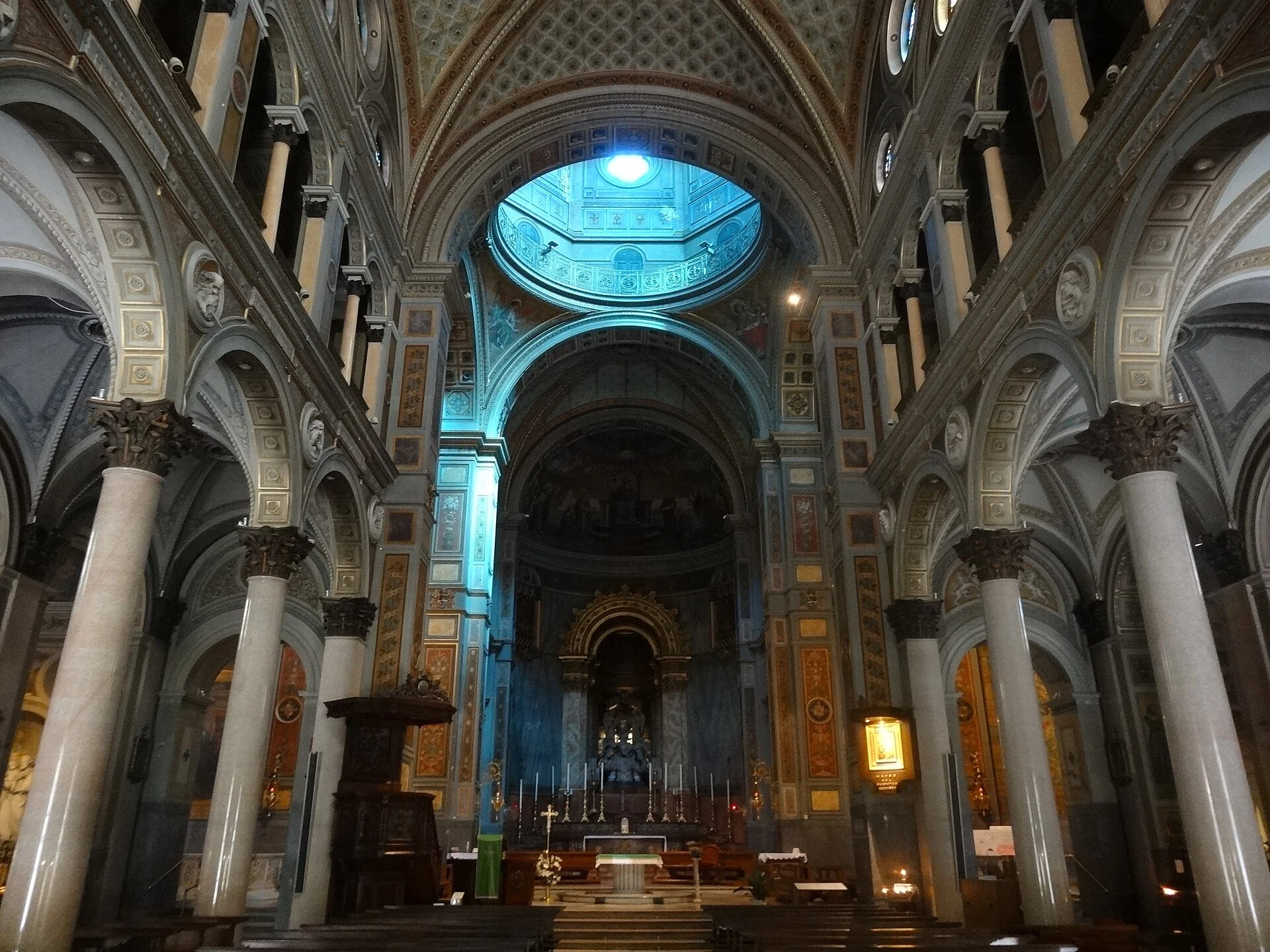
San Gioacchino in Prati is on Via Pompeo Magno, at the corner of Piazza dei Quiriti, and the Roma Capitale tourist portal gives street number 106. It's a parish church entrusted to the Redemptorist fathers, that is, the Congregation of the Most Holy Redeemer. Entry is free, there is no ticket and no booking is needed. You enter during the opening hours for worship, which the parish communicates at the numbers 06 3216659 and 06 3211734 or at the address SanGioacchino@VicariatusUrbis.org.
The reason people cross Prati to see it is the dome. Outside it's clad in aluminum, inside it's perforated with small glass stars that let daylight filter through. Under the dome are 14 chapels paid for by the Catholic nations for the priestly jubilee of Leo XIII, born Gioacchino Pecci. And between the vault and the roof, in the winter of 1943-1944, a group of people persecuted by the Nazis stayed hidden for months.
The practical information given here was checked on September 29, 2026 on the Roma Capitale tourist portal and on the pages of the Diocese of Rome. Mass and opening hours change between summer and winter, on holidays and on days of special celebrations, and the parish doesn't publish them on an official online calendar that everyone can read. Before crossing the city just for the dome, phone the parish and have them confirm when you'll find the door open.
Where it is and what you really see
The church occupies a lot on Via Pompeo Magno, between Piazza dei Quiriti and Via Ezio, inside the regular grid of streets that Rome, capital of Italy, laid out at the end of the 19th century on the old meadows of Castello. The district is one of law firms, offices and Umbertine buildings, a few minutes from the Palace of Justice. Those coming from Piazza del Popolo cross the Tiber and see it emerge among the rooftops.
From outside you first read the facade with its portico and columns, then, looking up, the silver-gray dome. The aluminum cladding has a color different from any other Roman dome, no dark lead and no tiles: on sunny days it reflects, on cloudy ones it looks almost like zinc. The two columns at the sides of the central door, according to the city's tourist portal, are a gift of the Tsar of Russia.
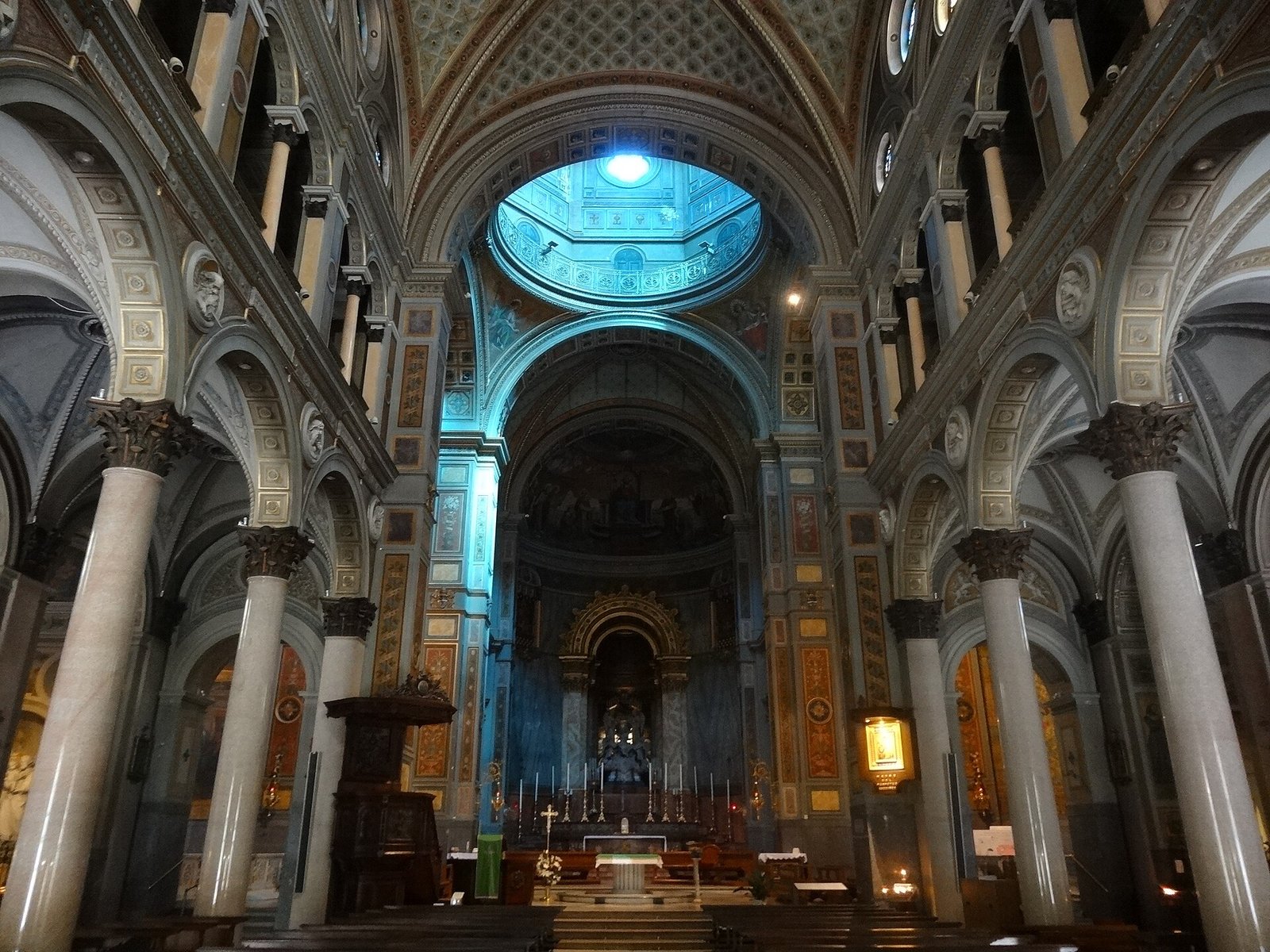
Inside the plan is a Latin cross, with three aisles divided by pink granite columns with bronze capitals. The marbles are polychrome, the metal furnishings abundant, the style is that late-century eclecticism that mixes Romanesque, Renaissance and Baroque without choosing. The main attraction remains the dome seen from below: the surface is pierced by crystal stars that, in the right light, dot the vault like a night sky.
The rest of the visit is the chapels of the nations, 14 in all, each with its patron saint, its painters and its altar. Brazil, Portugal, Bavaria, Poland, Canada, England, United States, Spain, France, Italy, Holland, Belgium, Ireland, Argentina. It's a catalog of the Catholic Church in the world around 1900, painted on the walls of a neighborhood parish. Take the time to read them one by one, because that's where the church tells you something.
To frame the area before going in, the page on Prati and Borgo is useful, which explains how the district formed between the Vatican and the Tiber. San Gioacchino is one of the few churches built specifically for the new inhabitants, together with the Sacro Cuore del Suffragio on the Lungotevere, which hosts the small museum of the souls of purgatory.
Piazza dei Quiriti deserves a glance before going in. It's one of the most orderly squares in Prati, with a fountain in the middle and early 20th-century buildings all around, and the name itself recalls the citizens of ancient Rome, like almost all the district's place names. The church occupies a corner of it without dominating it. Those arriving for the first time often circle the square looking for a monumental facade that isn't there, and find the dome before the door.
How to get in: hours, Masses and contacts
The church is a living parish, not a monument with a ticket office. You enter for free during the hours when it's open for worship and personal prayer. The parish doesn't publish online, on an official channel you can consult, an updated calendar of Masses and openings, and the Roma Capitale tourist portal refers you to direct contact. To know when you'll find the door open phone 06 3216659 or 06 3211734, or write to SanGioacchino@VicariatusUrbis.org or administrator@sangioacchino.org.
The institutional listing with address, phones and email can be read on the Roma Capitale tourist portal, which also points to the parish's Facebook page as a communication channel. That's where the community usually publishes notices about summer hours, holidays and special celebrations. If you need a Mass at a precise time, trust the phone more than any schedule aggregator found online, which is often seasons behind.
One official, dated piece of data helps to understand the parish's rhythm. In September 2023 the Diocese of Rome reported that for nine years there had been a weekday Mass at 13, introduced at the request of the lawyers of the area's firms. It's a clue: on working days the church follows the hours of the office district. If that time is still in force today, you must ask the parish, because the data goes back three years.
During services the tourist visit is suspended. No walking along the aisles, no photos, no conversations under the dome while Mass is said. If you enter and find a service under way, sit at the back or leave and come back later. Weddings and funerals often take up Saturday mornings and weekdays, and in those cases access to the side chapels may be limited. The dress required is that of any Roman church: shoulders covered, no swimwear.
A curiosity about San Gioacchino in Prati
The church's name is a birthday present, or nearly. Leo XIII was called Gioacchino Pecci, and the dedication to Saint Joachim, father of the Virgin according to tradition, recalls the pope's baptismal name. A Roman parish named after the namesake saint of the reigning pontiff, built to celebrate his 50 years of priesthood: it's a personal tribute written on the plan of the city, as happened in the Rome of the popes when buildings were still signed.
The priestly jubilee of Leo XIII fell at the end of 1887, 50 years after his ordination. The pope born in Carpineto Romano had reigned for 10 years, shut in the Vatican after the taking of Rome, without recognizing the Italian State. A new church in a new district, built by the secular government right under the Vatican walls, had a meaning that went beyond devotion: it was a presence.
The second curiosity is the metal. At the end of the 19th century aluminum was an industrial novelty, producible in quantity only for a few years, and using it to cover a dome was a technical and image choice at once. You often read that San Gioacchino has the first aluminum-clad dome in the world. It's a record repeated insistently, but the institutional sources consulted don't report it, so it should be taken as local tradition, not as fact.
Leo XIII and the Rome of the late 19th century
To understand San Gioacchino you have to go back to the years in which it was born. After 1870 the pope doesn't leave the Vatican and doesn't recognize the new State, which has made Rome its capital. Facing the Leonine walls, on meadows that until a few years earlier were gardens and vineyards below Castel Sant'Angelo, the government has a new district built with wide streets, bourgeois buildings and large public buildings. It's in that context that the pope gets his church.
The most visible building site in Prati, in those same years, is the Palace of Justice on the Lungotevere, which Romans will call Palazzaccio. The dates almost coincide: the courthouse too was inaugurated in 1911, the year in which the San Gioacchino construction site closed. Two big buildings in the same district, one of the State and one of the Church, grown in parallel a few streets apart. It's worth looking at them one after the other to feel the contrast.
Leo XIII is also the pope of the social question, the one who in 1891 signed the encyclical on the condition of workers. A neighborhood church paid for by the faithful of the whole world, entrusted to a congregation born to preach to the poor like the Redemptorists, inside a bourgeois district built by the secular State, is a message consistent with that season. Not a basilica for pilgrims, but a parish for those who lived there.
The aluminum dome and the crystal stars
The city's official description speaks of an aluminum dome perforated with crystal stars, through which light filters inside. It works like this: the inner shell is dotted with small transparent elements, and when the sun strikes the covering those points light up one by one. The brighter the day, the more the starry sky shows. In gray weather the effect is reduced to a dark vault with a few pale dots.
Here something needs saying that contrasts with what circulates online. The photos going around social media show a dense, sparkling firmament, and those who arrive expecting that are often disappointed. The stars are small, the dome is high, the eye takes a few minutes to adjust. The dome of San Gioacchino is overrated as a postcard spectacle and underrated as a technical object: its real interest is in the idea, not in the first impression.
If you want to see the effect at its best, go in during the middle hours of a clear day, when the sun is high and the covering receives more light. Stand under the center of the dome, let your eyes adjust to the half-light for a couple of minutes and then look up. That's the moment the stars detach from the vault. Always remember that access depends on worship hours and not on tourist ones.
From outside the dome is better understood than from inside. The metal cladding covers a tall shell above the drum, and the difference in color from the lead domes of the historic center is noticeable even from afar. From the Lungotevere of Prati, on clear days, it appears among the rooftops as a pale patch. After more than a century the metal has lost its original brilliance, and today the tone is closer to light gray than to silver.
Something nobody tells you about San Gioacchino in Prati
Look at where the church stands in relation to the square. Piazza dei Quiriti is a wide space with a fountain in the middle, and the natural spot for a church would have been on one of its sides, on axis. Instead San Gioacchino stands on an ordinary lot on Via Pompeo Magno, aligned with the other buildings, with no churchyard and no scenic backdrop. It's neither chance nor an architect's mistake, and the explanation says a lot about the district.
Prati was planned by the Italian State after 1870 as the district of the new capital, and the street names say so openly: the streets carry the names of heroes of republican and ancient Rome, from Cola di Rienzo to Pompeo Magno, from the Gracchi to the Scipios. In that climate places of worship received ordinary lots in the new subdivisions, aligned on the streets even secondary ones, instead of the dominant positions they had in papal Rome.
The consequence is still visible today: San Gioacchino has no overall view. From Piazza dei Quiriti you see a flank and the dome, from Via Pompeo Magno you see the facade too close up. To take it in whole you have to look for a lateral vantage point and accept that the church was built to be discovered in passing, not contemplated from afar. It's the opposite of the Baroque staging of Rome's older churches.
Another thing the guides ignore is the parish itself. In 2023 the Diocese of Rome wrote that in 1950 the territory counted 10,000 inhabitants and today fewer than 3,000. The district has emptied of residents and filled with offices, and the church has adapted its life to those who work there by day: the weekday Mass at lunchtime for the lawyers comes from that. A neighborhood church that changes its public without changing its address.
The chapels of the nations, one by one
The 14 chapels recall the countries that contributed to the construction. Brazil has the Madonna of Aparecida frescoed by Eugenio Cisterna from a design by Cesare Cappabianca. Portugal is dedicated to Saint Anthony of Padua, with paintings by Virginio Monti. Bavaria shows Emperor Henry II the Saint with his wife Cunigunde. Poland revolves around the icon of the Madonna of Częstochowa, with Saint Adalbert, Queen Jadwiga and other Polish saints painted by Attilio Palombi.
The chapel of Canada is dedicated to Saint Anne, with the Presentation of Mary at the Temple painted by Virginio Monti. England's is the richest in marbles: alabaster, malachite, gilded bronze, a bas-relief reproducing Leonardo's Last Supper, and the English saints from Thomas Becket to Thomas More and John Fisher. A stained-glass window shows Leo XIII between Prudence and Temperance. The United States chose the Immaculate Conception, with the biblical heroines Judith, Rebecca, Esther and Abigail.
The chapel of Spain, dedicated to the Madonna del Pilar, was inaugurated on October 12, 1908, the day of the Pilar feast. The paintings are by the Catalan José Nogué Massó, the altar is in Carrara marble, and the walls line up Spanish saints such as John of the Cross, Teresa of Avila, Isidore of Seville and Vincent Ferrer. Anyone who has already seen the Spanish national church of Santa Maria in Monserrato finds here the same idea of national identity entrusted to saints.
France chose the Sacred Heart of Jesus, with Cosmatesque-type mosaics, Saint Louis IX, Saint Martin of Tours, Joan of Arc and the fresco of the baptism of Clovis by Bishop Remigius. The chapel holds an urn with the body of a martyr venerated as Saint Generosa. To compare this representation of Catholic France with its historic national church you only have to cross the river and reach San Luigi dei Francesi.
Italy occupies the end of the left transept with a chapel dedicated to Saint Alphonsus Maria de' Liguori, founder of the Redemptorists, frescoed by Virginio Monti. Alongside the great Italian saints appear two Redemptorists, Clement Maria Hofbauer and Gerard Majella. Holland, Belgium, Ireland and Argentina close the series: Saint Willibrord and the martyrs of Gorcum, Saint Joseph painted by Silvio Galimberti, Saint Patrick enthroned with Brigid, the Madonna of Luján with Saint Rose of Lima.
The eclectic style: how to read it without prejudice
For decades Rome's late 19th-century churches have been dismissed as eclectic, that is, without a style of their own, and San Gioacchino has paid for that judgment. You look at the polychrome marbles, the bronzes, the gilding, and you think of excess. It's a lazy judgment. Eclecticism was the official language of the era, the same as the Palace of Justice and the big buildings of Prati, and here it is used consistently by a single building site.
The best way to read the interior is by materials. The pink granite of the columns, with the bronze capitals, gives the rhythm to the aisles. The colored marbles of the chapels change from one nation to another, because each country chose and paid for its own altar. The metal dome is the modern, almost industrial part. Looked at this way, the church stops being an accumulation of decorations and becomes a sampler of late-century techniques and tastes.
The useful comparison is with the historic national churches of the center, built in earlier centuries by a single community. At San Gioacchino all the nations are under the same roof, each with its chapel and its saints, and the architecture has to hold together very different tastes. The result isn't elegant in every detail, but it's rare: an entire Catholic geography compressed into a neighborhood parish, readable in half an hour of visiting.
My advice for visiting San Gioacchino in Prati
Phone first and ask two precise things: at what time the church is open outside Masses, and if that day there are weddings or funerals. They are the two pieces of information that decide the visit. A parish church doesn't have a museum's staff, and often opening depends on the presence of the priests or volunteers. Arriving blind on a weekday afternoon can mean finding the door closed and circling the dome without going in.
Choose a sunny day and a midday hour, when the light on the covering is strongest. It's the only condition in which the dome's stars give their best. On gray winter days and at sunset the effect almost completely disappears, and the interior looks dark and a bit heavy. If your visit to Rome is rigid, put San Gioacchino on a day with favorable weather and move the rest of the program around it.
Spend most of the time on the chapels and not on the dome. Five minutes under the vault are enough to understand the effect. The chapels instead need at least half an hour if you want to read the figures, recognize the national saints, compare the painters' styles. Bring an app to read the saints' names or note down the list of nations beforehand, because the church doesn't have detailed explanatory panels in every chapel.
Keep an eye on the patron saint's feast. In autumn the parish organizes its feast with a solemn Mass and, in the years when it was announced by the diocese, guided visits to the church. In 2023 the solemn Mass was on October 1 at 10:30, within a program that also included an outdoor evening. The dates change every year and must be asked of the parish, but it's the moment when the church shows itself with the most people available to tell its story.
Another well-known fact, yet rarely cited
San Gioacchino was built with the money of the whole world, not of Rome. The building site was financed by contributions that came from the Catholic nations, and every chapel bears the name of whoever paid. Everyone knows this. What is rarely cited is that even the church's biggest instrument comes from abroad: the organ was built in 1908 by the Belgian Jules Anneessens, with three keyboards and 29 stops. In 2008 it was restored by the Zanin firm of Codroipo.
Then there are the Tsar's columns. That the sovereign of an Orthodox empire made a gift to a Catholic church built for a pope's jubilee is a detail that says a lot about the diplomacy of the era. Leo XIII had worked for a long time to improve relations with the European powers, and the gifts to his jubilee spoke that language too. The two columns at the sides of the central door are the visible sign of that climate.
Look at the list of nations with a geographer's eyes too. Alongside countries of ancient Catholic tradition are Canada, the United States, Brazil and Argentina, that is, the Churches of the New World grown with 19th-century European emigration. Countries you would expect are missing instead. The list of chapels is a snapshot of who, around 1900, had the faithful, the money and the desire to be represented in Rome next to the pope.
The third fact concerns the parish as an institution. The church was opened for worship in 1898 and became a parish in 1905. The Redemptorists have run it for over a century, and in 2023 the Diocese of Rome celebrated 125 years of their presence. Since 1960 San Gioacchino is also a cardinalatial title: the cardinal who receives it becomes its titleholder, and the Prati church thus enters the symbolic bond between cardinals and the churches of Rome.
The right photo to take at San Gioacchino in Prati
The photo that counts is vertical, from the center of the nave, aimed straight at the dome. Stand under the drum, rest the phone or camera against a column if you can, and capture the whole shell with the stars lit. No flash, which flattens everything and disturbs those praying. Expose for the stars, not for the vault: let the background stay dark, so the points of light stand out as they should.
Outside, the right photo is the one showing the silvery dome above the district's rooftops. From the corner between Piazza dei Quiriti and Via Pompeo Magno you catch it foreshortened together with the Umbertine facades, and the contrast between the aluminum and the yellow plaster of the buildings says more than any caption. The best moment is the morning with the low sun from the east, when the metal reflects and the sky is still clean.
With a telephoto lens, look also for the small window in the center of the facade's pediment. It's a tiny detail, high on the facade, and it has a precise story: during the Nazi occupation it was the only link between the persecuted hidden in the attic and the outside. A photo of that spot, with no need for comment, tells the church better than 100 frames of the dome. Those who know the story recognize it at once.
Inside the chapels the light is low and the colors of the frescoes get lost with phones on automatic. Reduce the exposure by a third and hold the device still. The English chapel, with its marbles and gilded bronze, works better in detail than in a wide shot: close in on a malachite panel or on the Leo XIII window. Remember that you don't photograph during services, and that at weddings you photograph only if invited.
The hideout in the dome, 1943-1944
During the German occupation of Rome a group of persecuted people, Jews and political opponents, found refuge in the space between the church's vault and the roof of the dome. The Diocese of Rome, in 2023, recalled that the church hid for months a group of Jews and other persecuted people. The published reconstructions indicate that the hideout was organized by the engineer Pietro Lestini and that the only access door was walled up on November 3, 1943.
That space was uncomfortable, cramped, exposed to the cold in winter and the heat in spring. The reconstructions speak of about 10 people permanently present, but on the overall number the sources do not agree. Food, clothes, newspapers and letters passed through the little window in the pediment, and waste went out the same way. The hidden people left the refuge after the liberation of Rome, in June 1944. None of them, according to the reconstructions, was discovered.
For this rescue the State of Israel has recognized as Righteous Among the Nations the Redemptorist Father Antonio Dressino, then parish priest, Sister Margherita Bernès of the Daughters of Charity, who looked after the supplies, the engineer Pietro Lestini and his daughter Giuliana, who kept contact between the families and the hidden. Four names that deserve to be remembered when you raise your eyes to the dome, even before the stars.
Those who want to place this story in the city's framework will find the map of the places of memory in Rome, from the stumbling stones to the sites of the Resistance. The natural next step is the Jewish Ghetto with the Jewish Museum of Rome, where the history of the 1943 persecution is told with documents. The hideout isn't open to the ordinary visit of the church.
A note on how to tell this story. On the number of people, the exact length and the names of the hidden, different versions circulate, some enriched with novelistic details. The solid facts are few and are enough: the space existed, the door was walled up, the little window served for supplies, nobody was betrayed, four people have been recognized as Righteous. Everything else should be taken with caution, and in front of the dome it's best to stick to these facts without adding color.
Some important events that took place here in history
At the end of 1887 Leo XIII celebrates his priestly jubilee, and from there comes the idea of a commemorative church in the new district growing under the Vatican. On the date of the first stone the sources do not agree. The Roma Capitale tourist portal has the works begin in 1891, the year in which the same pope published the encyclical Rerum novarum. The project is by the architect Raffaele Ingami, who chooses the Latin cross plan and the large dome.
In 1898 the church opens for worship, still incomplete in its decorations. In the same period the Redemptorists arrive, whose presence the diocese dated, in 2023, to 125 years earlier. In 1905 San Gioacchino becomes a parish with its own territory. In 1908 the national chapels take shape, with the inauguration of the Spanish chapel on October 12 and the installation of the Jules Anneessens organ. The building site closes completely in 1911.
On November 3, 1943, during the German occupation, the door leading to the space between the vault and the roof is walled up, where a group of persecuted people stays hidden for months. In June 1944, with the liberation of Rome, those people come out. In the following years the State of Israel recognizes as Righteous Among the Nations the parish priest, a nun and two laypeople who had made the rescue possible. It's the most important episode in the church's history.
In 1960 the church becomes a cardinalatial title. Today, according to encyclopedic sources, the titleholder is the Nicaraguan cardinal Leopoldo José Brenes Solórzano. In 2008 the organ is restored. In September 2023 the parish celebrates its patron saint's feast together with 125 years of the Redemptorist presence, with a solemn Mass on October 1 and guided visits to the church. Meanwhile the district has lost a large part of its residents.
Who passed through San Gioacchino in Prati
Leo XIII, Gioacchino Pecci, pope from 1878 to 1903, is the figure who gave the church its name and its reason. Born in Carpineto Romano in 1810, he lived his pontificate shut in the Vatican, never recognizing the Kingdom of Italy. He is buried in the Basilica of San Giovanni in Laterano. At San Gioacchino his face appears in the stained-glass window of the English chapel, between two cardinal virtues.
Raffaele Ingami is the architect who designed the church, with the choice of the metal dome. Alongside him worked a small team of painters and decorators who divided the chapels among themselves: Eugenio Cisterna, present in at least six of them, Virginio Monti, Attilio Palombi, Silvio Galimberti, Cesare Cappabianca, the architect Carlo Busiri Vici, the sculptor Giovanni Scrivo. These are names that recur in many Roman churches built between the late 19th and early 20th century.
Father Antonio Dressino, Redemptorist and parish priest during the occupation, is the most important name in the recent history. With him Sister Margherita Bernès, of the Daughters of Charity, who took care of supplies to the hidden people. Pietro Lestini, engineer and layman active in the parish, designed the hideout in the attic, and his daughter Giuliana kept contact with the families. All four have been recognized as Righteous Among the Nations for saving those people, and their names remain forever tied to this dome.
The national communities passed through here with their gifts and their saints. Those who want to see how the same nations represented themselves in their Roman churches can compare the Polish chapel with San Stanislao dei Polacchi, the Portuguese one with Sant'Antonio dei Portoghesi, the German and Dutch one with Santa Maria dell'Anima, and the link with eastern France with San Claudio dei Borgognoni.
Finally the Redemptorist fathers, who have run the parish for over a century. The congregation founded by Saint Alphonsus Maria de' Liguori has here one of its most visible Roman presences, and the Italian chapel dedicated to the founder recalls it. In 2023 the diocese named as parish priest Father Piotr Sulkowski, a Pole, leading the community since 2016. The information may have changed, and for practical details it's always best to ask the parish.
Then there are the titular cardinals. Since 1960 San Gioacchino has been assigned as a title to a cardinal priest, who becomes so to speak its honorary parish priest and ties his distant diocese to a Roman parish. The current titleholder, according to encyclopedic sources, comes from Nicaragua, and this too continues the church's international vocation. It's a formal link, but it says a lot about how Rome continues to use its parishes to keep the world close.
How to get there and how to get around Prati
Prati is one of the easiest districts to reach in Rome. Metro Line A crosses it, and from the nearest station you walk in a few minutes along straight, flat streets. For surface lines and updated routes use the Rome transport company's planner, because detours are frequent. The page on how to get around Rome explains tickets and apps.
On foot from the historic center the most beautiful route passes along the Tiber. From Piazza del Popolo you cross the bridge toward Prati and in a quarter of an hour you're in Piazza dei Quiriti. From Castel Sant'Angelo you go up Via Crescenzio or Via Cola di Rienzo and arrive in similar time. The district is flat, with wide sidewalks, and you walk well even with children or with those who have difficulty.
By car Prati is an area with paid parking and heavy traffic during office hours, and near the Palace of Justice finding a spot on weekdays is almost impossible. Better to leave the car and use public transport. For those using a wheelchair, the accessibility of the entrance should be asked of the parish, and the page on accessible Rome helps build a route with few obstacles in the district.
When it's closed and what not to expect
Don't expect museum hours. The church opens for worship and closes in the middle hours of the day or in the afternoons like many Roman parishes, and the calendar of openings isn't published on an official online channel. Showing up without phoning first means risking a closed door. On holidays and during special celebrations the hours get longer or shorter, and the only way to know is to phone.
Don't expect visits to the dome from inside. The space between the vault and the roof, the one of the 1943 hideout, isn't part of a route open to the public, and access to those parts of the church isn't regulated by an official visit service published by the parish. Periodically cultural associations offer paid guided visits: if you find one, check who organizes it and if it's authorized by the parish before booking.
Don't expect services. There is no ticket office, audio guides, bookshop or extended explanatory panels, and the restrooms are not available to visitors. The church is a place of prayer for a neighborhood community. If you have questions about the history or the chapels, the best thing is to prepare the visit beforehand and, if you find it open, discreetly ask whoever is present in the sacristy, respecting the hours of services.
Don't expect crowds either, and that's an advantage. San Gioacchino stays outside the circuits of big organized groups, and even in the peak months of Roman tourism you can find yourself with the nave almost to yourself. The largest presences are those of the community at Sunday Masses and feasts. If you're looking for a late 19th-century church to look at calmly, with no lines and no pushing, a few minutes from the Vatican, it's one of the quietest choices in the area.
Eating in the area
Prati is a district where you eat well because a lot of local people work here. At lunch the lawyers, office workers and court clerks fill the area's places, and a spot frequented by people who work here every day tends to keep honest prices and steady quality. The problem arises near the tourist destinations, especially toward the Vatican and along the streets leading to Saint Peter's, where the warning signs multiply.
The first sign is the menu with photos of the dishes, often laminated and translated into many languages. A place that has to show you the photo of a carbonara is addressing someone who doesn't know what it is, and the kitchen that comes out of it is designed for a passing customer. The second is the person at the door inviting you in: a place that has to stop customers in the street has no regular clientele to count on.
The third sign is the lady making fresh pasta in the window or on the sidewalk. It's a scene staged to stop the passerby, not a guarantee of quality: well-made pasta is prepared in the kitchen, away from the dust. The fourth is the kitchen open without interruption from morning to night, because a real crew has a break to rest and prepare. This too is a clue to a place built on tourism.
In Prati there is also a timing rule worth knowing. Many places in the district work on the office lunch, between 12:30 and three, with quick daily menus and rooms full of people who have to get back to the courthouse or the firm. In the evening the same district becomes quieter, and some kitchens close early or on weekends. If you want to eat where the district eats, the weekday lunch is the right moment.
The fifth concerns prices. In front of monuments some places adapt the bill to the customer: items without a price on the menu, vague formulas like catch of the day, and sometimes a different price list between the tables inside and those outside. Ask the price before ordering, always. Romans don't avoid these places out of snobbery, they simply know that a few streets away they find more honest kitchens at the same price or less.
The simplest criterion remains looking at who's seated. If at lunch on a weekday there are tables of people in ties and courthouse badges, you're in the right place. The Mercato Trionfale, a little further north, is a good spot to understand what the district eats. To avoid trial and error there is our list of the places where we eat ourselves.
What to combine in a day
The most natural combination is a morning in Prati and Borgo. After San Gioacchino you go down toward the river to the Palazzaccio, then to the Sacro Cuore del Suffragio with its small museum, then to Castel Sant'Angelo and the Ponte Sant'Angelo. They are all within walking distance and read like a story of the Rome between the 19th and 20th centuries.
From Castel Sant'Angelo you enter the Borgo district following the Passetto, and you reach Santa Maria in Transpontina and Santo Spirito in Sassia. Those with time get to Saint Peter's Square, the Basilica and the Vatican Museums, but they are long visits that deserve a separate day.
For those who want to stay on the theme of churches built under Leo XIII, the most interesting comparison is with the Basilica of the Sacred Heart of Jesus near Termini, born in the same years. Other churches born with Rome as capital are those of the Protestant communities, such as St. Paul's Within the Walls and All Saints. For a jump into the 20th century there is the Gran Madre di Dio at Ponte Milvio.
If you prefer the other bank, from Prati you cross the river and you're at the Ara Pacis and the Mausoleum of Augustus, then at Santa Maria del Popolo and the Pincio for the view over the city. Those who love early 20th-century eclecticism find its most extreme version in the Coppedè district. For rainy days, the church fits well into a program of Rome when it rains.
For those traveling on a tight budget, San Gioacchino is among the city's free visits, together with many other churches and squares collected on the page about free Rome. If you're interested in the view from above over Prati and the domes, the page on Rome's panoramic points suggests where to look at the district from. And if the story of Leo XIII has made you curious, his native town is a half-day trip from the city.
Frequently asked questions
How much does it cost to enter San Gioacchino in Prati?
Entry is free. San Gioacchino in Prati is a parish church entrusted to the Redemptorist fathers, not a museum, and there is no ticket to visit it. You enter during the opening hours for worship, which the parish communicates by phone at 06 3216659 and 06 3211734. Any guided visits organized by third parties are another matter and have their own conditions, to be checked with the organizer.
What are the Mass times?
The Mass calendar isn't published on an official online channel you can consult, and the Roma Capitale tourist portal refers you to direct contact with the parish. In 2023 the Diocese of Rome reported a weekday Mass at 13, designed for those who work in the area's law firms. For current hours, weekday and holiday, phone the parish or write to SanGioacchino@VicariatusUrbis.org.
Why is the dome made of aluminum?
The dome was clad in aluminum when the metal was an industrial novelty of the late 19th century, and the shell is perforated with small crystal stars that let light through. The result is a starry-sky effect visible from inside on sunny days. The supposed record of first aluminum dome in the world is often repeated, but it doesn't appear in the institutional sources.
What are the chapels of the nations?
They are 14 chapels financed by the Catholic nations that contributed to the construction for the priestly jubilee of Leo XIII. Each is dedicated to a saint or a devotion of the country: Brazil to the Madonna of Aparecida, Poland to the Madonna of Częstochowa, Spain to the Madonna del Pilar, Ireland to Saint Patrick, Argentina to the Madonna of Luján, France to the Sacred Heart.
Is it true that during the war there were people hidden in the dome?
Yes. During the German occupation of Rome a group of Jews and political persecuted people stayed hidden for months in the space between the vault and the roof. The access door was walled up on November 3, 1943 and the people came out after the liberation of the city, in June 1944. The parish priest Father Antonio Dressino, Sister Margherita Bernès and Pietro and Giuliana Lestini have been recognized as Righteous Among the Nations.
Can you climb the dome or see the hideout?
The hideout and the attic are not part of an ordinary visit route run by the parish. On some occasions cultural associations organize paid guided visits that include parts of the church normally closed, but there is no official service with a published calendar. If you're interested, ask the parish if there are authorized visits and on which dates they are planned.
How do you get to San Gioacchino in Prati?
The church is on Via Pompeo Magno, at the corner of Piazza dei Quiriti, in the Prati district. Metro Line A crosses the district and from the nearest station you walk in a few minutes. From Piazza del Popolo or from Castel Sant'Angelo it takes about 15 minutes on foot. By car, parking in the area is difficult on weekdays.
How much time does the visit take?
To see the dome a few minutes are enough, but to read the 14 national chapels calmly you need at least half an hour, better 40 minutes if you want to recognize the saints and compare the painters. The visit fits well into a morning devoted to Prati and Borgo, together with the Palace of Justice, the Sacro Cuore del Suffragio and Castel Sant'Angelo.
Who wrote the page
The page comes from the editorial team of Tour Leader Pro, the Rome-based company that designs itineraries, visits and cultural events across Rome and Lazio. The address, contacts and access information given here come from the official sources mentioned in the text as of the date indicated at the start. Since this is a parish with hours tied to worship, always check again by phone before going, and let us know what you find changed.
Organizing a morning among the churches of Prati and Borgo means fitting together worship hours that nobody publishes online, Saturday weddings that close the chapels, lines at the Vatican and the lunch breaks of office districts, for yourself or for a group of 40 people. Anyone facing this kind of puzzle will find on Tour Leader Pro working materials designed for those who guide and for those who organize on their own.
For the wider picture, that is how to combine Rome with the rest of Italy, high-speed and regional trains, airports, travel between one city and another and destinations outside the center, from the Castelli to the volcanic lakes to the Tyrrhenian coast and the villages of the interior, a useful resource when you have to put together a multi-day itinerary is Italy Planner.