San Stanislao dei Polacchi
In short. San Stanislao dei Polacchi is at Via delle Botteghe Oscure 15, between Largo di Torre Argentina and Piazza Venezia, and it is the Polish national church of Rome, run today by Monsignor Paweł Ptasznik for the pastoral care of Poles in the Diocese of Rome.
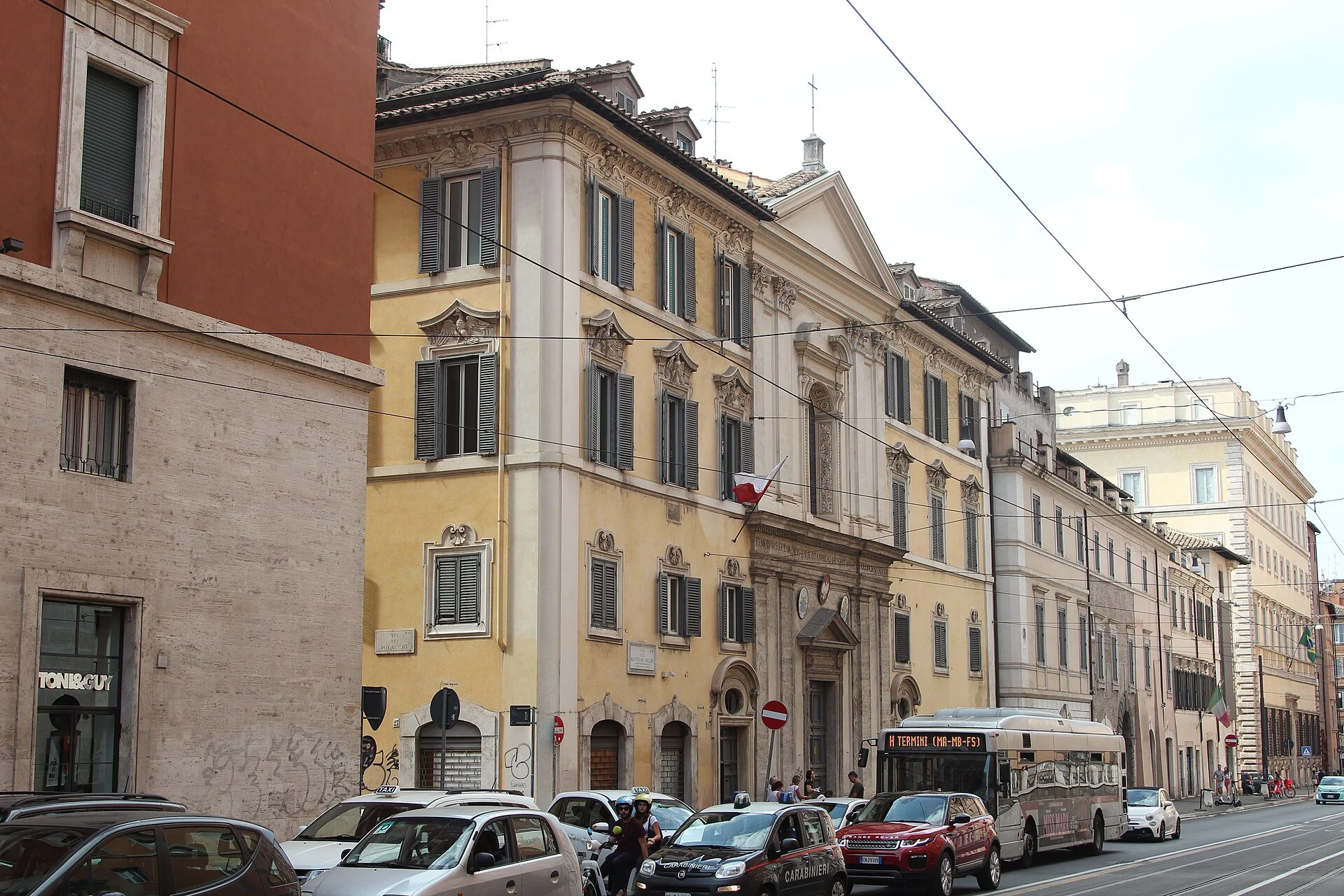
San Stanislao dei Polacchi is at Via delle Botteghe Oscure 15, between Largo di Torre Argentina and Piazza Venezia, and it is the Polish national church of Rome, run today by Monsignor Paweł Ptasznik for the pastoral care of Poles in the Diocese of Rome. Entry is free and at no charge, with no tickets or reservations. You go in mostly around Mass times, celebrated for the Polish community: on Sunday at 08:30, 10, 11 and 18, on weekdays at 07:15 and 18:30.
Behind a gray facade that almost nobody looks at is the oldest pastoral seat of Poles outside Poland, born in 1578 with a hospice for pilgrims wanted by Cardinal Stanisław Hozjusz, whom in Rome they call Osio or Hosius. The present church dates from the 18th century, is small, decorated with white and gold stucco, and gathers in a few chapels the Polish national saints painted by Polish and Roman painters.
The Mass times, contacts and names of those in charge reported here come from the check of September 29, 2026 on the website of the church and hospice and on that of the Polish pastoral care in Rome. The rectory publishes the times of services but not an opening time for visits: before making a special trip, especially in summer, call 06 6795347 and ask at what time you'll find the door open.
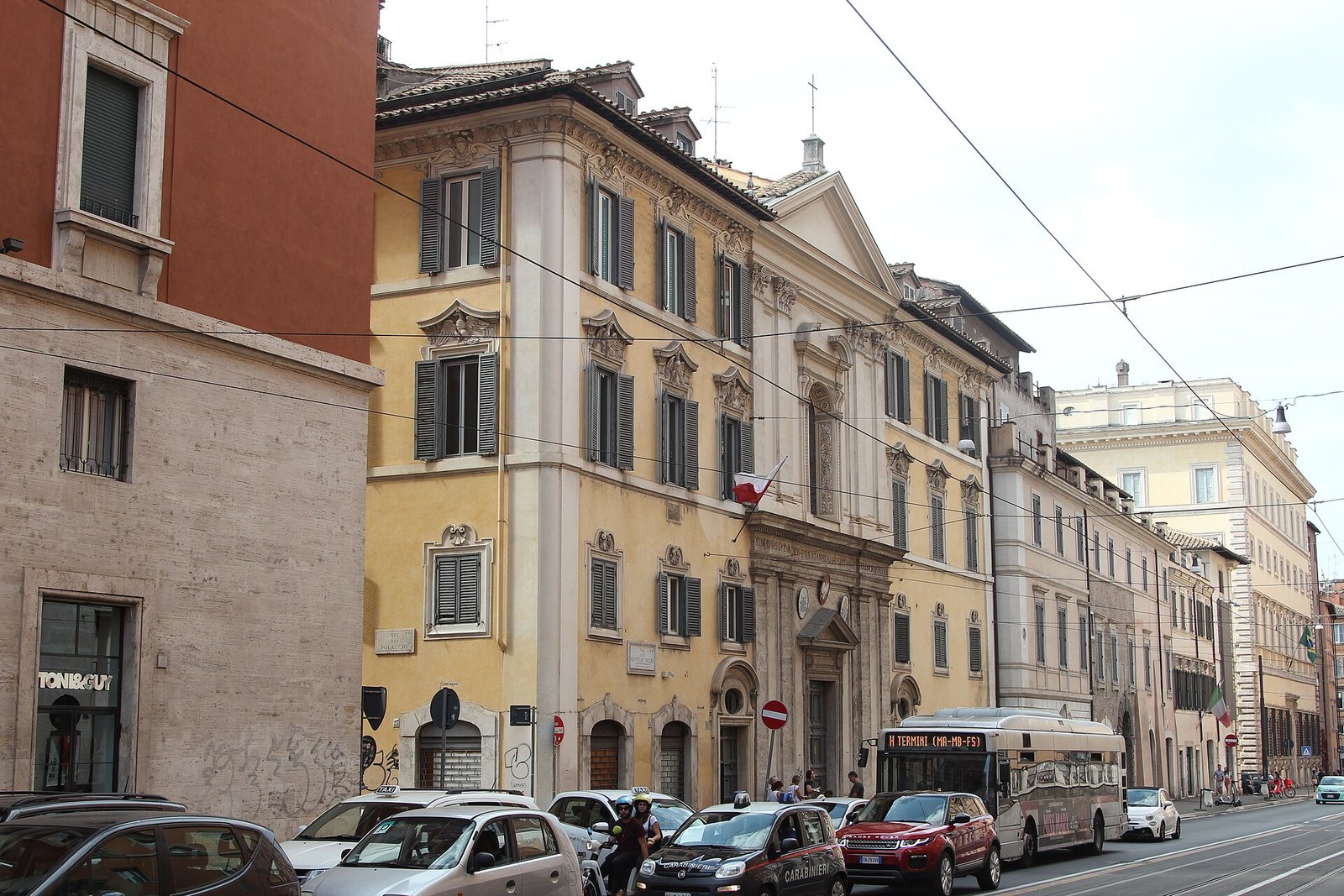
Where it is and what you really see
Via delle Botteghe Oscure is the wide traffic road that links Largo di Torre Argentina to Piazza Venezia, and forms the boundary between the Pigna district and the Sant'Angelo district. The church opens directly onto the sidewalk, with no forecourt and no staircase, squeezed between the buildings of the old hospice. Anyone walking toward the Vittoriano almost always passes it without noticing, because the door often stays ajar even when it's open inside.
The facade dates from the 18th century and reads quickly: two superimposed orders with four pilasters each, Doric below and Corinthian above, light plaster and travertine details. On the frieze of the first order runs the Latin inscription dedicating the temple to the Most Holy Savior and to Saint Stanislaus, hospice of the Polish nation, with the date MDLXXX. Above the portal a triangular pediment, higher up an arched window framed by stucco.
On the side buildings, those of the hospice, appears the crowned eagle of royal Poland. It's the detail that tells you right away where you are, more than the church's plaque. The bell tower exists but can't be seen from the street: it is small, placed at the back to the right of the nave, and from the sidewalk it stays hidden by the roof. There are no projecting chapels, and from the outside the church looks like a palace with a door taller than the others.
Inside you find a single nave of three bays, covered by a barrel vault with windows in the lunettes, and a rectangular presbytery closed by a shallow apse. The four side chapels are actually arched niches cut into the thickness of the walls. The decoration is all white and gilded stucco, with the pillars painted in imitation lemon-yellow marble. The first impression is that of a Baroque parlor, compact and bright.
The effect changes with the light. By day the high windows light the vault and the gilded stucco, while the side chapels stay in half-light and the altarpieces are hard to read. In the evening, with the lights on for Mass, the opposite happens: the chapels light up and the vault darkens. If you plan to look at the canvases carefully, the right moment is the one before the evening service, when the lights are already on.
How to get in, Mass times and contacts
Entry is free and at no charge. There is no ticket office, no paid guided tour, and no circuit sells places for this church. The official reference is the website of the church and hospice of San Stanislao, written in Polish, which gives the address as Via delle Botteghe Oscure 15, 00186 Rome, and the phone 06 6795347. Everything else, that is the openings outside services, has to be asked of them.
The published Masses are these. On Sunday at 07:15, 08:30, 10, 11, 12 and 18, with the note that the 07:15 and 12 services are not held from July to mid-September. On weekdays at 07:15 and 18:30. The services are for the Polish community and are held in Polish: Masses in Italian or other languages are not part of the ordinary calendar.
The Polish pastoral care in Rome, based at the same address, publishes on its own website a parish office open Tuesday and Thursday from 9 to 12:30 and from 16 to 17:30, the number 393 7306060 and the email parafiaroma@gmail.com. The rector is Monsignor Paweł Ptasznik, the administrator Father Tomasz Jarosz. For baptisms, weddings and certificates that is the channel, not the sacristy.
An opening time for visitors, separate from the Masses, is not given by the operator. In practice the church opens before and after services, and in summer, with fewer Masses, the entry windows get shorter. During services you go in to pray, not to wander with a phone in your hand. If you want to see the chapels at leisure, call and ask for a moment without liturgy.
A curiosity about San Stanislao dei Polacchi
The church is not officially called San Stanislao dei Polacchi. The name "of the Poles" is a Roman usage, convenient and by now universal. The historical dedication is double, to the Most Holy Savior and to Saint Stanislaus, and it is written on the facade. The Savior comes first because he was the patron of the medieval little church that the Poles received in the 16th century, and out of respect it was not erased. In the city's street directories you often find it as San Stanislao alle Botteghe Oscure.
The double dedication is found again on the main altar, which is dedicated to Christ the Savior, while a side chapel is reserved for the Polish saint. It's a small reversal that surprises whoever walks in convinced of finding Stanislaus at the center. Behind it lies an old rule of ecclesiastical Rome: when a nation received a church, it brought its patron along but respected the original title, which was a right of the place and not of the community.
Even in Polish the name differs from the one Romans use. On the official website you find it as the church and hospice of Saint Stanislaus bishop and martyr, and for the faithful it is simply the church of Saint Stanislaus in Rome. The adjective national is one we add, to distinguish it from the other national churches of the city, like Santa Brigida for the Swedes or San Biagio degli Armeni.
Then there's the question of spelling. In Italian Stanislao and Stanislào alternate, santo and san, dei Polacchi and alle Botteghe Oscure, and even official Roman sources waver between one form and another. It has no importance at all for someone walking in, but it matters a lot to someone searching: if a search gives you nothing with one name, try the other, and add the street name so as not to confuse the church with the Roman parishes named after the same saint.
The interior, chapel by chapel
Raise your eyes right away. At the center of the vault is the fresco of the Apotheosis of Saint Stanislaus by Ermenegildo Costantini, a Roman painter from the circle of Marco Benefial, among the last interpreters of Roman Baroque. In the presbytery the same Costantini painted the oval with God the Father. Above the entrance a white and gold choir loft rests on two columns of verde antico, and at the sides of the door are two memorial plaques of Poles buried or remembered here.
The most important piece is the altarpiece of the main altar: Christ with Saints Stanislaus, Adalbert and Hyacinth, by Antiveduto Grammatica, a Roman painter of the early 17th century and a workshop master of some weight in the Rome of Caravaggio. It is considered one of his best works. Adalbert and Hyacinth are two Polish patrons, the first a bishop and martyr of the 10th century, the second a Dominican of the 13th. The altar is framed by two tall Corinthian columns.
The first chapel on the right is Saint Casimir's, a Polish prince and patron of Lithuania, with the altarpiece of the Miracle of Saint Casimir by Franciszek Smuglewicz, a painter who had an influential career in Poland and Lithuania. The second on the right is dedicated to Saint Stanislaus, with the canvas by Taddeo Kuntze, a Pole known in Italy as Taddeo Polacco, showing the bishop as he raises the knight Piotrowin from the dead. On the altar is a copy of the Black Madonna of Częstochowa.
On the left, starting from the presbytery, the second chapel is Saint Hedwig's, with the altarpiece by Szymon Czechowicz of 1725 in which the saint adores a crucifix. Here there is also a neoclassical funerary monument of 1836 dedicated to Giacomo Raffaelli, a very famous Roman mosaicist, by a sculptor not identified with certainty. The first chapel on the left is Saint John of Kęty's, with the canvas by Salvatore Monosilio showing him as he distributes his goods to the poor.
Under the altarpiece of Saint John of Kęty is a small painting of Saint Stanislaus Kostka receiving communion from an angel, also attributed to Czechowicz. It's easy to miss, but it's the most direct link between the church and another part of Rome: Kostka, a young Polish Jesuit novice, died in the city in 1568 and his body is venerated at Sant'Andrea al Quirinale. Anyone doing the round of Polish saints in Rome starts here.
Something nobody tells you about San Stanislao dei Polacchi
For a century this Polish church was run by the Russians. After the Congress of Vienna in 1815 the tsar obtained the title of king of Poland, and with the title he also inherited the Roman hospice. The complex changed its name and became the Imperial Hospice of San Stanislao for the pilgrims of the Russian nation. The Poles of Rome, many of them exiles precisely because of the uprisings against the empire, found themselves attending a church administered by the power they were fighting.
The protests of those years are documented. The Poles denounced the use of the church for Orthodox services, which in papal Rome before 1870 were not permitted, and the dispersal of the sacred vessels donated in the 16th century by Queen Anna Jagiellon. A plaque in the presbytery still recalls that gift, and today it also recalls its loss. The conflict was such that the Poles ended up founding in the city another church all their own, dedicated to the Resurrection.
The most curious trace of that period is on the main altar. The book that Christ holds in Antiveduto Grammatica's altarpiece bears an inscription in Greek, and according to the most widespread reconstruction it was added by the Russian administration at the end of the 19th century. Look at it up close: a 17th-century painting commissioned by Catholic Poles with a Greek inscription on top, left there even after 1918. The sources don't agree on the exact date of the intervention, but the presence of the inscription is visible to the naked eye.
The thing is better understood if you put it next to another Roman church, the Russian Orthodox church of Santa Caterina, built much later, in another era and with another history. In the center of the city the national churches were always also informal embassies, and their ownership followed the borders. When the borders moved, the landlord changed and with him changed inscriptions, coats of arms and even liturgies.
Stanislaus between documents, tradition and legend
What the documents say is little and dry. Stanislaus of Szczepanów was bishop of Kraków and died in 1079 on the orders of King Boleslaus II, with whom he had come into conflict. The medieval chronicles speak of a serious clash between bishop and sovereign, but they don't agree on the reasons or even on the bishop's fault. Canonization came in the 13th century, and since then Stanislaus has been the first patron of Poland.
What tradition says is more dramatic. According to the hagiographic account the king killed the bishop with his own hand while he was celebrating Mass, and the body was cut to pieces and scattered, only to put itself back together miraculously, watched over by eagles. From this comes the image of Stanislaus as a martyr for the freedom of the Church against political power, an image the Poles used for a long time as a national metaphor, even in the centuries without a State.
What is legend is the scene painted by Taddeo Kuntze in the chapel on the right. Accused of having taken a piece of land without paying for it, Stanislaus is said to have raised the knight Piotrowin, dead for three years, so that he would testify before the king that he had sold it to him. The dead man speaks, the king is left without arguments. It's a sermon story, much loved by Polish painting, and should be taken for what it is: a way of saying that the truth comes out even from the grave.
Keeping these three levels apart helps in front of the altarpieces. Grammatica paints the bishop in glory next to Christ, Costantini carries him to heaven on the vault, Kuntze puts him in a courtroom with a dead man at his side. They are three different registers, from theology to miraculous chronicle, and the church sets them side by side without hierarchy. Anyone looking with this key leaves having understood how a nation built its saint.
My advice for visiting San Stanislao dei Polacchi
Go on a weekday, around six in the afternoon, and stay for the 18:30 Mass if you like, even without understanding a word. It's the moment when the church stops being a monument and goes back to what it was born for: the place where the Poles of Rome meet. Before the service you have a few minutes for the chapels, afterward the church empties quickly.
The door often seems closed even when it isn't. Churches that open directly onto a busy street keep the door leaf ajar because of the noise and smog, and San Stanislao is no exception. Try pushing before giving up. If it's really closed, don't insist on the hospice doorbell: it's an inhabited house and an office, not an information point for tourists.
On Sunday morning, on the other hand, forget about visiting. The Masses follow one another an hour apart, the church is small and fills up to the door, with people standing even on the sidewalk on the main feast days. Going in at that moment to look at the altarpieces means disturbing a community at prayer, and seeing nothing. If you want the experience of the Polish Sunday Mass, arrive early and stay until the end.
Dress as for any church, shoulders covered and no hats inside. There are no explanatory panels in Italian and no audio guides, so prepare beforehand: knowing who Casimir, Hedwig, John of Kęty and Stanislaus Kostka are completely changes what you see. With 10 minutes of reading at home the church reads like a catalog of Polish saints, without it, it remains a nice box of stucco.
If you can, tie the visit to the Crypta Balbi in the same outing, the museum first and then the church. The museum shows you what was under Via delle Botteghe Oscure before the Poles, the church shows you what they built on top of it. Check the museum's days and hours on the operator's website, though, because they don't coincide with those of the Masses and the fit has to be planned.
Another well-known fact, yet rarely cited
The Poles did not build here on just any ground. Under and around Via delle Botteghe Oscure are the remains of the theater of Lucius Cornelius Balbus, one of the three masonry theaters of Augustan Rome, and the very name of the street comes from there. In the Middle Ages the arches of the theater, walled up and turned into windowless shops, were precisely the dark shops, the botteghe oscure. The little church of the Savior stood in the middle of these inhabited ruins.
The documents record that first church from 1174, with the Latin name San Salvatore Pensilis de Surraca, and then, between the 14th and 15th centuries, as San Salvatore de Apothecis Obscuris or super Arcum Obscurum. The variants of the name tell the story of the neighborhood: a church under a dark arch, among shops carved out of an ancient monument. All this is easy to grasp by visiting the museum of the Crypta Balbi, on the same side of the street.
The museum tells precisely the transformation of that block from antiquity to the Middle Ages, with the excavations of the theater's portico and the shops that settled on top of it. After seeing it, the 18th-century facade of San Stanislao appears for what it is: the last layer of a sequence 2000 years long. There's no other point in the city where the passage from ancient theater to neighborhood church reads so clearly.
There is also another detail that gets forgotten. The Poles were not the first community to look for a home in this area, which since the Middle Ages has been thick with small churches, confraternities and welfare institutions. Within a few minutes you find churches tied to trades, to confraternities and to other nations, and the neighborhood worked as a network of hospices and tiny parishes. San Stanislao is one of the few nodes of that network that still keeps its original function.
The hospice and the Polish community today
The hospice is not a museum. It was born to house the Polish pilgrims who came to Rome, and still today it hosts pastoral activities, offices and initiatives for the community. The official website lists an information office for Polish pilgrims, which also helps with news on papal audiences, a Polish Catholic school and a Polish kindergarten open on Saturday mornings from 9 to 13:25.
Since the Second World War the hospice has been the center of pastoral care for Polish emigration, entrusted to the priests of the Society of Christ for Poles Abroad. That center closed its activities in 2004, but the church remained the seat of the mission with care of souls for the Poles of the Diocese of Rome. Among the priests listed today by the pastoral care there are still members of that congregation.
The community is large and lively. On the big Polish feast days the church isn't enough, and according to the sources consulted part of the liturgies and initiatives also take place in other churches of the city. Anyone passing along Via delle Botteghe Oscure on Sunday at noon sees people coming out, talking in Polish on the sidewalk, stopping in front of the notice board: it's the truest scene this church offers.
The right photo to take at San Stanislao dei Polacchi
The photo that counts is the one of the frieze with the inscription and the date MDLXXX, taken from the opposite sidewalk. The street is narrow for a tall building, so you need a wide-angle lens or the phone in vertical panorama mode. Wait for the bus to pass and shoot with the whole facade, from portal to pediment, trying to keep the verticals straight. The best time is late morning, when the sun lights the front.
The second image is the crowned eagle on the hospice buildings. Here you need a zoom, even digital, and a bit of patience with the reflections on the glass. Framed tight, with a piece of cornice around it, it tells the church better than the whole facade: it's the coat of arms of a kingdom that for more than a century did not exist on the maps, left over a door in Rome.
Inside, if the moment allows and there isn't a service, the right framing is from the back toward the altar, low enough to take in the vault with Costantini's fresco and Grammatica's altarpiece in the same photo. Natural light is scarce, so rest the phone on a pew or the doorjamb to avoid blur. No flash, which flattens the gilded stucco and bothers those praying.
Avoid the photo of the Madonna of Częstochowa taken up close during other people's prayer. It's the most sought-after image and also the most delicate, because in front of that icon the faithful often stop in recollection. If you want a memento of that altar, take it from a distance, from the center of the nave, with the whole chapel and Kuntze's canvas above. It comes out better and you disturb no one.
Some important events that happened here in history
In 1174 the church of the Savior appears in the documents of the archive of Santa Prassede. Its foundation is not known. In the following centuries it remains a small neighborhood parish, and in the 16th century it is in decline. During the Jubilee of 1575 Cardinal Hozjusz notices that the Polish pilgrims have no home of their own in Rome, unlike other Catholic nations, and asks for a seat.
In 1578 Gregory XIII entrusts the ruined church to the cardinal, who starts the hospice project. The money comes from King Stephen Báthory and Queen Anna Jagiellon. Hozjusz dies in 1579 and his secretary Stanisław Reszka carries the works forward. The church is ready in 1580, according to the facade inscription, and the complex in 1591, when Cardinal Jerzy Radziwiłł, bishop of Kraków, consecrates the church.
Between 1729 and 1735 the church is entirely rebuilt on a design by the architect Francesco Ferrari, with Ignazio Brocchi overseeing the interiors. The hospice too is remade, and the overall construction closes in the middle of the century. It is in this phase that the church takes its present appearance, with the two-order facade and the stucco decoration. The bishops of Kraków become its patrons.
With the French occupation of the Napoleonic age the Poles are driven out and the complex becomes a barracks. After 1815 it passes under Russian administration as an imperial hospice, with the tensions we have talked about. Only with the rebirth of the Polish State in 1918 does the church return to the Poles. The first priest of the new course is Józef Florczak, followed by Stanisław Janasik.
In 1928 a lawsuit between the Polish State and the Diocese of Kraków over the ownership of the complex closes in favor of the diocese. In 1948 the hospice becomes the pastoral center for Polish emigration, entrusted to the Society of Christ. From 1980 to 2007 the person in charge is Monsignor Szczepan Wesoły, who oversees a major restoration. In 2004 the pastoral center closes, while the church continues its function as a national rectory.
A caution on the dates. The sources agree on 1578 as the year of the grant and on 1580 as the date of the church, but for the conclusion of the 18th-century construction and for the benefactors of that phase the versions do not fully coincide, and some recall among them the last king of Poland, Stanisław August Poniatowski. The solid fact remains the reconstruction between 1729 and 1735, with Ferrari as architect.
Who has passed through San Stanislao dei Polacchi
Stanisław Hozjusz, the founder, a Polish cardinal among the most influential of the 16th century, a leading figure of the Catholic response to the Reformation in central Europe. He saw Rome full of pilgrims during the Jubilee of 1575 and understood that his nation needed a stable foothold in the city. He died the year after obtaining the church, without seeing it finished. His name is tied to every account of the origins.
Anna Jagiellon and Stephen Báthory, the queen and the king who financed the work. She, last of the Jagiellon dynasty, donated the sacred vessels recalled by the plaque in the presbytery. He, a prince of Transylvania who became king of Poland by election, was one of the most energetic sovereigns of Polish history. They are the names that give the hospice its character as a foundation of the Crown, not of a simple confraternity.
Jerzy Radziwiłł, bishop of Kraków and cardinal, who consecrated the church in 1591. In Rome there also remains his burial in the Church of the Gesù, a few minutes on foot along the same street. Anyone who wants to close the circle of the origins can make the two stops in a row: the church the cardinal consecrated and the one where he was buried, separated by 300 meters of traffic.
The painters, who left here the most compact catalog of Polish saints in Rome. Antiveduto Grammatica for the main altar, Szymon Czechowicz, Taddeo Kuntze and Franciszek Smuglewicz for the chapels, with the Romans Ermenegildo Costantini on the vault and Salvatore Monosilio, a Sicilian of the school of Sebastiano Conca. A small church where Roman hands and Polish hands work together over a century and a half.
Giacomo Raffaelli, the Roman mosaicist, who has his funerary monument of 1836 here in the chapel of Saint Hedwig. He was one of the great names of micromosaic, the art of tiny tesserae that in Rome became a luxury souvenir for Grand Tour travelers. Finding him in a Polish national church is surprising, and it's one of those details that show how much the national churches were also neighborhood churches.
Stanisław Reszka, Hozjusz's secretary, who after the cardinal's death in 1579 took the construction site in hand and carried it forward. He is a minor figure in the textbooks, but without him the hospice would have remained a project. It often happens in 16th-century Roman foundations: the big name ends up on the plaque, the work of years is done by a collaborator who knows the offices of the curia and knows how to wait.
Szczepan Wesoły, who led the church and the pastoral center from 1980 to 2007, the years in which Poland changed regime and Rome became the reference point of Polish emigration around the world. Under him the major restoration was done that gave the stucco the look you see today. Before him, between the two wars, Józef Florczak and Stanisław Janasik had reopened the church to the Poles after the Russian century.
John Paul II: what he really has to do with it
The link with John Paul II is real, but it is institutional before it is anecdotal. Karol Wojtyła was archbishop of Kraków, that is a successor of Stanislaus on the same see, and the bishops of Kraków are the historic patrons of this church, so much so that the 1928 lawsuit was won precisely by their diocese. For a Pole, a pope who came from Kraków and a Roman church dedicated to the bishop and martyr of Kraków are two faces of the same story.
The community remembers him every year with liturgical celebrations, and the official website presents the church in this key too. That said, the contrarian position has to be made clear: anyone who arrives expecting a Wojtyła shrine, with relics on display, memorabilia and dedicated routes, will be disappointed. That is not the reason to go in. The reason is Antiveduto Grammatica's altarpiece, and in our view it is neglected precisely because everyone is looking for the pope.
Anyone who really wants to follow John Paul II in Rome has to go to the other side of the river, to St. Peter's Basilica, where his tomb is, and perhaps pass through Piazza San Pietro. San Stanislao is something else: the place where Catholic Poland had a home in Rome four centuries before a Pole became pope. Read this way, the church gains depth instead of losing it.
Via delle Botteghe Oscure and the neighborhood
For many Italians the street has a political meaning before a topographical one. For decades Via delle Botteghe Oscure meant the national headquarters of the Italian Communist Party, and even today the name of the street is used as a synonym for that party in newspaper headlines. The Polish church is on the same street, and the contrast between the very Catholic Poland of the national saints and the PCI headquarters is one of the ironies of Roman street names.
Around you there are two worlds. On one side the sacred area of Largo Argentina, with the Republican temples, the cat sanctuary and the Teatro Argentina. On the other the Jewish Ghetto, which begins behind the Crypta Balbi and runs down toward the Portico d'Ottavia. In five minutes on foot you pass from antiquity to Jewish Rome.
Via delle Botteghe Oscure in itself is not a pleasant street to walk. It is an artery of buses and taxis, with narrow sidewalks and constant noise, and those who use it on foot cross it more than visit it. The advice is not to linger: get to the church, go in, and then leave toward the side streets, where the neighborhood changes face in a few steps and you find the Rome of the little squares again.
How to get there
The church is in the historic center and the most sensible way to reach it is on foot. From Piazza Venezia it's a few minutes along Via delle Botteghe Oscure, from Largo di Torre Argentina even less. From the Pantheon you go down through the streets of the Pigna in a good quarter of an hour, passing near the Minerva.
Largo di Torre Argentina and Piazza Venezia are two of the main surface transport hubs of Rome, served by many bus lines and by the tram. Line numbers and routes change with construction in the center, so check them the same day on the website of the Roman public transport company. There is no metro stop a few steps from the church, and it's best not to count on one.
By car, forget it. The church is inside the limited traffic zone of the historic center, surface parking is rare and reserved, and the street is used almost only by public transport and taxis. Anyone arriving from outside Rome is quicker leaving the car at a park-and-ride and continuing by public transport. A taxi can leave you at the door without problems.
When it's closed and what not to expect
The church is closed for a large part of the day, and this has to be taken into account. Between the early morning Mass and the evening one, on weekdays, it's easy to find the door barred, and the operator doesn't publish intermediate openings. Anyone passing in mid-morning by chance, coming out of the Crypta Balbi or heading toward the Campidoglio, has a good chance of seeing only the facade. It's not neglect: it is a rectory with a community, not a monument with an attendant.
In summer the services are reduced, because the Sunday Masses at 07:15 and 12 are not held from July to mid-September, and with them the opening moments get shorter. In the periods of the big Polish feasts the opposite happens: the church is full, the services are long, and visiting becomes impossible. The quietest period to see the chapels is a weekday in autumn or spring, before the evening Mass.
Don't expect services. There are no restrooms for visitors, no bookshop, no panels in Italian or English, and the sacristy doesn't act as an information point. Access is at street level, without significant steps, but an accessibility statement does not appear to be published: anyone in a wheelchair does well to call beforehand, also to find out at what time the door is left open.
Don't expect a big church either. The whole route, chapels included, takes a quarter of an hour at a slow pace, and anyone arriving after seeing the Gesù or Sant'Andrea della Valle may get the impression of something minor. It is small, but it is coherent: a single national commission, a single iconographic program, no random layering. For exactly this reason it reads better than many more famous churches in the area.
One last warning concerns the sidewalk. In front of the church there is little space and the buses pass a few centimeters away, so don't stop to read the facade at the edge of the street and don't make a group wait there. Whoever guides several people does better to give the explanations beforehand, in a nearby square like Piazza Mattei or Largo Argentina, and then enter the church in silence, in small groups, without blocking the entrance for the faithful.
Eating in the area
Between Largo Argentina, Piazza Venezia and the Ghetto the temptation to sit at the first little table is strong, and that's exactly where you should be careful. This is one of the areas most trodden by groups and passing visitors, and part of the offer is built on people who won't come back. The signs for recognizing it are always the same, and don't require knowing a single restaurant name.
First sign: the menu with photographs of the dishes, often laminated and translated into five languages. Whoever needs to show you the picture of a carbonara is talking to someone who doesn't know what it is. Second sign: the woman rolling fresh pasta in the window or on the sidewalk. It's theater for the passerby, not a guarantee of quality, because serious pasta is made in the kitchen, in the morning, away from the street.
Third sign: the person at the door who stops you to invite you in. A place that has to get customers on the street has no regulars. Fourth: places open continuously from morning to night, with no kitchen break. A real kitchen crew has shifts and a pause. Fifth: tables placed in front of a monument, where the price tends to adapt to the customer.
The last two signs are found only by reading closely. Items with no price, like the fish of the day or the chef's dish, which force you to ask and to trust. And the menu that differs between outside and inside, with figures that change between the blackboard on the street and the menu at the table. Always ask the price before ordering and check that the cover charge is written down.
It's not snobbery. Romans don't avoid these places on principle, but because they know the same spend goes further one street away, where the customer is a regular and the cook knows it. The practical rule is to look at who is sitting: if at lunch on a weekday there are office workers from the area and people speaking Roman dialect, you're in the right place.
To find your way without trial and error, there's our list of the places where we eat, in Rome and around, kept up to date and not sponsored. If you only feel like a coffee, the historic Sant'Eustachio and the Tazza d'Oro near the Pantheon are places with a history told in our dedicated pages.
What to combine in the same walk
The most logical combination is with the Crypta Balbi, which tells the underground of the same street, and with the Church of the Gesù, where the cardinal who consecrated San Stanislao rests. Then you go down toward the Turtle Fountain in Piazza Mattei, go into San Carlo ai Catinari and arrive at the Basilica of Sant'Andrea della Valle.
Those with time for a tour of the national churches can build a themed afternoon. Besides Santa Brigida and San Biagio degli Armeni, worth seeing are San Luigi dei Francesi, Santa Maria dell'Anima for the Germans and Flemish, Santa Maria in Monserrato for the Spanish and Sant'Antonio dei Portoghesi. Among the national churches of Rome there is also San Claudio dei Borgognoni.
For a walk through ancient Rome, from the church you can reach on foot the Theater of Marcellus, the Capitoline Hill with the Capitoline Museums and the staircase of the Basilica of the Aracoeli. The Museo di Palazzo Venezia is at the other end of the street, and rounds off a morning well.
If you're on the trail of the Polish saints, the natural stop after San Stanislao is Sant'Andrea al Quirinale, with the body of Stanislaus Kostka, and then the Vatican. With the Ghetto a few minutes away, and the Synagogue with the Jewish Museum, the same neighborhood holds together the stories of communities very different from one another, and it's worth reading them in sequence.
Frequently asked questions
How much does it cost to enter San Stanislao dei Polacchi?
Entry is free and at no charge. San Stanislao dei Polacchi is a rectory church, not a museum: there is no ticket office, there are no paid guided tours and no website sells entry. You go in at the hours when the church is open, mostly before and after Mass. Offerings and candles are voluntary, as in any Roman church, and nobody asks for them at the entrance.
What time are the Masses and in what language?
The official website gives Sunday at 07:15, 08:30, 10, 11, 12 and 18, with the 07:15 and 12 Masses suspended from July to mid-September, and on weekdays at 07:15 and 18:30. The services are for the Polish community and are held in Polish. For special feasts it's best to ask for confirmation at the church's phone, 06 6795347.
What are the church's opening hours for visits?
The operator gives no opening time for visitors separate from the Mass times. In practice the church is open around the services, and in summer the entry windows shrink. Anyone who wants to see the chapels at leisure does well to call beforehand, at 06 6795347, or write to the Polish pastoral care at parafiaroma@gmail.com.
Who runs the church today?
The church is the seat of the mission with care of souls for the Poles of the Diocese of Rome. The rector listed on the pastoral care website is Monsignor Paweł Ptasznik, the administrator is Father Tomasz Jarosz, and priests of the Society of Christ are also active in the pastoral care. The parish office receives on Tuesday and Thursday, from 9 to 12:30 and from 16 to 17:30.
What is there to see inside?
A single nave decorated in white and gold stucco, with the fresco of the Apotheosis of Saint Stanislaus by Ermenegildo Costantini on the vault. On the main altar the altarpiece by Antiveduto Grammatica with Christ and Saints Stanislaus, Adalbert and Hyacinth. In the side chapels the Polish saints Casimir, Stanislaus, Hedwig and John of Kęty, with a copy of the Madonna of Częstochowa and the monument to the mosaicist Giacomo Raffaelli.
Is John Paul II buried or remembered here?
John Paul II is not buried here: his tomb is in St. Peter's Basilica. The church is tied to him because it is dedicated to the bishop and martyr of Kraków, the same see that Karol Wojtyła led before becoming pope, and because the Polish community of Rome remembers him every year with liturgical celebrations. There are no permanent displays of memorabilia.
Can you take photos inside?
No bans are published on photos without flash outside services. During Masses, on the other hand, the common-sense rule is not to photograph, also because the church is small and the community present is large. Avoid flash on the stucco and the altarpieces, and don't film people at prayer in front of the icon of the Madonna of Częstochowa.
Can you ask for help with papal audience tickets?
The official website lists at the church an information office for Polish pilgrims, which also provides news on papal audiences. It is a service meant for the community and for Polish groups, not a ticket office. Tickets for audiences are free in any case and are requested through the official channels of the Holy See, never for a fee on third-party sites.
Can you visit the hospice next to the church?
No, the hospice is not open to visits. The buildings at the sides of the church house pastoral offices, activities for the Polish community, the school and the Saturday kindergarten, and they are spaces for work and living, not a museum route. From the outside you can see the crowned eagle and the windows of the old complex. For practical needs the reference is the parish office during the published hours.
Who wrote this page
The page comes from the editorial team of Tour Leader Pro, the Rome-based company that designs itineraries, visits and cultural events across Rome and Lazio. Mass times, contacts and names of those in charge reported here come from the official sources of the church and of the Polish pastoral care as of the date given at the top. Rectories change their calendar between summer and winter: check again before going and let us know what you find changed.
Lining up a morning in the historic center means fitting together churches that open only around services, museums with different closing days, construction sites that move bus stops and streets where a group can't stop on the sidewalk. Anyone who has to solve this kind of puzzle, for themselves or for a group of 40 people, will find on Tour Leader Pro working materials designed for those who guide and for those who organize.
For the big picture, that is regional trains and seasonal timetables, airports, transfers between one city and another and Italian destinations outside Rome, from the Castelli to the volcanic lakes to the coast and the hill towns of the interior, a useful resource when you have to put together a multi-day itinerary is Italy Planner, which puts connections and stops in order without losing sight of real times.