San Claudio dei Borgognoni
In short. San Claudio dei Borgognoni, which in the official sources carries the full name Santi Claudio e Andrea dei Borgognoni, stands in Piazza di San Claudio, next to Piazza San Silvestro, in rione Trevi.
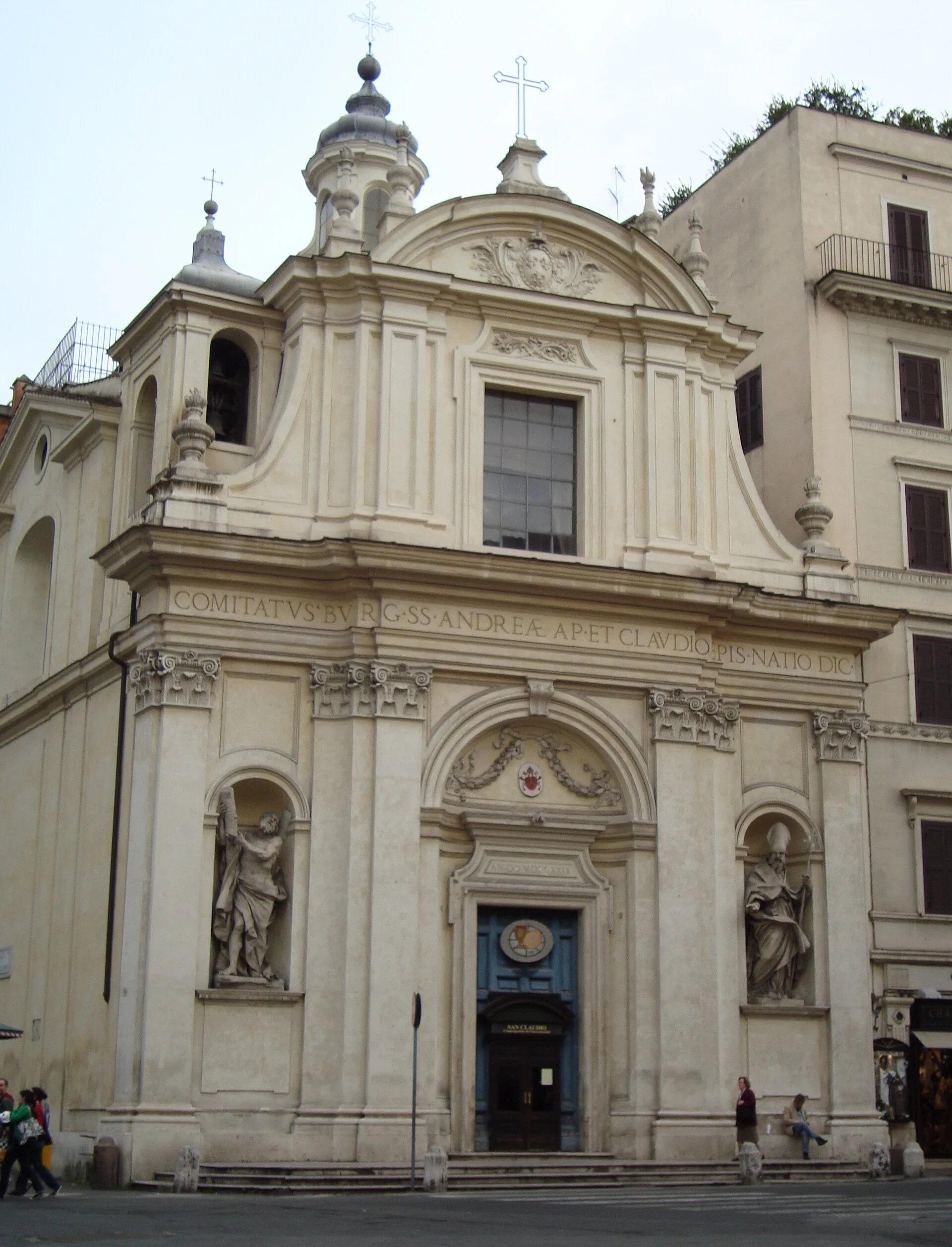
San Claudio dei Borgognoni, which in the official sources carries the full name Santi Claudio e Andrea dei Borgognoni, stands in Piazza di San Claudio, next to Piazza San Silvestro, in rione Trevi. Entry is free and nothing needs to be booked. Since 1886 it has been served by the Blessed Sacrament Fathers of the Congregation of the Blessed Sacrament, and the Rome city tourism portal lists it as open Monday to Saturday from 13:30 to 17:30, with a Mass every day.
It is the national church of the Burgundians of Franche-Comté, the region of Besançon, and it is one of the five French-language Catholic churches in the city. The building you see is 18th-century: the 17th-century church was demolished in 1726 and rebuilt by Sebastiano Cipriani and then by Antoine Dérizet, with consecration in 1731. Today its true identity is another one, Eucharistic adoration, and the high altar is built expressly for this.
Hours, Masses and contacts come from the institutional sources consulted on September 29, 2026, starting from the entry on the Rome city tourism portal, which as its reference points to the website and email of the Pieux Établissements de la France à Rome et à Lorette, pieuxetablissements@pefr.it. The website of the Pieux Établissements, which lists the church among the five it administers, also publishes the number 06 68827200. Churches served by a religious community change hours in summer and on feast days: if you're crossing Rome on purpose, write first and get confirmation.
Where it is and what you really see
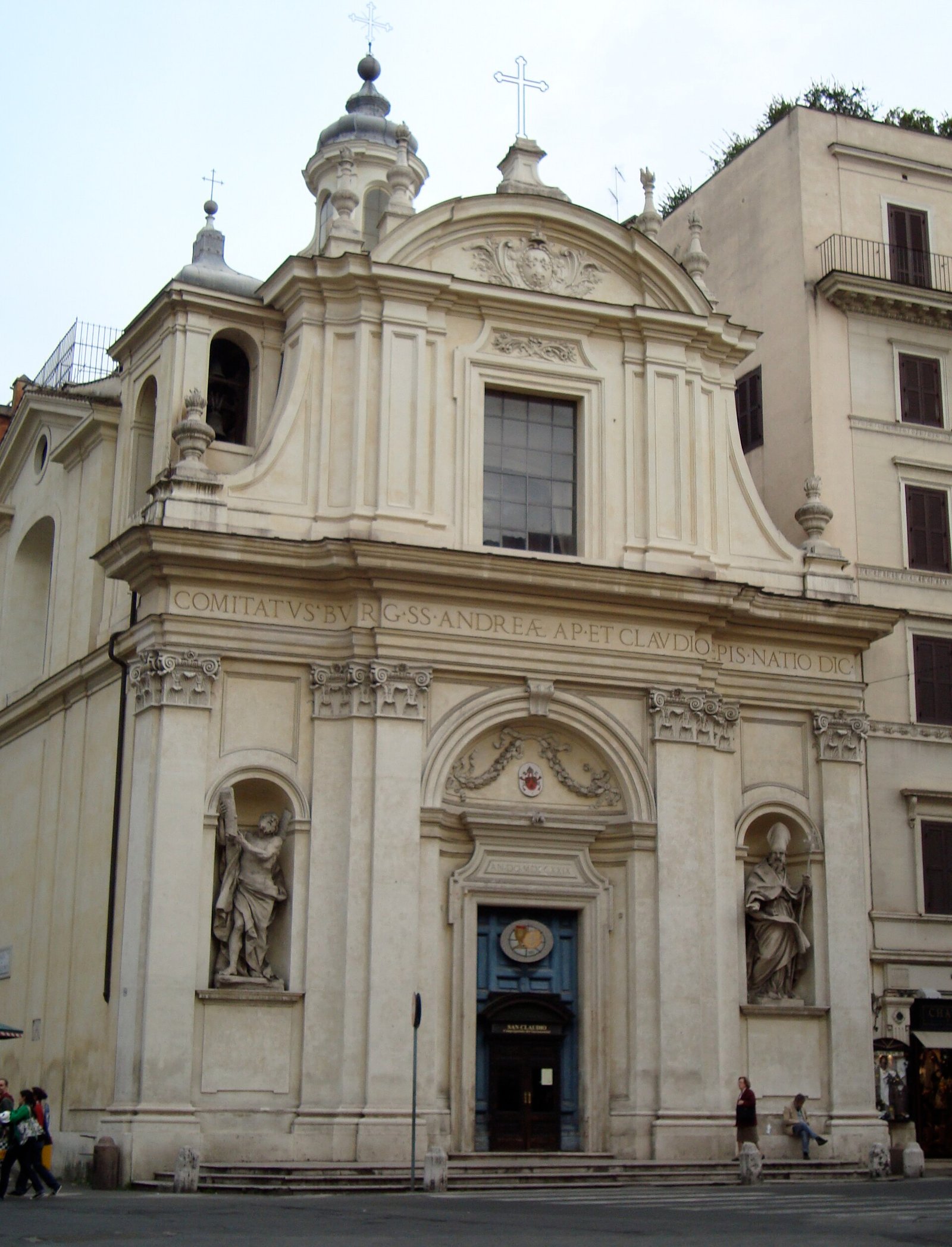
Piazza di San Claudio is a patch of paving that opens on the side of Piazza San Silvestro, the big square with the post office building between Via del Corso and Via del Tritone. Those coming from the Corso see first the bulk of San Silvestro in Capite, then, turning their gaze, a pale and composed facade, squeezed between the buildings. That is San Claudio, and almost everyone walks past it without looking up.
The Rome city tourism portal and the encyclopedias place the church in rione Trevi, even though in everyday language the area is perceived as part of the district of Piazza Colonna and the Corso. The difference matters little to those walking and a lot to those looking for the church on maps by rione: if you search for it under Colonna you won't find it. The Trevi Fountain is a few minutes' walk away.
The facade has two superimposed orders and holds the statues of the two patron saints: Saint Andrew, by Luca Bréton, and Saint Claudius, by Guglielmo Antonio Grandjacquet, both from 1771. They are 40 years younger than the church, a detail the front doesn't declare and that explains why the two figures seem of a slightly different taste from the rest. Up close the facade is hard to read, so it's best to look at it from the other side of the square.
Inside you find a Greek-cross plan with a hemispherical dome. In the pendentives are the four Evangelists in stucco, in the arches of the dome angels and allegories of the Passion, of Hope and of Faith. The high altar supports a bronze terrestrial globe that serves as a throne for the Eucharistic exposition, with a gilded sunburst, beneath a fresco by Antonio Bicchierai of God the Father blessing. It's a collected, luminous space, to be looked at in a few minutes and experienced in silence.
On the sides, two chapels. In the left one you see the polychrome marble urn by Corrado Mezzana dedicated to Pierre-Julien Eymard, the founder of the Blessed Sacrament Fathers, with a canvas by Placido Costanzi from 1731, the Vision of Saint Charles Borromeo, and paintings from 1939. In the right one, dedicated to Saint Joseph, works by Cleto Luzzi from 1949 and a Saint Joseph between two angels by Guido Francisci. In the small choir to the left of the altar is the Vegezzi-Bossi organ from 1910.
How to get in: hours, Masses and adoration
Entry is free. The Rome city tourism portal lists opening Monday to Saturday from 13:30 to 17:30 and gives these Masses: Monday to Friday at 18:30, Saturday at 12:00, Sunday at 10:00. According to the same entry the celebrations are held in French, except Tuesday and Friday, when the language is Italian. For Sunday the operator does not give an opening time different from that of the Mass.
Those who don't speak French and want to follow the Mass therefore have two useful days, Tuesday and Friday, when according to the same source it is celebrated in Italian. Those who are instead looking precisely for the liturgy in French find here, on weekdays, a convenient chance to fit into a walk between Trevi and the Corso. In both cases arrive a few minutes early and sit down, because the church is small and the seats fill up fast on feast days.
Eucharistic adoration is the reason the church exists in its present form. The encyclopedias report that the Blessed Sacrament Fathers hold solemn adoration of the Eucharist there. The precise times of the exposition of the Blessed Sacrament do not appear in the city's entry, and the information is not published in the institutional sources consulted: if you want to take part in a prayer shift, write to the contacts given and ask for the week's schedule, which can change on feast days.
There are no tickets, no paid guided visits offered by the operator, no audio guides. Anyone who offers you a paid tour with entry to San Claudio is making you pay for a walk, not for access. The church is visited under the rules of a place of prayer in use: you enter in silence, avoid walking in front of the altar during the exposition, and put off the visit if a celebration is under way.
For dress, the common rule of Roman churches applies: shoulders covered and trousers or skirts not too short. In a church of adoration the check is not entrusted to a custodian at the door as in a basilica, but left to the good sense of those who enter. Those arriving in summer from the Trevi Fountain in a tank top would do well to keep a shirt in their backpack.
A curiosity about San Claudio dei Borgognoni
The Burgundians who founded this church did not come from the Burgundy of Dijon and of wines. They came from Franche-Comté, the old County of Burgundy, with Besançon and Dole, a land distinct from the duchy next to it. And in the 17th century, when the confraternity was born, Franche-Comté was not French: it belonged to the Habsburgs of Spain. The national church of a region that is now French was therefore founded by subjects of the King of Spain.
Franche-Comté passed to France only in 1678, with the Peace of Nijmegen, after the campaigns of Louis XIV. Until then the Franche-Comté people in Rome were a community apart, with a French language and a Spanish political loyalty. The encyclopedias note that it was Pope Innocent XI, elected in 1676, who proclaimed the oratory the national church of the Burgundians. The recognition thus comes in the same years in which their land was changing crown.
To understand how this situation came about you have to go back to 1477, to the death of Charles the Bold, last Duke of Burgundy. The duchy, the one of Dijon, was absorbed by the French crown. The county, instead, followed the inheritance of his daughter Mary and passed to the Habsburgs, and from them to the Spanish branch. Two Burgundies with the same name and opposite destinies: that is the reason why in Rome the Burgundians of this church did not consider themselves French.
The double dedication also tells the story of the region. Saint Andrew the Apostle is the traditional protector of Burgundy, and the cross of Saint Andrew, the X-shaped one, was the emblem of the Burgundian dukes, later passed to the Habsburgs. As for who the Claudius of the title is, the sources don't agree: the encyclopedias speak of a martyr of the third century, while the Franche-Comté devotion is tied to Saint Claudius bishop of Besançon, venerated in the Jura.
This double belonging, French in language and Spanish in government, also explains why the community needed its own church and did not lean on the church of the French of the kingdom. San Luigi dei Francesi was the church of another sovereign. The Burgundians wanted a place to bury their dead, welcome their pilgrims and pray to their own saints, and they found it here.
The Burgundians in Rome: who they were and why they came
The community formed in two waves. According to the encyclopedias, a colony of merchants and bankers from Franche-Comté had settled around the present Via del Corso for more than a century when, toward the end of the 30 Years' War, a great wave of refugees arrived. The figures reported speak of about 12,000 people. It's an enormous number for 17th-century Rome and should be taken with caution, because the sources don't say how it was calculated.
The 30 Years' War, in Franche-Comté, was particularly harsh. The region, Spanish and surrounded by French and imperial territories, was crossed by armies and struck by famines and epidemics for a decade. Those who could left. Rome, for a French-speaking Catholic, was a natural destination: there was work in the workshops, in the banking houses and in noble households, and there was a network of confraternities that assisted those who arrived with nothing.
In 1652 the Burgundians formed a confraternity and bought an oratory in the area where they lived, near Piazza San Silvestro. 10 years later, in 1662, they opened a hospice for pilgrims next to it. It's the pattern found in almost all the national churches of Rome: a lay confraternity, a church, a hospice, a cemetery or a crypt. Faith and assistance traveled together.
The same model can be read not far away at San Bartolomeo dei Bergamaschi, in Piazza Colonna, where the community from Bergamo ran a church and a hospital, or at San Biagio degli Armeni and at Sant'Atanasio dei Greci. Walking among these churches means reading a map of migrations to Rome, made of trades, languages and mutual protections.
One thing nobody tells you about San Claudio dei Borgognoni
The national church of the Burgundians today is above all something else. Since 1886 it has been served by the Blessed Sacrament Fathers, an international congregation born in France and devoted to the adoration of the Eucharist. Their presence has changed the meaning of the building more than any restoration: the bronze globe on the high altar, a throne for the exposition of the Blessed Sacrament, turns the presbytery into a place designed for staying before the host, not for looking at paintings.
The second point the guides skip is the urn in the left chapel. The encyclopedias describe it as the polychrome marble urn by Corrado Mezzana that holds the remains of Pierre-Julien Eymard, the founder of the congregation. For a worshipper tied to the congregation, a visit to San Claudio is not about Franche-Comté or 18th-century architecture, it is about this saint. That is why the left chapel counts for more than the high altar in the eyes of those who pray, and it's worth knowing before you go in.
Third point: the Mass in French. If the city's entry is accurate, here on weekdays the liturgy is almost always celebrated in French, with Italian reserved for Tuesday and Friday. It's a piece of international Rome not visible from the street, with nothing touristy about it, and it reminds those who enter that the church was born for a French-speaking community. Those who speak French and want to hear a Mass different from the usual have a chance here.
From here comes a position that goes against the way the church is usually presented. San Claudio is sold as one more Baroque church of Trevi, a minor stop between the fountain and Piazza di Spagna. That's a mistake: as architecture it is correct and not very surprising, and those who go in for the artworks come out disappointed. Its value lies in its function as a church of adoration, and that is why it's worth going in, even for those who don't believe.
The facade and the interior by Dérizet
The building site for the new structure opened in June 1728, after the demolition of the 17th-century church in 1726. The encyclopedias say the work was entrusted first to Sebastiano Cipriani and then completed by Antoine Dérizet, a French architect active in Rome, and that the consecration took place in 1731. The Rome city tourism portal simplifies and attributes the reconstruction to Dérizet in 1729. The sources don't agree on the steps, but they agree on the result.
The facade has two orders, a classical and measured approach that looks more to the academy than to theatrical Baroque. The two statues of the patron saints arrive only in 1771. It's a front that doesn't seek effect, and in an area where facades compete with each other through columns and broken pediments its sobriety makes it almost invisible. Those who love the more measured side of Roman 18th-century architecture find a good example here.
The Greek-cross interior is the most successful choice. The hemispherical dome, which you almost don't notice from the square, gives light and order to the whole space. The stuccoes of the pendentives and arches complete a coherent program with the Evangelists, the angels and the allegories of the Passion, of Hope and of Faith. There are no great names of painting, but the whole is homogeneous, and in Roman churches that is rarer than people think.
The side chapels tell instead the recent story. Placido Costanzi's canvas from 1731 is contemporary with the consecration, while the paintings of 1939 and the works by Cleto Luzzi from 1949 belong to the phase in which the Blessed Sacrament Fathers adapted the spaces to their own devotion. Corrado Mezzana's urn is the most evident sign of that season. Within the same church two eras and two patrons therefore coexist, and they are easy to tell apart.
Those who want to understand Dérizet's style can make a useful comparison with the two churches of Trajan's Forum, where the church of the Santissimo Nome di Maria is attributed to the same architect. For a wider picture of the Rome of those years, the itinerary on Baroque Rome lines up the churches and squares that formed the context for the San Claudio building site.
The advice I give you for visiting San Claudio dei Borgognoni
Go in early on a weekday afternoon, shortly after the 13:30 opening given by the city. It's the hour when the Trevi area is most crowded and noisiest, and the contrast with the silence inside is the best way to understand this church. Sit at the back, stay 10 minutes without a phone in your hand and look at the dome. It's a pause that no other place in the area gives you for free.
If you're interested in architecture and artworks, avoid the times of the Masses and the moments when the Blessed Sacrament is exposed with a group at prayer. Going in is not forbidden, but walking among the chapels to look at the canvases in front of people kneeling is out of place. If you find the exposition under way, stay in the last rows, look from there at the dome and the bronze globe, and put off the inspection of the chapels.
Write first if you're coming with a precise purpose: the Mass in French, a moment of adoration, a visit to Eymard's urn. The reference given by the city portal is the email of the Pieux Établissements, pieuxetablissements@pefr.it. A written reply saves you from finding the door closed for a feast or a summer change of hours, which in churches served by religious are frequent and rarely published in advance.
Put San Claudio at the end of a tour, not at the start. Devote the morning, when the other churches in the area are open and the light is good on the facades, to Sant'Andrea delle Fratte, San Silvestro in Capite and Piazza Colonna. In the early afternoon, when many churches in the center close for the break, San Claudio opens, and it's one of the few reasons that hour turns out to be useful.
One last practical warning. The square the church faces is small and a thoroughfare, with no benches and with the service traffic of the center. It's not a place to stop and eat a sandwich or rest. For a seated break it's better to go back toward the Galleria Alberto Sordi, which has covered spaces, or toward the steps of the nearby churches when they don't block the entrance.
The Blessed Sacrament Fathers and adoration
The Congregation of the Blessed Sacrament is a religious family founded in France in the 19th century by Pierre-Julien Eymard, a French priest later proclaimed a saint. Its members are called Blessed Sacrament Fathers and have the Eucharist at the center of their life: celebrating it, adoring it, spreading its cult. In Rome their presence is tied to San Claudio since 1886, according to the encyclopedias, and the church keeps in the left chapel the urn dedicated to the founder.
Eucharistic adoration, for those unfamiliar with it, is silent prayer before the consecrated host, exposed on the altar in a monstrance. It has no long rite and no obligatory words. Those who enter stay kneeling or seated, pray or simply remain in silence, and then leave. In churches where the exposition is solemn and prolonged there is usually someone present at every moment, and this changes the atmosphere of the building.
For the lay visitor the rule is simple: respect and discretion. No conversations, no photos with flash, no crossing in front of the altar. Those who don't take part in the prayer can still sit and observe. In a city where the most famous churches have become one-way routes with a ticket, a place where the religious service still has priority over the visit is an experience of its own.
The bronze globe on the high altar is the symbol of all this. The sources describe it as a throne for the Eucharistic exposition, topped by a gilded sunburst: the whole world as a base for the host. It's a theological idea translated into sculpture, and worth stopping to look at even just as an object. In the other churches of the area there is nothing similar.
Another well-known fact, yet rarely cited
Everyone knows that French national churches exist in Rome, and the guides always cite two: San Luigi dei Francesi, for the Caravaggios, and the Trinità dei Monti, for the staircase. It's cited much less that the French-language Catholic churches in the city are five. The encyclopedias list them like this: Trinità dei Monti, San Luigi dei Francesi, San Nicola dei Lorenesi, Sant'Ivo dei Bretoni and this one, of the Burgundians.
Each corresponds to a region that was once a nation of its own, with its own sovereigns and its own saints. Lorraine was an independent duchy, Brittany had a long autonomous history, Franche-Comté was Spanish. Today they are all France, and the five churches read as a single network, but they were born as five different identities that in Rome each claimed its own space.
For San Claudio the Rome city tourism portal gives as contact the website and the email of the Pieux Établissements de la France à Rome et à Lorette. The name itself says that the body concerns the French religious foundations of Rome and Loreto, the Marche shrine of the Holy House. It's the administrative thread that ties this small church to the French presence in the city.
For visitors, the practical consequence is one: the five churches can be put in a single itinerary on foot, between Trevi, Piazza Navona and Piazza di Spagna. None requires a ticket and each has its own hours, so it has to be built with care. San Claudio, by hours, is the best suited to the early afternoon, when many of the others are closed.
The right photo to take at San Claudio dei Borgognoni
The photo is the one of the facade taken from the opposite corner of the square, in portrait orientation, with the two statues of the saints inside the frame. Stand as far back as possible, toward Piazza San Silvestro, and raise the lens just enough to take in the whole front without cutting off the crown. In landscape the side buildings come in and the church disappears, in portrait it becomes the protagonist.
The best moment is the afternoon, when the light comes in from the side between the buildings and gives relief to the statues by Bréton and Grandjacquet. At noon the square is half in shade and the contrast is unpleasant. Wait for the service vans and the groups headed to Trevi to pass: the square empties at intervals, and a minute of patience is enough to have the front clear.
Inside, the rule is not to photograph during the exposition of the Blessed Sacrament and during Masses. If the church is empty and no adoration is under way, the right image is from the center of the Greek cross looking up, to take in the dome with the pendentives of the Evangelists. No flash and no tripod. Ask anyway, if a religious is present: a yes or a no in advance avoids embarrassment.
The second photo is a context one. From Piazza San Silvestro, widening out, you take the facade of San Claudio together with the bulk of the post office building and the bell tower of San Silvestro in Capite. It's an image that tells this part of Rome well, where an 18th-century national church coexists with the administrative architecture of the Kingdom. The result is more documentary than beautiful, but it says something.
The network of French and national churches
The most visited French church remains San Luigi dei Francesi, near Piazza Navona, and visitors look for it for the three Caravaggios of the Contarelli chapel. It is the church of the king of France, that of the nation understood as a kingdom, and the comparison with San Claudio is instructive: there the magnificence of a monarchy, here the modest scale of a regional community that built itself a church with its own means.
Trinità dei Monti, at the top of the staircase of Piazza di Spagna, is the other French pole, tied to the kings of France since its foundation. A little further on is Villa Medici, seat of the French Academy. The three stops can be done on foot in less than an hour and show three different faces of the French presence in Rome: the crown, the culture, the community.
If the theme interests you, the network widens to the other national churches of the city. The church of San Stanislao dei Polacchi tells of the Polish community, Santi Michele e Magno in the Borgo that of the Frisians, the Russian church of Santa Caterina the Orthodox presence. Each has its own hours and languages and is prepared separately.
The two lesser-known French churches, San Nicola dei Lorenesi and Sant'Ivo dei Bretoni, are located between Piazza Navona and Via della Scrofa and have even more limited openings than San Claudio. Those who want to complete the tour of the five must allow for more than one attempt, or write first. It's an itinerary for enthusiasts, not for those who have two days in Rome and want to see the main things.
For English-speaking travelers there is a counterpoint a few meters away: San Silvestro in Capite is the church that serves the English-speaking Catholic community in Rome. From the same square you thus pass from a French-language church to an English-language one, and a little further on the Anglican church of All Saints completes the picture. Few neighborhoods in Rome are so international in so little space.
Some important events that happened here in history
In 1652 the Burgundians of Franche-Comté formed a confraternity and bought an oratory near Piazza San Silvestro, in the area where they lived. According to the encyclopedias the community had grown a great deal with the arrival of refugees from the 30 Years' War, who had joined the merchants and bankers settled for more than a century along the present Via del Corso. The oratory is the first nucleus of the church.
In 1662 a hospice for pilgrims opens next to the church, welcoming those who arrive from the region out of devotion or for work. In the following years Pope Innocent XI, elected in 1676, proclaims the oratory the national church of the Burgundians. The exact date of the measure does not appear in the sources consulted. In 1678, with the Peace of Nijmegen, Franche-Comté passes from Spain to France.
In 1726 the 17th-century church is demolished. In June 1728 the building site of the new structure opens, entrusted first to Sebastiano Cipriani and then completed by Antoine Dérizet. In 1731 the church is consecrated and dedicated to Claudius and to Andrew the Apostle. In the same year Placido Costanzi signs the Vision of Saint Charles Borromeo that can be seen today in the left chapel.
The Roman context of those years helps in reading the building site. The 1731 consecration falls at the beginning of the pontificate of Clement XII, the same pope who in 1732 announces the competition for the Trevi Fountain, won by Nicola Salvi. The church of the Burgundians is thus born while the district changes face, a few years before the great building site of the fountain transforms the surrounding streets forever.
In 1771 the statues of the two patron saints arrive on the facade, Saint Andrew by Luca Bréton and Saint Claudius by Guglielmo Antonio Grandjacquet. Then a jump of more than a century: in 1886 the church is entrusted to the Blessed Sacrament Fathers, who serve it still today and introduce there the solemn adoration of the Eucharist. It's the step that defines the church one visits now.
The 20th century brings the interventions that complete the present layout. In 1910 the organ by Carlo Vegezzi-Bossi is installed in the small choir to the left of the altar. In 1939 the modern paintings of the left chapel are added, where Corrado Mezzana's urn dedicated to Eymard is located. In 1949 Cleto Luzzi paints the Dream of Saint Joseph and the Flight into Egypt in the right chapel.
Who has passed through San Claudio dei Borgognoni
The first to pass through here are the Burgundians themselves, merchants, bankers, craftsmen and refugees from Franche-Comté. They left no famous names in the sources consulted, but they left the church, the hospice and the confraternity. They are the reason this corner of Rome still carries the name of a region that, when they arrived, belonged to the crown of Spain.
Antoine Dérizet is the French architect who gave the church its present form, completing the building site begun by Sebastiano Cipriani. He was one of the many French who worked in Rome in the 18th century, in a city where the French Academy trained generations of artists. His church is sober and orderly, far from the scenic effects of mature Baroque, and says a lot about the taste of those years.
Placido Costanzi, a Roman painter, signs in 1731 the Vision of Saint Charles Borromeo. Luca Bréton and Guglielmo Antonio Grandjacquet sculpt in 1771 the statues of the saints on the facade. Antonio Bicchierai signs the fresco of God the Father blessing above the altar. In the 20th century come Carlo Vegezzi-Bossi with the 1910 organ, Corrado Mezzana with the urn, Cleto Luzzi and Guido Francisci with the works of the chapel of Saint Joseph.
Pierre-Julien Eymard never saw the church entrusted to his religious. The Blessed Sacrament Fathers arrive there in 1886, after his death, which occurred in 1868. Yet today he is the figure who dominates the building: his urn is the point toward which the congregation's faithful turn, and his name is the one many foreign visitors look for on entering. It's the case of a church that has changed protagonist.
Innocent XI, the pope who proclaimed the oratory a national church, ties his name to this place with an administrative act more than with a physical presence. And with him pass ideally all the pilgrims welcomed in the hospice from 1662 onward, whose names the sources do not preserve but who gave meaning to the foundation. A national church is made above all of anonymous people.
How to get there and what's around
Piazza San Silvestro is one of the easiest points to reach in the center: it lies between Via del Corso and Via del Tritone, a few minutes on foot from Piazza Colonna, the Trevi Fountain and Piazza di Spagna. The bus lines that pass through the area often change because of works and detours, so it's best to check the route on the ATAC journey planner the same day. The guide on getting around Rome explains tickets and apps.
If you're coming from Termini station, you can choose between the metro and a long but flat walk. If you're coming from the Vatican or Piazza Navona, you cross the Pantheon and Piazza Colonna. In any case the last stretch is on foot, because Piazza di San Claudio has no stops in front and no parking: the area is a limited traffic zone and a car here is only a problem.
Around it is a concentration of monuments that few neighborhoods have. To the west Piazza Colonna with the Column of Marcus Aurelius and, right behind it, Montecitorio with its obelisk. To the north San Lorenzo in Lucina. To the south the Galleria Sciarra and the Trevi Fountain.
To the east you climb along Via del Tritone to Piazza Barberini, with the Triton Fountain and Palazzo Barberini. A little north of Via del Tritone you come to San Giuseppe a Capo le Case. It's a web of streets where the churches follow one another a few dozen meters apart, and each has different hours.
When it's closed and what not to expect
According to the Rome city tourism portal the church opens Monday to Saturday from 13:30 to 17:30. Outside that window, and the Masses, the door may be closed. In the morning, which is when many tourists pass through Piazza San Silvestro, you risk finding it barred. On Sunday the operator gives no opening time beyond the 10:00 Mass.
Don't expect services. The operator lists no bookshop, no explanatory panels in several languages and no organized visit route, and no audio guides appear. Everything there is to understand, you understand by looking and, if you're lucky, by exchanging a few words with a religious who has time. It's a church in use, and the visitor is a guest, not a customer.
On accessibility the information is not published in the sources consulted. Before going with a wheelchair it's best to write to the contacts given and ask if the entrance has steps and if there is an alternative access. The same goes for big groups: a church of adoration is not the place for explanations in a loud voice, and group guides would do well to speak outside and let people in quietly.
Finally, summer and holiday hours. Churches served by religious often reduce openings in August and in feast weeks, and rarely publish the changes far in advance. The institutional sources consulted report no scheduled closures for the current period. If you have a precise date, write first: the reply is worth more than any hours found online.
Eating in the area
The area between Trevi, the Corso and Piazza San Silvestro is one of the hardest in Rome for eating well at an honest price. The reason is simple: the flow of visitors coming and going from the fountain is so high that many places don't need regular customers. That doesn't mean good kitchens don't exist, it means you have to know how to tell them from the others.
First sign to look for: the menu with photographs of the dishes, translated into many languages and displayed on the street. A place that shows you a picture of carbonara is talking to someone who doesn't know what it is, and builds its kitchen around a passing public. The second sign is the lady rolling out the sfoglia in the window or on the sidewalk: it's theater to stop the passerby, not a sign of quality.
Third sign: the person at the door inviting you in. A place that has to stop customers in the street has no regulars, and regulars are the only real guarantee. The same goes for places open continuously from morning to late at night: a serious kitchen has a break, because the crew has to rest and prepare the next service.
Fourth sign, very common around fountains and famous squares: the price that adapts to the customer. Menu items with no price, fish listed by weight with no figure, different price lists between the dining room and the outdoor tables, sometimes an English menu different from the Italian one. Always ask the price before ordering, and if the answer is vague, get up without embarrassment.
The same reasoning holds for gelato and sweets, which around the Trevi Fountain are the most frequent trap. Mountains of brightly colored gelato sticking out of the tub, flavors with no price tag, cones sold by weight with no price list displayed. Well-made gelato is kept in low or covered tubs and has natural colors. Look at the prices before getting in line, and if there are none, walk on.
Why Romans don't go there is quickly said, without snobbery. It's not contempt for tourists, but a calculation. Those who live in the city know that by moving 10 minutes on foot, away from the fountain and the shopping streets, you find kitchens with regular customers, prices in writing and dishes that change with the season. The surcharge for the view of a monument is paid without eating better.
The simplest rule is still to look at who is sitting there. If at lunchtime on a weekday there are office workers from the area, shop assistants and people speaking Romanesco, you're in the right place. If there are only tables of visitors with shopping bags and the waiter switches to English at first glance, that's information about the type of kitchen, not a judgment. To orient yourself there's our list of the places where we eat.
What to combine it with in a day
The most coherent tour is the one of the French churches. You start in the morning at San Luigi dei Francesi, pass by the Pantheon and the church of Sant'Ignazio, reach Piazza Colonna and go into San Claudio when it opens in the early afternoon. Then you go back up toward Piazza di Spagna and the Trinità dei Monti, ending at Villa Medici. It's a day on foot, with no transport.
Those who prefer the theme of communities can link San Claudio to San Bartolomeo dei Bergamaschi in Piazza Colonna, to Santi Vincenzo e Anastasio a Trevi, in front of the fountain, and to Gesù e Maria al Corso. They are small churches, with limited hours, that have to be lined up with care but that together tell a Rome different from that of the basilicas.
For those seeking art and architecture, the natural pairing is with San Marcello al Corso and Santa Maria in via Lata, along Via del Corso toward Piazza Venezia, and with the Accademia Nazionale di San Luca, near the Trevi Fountain. In half a day you pass from the sober 18th century of San Claudio to full Baroque.
For those traveling with kids, the most effective combination is short: Trevi Fountain, San Claudio for 10 minutes of silence, Galleria Alberto Sordi, Piazza Colonna. It's a loop of under a kilometer that alternates crowd and calm, and it's the simplest way to show that in Rome, a few steps from the most crowded point in the city, there are still places where time moves more slowly.
Those who go into San Claudio toward the 17:30 closing can end the day by climbing to the Pincio for sunset, passing through Piazza di Spagna and the Barcaccia, or by going down toward Piazza del Popolo along the Corso. It's 20 minutes on foot uphill in the first case, a quarter of an hour on the flat in the second, and the evening light repays the effort.
Frequently asked questions
Can you visit San Claudio dei Borgognoni freely?
Yes, entry is free and no booking is needed. The Rome city tourism portal lists opening Monday to Saturday from 13:30 to 17:30, in addition to Mass times. Since it is a church of Eucharistic adoration served by the Blessed Sacrament Fathers, the visit should be made in silence and with discretion, avoiding moving among the chapels during celebrations and the exposition of the Blessed Sacrament.
What time are the Masses?
According to the entry on the Rome city tourism portal the Masses are Monday to Friday at 18:30, Saturday at 12:00 and Sunday at 10:00. The same source says they are celebrated in French, except Tuesday and Friday, when the language is Italian. Hours can change in summer and on feast days, so before a targeted visit it's best to write to the contacts given.
Who runs the church today?
Since 1886 the church has been served by the Blessed Sacrament Fathers of the Congregation of the Blessed Sacrament, who hold solemn adoration of the Eucharist there. The Rome city tourism portal gives as reference the website and email of the Pieux Établissements de la France à Rome et à Lorette, at pieuxetablissements@pefr.it. The website of the Pieux Établissements, which lists the church among the five it administers, also publishes the number 06 68827200.
Why is it called dei Borgognoni if it's a French church?
The Burgundians were the inhabitants of Franche-Comté, the old County of Burgundy with Besançon, which in the 17th century belonged to the Habsburgs of Spain and passed to France only in 1678. The confraternity was born in 1652, when the region was still Spanish. The name therefore indicates a regional French-speaking community, distinct from the French nation that looked to San Luigi dei Francesi.
What is there to see inside?
The interior is a Greek cross with a hemispherical dome, stuccoes of the Evangelists in the pendentives and allegories in the arches. On the high altar is a bronze globe that serves as a throne for the Eucharistic exposition, beneath a fresco by Antonio Bicchierai. In the side chapels are the urn by Corrado Mezzana dedicated to Pierre-Julien Eymard, a canvas by Placido Costanzi and 20th-century works.
Can you take photographs?
The institutional sources consulted report no general ban, but in a church of adoration common sense counts for more than any written rule. No photos during Masses and during the exposition of the Blessed Sacrament, no flash, no tripod. If the church is empty and there is no adoration, a photo of the dome from the center is possible. If a religious is present, ask first.
How much time does the visit take?
To see the church 15 or 20 minutes is enough: the facade with the statues, the dome, the altar with the bronze globe and the two side chapels. Those who want to stay for a moment of prayer or silence can remain as long as they wish. It's best to fit it into a wider tour among Trevi, Piazza Colonna and Piazza di Spagna, making use of its afternoon opening.
Is it one of the French churches of Rome?
Yes. The encyclopedias list it among the five French-language Catholic churches of the city, together with Trinità dei Monti, San Luigi dei Francesi, San Nicola dei Lorenesi and Sant'Ivo dei Bretoni. Each comes from a different community, and San Claudio represents Franche-Comté. The five can be visited in a day on foot, respecting the hours of each.
Who wrote this page
The page comes from the editorial team of Tour Leader Pro, the Roman outfit that designs itineraries, visits and cultural events across Rome and Lazio. The hours, Masses and contacts given here come from the entry on the Rome city tourism portal and from the other sources cited in the text, as of the date indicated at the top. Since this is a church served by religious, recheck them before setting out and tell us what you find changed.
Lining up a day among the churches of the center means fitting together short and different openings for each, midday breaks, Masses in different languages, feasts that change hours without notice and crowds that always concentrate in the same spots. If you have to build a route like that, for yourself or for a group, Tour Leader Pro has working materials designed for those who guide and for those who organize on their own.
For the wider picture, meaning regional trains and seasonal timetables, rentals, airports, transfers between provinces and Lazio destinations outside central Rome, from the Castelli to the volcanic lakes of the north, the Tyrrhenian coast and the villages of the interior, a useful resource for putting together a multi-day itinerary is Italy Planner.