Santi Michele e Magno
In short. The church of Santi Michele e Magno stands on the slope above Borgo Santo Spirito, beside the colonnade of Saint Peter's, with number 21, which reference entries place on Largo degli Alicorni.
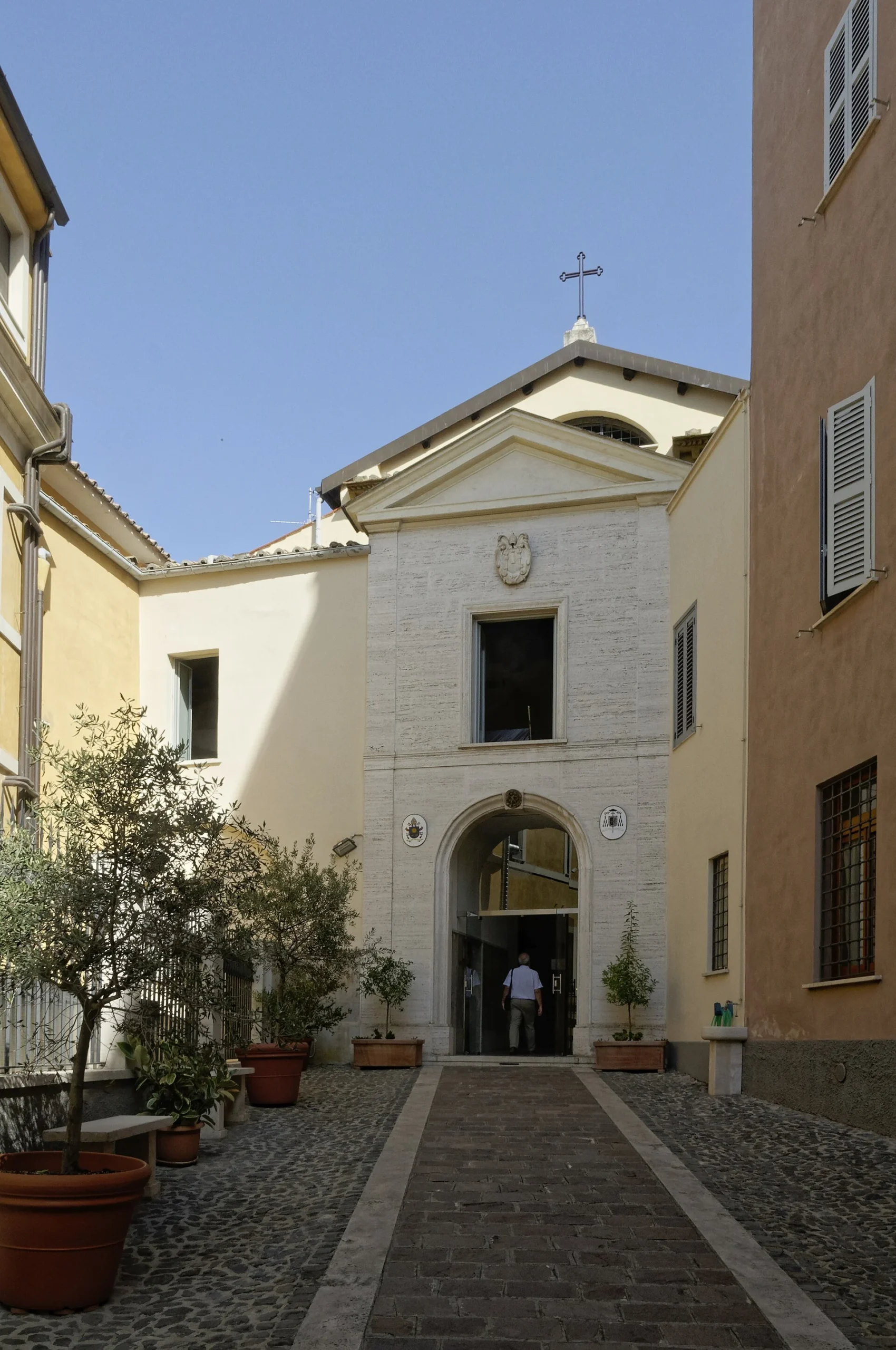
The church of Santi Michele e Magno stands on the slope above Borgo Santo Spirito, beside the colonnade of Saint Peter's, with number 21, which reference entries place on Largo degli Alicorni. It is the national church of the Netherlands, used by the Dutch community of Rome, property of the Holy See. Entrance is free, with no ticket and no reservation, on the days and at the opening hours that the community publishes on its own website.
Romans still call it the church of the Frisians, the Dutch call it Friezenkerk. It began as the chapel of the Schola Frisonum, the house of pilgrims who came from the coasts of the North Sea in the early Middle Ages, and it has kept a Romanesque brick bell tower that is the oldest and most recognizable piece of the complex. Inside is the funerary monument of the painter Anton Raphael Mengs, one of the big names of 18th-century Europe.
The practical information given here stands as of September 29, 2026 from the sources indicated in the text, and the primary source remains the church's official website, friezenkerk.nl, written in Dutch. Hours, Masses and extraordinary openings depend on a small community and on the Vatican's calendar: before climbing the stairs on purpose, check the website or write from the contacts page, because sudden closures happen.
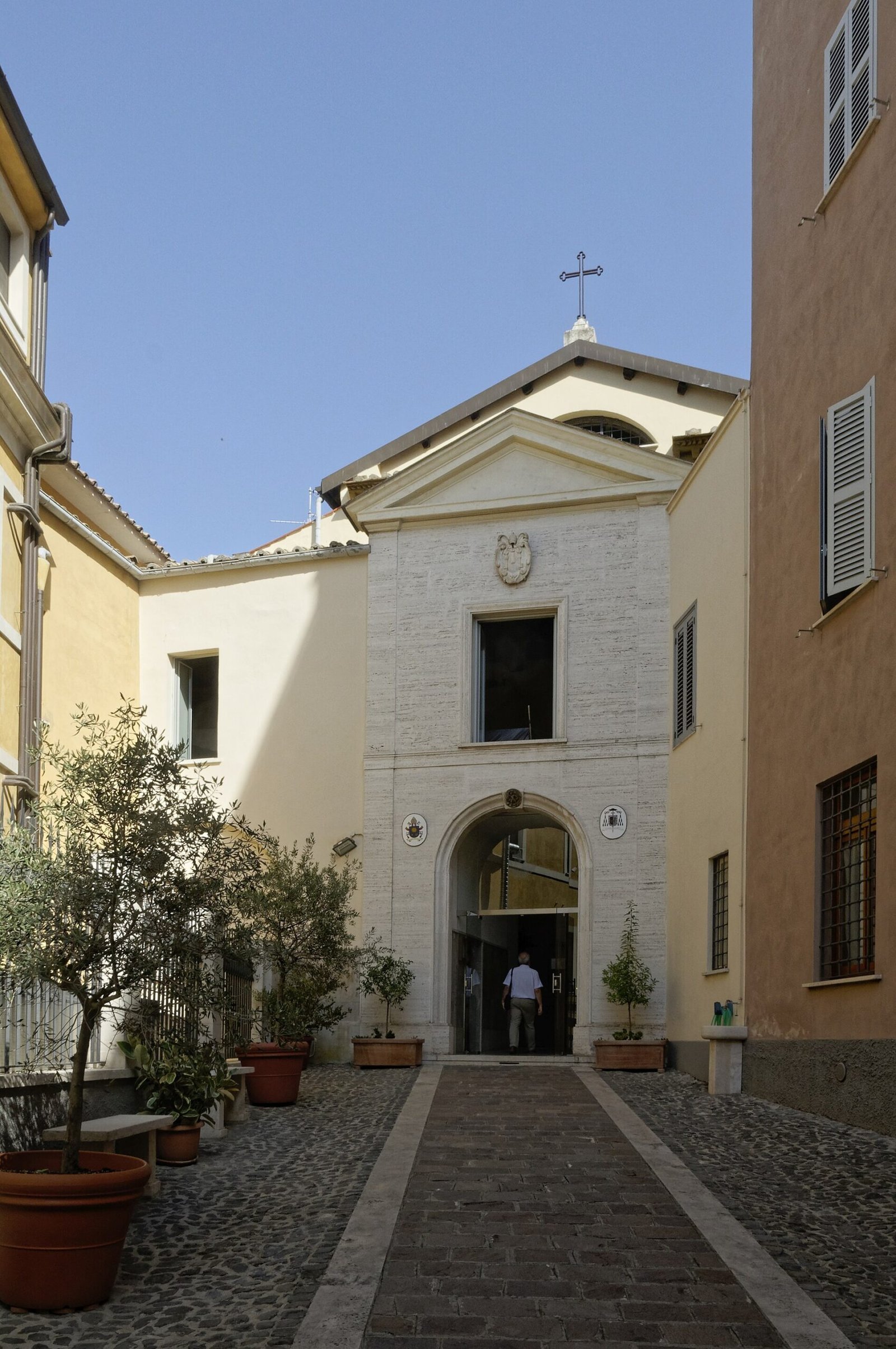
Where It Is and What You Really See
The spot is the end of Borgo Santo Spirito, the street that runs parallel to the Tiber between the hospital of Santo Spirito in Sassia and the southern arm of the colonnade of Saint Peter's Square. A steep staircase breaks away from the street and climbs toward the white facade, on the first slopes of the hill that leads to the Janiculum. From below you mostly see the bell tower, and many pass by without realizing there is an open church up there.
The facade is simple and 18th-century: an entrance porch with a space above it, very flat Doric pilasters, a triangular pediment now empty that seems to have held a fresco. Everything is plastered bright white. Don't look for marbles, statues or carved portals. The sobriety comes from the restoration of 1756-1759, entrusted to the architect Carlo Murena, who gave the church the look it still has now, and from the fact that for centuries it was a neighborhood church.
The Romanesque bell tower is more than 20 meters tall, in exposed brick, with three stories above the roofline. On two opposite faces of each story open arcades of three arches. The guides to Roman churches date it to the 12th century, in connection with the reconstruction consecrated in 1141, and recall a restoration in 1993. For anyone looking at Borgo today, after the demolitions of the 20th century, it is one of the few vertical signs of the medieval borgo that survive.
Inside you find a basilica with three naves, the central one of six bays, a flat coffered wooden ceiling painted gray, white and orange, with a large stucco relief of the keys of Saint Peter at the center. Eight frescoed roundels of the 18th century show saints tied to Northern Europe and to the history of the church. The whole is orderly, bright, small. You walk through it in 20 minutes, and the rest of the time you spend reading memorial stones.
How to Get In: Hours, Masses in Dutch and Who Runs It
Entrance is free. There is no ticket office, no advance sales and no portal sells access to this church: if someone offers you a ticket, you are paying for a third party's guided visit, not for entrance. The church belongs to the Holy See and since 1989 has been the national church of the Netherlands, entrusted to the Dutch community of Rome with a rector, today Antoine Bodar according to the official website, and volunteers who handle openings and welcome.
The official website, on the visitors page updated in May 2026, indicates the church open Tuesday to Saturday from 9 to 13 and from 14 to 17, Sunday from 10 to 12:30 around the Mass, and closed on Monday. A small community can change the hours with the seasons, with Dutch holidays and with the needs of the nearby Vatican Basilica: check before climbing up on purpose.
The Sunday Mass is celebrated in Dutch, at 10:30 according to the official website. It is a Catholic liturgy of the Roman rite, so those who don't speak the language recognize the structure and can follow it without difficulty. During the celebration the church is not visited: you come in to take part or you wait for the end. For other services, for weddings and for the celebrations of Dutch pilgrim groups, the calendar must be asked of the community.
The official website asks groups who want to attend the Sunday Mass to announce themselves as soon as possible, and on weekdays it also welcomes groups who arrive with their own priest. The channel to use is the contacts page of friezenkerk.nl, where you write in Dutch or English. For an organized group write well in advance and state number of people, language and time, because the interior space is small and the volunteers are few.
A practical warning about access. The official website describes the entrance like this: a gate and a tall staircase, about 20 meters from the left arm of the colonnade, with a second gate at the top, and then on the left the door of the church. Anyone in a wheelchair or with difficulty must ask first if there is an alternative access from the upper level, toward Largo degli Alicorni: the information is not clearly published, and showing up at the foot of the stairs without knowing it means giving up the visit. The same goes for strollers or suitcases.
A Curiosity About Santi Michele e Magno
The second saint of the dedication is the result of a misunderstanding. Magnus is an Italian bishop and martyr, whose relics were deposited here at the consecration of 1141 by Pope Innocent II. The Frisian pilgrims, however, mistook him for Magnus Forteman, a hero of their national history who lived, according to the tales, in the 8th century. A bishop of Lazio turned into a captain of the North by sharing a name: in Rome it is not the only case, but it is one of the clearest.
It helps to keep the levels distinct. The documents say that the relics of a Saint Magnus were placed in the church rebuilt in the 12th century. The Frisian tradition says that this Magnus was their leader. The legend adds that Magnus Forteman led the Frisians at the side of Charlemagne in the taking of Rome and that the emperor, out of gratitude, granted Frisia the famous Frisian freedom, a political privilege claimed for centuries.
That freedom is true history in another sense: the medieval Frisians really used it to refuse feudal lords and taxes, and the tale of the Roman feat served to give it a glorious and ancient origin. The church in Borgo, with the relics of some Magnus or other, became the material proof of a useful legend. It is a mechanism found in half of Europe, where relics certify invented genealogies and contested rights.
Saint Michael, the first patron, has instead an entirely Roman logic. The warrior archangel protects high places and gates, and in Borgo his presence recurs in several spots, starting with the angel that gives its name to Castel Sant'Angelo. A church of armed pilgrims, built on the slope that looks at Peter's basilica, under the protection of the head of the heavenly militia: the choice makes sense even without documents to explain it.
Something Nobody Tells You About Santi Michele e Magno
Passing through the entrance gate, legally, you are entering a place that does not belong to the Italian state like the rest of the street. Since 1929, with the Lateran Pacts, the church has enjoyed extraterritorial status in favor of the Holy See, like other buildings in Borgo and in Rome tied to the Vatican. It is not territory of Vatican City in the strict sense, but it is a property that Italian laws treat as a foreign seat.
The same date marks the end of the parish. The church had become parochial in 1508, and in 1929 that function was suppressed. For 60 years the building remained in a sort of limbo, open for the confraternity and little else, until in 1989 it was assigned to the Dutch community as a national church. A curious return: the descendants of those pilgrims from the North have retaken possession of the place that their ancestors had left more than five centuries earlier.
Even less cited is the international recognition. In 1990 UNESCO extended the historic center of Rome site to the extraterritorial properties of the Holy See in the city, and the church of the Frisians falls within that list. Few visitors know it, and almost no tourist guide writes it. The World Heritage mark on such a small building says more about its legal status than about its artistic weight.
This status also explains why the hours follow different logics from those of the parish churches of the diocese. Here the neighborhood parish priest is not in charge, a foreign community that is a guest of a Vatican property is, with its own volunteers, its own liturgical calendar and its own national feasts. That is why the website to consult is Dutch and not that of the Vicariate, and why openings can be skipped when community events coincide.
The Schola Frisonum and the Other Scholae of Borgo
In the early Middle Ages the area between Saint Peter's and the Tiber filled up with scholae peregrinorum, national houses that welcomed pilgrims coming from Northern Europe. There were the Saxons, the Franks, the Lombards and the Frisians. Each schola had its church, a hospice, a cemetery and a group of armed men who, when needed, defended the basilica. The sources mention that of the Frisians for the first time in 799, while the church appears in documents in 854.
The heirs of those institutions can still be seen a few hundred meters away. The schola of the Saxons gave its name and origin to Santo Spirito in Sassia, that of the Franks survives in the territory of the Camposanto Teutonico, inside the Vatican walls. If you want to understand the geography of the Rome of medieval pilgrims, tour these three places in a row, on foot, and the map of Rione Borgo becomes readable.
The Frisian tradition holds that an earlier church had been founded by Saint Boniface, the evangelizer of Germany who died in Frisia in 754. It is a tradition, not an archive fact, and the sources disagree on the saint's direct role in Rome. The same goes for the tale that the Frisians of the scholae were among the defenders of the basilica during the Saracen raid of the mid-9th century.
That raid, which plundered Peter's basilica, is instead a solid fact, and it is at the origin of the Leonine walls ordered by Pope Leo IV, of which the Passetto di Borgo is the most visible heir. Borgo was born as a fortified citadel of pilgrims. The church of the Frisians is one of the few buildings that preserves, in its title and in the community that uses it, the memory of that original function.
The Romanesque Bell Tower, Up Close
The bell tower is the reason it is worth stopping even when the church is closed. It is a brick tower of the 12th century, of the type that in Rome accompanies the churches rebuilt after the Norman sack, with stacked stories separated by cornices and arched openings that lighten as they rise. Anyone who has seen the bell towers of Santa Maria in Trastevere or San Giorgio al Velabro recognizes at once the same building family.
Look at it calmly from the street. The arcades of three arches open on two opposite faces of each story, and the other two faces stay more closed: it is a choice that balances weight and lightness, and that served to let the sound of the bells out toward Borgo and toward the basilica. The proportions are slender for such a small church, a sign that the tower had to be seen from the far end of the pilgrims' street.
The restoration of 1993 cleaned the brick and consolidated the structure. Today the tower reads well, with the warm color of the brick contrasting with the white of the 18th-century facade. That contrast tells at a glance the two lives of the church: the medieval foundation of the pilgrims from the North and the Roman remodeling of the 18th century, two eras that live together on the same slope without trying to resemble each other.
Borgo Around the Church, Yesterday and Today
To understand where you are, imagine Borgo before the 1930s. Between the Tiber and Saint Peter's ran two parallel streets, Borgo Vecchio and Borgo Nuovo, separated by a block of houses called the spina. The basilica revealed itself at the last moment, as you came out into the square. The demolitions for via della Conciliazione erased that surprise and opened the great long vista that today leads straight to the facade.
Borgo Santo Spirito, the street on which the staircase faces, has stayed more faithful to the old layout. On one side the large hospital complex of Santo Spirito, on the other the lower buildings and the climb toward the hill. Walking it you can still sense the rhythm of the pilgrims' quarter: hospices, national churches, workshops, hospitals, all oriented toward the tomb of Peter, a few hundred meters away.
Today the neighborhood lives on two populations that almost never meet. On one side the flow of visitors headed to the Vatican, on the other the residents, the religious of the institutes and those who work in the offices of the Holy See. The church of the Frisians sits on the border between these two worlds: at the top of a staircase that almost everyone looks at from below, and that few really climb.
My Advice for Visiting Santi Michele e Magno
Come on a Tuesday or a Wednesday, late in the morning, after seeing Saint Peter's, and not on a Sunday. On weekdays the church also opens in the morning, and the official website notes that on Tuesday afternoons a priest of the community is usually present. On Sunday morning there is Mass in Dutch, the space is occupied by the community, and walking around among memorial stones and altars becomes rude toward those who are praying.
Avoid Wednesday morning if you plan to pass through Saint Peter's Square first: the pope's general audience, when it is held in the square, closes accesses and fills Borgo with groups, buses and barriers. On days of major Vatican celebrations even the church's staircase can become a point of passage or observation. Check the calendar of the Holy See's celebrations before setting the day, and if needed choose a Thursday.
Climb the entrance staircase on foot calmly, and stop halfway. From there the bell tower is seen at an angle, and turning back you have the street running toward the Tiber on one side and the colonnade on the other. It is the spot from which you understand why the Frisians chose this position: above the pilgrims' street, in sight of the basilica, protected by the slope. 10 seconds of pause give more context than a panel.
Inside, give time to the memorial stones and the funerary monuments, not to the paintings. The painting is 18th-century, decorous and from a Roman workshop, and is not the reason for the visit. The inscriptions, on the other hand, tell who lived in Borgo between the 17th and 19th centuries, and the monument of Mengs is the piece that justifies the climb for anyone interested in art history. Read the roundels with the saints of the North: they are the church's identity card.
If you want the volunteers' guided visit, write at least two weeks before. Anyone traveling with a group must consider that the interior space holds a few dozen people and that the staircase is a bottleneck: with 40 participants you need two shifts. Bring something for the offerings, because a church without a ticket lives on that, and don't take for granted that the volunteer speaks Italian. English usually works.
Another Well-Known Fact, Yet Rarely Cited
The complex also has a holy staircase, distinct from the staircase you enter by. According to the most detailed historical entry on the church, that of the wiki Churches of Rome, it is a steep ramp of 33 steps that climbs from Borgo Santo Spirito to a side chapel, restored in 2000. The door on the street, with a mosaic roundel above it, stays closed: the staircase is reached from above, from the inside. Anyone who climbs it on their knees, under the conditions set by the Church, can obtain the plenary indulgence by special concession.
For an Italian visitor this information usually doesn't arrive: general guides almost never mention it, and passersby in the street see only a closed door. If you find the chapel open and see someone climbing on their knees, give them space and don't photograph them up close. It is a religious practice, not a folkloric scene, and the staircase is narrow and steep.
The second well-known and little-cited fact concerns the crypt. Between 1618 and 1628 a burial ground was set up under the church with separate rooms for men, women and children, marked with the Latin inscriptions virorum, mulierum and infantium. It is a document of how urban burial worked before the 19th-century cemeteries, when every neighborhood church was also the cemetery of its neighbors. The crypt is not part of the ordinary visit.
Third fact: the church risked disappearing more than once. Damaged in the Norman sack of 1084, rebuilt and consecrated in 1141, restored in the mid-1700s, hit by a serious fire in 1860, then emptied of its parish in 1929. The last major restoration ended in 2011. 10 centuries of life for a small building, without powerful patrons, are a proof of endurance that you read in the walls if you know where to look.
Inside the Church: What to Look At, Altar by Altar
The high altar has an altarpiece by Niccolò Ricciolini with the two titular saints, Michael and Magnus, a work of the first half of the 18th century. Beneath, a sarcophagus bears a Latin inscription according to which this is the stone on which the Virgin presented the Son at the Temple according to the custom of the Jews. It is a devotional attribution, to be placed on the level of tradition and not of documents. Read it the way you read a medieval relic label.
In the left aisle the altar of Saints Peter and Paul has an altarpiece by Ludovico Stern, a Roman painter of the 18th century. In the right aisle the altar of the Immaculate Conception has a good stucco representation. The organ has recently been attributed to Giovanni Corrado Verlé, an 18th-century organ builder. None of these pieces justifies the trip alone, but together they give the coherent image of a Roman church remodeled in a single campaign of works.
The frescoed roundels along the nave are eight and depict, among others, Saint Boniface, Pope Leo III, Saint Willibrord, Saint Charles Borromeo, Saint Theodore, Saint Suitbert and Blessed Antonio Fatati. It is a targeted gallery: Boniface, Willibrord and Suitbert are the apostles of the Netherlands and of northern Germany, Leo III is the pope of Charlemagne. The choice of subjects tells the Nordic identity of the church better than any panel.
The baptismal font comes from the Netherlands. It was carved in 1925 for a church in Maastricht and has a gilded metal cover by the artist Bert Kreijen, with the image of Saint Servatius, patron of that city. It is one of the few furnishings of the 20th century, and shows how the Dutch community brought pieces of its own home to Rome, instead of buying furnishings on the Roman antiques market.
The community has named a room for visitors after Titus Brandsma, with a modern bust by the artist Josephine Kortman-Hilders. Brandsma was a Dutch Carmelite, journalist and professor, who died in the Dachau camp in 1942 and was canonized in 2022. The room works as a welcome space for visitors and for the community. If it is open, go in: it is the point where the church stops being a monument and goes back to being a living community.
The Right Photo to Take at Santi Michele e Magno
The photo is from below, on Borgo Santo Spirito, a few meters before the staircase, with the lens pointed upward and the bell tower vertical. Put the staircase in the lower part of the frame, the white facade in the middle and the bell tower at the top, with a piece of the colonnade coming in from one side. Vertical, not horizontal: the composition works only if the climb reads from the first step to the belfry.
The good light is that of the afternoon, when the sun turns west and catches the brick of the bell tower from the side. At noon the white facade burns out and the bell tower becomes a flat silhouette. If you shoot with a phone, lower the exposure by tapping the facade, and recover the shadows afterward. With an overcast sky the photo loses color but gains detail on the arcades of the bell tower, which is the part that matters.
The second photo is from above, from the landing in front of the porch, toward Borgo Santo Spirito and the Tiber. From there you read the alignment of the street toward the river and the dome of Saint Peter's stays to the side, so turn your body toward the colonnade if you want to keep it in the frame. Respect those who climb: the staircase is narrow, and setting up in the middle with a tripod blocks everyone.
Anyone looking for an illustrious precedent finds it in the Dutch engraver Maurits Cornelis Escher, who in the years he lived in Rome portrayed this church. The sheet is in the National Gallery of Canada. Try looking at it before you come and finding his point of view again: it is an exercise that forces you to observe the structure of the building, and brings home a less banal photo than the one everyone takes from the end of the street.
Some Important Events That Happened Here in History
799 is the first useful date: the sources mention the Schola Frisonum, the house of the Frisian pilgrims in Borgo. It is the year in which Pope Leo III, depicted in one of the roundels of the nave, suffered the attack in Rome and fled toward Charlemagne, who the following year was crowned emperor in Saint Peter's. The Frisians' schola lives within that season, when Rome and the Carolingian world were tied by a double thread.
In 854 the church appears in documents. A few years earlier, in the middle of the century, the Saracen raid had plundered Peter's basilica, and the papal response was the building of the Leonine walls, which enclosed Borgo in a citadel. The foreign scholae thus found themselves inside the fortified perimeter. For the Frisians it meant safety, and at the same time growing dependence on the papacy, which from then on controlled the pilgrims' space.
In 1084 the Normans of Robert Guiscard, who had come to free Pope Gregory VII, sacked the city, and the church was damaged or destroyed. The reconstruction ended with the consecration of 1141 by Pope Innocent II, who deposited there the relics of Saint Magnus. The Romanesque bell tower belongs to that phase. Since then the building has kept the same basilica plan, changing skin but not structure.
In 1446 Pope Eugene IV suppressed the schola: the Frisian pilgrims were by then few and the medieval national institutions were being absorbed by the structures of the Vatican basilica. In 1508 the church became a neighborhood parish. Between 1618 and 1628 the burial crypt was set up, and between 1756 and 1759 Carlo Murena directed the restoration that gave it its current look, with the white facade and the flat ceiling.
In 1860 a serious fire badly damaged the building, and the restorations that followed lasted years. In 1929 the Lateran Pacts made it extraterritorial and the parish was suppressed. In the 1930s Borgo was upended by the demolitions for the opening of via della Conciliazione, which erased the medieval spina between Borgo Vecchio and Borgo Nuovo. The church, set off to the side on the slope, was saved because it stood outside the route.
In 1989 the church was entrusted to the Dutch community and became the national church of the Netherlands. In 1990 it entered the perimeter of the UNESCO World Heritage together with the other extraterritorial properties of the Holy See. In 1993 the bell tower was restored, in 2000 the holy staircase, and in 2011 the last major restoration ended. In a little more than 20 years the building went from forgotten church to reference point for Dutch pilgrims.
Who Passed Through Santi Michele e Magno
The Frisian pilgrims, first of all. Men who came from the low coasts of the North Sea, from the islands and the reclaimed lands, who for centuries crossed Europe on foot to reach the tomb of Peter. Here they found a bed, a church where their language was spoken and a place to be buried if they died far from home. Today's church remains, at bottom, a service to the same community by different means.
Anton Raphael Mengs, the painter born in 1728 in Aussig, in Bohemia, who died in Rome in 1779. He was a court painter in Dresden and Madrid, in the service of Charles III of Spain, and one of the protagonists of the return to the antique in 18th-century European painting. His funerary monument in the church has a portrait in a medallion held up by putti, attributed by specialist guides to the sculptor Vincenzo Pacetti. For anyone studying Neoclassicism it is a required stop.
Nicola Spedalieri, a Sicilian priest and philosopher who died in 1795, also has a monument with a painted portrait in the church. He was one of the Catholic thinkers who in the 18th century tried to engage with ideas about the rights of man, a position that cost him controversy in his lifetime. Next to him is the Baroque monument of Leonardo Santi, from 1668, with a painted portrait of good quality. Two minor names who tell the learned and clerical Borgo of their time.
Niccolò Ricciolini and Ludovico Stern, the two painters of the altars, passed through here as craftsmen of a Rome that in the 18th century turned out altarpieces nonstop for hundreds of churches. Carlo Murena, the architect of the 18th-century restoration, worked in that same season. None of them is a textbook name, but their work gives the church that overall coherence that is often missing in the more famous churches.
Titus Brandsma, the Dutch Carmelite who died at Dachau, is not buried here but is present with the bust in the room that bears his name. The Dutch community chose him as a reference figure, and his canonization in 2022 brought many pilgrims from the Netherlands to Rome. For them the Friezenkerk is the natural home during their Roman days, the meeting point before and after the celebrations in the Vatican.
Maurits Cornelis Escher, finally, the engraver of impossible worlds, who lived in Rome between the two wars and drew this church. His view of the building is a curious document: before the infinite staircases and paradoxical geometries, Escher looked at real architecture, and this was one of those he chose. For a Dutchman in Rome the church of the Frisians was, even then, a reference point of identity as well as a subject.
The Other National Churches of Rome, for Comparison
Rome is full of national churches, and lining them up helps to understand what is particular about that of the Frisians. The closest in history is Santa Maria dell'Anima, church of the German nation that for centuries also welcomed Flemings and Dutch, and where Adrian VI, the only pope born in the Netherlands, is buried. Those who come from Holland usually visit both on the same day.
Then there are the big ones: San Luigi dei Francesi, with the Caravaggios, Sant'Antonio dei Portoghesi, Santa Maria in Monserrato of the Spanish, San Stanislao dei Polacchi. And the small ones, like San Nicola dei Lorenesi, San Claudio dei Borgognoni and San Girolamo dei Croati. Each has its own hours and community.
The churches of the Eastern nations complete the picture: San Biagio degli Armeni and Sant'Atanasio dei Greci, with their rites. And there are the churches of the Italian nations before unification, like San Giovanni dei Fiorentini, Santo Spirito dei Napoletani and San Bartolomeo dei Bergamaschi, who for a Roman of the 17th century were as foreign as a Dutchman.
The difference is one of age. Almost all the Roman national churches were born between the 15th and the 17th centuries, when the European monarchies built their religious representations in Rome. The church of the Frisians belongs to another world, that of the Carolingian scholae, and has a 700-year head start. It is also for this reason that it is so small: it was born as a pilgrims' hospice, not as the embassy of a kingdom.
How to Get There on Foot From Saint Peter's and From Castel Sant'Angelo
From Saint Peter's Square the way is very short. Leave the colonnade on the left side as you face the basilica, that is from the southern arm, and go down toward Borgo Santo Spirito: according to the official website the entrance gate, with the staircase, is about 20 meters from the arm of the colonnade. On days of heavy crowds the square's security checkpoints change position, so follow the indications of the police instead of your phone's map.
From Castel Sant'Angelo and from Ponte Sant'Angelo you walk Borgo Santo Spirito from the start, passing in front of the Santo Spirito hospital complex, all the way to the end. It is about 10 minutes at a relaxed pace, on the flat, with the colonnade getting closer. It is the route that pilgrims arriving from the bridge took for centuries, and it still makes sense to do it in that direction.
For public transport we don't indicate lines, because bus routes in the Vatican area change often with construction, big events and detours. Use the route planner of Rome's transport company the same day, and consider that almost all solutions lead to Piazza Risorgimento, to Lungotevere in Sassia or to the head of via della Conciliazione, from where you arrive on foot in a few minutes.
Don't come by car. In Borgo surface parking is extremely rare, the streets are narrow, and on days of Vatican celebrations traffic is closed in stretches without notice for those arriving from outside. If you are in the city with your own vehicle, leave it in a garage in Prati and continue on foot. The neighborhood is toured on foot in half a day, and the car here becomes only a problem.
When It Is Closed and What Not to Expect
According to the official website the church is closed on Monday and on Sunday afternoon, and on weekdays it breaks between 13 and 14. Openings can be skipped for the community's holidays, for private celebrations and in periods when volunteers are lacking. The manager doesn't indicate fixed summer closures, but August, with a community of foreign volunteers, is a month to check with particular care before setting out.
Don't expect a museum. There are no panels in Italian, audio guides or marked routes, and the explanations, when there are any, come from the volunteer present or from the materials on sale. Don't expect masterpieces either: the painting is of good Roman 18th-century level, nothing more. Anyone who comes for the name of Mengs finds a funerary monument, not a painting by the artist.
Now the editorial team's position, contrarian to the Dutch guides that describe the Friezenkerk as a hidden treasure: the interior is overrated. It is a clean and well-kept 18th-century hall, but without a single work that is worth the climb on its own. The value of the place lies entirely outside and before: in the 12th-century bell tower, in the holy staircase, in the history of the schola. Anyone who enters for the art stays lukewarm, anyone who enters for the history leaves happy.
Don't expect total silence, finally. The church sits right next to the flow of visitors to Saint Peter's, and from the street come the voices of groups, the guides' loudspeakers and the noise of coaches. Inside the tone changes, but the staircase is a place of passage. If you seek quiet, come in the early afternoon of a weekday out of season, when Borgo empties for a few hours.
Eating in the Area
Borgo and the area around via della Conciliazione are one of the hardest areas of Rome in which to eat well. The flow of Saint Peter's visitors is continuous, doesn't come back, and the restaurants know it. The result is a concentration of dining built on passing trade. Not everything is to be avoided, but the signs for recognizing the traps are clear and worth learning before sitting down, because here the bill always comes afterward.
First sign: the menu with photos of the dishes, laminated and translated into five languages. A place that has to show you the picture of a carbonara is talking to someone who doesn't know what it is. Second sign: the person at the door who stops you and invites you in. A place with regular customers doesn't need a barker. Third: the lady rolling fresh pasta in the window or on the sidewalk, put there as a scenic lure, not as a guarantee.
Fourth sign: the kitchen open without a break from morning to night, which means dishes prepared in advance and reheated. Fifth: items without a price, like the fish of the day or the chef's dish, and different menus inside and out, with the sidewalk tables costing more. In places in front of monuments the price tends to adapt to the customer. Always ask the price before ordering, and have it written down.
Romans don't eat in this area, and it's not snobbery. Those who work in the Vatican or in the offices of Prati look for places with a kitchen that has fixed hours, a short menu that changes with the seasons, and a posted price list. Moving 10 minutes toward Prati, past Piazza Risorgimento, the situation changes a lot. The criterion is always the same: look at who is seated and in what language they order.
So as not to go by trial and error, we have an updated map of the places we really go to in Rome and around, with no sponsorships, built over time and corrected when a place changes management or quality: our list of places where we eat ourselves. In Borgo it's worth booking even for lunch on days of major celebrations in the square, when even the good places fill up early.
What to Pair It With in a Day
The natural combination is with Saint Peter's. You visit the Basilica early in the morning, before the groups, look at the obelisk at the center of the square, then go down toward the church of the Frisians and finish at the Camposanto Teutonico, if the hours allow. Anyone who has booked the Scavi di San Pietro finds here a stop consistent with the history of the pilgrims.
Those whose morning is taken by the Vatican Museums and the Sistine Chapel can do the route in reverse in the afternoon: exit from the Museums, descent toward the square, church of the Frisians before closing, then Borgo Santo Spirito to Castel Sant'Angelo. The neighborhood guide Prati and Borgo helps build the route and not miss the minor stops.
Climbing toward the Janiculum, instead, you reach Sant'Onofrio al Gianicolo and then, along the promenade, the Acqua Paola Fountain and San Pietro in Montorio. It is a real climb, to be done with comfortable shoes and water, but it leads to one of the widest panoramas over the city and ends the day with the view, instead of with a line.
To stay in the Rome of the pilgrims, cross the Tiber and go to the Santissima Trinità dei Pellegrini, which for centuries welcomed those who arrived for the jubilees. Anyone who prefers the history of medicine finds in the Santo Spirito complex the Accademia di Storia dell'Arte Sanitaria. And anyone who wants to see the neighborhood born at the end of the 19th century can go as far as San Gioacchino in Prati, the building site of another world.
Frequently Asked Questions
Do you pay to enter the church of Santi Michele e Magno?
No, entrance is free and there is no ticket office. The church is property of the Holy See and since 1989 has been the national church of the Netherlands, entrusted to the Dutch community of Rome. Offerings are welcome because the church lives on voluntary contributions. The guided visits offered by the volunteers must be requested through the official website, which doesn't give conditions and contributions in Italian.
What are the opening hours?
The official website friezenkerk.nl, updated to May 2026, indicates Tuesday to Saturday 9-13 and 14-17, Sunday 10-12:30 with the 10:30 Mass, Monday closed. The hours depend on a small community and can change with the seasons and holidays: confirm them on the website before setting out.
Are the Masses in Dutch?
Yes, the Sunday Mass is celebrated in Dutch, at 10:30 according to the official website. It is a Catholic liturgy of the Roman rite, so anyone can take part even without knowing the language. During Mass the church is not visited as a tourist. For other celebrations, weddings and Masses of pilgrim groups you must contact the community through the website.
Why is it also called the church of the Frisians?
Because it was born as the chapel of the Schola Frisonum, the house of the Frisian pilgrims recorded by the sources in 799. The Frisians were the population of the North Sea coasts between the present-day Netherlands and Germany. For this reason the Dutch call it Friezenkerk, and for this reason since 1989 it has been entrusted to the Dutch community of Rome as a national church.
Is Anton Raphael Mengs buried here?
In the church is the funerary monument of the painter Anton Raphael Mengs, who died in Rome in 1779, with a portrait in a medallion held up by putti that specialist guides attribute to the sculptor Vincenzo Pacetti. It is the most cited monument of the interior. Anyone expecting paintings by Mengs will be disappointed: none of his painted works appear to be on display in the church.
Is the staircase really a holy staircase?
Yes, but it is not the staircase you enter by. The holy staircase is a steep, separate ramp, of 33 steps according to the historical entries, that connects Borgo Santo Spirito to a side chapel. The door on the street stays closed and the staircase is reached from inside. Anyone who climbs it on their knees under the conditions set by the Church can obtain the plenary indulgence.
Is the church in the Vatican or in Italy?
The church is in Rione Borgo, on Italian territory, but since 1929 it has enjoyed the extraterritorial status in favor of the Holy See provided by the Lateran Pacts. You don't go through border controls and you enter freely from the street. Since 1990 it has been part of the UNESCO site of the historic center of Rome together with the other extraterritorial properties of the Holy See.
Is it accessible to people with mobility difficulties?
The entrance from the street goes through a tall staircase between two gates, so anyone in a wheelchair or with difficulty cannot climb up from Borgo Santo Spirito. A possible alternative access from the upper level, toward Largo degli Alicorni, is not clearly indicated in the published sources. Write to the community through the official website before the visit to find out how to organize.
How much time does the visit take?
For the interior 20 or 30 minutes are enough, including reading the memorial stones and the monument of Mengs. If you add the pause on the staircase, a look at the bell tower from the street and a guided visit by the volunteers, count an hour. The church fits well into a day dedicated to Saint Peter's, Borgo and Castel Sant'Angelo, without needing a half day on purpose.
Who Wrote the Page
The page comes from the team of Tour Leader Pro, the Roman outfit that designs itineraries, visits and cultural events in Rome and Lazio. Hours, Masses and access terms given here result from the sources cited in the text at the date indicated at the top: since this is a church run by a foreign community of volunteers, recheck them on the official website before leaving. Tell us what you find changed.
Lining up a day among Saint Peter's, Borgo and the Janiculum means fitting together Wednesday audiences, security checkpoints that move, small churches with short hours, reservations at the Museums and climbs that you can't see on the map, for yourself or for a group of 40 people. Anyone facing this kind of puzzle will find at Tour Leader Pro working materials designed for those who guide and for those who organize on their own.
For the wide picture, that is trains, airports, travel between one region and another and Italian destinations outside the center of Rome, from the Castelli to the volcanic lakes of the north to the Tyrrhenian coast and the villages of the interior, a useful resource when you have to put together a multi-day itinerary is Italy Planner, which collects practical guides for organizing a trip to Italy city by city.