Gran Madre di Dio
In short. Gran Madre di Dio is at Via Cassia 1, on the square of Ponte Milvio, 00191 Rome, and it is a parish of the Diocese of Rome.
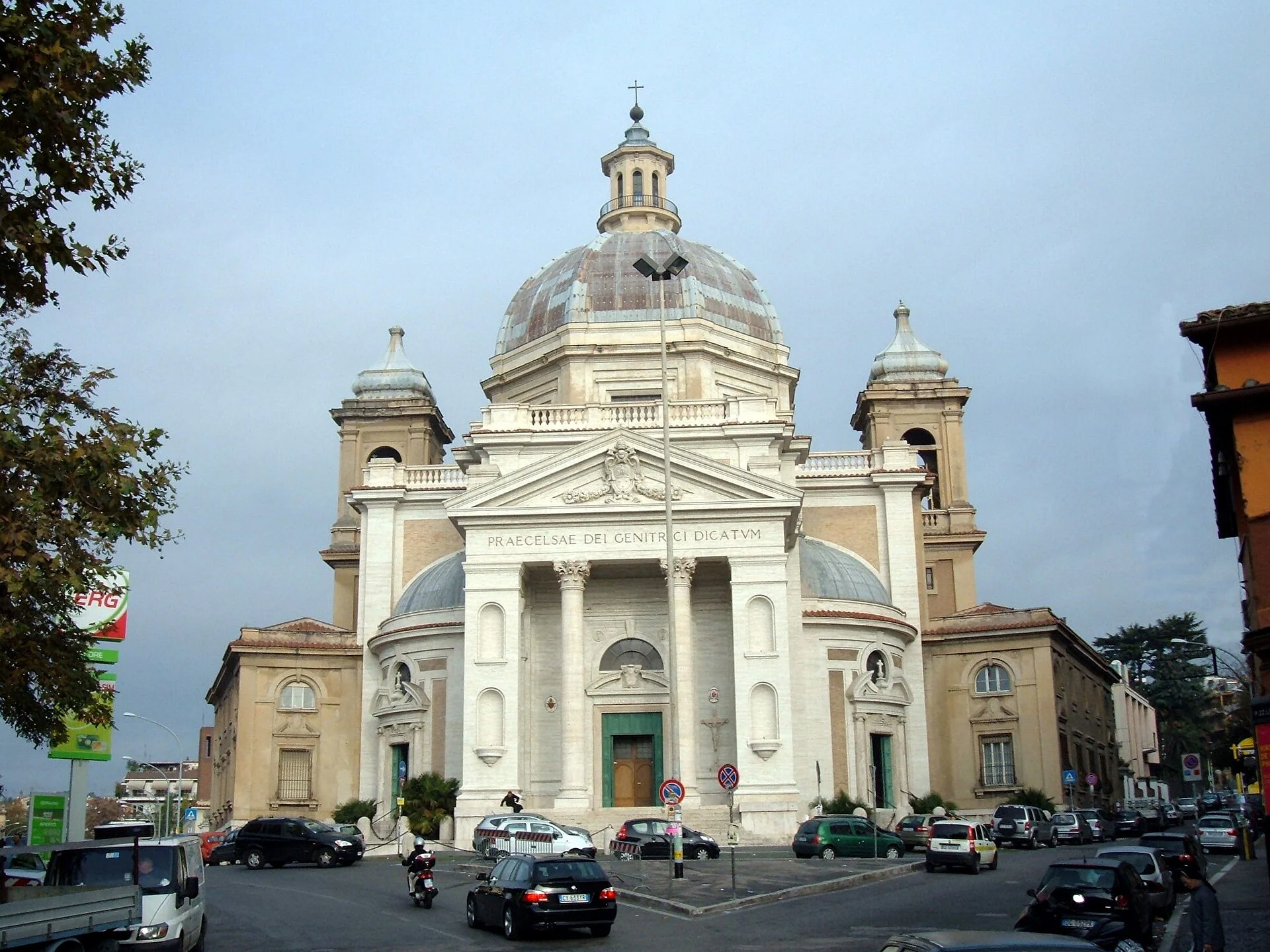
Gran Madre di Dio is at Via Cassia 1, on the square of Ponte Milvio, 00191 Rome, and it is a parish of the Diocese of Rome. Entry is free, there is no ticket and nothing to book. The church is open Monday to Saturday from 7:00 to 12:30 and from 16:30 to 19:30, and on Sunday from 7:30 to 13:00 and from 17:30 to 20:00. Weekday Masses are at 8:30 and 19:00, and holiday Masses at 9:00, 10:30, 12:00 and 19:00.
It is the church with the big lead dome that closes the view for anyone crossing Milvian Bridge from the Flaminia side. Pius XI wanted it in 1931 to mark a millennium and a half since the Council of Ephesus, the one that proclaimed Mary Mother of God, and it was designed by Cesare Bazzani, the Roman architect of the Galleria Nazionale d’Arte Moderna. It was consecrated in 1937. Since then it has served as the backdrop to one of the oldest bridges in the city.
The practical information given here comes, as of September 29, 2026, from the official website of the parish, which shows the hours page as modified on September 14, 2026. A parish's hours change with feast days, with summer and with the needs of the clergy, so before crossing the city for a specific celebration call 06 3339340 or write to parrocchia@granmadredidio.it, the two contacts published by the parish itself.
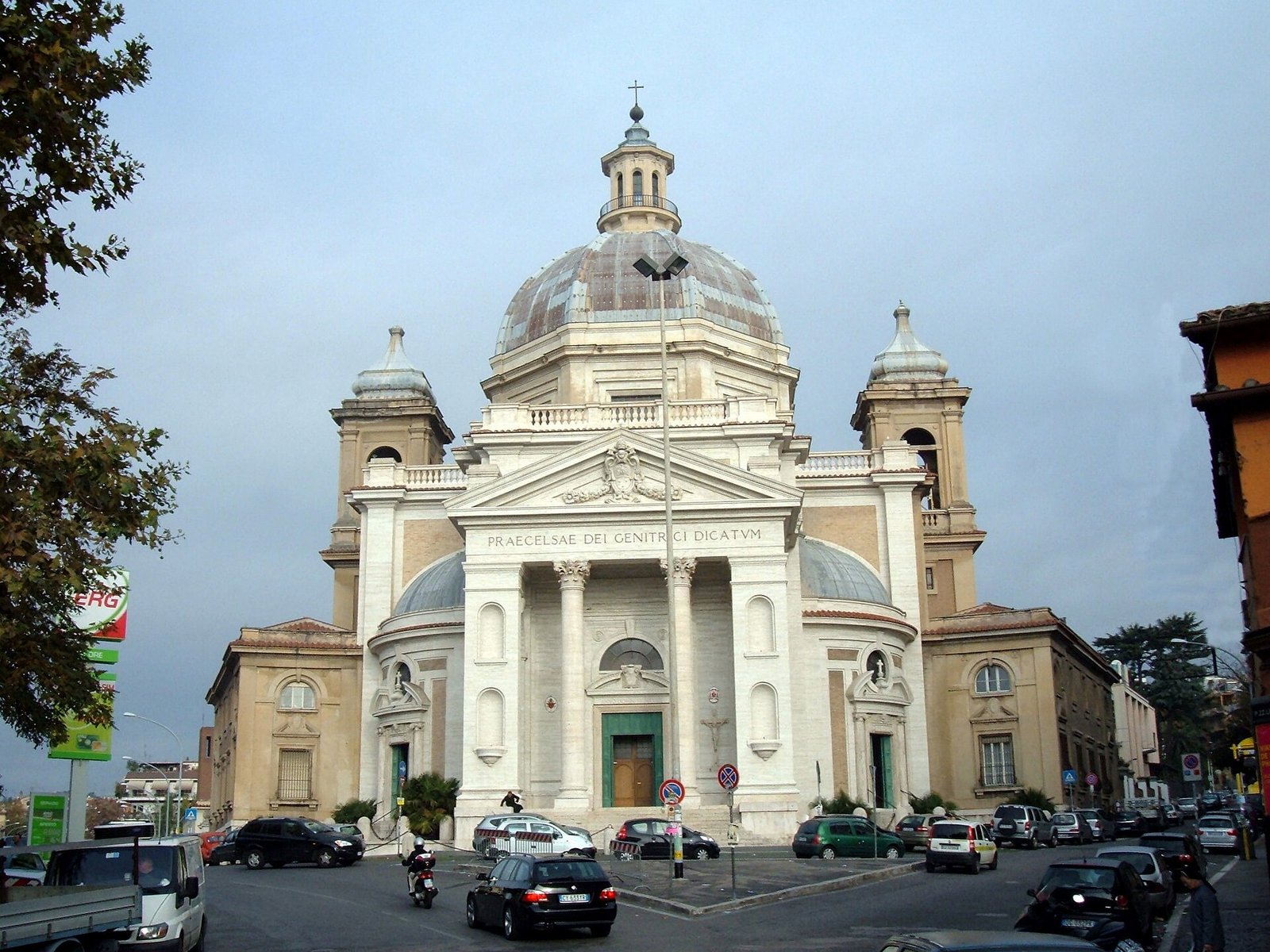
Where it is and what you really see
The church occupies the north side of the square of Ponte Milvio, at the point where Via Cassia splits off from the Flaminia just after the river. The official address is Via Cassia 1, but to find your way it's enough to think of the bridge: crossing it on foot from the south, the dome comes toward you on axis, and the whole church appears only when you come out onto the square, behind the little tower that closes the northern arch.
From outside you can pick out three elements. The first is the hemispherical dome covered in lead, raised on an octagonal drum with eight large windows and marked by ribs. The second is the two twin bell towers, with their bulb-shaped spires, also in lead. The third is the entrance, a travertine propylaeum with two enormous square piers of the Doric order and a triangular pediment with a coat of arms.
Under the pediment runs the dedicatory inscription PRAECELSAE DEI GENITRICI DICATUM, that is, dedicated to the most exalted Mother of God. The dominant material is pinkish brick, with the architectural parts in travertine. The parish gives a surface area of about 2000 square meters and a Greek-cross plan, with the crossing covered by the dome and four short arms, adapted to an irregular lot squeezed between two consular roads.
Inside there is a large central space dominated by the light from the drum, two side chapels, an apse clad in marble and little else. Anyone who walks in expecting the dense decoration of a Baroque church in the center is thrown off. Here the decoration has stayed essential, and the walls are largely travertine and light plaster. It is a 20th-century church, built for a neighborhood parish that was just coming into being, not a museum.
What you don't see: there are no visitor routes, panels, audio guides or paid areas, and the church has no museum attached. The parish rooms, oratory and offices are community spaces and are not visited. During Masses and funerals the tour of the interior has to be suspended. What is left for the visitor is the church open during the published hours, and to understand it 20 minutes well spent are enough.
A curiosity about Gran Madre di Dio
The church celebrates a council. Not a saint, not a miracle, not an apparition: the Council of Ephesus of 431, which recognized Mary's title of Theotokos, she who gives birth to God. The parish writes that Pius XI wanted the new church in 1931 precisely to commemorate the 15th centenary of that assembly. It is a rare case in Rome of a sacred building dedicated in effect to a date in the history of doctrine.
That same year the pope also dedicated an encyclical to the centenary, Lux veritatis, issued at the end of 1931, in which he retraced the controversy between Nestorius, bishop of Constantinople, and Cyril of Alexandria. The point was both theological and political: saying that Mary is the mother of God meant defending the unity of the person of Christ. The name of the church, Gran Madre di Dio, translates that Greek formula into Italian.
Rome already had a monument tied to Ephesus, and a much older one. After the council Pope Sixtus III rebuilt the basilica on the Esquiline that we now know as Santa Maria Maggiore, and the mosaics of the triumphal arch from that fifth-century building site have always been read as the figurative manifesto of the new doctrine. At Ponte Milvio Pius XI took up the same theme a millennium and a half later.
The name has an illustrious relative outside Rome. In Turin, beyond the Po, there is the neoclassical Gran Madre di Dio with its columned pronaos and low dome, built for the return of the Savoy after Napoleon. The two churches have no direct ties, and confusing them in online searches is very easy. The Roman one is more than a century younger and was born from an entirely different occasion.
One thing nobody tells you about Gran Madre di Dio
Bazzani signed the project, but on the building site the work was overseen by another Roman architect, Clemente Busiri Vici, whom the parish names as the builder of the work. The distinction matters. In the guidebooks you almost always find only Bazzani's name, because he was the famous professional, the man of ministries and art galleries. The passage from the drawing to the built church, with all the choices a building site forces, also carries the signature of Busiri Vici.
Second thing that goes unmentioned: the interior gives the impression of a decorative program left half finished. The walls are travertine and cream-colored plaster, which has turned grayer over the years, the entablature from which the dome and the vaults spring is sober to the point of poverty, and the large empty fields seem to be waiting for paintings that never came. No open source explains why, and the information is not published.
The hypotheses are reasonable but remain hypotheses. The church was made a parish in 1933 and consecrated in 1937, in years of tight budgets, and right afterward came the war and reconstruction. Many Roman churches of that generation met the same fate: complete structure, decoration reduced to the presbytery. Seeing the interior knowing this changes the judgment. It is not deliberate coldness, it is a building site that stopped.
Third detail: the square the church faces has a longer history than the church. The parish recalls that the space was laid out by the architect Giuseppe Valadier, as part of the works commissioned by Pius VII at the beginning of the 19th century, the same years in which Valadier worked on the little tower of the bridge. Bazzani's church arrives more than a century later and fits into a space already designed, choosing to converse with the bridge.
Hours, Masses and how to get in
The church is open Monday to Saturday from 7:00 to 12:30 and from 16:30 to 19:30, and on Sunday from 7:30 to 13:00 and from 17:30 to 20:00. Weekday Masses are at 8:30 and 19:00, the Saturday vigil Mass at 19:00, and holiday Masses at 9:00, 10:30, 12:00 and 19:00. Every day at 18:30 the rosary is recited. The hours are those published on the parish website and checked on September 29, 2026.
Entry is free and there is no booking channel, because it is a parish church and not a paid monument. The parish publishes no organized guided visits on its website, and no portal sells tickets to get in. If someone offers you a paid tour that includes the church, you are paying for the guide and the storytelling, not for access, which stays free for anyone during opening hours.
Confessions, according to the official hours page, are held during office hours, during holiday and weekday Masses and in any case on request. The website does not publish separate hours for the parish office, and in case of urgency it refers you to the phone or to the priest present at the celebrations. For certificates, baptisms, weddings and assorted paperwork the right channel remains the number 06 3339340 or the email parrocchia@granmadredidio.it.
The website does not indicate summer changes, but in Rome almost all parishes cut back Masses between July and August and change a few things on major feast days. The operator does not state any written rules for photographs either: the custom of every Roman church applies here too, no flash, no shots during celebrations, silence near the tabernacle. Covered shoulders and knees are not a published requirement, but they are a sign of respect.
My advice for visiting Gran Madre di Dio
Arrive on foot from the bridge, not from the square. Start from the south bank of the Tiber, on the side of Via Flaminia, and cross Ponte Milvio slowly, looking straight ahead. The church was placed and designed to be seen this way: the little tower of the bridge in the foreground, the dome growing behind it with every step. Anyone who arrives by car from the Cassia sees it from the side and loses the whole point of the exercise.
Pick a weekday afternoon, after the reopening at 16:30 and before the rosary at 18:30. In those two hours the church is quiet, there are no celebrations, and the light coming in from the eight windows of the drum is the best for reading the space. Early in the morning there is the 8:30 Mass, and on Sunday between 9:00 and 13:00 three Masses follow one another and the interior is taken up by the community.
Avoid Friday and Saturday evenings if you want calm. The square of Ponte Milvio is one of the hubs of nightlife in north Rome, and from 19:00 on the square changes face: tables, crowds, traffic and noise until late. The church closes at 19:30 on weekdays, so an evening visit is brief anyway. On Saturday morning, on the other hand, the square still belongs to the neighborhood.
Inside, take the time to do the full loop. Walk in, stop in the center under the dome, then go toward the apse and read the inscription in the semi-dome, then move on to the two side chapels. The sense of the church comes from the relationship between the height of the dome and the shortness of the arms, and you only get it by walking. Anyone who stays at the door and takes a photo leaves with half the information.
One last tip: combine the visit with a walk along the river. From the bridge you go down toward the Foro Italico and the Ponte della Musica following the bank, and you reach the MAXXI and the Auditorium Parco della Musica in a good half hour. It is the best way to set Bazzani's church beside the architecture that Rome built on the same bend of the Tiber after it.
Ephesus, Nestorius and the title of Mother of God
To understand the dedication you need half a minute of ancient history. In 431 the emperor Theodosius II summoned the bishops to Ephesus, on the coast of present-day Turkey, to close the dispute opened by Nestorius. The bishop of Constantinople maintained that Mary should be called mother of Christ and not mother of God. Cyril of Alexandria led the opposing side, and the council sided with him, condemning Nestorius and deposing him.
Here it helps to distinguish the levels. The conciliar documents, preserved in the acts, attest the condemnation and the title of Theotokos. Tradition says that the crowd of Ephesus escorted the bishops with torches and songs on the evening of the decision, and the account comes from letters on the Cyrillian side, so from a partisan source. Legend, finally, makes Ephesus also the city where Mary supposedly spent her last years with the apostle John.
The title of Mother of God is not a theologians' nuance. From Ephesus on it enters the liturgy, the prayers and the names of churches throughout Christendom, East and West. The formula you read in the semi-dome of the apse, Sancta Maria Mater Dei, is that same decision of 431 said in Latin and recited every day by millions of people, often without knowing where it comes from.
Pius XI chose to remember the centenary with a built gesture, not only with a document. In a Rome that was expanding rapidly, a new church dedicated to the Mother of God brought the theme of the council into a neighborhood of young families and put a recognizable mark at the northern entrance of the city. The pope thus linked a doctrinal anniversary to a very concrete pastoral need.
North Rome in the 1930s: why a church right here
At the beginning of the 1930s the Ponte Milvio area was still an edge of the city. The Flaminia ran among barracks, vegetable gardens, a few villas and the first apartment buildings, the Cassia headed out toward the countryside, and the opposite bank was occupied by the building site of the great sports complex. The official city of the 1931 master plan was meant to fill those gaps, and the Church moved ahead of the houses.
The reasoning was simple. A parish that is born before the neighborhood becomes its center, gathers the families who arrive, and organizes schools, oratories and activities. A parish that arrives afterward has to win a space already occupied. In those same years many new churches went up in Rome in the expansion areas, and Gran Madre di Dio is among the most visible, for its position and for the size of its dome.
The position also had a symbolic value. For 2000 years the bridge was the gate of Rome toward the north, and Ponte Milvio was the site of Constantine's victory, so in Catholic memory the point where Christianity began to become the religion of the empire. Putting a monumental church dedicated to the Mother of God there meant stepping into a history already loaded with meaning.
On the other side of the river, in the same years, the State was building the Foro Mussolini with its marbles, its statues of athletes and the obelisk with the name of the head of government. Church and regime, after the Conciliation of 1929, coexisted in a formal collaboration that also included rivalry. The two banks of Ponte Milvio show that double register well: the dome on one side, the Stadio dei Marmi on the other.
Today the neighborhood around the church is compact, residential and middle class, with the square having taken on an evening vocation and the river remaining the big open space. The parish keeps doing the work it was born for: Masses, catechism, oratory, solidarity initiatives and activities for the neighborhood's families. A tourist who visits it enters a place that belongs first of all to those who live here.
The dome, the propylaeum and the Greek cross
The dome is the heart of the project and the reason the church is remembered. Hemispherical, tall, covered in lead sheets, it rests on an octagonal drum where eight large windows open, separated by simple pilasters. Eight semicylindrical ribs divide the cap into segments, and at the top a cylindrical lantern pierced by arched windows supports the lead pinnacle with the sphere and the cross.
The two twin bell towers flank the presbytery and give the church its silhouette, recognizable from afar. Each has a large arched opening on every side for the bells and is covered by a bulb-shaped spire, also of lead. It is a solution that looks more to the Baroque of Central Europe than to the Roman tradition, and it contributes to the slightly eclectic air of the whole.
The entrance propylaeum is the most solemn part. Two square travertine piers, enormous and of the Doric order, carry the architrave with the inscription and the pediment with the coat of arms. There is no deep portico with columns, as you would expect from a neoclassical church. There is rather a monumental gateway, which works as a gigantic frame for whoever arrives from the bridge and sees the church on axis.
The Greek-cross plan, with four short arms around the large central space, is an ancient choice and in a sense a Renaissance one. Bazzani adapts it to an irregular lot, compressed between the Cassia and the Flaminia, and uses it to concentrate all the space under the dome. Anyone who knows St. Peter's Basilica recognizes the idea of Bramante and Michelangelo, reduced to the scale of a parish.
Stylistically the parish speaks of neoclassical, which is a handy but narrow label. The church mixes the classicism of the Doric piers, the pinkish brick of the Roman tradition, the bulb-shaped spires of Nordic taste and a dome that cites the Renaissance. It is the academic eclecticism of which Bazzani was the acknowledged master, and which in the same years the young Rationalist architects fought as an outdated language.
Another well-known fact, yet rarely cited
Gran Madre di Dio is the seat of a cardinalatial title. Paul VI established it in 1965 with the apostolic constitution Sacra Romae, as the parish reports, and this means that a cardinal of the universal Church receives this church as his Roman title and formally becomes its cardinal priest. Among the most recent titleholders is Cardinal Angelo Bagnasco, for a long time archbishop of Genoa.
The system of titles is very ancient and goes back to the first Christian communities of Rome, when churches were identified by the name of the owner of the house in which the faithful gathered. In the 20th century the popes enlarged the number of cardinals and had to create new titles, assigning them also to modern neighborhood churches. So a parish of 1933 finds itself on the same list as the Basilica of Santa Sabina.
The second known and little told fact concerns the visits of the popes. The parish recalls that Paul VI came here on March 8, 1964 and that John Paul II visited it on November 11, 1984. They are pastoral parish visits, the kind the bishop of Rome makes going around the communities of his diocese, and they say one simple thing: this is not a monumental church for tourists, it is a living parish.
Third: the church carries two Latin inscriptions, and reading both helps. Outside, under the pediment, is the dedication PRAECELSAE DEI GENITRICI DICATUM. Inside, in the semi-dome of the apse, the parish gives the prayer SANCTA MARIA MATER DEI ORA PRO NOBIS, the same formula as the Hail Mary. The first is the official dedication, the second is the title of Ephesus turned into daily prayer.
The interior: apse, chapels and inscriptions
The apse is the most carefully done part of the interior. The walls have a rich marble facing, with red Ionic pilasters separating five windows, and behind the altar is a large statue of the Madonna and Child. In the semi-dome the parish attributes the fresco to the painter Federico Morgante: the dove of the Holy Spirit and angels carrying Marian symbols, distributed in five sectors.
The two side chapels tell of the parish's devotion in the founding years. On the left is the Chapel of the Sacred Heart, where the Blessed Sacrament is kept, with a pair of Corinthian columns of violet-gray marble and the inscription COR IESU FLAGRANS AMORE NOSTRI, the heart of Jesus burning with love for us. It is the most widespread devotion among Roman parishes of the first half of the 20th century.
On the right the Chapel of Saint Joseph has a statue of the saint with the epigraph FAMILIAE DECUS, EXEMPLAR OPIFICUM, ornament of the family, example for workers. The second half of the sentence is the sign of an era. In the 1930s the Church proposed Joseph as a model for workers, and later Pius XII would establish the feast of Saint Joseph the Worker. The inscription anticipates that season.
Under the dome, the space is dominated by the light that comes down from the drum. The eight windows are large, with barely projecting frames, and between one and the next runs a single pilaster. Look up from the center of the cross: the dome is not painted, and precisely this absence of frescoes lets the light draw the architecture. It is the most successful effect in the church, and it does not depend on any decoration.
A note for those looking for mosaics: open sources describe no significant ones in the interior. They speak of frescoes in the apse, marbles, statues and inscriptions. If in some online text you read of great mosaic cycles at Gran Madre di Dio in Rome, check that it isn't another church or a confusion with the one in Turin. Here figurative art takes up the minimum of space, and the rest is done by the architecture.
The right photo to take of Gran Madre di Dio
There is only one photo and you take it from the bridge. Stand on the south bank, at the start of Ponte Milvio on the Flaminia side, and shoot along the axis of the pedestrian roadway, with the arches and parapets leading the eye to the little tower and, behind the little tower, the dome. Vertical format if you want the whole dome with the lantern. Horizontal if you also want the river and the banks.
The right light is that of late afternoon, when the sun comes from the west and lights up the pinkish brick and the lead of the dome, or the hour after sunset, with the sky still bright and the bridge's lamps on. At noon the facade is flat and the lead turns dull gray. Late in the evening, on weekends, the bridge is full of people and the clean photo becomes impossible.
The second framing is from the riverside, going down to the embankments or staying on the lungotevere next to the bridge. From there the church appears in three-quarter view, above the ancient arches, and the dome is mirrored in the Tiber when the water is calm. It works especially in autumn, when the swells keep the river high and smooth. Don't go down to the embankments when the river is in flood or they are closed.
Up close, the photo that counts is the propylaeum from below: the two Doric piers and the inscription, shot from a few meters away with a wide-angle lens, so that the words PRAECELSAE DEI GENITRICI DICATUM run across the image. Avoid the frontal photo of the facade from the middle of the square. There are always cars, scooters and tables covering the base of the church, and the result is cluttered.
Inside, if the church is empty and there are no celebrations, the right photo is upward from the center of the Greek cross, with the eight windows of the drum and the lantern at the far end. No flash and no tripod. A handheld shot with a short exposure is enough, because the light from the drum is abundant in the central hours of the afternoon. Always ask, if there is a priest or a volunteer, before shooting.
How to get there
On foot, from the center, the clearest route is Via Flaminia. From Piazza del Popolo you leave through Porta del Popolo and follow the consular road north for a little over three kilometers, as far as the bridge. It is about 40 minutes of walking on the flat, along a straight axis that was already Rome's way out to the north in Roman times. The last stretch rewards you with the view of the dome at the far end.
By public transport the area is well served, but the parish website does not list the lines and refers you to a map. To avoid relying on bus numbers that change, use the route planner of Rome's transport company, setting the square of Ponte Milvio as the destination. From there the church is on the north side of the square, at the start of the Cassia, a minute on foot.
By car the parish indicates two routes. From the Grande Raccordo Anulare you take the Tor di Quinto exit, from the Tangenziale Est the exit for Viale di Tor di Quinto, and in both cases you follow signs for the square of Ponte Milvio. Parking in the square and the surrounding streets is difficult at any hour and almost impossible in the evening, when the area fills up for the nightlife.
By bicycle the best route is the path along the Tiber, which connects the center to the Ponte Milvio area following the bank. It is the most pleasant way to arrive and gives an idea of the relationship between the river, the bridge and the dome. Some practical pointers on the bike paths that really work are on the page about Rome by bike, to be checked before you leave for roadworks and closures.
Some important events that happened here in history
The history of the place begins long before the church. The masonry bridge dates to the 2nd century BC, attributed by historical tradition to the censor Marcus Aemilius Scaurus, and for centuries it was the gate of Rome toward the north: the Flaminia and the Cassia passed through here, along with armies and pilgrims. The church of 1931 sits at the exact point where the two consular roads part, and it is no accident.
On October 28, 312 the battle between Constantine and Maxentius was fought near the bridge, which marked the end of his rival and the start of Constantine's power over Rome. Here it helps to keep the three levels separate. The documents say the battle took place and that Maxentius died in the Tiber. The Christian writers of the time tell of a heavenly sign before the clash. The writing in the sky, as we imagine it today, is a legend that grew later.
In 1805, according to the parish, Pius VII entrusted Giuseppe Valadier with the layout of the square and the restoration connected to the bridge. In 1849, during the defense of the Roman Republic, an arch was blown up to slow the advance of the French troops, and the bridge was repaired later. They are episodes that can still be read in the structure of the bridge, where ancient masonry and modern reconstructions alternate.
In 1931 Pius XI decides on the new church for the centenary of Ephesus, and the works to Bazzani's design go on until 1933. On December 1, 1933, during the extraordinary Jubilee of the Redemption, the apostolic constitution Quo perennius erects the parish. On May 29, 1937 Bishop Francesco Beretti consecrates the church. In 1965 Paul VI makes it a cardinalatial title. These are the fundamental dates reported by the parish.
While the church was rising, on the other bank the Foro Mussolini was taking shape, now the Foro Italico, with the Stadio Olimpico that would come later. In 1960 the Olympics brought facilities, roads and the athletes' village to the area. The parish thus found itself next to Rome's great sports hub, and match days still change the life of the neighborhood and the square today.
Who passed through Gran Madre di Dio
Pius XI, born Achille Ratti, pope from 1922 to 1939, is the patron. He is the same pope of the Lateran Pacts of 1929 and of the Church's great building works in Rome in the 1930s, from the new parishes to the colleges. Gran Madre di Dio belongs to that policy: holding with new churches the neighborhoods the city was building toward the north, the east and the south.
Cesare Bazzani, a Roman, was one of the most active architects in Italy between the 19th and 20th centuries. In Rome he designed the Palazzo delle Belle Arti at Valle Giulia, now home of the Galleria Nazionale, and the Ministry of Public Education on Viale Trastevere. He also worked a great deal outside Rome. Gran Madre di Dio comes in the last years of his career and is one of his most visible sacred buildings.
Clemente Busiri Vici, a Roman architect, oversaw the construction. He came from a family of architects active in Rome for several generations, and his name has stayed in the shadow of Bazzani's even here, where his work was decisive. Bishop Francesco Beretti, who consecrated the church in 1937, completes the picture of the protagonists of the founding.
Paul VI figures twice in the history of the church. In 1964 he visited it as pope, on March 8, and the following year he gave it the cardinalatial title. John Paul II came on November 11, 1984, during the long round of visits to Roman parishes that marked his pontificate. These are the two papal presences officially recalled by the parish on its website.
Then there are the titular cardinals, who since 1965 tie the name of the church to distant dioceses, and the generations of parishioners of Ponte Milvio, Flaminio and the Cassia who married here, baptized their children and held funerals. It is the least documented and truest history of a parish, the one that doesn't make it into the guidebooks but fills the registers kept in the rectory.
The bridge, the square and the church: how to read them together
The church makes sense only with the bridge. Ponte Milvio is one of Rome's ancient bridges still in use, today pedestrian, with the little tower on the north arch. Bazzani's dome was placed so as to close the view of anyone crossing it coming from the city. It is old-school urban planning: a monument as the backdrop of a street, in the manner of Baroque Roman churches at the end of long straight roads.
The square around it has changed a lot. For decades it was a neighborhood square with the market, the stops, the traffic of the Cassia and the Flaminia. Since the 2000s it has become one of the centers of the city's nightlife, with bars, tables and crowds until late. The church has stayed there in the middle, with its dome serving as the backdrop to weekend evenings.
Then there are the padlocks. In the mid-2000s, in the wake of a novel and a film very popular among young people, couples began to attach padlocks to a lamppost on the bridge and throw the keys into the Tiber. The phenomenon grew to such a size that the city ended up having them removed. The bridge is clean again, but the romantic legend remains in the story of the area.
Here is the contrarian position. Ponte Milvio is described as the square of the nightlife and the padlocks, and it is the most overrated part of the area: the bars change every two years, the crowd is identical to that of a hundred other Italian squares. What is worth the trip is the combination of a 2000-year-old bridge and a church of the 1930s that uses it as its nave. That doesn't change.
The second judgment that goes against the current opinion concerns Bazzani. 20th-century criticism dismissed him as academic and rhetorical, squeezed between Liberty and Rationalism. Here, though, he solved a difficult problem well: giving a monumental face to a crossing of roads and making a new church converse with an ancient bridge. Anyone who looks at the dome from the bridge at sunset will hardly consider him an outdated architect.
When it is closed and what not to expect
The church is closed every day between 12:30 and 16:30, on Sunday between 13:00 and 17:30, and in the evening after 19:30 on weekdays and after 20:00 on holidays. Anyone who arrives at lunchtime finds the door shut, and anyone planning to combine the visit with an evening aperitivo in the square should know that the two schedules barely overlap. Plan the church first, the square after.
During Masses the visit has to be suspended. On Sunday morning between 9:00 and 13:00 there are three celebrations in a row, and every day at 19:00 the evening Mass takes up the last hour of opening. Weddings and funerals can take over the church at other times too, with no published notice. If you are coming from far away to see the interior, phone 06 3339340 beforehand and ask if there are celebrations.
Don't expect tourist services. There is no ticket office, bookshop, guides, panels or restrooms open to the public. On accessibility the parish website publishes no information. The monumental entrance has steps, and anyone in a wheelchair should ask the parish if an alternative access exists. The operator does not indicate a parking space reserved for people with disabilities in front of the church either.
Don't expect a church of the historic center either. There is no Caravaggio here, no noble chapels or Bernini sculptures. Anyone who arrives with the idea of finding famous works of art is disappointed. Gran Madre di Dio should be seen as architecture and as a piece of the city, an example of the way the Church of the 1930s designed the outskirts that were becoming neighborhoods.
Eating in the area
Ponte Milvio is an area where people eat and drink a great deal, and that is exactly why you have to be careful. The square is full of places that live off passing trade, evenings out and large groups. No individual addresses are named here, but a few signs for spotting the traps are valid in this square as in any tourist or nightlife area of the city.
First sign: the menu with photographs of the dishes, laminated and translated into five languages. A place that needs to show the picture of the carbonara is aimed at people who don't know what it is. Second sign: the lady rolling fresh pasta in the window or in front of the entrance. It is a show to stop the passerby, not a guarantee. Serious pasta is made in the kitchen, in the morning.
Third sign: the person at the door inviting you in. A place that has to get customers by stopping them in the street doesn't have enough regulars. Fourth: places open continuously from morning until late at night, with no break in the kitchen. A real kitchen has a rhythm, with lunch and dinner hours, and the crew prepping in the afternoon.
Fifth sign, which you often see in crowded squares: the price adjusted to the customer. Items with no price on the menu, dishes of the day announced by voice, different price lists inside and outside. Always ask the price before ordering. Romans don't avoid these places out of snobbery: they avoid them because they have learned that they pay more to eat worse, and they prefer the neighborhood trattoria.
The simplest criterion remains looking at who is sitting there. If at two in the afternoon on a weekday there are office workers, families and neighborhood people speaking Romanesco, you are in the right place. To get your bearings without trial and error you can use our list of the places where we eat, a selection on Google Maps that is not sponsored and changes when the places change.
What to combine in a day
The most natural pairing is the sporting and monumental 20th century of the other bank. The Foro Italico with the Stadio dei Marmi and the great obelisk is a few minutes away on foot across the river, and the Stadio Olimpico is right behind it. They are building sites of the same years as the church, built with an opposite idea of the city: the State celebrating itself facing the Church founding parishes.
Going down along the river you reach the contemporary Flaminio district. The Ponte della Musica connects the two banks, the MAXXI by Zaha Hadid and the Auditorium by Renzo Piano are half an hour's walk away, with the Museo Aristaios inside the Auditorium complex. They are architecture of the 2000s that responds, seven decades later, to the same problem of giving shape to the neighborhoods north of the center.
If you prefer green space you have two choices. Going up toward the west you reach the Monte Mario Reserve and the Monte Mario Observatory, with one of the best views over north Rome. Farther away, along the Cassia, are the Insugherata Reserve and the Veio Park. On the other side of the Flaminia, toward the Salaria, is Villa Ada.
Heading back toward the center along the Flaminia you come to the Galleria Nazionale d’Arte Moderna by Bazzani and the Etruscan Museum of Villa Giulia, then Villa Borghese and the Casa del Cinema, as far as Piazza del Popolo with the Flaminian Obelisk and the twin churches. It's a whole day on foot, all along the same consular road.
For a comparison among 20th-century churches, two of our pages help. San Gioacchino in Prati was born at the end of the 19th century for the priestly jubilee of Leo XIII, the Basilica of the Sacred Heart of Jesus at Castro Pretorio in the same decades. Later, on the other side of the city, the Basilica of Saints Peter and Paul at EUR closes the discussion of Rome's great 20th-century domes.
If your day includes the evening too, it's worth going up to one of the city's viewpoints before heading down to the square. On the page about Rome's scenic viewpoints you'll find the ones from which the domes of the north can be recognized, and on the one about Rome at night ideas for after dinner away from the crush. The Teatro Olimpico, in Flaminio, is the alternative for anyone who wants a show.
Frequently asked questions
How much does it cost to enter Gran Madre di Dio?
Entry is free. Gran Madre di Dio is a parish church of the Diocese of Rome, not a museum, and there are no tickets or reservations to get in. You visit during the opening hours published by the parish, Monday to Saturday from 7:00 to 12:30 and from 16:30 to 19:30, and on Sunday from 7:30 to 13:00 and from 17:30 to 20:00.
What time are the Masses at Gran Madre di Dio?
According to the parish website, checked on September 29, 2026, weekday Masses are at 8:30 and 19:00, the Saturday vigil Mass at 19:00, and holiday Masses at 9:00, 10:30, 12:00 and 19:00. The rosary is recited at 18:30. In the summer months and on major feast days the hours may change, so it's best to phone 06 3339340.
Who designed Gran Madre di Dio?
The design is by the Roman architect Cesare Bazzani, who also designed the Palazzo delle Belle Arti at Valle Giulia that houses the Galleria Nazionale d’Arte Moderna. Construction was overseen by Clemente Busiri Vici. The works took place between 1931 and 1933, the parish was erected on December 1, 1933 and the church was consecrated on May 29, 1937.
Why is it called Gran Madre di Dio?
The name recalls the Council of Ephesus of 431, which proclaimed Mary Mother of God. Pius XI wanted the church in 1931 for the 15th centenary of that council. The inscription on the pediment, PRAECELSAE DEI GENITRICI DICATUM, means dedicated to the most exalted Mother of God. The Roman church has no ties to the church of the same name in Turin, which is more than a century older.
Where exactly is the church in relation to Ponte Milvio?
The church is at Via Cassia 1, on the north side of the square of Ponte Milvio, just after crossing the bridge coming from Via Flaminia. The facade faces the bridge, and the dome closes the view for anyone arriving on foot from the city. From the bridge to the church door it is a few dozen meters across the square.
Can you take photos inside the church?
The parish publishes no specific rules on photography. The courtesy rules of every church apply: no flash, no shots during Masses, weddings and funerals, no tripods, silence near the Blessed Sacrament chapel. If there is a priest or a volunteer, ask before shooting. The best photo of the exterior is taken from the bridge anyway, not from the square.
Does the church have a cardinalatial title?
Yes. Paul VI established the cardinalatial title of Gran Madre di Dio in 1965 with the apostolic constitution Sacra Romae. The cardinal who receives it formally becomes the cardinal priest of the church. Among the recent titleholders is Cardinal Angelo Bagnasco. The church remains, first of all, a neighborhood parish with its ordinary life.
How do you get there without a car?
On foot from the center, follow Via Flaminia from Piazza del Popolo northward for a little over three kilometers, about 40 minutes of walking on the flat. By public transport, it's best to use the route planner of Rome's transport company, setting the square of Ponte Milvio as the destination. By bicycle you can follow the bike path along the Tiber.
Who wrote this page
The page comes from the editorial team of Tour Leader Pro, the Rome-based company that designs itineraries, visits and cultural events in Rome and Lazio. The opening hours, Masses and contacts given here come from the official website of the parish as of the date indicated at the top. Parishes change their hours with the seasons and with feast days: check them again before you head out and tell us what you find changed.
Building a day in north Rome means fitting together churches that close at lunchtime, museums with different closing days, stadium matches that block traffic and squares that change face in the evening, for yourself or for a group of 40 people. If you're facing this kind of puzzle, on Tour Leader Pro you'll find working materials designed for those who guide and for those who organize on their own.
For the bigger picture, meaning regional trains and seasonal schedules, rentals, airports, travel between provinces and destinations in Lazio outside the center of Rome, from the Castelli to the volcanic lakes of the north and on to the Tyrrhenian coast and the villages of the interior, a useful resource when you have to put together a multi-day itinerary is Italy Planner.