San Teodoro al Palatino
In short. San Teodoro al Palatino is a round church sunk below street level, on the northwest flank of the Palatine, along the ancient road that ran down from the Roman Forum toward the Foro Boario and the Circus Maximus.
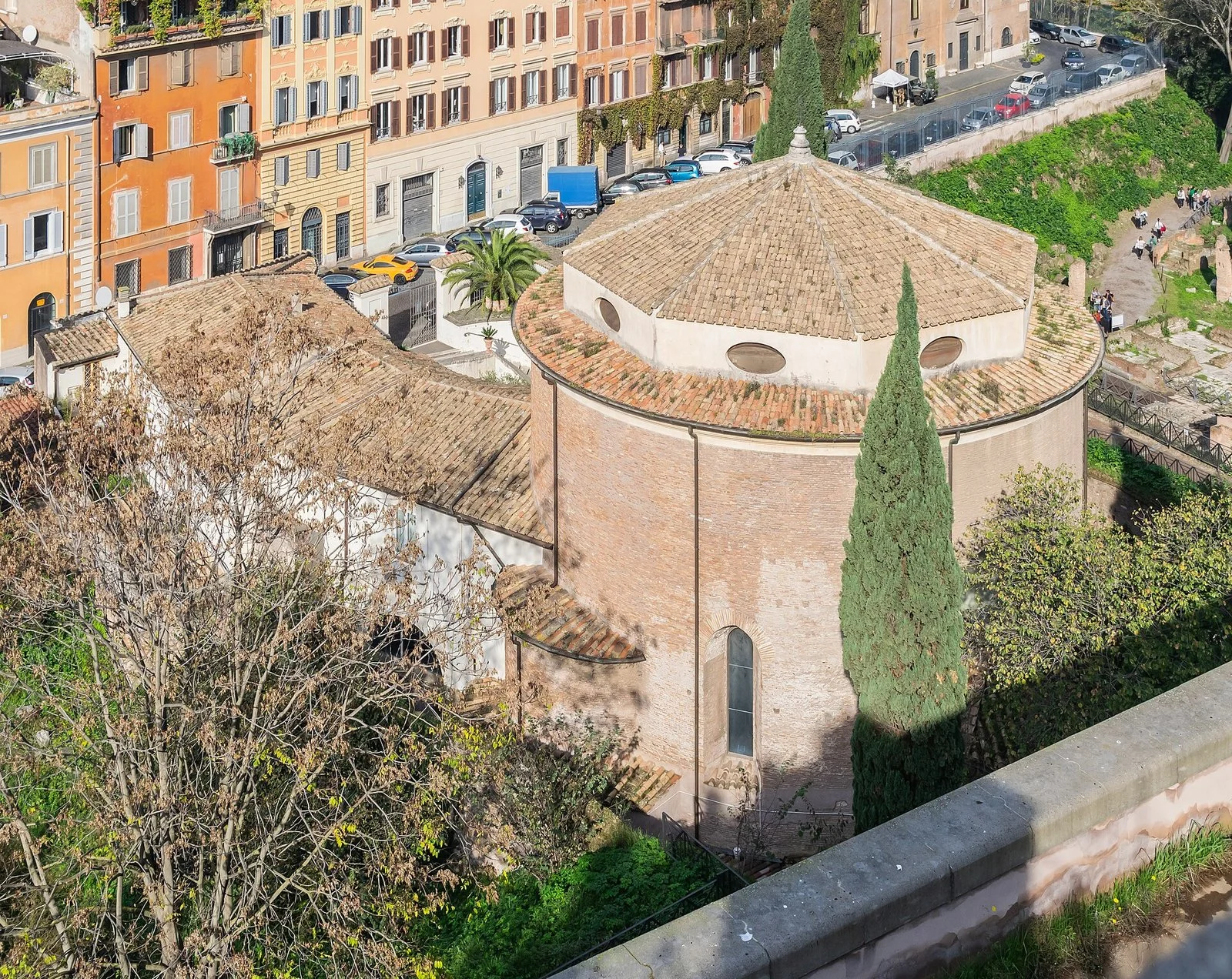
San Teodoro al Palatino is a round church sunk below street level, on the northwest flank of the Palatine, along the ancient road that ran down from the Roman Forum toward the Forum Boarium and the Circus Maximus. People who pass by rarely see it: from the sidewalk you glimpse a curved wall and a doorway, and the real church lies seven or eight meters lower down, at the bottom of a two-flight staircase. Since 2004 it is no longer used for worship in the Latin rite: it is used by the Greek Orthodox community of Rome, with Byzantine liturgy, iconostasis and its own hours. The apse preserves an early Christian mosaic that is among the oldest in Rome and also among the most reworked, and on how much of it is authentic the sources have been quarreling for two centuries. This page lines up what you see, what the sources say, where they diverge, and how to behave when entering a church that belongs to another rite and another community.
Where San Teodoro al Palatino is and how to get there
The address is Via di San Teodoro 7, Campitelli district, on the stretch of street between the Arch of Septimius Severus and the start of Via dei Cerchi. Via di San Teodoro follows a very ancient route, the one that connected the forum area to the river port zone, and the church lies halfway between two archaeological poles that almost no visitor links together. The street number doesn't help: the doorway is low, set into the boundary wall, and from the street you can't see anything.
On foot, which is the only sensible way
Via di San Teodoro is walked on foot in a few minutes, and anyone coming from the Roman Forum turns into it right after the Capitoline, going down on the right-hand side looking south. From the Colosseum you need 12 or 15 real minutes passing under the Arch of Constantine and then along Via di San Gregorio and Via dei Cerchi. From the Mouth of Truth and Santa Maria in Cosmedin it's seven minutes on a gentle uphill. It's a narrow street, with high walls and little foot traffic, and in summer there is almost no shade.
By metro and surface transport
The useful stop is Circo Massimo, on line B, from which you go up Via dei Cerchi for about 600 meters. Colosseo, also line B, is an alternative that adds a little and has the advantage of taking you past the monuments that almost everyone wants to see anyway. The surface lines serving the Foro Boario and Piazza Bocca della Verità leave you five minutes from the doorway. Roman bus routes change constantly because of construction and detours: check on the same day on the transport company's app, and the general picture of the options is summarized on our page on getting around Rome.
By car, by bike and the parking question
Via di San Teodoro is inside the limited traffic zone of the historic center and has no parking usable by people coming from outside. Anyone arriving by car leaves the vehicle at a park-and-ride on line B and completes the trip by metro, or else must count on a fine. By bicycle the stretch is short but the paving in some spots is in sampietrini and the descent toward the Foro Boario is more awkward than it looks on the map. Which Roman bike lanes really hold up we evaluated on the page Rome by bike.
Hours, access and what to expect on entering
The hours published by the listings that collect Roman places of worship indicate opening every day except Saturday, in the morning, roughly 9:30 to 12:30, with free admission. The information should be taken as an indication and not as a guarantee: San Teodoro is the seat of a living parish community, not a museum with room staff. On days of Orthodox liturgical feasts the hours go out the window, one way or the other.
It is not a Catholic church, and the difference shows
Entering, you find yourself facing an iconostasis, the wall of icons that separates the sanctuary from the nave and that does not exist in Latin churches. The altar can't be seen. The chairs are few or absent, because in the Byzantine liturgy the faithful stay standing for much of the celebration. The icons are placed on lecterns and are kissed by the faithful as they enter. Anyone arriving expecting the Baroque stage setting of the center finds something barer and more used.
Rules of behavior worth respecting
Silence here is not a formal request. The community is small and the space is small: two people talking at normal volume can be heard everywhere. Photographs with flash are to be avoided always, and during celebrations it's best not to photograph at all. Anyone entering while a service is under way stays at the back, standing, and waits. Anyone who wants to look at the mosaic calmly has to come outside the liturgy hours, which in Orthodox churches take up Sunday morning and the evening vigils of feasts.
What you don't see
Beneath the church are the remains of the Horrea Agrippiana, the food storehouses tied to the name of Agrippa, and they can be neither visited nor seen from the inside. The ancient level is sensed from the elevation: the floor of the church is the Roman one, the street has grown above it. There are no underground routes open, no ticket office, no explanatory panels. Anyone who comes without knowing what they are looking at leaves convinced there was nothing.
The circular church and its dating: where the sources diverge
The round shape is the most striking fact and also the most debated. Early Christian churches in Rome are almost all basilican, with aisles: a circular plan with an apse is an exception, and exceptions call for an explanation. The current explanation is that the church reused an ancient structure that was already round, but on what that structure was there is no agreement, and the hypotheses circulated over the centuries contradict one another.
The three families of hypotheses
The first hypothesis holds that the church rose on the ruins of the Horrea Agrippiana, the warehouses built in the area between 33 and 12 BC, reusing a circular building included in the complex. The second, of ancient scholarly tradition, spoke of a temple dedicated to Romulus or to the twins, and on this a large part of the popular literature was built. The third, taken up from English-language 1800s topography, proposes a temple of Juno Sospita and argues precisely from the round plan, setting it beside ancient structures of similar form. None of the three is proven.
The dates in circulation, and why they don't match
The most widespread dating places the construction in the sixth century, and rests above all on the apse mosaic, which scholars assign to that century. Part of the English-language popular literature speaks instead of a 7th-century building, rebuilt in the 1400s. The English encyclopedia entry is the most cautious and the most inconvenient: it observes that there is no definitive proof of the existence of the church before the 9th century, and that everything else is deduction. Anyone who reads three different listings finds three different dates, and none of the three is wrong with respect to the source it cites.
The argument from the name
The dedication to Theodore of Amasea, an Eastern martyr, is a chronological clue worth more than many dates. The cult of Theodore is Greek, and its spread in Rome is explained by the phases of strong Byzantine presence in the city, between the 6th and 8th centuries. The stretch of the Tiber bank between the Pons Sublicius and the Tiber Island was called Ripa Graeca precisely because of the Greek-speaking Christian communities settled there. The nearby Santa Maria in Cosmedin was born in the same environment and with the same function.
The diaconia and the grain
San Teodoro is traditionally counted among the seven original diaconiae of Rome, the ecclesiastical structures that managed assistance and the distribution of food. The first deacon is said to have been assigned by Pope Agatho around 678, while the first certain name is that of a Roberto attested around 1073. The location above ancient grain warehouses is no accident: the administration of the food supply passed from imperial officials to ecclesiastical ones, and the diaconiae settled where the grain already was.
The apse mosaic: subject, restorations and how ancient it really is
The mosaic of the apse conch is the reason an art historian enters San Teodoro. It shows Christ seated on a globe alluding to the heavens, flanked by the apostles Peter and Paul and by two martyrs, Theodore and Cleonicus. Christ wears a dark robe with gold laticlaves, that is the vertical bands that in Roman dress signaled high rank. It's a scheme with a close and very near parallel, and the parallel helps to date it.
The comparison with Santi Cosma e Damiano
A few hundred meters away, at the edge of the Roman Forum, the basilica of Santi Cosma e Damiano preserves an apse mosaic made around 526-530, under Pope Felix IV, with Christ among saints and a composition of the same family. Scholarship has always read the two mosaics as a pair, and already in the 1700s the scholar Ridolfino Venuti wrote that the mosaic of San Teodoro seemed very ancient and attributable to the time of Felix IV. Anyone who wants to understand the mosaic of San Teodoro should see first that of Santi Cosma e Damiano, which is better preserved and more legible.
The added saint
The figure of Theodore in the mosaic is not original. The sources agree in assigning it to the restoration promoted by Pope Nicholas V, that is in the mid-1400s, and this has a heavy logical consequence: in the mosaic dedicated to Theodore, the Theodore you see today dates from the 1400s. The symmetrical figure, the one on the left, is the point of maximum uncertainty. It is identified with Cleonicus, a martyr companion of Theodore, but its iconography has sparked debate: long blond hair in place of a veil that appears in old copies, floral motifs on the garment that someone has read as Angevin lilies, with resulting proposed identifications that have reached as far as Charlemagne and Charles of Anjou. These are minority readings and should be flagged as such.
The sequence of restorations
The campaigns of work documented or hypothesized on the mosaic are many and cover 1,200 years. A restoration under Hadrian I, between 772 and 795, is reported only by 1600s sources and has no contemporary confirmation. There follow the intervention of Nicholas V between 1447 and 1455, a second 1400s intervention attributed to Sixtus IV, a reconstruction under Gregory XIII of which no trace remains, and in the 1640s the restoration commissioned by Cardinal Francesco Barberini, motivated in the documents by the injury of water, dampness and time.
From the 1700s onward the documentation becomes more precise. Under Clement XI, between 1700 and 1721, a campaign opens on interiors and exteriors. In 1778 Domenico Cerasoli of the Vatican Mosaic Studio steps in, and it is the only intervention with direct archive confirmation. In 1826 the Archconfraternity of the Most Sacred Heart of Jesus works there with the coordination of Visconti and Camuccini. Around 1851 the dampness is tackled again with applications of asphalt on the walls. In 1946 the anti-aircraft protection, aluminum and jute, is removed, and the tesserae are cleaned and fixed.
What remains of the original
This is the question the client poses and it deserves a precise answer instead of a formula. Recent studies, and in particular the analysis of Claudia Bolgia cited by the specialist literature on the restorations, identify as portions not reworked the faces of the apostles, with the exception of Paul's forehead and hair and the lower part of Peter's beard, the face of Theodore though with hair, beard and lips redone, and the body of Peter from the right forearm to the front of the foot, with the toenails modeled one by one. Everything else is, to a varying degree, remaking.
The consequence is twofold and worth keeping in mind in front of the apse. On one hand the mosaic cannot be read as a document of the 6th century, because most of the tesserae you see are not from then. On the other, the few intact portions have a quality that forced critics to revise the current judgment, which for decades had dismissed the work as a mediocre artisan product. Peter's foot with the nails made one by one is not the work of a careless workshop.
The changes introduced by the restorations
Two iconographic alterations have been identified by studies of old drawings. The first concerns the headdress of the saint on the left, reinterpreted as blond hair in a later intervention. The second concerns the four mountains at the base of the globe on which Christ sits, an element that finds no comparable models in other medieval Roman mosaics and that is probably the result of a remaking prior to the Barberini campaign. Anyone looking at the mosaic today is therefore also looking at the ideas the restorers had formed of how it should be.
A theory taken apart
The historian Giovanni Battista De Rossi had hypothesized that the mysterious saint originally held a model of the church and not a martyr's crown. It's a proposal that would have changed the reading of the mosaic, because the model normally identifies a founder or a patron. Later restorations, however, established the authenticity of that portion with the crown, and the hypothesis fell. We report it because it keeps appearing in secondhand texts that haven't registered the refutation.
The Nicholas V building site and the dome
The 1400s are the moment when the church takes on the form that can still be read. The sources place the intervention of Pope Nicholas V between 1453 and 1454, and the Roman diarist Stefano Infessura reports that the building had fallen down from the foundations and that the pope rebuilt it, moving it slightly and reducing its dimensions compared to the previous one. It's an important detail: the rotunda you see today does not sit exactly on the ancient layout.
Rossellino, Alberti and the cautious attributions
Part of the literature attributes to Bernardo Rossellino the ribbed dome with sails, indicating it as the first Roman example of this solution, and to Leon Battista Alberti the marble portal with painted lunette. The attributions appear in encyclopedic entries of Catholic provenance and in local guides, while the English encyclopedia entry does not report them at all and indicates as documented architects only Barberini and Carlo Fontana. Faced with a divergence of this kind the rule is to say that it exists, not to choose the more flattering version.
The courtyard and staircase of Carlo Fontana
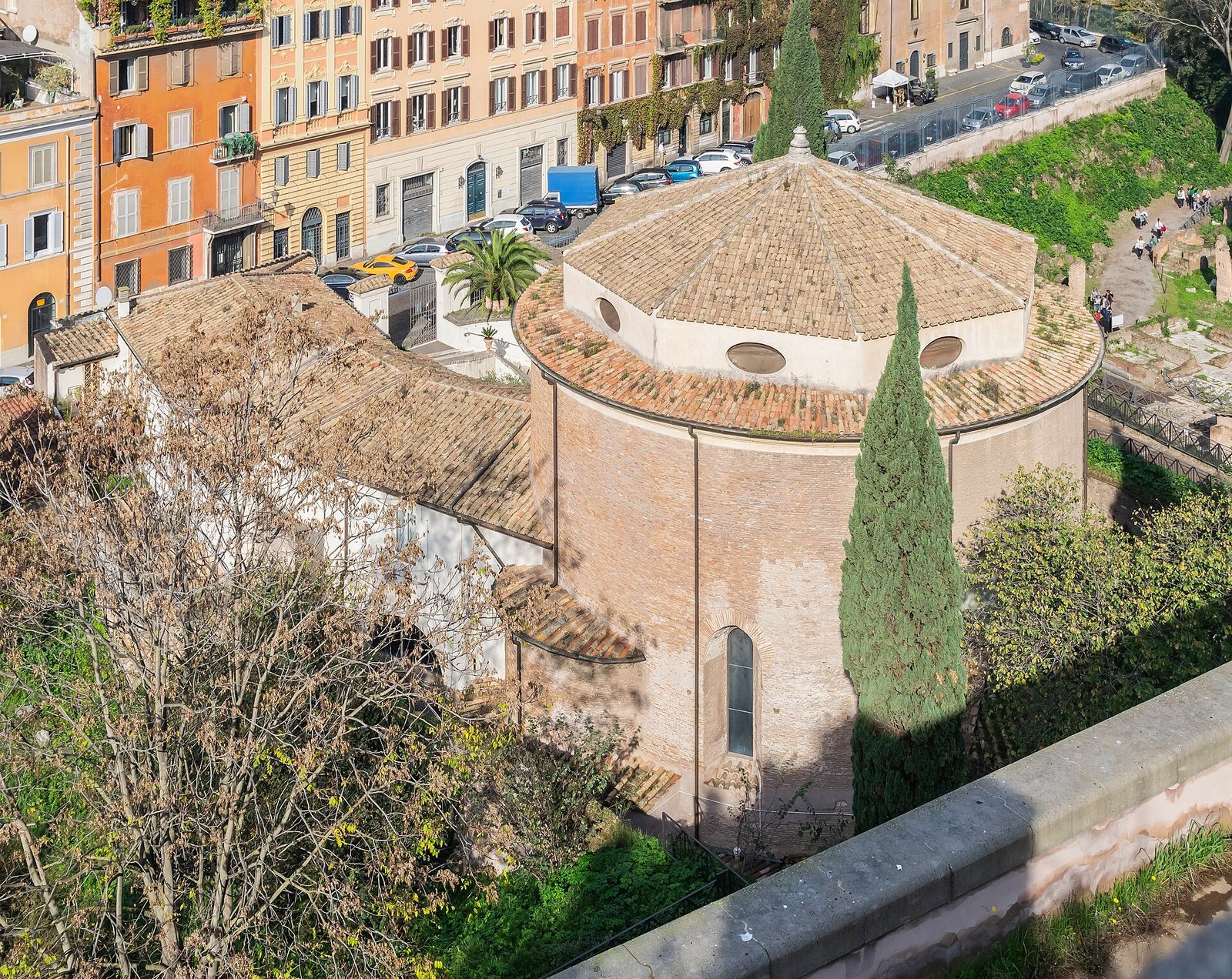
The part of the building that is seen from the street is the work of Carlo Fontana, and it solves a practical problem before an aesthetic one. Between 1703 and 1705, commissioned by Pope Clement XI, Fontana worked on a church that flooded regularly, because the level of the surrounding ground had risen over centuries and rainwater flowed in. The solution was to excavate around the building, create a lowered circular forecourt and connect it to street level with a double-flight stair.
How it is built and why it works
The forecourt is a circular basin that repeats the plan of the church and isolates it from the surrounding ground, with a retaining wall that holds up the street. The two flights descend symmetrically from the doorway on Via di San Teodoro and meet at the bottom in front of the entrance. The effect is that of an urban well: anyone going down loses sight of the street after five steps and finds themselves in a closed, silent space, with the church ahead and the green of the Palatine above their head. It's one of the few places in the center of Rome where the noise of traffic disappears entirely.
The ancient altar
In the courtyard an altar of the Roman age is preserved and visible. Ridolfino Venuti, in 1763, writes that it was inside the church and that it was Clement XI who placed it near the door during the work of 1703. Venuti used it as an argument for the pagan origin of the building, which is a weak argument: a reused altar in a Roman church proves only that ancient material was lying around, and in Rome it was everywhere. It remains a piece you can look at up close, for free, without entering the church.
The ossuary
At the back of the atrium, outside the church, there is an ossuary with skulls and bones piled up, visible through a grate. It's an element that appears little in tourist listings and that throws anyone who meets it unprepared. Rome has ossuaries and bone crypts in several places, but this one is among the most out of the way. It isn't lit: you have to get close to the grate and let your eye adjust.
Velabrum, Wolf and Lupercal: what is documented and what is not
A legendary literature has accumulated around this church that has to be untangled carefully, because it mixes verifiable data and fanciful reconstructions into a single story that then circulates as is. The Velabrum was the marshy depression between the Palatine and the Capitoline, reclaimed in ancient times, and Roman tradition placed there the spot where the basket with Romulus and Remus ran aground. The Lupercal was the cave where the she-wolf supposedly nursed them, and ancient sources put it at the foot of the Palatine.
Where the Lupercal stood, according to ancient sources
Ancient indications place the cave on the southwestern slope of the Palatine, in a stretch between the temple of the Magna Mater and the area of Sant'Anastasia al Palatino. San Teodoro sits on that same slope, a few dozen meters farther north. The geographic proximity is real, and for that reason the church is regularly associated with the Lupercal in guidebooks. Topographic association and identification are two different things, however: no ancient source puts the Lupercal where the church stands.
The 2007 cavity and the controversy
In January 2007 the superintendency announced the discovery of a cavity about 15 meters deep beneath the Palatine structures tied to the house of Augustus, decorated with mosaics, pumice and shells and with a white eagle at the center of the vault, identifying it with the Lupercal. The announcement went around the world. Leading scholars contested the identification on topographical and stylistic grounds, proposing instead to read the space as a nymphaeum or an underground triclinium of the Neronian age. The prevailing view today rejects the identification and places the Lupercal farther southwest, toward Piazza Sant'Anastasia.
The bronze Wolf: a real divergence
On the statue of the Wolf the sources contradict each other sharply and it's worth looking at closely. The oldest medieval attestations, from the 10th century on, place the Wolf at the Lateran, chained on the facade or inside the palace, and the monk Benedict of Soracte remembers it as the mother of the Romans. In 1471 Sixtus IV donated it to the Roman people and since then it has been on the Capitoline, today in the Sala della Lupa of the Capitoline Museums, inside the Palazzo dei Conservatori.
The problem arises when you try to fit San Teodoro into this sequence. Venuti in 1763 wrote that in this church until the 16th century there was the bronze Wolf with the twins, taken to the Capitoline in the days of Panciroli or shortly before. The Italian encyclopedia entry on the Wolf picks up the report and places it at San Teodoro until 1471. The Italian encyclopedia entry on the church writes instead that the Wolf was here until 1471, before being moved to the Lateran, that is it reverses the direction of the transfer compared to all the other reconstructions. The dates of 1471 and of the 16th century do not coincide with each other, and the sequence Lateran, San Teodoro, Capitoline is not documented by sources contemporary with the events.
The honest conclusion is that the Wolf's passage through San Teodoro is a scholarly tradition of the modern age, repeated afterward out of inertia, and that the solid fact is another: in 1471 the statue arrives on the Capitoline by donation of Sixtus IV. Anyone who says with confidence that the Wolf stood in this church is reporting Venuti without saying so. Anyone who wants to see the statue finds it at the Capitoline Museums, eight minutes on foot going up the Capitoline Cordonata.
A curiosity about San Teodoro al Palatino
The Romans never called it San Teodoro. The popular name, attested in writing at least from the 1700s, is Santo Toto, later shortened to San Toto, and Ridolfino Venuti records it in 1763 with the curt formula "dal volgo detto Santo Toto". It's an affectionate contraction and at the same time a sociological signal: a church that enters the dialect with a nickname is a church frequented by people of the neighborhood, not a monument.
Why Toto
The reduction of Teodoro to Toto follows a common mechanism in Romanesco, which shortens long names by keeping the central or final syllable and doubling it. The same process produced other popular forms of names of churches and saints across the city. The nickname has outlived the church itself: it appears in old guides, in collections of Roman traditions and in the oral place names of the district, and you still hear it cited by people of a certain age.
Something nobody tells you about San Teodoro al Palatino
The tradition that ties this church to sick children is documented, and it's documented in a way that is worth more than many Roman legends. Venuti, in 1763, lists among the arguments in favor of the antiquity of the place "l'uso di portarvi i Bambini infermi, come anticamente". Here it is not a modern guidebook speaking, but an 1700s scholar recording a custom then under way.
What the source says exactly
Venuti's formula contains two distinct pieces of information. The first is that in the 1700s Romans brought sick children here. The second is his conviction that the custom was ancient, that is pre-Christian, and that it continued a practice tied to the supposed temple beneath. The first piece of information is a direct testimony and it holds. The second is a deduction of the author, built to support his thesis on the pagan origin of the building, and has no documentary support.
The link with the Lupercal, and why it is weak
The reasoning you read everywhere is this: the she-wolf nursed two infants, the Lupercal was here, so the place protects children and Christian devotion inherited the pagan cult. It's a chain that convinces the ear and has no documented link. There is no proof that the Lupercal stood here, there is no attestation of any ancient cult of children at this spot, and there is no continuity between the two practices, which never appears in the sources. The bare fact remains: in the 1700s sick children were brought here, and the patron saint is a warrior saint from the East to whom popular devotion attributed powers of protection.
What other sources add
The local listings that collect Roman traditions report that the Romans called the church Santo Toto and brought sick children there to obtain healing from the saint, with formulations that all depend, ultimately, on the same line of 1700s scholarship. There is no ecclesiastical documentation, as far as accessible sources show, of ex-votos, registers or feasts dedicated specifically to children in this church. Anyone who tells the tradition as a structured cult is adding something that isn't in the papers.
The advice I give you for visiting San Teodoro al Palatino
Come early in the morning, on a weekday that isn't Saturday, and give it 20 real minutes, not five. The opening window is narrow and falls in the same hours when everyone lines up at the Colosseum. That's why this church stays empty even in high season, 200 meters from one of the most crowded places on the planet. Anyone who arrives at 10:00 on a Tuesday in July has a good chance of being alone.
The right order for the visit
Stop first up above, on the sidewalk, and look at the curved wall and the stairs from outside: from there you understand the difference in level, which from inside the courtyard you can no longer read. Go down the flights slowly and stop at the bottom before entering, to look at the altar and the ossuary. Go in and stand still for 30 seconds in the shade, without taking out your phone, until your eye adjusts: the mosaic is backlit with respect to the door and the first impression is always darkness.
What to look at in the mosaic
Look first at Peter's right foot, with the nails modeled one by one, because it's one of the portions that studies indicate as not reworked and because it's the point where you grasp the quality of the original work. Then look at the faces of the apostles. Then, only at the end, look at the figure of Theodore, keeping in mind that it's an addition of the 1400s. Seeing the mosaic in this order means seeing it as the person who studies it sees it, and not as a caption tells it.
What to pair it with
San Teodoro alone doesn't carry a morning. It works as the first or last link of a short walk that holds together the Velabrum and the Foro Boario: San Giorgio in Velabro, the Arch of Janus, the Temple of Hercules Victor, the Temple of Portunus and Santa Maria in Cosmedin are all within a radius of 500 meters. It's the densest tour of ancient Rome you can do without paying for a ticket, and you finish it in two hours walking slowly.
When to avoid
On Sunday morning the church is occupied by the Divine Liturgy and it's not a moment for a visit: anyone who enters finds themselves inside a celebration of a small community, in a language they probably don't understand, and their presence is noticed. Saturday appears closed according to the published indications. The afternoon is outside the stated opening window. On the feasts of the Orthodox calendar, which don't always coincide with the Latin ones, everything is off.
Another well-known fact, yet rarely cited
Rome has very few churches with a circular plan, and anyone who lines them up gets a small catalog of exceptions that tell different stories from one another. San Teodoro is the smallest and the least visited of the group, and it's also the only one in which the roundness seems to derive from a reuse and not from a design choice. The comparison with the others clarifies what makes it anomalous.
The other Roman rotundas
Santo Stefano Rotondo on the Caelian, from the fifth century, is the largest centrally planned church of Christian antiquity and was born circular by the will of whoever built it. The Pantheon is a Roman temple transformed into a church in 609, and it's the most celebrated case of reuse in the city. Santo Stefano Rotondo and San Teodoro have the plan in common and almost nothing else: size, function and fate are opposite.
Why the round plan is rare
The circular plan in ancient Christian architecture is associated with particular functions: baptisteries, mausoleums, martyria, that is buildings constructed around a tomb or a sacred spot. A parish or diaconal church on a central plan is an anomaly, and anomalies in archaeology are almost always explained by a preexisting constraint. For San Teodoro the most probable constraint is an ancient structure that was already round and was still standing when the decision was made to turn it into a church.
The right photo to take at San Teodoro al Palatino
The photograph that tells this place is not the mosaic, which in dim light and backlit comes out badly with a phone and better in the reproductions made by people who had lights. The photo nobody takes and that explains everything is the one shot from the bottom of the courtyard, down low, aiming upward: in the frame come the facade of the church, the two flights of the stair rising symmetrically, the retaining wall and, above, the vegetation of the Palatine.
How to set it up
Stand on the axis of the doorway, a few meters away, and hold the camera low, at chest height, tilting it just slightly upward. The lines of the flights converge and give depth to a space that in person looks flat. Let a piece of sky in at the top, because it helps show how far down you've come. If the sun is high the stair goes into shadow and the facade into light, which is the worst condition: better an overcast day or the first hour of the morning.
The second framing
From above, from the sidewalk of Via di San Teodoro, leaning over the parapet, you get the opposite shot: the church seen inside its well, with the circular roof at the center of the frame. It's the image that explains in one stroke the problem Carlo Fontana had to solve. You need to keep your arms extended and watch out for the traffic behind you, which moves fast on this street.
Inside, and how to behave
Inside, photography is tolerated outside of celebrations, without flash and without a tripod. The best subject is a detail: an apostle's face, Peter's foot, the rim of the globe. If even a single person is praying, the camera stays in the bag.
Some important events that happened here in history
The history of San Teodoro is made of a few dates that matter and many reconstructions. It's worth lining them up with their uncertainties stated, because the way a small church crosses 15 centuries is more interesting than the sum of its furnishings.
The ancient and medieval phases
In the Middle Ages restorations are recorded under Hadrian I in 774, Leo III in 795 and Gregory IV in 835, according to the chronology given by local listings. These dates derive from the papal catalogs and should be taken as an indication of continuous maintenance more than as building sites documented one by one.
The collapse and the 1400s reconstruction
The news of the collapse comes from Stefano Infessura, who writes that the building had fallen down from the foundations and that Nicholas V rebuilt it a little farther along and a little smaller. It's the most circumstantial testimony we have on a traumatic event in this place, and it comes from a diarist contemporary with the facts. The dates proposed for the building site range between 1450 and 1454 depending on the source.
The 1500s and 1600s
The Sack of Rome in 1527 left damage that part of the literature links to the 1600s restoration. Sixtus V suppressed the diaconia in 1587. In 1643, or in 1647 according to other listings, Cardinal Francesco Barberini promoted a renewal that heavily affected the mosaic, motivated in the documents by dampness and water damage. The discrepancy between the two dates is an example of how the same intervention gets recorded in different ways depending on if the start or the conclusion is dated.
The 1700s
The building site of Clement XI, entrusted to Carlo Fontana between 1703 and 1705, is the intervention that gave the church its present exterior appearance. In 1729 Benedict XIII granted the church to the Archconfraternity of the Sacred Heart of Jesus, also known as the Archconfraternity of the Sacconi Bianchi for the white robes of the members, founded to combat blasphemy and promote the cult of the Sacred Heart. These are the same decades in which Venuti records the popular nickname and the custom of bringing sick children there.
The 1900s
During World War II the mosaic was protected with an anti-aircraft shield of aluminum and jute, removed in 1946 with an operation of cleaning and fixing of the tesserae. The cardinal title was reestablished by John XXIII on December 2, 1959. These are the two facts that close the Catholic cycle of the church, shortly before the transition that changed its purpose.
2000 and 2004
The two dates have to be kept distinct, because they are constantly confused. In November 2000 John Paul II announced the granting of the use of the church to the Ecumenical Patriarchate of Constantinople and to the Greek Orthodox community of Rome. On July 1, 2004 the inauguration ceremony was held, presided over by Ecumenical Patriarch Bartholomew I, and on that occasion the church was consecrated for Orthodox worship. Between the two dates almost four years pass, partly spent on restoration work and adaptation to the Byzantine rite, which German sources place between 2002 and 2006.
What "concession" means
The legal formula matters. The church was not handed over in ownership: the Holy See granted its use to the Orthodox Archdiocese of Italy, so that Orthodox faithful would have a stable and continuous presence near the tomb of the apostle Peter. It's an ecumenical gesture with a practical content: a community that had previously made do received a seat of its own in a place of great symbolic weight. Anyone who enters today enters a church owned by the Vatican and used for worship according to the Byzantine rite by a Greek community.
Who passed through San Teodoro al Palatino
The list of people tied to this church is short and well spread over time, which for a building this size is already remarkable. There are no legendary figures to verify, because the church is too small to have attracted personal legends: there are patrons, architects, cardinals and one patriarch.
The patron popes
Nicholas V is the humanist pope of Rome's great urban renewal project in the mid-1400s, and the rebuilding of San Teodoro belongs to that season. Clement XI is the pope who, between the 1600s and the 1700s, put his hand to dozens of Roman churches, and here he dealt with a water problem before an artistic one. Sixtus V, who suppressed the diaconia, and Benedict XIII, who entrusted the church to the confraternity, mark the two ends of the period in which the building loses and then regains a function.
The architects
Carlo Fontana is the only architect whose presence here is beyond dispute, and he is one of the leading figures of Roman architecture between the 1600s and the 1700s, a pupil and continuer of the Bernini line. Bernardo Rossellino and Leon Battista Alberti appear in some of the sources for the dome and the portal, but not in all of them, and whoever writes about this church should say so. For the overall itinerary of Roman architecture in those decades we have a page on Baroque Rome.
Cardinal Barberini
Francesco Barberini, cardinal nephew of Urban VIII, is the figure who in the 1600s keeps the family's patronage going across half of Rome. His work at San Teodoro in the 1640s is the one that changed the mosaic the most, and we even know the reasons he gave: water, damp, time. It is a case in which the restorer left more traces than the builder.
The scholars
Ridolfino Venuti, antiquarian and archaeologist, published his topographical description of the antiquities of Rome in 1763, and he is the source that hands us the nickname Santo Toto, the custom of the sick children, the placement of the altar near the door in 1703 and the news of the She-Wolf. Stefano Infessura, a Roman notary and diarist of the 1400s, hands us the collapse and the rebuilding. Giovanni Battista De Rossi, founder of modern Christian archaeology, hands us a hypothesis about the mosaic that was later disproved. They are three different ways of being a source.
Bartholomew I
The Ecumenical Patriarch of Constantinople, Bartholomew I, presided over the inauguration on July 1, 2004. He is the figure who makes this church more than a historic building: since 2004 San Teodoro has been one of the places where the Orthodox presence in Rome is visible and stable, and it is included in the city's ecumenical itineraries. Anyone who arrives on a patron saint's feast day finds a sung liturgy and a whole community, and understands why the gesture mattered.
What's around it, within 500 meters
San Teodoro's strength is its position. Within a short walk you find one of the densest concentrations of monuments in the city, mostly visible for free and from the outside. Anyone planning half a day here has almost nothing to plan, only needs to know what they are looking at.
The Velabrum and the Forum Boarium
Going down toward the river you enter the area of the Forum Boarium, the cattle market of antiquity and the oldest river port of Rome. Here stand the Arch of Janus, the Basilica of San Giorgio in Velabro with its medieval portico, the round Temple of Hercules Victor and the rectangular Temple of Portunus, two of the best-preserved Roman temples in the city. The Mouth of Truth is in the portico of Santa Maria in Cosmedin, with its perpetual line.
Toward the Forums and the Capitoline
Going back up in the opposite direction you reach the Roman Forum, with the Arch of Septimius Severus, the Curia Iulia and the Rostra. Above, the Capitoline Hill with the Capitoline Museums, the Capitoline Cordonata and Santa Maria in Aracoeli. At the foot of the rock stand the Mamertine Prison and San Giuseppe dei Falegnami, which are the same building on two levels.
The Palatine and the Circus
The Palatine looms over the church and is visited with the combined ticket for the Colosseum, which also includes the Palatine Museum. On the other side, the Circus Maximus is a grassy open space 600 meters long that Romans use for running and that hosts concerts in summer. The church of Santa Francesca Romana, on the opposite side of the Forum, completes the picture of the ancient churches of the area.
Across the river and toward the Aventine
Crossing the Ponte Palatino you see the Ponte Rotto in the middle of the water and you enter Trastevere. Staying on the left bank you climb the Aventine, with the Orange Garden and Santa Sabina, or you continue toward Testaccio. To the north, beyond the Theater of Marcellus and San Nicola in Carcere, the Jewish Ghetto begins.
Eating in the area: a harsh and necessary chapter
Around Via di San Teodoro you don't eat. It's a belt of archaeological walls, gates and avenues with no commercial fabric, and the few businesses you meet going down toward the Forum Boarium or back up toward the Forums work exclusively on the tourist traffic headed straight for the Colosseum. Anyone who sets out counting on stopping here gets the math wrong: you have to decide beforehand where you'll eat and walk there.
Why this area is the worst in Rome for eating
The mechanism is simple and applies anywhere there is a world-famous monument. The customer passes through once, won't be back, leaves no reviews that weigh on the neighborhood and has no points of comparison. Under these conditions quality is of no use to anyone and the price detaches from the kitchen. Via dei Cerchi, the front of the Circus Maximus, the stretch around the Mouth of Truth and the descent toward the ghetto all fall inside this logic, with the aggravating factor that here the competition is scarce and far away.
The signs to recognize
The menu with photographs of the dishes is the first and most reliable: someone who cooks doesn't need to show the carbonara in a photo. The lady rolling fresh pasta in the window or at a small table on the sidewalk is a theatrical setup meant for passersby, not a clue about the kitchen. The person at the entrance who intercepts passersby and invites them to sit works on foot traffic, and whoever works on foot traffic doesn't work on returning customers. The place that stays open continuously from morning to night, with no break between lunch and dinner, doesn't have a kitchen crew organized around defined services.
Then there are the places set right in front of the monuments, and around here there are quite a few. Look at the price list before you sit down, and look at all of it: items with no price next to them, generic wording like fish of the day or sliced steak, cover charges and service charges in small print are the points where the bill grows. You may also find different price lists between the outdoor table and the indoor dining room, or between the Italian version and the translated one. A clear and complete price list posted outside is in itself a good sign.
The chains with repeated signs
In the center of Rome a kind of restaurant with a repeated sign has spread, with the same menu in several points of the city, the line at the entrance and a set design cared for in every detail. It works as a tourist attraction in every respect, with its lines and its photographs, and Romans don't go. There is no contempt in this observation: that model sells a standardized, recognizable product, which is exactly what someone traveling for two days is looking for. Those who live in the city look for something else, and know where to find it.
The one criterion
Look at who is sitting there and in what language they order. If at the tables there are people who speak Italian and order without opening the menu, the place holds up. If there are only backpacks, maps and cameras, keep walking. Nothing else is needed, and this criterion works even in a difficult area like this one, where however it requires you to move away: toward the Aventine, toward Testaccio and its market, or toward the inner streets of the Ghetto, where a few serious addresses hold out.
Already-filtered references
Anyone who doesn't feel like doing the selection work on the spot can start from an already vetted list: Daniele Dezi's personal list on Google Maps collects tried and non-sponsored addresses. For the full reasoning on how to choose a restaurant in Rome without falling into traps we have a dedicated page on where to eat in Rome, and for the historic places the one on historic cafés and shops.
Frequently asked questions about San Teodoro al Palatino
How much does it cost to enter San Teodoro al Palatino?
Entrance to San Teodoro al Palatino is open and free, as for all open places of worship in Rome. There is no ticket office, no reservation, no guided tours organized by the church. If you find a price online referring to this church, it is a package from a third-party operator that includes other things. An offering left to the community is an appreciated gesture and never requested.
What are the opening hours of San Teodoro al Palatino?
The published hours indicate opening every day except Saturday, roughly from 09:30 to 12:30. The church is run by a Greek Orthodox parish community and not by a tourist body, so actual opening depends on the presence of someone and on the Byzantine liturgical calendar, which doesn't always coincide with the Latin one. Anyone coming from far away should allow for the possibility of finding it closed.
Is San Teodoro al Palatino a Catholic or an Orthodox church?
San Teodoro al Palatino is owned by the Holy See but its use has been granted to the Ecumenical Patriarchate of Constantinople and to the Greek Orthodox community of Rome. The concession was announced by John Paul II in November 2000 and the inauguration ceremony was held on July 1, 2004, presided over by Patriarch Bartholomew I. Today the Byzantine rite is celebrated here, with an iconostasis and a liturgy in Greek.
What century is the mosaic of San Teodoro al Palatino from?
The apse mosaic is attributed by most sources to the 6th century, with a close comparison to the one in Santi Cosma e Damiano made around 526 to 530. Some sources speak of the 7th century. Keep in mind that the mosaic has undergone at least 8 restoration campaigns and that the surely original portions are few: the faces of the apostles, part of Theodore's face and Peter's body from the right arm to the foot.
Was the Capitoline She-Wolf kept at San Teodoro al Palatino?
The story comes from Ridolfino Venuti, who wrote in 1763 that the bronze She-Wolf with the twins stood in this church until the 16th century. The earliest medieval records, however, place it at the Lateran, and the solid fact is that in 1471 Sixtus IV donated it to the Roman people, bringing it to the Capitoline, where it still is today in the Capitoline Museums. The passage through San Teodoro is modern scholarly tradition and not documentation contemporary with the events.
Is it true that sick children were brought here?
The custom of bringing sick children to San Teodoro is documented by Ridolfino Venuti, who in 1763 records it as a practice in use in his time. What is not documented is the continuity with a supposed pre-Christian cult tied to the Lupercal, which Venuti himself proposed as a deduction in support of his thesis on the pagan origin of the building. The practice is attested, its ancient derivation is not.
Can you visit the Lupercal under the church?
There is no visitable Lupercal under San Teodoro. The cavity announced in 2007 as the Lupercal is on the Palatine under the structures tied to the house of Augustus, is not open to the public, and its identification has been contested by leading scholars who read it as a nymphaeum or underground triclinium from the Neronian age. Ancient sources place the Lupercal farther southwest, toward Sant'Anastasia.
How long does it take to visit San Teodoro al Palatino?
For San Teodoro al Palatino 20 minutes are enough, counting the descent into the courtyard, the altar, the ossuary and a real pause in front of the mosaic. Anyone who goes in and out in five minutes has seen nothing, because the eye hasn't had time to get used to the dim light. Included in a tour that takes in the Forum Boarium and the Velabrum, it fills half a day comfortably without spending a euro on tickets.
Is San Teodoro al Palatino accessible for people with mobility difficulties?
Access to San Teodoro al Palatino is through a double-ramp staircase that descends several meters from street level, and no accessible alternative route has been published. Anyone who uses a wheelchair or has trouble with stairs should allow for the possibility that the entrance may be impassable. It's best to contact the community before organizing the visit, because the answer is not a given.
Who wrote this page
The page is edited by the staff of Tour Leader Pro, the Rome-based project office that designs and coordinates visits, itineraries and cultural events in Rome and Lazio. Hours, access conditions and historical data reported here are checked as of the publication date against the sources indicated in the text, and where the sources diverge we wrote that down instead of choosing the more convenient version. If you find an outdated detail, let us know.
Building a Roman itinerary that holds together churches run by religious communities and not by tourist bodies, opening windows of three hours a day, liturgical calendars that don't coincide with civil ones and walking distances that look like nothing on the map and are not so uphill, for yourself or for a group, takes different tools than a list of monuments. Those who need them will find planning materials on Tour Leader Pro, designed both for those who lead visits for a living and for those who organize on their own.
For the wider picture on trains, rentals, airports and Lazio destinations outside central Rome, from the Castelli to the lakes to the coast, a useful resource is Italy Planner.